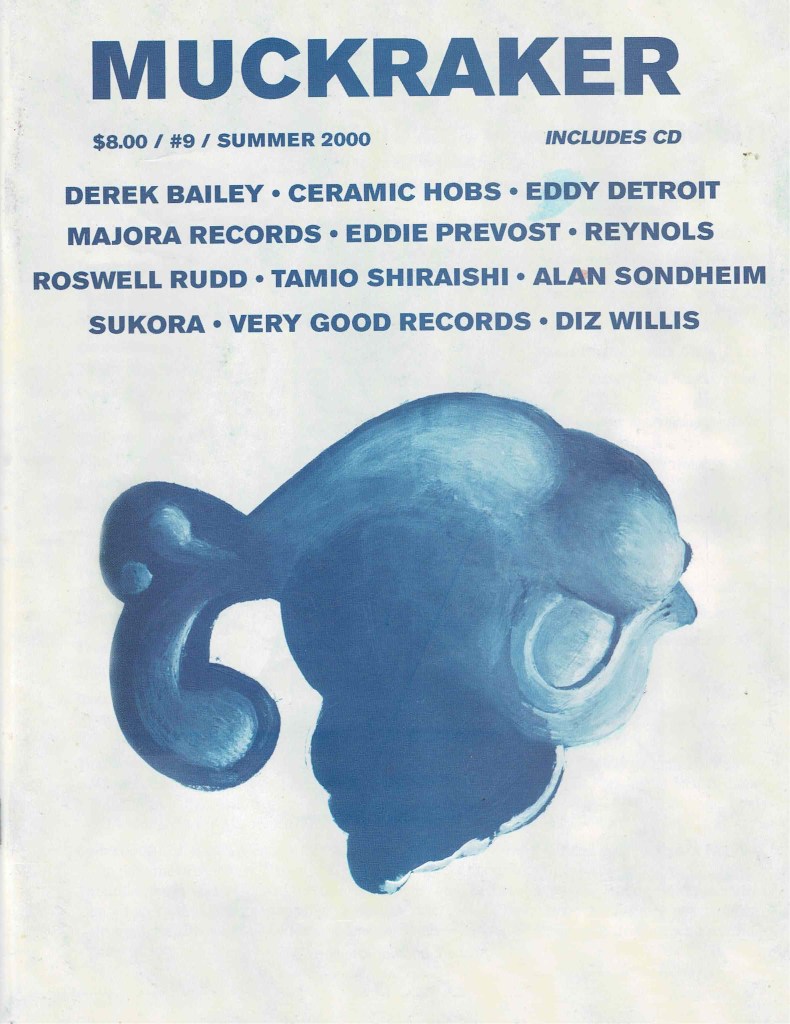
I guess 23 years on, we’re probably well past the point where we might routinely encounter a thick, glossy-cover, free improvisation / experimental / noise mag with a CD inside of it at Tower Records, aren’t we? Muckraker #9 came out in Summer 2000 and was a pretty fetching and decently-distributed publication pulled together with some regularity throughout the 90s by Patrick Marley – always on the deep edge of obscurity, while always approachable enough to bring in purportedly open-minded experimental skeptics such as myself.
I mean, Muckraker #9 is literally packed with so many deep and likely semi-listenable obscurities I really can’t grasp a ton of it; it’s music I haven’t heard and perhaps never will hear, and that’s probably okay. Much of the reviewed tapes and CD-Rs and lathe-cut singles are not findable even today, though you never know what’ll turn up at Fusetron that might have been sitting there for 23 years. Muckraker often skirts the boundaries of what TQ fanzine once called “the no fans underground” – music so formless and vague that it’s often comfortable assuming that it’s being directed toward a listening audience of zero. Still, I’m excited to see so many great, fanzine-funding ads for labels with deep weirdo catalogs that I missed or barely comprehended at the time – labels like Squealer, Little Army, High Knee, Chocolate Monk, Freedom From, Polyamory, Menlo Park, Povertech Industries and many, many more.
The biggest draw for me here has always been the interview with Nick Schultz of Majora Records by Gretchen Gonzales. It was such a phenomenal and wide-ranging talk with one of our nation’s leading and most cantankerous lights that I reprinted it in Dynamite Hemorrhage #5, then interviewed Nick myself as an addendum to it. Majora was an exceptionally special 1990s label, and one that we risk forgetting to our undying shame. This is followed by a piece with Nick and Alan Bishop of the Sun City Girls bantering about Eddy Detroit, telling stories about this longtime Phoenix-area musical enigma, mostly because Marley and the Muckraker team couldn’t actually pin down Eddy Detroit himself for a talk.
Some hallowed forerunners of the no-fans underground are interviewed as well, both Derek Bailey and then Eddie Prevost of AMM. Prevost is the exact opposite of pompous and obtuse; he tells stories of early AMM shows in 1966 where promoters wouldn’t pay them for their completed sets because they were “only tuning up”. There’s another interview with Ceramic Hobs, a group I’m most familiar with due to the forthrightness of the principles about their mental illness, institutionalizations and so forth. Simon Morris of the band calls the music he makes about his psychosis “the last frontier”. It might be, but does it burn down the house? Does it totally kick out the fucking jams? You’ll have to tell us.
I always liked that Patrick Marley went on to thrive in a true journalism career – like, he’s a major stringer for The Washington Post these days. He and the Muckraker team proved to me back then both here and in previous issues that you can make anything musical (or non-musical) interesting enough if you ask the right questions, write intelligently, respect your audience and do the hard work of explaining the validity and context of the music you’re talking about.

 Fanzine Hemorrhage
2 thoughts on “Muckraker #9”