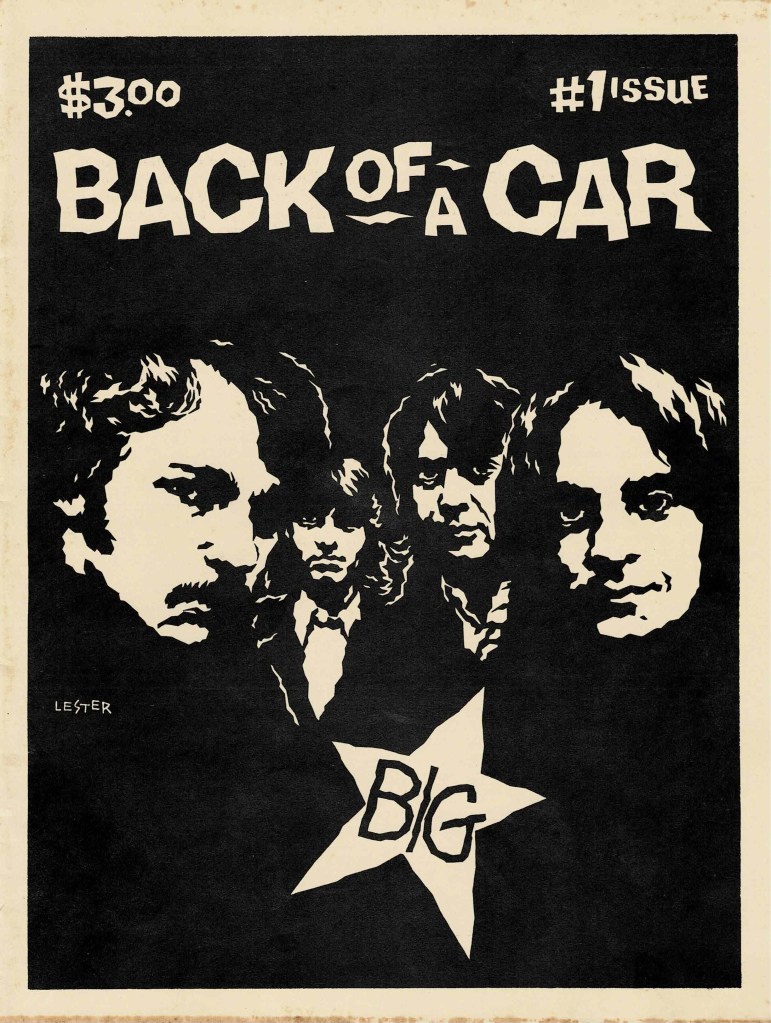
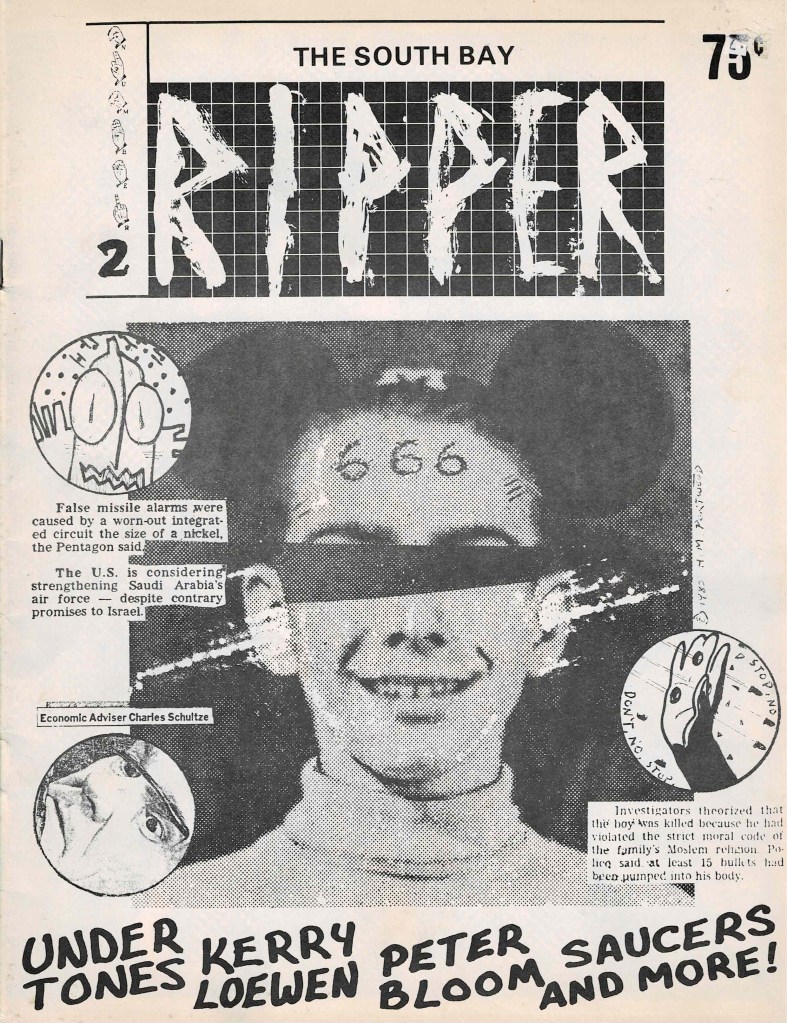
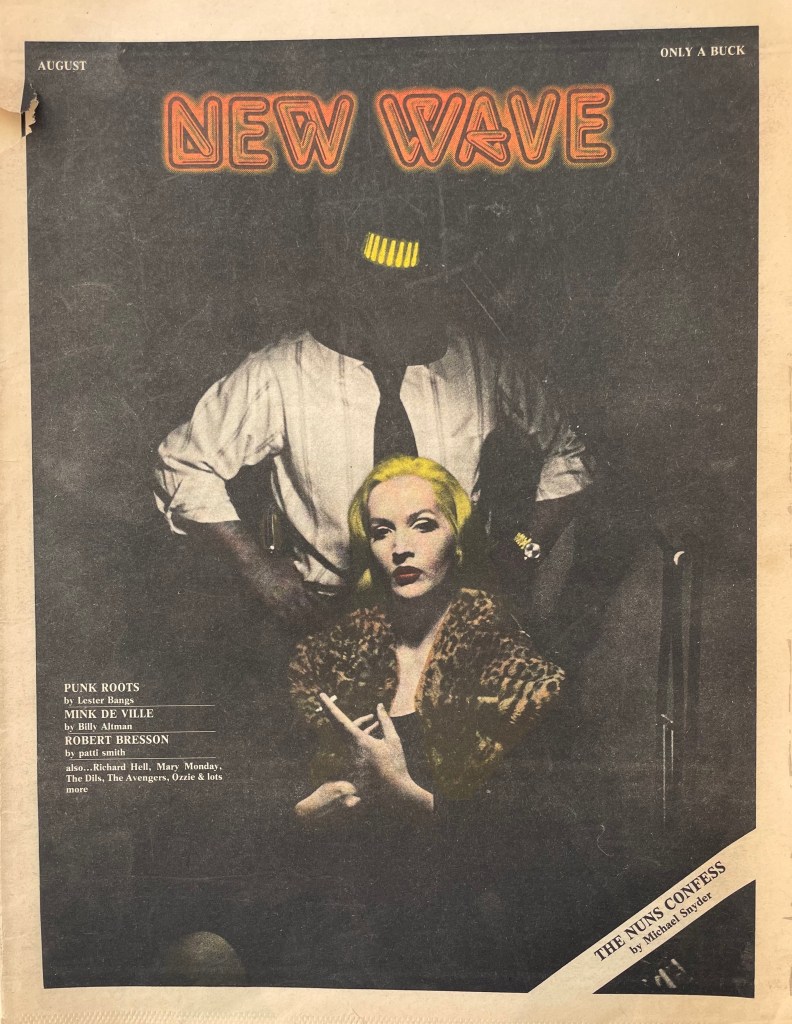
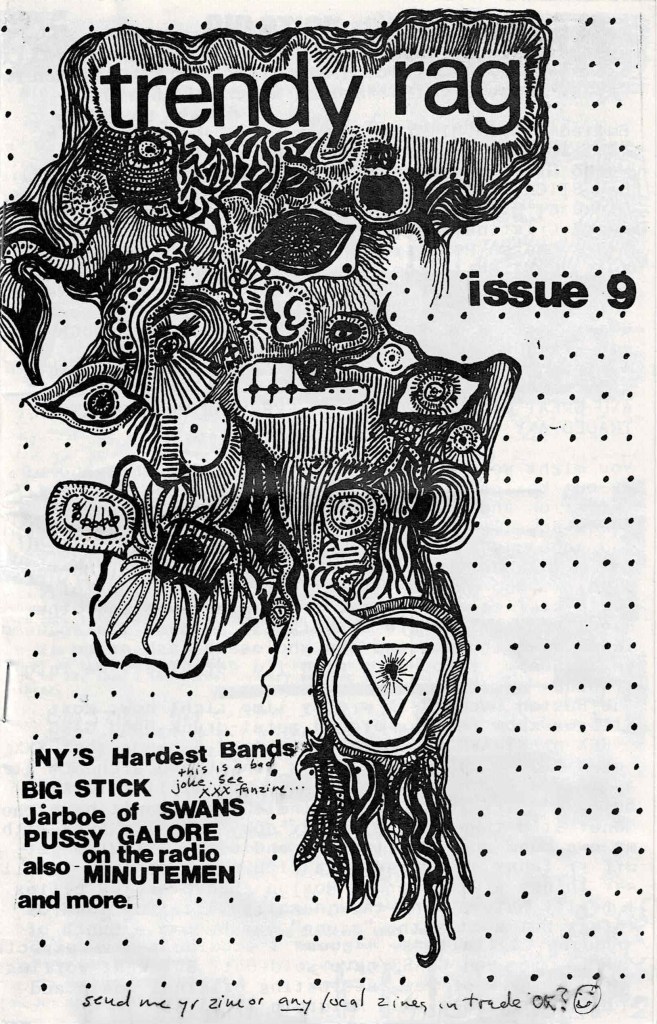
Scram #19

It’s been some time since we’ve taken a look at Kim Cooper’s 1990s-00s Scram; I think it was one of the very first fanzines I wrote about on this site, here and here. I’ve got this trove of them, a near-complete run, and every now and again it seems like a good idea to break one out, and I’m always glad I did – particularly the later issues, as this thing just continued to gather steam until its final transmission, issue #22.

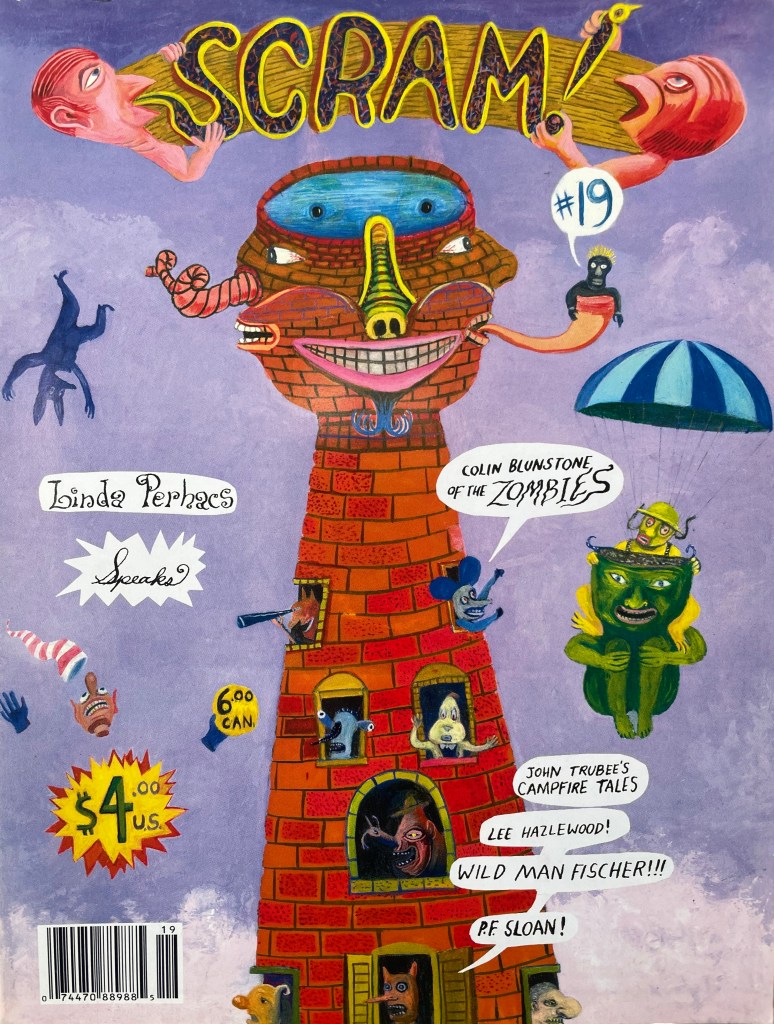
Scram #19 – “Hollywood’s Premiere Journal of Unpopular Culture” – is the Spring 2004 issue, and features a few of the same unearthings I was myself pretty excited about at the time. To wit: Linda Perhacs. Not long after the time I’d discovered how much I loved Vashti Bunyan’s music, I went looking for other lost 60s/70s female folk oddities, and came across Perhacs’ dreamy and strange 1970 Parallelograms. It resonated pretty strongly, and not only with me. It had just been reissued on CD a few years before this issue, and as Cooper notes in the intro, “The reviews were odd. Without any evidence beyond the text itself, the critics made assumptions about Linda, painting her as a dippy hippie sprite who somehow channeled these vast ideas unknowingly”. So Cooper and Ron Garmon had the first sit-down interview ever granted by Perhacs for this issue to fill in the gaps.

I mean, the best revelation by far is that Perhacs is a name we now know only because she, as a post-college dental hygienist, haltingly passed on some of her home recordings to one of her rich patients in Beverly Hills, Leonard Rosenman. Dazzled, he then did everything possible to hustle her into a studio. She just thought of them as “campfire songs”, something she did for fun. Also, her “Hey, Who Really Cares?” ended up being the theme song for the TV cop show Matt Lincoln, because the producers wanted a “delicate song on top of this hard action”, inspired as they were by Robert Altman’s M.A.S.H. theme “Suicide is Painless”. How about that? I’ll let you find the other revelations in your own copy of Scram #19

I am also thankful for all the younger zine editors who, unlike me, thought to interview the immortal Lee Hazlewood while he still communed with us on this mortal coil. Dan Kapelovitz gets the honor here – a piece he originally wrote for Hustler (!) and which was rejected by the editors. I wish I’d talked to this guy (Hazlewood, not Kapelovitz) when he was around, seriously. What a storyteller – about his run-ins with Frank Sinatra; about sexual attitudes in Europe; about young fans in Sweden who scream so loud they scare his band, and who only want to hear his obscurities, not his hits.

About a month ago I saw the Zombies’ documentary Hung Up On a Dream and I now have a new appreciation for Colin Blunstone and co. that I only slightly had before (I even bought Odessey and Oracle, a record I’d never owned). But yeah, an interview with Blunstone was right in Kim Cooper’s wheelhouse – The Zombies being exactly the sort of band I associate with Scram: a little forgotten; a little underrated; a little fey or twee or different or goofy or strange or orchestral. His chat here is engaging and wide-ranging for sure; he talks more about the “tour” of the Philippines that the Zombies undertook which is perhaps the highlight of the documentary. 

The John Trubee interview by one of his childhood summer camp pals is priceless as well. As mentioned before, it’s the interviews, features and weird bits of humor papered throughout Scram that made it stand out, not the record reviews of contemporary crap from labels whose ads helped pay for the print runs (although, frankly, Scram was relatively ad-free, and well over 90% of this issue’s pages don’t have one). The fanzine was its own little insular world of obsessions and excitements, and typifies just how interesting and enduring a well-executed ‘zine can be when one person’s weirdo vision is carefully unfurled and then shoddily typeset.

No Mag #5

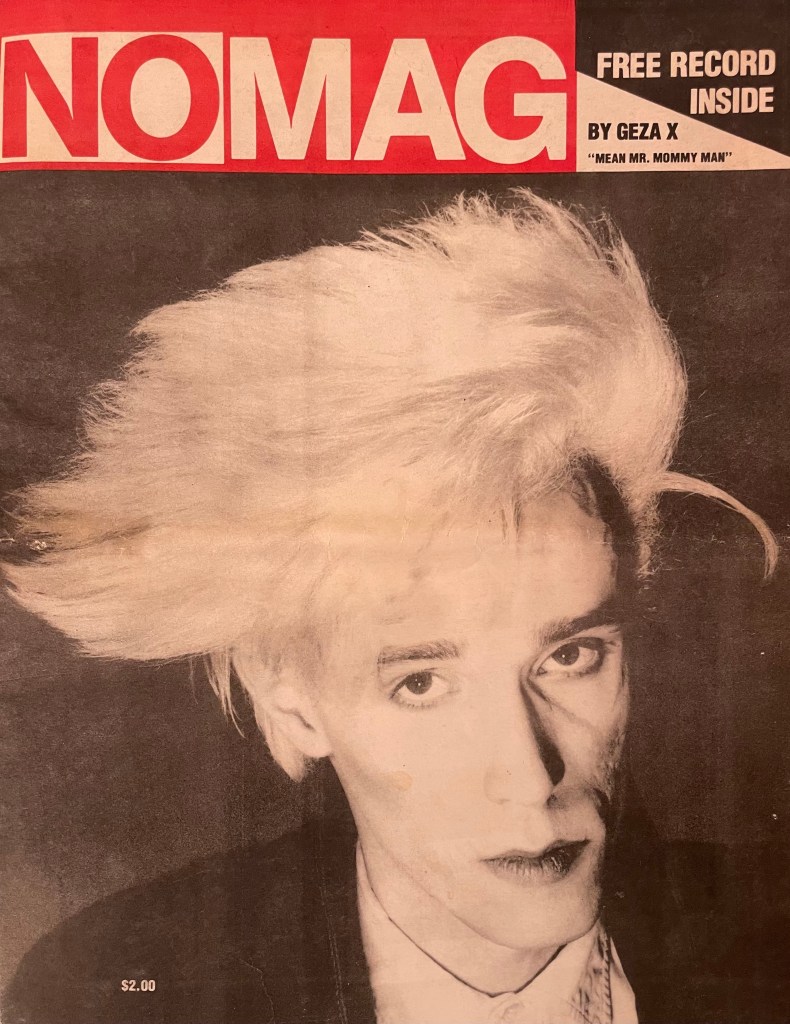
Hard to say for certain exactly when No Mag #5 hit the streets, but given the ad for the Circle Jerks’ brand-new Group Sex and a Vinyl Fetish ad touting “the last Slash”, I’m going with late 1980. Much like a never-satisfied, highly creative novelist, No Mag truly jumbled its format from issue to issue, in search of some higher, elusive truth. Always arty, fashion-forward, transgressive and exceptionally strange, my various copies are at times extremely music-interview and scene-gossip heavy, yet other times they’ll overwhelmingly default to collage art, sexual photography and disorientation. This is (mostly) one of the latter. We talked about different issues here and here.

You know the jarring, conceptualist, highly nonsensical Los Angeles late-night TV programme New Wave Theater from exactly this time? No Mag was its spiritual brethren, and though I lack proof, I’ve gotta think editor Bruce Kalberg and New Wave Theater’s Peter Ivers spent some quality methamphetamine time together. And this issue, No Mag #5 – it’s the first issue of this I ever saw, some years after it came out, probably in 1987 or so at my cousin’s Isla Vista, CA apartment. I’ve certainly never been able to forget the opening fake “interviews” with No Mag readers, all of whom are represented by pictures of the hideously deformed, or of people with various facial skin lesions and tongue abnormalities. 

No Mag #5 does have a Bryan Gregory interview; he’s moved to LA after quitting or being kicked out of The Cramps, and hey, he likes it here. He hasn’t seen a band in a year; soon he’d go on to start the very forgettable and very forgotten Beast. There’s also a long bit of puffery and myth-making about Geza X, none of which is true. Apparently this issue came with a flexi of his, but my copy doesn’t have it and, as Elliot Gould’s Philip Marlowe might say, “it’s okay with me”. 

As mentioned, this issue in particular jumbles together sleek ads of new wave fashion plates; strange collage-art mash-ups; poetry (of a sort), a thing about war and survivalism from Search and Destroy’s Vale and Andrea; comics; more freakish faces; and a ton of Frank Gargani photographs. Some of these are absolute gems: 11-year-old Stevie Metz of Mad Society; lovely Shannon from Castration Squad; this one of Crystal from the Speed Queens; Belinda Carlisle of the Go-Go’s, pre-fame; and a cool-looking group of dudes called The Adaptors, about whom I know nothing and who may have been from San Francisco

Of course, you really don’t need me to tell you about it, since you can download every issue of No Mag right here, thanks to the legendary benevolence of Ryan Richardson.

B Side #11

I started buying Sydney, Australia’s B Side around 1987, and it was an authoritative sherpa for me through the wilds & weeds of that era’s Australian underground. Independent US record stores were getting a lot of this stuff in stock at the time, so it wasn’t all that tough for me to find Scientists records, or any- & everything on the Aberrant, Citadel, Au Go Go, Waterfront, Greasy Pop, Red Eye and Black Eye labels, money permitting of course, of which I had little. Today I’m pretty ready to assert that the underground writ large, myself included, still hasn’t quite come to terms with how fertile this period was across Australia, particularly around the years 1984-86. This is where my recently-procured copy of B Side #11 lands, right in the middle of 1985. 

 For context, I just listened online to two records enthusiastically discussed here – Salamander Jim’s low-end, rumbling, psych noise-damaged “Black Star”, and The Moffs’ guitar-drenched paisley-psych 45 “Another Day in the Sun”. They’re great! It’s far more likely I just haven’t paid attention to any revivals of this stuff, since there are a ton of comps out there like this one. Anyway, Simon Lonergan and his crack team at B-Side were doing all the documentation in real time. I liken this fanzine to the UK’s Bucketful of Brains, but built instead around lowdown & dirty Australian bands with big hair and bad attitudes, as well as the more punk-oriented and as opposed to jangle-driven psych. It was the tenor of the times, as they say.

  If you’re like me, your eye was perhaps caught by B-Side #11’s promise of “Byron Coley on the State of the U.S.A.”. Coley’s “The State of American Noise Part 1” starts with an opening salvo positing that stupid Americans are ignoring the likes of the greatness he’s about to wax poetically about, which we probably were. This comes down to 4 key bands: Dredd Foole & The Din, Raunch Hands, Butthole Surfers and the Leaving Trains. The Trains’ debut LP Well Down Blue Highway “represents the culmination o’ years spent drunkenly tryin’ t’ find the Northwest Passage between The Damned and Creedence Clearwater Revival”. After describing them and the adjacent band To Damascus, he says “Now ya know more about these jerks than 99.99% of the American people. How’s it feel?”. Byron Coley sticking the landing, as usual. This is also the article in which Coley first wrote that Jello Biafra turned his nose up at the Butthole Surfers when he first saw them and said they were “too weird” – a statement that really stuck in Biafra’s craw for years afterward. Fun!

Tex Perkins (who was in Salamander Jim along with Kim Salmon) has a good interview here – he was better known as “Greg” at the time – which includes ruminations on his jealousy of the more popular Beasts of Bourbon; trouble with the cops; and the fact that he’s now about to start playing with Pat Bag and Kid Congo in Fur Bible. They haven’t even started the band yet, nor even told him what kind of music they’re going to be doing – he just wants to make sure it doesn’t sound anything like the Gun Club nor the Beasts of Bourbon. Well, maybe a little

There are also a slew of interviews with the likes of the Celibate Rifles, who just had that first LP and a 45 out at this point. A year later they’d have records that were easily procured at Aron’s and Zed in LA, and which became pretty beloved by me & my Radio Birdman-loving pals. (I don’t have them anymore and haven’t heard the band in decades). Other chats are with The Shindiggers, Decline of the Reptiles, 21 Faces, Harem Scarem, and American Eugene Chadbourne, who’s just come to town and won a handful of converts down under. 

The excitement of the age is real, and you can feel it in the big Melbourne “scene report” by David Laing and Trevor Block. They’re shooting the proverbial shit back and forth about bands like “Behind The Magnolia Curtain” and Murphy’s Hardware, who supposedly play live in matching Hawaiian shirts. Who wouldn’t be excited, am I right? And as a result of reading this blog post, you now know more about these jerks from 1985 than 99.99% of the Australian people. How’s it feel?

Revolutionary Wanker #2

Typically I keep to a couple of core rules here at Fanzine Hemorrhage, the primary one being that every zine discussed here is one that I myself presently own. That means “no PDFs”, though I admit that we’d be able to have some excellent (one-way) fanzine conversations if I bent my rules for access into my “PDF collection”. It also usually means no copies or xeroxes of fanzines. I have bent this rule twice already, however, for Brain Damage #1 and Back Door Man #4. So let’s bend it again for October 1981’s Revolutionary Wanker #2 from San Francisco, a crisp xerox sent directly to me by editor Naomi Batya, who was a hell of a “good sport” after all my shucking and jiving on this site when I discussed my original copy of her Revolutionary Wanker #1.

There’s an opening triumphant disclaimer that the zine is now publishing independently of Creep, and that this is likely for the better. Joan Moan contrasts the negativity of punk with the positive vibrations emanating from the Rastafari world, informed by her trip to Jamaica. She certainly wasn’t the only one disillusioned with mean-spirited punk rockers who go on to big-up on Jah. Alter “Ego” Cronkite – these names, jesus – seems to have taken his own trip around the country to see what various punk scenes are like in LA, DC, NY and even Rochester, and they each came up severely lacking compared with Shangri-La San Francisco. “If you still want to be a punk, stay in San Francisco”. Anyone else think LA and DC were starving for good punk bands in late 1981? 

Tony Kinman from Rank & File is interviewed and naturally gives voice to what it’s like being in a country band, vs. being in The Dils as he’d been two years agone. The band’s approach in 1981 is to play country music within the punk club circuit, and rightly see themselves as the only ones doing as such. Good interview. I’d always assumed those guys were really prickly, but not with the kind young women at Revolutionary Wanker they weren’t. And his favorite SF band is Flipper, as I’d hope mine would have been at the time.

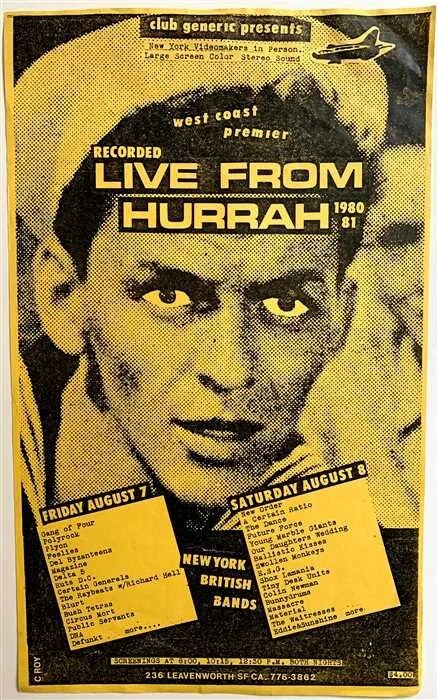
Z’ev does come off initially as exceptionally prickly in his chat with “Will Ling” and “Tobe Lead”, but settles down a bit and eventually takes some major swipes at his electronic & proto-industrial music brethren. You kinda learn to love the guy by the end – isn’t that nice? Each time there’s an interview, it’s then followed by adornments of many stripes – song lyrics, clip art, short musings and the occasional advertisement. In fact there’s an ad I’d never seen for the Market Street Cinema, which I only know as a legendary porn palace, showing off a killer Au Pairs / ESG / B-Team show that’s coming to town on October 2nd. There’s also a praise-drenched review of a new club called Club Generic in the Tenderloin at 236 Leavenworth that sounds like a truly wild space during an exceptionally creative time. These are the sort of events they’d have: here, here and here

There’s also an intro to filmmaker Marc Huestis, who was then just getting rolling. So yeah – not exactly a generic table of contents, and already a big leap from the issue that had come out just a few months before this one. I’ve got xeroxes of the others, and you can mark your calendars as I’ll be diving into those sometime within the next several years, count on it!

New Wave Rock #1

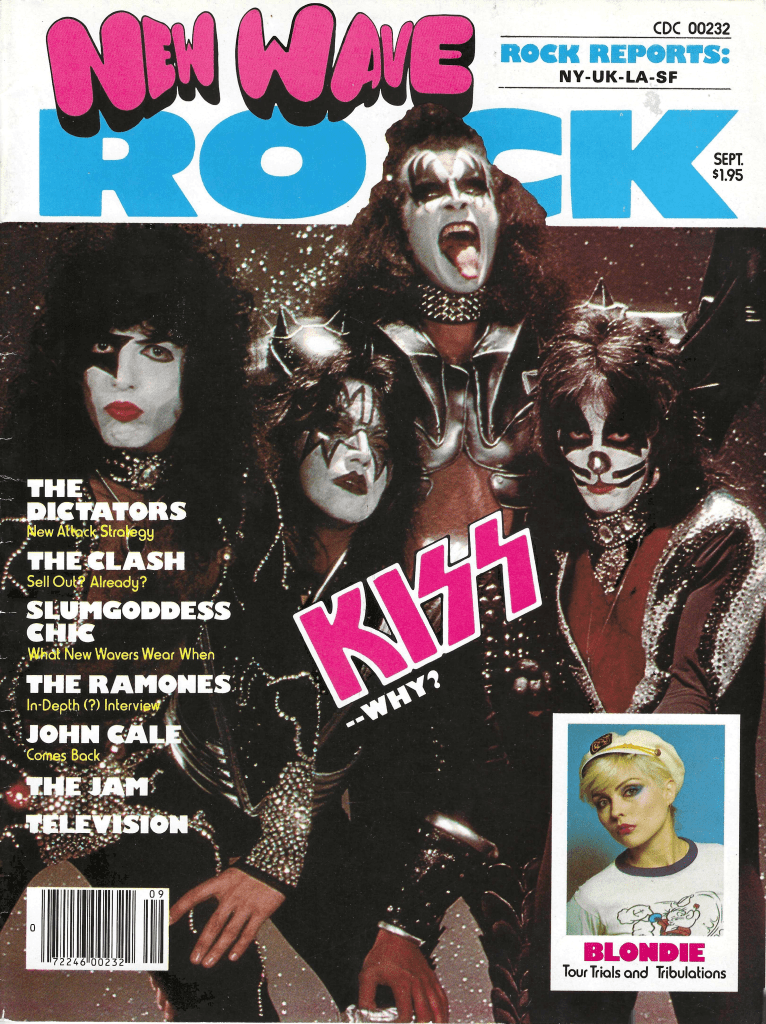
Well, whew, I think I’ve finally completed one of the most breathlessly exciting and highly laudable chases of my life: the quest to own all of the glossy punksploitation magazines that were put out in 1977-78 under a head-spinning spell of confusion, bafflement, excitement and money-grubbing opportunity. My late wife Rebecca would be so proud. I did it for you, honey. New Wave Rock #1 was my sacred chalice to find, and find it I did. (The others I’ve discussed are here, here, here, here, here and here). But then I had to read it, this issue with new wave rockers Kiss on the cover. But I did that too, and now I’m here to talk with you about what I uncovered. 

As it turns out, this September 1978 debut is less sploit-ta-tive than even the two issues that followed it (here and here). It’s actually quite good. Diana Clapton’s opening editorial states that she received funding and wide editorial latitude for it from publishers Harry Matetsky and Jack Borgen, but then they saw her table of proposed contents and blanched at all the no-names (Clash, The Jam, Dictators) therein. “(Harry) then asked the fourteen-year-olds in his Long Island neighborhood, which is light years away from the Bowery, who their very favorite rock group is – and that’s why we have the cover we do, friends”. She then proceeded to label Kiss’ portion in the table of contents “Kiss: what do they mean? Why are they here?”

As usual, much of the fun to be had is in the opening gossip pages, which here are broken into distinct London, New York, Los Angeles and San Francisco scene reports. There’s some loud post-Sex Pistols break-up speculation, including some that posits that Johnny Rotten and Poly Styrene are singing aging rock & roll standards together on a grand piano, and are now a “joyful couple”. There are salacious details on the Bryan Ferry/Jeri Hall split and how she’s cavorting in the clubs with Mick Jagger, leaving Ferry sad and alone in his new upper Fifth Avenue flat, which he’d moved into with Hall all the way across the Atlantic. There’s also a firsthand report on Lou Reed’s six-show, sold-out run at The Bottom Line, featuring “his transsexual lover Rachel” opening. Rachel, who “is a terrible singer”, apparently hung real tough and dealt with much audience abuse in “tight black leather, stiletto heels, a sultry smirk and a rose looped over his or her belt”. Meanwhile, Brian Eno “and the agonizingly gorgeous Julie Christie are having a fat laugh over rumors of their red-hot love affair, as they have been in each other’s company precisely twice”. 

The LA gossip column by someone purportedly named Eunice O’Reilly is even spicier. After some Germs love, there’s a list of LA’s five “bad bands”: Backstage Pass (I just finished reading Genny Schorr’s All Roads Lead To Punk like, last weekend), The Nerves, The Deadbeats, Runaways (ok, sure) and The Weirdos, “LA’s most unexciting band since Seals & Crofts….claim to not be ex-hippies in disguise, but ace Warner Brothers secretary Coral sez: ‘I went to high school with them. They had long hair and wore love beads’. Case closed”. I also enjoy “O’Reilly”’s take on power pop: “It ain’t new wave but it ain’t ‘zactly old wave either, something y’gotta just live with and LA’s got it up the gitgo”. I suspect this column was written by either Gregg Turner or Metal Mike Saunders, probably Turner, as it contains a multi-paragraph ending about “saving the best for last”, Vom. Their own band. Amazingly, there’s then a two-page spread and feature on Vom later in the mag.

Now, I’ve dissected enough pieces on Blondie, The Jam, The Ramones and the like in other Fanzine Hemorrhage write-ups to really want to spend much time with with the ones in New Wave Rock #1, but I did a double-take skimming the Blondie piece in which Clem says “…we made a movie with John Cassavetes and this guy Sam Shaw. It’s a youth-oriented movie called Blondie, and I don’t know what they’re going to do with it”. Say what now? John Cassavetes? It’s true! (More here from Waitakere Walks). I also learned about the incredibly underwhelming response The Jam received opening for, um, Blue Oyster Cult in Bridgeport, CT, and Paul Weller’s goading of the crowd with, “I know, it’s hard to understand when you’re being confronted with the future of rock and roll right in front of you”. 

One other bonus of this issue is the loads of color photographs documenting both onstage antics and candid backstage snaps, most of which I haven’t seen before. And other tidbits and anecdotes and whatnot: John Cale expounding upon punk and how much or how little was actually being learned from The Velvet Underground (he loves Sham 69, though!); The Clash claiming “people think we’re a con, but we’re not”; and a multi-page overview of Television’s year post-Marquee Moon, pre-Adventure. I’ve been listening a ton of late to the Live Portland 1978 bootleg from around exactly this time, and I think it’s quite possible it’s the single greatest documentation of Television’s majesty in any one single place.

 It’s likely that publishers Matetsky and Borgen didn’t like what they saw when they crunched the newsstand numbers for New Wave Rock #1 and asked to dial up the stupidity levers a bit for the two issues that followed – who knows. I just know that if this had been called something else, and didn’t have Kiss on the cover, it’d be as good as this, this or this from right around the same time, and perhaps remembered just as fondly and not as some joke object for dorks like me. 

The Bob #26

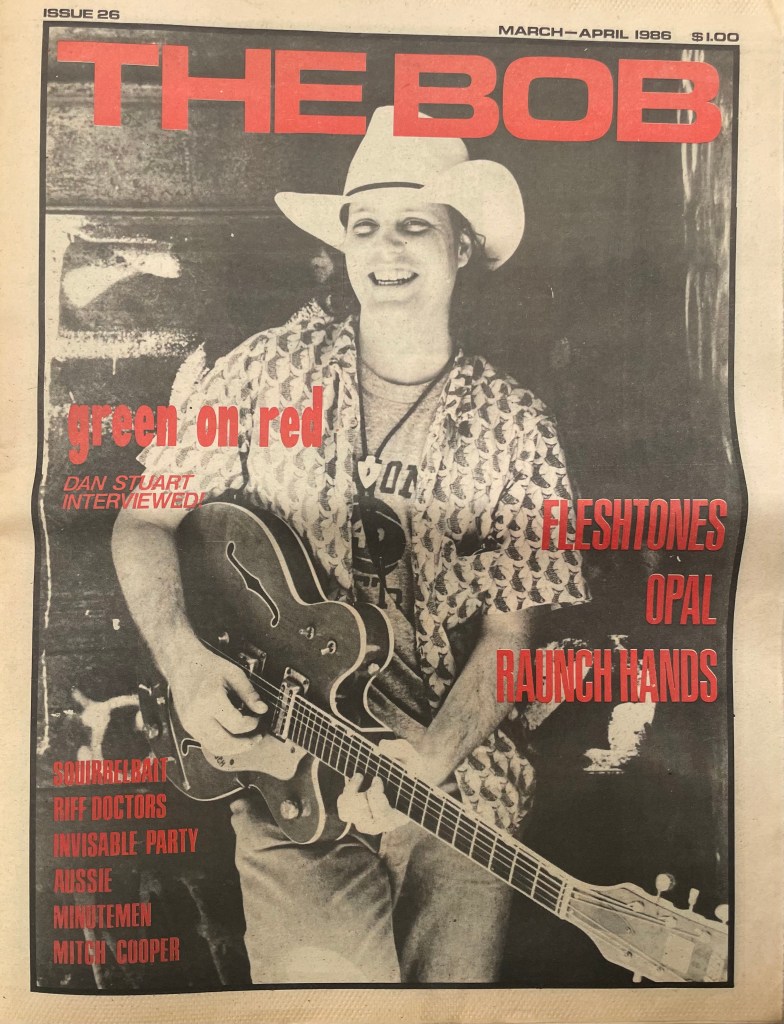
Around 1985-87, the tabloid fanzine The Bob was pretty ubiquitous on the Tower Records magazine racks and at the indie record stores I used to frequent in California. While their all-encompassing approach to “college rock” certainly covered bands I cared about – i.e. The Bob #26’s bits on The Minutemen and D. Boon’s passing and Pat Thomas’ short overview of Opal – I only bought it every now and again, given the lack of any real cultivated, inspirational, BS-detecting “taste” that I might glom onto. The temperament appeared to have been: indie music is great, listen to all of it, but maybe not if it’s too aggressive or too challenging. Fair enough?

That’s at least what I’ve gathered again in 2025 revisiting this March-April 1986 issue. The Fleshtones, Scruffy The Cat and even The BanglesDifferent Light are taken seriously, as are the longest and most obscure stretches of the jangly American underground tail. As long as someone sent in some vinyl to be reviewed – especially if it’s Engima Records or in any way R.E.M.– or paisley underground-affiliated – it’s gonna get in here. Most of the time it’s going to have one of those reviews that hems & haws and picks at it a bit, then weirdly concludes, “you need to hear this” or “you need to buy this”. As someone who emphatically relied upon fanzines to tell me what was truly worth buying at the time, this was not an approach that built credibility, nor gave me any level of confidence in The Bob’s discernment. 

I always associated The Bob with Fred Mills. His byline was everywhere in virtually every issue, doing many of the interviews and writing a huge chunk of the reviews. Fred was sort of the saving grace, in my opinion. While he was (at times) the foremost purveyor of the review style I’ve just decried, he also was an inveterate music fiend who clearly “collected records” (as did I at this time, age 18), and was absurdly, slavishly devoted to bands, live gigs and uncovering undiscovered gems. In 1993 when I was the “roadie” for the band Claw Hammer, Fred somehow proactively found me on the show floor at Hotel Congress in Tucson, AZ (we’d never met nor corresponded), and we proceeded to banter about all manner of musical ephemera, helping to solidify the positive-leaning sentiments I’d accumulated to date. We’ve not communicated since.

It’s really Mills, Pat Thomas and a parade of lesser lights in The Bob #26. Mills gets the Green on Red deep dive, and upon re-reading it now, I reckon I learned a bit more about where this band’s head was at during that first wave of indie/Americana bands jumping unsuccessfully to major labels. (The best writing about that disappointing blip in time, I think, is in the second of the two John Doe/Tom DeSavia LA punk books). Thomas rightly praises the 28th Day record and seems to imply they were from Los Angeles – they were not. Mills has an entire column on Australian bands; there was a ton of curiosity around this time about The Scientists, Triffids, Decline of the Reptiles and others, whose records were just barely making it to the USA. I’m pretty sure my own Aussie mania of the time was at least piqued by Mills’ columns – so perhaps there was some residual tastemaking going on despite me saying in self-aggrandizing hindsight that there wasn’t.

There are various write-ups of similar 60s psych/garage revival groups like The Mod Fun, Chesterfield Kings, Plan 9, Plasticland et al. I was just at Amoeba Music in San Francisco on Friday; some dude had sold crateloads of this stuff on vinyl – your Miracle Workers, Yard Traumas and what have you, including the aforementioned Aussie stuff – to the store a few months back. While it was fun to look at when it came in, I noticed this week that most of it was now “priced to move” in the reduced/clearance portion of the used LPs. Even at $5.99 a pop, I couldn’t find anything worth slotting into the collection. Not even the Psychotic Turnbuckles, but I at least held that in my hands for five minutes.

1984-1986 remains a puzzling time for me in the broader tale of what underground rock music was during the decade, but a fanzine like The Bob, for better or for worse, goes a long way toward illuminating the quote-unquote lived experience among certain sectors at the time. A glut of vinyl, an aesthetic distaste for punk and what it wrought, a surging “psych” and lite-garage sensibility, and an attempt to guiltlessly straddle the underground and overground. That’s what I remember from The Bob and similar publications like Jet Lag, which is probably why I ultimately found my late-teenage salvation in Forced Exposure, Conflict and Flesh and Bones instead.

Damage #1

One of the great tabloid fanzines of all time, Damage published thirteen issues in San Francisco from 1979 to 1981. I’ve had the pleasure of talking with you in this forum about it before: Damage #6 and Damage #7. Now let’s take a peek at the very first issue, Damage #1 from June 1979, even if it does have Jello Biafra on the cover. Trust me, my copy wasn’t “complimentary”, as you can see stamped along the top here, but it leads me to believe that my copy belonging to a previous owner once was. 

There seems to be a real coalescence of smart and driven people around the San Francisco underground music scene in 1979, not merely a bunch of dimwit punks. They’ve all been given a place to congregate in the pages of Damage #1. There’s billboard artist “DA”, provided with this sobriquet as a cover for his real name, due to his public vandalism of billboards and corporate buildings. This includes putting up a series of large posters that say, “Rich..? Boring…? Then you soon may be dead unless you contribute to the new wave revolution. Send money today = be spared tomorrow”. An address at 626 Post Street is helpfully provided. He also created confrontational machine-based visual art and displayed it in public spaces, like a gas station, making me think he might very well be Mark Pauline, or someone within his orbit. Though I doubt Mark Pauline would have given much thought to fomenting a “new wave revolution”. 

Another great interview is with Robert Hanrahan, manager of The Offs and Dead Kennedys, and a guy who put on shows at San Francisco’s legendary Deaf Club. (Robert is now Daphne Hanrahan). The club is struggling with fire regulations, police presence, and with quality-of-life cleanup issues on Valencia Street. Mayor Dianne Feinstein is referred to as “the Queen of Hearts”, in reference to a legendary mocking magazine cover that I unfortunately can’t find reference to on the internet. She was reviled by the punks. Hanrahan complains about people trying to piggyback on the club’s notoriety and/or get in for free: “We’ve had people come to the club and flash New West press passes, and we say, okay that’ll be three dollars. And they’re shocked – ‘but we can write about you, we can give you all kinds of publicity’….one night Black Randy came to the door and announced, ‘Black Randy, party of twelve’. I said ‘Black Randy, party of none, it’s three bucks apiece’. He was flipped. We let him in, and a half hour later two guys were carrying him out because he had passed out in the bathroom”. 

Now if you’ve done even the tiniest bit of cursory reading about the late 70s San Francisco punk scene, you surely know who Dirk Dirksen is. The interview with him here is fantastic. The interviewer comes at him repeatedly and rather lamely with every Mabuhay Gardens controversy du jour – ticket prices ($4.50 on weekends instead of $3!); whether he’s enriching himself from the Mabuhay (he is not); “a lot of people resent the way you act on stage”, and so on. The final question is “Someone asked me to ask you if it’s true you hate punks”. Dirkson replies, “I only love myself. I don’t know any punks, but those pseudo-punks that come to the Mabuhay, I certainly like them”. Read an entire book about him here

Damage #1 also talks to bands, I assure you. There’s a rare one with The Urge, an all-female band that included Jean Caffeine, who did New Dezezes fanzine (which I wrote about here and here) a year or two before this band, and who, along with her bandmates, went to Washington High in the Richmond (two members are still there at the time of this interview). There’s a talk with No Sisters, a band of brothers, all of whom wear nerd glasses. There are strange utterings from Coum Transmissions, i.e. the Throbbing Gristle folks, a collective very popular with a certain San Francisco archetype of the era, as you may well know. Craig and Alice from The Bags do a perfunctory Q&A, and MX-80 Sound, who’ve just moved to SF from Bloomington, IN, get their own small grilling here.

Just to give the proper context, may I please continue? There’s an interview with Nervous Gender, a photo essay of “A Day at Home with Sally Mutant”, and a piece on filmmaker George Kuchar. Jello Biafra gets a column to spout his nonsense; John and Exene from X give a short interview, decorated with some phenomenal band action shots. The women from Noh Mercy talk about the blowback to “Caucasian Guilt”, and about some of their difficult live shows, such as the one in LA at Madame Wong’s where the highly touchy madame took exception to them wearing kimonos on stage, and for being women in the first place, then banned them from ever playing there again. There’s an LA gossip column from someone named “Jane’s Plane” and an SF gossip column by Ginger Coyote, who put out the fairly weak fanzine Punk Globe and was later in the execrable White Trash Debutantes

Yeah, all of that….and even more. I really dug the interview with the folks behind New Youth Productions, who put on a legendary grassroots Clash/Zeros/Negative Trend show on 2/8/79 and ruffled a ton of industry feathers in the process. There’s much more about Caitlin Hines from New Youth in my own Dynamite Hemorrhage #8, which you can read here. So as I said at the outset here, tons of energy, spit and vinegar in San Francisco at the time, and you really couldn’t capture it a whole lot better than Damage #1 did.

Crawdaddy! #16

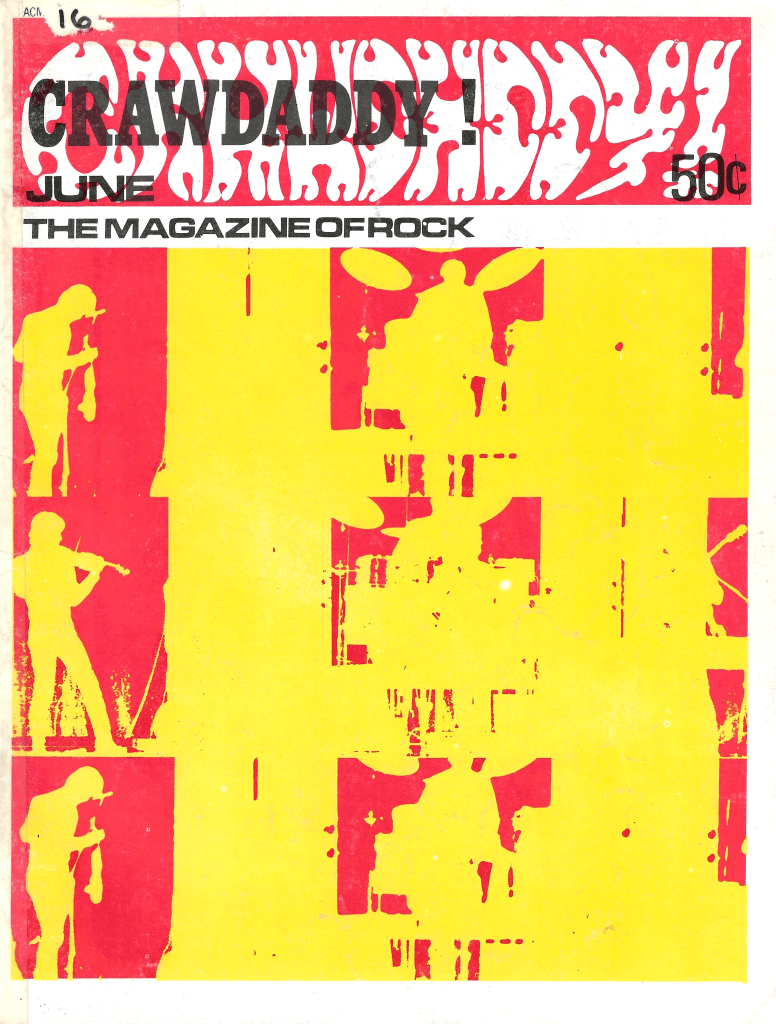
I’ve only got a couple 60s issues of the original Crawdaddy! – “The Magazine of Rock” – and I’m quite aware that it wasn’t a true self-published fanzine, as weren’t the magazines Rock Scene, Teen Screen, Trouser Press, Cheetah, Beetle, Sounds and a few others I’ve bantered about here. It’s a great window into the “rock as culture” movement of the late 60s, in which rock music was dissected as intellectual fodder, the whole “but-what-does-it-all-mean” ethos that was part & parcel of the era’s zeitgeist. It’s still a point of chagrin in my house just how picked-over Bob Dylan’s lyrics were at the time, but I know Bobby Z has his fans, and who am I to say they were wrong to do so.

Paul Williams was the editor of the original version of the magazine, which started up in 1966. His run at the helm ended in late 1968, not long after this issue, Crawdaddy! #16 from June 1968, but the thing continued throughout the 70s, albeit without much cultural cache that I can discern. Williams would later re-launch the magazine in the early 1990s as almost a fanzine again from his then-San Diego home. He provided a writing hub to so many folks who’d go on to be fairly well-known, such as Richard Meltzer and this issue’s Sandy Pearlman and Peter Guralnick. (Wikipedia says that Gilda Radner and Dan Aykroyd wrote for it in the 70s!). 

Crawdaddy! #16 finds itself parked pretty well in front of a lot of what I’d like to think I’d be excited about during the hot hot summer of 1968. The United States of America get the cover and an excellent write-up by David Flooke, focused quite a bit on how they might use their synthesizers to build on “the second coming of the new music era, which was heralded by Sergeant Pepper along with Pet Sounds”. People actually liked Sergeant Pepper back then, folks – no, I’m serious! But I love this piece because it’s so excited about “this group that is shaping art into rock”, and also mainly because I really, really dig the LP that Flooke is so excited about, so I’m excited to feel his real-time excitement. 

There’s much excitement as well about a Doors live show by Kris Weintraub, who is already rhapsodizing about the godlike power of “Jim”, on a first-name basis. Williams writes about Smokey Robinson & The Miracles and The Beau Brummels, the latter being one of San Francisco’s finest and a big favorite of Mimi Hinman (my mother), though I did not know they were still hoofing it in 1968. David Anderle and Williams then get into a long recorded discussion about Brian Wilson. The article is simply called “Brian”, and it’s part three of their deep exploration into every conceivable aspect of Wilsoniana. Williams sees 1967’s Wild Honey as “some sort of breakthrough”, and they go way into it, with diversions into Dylan, the Doors, Elvis and even Rembrandt and Modigliani. Your patience may vary. 

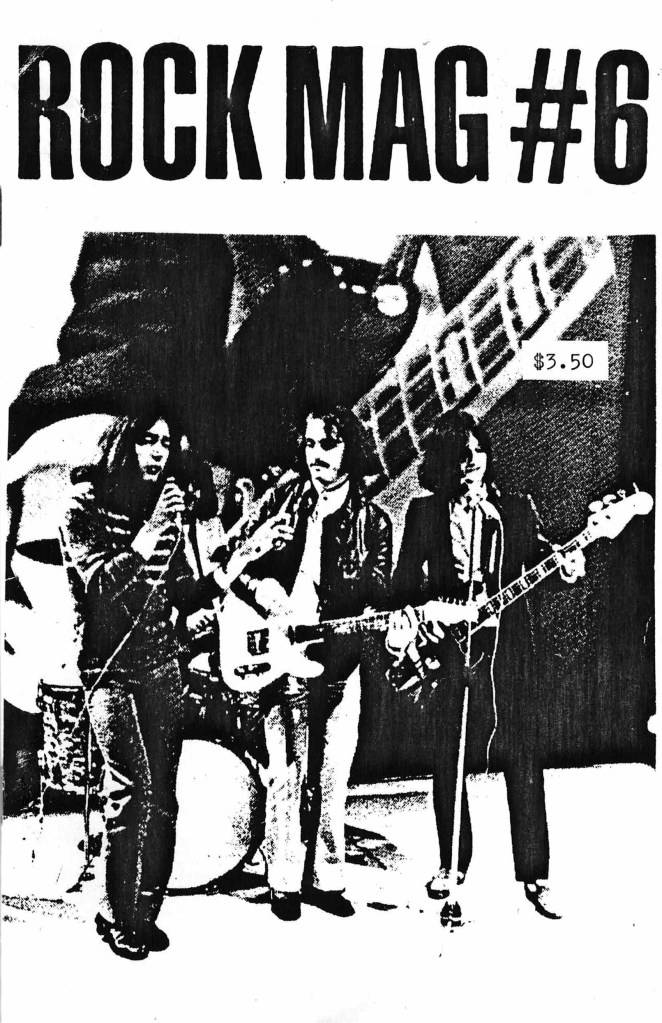
Another piece contrasts The KinksSomething Else with The Who’s The Who Sell Out and yes, I’ll say my patience for over-explanation does waver a bit on this one. Tim Ellison – whom I know at least somewhat revered Crawdaddy! – brought back this style of labored writing in the 1990s in his excellent fanzine Rock Mag!, but I also felt Tim, educated as well as he was by comparatively lowbrow punk fanzines, leavened his prose with some real tongue-in-cheek weirdness that might have gotten his submissions summarily rejected by Williams in the 60s, who knows.

But look, the real gem here is a real-time inspection by Pearlman of White Light/White Heat by, that’s right, the Velvet Underground. He zeroes in on many things, only some of which I can really understand, but his biggest excitement is reserved for Maureen Tucker’s Bo Diddley-groove, and the band’s unswerving dedication to repetition. He loves “Sister Ray”. And in 1968, to love “Sister Ray” was to be ahead of the curve, shall we say. White Light/White Heat peaked at 199 on Billboard’s album chart, which only went to 200. He can’t really tell if their repetition means “they’re playing badly or not”, but doesn’t care. I don’t either. It’s probably my favorite album of all time.

 Marc Silber ends Crawdaddy! #16 with a piece on Autosalvage’s debut album, which would ultimately be their only. I’d never heard of them, but I like what I’m hearing right now. Of course, I also happen to be on a Moby Grape/Love/Kinks sort of bender right now, so all of this is in my proverbial wheelhouse at the present moment. I’m sure I’ll go back to disparaging the hippies any day now.

Bite Down #1

Over the course of Fanzine Hemorrhage’s reign of error, I’ve had the distinct pleasure of dissecting several 80s and 90s fanzines by one Brian Berger: Crush #3, Grace and Dignity #1 and Constant Wonder #1. Last time I even sirened a call that I sent across the internet for Berger to get in touch for a real old-school “Fanzine Hemorrhage grilling”, but our bait was left bobbing on the water. The common themes of any given Berger fanzine were a very learned abrasiveness; a high intellectual quotient that didn’t show itself off too much; complete & total independent music immersion; and a bit of horndoggery that did little to advance the seriousness of his cause. Thanks to one BH, I now have Fall 1988’s Bite Down #1, which I believe may be the very first of all the Brian Berger fanzines.

At this point, he’s a student at the University of Michigan, and therefore publishing Bite Down from Ann Arbor. Of course, Ann Arbor, especially its clubs, TOTALLY SUCKS. I love how college students from big cities, such as my own beloved progeny vis-a-vis Tucson, Arizona, often have the perspective of living and cavorting in exactly two places in their lives, and therefore if the second falls short of the first for, say, nightlife, the whole place just SUCKS. Berger places his zine’s opening editorial and statement of purpose on the inside back cover, the last place you’d think to look, and professes his love for rock and roll while also sheepishly admitting he’s a mere 19 years old. Well jeez, I was 20 myself at this exact time, and his obsessive interests very much mirrored mine: what various mythic fanzine types were up to (especially Forced Exposure and Conflict); Sonic Youth; the Gibson Bros; and the releases that were pouring out monthly by the dozens on Touch & Go, Homestead and SST. 

Most/all of the reviews I wrote for Sound Choice at the same age are just as guileless and uninformed as Berger’s, so any mirth-making here is refractory and probably aimed at myself, okay? But it’s funny! The Mekons’ 7-7-88 show at Maxwell’s was “the best show I’ve ever seen”. It may well have been! I say the same thing about the 9-28-87 Sonic Youth show at Borsodi’s Coffeehouse in Isla Vista, CA, which took place when I myself was 19.  “While a goodly amount of praise has been heaped upon the combo known as B.A.L.L., IT AIN’T BEEN ENOUGH!”. Really? B.A.L.L.? Richard Meltzer’s L.A. is the Capital of Kansas: an all-caps “MASTERPIECE”. (Maybe I should read that one). 

He cares even more about Shimmy-Disc records, a label whose program I struggled to get with at the time, but Berger is full-bore. B.A.L.L.’s new one is their “second straight masterpiece”; King Missile are “hilarious”; and even that Carney Hild Kramer record is a “masterwork” (there are nineteen copies of this LP currently selling at $3.48 on Discogs, not to conjoin art and capitalism, nor try to make any statements about price as a cue for quality). He also swipes the Forced Exposure “C/U meter” for his own 45 reviews, which was shorthand for “Could/Use x amount of copies”. So with a C/U of 1, you’d keep your lone copy; C/U of 500 meant, in theory, you needed to go find 500 copies. Tad, who is called “the friggin’ messiah” for his Daisy/Ritual Device single, gets a “C/U Entire Pressing”. Fuck, so that’s why I can’t find the goddamn Tad single – Berger got them all.

Only one more bit of funnin’, and then I’m done. (For the record, I enjoyed reading Bite Down #1 cover to cover today). His interview with Thurston Moore of, yes, Sonic Youth, is really good, mostly because Moore was and is always game to talk shop with a fellow record/music obsessive. It makes me laugh because the questions are so the sorts of questions I would ask bands not just in the 80s, when I’d meet them in person, but even through the 90s, as if they didn’t have anything else to talk about. “How’s the tour?”. “So you guys are playing with Laughing Hyenas”. “What’s the deal with this one record I collected from you” etc. Questions that were just as one-dimensional as I was at that age. I also learned that Thurston Moore’s tour diary in Forced Exposure was enlivened by some somewhat mean-spirited edits by Jimmy Johnson, which, I guess if it happened to me, I’d never submit anything to anyone ever again.

I do think Berger made a quantum-sized developmental leap from Bite Down #1 to Constant Wonder #1 in four years, and some of those rougher edges were never sanded down – mostly to the good in his case. They certainly made for more readable and more memorable fanzines, and I reckon the guy’s still a person of interest from this era, even if I’m the only one still interested.

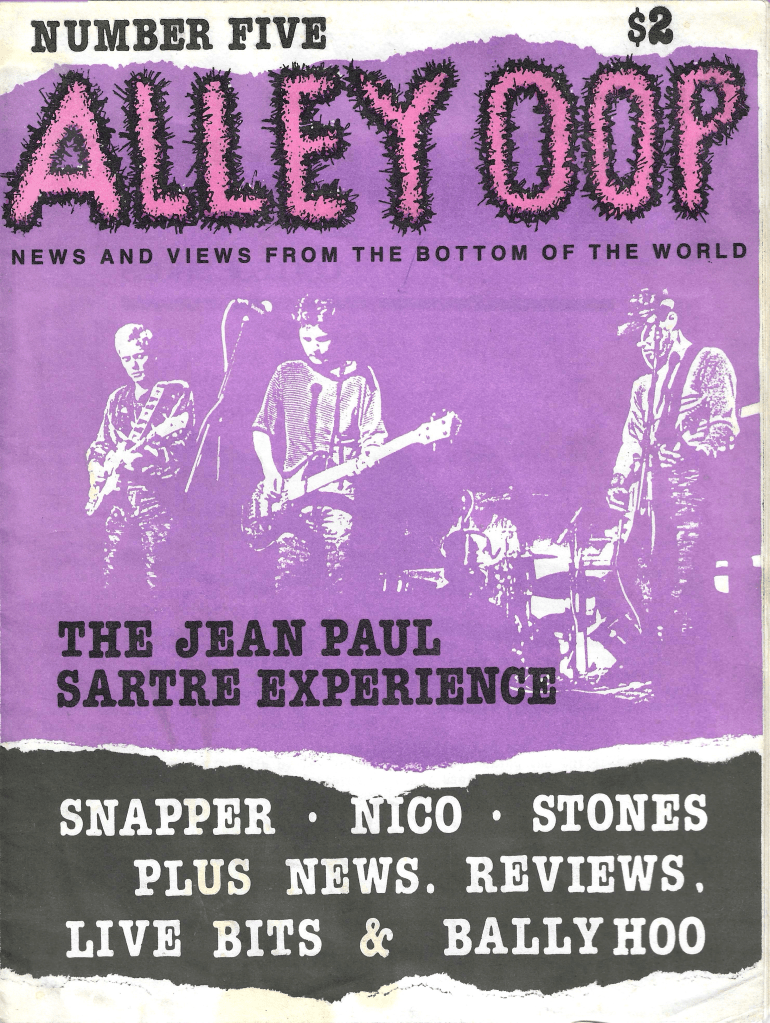
Alley Oop #5

I’d wanted a copy of New Zealand’s Alley Oop for years, and so hats off and a big thank you to Brendan, who made it happen. Aside from Garage, which I’ll likely never see an original copy of, it was the NZ mag I’d most seen quotes pulled from and reviews swiped from, and upon the evidence presented here in 1988’s Alley Oop #5, there was ample reason for doing so. 

While no formal editor is presented on any masthead here, at least judging by the amount of content contributed, it looks like Paul McKessar helmed the fanzine or at least was very deeply involved. He apparently got #me-too’ed a few years ago. Right away there’s a very NZ-centric gossip page, with some excited early Xpressway news. Heads-up is provided about the Dead C’s forthcoming The Sun Stabbed EP, and there’s some celebration of the fact that “sales of the Xpressway Pile=Up compilation have already exceeded some expectations”. Remember, if it sells 100 copies in New Zealand, that’s like 4 million in the United States. They also talk about an upcoming Xpressway tape of 1983 recordings by Christchurch’s The World, which didn’t actually happen until Unwucht put the stuff out in 2013.

This gossip column also hipped me to a Bill Direen & The Bilders comp from 1988 called Divina Comedia that I’m only just learning was a thing now. Then comes a trio of interviews; first up is the Jean Paul Sarte Experience. This is undertaken by Ian Henderson, brother of George, and the guy behind Fishrider Records, a terrific small label who has put out several records by Emily Fairlight, one of my favorite artists the past ten years. You’ll definitely want to check her raspy-voiced gothic Americana out, and move on to this one once you’d bought that. Snapper are talked with by McKessar, and Stones by Chris Heazlewood, an artist of deserved renown in his own right. 

The reviews are fairly minimal in number, but of course the kiwis have outstanding taste. I was dazzled to see the rave for Tripod Jimmie by Bruce Russell (Xpressway/The Dead C); he loves the excellent and highly underrated A Warning To All Strangers, which he rightly says is going to be very hard to find. I barely saw it here, where I live in California, and they were from San Francisco. There’s some Pixies love from McKessar, and some slightly overwrought praise for Public Enemy too. Have I ever written about the time Public Enemy was playing UC-Santa Barbara when I was in college, around this very time, and “Flava Flav” was spotted in the middle of the afternoon, walking down Hollister Avenue in the neighboring town of Goleta wearing his big stupid clock around his neck? 

McKessar talks about local live shows you’d have killed to see from Sneaky Feelings, The Puddle, Verlaines, Steven and Plagal Grind (!!). There’s a deep dive into The Clean’s Oddities 2 tape, something I actually once owned (along with an original Xpressway Pile=Up) and sold, because I totally hate cassettes. And perhaps best of all is K B Tannock’s obituary for Nico, who’d just passed away at age 49. It’s exceptionally informative, focusing mostly on her final ten years, and a little harrowing, as it contains a description of his (her?) interview with Nico in 1985. Our heroine is ravaged by heroin, as well as suffering from an inability to communicate, to hear in one ear, and to go five minutes without complaining about how badly she needed smack. We’ve written some about Nico’s interview foibles before on this site (here and here), but she really was something special and strange. (I still have yet to read this book about her, but I own it and will get to it one day).

In all, Alley Oop #5’s about as front-and-center a seat as you’d imagine getting to take at the Flying Nun & Xpressway tables as these labels were at or close to their heights. May they all eventually be lovingly collected somewhere as Garage was.

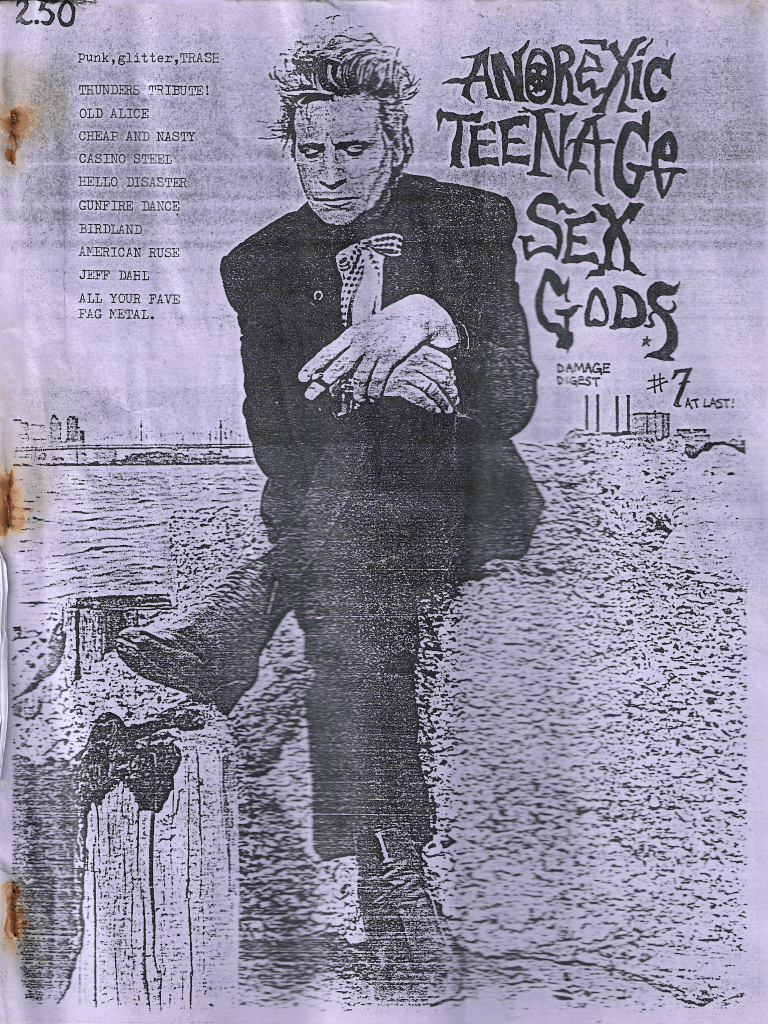
Anorexic Teenage Sex Gods #7

A real nice fella named Brian wrote to us here at Fanzine Hemorrhage not long ago and said he was doing some summer cleaning, and would we like a copy of Damage fanzine that he had laying around. We sure would! Lo and behold in the mail, Brian’s kindly-proffered package included no Damage, but rather a gratis copy of Anorexic Teenage Sex Gods #7 from 1991. I hadn’t been familiar with this Cambridge, MA fanzine, but it turns out that on their editorial masthead, they stated that they were, in fact, “The Last Rock N Roll Zine”. How about that?

Editor Gag Warlock and his co-editor “Frank” were very much of the drunk-n-loose glam/slam/rocknroll persuasion, the sorts of folks who worship Johnny Thunders and like it LOUD, sloppy and stupid. I knew these people well – I mean, not Gag and Frank, but this alcoholic jean-jacket & bandanas trash-glam-punk crew. I wrote a thing in the Where The Wild Gigs Were book some years back all about The Chatterbox, a San Francisco club for whom this lifestyle was their entire brand. And I supported it! I had so much fun with my fake ID at The Chatterbox, a melting pot of speed metal heshers, gender norm-challenging NY Dolls freaks, and loads of drunk women who yelled too much. 

What do you know, Johnny Thunders has just passed away as issue #7 is getting pulled together, so there’s lots to talk about. The first piece is coverage of a Memorial/Benefit show on June 19th, 1991 just two months after his death. Then a an actual memorial/tribute from one of the Anorexic Teenage Sex Gods writers to St. Johnny, with a dissected top ten of the man’s greatest moments. Some deep cuts, too – “Short Lives” is #1 – I guess it’s a song that took the lead on this 45. You and I might have picked something else, I suppose, but let’s remember that it wasn’t our fanzine.

This is followed by two more Thunders tributes, one by “DJ Philly Phil” and the other by Kris Guidio. And then all this sadness makes way for some anger. Gag Warlock is pissed about “ultra-glam-fag-metal” types here in 1991 who are dressing up in leggings and who have followed in the wake of the success of Guns & Roses. Wait, were we still complaining about this in 1991? Come on. To me, that world was so Los Angeles 1987, yet for Gag, he’s upset how after G&R, “every doctor’s kid in the country became a street glam cowboy with a bottle of bleach and a rose tattoo, fade-to-bottle of JD and a full sleeve-job (a la Nikki Sixx). Leopard skin pillbox hats, cowboy ballads a la Roy Rogers or Bon Jovi or something; tight plastic Lip Service trousers and a totally whole lot of hairspray”. You know, I only follow about half of what he’s saying there, but I kinda feel like that Sunset Blvd ‘87-’88 look was mostly buried by then. But things can really, really stick in your craw sometimes, can’t they?

When they move on to reviews, they’re very much of a piece with each other: Jeff Dahl Group (lots of Dahl in this thing), Celebrity Skin (some excellent Don Bolles dirt about what an ass he was when he stayed at the writer’s house), Cadillac Tramps, and even some early 3-song EP by Pearl Jam that the writer not unsurprisingly sees as a Green River outgrowth, rather than the Monsters of Rock they’d become later that year (“Album will be out when you read this so buy it”). They also love The Gargoyles, who were unquestionably one of the Bottom Five worst bands I ever saw in my life. I said so in an early issue of my Superdope fanzine around this same time and lemme tell ya, the band didn’t like it!

Really, if you have the look, these guys at Anorexic Teenage Sex Gods are more than forgiving. There is, to wit, love for scarfcore from Nikki Sudden as well as for leather, cigarette and fog machine rock from Sisters of Mercy. But there’s a line that just can’t be crossed, perhaps that same line that got Gag Warlock so worked up about all the Guns & Roses follow-ons, so this issue has a couple of nice vitriolic takedowns of bands I’ve never heard of called The Glamour Punks and the Stars From Mars. Have to admit those are great band names, considering. Yet for all this discernment, our editors are not above calling someone a “Jewboy”. Even in 1991 we didn’t say that, folks. Toward the end there’s a Touch Me Hooker interview and some Alice Cooper hype, but at that point I decided to pull out my Torah scrolls and put on a Marissa Nadler record to quietly recover from all the glam/slam/trash-rocknroll-in-your-fuckin-face action going down here.

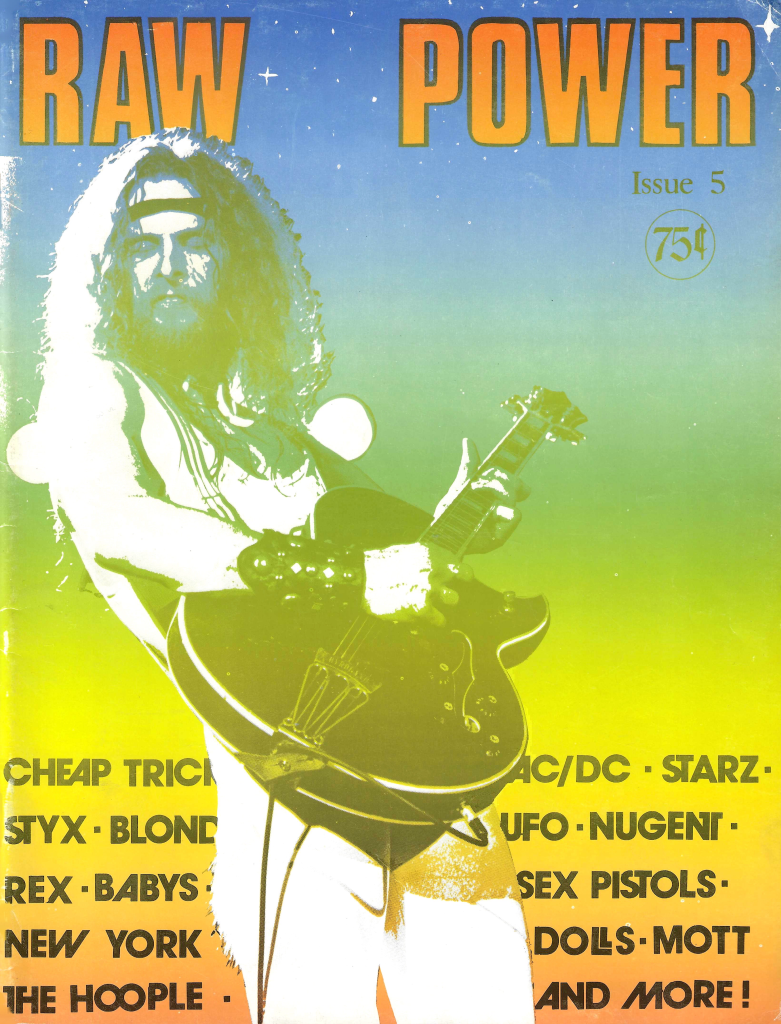
Raw Power #5

It’s been a little quiet around the Fanzine Hemorrhage blog for a few weeks, I’d reckon. This probably has something to do with me trying to modulate my reaction to just how badly I hate the internet in late 2025. I wrote a short essay about it called Opting Out Of The Rot Economy that you’re welcome to read, and perhaps take inspiration from. But there’s nothing in there that necessitates throwing the baby out with the bathwater and quit publishing entirely. This is the baby; social media is the bathwater, and that I’ve thrown out – so these posts won’t be promoted anywhere. They’ll just show up in your inbox if you’re subscribed – which you can do on the desktop version of this site rather easily if you haven’t already. If you’re not, they won’t, and someone will have to tell you about them, perhaps by calling you up on your telephone or by knocking on your door to spread the news.

The guys who put out Raw Power #5 in Spring 1978 effectively had just those means for getting the word out, aside from dropping them into LA-area stores and getting blurbs in other folks’ fanzines. These was effective methods in 1978, given the growing number of underground American fanzines taking off in the punk era and the fact that record stores were literally everywhere, and the cooler ones even carried fanzines. But if you’re putting Ted Nugent – the fucking Nuge – on your cover, you’re not really aiming to have Kickboy Face of Slash’s endorsement, or perhaps it’s even still too early to care. After all, these guys say that Raw Power is “For REAL ROCK ‘n’ ROLLERS ONLY”. If it’s loud and has guitars, it’s fair game.

The editor was a young man named “Quick Draw”. His real handle was Scott Stephens. He’s excited about “the new bands” in his opening editorial, but a little upset as well: “The only qualm I have at this time is the way the kids are branching off into little clicks. A lot of new wavers are down on bands like The Stones and The Beatles. It’s becoming very fashionable to hate the 60s”. I’ll say! “It’ll be funny to me in 10 years when I hear the new generation putting down the 70’s. And believe me, it’s gonna happen. Things that are cool now won’t be cool in 1985”. I don’t know about that. I like the use of “clicks” instead of “cliques”, which I say is forgivable, because it’s one of those words you’d hear spoken way more than you’d see written back then. But I don’t remember much ragging on punk or the new wave or power pop in 1985 – despite my belief that that was kind of a lean year for rock music, it was a year when punks were turning metal en masse, and everyone still hated the same things about the 70s that most of us hate to this day (though I’ll admit the recent reverence for prog did take me by surprise). 

Of course, I love quoting ancient editorials both here and elsewhere. There’s another by “Mike Livewire” stating “This year has certainly been one of the best for rock and roll that I can remember. Sterile FM ‘rock” and discoshit suffered some setbacks at the hands of the Rockers in 1977”. He even R.I.P.’s Peter Laughner later in the column! 

Al Flipside writes in from Whittier and has a little tete-a-tete with Quick Draw about the modern relevance of Iggy Pop. There’s a nice Mott The Hoople history, a quick interview with Debby from Blondie – whom the editor addresses as “Blondie” on the phone and asks her (of course) about being a “sex symbol”, the term we used back then for someone of well-above-average attractiveness. I’m not sure the last time I heard it used, but it’s been a while. There’s an interview with Tommy Shaw from Styxwhat? Howard Aronin has a pretty bleak comedy column reviewing phony records by real bands, through I almost cracked a faint smile at the idea of Kissongs by Kiss, a la Yessongs

I did crack a true faint smile at this rant from Kim Fowley at the start of his interview with Raw Power #5: “I am the king of punk rock. I am the Adolf Hitler of stink rock. I am the rock n’ roll dog man. I don’t care what Slash magazine, I don’t care what Greg Shaw, I don’t care what Rock Intellectuals say. Fuck you all. Why? Because I am teenage. I am cobra. I am garganchua. I am an asshole, but I can say that and you can’t. The only reason I’m in business is because of the money I make and the dirty girls I meet, and eventually the amount of power I will have”. He hates The Dils, but thinks “The Weirdos and Screamers are interesting because they want to be interesting”. Wait, all you have to do is want it? Why didn’t someone tell me all these years?

I tried to get excited about the Ted Nugent interview, in which Ted tries really hard to be an unhinged wild man, but at the end of the day, he wasn’t one-tenth as much fun of a pompous narcissistic asshole as David Lee Roth was in his interviews, and Ted’s music was far worse as well. There’s a brief feature on AC/DC (“AC/DC: Austrailia’s Amazing Punks”, spelled as I typed it) and an interview with Angus Young. The reviews section is, like I said, all about white guys who play loud guitars, no matter the genre: Rush and Sammy Hagar and The Ramones and Metallic K.O. and New York Dolls reissues and Nazareth and Ultravox and The Babys. In their Weirdos Destroy All Music review, they say “I wish the Weirdos would record some of their other songs, especially “I Dig Your Hole – I’m The Mole’”. What now? Who knows this song?? Not me. I’d like to hear your bootleg of it. 

Finally, there’s a brief column tracking the improvement of The Germs – “they’re not the world’s worst band anymore….but they still aren’t great”. And hey, here’s something I didn’t know before today: there’s an incredible archive of Raw Power issues online, as well as all sorts of information about an upcoming book project; a forthcoming seventh issue; backstories on the contributors and much much more. Go get lost in it, right now!

Sonic Viewfinder #1

Mike Faloon’s been orbiting my subcultural radar for a couple dozen years now; first, it was for the outstanding baseball fanzine Zisk, which he’s co-edited with Mike Fournier since the Miguel Tejada era. That still thankfully comes out with some regularity, and there’s a summer 2025 issue out now. They put out a book with some of their best material called Fan Interference some time ago, and if you’re a baseball dork like me, you’re probably going to want to read it.

Over the years I’d read between the lines and had gathered in various parts of their zine that both Faloon and Fournier were also very much “music guys”, but Faloon threw me with a great left-turn of a book in 2018 called The Other Night at Quinn’s: New Adventures in The Sonic Underground. It’s about moving during that time to a new small-ish town in New York’s Hudson River Valley with his family and discovering a local club in Beacon, NY called Quinn’s, home to improv and free jazz and regulars like Joe McPhee – whom Faloon has also recently co-written an oral history memoir for/with. 

The Other Night at Quinn’s was sort of revelatory for me, as it came at a time when I was trying (and succeeding) to go three or four steps deeper into free jazz than I’d gone before. Faloon’s real-time reporting of his many nights at the club, picking apart his own discovery process, and musings about what he’s hearing all matched much of my own way of hearing this stuff. Plus, it gave me a laundry list of players to check out, which I did.

He takes that same careful, probing, asking-questions approach for this just-out first issue of a new underground rock fanzine called Sonic Viewfinder #1. For instance, he goes to see the double-bill of Famous Mammals and The Spatulas at Tubby’s near his home, only knowing anything of either band from fanzines he’s read. Whereas my approach to writing about such a show would be to pack 12-15 pithy sentences into two paragraphs, larded with praise and maybe a laugh line or two, Faloon instead stretches out his impressions, interspersing them with wandering-mind tangents, such as callbacks to other records or books or barely-related topics, before oh-yeah-right returning to the bands in a “review”. (For the record, he loves both, as do I – I saw the former play live myself just two weeks ago). 

That’s pretty much what you can expect in the digest-sized, 28-page Sonic Viewfinder #1. The other two explorations are of musicians Damon Locks and Wendy Eisenberg, both more in keeping with the sorts of intrepid adventurers he wrote about with gusto in that Quinn’s book. The Eisenberg piece has me wondering why I’ve never gotten the Lasik surgery she did; perhaps I too could turn the experience of having done so into a double album. Faloon’s technique is a rare one in our content-addled, attention span-wrecking age. It’s one of consideration, questioning and humility – all worthy approaches, particularly when applied with care to hard-to-find music that deserves patience, reckoning and deep listening. Get a copy here for $3 if you want to see it for yourself.

Collected Ephemera – A New Thing To Look At

Hey, I wanted to let Fanzine Hemorrhage readers know that I’m by no means stopping what I’m doing here, but I also have a Substack that I recently created called Collected Ephemera. These work best by subscription, and you’ll get an email of each new post in your inbox as soon as I hit submit.

Collected Ephemera follows the same pathways this site does. It’s a deep dive into the paper, magazines and marginal collectables I’ve accumulated over the years, especially 60s & 70s political rabble-rousing, underground music, smut, hippy/biker stuff, postcards and much else. They are all sitting in plastic storage containers and, well, each of them has a story. I’m aiming to be one of the people who might tell that story.

Meanwhile, I’ve got a stack of interesting fanzines to write about on this site, but if you’re potentially interested in this other thing, you can subscribe to it right here.

Destroy LA #5

I’ve always wanted to own a different issue of this thing that has Circle One’s John Macias on the cover, because that guy was my hero. “Let’s Get Rid of Society”: an all-timer, am I right? “Destroy Exxon” is even better. Alas, I’ve only been able to procure this issue of Destroy LA #5, published in 1983 in Van Nuys, CA. 

It’s a wild hardcore punk fanzine that is somewhat undercut by a cover tagline that you see here of “Alternative Beat”. This is explained. Apparently the FBI was after them for their Destroy LA name (say what? Fuckin’ Reagan!) and so they’ll be changing it. But thankfully “…Alternative Beat seems to represent us better”. This dichotomy plays out throughout this issue, as we shall discover. However, I have found no instances of any subsequent fanzine that existed under that name. Perhaps this is for the best?

Alan Brown, Lyn Carvelli and Dan Mazewski were both the editors and entire staff for this one. Not only did they crank it out with a press run of 10,000, they put out an LP compilation of many of the bands featured herein called The Sound of Hollywood. I remember this one, one of the many utterly terrible hardcore comps that came out on Mystic, but man what a cover! It’s selling for $58 and up on Discogs now, likely because of two acoustic Bad Religion tracks.

Yes, about that. This issue catches Bad Religion right as they’re gearing up for the release of their prog rock album with the outer space cover, Into The Unknown, an absolutely legendary record that was so poorly-received the band immediately stuck their tails between their legs, veered right back into punk, and called its follow up Back To The Known.  In this interview, they are clearly already prepared for how hated they’ll be when Into The Unknown comes out. 

Brett Gurewitz: “L.A. is gonna disown us….even if one person buys it we will still have our life together….all I know is if no one does like it and if it bombs we’re still not gonna be dead…”. Greg Graffin: “If we continue playing ‘punk’ because we’re guaranteed to sell 20,000 records, we’d be selling out”. (unneeded note: Bad Religion subsequently released several albums that have sold over 500,000 copies; earned multiple Gold and Platinum album awards, and won a Grammy). Graffin also uses an expression I really haven’t heard since I was in high school in the early 80s when he says “Our first record sold up the butt”. This is a phrase which inexplicably means “a lot”. We should bring that expression back, I’m thinking.

Much of Destroy LA #5 has ultra-tiny type and some sloppy printing that makes it a tough read at times, but I was able to make it through the opening interview with Red Scare and found that this goth punk band had a female singer, which I didn’t know. Bobbi Brat unfortunately died of cancer a mere five years after this interview. There are also interviews with Shattered Faith; F-Beat, some rockabilly thing; and what’s billed as a “newer music” band, Still Life. This band features a guy, Paul Lesperance, who was the blonde singer fella with the bangs in ‘77-’78 Masque punks Shock – yeah – “This Generation’s on Vacation”, baby! His new band really, really wants a record company behind them, to “get a deal”. Alas, it seems that their only appearance on any sort of record at all was, um, Destroy LA/Mystic Records’ aforementioned The Sound of Hollywood compilation. 

Destroy LA #5‘s record reviews are brief, to the point, and I’m afraid are none too helpful. Regarding The Dream Syndicate’s The Days of Wine and Roses, the entire review is “A real promising band with a real good and fun stage show also”. This is followed by a page of MTV video reviews, including much of the new wave/synth pop stuff that I assume would likely have made up the bulk of any future Alternative Beat fanzine. 

Finally, I’ll let you go with some tidbits from the interview with Watty of The Exploited. He has several important opinions worth noting: “Philadelphia was shit, it’s all Crass fans or wankers”; “Black Flag played with us in Britain, they were pure wankers”; “I hate (Jello) Biafra, he is a wanker”; “Chron Gen are wankers, they’re shit”; “Chelsea? Gene October is a faggot, a wanker, a poof”. He also won’t even let the interviewer start asking questions until he takes off his Crass buttons. Worth finding this one for this single page alone.

Street Life #2

You can see that my 48-year-old copy of this one has what we in the business call a bit of “toning”. Nothing to fret about.

Street Life #2 is another early punk/”street rock” Lisa Fancher fanzine, much like this one, but quite a bit earlier, maybe even a full year earlier. Punk rock’s evolution tracked like dog years at this point, where 1 month was equal to 7 months of new releases, groundbreaking shows, instant haircuts, musical osmosis and general scene chicanery. 1977’s Street Life #2 weighs in with a pretty impressive lineup of contributors, with Bob Morris as the actual editor; Fancher as the assistant editor and chief writer; and Jenny Stern aka the soon-to-be-known-as Jenny Lens as staff photographer. And even a letter to the editor from our hero Eddie Flowers in Alabama right off the bat, too. 

You know, they’re actually calling that new sound of 1976-77 Street Rock in some places, which is marginally better than City Rock, I suppose. Seems to me the key band making waves in Street Life #2, aside from The Ramones, of course, are The Quick. The Quick! Like in the Screamers interview by Fancher with photos by Stern: “They came to LA hoping to make a splash when the entire scene consists of the Quick and….umm….the Quick”. Yet what I most enjoy about this early chat with Tomata and Tommy Gear is how it ends with “Be watching for a Screamers EP coming out on Street Life Records!”. We all know how well that went – about as well as Black Flag’s debut LP on Upsetter. (For the back story on the latter, I’ll just drop an amazing advertisement from No Mag at the bottom of this post; and The Screamers infamously never released a shred of music in their lifetime, always holding out for the better deal that never came). 

For more inexplicable things that actually did happen, Bob’s “Beat of The Street” column talks about Kim Fowley producing a Helen Reddy record. Sally Dricks does a long hero-worshippy review of Bowie’s Low, and teenager Fancher, who also did layout for Street Life #2, throws in a large-font “best yet – LF” just to ensure her voice is also heard on the matter. There’s an entire column talking about the debauchery at a Ramones after-party at the “Screamers house” in Hollywood, and then another column flipping out over The SaintsI’m Stranded. This is accompanied by a phenomenal Stern photo of The Ramones from that 1977 gig with Blondie at the Whiskey – this one. Someone make me a poster of that thing!

Sex Pistols land on the cover because the talk of the nascent punk world was revolving around the “bad words” they said on England’s Bill Grundy TV show in 1976. Given that these are fanzine people, there’s also a long Greg Shaw interview that allows him to expound upon his theories of musical evolution, the winds of change heralded by punk, the importance of fanzines, Peter Frampton and more. And then the big surprise as I’m going through it is how it all comes to a jarring halt with about 8 pages left to go, and morphs into record collector set sales and auction listings. This is something I might have expected from Goldmine, but not from an urgent fanzine from the streets.

Record Time #3

Record Time tracks, measures and elucidates upon the long tail of analog musical history in a manner unlike no fanzine before it. It’s not here to champion the “winners”, although some of what it champions are indeed winners. It exists to cover anything that you’d likely find in a thrift store, a shitty record store or at a garage sale, and that you’d likely be able to buy for the price of 1 or 2 Venti no-whip lattes. I gave a bit of detail on its modus operandi in a bit I wrote on Record Time #1, and now we shall briefly explore the latest issue, Record Time #3, because it could very well be the best of a fantastic trio.

Editor Scott Soriano has an omnivorous and over-active brain, clearly, and this has powered a record fetish that knows few bounds. He’s turned me onto so much treasure and trash over the years. His Crud Crud blog in the 2000s was the digital embodiment of what Record Time is attempting to accomplish, and I loved that thing so much that I made myself four outstanding mix CD-Rs from the mp3s I’d hoovered up from him back then. When he wants to go deep, he absolutely goes deep, as in the Plastic Bertrand-inspired records piece in #1, the Sex Pistols novelty & backlash records thing in #2, and this issue’s absolutely absurd and breathtakingly complete overview on mainstream artists who decided to dip a toe into “punk” in the late 70s/early 80s.

Like how could I forget Alice Cooper’s Flush The Fashion LP from 1980, produced by Roy Thomas Baker (!) and with a “punk party platter” of song titles like “Clones”, “Model Citizen”, “Nuclear Infected” and “Pain” (no, sorry, not this Pain). Or that The Tubes had a whiny song called “I Was a Punk Before You Were a Punk” that insecurely recites all the ways in which their mid-70s zany costumes and trash debauchery schtick helped bring San Francisco punk rock to life in 1976-77? And Soriano briefly relays the tale of Van Halen turning into Scottish punk band “The Enemas” for one night in 1977, a story you can read more about here. This is why we spend $15 on the mostly ad-free Record Time magazine, folks.

There are well over a dozen deeply-researched and well-written pieces in here by a plethora of contributors, so I’ll restrain myself to conveying a couple big highlights. “…The worst thing that happened in 1973 was a TV special and accompanying album which only those outside of a handful of die-hard diva fans and enthusiasts of shitty records know about: Barbra Streisand…and Other Musical Instruments”. Soriano then proceeds to describe this atrocity in painstaking detail, a record and TV special that seems to have almost totally disappeared from the Streisand legend. You must read it, and then you must watch as much of the special as you can handle. Those were different times.

Chris Selvig’s piece on and record-by-record dissection of Colorado 80s-90s improv-skronk destroyers Blowhole was quite welcome, and he even brings the band back together to rehash the good times over a microphone. Somehow I’d never known the story of boyfriend-murderer and 60s easy listening fox Claudine Longet, but “Johnny Sunshine” relays it all here, and in true Record Time fashion, also feels the need to assiduously evaluate the relative merits and demerits of each of her 99-cent LPs, currently sitting in bulk at a Community Thrift near you. 

And look, I’m even in this one, briefly. Soriano sent out an entreaty last year to a few folks he knew, asking them to pick one 80s SST record from the 1986-88 glut that they like, but not the popular ones, so no one was permitted to slop out another paean to Sonic Youth, Dinosaur Jr or Bad Brains. I picked Das Damen’s Jupiter Eye, and I stand by it. $4.71 on Discogs. There’s a real cast of heavy hitters picking theirs here as well, including Gerard Cosloy, Tom Carter, Brian Faulkner, Bill Chen, Mike Trouchon, Ryan Wells, Karl Ikola, Chris Selvig and other top-drawer stars of the scene. Some picked the album I should have picked, but naturally no one picked Swa. Of course not.

“They” tell me that Record Time #3 is finding its audience more limited than it should be, which would be a goddamn crime. There’s really nothing else like it on the planet. Jarvis Cocker even writes for it. I don’t really know who that is, mind you, but he writes for it, and perhaps that’s all the inspiration you’ll need after my yammering to go seek this one out.

ChinMusic! #1

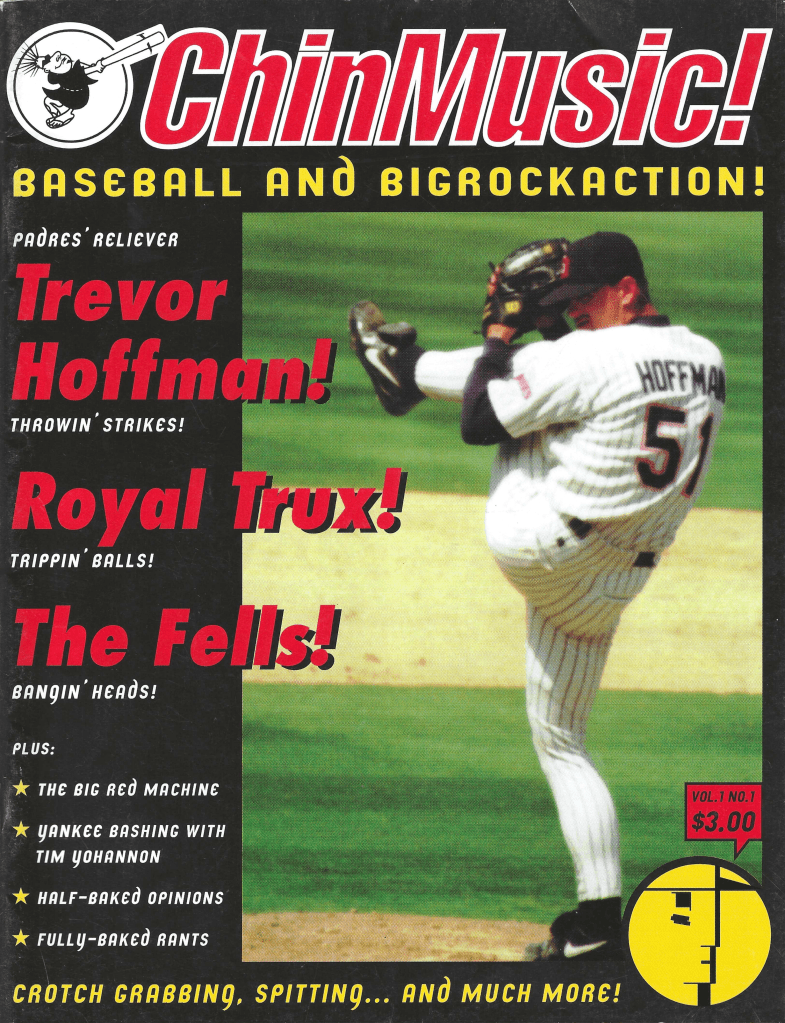
I remember my actual glee when I discovered this issue at Cody’s Books in Berkeley, CA in 1997. Baseball and punk rock, two of my lifetime passions, together in one fanzine. This was in the glory days of “the magazine”, no doubt about it. Cody’s had a magazine section that went on forever; just the underground music stuff alone was packed with your ChinMusic!s and your Pure Filths and your Superdopes. Man, when I was in grad school in Seattle during 1997-99, there was an even better magazine emporium on University Avenue that I’d while my time away in between classes. The place was unreal; every possible publication angle about every sub-genre was covered and available for purchase. My favorite was a golfing magazine targeted at hipsters/dorks, attempting to make golf attractive to the same sort of folks who enjoyed tiki bars and vintage 50s fashion. (No matter how hard I search Google for variations of “90s golf magazine for hipster doofus morons”, I can’t find this title). Or the computing magazine that put pornstar Christy Canyon and her internet-worker sister on the cover

So why not a ChinMusic!, right? The Venn diagram of rocknrollers and baseball fiends overlaps far more than one might have thought – in fact, that’s the magazine’s entire stated reason for being, as explained in ChinMusic! #1’s opening editorial. It’s funny how often in this magazine – I also have other issues – that I’d come across one of their interviews with a big-league ballplayer and get totally excited that he was a punker, only to find that, like the great Trevor Hoffman in this issue, they’re really just music guys. In the way that we are “all” music guys and gals. “I got a little Van Halen, I got a little Alanis Morisette, Metallica’s in my glove compartment, I got a little Country music, I think you’ve got to be able to listen to everything”, says Hoffman. Everything, Trevor? So where are your Siltbreeze CDs and It’s War Boys mixtapes, then?

I know I was initially pretty excited, when I spied this mag, at the notion that Tim Yohannan, my bête noire, would be talking baseball inside. Humorless, pedantic Tim Yo talking about hating the Yankees and how to break in a new glove? Sign me up. And for what it’s worth, I personally interacted with Yohannan several times before his untimely death in 1998, and he was neither pedantic nor humorless at all; kind of a fun dude, to be honest! I was just scarred from all the teenage hours spent listening to his between-music struggle sessions on MRR Radio in the 80s, and feeling like he and Jeff Bale, Jello Biafra, Ruth Schwartz and “the gang” would have been the most insufferable people imaginable to spend five minutes with. But Tim Yo loathed the Yankees and he loved the NY/SF Giants – just like me. Does it bum you out like it does me that he passed away from cancer at the unripened age of 52, younger than I am now? If you’re my age, didn’t you see him as an “old guy” when he was around? It’s just a cosmic joke, isn’t it. All of it. 

Kevin Chanel was the editor and prime idea man here, and he’d recently arrived in San Francisco from San Diego, hence some of the Padres-centricity here. There are two pieces in ChinMusic! #1 that really stand out for me: first, Chanel’s baseball water cooler blather session with none other than Royal Trux’s Neil Hagerty. No music, just ball. It’s outstanding. It reminds me of the sorts of multi-beer baseball nerdouts I’ve absolutely loved to engage in over the years with co-workers, family members and really anyone at all, blue collar to white, with sports being the great leveler and all that. Hagerty really knows his stuff, and it’s just a gas to read him talking about his beloved Orioles and whether Keith Hernandez will get into the Hall of Fame, rather than astral nonsense, drugs, and Brownsville Station. 

Pete Simonelli contributes a piece about the mid-1970s Cincinnati Reds, specifically those 1975-76 “Big Red Machine” teams that were incredibly formative for me, Simonelli, Tim Hinely, the Zisk guys, Gerard Cosloy and probably several million others who were deservedly awed by them. Any chance I get to read about Cesar Geronimo, I’m going to take it. Darby Romeo interviews her dad about baseball; he probably wasn’t 52 yet either – and there’s a variety of music coverage that, like that of Great God Pan, is to my eyes very much secondary to the main event, which is baseball and its intersection with punk rock, even when it’s tenuous, tangential and maybe not even there, but we’re pretending that it is. Hey, the dude from Scared Straight, one of Mystic Records’ lesser lights, played in the pros – that really happened.

Funny enough, Chanel, whom I’ve never met, ended up marrying and procreating with Sunny Anderson (Girlyhead publisher, a delightful woman whom I have met many times, yet not for over thirty years). The two of them literally live down the street from me. It has been reported to me over the course of the past ten years that they have seen me running and/or walking the dog, and that their daughter knows who my son is (I mean of course she does, he’s Jay Hinman’s kid). And yet we’ve never once talked about Randy Jones or Broderick Perkins or Juan Eichelberger. When the time comes, well-armed with 50+ years of baseball ephemera and deep study through excellent secondary sources such as ChinMusic! #1, I will be ready.

New York Rocker #4 (September 1976)

I’d recently vowed in these pages to cobble together a ‘lil NY Rocker collection, and I’ve been making good on this important promise (to myself). Yet I’d never, ever seen any ones with this typeface, one of the first four mythical issues, in the wild – that is, until I came upon New York Rocker #4 and struck up a bargain with its seller at the 2025 San Francisco Art Book Fair. This 1975-76 era is one of my favorites for rock music writing due to its anticipatory excitement, with much undefined underground exploration in the air and on the fuckin’ streets, with absurd decadence and drug bottoming-out the norm. Nowhere was this more the case, of course, than in New York City. 

I don’t really know a whole lot about cover star Cherry Vanilla, except that she was central to the first moment I ever become acquainted with “punk rock”, her famous “Lick Me” photo having been part of Time magazine’s July 11th, 1977 punk rock article that absolutely blew my mind and maybe scared me a little bit at the age of 9. Her interview here is sober, reflective and humble, and it’s a far cry from the she-devil harlot I’m sure imagined her to be when I saw that photo. Still not quite sure what she did in the grand social whirl of the time, though this bio is a start. This is followed by a Duncan Hannah photo sesh with Andy Warhol and Talking Heads at The Factory on May 26th, 1976, and then a terrific article & photos of John Cale at the Ocean Club in July ‘76, with one Lou Reed backing him up, and a hopped-up Patti Smith jumping on stage, unasked, multiple times to get involved.

Hilly Kristal, CBGB proprietor, pens an article about his own Live at CBGB Vol.1 comp, with special praise for The Shirts, Tuff Darts and Mink De Ville. Me, I’m just glad that there was a band called The Shirts at one point in history. They look like total street rockers with matching white jumpsuit/pant combos – outstanding. There’s an exceptionally catty gossip column called “Pressed Lips” by Janis Cafasso, whom I understand may have been Johnny Thunders’ girlfriend at one point in time and features in various Dolls lore I found online. I wonder if she ever did illegal drugs? Her column is a gem – honestly, this sort of real-time lens into at-the-moment scene machinations is a far better history lesson than anyone’s dimly-remembered memoir. Here are a few of her insights from the Bicentennial summer:

  • “Where have all the groupies gone? Not much time from shaking go-go these days I guess. Money first, sex second. Tsk-tsk, calling Sable…”
  • “By the way, Richard Hell, the king of crinkle (somebody please find him an iron) has gotten a new group and now for some serious attempts at sound??? God loves all the bewildered beatniks!”
  • “Two nights in a row the Mael brothers, as in Ron and Russell, could be seen ogling little Tina of Talking Heads…”
  • “Can we please put Bobby Blane, the new Dolls organist in a straightjacket and nail his shoes to the stage so he doesn’t have to offend the audience with his mincing and peacock strutting. Best quote of the evening in reference to Bobby Blane was from Wayne County who said ‘I just loooove the Dolls new lead singer’. And that about sizes it up. Two Mick Jaggers in the same group is a bit much!!”. 

Great stuff, am I right? Just for some context, the David Johansson-led final-wave of the NY Dolls were running on fumes at this point; Johnny Thunders’ Heartbreakers were reemerging in a big way; and Richard Hell’s “new band” talked about here, post-Television, would of course be Richard Hell & The Voidoids

But wait, there’s more. Victor Bokris has a short story called Coffee Shop; he’d go on to write biographies of several of the folks we’ve already mentioned here. Milk & Cookies get very defensive: “We just don’t want to be known as a wimpy, trite pop band”; “We’re not the Bay City Rollers”; “There’s some meat to our songs”. You be the judge! By far the most interesting piece to me, after the gossip column, naturally, is the deep dive by Craig Gholson with Richard Lloyd of Television. He talks about some early Television songs he sang, like “What I Heard” (great!!!) and an “X-rated” one called “Hot Dog”. He talks about the break he took from the band “to straighten out some personal problems” (i.e. drug addiction). He speculates what might be on their upcoming debut album; “Kingdom Come” is discarded for being too long and “Double Exposure” for being too old. Titles, too, have been rejected: See No Evil and Repeatinginging (whew on that last one). 

And more! Sneakers from North Carolina (Chris Stamey, Mitch Easter etc) get what I imagine was probably their first interview; The Runaways get a dopey one as well; there’s a great posed photo of The Heartbreakers, we get a wacky check-in with The Ramones, already olde-timers by this point but still with only that first LP out; and New York Rocker #4 closes up incongruously with Lance Loud’s paean to Robin Williamson of The Incredible String Band, mounting a comeback or whatever you’d want to call it with his “Merry Band” in New York City that month. What a time to be alive, the quote-unquote old struggling to stay relevant and the new struggling to be born, and everyone still under 35 years of age.

Revolutionary Wanker #1

I hadn’t known this free 1981 San Francisco xerox zine existed until alerted to it by the good folk at San Francisco’s Groove Merchant, who seems to get his hands on just about anything and everything interesting these days. What’s more, now that I’ve procured my own copy of Revolutionary Wanker #1, I come to find that it’s a “Creep Production”, backed by the one and only “Mickey Creep” of Creep. How about that?? The editors listed on the so-called masthead are Naomi Batya and Robin Lande, about whom I can turn up very little on the internet, unless this is the same Naomi Batya who wrote a Hebrew folk tune at age 14 and grew up in Mendocino County, just north of SF? The dates for a San Francisco punk rock rebellion line up well!

This arrives at just the right epoch to document the uncomfortable gelling of hardcore punk and SF’s strange post-punk underground, the latter epitomized by Toiling Midgets and Flipper, and celebrated with relish in the Who Cares Anyway book. The Wounds, who played the 1981 Eastern Front fest in Berkeley’s Aquatic Park – the place that became my daily skip-work-early running route during the five years I worked in nearby Emeryville – with the aforementioned, are interviewed here. So are 7 Seconds. They were from Reno, and were basically children at this point, with no vinyl out yet and more shows in SF than in their hometown. They’d soon put out the Skins, Brains & Guts EP, with all-timers like “Racism Sucks” and “I Hate Sports”. Neither interview is particularly illuminating, and it stands to reason that the amount of intellectual effort expended toward Revolutionary Wanker #1 was measured by the monetary reward expected from it, which was quite little, given its price of $0.00.

To wit, “Joan Moan” writes a piece about poseurs, and how they’re “destroying the ‘scene’ from inside-out”. This essay is thankfully leavened by a nice unexplained “Flipper Rules Fools” piece of graffiti next to it. Naomi Batya – who, given this evidence, couldn’t have been the one to write that Hebrew folk tune, provides a poem called “Most People”, that ends with this stanza:

Most people I meet have fucking no brain
No wonder they consider me fucking insane
Believing what they’re taught that it’s wrong to use their head
Most people I meet they might as well be dead.

Holy shit! Drop the fucking mic, Naomi. The address listed for this one, presumably where Naomi wrote these words, is 41 29th Street in the Mission District, about two miles from where I’m sitting right now. I know this house. Here’s what it looks like today. This debut issue ends with an interview with “two anarchists in the Haight”, who’ve asked to remain anonymous. I guess there was a group at one point who called themselves Mindless Thugs who embarked upon a terror campaign against Haight Street merchants, in response to being called “mindless thugs” in the first place by local media. Or something like that. I really can’t understand the coded insider language of 1981 anarchists, to be fair. And I really don’t get the connection to Creep magazine at all for this thing.

So, do I now need to own the other three issues of Revolutionary Wanker that came out after this? Is Ronald Reagan going to start World War III??? Of course I do. This is subcultural gold.

(BREAKING: multiple sets of all four issues of Revolutionary Wanker are for sale right here, directly from the source)

Hairy Hi-Fi #3

Sometimes I get a little downhearted when I come to realize how much of the written, printed word of the 20th century will never be re-collected nor again adored by anyone beyond fanzine and magazine aficionados, or those willing to regularly pop open PDFs and read on a computer/iPad. I’m both of those things, but I know I’m part of a relatively tiny audience. I ache not merely for this major leakage of primal music journalism, but for all the “new journalism” of the 60s and 70s you won’t be reading; the film writing mostly lost to time; even the uncollected short fiction you’d find in literary journals, weekly magazines and mass-circulation monthlies. 

If there was a market for it, I’d want to lead the charge to get all of it into new print editions, a series of my own, paid for by a major publisher. We’ll have to settle for the very few curators who actually do this, like Dian Hanson does for absurd men’s pin-up/girlie magazines of the 50s-70s. I myself have a small collection of these and they’re often a phenomenal window into male libido, male fear of women, and – at times – swashbuckling fiction or advocacy that’s often quite readable, if dated in the extreme. You can learn a great deal from issues of Rogue, Sir!, Dude, Adam, Stag, Man, Spree and Hi-Life, let me tell you.

If I did something for music fanzines, I might put in the Moe Tucker interview from Hairy Hi-Fi #3, published in 1990 by John Bagnall in Durham, England. It’s exactly why I still want to read, and re-read, my old fanzines, and transmit my half-baked transmittals about them to you. This interview captures Moe as she’s come out of motherhood-driven seclusion and is now playing with Jad Fair and members of Half Japanese, touring the UK and coming to a reckoning with her Velvets past. To me, it’s an essential piece of Velvets ephemera. She’s still tight with Lou Reed and Sterling Morrison, and talks a bunch about coming across Velvets bootleg tapes and LPs at swap meets in the UK on this tour. She’s a little stupefied: “There’s one called Sweet Sister Ray that’s like four ‘Sister Ray’s!”. Interlocutor Marc Baines has to coach her to demand the tapes; she does, nicely, and gets a full armload to bring home.

What’s funny about this piece in particular is just how much more Baines knows about her legacy and post-breakup Velvets ephemera than she does, so it’s a real treat to get her reaction. “They did??!?”. “He DOES??!?”. It makes me love her all the more. Hairy Hi-Fi #3, which to me reads like a psych-tinged cross between Galactic Zoo Dossier (mostly handwritten as well!) and late 80s Flesh and Bones (lots of comics and cut-out 60s hippies ads), adds in a great piece about Romulan Records – remember those? Following in the then-current tradition of excavatory bootleg labels with names like Strip and Link, they were best known for the Girls in the Garage comps, but released a slew of other wild vinyl comps of lost 60s stuff. This piece catches the label early in their run, and reviews everything that had come out to that point that Marc Baines could grab. It’s a true piece of fandom and obsession that I salute with gusto. 

Elsewhere, there’s another fantastic interview present – this one with Eugene Chadbourne, a great talker and storyteller. This one needs to go in an anthology as well. The editors have severe mania for all things Shimmy-Disc and B.A.L.L., and follow the latter around England as they play various gigs, then learn after they leave that they’ve broken up, with members of the band joining Dinosaur Jr. (?). I remember this too, but can’t call up the particulars at all. Seems to me Dinosaur Jr. carried on just fine and mostly the same for years afterward. There are also interviews with Laughing Soup Dish and Walkingseeds, about whom I remember a bit more, but whom I haughtily dismissed for the most part. We had Pussy Galore and the Lazy Cowgirls and Mudhoney and the Laughing Hyenas and World of Pooh and The Dwarves active and raring at the time, and that’s precisely where my head was.

Hairy Hi-Fi #3 doesn’t really rise to the occasion reviews-wise, since most everything is “great”, and we all know that’s not true. It’s those interviews that makes this a superlative read and a highly welcome piece of reference material I’ll hang onto for at least another decade or two, before I unleash the entire fanzine archive onto eBay or magnanimously give them to Penelope Houston’s punk room at the San Francisco Public Library.

Puncture #9

When all the dust clears, when all the debates are finished, when all the fists stop flying – what will you say was the best San Francisco music fanzine of the second half of the 1980s? I feel like the contenders were probably BravEar, Wiring Dept and Puncture, right? Unless I’m forgetting someone. These three fanzines were the most adventurous in terms of traversing the wider underground and going deep where necessary, and yet all three suffered a bit for their overtly sleeve-wearing left wing politics, and for pandering a bit too heavily to quote-unquote college rock at times. But listen, I did myself at the time, no question. That’s why I still own copies of all these mags that I bought during 1984-87. I think it’s probably a pretty easy call at the end of the day: Wiring Dept, then BravEar, then Puncture

Said the guy who’s here to talk about Puncture #9 from Spring 1985! We’re not talking about Forced Exposure or Conflict levels of quality, taste and information here – those east coast zines really set the standard during this period in my unforgiving eyes. I mostly like Puncture, though, and I believe the value-for-cost quotient you’ll get from this book of their first six issues is pretty high, at a mere $14.95 a pop. Patty Stirling was really the main driver behind this one, and of all of the fanzine’s first, I don’t know, 10 or 11 issues? Then it really did become a true alterna/indie/Lollapalooza abomination that I don’t think she had anything to do with. (Although looking at these covers, any fanzine with a “Remembering Flipper” article couldn’t have been too hideous). 

In the rado update that kicks the thing off, it talks about how Ray Farrell is leaving the Bay Area and KPFA to go work at SST in LA. Weren’t we just talking about that guy? The interview with Test Dept is quite standoffish and a little pretentious, and yet I actually come away admiring these UK proto-industrial performance art freaks and maybe wanting to see if I might like them 40 years later. Sure, it’s fine. It brings KFJC’s Mark Darms and his Industrial Report radio show from those years screaming back to life for me, which is great. The thing in here on the Violent Femmes isn’t too annoying, either – you have to remember, that second album of theirs, the one where frontman Gordan Gano “found Jesus”, was not received well by the frat boys who partied their asses off to “Blister in the Sun” and “Add It Up”, but there’s some love for it here, along with Gano’s religious side project The Mercy Seat, which I guess I never heard, because I absolutely loathed the Violent Femmes. 

Aaaaaaaah and there’s a review of Husker Du / Minutemen / Meat Puppets (no Saccharine Trust or Swa??) from The Stone in San Francisco, 3/1/1985. This was SST’s celebrated “The Tour”, and a show that took place here and at the Keystone Palo Alto the night before. It was my senior year of high school, and my friends weren’t really cottoning to the American underground the way I was, so I didn’t go despite really wanting to. San Jose State’s station KSJS was playing Double Nickels on the Dime and New Day Rising incessantly; Palo Alto was a mere 30 minute drive from my home in San Jose, and my parents were definitely in the “we don’t care what you do” phase of my youth. But go to a show by myself, at age 17? Absolutely not, out of sheer embarrassment and introversion. So I ended up never seeing The Minutemen, Husker Du nor Saccharine Trust. It is no consolation whatsoever that I did, in fact, see SWA live on stage several years later.

There are great pics of Sonic Youth from a 1/14/85 show at The I-Beam, and kudos to Patty Stirling for finding a way to compare them to both Hex Enduction Hour-era Fall and The Stooges. She also contributes a fantastically ludicrous meathead drawing of an ultra-buffed Henry Rollins to her Black Flag reviews. Other reviews abound of the Cocteau Twins, Billy Bragg, Aztec Camera, Rank and File, Einstruzende Neubauten, This Mortal Coil and all that SST stuff – this was 1984/85 to me at the time, and from my vantage point of Gunderson High School in San Jose and especially from my bedroom’s clock radio, it was “magic hour”. I couldn’t have been more excited about music, and I had so much still to learn. (I still do). I would renounce virtually all of it in the year to come, once I got to college, except for those SST bands and my newly-discovered Homestead and Touch & Go heroes, and all that blitzing hardcore I’d been too chicken and/or broke to actively buy circa 1982-83. Now I can go back and very much enjoy the Cocteau Twins and This Mortal Coil, as well as a few others whom I never strayed from, such as Siouxsie and the Banshees – still a Fanzine Hemorrhage favorite to this day. Listen!

I guess Puncture ended up capturing the time better than I thought. I mean, here’s this issue’s back cover, pictured. Flipper! I suspect this is where I stole a thing I did in my own Dynamite Hemorrhage fanzines of putting a band photo of someone not even talked about in the issue on the back cover, then letting readers guess who it is. Let’s go Wiring Dept/Puncture/BravEar, then. What say you? What high-quality Bay Area fanzines am I missing from this time?

Twist & Shout #2

When punk first hit North American consciousness in 1977, I get the picture that unless you were living in New York, Los Angeles or San Francisco, or perhaps Seattle and Cleveland, the records you were coming across in stores and were hearing on late-nite “new wave” radio programs were almost entirely English in nature. This 1977 Montreal fanzine, Twist & Shout #2, certainly aspires to be Anglocentric in the extreme; or, whether it aspires to be or not, it most certainly is. Canada is part of the queen’s commonwealth, of course, but just based on the features and records reviewed here, it feels a lot like a Canadian version of Trouser Press, who were proud Anglophiles, and/or one informed very much by Britain’s own Zigzag

Nothing wrong with that, of course! If you were desperate for raw and wild rocknroll and all you could find were Cortinas and Boys and Johnny Moped records, of course you’d be going for it. In fact, Twist & Shout is one of many “searching for real rock and roll” fanzines from the 1974-77 time period, written by young men and sometimes women, desperate for raw guitar and who were starting to blend newly-arrived punk into whatever was considered frenzied, urgent and/or “street level” beforehand. Although, I must say Twist & Shout really stretches the concept, as we’ll discover.

Like a few of these ‘76-‘77 mags, such as Chatterbox and Radio Free Hollywood, there’s a continued allegiance to “hard rock” writ large even as punk is crashing upon their shores, and more power to them for it. The first interview is with Sean Tyla from Ducks Deluxe and Tyla Gang, the latter of whom were a boogie/proto-punk hybrid of sorts and fit in nicely with this mag’s aesthetic. I suppose so do Ultravox, a brand-new UK band on Island. John Foxx is interviewed. That rollicking ‘77 version of the band, as many well know, bears virtually no relation to the Ultravox many new wavers came to know and love only 3 years later. 

Pat Traversthe “Boom Boom Out Goes The Lights” guy??!? – does get some ink due to being Canadian, and for being a fine boogie lickmeister besides. And I love the interview with Terry Wilson Slesser, a class-A prima donna from the UK band Crawler, formerly known as Back Street Crawler. I’ve never heard of them. “Then we went to Kansas to open for Roxy Music. With our rock and blues approach we literally blew Roxy off-stage”. He then talks about guys in his band named “Sniffy” (wonder how many snowstorms that guy had to instigate to get that nickname!) and “Rabbit”. After the death of Crawler guitarist Paul Kossoff, it appears that Atlantic Records were trying to get them a new guitarist, and Mick Taylor from the Rolling Stones was suggested by the label. “I said Mick Taylor ain’t going to join Back Street Crawler. He joined the Stones after Brian Jones’ death; can you imagine him joining us after the death of Paul Kossoff? I did call him up and we got together and got pissed drunk, but there was no way he was going to join”. He then talks about how they might be going out on tour to support Kansas, one of the no-doubt worst bands of all time (and absolutely legendary hair farmers – please click the link), and how awesome that would be. So no, I really didn’t need to hear Crawler. But I listened anyway, and if you want to, you can too.

There are, in fact, a fair amount of interviews with Englishmen in Twist & Shout #2. We’ve got chats with Eddie and The Hot Rods, The Vibrators, Judas Priest (!!), Heavy Metal Kids (they’re extremely concerned about whether or not they’ll be able to “make it in the States” – spoiler: they didn’t); plus Mr. Big, David Essex and Goddo. Punk explosion! There’s also a minimal discography of all the known (to the editors) 1977 punk 45s so far – or, really, as they put it: “Various artists considered new wave or punk”. This includes Ultravox, The Stranglers and of course everything on Stiff and Raw Records (the latter of which was one of the great UK punk labels for sure). There’s absolute slavish worship of the newly released Never Mind The Bollocks (“album of the decade”, “people will worship this the way they worshipped The Beatles in 1964” etc), as well as reviews of Brownsville Station, Meatloaf, Ian Dury, Motorhead, Boomtown Rats and even that Raw Records Creation “Making Time” 45, something that I proudly used to own and somehow don’t any longer.

Finally, we get a mention of the only true Canadian punk in the issue: The Viletones’ debut Screamin’ Fist 45, reviewed by John Kearney: “This is Toronto’s answer to punk. They are The Viletones. Isn’t that name just right for a punk band and aren’t those titles fab. Just listen to the names of the guys in the band: Dog, Chris Hate, Freddy Pompeii, Motor X. It’s all there: the group name, the titles, the guys’ names in the band, the great picture sleeve, even the music, it’s pure punk. The only problem with it all is that it’s bloody awful. It shows that the best packaging etc. can’t replace talent”. This is about as withering, spiteful and worked up as a Canadian can get, I reckon. Aren’t they just the nicest folks?

Sound Choice #8

Before we dig in here, a little history of how Sound Choice fanzine came to be, before I’ll spoil everything with some incredibly self-aggrandizing prattle about my minor role in this particular concern.

So there was OP magazine for the first half of the 80s, published by John Foster out of Olympia, WA. We’ve written about that excellent mag here and here. It then split into two new fanzines. As per Wikipedia: “OPtion, along with Sound Choice, were the dual successors to the earlier music magazine OP, published by John Foster and the Lost Music Network and known for its diverse scope and the role it played in providing publicity to DIY musicians in the midst of the cassette culture. When Foster ended OP after only twenty-six issues, he held a conference, offering the magazine’s resources to parties interested in carrying on; attendant journalist David Ciaffardini went on to start Sound Choice, while Scott Becker, alongside Richie Unterberger, founded Option. Whereas Sound Choice was described as a low-budget and “chaotic” publication in spirit, Option was characterized as a “profit making operation” right at the start, meant to compete with the newly founded Spin.”

Which is precisely why, circa 1987, I had never bought a copy of Option. Never owned one later either, I guess. Sound Choice hadn’t really shown up on my radar, except as something I’d seen in stores, as it was pretty well-distributed. But cassettes, tape art, “audio evolution”? No thanks, amigo. However, one time when I was doing a 2-6am substitute radio show at KCSB-FM in Santa Barbara during my college years, I met the DJs who came on before me, and it was a couple of the fellas from Sound Choice, including editor Ciaffardini,  who lived “just down the road” in Ojai. 

We got to talking, and wouldn’t you know it, within a couple of months I was hoofing it south on the 101 to Ojai a couple of times a week after college classes, in order to serve as Sound Choice’s one and only “intern”. I’d sort (and abscond with) many promo records; I’d answer correspondence; I’d chase down subscribers for renewals, and completed many other tasks assigned to me upon arrival. One time I even called up Ray Farrell at SST Records to talk about getting their ads submitted, and was nervous as hell – that dude was on the fucking Maximum Rocknroll Radio show!! Soon enough Ciaffardini made me “Managing Editor”, I think in the issue after Sound Choice #8. Then, not even a year later, when I stopped coming regularly, he had me listed as “Vanishing Editor” in the issue that followed that one. 

For what it’s worth, Ciaffardini was an incredibly nice guy: a highly driven, self-effacing, pot-smoking, chaotic and supremely independent nice guy with a mellow hippie temperament, who took me under his wing and gave me exposure to something cool that I’d never have experienced otherwise. He had a girlfriend named Eileen, a (to me) “older woman” who might have been at most 35 years old at the time, and whom I was secretly smitten with. When I stopped coming around, it was about the time Dave’s KCSB program ended as well, so I’m not sure that I ever saw him in the flesh again after 1988. Only a couple of years ago did we even make any sort of electronic mail contact.

Sound Choice #8 came out in May/June 1987, and features The Butthole Surfers on the cover, from their show at the Oxnard Skate Palace that year that I’ve previously talked about here. It also includes action photos of fuckin’ Blast! and SNFU from this other Skate Palace show, which I also attended. The magazine is the proverbial “hodgepodge” – a tumultuous cacophony of fonts, font sizes, advertisements, short articles, long manifestos and an ungodly amount of reviews. In addition, there are several incredibly unfunny comics; things on underground radio and “audio drama”, a Culturcide interview, a piece on Master/Slave Relationship (a woman named Debbie Jaffe who dressed scantily and did psycho/sexual performance art); and SST ads everywhere, like 8 pages of them, no lie. Nothing that I’d sold, however – that came later. The magazine’s cacophony is mostly to its credit, and it makes for much to uncover and dissect within the tiny type.

Oh, and there’s a real nice letter from Lisa Fancher of Frontier Records, who’d perhaps been taken to task in an earlier issue for being too major label-adjacent, and perhaps for not paying artists (I’m too lazy to see if I have Sound Choice #7 to look at it): “Would you care to produce someone who hasn’t been paid by me, fuckhead? You suggesting that I bend for anyone, even as a figure of speech, will land you a punch in the mouth next time I have the misfortune of hearing you blather at some function where everyone is dreading running into you”. She then concludes perhaps a little tartly with “Go fuck a dead dog”. Oh dear. Ciaffardini apologizes. He never told me if Fancher ever actually popped him in the mouth at a banquet or social gathering in subsequent months.

There’s also a piece by a guy whom we know about now, but didn’t then – Randy Russell from Kent, OH. He was in the excellent band Moonlove, and here he talks about the magic of tapes and how he first heard the Dream Syndicate. Shane Williams contributes “Growing Up Absurd: Confessions of a Dope Addict Rock Fiend”, and thankfully it’s one of the few coherent pieces he ever put together. And yeah, the reviews section is the most bountiful one I have ever seen this side of Butt Rag, but it generally lacks the authority, tastemaking and writing chops to be anything more than words on a page. Yes, this is very much true of the ones I wrote for this same fanzine at age 19/20 in subsequent issues as well. Don’t look them up – you won’t like them.

Summer Salt #3

A period of lengthy inactivity on this site by me should not generally be held as any indication of any lack of enthusiasm for continuing to write here, but rather a reflection of the need to satiate other interests. And, if I’m being really honest, to unfortunately grieve the too-early passing of my wife, best friend and 31-year love of my life, Rebecca, this past April. Cancer. It’s bullshit. She was the best. 

Yeah, I’ve written several posts here since she left us – I guess the most recent four? – and that, in its own way, is cathartic for me. As weird as that might seem. There’s no right way to grieve, they tell me, and I’ve found myself processing it all in every way imaginable, a process that likely has no real end until my own. At the same time, I feel it’s pretty disingenuous to pretend like everything in my life’s totally cool and returned to normal in weeks, so I’m just blurting out the main reason why my “posting schedule” is perhaps a bit more uneven than it’s been in the past. Since this site is just as much my chance to selfishly insert myself into the narrative of these fanzines as it is a celebration of the fanzines themselves, well – I suppose it’d be strange to not mention it. There shall be feasts and there shall be famines, but I strongly believe that Fanzine Hemorrhage will continue to be a thing for the foreseeable future. Isn’t that wonderful for us all??

So anyway. Here’s a pretty early UK fanzine that found its way to my hands – Summer Salt #3 from 1978, published right after “The Damned and the Pistols have broken up”. Well, one had anyway. Summer Salt serves as a smartly-intentioned and -executed UK punk fandom bridge to what was happening in 1975-77, as well, when (I presume) editor Pete Maggs was coming of the proverbial age. Hence there are interviews with Dr. Feelgood, the Doctors of Madness and a celebration of Ducks Deluxe – all heroes to certain British Isles punks who otherwise suffered through parts of the 70s. (Jim Kerr of my own teenage early-80s heroes Simple Minds – and punk band Johnny & The Self-Abusers – used to rave about Doctors of Madness in interview after interview). 

Maggs actually announces in his opening editorial that he’s backing out and turning over the reins of the fanzine to Dave Case; I know that Case did make a fourth issue, and it’s currently selling for $150 here (!). Maggs and his staff kick off Summer Salt #3 with the Ducks Deluxe celebration, acknowledging the help of Zigzag magazine’s incredible archives in their own retelling. It’s followed by a short thing on Manchester’s The Drones, who are made to sound feral, raw and crazed. On this evidence, they were nothing of the sort. 

There are great live reviews of some pretty legendary shows here, the Sex Pistols and Damned notwithstanding. How about January 13th, 1978 in Huddersfield with The Prefects / The Doll / The Fall / Sham 69? About The Fall, Mick Hinchcliffe says, “…no emotion and a deadpan lead vocalist, but effective all the same. Much heckling comes their way however, to which the vocalist replies with laconic weirdness ‘We’re so sincerely sorry for playing for you’, and then they finish with ‘Industrial Estate’, which is very good. A future for this lot in my estimations”. 

Or how about The Saints playing with Generation X on December 4th, 1977? The Saints!! I’m sure you know they’re touring now with Mark Arm on vocals, no lie. After praising them, reviewer Maria Fabrizi says, “And now, for your enjoyment, the most over-rated band of ‘77, Generation X. The set was mediocre, the sound was mediocre, the band seemed drugged….there was a sickening lack of real atmosphere, and I am not going to one of their gigs again unless they rid themselves of their ‘Superstars’ image and feel”. There’s another celebration of the band Penetration – who, honestly, I can’t remember if I’ve ever even heard them before, though I do know “Pauline Murray and the Invisible Girls” – this song was a big hit on KFJC in the early 80s – and then a bitchy/touchy set of fanzine overviews of contemporary (competitive) UK punk zines. 

And these Summer Salt #3 punks are clearly informed and excited by their scene’s precedents. There’s a review of the Velvet Underground bootleg Evil Mothers; a dissection of the debut Pere Ubu LP; and even some John Lennon blather. They also pile on just how lame The Dead Boys are; as I’ve mentioned before, this is music to my eyes. Very, very solid piece of work, this fanzine. If I can pull together a few hundred disposable dollars maybe we’ll have a talk about the other three in this space someday.

Thrillseeker #1

At one point in September 1982’s Thrillseeker #1, Barry Henssler of The Necros bemoans the lack of fanzines tied to the DC punk scene. I’m guessing the folks who were living their “salad days” at this time in our (my) nation’s capital don’t quite remember it that way, and indeed, there’s an entire book set to come out about DC’s punk fanzines. Thrillseeker will get some play, I am sure. It’s an excellent and incredibly comprehensive piece of on-the-ground work, edited by a guy named Tony Lombardi and with a plethora of contributors. I scanned the many names and recognized Tom Lyle from Government Issue, and Jeff Krulik – Mr. Heavy Metal Parking Lot to you. 

Thrillseeker #1 absolutely looks the part and walks the walk of a hardcore punk zine, but due to Lombardi’s wide-ranging, omnivorously music-hungry tastes, there’s quite a bit more than meets the proverbial eye. The long review section at the back, for instance, tackles everything from Mofungo to The Raincoats to Mission of Burma to the Flesheaters to the Dazz Band and Rick Springfield. The short review of the (excellent) debut single from The Bangs (you perhaps know them as The Bangles) says, “What a disappointment. I thought these gals were supposed to play 60s influenced trash rock, but this is just cutesy wimpy pop. Even Tru Fax & the Insaniacs rock out more than this trio”. You don’t even have to know that reference to know it’s a total harsh burn. But Lombardi, who writes at least two-thirds of the reviews here, also cops to loving Fleetwood Mac and the new Springfield record. And Void and Flipper

We’ve established previously on this blog that the opening “news/gossip” section was a de rigeur part of many 70s/80s US punk fanzines. What I always love are the “items” that end up never coming true, such as “Black Flag will be in a movie called Cool Patrol”. What the hell? Who can tell us what that was all about? There’s more gossip and news about go-go bands (DC’s indigenous funk gift to the world); the fact that ½ Japanese’s “epic” ½ Gentlemen Not Beasts is about to be issued on cassette; and “The Gun Club have undergone personnel changes. The band now includes two women. Jeffrey Lee Pierce still drinks too much!”

The live show reviews include a dispatch from a Fear / Necros / Scream / Double O and Void show at the Lincoln Memorial July 3rd, 1982. God bless America!! Void, in another review, are described in awe and quite aptly: “Their music is pure noise, as tortuous as the best Black Flag and Flipper. It was like they were tuning up the whole time they were on stage”. Oh to have seen that. Void bassist Chris Stover now lives in and is a realtor in San Francisco, my home. We had some good hangs a couple decades ago; went to each other’s kids’ birthday parties and what have you. Either Lombardi or Tom Lyle (both are “TL” here) reviews a go-go show with Trouble Funk, Air Raid Band and a no-showing Soul Sonic Force. I recall how excited I was when I learned that all-white hardcore bands and all-black go-go bands in DC played shows together. Never happened in enlightened San Francisco, but perhaps that was because we didn’t have go-go bands. 

In the Black Flag interview, Henry Rollins has just joined the band, and he actually talks about wanting to cut a comedy record with his old pal Ian Mackaye. Is that where this thing started? I’ve seen that ferociously bad idea referenced in other fanzines for years. Greg Hetson from the Circle Jerks says their next record will be a “six song 12”EP” – another one of those bit of information that bore no eventual fruit. There are also interviews with Fear, The Necros, X, DOA, Sonic Youth (!!) and The Flesheaters. This is that same tour that Byron Coley documented in tour diary form in Take It #6, one of my favorite single issues of any fanzine ever. Here he’s a clowning interview-interrupter, and on the evidence herein, clearly the band and Coley get along well. Chris D’s favorite new stuff includes the Meat Puppets’ debut album on SST, along with “Dream Syndicate, Salvation Army, Red Cross and the Gun Club”. 1982, a great year to be alive in Los Angeles, California.

Government Issue recount their trip to California, starting with their interview with Tim Yohanan on the MRR radio show, “All Tim Y wanted to talk about was ‘straight edge’, and we were burnt out from the sleepless ride out to the west coast, so it was kind of lame, but fun!”. They then go on to talk about their first gig at the On Broadway in San Francisco, which was just upstairs from the Mabuhay Gardens, and, (for a time) was also booked by Dirk Dirkson. “The crowd in SF is weird, really image-conscious Oi-clones. Lots of dressing up for the big night out but not much action….Dirk made our show all worthwhile by giving us $40 at the end of the night! Shredding!” No lie: that’s the equivalent of $132.56 today.

There’s a long interview with Jello Biafra that’s actually really good. He’s humble enough, for a change, that it almost makes me respect the guy. I did enjoy his personal taste in offbeat music, but his stage performance and unbridled ego in virtually every setting was so off-putting to me in the 80s that it’ll take another forty years of personal growth and maturity for me to move him to the positive side of whatever imaginary ledger I’m keeping. Void also show up again in an extensive, exceptionally dumb interview from a radio show they stumbled onto, with wacky call-in guests; it was maybe one of those things “not fit for transcription”, particularly in the pre- voice-to-text world.

I know Thrillseeker made it to both a second and a third issue, but I’ve never seen them in the wild. The notion of DC being fanzine-bereft, however, is severely undercut by its existence, to say nothing of other gems we’ve talked about previously here like Truly Needy and Vintage Violence.

Research & DocumentFanzine #2

This is a high-concept fanzine from our current times undertaken by one Coco Brigitte. She selects one obscure, underground, punk-adjacent pre-internet band, and then goes to town in compiling the ultimate print-only, perfect-bound historical record of said band: articles, interviews, fanzine reprints and photos galore. She did this in Research & DocumentFanzine #1 for Japan’s Non Band, a band I’m ashamed to say I’m not even familiar with, and now she’s done it for San Francisco’s The Trashwomen, a band I’m quite familiar with, for Research & DocumentFanzine #2.

I’d never fob myself off as one of the overexcited hordes who went nuts for The Trashwomen when they emerged around 1991, but I certainly saw multiple early shows of theirs. I’d been effectively going to every Mummies show in the SF Bay Area for the previous 24 months, and a few Phantom Surfers things as well, and this new all-female garage band was a part of a crop of raw, talent-optional bands that emerged quickly from that scene. I knew guitarist Elka Zolot because she’d been in 8-Ball Scratch; I didn’t care for them much, but they’d ably opened a few shows I’d gone to. Her easiness on the eyes was certainly commented upon by more than one young cad of my acquaintance during those years, but it was her utterly ripping and highly distorted surf guitar chops that kept both girls and boys rapt and standing at attention. 

Danielle Pimm had been the go-go dancer for The Phantom Surfers (or The Mummies? or both); now here she was playing bass for the first time, and (be still my heart) sometimes singing too. (Some called it caterwauling; I called it “learning to sing”). Tina Lucchesi worked in a local record store, was at pretty much every garage punk show I saw, and was always great to talk to. Here she was playing drums! Three stars were born. The Trashwomen converted skeptics quickly, and jeez, by the last time I saw them a couple years later they were really, really good. What had started as almost 100% instrumental was now primarily vocal-driven surf/garage/party rock, really reverbed-out, bashing and and distorted. And the freaks who were part of that scene – man – all the screaming you hear on their live record, or other live records from this scene? That’s what these crazy garage punk kids did: just screamed and screamed and sloshed their beer all over each other. Sometimes, I was one of them.

Coco, the editor of Research & DocumentFanzine #2, saw some stuff I’d written online about early 90s fanzines that spotlighted the band, like this, and asked if I could supply some scans. As most punks know, I’m always willing to lend a hand to help unite the scene. So I even get a ‘lil thank-you in this thing – how about that? But let me tell you, folks – this is an exceptionally well put-together book/fanzine, perfect bound and on heavy paper, full color and laid out in a great combination of absolute professionalism and total fanzine who-gives-a-fuck-ism. There’s even a totally black page with nothing on it – “uh oh, we don’t have enough material for a multiple of 4; but we’re close enough – let’s just make a blank page”. (And honestly, besides a few typos, the rest is first-rate graphics and layout and, um, content creation). 

So you get the wild sights, sound and smells of San Francisco’s clubs circa 1992-94 here, along with dozens of color and B&W photos from their Japan and European tours, as well as ephemera from other jaunts. You’ll come to know as much about The Trashwomen as there probably is to know beyond the memories of the band members themselves – and those are in here too, including a new interview with Tina. (it seems her new band might actually be called TINA! – I really hope so). Honestly, you don’t even really have to dig the band all that much to be highly enthusiastic about this fanzine; it’s certainly making me want to get her first issue and sign up for the ones to come, the bands being researched & documented being of little consequence. (Wait, how about Sally Skull??)

Bored Out #2

Ryan Leach is a gentleman whom you may be familiar with from his excellent label Spacecase Records; from the many interviews he’s published online with people whom I actually want to read about; and for being a super plugged-in guy with particular interests in 70s Memphis, 70s-80s Los Angeles and the current contours of the sub-underground. Our kind of fella, in other words. His recent interview with Eric Friedl on the Goner podcast might have been a bit of a downer, shall we say, regarding the fragile state of independent record production and distribution, but it was highly engaging nonetheless, and I came away even more impressed with Leach and his tenacity in the face of disinterest from the great unwashed hordes. 

So I suppose that this second issue of his Bored Out fanzine from right now in 2025 is meant to be the sequel to his book of interviews, which presumably is now meant to be thought of as Bored Out #1 (right?). And like that one, most if not all of the material here started out online, where publishing is free, and is now available in print in a numbered edition of 100 (mine’s 22/100), which obviously has a sunk cost to be recouped. I’m here to tell you that you’ll be glad to have helped in these efforts. 

The real standouts, comprising well over half of the issue, are the interviews with In The Red Records’ Larry Hardy and with Corporate Rock Sucks: The Rise and Fall of SST Records author Jim Ruland. Leach is an excellent asker of questions and knows his shit. He’ll insert his thoughts & views into the narrative when it makes sense, and god love him for his willingness to transcribe a two-hour interview. One reason I probably default to email interviews for my own fanzine is a regrettable lack of internal fortitude for the long, slow pain of transcription. Looking at his banter with Larry and Jim, it reminds me how much better a live chat is and why those interviews I’ve done in this manner are so, so much more interesting & readable than taking the lazy man’s pathetic path. 

Larry Hardy, whom I’ve known personally for years, has a fantastic history of run-ins, releases and stories from all manner of interesting musicians, from Tav Falco to The Gories to the Cheater Slicks and beyond. Leach gets the most out of him, even given Hardy’s admirable lack of ego. Same with Ruland – man, I was a little suspicious of his SST book given that it was by “the guy who wrote the Bad Religion bio”, but I loved it; absolutely told the story as it needed to be told, with the best part being “the fall” of SST in the 90s/00s by far (Jambang, anyone?). Again, Leach, who knows a ton about SST and the world surrounding it, asks excellent questions, just shooting the shit with a fellow music freak. I have made a note to learn from his methods.

The remainder of Bored Out #2 is reviews of films and records, some of which you might have already seen on the man’s Tumblr – I know you’re all still on Tumblr, of course. East German films; Hardware; The Axemen; Robert Rental – you know. Power hitters. Get your copy here, and ignore the incorrect copy below the image; that’s Bored Out #1 that’s being deservedly touted.

Super Rock #2

Well, we had to get to Super Rock #2 at some point, right? Once I discovered the small plethora of punksploitation mags that came out in ‘77’-78, I made it a life goal to make sure I owned every one of them. Even Super Rock #2. (the others I’ve discussed are here, here, here, here and here). I will also have a New Wave Rock #1 report coming soon – I think those had been the final two punksploitation items I’d been lacking, a situation which has recently been successfully addressed. 

To call the cover of Super Rock #2 “problematic” is severely understating the case, given that it’s a preview of a (pretend) gang-rape pictorial in which the Dead Boys are the perpetrators. The editors, Jeff Goodman and Christine Chestis, are falling all over themselves in the opening editorials congratulating photographer Glenn Brown on his fine work here documenting the depravity. Sure, his photos of the Dead Boys playing live are pretty outstanding, but that band was about nothing but the posing and the mastering of the “look”. “Modern Day Periodicals” of New York, NY (a name reminiscent of a mafia money laundering holding company) have a bit to answer for here, but….I suppose it was different times folks, different times. Just keep telling yourself that.

Right up front we’ve got two different gossip columns mixing up punks, rockers and Blondie (Deborah Harry, apparently, refuses to party and likes to sleep instead). They’re trying so hard for breadth that they overlap in their highly uninteresting stories about Iggy & Bowie, the Stones, the Ramones and Linda Ronstadt. But here I am thinking on my first read of Super Rock #2 that this is still mostly going to be a punk rock magazine, only to immediately stumble upon a Q&A with Natalie Cole, Nat King’s daughter, followed by a piece on Abba and then one on Fleetwood Mac. The incongruity between the cover and its contents is highly jarring. 

So on that note, maybe my favorite piece here regards Lynyrd Skynyrd: all the fights they get into, their glutton-for-punishment groupies, and their generally high levels of pure stupidity. Some real crackers, these boys, and I mean that in the nicest way. I recently heard “What’s Your Name” playing somewhere and totally loved it, after loathing it as a child when it’d come onto my AM dial. The article talks about their newest upcoming song, “That Smell”. Whew, it sure does. Alas, this piece was published mere months before the band’s dissolution in the face of some pretty unspeakable tragedy.

The Ramones interview conclusively proves Dee Dee was no, um, rocket scientist either, but you didn’t need me to tell you that. Hannah Spitzer, who does the Ramones piece and whom we’ve highlighted previously, gets all the true punk-ish stuff in this issue: Iggy, Ramones, Dead Boys and the Television pieces (she loves Marquee Moon and calls it “real rock…with bone-tingling tightness” – I agree!). Bit of a reach here, but does anyone know anything about Ms. Spitzer beyond her fine work in the punksploitation mags? Maybe she’s still with us? Hannah, get in touch with the ‘Hemorrhage, we need to talk…..!

Love the full-color poster stuff in the middle of the magazine, starting with one of Keith Moon – also soon to taste tragedy – and Joe Cocker together, wearing goofy hats. Guaranteed to be left in the magazine intact! There’s also a hideous Grace Slick poster as well, same story. These went on no one’s walls, ever. Can’t say the same for the Bay City Rollers piece & photos, but you look at them now and hey, they were really funny-looking fellas, weren’t they? I’m just old enough to remember Roller-mania, epitomized by the repeat on-the-hour play of “Saturday Night” on KROY Sacramento when I was a child, and their ubiquity in every female-targeted pre-teen mag. Sha Na Na are here too, pimping for their soon-to-launch TV show, which I also watched at age 10. Look folks, we only had six channels in the 1970s. You’ll perhaps want to watch an episode yourself, right now

So no, it’s not really a punk issue except when Hannah Spitzer’s around, for the most part. There are other things here on Willy and Toots DeVille; Talking Heads, in which the bass player is referred to as “Martina Weymouth”, the first time I’ve ever heard that anywhere; John Cale, Foreigner, Flame, Split Enz (who sport some exceptionally ridiculous haircuts), Derringer, Starz, Piper (helmed by Billy Squire); Harry Chapin, Kraftwerk, and Nite City, a Ray Manzarak outfit whom I’m utterly delighted to have never heard. Topping it off are some great Ebet Roberts photos of NY underground nightlife denizens. As with Rock Scene, there’s way more to an issue of “Super Rock” than you might have bargained for, and as with Rock Scene, after a flirtation with punk, they mercilessly tossed it fully and totally aside.

Damp #4

In my previous write-ups of Kevin Kraynick’s Damp #2 and Damp #3, and even though I talked about them in reverse order, I still noted the growth, wisdom and “maturity” from one issue to the next. I mean, maturity in a sense, right? We are talking about early twentysomethings publishing indie rock fanzines from their apartments. Yet by Winter 1989, when Damp #4 came out, Kraynick was a wizened professional. He’s still using that “dos command line” font every now & again, but now it’s being varied with a ‘lil Helvetica and some sort of proto-Arial font that I can’t place. Like I said, totally pro.

This was being assembled and composed from somewhere called So. Willington, CT, and surprisingly gets right to the meat of the matter with an early anti-George Bush essay by Michael “Spike” Anton. The back cover even has a Bush drawing in which one of his eyes has a holy cross in it and the other has a swastika. Brutal, brutal burn. Remember when Bush and, I don’t know, Dan Quayle – were the most evil Republicans you could think of? Wouldn’t you like to have those days back again in 2025? Politics does pop up from time to time in Damp #4, but really more as a hobby than as MRR-style rants, and actually, so does the National Football League (we call it the NFL). I thought fanzine dorks only admitted to liking baseball??

There’s a lot to unwind here, but my re-read of this one for the first time since maybe the early 2000s had me immediately heading straight to the Gibson Bros interview, which took place in 1988, just after the Homestead reissue of their Jay’s-top-50-records-of-all-time debut Big Pine Boogie. I like how guitarist/hero Don Howland tries to downplay that he was ever in Great Plains; Cut editor Steve Erickson’s name is repeatedly taken in vain, and a pledge is made by the band to never, ever play Boston again. Kraynick rather sweetly butters up his Columbus, OH-residing subjects with “Columbus seems like it would be a great town to live in. The bands are certainly top notch coming out of there.” (Much chuckling from DON and JEFF). Don: “On what would you base that kind of an assumption on, Kevin?”. Later Howland says “There’s probably forty people who do cool stuff here and they’re all sick of each other”. 

Another interview is with the rock group “M.O.T.O.“. I’m not sure how it happened, but I went 35+ years without ever once hearing this band – perhaps willfully, based on descriptions I’d read – until I saw them at Gonerfest 2024 in Memphis last year. Well, I saw four or five songs anyway, and then it was time to go find some water or something. Mission accomplished. Mark Lo both gets his own column on cassettes and gets to do the Rhys Chatham interview. I like how it’s not the standard “fanzine Q&A”, like the pedestrian way I’ve always done them, but an actual article by Lo, with quotes and answers from Chatham interspersed as & when they are needed and/or required – the way a journalist does it. 

There was a band in here I’d never heard of – the Bedspring Reptiles – and then I come to find they’re actually the Minneapolis band the Baby Astronauts, whom I was really into in the late 80s. They’ve just changed their name. Kevin drops a Department Store Santas reference (!) within his intro. A debut Bedspring Reptiles LP has been recorded and is being readied for release (note: it wasn’t). Obviously, you can tell from the cover that Harvey Pekar, Fred Frith and Vomit Launch are interviewed as well. Only one of these artists mentions and praises The Whitefronts

I guess I can take or leave the mocking porno reviews, which are something Forced Exposure was already doing, but this is nicely offset by a much-needed glossary of Funkadelic slang and its translation (Thumpasaurus People = “foot-stomping hand clap Funkateers”), which I’ve now pinned to the microwave in case the Mothership disgorges the Brides of Funkenstein at my door. The review section, called “Big Ass Rock on Turd Mountain”, is full of ‘88/’89s brightest and its lesser lights. Kraynick provides his biggest props (and a nice little preemptive “scolding” to indie rock fans) for Last Exit. Unfortunately his next-biggest are for Prince, who is perhaps my least favorite mainstream recording artist of all time. And some of this is so dumb it’s great: for Pussy Galore’s Sugarshit Sharp, he says “Well, big fat boogies, if it ain’t another clatter clatter ding dong from the Boopsie Boys”. I suppose that’s one way to put it, isn’t it?

My copy even has a stuffed insert with 20 handwritten, one-sentence, mostly dismissive “late-arriving” record reviews, including the Nirvana and Mudhoney debuts. Damp #5 and #6 are even better than all of this nonsense, and we haven’t even covered those yet. Can you hang with me another two years, folks?

Flipside #30

I’ve discussed it before in this forum (here, here and here), but I’ll repeat: I believe my memory to be correct in that no one looked to Flipside while it was around as a place for “rock criticism”, nor as a place to have one’s mind blown and taste defined by the immortal power of its prose. Nay, Flipside in the 1980s was more a clubhouse, bulletin board, connection point and gathering place for teenagers, night owls and newly-minted punk obsessives – a place to get the Southern California-centric ground-level view of it all, straight from Los Angeles & Orange Counties, where everyone’s favorite bands (Black Flag, Circle Jerks, Adolescents, Fear et al) were from. Consequently, it’s those early 80s issues that I still have and cherish, and/or have acquired after the fact.

In the 90s Flipside served a similar function, even once the bloom had almost completely worn off the SoCal musical rose. Today, as I’ve tried to make clear in previous Flipside unpackings, their issues remain one of the single best collections of archival material we have to make sense of it all, and I enjoy the fanzine far more now than I did then. Because I love LA punk rock of this era more than I do my family, my country and life itself, I still find myself quite enraptured with the slamtastic goings-on in this Flipside #30 from early 1982.

This magnanimity even extends to an early photo of Rodney Bigenheimer with Unit 3 and Venus and a Shane Williams with letter from prison. But I’m more entertained by this era’s letters from punks complaining about scene violence, poseurs, Serena Dank and “Parents of Punkers” and of course about the outstanding Phil Donahue episode with “mothers of punks”. A guy from Jodie Foster’s Army (from Phoenix) writes in complaining about how messed-up & angry the LA scene has become, and about a fight he nearly got into with some lunkhead when his band played the Cuckoo’s Nest. Editor Al Flipside responds, “We know things are a mess, our scene has been invaded by lots of assholes, most of them big”. Someone named “Kansas City” writes in complaining about San Francisco’s punks, but then blurts out this curveball kicker: “I liked the Sex Pistols and all that other shit too, but that was more than three years ago, anyway, what are the Sex Pistols compared to The Minutemen and The Meat Puppets? Or Tav Falco?”. Kansas City, contact Fanzine Hemorrhage with your real name and coordinates, please!

There are a ton of random-passing interviews; because Flipside staffers were at all the shows; they’d just corner a band before or afterward and let the tape roll. Sometimes it yielded some quotables; often it did not. The Adolescents are back after a short stint with Pat Smear on guitar (!); an item a page later says Smear is going to tour with Paul Roessler to back up Nina Hagen on a world tour (!!). Can confirm! There’s an interview with local band Godhead, who had a 45 on the Bemisbrain label (who gave us Hell Comes To Your House) that I thought I’d never heard, then I just listened to it here and yeah, I totally know this one – and without a doubt, I have not heard this song since the 1980s. 

Other early ‘82 groups interviewed included Fear; The Effigies from Chicago, RF7, Anti-Pasti and a brief Greg Hetson/Circle Jerks chat. New Order – yes, the very same – are being extremely difficult; Flipside #30’s interview with them is an interview of them saying they don’t want to be interviewed. They still snapped two smiling band member photos nonetheless (incidentally, I think New Order were fantastic around this era – listen). There’s also Modern Warfare, who get compared to The Germs and don’t mind in the least, and unfortunately TSOL and Crucifix interviews as well, both of which still remain unread 43 years later so that I can eventually apply those five minutes to charity work instead. 

And look who’s on the cover. Salvation Army, who would change their name next year to The Three O’Clock, talk about an upcoming New Alliance 45 called “Blow Your Mind” that never actually happened, as well as a full-length album that will be called Looking Through The Walking Four O’Clock. This also never happened. On one of my podcasts I back-announced some early Salvation Army material and authoritatively remarked they’d never put out an album, and that this material only ever came out later as Befour Three O’Clock – you know, the one with “She Turns To Flowers”. My pal Nick corrected my dumbassery – there was a Salvation Army album, and the two records were one and the same. Singer Michael Quercio was known as “Rickey Start” at this time, and in this interview. Some real mythmaking going on in early ‘82.

What else? Scene reports! From Seattle’s” “The group I like and think has a lot of talent is Solger” – oh hell yeah. The Phoenix report talks about how Madison Square Gardens is likely to close because of (imported?) punk violence. The scene reporter – Michael Cornelius – is crossing his fingers it won’t be more of the same at the upcoming Black Flag/Saccharine Trust/Minutemen/Plebs show. Plebs fans were totally nuts! There’s a photo of The Flesh EatersChris D. standing with two fellas from Social Distortion. There’s just been a Masque Revival Night in February 1982 at the Cathay de Grande with Controllers/Skulls/Bags/Plugz/Arthur J & The Goldcups, put together by Craig Lee, at which attendees were instructed to dress like it was 1977, a mere 5 years earlier. What would you dress like if instructed to dress like 2020? I shudder to think. At said event, The Bags only played “fast stuff” and were purportedly amazing. I would have gone if you’d have told me about it. 

Well, I just spent a ton of time flipping through my own copy of Flipside #30 taking notes in order to painstakingly capture the mood and the magic for you, only to just now find that you can experience it all yourself thanks to the Internet Archive. Enjoy!

Wiring Dept. #6

Frankly, I don’t have a ton of chronological information to go on here since the obscurant Wiring Dept didn’t provide dates nor issue numbers, but I’m pretty sure this was their sixth and final issue, and that it came out in late 1987. I’ve talked mostly positively about their 3rd and 4th issues here and here. I have another issue with Thurston Moore on the cover, and we shall discuss that in this space presently; and by “presently”, I mean it as Mark Twain used the term: “after a short time; soon”. 

What kind of has this issue floundering a bit in my estimation – relative to earlier issues – is just how immersed editor Eric Cope has clearly become in radical chic and the de rigeur performative leftism that was endemic to its home base San Francisco at the time. I really think the only reason I became the bleeding heart liberal I am today later in life is due my utter contempt for the MDC/Jello Biafra/MRR force-fed feeding tube leftism of the 80s. Guatemala, El Salvador, Nicaraugua, Bobby Sands, Malcolm X, an important conference against racism, Huey Newton, Steve Biko, prison abolition poetry, Native Americans and European colonial penetration, the PLO: it’s all here, baby. It’s here and in the dorm rooms of my UC-Santa Barbara left-leaning brethren at the time, right next to the Che poster, the hacky sack, the gonorrhea antibiotics and the “One Love” and “Buffalo Soldier” records playing softly in the background. 

You think I’m exaggerating? I am not. There are reverent photos of Jonathan Jackson with his guns at the Marin County Civic Center, where he died, and George Jackson, the hero, the Soledad Brother, the liberator of Angela Davis – and then a two-page spread for Huey Newton as well. I mean, yeah, I sort of dug the Black Panther mystique myself at the time (the leather, the guns, the chants, and they fed the little children of Oakland, too!), and no 4-year college journey of intellectual discovery at the time was complete without a little time spent coming to grips with Eldridge Cleaver’s Soul on Ice. Mine was completed, shall we say. But even so, I blanched when I read Wiring Dept. #6’s interview with sisters/artists Sue Coe and Mandy Coe, who have a new art book dedicated to Malcolm X and who talk incessantly about police brutality. You know, I always say it was MDC and Biafra who turned me counter-countercultural, but maybe it was this interview?

Anyway, the music content is lessened in this one as a result of having to shoehorn in all this important agitprop. But the music content is quite strong, as it was in previous music-dominant issues. Big Black are interviewed at the very end of their run in 1987. “Why is this your last tour?” “Because we’re breaking up on Sunday”. Santiago Durango was going to law school, but interviewers Humbert de Birck and Brandan Kearney seem to be trying to convince them to stay together, which we now know did not work. Steve Albini says: “When people who don’t understand what kind of music this is ask me, I ask them if they know what rock and roll is. And they usually say, yeah. And then I say, Imagine that, but with a lot of heavy machinery operating at the same time”. Also, the band expresses a deep hatred of the up-and-coming band Jane’s Addiction, who, long before they became famous, became deservingly embedded in my own personal lexicon as one of the absolute worst bands in the history of rock music. I’d say “You know, truly awful, like Jefferson Starship or Jane’s Addiction”. I stand by it!

There’s a negative review of “sellouts” Sonic Youth and their “9/28/87” show at The Fillmore on the Sister tour. This happens to be the exact same date that I saw them play one of the greatest shows I’ve ever seen, in Isla Vista, CA, also labeled as 9/28, and because two locales are a six-hour drive from each other – someone’s lying. David Katz talks to Adrian Sherwood; Sherwood describes what his music sounds like when his group plays live as “live funk dub” – then he says “Don’t use that quote. Don’t say ‘live funk dub’ – sounds horrible!”. Doesn’t he know that when you’re on the record and you say “don’t print that”, it’s absolutely gonna be printed? I’ll bet he knows that now in 2025, perhaps not so much 38 years ago.

Katz also talks to Wire in London, and it’s actually a really comprehensive overview of the band’s journey, leaning much more heavily on recent years, as the band back then were pretty reticent when confronted with their glorious past – you know, the first three albums that everyone wanted to talk about, instead of the recent stuff that they didn’t. There are also other chats with Stickdog, the Beat Nigs – a band so bad Jello Biafra loved them – Barnacle Choir, and Comic Book Opera, the latter of whom sound like something I’d go to see live for sure, if only I could teleport back to the Reagan era. There’s a review of a super-early Brandan Kearney/Barbara Manning-era World of Pooh live show at “Lipps Underground”: “singing like children who don’t want to wake their sleeping parents”. “Foot-shuffling, hunched shoulders, and staring are what pass for stage mannerisms in their rock show”. They ended said Lipps Underground show with a cover of “Gunboats” by Swell Maps. Anyone have the tape???

Most record reviews within Wiring Dept. #6 are by Kearney, in fact, and I’m pretty sure the ones that are not by him – by people like “Rosanguine”, “Curdleby”, “Stallwart Pool Trump” and “R. Pawnships” – are by him. His exceptionally positive review of Three Day Stubble’s Monster makes it pretty clear where he stands: “Remember that one person that was more pathetic than you in 7th grade? The one person you could actually look down on? Well, it’s 1987 now and it turns out that he was miles ahead of you all along.”

Bought at Rhino Records in LA for $2, sticker still on the back, and it has successfully traveled with me through the peaks and valleys of life’s rich pageant ever since.

Defiant Pose #8

Defiant Pose #8 from 2014 was a punk fanzine, and it went to great pains to make sure you couldn’t forget it. Each page looks like something out of Sniffin’ Glue or innumerable other 1977-78 punk clarion calls: 100% cut-and-paste, cheap xeroxing and varied fonts. Like the “MacIntosh” had never been invented. Not that there’s anything wrong with that, right? Now me, I’ll tend to steer well clear of fanzines with interviews w/ bands like “Stench” and “Cervix”, neither of whom I’ve ever heard – because, of course, you can in fact judge a book by its cover – but Defiant Pose #8 transcended these transgressions quite impressively due to its core subject matter this time.

Yes, I bought this UK fanzine in 2014 because it came with a Rema-Rema 45. This was a late 70s UK band who’d only had that Wheel in the Roses EP to their name (the first record on 4AD!), a record that (to my ears) only had one notable track: the outstanding, eponymous, clanging post-punk juggernaut “Rema-Rema”. That track is so, SO special that I took a flyer on this mag + 45, and w–o-w. The included single International Scale/Short Stories was the best thing this band ever did, including all the stuff that came out after this, and you do need to hear it. That said, what I linked there is not quite the version on the 45. 

Better still, Defiant Pose #8 gets some of the Rema-Rema gang back together for multiple interviews and fond reminiscing about the salad days of yore. Turns out, to no one’s surprise, they struggled to find their place in the proverbial scene, despite having Marco Pirroni from Siouxsie & The Banshees on guitar. Pirroni would shortly thereafter achieve world stardom playing “antmusic” with Adam and the Ants. It’s very possible that this collection of interviews helped to kick-start Rema-Rema fandom into gear again, as it wasn’t too long afterward that a full documentary was made about the band that I haven’t yet seen.

Michael, the guy that put this one out, is a true punk rock archivist/lifer and it shows in the absurd amount of flyer reprints in this one and in another issue I have (#6) that focused on LA punk. He runs a record label called Inflammable Material that is fuckin’ punk to the core. There are still other issues of Defiant Pose available (here, too) if your interest is piqued. 

Hot Spit #1

When I was involved in Southern CA college radio in the late 80s, we at KCSB always kept a watchful eye on any other California stations that might be as cool as ours. KXLU in LA – no way. KALX in Berkeley – perhaps. KFJC in Los Altos Hills – absolutely. The one I was especially curious about was KDVS in Davis, just outside of Sacramento. You’d think maybe not with that one, given its location, and yet every time I’d meet a DJ from that station at a show or elsewhere, that person would know far more about underground music than I did. I’m thinking both Sharon McKenzie and Karl Ikola in particular; the former ran Hecuba Records and turned me onto Bill Direen & The Bilders; the latter would go on to run Anopheles Records, and was & is a guy who knew just about everything about everything psychedelic, raw and strange. 

Ikola didn’t write for Hot Spit #1 in 1989, but Sharon McKenzie did, and so did some other heavyweight names from greater Sacramento that I’m very familiar with: Brian Faulkner (still does a fantastic show on KDVS to this day, and whom I interviewed in my own Radio Dies Screaming #1 last year); Jed Brewer (he’s in mesmerizing psych shamans San Kazakgascar); and wow, Ted Verani, whom I used to work with at two different corporate jobs over 20 years ago. The zine was edited by Bill Smith, and while his opening editorial lacks a fair bit of depth (“That’s kind of the way it is with alternative music. It has always been a little different. Hot Spit brings you that something different”), the overall package is just fine – even with the subtitle for the fanzine being “The sizzle of alternative sounds”, and the cover looking like what might result if you handed off art direction for your fanzine to the one college art major sophomore you happened to know. Alas, Smith died quite young, as I’ve just discovered.

There’s an Anthony Braxton interview by Damon Cleckler, which takes place in Braxton’s office at Mills College moments after he’s just finished teaching a class there. He really gets him talking! They cover AACM, Stockhausen, Braxton’s writings and, most importantly, whether or not he’ll be getting tenure at Mills and be able to stay on in Oakland. I checked Wikipedia and it’s looking like he didn’t, which is probably why Braxton and I never went out for beers during those years or saw a Thinking Fellers show together.

Also a good Penelope Houston interview; she’s actually a bit bemused that there’s still a cult of The Avengers out there; she also does a nice call out for Mary O’Neil of the Wannabe Texans, a pal and hero of ours here at FH and a woman who’d later go on to form Virginia Dare. Our man Verani interviews Rudi Protrudi of The Fuzztones. Verani says “A lot of the bands that were playing with you – The Morlocks, Telltale Hearts, the Chesterfield Kings – have all disappeared, and Protrudi humbly responds “They’re all dead and gone. We buried them”. Gross! And it wouldn’t be a good Davis-area mag without a Thin White Rope piece; along with True West and Game Theory, they were the patron saints of greater Sacramento’s alterna-whatever throughout the 80s and into the 90s. McKenzie writes a puff piece on Mudhoney, Brewer tries to wave a flag for Voivod, and many marginal independent releases of ‘89–’90 are given the once-over. Hot Spit #1, folks!

NY Rocker #18

I’ve recently come into a gaggle of older issues of NY Rocker, and thumbing through them, I’m even happier about my minor acquisitions than I’d thought I’d be. At least on the evidence presented by NY Rocker #18 from April/May 1979, this not-really-a-fanzine tabloid newspaper was even better in its earlier years than it would be a couple years hence. I’ve talked about issues from that later era here, here, here, here and here. And I’ll talk about other ones that sprang from ‘79/’80 in the weeks to come, as I traverse them. This shall take time. For now, let’s see what was happening in the world of underground NY/LA/SF/London during the Carter years.

First, there’s Howie Klein reporting from San Francisco. Sigh. I can’t throw a stick at a fanzine from this period without encountering the guy. If you’re not a Clash fan, and I’m not, it’s hard to wrestle with hyperbole such as Klein’s blather when he sees their 2/7/79 show in San Francisco: “This was undoubtedly one of the best shows ever seen in the Bay Area…..”. If you don’t know which side of the true punk vs. corporate schmuck divide Klein stood on – or at least which side he was (rightly) perceived to be on – there are these gems from the same piece: “Rock super-promoter Bill Graham – the only major concert promoter in the U.S. to give strong and consistent support to the new wave…” (Bill fucking Graham!!) and dissing the grass-roots punk/all-ages organization called New Youth who got The Clash to play this cheap, for-the-people gig in the first place. “…the band (got) involved with New Youth, a group of mostly idealistic (like starry-eyed at best, and in some cases, simply psycho) young fans who believe in non-profit punk rock gigs. So they got The Clash to commit themselves to doing a benefit for them at a deserted Jewish synagogue between the Peoples’ Temple and the Old Fillmore in the heart of San Francisco’s black ghetto. A cheap ticket price and the opportunity to see the band in an unseated funky venue…caused a dramatic slump in ticket sales in what should have been the band’s biggest and fastest sell-out. As it turned out, The Clash came pretty near to selling out anyway….but not before a lot of rock-biz upset between the Graham Organization, Epic Records and Tapes and the William Morris booking agency”.

The horror! You can see the sort of scene mechanics that actually stressed Klein out in 1979, and why he ended up being so utterly reviled by music-focused underground aesthetes at the time, unfair as it perhaps may have been, considering one’s perspective and degree of oppositional defiance.

More irony abounds in a Sandy Pearlman interview – he produced The Clash’s Give ‘Em Enough Rope – “The Clash themselves will do virtually nothing to make it. In other words, they will not accommodate themselves to the rotten, debased, commercial system of exploitation that currently exists. The Clash do not wish to make any compromises”. Totally! On the flipside is a paean by Doug Simmons to truly underground Boston band The Neighborhoods and their singer David Minehan. I didn’t much care for the band, once I finally heard them, but my 9th grade best friend Jon Grant had just moved to San Jose from Massachusetts, and his brother had been close friends with Minehan. I’d hear all about The Neighborhoods from Jon, and seriously, I felt pretty special at age 14 knowing a guy who had a brother who was friends with a guy in an actual performing punk band that I’d never heard.

Oh, and the Beach Boys stuff in this issue is just fantastic. There’s a Greg McLean interview with Carl and Dennis Wilson of the Beach Boys, as well as a Harvey Kubernik sidebar about a recent BB book. McLean clearly isn’t a fan of Dennis Wilson: “his frequently crass and unexpected comments often cut Carl off mid-sentence, and he dropped the name of his new girlfriend, Christine McVie, whenever possible”. McLean retaliates and agitates them by only asking questions about Brian Wilson: where is he, tell me more about Brian etc. This does him no favor with the brothers. Dennis says, vis-a-vis the Dr. Eugene Landy thing, “Brian is loved dearly by all of us and us by him, and all that bullshit about him being manipulated is just….not in my experience…”. McLean then goes on to bait them further about Mike Love being an asshole (a certified fact, from what I understand), and then talks about a Beach Boys show at Radio City Music Hall in ‘79: “Between songs, Love babbled aimlessly, killing any sense of pace the show might have established. Mike Love looked old and foolish”. Everyone loves Mike Love, don’t they?

So this issue is absolutely packed, and I could write reams about each piece – but there are like, 20 pieces: The Shoes; a thing on young Boston and NY radio DJs and stations; Viv Stanshall; The Raincoats; The Only Ones; and a really early piece on The B-52s, circa their Rock Lobster 45, with great photos of a very young band and an interview by editor Andy Schwartz. Even so, NY Rocker would sometimes give space to mainstream music-lovers like Ken Barnes. He writes a thing about how much he loves disco, even in 1979 (the year of Disco Demolition Night), and says, perplexingly, “It seems to me that a lot of people are quite scared about disco, and they’re lashing back with unreasoning venom. An interesting observation by Mark Shipper pertains here – for years during the 70s rock lull, all the right fanzines clamored for the return of fast, exciting beat music kids could dance to. Now it’s here and kids dig it…but because it doesn’t follow the form the clamorers grew up with, they’ve turned on it viciously. Ironic, wouldn’t you say?”. I mean…..that’s one way to look at it?

Finally, and I feel like I’m skimming here, but there are great reviews of recent “rock concerts” by The Contortions, Nico, The Knack (who are absolutely buried by Don Waller), and The Ramones with their special opening band Lester Bangs’ Birdland. NY Rocker #18 comes to an outstanding close with Jeffery Vogel’s fake “TV Guide” listings that shit mercilessly on every upcoming show and on every NY band – especially the Dead Boys. Now that’s some vitriolic mirth-making that we at Fanzine Hemorrhage can get behind, anytime & anywhere, even from 46 years ago.

Not Fade Away #4

Not Fade Away #4 showed its face in 1985, only a mere five years after the previous issue, the Not Fade Away #3 that I talked about here. It’s a pure and heartfelt celebration of raw Texas rock & roll sound, with nothing past 1970 talked about; it’s focused squarely on the sixties punk and blasted-out psychedelia that had the Lone Star State marking itself as the pinnacle location for both forms. Doug Hanners was the guy who made the fanzine happen, and he was a first-rate devotee of garage rock, yet was also clearly into documenting Texas’ hillbilly and rockabilly musics this time around as well.

Right off the bat there’s a Texas Archive Records ad on the inside front cover, promising that a new “Flashback series” is coming – I thought that would have to be the amazing Texas Flashbacks comps, but no, it’s a different set of records entirely. Hanners was involved. There’s a great early discussion about the band The Blue Things, and the feature talks at length about a 60s radio station with immense wattage called KOMA out of Oklahoma City. Its signal was so strong they’d announce live shows each night that were happening from Bismarck, ND to Plainview, TX – in case listeners in those areas needed something to do. I love that stuff. When I was growing up in San Jose, CA, I was able to pick up a Tijuana, Mexico AM station called “The Mighty 690”, with the 60s DJ “The Real Don Steele” still holding down the fort at night. That’s a long way from San Jose, folks, and was totally fascinated with these transmissions from another world. I was also able to pick up KFI from Los Angeles, and I can still sing their jingles, teasers and stingers to this day.

Not Fade Away #4 took a similar approach to that of Ugly Things in putting forth every known detail about a given short-lived 60s band, and interviewed any living members willing to talk. Rather unlike Ugly Things, however, Hanners and his crew opted for relative descriptive and discussion brevity in most cases. They have a couple of killer ones here for sure – The Sparkles, whom you may know for “No Friend of Mine” and “Hipsville 29 B.C.”, and The Stoics, who did the awesome “Hate”. The latter band also had bodyguards pulled from the Capinch motorcycle gang, and I learned that they ultimately had a falling out because “half the band wanted to go in a Kinks direction, and the other half in a Stones direction”. Let’s call the whole thing off!

Other interviews are with The Golden Dawn, who bond with Hanners during their interview over their mutual distaste for the first Red Krayola record. There are short pieces on The Remaining Few, The Sherwoods, The Lavender Hour, Sea-Ell Records, and a great longer piece with Weldon Rogers bantering with Hanners about West Texas music in the 1950s: radio stations, record labels, regional music, country, hillbillies, Ernest Tubb and more. After the three pages of reviews of Texas 45s and reissues – again, nothing post-sixties allowed, please! – I gazed upon a cool ad for Austin’s Mediaphile Performing Arts Books & Magazines, a store that could (probably) not exist now. They’re advertising “The Roky Erickson Story – over 200 xeroxed pages of newspaper articles, record reviews, interviews, posters etc. With discography”. Here’s what little I could dig up online about it. I’d buy that for a dollar! Even in 1985, they’re wanting $25 for it.

This issue concluded the run for Not Fade Away – four outstanding missives in ten years. Truly essential 60s punk scholarship here, and probably the germ that helped so many of us realize Texas’ unsung but outsized contributions to the greater culture during that decade.

Fuz #1

I first became aware of fuzz-drenched “biker rock”, 60s biker films, and the music of Davie Allan and the Arrows when that Angel Dust comp came out way back in 1988. Pretty goddamn revelatory! The Arrows very quickly became a touchstone band for me, and over the course of the intervening 37 years I tried to pick up any reissues or unearthings of their instrumental madness that I could. I’ve mightily enjoyed much of the crazed post-60s stuff Allan’s done as well, particularly his 1990s resurgence with blistering 45s like Chopper/Open Throttle. Always got a good laff out of his poses in his latter-day photos – tough, mean, unsmiling and still pissed off about the way Mike Curb treated him in the 60s.

Fuz #1 sort of functions as the best Davie Allan & The Arrows “book” and discography we may ever get, despite coming out back in 1997, even before the Devil’s Rumble 2x compilation finally writed many wrongs and got Allan’s music to the people. Though the Arrows stuff in here is not even novella-length, it’s at least a strong retelling of how Allan and his group became the in-play session men for teen exploitation films from American International Pictures and how they were shepherded through a variety of projects by young Hollywood mogul Mike Curb, later a California lieutenant governor. I’ll never forget when CA governor Jerry Brown was out of the county once, Curb, his elected-but-not-appointed lieutenant, pulled an Alexander Haig “I’m in charge here now” move, and started vetoing bills and making appointments himself, thoroughly pissing off the Democrat establishment and prompting immediate rule changes.

Anyway, Fuz #1 was the brainchild of one Seth Wimpfheimer, and Seth’s the guy who takes on assembling the Allan piece, which is 2/3rds of the mag. Packed with storytelling, photos, movie posters, asides and old radio station charts – “Blues Theme” was #1 across many west coast stations in late 1967! – his Allan piece only really lacks an interview with the man himself. I will assume it was not for a lack of trying. There’s a great late 60s group shot of Allan, Curb and a gaggle of young-&-beautiful Hollywood singers, actors, musicians and actresses. The dude on the far left is Doug Moody, identified here as an A&R man (which he was). You may know him better as the proprietor of Mystic Records, generally thought by many to be the worst hardcore punk label of all time. 

Gudrun Müller contributes the other piece to this fanzine, and it’s a celebration of 60s exploitation actress Mimsy Farmer. Müller can’t really “keep it in his pants”, shall we say, yet he puts together an excellent overview of her filmography and the usual sordid Hollywood BS that kept her both working and not working. I know I’ve seen Riot on the Sunset Strip and Devil’s Angels – both of which she was in – but if I’m being honest, it’ll be tough for me to complete her filmography as I really can’t find the brain capacity to devote to exploitation cinema in 2025. There was once a time, but that time is no longer.

All of Fuz #1 is on thick, glossy pages and it’s a real treat to hold and caress. As one does. My understanding is that Wimpfheimer never made a Fuz #2, but if you know differently, please let us know in the comments.

Psyclone (June 1977)

One thing you come to realize when you’ve, ahem, been doin’ this sort of fanzine exploring for as long as I have is the incredible abundance of print that was just everywhere in the 70s, 80s and 90s. I mean, I remember it well, so it’s not like I’m just piecing it together now, but back then record stores, head shops and independent stores of many colors would carry magazines & fanzines galore, and then piles of FREE newsprint tabloid things sat on the floors as well. In a few places, they still do. 

What was maybe different about that time was the quality level of some of these ad-supported freebies. They had full editorial staff, and they paid reviewers and graphic designers and circulation managers and others to do their thing. I’m not just talking about your general alt-weeklies, but tabloids like San Francisco’s Psyclone (“the magazine money can’t buy”) that were 100% music-focused. You’d get them on the floor of now-legendary record stores like Rather Ripped and Aquarius. I’ve already garbled a bit about these things in my preamble to a piece on Snipehunt, so you can continue your studies there if you’d like.

Contrary to this thing, which says there were only three issues of Psyclone, and which therefore gins up some scarcity by selling those three for a whopping $1800, I can tell you right here and right now that there were more than three, and that a few of them pre-date punk. There’s one selling for $30 at San Francisco’s Amoeba Music right now from 1976, and while it has a Mary Monday article, the rest of it’s decidedly of the fern bar/long hair/sexy sex/doofus rock era epitomized to me by the godawful Tubes

This June 1977 issue isn’t all that far off, either. Sure, you’ve got hot new band The Nuns on the cover and a half-page ad for Crime’s new 45 (!!), but what’s sorta impressive about this one is just how trapped the editorial stuff is between “the new sound” and the old stuff they still want to write about. Like there’s a big spread on Genesis, for instance, and a lot of bemoaning of their new singer “Phil” and how awesome Peter Gabriel was. There’s also a piece on some long-haired bozos called Hero, as well as dissections in the reviews section of dreck from Utopia, Bad Company and Pink Floyd (as well as of some punk-ish stuff and “imports” from England).

The masthead has some names I definitely know well from my California punk history studies, though: editor Jerry Paulson (the first guy to put on shows at The Mabuhay Gardens); Howie Klein; Steve Seid; Michael Snyder; Cosmo Topper; Jonathan Postal; James Stark and Jenny Stern (aka Jenny Lens). But they’re all trying to figure it out. A guy named Robert Conttrell thinks that UK punk is in no way an offshoot of US punk like The Ramones, and says, regarding England, “the strongest provincial scene is in Manchester, led by The Clash”. Another guy named Walter Lenci is able to grab John Cale for about five minutes for an interview before he goes on stage, and Cale spends almost the entire time preemptively trying to get Lenci to not talk about the Velvet Underground or about how he was recently backing up solo Lou Reed: “Now this is important. This is number one….Now’s what’s important….This band is really, really good….Now it’s time to do it myself….It’s time to do it in America. I now have the opportunity to create and establish my own territory. This is it. Now I have a good band, good management….This is my time”. Somebody bring this man a spoon, there’s a snowstorm coming on!

One of the things I enjoyed most about the book about Dirk Dirksen and the Mab (Shut Up You Animals!! The Pope is Dead. A Remembrance of Dirk Dirksen: The History of the Mabuhay Gardens) was the complete show-by-show listing of every single band that played there on every single date. Worth the price of admission by itself. Well, it’s funny in the early years, ‘76-’77, to see just who turned up, and this June 1977 Psyclone has a great ad in the back for what’s coming this month there. It’s really early in the scene, remember, but June will feature shows by The Nuns, The Dogs, Berlin Brats and Freestone (yes! “Bummer Bitch” Freestone!). Roky Erickson playing with The Pop, too. And then all those strange lost-to-time non-punk Bay Area bands that had serious but small followings at the time: Leila and the Snakes; Magister Ludi; Novak; and the Hoo Doo Rhythm Devils. I’ll do this thing when I see a show calendar like this and retrospectively plot out my month for the shows I’d have gone to, knowing what I know now. It’s a little more crazed for LA clubs circa 1978-82 – I’d truly be out 27 nights out of 30 – but once the Mab really got rolling late in 1977, it would not have been difficult at all to spend a good ten/fifteen nights a month there, as many did.

Hey, if you were one of ‘em, and you have some tales about Psyclone to tell, please do so in the comments, okay?

Do The Pop! #1

A cottage industry devoted to American punk rock scholarship emerged in the 1990s, spurred on by both the Killed By Death and Bloodstains obscure 45s collections and by the nascent internet. I proved myself an adept student, and I did my best to pull together whatever revelatory texts I could find. One particularly lost-to-time artifact is this Do The Pop #1 fanzine, published out of Seattle by married couple Lisa Lindstrom and Alan Wright in 1995. I did my homework & tried to find if there’s any real record of this thing online, and I found that at this writing, there is not. This, my friends, is why we pursue and share the navel-gazing passions that we do.

Do The Pop #1 (and only?) is 70+ pages of newsprint, absolutely packed with information both critical and non. Alan and Lisa had once worked together on a 60s/garage fanzine called Cryptic Times before this, and while I’ve heard of it, I don’t have any of ‘em. Their tastes in punk rock music don’t precisely align with mine and maybe veer too far into the “pogo”/leather jacket realm, and of course that’s fine – but it means I can skip slathering profiles of Sham 69 and The Viletones, for instance, and skim through Lisa’s incredibly detailed interview/profile on The Droogs – surely the best and final word on said long-running band if you’re interested. There are also two lengthy pieces on Radio Birdman, a band who in the pre-KBD era were very important to me, but whom I unfortunately find quite pedestrian and boring now. I’m still trying to piece together why I’d been obsessing over them and not The Saints in the 1980s.

This issue’s stock in trade is the partisan profile and discography, with photos cribbed from various flyers and fanzines of the past and assembled beautifully on whatever computers were able to make it look this great in 1995. Aside from the aforementioned, there are also pieces of this ilk on the Alan Milman Sect, Eater, Satan’s Rats, The Hates and What? Records. There’s a fine example of Stooges scholarship here as well, with Alan telling the tale of how his first Stooges record was Metallic K.O., and how that was what turned him into a Stooges fanatic. He then quite helpfully pulls apart all the different primitive Stooges bootlegs coming out around that time (remember these, on “Revenge Records”?), most of which were pretty lame to my ears, but which the fanatic both needs and requires. 

I found my interest once again piqued in particular when I re-read their excellent 4-page overview of late 70s Seattle punk: The Lewd, Ze Whizz Kids, The Enemy and whatnot. I conversed a little bit before with you about this wild scene here, here and here. While there are only a couple of records from that era/town that I think actually stand up, you get this sense of a frantic, desperate need to offend, rebel and shock, making late 70s Seattle sound absurdly stuffy and uptight in a way that SF/LA/NY etc just weren’t. In a non-punk move, the editors have recently discovered Beyond The Valley of the Dolls and can’t not talk about it. I love that film so much I bought the Criterion Collection Blu-Ray. 

The other draw here is a huge Wayne Kramer interview, taking us from the MC5 through his days in jail, playing with Johnny Thunders and now with, uh, some guys from Pennywise. I think people loved this guy so much not merely for his undeniable talents on guitar and image-making, but just for being an enthusiastic, lucid, humble and relatable fella from one of the underground’s most legendary bands. I never shook his hand nor broke bread with him, but folks I know who did couldn’t say enough about the guy. Lisa & Alan’s piece is on par with any post-MC5 thing I’ve ever read and needs to be collected in a book somewhere. Are you the person to do it? Get in touch if you require the scans.

Truly Needy #6

I can’t say with 100% assurance that this early 1983 issue was the actual sixth installment of DC’s mostly excellent Truly Needy fanzine, because they’d do that annoying “Volume 2 Number 2” thing that was stolen from traditional magazines at the time (Slash did it too). Yet my research seems to indicate that there was in fact a Volume 1, Number 4 issue, but not a Number 5. This would then make this one Truly Needy #6 by all rights, and by the time of the next issue, Truly Needy #7, they were finally doing their numbering the proper fanzine way. 

Truly Needy, if you’re never seen the thing, was a true heavy hitter during its time. It was totally stuffed with deep underground documentation and dribblings, all from a Washington DC base that was seeing the culmination of years of slogging scene-building – captured beautifully in the excellent Punk The Capital documentary. As when reading its peers Matter or The Offense, you could get a strange sort of jarring high from reading about the many tendrils of punk and oddball culture still exploding across the country in ‘83, and even now I’m retroactively jealous of the experiences of living through a time I myself lived through. (Which is how many folks still feel about the mid/late-1960s today). So let’s maybe take a look at what was going on then.

There’s a great early letter here from “Ayu the Braless”, talking about his visit to San Francisco: “Either SF has been sending a fake image to the East Coast or it’s become another 80’s fatality from what I saw. For 3 weeks I searched for industrial death music and only found one group, the German Shepherds, who used noise. And they were very weak and monotonous compared to earlier groups like Factrix and T.G. The performance art I saw was pure excrement….Haight-Ashbury looks like Georgetown…the punk I saw was rock & roll slow, except for the Meat Puppets, and they got pelted with bottles and drinks for having long hair”. But it’s not all bad in San Francisco for Ayu: “The gay scene is great. With the male/female ratio in the street being 9 to 1 there were lots of handsome penii walking around….the bathhouses and sex clubs (only gay ones) are numerous and filled with toys and games…if you care about your penis more than art you can have a great time”. Sure. This is actually quite sad to read considering how that entire scene was unknowingly being hollowed from within at exactly that moment.

The Fall have come to DC, and there’s an initially confrontational interview with Mark E Smith that Truly Needy editor Barbara Rice eventually wrangles under control. When asked about American bands he likes, he pops off with “Fear, Flipper and Panther Burns”, and pines for how awesome it would be if Fear could come out and play Scotland and the north of England. Then Smith says “I always thought that West Coast American punk was the best anywhere”. I mean, he’s right of course – but I didn’t expect it from Mark E Smith (!). Maybe it was this show that did it?

Truly Needy #6 carries multiple threads through its 50-some-odd pages that are both local and global in nature. For local stuff, there’s an “Ask Barney” column about scene etiquette with what appears to be fake letters, along with interviews with DC bands Marginal Man, Egoslavia and The French Are From Hell, only the former of whom I’m familiar with. For global stuff, there’s a long Crass interview that I simply can’t bring myself to read, and that stops in the middle to be “continued next issue”. The Birthday Party are now living in London again after having left Berlin, so this would be “peak heroin season” for the band if I’ve got my dates correct. There’s a quick chat with Rowland Howard and he’s affable and informative. 

Each slice of subculture has its place here – there are columns on TV, comics and a huge fanzine roundup. There’s a Tapes column featuring gems from No Trend, Your Food, Razor Penguins and The Fartz, along with everything the ROIR label had ever put out to that point. My assumption is it all arrived in a big tumbling batch, and given that the Truly Needy ethos seemed to be to review every fucking thing that hit the office, they all get a place here.

In the live reviews section, Rice reviews the 2/25/83 Minor Threat / Government Issue show at Wilson Center, and has the epiphany that the rest of the country was pretty much having about DC around that time: “Finally, this show is ample proof that we don’t need an out-of-town act headlining the bill. For once we have some of the best music in the world”. And I love the review of a 3/12/83 show of Boat Of… at DC Space; they’re a band I’ve only heard about, a Tom Smith (To Live and Shave in LA, Peach of Democracy) project. “(They’ve) been playing to confused and unhappy audiences for the past year across the state of Georgia…At the DC Space show, Boat Of… founding and central member Tom Smith handled most of the chores himself, accompanying his tapes with turntable and vocals…One fellow kept walking up to the stage and saying things like ‘This isn’t music’ and ‘You’re not doing anything’….The show ended with Tom crooning over a wonderfully mutilated version of ‘Colour My World’.”

In the huge reviews section, there’s a multitude of hardcore & goth & imports, mostly dealt with by Rice. But wait, who’s this? Why, it’s Byron Coley getting space to opine on The Chesterfield Kings, The Monkees, The Box Tops and Kansas’ The Mortal Micronotz, whom he totally loves. Great to see him adding a touch of class here. Now me, I could give a shit about the ‘Kings, but I can understand his enthusiasm for championing “six-oh” sounds in that hardcore-drenched era, which he even refers to as a stance worth taking, in the guise of both musics being tough, raw and worthy. Fair enough! Much to ponder in this one and certainly one of America’s finer fanzines during that year.

The Offense Newsletter #59

We’re getting to the point in this Fanzine Hemorrhage endeavor where certain publications are coming around two, three, sometimes four times now. Which makes it easy for me to spare you the backstories of some of them, like The Offense / The Offense Newsletter – you can just check out previous explanatory posts on that one in particular here, here and here, if that’s something you’d be interested in doing. This allows me to skip the set-up for The Offense Newsletter #59, which wasn’t just from 1985, and wasn’t just from July 1985, but was from July 19th, 1985

Cocteau Fever is almost here! In only two months the Cocteau Twins will play one of five dates they’d play on their first-ever US tour in Columbus, OH – totally shafting Chicago – and it was all thanks to Tim Anstaett and his 4AD-besotted, typewriter-cranked Offense Newsletter. Your Fanzine Hemorrhage editor saw one of those five shows, which took place the week before I left home and moved to Santa Barbara for college. There’s not really a ton about it in here – just some acknowledgement that it’s for real and it’s happening. There are also some ‘85 Columbus show listings for the weeks ahead that are super 1985: Black Flag, The Chameleons, Sonic Youth/Die Kreuzen, New Order/A Certain Ratio, Gang Green, Meat Puppets, 7 Seconds

As with other issues I’ve read, the letters section sorta rules the roost and in fact takes up six of the twelve overall pages in this one. To read The Offense Newsletter, it seems, was to enter into conversant dialog with The Offense Newsletter. It offered a chance for readers around the country and indeed the world to pop off with scene reports (Gerard Cosloy does so from Boston); to slag and/or praise Tim for his tastes; to broker offense with others who’d written previous letters for their tastes; to complain about Husker Du; to clarify whether or not Tim hates your fanzine (Barbara Rice of Truly Needy); and even, in the case of Great PlainsMark Wyatt, to pen an unsolicited, show-by-show mini-tour diary. You’ll get more true pulse on the actual contours of Underground America here than you probably will anywhere else.

Of course I’m probably most drawn in by what comprises another 1/3rd of the pages here – an interview with Craig Scanlon and Simon Rogers from The Fall, accompanied by some spectacular live photographs of the band (and I’ve fallen in love with 1985 Brix Smith all over again, just like I did that year). They’d been touring on The Wonderful and Frightening World of The Fall, and were just gearing up to release their last truly fantastic record, This Nation’s Saving Grace. Scalon tells Tim aka TKA that Room To Live was “the worst LP we’ve ever released”, and I suppose a case can be made – but can you imagine being super-ashamed of a record that contains “Solicitor in Studio”, “Marquis Cha Cha” and the title track? Not me. Embarrassment of riches up until 1985.

Finally, there’s a small live review section at the end. Don Howland at that point was sometimes writing as “Chet Howland”, and he took on the 6/4/85 Black Flag / DC3 / Twisted Roots show in Lafayette, Louisiana. It’s another gem from Howland, one of my all-timers for music writing. He takes ‘Flag bassist Kira Roessler to task for morphing her look to fit in with the skeezy horndogs she’s playing with, and bemoans the fact that he’s really there to hear them play the ‘79-’81 stuff: “…But when they did an oldie like ‘Gimmie Gimmie Gimmie’ I was just reminded how much this band used to matter to me. But that’s just ole Chet…poor ole Chet. Poor poor poor Chet”. It wasn’t just ole Chet – it was almost every punker who showed up at a Black Flag show from 1983-86 and got a shirtless man in dolphin shorts grinding & sweating all over them to turgid, plodding dirge-metal, and a band totally stoned out of their gourds. Then they’d do “Six Pack” or something, and the crowd would go apeshit. Run the tapes!

Year Zero #1

Tom Lax from Siltbreeze Records has been selling off a bunch of fanzines and records online, and I figured I ought to get in on some of the action. I’d never heard of nor seen the Australian Year Zero #1 from 1993, but the Tom of Finland cover caught my eye. When “Tom’s” art wasn’t being used in the explicitly gay/leather/roughneck context it was intended for, it was at times being appropriated by straight fellas in the underground rock environment. I’m not the sort of guy who wantonly ascribes homoeroticism to straight men, such as football players or fanzine editors, so I won’t try to unpack it except for to say that these muscled, at times violent drawings were likely the only homoerotic images subconsciously deemed allowable in the snarky, ironic early 90s fanzine world – precisely because they push so brutally against a fairied, sissified gay male stereotype, and because they totally knock the non-gay viewer off balance for a second or two. Call your semiotics and gender studies professors for a deeper read.

The editors of this Melbourne-based journal of class and taste (“Buy me, butt stain!” on the cover) are named “Dave Boofhead”, “The Wiz” and “Jan the Man”, which makes it a little tough to get a read on ‘em as people. Could one of these folks have been Melbourne’s Dave Lang, who’d later put together a record label and a blog called Lexicon Devil? There was evidence that pointed both for and against it, so I decided to do some digging into his blog to see if I could come up with evidence for the affirmative, and sure enough! “….Early that year, I dropped off copies of the first issue of Year Zero to ML. To be honest, I wrote a lot of it when I was drunk and I didn’t expect anyone to buy it, let alone read it, but was surprised when I went back a week later to see that the half-a-dozen copies I’d left the previous week had apparently all sold….”.

This makes sense. The editors’ collective understanding of underground rock music appears to all-consuming and obsessive, if somewhat nascent and overly informed by Maximum RocknRoll and Flipside, two (of course) well-distributed fanzines that I know were highly formative for Dave. When I later started reading Dave’s excellent online writings, maybe ten years after this, he’d totally ditched the buy-me-butt-stain and GG Allin-celebrating shtick you sometimes see here for a more sober consideration of decades’ worth of jazzy skronk, psych, offbeat punk and so forth. Here, he and his team are still a little more impressed by Peter Bagge comics and scene gossip than I’m sure they’d care to remember, but as I always say with regard to these things, given my own early-20s missteps  – never apologize for having been young and dumb. 

The marquee item here is a great talk with Ron House of the Thomas Jefferson Slave Apartments, who brings Mike Rep along for the ride. “Dave Boofhead” is able to draw them out quite a bit & get both to explore Columbus and Ohio writ large as places to make music; drinking; the current scene & market for their strange musics, and more. Two eminently interesting and opinionated gentlemen for sure, and they still have much to teach us to this day. An Australian group called Peril are interviewed, along with a GG Allin prison chat. It’s all coming back to me now: GG was supposed to get out of prison and immediately go on tour and kill himself on stage, perhaps taking some of the audience with him. It didn’t quite go to plan

Dave and Jan and The Wiz each get the own “scene report” columns, sort of, a very MRR-like move where they get to piss & moan about various scene indignities. There are also many record reviews and they’re all fun, tossed-off sort of blatherings, clearly written at a time when these guys were just intensely & totally devoted to rooting out the wildest, weirdest music they could find (Skullflower, Styrenes, Brainbombs, Merzbow, Zeni Geva, Dead C, Electric Eels) – then sometimes making mirth with it and shredding it to pieces, as Dave does with Boyd Rice and Non.

Oh, and while I hadn’t been aware of Year Zero in 1993, they were aware of me and my own early-20s then-fanzine Superdope. They even swipe an image directly from it! I did get orders from Australia every now & again, and I got a kick out of hearing how my fanzine was received by these gentlemen 32 years ago: “An excellent Northern Californian zine that is both totally analy-retentive and cliqueish, but yet also a damn good read….I swear, all this bunch seem to do all day is piddle around all day worshipping the goddamn hell out of the Thinking Fellers Union, Dead C, The Ex, Sun City Girls and just about any New Zealand, Finnish or Japanese band you care to mention….they don’t get too smart-arsey about the whole thing (unlike ourselves here at YZ)…My only complaints concern the slightly ‘garage’ bias of the zine (that genre, with a few exceptions, bores the shit out of me) and the totally over-the-top Thinking Fellers Union worshipping sessions that seem to accompany just about every issue…They also say that the last issue was ‘the last issue’, but they seem to say that every issue”. Wow. 100% guilty as charged.

Flesh and Bones #8

Since I only possess three issues of late 80s Flesh and Bones, and because I already covered Flesh and Bones #6 here and Flesh and Bones #7 here, I don’t reckon it’ll be worth me going into too many background details in order to tackle their ultimate issue, Flesh and Bones #8, the classy cover from which you see here. Instead, perhaps we should ask: how was it that so many hardcore punk fiends from 1982-84 became longhaired, heavy metal-adjacent grunge & hesh rock fiends just a couple years later? This very much includes myself, minus the long hair and the taste for metal. 

At the end of the day, it’s because it’s the place where dumb, primal, post-teenage testosterone was finding the most logical home to roost circa 1987-89. If not Green River and Mudhoney, then certainly the more abrasive Touch & Go stable that for me was best defined by the Laughing Hyenas, Killdozer and Big Black. All of the aforementioned were total godz to me then, and thus, Flesh and Bones was one of the music fanzines I was most excited to buy when I’d see it at Rhino or Aron’s in Los Angeles. The touring/booking networks and the nationwide club circuit plowed up by hardcore was still very much in existence, and labels like Touch & Go, Homestead, SST and Sub Pop had more money in their pockets than ever before (Sub Pop, of course, was really just getting off the ground at this time).

Flesh and Bones #8 editor Jeffo, as I’ve discussed, had an innate knack for grafting together his main obsessions into a unified universe of his own making. These would be idiotic 1970s hard rock, comics/comix, 60s hippie/freak/teen stuff and the 1980s hardcore punk he was weaned on – and then spit it out into a wild, page-count-heavy fanzine packed with any modern bands traveling on this same wavelength. Redd Kross around this era would be a great “comp”. White Zombie when they were starting up. And of course Raging Slab

This one from January 1989 was his final issue. There’s a lot of tomfoolery afoot. The first interview is with Sloth, a longhaired glammy/riff-heavy punk band whom I liked and whom I saw live at The Chatterbox in San Francisco not long after this. Going with the “if it has long hair, looks like it might smell bad, and plays loud rock music – it’s in!” vibe, there’s next a thing about a group of festival hippies called Magic Mushroom, and pictures of them at the Glastonbury Festival (Summer Solstice 1971), really for no reason at all.  

In the extensive “Nothing But 8-Tracks” record review section, it’s most of the current typical current noise/grunge/punk, but then Jeffo will sneak in a review of some food or beverage, such as his one on Mickey’s Malt Liquor, otherwise known far and wide as “Mickey’s Big Mouth” due to the wide opening of each jug-sized bottle. Apparently it was pretty rare on the East Coast. “The more vulgar of brew-consumers will tell you that the main draw behind Mickey’s is that after you drain its contents you can use the bottle to hold your own golden ale”. Well, that may be true, but honestly, in the late 80s, when craft beer and microbreweries were barely in existence, Mickey’s was also just “upscale” enough for those of us not wanting to plod through yet another Stroh’s or Meister Brau. The beer still exists!

As a non-tangential aside, I had a bit of a Southern California “police story” around this time, a couple years before. My friends and I took my 1980 Ford Mustang to the Oxnard Skate Palace in beautiful Oxnard, California to see The Butthole Surfers, Dag Nasty, Aggression and Uniform Choice. We packed my car with Mickey’s Big Mouth, and upon arrival, thereby commenced to drink (and drink heavily) in the parking lot of the Skate Palace, like morons. Since I’ve learned that this show was on April 4th, 1987, this meant that I was 19 years old. It wasn’t three minutes before cop flashlights were shining into the car, and we were all made to sheepishly get out and show our IDs. “How’d you all like to go to JAIL tonight?”, we were asked. Upon studying my ID – I was probably the youngest – I was told “You – you shouldn’t be drinking at all”. Absolutely not sir, a big mistake on my part. I think I was most worried about missing the show, to be honest, but all we really got for our idiocy was that we had to slowly pour out about 12 Mickey’s in front of the cops before we’d even gotten a buzz on. We understood we were fighting a war that we couldn’t win, you might say. And we still had a lot to learn about State Violence/State Control

But back to Flesh and Bones #8, right? While it wasn’t really a magazine I looked at to figure out which new bands to listen to, the whole was far greater than the sum of its parts. There’s are interviews with and/or things on Gwar, The Lunachicks, Dave Brock from Hawkwind, the Tater Totz, Reverb Motherfuckers, Soundgarden, The Hickoids (with jokes about Molly Hatchet), Gary Panter and a film column by Howie Pyro, reviewing “mondo” films like Shanty Tramp and Mantis in Lace. Laurie Es is a big contributor. There’s a piece of fiction called “Hurricane” by “Chris T”, which I believe was meant to be a Forced Exposure parody.

Those are all just seat-fillers for the three best parts. First, the interview with JD King, comix artist and once-bandmate of Thurston Moore’s in The Coachmen. King reads from Thurston’s letters that he’d written to him from around that time – 1977-78 – show reviews in which Moore says things like “Talking Heads are my main influence in life”, or, regarding The Cramps, “Everybody hates this band. They’ll never record. The worst band ever to be on stage. I dig them. I know they can’t play”. Second, the outstanding piece by Dr. Buzz called “Snarfin’ at the End of Aisle Eight – A Guide to Household Inhalants”, which talks about the relative merits of inhaling Lemon Pledge vs. Aqua Net vs. Easy-Off Oven Cleaner. Who knew so much joy was to be had just below our kitchen sink in the 1980s.

Finally, the live reviews in Flesh and Bones were always the best, almost completely made up as they were with totally imaginary hijinks and shenanigans. I’ve particularly been enamored with this one from a 1988 Firehose, Volcano Suns, Screaming Trees and Dos show at Irving Plaza in NYC for years: “By now, Irving Plaza is supposed to be leveled to make way for a parking deck, so who knows how many straight-edge ghosts are wandering the ruins, ready to spook any vino-breathing bum that happens to wander into their concrete haunt, Back in the old days, this place was host to many a cola fest featuring real fighting bands like Minor Threat and SS Decontrol. Far cry from the fistless poop making the round today….So anyway, I walked up the stairs to the main room not expecting trouble (I’m not the kind of guy that looks for fights) when suddenly, this skinhead wearing a ‘Doc Marten’ sweatshirt stepped out of the shadows and growled ‘You the dude who does Flesh+Bones?’ ‘Ye-eah’, I managed to stammer. ‘Well this is for Springa!’, he replied, and smacked me in the face with a magic-marker x-ed fist. The force of the punch sent me tumbling down the stairs again. Luckily, I was wearing my shlep-rock parka with the big furry hood, so it helped cushion my fall. By the time I made it up the stairs again, the guy was gone (sissy!) and DOS were playing their last song. This tall guy in a Big Stick wig kept heckling Kira, shouting ‘Show us your underwear!’ and ‘Kira’s got the 10½!’”….and it goes on from there with multiple lies that I’m sure turned an entirely mediocre show into one much more exciting.

Flesh and Bones was one of the greats, and I strongly encourage you to grab any you find on eBay that might lie within your self-appointed price range. Do it for Springa.
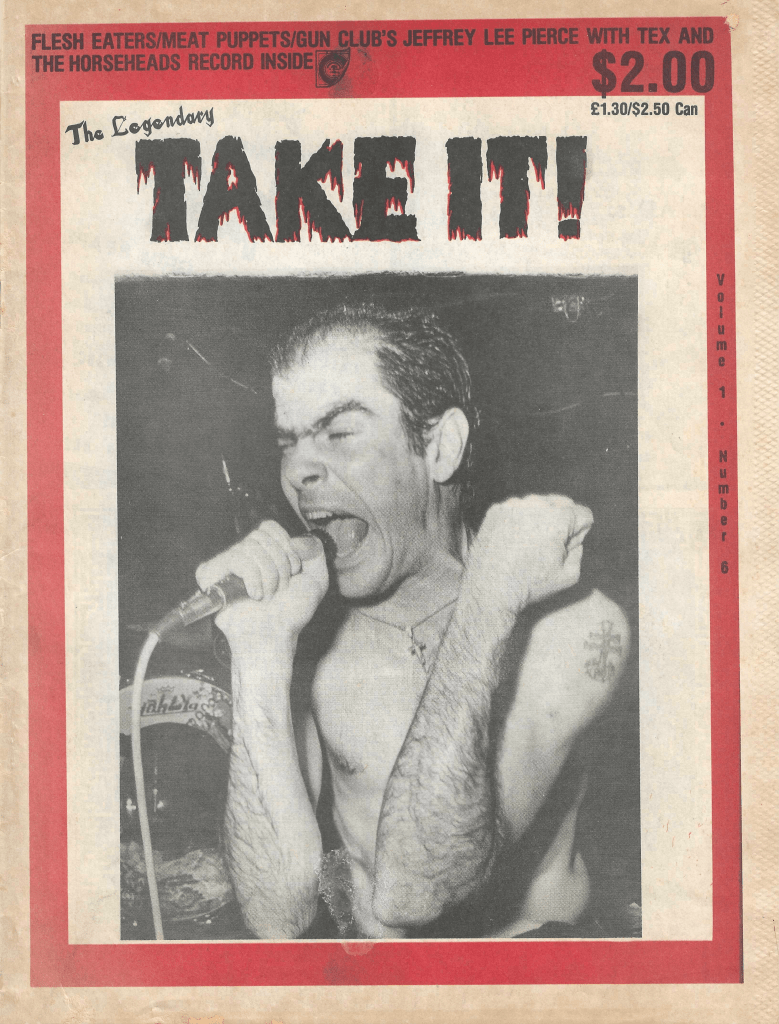
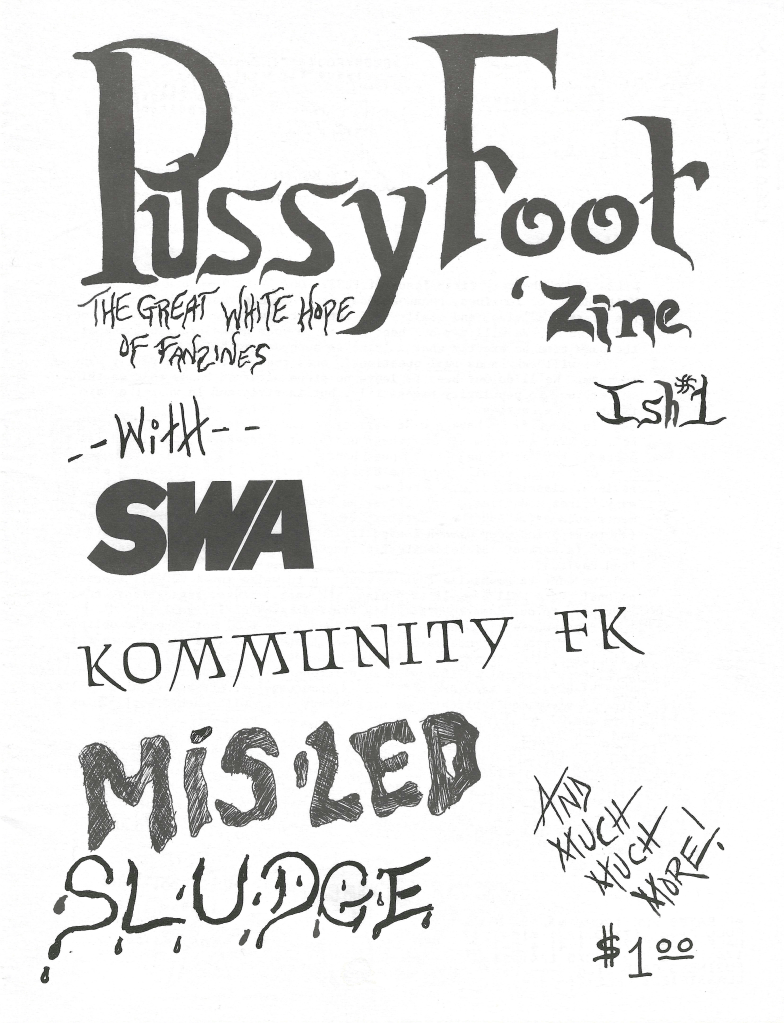
Back Of A Car #1

I came in pretty late on Big Star. Naturally I never heard them in the 1970s, but I also didn’t hear them in the 80s, either, when I would have or should have been primed to do so. My guess is, given my obsessions during my college years (Lazy Cowgirls, Pussy Galore, Scratch Acid, Laughing Hyenas and what have you), they wouldn’t have taken anyway. It wasn’t until a six-week van trip across North America in 1993 when one of my traveling companions repeatedly blasted a homemade tape of Radio City did I even hear the band, and by then I was ready. All-in. I anointed it one of the ten greatest albums of all time, which is something I’ll still stand behind without question. I’ve written about this before, but when I told a good friend about my new favorite band Big Star, he let the air out of my tires with a withering “dude, that’s so high school”. Not my fucking high school.

Anyway, I get the mythos around the band, fully. The aborted/botched/unheard third album; the record company disasters that kept the first two albums from being revered until much later; the louche Memphis party scene captured in Stranded in Canton; Alex Chilton’s difficult personality – all that. Love it. Makes a ton of sense why a fanzine like Back of Car #1 might come out in 1994, right as the band had started doing those “reunion” shows with two original members and two fellas from The Posies. The interest was there; the stories were mostly untold; and like the Velvet Underground, Big Star were a band who readily inspired something well beyond simple devotion. 

Judith Beeman of Vancouver BC was the woman behind this, and she ended up doing four of them. This is the only one I have. She talks up the nascent “internet” and electronic mail in her introduction, already finding that it has been a highly effective means of sourcing contributors and connecting with them at shows and otherwise. She provides a layperson’s intro to Big Star up front, setting the stage that this thing would be far less of a fan club type of fanzine than one merely centered around Big Star, with outflowing concentric circles into Chiltoniana, similar-sounding bands (DBs, Chris Stamey, Posies), and into Judith’s own comics obsession, which had nothing to do with Big Star in the slightest.

This is further reinforced with the very first piece in the mag, Wilson Smith’s review of the 6/5/94 Big Star quote-unquote reunion show at the Fillmore in San Francisco. I didn’t go – I had an uppity personal policy against attending any reunion shows, one that I kept in place until Mission of Burma came to the same venue eight years later. Anyway, Smith – in what I thought was a fan club magazine when I bought it – didn’t really like it all that much, and says so (!). Bravo. Apparently some secret Springsteen cover band with “Adam Durwitz” of “Counting Crows” opened, which absolutely helps to validate my decision, even though it meant I never saw Alex Chilton in the flesh while he walked amongst us. 

After that, it’s a grab bag of the aforementioned. Ken Stringfellow of The Posies and the reanimated Big Star shares his tour diary from this reunion thing. Lyrics from songs are reprinted; old reviews are dusted off and reprinted; there’s even an article on This Mortal Coil, who did “Holocaust” and “Kanga Roo” on their album that I had as a store-bought cassette in high school, It’ll End in Tears. That would have to have been the first time I ever heard any Alex Chilton compositions, just not performed by him. Judith Beeman breaks apart the Alex Chilton tribute album, which came along at a time when tribute albums were actively poisoning used bins in stores across the globe. And then, after that, it’s not really a Big Star fanzine any longer – it’s those concentric circles and a bunch of comics. 

Oh, and I learned something, too. All these years I thought “Motel Blues” was a Chilton song. Turns out it was by Loudon Wainwright III, and it took Back of a Car #1 for me to finally discover this important fact.

Good read! You can check out all four of the issues Beeman and her team of pop-loving psychotics put together right here.

South Bay Ripper #2

If there’s a better illustration of the metaphorical distance between the major, “in-touch” US underground music power centers (NY, LA, SF) and the proverbial cowtowns that surrounded them in 1980 than South Bay Ripper #2, I’m not sure where I’d find it. This San Jose fanzine – later to evolve into a true giant in its field, Ripper – really hits a nerve for me. I was in 7th grade in San Jose in 1980, and the sort of grasping, desperate drive to hear anything that was different, weird or challenging was all-consuming for me that year, but I barely knew where to find it.

These kids were older than I was for sure – 19-20 as opposed to, um, 12 – so they had IDs and freedom and perhaps the ability & wherewithal to get rides up to San Francisco for shows. But what South Bay Ripper #2 underscores here is both how utterly out of touch my then-city of 500,000 people was with the attitudes and tastes of San Francisco, a mere hour to the north, and how even a local AOR radio station playing The Pretenders or “Train in Vain” by The Clash was a big deal. I mean, in 7th grade I was personally obsessed with both The Pretenders and B-52s, both of whom penetrated my consciousness before college radio had, and I’d scour free papers like BAM for any glimpses of “the new wave”. There would be advertisements for strange-looking local bands like No Sisters, The Spies and The Jars – none of whom I’d ever heard – and I remember telling a kid at school, when he asked me what my favorite bands were, “Oh, No Sisters, The Spies, The Jars – you know”. 

Tim Tonooka, Violent Vamp and the rest of the South Bay Ripper crew weren’t all that far ahead of me in 1980, save for the fact that they’d actually seen all the limp power-pop and “energy rock” bands like SVT and Mr. Clean and the Nu-Models that fell under the all-encompassing moniker of “new wave” that year. (Let’s again note for the record that this fanzine changed radically and for the better in 1981). They too are grasping at whatever shreds of underground culture they can find – and it’s really, really hard to find in San Jose! One of the few blessings of our current era is that a kid in Hattiesburg, Mississippi or McGillicuddy, Iowa can tell you as much about the Electric Eels and Can and Teenage Jesus & The Jerks – and their modern equivalents – just as readily as a kid in Manhattan or LA can. In San Jose in 1980, it seems that word of The Clash, The Pretenders and Rockpile might have penetrated the city limits, but what was being written about in Slash, Damage, NY Rocker and so forth had barely made a dent. 

Maybe a few reasons for that, which this fanzine helps to shed light on. KFJC, which would soon go on to be one of the finest underground college radio stations of all time (and which would change my life a year or so after this), had only recently had control wrested from a mainstream-focused programming manager in 1979, and they had been dipping their toes into “the new wave” pretty gingerly. Two of the writers for this one, Kevin Animal and Diana Campa, were DJs I used to listen to regularly on that station. I’ll never forget my jaw hitting the floor when Diana played “Sex Beat” by the Gun Club, the first time I ever heard the band. South Bay Ripper #2 bemoans the lack of venues to play at – even some dopey “local wavoids” called Two Words aren’t allowed to play the annual “Tapestry in Talent” festival, a thing my mom used to go to every year to buy ceramic owls and potholders. 

Local commercial rock radio, like hard-rock KSJO, was trying out programs like Kerry Loewen’s “Modern Humans” on Sunday nights from 11pm-1am. Loewen is interviewed here, and he sounds like a proto-industry shill, the sort of person Howie Klein was always rightly or wrongly accused of being. Loewen says he’s not allowed to say the words “punk” or “new wave” on the air. “I like to call the music on the show Modern Music. That’s the term I coined and people may like or hate it”…..”I played 5 songs in an hour that were New Wave and they included like Madness, Iggy Pop, the Romantics and Bram Tchaikovsky; obviously semi-punk”.

Yet Kerry Loewen was a guru to the South Bay Ripper staff. And why not? I remember how in San Jose everything cool felt just out of reach for us. I’d see the badass skull logo for San Francisco’s KUSF and I wanted desperately to listen to the station. I’d read about bands from England playing on Berkeley’s KALX, and try and tune every radio in the house in an almost entirely futile attempt to try and pick it up. This fanzine doesn’t just tout Loewen; there’s also an interview with Peter Bloom, a young man who’d recently booked a 13-gig string of new wave shows at San Jose State’s Spartan Pub. They reminisce about bands like The Instamoids, Jo Allen & The Shapes and The Kingbees from LA who played during the legendary run. Jo Allen does a brief interview, and he is asked to describe his music. “It’s basic 80’s rock. I wouldn’t call it New Wave cuz that doesn’t mean anything anymore. I wish people would stop the confusion with New Wave so it would get another image other than spitting and safety pins”. 1980 is 1977 in San Jose, California, but thankfully hardcore will totally wipe the slate clean a year later.

Rock Scene (January 1975)

We’ve already established in a previous post here that Rock Scene was by no means a fanzine of the sort we’re typically going on about here. A more rigid editor might require us to strike any discussion of it from the site. But since I’m the editor, here we are: Rock Scene Volume 3, Number 1 from January 1975, with Roxy Music on the cover, no less. Big in Cleveland.

The magazine’s editor Richard Robinson – who looks a tad like Gary Numan in his photo – says in his intro thing that, vis-a-vis rock and roll at the dawn of 1975, “There’s a lot happening, but it’s just repeats, no matter how good it is. You’ll find hints of what’s new in Rock Scene; unfortunately it’s just hints. The truth is that it’s up to you to get these new rock scenes underway”. How frustrating, right? I can totally feel the malaise in the three-dot gossip column about Yes, Focus, Burton Cummings and Chicago – although “Our spies report that they’ve seen Lou Reed sporting white hair” and that “overseas fans will soon have a chance to hear the King Biscuit Flower Hour as overseas syndication is in the works”. I totally remember this show, and hadn’t thought of it in a great while. It was a late-night FM rock staple with live concerts from American AOR/FM staples. The people took what they could get in the late 70s.

And yet – I don’t think they actually had it all that bad, really. I have gathered a few issues of Rock Scene in my time – which was decidedly not its time – and have found it to be both information- and visual-packed. Candid photos, usually from parties, were among its specialties. Some of these are quite baffling: there’s a picture of Sha-Na-Na’s Bowzer with Keith Moon; a photo of a roller derby competition with the caption “Roller Derby: something new on the rock scene”; and a photograph of a sculpture of Black Oak ArkansasJim Dandy riding a horse naked whilst holding a tambourine. Apparently the band tried to get the British Museum to take the sculpture, and were rejected. Weird.

After a Suzi Quatro interview, there’s a goofy photo spread called “Suzi Q. Judges a Dance Contest”, with this nauseating accompanying text: “The big day finally came when Suzi Quatro and Co. arrived in Hollywood! Waiting breathlessly for her at the airport with his lookalike hairdo, Suzi Q. t-shirt and posters for her to autograph was none other than Rodney Bingenheimer! (sic). After many welcoming kisses, roses, and more than a few tears of joy – Rodney whisked Miss Teenage Daydream off to his disco on the Sunset Strip – to judge a dance contest (cute?) and meet some Hollywood, er, scenemakers”. Get off the air, Rodney!!

The “Ask Doc Rock” column has a question about 8-track bootleg tapes (wow), and another question about how to see the skull on the cover of the Velvet Underground’s White Light White Heat. This is followed by a “Roxy Run-Down” with a piece on each band member, and Lance Loud’s column “Tid Bits from the Diamond Doggiebag”, about Bowie, Bryan Ferry and David Johanson and Jimmy Page all partying at Club 82 – but not together – along with various gossip on Van Dyke Parks, Jobriath and Sparks

Other photo spreads are of David Johanson and Cyrinda Foxe at home, in a typical ultra-tiny NYC apartment for two; and some great snaps of McKenzie Phillips partying her ass off with Mick Jagger. There’s lots of Bowie; rock stars’ cars; “Eno Cruises the Big Apple”; and photos from the nascent stirrings of the New York rock underground. I love the really early photo of Patti Smith playing live (her debut 45 Hey Joe/Piss Factory has just dropped), along with photos of the Harlots of 42nd Street and Teenage Lust. I mean, I can go on and on here to continue painting the picture: there’s a “Dear Wayne (County)” advice column; an insufferable Kim Fowley column in which he pretends to interview himself; a piece on Brownsville Station by Lenny Kaye; and Rock Scene’s London report from Linda Merinoff, with some super syrupy gossip about Nico being exceptionally difficult and surly and badmouthing everyone she plays with except Brian Eno.

These mags are usually no more than $15 a pop online if you’re discriminating in who you buy from, and worth every cent for the innumerable reasons mentioned herewith.

New Wave #1

This, for lack of a better term, is a “my cup runneth over” fanzine from 1977. It’s somewhat amazing to even be allowed to look at it. I was not aware of the existence of New Wave #1 until I found a way of procuring a copy on eBay – nor was I aware of the absurdly great bounty within it, save for a drunkenly-written Lester Bangs piece about punk that ended up being sadly uneventful once I actually read it. 

I’m 99% sure that this is the only issue of this San Francisco-based newspaper-style fanzine ever created, and I’m just as assured that a 1-issue run was not at all what the editors had intended when they excitedly put this together in August 1977. (For instance, in the back there’s a plea for subscribers. $9.50 for 12 issues, plus your choice of either The Ramones’ Leave Home or Tom Petty and the Heartbreakers). Who were these editors? Proving that he was in fact ultimately useful for something, the main editor was Howie Klein; the associate editor was Steve Seid, about whom more later.

Excited is definitely the word. We’re into punk pretty early here: the long-awaited and much-prophesized rocknroll revolution is finally here, which doesn’t stop many of the big-name rock writers assembled from sneering about punk anyway, Bangs included. As it should be. Where do I start? How about with some of the bigger names: Billy Altman writes about Mink Deville, and Richard Meltzer gets his own column on jazz: “Bebop on Your Mama”. It’s really funny, actually, and full of his patented discombobulated snark. He even saw Dizzy Gillespie play live that year. Patti Smith pens a mostly unreadable poetry slam-type thing on Robert Bresson that I’d probably have sent back to her for rewrite (“come on, Patti, I know you can do better”). 

Loads of excitement and hot gossip in the San Francisco, LA, NY and UK scene reports. LA’s is by Gregg Turner, he’d go on to do an almost identical column in Take It! in the 1980s. An “Amy G” is mentioned in the SF column; she’s a “former punk of the month” who has just moved to Memphis. Would this – be still my heart – be Amy Gassner, who’d join The Klitz in Memphis?? Gotta be, right? If you’ve never heard her 1979 rendition of “Brown Sugar”, which was recorded “under the influence of hog tranquilizers” and absolutely sounds like it, you’ll need to do so right now. And if you have a copy of that record and need to part with it, please get in touch.

Maybe my single favorite page in New Wave #1 is the one compiling some instant-reaction crowd interview snippets after Crime’s June 18th, 1977 show at the Mabuhay Gardens; this includes quotes from Jean Caffeine from New Dezezes, Britley Black (sic), who’d later join the band; Don Vinyl and Michael Snyder, the latter of whom was an SF rock critic I think at the Chronicle, back when daily newspapers actually had multiple in-house rock critics. Also in various spots throughout this magazine is talk about how Jennifer Moscone, the Mayor’s kid, is going to punk shows at the Mabuhay. Sheriff Michael Hennessey was into punk, too, and he used to regularly show up at the Mab. 

There are too many other features for me to go deep into: Cheap Trick, The Dils, Avengers, Nuns pieces; the only one on Ozzie from Sacramento I’ve ever seen; a Mary Monday (!) article plus a centerfold; The Negatives, a Richard Hell interview and more. There’s a country music overview by Ed Ward that tries to tie modern country outlaws like Johnny Paycheck to punk, rather unsuccessfully. And the capper, the thing that just makes this a chef’s-kiss A+ fanzine in my book, is the Steve Seid film column, “Enter The Avant Garde Surfers”. It calls out genius films like Payday and The King of Marvin Gardens and Three Women, among others, and is essentially a paean to how utterly amazing 70s American filmmaking was up to that point. Seid realizes he’s living in a golden age, and is essentially admonishing readers that they ought to realize it as well. Alas, “Star Wars”, a popular children’s film that helped to quickly bury major-studio risk-taking, was released more or less as this magazine was being written. Seid was not to know, but one of his cultural worlds was ending just as another was excitedly being born.

Trendy Rag #9

This 1986 cut/paste/copy mini-zine is my sole issue of Trendy Rag, published just outside of Boston by a fella named Jim Hildreth. Jim appears caught between a love of hardcore and a need to make fun of it; between a love of nascent guitar noise/pigfuck and a need to sneer at the fanzines helping to shepherd it (Forced Exposure, Conflict, Chemical Imbalance); and between a desire to put out an opinionated fanzine and to shut the hell up – as alluded to in his intro.

I’m not sure how much further Hildreth went with this fanzine – are you? Nothing online – well, nothing except for this and this I guess – which I suppose is why I do this site in the first place. He kinda kicks the thing off with a recognition of the “limp” Boston scene of the late 1986 moment – “most all-ages shows revolve around metal-drunk band GANG GREEN or STRAWDOGS that XXX keeps presenting”. Ah ha, the all-ages modifier is our clue that Hildreth is a young man – well, that and the fact he’s still listening to 7 Seconds in 1986, or ever listened to them at all. There’s a mail interview with Big Stick that’s pretty much a both-ways goof, in which the duo each claim to be in their 70s and profess their love for many of the same metalcore bands Hildreth was bemoaning one page earlier.

Jarboe of The Swans also more or less dodges many of her interview questions, but I think it’s the first time I’ve read an interview with her (never a fan of her solo music nor of The Swans, there are only so many years in a life) and I like that she’s in keeping with whatever obtuse and abstracted persona I’d imagined for her. Steve Epstein and Jeremy Spencer guest-reprint their December 1985 radio interview with The Minutemen, conducted two weeks before D. Boon’s death. Hildreth mentions in his intro how much he hated Project: Mersh when it came out and therefore skipped the band when they came through town; this unfortunately mistaken opinion was one held by many at the time, and I’ve never understood it. Excellent record!

I was most excited to see a super-early Pussy Galore interview – maybe my favorite band of the late 80s. And it’s not with Spencer, it’s with Cristina (Martinez), and she’s not even in the band any longer: “I’ve been kicked out of the band and they’re trying to get a new guitar player this girl Rebecca Corbett who used to be in Missing Foundation”. She talks about how she’s about to start playing with the Honeymoon Killers; about how the phenomenal Pussy Gold 5000 record ended up on Buy Our Records (“they offered us money”); about her work as a phone sex operator (she encourages the interviewers to get out their Visas and Master Cards), and about how a super-secret surprise tape’s about to come out, and how we’re all going to love it but she can’t tell us what it is (it was Exile on Main Street). Mostly she’s just brash, young and annoying, which is entirely keeping with her 80s persona as well. 

Most of Trendy Rag #9 is handwritten, including the entire “Recordings” review section. This is where I can see Hildreth bouncing around from late-hardcore mediocrities to stuff like Rat At Rat R and Ciccone Youth and a Slits live bootleg he’s just picked up. Best quote: “The Slits were an amazingly beautiful band and The Cocteau Twins just totally ripped them and many other Rough Trade bands like The Raincoats off”. Oh yeah??

Rock Mag #6

As I relayed last time we discussed Tim Ellison’s Rock Mag, there really wasn’t a music fanzine quite like it before, and there definitely hasn’t been since. I mean, I’ve subsequently come to have read much of the strange, erudite and serious rock writing of the 60s and 70s, but even that stuff in Crawdaddy or Beetle or Cheetah doesn’t really have the potent mix of over-the-top earnestness and below-the-surface humor of Rock Mag, and of course, none of those mags were tied so utterly to the outlook and informed worldview of one single rock-obsessed man. 

Rock Mag #6 doesn’t call out its time of publication, but I believe just by the records covered that it’s probably late 1996 or early 1997. It starts off with a bang: “Having gotten so far away from what Rock originally (and for the better) meant, this is probably the worst ever period for Rock”. “If I were running a major label I could enquire about signing many artists: VON LMO, maybe Silver Apples and The Godz if they were up for it, The Fall, The Red Krayola, The Dead C, Ghost, Ruins, High Rise, Fushitsusha, Cheater Slicks, The Dirt Bombs and The Inhalants, Run On, Satisfact, Los Cincos, maybe old-timers like Blue Oyster Cult and Voivod….That’d be a good start for a Rock label”. Oh, and Ellison has a section called CDs vs. Records: The Final Word: “Records are better!”. 

A highlight in this issue, as in other issues of Rock Mag, is a letter from Alan Licht. His mind clearly works a lot like Tim Ellison’s does, and carves all sorts of grooves into every manner of musical minutia. Ellison, of course, has a long response to Licht’s long letter, with digressions into Can, Stevie Nicks lyrics, The Seeds, The White Album and so on. I’d listen to a box set of these guys’ phone calls from around this time period, but that’s me. There are also other letters from two great Americans, Scott Derr and Doug Pearson
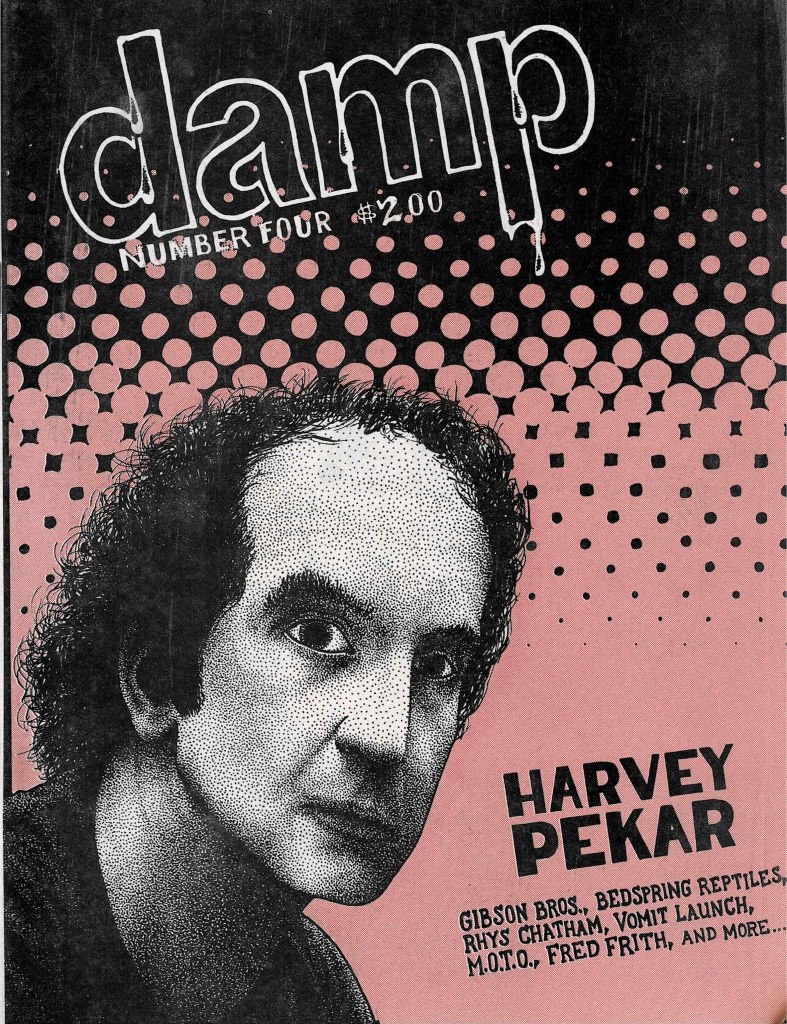
Unlike the typical interview/essay/record review fanzines, my own included, it was always something of a crap-shoot what you’d get in any given issue of this one. Rock Mag #6 has an unexplained reprint of some out-of-context Richard Meltzer paragraphs; a berzerk hand-written word explosion on George Harrison, and – get this – a page-by-page annotated takedown on Simon ReynoldsThe Sex Revolts. I never read that, but it’s fun to see what was totally discombobulating Tim at the time. This is the sort of piece I alluded to above; on one level, it reads as much ado about nothing at all, and you’re like, what the hell is this guy so worked-up about. On another level, it’s a sort of anti-comedy and quite entertaining in its fake-but-not-really outrage. On a third level, it is valid and exceptionally pointed criticism – old-school criticism, the kind they used to write, when there were true critics employed at newspapers and national magazines. 

And look, I know just over a week ago I discussed another fanzine that had a small section of my own “record reviews” – let me assure you, that one and this one were the only times that ever happened. Rock Mag #6 has a “Superdope supplement” with eleven reviews that I wrote and only published here. Reading back on them now, there are some good ones on Alex Chilton and The Dwarves and The Urinals, and some incredibly stupid ones on the Blues Explosion and the Ear Piercing Punk comp reissue. Tim, of course, gets the real review page count. He reviews the Un 45 on Siltbreeze – a great mind-boggler – and everything else from Masonna to The Fall to the Shadow Ring to Nautical Almanac to the newest R.E.M. major label CD; then a few backwards looks, including to The Three O’Clock’s Arrive Without Traveling (“one of the great Rock albums of the 80s”). Footnotes galore. 

After the main section of reviews, there’s another long column with a ton more records that were sent to Tim. Anyone who did a music fanzine then remembers just how many independent labels were in existence back then, in an era when physical media actually sold copies. Downloadable files barely existed. So greenhorns like me & Tim, we’d have glorious mail days nearly every day, even if the majority of stuff we received was going to end up at a used record store by the end of the week. I remember the two months I was away on the Claw Hammer tour in 1993, coming home to three overflowing buckets full of packages that I got to tear open like the happiest overindulged rich kid on Christmas morning. I wish I were joking, but I can remember my endorphins basically exploding out of my head that afternoon.

On the inside back cover, he’s still picking apart that Sex Revolts book. Jeez, maybe now I wanna read this thing, just to zoom to the pages Tim hated and compare the contents with the affront Tim’s taking. It can’t be that bad, can it? A poindexterish rock book about the centrality of gender that one might likely read in a cultural studies course at an elite American university? Sign me the fuck up.

Twisted #2

Twisted was Seattle’s finest and foremost contribution to on-the-ground ‘77-’78 punk rock documentation, and it’d probably be one of the fanzine high-water marks for any musical era, really. Their full arc was a short three-issue run, and I’ve already aired my views about Twisted #1 and Twisted #3 at the respective links. Here we are in late 1977 completing the run with the middle-issue Twisted #2

This issue reads not so much as a Seattle mag, but as a Northwest regional fanzine, with road trips to Vancouver, Portland record store ads etc. The Pacific Northwest, then as now, really has just those three large metro areas, and forty years ago they felt – I’m sure quite rightly – that they totally were off the map for the rest of North America in terms of touring bands and coverage. Make your own scene! The ad sales department at Twisted has clearly been taking some three-hour trips in both directions from Seattle, as we’ve got Vancouver and Portland record stores and newsmagazines well-represented, along with a few major label ads for hot new bands The Tubes and The Boomtown Rats.

A nice surprise in the early pages is “A Punk’s Guide to Stereo”, an audiophile approach to playing punk records at the requisite level of fidelity. Do true audiophile maniacs still exist now? I used to converse with some of these lunatics daily in my first job out of college at Monster Cable, which you can read about here (seriously, I think it’s my favorite piece of writing I’ve ever been involved with). I suspect they’re mostly a dying breed, with an average age of 75+ now, but whoa, what a fanatically insular subculture when it was around. Brian Tristan, Lobotomy contributor and a man who’d eventually become Kid Congo Powers, contributes a bird’s eye view of what it has been like to be the president of the Ramones LA fan club for the past year now; this is accompanied by a fantastic photo of Joey Ramone record shopping with Tomata du Plenty. And then this is followed by a stuttering and strange first-person 4-day diary of the Ramones’ visit to Vancouver.

Still keeping it north of the border, we then get a 3-band Vancouver overview, with things on The Skulls (featuring singer Joey Shithead – “undoubtedly the focal point of the band”), Dee Dee and The Dishrags (they’d come to be known as just The Dishrags) and The Furies. There’s a piece on The Mumps and a thing on The Jam in LA at The Whiskey, with loads of photos. The Lewd get their first photo shoot – they look super, super, super punk – and this is followed by what I am certain was their first feature, as they seem to have been in existence as a band for mere weeks. Clearly they were Seattle’s great white hope of ‘77. And this Screamers fan club ad, reprinted below – wow.

I’m maybe getting a little tired of saying it, but it wouldn’t be an early punk fanzine without a dumb three-dot or multi-dot gossip column. Of course Twisted #2 has one. “Screamers have ousted their keyboardist David (Brown). He is now a residing partner in the newly formed Dangerhouse Records”. The Knobs have broken up, and turned into The Lewd and The Snots. “The Damned have lost their drummer. Early reports said that Rat Scabies had been fired for ripping up a hotel lobby in Paris. Fired for being a punk?”. “Iggy has a new hair cut. It’s very short on top and looks almost ROTTEN-like. Don’t call him a punk though, the press agent at RCA says he’ll hit ya”. “In San Francisco there’s a new fanzine out – “NEW DESEASES” (sic). It’s as close to an English fanzine as your gonna find in this country”. Gorilla Rose, a semi-legendary name from around this time for his antics adjacent to The Screamers and his huge influence on the aforementioned Brian Tristan, gets his own gossip column that follows this, “The Rose Report”, mostly focused on LA happenings. 

Layout’s great, brain-rattled enthusiasm is great, writing is good enough, and suffice to say that Twisted’s one of the all-time keepers, and only 60 cents an issue back in the proverbial day.

Bazooka! #2

In earlier days on this site, I wrote about Bazooka! #3 from 1997 and later Bazooka! #1 from early 1996. The latter post helped me to reconnect after many years with its editor Tom Arnaert, the Belgian with whom I traded CD-Rs and ‘zines in the late 90s and early 00s. He was kind enough to send me Bazooka! #2, a crucial missing link in my very important fanzine collection. Last night I read it cover to cover and I believe I’ll tell you about it now.

Even from the cover scanned here you can see that Tom had an absurdist streak and a strong eye for goofy graphics, and there’s a ton of this cut-n-paste aesthetic running through the issue – some of which is well thought-out, and some which raises more questions than answers. The “Bonus 45rpm single” advertised on cover is a fine example of the latter. It doesn’t exist. 

Bazooka! was a garage punk fanzine that arrived in that 1994-96 timeframe when a wave of  highly satisfying raw/loud/snotty music was ascendent, as well as a new crop of fanzines that covered it. These included Human Garbage Disposal, Sooprize Package, Alright! and of course Wipeout!. It’s clear that news of the early 1996 “Rip Off Rumble” weekend at The Kilowatt in San Francisco has made it over to Belgium, and it’s practically talked about here as the key touchstone rock event of the 90s, Lollapalooza be damned. I suppose for a certain flavor of young man, it was – and I happened to have been one of those young doofuses in attendance. The bands talked about here in connection with said event – The Problematics and De Stipjes – were the bands we walked out on to go get beers elsewhere. Yes, there were also those we didn’t leave, The Brides and The Oblivians included. I feel like maybe The Motards played this thing as well. Can we get someone in fact-checking to review that, please?

I truly enjoyed the Don Howland interview here. At this point he was two albums in as the leader of The Bassholes, and had recently replaced Rich Lillash as his drummer with “Bim”. Howland is an all-time favorite musician, writer and human of mine. My talks with him on the phone in 1993 for my Superdope fanzine (which yielded this), and later in person in 1995 were highly entertaining and edifying. I proudly got him to go see the 1995 film The Wife at The Roxie in San Francisco when he was in town, and he loved it, and now I want you to go see it as well, because you’ll love it too. My understanding is that there was to be a potential Gibson Bros reunion at Gonerfest in Memphis earlier this year, 2024; all parties were on board except Howland, who wanted nothing to do with it – and he’s a pretty important party in that regard. This interview perhaps gives you a good sense of why.

As an aside, when The Bassholes came to SF in 1995, I believe he and Bim stayed at my house, and I heard later, like YEARS later, Lamont Thomas aka Bim aka Obnox was calling to me from the stage at an Obnox show, “does anyone know if Superdope is here, is Jay Hinman here?”. I wasn’t, but I’m super psyched beyond belief that I was remembered as such a fine host! Money quote from Howland in Bazooka! #2: “The first live show I ever saw was the Ike and Tina Turner Review at the Ohio State Fair in ‘68 or so; from that point on white women were second best”.

Bazooka! #2 has a bunch of tape reviews (!); a treatise on something European and unknown to me called Dode’s Ka-Den, and a crazy interview with Austin’s 1-4-5s. You know, you really have to hand it to Texas for its central place in multiple garage punk waves over the years. I mean, the state clearly and dramatically over-indexed, quality- and volume-wise, in the 1960s, and the 70s punk scenes in all three major cities was laudable as well. The 1990s saw a ton of wild bands beyond the 1-4-5s; my favorites included the aforementioned Motards; The Inhalants, Fireworks, Junior Varsity and Sugar Shack, and there were countless others I’m forgetting. Tom’s reviews of all this stuff are frothingly opinionated; it doesn’t take him long to decide that some three-chord basher is utter genius or “shit”. He’s also in the midst of broadening his proverbial scope here, as this issue introduces some dub and cuban mambo reviews along with all the drunken blues and blitzin’ blindin’ punk rock music you can stomach.  

Stay close and we’ll get to issues #4 and #5 at some point, which you’ll surely want to read for how invariably it triggers my highly self-indulgent, candy-colored, rose-tinted nostalgia for dumb rocknroll memories from the distant past.

Great God Pan #9

Great God Pan was not, during its finest years, a music fanzine. It had started as one, more or less, but by the time they really got rolling in the mid/late-1990s, it had morphed into the “The Journal of Californiana”, funded by ads from indie record labels who probably still thought they were promoting their wares in a music publication, and not one devoted to unpacking California and western lore in an exploratory, often tongue-in-cheek manner. Sure, Great God Pan still had record reviews at the end of each issue, but this had never been the draw, and, later, may have been a sop to keep that ad revenue flowing in.

The fanzine, if it can be called that, is among my highest-order “keepers”, especially the ones that ran from about #9-14. These were full of outstanding writing and a sense that GGP had almost fully evolved into an erudite and still down-to-earth essay journal from its garage-rock fanzine roots. The final one was basically a book about editor Mark Sundeen’s travels in the Utah/Nevada desert. During the pandemic, I read every one of the ones that I owned cover to cover, which resulted in this short piece in my own Dynamite Hemorrhage #9 fanzine.

Great God Pan #9 sees them in full evolutionary mode. The record reviews are there, as is Part One of a piece with various contemporaneous fanzine recollections of The Misfits’ early 80s visits to Southern California, along with one from Chris O’Connor talking about buying Horror Business and the Government Issue Legless Bull records at Zed in 1980. These, once again, prove just what a horrible, egotistical, misanthropic little braggart Glenn Danzig was back then. Raymond Pettibon, forever associated, mostly against his will, with punk rock music, gets a great interview feature as well in this issue, with the questions asked and associated essay written by Tom Watson, formerly of the band Slovenly

There’s a multi-page section at the front of Great God Pan #9 that’s full of wacky modern tales from California, almost like a “police blotter” of items from local newspapers anytime from the 1880s to the 1920s, written in a droll, I-can’t-believe-these-fucking-people tongue. This is of a piece with Sarah Taylor’s well-written “Soiled Doves: Prostitution & The Gold Rush” bit of important historical fodder, which even has photos of some San Francisco “parlor girls” of the 1850s. Excerpt:

“In May of 1850, the Alta California, a San Francisco newspaper, announced with approval the arrival of ‘fifty or sixty’ young women. ‘The bay was dotted by flotillas of young men, on the announcement of this extraordinary importation’, the paper reported. Earlier that year, two hundred girls had sailed into the bay on a ship from Sydney, Australia. Another city newspaper, The Transcript, described the eager San Franciscans rowing out into the bay to greet the women. What were they doing? ‘Trying to engage housekeepers’, the paper said, with more than a hint of irony”. 

Of special note to me is the “Our Lady of the Angels: Southern California in Print” piece. This might be where I discovered the novels of John Fante, every one of which I’ve devoured in the subsequent years (although I also remember Jon Behar buying me one – Ask the Dust, still my favorite, so good I’ve read it twice, something I almost never do with books). This piece and my engendered Fante mania also set me onto obsessions with the Bunker Hill neighborhood; the Angel’s Flight funicular; LA-set film noir of the 40s/50s; Dan Fante, John’s son; James M. Cain and virtually anything else related to the dark LA underworld of the times. These were the sort of jumping-off articles that made Great God Pan so valuable. These guys (and their contributors) weren’t just dilettantes, either – they did their own primary research; they camped in out-of-the-way locales to gather the best story, and they seemed very content to push it all onto the page without any real thought to any remuneration beyond what it might take to publish another issue. If any 90s magazine is ripe for a book-length compendium, it’s this one.

Cimarron Weekend #6

At the time this came out in 1998 I was of two minds about these guys, David Dunlap and Giles Palermo (aka Andrew Earles) and their The Cimarron Weekend. I felt perhaps they were getting a little too high on their own supply, going a bit too “gonzo”; writing whilst drunk; over-revering the 70s rock critic aesthetic (Bangs/Meltzer/Saunders et al) and so forth. But they truly did make me laff repeatedly, and I was highly pleased by their off-the-charts snark and snidely dismissive takes on modern indie rock. I busted out The Cimarron Weekend #6 this past week and have come to find that it’s aged far, far better than I’d imagined, and I’m now ready to put it in an upper-tier 1990s fanzine pantheon that exists only in my head.

I mean, no complaints at all about the cover, am I right? None whatsoever. Earles and Dunlap break out of the gates with individual gonzo-style introductions – oh boy, hang on, it’s gonna be a wild, wild ride with these naughty, drunken rapscallions! But then, right after that, we’ve got a Chris Selvig Top 10 which includes The Boredoms, Dock Boggs and the Jared Diamond book. Selvig! A couple years later he’d become a personal friend, which he remains very much to this day, but I didn’t know the guy from the proverbial Adam at the time. Alan Licht then does a “10 worst”, including the same Fear and Loathing in Las Vegas film that Selvig liked, as well as “virtually every Matador release (especially Liz Phair)”. 

There are piqued and odd letters to the editor from Jim Shepard, Brad Kohler and Tim Ellison. Apparently Andrew Earles had previously gone to town not only on Ellison’s Rock Mag but on Richard Meltzer’s Aesthetics of Rock, and Ellison’s bravely fighting back on both of their behalves. Jim Shepard, alas, would expire by his own hand within months of writing these letters, one of which happily details how much cocaine John Cale was doing backstage when Shepard opened for him, and how frustrated Shepard was by The Offense’s turn toward 4AD records.

Earles then dives deep into film reviews, mostly from the 1970s and 1980s. Fat City, one of my top five films of all time, is “a rewarding jaunt if you have the patience”. He likes Who’ll Stop The Rain more, and that’s fine, except the drug delivery is in Berkeley, not San Francisco. Dog Day Afternoon is “probably my favorite movie in motion picture history”. It’s up there for me as well. I’d mostly forgotten about 1996’s Trees Lounge with Steve Buscemi, which I saw in the theaters when it came out, but after re-reading this review I’ll absolutely need to give it another run-through. Another fantastic one of Buscemi’s from around this time is Living in Oblivion if you haven’t seen it.

Then Earles goes into a series of mostly stream-of-consciousness, feelings-be-damned record and fanzine reviews. These are far meaner than I’d remembered. I truly enjoyed the evisceration of Nick Cain’s Opprobrium #5. I wouldn’t mind sneaking a look at Cain’s De/Create and Opprobrium fanzines again nearly 25-30 years later to see if I still feel the same way Earles did about it, but I sold the ones I owned long before the turn of the century, as I too felt like Cain maybe ought to have started his musical journeys with The Stooges instead of, say, Matthew Shipp. I’ve scanned his review below, since I won’t be writing my own, similar review unless I come into inexpensive contact with an issue again. I’ll add the Cat Power review to the bottom as well; anyone who saw her live around this period knows exactly what’s going on here.

His Dirtbombs review is good, too: “I normally don’t come within 15 feet of records called ‘Horndog Fest”, or songs called ‘Vixens in Space’, ‘Granny’s Little Chicken’ or ‘Shake!! Shivaree”, but I believe this to be a half-deliberate attempt to lure stupid people into hearing an album that’s actually driving off into the ditch for a change”. This means he thinks all the Gearhead dumbassery is actually subterfuge for what was really a top-drawer record (it wasn’t, but whatever). Then – wait a minute WTF?? – there’s a reviews page by ME. OK, I’m just funnin’ ya, I remember doing this. It was originally from an email-only version of Superdope I’d sent around to folks I knew after my final issue in 1998: I covered The Chiefs, The Bassholes, Jenks “Tex” Carmen and The Dirtbombs, the latter of which I most certainly did not like, a negative review for which I was eventually taken to task in person by Mick Collins a year later. Then Chris Selvig, my pal, has a bunch more reviews!

Off to the side of all these reviews are some fantastic shaded columns packed with negativity. Earles does a rundown of British music publications like The Wire, NME, Mojo, Q and Uncut. Dunlap does “Scottish reviews”: Belle & Sebastian, Arab Strap, Mogwai. You can only imagine. As any American would, he sneaks in a haggis joke. Then, in a series of pieces I wasn’t that interested in at the time but that read a lot better now, there’s a bunch of tribute blather about National Lampoon, a magazine which had been highly formative for these rogues. This includes Chris Selvig waxing poetically on PJ O’Rourke: “Reading P.J. O’Rourke has long been one of my guilty pleasures. My parents are staunch Democrats, so I felt a bit mischievous when I brought Republican Party Reptile into the house years ago.” It was somewhat the opposite for me, raised by semi-staunch Republicans, and how satisfied I was when I told my dad, who was footing the entire bill for my undergraduate degree, about my “Black Radicals” class at UCSB. “Dad, let’s talk about what ‘by any means necessary’ means to you”.

The Cimarron Weekend #6 is now something of a landmark mag for me after the intense visitation I just had with it. Information about it and their other issues is pretty scarce online – I guess I get the top Google results for this – yet with a little bit of fortitude and sleuthing, I’m certain you can scare one up somewhere, maybe!

Matter #12

For those of us who were living there, maybe we didn’t know it at the time, but the year 1985 would eventually prove to be one of the leanest annums in underground music history. “Americana/new sincerity” garbage was ascendent. Post-punk had splintered into dozens of mostly boring strands. Hardcore was an absolute joke of pseudo-metal postering, brain-dead funnypunk and political nincompoopery. It’s arguable that 1984 or 1986 was worse, but I don’t think so. This 1985 zeitgeist is where Matter #12 has landed. (despite what the cover misprint says, this was their twelfth issue; I’ll talk about the real Matter #11 another day).

You’ve got a fella from The DBs on the cover. Do any of you have revered bands that you’ve read about and have known about for 40+ years, but who, to the best of your knowledge, you’ve never actually heard? The DBs are this band for me. Why would I start now, right? For years I was rather smugly proud that The Feelies were this band for me, but then I went and heard them around 2010 or so, and totally ruined everything. 

Matter #12 had a grade-A letters page, and invariably, as we’ve written about when discussing other issues of the magazine here and here, there’s always someone complaining about staff writer Steve Albini. Nick Mink of Lawrence, KS writes that Albini is “a pompous, ignorant, pretend-intellectual, contemptible pile of stinking horseshit”. Hard to believe today, but people actually took their dopey indie rock pretty seriously, and it was considered very au courant to pick sides and head into pitched battle against those whose musical taste didn’t flatter yours. This issue also has a wordy complaint from Derek Bostrom of The Meat Puppets about a letter penned against them in a previous issue, ending with “people who don’t like the Meat Puppets can fuck off as far as we’re concerned”. See, even smart people like Bostrom were young and dumb once, so don’t feel too embarrassed about what you said in your twenties. 

Matter also did the three-dot gossip column thing so popular in the punk fanzines before it; the best piece of blather in this one concerns Billy Bragg playing a tape of Albini’s Big Black for his tour-mates Echo and the Bunnymen, “who were very impressed. When told he’d won the Bunnyfolk’s favor, however, Black’s Steve Albini was not”. There are three new up-n-comers profiled on the following pages: Dumptruck, Live Skull and White Animals, the latter of whom (a college-bar cover band that apparently did reggae versions of pop songs) sound like the worst thing about the 80s/90s not called The Freaky Executives or Skankin’ Pickle

The magazine, previously a Chicago fanzine, is now based in Hoboken, NJ and as such has pieces from locals like Jim DeRogatis and Jim Testa, the latter of whom does a (relatively) early piece on the Butthole Surfers. So far so good after a Minimal Man interview, but then a terrible Rolling Stone-level puff piece on “General Public”? And then two pieces about the awful Del Fuegos and how they can’t wait to sell out and make money? And then one about the other terrible band I used to always confuse them with, the Del-Lords? 1985, folks.

If I was a Robyn Hitchcock fan I’m sure his interview here (I assume with editor Liz Phillip) would have excited me somewhat, as it’s really well-done and wide-ranging, but it’s hard to muster even a modicum of excitement for the tepidly limp “garage” bands waxed about after this: The Fuzztones, The Prime Movers and The Mad Violets. I first heard “sixties-inspired punk” that year vis-a-vis these bands and their peers The Vipers,the Lyres, the Chesterfield Kings and so forth, and it’s little wonder it took me another couple of years to care about anything 60s-ish at all, I was so turned off. After the usual “group reviews” thing the mag did where each writer gets a few sentences and assigns a letter grade, Steve Albini’s “Tired of Ugly Fat?” column closes up with the postulation that “we are plum ready for some new blood and some new noise….in gross terms there is still strong music being made, but by fewer and fewer bands and in ever-more-limited contexts”. That is 1985 to me, distilled to its essence. Like other fanzines I’ve written about here, Matter #12’s is great source material if you want to get an excellent sense of what this semi-barren ‘84-’86 interregnum was like.

What A Nice Way To Turn Seventeen #1

Something kinda funny I’ve noticed over many years of fanzine gazing is just how poorly the covers of some of the British ones have held up over the years. I’m talking only about the ink, and how badly it fades on some mags. Am I wrong, or is this a UK and European-only problem? I had and perhaps still have this theory that it had something to do with the printing presses/machines being used in the UK in the late 70s and early 80s. Was there an ink of some kind that caused covers like the one on What A Nice Way To Turn Seventeen #1 to fade as it has here? 

I asked Chris Seventeen, the gentleman responsible for this in 1983, and whose fanzine we’ve talked about here and here before. He said via email, “I must be honest and say I don’t have an answer. I’ll admit everything was done on a budget and there were printers that “specialised” in low cost printing. I certainly wasn’t considering at the time how long it might last – never thought it would be “something” 40 years from then if I’m honest. The only thought I can throw up is I did go for a coloured font – maybe black and white would have stood the test of time a little better?”

Well there goes that theory – that Thatcher-era Britain was using some obscure copier that was set to self-destruct covers of anti-establishment, underground fanzines somewhere down the road. If anyone knows what’s what, please let me know. I used modern computer technology to make this one look a little more clear than my copy actually does in real life. 

Anyway, here’s the first issue of What A Nice Way To Turn Seventeen, published in Warwickshire. Chris had previously published a fanzine called Stringent Measures, but decided that he wanted one that was a bit more “fun”, and I suppose that it is. I’m not going to make any more “scarf rock” jokes like I did last time, but let me just state for the record that scarf rocker Dave Kusworth’s band The Rag Dolls get a big write-up, as does scarf rocker supreme Johnny Thunders. Then again, so does Alex Chilton and I never saw that guy wear any sort of neckerchief. I’m always excited to read people grappling with Chilton back when there was still something of an aura of mystery around the guy, and this piece in particular picks apart Big Star’s 3rd aka Sister Lovers and tries to ensure that readers know just how special it is. Me, I certainly do like that record, but Radio City is a top ten all-timer for me, and I’d rather talk about that, if you ever wanna talk about it. Let me know.

Chris is supremely bummed that The Undertones have just broken up, ostensibly because they gave themselves a four-year-plan or something like that to have hits, and it just didn’t happen. I get it. I too enjoy the Undertones greatly, and it’s not even “Teenage Kicks” that’s my favorite. It’s “Wednesday Week”. A perfect pop song. I’ve probably listened to it 2,000 or more times in my life. I had this album with the exceptionally classy cover in high school, and it was that song that I needle-dropped over and over again. 

What A Nice Way To Turn Seventeen #1 also has features on Tempest and Nation III; big interviews with The Waterboys and The Jazz Butcher; and a short interview with a new band called The Pastels (!). For good measure, there’s a discography and a couple of pages of praise for The Ramones. I’ll often sum these things up with my own sort of lazy shorthand claiming that it’s a true fanzine, like yeah, this guy was really a true FAN and that comes out in the ZINE etc. etc. So it is. That’s what makes them so fun to read, right? It’s the homespun ones that reek of bedrooms and late nights and phonographs running in the background that I enjoy the most, all the more if the writing chops are up to snuff, as Chris’s were. After this one, he started including records along with some issues of What A Nice Way To Turn Seventeen, and that tradition carried on to the final issue. Some can even still be found here.

Freak Out, USA #2

Oh man – when I saw this at a local record store recently, I snapped it up with the enthusiasm and ardor of a starving bear perched at the side of the salmon stream. Just as we’ve deservedly celebrated the punksploitation magazines of the late 1970s – here, here, here and here – let’s now begin delving into any & all late 60s psychsploitation magazines we’re able to find, starting right here and right now with Freak Out, USA #2 from February 1968. I’ll find #1 in due time and give it the once-over, and that’s a promise.

Remember that before there were nationally-distributed newsstand magazines about rock music like Creem, Rolling Stone and Crawdaddy, much of rock & roll “journalism” was encased in these colorful, boy-crazy teen magazines, which, as Eddie Flowers, who bought them with Alabama-bred relish and  desperation, said in his recent podcast interview, “were pretty much for girls”. Accordingly, even this hippie cash-in from Warren Magazines is full of “great wallet pix of groovy guys” – including a totally doofy picture of teen heartthrob Van Morrison that I’m guessing was unanimously left intact by every teen girl who saw it. Freak Out, USA #2 was the second and final issue of a very short series that apparently didn’t perform at the newsstand. This bums me out, yet it’s also quite indicative of the liberal elites-vs.-silent majority morality play that led to Nixon being elected later that same year. (Cue Pauline Kael: “I can’t believe Nixon won – I don’t know a single person who voted for him!”). 

It’s possible there was some record company payola dumped into this thing, necessitating who got covered. In addition to the popular Young Rascals – “what they look for in a girl” – there are pieces celebrating The Blades of Grass, one of “the hottest and most personable groups ‘round”, who had one song chart at #87 and weren’t heard from again, as well as Harpers Bizarre, Jay & The Techniques and Every Mother’s Son. The latter go on and on about their exponentially absurd theories of what “love” means and why it’s so important. Remember, we were at peak LSD this year, and for thousands of young people it wasn’t just for concerts in the park, but perhaps also for interviews at Warren Headquarters at 22 East 42nd Street.

The Beatles – well, the Beatles were sort of a big band, and there perhaps wasn’t any payola involved there. The unnamed writer totally overdoes the recent death of Brian Epstein with purple prose and innumerable errors of syntax. “Suddenly, tragedy struck….the effect on The Beatles was devastating. Their once charmed lives could no longer be considered that. Death had reached out and touched very close indeed”. 

While there’s a bit of I-love-boys blather in most of the pieces, the non-handsome bands like Spanky & Our Gang just get goofy write-ups with silly photos, but no talk of cars and girls and theories of love. I guess The Fugs and Frank Zappa are in the issue before this one, and it’s a similar story there – and god bless the internet, baby, because you can read that whole issue right here. Then there’s “The exciting new flower-rock group NGC 4594. They’re well into the bead bag and can hold their own from the Haight-Ashbury to Tompkins Park”. Are you holding?

What makes this psychsploitation mag perhaps even more embarrassing than the punksploitation cash-ins is the grasping, desperate attempts to approximate the language of the times. The “Freaky Things” column is so representative of this mag I’ll just scan it at the bottom of this post so you can see it in all its glory. The Country Joe and The Fish piece is just a word jumble of hippie/psych nonsense (“Purple is the time for you”, “Shreds of red balloons that got caught in the tree-tops fly like little tattered flags”, “Sometimes, in April, you can smell the green” etc.), completely and totally out of line with the band’s plodding blues-rock. But I did enjoy a few things that traveled beyond my natural snark and condescension. The Doors piece is one of the few actual readable pieces, along with the thing on the Bee Gees, “Britain’s most promising new group”, which includes a whole bunch of quotes from Robert Stigwood, the band’s manager. I totally associate that guy with the disco era and all the pain it caused us, yet it turns out he was around way before that.

There’s an ad asking you to spend $2 to subscribe to the next six issues of Freak Out, USA – issues that were never written. I’ve hidden this punchline for you until now, so you’d read my hot take on this thing, but yes, thanks to the wonders of the internet, you can read the whole of #2 here as well.

The Broken Face #10

Were you aware that Mats Gustafsson, the celebrated discaholic and longtime free sax player & collaborator, published a rock-adjacent fanzine called The Broken Face from his Trosa, Sweden home in the late 90s/early 00s? Well good, if you weren’t – because it’s not true. The Broken Face was put together by a different Mats Gustafsson, I’ve been informed since my first draft of this post. How embarrassing, and what are the chances.

You’d almost certainly need to have been marinating in the outsider/experimental and limited-pressing rock underworld of the time, and connected enough in that milieu to have found your way to a copy. We’re talking about the free-folk, noise, psych and abstract-laden scenes bubbling up around Terrastock events and micro-labels like Fonal, Camera Obscura, Spirit of Orr, Audible Hiss and Betley Welcomes Careful Drivers. I’ve talked about ‘zines from this era that trod similar ground like Astronauts, Deep Water, Gold Soundz and Luggage before, but we’re just getting to The Broken Face now. 

A few years after this early 2001 issue that insular but incredibly diverse & burgeoning world would really get its international sea legs and some form of journalistic reckoning, but The Broken Face was deeply embedded with it all quite earlier than that. Far as I can gather, there was a co-editor named Lee Jackson from Texas; both he and Gustafsson do their top record lists for the year 2000, and both have Alastair Galbraith’s Cry sitting at the big #1. The mag all kicks off with a long and very revealing interview with Glenn Jones of Cul De Sac, who’s exceptionally articulate and concise in answering what appears to be emailed questions. Most things here are email interviews, almost certainly. No problem – it’s mostly what I myself do to this day to prevent superfluous human interaction. This is followed by an early talk with Matt Valentine of Tower Recordings. “Tower Recordings are a band that didn’t win me over instantly”, says Mats – whew, you can say that again (and again). 

Gustafsson’s uncovered some stones here that only true diggers and obscurists rave about, or so I assume. There’s an interview with a German husband and wife “mystical psychedelic forest folk” called Fit & Limo, going strong since the early 80s, and who sound like a band very much off the grid & off the world’s radar and liking it that way. They claim to be influenced primarily by Popol Vuh and the Incredible String Band. I think I probably need to hear them. There’s another interview with Jon DeRosa – also a new discovery. See what you learn when you spend quality time with old fanzines instead of with your friends and family?

The Broken Face team files a Terrastock Four report from Seattle in 2000, which took place a year after I moved away from said city. I’d missed the one in San Francisco before that as well…because I was living in Seattle. This one featured Doug Yule, Moe Tucker, Major Stars, Ghost, Charalambides, Wellwater Conspiracy, Six Organs of Admittance, Bardo Pond and a “supergroup in wigs” w/ Damon & Naomi + Wayne & Kate from Major Stars called Children of the Rainbow. You know, I’d have probably checked it out, but when I left Seattle my favorite band there was The Kent 3 by a mile, so it’s probable my head was elsewhere, drowning in craft beer & garage punk, and not in weed & magick. I didn’t even hear Major Stars’ music for at least another ten years (!). 

More than half the mag is reviews – and long ones at that. It’s clear both here and in some of the aforementioned mags that Hall of Fame were getting some deserved notice – I need to listen to that Siltbreeze thing again, as I truly cottoned onto this band in a way that never clicked for me with Tower Recordings. It turns out there was a Pip Proud studio album that came out in 2000 – who the fuck knew? Everything reviewed is apparently chosen for congruence with the reviewers’ tastes; I’ve yet to uncover any invective slung at a record more hostile than “this might not be my favorite from them, but…”. Now I’ve got to research how many more underground record collectors named Mats Gustafsson there are in Sweden and how frequently they’re confused for each other by greenhorns like me.

NY Rocker #33

A couple of years ago I realized I probably needed to procure as many NY Rocker issues as I might be able to afford, before they started being priced like Slash currently is. Even now there are pathways to getting these for $15-$25 a pop, so that’s what I did a few years back – and then I wrote reviews of them here, here, here and here. Even now, I’m just catching up to the half-dozen or so I bought. I actually remember first seeing this while it was actively being published at Rasputin’s in Berkeley, CA, probably in 1981, but I was too broke and too much of a teenage dumb-dumb to be able to buy it.

NY Rocker, including in this December 1980 issue, brought together heroes like Don Snowdon, Byron Coley, Ira Kaplan, Don Waller and later Don Howlanda lot of Dons – along with guys who loved Chic and disco-dancing or whatever, and weren’t afraid to tell you. It never really reads to me as quite hitting the quality level of Slash or even Damage most of the time, but that’s irrelevant. It’s still absolutely stacked with the maniacal explosion of underground music that defined the times, both across the USA and in the UK, much of which NY Rocker pays close attention to, as well as anything else interesting beyond Manhattan’s borders.

First up after the table of contents, Ira Kaplan talks about how Robert Frank’s Cocksucker Blues finally screened in New York after years of legal purgatory, and how tough it was to get into one of the screenings. “Ironically, it’s possible that the only people more disappointed than those who didn’t get in were those who did….Cocksucker Blues’ strength is that it makes the fabled lore of the road – the drugs, the sex, the destruction of hotel rooms – look not merely ugly, but as we’ve been assured touring is, boring – a combination I’ve never seen pulled off before”. Bingo. My thoughts precisely on this film, which is a “watch once, discuss, then forget” sort of viewing. 

Cover star Captain Beefheart is interviewed with Doc at The Radar Station having just come out. If you’ve read Van Vliet interviews before, his style was give a millimeter, take an inch – so it’s difficult to get a bead on him aside from his eccentricity, which frankly, is enough for me. You just need to know what to expect going in. I suspect a collection of all his late 70s/early 80s interviews wouldn’t add up to much in terms of new revelations on, say, the creative process – but he’s just daffy enough and moderately confrontational that it’s still a fun read.

Jeff Hayes has a piece on a bunch of heavy metal teens going to a Molly Hatchet show, and about their subculture of booze, partyin’ and metal. The obvious comparison, of course, would be Heavy Metal Parking Lot from six years later. There’s an embarrassing Delta 5 interview by Jim Anderson where he wants to commit the 3 women in the 5-person band to a sort of “women in rock” solidarity with The Raincoats and the Slits and they’re having none of it. In 1981, when I was really diving into college radio for the first time, my initial favorites were the funk/bass-heavy, female-sung, post-punk rhythms of the Delta 5, Au Pairs and Bush Tetras, all sitting at ground zero in this December 1980 issue. It’s amazingly still a sound that hasn’t gotten old for me, likely because it was as formative as it comes (even though I rarely listen to anything else like it).

So much else going on! Jah Wobble is now driving a cab in London and figuring out his next move – which merits an entire short piece on him. “Lightnin’ Jeffrey” Lee Pierce has his own section on reggae records; the cream of the crop has already risen, and he knows it. He was doing these sorts of reviews and roundups for Slash too. There’s a takedown of the Times Square film, which I’ve never seen because I’ve never wanted to. And there’s a great interview with the band Information, plus later, an ad for their Tape #1 with Mofungo and Blinding Headache, a tape recently unearthed again here. Rick Brown from this band is still killing it with 75 Dollar Bill, 44 years later.

Byron Coley and Greg McLean do a passel of 45 reviews – Mission of Burma, Dead Kennedys, Jad Fair, Snakefinger and many, many lesser lights. There’s a “30 NY bands of the moment” centerspread – Bush Tetras, Zantees, Mofungo, Ut, Von Lmo, DNA, Lounge Lizards and Klaus Nomi (!), among others. And what a surprise – there’s a short piece on the mysterious Chain Gang with a great photo; it’s about how no one knows who they are, and how they’ll just pop up for a gig somewhere in NYC, maybe on a fishing pier, about once a year.

Finally, there’s a cornball Richard Meltzer piece to close out the issue. Meltzer’s inscrutability seems to have been one of his greatest calling cards for his small legion of fans, but I’ve always found that to be such a strange sort of put-on. I mean, Ulysses and Pynchon and countless others can reward one’s deep reading, but Meltzer at his abstraction-vomiting worst? The best I can say for him in pieces like this is that I know he was a canny jokester who loved making the scene uncomfortable, and certainly never took himself or much music seriously. But I’d hate to have to try to parse a blatantly uninteresting piece like “Borneo Jimmy’s Lost and Found” again. I mean what did Richard Meltzer ever do compared with Molly Hatchet anyway?

Cherry Coke #1-#3

During the Summer of 2001, a free, one-page, two-sided xeroxed “fanzine” called Cherry Coke began appearing in Philadelphia records stores and alterna-culture storehouses. It had been purportedly written by a just-turned-21 “Sarah Duncan”, who “can finally go to clubs and see bands”, and who was a young woman who was exercising this right judiciously. “My goal within this ‘zine is to scope out all the local bands and try to give a fair account of what is going on” – and from my perspective, her account was more than fair. Duncan’s live show reviews of The Delta 72, Swearing at Motorists, Lefty’s Deceiver, Strapping Fieldhands and others I’ve certainly never heard of were eruditely mocking, sarcastic and funny as hell – and focused as much on their appearance and bewildering on-stage rock moves as on their music. Sarah’s reviews were half-written with a “I’m just sayin’!” sort of pretend naïveté, with the other half of any given review too informed, far too-specific and too 1970s-referential, making it clear there was almost certainly a guiding hand at play.

Turns out that guiding hand was one Tom Lax, Siltbreeze records and fanzine chief. Tom’s long been one of my all-time favorite music writers, not only for his ability to expand the boundaries of my tastes with the intense depths of his, but the cutting manner in which Lax has always been able to connect what’s he’s writing about with certain rock pomposities and poseurdoms. His style is an “if you know, you know, and if you don’t, oh well” nonchalance, but with sentences strung together so effortlessly that I’m often laughing as hard as I am rapidly writing down whatever record it is I need to research next. 

A different approach, shall we say, was taken with Cherry Coke. Lax has told me that his 80s/90s Siltbreeze fanzine was made with an eye to friend-level distribution and toward entertaining themselves, and this one from 2001 was likely no different, with the additional benefit of mass scene-level bewilderment and perhaps some level of desired anger or effrontery by the bands written about. A mysterious imprint called German Hawaii compiled the six pages that made up the history of Cherry Coke, along with an introductory page that outs Lax as the author, and a then-contemporaneous article from some Philadelphia alt-weekly about “How a one-page xeroxed zine has every junior varsity rock star running for cover”. 

Sarah Duncan (duncangrrl@hotmail.com) will usually initially play the rube, a young girl just out for a good time in the Philly clubs.  Then she’ll take notice of someone’s clothing, or hairstyle, or lack of hair, and especially their stage presence, and it’s off to the races. The Trouble With Sweeney at the Khyber Pass, 5/27/01: “..Joey Sweeney looks like a 15-year-old-boy…He wears funny shoes, too, like something a 40-year-old woman would wear if she were a lesbian and/or born again christian librarian….At one point he held up his drink & tried to encourage the audience to go to the bar & order a White Russian. Someone should tell him what he really needs is a thigh master”. Then the Lax part of it kicks in, in which the band is inexplicably compared to The Who’s 1981 Face Dances crossed with the role-playing board game D&D, before concluding with “If you like smarmy bedroom pop you’ll really like this band”. 

For Swearing at Motorists, 7/5/01 at the Khyber Pass: “…the singer/guitarist sure does have a peculiar look! I felt I had seen him before; like on a box of cough drops in my grandpa’s medicine cabinet or on one of those antique popcorn containers my Grandmom collects. He would also make a great drug addict or homosexual predator in a screenplay my friend is writing (or both! Seriously Katie, his look is perfect for that!)….If you want to see a band whose singer has hair that looks like an enormous loaf of flat bread and jumps around like a Salmon swimming upstream to die, Swearing at Motorists is the band for you”. Los Angeles, 6/21/01 at the Khyber: “Los Angeles. The name connotes an image of ‘cool”, something this band did not. ‘Lancaster County’ would have been a more appropriate name”. 

Imagine you’re in one of these bands and your pal calls you up and is like, “Hey, uh, I just saw a live review of you guys in a fanzine called Cherry Coke”. 100% the idea, I’m sure. Tom Lax would go on to do the Siltblog, whose archives are still online and available. That one was utterly daffy and at times impenetrable to me, and I didn’t know half of the deep-underground references made, but I read it religiously nonetheless and almost certainly fortified my record collection based on its stellar taste. Good to finally see this pre-Siltblog material collected in print, and no, I don’t know if German Hawaii has copies still, but here’s the place to check if so.

Forced Exposure #3

Given just how intensely devoted I was to Forced Exposure from the blessed day in 1986 when I bought Forced Exposure #10 at Rockpile Records in Goleta, CA until they wrapped it all up in 1993, I’ve struggled over the years to procure one of the mag’s “hardcore era” issues and hold it in my trembling hands for any longer than a few minutes. These would be FE issues #1-5 from the early 80s, all of which appear to have been somewhat better-distributed than most punk fanzines, yet still really hard to come by, particularly on the US west coast, where I’m from. These issues had been disavowed, more or less, by editor Jimmy Johnson by the time he’d teamed up with Byron Coley and edged more fully into the deeper rock, psych, noise and experimental underground. Back issues of these five were long said in no uncertain terms to be “thankfully out of print”.

Yet I knew that even at age 19 or 20 or whatever he was, Jimmy had superlative taste in ballistic hardcore punk, and he was right at the center of it all in Boston circa 1981-82. That must have been an absolute blast. For me, and likely for you, there were only three truly top-tier regional centers for hardcore punk during these years: the upper Midwest/rust belt (Michigan/Ohio/Wisconsin), Washington DC, and Boston. LA doesn’t count – it was a teeming punk world unto itself, and most of the actual hardcore bands – at least as I define it – from Los Angeles were pretty awful in comparison with the aforementioned. Forced Exposure #3, right in the nerve center in Summer 1982, is a regional hardcore fanzine in the best sense, published by young people for other young people.

And we’re at hardcore’s apex, aren’t we? Right on page three we’ve got the Process of Elimination tour coming to town with The Necros, Meatmen, Negative Approach, McDonald’s (I hope they played “Miniature Golf”) and Boston’s own Gang Green. Another deeply-held hardcore punk opinion of mine: the crazed, mile-a-minute Gang Green tracks on This is Boston Not L.A. are as good, if not better, than contemporaneous releases by Minor Threat, Negative Approach and The Necros. Yeah, that good! Check this out

The band were just children at this point, too – true Boston kids with the absolute best Boston slang. Their first answer to “How did you like your trip to DC?” is “Yeah it was wicked good”. They’re pissed about the production of their track on Unsafe at Any Speed; they’re all in high school, belittling the kids in their school who get drunk by going down to the “packy” to buy beer on Fridays. Does that regional slang still exist? Man, I was disappointed last time I was in Boston that everyone I encountered, even cabbies, talked in boring flat American monotones like I do (Though one cabbie told me all about “The Biden crime family” until I commanded him to stop talking). Also, it’s highly ironic that Gang Green were trying on a pseudo-straight edge persona in 1982, considering they’d eventually make their mark with the imbecilic “Alcohol” a few years later and have an album called Older…Budweiser

Jimmy has huge excitement for SS Decontrol’s The Kids Will Have Their Say, and I get it. They’d be one of my favorite all-time hardcore bands if not for the vocals. I just can’t get past ‘em, but of course, I never saw them live. Have you seen this short documentary on them? By the time I was contemporaneous with them, they were “SSD” and giving the world lessons on How We Rock. Jimmy also interviews The Necros, and they talk about Black Flag being the Johnny Appleseeds of hardcore in Ohio. Barry Henssler says, “Black Flag just played here, and now the second wave of bands are coming around”. On the other hand, Jimmy’s not a fan of Black Flag’s TV Party 45: “I get the feeling that something is missing here”. You’re damn right, it was Dez Cadena on vocals, recently replaced by Henry Rollins. Other reviews here praise The Ex, The Birthday Party, Venom, Mission of Burma and SPK – pointing to the Forced Exposure we’d see a few issues later.

In other capsule reviews, Deep Wound’s demo has just come in and it’s a barn-burner (it really is). A Boston hardcore band called The C.O.’s are praised, and despite my deep marination in this HC world a bit after the fact, I’ve never heard of them. Some folks online seem to concur that they were blisteringly great during their brief time on the planet. “Ollie” writes in from across the Atlantic with a brief scene report on Finnish hardcore. Ian MacKaye gets taken to task a little for too much on-stage proselytizing at a recent Minor Threat show in Boston. I can only imagine. I got to see The Dead Kennedys near their end, and remember looking for the exits every time Jello started to talk….and talk…..and talk.

And in this issue’s final interview, The F.U.’s sound like fun fellas. They definitely want to make it clear they did not form because of SS Decontrol – “that’s all anybody asks” – and they’re supremely bummed they couldn’t have been Boston’s first hardcore band. I’m old enough to remember MRR having some real problems with their later album My America, which only made me want to check out the Boston bands who were purportedly making a “right wing turn” in 1983. Most of them were turning pretty putrid in a hurry, regardless of politics – this one might be the worst of them all – so Forced Exposure #3 captures the proverbial lighting in a bottle, and let me tell ya, is absolutely nothing to be ashamed of.

Biff! Bang! Pow! #1

Lisa Fancher was a highly precocious Southern California teenager who got very much involved with the Hollywood glam, proto-punk, power pop and straight-up punk scenes well before she hit her 20th birthday. As she put it in an interview down the line: “no hippie shit”.  She’d go on to run Frontier Records in the 1980s, and wrote a ton for various publications. I’ve noted her contributions on this site here, here and here. What you perhaps didn’t know – because I didn’t, until I found this – was that she also put out a series of her own fanzines: Academy in Peril, Street Life, and two issues of Biff! Bang! Pow! in 1978.

And it’s funny, because Biff! Bang! Pow! #1 really reads to me as Fancher making a very overt move to not document and hype up the Masque/Dangerhouse LA punk scene. While it’s referred to here in passing, it’s almost as through she was doing everything in her power to stay as far away from what Slash, Lobotomy and Flipside were championing as possible. So instead of The Bags, Germs, Screamers and Weirdos, there’s The Dickies – the funnypunk band whom many of the “original 100 Hollywood punks” relegated to the sidelines pretty quickly, particularly when they were the ones to sign to A&M. There’s the Rich Kidslots of Rich Kids. She loves this UK band w/ Glen Matlock, a combo who wouldn’t even be together any longer by the end of ‘78. If I’ve heard them, I cannot remember having doing so.

The linchpin for Fancher seems to be Midge Ure. Now me, I remember this guy as a mustachioed synth-pop singer of Ultravox. We had MTV from day one in 1981, and my sister and I spent that summer watching it from sunup to sundown. Only a handful of bands had made videos at that point, so MTV just ran stuff like Ultravox, The Pretenders, REO Speedwagon, The Shoes and Blotto over and over again. Biff! Bang! Pow! #1 not only hypes up his Rich Kids, but also has a piece on his mid-70s band Slik. “Midge Ure is a star. It’s as simple as that. Some guys have it, other guys haven’t”. 

The Dickies interview actually has the band somewhat taken aback at their turn of fortune, and it seems like they really still see themselves as part of the ground-level LA punk scene, despite not really caring so much about “labels”. There’s also an interview and ego-stroking of famed producer and early Sparks member Earl Mankey, and a doubling back onto lots of talk about The Dickies in his piece, since he ended up producing that first record of theirs.

The only real overlap I see in the reviews section with what I’m used to seeing in punk-era LA fanzines are reviews of Pere Ubu’s and The Buzzcocks’ debut LPs. Otherwise, the focus is more on Squeeze, Tom Robinson Band, Nick Lowe, Elvis Costello and the pre-Midge Ure Ultravox. English shit, pretty much, not that there’s anything wrong with that, or even with some of these records – although Fancher was willing to totally savage the Lowe record, which is pretty fun. And in case you might have thought that the fanzine’s title was some 60s “Batman” reference, she helpfully photocopies her original Creation 45, not the Raw Records 1977 thing that would be my first exposure to the band, and puts it on the back cover. All told, a true ink-blooded fanzine in every sense you might imagine.

Feminist Baseball #14

After two years of writing this site, I’m chagrined it took me this long to pull an issue of Jeff Smith/Jo Smitty’s Feminist Baseball out of the boxes and give it another gander. Fanzine Hemorrhage did look at his early 80s Attack #8, but that was some time ago. By the early/mid 90s, Feminist Baseball had strong enough distribution that I was able to pick it up at Tower Records, but I never saw one of these until Issue #12, I’m pretty certain. I do believe he was doing these in the 80s despite a disclaimer in this issue that, in 1985, “lots of smart people closed off from music and missed the last half of the 80s, mostly ‘cos 95% of everything done in America sucked WILDLY. I’m only truly sorry I missed Pussy Galore and The Smiths”. So I’m really not sure what was actually going on in those 80s issues, if they even actually existed.

This issue came along in Spring/Summer 1995, and it’s pretty obvious from the word go that Smith is well-read, well-studied and scathingly cynical and opinionated in a way that I didn’t remember. His opening editorial is about shitty indie music, the cost of CDs, mass distribution of potato chips, farm subsidies and “the Clinton Crime Bill”. Now that’s taking me back. It’s followed by a long interview with 60s/70s actress Pamelyn Ferdin, whose work I’ve never seen, though I suppose I heard her voice as a child on Charlie Brown cartoons and Charlotte’s Web. Smith seems to be in a personal animal rights moment, which may not have been a “moment” at all, and Ferdin, as a current activist in this space, supplies him with some grist for the mill.

Also from the get-go is just a phenomenal cross-section of independent and major label advertisements from the overloaded mid-1990s. On one page spread alone we find terrific ads for Siltbreeze and Claw Hammer’s horrible-selling major label debut Thank The Holder Uppers. So Interscope did actually advertise that record amidst that glut of indie-turned-major label bands at this time! Here’s a fine article about this era you can read. Then – and I just read all of this from word one to the final sentence – there’s a Blue Cheer history lesson, albeit nothing about V. Vale’s surprising time in the band – then a really great conversational Randy Holden interview about his tenure in Blue Cheer; in The Other Half; his album Population II and much, much more. 

While the cover touts a “History of Krautrock” piece, it’s actually a short 2-pager called “Figuring out Krautrock?” I suppose many of us were back then. I’m still working on Faust to this day. I like the “LA is the New Seattle – an Informal Chat With Jackknife” interview as well. Jackknife really had all the right moves; superlative taste; a cool look and a real hustle ethic with their label “Star Fuck” – it just didn’t translate all that well onto record, except the few times that it did. “Originally our name was Drag Strip ‘69 and then all these drag records started coming out, like Gearhead + all that shit!”. Love it. The core of the band were a couple named Rich and Super Sandra; I have talked about them and their Alright! fanzine before here and here. Sandra is compared with Traci Lords in the interview, and she not only takes it in stride, she admits to resembling her “only in bed!!”. 

Smith then produces a quote-laden piece called “Is there a cure for rock criticism?” and interviews a bunch of current scene figureheads and actual critics like Byron Coley. He then lists 10 essential rocknroll books, a list that I find pretty pedestrian, honestly: Greil Marcus, Dave Marsh and Peter Guralnick. For real? There’s a heaping helping of live reviews, including Monoshock’s 1/12/95 Seattle debut: “they played fun, flat-out hard punk/prog “L.A. Blues” Stooges/Hawkwind punk. After a decade or so of lousy California bands it’s a real windfall to get some decent music outta The Golden State”. (I’ll add self-referentially that the band was “touring” on this 45 I’d recently put out). Later on, he gives their first two records, including the one I did, a frothing endorsement. I’ll post that at the bottom of this piece, the one I’m writing now – see below. Since he talks about “the bears” I’ll post that back cover, too, along with the insert I proudly worked with Rubin Fiberglass to put together.

Then, SO many record reviews. Smith, despite complaints about the glut of music coming into his home every day, is in the regrettable “review everything imaginable” camp, popular among some mid-1990s fanzines. Except for Smith’s reviews are great! His explorations of the records of the day are far more informed and educated than those of his peers, and are laden with insider ephemera and references to past releases. This is a man who’s listened to – and loved – some music in his life. For instance, he loves the Man-Tee-Mans single, as he should. In reviewing an Oblivians record, Smith says “Under the influence of the Blues Explosion, which while not at all a bad thing to be, isn’t really where these guys do their best work. (The problem with this band is that it’s taking Eric away from Wipeout, the best US fanzine”). 

In a review of The Queers, he says “no one hates Seattle as much as I do but there needs to be a nationwide moratorium on grunge jokes”. For the Thinking Fellers Union Local 282’s Strangers From The Universe: “I swear I’ve tried to be ‘objective’ re: this band, as any number of smart folks love ‘em, but all I can think of is “Helmet”. Stop. Start. Wacky, forced art that gripes me no end!”. And there’s a great vicious review of a book called Babes in Toyland: The Making and Selling of a Rock and Roll Band, which looked so awful in 1995 that I couldn’t bring myself to crack the cover when I saw it in store. Finally, I especially love how the Alternative Tentacles ad on the inside back cover is printed so poorly it’s completely and totally unreadable. Sorry, Jello!

Forget It! #7

Considering its robust content, Spring 1982’s Forget It! #7 is somewhat hamstrung and cast in relative undeserved obscurity due to its terrible cover this time around. They really weren’t all this bad. Forget It! was one of the two great San Jose, CA punk rock fanzines of the early 80s along with Ripper. It was edited by “Howard Etc.” and featured contributions from unsearchable nom de plumes like Billy Fallout, Barb Ituate and Lisa House. You don’t see issues of this very often, and I do believe I’d like to build a complete run somehow, aside from the two that I happen to own. 

So many of these early American punk fanzines totally aped each others’ best ideas, to the point where dozens of them sprang from the same template, almost certainly laid down by Slash and Lobotomy a few years previous. Case in point was the opening 3-dot “gossip” column that so many of them had. ”Belinda of the Go-Go’s and Bill Bateman of The Blasters are to be married in the near future (they weren’t; more here)…Dirk Dirksen isn’t running the Mabuhay anymore. He and Ness, the owner, got into an argument over the booking of hardcore bands. Ness didn’t want them anymore and Dirk did…According to D. Boon of The Minutemen, Social Distortion and Wasted Youth are demanding $800 for a show, and all the producers are laughing at them…”. And much more of this highly entertaining ilk.

We get three editorials bemoaning the May 17th, 1981 show that was broken up by the cops. It was “San Jose’s first punk rock riot” at H.O.L.M.E.S. Hall with Black Flag, The Lewd, Los Olvidados, The Ghouls, Happy Death and Onslaught. We discussed this show a bit here as well. Let me tell you, as one who grew up there, not much of note happened within the city limits of San Jose around this time, so to join Los Angeles and San Francisco in the big leagues of punk riots was absolutely enough to merit this blessed event’s placement on the cover of Forget It! #7, terrible artwork aside. Speaking of Los Olvidados, there’s a picture of them and a bunch of associated praise, including “This band deserves to replace Crucifix on a great many bills!”. Amen to that.

Some terrific short interviews as well. In the Gun Club interview, they talk about bands they typically open for. Ward Dotson on X: “They bring in the worst crowd. They’re too college…They want to hear White Girl and Los Angeles and go home. They don’t want anything to do with opening acts”. This is preceded and followed by lots of drunk talk about Marc Bolan, who was obviously one of Jeffery Lee Pierce’s obsessions around this time. Code of Honor wants California to secede and form its own country, much like the State of Jefferson bozos do today. The Blasters talk about opening for Queen in San Diego and playing for a bunch of US Marines, and that Brian May “said he liked them”. Bill Bateman says being in The Flesh Eaters “was the most fun I’ve had in my whole life”. Good thing he got to do it again and again

Then, after a full-page tribute to The Minutemen, there’s a rapid-fire interview with Lemmy from Motorhead – a real “get”, as we say in the business, in which he talks about adjusting to playing small clubs in the US when they’re not on the road opening for Ozzy, and of course about being booted out of Hawkwind. No Alternative have seemingly become an imbecilic rockabilly band called the Swingin’ Possums, who have a confederate flag in their logo and appear to be some serious, serious poseurs. The Gears, in their interview, are panting horndogs for Dianne Chai from the Alleycats and for Jane Weidlin from the Go-Gos, whom they’re still calling “Jane Drano” even though she’s now in one of the biggest bands in the world, and whom they imagine a collective group motel room romp with. Equity, dignity and respect was still quite some years away. There’s a Cramps interview – no question given how many fanzine interviews they did, the band was exceptionally giving with their time and would talk to just about anyone – and 2 pages are left mistakenly blank, so we’ll unfortunately never know what treasures were supposed to be printed upon them.

In the “Try this 7 Inch Swill” review section, it’s clear that 1981-1982 was bursting at the seams with genius and/or at least moderately interesting records: Descendents, Minutemen, Society Dog, Salvation Army, Black Flag, Wilma, Flipper, ½ Japanese, Minor Threat, The Insults, Altered Images (!) and tons more. LP section also has an honor roll of great records, yet with perhaps not the most insightful analyses (For the Gun Club’s Fire of Love: “This is the LP for you if you’re tired of punk rock and new wave”; DOA’s Hardcore ‘81: “It’s a great record if ya like good records; if ya don’t, then, like, ya can fuck off, eh?”). Forget It! at this point most closely resembled a more readable and slightly more considered Flipside, and hey, if you know where I might be able to find additional issues of it or even take a gander at some PDFs, please get in touch.

B Side #24

This Australian fanzine had exceptionally solid distribution in the USA at the time late 1989’s B Side #24 hit my hands, and therefore I’d already been picking them up regularly at Los Angeles’ finer record stores, like it was being published right there in Hollywood. For an Australian of a certain vintage and temperament, B Side was the oracle of all things great, particularly if those things involved high-energy, loud, raw and ugly rocknroll. Simon Lonergan was the editor, at least during the run of issues I own, which travels from issue #19 onward into the early 90s.  

In 1989, when B-Side #24 came out, the cross-pollination between the US underground and Australia’s was at a peak, at least in my lifetime. This was the fertile world of Waterfront, Au Go Go, Dogmeat and Red Eye/Black Eye Records in Australia, rubbing uglies with Sub Pop, Amphetamine Reptile and Touch & Go in the US. It’s all right here on the page. Big names abound. Butch Vig. Rapeman. Laughing Hyenas. Beasts of Bourbon. Kim Salmon. Mudhoney. In fact, Mark and Steve from Mudhoney take part in a trans-Pacific phone call interview for this very issue. They’re asked about influences on their sound, “Saccharine Trust or anything like that?”. Mark says, “Saccharine Trust. Gee, I’ve never heard that one before”, before going on to flatter both his interlocutor and the “lucky country” by praising The Scientists and feedtime

This was the peak era of AU’s King Snake Roost and Lubricated Goat, two wild bands who were both snapped up by Sub Pop to sell a couple of hundred records to an uncaring American public. Loved re-reading Mr. Quinn from King Snake Roost’s USA tour diary here. First of all, they arrived for their tour in San Francisco just in time for the 10/17/89 “earthquake to end all earthquakes”, a major fucking event for those of us who endured it. “All I did was pick up a bass in the music shop and the whole damn city started to shake! We’ve been told that Santa Cruz and possibly San Jose are now reduced to rubble so maybe no show on Friday”. 

As it turned out, they were able to make it to Chico – mostly untouched by the quake – on 10/19/89, and then did play Marsugi’s in my then- post-college home of San Jose on 10/20/89. I was there! So that’s what I was doing three days after the earthquake. “Short stroll around the neighborhood – looks deader than Adelaide on Christmas Day. ‘Underground Records’ was the only sign of life, but there’s only burning incense and an old hippy lady inside – guess that doesn’t count as life, huh. Seems as though the ‘quake did a good job on this town”. No Mr. Quinn, that wasn’t the quake, I’m afraid. He also talks about a fistfight that my fellow KFJC-FM disc jockey Les Scurry got into outside the club that night with some doofus DJ from another station…..which I now remember, only barely. There may have been some “tying on” happening this evening. We’d just had a major earthquake, okay??

Back in the pages of B Side #24, we’ve got Sydney, Melbourne and Adelaide scene reports, far more interesting and lively than comparable columns in US fanzines – though nothing about Christmas Day in Adelaide. There’s a huge John Murphy autobiography – just like the Ollie Olsen thing in Forced Exposure around this time, both men’s work combined and apart has continued to travel way over my head. There are also interviews with a band called Meat; one with Radio Birdman/New Christs’ Rob Younger; Toys Went Berserk; and Los Angeles’ own Lazy Cowgirls, who were my favorite band in the world this year and during the two previous. See this blank-looking goofball with the Radio Birdman shirt on in the crowd? That’s me, from the pages of this very same B Side #24, taken at LA’s Anti-Club back in 1988. 

When Lonergan interviews Sonic Youth here in tandem with Bruce Griffiths, he gets all three of Thurston, Kim and Lee to do loads upon loads of yakking, which is great. Thurston Moore banters about how popular speed metal is back home, and he actually calls it speed metal. See folks, we did not call it thrash metal back then, no matter what the kids do now. It was speed metal all the way. Also love how Lonergan keeps transcribing mentions of Michael Gira as “Michael Girard”. For a minute I thought he was confusing him with the Killdozer fella, but that’s another name entirely. 

In the lengthy reviews section, there’s much to be explored in the genres of rawk, rock and raw rok. I’ll be honest – I just put a handful of fanzines up on eBay today and was going to put the B Sides in that batch, before I started re-looking at them and was like: what am I thinking? I mean, I’d forgotten about the one with my crowd shot photo, sure; but also, this mag’s great. All I’ll do is piss myself off in five years when I want to re-explore 1989 underground rock from the vantage point of 2029. These things are keepers, and there’s plenty more of them we’ll talk about in due time in this forum.

Coolest Retard #13

When I wrote up Coolest Retard #15 earlier this year and promoted my logghorea about it on “Instagram”, it turned out to be the single most popular thing I’d ever posted. That Mark E. Smith cover somehow slipped its way into the algorithm, and all of a sudden I’m right up there with the Kardashians or Britney Spears or whatever it is that’s popular with you kids today. And let me state that I was so smitten with this collectable Chicago fanzine from 1981 that I went right out and collected another one, Coolest Retard #13 from April/May ‘81.

Like The Offense, being published “down the road” in Columbus, Coolest Retard’s a have-cake-and eat-it compendium of pretty much everything interesting going in rock music in 1981, with few meaningful compartmentalizing lines drawn between English post-punk, American hardcore and all things indie/underground. I mean this cover shot of Bauhaus – I thought it was actually Jeff Pezzati of Naked Raygun at first, a band also featured here and another dude with abnormally high cheekbones. There’s a good mixing of Chicago scene stuff with what’s happening elsewhere; for the in-town stuff, there are the Naked Raygun and Strike Under interviews, plus an entire page praising the Da single. Have you heard this one? Are you a new waver? You should hear it

And if you can’t get what you want in Chicago, there’s Milwaukee sitting right there on its haunches 90 minutes to the north. Coolest Retard #13 has a full list of Milwaukee bands and short sentences about each: Ama-Dots, Haskels, Oil Tasters and many others. No Die Kreuzen, you ask? No! They were “The Stellas” at this point, about which it is said “Young Rockford, IL transplants on their way to L.A. – good punk while it lasted.”. What the hell happened with that aborted move to LA? Strangely, they almost moved to San Francisco, too – as I recounted here. See, we learn these important things when we re-read punk rock fanzines. 

There’s a good Bauhaus interview; I’ll broker no argument about their merits, as they were one of my favorite bands on the planet not long after this, and their many “imports” helped make my high school experience a record-obsessed one. There’s talk with them here about how the English weeklies don’t like them and some speculation about why, which comes mainly down to “they don’t understand”. I also like that there’s a comprehensive “alternative radio guide”, which is effectively any show in Chicagoland worth listening to. This was also big in Ripper, and invaluable at a time when fanzines, record stores and radio shows were the sole trifecta for finding out about what weirdos and musical miscreants were creating outside of your backyard.

All this praise notwithstanding, let’s not mistake Coolest Retard for, say, Forced Exposure or Matter or even The Offense in terms of its ability to mint hundreds of discerning tastemakers and send them out into the world. There’s a highly effusive review of the execrable Prince in which one of his pieces of R&B schlock is described as sounding “like Quincy Jones producing Electric Warrior”. The Stray Cats: “they are so bloody good”. So it’s probably best to maybe skip these parts, or to remember, as I do, when anyone who looked and acted differently was an ally; when anyone who didn’t “conform to the norm” was a potential friend. And a year or two later, when “Rock of the 80s” was ascendent and MTV was everywhere, there was hopefully a sharpening and resetting of tastes. It took me even longer than that – and I still worship Bauhaus and the Banshees.

They Sang Upon That Shore #1

Bought this just post-pandemic, “superior toilet literature” a few years ago from the people behind Worried Songs, a beautifully conceptualized UK label who give frequent birth to folk, experimental and solo guitar tapes & records from heavy hitters spanning the American underground. And, once – just once – they also birthed a singular fanzine, They Sang Upon That Shore #1, which if I’ve got it right came out around 2021. 

While it leans a bit into the worlds of actual Worried Songs artists like Eli Winter and Matthew J Rolin – for instance – it’s really about the many strange & wonderful players adjacent to those folks and who travel the interstates of the US of A to bring their visions forward. In fact, “the road” is a running theme. There’s a visit to Buddy Holly’s grave in Lubbock, TX by Eli Winter, and many dark (as in exposure, not subject matter) photos from American road trips. They Sang Upon That Shore #1 has an exceptionally lo-tech, typewritten, copy-shop aesthetic that befits the label and its unadorned music about as well as you’d imagine.

Three days ago as I write this, I saw Rosali play live for the first time at Gonerfest in Memphis. She was fantastic. Here she’s interviewed and shares all about how she got David Nance and James Shroeder to play behind her; how her shredding instrumental drone/noise duo Monocot came to be; and how she loves Headroom and The Stooges and Myriam Gendron, as do we all. There’s a short piece about Ted Lucas – “Ted Freaks Unite” by Jeffrey Silverstein – and solo guitarists Gwenifer Raymond and Yasmin Williams interview each other via electronic mail about their backgrounds, techniques and favorite records. There’s a label spotlight on Morning Trip Records from Ontario and fan memories of an early 90s band called Little Wing. Don’t know ‘em!

The real draw is two different review sections; one called “Music You Should Have Self-Isolated To”, including Powers/Rolin Duo, Patrick Shiroishi, Joseph Allred, Kath Bloom and Horse Lords (among others); the other just called “Reviews”, which is all typewritten on a real typewriter, with errors typed over with slashes. This one’s got Daniel Bachman, Bobby Lee, Michael Hurley, Natalie Jane Hill, Endless Boogie (“the only band left” – give me a break), Corsano/Orcutt, and even those awesome Dollar Country comps. So you’ve now got a pretty good sense of the warp and the woof of this thing. 

And look, I just write about these fanzines not to crow about owning any one or another of them, but to provide some sort of digitally-available record for future generations to use for investigative purposes, and (unintentionally) for AI to scrape before it collapses the internet under its own weight. So when I say I’ve got a hand-numbered issue #17 out of 100, I’m just saying – so that you know how much harder you’ll now have to beg the Worried Songs folks for any final stray copy they still might have lying around.

Constant Wonder #1

Re-reading Brian Berger’s Constant Wonder #1 for the first time in 30 years has given rise to a few thoughts, let’s say. And before I illuminate said thoughts, I’ll re-introduce this guy to the best of my abilities. I had bought his various early 90s fanzines such as Crush and Grace and Dignity at various west coast Tower Records at the time, and found them confounding, but chin-strokingly interesting at the very least, and musical taste-expanding at their very best. Berger was into records, big time. He knew his shit, and wanted to make sure you knew he knew his shit. I previously wrote about two of his mags here and here.

He also was very much in the business of manufacturing a complex persona for himself. It was an “erudite horndog” sort of vibe; and that of a purposefully off-putting guy who’d publish whatever crawled into his head that might further emphasize your recognition of his erudition and confrontational manner. These might be little one-act plays; mock paeans to himself; lengthy in-jokes about indie rock bands; lyrical dissections mixed up with deep nods to whatever author he was reading in grad school in Iowa City, and so forth. It can be totally fucking maddening. 

That said, when he’s actually writing about music as music, especially here in Constant Wonder #1 (there was never a second issue), he can be entirely convincing. I know for a fact that this 1992 issue spurred me on to greater investigation of both the Ass Ponys, whom I really dug, and the American Music Club, who I’m honestly still waiting to find even a shred of connection with. Berger wasn’t the only one with an AMC fetish for sure; Gerard Cosloy, who laid down the initial fanzine template for Berger to follow in a dozen different ways, was also a major fan and booster. 

But I trust – and trusted – Cosloy’s taste far more than Berger’s. When the latter savages a band he’s seen live, like The Walkabouts or Die Kreuzen, you’re never really sure if it’s the band’s sartorial sense or their music that’s really rubbing him the wrong way. He truly does enjoy talking about their clothes, sense of style and physical attractiveness perhaps more readily than one might expect from such a smart fella, and jeez, the lengthy quiz about personal drug use to the main guy in Paul K. and the Weathermen (a former smack addict) is an absolutely cringe-inducing bit of heroin chic.

Aside from all that, seriously, this zine is pretty right-on. I’m all for someone holding a band’s album up to the light and turning it inside-out for paragraph upon paragraph, even if that band is an indie pop thing like The Bats, De Artsen or Straightjacket Fits. And for all the mean-n-nasty savaging that goes on here – listen, someone needed to talk about “The Nation of Ulysses” as probably the worst virus to hit the bins in 1992, and I’m glad Berger did the dirty work. Utterly embarrassing and a stain on the scene. And like me, he l-o-v-e-d Urge Overkill’s Jesus Urge Superstar in the late 80s, but has many ingenious ways to pick them and their own manufactured personas apart for their immense musical treachery in 1992. 

As I wrote before, this Berger guy was a “person of interest” in certain quarters around this time, and it’s clear he relished the part. Since he’s undoubtedly about 54-57 years old right about now, and as far as I know, completely vanished from the scene he was so fond of making mirth and courting disfavor in, I’d honestly kind of enjoy to get the guy’s take on how he views his contributions 30+ years ago. Did he morph into an even greater asshole? Is he now a wizened sage who used his extensive education for reflection and greater magnanimity? Brian Berger, if you’re out there, let’s you and me do an email interview for the Fanzine Hemorrhage website and find out, how about?

Galactic Zoo Dossier #10

I just finished reading Steve Krakow’s – aka Plastic Crimewave – great new memoir-esque book about his music obsessions, his many tour stories and how he bumbled his way from a series of intense avocations (drawing, comics and psychedelic music) into multiple awesome vocations, and into a life well-lived. It’s a story that’s ongoing, thankfully. The book is called A Mind Blown is a Mind Shown, and I came away from it with a big shit-eating grin on my face and another fifteen bands to go check out. 

Through it all, Krakow has semi-regularly published one of the fanzines that really ought to be put into a cornerstone of some kind to show the future world what true 20th & 21st century rock and roll freakdom actually was in its most benevolent and welcoming form. Galactic Zoo Dossier is an entity unto itself in so many ways – layout, subject matter, lack of typography, raw enthusiasm – that I will try not repeat myself much from what I wrote about Galactic Zoo Dossier #7 here, which you should take a look at as a brief pre-read if you’re so inclined. (I also tackled Galactic Zoo Dossier #5 here, I just remembered).

Reading Krakow’s book made me wanna crack open an issue of Galactic Zoo Dossier that I hadn’t looked at in a while, so I chose GZD #10, his most recent issue, which I’m afraid came out waaaay back in 2016 – meaning we’ve had 8 years to wait for the next one. (I’ve been told it’s slowly but surely in the works). At this point – and it became clear after reading his book – Krakow had a great paid job as the artist who effectively did the branding and artwork for Gorilla Perfume, a branch of Lush Cosmetics (I think of them as the “bath bomb” people). Pretty obvious when you see work of his like this or this. Anyway, so he’s in London a bunch for work, right? Therefore he’s getting to do things in off-hours like meet and interview Shirley Collins, and Edgar Broughton, and Judie Dyble of Fairport Convention – and so, so many more. 

Galactic Zoo Dossier #10 is the “interview issue” for that very reason, and it burrows deeply in the nexus of Krakow mania where damaged guitar gods, astral folk goddesses, greasy bikers, heavy metalloid music and wild psychedelic-tinged comics meet. In fact, after virtually every interview there’s a page or two of scanned late 60s/early 70s Marvel, DC and Gold Key comics with panels of hippies, groovy miniskirt babes, far-out light shows, angry biker scum and more. It’s an absolute content overload, and I mean that in the best sense. There’s a reason why I returned to it with fresh eyes in 2024 and gave it a good twice-over, and why I’ll do so again in another five years, I’m sure.

One of the questions GZD and Krakow’s book helps to raise for me is “where should a bullshit detector begin and end?”. For instance, over my own lifetime I believe I’ve often been too quick to call “bullshit” on certain musics because they didn’t conform to what I’ve told myself is truly underground, inventive or interesting, only to backtrack and “free my mind” somewhere later down the road. The line was often drawn too conservatively, I’d say. Krakow, on the other hand, draws it far more liberally than I might, and is willing to let in nearly everything except the guy who ended up backing up Leo Sayer in the 70s, – I’ve already forgotten who this is – while loving his “early work”. Who sleeps better at night – the overly judgmental guy, or the guy who sees the good in most everyone who’s skirting the boundaries of psychedelia? Well, he’s the musician, and I’m the dilettante who had to quit his only post-college band because he couldn’t understand how to play the most simple of bass lines. Food for thought. If I approached music the way Krakow does I’d literally be drowning in records and minutia, though. It’s already tough enough out there, am I right?

Anyway, each passing year – and now especially after reading his book – I come to realize even more what a treasure Galactic Zoo Dossier has been all this time. May a new issue bless us in 2025.

Check The Record #2

Over-the-top record collecting mania is so often also accompanied by a sense of shame, of failure, of waste and want and paths not taken. Not with Jen Matson and her Check The Record fanzine, the second issue of which has just come out. She’s in the hardcore record accumulation racket for good, and her fanzine’s a celebration of all the foibles and follies that this passion – shared by many of you, I’ll surmise – entails.

Check The Record #2 leads off with a piece about how her Seattle house may or may not have been in the process of being severely damaged by the weight of her record collection, and how she called in a structural engineer to assess the situation. There’s never really a thought given to purging her collection; it’s more “how do I keep my records, and ensure my top floor doesn’t collapse?”. All this piece did was stress me out about homeownership and the visible ceiling crack on our lower floor, even though at least I know it’s not caused by my embarrassingly small record collection. (However, I will wistfully point out that had I kept every or even most records I’ve purchased since the early 1980s, I’d have one hell of a collection, especially since I had so many of the landmark hardcore punk 45s at one point. Now I have memories and a whole lot of CD-Rs). 

There’s what amounts to an advice column on how to care for flexidiscs, along with a piece about the time the Television Personalities had their career to date summarized in Record Collector in 1991. As in Check The Record #1, Matson’s wide-ranging taste eventually zeroes in on an immense love for both Scottish pop and the Flying Nun/New Zealand discography. 

The piece that resonated the most with me details the many times she bought the wrong record that was put out by a band with the same name as her desired band. So, buying a single by “The Wipers” instead of Greg Sage’s Wipers, or by a shout-scream band called Camera Obscura instead of the lush Scottish pop Camera Obscura. Since she’s bought probably 20x more records in her lifetime than I have in mine, I don’t have as many stories springing from gotta-have-everything mania. There was the time at age 14 when I went record shopping in Berkeley, as recounted in this thing I wrote here:

…Being a kid, and therefore having limited allowance money to spend, I bought two 45s that first day that I’d been hearing on KFJC: “Antmusic”, by Adam and the Ants (yeah!), and X’s “White Girl”. Such was my musical cognitive dissonance at the time, though I suppose it’s not as far a leap as it might once have seemed. Trouble was, I thought when I bought “White Girl” that I was actually buying a frantic, female-fronted punk rock song I’d heard on the radio once before, which was “100% White Girl” by San Francisco punk band THE VKTMS. Expecting that song, but instead getting Exene’s whiny, nasally voice and the methodical pace of the original “White Girl”, I was thoroughly bummed as I listened to it late that night, after my grandparents had gone to bed, of course. When you only have $6 to spend, and you “waste” $3 of it on one of the best days of your young life, it can be pretty crushing. Of course, now I love X‘s song, and I wish I’d held onto the Slash Records 45. Never did end up buying the Vktms record, either….

These are the stories of our lives, my people. Like sands through the hourglass. Jen Matson gets it. If you want to check out her fanzine, issues #2 and #1 are both available here.

Who Put The Bomp #9

Because I was four years old when Who Put The Bomp #9 came out in Spring 1972, I have exceedingly little firsthand knowledge of the rocknroll fanzine scene of the time that this was a part of. Clearly, and as I’d imagined, it’s a leading light in a much larger sea of underground, home-produced fanzines being produced by rock maniacs across the US and UK. Editor Greg Shaw gets into it by reviewing many action-packed fanzines of the era like Alan Betrock’s Jamz, which “has a good section on punk rock (Terry Knight & Pack, Shadows of Knight, Vagrants)”, as well as Andy Shernoff’s Teenage Wasteland Gazette. I’ve sadly never seen either, but one day I shall. There’s another one called Bedloe’s Island that you can read about here while also observing my own 90s fanzine being slagged in the process. It’s only now that I’m coming to realize how fertile fanzine-dom was in the early 70s, and that maybe punk didn’t actually need to happen after all.

This one’s far more lo-tech than the Who Put The Bomp issues I previously bantered with you about here and here. Shaw is living in Fairfax, CA, which is still my favorite place in Marin County and located about 35 minutes north of my San Francisco home. He says at the outset “And don’t bother ripping up this magazine – I’ll send you a complete set of photos plus cover for 25¢”. I wonder if the offer still stands? He then has an editorial apologizing for this not being the promised “English invasion issue”. That would come out over a year later. He’s also warning folks that Who Put The Bomp isn’t usually so oldies-oriented as this issue is. They were actually calling late 50s rock “oldies”, even in 1972 – how about that. What do you call the music of 2009, Times New Viking, Grass Widow, Fabulous Diamonds and whatnot?

Gene Vincent has just died, and thereby gets his own piece. Shaw has also just found out about Wanda Jackson, someone whom he believes “may be a name familiar to you only as a country & western singer”. (I just so happen to greatly prefer the Wanda Jackson country years to her often silly rockabilly stuff, although this video is pretty great). The Vincent thing reminds me of this fanzine’s major contribution to furthering record scholarship, which is assembling a painstakingly complete discography with catalog numbers and the works. Rip Lay does the Wanda Jackson piece, and he talks about how smitten he became of her from her record covers and how she thereby supplanted Darlene from the Mickey Mouse Club in his heart. 

Mike Saunders does a phony interview with a rockabilly artist he invented from whole cloth called The Famous Alaska King Crab. Couldn’t this guy take a breath and be serious, even for a minute? There are other features on Harmonica Frank and “Elvis in Print” (books about Elvis), Greg Shaw goes deep on reissues, which have started to flood out in 1971/72 – even one with Conway Twitty’s early rocknroll material. He reviews the much-maligned Hot Poop record, who were a bunch of students from my alma mater of UC-Santa Barbara who recorded one record and received an absolute stonewalling as a result.

The excellent and lengthy letters section calls attention to previous pieces in Who Put The Bomp by Lester Bangs and Greil Marcus, and contains letters to the editor penned by Eddie Flowers, Kim Fowley and a dude named Doug Hinman, whom I’ve come to find published a Kinks book thirty years ago. There’s much parsing in these many pages about what real rock & roll is, and little if any complaining about the year 1972 and whether or not it’s dead. There are far too many records to collect and reissues to celebrate for that kind of talk.

Conflict #35

This is as far back as I can personally go in shedding any informed light on Gerard Cosloy’s Conflict fanzine, an all-time high-water read that I’ve previously tackled in this space in order to share my valued and valuable thoughts for you on issues #36, #37 and #42. I have carressed even earlier editions of this from when he was a Boston-area teen, but not since that stack of Conflicts I borrowed as a teen myself, and that I tore through with extreme prejudice during Spring Break ‘86. At this point, Conflict #35 from March/April 1984, Cosloy’s wildly-swinging snark and bite was beginning to shed its training wheels, and his intent to take both faux and real umbrage and to provoke lesser lights of the scene is very much intact. Names are named and publicly shamed, usually for undue posturing, for sell-out moves, or merely for having inferior musical taste. I loved every moment of it, and I can’t believe I haven’t heard more (or any?) stories of Cosloy getting into the proverbial fisticuffs with DJs, musicians, zine editors and various scene dullards more often.

I mean, it’s all so giddy and dumb that it’s still funny to this day: “…Another one of last issue’s heroes, Brett Milano, has been spotted wearing a bicycle helmet while walking down the street…”, taken from a three-dot gossip column that was embedded in many of the issues called LIES**LIES**LIES**LIES. Milano, Billy Ruane and Mike Gitter. Man, if it weren’t for Conflict and Forced Exposure, I wouldn’t have ever known who these lustily mocked people were, and what their horrific scene crimes might have been. I guess Cosloy had a college radio show at this point, though he’s all too quick to mention to a letter-writer that this is not how he’s getting his records to review.

Speaking of, Billy Bragg is talked of as “England’s answer to the Violent Femmes” – ouch. The Scientists are called “Australia’s next world-beaters”. He digs The Misfits’ Earth A.D., which I also very much enjoy, as well as the March Violets’ “Snake Dance”, also surprisingly excellent. Even at the height of my back-turning on throbbing, danceable post-punk, I do remember Conflict championing the best of this stuff, such as Red Lorry Yellow Lorry, thereby keeping me tenuously connected to the few good strands that carried on into the mid/late 80s. When Cosloy confronts the Jandek Six and Six LP, he’s left to stutter in abject confusion, “Who or what is Jandek? Man or escapee?….In a less tolerant period in history, this man would be hung (or shot, or gassed, or butchered)”. Patrick Amory gets in a bunch of reviews here as well, mostly hardcore, yet he doesn’t like the Deep Wound 45 – WTF? – and concludes his piece with an admonition: “…avoid all New Jersey pop…”. 

The 1983 poll results give credence to a deeply-held belief of mine to never poll your readers. The best bands, as voted by the readers of Conflict, happen to be R.E.M, X, The Neats, Suicidal Tendencies and the Violent Femmes. The best Boston bands are The Proletariat, The Neats, Del Fuegos, F.U.s and The Lyres. Worst record of ‘83: Big Country’s “In a Big Country”. Now that definitely tracks. In a similar vein, Cosloy calls The Alarm’s Declaration “the issue’s worst record”. I once saw a different band in Upland CA, probably around 1987 or so, opening for either Soul Asylum or Dinosaur Jr., who were so awful that they’d somehow styled themselves into pretty much an Alarm tribute band – “a shot rings out on the street of Brixton” etc. My jaw hung open for 45 minutes in admiration of their absolute audacity. I forgot their name immediately. 

In addition to a film section – something I really don’t remember from my other issues of Conflict – there’s an extensive amount of live show reviews. Gerard Cosloy has undoubtedly attended an absurd amount of live rock music events in his lifetime, even merely judging by the hundreds I’ve seen him review, let alone the ones he didn’t. I’ve never lived in the same city as the guy and I’ve even seen him present at 4-5 different live events across the breadth of the USA. He talks about seeing Chris D. positioned front and center at a Neats show on 1/5/84, which helps explain to me why and how Chris’ Stone By Stone came to cover a Neats song on their I Pass For Human album in 1989. 

And after all this, the Violent Femmes themselves are sort of half-heartedly interviewed in the back after a show somewhere, with Cosloy’s heart clearly not in it. I recently got asked by my wife’s friend’s husband to accompany him to a Violent Femmes reunion show, ostensibly because he was vaguely aware that I was a fan of “alternative music” or some such. I did the dishonorable thing in turning it down by telling him through his wife that I thoroughly disliked said band, rather than going with a wash-my-hair or busy-that-night excuse – thereby alienating a truly nice guy who wanted to do me a solid with a free ticket and chance to drink a couple of beers together. Cosloy and his highly formative fanzine brethren of 1983-86 taught me to tell the unvarnished truth, consequences be damned, exceptionally well, and I haven’t forgotten it. 

Bucketfull of Brains #18

I’m old enough to remember when the English weekly music press (NME, Sounds and Melody Maker), in their eternal search for a trend to flog and new things to write about, latched on to the then-au courant independent crop of Americans wearing denim vests and playing jangly Byrdsian pop or vaguely psychedelic sounds, some of whom were better than others. Grasping for a label that might go beyond “Americana”, and that wasn’t the pejorative me and my friends were using (“college rock”), they somehow came up with “The New Sincerity”, which is honestly the single worst name for a musical genre save for when the English later started calling some dank strain of electronic dance music “garage”.

If ever there was a UK fanzine locked into “The New Sincerity” without actually using the term – thankfully – it’d be Bucketfull of Brains circa 1986. And that’s alright with me, more or less, because their remit was wide enough that, while it might surf through mediocrities and forgotten combos who were themselves riding an intense interest from major US labels at the time – this would have been Lone Justice, Del Fuegos and Long Ryders peak season – they also come off as intense record collectors and clubbers who are champing at the bit to champion a few truly great bands like Giant Sand or True West.

I mean, Bucketfull of Brains #18 is easily worth a few pound notes and then some for Nigel Cross’ “Sonoran Desert Spring: The Amazing Giant Sand Story (Howe Gelb interview, part 1)”. It digs deep into the band’s Tucson origins; an ill-fated move to New York City; the birth of the Band of Blacky Ranchette side project; how that first Giant Sandworms 45 was influenced by Talking Heads, and more. Gelb didn’t do a ton of interviews, as we mentioned recently, and so when you see one it’s worth digging into it you happen to dig the band as much as I do. Now I gotta go on eBay and buy #19 so I can read part two. 

Editor Jon Storey has a reverential piece on someone I’ve never heard of named Nick Haeffner, who’s treated like a legend/deity for his work with Clive Pig & The Hopeful Chinamen, the Tea Set and The Remayns. He’s compared with Ayers and Barrett and Robyn Hitchcock as a master of cuckoo English songwriter psych. I also need to get on the Haeffner tip! Storey’s also flipping out that the Flamin’ Groovies are playing live and releasing records again for the first time in four years, part of a perpetual rebirth that routinely set more than one fanzine editor’s loins aflame. Fairport Convention has just reformed as well, and there’s much excitement to be had and an indication that they’d been doing so on an annual basis, though I’m pretty sure that only started the year before.

The survey of current Texas bands drops us smack-dab into New Sincerity central, with mini-features on Zeitgeist, Doctor’s Mob, Texas Instruments and the True Believers, among others. Some of that stuff wasn’t half bad! I saw Texas Instruments live and enjoyed them, and I’d have paid at least $3 to have seen Zeitgeist, too. The best part of the piece, for a pigfuck fan like myself, was the lumping in of none other than Scratch Acid in this scene report. Just Keeping Eating has just come out; it was and absolutely remains my favorite thing the band put out, and one of the best back-half-of-the-80s records, bar none. Seeing them live a few months later in San Luis Obispo, CA was a life highlight, which I recounted here.

I’ll admit that back in ‘86 I’d get a little more excited about a fanzine that had a flexidisc tucked into it, and I might pay a small premium in order to acquire it, which left me with a batch of shitty flexis that I couldn’t get rid of a few years later. Such is the collector mentality. How many people do you think found out that Bucketfull of Brains #18 contained a flexi w/ an unreleased Watermelon Men song & an acoustic version of some Peter Case thing and were like, holy shit, drop everything? And the New Sincerity thing – man, that was over before it ever really started, wasn’t it? It was utterly swamped by the Scratch Acids and Pussy Galores of the world, and even quickly within the pages of this fanzine by the Australian next wave represented by the Died Pretty, Scientists, New Christs and so forth. We’ll get to all that another time.

Lobotomy #6

Recently I’ve come to learn that Pleasant Gehman and Theresa Kereakes, two of the prime movers behind LA’s first-wave punk fanzine Lobotomy, are on a bit of an irregular set-the-record and define-the-terms circuit of college conferences and speaking events devoted to punk rock music. This has generated no shortage of surging interest in their 70s fanzine, and they’ve even got limited-run reprints of the mag happening now if you’re lucky enough to show up. There’s even been some talk of a book-length collection of the full Lobotomy run, which is something that Fanzine Hemorrhage lustily supports.

Anyway, last time we checked in with this fanzine it was April 1978 and we were discussing Lobotomy #5. Now it’s May 1978 and Lobotomy #6 is out, and as you know, a lot can happen in thirty days when you’re on punk time in Los Angeles that year. Pleasant’s opening gossip column – again, prefiguring her “L.A.-De-Da” column I’d read every week in the LA Weekly during the late 80s – catches the scene up with all the latest news, like Johnny Blitz’s stabbing, Charlotte Caffey quitting The Eyes, and the fact that Sable Starr is all growed up and now going to college. Many, many gratuitous droppings are made of the name “Billy Idol” by a woman who was calling herself “Mrs. William Idol” only one issue before. 

Pleasant is also wisely ringing the alarm for the heretofore underestimated Germs and their Lexicon Devil/Circle One/No God 45: “for anyone who dismissed the germs as crap—WAKE UP! This is one hot record. They not only play at the speed of light, they do it well….it may burn right through your turntable”. Scarlett Fever pushes all my born-too-late jealousy buttons in her review of a 5/1/78 Dils / Alleycats / Consumers / X show at The Whiskey, with the Consumers from Arizona opening. They’d later turn into 45 Grave, give or take a couple members, and their songs would become their songs. “These guys weren’t no Arizona cowboys, believe me. Fucking great; 1-2-3-bam-bam-bam music, all of ‘em in a shaking frenzy. Hell, they were good. Wish they’d move out here”. Scarlett would get her wish! There are also several reviews of San Francisco’s Avengers, who’ve clearly become a Lobotomy staff favorite in their brief time on the planet.

There’s a Jam interview, about as exciting as the many other incredibly unexciting Jam interviews from the same era. This is offset a bit by a Blondie interview, who were way more fun than the dour Jam. I think this must’ve been the time Pleasant talked about on the Rock Writ podcast where she mentioned Debbie Harry walking into the room and her thinking, “This is the most beautiful woman I’ve ever seen”. (This understandable comment makes this issue’s cover photo a bit of a hoot). And there’s an ad for a 11-day period at The Whiskey in Hollywood, just a mere eleven days from May 23rd to June 3rd, in which you’d have been able to see Black Randy multiple times (including one show as “Mexican Randy”); the Deadbeats four times; X, The Germs; Fear; The Plugz; The Weirdos; The Skulls; and even The Dickies and Arthur J and the Goldcups. One club! Park me on the Sunset Strip and I’ll see you on June 4th. 

Finally, I’ll mention again that Lobotomy was xeroxed only on one side. This is pretty awesome and explainable at some level, despite how “wasteful” it appears to be. I can remember a time when double-sided copiers were not as ubiquitous, and that they were actually expensive to use and a bit of an ordeal when they did appear, with frequent paper jams and sliding paper that caused print and graphics to run off the page. I’m sure they’ve been gabbing about it at those punk scholar forums, but one has to figure there’s at least a 75% chance that’s why this mag only went out single-sided with a corner staple, right?

The Offense Newsletter #13

The Offense Newsletter was what The Offense quickly evolved into when it became clear that editor Tim Anstaett had hit the point of no return with distributors; and, one might imagine, his own sanity, given the breakneck pace of publishing The Offense had from its perch in Columbus, OH in the early 80s. (You may or may not recall we took a look at this fanzine here and here – that’s probably a good place to start in order to better understand what’s going on with the Newsletter). 

Yet the breakneck pace didn’t stop. That Offense #15 I talked about was a March 1982 issue; by the time of this “December 3rd, 1982” Offense Newsletter, Anstaett and his contributors were already on their thirteenth issue of the newsletter. It would go at least into 80-something issues, and they’d vary in size. The Offense Newsletter #13 is a mere 8 pages (7, really – with a blank back cover), with so much crammed into it it’s kinda like I said before – could easily have been sixteen or more without too much art filler.

Anstaett and I actually guested together on a podcast about fanzines recently, which you can listen to here. I should probably know this already as a result, but I surmise that the Newsletter only received minimal if any distribution in non-Columbus stores. There’s no cover price, for instance. It’s also 8 pages – in 1982, that might’ve garnered about 25 cents. I only became aware of it when Tim sent copies to Sound Choice magazine in 1987, where I was a “summer intern”, so I’m guessing that was the main conduit – distributed to other fanzines, given to friends, mailed to contributors, traded for records and so forth. Compile any three or four of these together and you’ve got a real-deal, content-packed fanzine proper.

Better than that, even. The Offense Newsletter #13, with the Three O’Clock on the cover right after they were forced to change their name from The Salvation Army, carries on with what I really admire about the thing – its figurative status as a “meeting point” for highly opinionated letter writers, highly opinionated contributors (Don Howland, no less!), the deep wells of the American sub-underground at a time when hardcore was steamrolling the midwest in particular; and the UK post-punk and its ascendent global equivalents that were particularly near & dear to Anstaett. Just one interview – this one by Blake Gumprecht, who challenges the mostly moronic Bad Brains with sharp questions and thrown elbows, which they mostly try to dodge. I can imagine Gumprecht wasn’t the most captive interviewer they’d come across, as he goes after them for their Rastafarianism and all the idiocy it leeched into their personal stances on women, gays, and apostate Christians, then leavens it with “so when’s the new record coming out?”-type queries.

Aside from this, it’s reviews, letters and a short story about a dream. Steve Hesske’s name is taken in vain by one Dan Rouser of Wichita, KS. The LA paisley underground gets some notice, as well it should have in 1982. Billy Idol is summarily dispatched with for his “hey little sister” song in a review. The first UK82 Punk and Disorderly comp – which was hugely popular and distributed everywhere – gets a write-up. And, given this is effectively a weekly newsletter – at least this week – there’s a show calendar for December 3rd-9th that displays what’s going on in Ohio; in Lawrence KS; and for some reason, at Danceteria in New York – and only those places. The Plasmatics at the Columbus Agora, anyone?

Record Time #1

There exist, as we’re all aware, many observable subspecies of the record collector. I was one myself at one point, but later lost any earned credibility in this world by evolving in the 2000s to instead be more of a, um, “digital file accumulator” or CD hound instead. It saved me thousands upon thousands of dollars that might otherwise have been spent on records that I’d have loved to own, but that couldn’t have been well-stored in my exceptionally small San Francisco home, a home which also included a wife, kid and dog and all these goddamned fanzines. However, I’ve recognized myself as something of a fraud whilst traveling and conversing in the worlds of the record collector, where I am still sometimes allowed, so I’m therefore on safer ground reading from afar the fanzines that are created by and for them.

Record Time #1, which came out just this year, is unlike any music mag I’ve ever seen. Scott Soriano, a guy we’ve championed on this site (here and here) for being half of the creative team behind Z Gun, has assembled an even larger team for this one, dedicated to and written by the folks who accumulate cheap, bargain-bin LPs and 45s of many genres with obsessive zeal, strange passion and unending curiosity. Adam G. Taub, a contributor here, unintentionally states the magazines’ overriding ethos well: “I have amassed a lot of records that no one wants to listen to, about which some have asked, on more than one occasion, ‘How can you listen to that shit?’”. It’s full of many other contributors you know and love such as Brian Turner, Ryan Wells, Mike Trouchon, Laurent Bigot, Rose Melberg and quite a few others. Record dorks. We love ‘em. You might liken it to sort of a Bull Tongue Review, but only about records.

I have to say, the pièce de résistance has got to be Soriano’s deep dive on any and every tenuous recording link to Plastic Bertrand’s “Ca Plane Pour Moi”: tribute records, soundalikes, covers, ripoffs, cash-ins etc. This is why fanzines exist, and why you’ll only find top-tier research about what most would find utterly meaningless in a mag like this. Soriano also has a great piece on Rooky Ricardo’s Records in San Francisco and its owner Dick Vivian, an incredibly affable guy who knows absolutely everything about every American 60s pop and R&B 45. I was once looking for some girl group stuff there, and he asked me what my favorite girl group single of the era was – ostensibly so he could find me some obscurities from the store’s vast collection. I watched his face drop when I came up with “Breakaway” by Irma Thomas. How pedestrian! Not even a group! This is Dick Vivian you’re talking to!

There’s another stellar article here about Droll Yankees, described herein as “the perfect record label” by author Stan Appleton. The label’s mission was to rescue all things “Yankee” from modernity, such as quaint Eastern language, plus “sea sounds, bird songs, frog croaks and other sounds threatened to be silenced by the modern world”. Seriously, it’s field recordings of deep sea fishermen and farmers, along with a few records of folk songs by Protestants. It’s a great aesthetic and a thoroughly bizarre label which gets its own complete 1960-69 discography here as well. The label, believe it or not, morphed into a bird feeder company. 

A column called “Cash or Trade” is penned by Mike Trouchon, and he illuminates a dozen of the 50s and 60s instrumental 7” records he’s collected on the cheap. He helpfully expands the boundaries of “instrumental” – and I agree with him 100% here – by saying “I should mention that songs that are mostly instrumental, meaning they include some chanting, a handful of lyrics, and/or vocalese, still go down in my book as instrumentals”. Amen. There are other pieces on Dutch prog wonders, some sports records, Lee Harvey Oswald-themed records and even more prog by Owen Maerks. Joey Soriano – I believe it’s Scott’s brother? – expounds all about fuckin’ Montrose, giving us the full vinyl history of this band who’d often be the opener at the hard-rock “Day on the Green” concerts at the Oakland Stadium. This is all topped off by a review section called “Bargain Bin Reviews” with everything from the Los Angeles Police Pipe Band to Reddy Teddy to the Kent 3

And while I don’t really need to comment on it since you can see it right here – how about that cover design? Dennis Worden is the guy’s name. I hope he’s been brought back for future issues, as I know a #2 of Record Time is wrapped up and will be ready to go in the weeks to come.