Because I was four years old when Who Put The Bomp #9 came out in Spring 1972, I have exceedingly little firsthand knowledge of the rocknroll fanzine scene of the time that this was a part of. Clearly, and as I’d imagined, it’s a leading light in a much larger sea of underground, home-produced fanzines being produced by rock maniacs across the US and UK. Editor Greg Shaw gets into it by reviewing many action-packed fanzines of the era like Alan Betrock’s Jamz, which “has a good section on punk rock (Terry Knight & Pack, Shadows of Knight, Vagrants)”, as well as Andy Shernoff’s Teenage Wasteland Gazette. I’ve sadly never seen either, but one day I shall. There’s another one called Bedloe’s Islandthat you can read about here while also observing my own 90s fanzine being slagged in the process. It’s only now that I’m coming to realize how fertile fanzine-dom was in the early 70s, and that maybe punk didn’t actually need to happen after all.
This one’s far more lo-tech than the Who Put The Bomp issues I previously bantered with you about here and here. Shaw is living in Fairfax, CA, which is still my favorite place in Marin County and located about 35 minutes north of my San Francisco home. He says at the outset “And don’t bother ripping up this magazine – I’ll send you a complete set of photos plus cover for 25¢”. I wonder if the offer still stands? He then has an editorial apologizing for this not being the promised “English invasion issue”. That would come out over a year later. He’s also warning folks that Who Put The Bomp isn’t usually so oldies-oriented as this issue is. They were actually calling late 50s rock “oldies”, even in 1972 – how about that. What do you call the music of 2009, Times New Viking, Grass Widow, Fabulous Diamonds and whatnot?
Gene Vincent has just died, and thereby gets his own piece. Shaw has also just found out about Wanda Jackson, someone whom he believes “may be a name familiar to you only as a country & western singer”. (I just so happen to greatly prefer the Wanda Jackson country years to her often silly rockabilly stuff, although this video is pretty great). The Vincent thing reminds me of this fanzine’s major contribution to furthering record scholarship, which is assembling a painstakingly complete discography with catalog numbers and the works. Rip Lay does the Wanda Jackson piece, and he talks about how smitten he became of her from her record covers and how she thereby supplanted Darlene from the Mickey Mouse Club in his heart.
Mike Saunders does a phony interview with a rockabilly artist he invented from whole cloth called The Famous Alaska King Crab. Couldn’t this guy take a breath and be serious, even for a minute? There are other features on Harmonica Frank and “Elvis in Print” (books about Elvis), Greg Shaw goes deep on reissues, which have started to flood out in 1971/72 – even one with Conway Twitty’s early rocknroll material. He reviews the much-maligned Hot Poop record, who were a bunch of students from my alma mater of UC-Santa Barbara who recorded one record and received an absolute stonewalling as a result.
The excellent and lengthy letters section calls attention to previous pieces in Who Put The Bomp by Lester Bangs and Greil Marcus, and contains letters to the editor penned by Eddie Flowers, Kim Fowley and a dude named Doug Hinman, whom I’ve come to find published a Kinks book thirty years ago. There’s much parsing in these many pages about what real rock & roll is, and little if any complaining about the year 1972 and whether or not it’s dead. There are far too many records to collect and reissues to celebrate for that kind of talk.
This is as far back as I can personally go in shedding any informed light on Gerard Cosloy’s Conflict fanzine, an all-time high-water read that I’ve previously tackled in this space in order to share my valued and valuable thoughts for you on issues #36, #37 and #42. I have carressed even earlier editions of this from when he was a Boston-area teen, but not since that stack of Conflicts I borrowed as a teen myself, and that I tore through with extreme prejudice during Spring Break ‘86. At this point, Conflict #35 from March/April 1984, Cosloy’s wildly-swinging snark and bite was beginning to shed its training wheels, and his intent to take both faux and real umbrage and to provoke lesser lights of the scene is very much intact. Names are named and publicly shamed, usually for undue posturing, for sell-out moves, or merely for having inferior musical taste. I loved every moment of it, and I can’t believe I haven’t heard more (or any?) stories of Cosloy getting into the proverbial fisticuffs with DJs, musicians, zine editors and various scene dullards more often.
I mean, it’s all so giddy and dumb that it’s still funny to this day: “…Another one of last issue’s heroes, Brett Milano, has been spotted wearing a bicycle helmet while walking down the street…”, taken from a three-dot gossip column that was embedded in many of the issues called LIES**LIES**LIES**LIES. Milano, Billy Ruane and Mike Gitter. Man, if it weren’t for Conflict and Forced Exposure, I wouldn’t have ever known who these lustily mocked people were, and what their horrific scene crimes might have been. I guess Cosloy had a college radio show at this point, though he’s all too quick to mention to a letter-writer that this is not how he’s getting his records to review.
Speaking of, Billy Bragg is talked of as “England’s answer to the Violent Femmes” – ouch.The Scientists are called “Australia’s next world-beaters”. He digs The Misfits’ Earth A.D., which I also very much enjoy, as well as the March Violets’ “Snake Dance”, also surprisingly excellent. Even at the height of my back-turning on throbbing, danceable post-punk, I do remember Conflict championing the best of this stuff, such as Red Lorry Yellow Lorry, thereby keeping me tenuously connected to the few good strands that carried on into the mid/late 80s. When Cosloy confronts the JandekSix and Six LP, he’s left to stutter in abject confusion, “Who or what is Jandek? Man or escapee?….In a less tolerant period in history, this man would be hung (or shot, or gassed, or butchered)”. Patrick Amory gets in a bunch of reviews here as well, mostly hardcore, yet he doesn’t like the Deep Wound 45 – WTF? – and concludes his piece with an admonition: “…avoid all New Jersey pop…”.
The 1983 poll results give credence to a deeply-held belief of mine to never poll your readers. The best bands, as voted by the readers of Conflict, happen to be R.E.M, X, The Neats, Suicidal Tendencies and the Violent Femmes. The best Boston bands are The Proletariat, The Neats, Del Fuegos, F.U.s and The Lyres. Worst record of ‘83: Big Country’s “In a Big Country”. Now that definitely tracks. In a similar vein, Cosloy calls The Alarm’s Declaration “the issue’s worst record”. I once saw a different band in Upland CA, probably around 1987 or so, opening for either Soul Asylum or Dinosaur Jr., who were so awful that they’d somehow styled themselves into pretty much an Alarm tribute band – “a shot rings out on the street of Brixton” etc. My jaw hung open for 45 minutes in admiration of their absolute audacity. I forgot their name immediately.
In addition to a film section – something I really don’t remember from my other issues of Conflict – there’s an extensive amount of live show reviews. Gerard Cosloy has undoubtedly attended an absurd amount of live rock music events in his lifetime, even merely judging by the hundreds I’ve seen him review, let alone the ones he didn’t. I’ve never lived in the same city as the guy and I’ve even seen him present at 4-5 different live events across the breadth of the USA. He talks about seeing Chris D. positioned front and center at a Neats show on 1/5/84, which helps explain to me why and how Chris’ Stone By Stone came to cover a Neats song on their I Pass For Human album in 1989.
And after all this, the Violent Femmes themselves are sort of half-heartedly interviewed in the back after a show somewhere, with Cosloy’s heart clearly not in it. I recently got asked by my wife’s friend’s husband to accompany him to a Violent Femmes reunion show, ostensibly because he was vaguely aware that I was a fan of “alternative music” or some such. I did the dishonorable thing in turning it down by telling him through his wife that I thoroughly disliked said band, rather than going with a wash-my-hair or busy-that-night excuse – thereby alienating a truly nice guy who wanted to do me a solid with a free ticket and chance to drink a couple of beers together. Cosloy and his highly formative fanzine brethren of 1983-86 taught me to tell the unvarnished truth, consequences be damned, exceptionally well, and I haven’t forgotten it.
I’m old enough to remember when the English weekly music press (NME, Sounds and Melody Maker), in their eternal search for a trend to flog and new things to write about, latched on to the then-au courant independent crop of Americans wearing denim vests and playing jangly Byrdsian pop or vaguely psychedelic sounds, some of whom were better than others. Grasping for a label that might go beyond “Americana”, and that wasn’t the pejorative me and my friends were using (“college rock”), they somehow came up with “The New Sincerity”, which is honestly the single worst name for a musical genre save for when the English later started calling some dank strain of electronic dance music “garage”.
If ever there was a UK fanzine locked into “The New Sincerity” without actually using the term – thankfully – it’d be Bucketfull of Brains circa 1986. And that’s alright with me, more or less, because their remit was wide enough that, while it might surf through mediocrities and forgotten combos who were themselves riding an intense interest from major US labels at the time – this would have been Lone Justice, Del Fuegos and Long Ryders peak season – they also come off as intense record collectors and clubbers who are champing at the bit to champion a few truly great bands like Giant Sand or True West.
I mean, Bucketfull of Brains #18 is easily worth a few pound notes and then some for Nigel Cross’ “Sonoran Desert Spring: The Amazing Giant Sand Story (Howe Gelb interview, part 1)”. It digs deep into the band’s Tucson origins; an ill-fated move to New York City; the birth of the Band of Blacky Ranchette side project; how that first Giant Sandworms 45 was influenced by Talking Heads, and more. Gelb didn’t do a ton of interviews, as we mentioned recently, and so when you see one it’s worth digging into it you happen to dig the band as much as I do. Now I gotta go on eBay and buy #19 so I can read part two.
Editor Jon Storey has a reverential piece on someone I’ve never heard of named Nick Haeffner, who’s treated like a legend/deity for his work with Clive Pig & The Hopeful Chinamen, the Tea Set and The Remayns. He’s compared with Ayers and Barrett and Robyn Hitchcock as a master of cuckoo English songwriter psych. I also need to get on the Haeffner tip! Storey’s also flipping out that the Flamin’ Groovies are playing live and releasing records again for the first time in four years, part of a perpetual rebirth that routinely set more than one fanzine editor’s loins aflame. Fairport Convention has just reformed as well, and there’s much excitement to be had and an indication that they’d been doing so on an annual basis, though I’m pretty sure that only started the year before.
The survey of current Texas bands drops us smack-dab into New Sincerity central, with mini-features on Zeitgeist, Doctor’s Mob, Texas Instruments and the True Believers, among others. Some of that stuff wasn’t half bad! I saw Texas Instruments live and enjoyed them, and I’d have paid at least $3 to have seen Zeitgeist, too. The best part of the piece, for a pigfuck fan like myself, was the lumping in of none other than Scratch Acid in this scene report. Just Keeping Eating has just come out; it was and absolutely remains my favorite thing the band put out, and one of the best back-half-of-the-80s records, bar none. Seeing them live a few months later in San Luis Obispo, CA was a life highlight, which I recounted here.
I’ll admit that back in ‘86 I’d get a little more excited about a fanzine that had a flexidisc tucked into it, and I might pay a small premium in order to acquire it, which left me with a batch of shitty flexis that I couldn’t get rid of a few years later. Such is the collector mentality. How many people do you think found out that Bucketfull of Brains #18 contained a flexi w/ an unreleased Watermelon Men song & an acoustic version of some Peter Case thing and were like, holy shit, drop everything? And the New Sincerity thing – man, that was over before it ever really started, wasn’t it? It was utterly swamped by the Scratch Acids and Pussy Galores of the world, and even quickly within the pages of this fanzine by the Australian next wave represented by the Died Pretty, Scientists, New Christs and so forth. We’ll get to all that another time.
Recently I’ve come to learn that Pleasant Gehman and Theresa Kereakes, two of the prime movers behind LA’s first-wave punk fanzine Lobotomy, are on a bit of an irregular set-the-record and define-the-terms circuit of college conferences and speaking events devoted to punk rock music. This has generated no shortage of surging interest in their 70s fanzine, and they’ve even got limited-run reprints of the mag happening now if you’re lucky enough to show up. There’s even been some talk of a book-length collection of the full Lobotomy run, which is something that Fanzine Hemorrhage lustily supports.
Anyway, last time we checked in with this fanzine it was April 1978 and we were discussing Lobotomy #5. Now it’s May 1978 and Lobotomy #6 is out, and as you know, a lot can happen in thirty days when you’re on punk time in Los Angeles that year. Pleasant’s opening gossip column – again, prefiguring her “L.A.-De-Da” column I’d read every week in the LA Weekly during the late 80s – catches the scene up with all the latest news, like Johnny Blitz’s stabbing, Charlotte Caffey quitting The Eyes, and the fact that Sable Starr is all growed up and now going to college. Many, many gratuitous droppings are made of the name “Billy Idol” by a woman who was calling herself “Mrs. William Idol” only one issue before.
Pleasant is also wisely ringing the alarm for the heretofore underestimated Germs and their Lexicon Devil/Circle One/No God 45: “for anyone who dismissed the germs as crap—WAKE UP! This is one hot record. They not only play at the speed of light, they do it well….it may burn right through your turntable”. Scarlett Fever pushes all my born-too-late jealousy buttons in her review of a 5/1/78 Dils / Alleycats / Consumers / X show at The Whiskey, with the Consumers from Arizona opening. They’d later turn into 45 Grave, give or take a couple members, and their songs would become their songs. “These guys weren’t no Arizona cowboys, believe me. Fucking great; 1-2-3-bam-bam-bam music, all of ‘em in a shaking frenzy. Hell, they were good. Wish they’d move out here”. Scarlett would get her wish! There are also several reviews of San Francisco’s Avengers, who’ve clearly become a Lobotomy staff favorite in their brief time on the planet.
There’s a Jam interview, about as exciting as the many other incredibly unexciting Jam interviews from the same era. This is offset a bit by a Blondie interview, who were way more fun than the dour Jam. I think this must’ve been the time Pleasant talked about on the Rock Writ podcast where she mentioned Debbie Harry walking into the room and her thinking, “This is the most beautiful woman I’ve ever seen”. (This understandable comment makes this issue’s cover photo a bit of a hoot). And there’s an ad for a 11-day period at The Whiskey in Hollywood, just a mere eleven days from May 23rd to June 3rd, in which you’d have been able to see Black Randy multiple times (including one show as “Mexican Randy”); the Deadbeats four times; X, The Germs; Fear; The Plugz; The Weirdos; The Skulls; and even The Dickies and Arthur J and the Goldcups. One club! Park me on the Sunset Strip and I’ll see you on June 4th.
Finally, I’ll mention again that Lobotomy was xeroxed only on one side. This is pretty awesome and explainable at some level, despite how “wasteful” it appears to be. I can remember a time when double-sided copiers were not as ubiquitous, and that they were actually expensive to use and a bit of an ordeal when they did appear, with frequent paper jams and sliding paper that caused print and graphics to run off the page. I’m sure they’ve been gabbing about it at those punk scholar forums, but one has to figure there’s at least a 75% chance that’s why this mag only went out single-sided with a corner staple, right?
The Offense Newsletter was what The Offense quickly evolved into when it became clear that editor Tim Anstaett had hit the point of no return with distributors; and, one might imagine, his own sanity, given the breakneck pace of publishing The Offense had from its perch in Columbus, OH in the early 80s. (You may or may not recall we took a look at this fanzine here and here – that’s probably a good place to start in order to better understand what’s going on with the Newsletter).
Yet the breakneck pace didn’t stop. That Offense #15 I talked about was a March 1982 issue; by the time of this “December 3rd, 1982” Offense Newsletter, Anstaett and his contributors were already on their thirteenth issue of the newsletter. It would go at least into 80-something issues, and they’d vary in size. The Offense Newsletter #13 is a mere 8 pages (7, really – with a blank back cover), with so much crammed into it it’s kinda like I said before – could easily have been sixteen or more without too much art filler.
Anstaett and I actually guested together on a podcast about fanzines recently, which you can listen to here. I should probably know this already as a result, but I surmise that the Newsletter only received minimal if any distribution in non-Columbus stores. There’s no cover price, for instance. It’s also 8 pages – in 1982, that might’ve garnered about 25 cents. I only became aware of it when Tim sent copies to Sound Choice magazine in 1987, where I was a “summer intern”, so I’m guessing that was the main conduit – distributed to other fanzines, given to friends, mailed to contributors, traded for records and so forth. Compile any three or four of these together and you’ve got a real-deal, content-packed fanzine proper.
Better than that, even. The Offense Newsletter #13, with the Three O’Clock on the cover right after they were forced to change their name from The Salvation Army,carries on with what I really admire about the thing – its figurative status as a “meeting point” for highly opinionated letter writers, highly opinionated contributors (Don Howland, no less!), the deep wells of the American sub-underground at a time when hardcore was steamrolling the midwest in particular; and the UK post-punk and its ascendent global equivalents that were particularly near & dear to Anstaett. Just one interview – this one by Blake Gumprecht, who challenges the mostly moronic Bad Brains with sharp questions and thrown elbows, which they mostly try to dodge. I can imagine Gumprecht wasn’t the most captive interviewer they’d come across, as he goes after them for their Rastafarianism and all the idiocy it leeched into their personal stances on women, gays, and apostate Christians, then leavens it with “so when’s the new record coming out?”-type queries.
Aside from this, it’s reviews, letters and a short story about a dream. Steve Hesske’s name is taken in vain by one Dan Rouser of Wichita, KS. The LA paisley underground gets some notice, as well it should have in 1982. Billy Idol is summarily dispatched with for his “hey little sister” song in a review. The first UK82 Punk and Disorderly comp – which was hugely popular and distributed everywhere – gets a write-up. And, given this is effectively a weekly newsletter – at least this week – there’s a show calendar for December 3rd-9th that displays what’s going on in Ohio; in Lawrence KS; and for some reason, at Danceteria in New York – and only those places. The Plasmatics at the Columbus Agora, anyone?
There exist, as we’re all aware, many observable subspecies of the record collector. I was one myself at one point, but later lost any earned credibility in this world by evolving in the 2000s to instead be more of a, um, “digital file accumulator” or CD hound instead. It saved me thousands upon thousands of dollars that might otherwise have been spent on records that I’d have loved to own, but that couldn’t have been well-stored in my exceptionally small San Francisco home, a home which also included a wife, kid and dog and all these goddamned fanzines. However, I’ve recognized myself as something of a fraud whilst traveling and conversing in the worlds of the record collector, where I am still sometimes allowed, so I’m therefore on safer ground reading from afar the fanzines that are created by and for them.
Record Time #1, which came out just this year, is unlike any music mag I’ve ever seen. Scott Soriano, a guy we’ve championed on this site (here and here) for being half of the creative team behind Z Gun, has assembled an even larger team for this one, dedicated to and written by the folks who accumulate cheap, bargain-bin LPs and 45s of many genres with obsessive zeal, strange passion and unending curiosity. Adam G. Taub, a contributor here, unintentionally states the magazines’ overriding ethos well: “I have amassed a lot of records that no one wants to listen to, about which some have asked, on more than one occasion, ‘How can you listen to that shit?’”. It’s full of many other contributors you know and love such as Brian Turner, Ryan Wells, Mike Trouchon, Laurent Bigot, Rose Melberg and quite a few others. Record dorks. We love ‘em. You might liken it to sort of a Bull Tongue Review, but only about records.
I have to say, the pièce de résistance has got to be Soriano’s deep dive on any and every tenuous recording link to Plastic Bertrand’s “Ca Plane Pour Moi”: tribute records, soundalikes, covers, ripoffs, cash-ins etc. This is why fanzines exist, and why you’ll only find top-tier research about what most would find utterly meaningless in a mag like this. Soriano also has a great piece on Rooky Ricardo’s Records in San Francisco and its owner Dick Vivian, an incredibly affable guy who knows absolutely everything about every American 60s pop and R&B 45. I was once looking for some girl group stuff there, and he asked me what my favorite girl group single of the era was – ostensibly so he could find me some obscurities from the store’s vast collection. I watched his face drop when I came up with “Breakaway” by Irma Thomas. How pedestrian! Not even a group! This is Dick Vivian you’re talking to!
There’s another stellar article here about Droll Yankees, described herein as “the perfect record label” by author Stan Appleton. The label’s mission was to rescue all things “Yankee” from modernity, such as quaint Eastern language, plus “sea sounds, bird songs, frog croaks and other sounds threatened to be silenced by the modern world”. Seriously, it’s field recordings of deep sea fishermen and farmers, along with a few records of folk songs by Protestants. It’s a great aesthetic and a thoroughly bizarre label which gets its own complete 1960-69 discography here as well. The label, believe it or not, morphed into a bird feeder company.
A column called “Cash or Trade” is penned by Mike Trouchon, and he illuminates a dozen of the 50s and 60s instrumental 7” records he’s collected on the cheap. He helpfully expands the boundaries of “instrumental” – and I agree with him 100% here – by saying “I should mention that songs that are mostly instrumental, meaning they include some chanting, a handful of lyrics, and/or vocalese, still go down in my book as instrumentals”. Amen. There are other pieces on Dutch prog wonders, some sports records, Lee Harvey Oswald-themed records and even more prog by Owen Maerks. Joey Soriano – I believe it’s Scott’s brother? – expounds all about fuckin’ Montrose, giving us the full vinyl history of this band who’d often be the opener at the hard-rock “Day on the Green” concerts at the Oakland Stadium. This is all topped off by a review section called “Bargain Bin Reviews” with everything from the Los Angeles Police Pipe Band to Reddy Teddy to the Kent 3.
And while I don’t really need to comment on it since you can see it right here – how about that cover design? Dennis Worden is the guy’s name. I hope he’s been brought back for future issues, as I know a #2 of Record Time is wrapped up and will be ready to go in the weeks to come.
Popwatch fanzine was one hell of a tremendously informative compendium, and as thickly-packed a time capsule of what was going on in the post-Forced Exposure underground in a given year as anything this side of Butt Rag. It was edited by Leslie Gaffney in Somerville, MA and, as we discussed the last time I dissected Popwatch, had probably the single best American pipeline into New Zealand’s tripped-out noise and abstract pop ensembles & artists of the time. Clearly, whatever intersections there were between lo-fi pop, psych and experimental heavy guitar rock informed the Popwatch outlook and who they covered, and those happened to be some intersections that were exceptionally prevalent around the time of 1993’s Popwatch #4.
I mean, this plethora is all too much for even Peter Jefferies to handle. He’s interviewed here, and his The Last Great Challenge in a Dull World has just come out. He’s asked to provide a scene report for NZ, and he says he can only focus on Dunedin. “In the last few days I’ve seen The Puddle, Alastair Galbraith, the 3Ds, King Loser and Snapper play live….there’s so much talent down here, it gets difficult to keep up with”. Barbara Manning, who had her own connections to multiple NZ heavyweights at the time, talks about working at Reckless Records on Haight Street (I used to see her behind the counter all the time, along with filmmaker Jon Moritsugu) and about how “Byron Coley has me and Seymour Glass doing a series of Captain Beefheart songs….each single will have a painting on it”. What the hell happened to all of that? Tying it all together, she also discussed how she wants to do a couple of Peter Jefferies songs on a Siltbreeze 45 (!); oh, and she’ll also be conceiving babies in 1999.
I was truly excited to go through this one again just now and see a Giant Sand and Howe Gelb interview, a mythic rarity one hardly ever came across in the wild back then. This was right as Center of the Universe was coming out, which is a record I dig so much that I’m joyfully listening to it right now. Gaffney does a thing that I once did in my own fanzine. A band once didn’t answer my carefully-prepared questions, so I just printed the questions themselves in my fanzine anyway as a means of conveying to the reading audience why I was interested in the first place (The Fall-Outs, in my case). “Getting Howe to talk when he knows the words are gonna wind up in print somewhere has proven to be a difficult task (which might explain why there aren’t a helluva lot of known Giant Sand interviews)”. She does get him to talk, a little. I was personally so smitten by Giant Sand that year, 1993, that I actually wrote the band a letter in May 1993 offering my meager services to them as their tour manager, having just come off of a 6-week North American tour as roadie/t-shirt seller/money-holder with Claw Hammer. I penned a similar letter to Come, too. I’d never met anyone in either band. Neither wrote me back. It’s a trip to think what my life might’ve become had either or both taken me up on it, and in retrospect I’m quite glad they didn’t.
There are further interrogations with Combustible Edison and Madder Rose – bands I’ve never heard – and with Azalia Snail, a woman given to off-kilter, strange traipsing-through-the-tulips psych and who was pretty special there for a while. She is someone I’ve neglected far too often, and her new one sounds like something worth digging into further for sure. Crystallized Movements garner a big discussion, too – and it’s the only interview with them I’ve ever seen. Wayne and Kate sound like folks I should have known and/or should still get to know while we’re all still alive and totally psyched about killer records. Stewart Moxham from Young Marble Giants gets his say as well. Yeah, I know – it’s all in the same $4 issue.
The reviews squad for Popwatch #4 included Lou Barlow and Bob Fay from Sebadoh and James McNew from Yo La Tengo, along with world-class American Tim Bugbee, and with Leslie Gaffney really taking the reins on most of them. And there are dozens upon dozens upon hundreds of reviews – really, everything moderately interesting that came out that year and even a few things that weren’t. It was kind of a gas to see a review of the A Band Artex/A Lot LP on Siltbreeze, which was a Richard Youngs project and the first of that label’s releases that actually pissed me off. I even loved the Sam Esh record (and I still do). When Popwatch reviewers didn’t like something, they mostly tended to cover up for it by changing the subject rather than slamming the record – or by saying things like “Good, I’m afraid, is all it is”. That’s what counted as a supremely harsh bummer in this fanzine, a nice if unhelpful counter to the preening vitriol that informed so many of the dude-helmed fanzines of the era.
Ballroom Blitzwas the Detroit version of Los Angeles’ Back Door Man or Seattle’s Chatterbox – pre-punk 70s fanzines high on energy and attitude, and desperate for anything with loud guitars and the correct amount of raw, underdeveloped talent. This fanzine is smaller than those – Ballroom Blitz #19 is only 12 pages – and more or less put together by two guys, Jim Heddle and Mike McDowell. It’s mostly Michigan-centric and delightfully rocknroll-crazed, and at this juncture, March 1977, very much aware that something interesting seems to be underway in music.
The opening editorial has editor Jim Heddle talking about his radio station music survey collecting obsession, and he lists his wants right there on the editorial page. This is followed by a tribute to a Michigan band called The Woolies whom I’ve never heard nor heard of, but right off the bat you get, “The Woolies are without a doubt the longest-lasting punk rock band in the history of rock and roll”. For real? They started in 1965, but at this point, they haven’t released anything since “The Hootchie Cootchie Man is Back” in 1974. “The Woolies have stuck it out, waiting for that big break”. 12 years of punk. I guess some of these bands have subsequently been left waiting much longer, haven’t they? Anyway, here’s what raw feral punkers The Woolies sounded like.
In the Bits & Pieces column by McDowell, there’s also talk of 60s punkers The Cryan Shames, the Ides of March and The Remains – the latter of whom apparently “blew the Beatles off the stage” in Detroit in 1966. Another column by the editor loves the Suicide Commandos, the Flamin’ Groovies and Thundertrain. McDowell’s also got a piece that not a lot of folks were writing in 1977 – “It can be argued that the world of rock and roll has produced 15-20 people that can truly wear the tag of genius. It can also be argued that one of these people is Michael Nesmith”. It’s actually a really good essay, with huge love for the First National Band and for a new Nesmith record that’s just come out that year.
Keeping with the can’t-keep-up excitement of the era, there’s a piece on Cheap Trick that identifies them as being from Boston, despite actually being from Chicago, only a four hour’s drive away. In the reviews, there’s a new one of the Death “Politicians in my Eye” 45, and a thing about a 1971 Dave Clark Five single where they covered “Southern Man”, which I had no idea existed. “Neil Young is the prime example of everything you’ve always hated about the early 70’s, but couldn’t quite put your finger on. His “Southern Man” remains the most banal thirteen minutes of vinyl in history”. Thirteen minutes?!? I suppose if you play it 2.5 times, sure. I really wish people wouldn’t say things like that about Neil.
And finally, an effusive and excited review of a Sonic’s Rendezvous Band show in Ann Arbor 2/22/77, in which “they got the audience so high on their music”. They’re probably one of the fifty or so live bands I wish I’d have been able to see – check this out. And here’s an actual video’ed live performance. Ballroom Blitz is supremely bummed that they’re playing small bars and not large arenas, but as we punkers are prone to say, “careful what you wish for”.
I’m pretty sure I know where I got my idea that the San Francisco underground music scene was so mediocre-to-downright-awful around 1985-86. It was from the San Francisco fanzines like BravEar, Wiring Dept and Puncture that championed it. I bought those mags, sure, but I also turned my 18-year-old nose up at them, even at the time. This was my first year of college, and my first year away from the SF Bay Area, and therefore everything that was going on in New York, Chicago, Minneapolis, Boston and even LA was just so much more visceral, exciting and new to me than the SF peace punk/political protest communal hippie-tinged shtick that just bored and at times angered me no end. Especially that year, as punk morphed into speed metal or “cowpunk” or even lamer versions of post-hardcore punk. Steve Albini and my other new heroes that year said San Francisco music was the absolute worst, and I could present very little evidence to counter with.
It was MRR and all my record shopping excursions to peace-punkified Berkeley that probably left me so bereft. That and the explosion of Camper Van Beethoven mania my senior year of high school on college radio and the local music press. As it turned out, I came to eventually enjoy that band’s second record II & III and certainly my issues of Wiring Dept. fanzine down the line. Puncture, not so much, although in reading through Puncture #10 from Fall 1985, it’s still a terrific curio and a strong attempt at making lemonade from lemons. Exhibit A is Mia from Frightwig on the cover here, and several tributes to the band inside. I dug Frightwig; saw them live twice, including once at the world-famous Mabuhay Gardens. In ‘85 they’d have been one of my favorite SF bands; a year later, they actually were.
There’s a piece in here about the goings-on at an Agnostic Front / Fuck-Ups show that was held at the Sound of Music instead of the Mab, because Ness Aquino of the Mab was warned that 200 skinheads were going to show up and cause havoc, as skinheads are wont to do. This was considered an “anti-Maximum Rocknroll” show (hear hear!) because that mag was critical of skinheads, right-leaning politics and so forth, which is understandable, but I’d have liked to have supported an anti-MRR event in any case, just for fun. Shame about the bands.
J. Neo Marvin has a piece in here reviewing four Velvet Underground records – one sometimes forgets just how tough these were to easily find in the bins in the 80s – as well as the new Victor Bokris book on the band, Loaded. This was when a big wave of new Velvets fandom was just starting to crest, with myself included in said wave. In fact, the first songs by the band I ever enjoyed were “Foggy Notion” and “Temptation Inside Your Heart” that very year, because of the recent archival/unreleased LP, although once I heard “I’m Waiting For The Man” and “Sweet Jane” later that year, I was like, hey, I know these songs.
There’s an uneventful Blixa Bargeld interview and a fun pooh-poohing of a Diamanda Galas show at the I-Beam. In the reviews section, there’s loads of love for the Meat Puppets’ new Up on the Sun and for Camper Van Beethoven’s Telephone Free Landslide Victory, of course. Other new favorites included the Butthole SurfersPsychic…Powerless…Another Man’s Sac and locals Glorious Din and their Leading Stolen Horses. The Knitters’ Poor Little Critter on the Road gets compared to “Hee-Haw”, which sounds about right. I honestly don’t think I could bring myself to listen to that record for even a minute in 2024. By the way, if I’m ever sick in bed for an extended period of time, I might just binge-watch a couple seasons of Hee-Haw. I watched so, so, so much television in the 1970s, whatever was on our six channels, that I put in some quality time with this outstanding American television program. If you’ve never seen it, check this out or this one. I’ll take that over The Knitters any goddamn day.
Puncture #10 wraps up with book reviews of the new Less Than Zero as well as a takedown of the punk photo book Loud 3D: “the vast majority of the pictures are performance shots of big-name hardcore bands that would do any photographer from the San Francisco Chronicle proud”… “many of the shots are too dark, out of focus, or lacking sufficient depth. All these factors are important for photography of any kind”. Tell it! Henry Rollins’Two Thirteen Sixty One book is also taken down for having two pieces printed twice in the same book and for its many typos. “Surely Henry Rollins could give us strong street writing if he tried harder”. Try harder, Rollins! I think he had other priorities; around this time is when I saw Rollins write something about his workouts: “When I go into the gym, it’s like I’m going into WAR.” So much to make fun of from 1985, so little time.
Gurgling under the history of fanzines one had to pay for is another entirely separate history of fanzines that one didn’t have to pay for. These were usually ad-supported newsprint music papers, free for pickup at local record stores. I see very little difference between the best of these and actual fanzines, except for perhaps the profit motive, and in some cases, the existence of actual “staff”. Seattle’s The Rocket was one I used to always grab when I saw it. In San Francisco there was the execrable bi-weekly BAM for many years, which I’d usually pick up in spite of its godawful contents due to its occasional coverage of the new wave, “modern music” and other topics of interest. I even remember when longtime alt-paper SF Weekly was called Music Calendar and had listings for anything and everything that was happening. Los Angeles had its own music-only freebies, and at least when I was living nearby, they seemed to be mostly about hair metal.
That was all a big windup for my all-time favorite of the many free music papers: Portland, OR’s late 80s and 1990s treasure Snipehunt. Luckily, we got them in discerning record stores in San Francisco as well, sitting right there on the floor to stuff into your bag as you exited. Snipehunt #16 came out during the summer of 1993, and that would have been the summer that I was personally this close to moving to the Pacific Northwest – no, not Portland, which I had taken to calling “the poor man’s Seattle” just to bum people out, but Seattle itself. I’d get there four years later, only to return happily to San Francisco two years after that.
Part of the NW draw were these free papers that just made it appear that underground music was seeping out of every door and storefront, not just Snipehunt but also Seattle’s free weekly The Stranger, which I liked to read so much at the time that I took out an expensive mail subscription for it to my house in San Francisco. Both papers gave me the impression that everyone was young & weird & totally ready to party in these cities, as I was in all three cases. I’m sure both papers therefore did a lot to stoke my heightened enthusiasm for the region. Snipehunt #16 even contains “scene reports” from Eugene and Bellingham, from Idaho and from Orange County, CA. It was clearly meant to be a “west coast” paper, with Portland positioned as the center of the scene (!) – and honestly, with Los Angeles itself mostly being ignored and at times mocked, if I remember correctly.
I’m happy that the issue of Snipehunt that I still own is the one with the Thinking Fellers Union Local 282 interview by Erika Bury. They were a huge, huge favorite for me at the time. She plays it mostly serious, but also lets them goof and prank and make mirth & merriment when appropriate. Then it’s just a slew of similar interviews – Motorgoat, Smut, something called Anal Solvent; Dog Faced Hermans, Icky Boyfriends, Leather Uppers, Unsane and Trumans Water. 1993! Eagle eyes and folks with strong memory function may recall that Icky Boyfriends/Leather Uppers EP that very year, and that the two bands eventually shared a member in Anthony Bedard, whom the world often knows and quite rightly loves to this day as “Tone EB”.
I can’t recall if this was always the case, but Snipehunt #16 has a huge comics section in the middle. The Stranger used to do this as well. They also have a helpful resource section of clubs, bookers, radio stations and record stores that bands might wanna contact in Portland, Seattle and San Francisco, and they close the whole thing out with an enormous section of reviews of tapes, LPs, CDs, videos, fanzines and books, even one about TinTin. I also don’t remember actually trusting any particular writer at Snipehunt to be the man or woman who’d lead me to my next mindblowing band, and in re-reading these ill-considered capsules, I can see why that was – but their breadth was highly impressive, and again, you get the sense that underground and weird culture was what was making the west coast tick in the early 1990s. I mean that’s how I remember it, but that’s of course where I spent virtually all my non-sleeping, non-working time.
I linked to it up top, but if you want to go deeper into Snipehunt and what it meant to various alternajerks like me during that time, check out this oral history here.
18 months ago was the first time I gave the once-over to an issue of Marc Masters’ excellent 1990s fanzine Crank, and I suppose I already provided my main introductions to its subtleties there. That one came out in 1991; three years later, we’ve got Marc publishing Crank #4 from Syracuse, NY. Was Masters an Orangeman? So was my mom! Lou Reed, too. Why else would anyone live there, right?
This issue came with a 45, a rather landmark single in my world to be honest, because it was the first time – the very first and quite frankly one of the only times – that a pure, no-doubt-about-it “noise” composition pierced my consciousness in a highly pleasing manner. It was, and remains, Alan Licht’s blistering “The Protocols of the Elders of Zion” – the first noise track to really zonk me. Maybe it’s an unlikely one, but there it is. Still sounds great to this day. The flip was by Bruce Russell’s project A Handful of Dust, and it didn’t pack quite the punch.
The interview with Alan Licht is the centerpiece of this issue. Licht, in high school, was listening to Beefheart, free jazz, The Fugs, Minutemen, Stooges etc. – now this is a guy I’d have wanted to have been hanging with, rather than the Night Ranger and Foreigner-loving morons who clogged the halls of Gunderson High in San Jose. I appreciated the part where he and Masters banter about how Licht’s college band Love Child enraptured the fanzine cognoscenti at the time with their early demos, your Byron Coleys and Chris Stiglianos and what have you, and then sort of fell off a cliff critically – at least with that crew – once they put out proper albums. Licht even compares Love Child’s “Church of Satan”, from their first album, to “Bitchen’ Camaro”. Harsh. I remember this too, the Forced Exposure mania for early Love Child because they had a track called “Crocus Says”, as in Crocus Behemoth from Rocket From The Tombs. Licht, man – this guy totally knew what he was doing, didn’t he?
He also says what I was very much fretting about at the time: “Improv has become the thing that jaded punk rock record collectors are into” – except rather than playing actual improvisations as he was, I took this fact personally, almost, and dove deeper into garage punk and “KBD” knuckle-draggers instead, turning my back on the improv/noise underground almost entirely aside from whatever Siltbreeze was putting out. Licht, in 1994, also wanted to write a book on John Cassavetes. Perhaps he still shall.
There’s a shorter interview with Bruce Russell to complement the other side of the included 45, and then a meaty section with 7 different Sun City Girls reviews. And then into the reviews – what a great 1993-1994 roll call: Bassholes, 68 Comeback, Free Kitten, Harry Pussy, Palace Bros, Brainbombs, Blue Humans, Arthur Doyle, Fly Ashtray, Alastair Galbraith and many more. Marc is very excited about most everything reviewed, then as now not a guy ready to serve heads on platters. He even loved the Jon Spencer Blues Explosion as much as I did that year – whoops!
I’ll never lose sight of the magnanimity shown by Miranda Fisher to yours truly in 2013 when I was working to get Dynamite Hemorrhage #1 fanzine off the ground, when she and photo editor Jon Chamberlin gave me heeded advice on ad rates, the proper weight of paper and what to look for in a printer. She was publishing Rubberneck fanzine from Texas at that point, at a time when underground music fanzines were kinda scarce. She’d later go on to do one called Casting Couch – color covers and everything for both mags – and played in a number of wild garage punk bands, the most well-known of whom – relatively speaking, folks! – was probably The Zoltars.
So I see a thing about this new music fanzine The Bible #1 online; Dave Brushback was waxing enthusiastically about it most certainly, and hey, being a fan of the fanzine genre, my interest was piqued and an order was placed. Moreover, I’m looking at the cover and wondering if there was maybe a Grady Runyan interview in there somewhere. Yet little did I know it was a Miranda Fisher ‘zine until it arrived in the post, and moreover yet again, that she published it right here in my hometown of San Francisco, California, where she too now lives. Welcome, Miranda. I do hope the Golden Gate has opened its arms to you.
The two best pieces in here do in fact happen to be Miranda’s, and they’re ruminative explorations – one on the nature of music taste and how one comes by it, and another about her obsession with “TikTok” videos in which average doofuses make short videos in order to rate and review everything on Rolling Stone’s top 500 albums list. I’m glad she described these excruciating exercises in dumbassery for me, because not only do I not have access to “TikTok”, there’s just certain stuff I can’t watch any longer, even ironically – like, say, a Presidential debate, or an 80s boobie comedy, or any sort of video by a would-be influencer or talking head on social media.
The Bible #1 is also enriched by Miranda’s reviews of records more or less in the garage/psych/spazz realm, with exceptions like Rosali and Winged Wheel and other things of that ill-defined ilk. Mitch Cardwell – a great American whom I did know lived around these parts, as he always has – writes about David Nance and Mowed Sound in Oakland, a show that literally took place only two months ago. So yes, this is a new fanzine. And among other things, there’s a long talk with Donna Allen from Chronophage, and it’s clear that Miranda and Donna know each other from ‘ol Texas times and have the sort of comfort and familiarity to put forth a pretty “intimate” talk, in the figurative sense. There’s some joshin’ and free-associatin’ and perhaps some secrets spilling out. Maybe partying had helped!
Anyway, I think it’s one of those things where you get in contact with Miranda directly to be allowed to order one, sort of like “ask a punk” shows at someone’s house. The Bible #1 can be obtained by asking nicely at thebiblezine@gmail.com.
At some point I’m going to have achieved the unthinkable, and will have amassed a complete run of Slash magazine, all 29 issues plus the NY Rocker “supplement” from 1981. I don’t have that many goals in life – I mean, I wanna see all the National Parks, and I’d like to see the SF Giants win another World Series with me in the crowd, and maybe my kid’ll have his own kids – so this is by far my dumbest bucket list goal. I’m three away. Bracing myself for the anticlimax.
Slash, Vol. 1, No. 8 is a very recent acquisition – thank you JJ from Germany. It is, of course, phenomenal – a stellar early example of what was almost certainly the best punk fanzine of all time. Central to many folks’ conception of and love for Slash was the ritualistic opening editorial from Claude Bessy, aka Kickboy Face. This one from February 1978 is called “Warning: Crazed Punks Ahead”. It’s dripping with sarcasm and some level of vitriol, but also with love and warmth for the pure, the true, and the open-minded. Even in early 1978, Kickboy was warning the hordes and asking them to please allow punk to evolve and breathe and not reach a dead end – this request coming right with the Pistols just having broken up and The Masque having just closed. About the former, he says: “It does not matter”. Regarding the latter: “It does matter. As soon as we know what has to be done, we will do it”.
There are many interesting, unconfirmed threads in the “Local Shit” column. There’s a warning of a Dils and Avengers combination band getting together to play a gig in San Francisco as Police and Thieves. Did this actually happen? “X’s single is still awaited on Dangerhouse. Main track will probably be “Blue Spark”. (It wasn’t). “Speaking of Dangerhouse…they are already negotiating with Arizona band The Consumers”. (They didn’t).
Of-their-time gems crop up on virtually every page in any given Slash. A key theme in this issue is the encroachment of “power pop”, and a little thrashing of Greg Shaw (Bomp!)’s character for already wishing to sand down the rough edges of punk with lightweight, skinny-tie melodic pop music – though Kickboy nicely defends Shaw’s honor as well. There is a terrific letter to the editors about this power pop threat from “El-Tot Sira”, hopefully someone who went on to paid writing elsewhere. This person could even have been a Slash staffer for all I know. It sounds a little like Falling James. Too early, probably.
I suppose the centerpiece of this thing are the two long bits on the Sex Pistols’ southern US shows in Dallas and Tulsa; Kickboy then gets in a long piece about their San Francisco farewell show, which just about every LA punk you can name traveled up north for. There is some excellent bagging on The Nuns and on The Dictators: “How many times do the creeps have to be told that The Dictators are about as relevant as Blue Oyster Cult? When will they stop reading those press releases and listen to the fucking music?? I’m not even a hardcore punk but I can tell the pseudo leftovers from the desperate kids, and the Dictators…”. Dot dot dot.
One cool curio here is a big full-page ad for the benefit shows being held for the recently-closed Masque at the Elks Lodge on February 24th and 25th. I know what you’re thinking – the shows that ended in a riot, with punks getting clubbed left & right by the pigs! No!!These were successful benefit shows. In 1979, at the same venue, it didn’t go quite as well.
Finally, a few other interesting tidbits – an interview with an LA punk band called The Wildcats, whom I’d never heard of. The Xray Spex interview catches Poly Styrene when she’s young and nervous, a mere 19 years old in December 1977 and sounding every bit of it. There’s a rave review for Skrewdriver’s All Skrewed Up. Kickboy does an entire reggae column called “Dread Greats!” under the nom de plume of Chatty Chatty Mouth, and gets into Tapper Zukie, The Upsetters’ Super Ape, Yabby U and the Prophets and more. Don’t forget, his original foray into publishing was with a reggae fanzine called Angeleno Dread, and what I wouldn’t kill to see a copy of one of those, even a PDF. And he gets in a nice rave for The Avengers and a little LA/SF dig: “Next time The Avengers drop by, let’s kidnap them until they agree to live down here. All this commuting back and forth is a waste of energy. Or maybe we should trade them for something San Francisco might want”. I know – we’ll take the Masque and all the bands that play there – how about that?
(I wrote this for a print magazine that’s not coming out, and borrowed a few sentences from an issue of Trouser Press I talked about here).
I happened to have been a teenaged Trouser Press subscriber in the early 1980s, but given my youth, had never purchased an issue during their 70s heyday as an Anglophilic rock magazine whose subhead was “America’s Only British Rock Magazine”, and who were actually originally known as the Trans-Oceanic Trouser Press. Theirs was a good niche to mine in the 1970s going head-to-head on the stands with Creem, Circus and Rock Scene, yet starting in 1978 with a Todd Rundgren cover, the magazine started backing away from the UK in favor of the domestic. By the time I was subscribing, their forte was whatever crapola English or American “rock of the 80s” band was burning up MTV, with cover features on Duran Duran, the Stray Cats and Adam Ant egregiously pulling them away from whatever earned credit they’d accumulated.
That said it’s hard to be too overly critical of Trouser Press, as this curated collection makes clear. Editor Ira Robbins emerges through the looking glass of 40 years and peppers his article introductions with the same criticisms you and I might level at his magazine. I’ve heard the man give an articulate account of himself in several quarters, and he’s a mensch and a fan above all else. The magazine was still far too indulgent of whatever was “above board” and on the charts, with a particular focus on power pop, pub rock (they loved them some Ducks Deluxe and Brinsley Schwarz), Elvis Costello, The Ramones and The Who. Granted, the “American Underground” column was a longtime staple and highlight; it’s where I learned about LA’s paisley underground in 1982 – and they even wrote about Flipper, GG Allin and all manner of small-press 45s in the same space. The Kate Bush, P.I.L. and Peter Tosh pieces in particular that are fully reprinted here are excellent reads, as is a 1979 Lou Reed interview that helped cement and lock in place his reputation as the biggest asshole on the planet.
It’s maybe a little difficult to get the full sway of the magazine and the tenor of their times, even when contracted and excerpted in this heavy 447-page tome. I’d recommend picking up individual pre-1982 back issues of Trouser Press instead to get a far better sense of how each contextualized any given month of rock music in real time.
Here’s another issue of this 1980 English fanzine – I talked about Issue #4 here. “Marts” and “Tim” are the editors, and it looks like this is a Summer 1980 thing, which means the short interview with Joy Division and Ian Curtis was done mere weeks before he killed himself in May 1980, and this was printed before they had a chance to acknowledge it. Ironically, Curtis asks here, rhetorically, “Why does everyone say our music is gloomy and doomy?”. Poor fella.
You have to imagine that Tim and Marts were excellent at slapping backs and greasing palms, given the access they were provided to “bigger names” for their small regional fanzine The Story So Far #3. For instance, The Clash have just come back from the US, and London Calling has just come out. I certainly appreciate the band providing this much attention to a small fanzine; however, what came out of their mouths was often just narcissistic BS and it totally soured me on the band from an early age. This happened to be late, late in their run, but man – I remember listening to San Francisco’s commercial “rock of the 80s” new wave station The Quake around 1984 or so, and a drunken Joe Strummer either called in or stumbled into the studio, I can’t remember which. He proceeded to give an over-the-top master class in unbridled self-admiration, conceit and ego, ranting about how he was takin’ The Clash back to their roots, how his music was incredibly important for the kids, and how the new album he was working on – it would be Cut The Crap – was going to be a major, major work. It was highly entertaining, to be fair.
So are these Mick Jones quotes from the Clash interview in The Story So Far #3:
“America is dying for the sort of music we play. Dying for it. Going berserk, right…We’re probably one of the last hopes you’ve got, really”.
Better still: “I personally asked Gary Numan, who must be a quite a simple chap really, to explain what the fuck he’s on about. Because we can stick two roadies in fuckin silly pyramids and make them dance around the stage, and we can get a load of fuckin big lights at the back to make us look better….explain what you’re on about, my man. It’s your time to do it…be plain, the kids can’t understand you. They only buy your records because ours ain’t out, but when they are out, you can go to fuckin hell”.
Mick Jones, ladies and gentlemen. The guy who’d be in Big Audio Dynamite a few years later.
Gary Numan kinda takes it on the chin across the entire issue. There’s an interview with Daniel Miller from Mute Records, who’s just come off being “The Normal” but hasn’t quite hit paydirt by signing Depeche Mode yet. In it. one of the editors hand-scrawls something about how Gary Numan’s Tubeway Army has “ripped off Daniel Miller”. Perhaps. Now these guys loveThe Cramps; it appears to have been total mania at their recent shows in the UK, and the editors see them as the personification of everything great about America, as do I. As should we all.
Finally, there’s an “unedited” interview with The Mo-Dettes. I’ve read interviews with them before and they were pretty loopy, “taking the piss” sorts of talks. They adored going after other bands in a way that no one does any longer. Here’s a feisty quote from Jane in the band: “Rough Trade’s a bunch of hippies. They’re a load of stupid intellectuals with too many ‘isms’. It’s all these feminists. I’d include The Raincoats in the feminist bag…I think their music stinks”. Apparently there’s a Mo-Dettes flexidisc included in this issue, but mine’s just two blank pieces of orange tape on the inside front cover, sort of like what a gallery wall looks like after an art heist. Not that I’m comparing the two, mind ya.
Punksploitation gets pretty meta here, for what could be more exploitative than a single-issue magazine about the most exploitative and supposedly shocking band around, right? I’ve said it before, and I’ll say it again: I sometimes find it difficult to read about the Sex Pistols at all. So much of my so-called musical education was formed with them as the dominant example of “punk”, the band that had changed the world and so on. It’s hard to even contextualize those guys now due to over-familiarity. I’m also not all that hopped-up on their music, and never really have been.
However, in the spirit of late 1977 newness, especially in the US, it’s easy to recognize why the Stories, Layouts & Press publishing enterprise would have found it a strong business move to put this out. They even call it a “cash-in special” with no irony. The purpose is to introduce the band to the US public, and they absolutely revel in the salacious and the vile. The band is “besmeared with vomit, dripping with obscenity”, and right from the off there are several tales of how each of the Sex Pistols has gotten his ass royally kicked back in England multiple times.
There are mini-features on each band member. “The most horrible, the most ugly-looking, the one that leads the group is a 20-year-old deviant named Johnny Rotten”. “The Sex Pistols needed a guitar player, see, so they found one, a jerky lookin’ nerd with an asshole of a smile. The kid’s name was Steve Jones”. After that, it’s every page loaded with sneering photos of the band, sometimes with those same photos repeated on subsequent pages. Punksploitation any way you cut it, baby.
Inexplicably, there’s also a small scene report from London with live show pictures of Poly Styrene and….Angus Young of AC/DC (hunh?). Hannah Spitzer weighs in with a preposterously dumb “How To Be a Punk” piece to close it all off, which appears to borrow almost completely from the same piece she wrote in Punk Rock #2, I’ve reviewed previously and which came out right around the time this one did. Page count, Hannah! We have a page count to fill!
This whole magazine’s wonderfully crude and flaunts its capitalistic approach in multiple manners, even comparing England’s no-future problems with America’s so-called robust economy (this in 1978, the high-interest rate doldrum Carter years). If I’d somehow owned this at the time I’d have hidden it so, so deep into the crevices of my bedroom that even I wouldn’t have been able to find it. I lived in fear of encounters such as the one where my aunt found my cousin’s hidden Hell Comes To Your House comp LP, and told him, “I found your punk rock record, and I literally threw up”. No wonder misbegotten youth totally gobbled up the entire print run of this top-tier punksploitation special.
Here are a ton of otherwise hard-to-uncover links to posts written here in this site’s earliest days waaaay back in 2023. All the other posts are located on the sidebar of the desktop site (but can’t be seen on mobile).
I was a major Wipeout! partisan when this thing was around, and even still, I’m not sure many fanzines have aged as gracefully thirty-plus years on as this one has. Even when Eric Friedl was finding pedantic fault in some 45 or live show, it was the man’s overall and all-encompassing joie de vivre vis-a-vis wild, sub-underground rock n roll music – and Friedl’s ability to transmit it and get you REALLY excited to come aboard – that stands out. This was a guy deeply into culturally mining multiple corners of the musical underground. You can just feel the endorphins rushing as he turns over another rock and immediately pounds his impressions into his TRS-80 or whatever. It’s hard even now to not want to make his 1992 bag your bag today, even if it’s harsh and unlistenable Japanese noise. I’m reading through his reviews just today, and genuinely wondering if I totally missed the boat on Zeni Geva and The Gerogerigegege.
Not that everyone agreed with this assessment at the time! In 1992’s Wipeout #6, Friedl reprints a review from the Denver Independent Observer’s 6/18/92 issue and an article called “New Alternative Music Magazines”: “…and of all the Bangs/Meltzer/Coley-inspired zines, WIPEOUT is by far the worst…Friedl reviews in (an) ‘irreverent’ borrowed style that merely succeed at being irrelevant, insulting and inane…has nothing to say to true followers of British and American alternative music…”. Let me state for the record that for true followers of alternative music, depending upon how defined, this may be true. There’s another letter from a guy in a Columbus, OH band called Shitfits, complaining about not being reviewed in Wipeout: “Skaters are into ska and hardcore too”. Also not untrue. But Friedl wasn’t. Glen Galloway also has a partial letter printed in which he writes about my fanzine: “Superdope reigns and I didn’t mean to imply otherwise”. Wait, what did he imply??
The linchpin piece in this one, I suppose, is the giant overview and complete discography to date of The Mummies, a band that for better or for worse helped define the “budget rock” template and aesthetic for so many bands that followed. It talks about their “final gig” on New Year’s Eve 1991 – this is a band that’s still playing multiple shows per year to this day. I like that Friedl looks askance at the band’s involvement with local San Mateo hair farmers/stoners Three Stoned Men and Wig Torture: “What is it with these ‘just say fuck hippiedom’ kinda guys’ involvement with stoner rock? Could they be closet long-hairs? Or is the San Mateo scene so small that these are the only other bands worth their time?”. I think I’m pretty sure I know the answer.
As sort of a tag-along, there’s a Supercharger overview and interview (best SF Bay Area garage band of the era by a mile, though they were thought of in some quarters as a Mummies “little brother band” at first). Clearly it’s a mail interview, as every time guitarist Darin Rafaelli makes a smart-ass remark, he’s immediately corrected by bassist Greg Lowry, who clearly filled out his portion next. Friedl gives a bunch of ink to an act called the Country Rockers, a Memphis band whose entire trajectory and decline I completely missed. Other sections include a mighty Roky Erickson overview and discography; a thing on Mexican rock and roll, a little bit of a non-judgmental tiptoe into “techno”, and loads of zine reviews.
As I’ve discussed before, Wipeout! was one of a tiny handful of fanzines that gave tons of slavish attention to obscure Japanese weirdness, along with Bananafish and Show-Kai. Wipeout! treats many things from the land of the rising sun as worthy of attention, from blistering and atonal noise to garage rock to pop. He even reviews Pink Lady. I still remember the brief 1980 TV show Pink Lady and Jeff, which you can watch here. My mom was an ESL teacher to Japanese exchange students, who’d come to San Jose and stay in our home. We went through a major “Japan” phase ourselves at 1085 Normington Way, and this unfortunately even included watching each episode of Pink Lady and Jeff when it came on.
And like any fanzine worth its salt, Wipeout! #6 is just larded up with a ton of reviews, except it’s not lard at all, and maybe unlike the following issue, most of them are totally coherent and well-reasoned, if in a “first-draft, fuck it” style. This is where you really feel the full weight of Friedl’s fetching, wide-ranging and entirely self-curated music mania. He loves The Brainbombs’ first two 45s: “these singles completely busted my wig wide open”. He gives critical and deserved hosannas to the Feel Lucky, Punk?!! compilation. He loves the Jesus Lizard; well, we were all young once…! There’s a big Sun City Girls section. You could curate a tremendous 1992 record collection from these picks, and I’m certain that this fanzine helped my own collection along a bit.
Not long after I wrote about Wipeout! #7here, a terrific podcast interview with Friedl came out on Armen Svadjian’s RockWrit and it’s a great place to understand where the man’s head was at at the time. You’ll learn that Wipeout! actually “started with Issue #4, because I thought no one actually cared about a first issue. If anyone has copies of the extremely rare #1-#3 issues, let me know, because I didn’t write ‘em”.
One-and-done New England fanzine put out by a guy who chose near-anonymity by merely calling himself “Kris”. I’m sure there’s no question that if you were at all part of the Brattleboro/Amherst early 2000s freak scene that funneled its way into wider consciousness via Byron Coley & Thurston Moore’s Arthur column, you surely knew who Kris was. He seems to have been exceptionally well-acquainted with the whats and wherefores of just about everyone and everything surrounding the players in that professed New Weird Underground, a movement that had something of a moment around the time of Smallflowers Press #1’s publication in 2004. I found this hippie encroachment to be a little threatening at the time and I kept a wary and highly suspicious eye upon it, yet it fizzled and fragmented as these things tend to do.
Kris and his small team did something I’ve never seen in a fanzine before: Smallflowers Press #1 consists of three long interviews, period, each supplemented by a ton of photos. Here’s what Coley/Moore had to say about it in one of their columns:
“If you ever wondered about the minutiae of the New England Underground, you could do much worse than to get the debut issue of SMALLFLOWERS PRESS. This is a solo newsprint mag that contains incredibly detailed interviews with Dredd Foole,Chris Corsano, and all the countless members of Sunburned Hand of the Man. It’s a massive 76-page read, and probably a tough slog if you’re not somewhat besotted by this stuff, but if you are, well, sheesh, this one’s for you.”
I suppose it could be a tough slog, yet the interviews have such obvious camaraderie and are so stepped in music arcana that I find them fairly easy sledding in most parts. The massive Dredd Foole (Dan Ireton) interview in particular hones in for a big chunk on the late 70s/early 80s Boston underground, and the man’s deep involvement with Mission of Burma and its players. The comparatively small-ish Chris Corsano interview is cool because Corsano – one of the all-time most ferocious drummers I’ve ever seen – was really just a young pup at this point, already quite accomplished and playing with numerous free jazz and freeform giants.
The true whopper here is the enormous Sunburned Hand of the Man interview, which takes up nearly 50 pages in total. You want the early story on this magickal, mystical free rock collective, you’ll find it here. The band talks about their June 10th, 2003 show in San Francisco with Comets on Fire that I captured my magnanimous impressions of here the following day. I guess I kinda liked ‘em! I was trying so hard back then to incorporate the hippie and free-folk interlopers into my hidebound worldview and taste parameters. Every so often, it’d work – like I became a huge Josephine Foster fan around this time. You read the interview with “Sunburned” here, and it’s not hard to admire their rural, back-to-the-land, communal approach to living and making music.
I don’t know, something about the post-9/11 cultural landscape and the void left in underground music after the massive wave of the 1990s left a lot of interesting, obscure musical tentacles, micro-labels and homespun fanzines like Smallflowers Press floating about, each doing their thing in as radically independent a manner as could be imagined. When I search for ways to make fun of it, as is my wont, I don’t get as far as I’d like, leading me to believe that given the right set of circumstances and chemical fortification, I too might have been one of the barefoot dancing heshers on stage with them at any given show. I also think that someone could pull together from tapes a compilation documenting the best of the New England “free music” scene documented here that’d probably knock our socks off. Kris, you still out there?
What do you call those low-run, xerox-y looking, print publications that Boo-Hooray puts out, often about obscure and collectible underground music? Fanzines? No? Well then will you at least humor me this time? I only have a couple of Boo-Hooray items, the few that correspond precisely with my interests, of which one of them is something I’d have opened a vein for if I hadn’t otherwise been able to procure it. It’s a one-off, 66-copies-printed (allegedly) fanzine all about the Back From The Grave 60s garage punk compilation series. This Tim Warren-curated album collection, as I’m sure I don’t need to tell you, is an all-time peak cultural totem that makes Americans like me just a little more patriotic every time we listen, and it’s a series that did more for the cause of “garage punk” writ large than anything save for Lenny Kaye’s Nuggets and those mid-60s teenage punkers themselves. And each volume was 100x better than the best volume of Nuggets, great as those are.
This Back From The Grave “fanzine” – well, I only latched onto a copy because Boo-Hooray proprietor Johan Kugelberg traded me one, mostly because I’d just published my own interview with Tim Warren about the then recently-resurrected Back From The Grave series in my Dynamite Hemorrhage #2 fanzine. Read it here if you’d like. The reason I did so wasn’t merely because I wanted to pay tribute to the most raw, savage and deeply underground 60s punk 45s – though of course there was that – but because Warren himself was, and I’m sure still is, a wildly enigmatic, funny and highly opinionated and obsessive vinyl hound. He’s a guy whom I’d somehow built up enough personal goodwill with over the years that he said he’d talk to me, and he doesn’t seem to talk to that many folks. I’ll never forget while I was waiting to call him at the anointed hour we were supposed to speak, he was already frantically typing unedited answers to my questions in the Google Doc I’d sent him. I’m sitting there watching the document explode in real time, so I had to call him in Germany 15 minutes early just to get him to stop. The interview is transcribed just as it happened – some written, most spoken.
Also met the dude once in San Francisco in the mid-1990s when he was nice & hammered, sunglasses on in a club at 11pm, trucker hat pulled low over his forehead. We had a real nice chat. Everything about this LP series and how it came to be – and of course the music it documents – is immensely fascinating to me. I’m also writing right now with the fatal elitist prick assumption that you reading this right now “get” everything I’m saying, and totally already know all about Back From The Grave and the music on it. Odds are you actually might not, and that’s completely understandable. Check out this, this, this and this for some of my all-time favorites.
This Back From The Grave mag has an unnecessary but very cool “glow in the dark” substance slathered on the lettering for “Back” and “Grave” that you see here. Tested it last night (for the first time, after owning this for ten years) and it worked! Its contents are even better. Effectively, it’s a well-curated collection of every bit of BFTG ephemera that Kugelberg could find: interviews, advertisements, alternate album covers that weren’t released, even the hand-written interview that Tim Warren did with members of The Keggs as he was putting Back From The Grave Volume One out.
The main entry, I guess, is Sylvain Collette’s illustrated discography of the different BFTG volumes and editions. You get a teaser about a wildly rare bootleg double LP called Garage Kings that came out with the first two BFTG editions, something I certainly never knew about. There’s a fantastic interview with Mort Todd, the guy who created the covers for the first seven editions of the series, all of which are worth staring at and parsing for twenty minutes at a time. They offer much to learn about Warren’s worldview. There are several Tim Warren interviews, a Mike Stax essay, a Johan Kugelberg essay, and quite a bit more. Johan says, and I believe him, that Warren is the one who told him “Oh, you should do a 70s punk Back From The Grave”. Kugelberg took the advice, and those ended up being the first 4 volumes of the Killed By Death compilations. Life-changers.
So I know it’s a drag reading about something that only 66 copies were made of. Bums me out with collectable records all the time. I have good news for you, though, something that I didn’t know until I started Googlin’ while writing this post. As of this writing someone’s selling one on eBay for $300; better still, someone scanned the whole thing and it’s available for free on the Internet Archive to look at right now, if that’s something you’d be interested in doing. Then you can see what all this malarkey and balderdash is all about.
I only came to possess a copy of 1982’s Skid #5 because its editor, one Jon Hope, kindly sent me one over ten years ago. We’d been conversing about this & that & what have you, fanzines and rock and roll music and all of that jazz, and in the course of him sending me some of his old copies of Matter – which I’m still totally psyched beyond belief he did – I also got Skid #5, published out of his hometown of Oconomowoc, WI. I kid you not. It’s a real place. Over 18,000 people happily live there to this day.
It’s funny, the deeper I head into fanzines from 1981-1982 the more I realize that not everyone was balkanizing themselves into hardcore vs. not hardcore. Out in California, where I’m from, I really can’t remember a reputable fanzine that successfully straddled blazing ‘core, English post-punk and mainstreamish FM alterna-rock, treating it all as part of the great cosmic whirl and with equal levels of respect. It was, like, Ripper and Maximum Rocknroll and Flipside and Paranoia – among many, many others – on the pure HC side, and then a few gothy, mod or nu-wave fanzines on the other side, never the twain shall meet. Out there in the “real America”, there was The Offense and Op and Skid making sure they did, in fact, meet. Hope’s favorite songs, listed in his intro, proclaim his current favorite songs to be from acts such as Felt, The Replacements, Die Kreuzen, Gang of Four, Flipper, The Embarrassment and Secret Hate (!).
And something I’ve never seen before: Skid #5 includes a post-it note to hold its contents in place, I thought it was just mine, but there are instructions right there in the intro. Deliberate – and very bold – D.I.Y. move. Being from Wisconsin, Hope and his crew cover some of the time period’s serious Wisconsin heavyweights – Ama-Dots, Oil Tasters and No, “a Green Bay hardcore band”. Kansas’ The Embarrassment have just come to Milwaukee after opening for P.I.L. in Chicago, and got 8 people in the crowd as their audience as their reward. “They report they haven’t given up on Milwaukee”. They appear here to be Hope’s favorite band, as he claims to be all out of superlatives to describe them.
Then you get into the astoundingly innumerable reviews – was he getting promos or was he just an incredible record collector? – and it’s really just the crème de la crème of modern hardcore punk. He flips for Flipper and the This is Boston Not L.A. comp (“except for the noticeable lack of SS Decontrol, this is really impressive”). Hell, I’ll say! I still think the blitzoid Gang Green stuff on that record is jaw-droppingly, eye-wateringly great, up there with Void, Negative Approach and The Fix in my personal hardcore pantheon, and just one notch below the first Die Kreuzen LP (speaking of Wisconsin, as we were). Hope is a little tepid on the Flesheaters’ Forever Came Today, before moving on to review the plethora of material that’s just come out that quarter, with Punk and Disorderly and Bullshit Detector II right in there with Joe Jackson, SPK and Y Pants. Raise your hand if you were 14 years old around this time and Punk and Disorderly was among your first five punk album purchases.
Then, in the area that’s not well-held by the post-it note, there’s an English Beat interview, and it all wraps up with a “Church of the Subgenius” pamphlet for reasons unknown. If you have to ask, you’ll never know. It’s probably better that way.
We return again to a prime example of one of my favorite recent discoveries, which has been the mere existence of high-circulation, newsstand-friendly punksploitation mags from 1977 and 1978. Right there, right in the grocery store’s magazine aisle, next to Creem, Circus and Rock Scene. I’ve written about previous examples here, here and here. Despite whatever moderate corporate backing was propping them up, they have the same immediacy and documentative relevance of nearly any given fanzine of the era. Yeah, you’ll certainly have to excuse some of the artists featured, In this one, new waver and cover star Bruce Springsteen is said to be “Walkin’ Streets of Fire”, and is also the creator of “the most exhilarating and passionate rock ‘n’ roll you will ever hear”. Arguable. But get past that, and you’ll find some real ore to mine in November 1978’s New Wave Rock #2.
As I talked about when we discussed New Wave Rock #3, this was produced by Whizbang Productions from their offices on East 43rd in New York City. Diana Clapton was executive editor. While I can’t find anything online about Whizbang (I’m talking nothing), Ms. Clapton wrote a Lou Reed/Velvet Underground book in 1983. She did a fine job corralling the talent. For most folks, the linchpin piece here is a continuation of a long Lester Bangs article about “The Roots of Punk” that was originally started in another publication, a 1977 fanzine from San Francisco called New Wave. The only way to read that, the editors say, is to order a copy from Aquarius Records in San Francisco. I don’t think it’s going to work anymore.
Bangs says his piece, and it’s a good piece, about The Sonics, Troggs, Count Five, Music Machine and so on, and posits that San Francisco’s dominance over rock and roll sounds in the late 60s led directly to the “punk backlash”. Speaking of the 1960s, there’s an interview with one Michael Hollingshead, who apparently turned Timothy Leary and various rock stars onto psychedelic drugs in the 60s. He believes that they “will become increasingly popular among those associated with new wave music”. I’m not sure it happened. New wavers I’ve known tended to drink, drink and drink some more. Some smoked illegal marijuana cigarettes. A couple were into “horse”. But psychedelics were for disco turds and hippie-hangover creeps.
“Scene reports” are a big deal in New Wave Rock #2 – only it appears that the only scenes worth reporting on are in NY, London, LA and SF. London’s is chock-full of color photos from a “Carnival Against The Nazis”. Paul Grant’s column about the LA scene, “Hot Stoopids on the Sunset Strip” has a bit of effortlessly casual anti-Mexican racism. He also talks about how The Cramps played “with Kim Fowley’s awful Dyan Diamond, who was pelted with ice by an unappreciative Kickboy Face (Slash’s pet frog)”. In the SF report, Howie Klein actually blames President Jimmy Carter for why The Nuns, Avengers and The Dils aren’t signed to record deals, and unfortunately it doesn’t sound like he’s joking.
Over in New York, there’s been a big benefit for Johnny Blitz of the Dead Boys, after he was stabbed on the street and couldn’t pay his hospital bills. John Belushi is pictured sitting on drums in his place; tons of photos from this thing. This issue’s got a quartet of small, colorful features on “New York’s finest”, who happened to be the Helen Wheels Band, Nervus Rex, The Erasers and the Slander Band. I seriously don’t think I knew what Helen Wheels looked like until today. And then stepping outside of the scene reports, there’s a big thing on Generation X’s “sexy singer” Billy Idol by Pam Brown, as well as a boring piece on XTC, who are said to have “a complete dislike, bordering on contempt, for the punk movement as a whole”.
Best of all – even better than the Bangs piece – is Mary Harron’s article interviewing Nico in Paris. Yeah, it’s the very same Mary Harron that would go on to direct I Shot Andy Warhol and American Psycho. We’ll end this wrap-up of New Wave Rock #2 with two gems from her piece on Nico:
“Nico has no tact. She says whatever comes into her head, and it can be frightening. The first indication I had of this was when she was explaining why she was dropped by Island Records. ‘I made a mistake. I said in Melody Maker, to some interviewer that I didn’t like negroes. That’s all. They took it so personally. I had no idea that Island was a Jamaican company. They took it very personally, although it’s a whole different, entirely different race. I mean, Bob Marley doesn’t resemble a negro, does he?’. She then goes on to describe Idi Amin eating people and believes it’s indicative of the “entire race”.
Nico: “I think I’m a terrorist actually. Maybe I would like to spend the rest of my life in prison. Just shoot somebody and just do what Andreas Baader did. But that would be a pity because there’s no other singer like me. And if I’m in prison I can’t appear on stage, right?”
You may know Tim Adams as the fella behind the Ajax Mailorder catalog, which was a pretty crucial conduit for record collection-burnishing in the 1990s. Or maybe you know the guy for his underground label Ajax Records. For me, he was always “Tim from The Pope”, as that’s where I discovered the cut of his jib back in 1987, when I swiped this issue of his fanzine from my “internship” job at Sound Choice mag in Ojai, CA. Tim was probably the first fanzine editor to send me a personal letter in the mail, when I ordered the issue that followed this one. Given my youth – I’d just turned 20 – getting a letter from a highly opinionated fanzine editor, even if it was mostly to make fun of the name of the college town I lived in (Isla Vista, CA), impressed upon me the value of customer service and providing “a little something extra” in transactions such as this. Not that I ever follow his example in my own mailings. I’m too fuckin’ busy.
The Pope #2 is a digest-sized, fairly packed read with an outstanding cover photo. I’m gathering here that Adams is going to college two hours away from Chicago, in Indiana, but that the address for the mag is in Oakbrook, IL – likely his parents’ house. Badass. He’s already gathered some fan mail from his debut issue. Jane Guskin from Ten Tall Men writes about how Tim needs to buy the Whitefronts LP(yes!) and mockingly compares his fanzine to Gerard Cosloy’s Conflict, a comparison not at all without merit. “I found his whole ‘mag’ utterly enjoyable, especially the cruel ‘slags’ of my ‘fave’ records. Same goes for your zine – you seem to have learned a lot from your idols, down to what could almost be imitation. You just seem a bit less….’worldly’, let’s say”.
Adams also reviews a bunch of current fanzines, taking extra care to repeatedly make sport of Jet Lag fanzine. Was he the guy that once called it “Jet Lack“? I could never call it anything but that after I’d read that. Other fanzine reviews include two that feature Karen Schoemer, whom I know sometimes looks at this site (whoa!), and a review of something I’ve never seen a copy of, Butt Rag #1 from Peter Margasak. Adams says, of the ‘Rag, it’s “..pretty nasty (maybe too nasty?)…I was initially turned off by the pure vitriol of the thing”. In reviewing Bill Callahan’s Disaster #3, he says “Apparently this is a side project of Gerard Cosloy’s, wherein he lets his three-year-old autistic son do the layout”. You get the temper and tone of young male American fanzine nation circa 1987 in spades here, something we’ve discussed in this space before.
I often get the sense that Tim Adams is “hedging” here a bit, which is fine. He seems to now realize that people in his musical orbit will actually read his fanzine, and unless it’s with regard to a band like “Scruffy The Cat” or something, his punches seem a little bit more pulled than the letters to the editor responding to The Pope #1 might indicate. I’ve never seen that issue, so wouldn’t know, but I at least recall Adams’ fanzine as being highly joke-centric and a little scene insider-y, but maybe that’s in the later issues that I haven’t seen in years but that we’ll talk about here eventually.
For interviews, there’s one with The Didjits and another with Killdozer, a band I associate with The Pope because it may have been this interview that turned me on to them that year, or perhaps because Tim calls himself “Hamburger_Martyr” on Instagram. There’s also a long talk with Clark Johnson of Squirrel Bait, who’d just broken up. Are you old enough to remember Squirrel Bait mania? There was something I read maybe my senior year of high school in Spin about how “Squirrel Bait will kill you” because they were so “loud”. Clark Johnson, who apparently is 6’7”, is game enough for a fairly long and well-professed interview, and he underscores just how young the band were – no older than myself at the time – when they were getting written up in Spin and whatnot. I’d thankfully forgotten that members of the band went on to a project called “Fancy Pants” at one point. This entire interview can be read here.
And as with other American underground music fanzines, my own from a few years later very much included, live and record reviews round out the proceedings toward the end. There’s a great live review of Big Black and their final Chicago show, in which Albini lights a big row of firecrackers on the stage right when they come out on stage, just as the band kicks into “Fists of Love”. Great night out. As for record reviews, Adams thinks Soul Asylum’s While You Were Out is a big step down from Made To Be Broken, which I don’t agree with because it’s not true, and he calls it “the worst album cover since the 1970s”, which I do agree with, at least until Murphy’s Law’s Back With a Bong came along two years later. He says “OK, call me a fag, but I like this album” for the Sex Clark Five’s Strum and Drum! (also a fine record). He does a little better when he dubs Scratch Acid’s Berserker a “squalling Tojo of a record”. Tojo!
Interestingly, I now have two copies of his follow-up The Pope #3 as well. Both have identical contents on the inside, yet one cover highlights that inside there’ll be stuff on They Might Be Giants, Zoogz Rift, Trip Shakespeare and additional bands so obscure that I have no idea how they’d become comedy punchlines, if that’s indeed what was going on here. Bold move if so. I wonder how limited my nutty “joke” cover might be?
I’ve never made much of an effort to connect with any “perzines”, if you will: personal fanzines, which are much more about the teller than the tale. It may be why I didn’t know about Liz Clayton’s and Summer 1996’s Wind-Up Butter Cow (“The All-Ohio Issue”) until TP wrote about it in my own Dynamite Hemorrhage #1 fanzine back in 2013. I almost certainly would have pegged it as a wacky perzine and kept walking had I seen it at Tower Records, which I’ve subsequently learned would have been a mistake. Here’s what TP had to say about it:
WIND-UP
“Not so much a record review ‘zine as the personal diary of coffee and soup aficionado Liz Clayton, Wind Up actually offered very little in the way of fuckin’ record reviews. In contrast, Liz spent the 90’s interviewing bands, submitting questionnaires, sharing recipes and highlighting the happenings in her life and the lives of her friends from Michigan to Chicago to Ohio and beyond. So what, right? Were there not hundreds of young Americans doing the same thing at the time? Maybe, but Liz wrote within the frame of a music head in love with her times and did so with classy aplomb. She changed the title of the zine with each issue, publishing five or six distinct epistles between 1991 and 1997: Wind-Up Toy, Wind-Up Frozen Entrée, Wind-Up Toaster Pastry, Wind-Up Industrial Burnoff, Wind-Up Butter Cow…
Like her Editor-In-Chief colleagues around music zine nation, Liz also nurtured a syndicate of like-minded writers, many of whom were musicians. Her crowning zine achievement was the 1996 issue Wind-Up Butter Cow: The All Ohio Issue, which, as can be deduced, exclusively cheered Ohio bands and culture: Gaunt, Moviola, My Dad Is Dead, Scrawl, TJSA, Bela Koe-Krompecher (“sum him up in seven words or less!”), as well as Ron House trashing the 4AD editor fanny who wroteThe Offense Newsletter. Liz’s book Nice Coffee Time was published by tinyperson press in 2013.”
Here’s what I’ll add. First, Ron House’s piece in Wind-Up Butter Cow doesn’t trash Tim Anstaett’s The Offense at all; in fact, it’s a full-stop tribute to the fanzine, with its idiosyncrasies and out-of-step-with-the-herd tendencies both noted and praised. Also, Tom Lax of Siltbreeze Records – an Ohioan himself – gets several pages to give a second listen to some of his 70s/80s Ohio “art-punk” 45s to see if they’re any good or not, and rounds ‘em up for the fanzine. Most don’t seem to make “the grade”. And while the standard questionnaire conceit at the heart of this fanzine ultimately gets a wee bit tiresome when applied to more than a half-dozen bands, their answers to questions like “What would you say Ohio is shaped like?” and “What is your favorite place in Ohio?” do generate some pretty interesting, and dare I say educational answers.
I mean, I’ve been to Columbus and Cincinnati once each on work trips, and three times to Cleveland – once with Claw Hammeron a 1993 tour; once for the 1996 Case Western dental school graduation to see my now-brother-in-law matriculate; and once again for Content Marketing World in 2013. I can’t therefore say with any confidence that I’ve got a unique read on the state of Ohio. But it’s a little bit more robust now that I’ve read Wind-Up Butter Cow. I mean, I could now go to Licking County and potentially find a few things to do, and/or follow Mike Rep’s advice and check out Serpent Mound or some civil war burial sites.
Oh, and a couple other things: Jeff Curtis tells the story (as a comic) of coming to college and immersing himself of the Kent, OH underground scene in the early 80s and playing in bands without once mentioning Moonlove, his phenomenal mid-80s band whose May Never Happen got reissued a couple years back. Finally, and completely refuting any notion that this might be a perzine and not really music-related, Clayton writes some truly funny live show reviews that have absolutely zero to do with Ohio, and Wind-Up is all the better for it. I wouldn’t mind one bit taking a look at the other issues that she did both before and after this thing.
I was recently able to procure a couple of copies of Pleasant Gehman’s legendarily notorious and notoriously legendary late 70s LA punk fanzine Lobotomy, thanks to the benevolence of an overseas Fanzine Hemorrhage reader who’d probably seen me faux-whining about all the great fanzines I’d never, ever see. And no, I’d never seen Lobotomy until 2024. I’d just read about it and seen it talked about in a few LA punk histories here and there. I knew it would be fun – I mean, Pleasant is fun, a woman whose picture appears in the dictionary next to the word “extrovert” and someone who’s basically been the personification of weird, eccentric, non-cinema Hollywood for over five decades now. Getting to read, hold and lovingly caress copies of her punk fanzine – for instance, this April 1978 Lobotomy #5 – is something I wasn’t sure would ever actually happen.
You know it’s an early homespun labor of love when it’s only xeroxed on one side and stapled in the corner, much like my copies of San Francisco’s New Dezezes from the same era. Right up front there’s a gossip column, much like her “L.A.-De-Dah” society page I’d regularly read in the LA Weekly in the 80s. She’s so excited and so much is happening that even when the typewritten page hits its limit, she’s hand-scrawling breaking news in the margins, like “New Germs single on Slash Records is incredible!!!” (that’d be this one, and it is). Some other hand-picked nuggets from this page: “Romance: LEIF GARRETT and JOAN JETT – WOW!….Oklahoma punk group MULETTO is in town, playing around, and possibly recording for Dangerhouse….PHAST PHREDDIE is now working at Carl’s Jr. in Glendale….JOHNNY ROTTEN went to see THE MUMPS at The Whiskey and said they were great….DARBY CRASH and KATHY went to see BOWIE off at the airport….THE BAGS are banned from Orange County….i had a big giant birthday party at the tropicana….i was too drunk to remember anything but i wasn’t the only one making a fool of myself…”.
I just want to know: who can tell us anything about MULETTO??!?
Then there’s Theresa Kereakes photos from a Lobotomy benefit party at The Whiskey, including this one of The Flesheaters that I’d never seen before. Pleasant reviews some singles, including Generation X’s Ready Steady Go: “Well what if I’m in love? Whaddaya mean, ‘what if’? Before I start the review, I want you all to know that you’re invited when Bill and I tie the knot (eat your hearts out)”. She crosses out her name at the end of the review and hand-writes in “Mrs. William Idol” instead. A few pages later, there’s an interview with Bradley Field of NY’s Teenage Jesus and The Jerks. There’s a lot to pull out of this interview, including his admission that it’s 100% Lydia Lunch’s band; that he and anyone else could be easily replaced, and that she mostly just yells at them. But how about this part here:
L: So when did you move to NY?
B: I lived in Cleveland until about a year ago. I just used to go to New York all the time to visit, and I figured ‘What the heck, I should just stay here’. Cleveland was great, though. There wasn’t a big scene but they had good bands. Of course the Dead Boys, and Pere Ubu, but the best was the Electric Eels. The lead singer was a polio victim, and he was really helpless-looking. They used to have a lawnmower flying off the stage. I got tapes of them with the lawn mower flying off the stage and the audience screaming. The audience used to keep time by breaking bottles or banging their head against the wall. The first time they played they all got arrested. The singer came out all wrapped in barbed wire, the bass player had long silver hair and he was wearing a dress, and this was like five or six years ago!!!”
“Nancy Nitro” reviews her attendance at the UC-Irvine filming of the NBC TV show “The Rock and Roll Sports Classic”, which her friend Joan Jett and The Runaways were asked to participate in, along with the aforementioned Leif Garrett, plus members of ELO, Boston, Earth Wind & Fire and Rod Stewart. Wow. I mean, I remember these sports competition jigglefest shows from my childhood all too well – “Battle of the Network Stars” and so on. I was delighted to find the full episode of this one that aired on May 5th, 1978 here. You’ll absolutely want to see Joan Jett win the bike race, along with Tanya Tucker, some dude from The Commodores and Bowzer from Sha Na Na competing in the team endurance sprint.
In fact, Jett herself writes in Lobotomy #5 about seeing X-Ray Spex at CBGB’s, on a live show page that also includes write-ups of springtime fiestas in LA with The Weirdos / The Bags / The Last and X / Black Randy & The Metrosquad / Arthur J and the Goldcups. Finally, one “K. Heights” gets to review a Lou Reed / Ian Dury and the Blockheads show and put a gravestone on Lou Reed’s career. “I feel his time to come has quietly stopped going. The whole band reeked of passivity and acceptance. I guess it’s time to call it quits”. What an issue. What a time to be young and drunk in Los Angeles.
I never dawdled on buying a given issue of Motorbooty the moment their issues hit the stands in the late 80s and well into the 90s, and I don’t believe I was an outlier in that regard. Motorbooty was an exceptionally highly-regarded conduit to a funny, crude and musically-informed worldview centered around all things “Detroit”, mostly for better and only sometimes for worse; as well as to wise-ass college humor and underground comix, many of them penned by co-founder and editor Mark Dancey. What I loved about Motorbooty at the time was its complete disregard for sacred cows; its intensely needling sense of humor, and especially any bit of writing where Mike Rubin put pen to paper. His “When Good Bands Start To Suck” piece in a later issue was a touchstone/lodestar piece of investigative journalism in my late 80s world. There was also, of course, that series of Insane Clown Posse comics that Mark Dancey did that were quite hilarious and deservedly renowned, comics that even attracted some terrific negative attention from that band and their awesome Juggalo Nation.
Motorbooty also loved to make fun of all things hardcore, which, as with Flesh and Bones around the same time, was dead-center in my endorphin-producing wheelhouse in 1987. Mark Dancey says here, “At that time we considered past involvement in the hardcore scene to be a badge of honor (to the snobbish point of being suspicious of peers who had not been into it) but thought that anyone who was still into it to be a hopeless fool”. The only time I was not into Motorbooty was when these white boys leaned too self-consciously hard into all things overtly Detroit and tried to meld black culture into white in a way that sometimes approached minstrelsy – writing about “muthafuckas” and so forth. Barry Henssler, Mark Dancey and Mike Danner’s – all key Motorbooty personnel – Detroit band Big Chief were the “funky” musical representation of this misbegotten and thankfully largely forgotten ethos.
And, for Motorbooty #1 and for several issues after this until issue #5 (when he was referred to on the masthead as the “Minister of Absentia”), the founder and co-editor was one Danny Plotnick, who happens to be a longtime friend of mine. He’s told me the story of how this magazine evolved away from his stewardship and into the hands of others, but I’m light on the details and, as usual, have forgotten more than I’ve remembered. Suffice to say his heaviest direct involvement was in the earliest issues, but he’d move to San Francisco after this point to become a filmmaker, likely making it a little tough to truly edit a Michigan-based magazine with Michigan-based compatriots. If you haven’t seen his book Super 8: An Illustrated History, you certainly need to. And if you really want a laugh, you can watch me as one of the “stars” of his 1999 Swinger’s Serenadehere. I’m the cuckolded husband figure, an absolute acting tour-de-force which really brings the house down no matter which living room or VFW Hall it plays in.
Anyway, Plotnick contributes a great piece of nonfiction in Motorbooty #1 called“Fat City Death Sled”, about being hassled by some goombahs that he later spun into comic gold in his Super 8 short film Steel Belted Romeos. The majority of the mag is about half underground music fanzine, half underground comix compendium. For the music portion, it starts with an interview with Breaking Circus, who are asked, “How do you feel about grouping bands with the term ‘Pig Fuckers’?”. Turns out they’re cool with it, as long as it’s not in reference to them. There’s also a piece on the fantastic Laughing Hyenas, whose debut EP hadn’t even come out yet. “Moving from the confines of Detroit’s Cass corridor to the too-mellow spaces of college town Ann Arbor has provided a stable base for the band, who drive cabs, make pizzas, sell army surplus and patchouli oil in order to afford a house to practice in”. Reference is made to this WCBN radio performance from 6-22-87, a samizdat tape I had for a long time and used to run off for others repeatedly. See this YouTube upload of it? The photo of the tape’s inner label and song titles? That’s my writing. Just discovered this whilst trying to link to it. Who are you, Uncouth Youth??
There’s a Mike Rubin Wire interview in which clear superfan Rubin seems to be enduring their pomposity more than anything else, as he’s still smarting from how bad their reunion album The Ideal Copy is. Barry Henssler has a Necros tour diary from Summer 1987, about half of which seems wholly made up, though I’m really not sure which half. I met Henssler a few years after this and he was nothing but highly entertaining company, someone whom I wish I’d had more than a single beer with. He talks in this tour piece about going to Tampa and how bored the band is there. “Needless to say, to ward off boredom we’ve already invented a couple of games, the first of which is called ‘I’m-from-out-of-town-and-you-think-I’m-famous-enough-to-do-an-in-store-at-your-record-outlet, therefore-anything-I-want-I-can-have-free-of-charge’. This game is amazing! Who’s gonna call the cops on a band doing an in-store for shoplifting?”. He talks about doing a massive amount of blow on Megadeth’s tour bus in Pittsburgh, and calls Prince his “main man” and “his purple badness” when in Minneapolis. I suppose that’s one way to put it. I remember hoping at the time that this was the fake part.
Unlike later issues of Motorbooty, there are record reviews in this one, and even a mean-spirited fake R.E.M./Michael Stipe tour diary that would not have existed had Forced Exposure also not existed. The mag, already top-drawer at this time, would only get better in the years to come, and would easily benefit from a full retrospective hardcover compendium if only someone would choose to put it out.
Matter was positioned right at the nerve center of underground and slightly just-above-underground America during its mid-1980s run. It was a fanzine that was well-designed enough to be a “magazine” and with enough cachet to land bigger interviews w/ the likes of The Smiths, while positioning them next to what they likely really wanted to cover, which was true favorites like The Go-Betweens and Chicago locals such as End Result and Sports of Kings. And let it be said that this wasn’t some mouth-breathing boy’s club. The masthead touts Editor Elizabeth Phillip, managing editor Irene Innes and business manager Irene Igawa – a female trifecta that, let me assure you, was tokenistically uncommon in this realm in 1984. This is the world of Our Band Could Be Your Life, except directed and guided by women, and with Steve Albini taking a starring role.
Matter #8 is the first issue with a new cover design – you can see all the covers here – and it came out in April/May 1984. Right there on the first page, BAM, first letter, there’s some correspondence from Steve Lafrenier with some concerns about one of the mag’s chief writers, one Steve Albini. Complaints of this sort came to color a great many of the letters-to-the-editors in Matter over the years. Lafranier says: “What is Steve Albini talking about? After reading two issues of Matter’s gleeful publication of this guy’s opinions, it gets pretty obvious that he doesn’t really have any. Exactly like the atrophied, tail-end of a dead ‘scene’ he unceasingly promotes, his writing exemplifies the kind of hypocrisy he claims to be in the business of subverting. Gad, what reactionary duck shit”, before then going and calling Albini and the editors on the carpet with some examples.
Albini responds not with a sneering load of snark, but with “You miss most of the points I’ve ever made, but you hit paydirt on one issue. Several people have brought to my attention how much overt fag baiting I’ve been doing. Having re-read much of what I’ve written, I have to agree. That’s not why I do this, and I don’t want it to appear that way. It takes letters like yours to make people like me rethink old habits”. Progress! The scene policed itself when it had to. Andy Schwartz of NY Rocker also writes in to complain about the 4-issue subscription price (for $6!) while praising Steve Albini’s “black and white” thinking to the hilt. And Dave Sprague of Sense of Purpose writes with his own boatload of praise for Matter, then asks if he can write for the mag.
As mentioned, coverage and interviews were straddling varying shades of musical taste and genres that were often not entirely complementary, and that’s why this is a fanzine that likely had a pretty wide appeal to those in Chicago and elsewhere who found it. For local stuff, there’s news of a demo from a new band called Urge Overkill; Naked Raygun’s Flammable Solid and Big Black’s Bulldozer are discussed as well, along with lesser lights like the Bonemen of Barumba. Beyond Chicago, there are interviews with Otto’s Chemical Lounge, The Bluebells, Slickee Boys, and The Specimen. The latter get stuck talking about how one writer dubbed their syntho-goth fishnet & lace posing as “positive punk”, somehow, and how they’re now having to live it down in every interview.
Blake Gumprecht doesn’t exactly paint The Go-Betweens as wild rocknroll outlaws, saying rather that “They’re not a cult band, nor have they ever had that hit single, and I’m not sure they ever will. They don’t dress remarkably, act funny or weird, or even talk a heckuva lot. Nice. Normal. Unassuming. Simple. Modest. Quiet. Those are the words people use to describe The Go-Betweens.” They’ve just been dropped from Rough Trade, and are at something of a crossroads, trying to figure out if they should move permanently to New York or not. Matter are so into the band – as I know many of you are/were and I sometimes am – that Michael Lev gets to write a second article/interview with the band in this same issue.
There’s breaking news on Kendra Smith’s new band Clay Allison – to be known as Opal a year or two later. They say, “Smith writes that the band is getting increasingly cool: ‘Led Zeppelin meets Love meets Syd Barrett’. Her partner David Roback, formerly with Rain Parade, says that Clay Allison is to Rain Parade what Big Star is to the Box Tops. An album is forthcoming on the band’s own Serpent label”. Neither the Led Zeppelin nor that forthcoming album were true – here’s what the (fantastic) 45 actually sounded like.
Furthermore! There’s a piece on the burgeoning Athens GA scene – OhOK, Love Tractor, Buzz of Delight et al. This world was a big deal and ever-present on many hipsters’ lips at the time. There’s a Trouble Funk complete discography along with a big multi-paragraph pile of praise, probably the single best and certainly the most completist thing written about them I’ve seen. Anyone out there go to this show? And Albini writes up “The Moron’s Guide to Making a Record”, which is funny because he did something similar and/or identical in Matter #10, which I wrote about here. I’m too lazy to go grab that one out of the boxes; I wonder if it was a reprint to help further the cause? Like I said, the scene looked after itself.
Finally, Matter would do this thing in their record reviews where 3-5 reviewers would get a short paragraph or two, and everyone would assign a letter grade. It was always good fun to see just how much of an outlier Albini might be. Black Flag’s My War gets a C from Albini – “This is it? We had to wait over two years for this? I don’t know what’s running through Greg Ginn’s head, but if he thinks noodling around in King Crimson territory while Henry grunts and huffs is some bold new direction, we’d be better off if Black Flag had another few years of court-imposed silence”. I couldn’t have said it better myself. He gives it a C. Glen Sarvady says “Side two is possibly the worst thing I’ve ever heard, and that includes groups I expect to be awful”. He also gives it a C. For these comments alone, I give Matter #8 an A, but I would even without ‘em.
You can really injure your cranium and dent your intelligence levels by spending too much time with 1981-84 US hardcore punk fanzines; and the later you are in that cycle, the more likely it is you’re also going to be reading about some truly atrocious hardcore bands. Brainstorm #1 has a great deal in common with We Got Power and Flipside, such as Southern California provenance, an admirable party-or-go-home mentality, an “everyone gets interviewed” approach and some of the most ill-considered record reviews of all time. Having come out later in the cycle, however – at least later than the Flipsides we’ve talked about here on Fanzine Hemorrhage – this late 1983 mag is obsessing over the thoroughly rotten end of the US hardcore explosion, and – with some mighty exceptions – over some of our nation’s least interesting bands. (I will admit it got worse in 1984 and even worser in 1985).
I’m gathering that this was affiliated closely with Toxic Shock Records and the “Fartblossom Enterprises” crew, and it was published out of Pomona, CA deep in Southern California’s inland empire. Like the aforementioned SoCal heavy-hitter HC mags, Brainstorm tried to talk briefly with just about everyone that came through town, and during the summer of ‘83, that would include Articles of Faith, Government Issue, the F.U.s and “McRad”. McRad!! The short F.U.s piece is the best – this was the band totally blackballed by MRR for their right-wing My America album; I remember the pseudo-controversy well. Apparently at this time they’re in a bit of a tiff with The Freeze, in conjunction with their friends SS Decontrol as well; all three Boston bands would soon turn into heavy metal lunkheads. They’re asked, “Do you get along with Forced Exposure?” and reply, “Sort of. Jimmy’s a real strange guy. He doesn’t say much, but I get along with him. Everyone says ‘He never talks’ but when I go up to talk to him he’s fine”.
Battalion of Saints are having some problems with the cops in San Diego and think “rock stars are fucked”, but otherwise don’t add a whole lot to the great conversation. Now MY favorite hardcore punk band from this era by a mile is Die Kreuzen, and they get a good chat in with the Brainstorm #1 posse. At this point, they’re in LA on tour but seriously considering staying in San Francisco when they get up there – “we’re gonna find an apartment or something up there – we haven’t decided if we’re gonna move up there”. Well, it didn’t happen. How might the course of hardcore history been altered if this landmark record had been recorded in SF rather than at Multi-Trac Studios in Michigan instead, and if Die Kreuzen had been routinely ripping it up at the Mab, On Broadway and The Farm over the next 3 years?? I ask myself, because I might have been able to see them play live in this alternate timeline; as it was, I saw them in 1988 at this show instead.
Locals that get some big coverage include Mad Parade, Iconoclast and Peace Corpse, and another one of my favorites, San Francisco’s D.R.I., get a golden chance to tell their truths as well. The interview is clearly so intense and full of incredible truths about parents, cops and Reagan that it’s going to be “continued next issue”. Unless someone tells me otherwise, I’m pretty sure Brainstorm was one and done, so we’ll never know, will we?
I didn’t exactly provide the most ringing endorsement of BravEar #12 when I talked about it here, and I’m not going to pretend that BravEar #10 from 1985’s a whole lot better, though remember I’m nitpicky and regrettably still fighting some of my teenage/early twentysomething “scene battles” in my head even now. What’s unique about this nearly forty year-old fanzine is that it’s one of the few that I have that old that I bought when it came out, and that I didn’t lose or damage somehow. You can see from the cover – which is actually a very well-done minimalist cover – that this San Francisco fanzine mixed it up stylistically without fear or favor, and good on ‘em for it.
Rory Lyons was the editor, Michael Miro the publisher and Seymour Glass – yeah, that guy – the star/ace reporter. There’s an opening faux gossip column that I know they carried over multiple issues called “Viv N’ Sandie”. They provide news you can use, such as the hot item that MDC’s rad-anarcho-veggie singer Dave Dictor “has opened a groovy veg-a-mighty snack bar in the midst of SF’s Mission District. Dave whips up millions of dead alfalfa sprouts as well as fro-yo and other delicacies”. Why is this culinary landmark not still around??? Who killed it? Reagan, that’s fucking who. They’re also giving unfortunate ink to the birth of one of San Francisco’s absolute worst trends of the late 80s, the “punk-funk” bands, by talking up “SF’s answer to the Red Hot Chili Peppers, the Three Mouse Guitars”. Thank christ I never saw that band, but I’ll admit that somehow I once caught a set by “The Freaky Executives”.
Frightwig get a post-first LP interview by Terri Sutton. I greatly enjoyed Frightwig interviews through the years, such as the one we discussed here. Here they say “We’re the female equivalent of macho men” and talk about reactions to them when they play live: “From Kansas City to Denver to back here, the consistent reaction I’ve heard – same words too – was these guys goin’, ‘Man, I’ve got a HARD-ON’”. Billy Bragg comes off as a pedantically boring lefty, total P.E.A.C.E. creep all the way. The Three Johns – yeah, Jon Langford from The Mekons was in this band as a part-timer; these Brits also talk about The Tories and the Miners’ Strike for their American underground music audience, raptly paying close attention I’m sure. And Social Unrest are called onto the carpet to defend why they’re still playing hardcore punk in 1985. Why indeed.
For whatever reason – and hey, I’m good with it, it’s definitely breaking the mold, there’s “part one” of a big piece about Richard Wagner’s Ring Cycle. “Der Ring Des Nibelungen”, baby. If you’re like me, you first heard “The Ride of the Valkyries” from this in that badass helicopter gunship scene in Apocalypse Now, and thought that this was some classical music you could get into. Then you learned a bit more about Wagner and his anti-semitism and how Hitler loved the guy and then you maybe thought you weren’t that into him. Then you remembered not to mistakenly conflate art with theartist, and recalled that this is always the best rule to follow, and were cool with Wagner again.
Seymour Glass gets to say his piece and interviews Slovenly. My takeback from this interview and others I saw with the band around this time was that they were ridiculously (and undeservedly, in my eyes) unpopular, and they knew it. Glass asks them, “Do you consider the album successful on any level whatsoever?”. Guitarist/bassist Tom Watson responds “At least we got it out”. Aim high, Slovenly! And in the reviews section, I had to laugh when I read Lyle S.’s review of Alex Chilton’s show at the I-Beam on 6/24/85: “Granted, when a singer/guitarist is 34 years old the voice and fingers don’t do what they used to at age 21 and 22, and it was evident this night, especially when Chilton performed those ‘72-’73 Big Star classics”. Ouch, 34 years old and too old to rock effectively. Keep that in mind if you’re in a band right now and creeping up on 30, okay?
So let’s be clear – I wasn’t shuckin’ and jivin’ in the Chicago clubs in July/August 1981, and I only became aware of Chicago’s Coolest Retard fanzine from that era this year, 2024. Thank you Todd N. Once I got the lowdown on it and was allowed to see – and touch! – a couple of copies of the thing, I resolved to track down a copy somehow, and Coolest Retard #15 is the one I chose as “the one to grab”. I mean, that cover, right?
Somehow the tribute piece to Mark E. Smith as “Retard of the Year” is even better than expected. Grotesque is the newest Fall record at this point, and like Kickboy Face, editor Craig Schmidt totally gets it. (At least I think it’s Schmidt – the piece is uncredited, but it’s the best writing in here, and who else but the fanzine’s editor gets to bestow the honor of coolest retard?). Who knows Craig Schmidt’s story out there? Schmidt, you there? Drop us a note in the comments, anyone, or contact me via electronic mail so as to further my societally valuable and highly desirable fanzine scholarship.
“Quite frankly The Fall are the only group I listen to at times. Not because they are so smoothing and soothing, but because there are so many loose ends to tie up…..They throw together their album sleeves, and chock them full of stories and myths about R. Totale and his son Joe. Mark indulges in hit and miss vocals (I dare you to try and replicate his vocal on New Face in Hell), kazoos pop up in songs, not as clever additions but as prominent keynotes in the song. Production aspects travel the gamut of the control board, definitely pass the level of ‘good’ taste”. Yep. How great was it to hear and enjoy The Fall for the first time, folks? I heard This Nation’s Saving Grace first in ‘85, and it’s fantastic – but I had the pleasure after that of diligently working my way backwards, and right or wrong – and there are many opinions here – had the liberty to not care much of what came out after 1985.
Coolest Retard #15’s most distinguishing characteristics beyond this, and I say this with zero malice, are its Anglophilia and the sheer number of ads from local clubs and businesses they were able to hustle into the thing. Profit margin on this cut/paste/staple job must have been immense! Schmidt, you out there? Anyway, touchstone bands beyond The Fall in this one are Gang of Four,Stranglers, Echo and The Bunnymen and the Au Pairs, among others. Even some early synth-poop like Heaven 17 – not the Canadian one – sneaks in. There’s some talk of punk and nascent hardcore, with news shared that The Fix are about to play the west coast with the Dead Kennedys. I just blasted a bunch of Fix in my car the other day – just an absolute onslaught and easily one of the ten great true HC bands of all time. At least that’s what I say. There’s some early coverage of Chicago locals Naked Raygun and Strike Under and the Busted at Ozbands.
Another interesting piece and very of its era is “That African Sound” by Johnny Von Damen, which looks at how African polyrhythms are sneaking into all sorts of rock and rock-adjacent music right about now, from Public Image Ltd. to Bow Wow Wow to Brian Eno. “Von Damen” welcomes the trend, and recommends, and I quote, that you “give it a spin!”. Whoever reviews The Cramps’Goo Goo Muck/She Said 45 believes that new guitarist “Kid (Congo) is no Bryan Gregory but a hell of a lot better than Julian”. Julian! Julien Hechtlinger, aka Julien Grindsnatch, was in The Cramps for about five minutes in 1980, famously playing second guitar on stage in the song captured for Urgh: A Music War, one of the greatest moments of historical culture ever recorded. No shade thrown to Julien, please. Finally, we learn in Coolest Retard #15 that Black Flag will be playing at local club Tuts on Wednesday, July 15th – and the next night at the same club, The Fall with locals Da. If you’re up for the threepeat, the next night you can go see The Psychedelic Furs. “Knowing what I know now”, I’d have been at all three for a back-to-back-to-backer the Summer of ‘81; hangovers, school and the fact that I was 13 and living in California and not reading the ‘Retard be damned.
Peter Margasak has, over several decades, come to represent for me what one might hope a snot-nosed 80s fanzine writer would ultimately blossom into with practice, open-mindedness and intense on-the-ground, in-the-clubs lived experience. I suppose one gets out of it they bring into it, and jeez, even in 1989 and in Butt Rag #5, Margasak’s taste was incredibly expansive and pushing ever outward, even as he gossip-mongered about Amphetamine Reptile records, Mudhoney and Sonic Youth. Even more so than in the previous issue of Butt Rag I wrote about, Margasak is caught suspended in amber here – for both better and worse – between the often mean-spirited tenor of US rock/underground fanzine-speak and a guy who’s leaving it all behind for intelligent forays into boundary-pushing music of many types.
To wit: talking about Steve Albini’s passing in his post just yesterday on his Nowhere Street site, Margasak says, regarding Albini and himself, “His lacerating wit and scrupulous code of conduct arrived like a worthy ideal. I tried to ape the way he and peers like Byron Coley and Gerard Cosloy wrote about music; being harsh seemed cool. Of course, it was stupid, misguided, and often cruel”. Alas, that’s something I do take away a bit from Butt Rag #5. In the intro essay, it’s relayed that David Thomas of Pere Ubu has just passed on an interview with the fanzine, “due to the obscene nature of the name of this publication”. Then Margasak fat-shames the hell out of him.
Yet his tastes were generally more open than those of his peers and certainly more than mine were in 1989. He’s into the deeper layers of indie/underground rock; noisy stuff, and especially avant-music trending toward free, far-out jazz and whatever honking and squirting is going on in the late eighties – very much including reissues and new discoveries from actual jazz legends and long-tail heroes. Margasak and I would have found common cause over a beer in Mudhoney and The Fluid that year (!), though, like many of his fanzine peers, he thought that the Thrown-Ups were fantastic (“three brilliant singles on Amphetamine Reptile”). You be the judge. Tar, whom he also talks to here, never did anything for me, but they made several dozen people happy and that’s just great. Not to speak ill of the dead, but Tar say in this mag that they were not happy recording with Steve Albini and found him, contrary to later reputation, to be far too heavy-handed and opinionated with them. (and if you’d told me in 1989 that the NY Times and The Atlantic would publish well-crafted Steve Albini obituaries on the eventual day of his death, I’d have seen it as some sort of unanticipatable upside-down world).
Then we get into the stuff that excites me now. A band called Chewing The Fat are interviewed by John Corbett. They are compared with Massacre, whom I’d shamefully never heard until this year, and who are one of my favorite recent “discoveries”. I can’t find anything online about Chewing The Fat, and I reckon that might mean that they never recorded. (Update: I’ve subsequently been informed by Peter Margasak himself that the band were just called FAT – just like it says on the cover – and their music can be found here).
There’s another piece on an improv-leaning band called Better Than Death, and then, of course, a John Corbett Sun Ra interview from 1985, which made it only 4 years old. Ra talks about his trips to Jupiter, that what he’s doing is “the first time this has ever happened on this planet”, and a lot of his usual patter – “the ‘avant-garde’ refers to, I suppose, advanced earth music, but this is not earth music….I have to play things that are impossible. I have to get a piano and hit some notes on there that aren’t on there”. You can see why we love the guy – I did long before I’d even heard his actual music. It’s still discordant for me to imagine Margasak having John Corbett writing for his fanzine, but that’s because I came to Corbett not when he was a 26-year-old writing for fanzines, but when he was the polished and highly experienced writer of jazz/improv books from the past decade like A Listener’s Guide to Free Improvisation and Vinyl Freak.
Then follows, as in Butt Rag #8, an absolutely massive section of reviews. These straddle both sides of that young man trapped in amber. Reviews range from High Sheriff Ricky Barnes & The Hoot Owls to Sub Pop neanderthals Blood Circus; Anthony Braxton; the Cowboy Junkies, whom he loves (nothing wrong with that); Galaxie 500; Machine Gun reviewed by Corbett, David Murray Trio, that Nirvana debut 45 i sold for $80 that’s now worth $10,000; Reverb Motherfuckers (he’s decidedly not a fan); the first Royal Trux; Talulah Gosh and the phenomenal Venom P Stinger 45.
Sometimes it’s clever, sometimes it’s not. He reminded me that people used to call Dinosaur Jr.’s Bug LP You’re Living All Over Me All Over Again – or maybe it was Margasak himself that started that “meme”, in this very issue. Regarding a Philly band called More Fiends: “Turning in an above-average effort in Philadelphia is generally several notches below what the same quality would rate nationally”. Well said. (This ratio would change for the better in the 1990s). By the same token, he’s really on board with the simpleton consensus on Halo of Flies; their new single “rips your head apart”. Fuck yeah! L7, the awful LA mostly-female band, well – “apparently the guitarist in the Laughing Hyenas got her start in this ancient band”. Alas, that was this L7, seven years earlier.
A review of a Chemical People album on Cruz Records: “I sure hope Greg Ginn gets his shit together, ‘cause I can’t take any more of this crap.” It may not have seemed so running a music fanzine at the time, but I’ll posit there was actually zero reason to take said crap in the first place. My life was bountifully enriched, and my lifespan possibly extended, by not listening to anything on Cruz Records, ever. I’d get records like that in the mail, and they’d go straight onto the Amoeba Music “to-sell” pile, unlistened to and most certainly unreviewed. As it should have been, for the betterment of the scene! And then in Butt Rag #5, there’s another giant section of short reviews after all of the longer reviews. It’s a lot to take in, but it’s fantastic to have it around when needed, and another reminder of this absurdly record-drenched era and its more general mania for over-the-top music documentation in print.
I possess more than a few fanzines, some even from countries besides my own, but I’m pretty sure Surfin’ Bird #3 from late 1979 is my only punk-era Canadian fanzine. Aside from Denim Delinquent and The Pig Paper, I personally don’t know of any others (?) from the pre-punk and punk interregnums. Well, I’m delighted to have this one from Verdun, Quebec in any case; it reinforces strongly what I felt when I was the merch guy for the band Claw Hammer in 1993 during their gig in Montreal: “Whoa, this is like being in a foreign country” – something I really don’t feel in Toronto or Vancouver at all.
Case in point, their local scene(s), aside from punk bands like Teenage Head (who give the best interview by far in this one) and new wave acts like Toronto’s Martha and The Muffins, are wholly unknown to me. You might have known about the Canadian band Heaven 17 – not to be confused with the English synth-pop duo – but I sure didn’t. Maybe you’ve been a lifelong fan of Segarini and the 222’s and Lorne Ranger and know all about a Jam knock-off band called The Mod, but Surfin’ Bird #3 has provided me with my virgin voyage with all of them. In Verdun and in Montreal, it appears, the battle lines between punk and new wave are not finely drawn; rather it’s disco that is drawn & quartered as the enemy, even as bands that we’d know later as danceable disco-esque hitmakers like Men Without Hats (!) are written up here.
It’s funny, when I was really young, maybe a year or so after this magazine appeared, I’d buy copies of Billboard Magazine in suburban San Jose, CA and ogle the charts they’d have in the centerspread called “Hits of the World”. It would list the Top 25 in places like New Zealand, or Australia, or England, or Canada. Because the US charts were just so godawful in 1979/1980 – Toto and Donna Summer and Rod Stewart and “Escape (The Pina Colada Song) etc. – I’d look at what was going on in the other English-speaking countries and wonder deeply what Split Enz or The Flying Lizards or Martha and The Muffins sounded like. This was the era when my new wave and punk curiosity was so incredibly high that I’d sit by the radio, scanning the FM dial for stations from San Francisco, and I’d write down the titles of anything that sounded like it might be part of “the new wave”. The very first song I wrote down was Lou Reed’s “Vicious”, so I was spot-on. Not long after, it was Martha and The Muffins’ “Echo Beach”, which most certainly was.
Anyway, here at Surfin’ Bird there’s a sense of a gaggle of big-city individuals (Verdun is a Montreal suburb) taking an us-against-the-world approach to defending and furthering the merits of their scene and worldview, and even if it means driving to Toronto for shows, that’s what needs to be done. Thankfully The Ramones show they’ve gone to is in Montreal, and they score a quickie interview with Dee Dee after the show. He doesn’t say anything outrageous or drugged and they’re left with a “wow, what a great guy, and his wife was so nice too” afterglow. And underscoring the vast metaphorical distance between the US and Canadian borders at this time, they’ve excitedly gotten their hands on the Rock and Roll High School soundtrack, but the film isn’t playing anywhere yet. I did get to see that pretty early and thought it was one of the funniest things I’d ever seen – my mom even loved it, and we’d watch it on cable repeatedly.
The Surfin’ Bird crew receive a supportive letter to the editor from Al Flipside as well, and this pleases said editors greatly, as they’re already avid Flipside readers. They had every reason to be proud without it, as their newsprint mag and this 3rd and final issue is well laid-out and tightly edited (as these things go), packed with photos and certainly not lacking in unjaded enthusiasm. The very first issue of Surfin’ Bird from 1978 is available here for you to peruse and download should you wish to do so.
Dave Sprague was the editor, publisher and for the most part, lone writer for Sense of Purpose #1. He published it from his apartment in New York City in December 1983, and I admire how dogmatically locked-in he was on only the defined contours of the rock music underground he cared about, rather than taking the larger view. I’m reasonably certain that Sprague may have been unaware of and/or unable to access much of it – you have to remember, a lot of fanzine folk got themselves deeply clued-in about far-flung independent music in one of two ways: by being involved in college radio, where new records were everywhere, or by receiving loads of free promos from all corners of the globe after publishing a first issue. This being the first issue of Sense of Purpose and therefore not yet reliant on a promo gravy train, I see Sprague trending a bit toward what was on alternative radio and in middlebrow-ish publications like Trouser Press at the time.
This includes a bunch of what we then called “imports” from the UK, records available almost completely in sections labeled as such at record stores – Alien Sex Fiend, The Cure, The Smiths and whatnot. He’s also big into LA’s Americana and quote-unquote paisley underground bands, as we shall discuss, and as relayed when we talked about his second issue of Sense of Purpose here. Sprague’s pedantic opening editorial bemoans the synth-pop, dress-up “Rock of the 80s”, finding too-easy targets in the Stray Cats and Billy Idol and positioning his fanzine as standing “against” them. I might have written something similar in 1983, so all is well. I do like and puzzle a bit how this is immediately juxtaposed with a paean to the Sisters of Mercy, whom I also kind of enjoyed myself during the days I rabidly trolled the imports section; I was also really big on Red Lorry Yellow Lorry and Xmal Deutschland my senior year of high school.
He gets a big talk in with the Dream Syndicate, who’ve recently lost Kendra Smith on bass but still retain Karl Precoda on guitar. The Medicine Show wasn’t out yet, but Steve Wynn is already warning people about how desperately he wants to be popular. He says the band’s way more influenced by Bryan Adams than by Lou Reed at this point, and claims “one band we all think is inspirational/amazing/great on every level is Steely Dan”. Regarding Kendra’s departure earlier that year, Wynn says “When Kendra left, it changed the band a lot – essentially we broke up and reformed, and now a lot of the old stuff sounds dated to me”. Fair enough, I suppose. I wouldn’t see Dream Syndicate live until 1986, with Paul Cutler on guitar, but they played the Days of Wine and Roses material beautifully. I just couldn’t stand Wynn, and everything he said on the mic was pompous, annoying and self-mythologizing. I can see in this interview that this is just where he was at for a few years; he thankfully mellowed with age, as one does.
The talk with Green on Red is good as well, albeit with much ado made about Dan Stuart’s legendary alcohol intake. There’s a Cleveland fixation in this issue and in its follow-up that makes me wonder if that’s maybe where Sprague was from originally. He touts a Cle band called The Wombats, and a fellow writer named Larry Smiley delves deeply into Brian Sands. Why not Evie Sands? Bobby Sands? Cleveland, that’s why. And speaking of Cleveland, Sprague drags up something I feel like I once knew, but then completely forgot – that post-Kid Congo Cramps guitarist “Ike Knox” was actually Mike Metoff from The Pagans! Sprague also goes unnecessarily overboard on The Cramps’ new Smell of Female EP, as many of us did at the time, because it was the first new Cramps vinyl in a long while, and despite it being live and mediocre, was felt to be much-needed. I’m sure I haven’t listened to it in over thirty years.
We last checked in with John Foster’s Op magazine a couple of years after this one, 14 issues down the line, when they’d found their feet a bit more. Here, back in early 1981, Op #5 is fully newsprint, folded up into a couple of messy sections like a free alt-weekly. I’d be lying if I said it didn’t make the reading experience moderately frustrating, and I’d be lying further if I said some of the layout choices weren’t totally, totally eighties, with acres of white space and new wavy doodles running across them.
At this junction, Op #5 had both breadth and depth but maybe not as much heft as it’d come to feature. It hewed to its vision as a central connecting point for the North American sub-underground, which crossed paths mostly through the mail and via the airwaves at this point in 1981: fanzines, cassettes, records and local radio shows, all of which Op is there to document with addresses and call numbers and perfunctory reviews. You’ll see something like Yazoo Records’ Heroes of the Blues trading cards reviews next to some avant-noise tapes next to new punk records like the Flesh Eaters’ No Questions Asked (Foster doesn’t like it). A young Calvin Johnson, who’d soon go on to start K Records and Beat Happening, doesn’t like the Circle Jerks’ Group Sex, either.
It’s not the place I’d have gone to build my record collection based on the sterling taste and deep knowledge of its writers. Their zeal to link freaks with freaks is messianic and all-encompassing, and in many ways a nice backward look at the hippie papers of the 60s and 70s that attempted to do the same thing. The shortcoming, at least at this stage of the fanzine, is that while I walk away impressed with all the buzzing and DIY activity across the US and Canada – and elsewhere – in 1981, it’s tough to get a read on what’s actually exciting out there. The excitement, it would seem, is that there’s a world beyond major labels, and that that’s enough.
Op published 26 issues, each focused on a letter of the alphabet. This one is “E”, so there are somewhat half-assed features on Bill Evans, Gil Evans and Roky Erickson, among others. Interspersed in the “E” section are a bunch more record reviews that have nothing to do with that letter. One gets the sense that for many of the labels who sent Op their releases, these might be the only reviews those records and cassettes ever got. I know this was a seminal mag for many folks, but I surmise based on the evidence presented that it really kicked in around the back half of the alphabet and not quite yet in Spring 1981.
Incidentally, my copy was sent to Creep magazine, based on the mailing label on the back, so I’m holding the very copy once caressed and fondled by “Mickey Creep”.
The wizened elders amongst us may remember when Reno, Nevada was a primo hardcore punk rock hot spot that gave birth to slammers like 7 Seconds, Urban Assault andThe Wrecks. In the 1981-83 hardcore heyday, tiny Reno was a stop on the touring grind for Black Flag, Husker Du, DOA, The Fix, Minor Threat and countless others. The scene’s “house organ”, if you will, was Paranoia, put out by Bess and Jone from The Wrecks. We celebrated their 4th issue from earlier in 1982 here; we shall be discussing their lively fifth issue, also from 1982, presently.
It starts off with a bang in the letters section, where one GG Allin writes in frothing mad (and cursing!) about a record review. Bessie & Jone try to one-up him with a delightfully snarky response. Grace Ann Sawyer writes in as a new resident in the Reno/Sparks area and says “I am starving for New Wave action of any type”. I certainly know the feeling, Grace Ann! Then it’s on to the news, where we learn that “Bryan Jones, the 15-year-old lead singer of Jerry’s Kids from Boston, Mass was forced to quit the band by his father”. There’s other news about Robo joining The Misfits, Void breaking up, and “Henry from Black Flag and Ian MacKaye from Minor Threat have thoughts of putting out a comedy record”. Had said thoughts been acted upon, this might have been the worst thing I’ve ever heard, save for Jello Biafra’s stand-up comedy records that unfortunately did come out.
Next we’re on to the interviews and detailed scene reports from Holland and the UK. There are talks with Chron-Gen, Husker Du, the Hugh Beaumont Experience and TSOL, who are vapid and dull-witted as always. Of course, I had to adjust my seating and get a glass of water to settle in with the Minor Threat interview. At this point, they’re all under 20, don’t like San Francisco punks and think Reno compares quite favorably. To each his or her own. Naturally, there are some detailed explanations about what “straight edge” both is and isn’t. Ian’s not against sex; “I think it’s a great great thing”. I also learned for the first time that Ian MacKaye once did codeine, and “it was boring”. This is what precisely what teen punks – and I – have come to Paranoia #5 for.
Born Innocent-era Red Kross have just changed their name, and are interviewed by Bess. She starts asking some gross-out questions (nose-picking, butts, and all manner of what have you), sadly causing my all-time punk rock heartthrob Tracy Lea to wander away from the interview that she’d previously been an active participant in. While they’re being interviewed here in Reno, the McDonald brothers ask Bess if she’s ever seen The Wrecks. She informs them that she’d recently been in The Wrecks, but that they’d just broken up. It’s as dumb of an interview as I’ve ever read, right up there with some of the We Got Powerchats for pure intellectual firepower.
Minor Threat and Husker Du have just played Reno, separately; otherwise Bessie and Jone are driving to San Francisco and sometimes Sacramento for their gigs. Man, one time I drove to Reno and back from San Francisco in one day trying to elect Democrats in Nevada in 2016 (you may remember one of them, Hillary Rodham Clinton), and let me tell you, that is a hoof. Anything for the blessed ‘core. These women and all of their friends are just having a blast; as in the other issue I reviewed, there are multiple party pictures, cut-outs of people smiling, at gigs, making out etc. The reviews, such as they are, are also pretty fun. The Fartz’ World Full of Hate is summarized with the very helpful “If you like The Fartz, get this.” Who didn’t like The Fartz??
Finally I learned a bit about The Sluts from New Orleans. Barry Goubler, did you see this band? They love The Stooges, Bad Brains, Black Flag and Saccharine Trust, so I say what’s not to love about them. I guess Dee Slut from the band had a little notoriety himself, unbeknownst to me – read all about that here.
Except for the couple of times I’ve written about fanzines that a friend personally xeroxed and assembled for me, my rule here at Fanzine Hemorrhage is to only blather on about zines I personally own. So, while I’m absolutely long in the proverbial tooth, that’d negate stuff likeWho Put The Bomp! #13 that came out when I was seven years old; unless, of course, I went and paid some large multiple of its Spring 1975 $1 cover price in order to own it – which is exactly what I did. As discussed last time we looked at Greg Shaw’s fanzine, my goal is to try and hunt down as many of the pre-punk issues of this as I can find and/or afford. Recently, this one came into my hands, and I’d like to tell you about it.
I don’t know about you, but I have a weird fascination with what rock & roll nostalgia looked like for folks when rock music was not even two decades old. Elvis, Charlie Feathers and Carl Perkins were still alive. Even Keith Richards was still alive. So Shaw’s big thing here on the rockabilly revival is kind of a hoot; many of the late 50s/early 60s 45s are being dug up for the first time and thrown out into the world on cheap-looking compilations, and “record collecting” is really starting to become a thing as a result. Shaw talks about it in detail. You’ve seen some of these comps before; they’d look like this and used today they sell for about what they did new back then.
Of course, Happy Days was something of an instigator of all the 50s nostalgic hullabaloo, but what I’m more interested in is what record collecting looked like in 1975. Set sale lists, painstaking discographies with catalog numbers, and man oh man – the sorts of mind-melting finds in record stores that guys like me only dream about in 2024. Can you imagine having a 60s punk 45 want list and stumbling across all the original singles for a buck or less, the monsters that’d come out on the Back From The Grave comps ten years later? Anyway, if you were that guy – and you were almost certainly a guy – Who Put The Bomp’d certainly be required reading.
Greg Shaw, an eternal optimist, surveys the world of rock music in early 1975 in an opening editorial, and sees that “70s rock is reverting to a 60s pop aesthetic”. His entire essay pushes against a narrative that 1975 is just as godawful musically as 1971 was, and hey, depending on one’s perspective, I suppose he was probably correct that “good times” were on the way. I’m just not sure it was a Beatles-esque 60s pop aesthetic that would lead the way in 1976-77. And honestly, looking at the record reviews in Who Put The Bomp! #13, it all just seems super grim to me, warmed-over glitter and boogie and pub rock. There’s a great review of the first AC/DC single, a total laff I’d never heard, and which you can watch an early video of here (do it!). He says “Their similarity to the early Easybeats is startling”.
He also reviews the debut King Uszniewicz & His Uszniewicz-Tones 45, and of course totally gets it and loves it to death. There’s a big piece on Michigan sixties rock, including a discography of A-Square records who put out MC5 and Rationals singles, and a related bit on Bob Seger, where I learned to my surprise that he did the original of the Lazy Cowgirls’ “Sock it to Me Santa”, released by Shaw’s Bomp Records nine years after this fanzine. Seger’s B-side was called “Florida Time”, “the only known song to glorify Florida’s surfing scene”. You might need to listen to that too.
Here’s another fun peek at the 1975 vantage point: Shaw writes that “The MC5’s best song, ‘Black to Comm’ was never recorded”. By the time I got into said band around 1985, that particular song had such the underground cache, total holy grail music that everyone wanted to hear. I’d wildly imagined this crazed, long, howling guitar blowout that’d be “Rocket Reducer” x100 and the total personification of “dope, guns and fucking in the streets”. Big disappointment when I finally did hear it, a fun rave-up but a huge sonic drop off from “Sister Ray” and “Fun House/LA Blues”. The MC5 never really had one of those, did they?
The single best thing in Who Put The Bomp! #13 is “The Rise & Fall of The Hollywood Stars”, written by Kim Fowley, and who happened to be the guy who sired them into existence and, for all I know, helped to screw them up and ensure their demise in one year. It’s really a fun read. I get this band confused with another flame-out band called The Hollywood Brats who had an entire book written about them that I see remaindered every now & again. After Fowley’s piece, a supposed 15-year-old Lisa Fancher follows up with her own piece about how special the Stars were over the course of their five gigs at The Whiskey. Here’s a good interview with her about those days. Next time I’ll try and give the 15th issue of Who Put The Bomp! a whirl, OK?
In my lifetime there have been no hometowners like Cleveland hometowners – which is to say that underground fanzine guys from Cleveland have traditionally covered their oft-maligned city and its punching-way-above-their-weight bands with the fervor and boosterism of highly-compensated Chamber of Commerce execs. “That’s okay with me”. Cleveland was a rock town for decades with a per-capita scene batting average high above the norm, I’m talking from ‘75 onward into the 1990s, even into June 1991 perhaps, which is when the digest-sized Ragnarok #6 came out.
Make that “Steve Wainstead’s Ragnarok”, as it says on the cover, in a feat of awesome doofus branding that just makes me laugh. Wainstead is indeed a hometowner, and outside of some visiting touring bands, Ragnorok #6 is C-Town all the way. If I didn’t know a little bit about Puff Tube and the Soul Vandals and whatnot – probably from Seven – Scat Records Quarterly and the 1990s version of CLE – I’d have no idea what he’s talking about. And again, that’s fine. His aesthetic is type, cut, paste, repeat – with vintage illustrations and graphics helping to tart up the overall environment. Any punk- or noise-adjacent show in Cleveland from the preceding month that he and his crew attended gets reviewed, with one megawatt event in particular (Puff Tube/Soul Vandals on 5/9/91, where were you??) getting six different reviews, including one from Cleveland royalty, Charlotte Pressler!
Steel Pole Bath Tub are the out-of-towners treated with respect. They were from my town, San Francisco, and around this time I was pretty well fed up with them, as they seemed to be the opening band for every other mid-sized show I went to that year. If it wasn’t them, it was The Melvins. At least one larger show I attended it was Steel Pole Bath Tub and The Melvins opening. I cared for neither, and I was always the guy who believes it when they’d say “Doors 7 / Show 8”, and then I’d show up at 9pm and walk in as Steel Pole Bath Tub were starting their first song. However, in their Ragnarok #6 interview, all three gentlemen are intelligent, funny and quite road-weary, with a good sense of their place in the whole cosmic joke. Now I feel just awful having tried to dodge them all those years. Boner Records 4-ever.
There’s another interview, this time with locals The Vivians, whom I’d never heard. Check out the entire campus at Case Western having a motherfucking rocknroll riot during one of their sets here. The Pressler stuff near the end is cool to read, though it spins out into the pointy-headed academic meandering that I’m sure made some sense to her at the time. In all, good local fanzine and you’d have bought one for three quarters yourself after a big night of excess at Peabody’s Down Under.
You know and I know that Rock Scene wasn’t a fanzine, and that it probably has no place on this blog. Yet they were so well-situated at the nexus of the pre-punk void, before 1976 and all it represented, that it’s one of the absolute best places to get a handle on how tastes, fashions, criticism and fandom itself were evolving in the mid-1970s. I mean here we are in March 1976. There’s no mention of the Sex Pistols, who’d played 13 gigs to that point, but everyone here will hear them in about in a few weeks and go bananas – the shot in the arm editors Richardand Lisa Robinson were looking for in their post-Dolls landscape, despite all that’s already going on right in their hometown of New York City. Rock Scene would embrace punk in a big way, without leaving the remnants of glitter, glam and hard rock behind, at least in what I think was their 1976-78 heyday.
Rock Scene was very much a NYC mag. They called themselves “The alternative to the alternatives!”. While that may be going a bit far in the era of Back Door Man, Who Put The Bomp, Chatterbox and countless others that I don’t own and wish I did, I actually enjoy it even more than Creem and certainly more than Circus. This is despite not having a ton of written content and much “criticism”, as it were. This March 1976 issue is a big drunken party on the streets and in the clubs, full of photos and photo essays with only a modicum of commentary to support it all. I figure as long as they were paying photographers like Bob Gruen, Leee Childers and Raymond le Fourchette well for their snaps – because they’re fantastic – it’s actually pretty fun to read an inversion of the text-over-visuals form that’s pretty standard in any fanzine or magazine dabbling in underground rock.
Besides, it is a fanzine when the editors are given so much leeway to cover whatever the hell they want, and then insert themselves into the visual narrative as often as possible. Richard and LIsa Robinson take an exceptionally onanistic approach to their duties by printing as many photos of themselves with rock stars, record execs and scenesters as they can fit. There are 5 with Lenny Kaye and either one or both of them in this issue alone. Because it’s early 1976, there is a bunch on the CBGB scene, with Heartbreakers and Television pics I’ve absolutely never seen. Cyrinda Foxe gets herself into many a photo, as well she should, and Lance Loud is out and about as well.
There are other photo spreads on Cherry Vanilla, Roxy Music, The Marbles, Patti Smith Group (with Ivan Kral giving Shaun Cassidy and Leif Garrett a run for their money in the set-teenage-girls’-hearts-aflame dept.), Elton John, David Bowie and Jim Dandy (!). There’s an early photo spread of Blondie’s Debbie Harry with a totally different, almost Midwest Christian wife look that I kinda like. (She doesn’t have a real name in this magazine – she’s “Blondie”). There’s also a “new bands” section trying to drum up excitement for Killer Kane, a Raspberries spinoff called Windfall and a bunch of hairy New Jersey bands. There’s even a Sable Starr (LA groupie) action shot to give the west coast a little love.
There is some actual writing, though! I appreciated an entire column about comics – Marvel, DC and comix – treating it all very seriously and simpatico with rock and roll. There’s some BS about Kiss at a high school – I can’t read anything about Kiss – but there’s also a great letter to the editor from one “Peggy O’Neil” about how great Kiss are. Could it really be this Peggy O’Neil?? Donald Lyons writes about the film scene in 1976 and finds it “lousy”, this the year of Taxi Driver, The Killing of a Chinese Bookie, Mikey and Nicky, Network and Marathon Man, which was hot on the heels of an even better 1975. Don’t get me started.
In 1987, Damp editor Kevin Kraynick openly worried in the pages of this issue that he’d be lumped in with fanzine editors “who are the kind of guys who always got picked last for kickball games in gym class”. I mean, sure, but if the shoe fits….right? So in meager compensation, there’s some aggro finger-pointing and posturing in places where there oughtn’t be any – “whatta dick”; “you bet your globular ass”; that sort of thing. Certainly, Damp grew up a ton in subsequent issues – including #3 that we discussed here – but was still taking some young man’s cues from Conflict without quite having the chops to approximate its humorous vitriol.
That said, I bought Damp #2 then and I’d have happily owned it now for 37 years had it not been “disappeared” in the Great Starving Students Lost Fanzine Box. Only recently was I able to procure a copy again, perhaps even my own original for all I know. Slight concerns aside, it was an unalloyed pleasure to read cover to cover last night. There is an interview with New England locals Expando Brain, one of my very favorite super-far-underground rock bands of the mid/late 80s. Kraynick also pulls together a well-researched Snakefinger interview that’ll always be my primary source material should I ever need to do any serious Snakefinger research, such as to write a paper. There are also interviews with acts that only a young man might pretend to like – Big Dipper and Zoogz Rift – but then there’s also the only piece I’ve ever seen on The Longshoreman, a long-running San Francisco band featuring Judy and Carol from Pink Section and the Inflatable Boy Clams. Kraynick was clearly looking a bit afield from the alterna front-runners of the day, your Soul Asylums and Big Blacks and whatnot.
Sometimes the vituperation is pretty funny in his reviews, too, as in this fine intro to a Dash Rip Rock review: “Front cover shows the band burning guitars in the fireplace and let’s hope those are the only ones they’ve got”. As it turns out, even Kraynick knows that the miniscule 4-point font for record reviews that he’s using is utterly comic, and christens the whole section “The World’s Tiniest Record Reviews”. This was the era of Squirrel Bait, Butthole Surfers, Dinosaur and Halo of Flies worship, a consensus that emerged in the East Coast fanzines I read all the way across the country in Santa Barbara, and my taste was molded accordingly. For some reason David Ciaffardini is a great target of derision, which I kind of understand if you were comparing his Sound Choice magazine with, say, Forced Exposure, but he was an exceptionally friendly dude whom I knew personally, a true mensch from the word go, and someone whom I recently re-established contact with after 35 years.
The snarky sub-underground fanzines all had to have their “out crowd” for sure, and there was a consensus pile-on against the same targets, the supposed “guys who always got picked last for kickball games in gym class”. Clowns like Tesco Vee and Lydia Lunch got a free pass for some reason, probably for the same reason confident extroverts always have and always do. If you can convincingly act the part, it doesn’t matter how brainless your material actually is; if you cower and show weakness in any social circle, particularly one in which young men are attempting to preen and show off for each other’s benefit, you get bullshit like over-the-top Mike McGonigal hatred and Baboon Dooley. I wasn’t totally immune myself when I started in this racket a few years later.
Then again, maybe we all just wanted to be Byron Coley. He’s interviewed here, the second part of a 2-parter, the first of which I’ve never read because I’ve never seen Damp #1. I remember reading this interview back then, and he praised the Lazy Cowgirls – who were my absolute favorite band – and it was a big, big deal to me, the voice of God anointing my own musical taste as being first-rate. And he also made fun of SWA, who were absolutely my friends’ & my favorite musical whipping post around this time. These “photos” of “Jimmy & Byron” from Forced Exposure definitely generated some chatter at the time as well, as it was hard to know what these guys looked like in an era before The Face Book and before I was able to Ask Jeeves. It took me at least a few years to realize 100% that these weren’t the guys.
Finally, Damp #2 closes up with a guy named Wandz, who has his own page of “Hip Cat Jazz Reviews”. He even writes as if he knows what he’s talking about. A nice icing to a pretty packed fanzine.
Last summer I worked myself into a small lather attempting to pick apart 1981’s The Offense #12, which you can peruse right here. I’ve got a few other issues of this thing in my stacks that we ought to talk about, such as March 1982’s The Offense #15. Not only must I beg and struggle for good lighting and total concentration in order to actually read its microscopic print, my head aches all the more for just how ridiculously stacked it is. Really, it’s 51 pages of content that could have easily been 102 pages with different layout decisions, and its breadth is just mind-boggling.
Hailing from Columbus, Ohio – no one’s real idea of any sort of musical hotbed at the time, yet it was just about to be rightly perceived as such over the following 15-20 years – The Offense was helmed by Tim Anstaett, who staffed it with a group of dispersed individuals, each intensely devoted to underground music and the life surrounding it, as well as to extending their tentacles to contact and convert every like-minded soul. I mean, it’s almost a crusade with these folks, and I remember very well this devout intensity of feeling of both being an outsider and worshiping other outsiders, and to gobbling up every bit of underground music, film, writing and gossip as I could.
Honestly, The Offense would have been my favorite mag in 1982 had I’d known it existed, because it was over-the-top anglophilic (as I was), while deeply interested in the American underground and what was happening in individual cities, or, as we once called them, “scenes” (as I was). UK chart-toppers live uncomfortably here side by side with the fastest and meanest American hardcore bands, and letter writers range from nascent goth girls to new wave goobers to Barry Henssler of The Necros, raving about his visits to the DC scene. You can see on the cover here that much mirth & merrymaking is being had at combatting the mag’s reputation as “anglophilic”, right up the dawn of the USA-love-it-or-leave-it Reagan era.
The 1981 readers poll results lean way more post-punk and English, which likely reflects that, at this point, there were no American publications covering that music with any sort of knowledge nor intelligence save for perhaps Trouser Press – and they were really just trying to stay alive at that point by putting Adam Ant or whomever on the cover. I’d buy two-months-old Sounds, NME and Melody Makers if I wanted to read about my faves Bauhaus or the Au Pairs or Simple Minds. At The Offense #15, the big winners are The Psychedelic Furs, Joy Division and Siouxsie and the Banshees – but also, there’s some serious coverage of underground Ohio as well. Human Switchboard are on the cover, and there’s lots of love for Naked Skinnies (who I only know as Mark Eitzel’s first band) and something called Razor Penguins.
The writing staff is populated by heavy hitters such as Ron House, Don Howland, Steve Hesske and the “controversial” Seattlite Joe Piecuch. I think it’s House who writes all his reviews like they’re song lyrics, like this for the Process of Elimination comp (currently selling for $271 on Discogs – I had this record!!): “Necros alternately try to be the scariest and fastest of all and succeed / Violent Apathy win shit production recognition, with most the others close runners-up / what’s wrong with saving your gig money for time in a decent studio with someone behind the board who halfway knows what he’s doing? / guess then it wouldn’t be a team effort /” – and so on. It takes some getting used to, but hey, “why be normal”, right?
There’s really no sense of what someone’ll think about something; records now part of the canon get slammed; commercial mediocrities like U2 and the “Fun Boy Three” are canonized; tiny underground bands can go either way. Hesske loves The Bongos’ “The Bulrushes” – so did/do I. Again, if I’d come across this at John Muir Junior High toward the end of 9th grade I’d have absolutely taken out a subscription and likely been king shit of turd mountain at my school (nah, I’d have absolutely gotten my ass kicked if I brought it to class).
Anstaett bemoans that only 1000 copies were able to be printed of his mag each issue due to various distribution snafus the past year. I’m just glad one of them landed in my paws eventually, and as it turned out, this was the final issue of The Offense before it relaunched as the smaller The Offense Newsletter later that year.
For me, the name “Greg Prevost” had mostly meant one, or rather two, things of consequence: the amazing, blown-out 1978 Distorted Levels single, and its belated and even more over-the-top Mean Red Spiders follow-up, which wouldn’t come out until 1990. Truly one of the all-timers for catastrophically ridiculous gargle-mouth vocals, unnecessary male screaming, violent lyrics, and blitzoid, sped-up Stoogified guitar worship. That’s my Greg Prevost. Turns out he was in some other bands as well and did a ‘lil fanzine called Outasite, an early 80s issue of which just crossed my transom.
Now I know this is from the early 1980s because Greg mentions his favorite band are The Zantees, but his opening editorial and highly-believable copyright symbol tries to mark Outasite #1 as being a fanzine from “1966”. The advertisements and clip-art from various teen mags are lined up accordingly, but his heart’s not really into the joke. A thing pops up about The Nazz; records are reviewed that came out in 1967; The Byrds and Chocolate Watchband (who he really interviewed!) talk about post-’66 stuff and so forth. I didn’t intend to hold him to the conceit as I read it.
I will hold him accountable for entertainment and educational value, however, and on that front Outasite #1 is a bit mixed. It might be that his taste in “outasite 60s psychedelic” stuff runs a bit more pedestrian than I’d have hoped. I mean, even in 1981 or whenever this was truly out there, page-filling photo features on The Rolling Stones, Yardbirds and Paul Revere & The Raiders really didn’t add much to any conversation that was happening or to any furthering of wild, underground 60s garage punk. It’s only those interviews, especially the one with Groop Ltd. – that really have any heft, and even those are little more than name/rank/serial number Q&As. There’s too much teeny bopper diddling, and not enough of the raw meat I so desperately crave.
Some of the reviews near the back get at the true fanzine qualities that might take this one into a higher strata. Prevost is a record collector, see, and his passion for 45s he’s found on record excursions is immense, clear and fetching. Love the devotion to uncovering every 60s jot & titter by any band connected with Rochester NY, his hometown, but he’s also a huge fan of the mind-melters from 1965-68 Texas, including Knights Bridge’s “Make Me Some Love” – a major favorite here at the ‘Hemorrhage. Somehow in the course of clicking around the internet I learned that this is the same Outasite mag that eventually put out this and this, too. Those definitely might be worth a flip-through some sweet day.
A year ago I wrote up a thing about a very important fanzine to me, Middlesex, New Jersey’s Flesh and Bones #6. When Spring 1988 rolled around and Flesh & Bones #7 rolled around with it, I made zero haste and bought this one immediately upon sight, almost certainly at Rhino or Aron’s in Los Angeles. I was, at this point, a junior in college and very much immersed in record collecting and ultra-loud “longhaired punk” bands from both Seattle and the east coast, very much including this issue’s Green River,White Zombie and Das Damen. But honestly, the music coverage in Flesh and Bones, such as it was, was absolutely secondary to the mag’s presentation ethos, which revolved around comedically cutting, pasting and manipulating 50s, 60s and 70s advertisements and comics; loads of drug and hippie humor; eye-popping modern comix art; wild, hair-swinging photos of modern abrasive heshers, and a super goofy, it’s-fun-but-who-gives-a-shit approach to rock & roll in general.
I believe I enjoyed this particular issue even more than I did #6, though it wasn’t quite as revelatory. Even now I get a big laff out of it. Published by Jeff/“Jeffo”, a gentleman whom I’ve tried to digitally engage with in our current era to no avail, Flesh & Bones #7 has even more erstwhile hair farmers than its predecessor, including truly awful shirtless photos of Saint Vitus, who were unfortunately interviewed as well. The mag starts with a phony underground rock gossip column with blatantly untrue “items” about the likes of Ed Gein’s Car, Sloth, Phantom Tollbooth, Redd Kross and Live Skull – so not only those captivated by that strange 1986-89 interregnum when male hair went totally bananas and a handful of bands half-pretended that Jim Dandy and Black Oak Arkansas were something to aspire to.
Along those lines, there is a fantastic “guide to being a real man” photo essay called “Manly Phrases and Gestures” by a greasy rocker named Davoid, from a (apparently real) band called Wassermann Love Puddle. He shows off his scar, his cop belt, his boots, how to answer the door with a baseball bat, and best of all, his melancholy down times, sitting at the bar alone, “Thinking about ‘Nam”. Oh yeah – ‘Nam. Charlie. Don’t get me started, comrade. There’s also a “Wild Women of Rock” article with loads of photos in which we get to meet and celebrate, among others, Elyse from Raging Slab, Jennifer from Royal Trux, Sean from White Zombie and yes, Yanna from Big Stick!
Das Damen are allowed to say their piece in an abbreviated 1986-87 tour diary that’s well worth paying attention to. Bob Bert tells his life story, taking us up to the present days in Pussy Galore, who were one of my 2-3 favorite bands on the planet at this time and who, in my eyes, aged the best of just about anyone from the so-called pigfuck years. Typical of Flesh & Bones #7 is in-jokey pieces that fill spaces in between features like “Twenty Ways To Ruin The Scene”. Those of you as old as i am will remember when “the scene” was sacrosanct, and any efforts to disunite or trample upon it were highly frowned upon. Is it funny? I don’t know, is it? When you’re 20 years old it sure is.
Peppered around all of this stuff are strange comics, tongue-firmly-in-cheek record reviews and so, so many great band photos – in the back section of live reviews alone are some of the best shots I’ve ever seen of The Flaming Lips, BALL, Divine Horseman, No Trend and Death of Samantha – with every photo uncredited! It’s as good as Monica Dee’s stuff but I have no idea who took these gems. And in 1988, you could buy this meaty, 80-page Flesh & Bones #7 for a cover price of $2. Today it goes for a little more than that.
In April 1981 I’m sure it felt like a pretty big deal that NY Rocker had weathered the storms of punk and post-punk and come out on the other side of five years of publishing. They’d have a few more to go, though the end was quite a bit more ignominious than anything happening there from 1976 through 1982. So this issue, celebrating said 5-year anniversary, is a pretty nice one to have around, particularly because it’s not all onanistic back-patting but rather a normal monthly NY Rocker issue, tarted up with a little deserved looking back.
On that front, there’s a cool piece called “Whatever Happened to the Class of ‘76?”, focused on the Manhattan/CBGB/Max’s whoosh that gave the mag and underground music much of its initial jolt. Tom Verlaine, in 1981, is said to be “a study in career suicide”. The Ramones’ lack of commercial breakthrough is thoroughly bemoaned, though some hope is held out for their new 45 “She’s a Sensation” (it didn’t chart, not even close). Suicide are “finally on the verge of the commercial success they so richly deserve” (I don’t remember said success). There’s definitely some bellyaching that Patti Smith is now in Detroit being a mom and raising a family, likely written by “a young person” who perhaps hadn’t yet considered having children now or ever.
They also track down “The De-Classe of ‘76” as well: those who disappeared. This includes acting editor for NY Rocker issues #2, 3 and 4 Craig Gholson, who says he got out early in the game because he “became disinterested in the music. I wanted to write about Television. I didn’t want to have to write about the Dead Boys”. Amen and godspeed, Craig. The “early days” reminiscing continues with a piece of Kristian Hoffman memories, a great Roberta Bayley photo spread of all the key ‘76-’77 NYC players and best of all, a reprint of Lester Bangs’ Peter Laughner obit from the September 1977 issue. It’s a phenomenal piece, readable here and also in one of the Bangs books, and it’s highly ironic for its depictions of Bangs trying to reason with Laughner to not drink and drug himself to death. and not letting him up into his apartment because Laughner was becoming “bad news”. I say highly ironic because I read the Bangs bio and, well, black kettle/black pot and all that.
As far as the 1981 stuff in here, well, there’s news of a Plasmatics indecency arrest in Milwaukee, and The Specials being fined in London for “encouraging fighting” at their gigs, which was highly preposterous. The Plasmatics were indecent, though, on every level. I remember both of these incidents, but man, growing up in the suburbs as I did among the rubes, any time my musically unsophisticated peers wanted to reference whatever was happening in punk and “the new wave”, it was often The Plasmatics that they reached for. The 6 o’clock news had probably done something on them blowing up a school bus, or Wendy’s nipple tape, or this arrest. The hoi polloi, the great unwashed – they usually knew about Devo (total fags), the Plasmatics (that chick’s a dyke) and the Dead Kennedys (probably gay).
Now – on the proverbial flipside, NY Rocker #38 features a cool visit to the Brooklyn abode of Miriam Linna and Billy Miller of The Zantees to admire their record collection, jukebox and retro dishware. Bill Landis of Sleazoid Express weighs in with a fantastic primer essay, “From Tack to Gore: The Exploitation Film in America”, so good it makes me want to order that book I just hyperlinked to. In the reviews section, reviewer David Blither tries to grapple with the landmark ½ Japanese½ Gentlemen/Not Beasts triple LP box set, and far from finding it wanting, walks away from the experience with the zeal of the convert. Love that thing. And Howard Wuelfling gets a ton of great shit to review: a pile of Cleveland 45s like Pressler-Morgan, X_X, The Styrenes and Cleveland Confidential, plus the debut Bad Brains, a Wipers single and even the Lesa (Aldridge) 45. What would you say if I told you 1981 was one of the top three years in rock music history? NY Rocker #38 is another in a long line & litany of verifiable and documented proof points, so I shall provide no quarter on my stance.
Part of the reason I hold onto so many of these goddamn fanzines is because I just know I’m gonna need ‘em someday. Case in point is this Larry Wallis piece in 2013’sSavage Damage Digest #3. I recently embarked upon a UK late 60s/early 70s hippie/hard rock scuzz mini-bender – Deviants, Pink Fairies, Groundhogs, all that – and man, was I glad to be able to dimly remember the Wallis piece in this one that I’d mostly skimmed over 11 years ago. You see, despite my longtime Talmudic “study” of the rocknroll form, I’m still constantly attending a school of my own making, expanding my horizons and whatnot, and/or revisiting stuff I’d passed on the first time because I wasn’t quite ready. Like The Byrds we talked about last time.
What am I gonna do for succor and encouragement, buy the nonexistent Pink Fairies book on Amazon? No, I’m going to head to the stacks and read editor Corey Linstrum’s long, ultra-nitpicking (in the best possible sense) overview of Pink Fairies guitarist Wallis’ entire musical career. Now I know. At least for the 45 minutes in which I retain the information I’ve just read, I can have a fuckin’ blowout conversation about Wallis with you or anybody. That’s why I “invest” in fanzines as I do, because it’s that important.
When I got this issue of Savage Damage Digest #3 in 2013, I was just grateful that a real print fanzine was still publishing. Seemed to be a grim period, besides my own, stalwarts like Ugly Things and a few others. I was drawn in my Linstrum’s massive Avengers/Greg Ingraham interview, which is bedecked with many well–placed photos and flyers, including many I’ve never seen before. Did I ever tell you guys that the first punk song I ever loved was the “The American In Me”? I was barely out of elementary school, heard it on the left of the dial, and it was world-changing. Today I sort of see them as a decidedly second-tier early-wave US punk band so my interest in their 70s shenanigans is perhaps lower than my interest in, say, first-hand recollections of The Electric Eels, which thankfully Linstrum has in a later issue. But yeah, the Ingraham interview is the sort of deep-dig dork-out that I very much admire, and should I ever need to gather source material for a big Avengers listening sesh and eventual discussion with you over a beer, I’ll absolutely know where to go.
One final thing I admire about Linstrum is that he clearly just heads where the spirit moves him. Like he’s got an entire fanzine out about the history of underground music in San Francisco’s East Bay, which I bought when it came out and’ll get to on this site at some point. He fills a page with a rocknroll crossword puzzle, with print so small I abandoned it both now and in 2013 when I first came across it – back when I could see everything just fine. Only moderate bum note is a perfunctory and sort of unprepared interview with Jeff McDonald of Redd Kross; time was an interview with the wacky McDonald brothers was a key reason to buy a fanzine, yet at this point Redd Kross were just awful and there was little use pretending otherwise. But there’s no accounting for taste, as they say!
My travels into and around the “classic rock” pantheon over my life have been halted, stuttering, filled with skepticism and, ultimately, redeemed with revelation and joy. Every few years there’s a popular band that you & everyone else has loved for years that finally fully clicks in for me; in 2023, that band was The Byrds. Several years ago, it was the Pet Sounds/Smile-era Beach Boys, which I wrote extensively about in my most recent Dynamite Hemorrhage #10 fanzine. To understand why it’s taken a fifty-something man with enormous lifelong exposure to these bands so long at times to finally grasp their genius, I’ll give a sense of my starting point.
In the late 1970s and early 1980s, as my tastes were being formed in the direction of punk and “the new wave”, it was classic rock and heavy rock that I 100%, fully and totally set myself in defiant, youthful opposition to. At age 13/14/15, the bands that my doofus junior high and high school peers loved, all of whom were routinely pouring out of boomboxes on KOME and KSJO, were the full antithesis of everything I thought myself to be. If it was popular, heavy, and on the FM dial, I hated it. If heshers and especially hippies liked it, I hated it. If it was unpopular, unknown, strange, bent, angular and possibly from England, I was interested.
So naturally this sort of stance precluded and eliminated a great deal of music in my life. The first crack in the armor for me in the late 80s was The Rolling Stones, especially once I heard Beggar’s Banquet and Exile on Main Street. Then it was a major Neil Young overdose in the early 90s, which continues to this day. The gates would continue to open, and have continued to open, for years. We let in the Beatles, AC/DC and of course The Kinks over time. Recently The Byrds, whom I’ve always sorta liked but never owned any records from, came waltzing in.
I recently got this February 1973 Zigzag #28 because I wanted to dig more into the cover feature on them. Zigzag, which I’ve written about before here and here, was edited by Pete Frame in the UK and was one of the premier fanzines of its time, even in the cold, lean years of 1972-73. “It’s produced for our friends rather than as a commercial enterprise”: this is how Frame defends to a letter-writer not wanting to “cover” Uriah Heep, Black Sabbath and Nazareth. That, and the greasy hair and foul body odor of the aforementioned. Frame’s just come back from the US where he’s hung out with a young Alan Betrock and unfortunately gone out there in the first place to see Genesis; Zig Zag in this era was quite hung up on prog, with a big Kevin Ayers interview and a killer hand-drawn “family tree” of Soft Machine, Gong and so on. I can’t predict where I’d have been in February 1973 myself at that age, and while I’d like to have said Beefheart/Stooges/Velvets were my guiding lights, I’m pretty sure Bowie would have been even more important. Which is fine.
The Byrds stuff is killer. It’s an overview of their existence from April 1965 through March 1966, including interviews with Chris Hillman and Roger McGuinn and a timeline walk through a pivotal year in the band’s life. As mentioned, for years I pretty much skimmed or ignored all the writing I’d see about this band because aside from their hits, I hadn’t heard that one song that opened the doors for me until I finally ingested “Have Your Seen Her Face”. Then Sweethearts of the Rodeo was it for me, then all the folky stuff and so on. Biggest fan etc. Zigzag #28 also has a similar retrospective piece on Love, and tells us that in 1973, “Arthur Lee is currently fronting an all-new, all-Black Love”. Click the link, it’s a good story.
In the Jimmy Page interview, at a time when Led Zeppelin were playing enormo-domes all across America and tossing TVs into swimming pools, Page talks about Takoma Records and his love for Fairport Convention and NRBQ (!). There is also an interview with Stealers Wheel – ouch. Those guys are famous for the awful 70s MOR “Stuck in the Middle With You”, which was later famously used to soundtrack the slice-the-ear-off-the-cop scene in Reservoir Dogs. And sorta apropos of nothing, there’s a long interview with author J.P. Donleavy, whose book The Ginger Manmy pal CM says is one of the all-time greats, and something that I must read. Should I?
There’s more in here, but some of you might especially be interested in the big Kim Fowley interview and timeline. Now me, I recently tried to reread the long-ago omnibus compendium from the early 2000s about him in Ugly Things, and I have to say I found it tough sledding. It’s not merely the beyond-credible rape accusations that have come up since that, it’s honestly that the guy was just so tedious to listen to talk about himself. His rap gets old very quickly, and Fowley’s production right-place-right-time “legend” is one of mediocrity and overhype across the board. Writer Mac Garry says “I haven’t heard the newly recorded Fowley solo album, but none of the others have ever been released here. Should you stumble across an import copy, do yourself a favour and leave it in the rack…they are all, quite frankly, abominable horsemanure”. Hey Mac, if you’re still with us 51 years later, I’d like to play you a song called “Motorboat”. Aside from that, sure. It may take yet another 51 years for me to finally come around to that particular brand of “classic rock”.
After years of being something of an afterthought and/or the provenance of “girls just sing better” dorks like me for a couple patriarchal decades, the exhumation of “female-fronted punk” truly took a quantum leap in the 2010s. I became acquainted with Erin Eyesore, née Erin Fleming, who lived in San Francisco as I did and hosted the great Ribbon Around a Bomb show that was only classically rad 70s/80s femme-punk. She had me onto the program at the Radio Valencia studios once and let me “spin” some of my best mp3s. It was fun to email her links to the Reference of Female-Fronted Punk Rock bootlegs every now and again with a quick “Hey u ever hear this?” and get an eye-roll emoji back. She was still doing the show recently at her and my joint alma mater KCSB-FM Santa Barbara, too – shows linked here.
Erika Elizabeth, too – superstar DJ, musician, risograph designer and writer – she did a killer piece in 2014’s Dynamite Hemorrhage #2 fanzine on female-fronted punk obscurities that helped further the disentombment of so much of this music. Right before that, I happily picked up a copy of 2013’s Only Death is Fatal #1, published out of Montreal by a woman known to me only as Megon, and it’s this deep dive into ultra-obscurity we’ll be talking about today. Unless I’ve got it wrong, Megon only published this one print fanzine before going the full digital on her “blogspot” blog, which ran out of steam in 2017 yet not before making a full accounting of hundreds of female-fronted punk and post-punk corners.
She was the type of editor to hear a weird UK DIY song on a comp track by a band with a ridiculous name like Cool To Snog and say, “Hey! I need to interview the folks from Cool To Snog!”. Someone needed to, and we’re all the better for it. That’s really the unstated mission statement of Only Death is Fatal #1 – to turn over the previously unturned rocks. She tracks down the two sisters from the only band in here besides Bona Dish whom I’d heard of – the Anemic Boyfriends, from Alaska (!) – and gives what I’m sure is the most full airing of their history to them they’d ever been proffered. Turns out the ‘Boyfriends moved to San Francisco, and then away from it, not once but twice!
Because these bands were barely talked to by fanzines in their day and almost all moved on (as people do) to raise families, work jobs and so forth, you get a sense that even the band members struggle to remember what actually happened in 1980 and why. Megon will ask the sort of naval-gazer of a question I’d ask, something learned through deep online & offline scouring and tape insert reading, only to get an answer like, “Ah, you’ve really got me there. I don’t know how that came about”. But she did a phenomenal job sourcing original photographs & flyers, and going deep on the questions – she actually knocked it out of the park with Bona Dish, who I myself interviewed in 2013 as well, and got a cool photo that the band didn’t send to me (sorry, Megon gets it mate).
And then, after all of this flurry of female-fronted punk documentation from Erin, Erika and Megon, Jen B. Larson put out the book Hit Girls: Women of Punk in the USA, 1975-1983 just over a year ago. I suggest you give it a gander if you’re so inclined. Sin 34 and the Inflatable Boy Clams get their own chapters, so you’re likely to want to get involved.
Seattle, Washington ended up being pretty well-represented at the mid/late 70s dawn of punk rock by not one but two stellar publications, both of which I’ve written about before – Chatterbox and Twisted. I vowed when I typed up some words about the latter that I’d do what it takes to procure the two copies I didn’t have of the latter, and somehow I was able to do just that. All it takes is a willing and friendly seller and a highly obsessive buyer willing to forgo some of life’s pleasures in order to buy some dopey fanzine from 1977.
Except Twisted #1’s not dopey – I mean, not really. Hitting the hot, hot streets of the jet city in July 1977, there’s excitement in the air and Seattle is all of a sudden on the fucking punk rock/alterna-music circuit, with Iggy Pop and Blondie not merely having just come to town to play together, but to party it up with our editors and with all sorts of new, nascent, barely formed punk bands as well. Their whole 4-day Northwest visit is documented blow-by-blow here, like the big deal that it most assuredly was for the participants. This was when Iggy had Bowie playing keyboards for him (!), and there’s a photo of him just sitting off to the side of the stage, nonchalantly doing his thing and trying not to be noticed. “With Iggy on stage it would be hard for anyone, even him, to be noticed.”
Each day, Iggy goes off to parties and jam sessions with the editors – he does not bring Bowie with him, though there’s a message left at the hotel for editor “Robert Roberts”: “David Bowie called – looking for Iggy”. Turned out Bowie was looking for the party but couldn’t find it. I think he got lost at the shpritzer honker splasher. He missed Iggy jamming with “Blondie’s band”; he missed Iggy hanging out with Seattle band The Feelings and commandeering their instruments; and he missed a trip to Herfy’s, the beloved Sacramento hamburger chain of my youth.
Somehow there’s a party as well in Ballard, and I’m going to guess new Seattle punk band The Knobs had something to do with it, as they are profiled in Twisted #1. This is the band that The Lewd grew out of, with lead singer J. “Satz” Beret. Hell yes. Weren’t we just talking about The Lewd? It says here that “…The Knobs never played an official show, because as SATZ says…”We had no songs.” However, The Knobs did play one intimate “performance” at a Fremont rehearsal space called The Funhole. This A-list evening was written up in a Seattle punk fanzine Twisted.” I know from having lived there that Ballard and Fremont are almost the same neighborhood, lightly separated as they are by “Phinney Ridge”. Going to guess this was the show. Anyone in the Fanzine Hemorrhage reading audience get loaded that night at The Funhole?
Other things are happening too, folks. Tomata and The Screamers have recently moved to LA but have kept their ties with the Twisted editors, which means there are a ton of a photos and a wild-eyed write-up of the band’s otherworldly synth-blast, including a snap from the legendary Slash magazine party where both entities became known to the LA underground. Tomata himself writes up a frothingly happy piece about The Damned’s visit to LA and all the partying they did together. I mean, this is all formative stuff. Any & all documents about 1977 punk in Los Angeles contains these events, and here we are on the ground with the people who either made it happen or were witnessing it.
In the record reviews, some nameless reviewer thinks The Saints’ I’m Stranded album is pretty awful, yet digs the new ones from The Tubes and U.F.O. Cool. And there’s a Danny Fields interview. Did you know that Fields was the editor of teenybopper mag 16 back then? Somehow this fact had eluded me. Twisted #1’s a short one, 25 pages, but for 60 cents and a chance to have your mind blown & musical taste rearranged, there’s some truly excellent value for money going on.
As I’m sure you’re aware, there’s been a rich history of single-artist music fanzines catering to “the obsessives” for many decades now. Backbreaking work has been done by certified Dylanologists, for instance, then deployed with extreme prejudice in numerous Dylan fanzines over the years – and whenever I get the gumption to search for music fanzines on eBay, I’ll get dozens upon dozens of listings for fanzines about Kiss, Tori Amos, Kate Bush, David Bowie, Pink Floyd, Stone Roses, Bruce Springsteen, The Smiths and obviously many more. Never the Velvet Underground, unfortunately; that is, unless a copy of What Goes On turns up online, which isn’t particularly often.
I scanned What Goes On #1’s cover and printed a bit of my interview with Velvet Underground Appreciation Society founder & What Goes On editor Phil Milsteinhere. Those first two late 70s issues are fantastic, but this fanzine really started to flower in 1982 with the publication of What Goes On #3, which, well – on one hand it’s a straight-up, obsessive fan magazine devoted to what might be the greatest rock band of all time, yet on the other, it’s a supreme piss-take on the idea of fan magazines. Milstein, as I’d later come to understand, encompasses multitudes – a wiseacre archivist of the obscure and the outsider; a serio-comic writer whom it’s sometimes impossible to know when he’s being honest or inscrutable; and, at times, a musician in his own right. That’s in addition to his lifelong servitude to and furthering of the cult of the Velvet Underground, a passion which I have nothing but the highest admiration for.
That admiration was extended once I dug into What Goes On #3. While fully devoted to explaining & expanding the genius of the Velvet Underground, It absolutely doesn’t take itself very seriously, and it’s all the better for it. Milstein, 25 years old at the time, prefigures one of my favorite SNL sketches of all time – the one at the Star Trek convention – with a moderately ridiculous Velvets quiz, with questions like “When Nico first met Andy Warhol, she was carrying a demo acetate in her purse. What was the song on the demo, and who wrote it?”. Funny enough, I can answer a big chunk of these questions, but that’s with the benefit of 42 additional years of Velvets scholarship having been brought to life since 1982.
This isn’t a navel-gazer of a fanzine, though. There are interviews in this issue alone with Andy Warhol, Tony Conrad, Henry Flynt, Terry Riley and Byron Coley’s outtakes of his NY Rocker John Cale interview from 1980. Dana Hatch – who’d later go on to glory as the drummer and throat-scraping vocalist in the Cheater Slicks – and who was really just a ‘lil nipper at this point – does a detailed overview of VU live records and gets his letter to & drawings for Lou Reed published as well. A big unpublished Lester Bangs piece on Nico is published here (!), and Tim Yohannan – yes! Tim Y! – has a piece about his own homemade, DIY Velvet Underground album covers.
What Goes On #3 treats solo recordings from Nico, Cale, Reed etc with the same sort of reverence and respect as it does VU stuff, but is certainly willing to carve it up as necessary, as it somewhat does for Reed’s newest LP The Blue Mask. A writer named Richard Mortifolglio contributes an excellent piece on White Light/White Heat – no jokin’ here, just a dissection of the record I’ve sometimes called my absolute favorite piece of vinyl. Perhaps the most entertaining section is “Ken’s Corner”, featuring a nursing home resident out of the pages of David Greenberger’s Duplex Planet magazine:
The mag’s nooks & crevices are filled in with bootleg reviews and every jot and titter from Velvets world, including mentions of the band in other mags, such as Lou Reed himself mentioning the VUAS and What Goes On in some Dutch mag, and how he likes to read it on the toilet. That’s actually pretty charitable from Reed, all things considered. I’ll be more charitable than that and state that this is an absolute treasure, and something well worth reprinting in book form along with the other issues. I do hope that someone takes up the call.
I believe it’ll serve the world and the ultimate digital historical record in some meager way if I take a crack on this site at each of the three Z Gun fanzines that came out toward the end of the 2000s. I talked about Z Gun #1 a year ago here. In Spring 2008, Scott Soriano and Ryan Wells sprung a second issue upon us, one they manifested as Z Gun #2. Like its predecessor, it was probably the best print fanzine that came out in its year, and I suspect I’d be hard-pressed to find examples to the contrary.
For instance, it contains one of my favorite interviews in any fanzine, ever – one with Australian duo Fabulous Diamonds. Not only was their dubbed-out experimental delay some of the absolute finest music of the day, the band were a male/female non-couple who seemed to cultivate this bizarre, right-out-in-the-open sexual tension that made them hate each other. In this too-brief interview by contributor DX, they talk about how they love to yank people’s chains about the sex they’re having with each other; how Jarrod wanted their record cover to be them actually 69’ing, and Nisa giving him tons of crap about how “if it came to the crunch I think he wouldn’t do it”, and Jarrod riposting that he wouldn’t be able to perform if it was with Nisa. Just a total gem of a chat, almost entirely about how much they loathe or fake-loathe each other, with nothing at all about their music.
There are Sightings and Ceramic Hobs interviews as well, with none of the interviews here having any photos of the bands whatsoever, a clearly deliberate anti-fanzine choice that I’ll have to ask one of these San Franciscans about one of these days if we ever find ourselves on the same cable car. Monty Buckles interviews Mike Doscocil of Drunks With Guns, and quite memorably says their band’s guitar “sounds the way burning plastic smells”. Bravo! This was never more apparent than on “Wonderful Subdivision”, one of the late 20th century’s most towering and majestic works of art. Doskocil admits that seeing Flipper in Kansas City at the local VFW in ‘83 or ‘84 had a major impact on his band, as you’d have expected it might have.
Rich Kroneiss, bless him, does an overview and survey of Amphetamine Reptile Records, which honestly, in 2008 was probably a label we were all a little too long in the tooth to pretend had any lasting power beyond its ability to fry the severely underdeveloped synapses of 19-year-old male faux misanthropes and colored-vinyl fiends. Hard for me to even get excited about Halo of Flies any more, much as I’d like to. Cosmic Psychos, sure. I’d have to really think beyond that, but nothing’s coming to me, and I saw just about all of them live at one point or another (King Snake Roost were a total blast).
2008, wow. A ton of underground records were still coming out on 45 and LP. In Z Gun #2, was the era of Eat Skull, Billy Bao, Black Lips, Eddy Current Suppression Ring, Hospitals, Mayyors, Pissed Jeans, Sic Alps and Slicing Grandpa. As I rather belatedly came to sort of realize putting out my own fanzines, reviewing everything that comes into the office helps no one – not the readers that have to wade through a plethora “it’s alright, I guess” reviews; not the bands whose work is given the cursory once-over and the tepid, “highly qualified” endorsement; and neither does it serve the writers, who spend some of life’s finite time padding the fanzine with mediocrity when it could have been perhaps better spent giving another 5 pages each to the Fabulous Diamonds to fight with each other, or to more stories from Mike Doscocil. This was the Art for Spastics era for me, a radio program I used to listen to religiously online made by DJ Rick of KDVS. His aesthetic fit neatly in line with that of the Z Gun editors, and even with my griping about too many reviews, when you get to the end of them you come to realize/remember that 2008 was actually a pretty healthy time for the scene.
We could use more Soriano and Wells in print right about now, couldn’t we? But hark! Scott Soriano has a new fanzine, Record Time, about to drop any day now. Pre-orders here!
I’ve come to terms with Flipside in its early 80s guise not as a taste-building nerve center, nor as a place where one might gather intelligent discourse on the state of the scene, yet rather as a sociological excavation of punk rock as it was actually lived. Every time I saw/see something like The Vandals or Suicidal Tendencies on a Flipside cover I mentally classified/classify it as a taste-optional children’s magazine, but that’s not totally fair. You can get more on-the-ground sociological punk research in any given Flipside letters section alone than anywhere else of its time, and if that’s your thing, then issues like late 1982’s Flipside #36 are worth their weight in gold.
In this one, Susanna Hoffs writes on a postcard with the breaking news of how The Bangs were forced to change their name. Someone else writes to defend the honor of Al from SS Decontrol, who’d apparently come under some scene criticism of late; Sothira from Crucifix writes to complain about a racist cartoon of him in a previous issue; and all manner of punk cretins write in from godforsaken Southern California towns like Norco, Glendora and El Toro, the latter of which is now called Lake Forest. We’re in the peak hardcore era, but Flipside was relatively magnanimous in their coverage breadth, extending it even to an Allen Ginsberg mail interview by “roving reporter Helen”.
There’s a whole page interviewing The Misfits about the fallout from Doyle recently clocking a kid on the head with his guitar in San Francisco. Needless to say they’re both defensive and dismissive. The editors talk to Rebel Truth from Sacramento; to 100 Flowers; to Bill Bartell from White Flag (who has a Dave Markey movie coming out about him); and to MDC from San Francisco, who for once don’t strike me as complete nincompoops. I will grant that band the quote-unquote power of some of their blitzoid hardcore on their first album, but they really turned me off at age 15 when I’d hear them on MRR radio, trying to out-Left Wing their hosts to the point of absurdity. There’s also a big interview with The Necros, with lots of discussion about English spike-haired punk; anarchy and its deeper meaning; bands that sing about Reagan etc. All the teenage punk hits of ‘82, brought to you by the deep thinkers at Flipside.
Want to know what else was going on with folks trying to “catch a wave” on the sub-underground in 1982? There’s an ad for Chris Ashford’s What? Records for a new Davie Allen and the Arrows 45, “Stoked on Surf”. “You may remember David’s 1967 twangy fuzz-tone hit ‘Blues Theme’ from that outrageous biker movie ‘The Wild Angels’. Now he’s off bikes and onto boards!”. Well that didn’t last long. I actually read an entire interview last night with a band that was unknown to me, The Romans, who had ex-Monitor, Human Hands and Deadbeats folks, and who loved the Symbionese Liberation Army and the paisley underground. My kind of people. Had to go listen to some online. I’ve heard worse! In fact, I totally dug it and ordered a cheapo used copy of their You Only Live Onceoff of Discogs. Who was it that said Flipside weren’t tastemakers? Me?!?
It’s apparent that if you’re looking to truly piece together the rough corners of Los Angeles music history during the glory years of 1977-83 that Flipside, given its breadth and dogged documentation, would have to be a primary resource. The amount of content in any given issue is staggering, honestly, and as I talked about before, one thing I actually admired and even sort of envied about Al, Hud, Gerber and the crew was how they really were out there and in clubs, veteran’s halls and parties – every night of the week, anywhere there was a show.
For better or worse, they set the historical record in ways that others never could or did. For that alone, I’ll keep reading and unpacking these with pleasure, because 15-year-old “Slammy” from Buena Park in the letters section gets to capture the essence of being young and dumbstruck by the power of the ‘core for eternity, in a way that some nostalgia-ridden 50-something meathead like myself simply can’t. Copy of this on the Internet Archive here!
I remember Sporadic Droolings fanzine mostly because it served as a repository for much of Shane Williams’ writing before he wrote for Flipside. When I came to “know” Williams – a story which I wrote about in detail here – he reminded me frequently about his time served at this fanzine. The man was, indeed, “a talker”. I almost didn’t write about Sporadic Droolings #5 because, in flipping through it, I came to editor Dave Burokas’ intro to an article of his that starts out, “If there is a person who is extremely dedicated to punk rock, it is certainly Donny the Punk”. Yet for better or worse, we plow onward.
Sporadic Droolings #5 came out in 1986. Burokas was based in Kearney, NJ, and was a devotee of tiny type and of cramming a ton of information into small spaces. He apologizes for not answering all his letters because “he’s going to college full-time”, and good for him. I was doing the same in the year of our lord 1986. You have to wade through some mire to find the good stuff here, such as a “save the punk scene” editorial written at a sub-kindergarten level by one Bill McLaughlin, but in general, there’s good materials to be found.
Shane Williams, in prison at this time, interviews shitty punk band 76% Uncertain and then redeems himself by interviewing Laura and Stacey from Austin’s Rabid Cat Records, who helped bring the world Scratch Acid, a band who that year were in the process of becoming one of my favorite things on the planet. He then writes a ham-handed but not altogether wrong editorial inveighing against political correctness of the MRR variety. I get the sense that Shane, having let’s say some time on his hands, was allowed by Burokas to just do his thing and send letters full of questions to various bands; they’d then take the answers back, type up an interview, and shove it into Sporadic Droolings. Shane also does this for Philadelphia’s Ruin and for Orange County, CA’s Pontiac Brothers.
Regarding the latter, it’s unfortunately a lot more Shane than actual answers from the band. Guitarist Ward Dotson is asked about his time in the Gun Club, and says, ‘I have been out of the band for over three years, and I’m doing my best to try and forget about the whole mess”. I have a real soft spot for these guys, the Pontiac Brothers, not just because my pal Jon W was in the band for a bit, but for their devotion to tiny clubs and bars in Orange County and for actually being the rare sort of bar rock band that I can envision seeing three sheets to the wind in a cramped bar and totally loving it. Here, here’s why. Alas, I missed them and never was allowed the experience.
Burokas catches Gerard Cosloy as Homestead Records has really hit its stride, with Sonic Youth having just announced they’re leaving for SST but with the label otherwise hitting big with Big Black, Squirrel Bait, Nick Cave & The Bad Seeds and so forth. Apparently, as was his wont, Cosloy had “tangled” with Sporadic Droolings and/or Burokas in the pages of his Conflict fanzine recently, and this interview was meant to be an amends-maker. In the intro, Burokas says, “He started out with two strikes, Gerard did. First, he was late for the interview. Second and worst of all, he had a Mets duffle bag with him. But he managed to escape the strikeout”. The interview actually fills in quite a few gaps in my personal understanding of Cosloy’s rise through, and eventual all-seeing lordship over, the US rock music underground.
Kudos as well to Burokas for his Honeymoon Killers interview – no one was writing about this NYC band at the time, and they sound like inspired & deranged people you’d want to hang out with. There’s a piece on the Celibate Rifles and much excitement about Birdman-inspired Aussie garage punk that was well-distributed at the time, and that was about to start clogging up my personal record collection with Psychotic Turnbuckles, Seminal Rats, Eastern Dark and Hard-Ons vinyl. In the live reviews section, I had to laugh at the entry on Dinosaur and Squirrel Bait at Maxwell’s in Hoboken NY on 1/9/86. Squirrel Bait were TOO LOUD for Dave, and I’m thinking, oh man if that was hurting his eardwums, what’s he going to think about….and then he predictably complains that Dinosaur were “even louder!!”. I heard all this stuff about how punishingly loud Dinosaur were for a good 18 months before I finally saw them, and when they finally came to the west coast, not only did my ears survive but they were perhaps the biggest live-music disappointment in my young life up to that point. Pussy Galore, on the other hand – oh dear. I’m still saying “whaaaat?” to my wife on their account.
I just couldn’t read the Donny the Punk interview, I just couldn’t. But there’s a nice full-page ad for the Ed Gein’s Car LP on the back cover. I’ll keep Sporadic Droolings #5 around for sure.
Last year I shared the formative and highly boring tale and of the very first fanzine I ever purchased, Ripper #4, procured in late 1982 from Do-Re-Mi records in Los Gatos, CA (though it had come out more than a year earlier). In the nearly forty-two years since, I’ve found my way to a few other issues of San Jose’s Ripper, including Ripper #6, which editor Tim Tonooka has scrawled in the margin that he “took to printer, 12/29/81”. Big year for the scene, and a big year to come.
As I wrote in that earlier piece, San Jose struggled with its relative cultural stature as compared with the cosmopolitan savoir faire of San Francisco, felt acutely by local punks and by high school dorks like myself at the time. Ripper #6 kicks off with a nice talk with local punks Ribsy, – two women, two guys, and a big point of local pride among the tiny handful of punks at my school. They’re quite adept of extracting lemonade from the lemons they’d been handed:
Ripper: What do you like about living in San Jose? Kat: The fact that you can make a dent. Sharon: Mostly the fact that there’s very few punks here at all. When people see us it’s really a shock to them, more so than if we’re in San Francisco. There nobody says anything. But in San Jose they say “Oh my god! What is wrong with you?”. People in San Jose don’t even know what punks are. Somebody asked me if I was a nun once because my hair was so short and I was dressed in black. People in San Jose are really uninformed, and that’s what I like, is being able to talk to people and inform them about it. Matt: The only reason I hang out in San Jose is the band, otherwise I would just as well be hangin’ out in San Francisco. Sharon: I like San Jose because I feel like a square peg in a round hole, and I always like that feeling. Because everybody in San Jose dresses the same, in clothes from two years ago.
I’ll bet Sharon Nicol from Ribsy grew up to be a very well-adjusted woman with an highly developed sense of self. If you want to get a sense of San Jose culture from around this era and the world I grew up in, here’s the inside front cover of my Gunderson High School yearbook from 1982-83:
A group called N.W.S. (New Wave Sluts) is trying to book shows in San Jose and are having some trouble. The 10/29/81 show at Campbell’s Briner Hall with Black Flag was “shut down by local police”. Fighting a war we can’t win! Ribsy made it onto the bill of every one of the 5 shows they were able to have there. There’s some complaining about local shows in San Francisco as well, with The Sound of Music – great article about it here – getting rep’ed as the place for discerning punks to make their presence known in late ‘81.
I like how Ripper provides the ages of the people whom they talk with, so we get to learn from Wasted Youth (later LA’s Wasted Youth) that everyone in the band is 17 or 18, which happens to be 2-3 years younger than my own son is today. When they talk with T.S.O.L. there’s some discussion about how moronic singer Jack wears horror/goth makeup on stage now. He says, “The only thing that makes me mad is that a lot of times people say I’m like an Ant or something, They go, ‘Oh yeah, you love Adam Ant.” But I was wearing makeup when I was a skinhead three years ago, just to bum people out”. Was there a worse California punk band than T.S.O.L. around this time? China White, maybe?
Cover band The Lewd are also interviewed; they were at their peak here, this year if you ask me. The Seattle-era Lewd were great but the American Wino-era Lewd totally ruled. Fantastic photos of the band, too, like 20 of them! In the Black Flag interview, there’s a reference to a 5/17/81 show they played with The Ghouls, Deanna from Frightwig’s early band. I’ve played them on Dynamite Hemorrhage Radio from a song (“Cheap Hotel”) that Brandan Kearney taped off the radio in 1981 (!) and was kind enough to digitize and send to me. I messaged Deanna about The Ghouls and this demo a couple years ago, and she effectively told me “I don’t have any recordings and barely know anything about it, godspeed to you”. Perhaps someone out there knows where these recordings are buried? The internet turns up exceptionally little.
Ripper #6 also contains a piece heaping well-earned praise upon England’s Au Pairs, who were one of my favorite bands at this time thanks to incessant play on KFJC of their debut Playing with a Different Sex. The huge review section includes a piece looking at six different Girlschool records, about which Tonooka says “Their records are proof that there actually is such a thing as good heavy metal”. Arguable on many fronts. The first Meat Puppets 45, one of my top 20 singles of all time, is delightfully called “one of those terminally great records like the Urinals single” and a “rubber room riot”. Finally, in the reader’s poll results, we find that “46% of the people who answered live in Northern California. Their average age is 19 years old. Our readers’ two most favorite bands are Black Flag and the Circle Jerks”. These pit demons, stage divers and Moral Majority enemies are now averaging out at 61 years of age today. Don’t you love it?
In 1989 my pal Bob, whom I was visiting and staying with in Seattle, took me for the first time to the house of his friend “Jimmy The Bud Man” across the water in West Seattle, so that we might drink some adult beverages and partake communally in what is often euphemistically called “the good times”. This was before I’d come to know Jimmy The Bud Man as Jimmy Stapleton, and before the world would come to know him as the proprietor of Bag of Hammers records, a label that put out some pretty exceptional garage punk 45s across the breadth of the 1990s.
Jimmy was a pin-on-the-chest, wave-the-flag, head-held-high record collector. I even saw him, later, introduce himself to someone at a party as, “Hi, my name’s Jimmy, and I collect records”. To that end, partying at his house was, for me, also a great night of plowing through his vinyl and through his stacks of fanzines. He was one of those guys who’d rip the needle off a record thirty seconds in to immediately play you something else, or jog to the back of the house to pull out some weird print gem from his fanzine collection. One he really wanted me to check out was Siltbreeze, a small digest-sized mag from Philadelphia festooned with an array of absurd 1970s pornographic pictures. I was first intrigued just by the sheer ridiculousness of the thing – super-dumb and ultra-cheap xeroxed porn photos bracketing various record reviews and short features – but then, as I started reading it, I got the sense that the folks behind it knew a ton about the deep crevices of the underground, self-created, pressing-of-200 rock music world that I was personally fascinated with then, as now.
Within a year I’d come to understand that Siltbreeze was primarily driven by Tom Lax out of Philadelphia, and he and I would become correspondents or telephone pals or whatever it was we did before electronic mail. This fanzine would quickly turn into a world-champion record label, about which I will assume you know a bit about – and if not, here’s a great primer. Let it be established: fantastic record label, one of the golden greats etc. etc. Yet Siltbreeze was a fanzine first, and I’m going to assume its outré design choices and decidedly politically incorrect general orientation is why more folks don’t know about it…..and yeah, its exceptionally limited print run is likely another reason.
The final issue was Siltbreeze #8, the one we’re looking at today. At this point, which I believe was early 1991, Lax & co. were off and running putting out Dead C, Gibson Bros and Monkey 101 records, among others. But even if he’d never done that, his fanzine’d still be one of the best I’ve ever come across. Once I got my hands on a bushel of his back issues, I came to realize that not only did this fella know about every wacko sub-underground record coming out on every continent, he wrote about them with panache and style, in truly comedic and reference-packed paragraphs that made you want to drop four dollars and an SASE in the mail for whatever 45 he happened to be hyping.
I mean, the guy’s brain makes connections that others don’t, can’t or won’t. I remember when I sent him the Monoshock 45 I put out back in 1994, and he told me, “they sound like the bastard sons of Kriminella Gittarer”. Told the guys in the band that, and they were like, “Ha ha, sure, OK. Kriminella Gittarer. We totally love them”. But they fucking did sound like that. In Siltbreeze #8, Lax – if it is Lax writing here (everything’s uncredited) – he’s fired up about Liimanarina (who were great!), Chris Heazlewood, Dustdevils, Vermonster, Terminals, Rancid Vat, Cheater Slicks and much more besides. There’s a “Silt Picks” top records list near the back that lists a few current favorites; when he listed “Television – Live Portland ‘78 LP” among them, I just knew, given the credibility the man had already built in previous pages, that was a bootleg I’d have to go out and find, and eventually I did. And lo, it was excellent.
Siltbreeze #8 rounds out the reviews and the general transgression with an Alcoholics Unanimous tour diary. Wow, anyone else remember Brilliancy Prize Records,Thee Whiskey Rebel, the Drinking is Great 45…? That’s a whole Portland, OR sub-subculture someone oughta do a feature film on. Right after they make the Jimmy The Bud Man movie and after Feral House compiles all the Siltbreeze mags into book form.
On the cover of this 40-page newsprint gem, the Slash magazine that hit the record stores of greater Los Angeles in August 1979, we have muscle-flexing LA punk “Jimbo”, setting the tone for a wave of eventual hardcore dolts like Circle One’s John Macias to follow. I’m probably a bit of a heretic here, but the nonsensical Gary Panter drawings in Slash have always gone over my head, or more likely, missed me as a member of the target psychographic profile. People seemed to love ‘em, and I suspect it was because a cartoonist/artist was actually spending time drawing punk rockers, in a punk rock magazine, and drawing them well. So bravo, Mr. Panter!
Inside we’ve got a masthead, a table of contents with photos + a “Reader’s Chart”, which looks to me to have been lightly goosed by the editors, given the presence of multiple reggae discs (Tapper Zukie?!?) and oddball critical faves like The Misfits’ Cough Cool/She 45. A year’s-long domestic subscription is hawked for $10. Different times.
The next two pages – LOCAL EXCREMENT – were standard for most of the magazine’s entire tenure, this time a nice castor-oil potty-mouth cleanup from the typical “Local Shit”. This virtiol- packed section is one that I presume was typically penned by editor Claude Bessy, given that it alternates gossipy scene reportage, unbridled enthusiasm for new bands and a heavy dose of fuck-you, aimed at targets both easy (cops) and potentially bridge-burning (club owners, certain local bands etc.). This time Kickboy quite rightly sets his sneering sights on a local free magazine called Gosh! and a recent piece called “A Conservative Looks at a Punk Rock Party”, in which the author purportedly slandered Nervous Gender’s Phranc, an out Lesbian, as well as on The Whiskey, a Sunset Blvd. club, for essentially banning punk bands “without a recording contract”, which meant most of the good ones.
Also going on in LA during the summer of 1979: Tomata du Plenty’s birthday party; the imminent release of the Germs’ as yet untitled album – you know it as (GI); the lovely Trudie Arguelles and her birthday party; a new gay club called The One Way that plays punk instead of disco; and a peaceful makeup between The Dils and Slash magazine, necessitated by some earlier poor reviews and/or snipes directed at the former by the latter.
We have an all-caps editorial – Kickboy again – that makes light of the fact that his typical editorial rant had been missing from the last few issues, and that he’d thus been hearing that Slash therefore was probably going soft, selling out etc. This August 1979 editorial eventually winds its way to the point, which is that the halcyon days of 1977 are long gone; that punk rock has evolved; and that “Punk was never more than an Attitude and a Stand. At the time, and often now, this was and is and is best expressed in the 1 2 3 4 I Hate Your Guts format. But there are other ways to get the lovely message across.”
Bessy/Kickboy enumerate a few of his favorites: The Fall. Alternative TV. The Pop Group. He’s excited and very much keeping the faith, which is one of the things I love about this guy and his writing at the time: “…it’s still all there. Growing. Spreading. Infecting.” In retrospect, it certainly was.
Next, we have the letters section. Always a hoot. The topic du jour this month relates directly to the editorial on the pages before it: Slash’s championing of slower, stranger, less raw music, much of it coming from the UK. Magazine; The Fall; Pere Ubu etc. Some of the hoi polloi are displeased. Kickboy, in his responses, keeps a hammer inside a velvet glove, nicely chirping mild and respectful dissent for some, and spewing venomous mockery at others.
On to this month’s interviews. Penetration, from England. Pauline Murray’s band. There were quite a few Slash interviews in which it was effectively impossible to discern actually who conducted it, and this was one of them. It’s just “Slash” asking the questions. I believe that probably means Bessy and Philomena Winstanley, the latter of whom took the photo of Penetration that accompanies the article. There’s also an interview with film director Paul Schrader (Blue Collar, Hardcore, American Gigolo), and this time we know who’s asking the questions: Chris D., Judith Bell and Clarissa Ainley. They’re actually pretty interested in why he’s deigning to talk to Slash, a punk magazine, and he’s clearly into punk rock in the same voyeuristic manner that his movies explore: “I like the anger, the heat…the feeling you used to have in CBGB’s that you could be stabbed and no one would know for fifteen or twenty minutes because it would so packed with people that you couldn’t fall down…”.
The other three interviews this time are with the aforementioned Nervous Gender; with X and with Nico. Nervous Gender, BPeople, Monitor and Human Hands were all arty, unusual and synth- driven bands just breaking onto the Los Angeles underground music scene that year, and often played together. Slash championed them in a major way. X, of course, were the proverbial belles of the ball in LA and with the Slash staff in general; the Slash label that grew out of the magazine would go on to release their second single and first two albums. These two interviews are conversational, respectful and interesting enough.
It’s that Nico interview that really makes this issue, though. The intro alone is phenomenal, capturing a time in her career as she was coming back & playing again in the late 70s, despite being caught in the grip of a 15-year addiction to heroin. Not precisely sure who wrote this intro which reviews her two shows at the Whiskey and sets up the visit of the interviewing crew at Tim Hardin’s house in LA, but here are some bits from it:
“Nico’ s second set was a burned-out shambles. You want your cult idol, well suffer her cult performances as she does a routine reminiscent of Judy Garland meeting Lenny Bruce in the last days….One girl shouting ‘We love you, Nico, we love you’ until Nico turns to the mike and says, ‘Do you really think that makes me feel any better?’.…when no one offers her a drink she throws a glass across the stage and says, ‘Isn’t there any dope in this damn place?’…
Next day’s interview took place at Tim Hardin’s house. Mr. Hardin, shit faced and stumbling around, hurt himself about four times while we were there. It was one of those dark sixties types hippie houses with art deco in the bathroom and a pot of beans on the stove. Nico had just been crying – former manager Paul Morrissey had taken her money so she wouldn’t spend it on foolish indulgences. She did seem too old for a babysitter, though. She is bothered by the people who have come to interview her – too many: One C. Bag, one Philomena, One Greg ‘New York Rocker’ Turner, One publicist Tim Hogan….”
To translate: that’s Craig Lee from the Bags; Slash founding editor Philomena Winstanley; Gregg Turner of Vom and the Angry Samoans; and, uh, publicist Tim Hogan. The rest of the interview proceeds as you think it might after this set-up. Nico, having delivered a strange, drugged soliloquy to Sid Vicious during her shows the night before, has this exchange with her interlocutors:
Slash: Do you like the Sex Pistols? Nico: Yes……of course. Slash: What was your favorite song? Nico: Oh – I don’t know. I couldn’t tell you. Because I don’t buy those records. I only listen to classical music.
There’s a three-page “Los Angeles Band Update” spread that seeks to update the reader about the prime movers on the local scene, circa summer ‘79. It’s a gas, because so many of these bands are being documented in single-paragraph form during either their early nascence or when they’ve already evolved into the legendary acts they’d eventually gain their due for. I’m reprinting the Germs piece here. This is whom Slash saw fit to document that summer:
The Alleycats / Arthur J and the Goldcups / The Bags / The B People / Black Randy and the Metrosquad / Backstage Pass / Black Flag / The Brainiacs / The Controllers / The Deadbeats / The Dickies / The Dils / The Eyes / The Extremes / Eddie and the Subtitles / Fear / The Flesheaters / The Flyboys / F-Word / The Germs / The Go-Gos / The Gears / Holly and the Italians / Human Hands / The Mau Mau’s / Middle Class / Nervous Gender / The Plugz / Rhino 39 / The Rotters / The Skulls / The Satintones / The Screamers / The Simpletones / U.X.A. / Wall of Voodoo / The Weirdos / X / The Zeros
That was what a week out in the clubs of underground Los Angeles would bring to you on any given day of the week that summer. Unreal. The blurbs are accompanied by fantastic Melanie Nissen photos of many of the bands, most of them never seen since except in these pages, this month. Oh, and there’s a two-full-pages center spread “family tree” with numerous drawings called “2 Years of Punk in LA” that does one of those hand-drawn family tree lineage things that Trouser Press was popularizing around the same time, but instead of being about Humble Pie or Traffic or whatever, it’s about virtually every punk band from LA the past two years, including many new-to-me combos like The Strict IDs, The Brothelcreepers, LA Shakers and The Whores – in addition to the Germs / Bags / Black Randy and the Metrosquad and all our other faves. I’d love to reprint it here, but you wouldn’t be able to read it.
After the interviews and features, Slash would most often feature live reviews from the previous months, and they do the same here. They’re often lengthy, packed with detail, and never withholding of opinion. As per the previous section – whoa. What a month! Chris D., writing as V/D, reviews early Black Flag (Keith Morris version) at the Bla Bla Cafe on 6/11/79: “They rival only the Germs in their potential for snowballing a room full of sedate people into a mangled tumult of chaos”. There are two reviews of a Screamers six-night stand at The Whiskey that make it sounds like the absolute death knell of the band, a Weimar cabaret-style performance with a female backing vocalist and violins. One unnamed reviewer wants to vomit; Kickboy says not so fast. The Screamers would be broken up within six months. The other reviewed shows range from X to Nervous Gender to the Plugz to Ray Campi and His Rockabilly Rebels. Teleport me back and I’ll go to every last one of ‘em.
Record reviews always came next, first a section of 45s, then one for albums. What was new in August of 1979? Everything from Augustus Pablo’s East of the River Nile to Devo’s Duty Now For The Future to Kleenex’s You/U 45 to The Jam’s Strange Town single (about which Kickboy writes, “This should have been reviewed ages ago. Nobody came forth with their little paragraph. What could be the reason behind such indifference. I wonder.”) The breadth of the reviews was wide enough to accommodate the aforementioned; a bunch of reggae singles; some new wave or power pop items from all over the country (most of which are dumped upon); and a ritual deboning of The Clash, a fairly standard and often wide target for Slash during their time publishing.
Finally, there’s a full page travelogue devoted to a worshipful trip to Jamaica taken by one Ranking Jeffrey Lea, otherwise known as Jeffery Lee Pierce, who would form the band that would eventually morph into the Gun Club mere months after this was written. Pierce, Bessy and Chris D. were huge reggae fiends and integrated their passion into the pages of Slash as effortlessly as they did other underground musics, recognizing in real time that this time – 1977-79 – was an exceptionally fertile period for reggae, dub and roots music, as the passage of time would soon prove.
Then a Jimbo cartoon, and that was Slash Vol. 2 No. 7, over and out. It’s certainly not enough for me to merely tell you about how interesting or well laid-out or of-the-moment it all is, yet I know of no other publication that captured the zeitgeist of a given month, any month, in musical history better than this one. Slash had the intimacy of a fanzine – written in the first person with the intention to cajole, harangue, celebrate and champion – combined with the ritual deadline-date urgency of a much more streamlined and professional operation. It arrived each month as promised, with a chronicling of the month just passed, a handful of new enemies made and heroes to pedestalize, and a wide-eyed, optimistic look at sub-underground musical horizons – and a possible revolution in musical tastes that might lay just ahead.
Finding a copy of Forced Exposure#10 in 1986 at Rockpile Records in Goleta, CA was one of those proverbial “trigger events” that dramatically sped my progress down a path of sub- underground music obsession. It would not be hyperbole to note that this particular fanzine was where I truly learned just how extensive, inventive and widespread the American & global independent music scene(s) were, while also getting some of my first critical filtering techniques that helped me better separate the truly excellent from the merely good-enough.
During the 1980s, I read every Forced Exposure magazine that came out with such a slavish devotion that it practically helped build the record collection that I have to this day. What I loved, and even today still love about it, was that it was the most accurate “consumer’s guide” I’d ever read, in the sense that if Jimmy Johnson and especially if Byron Coley said it was good, it almost always was. That to me has always subsequently been the litmus test for a good fanzine. “Can I trust your taste?” (please, let’s leave my own questionable taste out of this).
I’ve always admired those who might be trustworthy gatekeepers, and there’s no doubt this magazine helped me want to attempt to pretend to be one myself. I also thought, at age 18, the way Jimmy & Byron snottily but cleverly dismissed annoying halfwits like Jello Biafra was unlike anything I’d ever seen from the underground press to that time, and those guys helped at the time to provide me with a far more wizened (and newly subjective) perspective about music than anyone else, ever. In a nutshell, if you “came of age” in the 1980s and have the sort of general music taste that might lead you to peruse, say, my own Dynamite Hemorrhage, calling Forced Exposure your “favorite” magazine of that era is nearly self-evident. It was virtually everybody’s favorite at the time.
Forced Exposure #6 is where the levee broke for this magazine. For the first time, bands not on the breakneck hardcore touring circuit nor even remotely connected to hardcore were being spotlighted, praised, and interviewed in a somewhat juvenile (understandably so, given editor Jimmy Johnson’s age) yet incredibly informed way. Bands such as the Dream Syndicate, the Birthday Party and even Venom (!). I may be 100% wrong on this, so correct me if so, but I’m pretty sure this is the first time Byron Coley bared his pen in Forced Exposure‘s pages, after being a resident scribe at the New York Rocker and the excellent Take It! fanzine. He interviews Los Angeles’ weird fake-Christian punk band RF7 and scribes a few reviews, in the apostrophe-laden and made-up word style (spuzz, spoo, zug) that was hilarious, exciting & yes, a bit annoying at times.
Most of Johnson’s stuff sticks to the ‘core or the nearly-‘core, but he also dips a toe into some raving reviews of goth heavyweights of the time like the March Violets and Southern Death Cult (much like Touch & Go used to go ape over the Virgin Prunes). Another Boston teen, Gerard Cosloy, was a fanzine up-n-comer himself at the time, and he submits the Dream Syndicate interview, and it’s a good one, very “in the moment” when that moment was just after their incredible debut LP The Days of Wine and Roses.
Like any fanzine from this time, it’s a blast to look back & see the brand-new punk & post-punk records that people would gladly trade a kidney for in 2024 going for $3-$6 in advertisements. An additional treat is how out-of-step Forced Exposure was with the Maximum RocknRoll hardcore punk orthodoxy of the time, which was over-the- top “politically correct” before any of us had ever heard the term. Exhibit A is an interview in #6 with the Nig Heist, easily the most un-PC band of the day (GG Allin and the F.U.’s notwithstanding), and Exhibit B is a screed against the “Rock Against Reagan” collective, something championed by lefty punk bands MDC and the Dead Kennedys, making the case that the whole thing was a charade designed to buy a particular hippie named Dana Beale some more dope. Coming from the west coast, the first time I saw a punk rag that dared to question the Orwellian judgment of MRR was phenomenally refreshing (Flipside, the other popular west coast punk mag, was almost completely and totally apolitical).
The Forced Exposure of 1983, which is when #6 came out, would prove to be worlds apart from the musical universe of Forced Exposure #18 ten years after. But we’ll get there. I wrote about FE #9 and FE #15 as well, if you want to hit those links.
I think when I was introduced to the notion of “New Zealand’s punk rock history” not long before this – probably when I first heard AK-79 in 1993, when it was reissued on CD – I was like, “Wait, New Zealand had a punk rock history?”. Well indeed it did; I should have known better; and in the early 2000s, a fanzine called Mysterex sprung up to document it all. See, I’ve always been chagrined by the Flying Nun-centric notion that the bands The Enemy and then Toy Love “started punk in New Zealand”, something that you’ll read from time to time, and which is lustily contradicted here and here. Mysterex #2 from 2002, the only issue I have, was devoted to not only setting the record straight, but setting the record, period, for a scene completely eclipsed by the country’s even greater musical heights reached in the post-punk era.
Andrew Schmidt was the editor, and he’s explained the whole tale behind why he started the mag and its timeline here. Not surprisingly, this one surely moved the most units of any of his issues, coming as it did with a 23-track CD compilation of NZ punk called Move To Riot which I don’t seem to have around any longer. I remember reading Mysterex #2 on a beach on Cape Cod when we were visiting my brother in law that year, so if any of my P-Town or Sandwich crew found this CD 22 years ago, you know where to find me.
For me the big draw was and remains the feature on Shoes This High, helmed by Brent Heyward and creators of one of the great global post-punk 45s of all time. The long piece is full of Heyward reminiscences on the Wellington scene, and as accompanied by a timeline that explains the epochal events in said city, like David Bowie playing there in December 1978, and even “overseas records” by Pere Ubu, Captain Beefheart, Lou Reed and The Clash showing up in Wellington shops the same month. The article has got to be the pièce de résistance of Shoes This High scholarship, and I hope it finds its way to digital at some point, for the kids.
Speaking of The Clash, there’s an oral history of their visit to New Zealand in 1982, including quotes from members of The Clash taken from elsewhere. Much of the rest of the magazine is spent delving deep into bands that Schmidt and his contributors saw as missing links and important bands in the development of the two island’s punk scenes: The Androidss; The Newmatics, and a little bit of the Suburban Reptiles. Them I know! Mark Brooks is interviewed extensively about the Christchurch scene, and that’s followed by an interview with an early group, Desperate Measures. Mysterex fanzine has got a yen for the forgotten and the misplaced, and that’s right in my proverbial wheelhouse when I’m, you know, reading a fanzine on a beach somewhere.
Oh, and then there’s a list at the end that goes right for my obsessive/cataloging/list-making jugular: “Thirteen Great Uncomped Kiwi Post-Punk Classics, 1980-83”, which for some reason includes a track from the amazing **** (Four Stars) compilation. Would you say that was “uncomped”? I’d say that’s really stretching the definition. Really well-put together fanzine with a righteous mission and execution.
The pre-punk era of LA captured by Back Door Man and here in Radio Free Hollywood #1 is endlessly fascinating for those of us who love to marinate in the whos, whys and wherefores of the sparks that had to ignite to make that particular music scene as combustible as it became starting in 1977. But the argument here, in early 1977, is that the sparks have already ignited. There had recently been a “ground zero” event on August 24th, 1976 with The Pop!, The Dogs and The Motels playing a show in Hollywood, billed as an antidote to the fern bars, disco and cover bands plaguing greater Los Angeles.
While it’s hard for me to imagine that these particular bands could be a catalyst of any kind, you take what you can get sometimes, don’t you? The opening editorial sets its mission as wanting to capitalize on what’s been growing out of that one live show. You’ve got people who write for Back Door Man taking part in this as well, including Phast Phreddie Patterson and Gregg Turner. To them, what’s happening is something they’re calling “street rock”, so accordingly there’s a big column looking at what’s going on called “Out in the Streets”.
“At present, there are over a dozen good bands playing steadily on the Hollywood circuit, among them Quiet Riot, The Pop!, The Berlin Brats, The Dogs, The Motels, The Quick, The Boyz, Shock, Van Halen, Sway, Wolfgang and Zolar-X”. There’s even a letter to the editor talking about what a shredder of a guitarist Eddie Van Halen is. Street rock!! But as punk encroaches, Phast Phreddie, at least, is ready. He talks about some exciting new 45s and loves “(I’m Stranded)” by The Saints and the third Pere Ubu single. And I guess The Motels had a song at this point called “Whatever Happened to the Modern Lovers?”. This gives credence to just how barren and bereft rocknroll must have felt to so many who’d lived through the Sunset Strip-60s, and/or who marinated in The Stooges, MC5, Velvet Underground and even Can and Hawkwind. I’d certainly list 1976 as one of my bottom-five years to have been young and searching for hot raw sounds in the United States of America.
But you can always pretend, right? That’s how you get a piece like “The Pop – Rock n Roll Monsters” by Gregg Turner. I guess I can sort of see if you’re into this sorta street rock/headbanger/AOR/vest-rock bullshit, a la Van Halen and Quiet Riot and The Pop!, you might see the arrival of bands like The Germs and The Weirdos and The Screamers in a few months as something of a threat – which could be why Turner and Vom were sending it up somewhat, only to reverse course and in a can’t-beat-’em-join-’em move, start the Angry Samoans in 1978.
Radio Free Hollywood #1 is basically one large sheet of newsprint folded up. I find it quite entertaining in its way, and I’m glad to have it around.
I haven’t really sat down and given Summer 1993’s Osmotic Tongue Pressure #3 any sort of true once-over in the thirty-plus years since I enthusiastically bought it, devoured it and then mostly forgot it. I’d really only remembered & marked it as a real good one, one named after some Richard Meltzer-ism of unknown provenance. Gave it the full re-read last night in order to properly consider it for a true Fanzine Hemorrhage exhumation, and I’ll come out and say that it was a really great one, now ranking in whatever imaginary ledger I’ve got going internally as “one of the top music fanzines of the 1990s”. Allow me to explain why and how!
I once scanned the cover of this for another blog and said it was an early 1990s fanzine from San Diego put out by a guy named Mike Kinney, whom I also knew had shuffled off this mortal coil far too young – only eight or so years after this issue was created. I was half right. There were two editors, with Kinney holding down Southern California and Kevin Cascell as the other half, living and creating this from San Francisco, my hometown then as now. In fact, it’s almost eerie reading all these show reviews how often he and I were rubbing proverbial shoulders without actually knowing each other. It’s not like this is a really big city, just one with a subcultural footprint larger than its actual population.
Anyway, Cascell went to the May 1992 Pavement show and disliked it as vehemently as I did; he and I overlapped at shows ridiculously in this opening section. Sebadoh/Some Velvet Sidewalk at Morty’s (unlike him, I thought Some Velvet Sidewalk were fantastic, yet have barely thought of them since, let alone listened to them); Claw Hammer at the Nightbreak; Antiseen at Brave New World; I think I was even at the MX-80/Slovenly show in Oakland, although I missed Slovenly. I also saw the Helter Skelter: LA Art in the 90s thing w/ Raymond Pettibon, Robert Williams, Mike Kelley and many others at Temporary Contemporary/LACMA that Mike Kinney went to. Life is a drink and you get drunk when you’re young. In fact, when Kinney sees The Cows at the alcohol-free, all-ages Jabberjaw club in LA and, while he’d had a decent time and likes the band, concludes rightly that “it’d have been nice to throw some beer on ‘em”.
Cascell, by the way, would join the band Truman’s Water within a year of the release Osmotic Tongue Pressure #3, and he’d also put together stuff as the No Friends Band, whose unearthed stuff has received a ‘lil deserved airplay on my podcast. He’s also a phenomenal collage artist, one of my favorite offbeat forms of creativity, one I keep saying I’ll explore more of and never do.
I suppose I’m not really explaining yet just why this mag was so fantastic. To start with, these were young men of taste and class. I’ll enumerate further in a bit, but both wrote exceptionally well, each with a healthy combination of highly literate snark and excitable fanzine jive talk, and who just come off as the sort of lads you’d simply want to be talking music with. I’ve no doubt they’d have turned me onto some of the free jazz they were ably comprehending years before I was. For instance, a representative sampling from the reviews section finds the Gibson Bros, Pharoah Sanders, Rudolph Grey, William Hooker Sextet, Royal Trux, The Humpers, Eugene Charbourne and the Dead C – and a consistent bashing of a coterie of Merge Records / power-pop-turd / indie-lite bands. As well they should, my friends, as well they should.
These guys are also both clued-in enough to totally love the feral energy of rock beasts Claw Hammer, and accordingly have an interview with them here. Reviewer Cary Holleran observes their dip in form on Pablum in the reviews section, even though he knows & concedes they rule live and hadn’t lost a step there in the least. This happened to be right at the time I was along on a tour w/ those fellas as their road manager, somewhat discussed here. Kinney really digs Tim Ellison’s Rock Mag, to his immense credit. The interview with Slovenly is also really insightful and wide-ranging, and came at the absolute end of their run, as they wouldn’t be a band for even a few more months after the execution of this discussion.
Finally, showing off the style and taste of these erudite young scholars, there’s a guide to “cyberpunk” books and a set of reminiscences by Byron Coley, some of which are in such miniscule type that I can’t even read them with my reading glasses on. Now there’s a sentence I hadn’t conceived of myself typing in 1993. It kinda kills me that I wasn’t clinking glasses and slapping backs with these two guys when I was in my quote-unquote prime. We’d have had many a fine bro-down together. They made it to an issue #5 in 1996, but I’ve seen neither hide nor hair of the other three in my lifetime thus far. Have you?
Maybe it didn’t really feel like it at the time to me, but Wiring Dept. has reputationally come into its own, nearly forty years after the fact, as an important sub-underground music publication that found joy, innovation and immense left-of-center creativity in post-hardcore San Francisco circa 1984-86. These were supposed to be “the lean years”, but I’ve got a whole Wiring Dept. #4 here that says they weren’t. (I talked about Wiring Dept. #3 here as well).
I know where I was when I bought this in 1985 or early 1986 – it was at Rough Trade Records on 6th Street in San Francisco, and I was up visiting from college on one of my many record-buying excursions to the city while staying with my parents in San Jose. It was likely rung up at the counter by KFJC’s Spliff Skankin (Dennis Bishop), who worked there, and whom I listened to incessantly in high school (and who therefore likely intimidated me at the age of 18 when I bought this – these DJs were absolute gods to me). Given my youth and general punk rock orientation at the time, I probably blanched a little at the pretentious poetry and song lyrics – many by Dylan – in the margins of many pages, and at the inwards circularity of the fanzine, in which much of it seemed primed to elevate its creators and their own endeavors. I’m over it now.
But as examples of what I’m talking about, let’s dissect Wiring Dept. #4 a little. There’s an interview with SF band Trial by Grux of Caroliner and by editor Eric Cope. Then Cope writes about Caroliner. Then William Davenport of Unsound fanzine does an interview with The Flaming Lips after their first LP. Then Cope interviews Davenport. Cope’s own band, Glorious Din, gets a reprint of their interview on KALX radio, and then their album gets a rave review in Cope’s own magazine as well. Who’d have thunk it?
Brandan Kearney of World of Pooh was part of this loose collective as well. He writes a bunch of the record reviews; his band, then a duo, gets raved about; there’s a long review of their tape Dust. and also a review of Brandan Kearney’s magazine Nuf Sed Digest, which I’d never even known about until re-reading this just now. Who’s got a spare copy to trade me for one of my extra CMJ New Music Monthlies? There’s also a review of a World of Pooh tape called Pigmies in a Rose Petal that I’m not 100% sure actually ever existed, and another of a comp tape called UGLY SF III: Bellair McKuen Natures the Preying ANXthouse, supposedly with Lennonburger, Church Police and Caroliner. Google turns up nothing. I need to hear this and I need your help.
There are loads of short interviews, including with four small-ish bands who became much larger in years to come: the aforementioned Flaming Lips; 10,000 Maniacs; Faith. No More and Peter Buck of R.E.M., who were already kind of a big deal on the indie/Americana circuit but nothing like they’d be two/three years later. Yet there are also chats with Controlled Bleeding, Love Tractor, Flat Duo Jets and Stiff Legged Sheep – who were awesome, by the way. Listen here. Corrosion of Conformity, too. Fuckin’ C.O.C., man. I saw them play at the Oxnard Skate Palace, no lie.
Frightwig talk about their upcoming record: “Have you ever seen Russ Meyer, early Russ Meyer films? He did Debbie Does Dallas (sic). He had this film about three go-go dancers who travel around in these sports cars. It’s called Faster Pussycat, Kill, Kill. And we’re the three dancers in our sports cars. Faster Frightwig, Kill Kill. It has nothing to do with the music. We just like Russ. We identify with him. We all have big tits. We’re all foxy. I wear hip huggers and dance and we race around in our sports cars and kill men with our bare hands.”
Dave Katz – who for some totally weirdo reason got really mad at me for this 2005 review I wrote of his book! – writes about The Fall’s new 45 Cruiser’s Creek, saying that, “In a way, they sound almost like an 80’s Creedence Clearwater….the main problem with this song about a back woods party is its annoying backing vocals”. Poor Brix, just couldn’t catch a break from the men both lusting after her and wishing she’d go away, sort of a sub-underground version of modern MAGA Alexandria Ocasio-Cortez/Taylor Swift syndrome. And really, maybe the reviews in Wiring Dept. #4 aren’t to be trusted as a matter of course. There’s an uncredited review of the Dead Kennedys’ Frankenchrist, easily one of the worst records I’ve ever heard. This album with “Jock-O-Rama (Invasion Of The Beef Patrol)” and “MTV Get Off The Air” is compared to Iggy Pop and Joy Division, and about which it is said, “Frankenchrist is worth about a million dollars just for the lyrics. What Jello Biafra sings is not mere words put to music, these words come from deep within his heart. He feels with a tortured soul….a record that opens your eyes to injustice and human suffering….do not miss this record”. Hey, I’d leave that review uncredited, too.
All this and a picture of Bob Noxious from The Fuck Ups. It’s therefore little wonder that Wiring Dept. copies are p-r-i-c-e-y when encountered on eBay these days. It’s outstanding source material for documenting whatever it is that was going on musically in 1985, a tale that very much varies with the teller.
Earlier on Fanzine Hemorrhage we discussed Belgian Tom Arnaert’s late 90s Bazooka! fanzine and specifically, issue #3. Even thinking of Tom and his fanzine has me pining a bit for the late 90s/early 00s glory days of “CD-R trading”, in which I’d roast up six CDs for you and send ‘em through the mail, and you’d roast up six for me from your collection and fling them my way. I built a hell of a CD “burn collection” in that manner, not just with Arnaert but with several clued-in correspondents all over the world.
I was especially happy to do this with Arnaert and a guy named Luc Onderdonck, both of whom would check stuff out from libraries in Belgium, collections of 78s or punk or world music that never made their way to the USA, then make copies for us both. There was another fella up in Seattle that was a fellow online DJ at Antenna Radio – here’s a Wayback Machine capture of a 2001 show of mine, No Count Dance Party – and I’ve totally blanked on the guy’s name (I think it was “Irv Hunter”?), but he and I, we had ourselves a time with our frantic CD-R trading. To this day, I still make myself CD-Rs of digital files all the time, rather than store everything on a hard drive. I don’t like looking at digital files – I’d still rather cobble together the original artwork, print it out, stuff it into a poly sleeve with the disc and have a fake-but-real CD of my own making,
Anyhow, I recently was able to come into a copy of Arnaert’s very first issue from early ‘96, Bazooka! #1. We see this young man finding his musical and publishing sea legs at this point, and he is indeed a young man; based on some mathematical deducing done from an offhand comment in his interview with The Tinklers that he made about being four years old when they started up in 1978, that would put young Tom at 21 or 22 at this point. In many ways – much like the atrocities I myself was publishing at that age (but far better than mine) – it feels like it, and it even seems that Arnaert didn’t quite have the all-consuming command of the English language that he’d even have just a couple years later, when I first came across Bazooka! #3 and found this guy writing circles around his fanzine contemporaries.
1994-1996 was peak garage punk mania for many garage-crazed individuals around the world, as we’ve documented here, here and here. Accordingly, Arnaert is big on The Oblivians, and gets in a good mail interview w/ Eric Friedl, who magnanimously answers everything like a mensch. He also gets in good with Dennis Callaci of Shrimper Records and the band Refrigerator, a gentleman & a label that were true fanzine/underground “objects of attention” at the time, something I found it hard to latch onto myself. Then there’s an interview with Kevin Munro of the band Mule, a guy who’d been in the Laughing Hyenas for a time. He comes across as a bit of an antagonist and perhaps something of a “dum-dum”.
Oh, and I love Arnaert calling out some doofus from “The Swingin’ Neckbreakers” when they played in Gent, Belgium: “Highly praised by the people from Norton Records and despised by other garage freaks for copying the 60s r&r sound without adding anything substantial to it (or something like that). I could see from the singer’s face that he was some arrogant piece of shit and that they were going to suck real hard. And I was right cuz a bit later, after a series of sneers addressed to the soundman, the singer threw down his bass, jumped off stage and got in a fight with the soundman. Really weak….”. Who needs Pitchfork when you have reviewers who’ll lay it on the line and leave it all on the field like that? Tom Arnaert, it’s time to bring back Bazooka! for a new generation. Get in touch and I’ll hook you up with a printer.
Terrific third and final issue in Big Star’s run. You certainly can’t complain about the use of the name in Spring 1978, particularly when I was raised to understand that no one had cared about Big Star, the band, several years earlier, and that their fans at the time could be counted on the fingers of several hands. It wasn’t quite true, yet the fact that punk fanzine empresario Bernard Kugel (Bernie to his friends!) found a way to easily merge them into his mag along with The Ramones and so forth spoke volumes about how they were perceived by at least a subset of the underground.
Now Bernie, he was doing this in Buffalo, NY, and he’s been subsequently called the “godfather of the Buffalo punk scene”. I’ve never seen the other two issues of Big Star, but Big Star #3 is an excellent early ‘78 rocknroll fanzine right out of fanzine central casting. Like, I mean, I’m not really into Talking Heads but I like how Kugel does three seperate interviews with 3 different band members, right after their album’s come out, then loops back around to interview Tina Weymouth again. In some cases, each interview’s no more than a half-dozen questions. Jerry Harrison gets asked about his previous band, the godlike Modern Lovers:
Big Star: Why did the original Lovers break up?
JH: Just personalities.
Big Star:What do you think of Jonathan’s current stuff?
JH: I’m not wild about it. I mean I think it’s sort of interesting but it’s not exciting to me. That’s why I really didn’t want to continue because it was all his personality. If you really like his personality, then that’s great. I don’t think his personality is that great.
Miriam Linna – whom I believe was out of The Cramps at this point but in Nervus Rex – does a column called “The New Sounds of the U.S.A”. She goes wild for The Real Kids, DMZ, The Fleshtones and The Zantees, the latter of whom she praises for “their impeccable taste and truly inspired treatment of rock n roll”. As it turned out, she was weeks away from joining the band herself as their new drummer, if she hadn’t already.
Kugel does a puff piece on local band The Jumpers, whose 45 Kugel’s label Radio City has just so happened to have just released. There are brief fanzine-y chats with Cheap Trick and The Ramones, two bands who’d, unlike The Jumpers, go on to immortal and everlasting glory by being inducted into the Rock and Roll Hall of Fame. And there’s a good freewheeler of an interview w/ Metal Mike Saunders. He talks about becoming an accountant; how “Kiss is the best American rock group, hands down”; how “The Ramones’ albums literally make me ill”; his band Vom, which was still coming together with Richard Meltzer and Gregg Turner when this interview takes place in October 1977, after getting launched with the creation of their first song, “Getting High With Steven Stills”. All this and a full-page Twinkeys ad, with one band member holding a “Sacramento” baseball pennant right at the time that said city was my hometown!
I’d have to say that even if the late 1990s ended up being one of my least-favorite eras for music, I’m still rather struck by just how many well-designed, high-circulation fanzines were being made available at the time that covered the most absolute out music on the planet. People bought ‘em! I’m still not sure if the rock-adjacent improv & experimental underground was actually and truly peaking around this time, or if there were just more folks paying attention to it as a defiant reaction against the mainstream co-optation of the independent rock underground – you know, the whole “Royal Trux and V3 and Thomas Jefferson Slave Apartments on major labels” thing. I had the opposite reaction and mostly ran for the hills, both from the mainstream and from the deep-deep underground for a few years. But I still bought their fanzines.
From Muckraker to Bananafish to Opprobrium to Deep Water to this one, Halana #4 – and obviously there were others – there was an entire circuit of editors and an audience who revolved around craft micro-labels like Betley Welcomes Careful Drivers, Swill Radio, Sedimental, Oblique and dozens of others, many of whom released not-even-music music. Halana #4 came out in 1999 and was edited by Chris Rice in Ardmore, PA. His magazine focused primarily on what is somewhat euphemistically called “new music”, which means avant-grade and certainly non-linear music not at all informed by the 4/4 beat, nor from, say, your traditional “rocknroll boogiewoogie”.
The contributing editor was Ian Nagoski, who’d later become a hero of mine with his Canary Records and incredible unearthings of 78rpm records by American immigrants, which he then turned into an expansive series of analog and digital-only releases with all that and more. In a similar, fellow traveler sort of vein, the touchstone piece in Halana #4 is a long travelog by Richard Bishop (Sun City Girls), packed with advice and stories and an enumeration of his approach to jaunting across India, Indonesia, Malaysia etc. Ian Nagoski himself writes about saxophonist Joe Maneri and his son Mat, and like any good curator, he got me to check them out 25 years later, something I didn’t do in 1999 when I very first saw this piece and was sort of openly rejecting the world that Halana was marinating in. Check out Maneri’s Paniots Nine from 1998, totally beautiful klezmer/gypsy Greek jazz from another realm. It’s a long piece, but you come out really wanting to HEAR these guys. I sure did, and have more to learn.
There’s a long section of reviews by Chris Rice that takes up the rear of the fanzine. Nothing “rocks” in the least except Mainliner and Major Stars toward the end, and that’s fine as far as it goes. But there is a big heaping helping of praise for Revenant Records, which also just happened to be MY favorite record label in 1999. The rest of the section is lasered-focused on improvisational abstractions, with even most free jazz being too “straight” for Halana. There is a compilation CD in my copy that’s been there since I bought it. I just know I’m gonna hate it and I really like the mag, so why ruin it, right?
The first time I ever heard “sixties garage punk” was while in high school in the early 80s via the reissued Nuggets compilations. Not knowing anything about any of it, my standard was quickly set by The Count Five’s “Psychotic Reaction” and the Standells’ “Dirty Water”. I liked it, but was altogether indifferent to the larger picture. Once I arrived in college in 1985, I’d hear raw snatches of sixties garage punk on the radio that I really found appealing, but it wasn’t until I heard the Back From The Grave comps that year that I went totally apeshit for the form.
At that point, anyone modern with a bowl haircut and 60s psychedelic lettering on their records was fair game for me to (try and) get super excited about, and we had records from all of ‘em at KCSB, the college radio station I fell in with. I had plenty to sample from. Yard Trauma, The Raunch Hands, Pushtwangers, Vipers, Gruesomes, Deja Voodoo, Stomachmouths, Plasticland, The Brood, Chesterfield Kings, Cynics – it was all stuff I tried and failed to like. It really took The Morlocks, the Boys From Nowhere and then The Gories to get me fired up about any modern 80s band attempting to look and sound the part. Everything else sounded tinny and too reverentially retro, especially the stuff on Voxx Records, which suffered from both poor recording quality and mediocre A&R to boot.
This is all a long way of introducing a Montreal fanzine I have from 1986 called Lost Mynds #1 which is fully steeped and marinated in a world I was trying to steep and marinate myself in that year. You can see that the cover is beautiful, and the fanzine itself looks terrific, totally home-assembled and with a great visual, cut-and-paste aesthetic. However, it was really trite and untrustworthy in the main, especially re-reading it now. They’re trying to approximate some absurd version of hipster-speak across all of their articles: “daddy-o”, “cats and kiddies”, “way out”, “fab”, “squaresville” etc. Dear Christ is that shit annoying.
That said, their remit is wide and there’s no question the folks behind this were living and breathing all the nooks & crannies of 60s-inspired punk and psych that were blossoming across the 1980s. Nearly all of the bands I mentioned in my roll call above of the eighties/sixties bands are featured or are interviewed here, with an interview with The Lyres/DMZ’s Jeff Connolly as well. There include scans from other magazines, sixties stuff, and then a few tribute pieces to actual sixties bands like The Yardbirds, Stones, Pretty Things etc. – and, and good on ‘em for this, the Ugly Ducklings – maybe Canada’s finest sixties punk band? You tell me.
When they get to seeing The Cramps live for the first time, on the A Date With Elvis tour, they’re just as sour about it being their Cramps intro as I was when I saw them for the first (and only) time in 1986, having been a fanatic for the band for the previous four years. So I can commiserate there for sure, but all that forced teenybopper talk otherwise leaves me a little cold when considering the totality of the Lost Mynds #1 fanzine.
My understanding of the 1970s fanzine I Wanna Be Your Dog doesn’t travel particularly far, but here’s where it goes: I believe it started as an Iggy-obsessed French proto-punk fanzine, which then lasted into the punk era, with November 1977’s I Wanna Be Your Dog #7 being the final issue. It was actually an offshoot of the Iggy Pop fan club, no less. This final issue is in English, and they’ve opened a US “office” in Hollywood, ensuring that most of the content here is focused around US-based bands (which, frankly, it was previously, even whilst written in French).
Big-time punk rocker Eddie Money is on the cover. He’s interviewed and sounds absolutely coked to the gills. He keeps talking about Blondie, saying “she’s very beautiful”, and even when corrected by the interviewer, keeps referring to Blondie and “her band”, and rambles on about how bad they are for a backing band. It’s a pretty typical interview of rocker guys getting their first taste of Top 40 fame during the early punk era; they’re wanting to praise it all for being “from the streets”, but they’re also working to backhandedly distance themselves from it at the same time. I’ve seen a half-dozen similar interviews; at this time, ‘77/’78, one of the opening questions of virtually any interviewer in a punk mag was “What do you think about punk?” and/or “Do you see yourself as part of the punk movement??”.
There’s an interview with and some lavish praise thrown at Devo, as well as features on Mink Deville, Deaf School and Cheap Trick, the latter of whom come off as exceptionally affable goofballs. Of course, I’m most excited about I Wanna Be Your Dog #7’s early forays into the Los Angeles punk underground, and there’s a big LA scene spread near the back. It’s said that “the scene revolves around the bands and their performances. Three bands stand out: The Weirdos, Backstage Pass and The Screamers”. Two out of three ain’t bad! About Backstage Pass, they say, “They’re not ‘punks’ but they’re definitely part of the new wave”. Genny Schorr from that band is still active and she put quite a rock career behind her – all documented here.
There’s also a short piece on The Weasels, creators of “Beat Her With a Rake and Make Her Pay For Her Mistake” fame, along with a photo of creepy Kim Fowley with his arm around one of The Runaways. The Dogs from Detroit, now in LA, are interviewed, and they really were just about the perfect band for this fanzine’s Iggy-fied aesthetic. Crime from San Francisco are interviewed by Vale, and they come off as being kind of “silly”, which I like! They left all bogus attitudes at home that day. Phast Phreddie reviews the excellent first Human Switchboard 45 and says “If this kinda record sounds interesting to you, please, keep far away from me”. Finally, The Germs’ first 45 is reviewed by “Al and Pooch” (Flipside!) and they review it as if “Sex Boy”, and not “Forming”, had been the A-side. Strong move!
There appears to be a book about and possibly even collecting the I Wanna Be Your Dog fanzine, written completely in French, available here.
I’ve got a friend in the fanzine obsession game who occasionally will magnanimously take care of me by sending along small packages of stuff he’s accumulated that he thinks I might like, and he’s usually spot-on. I recently received an unasked-for copy of San Francisco’s Escargot #1 from Autumn 1995, published by three women, one of whom I personally know quite well: Windy Chien. She used to run Aquarius Records, and she’s since gone on to some very deserved recognition for her fine art knotwork, something that really has to be seen to be believed how cool it all is.
This mag came along at a time and in a year when I very much should’ve appreciated it and known what it was, and yet I’ve never heard of the thing. Devoted to “Music and the Internet” – mostly the then-new information superhighway – it seems to have been put out by something called “Sick & Tired”, which I vaguely recall being another fanzine or a record label or something. I believe the name is meant to be a witty counterpoint to “snail mail”, which is what folks started calling “hand-written mail with a stamp on it” at this point.
You know, I wasn’t really an early Internet guy. We got “e-mail” in at my job at Monster Cable in 1994, and as I’ve written about here, it was a revelation for those of us who sometimes made more time at work for pranking each other than we did, you know, actual work. My mom, of all people, was cavorting on the Internet a good 18 months before I was, farting around in AOL chat rooms and telling me all about it. She once asked me if I knew who someone named “Costes” was, as he was a strange Frenchman she was being weirded-out by online, and whom she deduced was probably running in similar underground circles as I was. I did know – he was a Lisa Suckdog compatriot. I don’t think I got my own e-mail address until late 1996, on “The Microsoft Network” – jhinman@msn.com. I never participated in chat rooms, the “Chug list”, on listservs or anything like that. I think my early web activity was restricted to reading Suck, Salon and Feed every single day, but honestly, until streamable and/or downloadable music became a thing, I mostly refrained from connecting with my fellow music freaks outside of e-mail correspondence until the late 1990s.
Given the current enshitification of the Internet in 2024, the boundless enthusiasm in Escargot #1 for its potential to liberate us all from Kathleen, Jeanne and Windy in 1995 all seems very quaint, and a little sad, I suppose. We humans really fucked it all up, didn’t we? The whole idea here is to help shepherd readers, most of whom were new to online life, into the underground music crevices and ratholes that Kathleen, Jeanne and Windy were so excited about. There are lessons in “netiquette”, “modem musts”; a jargon dictionary; and helpful instructions for how to get going on e-mail, mailing lists and “the newest and most glitzy aspect of the Internet”: the World Wide Web. Then, at the end, they list who’s online that you ought to check out, like a Kiwimusic page, KZSU radio, Sebadoh’s and Stereolab’s respective web pages, and many lists to subscribe to.
When they interview someone, like Pussy Galore/Free Kitten’s Julia Cafritz or Franklin Bruno, the talk is fun and gossipy, primarily revolving around Internet stuff. These early adopters, Cafritz in particular, are already getting a little over it. I wonder how they feel now, after the birth, heyday and slow death of social media? Midway in, there’s a stream of live reviews with zero Internet content (I’m capitalizing that word and hyphenating “e-mail” because that is what we did in the 1990s), including shows I was personally in attendance at, such as the Dirty Three opening for the Thinking Fellers Union Local 282 during “Dirty Three Weekend” in San Francisco, which Windy Chien rightly reports as a long weekend in which everyone in town’s mind was suitably blown by that trio’s live performances. Mine certainly was – knew I’d like it because I’d been such a big Venom P. Stinger fan, but that first trip through from Dirty Three was even better.
I also liked Jeanne McKinney’s description of “the lovely Miss Cindy Dall” during her time playing live with Smog. I certainly was smitten with her from the word go when I saw her play. “If you’ve seen them on either tour you’ll know what I mean by ‘the lovely Miss’…it’s what my friends call a ‘high-maintenance look’. Much of the time not only is Miss Dall tastefully made-up, with tastefully coiffed hair, but also with a theatrical gown. And while her guitar playing seems error-free, it’s pretty simple stuff…and even after the many shows she’s played with Smog, she still seems nervous but self-confident, on the one hand hiding behind her stage persona, on the other not quite sure where the persona ends…This is fascinating stuff for me.” Dall, sadly, died way too young. I really enjoyed her in Bill Callahan’s band, and there’s a great 1995 show available to watch right here if you’re interested.
All fanzines are time capsules in their way, of course, yet Escargot #1 especially marks a moment in time that was unique, refreshing and exciting for those caught up in it all. You can feel the promise of the Internet as a place where oddballs and obsessives are already starting to find each other, an algorithm-free, advertising-free, VC-money-free, bottoms-up collective of misfits who are straddling the world of print fanzines on one hand and an undefined, exploding digital realm on the other. It’s one of the more interesting fanzines I’ve ever come across.
Though we’ve barely met, I’ve been somewhat connected with Eddie Flowers, the founder and editor of Vulcher fanzine, for going on 35 years now. I spent huge portions of the years 1985-89 routinely driving two hours from Santa Barbara to see live shows in Los Angeles, during that grim era when LA music was still mostly ruled by jean jacket cowboys and bullet belt bullshit. My patron saints in those years were the Lazy Cowgirls, and I loved everything and anything in their orbit. That very much included Eddie Flowers’ band Crawlspace, who started life as a high-energy, MC5-adjacent compliment to the Cowgirls – as you can hear on the 1988 Gimme The Keys!! Trigon Records comp that featured Crawlspace, Claw Hammer and many of the other bands I/we then considered part & parcel of the Cowgirls’ hallowed, hard-driving cadre.
I remember “chatting” with Ed and the Lazy Cowgirls’ Keith Telligman in Isla Vista, CA – the student ghetto adjacent to UC-Santa Barbara – during an all-day Trigon Records fest at AnisQ’oyo’ Park while the two of the them were totally tripping their brains out on LSD. A short conversation! Later, Flowers would self-publish a tiny ‘zine in the late 1990s called Slippy Town Times, and he’d routinely send them all my way, and sadly, I lost every one of them in the great fanzine disaster of 1999. The previous year, I’d published the eighth and final issue of my own 90s fanzine called Superdope, and I’ll never forget how Flowers responded to my “Forty-Five 45s That Moved Heaven and Earth” piece with an absolutely frothing electronic mail pointing out ALL the amazing 45s I’d missed in my personal list of the greatest 45s of all time.
Frankly, if I’d never met the guy, I’d still know he was one of the good guys by his general tone, tenor and track record. Now you also might know him as the fella from all-timer 1970s Indiana punk band The Gizmos, and you’d be right about that. But we’re here today to talk about his Vulcher fanzine, and specifically Vulcher #4 from Summer 2018, which I chose randomly from the five issues that were published during the back half of the last decade, up through 2019. It boasts an incredible roll call of contributors and friends, including Byron Coley, Todd Novak, Alexa Pantalone, Eric Friedl, Bruce Cole, Tim Hinely and a couple dozen others. Vulcher was akin during its brief run to a free-form Ugly Things mixed with the haphazard contributions in Bull Tongue Review, with no real concern for whether music covered therein is from the 50s, 60s, 70s or 2018.
Flowers and his crew are excellent at staying current with the spaced-out, free youth making music around the planet. He’s super supportive of young bands he meets along with way such as Rays, who were probably my favorite band around this time. I also like that he does the thing that I tried to always do in my mags, which is throw a random record review into any available spare space, rather than actually try to adjust layout and photos to make it all look professional. Too hard. I truly know the feeling.
Vulture #4 includes some real ringers. There’s a great Richard Lloyd (Television) interview by Kelsey Simpson, a woman who is a major contributor here and in other issues, probably because she’s actually Vulcher’s co-editor. Rich Coffee – once himself a Gizmo with Flowers – interviews Michael Rummens of The Sloths, and later The Hollywood Stars. You know “Makin’ Love” by The Sloths, right? Right?? Jay Dobis writes an open letter to Sean L. Maloney, who wrote the 33⅓ edition on The Modern Lovers (a top ten gem for me). It’s chock full of “wrong!!!” corrections, the sort of totally obsessed navel-gazing esoterica that I live for.
I really dig the Screamin’ Mee-Mees photos and essay by Flowers. Eddie understands their genius as too few others did. There’s also a Flowers thing on strange CD label Eastern Prawn, one of whose bands were Celebrity Handshake, a band who at their best are absolutely fucked rocknroll of the highest caliber, and who fit neatly into the man’s improvisational, ultra-raw, drug-friendly worldview quite well. Finally, and perhaps a little strangely, Chris Sienko contributes a long history of Crawlspace circa 1985-97, including a picture taken from LA’s Anti-Club where I saw them play in their early days. Hey, who cropped me out of the photo?
I can’t find any issues of Vulcher for sale online at the current moment, which is a true shame because, I mean, these just came out five minutes ago in the relative timeline that this website covers. Flowers is still just in his late sixties, so if he’s got the gumption to get another printed endeavor off the ground, there’s still time and I’d be all over it.
I’ve noticed a trend over the course of the past few months with small-press books or collections I’ve purchased on Amazon. The final page will say “Made in the USA, Las Vegas NV” and then provide the date it was printed. In every case, this is the date I ordered it. It happened with a paperback of Charles Willeford’s Pick-Up, which was riddled with spelling errors. It happened with a book by Patrick Cooper about Elaine May’s 1976 film Mikey and Nicky, which I have yet to read. And it happened with this fanzine reprint of Pissed + Broke #4, put out in Bournemouth, England by Jon Lange in Spring 1980.
I get what’s going on here now. This must be Amazon’s print-on-demand offering “Kindle Direct Publishing”, and there’s a lot to recommend it. This could be how the Fanzine Hemorrhage book or my novel I haven’t written eventually sees the light of day, you know what I mean? And at least there’s no spelling errors in Pissed + Broke #4 beyond what young Lange bobbled himself in the original edition. There’s a sort of a modern “wrapper” around this one in which Lange explains his thinking and offers apologies for same, both in an introduction and in an appendix with endnotes. Chris D. did this in his Writing For Slash book as well. There’s not much reason for apologies; much of the endnotes is devoted to dissecting his interview with Adam Ant of the Dirk Wears White Sox-era Adam and the Ants, mostly to pile on Adam, who’d become one of the biggest stars in the UK about a year after this.
He talks to Gene October of Chelsea, another guy I’ve always reckoned to be a blithering idiot and a quote-unquote “bad person” after reading about his behavior toward the Black Flag guys on their UK tour in this Rollins essay. (I’m not sure if this Rollins follow-up tale is actually true, but I hope it is). Lange was also a massive Crass fan, and goes deep on Stations of the Crass. It was just after this time that I started buying my first issues of the UK music papers and Crass were a major topic of conversation, particularly in Sounds. Their confrontational political stance and extreme DIY ethos was highly perplexing and/or fascinating to the powers that be, both institutionally and journalistically. I’d say shame about their music, but I’ll listen to a little Crass every now and again.
Anyway, I’m all for unearthing old fanzines and republishing them via Kindle Direct Publishing or whatever it takes to bring them to the people. Lange has got another issue of his 80s fanzine up there as well if you’re interested.
Mouth of the Rat was a free South Florida music newspaper, similar in concept at least to the far inferior free BAM or even The Rocket papers of my youth and twenties, except entirely punk-centric, unbeholden to major labels, and far more in line with Slash or NY Rocker. Dave Parsons not only edited and wrote most of the paper, he hand-lettered it, which yeah, it’s been done in a few places, but I’d never seen it as extensively and hand-crampingly executed as it is here until Galactic Zoo Dossier came along. (Lindsay Hutton did do it pretty well himself in Next Big Thing over many years).
I’m especially excited about the May 1980 issue, Mouth of the Rat #14, for one very, very important reason. There’s actual, in-the-moment documentation of Smegma – soon to be Sheer Smegma and then Teddy and The Frat Girls! This all-female group might be the greatest thing to have ever emerged from South Florida, and I’m definitely including navel oranges, Gloria Estefan, the Challenger space shuttle and Kreamy ‘Lectric Santa. Atonal, decadent, primitive, godlike art/punk howl from women who were clearly making it up as they want along, but who, in two brilliant songs, “I Owe It To The Girls” and “Clubnight” – created two of the all-time high-water marks of American – nay, global – culture. Because they’re so ridiculously undocumented anywhere, I’ve snapped photos (below) from Mouth of the Rat #14 so you see how Parsons was perceiving them after their very first show.
That’s really enough, but there’s more. I gathered from reading this issue that The Cichlids meant as much to Floridians at the time as, say, the Ramones did to NY several years earlier. Here’s a scan I found from an earlier Mouth of the Rat. Such was the localization of scenes at the time, where your bands were barely known by anyone outside your city, even when they’d put out 45s, but were influential and life-changing heroes within your own city limits. It was a couple of years later, but we’d talk about hardcore band The Faction the same way in San Jose, CA, and it felt like maybe no one an hour north of us in San Francisco knew who they were.
Being 1980, The Clash and Public Image Ltd. are very much on young Parsons’ mind. Aside from reports of touring around and seeing them live across the eastern US – something you had to do growing up in the southeast corner of the USA – he’s writing about every new record he’s finding or getting sent, which includes all the Posh Boy stuff coming out of LA; The Mo-Dettes; the Pop Group and Young Marble Giants, the latter of which he loves, but he knows that you won’t, punker. Eventually Parsons would move to New York City and start Ratcage records and put out the first couple of Beastie Boys releases. I had this version of their Cooky Puss 12” in high school and am glad to see it’s only selling for triple what I paid for it at the time, as opposed to the 100x I’d expected.
I have a couple issues of Bob Bert’s late 90s/early 2000s BB Gun in the files and on balance I’m glad to have them around, though its “underground sleaze” horndog aesthetic was pretty off-putting even in its day. At its worst, it was sort of a lower east-side NYC parallel to the “lad’s mags” of the era, what with its lascivious droolings over various alterna-females and the constant written bloviations of Lydia Lunch. Thankfully, BB Gun #5 from 2001 is rarely at its worst, and can be much more generously read as a “glossy entertainment yearly”, albeit one drawn from fringe sub-scenes across music, film and literature, with many if not most participants plucked from Bob Bert’s most obvious orbits (i.e. Sonic Youth, Pussy Galore and Lydia Lunch, all of whom he drummed for).
BB Gun #5’s really one of those “all in the family” affairs. Bert interviews Kim Gordon and Ikue Mori; there are Richard Kern photos and many references to the man; Nick Zedd gets to say his piece (which is unreadable); Thurston Moore helps out with a Yoshimi interview. That sort of family. Actually, and this harkens back to the Sho-Kai #1 fanzine I wrote about here, here’s Bert’s description of encountering Yoshimi’s band for the first time:
“When Pussy Galore played in Osaka, Japan in 1988, the opening act was the Boredoms. In all my years of witnessing every kind of rock-noise attacks, I was never so blown away, as I watched this raucous, barrage of kamikaze sounds snap the air in two. There were two drummers, one who (at least three times per number) would stand up on his stool and fall face first into the set and continue playing, wildly and ferociously; thunder-driven. Behind the other kit was one of the most remarkable drummers I ever heard. I had a translator-friend next to me, who taught me how to say, ‘Yoshimi, will you marry me?’. I yelled it after every song!”
Cute!! I wish The Boredoms had performed that falling-into-the-drums trick when I saw them. Richard Hell isinterviewed by Bert, and Hell is already defensive at the fannish questions being asked at the start of the interview: “So how exhaustive is this gonna be?”. Well, it ends up being really exhaustive and extremely interesting, so journalistically I’m glad Bert stuck to his guns. Bert also gets a big piece in on Nancy Sinatra, who was in a sort of comeback phase around that time, if you’ll recall, as well as an interview with cover star Cynthia Plaster Caster, who’s just come off of casting the engorged member of longtime Fanzine Hemorrhage hero “Danny Doll Rod”.
Evelyn McDonnell, who used to be the lead rock writer at my local free alt-paper SF Weekly during the years when I read those things cover-to-cover, has a good interview with Ari Up of The Slits in BB Gun #5. Ms. Up has lived a life, shall we say. Lunch is awarded with the literature beat, and she interviews Jerry Stahl, the sort of barely-readable “transgressive” writer you’d expect her to admire. She also talks to Hubert Selby Jr., who apparently “stomped a new asshole in the face of literature”. One of the other main editors here is Jack Sargeant, and he talks to both Mary Woronov (!) and to Bleddyn Butcher, a photographer whom I always get mixed up with the woman in My Bloody Valentine.
There’s plenty of other things to mention in what’s nearly a 100-page tome. There’s an utterly insufferable “Beatles/Stones Dialectic in Music” by Ian Svenonius, a piece that makes Nick Zedd’s look like Percy Blythe Shelley. Bert’s really into a fetching underground actress named Misty Mundae, who acts in some guy named William Hellfire’s low budget exploitation films, and it all reminds me of the Film Threat era which has passed us by. And while I can’t fault Bert for falling for the JT LeRoy swindle, it’s still pretty funny to read “if he keeps it up into his twenties he could be the next Burroughs or Shelby Jr.”. We could’ve only hoped!
I was so charmed by my purchase of punksploitation mag Punk Rock #2 earlier in the year (wrote about it here) that I found it highly important to track down the first issue from December 1977 as well. And you know what? This one surprisingly doesn’t have quite the over-the-top “-sploitation” quotient of its descendant, reading instead like a frothy, punk-centric issue of Rock Scene from around the same time.
There are loads of photos and 66 pages of features, mostly centered on NY but really with a transatlantic ear to the ground. Sex Pistols, Blondie, Stranglers, Devo, Dead Boys, Iggy Pop, Deaf School (“a pick to click”) and Television interviews, photo spreads, treatises or all three. But where the rubber meets the proverbial road for me in this one is in the really well-done piece on DMZ, whom you kinda forget sometimes were blowing minds across Boston starting in 1976. What a fantastic band those first two years. Marie Cosentino’s feature is an interview with JJ Rassler of the band, and Robert Post’s photos show what a wild, unhinged powerhouse they must have been on a Friday night at The Rat. There’s also a “Hot Pix from The Rat” section, as it turns out, with crazed Post-taken pictures of new wavers The Cars, Nervous Eaters, Third Rail, Willie “Loco” Alexander and total heshers Thundertrain!
Rassler, in the DMZ interview, wants to dodge virtually all of the questions about punk and whether they’re a part of it, a stance that’s almost uniform across the interviews with Tom Verlaine, Patti Smith and others. Everyone’s excited that something new is happening, and everyone insists that they alone stand somewhat removed from it all. We’re so early in the game at this point that punk rock vs. new wave questions haven’t cropped up yet. Iggy Pop so successfully dodges these sorts of questions that his interview is almost like a piece of dada, a weird back-and-forth with interviewer Hannah G. Spitzer, who’s clearly making her questions up on the spot and is having loads of fun trying to bait Iggy to say something controversial.
Donna Santisi gets a full “punk rock from L.A.” photo spread in the back, and she was a hell of a photographer. Terrific snap of Chip Kinman wearing a hammer & sickle shirt that’s captioned “This is the lead guitarist from Dil”. There are Screamers, Shock, Weirdos, The Pop and Backstage Pass pics as well. Inject it in my veins.
I’m all-in on the punksploitation mags like this and New Wave Rock. Stay with us as I attempt to find the final Punk Rock #3 at a price I can afford, when we shall thenceforth discuss it in these quarters.
Sense of Purpose #2 came out in 1984 and was pulled together by a guy named Dave Sprague in New York City. I was just trying to figure out how I knew the name Dave Sprague from the 90s. Perhaps we were correspondents? We might’ve been. I didn’t save all my scented letters in a shoebox. I then remembered that he used to write for Your Flesh, and moreover, that I even used to readYour Flesh. But this fella honed his chops in his own self-defined corner of the underground music universe, with Sense of Purpose truly ignoring huge portions of what music fanzines were going on about at the time in favor of a curated garage, psych and rooted Americana angle, minus the jangle and the college rock endemic to fanzines like The Bob or Jet Lag.
In fact Sprague puts his critical ducks in a row right off the bat, with an opening editorial about how awful Psychic TV were live. Leaving aside the question of why he was in attendance, this essay expands into a treatise against the sort of then-fashionable juvenilia that tried to make hay out of surgical training films; that turned anything sexual into something potentially violent and ugly; that made fun of crippled children and so forth. The Meatmen, for instance, or some of the grade-z material that Forced Exposure somehow thought worthy of publication.
There’s a section of letters to the editor (including one from Mr. Ott from White Boy!) that has one correspondent taking him to severe task for liking the Green on Red LP on Slash in his first issue. Gravity Talks? Decent record! Clearly the LA so-called paisley underground was big in Sprague’s mind at the time; he’s got a tape of the Dream Syndicate’s forthcoming second album The Medicine Show and he’s truly flipping out over it. I share – and shared at the time – many folks’ reservations with the thing, but nearly forty years of perspective still have me pretty bullish on the record, despite the enveloping spectre of major-label, let’s-get-big-on-alterna-radio gloss on that and so many other second albums from 1984-1985.
We talked about Living Eye fanzine just a few days ago; Sprague is also keeping tabs on the NYC 60s scene and a bunch of bands I really just couldn’t cotton to: The Fuzztones, The Cheepskates, Mod Fun, The Vipers, Outta Place etc. Then, after listing and dissecting these heavyweights, there’s another short column on brand-new garage bands: Alter Boys, Raunch Hands, Tryfles, Swampgoblins,and House Pets. There is some bountiful and deserved enthusiasm in the reviews section for the new Australian sixties feedback/sleaze heroes the Lime Spiders, whom I discovered on San Jose’s KSJS radio that same year. When I hauled my nervous 17-year-old self to college in Santa Barbara the following year, and wanted to impress my older cousin who was DJ-ing a Cramps/fuzz/punk-laden show on KCSB, I called in to request that band’s “Slave Girl”, which he hadn’t yet heard. It was a 1985 “life highlight” when he breathlessly came on the air right after the song and said, “Jay you are HOT!”. I desperately wanted and needed that sort of cred in my life at the time, and music obsession would be my path forward.
Another thing I really enjoy about Sense of Purpose #2 is its intense focus on the Cleveland underground of the present and recent past. There’s big love for Cleveland’s Easter Monkeys from Christopher Stigliano, and he also provides the full Andrew Klimek story (X__X and others). His Cleveland enthusiasms duly infected Sprague, who then contributed a piece on Red Dark Sweet, probably the only one I’ve ever seen anywhere….? This was a NY-by-way-of-Cleveland duo of Charlotte Pressler and Andrew Klimek; they call themselves “free rock”, and you absolutely need to listen to their “Oh! Carol” here if you haven’t heard it.
There are interviews with Salem 66 and the Trypes as well, the latter of which includes a history lesson on The Feelies and common member Glenn Mercer. Finally, in what is always an entertaining and confounding chat with Jonathan Richman, we find in 1984 that Jonathan is clearly going through an intense environmentalist phase. “Farming is important, especially on a small scale like the gardens in the East Village. I also don’t like flush toilets. I avoid them whenever I can”. Definitely this was a fanzine a cut well above the median read at the time, as well as a fascinating look at how good music taste can concentrate into some really interesting Venn diagrams at different points in history.
I always felt kinda sorry for the city of San Diego during the 1980s. Despite the fact that over 1.7 million people resided in the San Diego metro area in 1980, and despite the area itself being an earthly paradise, the city’s underground music scene was duller than dishwater. Not even 90 minutes north lay Orange County and just over two hours away was Hollywood, and yet with LA and OC concurrently thriving with one of the greatest underground rock scenes of all time, the best San Diego could come up with was, what – Battalion of Saints? And in the-mid 80s, The Morlocks and Crawdaddys?
When I’d talk to music-obsessed folks from SD at the time, they’d tell me about their shitty music clubs and how biker gangs would regularly fight at X shows, as well as how their weekends were usually spent in cars driving to LA for shows by necessity. It was gratifying when the 90s rolled around and the city truly got “a scene of one’s own” and dozens of strange and oddly complementary local underground bands. Those who participated in it – such as my now-wife – say that it was truly a blast. But before that, to me it was the land of shitty hardcore and the embarrassingly juvenile (if highly complex and time-consuming) “macabre” art of “Mad Marc Rude”. So I concentrated my San Diego vibes on the fish tacos and the sunshine instead.
Mad Marc was otherwise known as Mark Hoffman, and his bizarre, nonsensical editorial in May 1980’s Away From The Numbers #1 illustrates the vapidity of adolescence and the scene he and his peers were trying to will into life. To their credit, while what’s going on in LA colors so much of what’s covered here, they’re trying very hard to make a figuratively clean cut at the border of Orange and San Diego counties, and editor Pete Verbrugge comes off admirably for trying. “The object of Away From The Numbers is to shed light on San Diego’s new wave scene by bringing to attention events, people and places that we feel haven’t received adequate coverage.” Like The Jam playing in LA? Sure! “There are obstacles, of course, like the SDPD”. Fuckin’ cops. They hate us, we hate them, right?
I do like the coverage of local thrift shops by “Jolie” – man, one thing I do remember about early 90s visits to San Diego was stuff like that: stopped-in-time thrift stores and old movie theaters and bookstores that looked like no one had walked in since 1974. Verbrugge’s “show of the month” took place on March 29th, 1980 and was a bill of The Alleycats, the Go-Gos and a local group called Mature Adults. Mature was perhaps the antithesis of our editor’s physical reaction to the Go-Gos: “It took the Gogos all of three minutes to win the crowd over, about the same time it took me to come all down my pants”. Whew; I know I’ve seen some really outtasite shows in my life but thankfully that hasn’t happened yet.
The Cramps are due to come play the North Park LIons Club in May, and I do hope that they made it, because Away From The Numbers #1, specifically reviewer Russ Toppman, is buzzing about the band, as well as should have been. Songs The Lord Taught Us has just come out and he’s floored, as I would eventually be when I’d hear it a couple of years later. I also like the back-page advertisement for a two-location local record store called Arcade Music Company, where all records and tapes are $2.49 (can you imagine?) and that there’s a “New Wave section coming in May”. A new wave section! Man, I used to love the new wave sections at my local mainstream chain record stores. At Record Factory in San Jose it was called “Modern Music”, and I’d go in there and ogle the same 17 or so unsold records every time, until I finally discovered Tower Records in Campbell, which had everything, and even domestic underground records were filed away as “Imports”. Away From The Numbers #1 is a strong time capsule of that era, and it’s a fanzine that’s highly fetching in a historical and sociological sense, while perhaps not quite as an informed curation of sub-underground SoCal circa 1980.
As much as I’ve been a fan of 60s punk and archival garage raunch for so long, I’d have to admit that my “fanzine game” in these areas has been pretty weak overall over the years. Sure, we’ve talked about Brown Paper Sack, Not Fade Away, Ugly Things and Who Put The Bomp! in these pages before, but I kinda feel like this whole group of obsessive/compulsive 60s garage punk maniacs emerged at once in the early 1980s, and I have to feel like they left some other good small-batch fanzines behind them. Right? Well Ken Aronds from New Jersey did, and the lone copy I’ve ever seen of his is the sole one that own, Living Eye #4 from 1982.
And look, I’m not talking about NY goofballs who ogled the Fuzztones or the Fleshtones or whomever. I mean those rubbing elbows with Tim Warren or Mike Mariconda, and who were sincerely crate-digging for 40-cent gems at Venus Records and Midnight Records, not dressing up like dipshits. Aronds and his pals seem to have been the former type. Doing this in 1982 is pretty ahead of the curve for sure, but Aronds casts a jealous set of loins toward Los Angeles, who “have the best neo-60s scene”, which was almost certainly true. “The scene here in the big city is followed almost entirely by guys, which is kind of depressing”. Amen, brother. If I could have been rubbing shoulders with Susanna Hoffs around this time, I’d have been all-in myself. “How come there aren’t any girls on hand trying to look like Marianne Faithfull or Edie Segewick or Raquel Welch or Nancy Sinatra???”. How come indeed, New York???
Living Eye #4 takes the various micro-genres that make up what I guess we’ll call “underground oldies” and provide them with their own review columns. For instance, there’s a surf 45s review column and a rockabilly reviews column by one Tina Valentine, then a girl groups column – all 60s stuff. Aronds has his own column of 60s punk and psych records, then there’s another by Dave Baldwin with more of them, mostly total obscurities. Again, I’m not getting the sense that these were high-spending collectors in the Tim Warren sense, but rather accumulators of anything raw, high-energy and fun that they could afford. The column authors stitch together whatever information’s on a no-PS record’s label with whatever arcana they already know about that scene (“Is this from San Jose? I think this is from San Jose. Did they go to school with the Count Five?” etc).
Aronds lands what I’m sure for him was quite a coup, an essay by Greg Shaw, “Why Collect Old Records?”. It’s a paean to the 1960s and a justification for burying oneself into spending money on records from it. There’s a rockabilly revival underway again (this every-three-years cycle seems to have completely died in the 21st century), so Wanda Jackson gets a reverent feature. Aronds also provides a feature on Ann-Margret, yet with a mere single photo of Ann tucked in the back. Clearly the man wasn’t yet able to shamelessly pilfer from the internet the way I do.
Right there in New York City keeping the flag flying in 1982 were cover stars The Zantees, with Miriam Linna and Billy Miller. Kicks, their fanzine which I’ll cover in these parts shortly, is talked about in the past tense. Maybe my favorite underground-fanzine thing about Living Eye #4 is how loads of pieces will start on one page and continue on another, including my favorite no-count fanzine move, in which a piece starts on Page 26 and is then “continued on pg. 23”, earlier in the magazine a few pages back. It’s a truly fumble-fingered, backed-into-a-corner layout choice that even I haven’t erred into yet, and I’m terrible at this stuff. I’d love to see the other Living Eyes, if anyone out there perhaps knows where I might see them…?
In my 20s I was very magnetically drawn to those who were undeniably smarter, funnier and more interesting than I was. Through the use of common bonding agents such as alcohol and underground music talk (areas in which I could hold my own, if nowhere else), on occasion I found myself holding court with one of these bon vivants, a guy named Brandan Kearney. I’d initially come to admire this gentleman through his band World of Pooh during the years 1989-90; he would come to do time in Caroliner, The Steeple Snakes, Faxed Head, the Heavenly Ten Stems, The Three Doctors Band and the Totem Pole of Losers in the 80s and early 90s, and then others besides. He ran a San Francisco label called Nuf Sed that put much of this out.
A couple methods to get a better handle on this world would be to read Will York’s Who Cares Anyway – Post-Punk San Francisco and the End of the Analog Age book, and/or to read the oral history of World of Pooh that I assembled in Dynamite Hemorrhage #3 fanzine, which you can download a PDF of right here. Aside from the boner where I bumbled and called Kearney WoP’s bassist, I’m proud of how it turned out. As Kearney was immersed in and helping to drive San Francisco’s absurdist early 90s parallel world sub-underground culture, he furthered his contribution with a two-issue run of a small fanzine called Nothing Doing. Nothing Doing #1 came out in Spring 1994, and it wasn’t really a music fanzine at all, because any and all music discussed within it did not exist except in Kearney’s unique and wacked vision, informed as it was by weird religious tracts, thrift store records, conspiracy theories, the Chinese Communist Party and an extreme and ahead-of-its-time notion of anti-comedy.
Its purpose was clearly to subvert, for lack of a better term, the notion of the fanzine. Since music fanzines were ubiquitous and often uniform in 1994, Nothing Doing #1 stood out, shall we say, to the extent that it was seen by anyone. There’s a table of contents with zero connection to the contents herein. The demo tape review section features music by acts like no (fucking) name and Whirling Petals, the latter of whom’s tape Embroidery and Crucifixion is reviewed thusly: “Within two minutes of pressing ‘play’ I felt like I was dying of encephalitis. I mean that in the best possible sense, and with all due credit to Oliver Eustace, the Petals’ morbidly obese lead singer – an utterly deluded fop whose muse seems to be having a little joke at his expense….Certainly no one else is washing hogs like this, at least not while accompanied by a chorus-drenched mandolin, a piccolo and a triangle”.
There’s a further section of reviews of recordings from “The China Record Company”, whose albums include We Steel Workers Have an Iron Will and Poor and Lower-Middle Class Peasants Love Chairman Mao Most. If I ever looked for these in thrift stores, I never found them. A representative proxy for the remainder of Nothing Doing #1 might be the “cartoons” section, which I’ve helpfully scanned for you here. Laugh it up, and I’ll get down to tackling this mag’s second issue here within the next 365 days.
This March 1978 issue of Seattle’s Twisted is almost certainly one of the twenty titles I’d bravely save from a fire, were I to only save twenty. The three issues of Twisted ran from June 1977 until this one, and someday, inshallah, I’ll find a way to procure the other two. While it has neither the writing chops of Slash nor the NY Rocker at this time, Twisted #3 is omnivorously devoted to uncovering the excitement of global punk wherever it leads them, no matter how far underground it takes them, and no matter how many miles they need to drive to, say, San Francisco for the Sex Pistols/Avengers/Nuns show to get the story.
There are over a dozen contributors, both writers and photographers. It starts off with a revelatory bang by a writer taken by friends while in NY to an early Cramps show at CBGB – mind totally blown. This is followed by a little local coverage of The Mentors, I’m afraid to say, who are called “the disembowelment of rock ‘n roll”. Early songs like “Secretary Hump” were already nice and worked out even here in early ‘78, and we’re blessed with lyrics for this and other fine songs like “Macho Package” and “Can’t Get It Up”. The disgusting picture of El Duce is thankfully followed up with one of lovely Jennifer from The Nuns, along with an interview w/ Richie Dietrick from her band, a total NYC born-and-bred, attitude-drenched goombah who was already an out gay man by this time. Pretty bold move in ‘78, and I’ve gone my whole punk-lovin’ life not knowing that.
As the eyes of the world zeroed in on punk rock, Twisted #3 was getting nervous. There’s a punk vs. “New Wave” semantics essay, and in the mag’s gossip column it is reported that “MISCARRIAGE in Boston reports that the city is being inflicted with a strange illness, ‘new wave virus’, which all the punks have….”. Meanwhile, there’s much love for The Avengers and Penelope, who’d recently moved from Seattle to SF to go to art school and then formed her band there. “Record contract rumors are flying like crazy – Sire being the head of the list”. Is this sorta like when Penelope was scouted to replace Grace Slick in Jefferson Starship?
I wasn’t particularly into the mean article about Nico and her show at the Mabuhay Gardens in San Francisco. The photograph you see here was from that December 8th, 1977 performance, and it’s one of my all-time favorite rock photos. And jeez, the ads in this thing. There are ads for Screamers and Dils tours which will bring them to the Northwest, and there’s a great one for Slash magazine itself. Twisted #3 are very excited about the debut Black Randy and the Metrosquad 45 “Trouble at the Cup”, and give the man a two-page celebratory spread just to rejoice about it.
As we discussed a bit when I reviewed Chatterbox #4, the local Seattle punk scene really got roaring quite a bit earlier than I’d previously comprehended. I mean this was Seattle – now a metropolis, but then with less than 500,000 people (and post-Boeing, falling) and in the corner of nowhere. Or so I thought. There’s a centerfold-esque photo of the early Lewd; an interview with The Snots and some Midwest transplants called The Invaders whom I’ve never heard of. In addition to a Portland scene report (with three other bands I’ve never heard of). Lydia Lunch of Teenage Jesus and the Jerks gets to be nihilistic; there some blather about The Clash; and a Generation X interview, a band that for me proved the maxim that any punk residing in the upper 20% of physical good looks will always gain disproportionate attention irrespective of talent. Until they don’t.


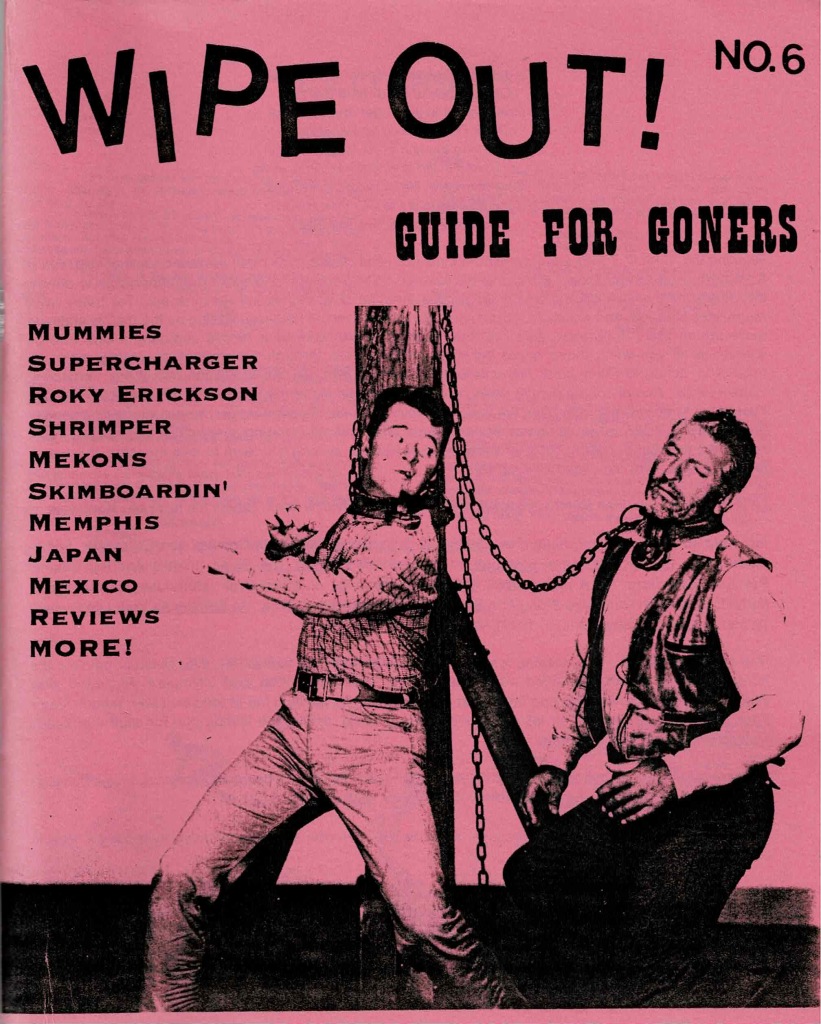



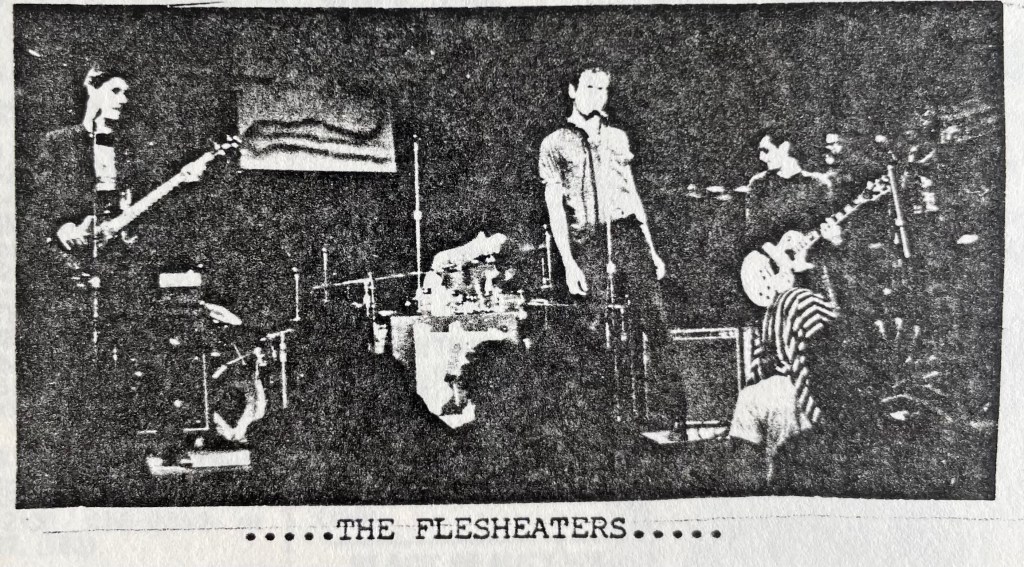
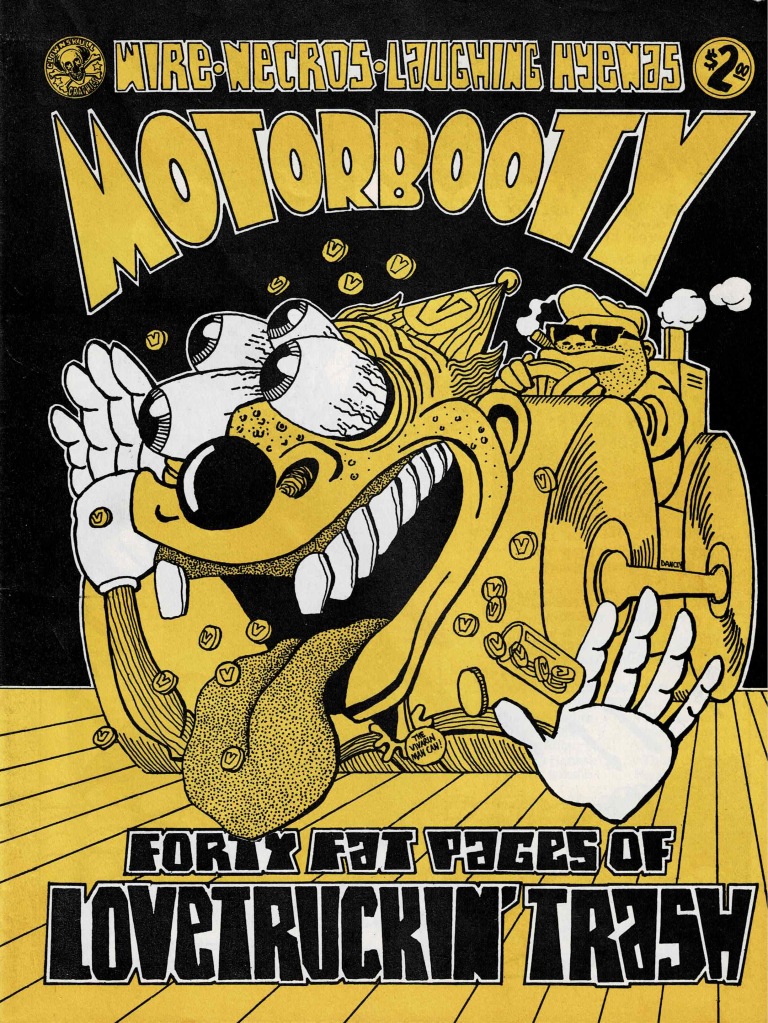


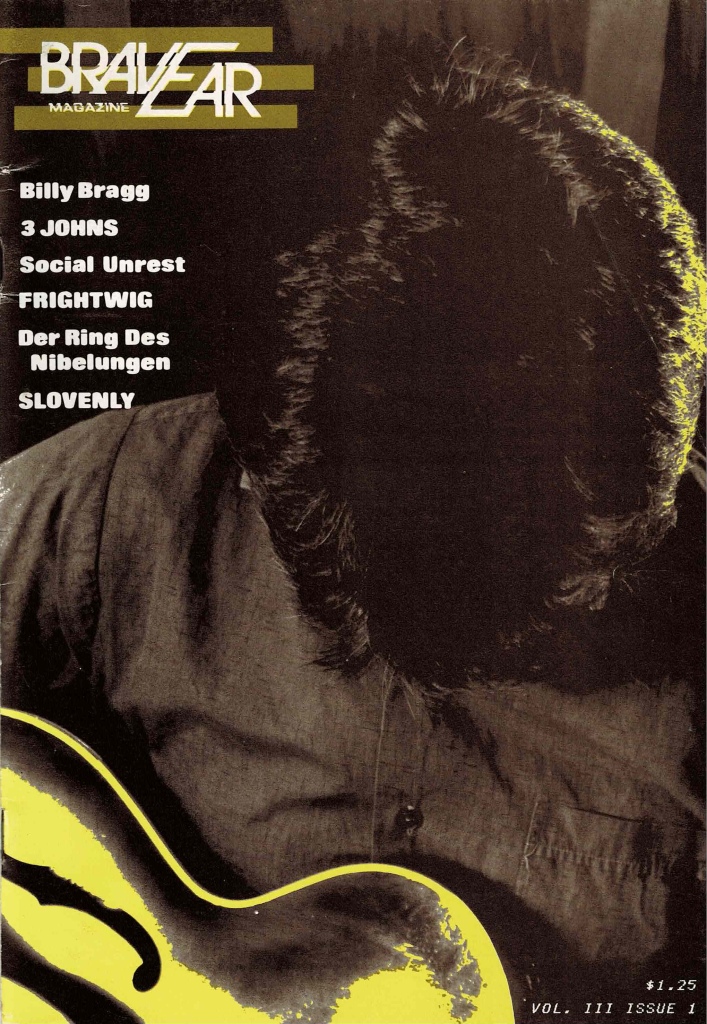

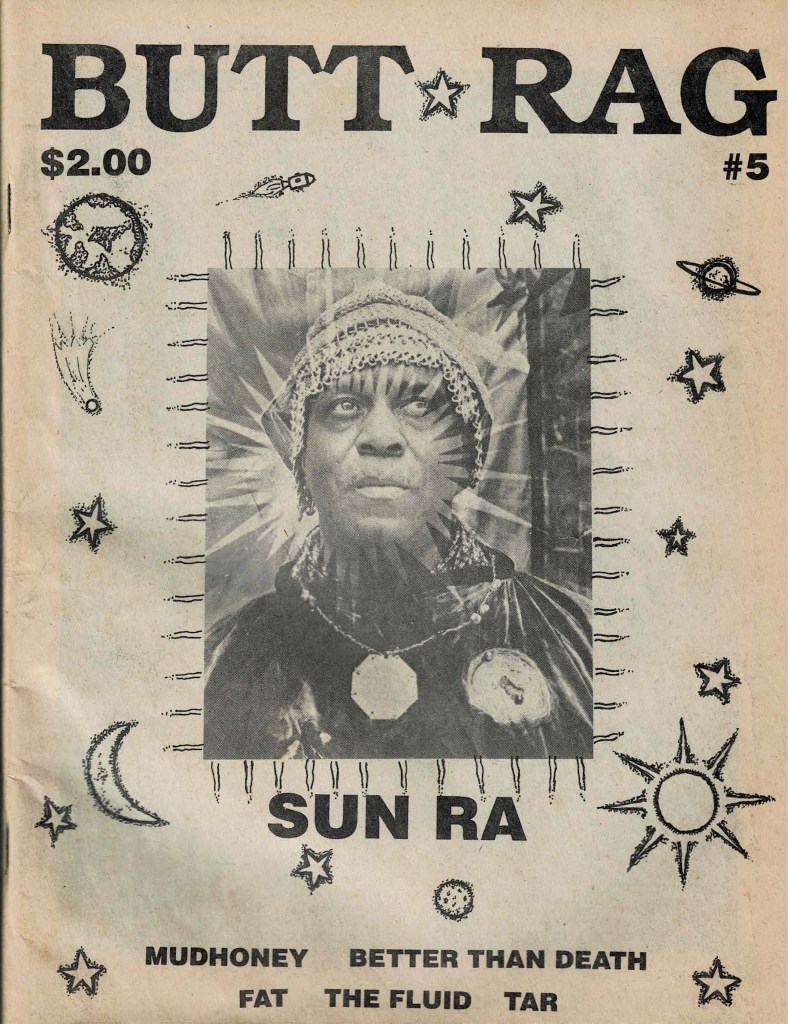


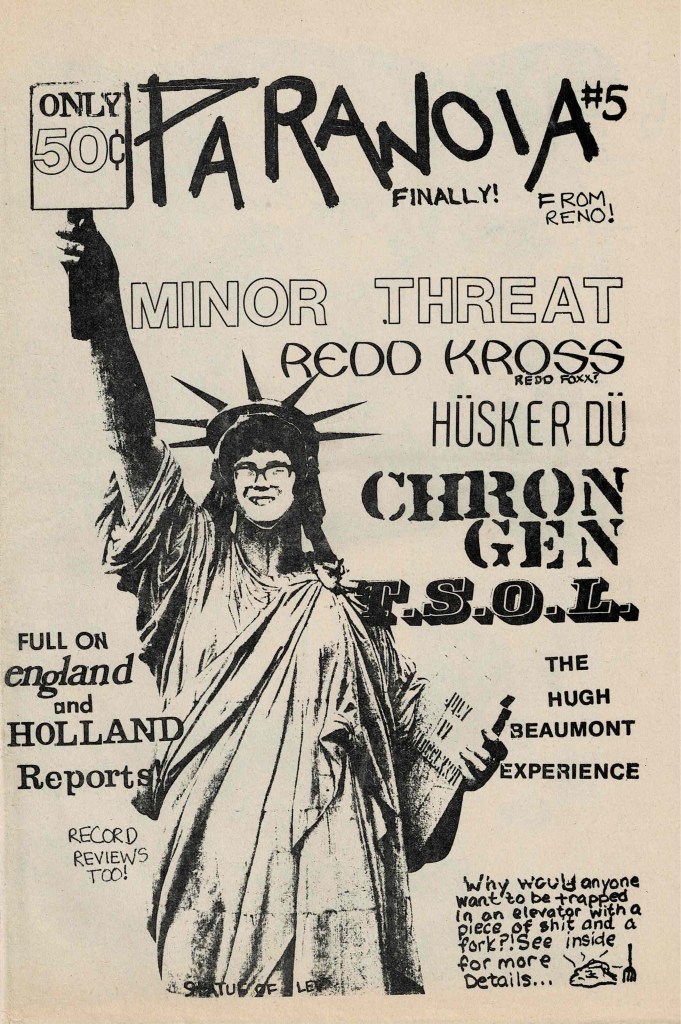


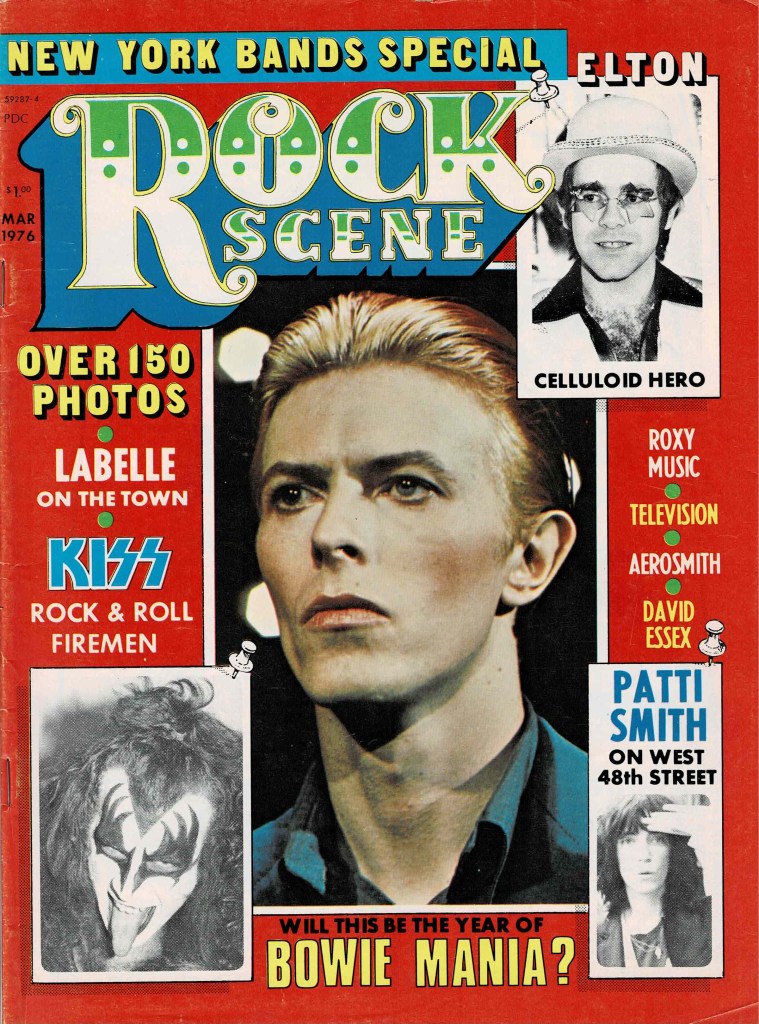


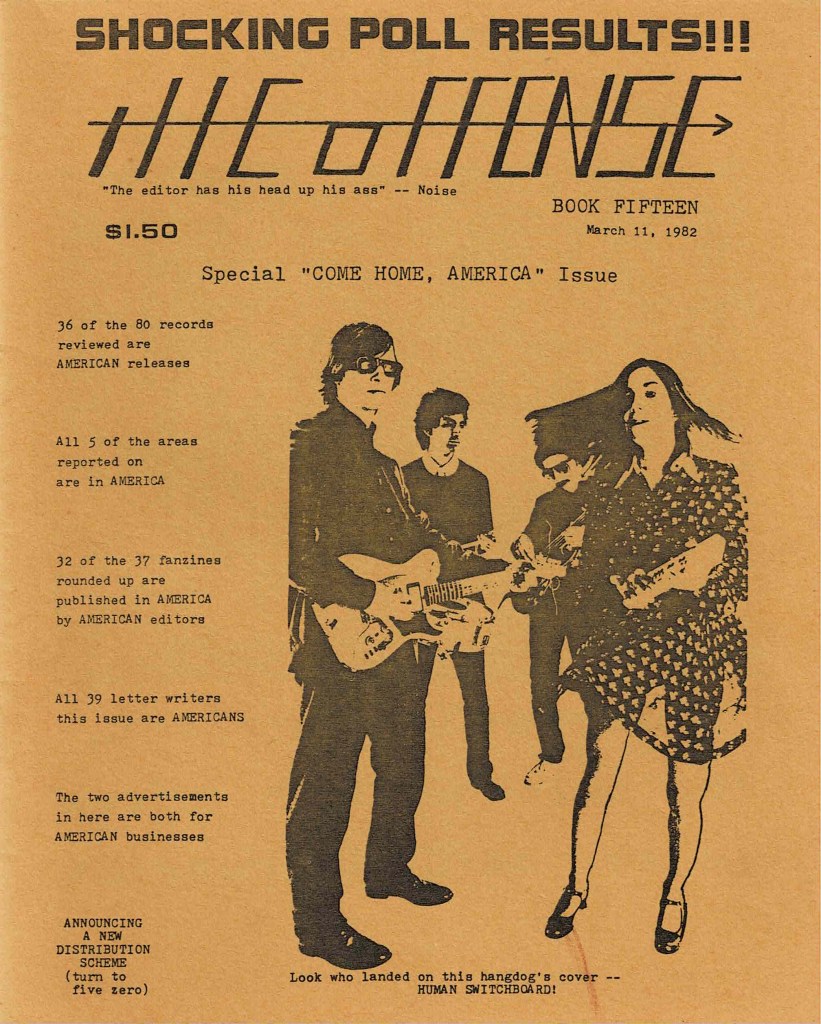


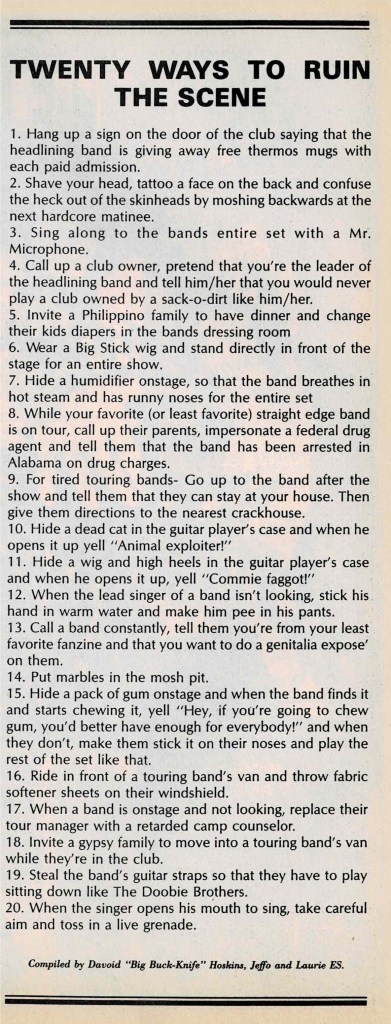
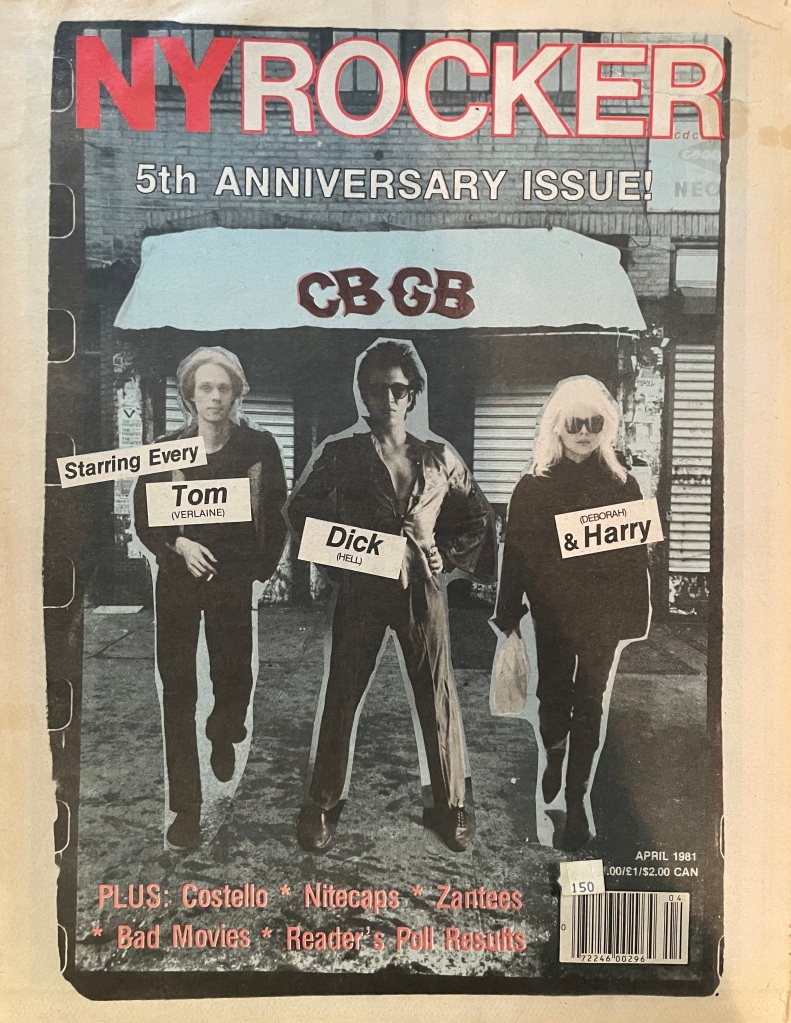


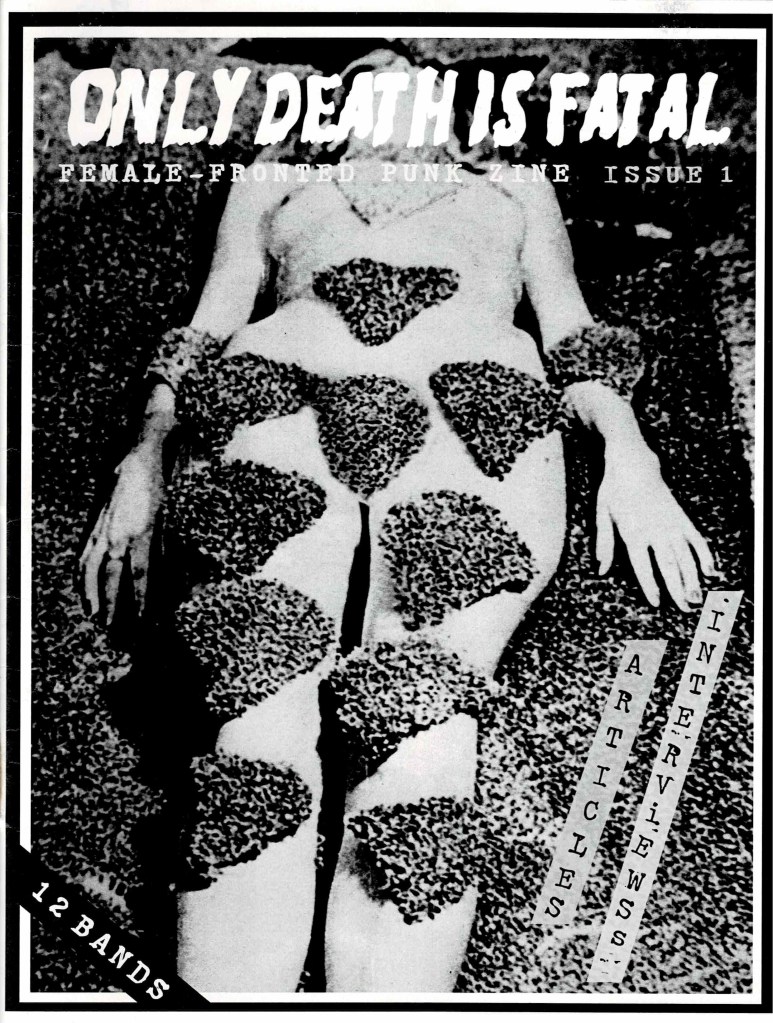

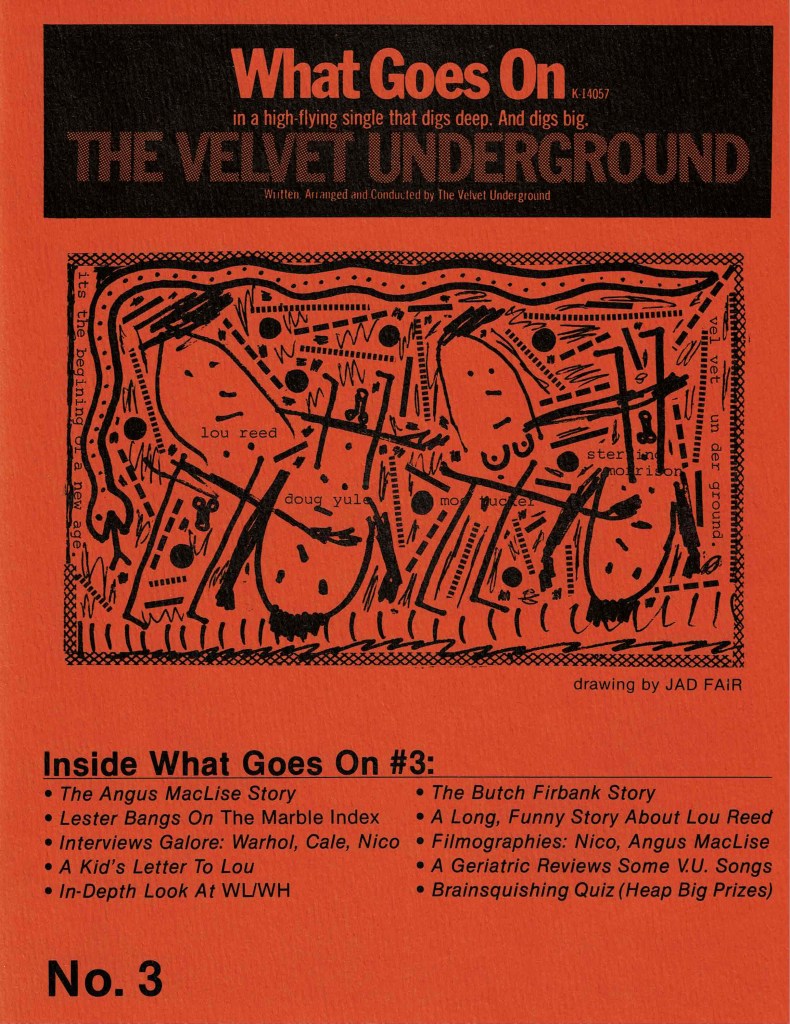
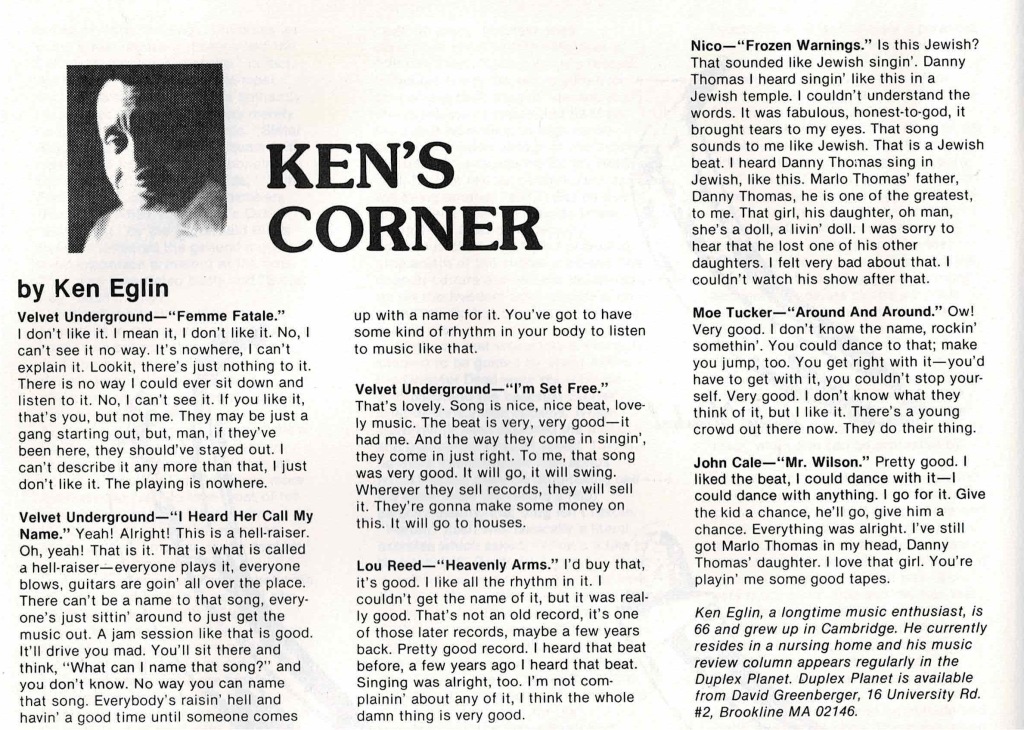


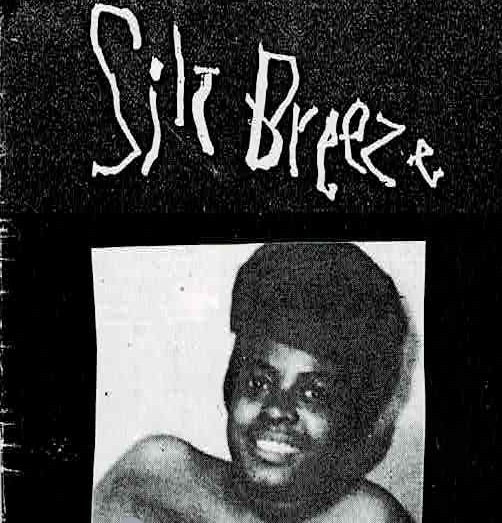
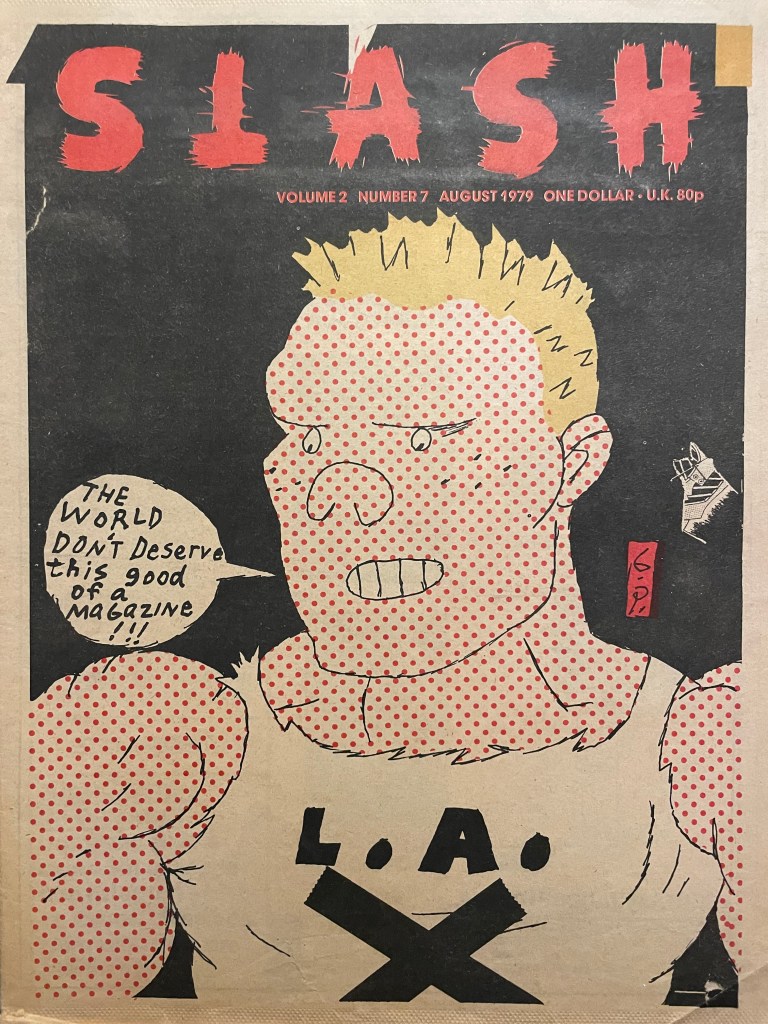
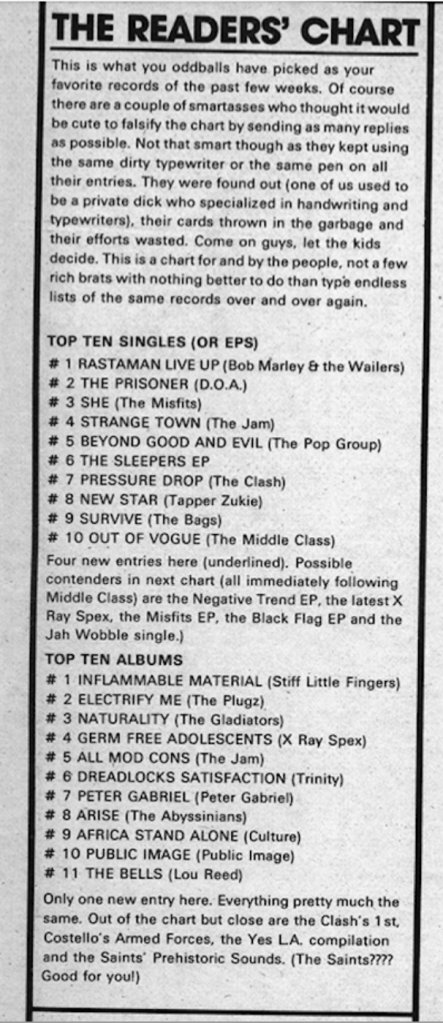


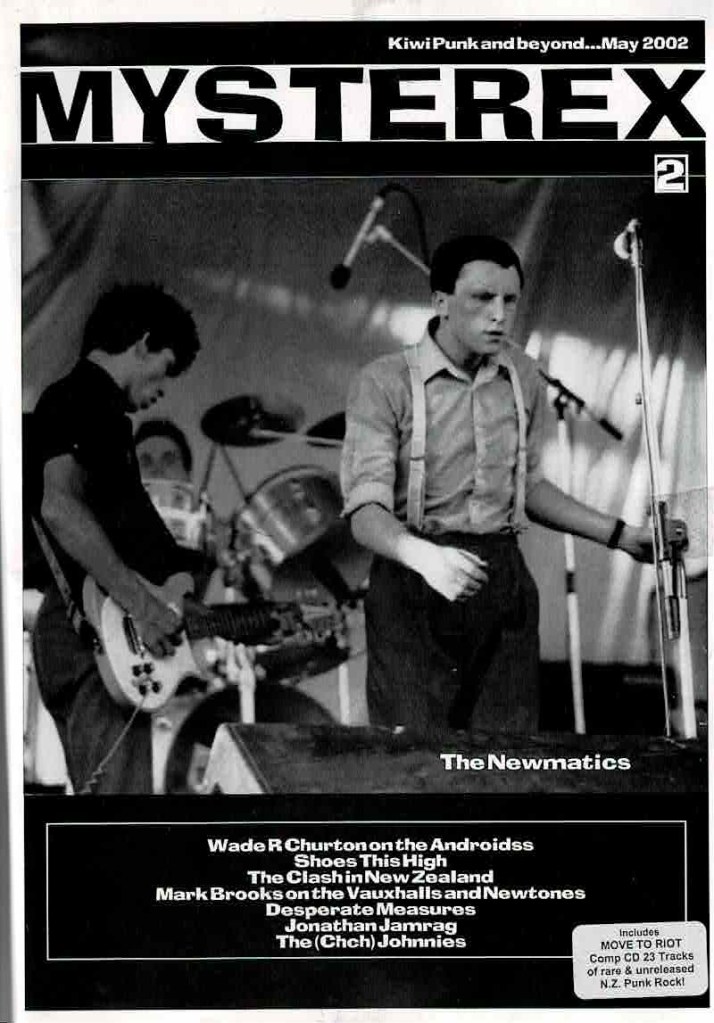

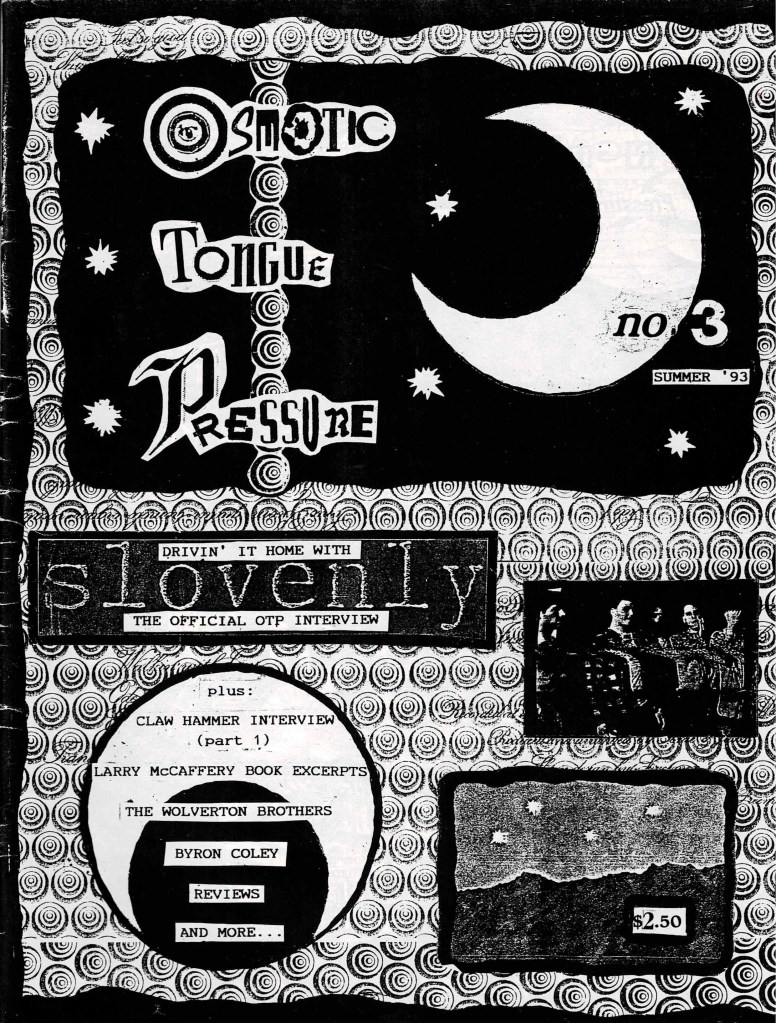


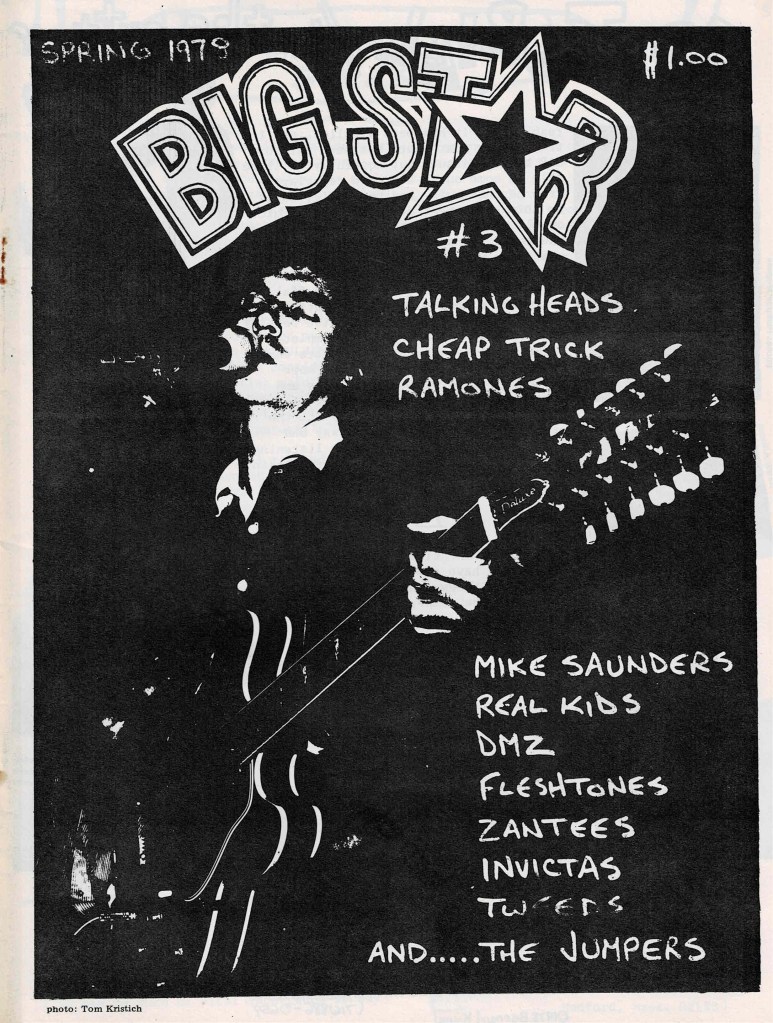


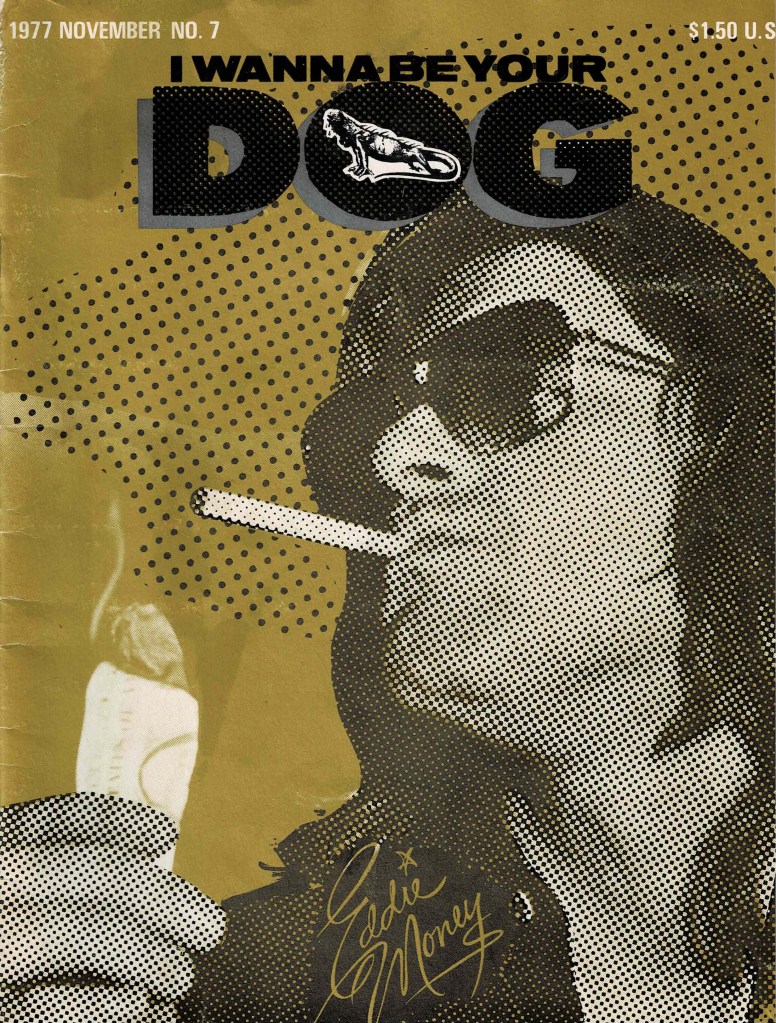


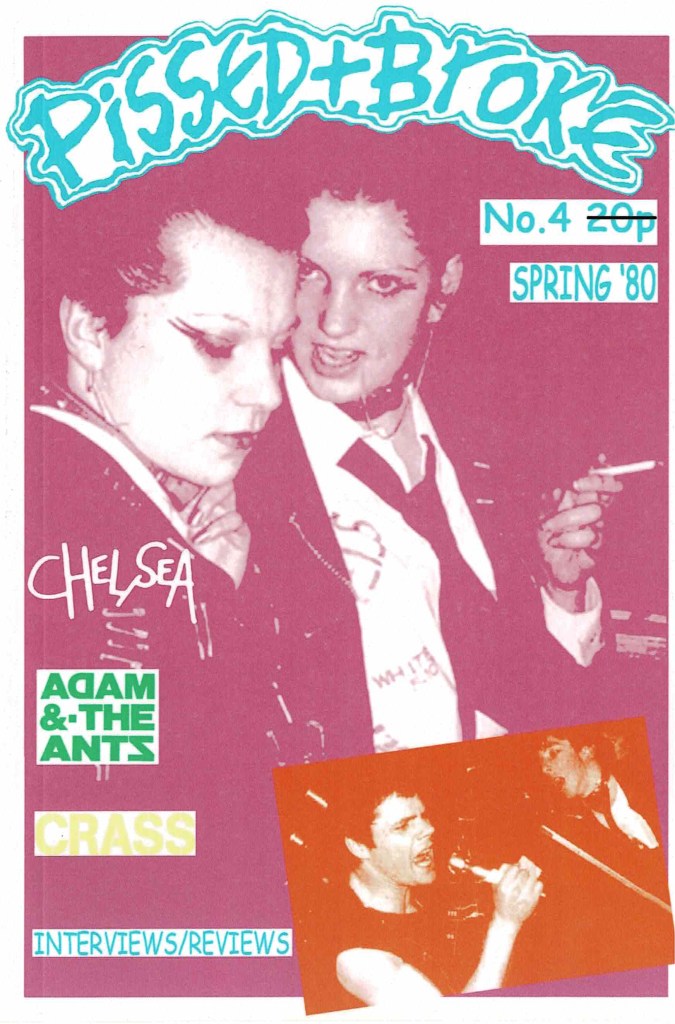
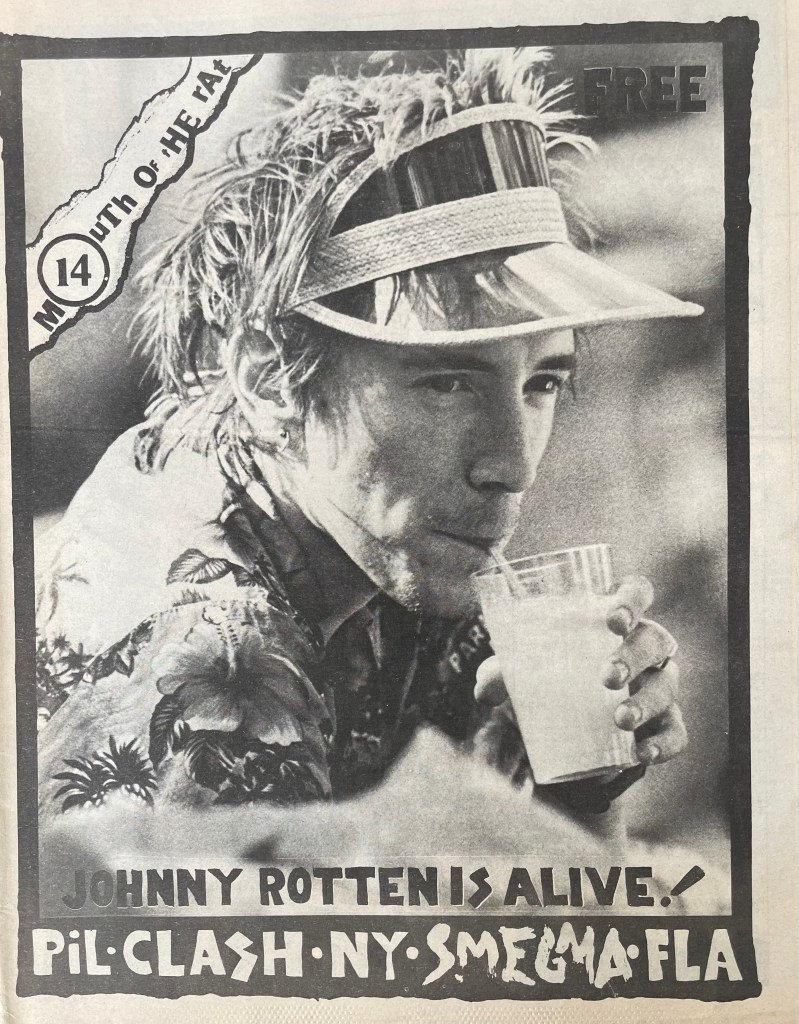


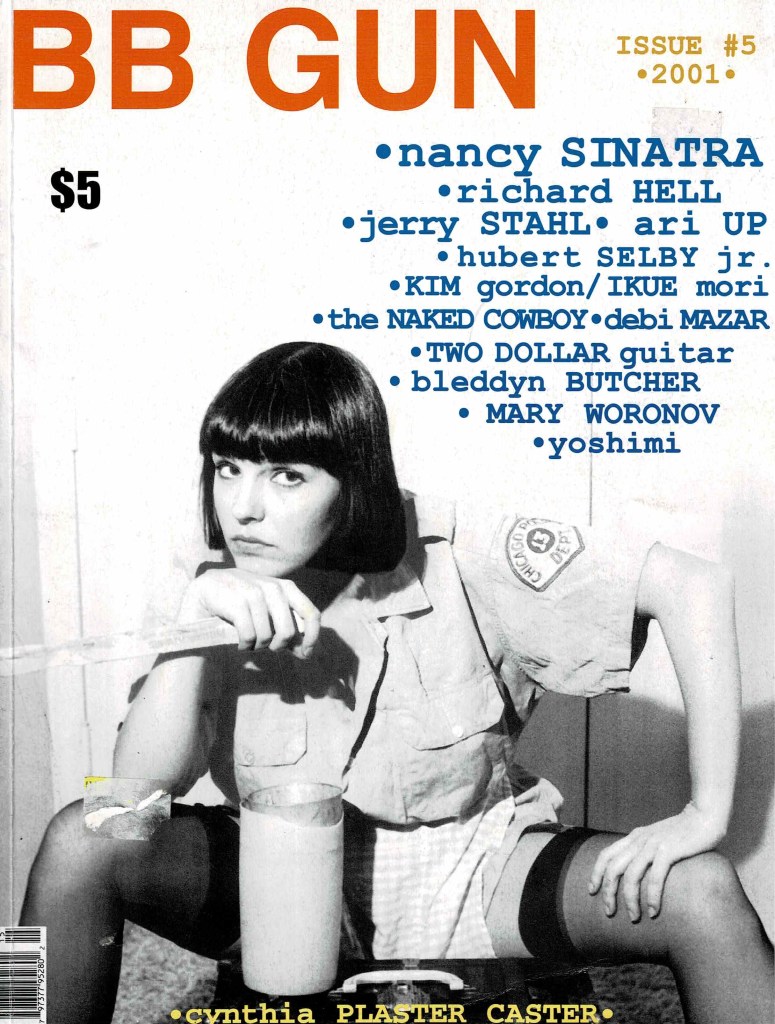

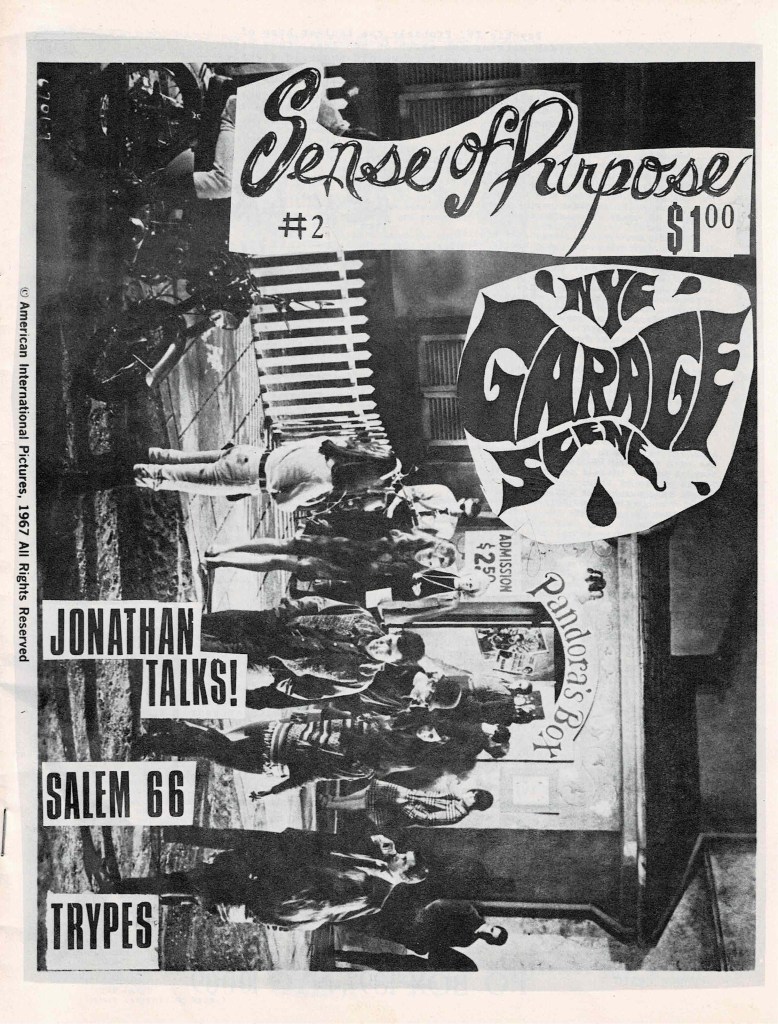




 Fanzine Hemorrhage