The Story So Far #4

We’re back here at Fanzine Hemorrhage after a several-month break. That break was what enabled us to complete a film-focused fanzine called Film Hemorrhage #1, which has just come out and is available here. Now on with the program.

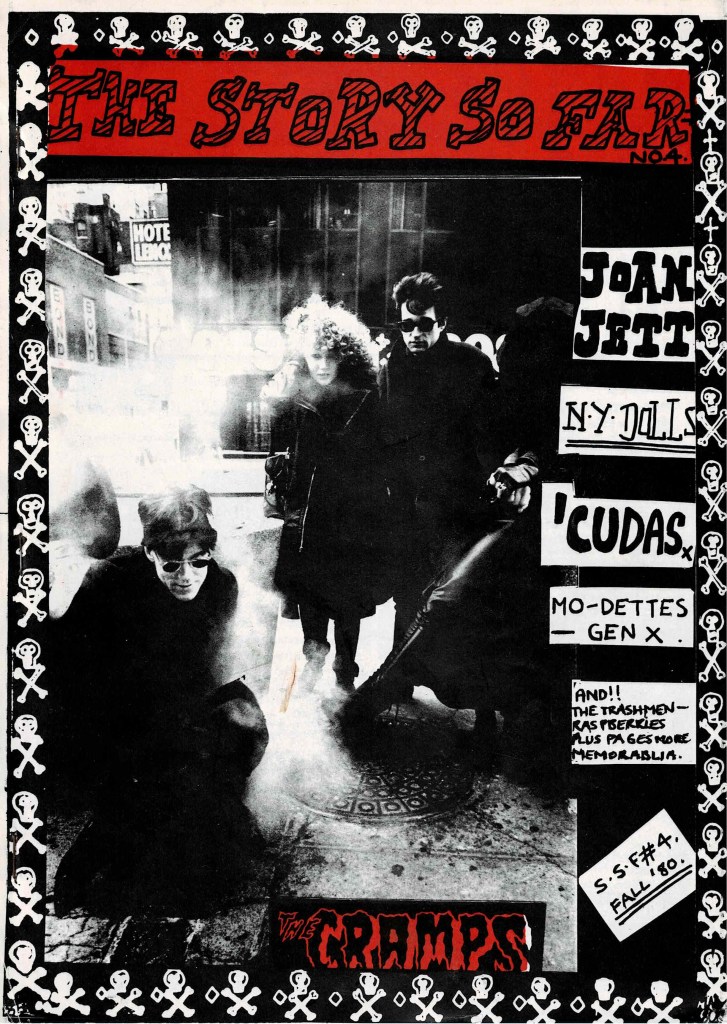
Music fanzine culture in the early 80s UK was more robust and fertile than anywhere else on the planet, I think it’s fair to say. The Story So Far #4 is highly representative of an excitable and ear-to-the-ground subculture of music freaks there, just allowing an onslaught of underground music to wash over them in 1980 and trying to document as much as possible before it drifts away. This in turn engenders new brain-jolting discoveries from the 1960s and 1970s, a particular new obsession of this fanzine, which has tribute pieces on The Raspberries and The Trashmen.

The editors were “Tim” and “Marts”, and according to the masthead, Nikki Sudden is a contributor in here somewhere. “This issue is full of yanks, which is unintentional but just turned out that way”, says one of them. If only they knew just how problematic that would sometimes feel for certain anglophilic American publications who went the other way. Key among the yanks in The Story So Far #4 are cover stars The Cramps, who really took hold of England during the early 80s and who were actually introduced to me back by English publications that I was buying in the USA (as well as by college radio). Even in 1980 we’ve got an ad in here for Lindsay Hutton’s Cramps fan club, as well as a Cramps interview and original photos from recent gigs. Lux is highly complementary of The Barracudas, a band highly visible in UK fanzines at the time but who don’t seem to me to be particularly well-remembered now.

I’m a little baffled by the letter to the editor from Vermilion Sands, a woman who became one of my retroactive 70s punk rock crushes once I saw her photo in Hardcore California a couple years after this. She’s at this point a former San Francisco punk and Search and Destroy contributor now based in England, making what sounds like some abysmal biker rock. It sounds as though she’s encouraging bands to sell out and join a major label, but she could just as well be arguing the exact opposite in her clipped, elliptical, punk rock-inspired typing. I’m really unsure, but it merited a full page in The Story So Far #4. In other news, Joan Jett has just released her first solo record and talks a bunch about the LA glitter and Rodney’s English Disco scene; Tim gives a full-page rave to the new Mo-Dettes album, and Marts tries to do the same for some new Generation X piece of vinyl, clearly his favorite bands two years ago but you can just tell the guy’s heart isn’t in it any longer. 

I wonder what became of Tim and Marts seven years later. Were they nodding off at Spacemen 3 gigs? Were they pigfuckers deeply into Big Black, Killdozer and the Butthole Surfers? Did they go through an intense “jangle” interlude? Fellas, write us here at Fanzine Hemorrhage as we’d love to get to understand the cut of your 1980s jib!

Charming #2

I was decidedly not an indiepop kid in the late 1980s, so I’ve come to my only issue of the Charming fanzine well after its publication date. But I do know that fanzines were an essential part of the UK pop underground and that within them many a battle was fought, many a crush was nursed and many an obsessed vinyl collector was born. Years later – and I mean years later – I finally caught up to 80s English and Scottish acts like Tallulah Gosh, Fat Tulips, Pooh Sticks and so on, but I didn’t give that stuff much of a sniff back in my knuckle-dragging youth.

Charming #2 from 1988’s pretty much everything you’d want it to be, though, if that is or was a world that mattered to you. Fully cut-and-paste, with loads of wacky photos, double entendres, scene gossip, drawings and excitedly hurried reviews of bands both new and old. The editor was “Stephen Charming” (he also refers to himself as “Stephen Sexbomb Charming”, as one does), and he published out of a really small coastal town in the east of England called Dovercourt. Wikipedia says “Dovercourt is a seaside town and former civil parish, now in the parish of Harwich, in the Tendring district, in the county of Essex, England.” So now you know.

The enthusiasm and vulgarity of The Pooh Sticks is on full display here in their interview, as the (male) members of the group discuss what they’d like to do to and with Clare Grogan. My Bloody Valentine are a new band, one already gathering a major reputation for “driving audience members out of the emergency exits” for their ear-bleeding set closer “You Made Me Realise” (spelling, MBV!!). I first heard them on Loveless and still enjoy that one in fits and starts, but they’d already started to become a touchstone band for many in the late 80s. Charming #2 has definitely lost whatever goodwill and admiration they had for The Smiths by this point – I can’t believe we’re talking about The Smiths for the second post in a row, or in any posts at all – and there’s a to-do made in multiple places about them selling out, cleaning up, whatever. All very nasty, too – Stephen Charming wasn’t a guy who suffered his fools gladly and while he may have enjoyed twee sounds he’s far from a shrinking violet in print, which makes for a fun read.

That’s when you can actually read the thing – jeez, am I starting to sound my age or what? 4- to 6-point fonts, man – I want to enjoy them, but I do really struggle with some of the fanzines of yesteryear, such as this one, made for US fighter pilots with 20/20 vision holding a magnifying glass. Oh, there’s a few other things, though – remember when we talked about Drunken Fish #1 fanzine and their big run-through of the Fierce Recordings label? Charming #2 does this too, in less discographical form. And the big overview in here of UK band The Primitives – I wouldn’t hear them until the 2010s, having closed my ears off nearly entirely to such music, but if you’ve ever heard a better feedback-drenched indiepop song than “Really Stupid” – listen to it right here – well, I want you to tell me about it and we’ll do a nude fistfight on hot coals over which one’s really better.

NY Rocker #57

The 1984 Conflict fanzine we talked about last time makes explicit reference within its pages at just how bad NY Rocker was by that year, and folks, it’s that exact era that this particular issue – NY Rocker #57 from May 1984 – resides in. And whew, it is indeed pretty bad. It’s not the voice of the NYC underground any longer, but rather an Anglophilic pseudo-music industry paper, reminding me just how rotten things were just north of the deep underground that year.  

What they’re covering is mostly garbage. The execrable Girlschool, The Smiths, Eddy Grant, another feature on X (the previous two issues I wrote about had X on the cover both times, just not their sell-out “year of change” X of 1984-85); Chrissie Hynde and all manner of commercial mediocrities across the board (Robert Cray??!), in every corner of the magazine. 

Patrick Albino writes in to vent about British provocateur and known Stalinist Julie Burchill having recently made her way to NY Rocker’s pages. Burchill was a bit more complex than that, politically, and eventually traveled from one pole halfway to the next, growing up enough to write this piece a couple of years ago. Editor Iman Lababedi takes the bait full-on and sounds about as much of a peace creep doofus as any Ruth Schwartz or Tim Yohannan response in that era’s MRR: “During an age that finds America’s right-wing lunacy reaching new dimensions of danger, you’re complaining about our printing a brilliant communist columnist. I know what side you’re on and it isn’t mine”.

Burchill’s column here is fantastic, actually, a wild review of various drugs and the current state of UK drug-taking. She’s said elsewhere that she had “put enough toot up my admittedly sizeable snout to stun the entire Colombian armed forces”. There’s a ton of UK/US cross-pollination going on in this issue, very reflective of the “Rock of the 80s” times when synth-pop and MTV were the centerpiece of mainstream rock writers attempting to shy away from Madonna, Springsteen, Prince, Michael Jackson etc. So it makes NY Rocker #57 feel far less of a fanzine than the previous issues I’ve discussed (here and here), and more like the new wave dreck Trouser Press was dishing out at this time, usually with worse writing. It reads at times like a non-benevolent corporate parent has taken over, yet that doesn’t appear to be the case, which is a bummer because it might explain why they took such a dive down the dumper.

Still, like Trouser Press in this era, there are moments. There’s a NY Underbelly column by Tim Sommer – he was in Even Worse! – featuring one of those rare Sonic Youth shots with Kim Gordon in glasses, along with small features on Swans, Ut and Sonic Youth. While the reviews are mostly of commercial records, the review section ends on a high note with a highly positive review of New Orleans’ Shitdogs (!). Three years later I’d see the Lazy Cowgirls play that band’s “Reborn” every single show, and have the singer of the Cowgirls relay to me personally the theretofore-unknown glory of The Shitdogs. 

Thing is, for $1.95 I’d have bought this every month had it been made available to me, reservations aside. I was a junior in high school at this point – and a Smiths fan – and I would have welcomed it into my home, while recognizing even then that it was fairly weak across the board. It’s a very different music publication than the one that had Byron Coley and Don Howland writing for it a couple of years earlier. What I learned is that the magazine had “folded” in 1982, and that this and only one other issue had been part of a brief – and totally unsuccessful – revival of NY Rocker. It ended up being the final issue, and I think that was most certainly for the best. 

Conflict #36

I’ve discussed Conflict #37 and Conflict #42 on this site previously; the former was (obviously) the issue of Gerard Cosloy’s fanzine that followed the one we’re discussing today, yet it took 18 months after Conflict #36 to actually see publication, by which point Cosloy had taken the entire year of 1985 off from publishing a fanzine, and had moved from Boston to New York City. So this one, Conflict #36 from August/September 1984 was the last of the Boston issues, and was definitely included in that whopping batch of Conflicts and Matters that Jackie Ockene let me borrow over spring break 1986, and which I count as a “germinal” event in my overall musical appreciation development, such that it was. 

Conflict #36 begins with something truly incongruous and unusual: what appears to be a heartfelt apology to folks like Mike Gitter and Billy Ruane and Al Quint whom he’d spent much mirth and merrimaking mocking in previous issues, the ones Jackie let me borrow. Mostly these folks were Boston-area publishers who wrote about punk & hardcore, and wrote about it poorly, as I gathered. Whatever happened in issue #35, I don’t know, but there are multiple letters printed in this one calling Cosloy out for being an asshole/jerk/too critical etc. It either had finally hit home, or this young man was being incredibly facetious in his apology; in any case, I have most issues of Conflict after this one, and sensitive and magnanimous they are most certainly not. So it didn’t hold for long – not even past page one in this one, to be honest.

What’s different about this issue from the ones that followed, aside from centering on Boston scene jibber-jabber and mock controversies rather than NYC, is its general girth. There are an obscene amount of reviews in here, everything under the 1984 sun that lived at the underground crossroads of hardcore, goth, college rock and nascent pigfuck. That could be X or R.E.M, Siouxsie and the Banshees or New Order, or Fang and the Sluglords and Flipper and Gang Green. Or Circle X or Sonic Youth or Live Skull. Interesting times, my friends. 

Patrick Amory, whom we last visited in these pages when we talked about his Too Fun Too Huge #2 fanzine, gets his own jumbo section to wax about records and live shows he’s seen around Boston. He puts out a contrasting (to Gerard’s) view of live 1984 Meat Puppets, calling them “heavy metal” and not worthy of the insane underground hype then-circulating around the Meat Puppets II record (one of my all-timers, for what it’s worth). Frankly, once I’d see them live for the first time two years later, that’s what they were – a shitty 70s rock band. Since I missed their berzerk, blitzoid hardcore days, I kinda feel like I missed their live genius entirely, because after I saw them in 1986, they were even worse!

Now Amory also reviews SSD’s How We Rock, which he rightly calls the worst album title of all time, yet he still thinks the whole thing is “powerful”, “supertight” and “awesome”. I wonder if he still listens to it. (Cosloy also reviews it, also digs it). I would have loved to see SS Decontrol live in 1981-82, but I personally believe “Springa” was hands-down one of the five worst vocalists in hardcore punk history. I really, really hope Al Barile, Choke and the Boston Crew don’t read this. Speaking of Boston ‘core, Forced Exposure’s Jimmy Johnson is a kid that has his say in Conflict #36, and gets a big section of reviews that mirror the interests of his own mag at the time – also HC, but also bizarro UK goth and noise. Cosloy’s excited about a ton of stuff in this one, with special lionizations of the latest records from Saccharine Trust and Big Black.

That’s it – no interviews, just dozens upon dozens of short reviews, laced liberally with scene reports, gossip and invective. That’s precisely what I needed when I read this in 1986, and Conflict from that point forward became one of the only two 100% totally essential fanzines for me in the late 80s, right alongside Forced Exposure.

The Two Hundred Pound Underground #1

First time I ever came across the name Tony Rettman was through a relatively strange pathway, back when I was doing my Agony Shorthand blog around 2004. Before there was really any social media of note, if you wanted to “troll” someone, you did so in the comments of someone’s blog. My blog was usually exempt, but at one point it got continually and habitually trolled by someone named Don Rettman – nothing too over-the-top, just some nastiness about whatever music I was writing about, mixed with some light-touch character assassination. All in good fun. In seeking to figure out who this guy was, I was told by a few east coasters in the know that Don Rettman was a longtime & well-known underground record collector, and a guy who had a younger brother named Tony, whom I came to find out actually looked at my blog on occasion and who I got in touch with via electronic mail.

Tony Rettman eventually cleared up the smoke somewhat; his brother wasn’t the rogue commenter, nor was it he, and it was someone anonymous out to besmirch us all in one way or another. All of those comments vanished when the comment-hosting provider I was using went belly-up. I then came to find that Tony Rettman was a main player on the Blastitude website, a really great digital fanzine of the era – not really a blog – which I eventually came to read daily. I soon found that Rettman was not only exceptionally versed in the minutiae of hardcore punk, he’d very much “lived through it”, and his subsequent books like this one and this one and this one have since crowned him as perhaps the preeminent historian of the genre. I remember one bit of correspondence between us back then in which he was jealous that I’d seen the band “Doggy Style” live. Now that is some truly omnivorous and forgiving ‘core commitment.

I came to track down some issues of his five-issue fanzine, The Two Hundred Pound Underground, which was later shortened to 200lbu. We’ll be talking about #1 today. It came out in 1996, and was co-edited by Nick Forte in New Brunswick NJ. The true pièce de résistance in this one is the extensive interview with Brian McMahon of the Electric Eels, going deep and going long on Cleveland in the 1970s at a time when many folks were waking up to just how incredible the sub-underground music scene had been there twenty years previous. McMahon is asked about Charlotte Pressler saying in From The Velvets To The Voidoids that he’d lived something of a double life, split between his Catholic upbringing and his involvement with the Eels, to which McMahon responds, “Charlotte is misguided…sounds like creative writing….Charlotte was insane at that time. She was abusing drugs too much. She was probably right in the middle of a nervous breakdown at the time. I mean look what Peter (Laughner) did to get away from her!”

There’s also a full page about something called the “God Says Fuck The Reunion” tour, in which bands in every town get to pretend to be The Electric Eels, in support of whatever bands the ex-Eels members are playing in at the time. I’ve never heard if this fiasco actually happened in 1996-97. Did it? Beyond that, there are a couple of pieces of fiction by V-3’s Jim Shepard, and a tiny, effectively unreadable print piece by Dwayne Zarakov about a tour by New Zealand’s Space Dust in the US. Can’t even read it to tell you much about what it says, but apparently my old pal Doug Pearson of Oakland, California is featured in it.

I’m always up for reading anything and everything by and about Eddie Flowers, whose Vulcher and Slippy Town Times fanzines I’ll eventually get to writing about sometime here. He talks a great deal about how his band Crawlspace came to be in Los Angeles, and how and why they morphed rather suddenly from the ramalama MC5-ish rock band I saw live in the late 80s to the sprawling, druggy, improvisation freak-noise act they’d become in the 90s. Todd Homer of Mooseheart Faith also gives a nice spin through how and why he broke from his bandmates in the Angry Samoans to do something similar, and just how uncaring and unkind the vacuous masses LA could be to bands like his and Flowers’ around this time (not that I liked them any more than said masses did!).

Rettman and the 200lbu crew at this point are really setting out to explore the outer limits, and do so in a large set of record reviews that, again, due to tiny blurred type are effectively impossible to read: Kevin Ayers, Brother JT, Climax Golden Twins, the Hampton Grease Band reissue, the LAFMS box set and so forth. As befitting The Two Hundred Pound Underground #1’s tenor and tone, it closes with a rapturous endorsement of the Siltbreeze 1996 live extravaganza with The Shadow Ring, Charalambides and Harry Pussy. Kids were going bananas for that stuff in ‘96. Aside from the readability concerns, it’s a highly effective and well-crafted snapshot of refined and expansive music taste, with the chops to communicate about it deftly and effectively. And zero Santana live record reviews to speak of.

Punk Doesn’t Need a Fanzine Called 20aMPC #1

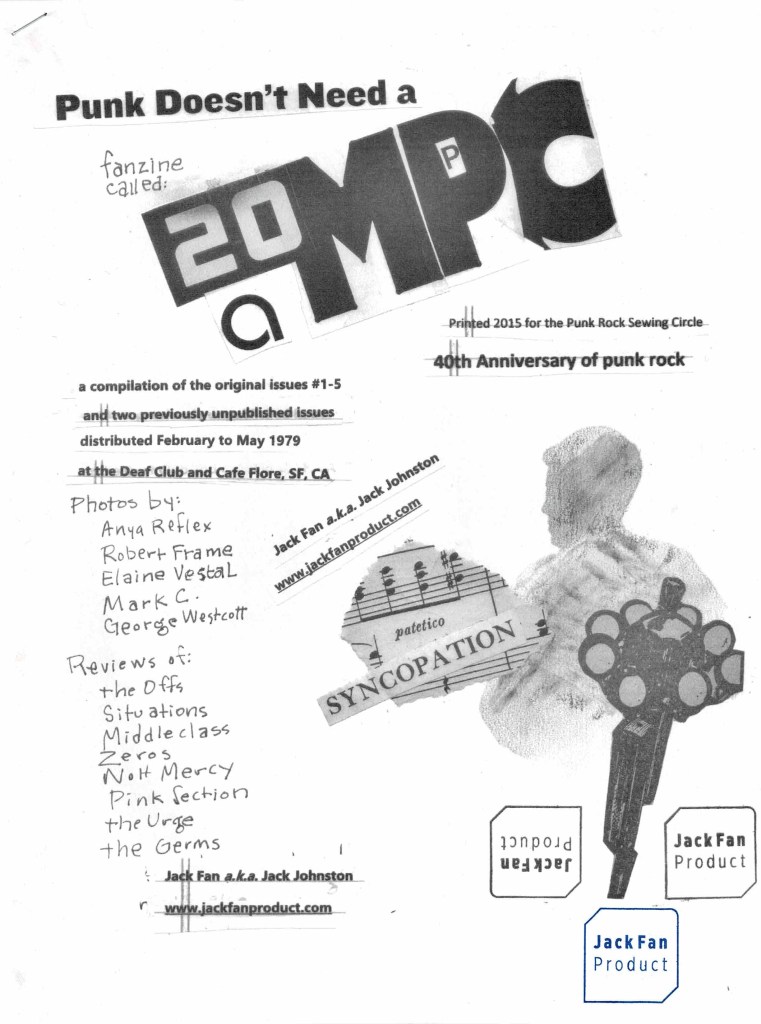
If this collection of blink-and-miss giveaway issues of a small free fanzine from 1979 called 20aMPC didn’t exist, I’d probably never have known of the thing’s original existence in the first place. I love it when folks collect stuff like this for those of us who weren’t there. My understanding from this podcast is that Pleasant Gehman is going to be reprinting her late 70s LA punk fanzine Lobotomy this year, and I’m all over that when it happens – but hey, just in case you find out about it first, can you let me know?

So 20aMPC was a xeroxed/stapled fanzine given away or sold for 5 cents (!) at The Deaf Club in San Francisco between February and May 1979. This collection takes the original five issues, and adds two brief “previously unpublished issues”. It was put together in 2015 by San Francisco’s Punk Rock Sewing Circle, a collection of quote-unquote original punks who were holding quite a few punk anniversary events around that time, some of which I attended. The writer and editor was Jack Fan, a.k.a. Jack Johnson, and he appeared to be a young man swept up into the scene and living large 24/7, pogoing from shows at The Deaf Club to DJing and working at Cafe Flore to touring with The Offs – clearly his close friends – and attending shows across SF, five nights a week at least. 

This was his micro-fanzine, and you gotta marvel how tightly he packed these issues with a mere four months of personal punk history, while also illuminating the evolution of punk on the ground, as it was happening. Key players in these issues include the aforementioned Offs; Pink Section; The Situations (I don’t know this band); The Cramps, and a posse of LA bands coming up the coast, like The Bags, The Germs, Middle Class, Zeros and more. Be still my friggin’ heart. 

One key takeaway is Fan’s massive disdain for the Mabuhay Gardens club and for Dirk Dirkson. He almost positions the Mab as the “corporate” club, the one that only tourists and the bridge & tunnel crowd go to. Such were the razor-fine lines of punk rock 1979! But jeez, there was such a cornucopia of shows to choose from in San Francisco every weekend, maybe you’d want to draw these lines once a cool clubhouse-type hangout like The Deaf Club opened up. 20aMPC came out so frequently that Fan is able to give schedules of upcoming shows each weekend, and the lineups just make one’s eyes water: X/Bags/Units/Suburbs; Offs/Bags/Alleycats, and Mutants/Avengers/Pink Section just over a 30-hour period alone, Friday and Saturday nights February 23rd-24th, 1979. 

Crime are called “notorious capitalists” because they charged $4.50 for a show. The other person to really take it on the chin here is Howie Klein, which absolutely seems to be a recurring theme in these SF punk fanzines. I mean, from the time I started hearing about the guy I was highly suspicious; while it’s hard for me to see Dirk Dirkson as anything but the real deal, Klein struck me as a musical opportunist with questionable taste in music, a junior-level Bill Graham safe enough for the suits but able to dabble in punk-ish power pop and with bands searching for career opportunities, the ones that never knock. Jack Fan sure thought so!

This Punk Doesn’t Need a Fanzine Called 20aMPC collection is still very much available for interested parties right here.

Bixobal #3

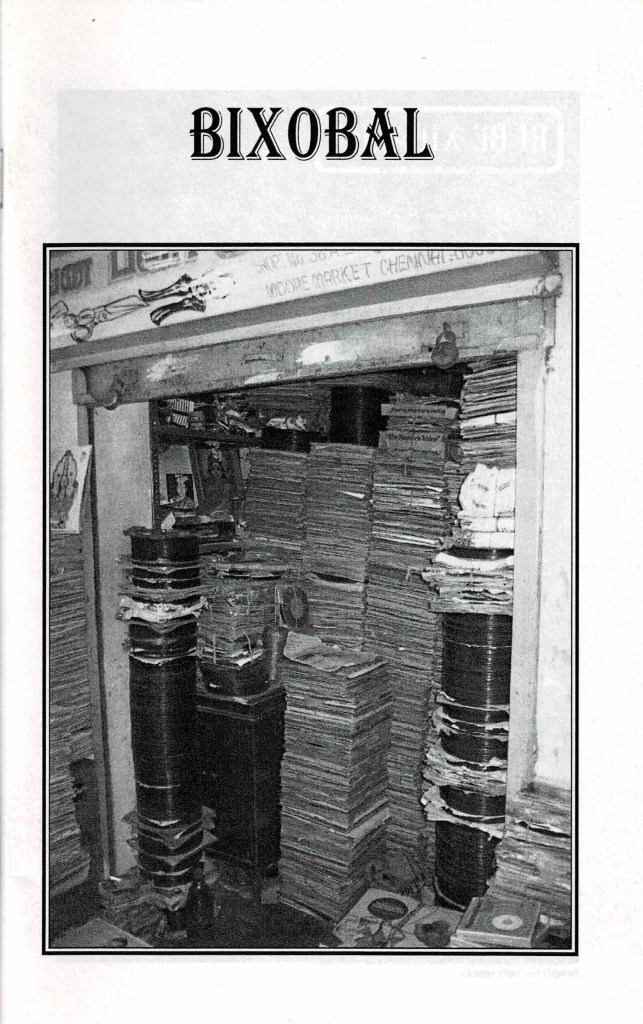
When the next great compendium of “cult bands” is written, please save a giant section of the book for the Sun City Girls if you’re the one who’s writing it. The sub-underground impact of this Seattle-via-Phoenix-via-the globe trio from about the mid-1990s onward was immense, and they did much to sully the loins of fans of improvisational ragas, world esoterica, barely-structured chaos, absurdist comedy and generalized audience baiting. They were a world unto themselves, and fanzines like 2008’s Bixobal #3 and quite a few others like it took no small amount of their cues from the expansive world they defined, and from rejecting the rest of the world said band were so clearly defined against.

That’s a hyper-simplification of this fanzine, no question – yet the first thing I see on its inside front cover is an ad for Bixobal’s in-house record label Ri Be Xibalba’s Charlie Gocher tribute album, and on the back, tour dates for Alan and Rick Bishop’s “The Brothers Unconnected” tour. Incidentally, I’m told that I accompanied some friends to the 5/21/2008 show from this tour at Slim’s in San Francisco. It’s one of the very few nights I spent absolutely hammered over the past two decades; in fact, it’s probably the last time that’s happened. Suffice to say I don’t really remember the show but I’m sure it was an outtacontroller. 

Bixobal #3, edited by Eric Lanzilotta in Seattle, I believe, is a point-perfect representation of the insular world defined and wrought by the Sun City Girls, taken into a written direction and done quite well. Rob Millis writes about 78rpm records; he’d soon put out the terrific Victrola Favorites package of some of his favorites. Allan MacInnis nails an extensive interview with Peter Stampfel of the Holy Modal Rounders, definitely a gem worth reading. There’s an interview with German 70s something-or-other Gerd Kraus, and then a mess of reviews, including a few at the end by Patrick Marley of Muckraker

If I’m being honest, so much of this No Neck Blues Band, formless drone, anti-music music drives me totally bonkers, and it becomes difficult for me at times to understand the line in between “I like this because it’s digging deeper and taking me someplace new” and “I like this because you won’t, and it’s obscure and insular.” I know that’s not an especially notable nor new criticism, now nor ever. I have no such problem with most free jazz and with challenging world musics I’m encountering for the first time, yet I’ve always shuddered a bit when formerly indie rock white guys disappear up their collective anus into music played by others like them that’s premised on & defined by its difficulty and obscurity. Then I wonder if the problem’s me. It probably is me.

Bixobal #3 reviews a few of the newer Sublime Frequencies releases and guess what – they love ‘em. I love that if this world I’m describing is one you cotton to, then you’re in luck – you can still buy this thing for a big $2.50 at the Fusetron music emporium. Load up your cart and tell them Fanzine Hemorrhage sent ya!

Scram #15

We return now to Kim Cooper’s Scram, a low-culturally omnivorous magazine whose fifth issue I dissected a bit earlier in the year here. The Los Angeles-based mag had gathered a great deal of steam by this point, 2002, to the point where they’d recently held their own showcase weekend “Scramarama” at the Palace Theater in LA, which I learned in this issue my cousin Doug Miller was the bartender and alcohol-procurer for. Of course he was! 

As mentioned last time, Scram had a sensibility that didn’t quite dovetail with my unrelentingly pure underground-music-that-must-be-beyond-reproach stance at the time, so while I always liked it, I really have come to enjoy it now, after the fact, now that I’m not such a pigheaded contrarian. The borders of their schtick were quite loose, but encompassed elements of goofy 60s pop, novelty records, garage punk, pranks, toys, oddballs, analog-era artifacts and underground comix. The writing was fun, upbeat, winking and satiric. Contributors – in this issue alone – ranged from Gene Sculatti to Mike Applestein to Andrew Earles to Brian Doherty, with Kim Cooper lording over the proceedings and setting the tone as “editrix”. 

Right out of the gate Scram #15 hits it out of the park with a funny & revealing Dan Clowes interview that’s contemporaneous with the release of the Ghost World film, one of the 2000’s best, discussing everything it took to get it made and released. I was so taken with reading this last night that I’m going to watch the Criterion edition of the film tonight w/ all the extras. There’s a panel review of rock-themed board games, such as a Monkees, a K-Tel and even a Partridge Family game that I actually remember from my youth. And then Sculatti’s piece is actually a 1971 interview he did with songwriter and producer Gary Usher, talking extensively about his interactions with the Byrds, Beach Boys and the early 60s instrumental surf scene.

Remember how excited everyone got about that Langley Schools Music Project release, a mid-70s recording of some Canadian schoolkids arranged through their music program into doing tracks like “Space Oddity” and “In My Room”? Applestein interviews Hans Fenger, the maestro behind it, as well as one of the now-grown-up kids, who gives a fairly reluctant interview about something she’s clearly still a little baffled about. Mike Applestein also milks a piece out of “Five Concerts I Missed”, a terrific concept I wish I’d thought of first: shows you could have gone to, but didn’t, and then regretted. I’d start with SST’s “The Tour” on February 28th, 1985 at the Keystone Palo Alto with The Minutemen, Husker Du, Meat Puppets and Saccharine Trust, which I couldn’t get any of my high school friends to attend with me so I bailed. 

I’ve got nearly a complete run of Scram except for issues #8, #9 and #10, which I’m missing and can’t find. Anyone able to help a brother out?

Creep #4

Earlier this year I bought a near-complete run of San Francisco’s top-drawer late 70s/early 80s punk fanzine Creep from the ZNZ store – who still have three of the five issues for sale as of this writing. I excitedly wrote up Creep #2 in these pages here, so I’ll spare you another introduction to the mag and let you go read that first if you’re interested, allowing us to get right to the heart of 1980 west coast punk rock USA in the here and now.

Creep #4 lives at an interesting intersection of several strands of California punk “journalism”, such as it was. There are half-hearted attempts at intellectually unpacking various scene controversies and kerfuffles of the time, such as a piece on Noh Mercy’s acerbic and still spine-rattling “Caucasian Guilt”, or a total mess of a P.I.L. show that almost didn’t happen – something akin to a piece you’d find in Damage around this time. There’s truly stupid punk-sneer writing by birdbrains such as one might find in Flipside. And given this magazine’s tenuous connection with Maximum Rocknroll, which wouldn’t publish its first issue for another two years, you can see a little bit of a political slant sashaying its way into these pages – but not too much to make Creep #4 intolerable.

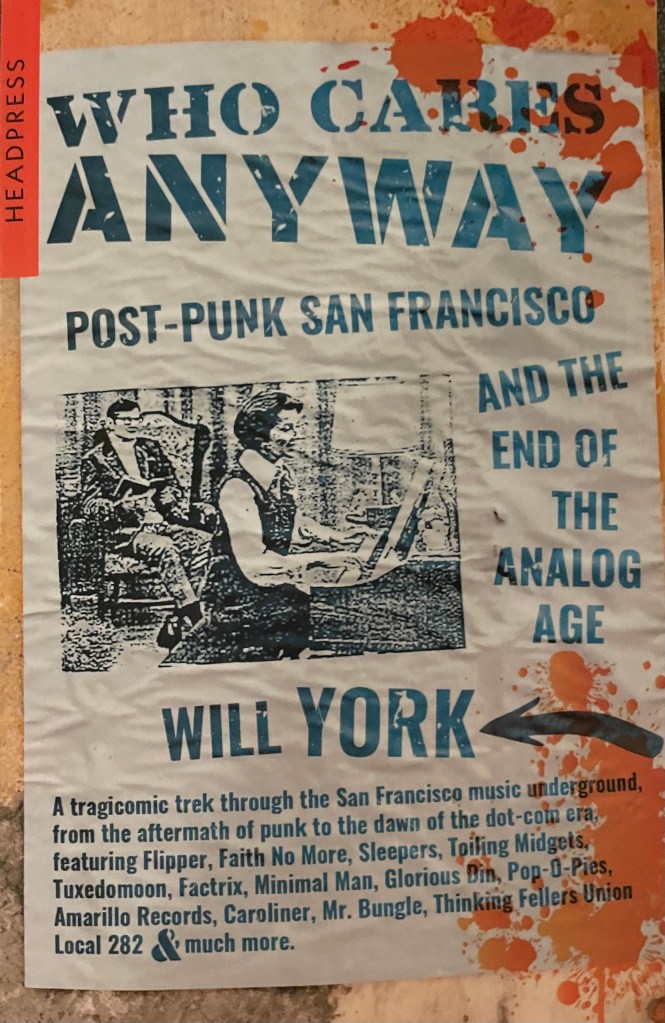
I actually have to give much credit for the breadth of the interviews here. There’s one with Alex Chilton by Ray Farrell, not at all something I’d expect here – and Alex is great, totally calm and cool as Farrell takes him to task for Like Flies on Sherbert (shame on you, Ray!). There’s a brief one with Steve Tupper of Subterranean Records, which was just getting off the ground. He tells it like it is: “415 (an S.F. label) appears to be primarily interested in very commercial or very well known bands. That means exclusion of everybody else. We’re much more interested in experimental kinds of things – the kind of music being made by hordes of kids just picking up guitars and synthesizers and making music. Everything we do has this hard, grey feel to it. That’s the way the world is. Let’s face it – a lot of this stuff just isn’t hit material.”. Subterranean were the label who first released Flipper, and they were covered at length in the excellent book Who Cares Anyway? – Post-Punk San Francisco and the End of the Analog Age.

On the other hand, the interview with The Vktms doesn’t do them any favors – with all due respect to Nyna, she definitely comes across as a major league dum-dum in this interview. And I’ve done some bellyaching about Gregg Turner, Mike Saunders and the Angry Samoans before but never have I seen their misanthropy and queer-baiting at such a jacked-up level as it is in their interview here, in which they go off on all the high crimes & misdemeanors of the LA punk scene, a scene that was known to blackball the Samoans for just such behavior. I mean, these weren’t 15-year-olds from Canoga Park writing into Flipside, these were guys in their early thirties play-acting as punks and – in Saunders’ case – saying Iggy, Iggy, Iggy whenever handed the opportunity. Of course, I laughed at “Get Off The Air” and I still love large chunks of Back From Samoa and I always will, but Saunders and Turner are (or were, in 1980) detestable human beings. Watch their brief interview in this 1980 LA punk “expose” called What’s Up America and you’ll see what I mean. And Gregg Turner’s recent book was an abomination that I couldn’t get even a third of the way through. Do I make myself clear?

This was the year of collective disillusionment with The Clash, and the piece by “Austin Tatious” (great punk name I’d somehow never heard before, but still not as classy as my friend Christina’s DJ moniker Geannie Lotrimin) expresses great disappointment in their San Francisco show. The whole Lee Dorsey (“Working in a Coal Mine”) “bored cocktail lounge a la Holiday Inn backup band” opening act bit was pretty funny; I suppose this was the time that they were bringing incongruous opening acts on the road with them, which, hey, hats off for trying I guess. The Specials are also on the road in America – “Horace’s impression of U.S. AM radio: ‘Great if you like ‘Hold The Line” or ‘Life in the Fast Lane’’. He swears he heard each at least 80 times across the country with only sporadic listening.” Oh yes, 1980 commercial radio in the United States was just awful if you were there, and I was there.

Creep #4 is a content-rich goldmine for you punk historians, probably one step up from Ripper and very much in the same vein, from size to breadth to paper type to regions covered. Now let’s see a Silicon Valley Bank-like run on the few copies remaining in the ZNZ store

Not Fade Away #3

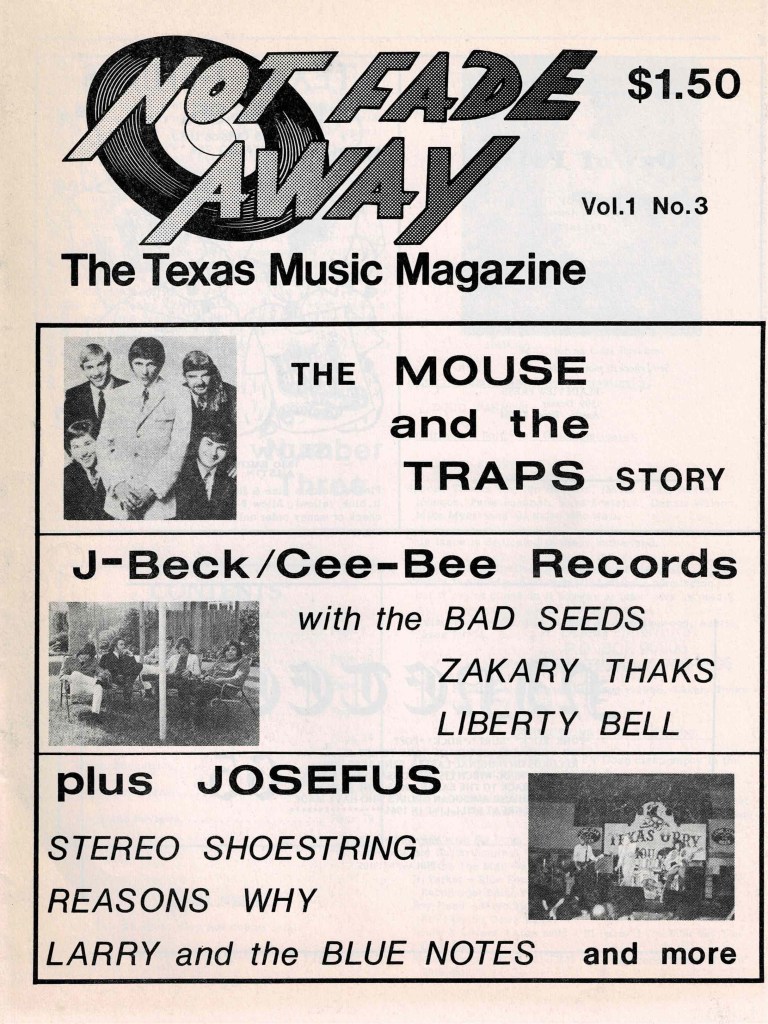
Despite never having truly been a true record collector – much more of a record accumulator – I hold obsessed, deeply committed collectors in high regard, and rarely tire of their stories of the hunt & the big score. Aside from the guys who almost single-handedly resurrected pre-WWII blues by going door-to-door in the deep South to look for 78s in the late 50s/early 60s, my favorite collectors are the 60s punk fiends, the guys who cobbled together a cohesive and distinctly American narrative for what was clearly going on in thousands of garages and basements across the USA in 1965-1967. That’s the world that 1980’s Not Fade Away #3 traffics in, and their scope is further refined to the great state of Texas, almost certainly the American locus of the most insanely wild and highest-quality 60s garage punk during those years. 

Now think back, if you’re old enough to do so, to what 60s punk scholarship was like in 1980. Sure, Nuggets had long been out, the first few Pebbles comps were around and Greg Shaw’s Who Put The Bomp! was writing about this stuff at times. Most of what we’d come to know about the great underground 60s punk 45s would come later, though, first through a series of 60s punk bootlegs like What A Way To Die, Garage Punk Unknowns and Scum of the Earth, and then of course via Back From The Grave, the greatest compilation series of all time. I’d have to imagine that editor Doug Hanners was doing his own original research, digging up telephone numbers from white pages & writing letters to studios listed on 45s released fourteen years previous – and he actually started the mag in 1975.

The biggest features are all listed on the cover here – Mouse and The Traps get the top billing and the longest piece. I was most smitten with the side-by-side photos of these Texas rogues from 1966 (basic cool roughneck hippie kids) and 1967 (far-out psychedelic shaman with love beads and paisley shirts). There’s a great short piece on The Reasons Why, who’d cut this absolute screamer called “Don’t Be That Way” in 1966. They dispel any myths one might have had about well-behaved teenagers at dance clubs and fraternal lodges, in particular the Beyersville SPJST: “All these kids from the little towns would pack the place. Being out in the country we’d get a lot of cowboy redneck types and sometimes things would get pretty wild. We’d be up on stage playin’ and the dance floor would be packed, then all of a sudden this whirlpool would start in the middle of the floor. It wouldn’t be just a few guys from Taylor fightin’ a few guys from Rockdale, it’d be everybody from Taylor fightin’ everybody from Rockdale….one time this cowboy picked up this hippy and threw him through the plate glass window in front.” Texas punk!

Was also psyched, if you will, to see the small piece on The Stereo Shoestring. Have you ever heard their psychedelic face-melter “On The Road South”?? Please do so, right here! Maybe ten years ago I re-read this particular issue and started cataloging the things in the review section I’d never heard, particularly in the short “Tex-Mex” section of 45s. I then went onto the illicit file-sharing site Soulseek and found said Tex-Mex 45s, and they were a true blast. Texas is a big state and all, but I think per-capita it really musically punched well above its weight for many, many years. Not Fade Away #3 is a superb fan’s-eye furthering of what made this particular state’s iconoclasts and cultural rebels stand out, and documents everything I love about the crazed collector mentality.

Chemical Imbalance #4

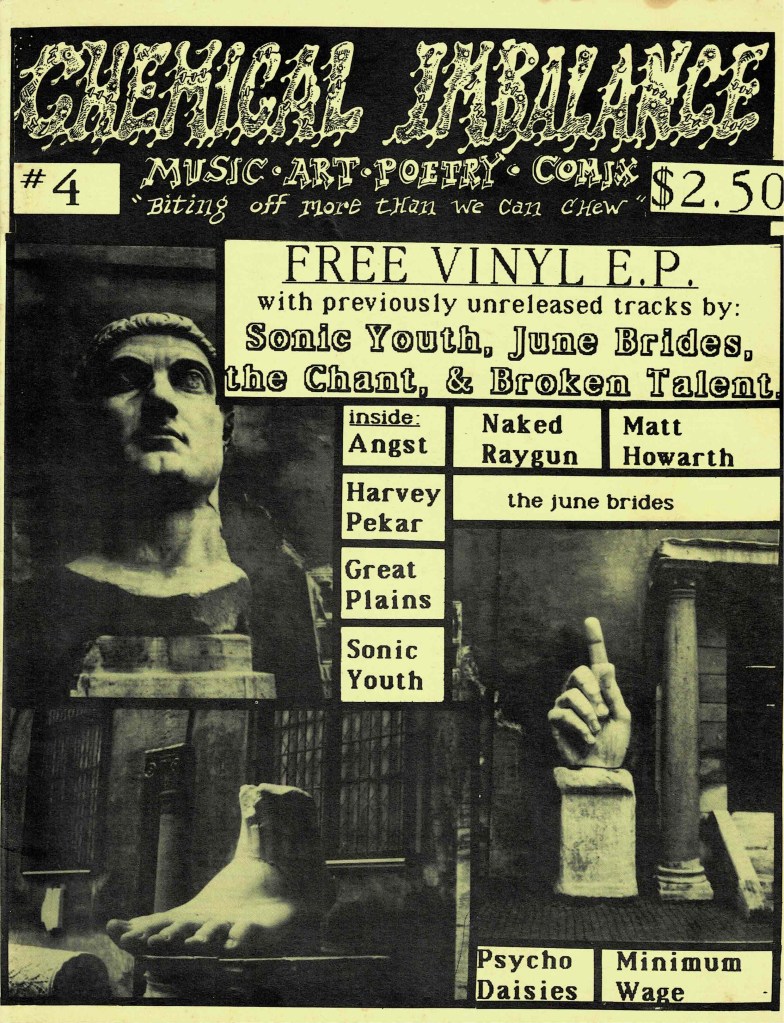
I’ve owned this issue of Mike McGonigal’s Chemical Imbalance since the day I bought it in 1986 in an LA record store because it had an included 4-song EP with Sonic Youth on it. It was clear to me in reading through it just now that I really hadn’t flipped its pages since, so honestly, it was a pleasant surprise to see a wonderfully sophomoric yet still well-informed and -intentioned dose of independent, far-left-of-center Americana. If you remember McGonigal as a guy pilloried for my-unremembered and what I’m sure were nonsense “scene crimes” by the likes of Byron Coley and Steve Albini, you’d be forgiven for thinking – as I did – that maybe his early college-era fanzine would have aged none too well. It’s aged just fine.

I mean, I have several of the issues that came after Chemical Imbalance #4 as well, I’m pretty sure. It was never one of my favorites, and I’d be hard-pressed to name a band, musical genre or artist of any sort that this fanzine turned me onto – but it was always easy to find, packed with deep-underground ephemera and tuned to whatever alt-wavelength I found myself frequenting in the late 80s. McGonigal went on to run Yeti and Maggot Brain magazines, both of which suffer(ed) from a seemingly forced, mile-wide/inch-deep eclecticism that render any tastemaking therein to be highly suspect. I suppose that was true of Chemical Imbalance as well – a sort of “look at me, I don’t only like punk rock” narcissism that probably kept me from ever coming back to his mag after my first reading, yet didn’t prevent me from buying at least three more issues. Like I said, maybe time and age has melted my resistance, because I kinda like nearly everything about this one save for the poetry and most of the comics. I always wonder if “fanzine poetry” is meant to be an ironic joke when I come across it anyway.

Seymour Glass, whom we learned recently to our great surprise was a key cog at San Francisco’s BravEar around this time, does a fine interview with that city’s so-deeply-unsung-that-nobody-liked-them Angst. As it turns out, I liked Angst; saw them live; and was a major proponent of their first Happy Squid EP, which you gotta hear if you haven’t. So this interview too was a nice surprise, a great retelling of awful tour stories and corrupt bookers and strange bills put together by SST with Angst and Saint Vitus. There’s a mail interview with Great Plains, another band on a bigger indie label who were probably better than the sub-minus attention they received indicated, and one with Kim Gordon of Sonic Youth, “because everyone else interviews Thurston”. Sonic Youth mania was only just barely wheels-up at that point, with Evol having recently come out, and it shows from interviews with other bands here, like when Jeff Pezzati from Naked Raygun interrupts himself to blurt out, “I just saw Sonic Youth, they were amazing!!”. 

And with regard to all the comics in Chemical Imbalance #4, well, I’ll tell you about my reverse-evolution with comics. In 1986, when a music fanzine would print comics, I’d get all huffy and uptight about it. Comics were for children, and were uniformly unfunny to boot. I thought “Baboon Dooley” was totally inane (still do). When grown men later started busting a nut over goofus music-adjacent comic artists like Peter Bagge, I stuck my head in the sand and said I. Hate. Comics. I only started thawing with regard to comics, or comix if you will, around the age of 40, and you know, that wasn’t all that long ago. I went back to re-read a bunch of Dan Clowes stuff and fell down that rabbit hole and it introduced me to the whole world of Fantagraphics and Kitchen Sink and bizarre art-dada stuff like Doug Allen’s Steven. I’m totally down with comix now, kids!

I still think the ones in this magazine are mostly imbecilic, but hey, I now thoroughly respect the gumption shown in pulling them together and stand proudly behind their Constitutional right to print ‘em.

Ptolemaic Terrascope #24

I’ve sort of dipped in and out of Phil McMullen and Nick Saloman’s Ptolemaic Terrascope world over many years, but I’ve come to see their efforts at creating a psychedelic music oracle and broadsheet as a highly successful one, no more so than this mid-career effort from November 1997, Ptolemaic Terrascope #24. I guess the way I sorta contextualize the magazine is as an underground but widely-distributed fanzine treading somewhere at a midpoint between Bucketfull of Brains and the later Galactic Zoo Dossier; more intelligent than either and slightly more geared toward a collector mentality.

Ptolemaic Terrascope often included vinyl and CDs, and this one, which has a 4-song vinyl comp EP, excitedly announces that future issues will include compact discs. Fuck yeah! It also announces the 1998 Terrastock 2 festival taking place in San Francisco, the city which has been my hometown for 34 years except for the mere two years I was away in grad school in Seattle, which, alas, coincided with this festival. I came home to SF for spring break and this has just happened and all the cool heads were abuzz about it; you are welcome to gaze at the lineup I’d just missed by a day or two.

The biggest draw in this issue is a Karl Precoda interview, a rarity if there ever was one. He won’t talk about The Dream Syndicate, but this discussion was held right as that excellent first Last Days of May CD was coming out, and I really love that thing and its follow-up and don’t get why they still seem to be almost completely unheard. It’s terrific to see a reluctant Precoda eventually settle graciously into his interview and talk technique, dub music, his guitars and more. There’s also a Guided By Voices interview. Robert Pollard has just turned 40 and defensively expounds a bit on his advancing age, saying “I still think I’ve got a few years left”. I’ll say he did.

Other features are on The Electric Prunes; The Misunderstood, later subjects of an exhaustive Ugly Things exhumation; a Ghost side project called Cosmic Invention; and a cool piece on Pelt (Mike Gangloff, Jack Rose and Patrick Best) – an excellent overview of a band I missed at the time, confusing them with the UK’s Felt whom I didn’t like. In the reviews section, we’ve got some absurdly tiny type that even twentysomethings might complain about – not that any of those were reading Ptolemaic Terrascope #24, right? – and it meshes reviews of stuff like Santana – Live at the Fillmore with a passel of freak-rock albums on the New World of Sound label such as Plague Lounge, a teenage pre-Comets on Fire band whom I once saw open for Monoshock.

That reviews section is a good encapsulation of the sort of musical melange this ostensible psych fanzine was trying to pull together: heavy rock, freakbeat, far-out pop, strange noise, garage rock, and anything with even a twinge of drug use, real or imagined. Advertisers are all over the map, from the most minimalist of noise labels to the most maximalist (if super-underground) of loud rocknroll/punk labels. Seems that issues of this magazine aren’t too tough to procure online if one is so inclined, but me, I’ve just got this and one other and could probably find room somewhere for another few.

Punk Rock #2 (February 1978)

Incredible: a true, no-doubt-about-it, cash-in-on-the-trend punk rock exploitation magazine. I was intrigued enough by the looks of this one to order it from Ryan Richardson’s Ryebread Rodeo fanzine emporium, and despite the falling-apart cover and the general contents therein, I’m glad I did. To the best of my knowledge, only three issues of this made it out there; this is the first one and this is the third and final. (Just poking around the internet I also came up with this 1978 issue of another punksploitation mag, Punk Rock Stars. “Kiss: Did They Start It All?” I’ve often wondered!). 

I really can’t be certain how serious the birdbrain writers at Punk Rock #2 were taking themselves or their punk magazine assignment from corporate parent Stories, Layouts & Press Inc. Most of the writing affects a silly, “dangerous” sort of phony aura that sounds like broke, young bespeckled journalists who’ve just come off of covering The Allman Brothers and Kansas for other mags, and who’ve maybe just been forced to read the 1977 Time magazine article on punk and taken their cues accordingly. Or they’re sort of hanging on to their former, more comfortable rocknroll worlds, as in Gloria Robinson’s opening gossip column, which starts off with items on Blondie, the Sex Pistols, The Runaways and Lou Reed before drifting wistfully to unironically talk instead about The Beach Boys, Elton John, Greg & Cher Allman and the Grateful Dead.

Photos of The Dead Boys permeate this thing. If there was one group who went all-in on throwing themselves in front of cameras and beclowning themselves as wild “punks”, it was them. It’s fun to see some of the features trying to decide what’s punk and what isn’t. This was the era, if you’ll recall, that Mink DeVille routinely showed up in punk features (including here), mostly because the band played often at CBGBs and Willy DeVille had an angular haircut and punkish mien. Punk Rock #2 has features on The Dictators (one of the few well-written pieces, this one by Michael P. Liben) and a wild-looking group of Detroit hair farmers with the MC5’s Dennis Thompson in the band called Sirius Trixon and the Motor City Bad Boys

Darcy Diamond travels to Los Angeles to go The Jam’s press conference, and to briefly write about and misspell the name of The Weirdos (here called “The Wierdos”; you’ll also see a great deal of confusion within Punk Rock #2 about there vs. their vs. they’re). “My punk friends in The Germs and The Bags implored me to catch The Weirdos set.”. And really, the less said about the “How to be a Punk” guide in the middle of this thing, the better. I get the sense from a doofus editorial up front that Punk Rock magazine was ginning itself up for an on-the-ground media war with John Holmstrom’s equally awful Punk magazine, which clearly never took place once the former checked out in April 1978.

Seven – Scat Records Quarterly #2

Robert Griffin was the fella behind the early 90s fanzine-with-a-record-from-a-band-from-Cleveland Seven. He also ran and still runs Scat Records, who, among their many other accomplishments, were the label who basically hipped the world at large to Guided By Voices, a band that only folks like Tom Lax knew about before the 1993 Propeller/Vampire on Titus CD hit the street, courtesy of Scat. And then the world fell in love, as you’ll remember.

Griffin also put out the phenomenal 3×10” release Those Were Different Times in 1997, which gave the world some incredible til-then-unreleased 1970s Electric Eels and Mirrors gems. He was in the band Prisonshake, and when I started communicating with him around the time Seven – Scat Records Quarterly #2 came out in 1990, I was blown away that I was actually in analog communication with a guy from the aggro mid-80s post-punk band Spike In Vain, whom I vainly held to my bosom as one of the secret treasures that only I knew about. I wrote about them in Superdope #2 the next year thanks to some info that he – and only he – was capable of providing me. 

And funny enough, Griffin plays something of a role in one of own my major life events. I took my now-wife of 25 years, Rebecca, on our first-ever date to see Guided By Voices at the I-Beam in San Francisco on July 2nd, 1994. I was a big fancy man, “on the list” with a “plus one”, thanks to Griffin, and of course that helped cement the date with this target of my affection. Who wouldn’t be totally impressed with a “potential boyfriend who gets on lists with a plus one”? – only to find at the door that “Nope, there’s no Jay Hinman on the list, sorry, nope, go away freeloader”. Thankfully I was able to rustle up $16 for a couple of ducats and she somehow stayed with me regardless. She’s upstairs right now. Griffin didn’t know what happened, and hey – it’s all cool in 2023.

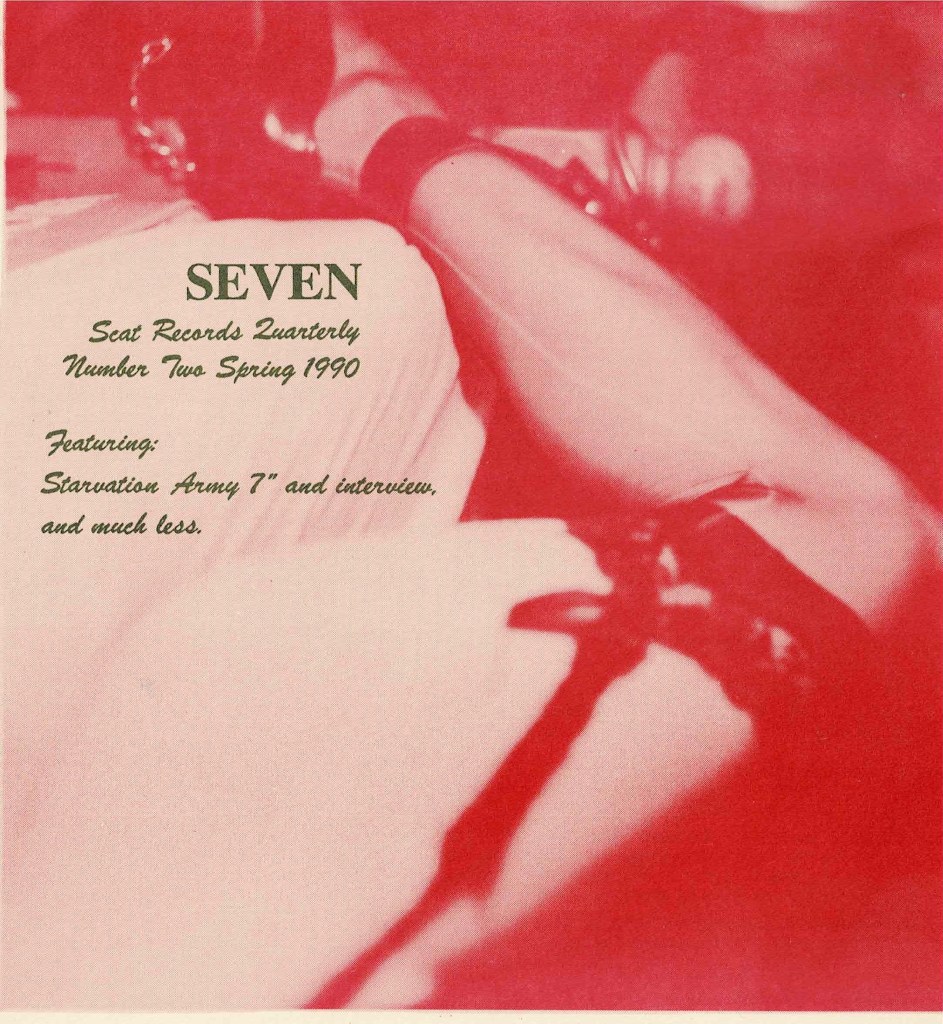
Seven #2 from 1990 was about 7” singles only, as were the other issues. I applauded and still applaud the concept. I’ve had my own deep forays into singles-only collecting, and even in recent years I’ve bought a bunch of 45s on Discogs and in stores to build back all the great records in my favorite format that I’d sold over the years, then thought better of it and promptly sold those records yet again. #2 comes with a Starvation Army single I’ve never listened to, as well as other wacky inserts like photographs, cheapo toys (a plastic snake, a skeleton hand and a black balloon), and other assorted real inserts, including a Scat Records catalog.

The idea to do a different sort of fanzine with packaging as the linchpin was another strong marketing play from a guy who was and probably still is interested in doing things differently from the indie herd, even if it meant spending more. The thing is even numbered, and mine is #343/1000. Serious record dork alert. The fanzine itself is OK. There are many reviews of small indie pop records, loads of Cleveland things and a focus on the Sub Pop and Amphetamine Reptile records that were pouring forth like Old Faithful around that time. 1990 – a weird year for the underground. I see it as a transitional year from the shitty late 80s into a much more fruitful underground (New Zealand, garage punk, Siltbreeze etc.) from 1991-94. 

I remember being moderately frustrated by the Cleveland-centricity of this fanzine at the time, primarily because I didn’t really like the bands. Griffin’s own band Prisonshake were good but so much of the local stuff that Seven flogged just didn’t have any real heft once I’d get down to buying it at Epicenter or Aquarius or wherever. Fair enough, though – I’d write disproportionately about my San Francisco Bay Area favorites in my own fanzine, and many of those bands proved to be utterly baffling outside of the 415 area code. I hadn’t looked at my copies of Seven in many years and now I’ve got two others in front of me, so I reckon we’ll take a look at those in these pages when the time is right.

Damage #6

Coming only mere months in May 1980 before the desultory Damage #7 issue that we discussed here, the bloom is most certainly not yet off of the punk rock rose in Damage #6. In fact, this issue’s one of this San Francisco tabloid’s very finest, easily in league with Slash and NY Rocker issues that were being published concurrently. Sure, it’s all filtered through a San Francisco sensibility, and despite being a proud taxpaying, child-rearing resident of said city for 34 years now, I still gag on so much of the “punk politics” and arty pretensions of SF during the 70s and especially the 80s – hell, even now – which are often just a real hectoring bummer in the midst of such a plethora of so much countercultural flowering. 

But not in Damage #6, really! I mean, there was a police bust at Target Video downstairs from Damage HQ during a party for Japanese group The Plastics, and editor Brad Lapin is none too pleased in his editorial. Damage then gives it full coverage in a big article and even a comic. I swear man, I hate cops to the max. There’s also a brief supplement for NART magazine, all political art and very San Francisco. Caitlin Hines, who wrote better at age 19 or 20 than I ever have at any age, savages promoter and record label impresario Howie Klein for something he said about her in issue #5. I have this issue, but am too lazy to go read it now. Hines says, “I have always been most fair in my dealings with him, never once alluding to his age, girth, infamous past exploits in Nepal, balding dome or rather unsightly general appearance”. She was fantastic. I interviewed her ex-partner Peter Urban about her in Dynamite Hemorrhage #8 if you wanna read it. 

Jane Cantillon interviews and writes about John Cale (I think it’s actually Jane Hamsher, who was a contributing editor at Damage). “When I told Cale I was writing this for Damage, he said defensively, ‘I’m not new wave!’”. There’s also a tongue-in-cheek short interview with the “pretty” and “pert and perky pop fave” Lydia Lunch, who’s just released Queen of Siam. Even then people were making deliberate fun of her horribly over-the-top persona! Speaking of similar circles, there’s an overview of performance art in San Francisco. I guess Karen Finley plied her trade for a while in SF? I did not know that. And we also have an introduction to “local electronic music”: Non, Factrix, Minimal Man and The Scientists. This was the wild sound of young San Francisco in 1980, along with Flipper, who get a rave review for their contribution to the SF Underground comp.  

I was also pretty impressed with the San Francisco scene report. It talks about artpunk quartet The Bob, whom they call “…the best thing out of Oakland since ‘You are now leaving Oakland’ signs”. The LA scene report right next to that says that Patricia Morrison has left The Bags (true) and that the band has renamed themselves Plan 9 (wow, if true!). And then a chunk of reviews, most of which are by rockin’ Jeff Bale, very soon to be a star player in the Maximum RocknRoll world. 

I’d be remiss if I didn’t mention the interview with The Mutants, whose Sue Mutant, one of their three singers, graces the cover. They’re not a band I’ve ever really cottoned to much, and most folks who were there will tell ya to steer clear of the records – live is where they were at. A couple of months ago The Roxie Theater here in San Francisco had a night of Napa State Mental Hospital rock & roll, by which I mean they played the entire June 1978 performance of The Cramps there; along with The Mutants’ entire heretofore-unseen performance, and then Jason Willis’ and Mike Plante’s excellent short documentary on the day. I swear the audience felt like it was comprised of San Francisco’s first 200 punks, all the Mab and Deaf Club denizens of the day, and they dutifully hooted and hollered whenever their friends turned up on camera. Then a couple of Mutants came out and did a little Q&A before V. Vale came up on stage and hijacked the proceedings and we left to go get a beer. Good times.

What a Nice Way To Turn Seventeen #2

Due to the beneficence of Chris Seventeen, the 1980s editor and publisher of the UK’s What a Nice Way To Turn Seventeen fanzine, I’m now in the possession of several additional copies that span beyond my original issue #6 that I talked about here. Many of these came with records included, including 1984’s What a Nice Way To Turn Seventeen #2, which has a 4-track EP that included musicians with whom I’m familiar, like Nikki Sudden and The Jazz Butcher, as well as those with whom I am not, like The Rag Dolls and The Sad-Go-Round. In any case my copy doesn’t have a record, and I’m going to be okay with that.

Now let’s get the big concern out of the way first. People, usually people even older than myself as if that’s possible, have at times expressed their concern about the font size of my own Dynamite Hemorrhage fanzine, yet my 9-point font is practically the top row of the eye chart when compared with this one. Epic Soundtracks – yes, that Epic Soundtracks, not the other one you went to high school with – writes a piece about discovering Brian Wilson that I’m dying to read, but it’s literally written in one or two point font, so small that it blurs on the page and is nearly an undifferentiated series of dots and inkblots. In the light on a nice day, it’s possible to find some coherence to it, but in evening light you can totally forget about it.

Andrew Bean contributes a piece on Captain Beefheart that I can somewhat read, though a magnifying glass helps – one of those plastic ones with a flat bottom that you can glide across a page that grandpas like me who complain about fanzine font sizes like to use. It posits that “When Trout Mask Replica appeared, cloaked in a sleeve which depicted a guy in a silly hat and a fish mask waving from the front, and on the back, a bunch of weird-looking guys who looked like refugees from the Alpha Centauri Home For The Criminally Insane creeping around in bushes, wearing dresses and waving table lamps around, the record-buying public were not impressed.” Why the hell not?? 

You want to know about the other things that make the 16-page What a Nice Way to Turn Seventeen #2 fanzine such a gem? I’ll tell you. There’s a record-fiends-only guide to collecting the Texas 60s punk label Eva Records by Chris Seventeen, as well as a celebration of Creation Records, a brand new label at this point (!). David J from Bauhaus rants with extreme passion about the John Cale show he saw in London in January 1983. And there’s an annotated Johnny Thunders discography. I certainly missed many of the greats, but I did see this fanzine’s cover star Thunders play live on January 7th, 1987 at a pool hall called The Golden Eagle in Santa Barbara, CA – the aural evidence of said performance is right here. I know I was mostly there because The Lazy Cowgirls opened, but still. Johnny Thunders, right? 

What a Nice Way to Turn Seventeen #2 actually reminds me of another fantastic fanzine that came out with a 7” single as part of the package – Drunken Fish #1. Both were “wrap-arounds” with the record inside and both take an omnivorous collector freak’s eye toward their scenes of choice. In this case, it’s the current UK underground, American offbeat rock geniuses and scarf rock through the ages. I’d love to see a book of this stuff someday if they’d agree to pump up the font size 5x at a minimum.

Check The Record #1

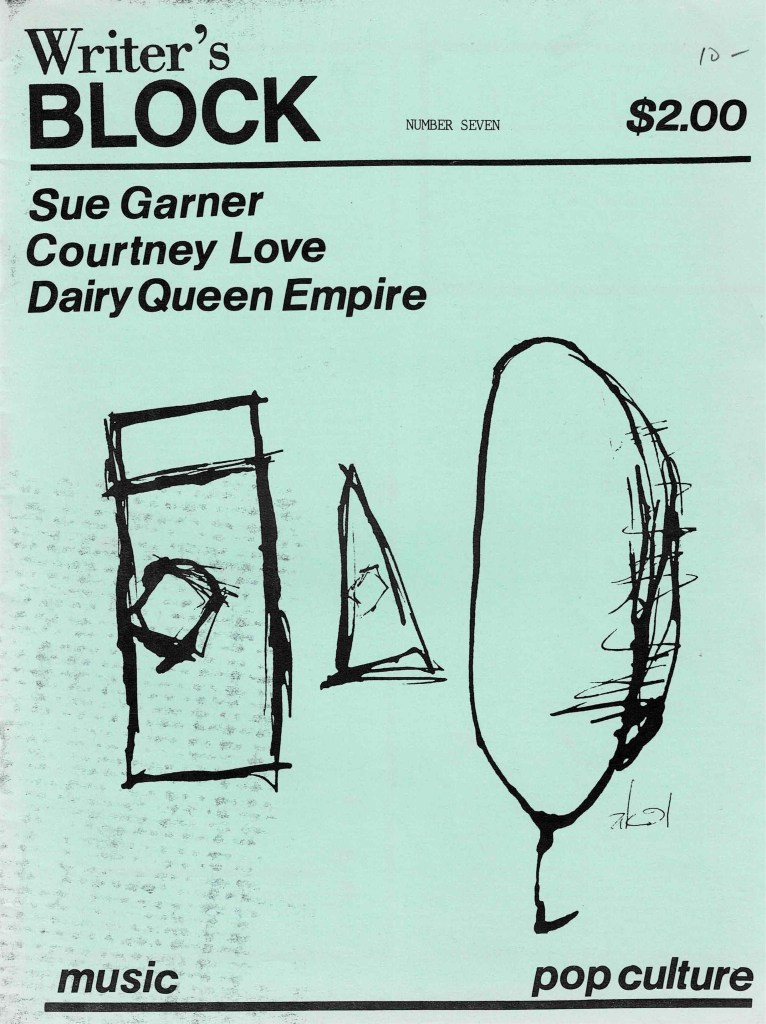
Last time we talked about Jen Matson over here it was to call attention to some early 90s writing she did in Writer’s Block #7. She also helmed her own indiepop fanzine in the 90s called Nonstop Diatribe, and through it all to the present day doing a radio show/podcast, she’s quite clearly someone with the record collecting disease. Check The Record #1 is an analog celebration of the analog sickness, done up in such a bright, breezy manner that you’d be forgiven for thinking that collecting records had somehow been very healthy and to be encouraged all along.

I actually suspected this whole thing was going to be Scottish records only, an ode to “Edwyn” and “The Shoppies” and whatnot, but it’s a more generalist whirl around her collection and how it came to be. Like the price stickers piece is totally great: photographic evidence of non-removable price stickers on various records she’s bought, along with the story of acquiring that record and the trade-off involved when she came to realize that peeling the thing would cause more damage than it was worth. Let me say it right now, for all of us: I’ve been there. 

The Scottish piece is great too, total thrill-of-the-hunt stuff, maybe not as mind-boggling as that Fŏrdämning piece “The Dirty Year”, but I was right there with Matson as she relays being taken to the “special basement” at Edinburgh’s Avalanche Records to have her pick of whatever treasures she wanted. I still have dreams like that, and I don’t even collect records anymore. There’s also a humility-first advice column about putting information into the crowdsourced Discogs, and about the creeps who sometimes populate the site and try to one-up these free laborers. 

Her partially facetious (I think) ode to the CD long box is really the ultimate glass-half-full paean to something that I remember being hated from the first day they appeared. In the late 80s I asked my parents for Coltrane’s A Love Supreme LP for Christmas, and I got it, except that my father somehow thought that the CD long box version of it was a 12” record. Dad…!!! I recently spent an hour at his house helping him set up his “cellular phone” (totally baffled), his laptop (he couldn’t get past the login screen) and even showing him how to find the Xfinity On-Demand channel so he could pick movies to watch. He’d told me and my sister that “Comcast changed the channel on me” and we totally shared a good laugh, thinking he’d sat on the remote or something and knocked his cable service offline. Turned out Comcast actually had changed the channel, and after showing Dad how to use the buttons on the remote to browse the guide, he was fully back in the business of entertaining himself.

Anyway, after my Coltrane long box fiasco – I brought it back to Rainbow Records in San Jose to exchange it for the LP, and they didn’t have the LP – I wouldn’t actually buy my first CD for another three years, until 1992. And I’m soooo proud of what it was: Monster Magnet’s abysmal Spine of God, sold back to a used store before the week was up. I’d forgotten all about long boxes until Matson’s piece, so there you go – she just spurred me to tell a couple of uninteresting stories in the service of talking about her new fanzine. See what yarns you can spin about your own record experiences by grabbing Check The Record #1 here.

Muckraker #9

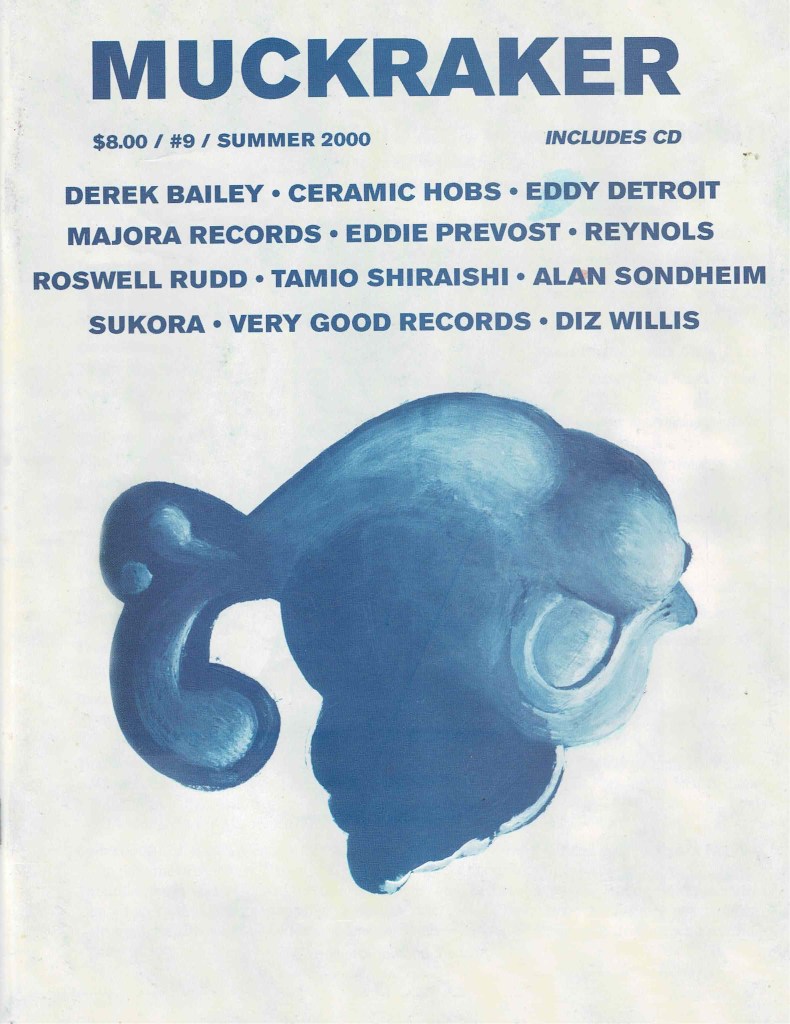
I guess 23 years on, we’re probably well past the point where we might routinely encounter a thick, glossy-cover, free improvisation / experimental / noise mag with a CD inside of it at Tower Records, aren’t we? Muckraker #9 came out in Summer 2000 and was a pretty fetching and decently-distributed publication pulled together with some regularity throughout the 90s by Patrick Marley – always on the deep edge of obscurity, while always approachable enough to bring in purportedly open-minded experimental skeptics such as myself.

I mean, Muckraker #9 is literally packed with so many deep and likely semi-listenable obscurities I really can’t grasp a ton of it; it’s music I haven’t heard and perhaps never will hear, and that’s probably okay. Much of the reviewed tapes and CD-Rs and lathe-cut singles are not findable even today, though you never know what’ll turn up at Fusetron that might have been sitting there for 23 years. Muckraker often skirts the boundaries of what TQ fanzine once called “the no fans underground” – music so formless and vague that it’s often comfortable assuming that it’s being directed toward a listening audience of zero. Still, I’m excited to see so many great, fanzine-funding ads for labels with deep weirdo catalogs that I missed or barely comprehended at the time – labels like Squealer, Little Army, High Knee, Chocolate Monk, Freedom From, Polyamory, Menlo Park, Povertech Industries and many, many more. 

The biggest draw for me here has always been the interview with Nick Schultz of Majora Records by Gretchen Gonzales. It was such a phenomenal and wide-ranging talk with one of our nation’s leading and most cantankerous lights that I reprinted it in Dynamite Hemorrhage #5, then interviewed Nick myself as an addendum to it. Majora was an exceptionally special 1990s label, and one that we risk forgetting to our undying shame. This is followed by a piece with Nick and Alan Bishop of the Sun City Girls bantering about Eddy Detroit, telling stories about this longtime Phoenix-area musical enigma, mostly because Marley and the Muckraker team couldn’t actually pin down Eddy Detroit himself for a talk. 

Some hallowed forerunners of the no-fans underground are interviewed as well, both Derek Bailey and then Eddie Prevost of AMM. Prevost is the exact opposite of pompous and obtuse; he tells stories of early AMM shows in 1966 where promoters wouldn’t pay them for their completed sets because they were “only tuning up”. There’s another interview with Ceramic Hobs, a group I’m most familiar with due to the forthrightness of the principles about their mental illness, institutionalizations and so forth. Simon Morris of the band calls the music he makes about his psychosis “the last frontier”. It might be, but does it burn down the house? Does it totally kick out the fucking jams? You’ll have to tell us.

I always liked that Patrick Marley went on to thrive in a true journalism career – like, he’s a major stringer for The Washington Post these days. He and the Muckraker team proved to me back then both here and in previous issues that you can make anything musical (or non-musical) interesting enough if you ask the right questions, write intelligently, respect your audience and do the hard work of explaining the validity and context of the music you’re talking about.

Brain Damage #1

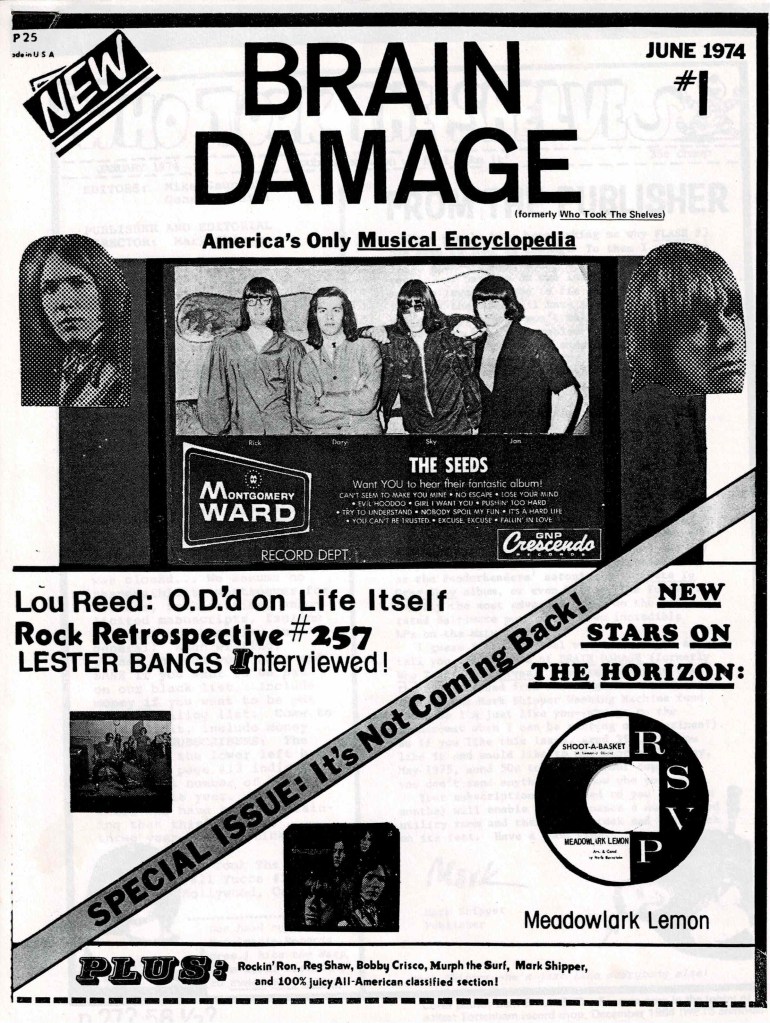
We had a post a couple of days ago about the annus horribilis of 1974, so let’s return there again today and talk about a “real” early-years music fanzine, Brain Damage #1, and a great, albeit insular, one at that. This comes courtesy of a xerox my friend JB made for me of it in the early 1990s, as he magnanimously did with the Back Door Man issue we once discussed here. Talk about heavy hitters: the editors are Metal Mike Saunders (much later of Vom and the Angry Samoans) and Gene Sculatti, and the publisher is Mark Shipper (Chris Stigliano went deep on his 1972 fanzine Flash, which put forth multiple issues, here). 

Brain Damage #1 was a one-and-done parody fanzine, “formerly called Who Took The Shelves”. I’m sure it was all quite uproarious for the creators, and if you’ve got something of a historical sense of fanzines like Who Put The Bomp, magazines like Creem, and the general rock critic milieu of the early 1970s, much of the mirth-making taking place here might even make some sense to a contemporary audience. They say “Subscriptions are $56 for 240 issues in the United States and Canada. Overseas rates do not exist and we reserve the right to refuse all requests from Limeys, Polacks, and New Yorkers.” They start with fake letters from Lester Bangs, Robot Hull, John Fogerty and Jon Landau, all very funny to the editors I’m sure, and continue on with a phony Lester Bangs interview and a heavy metal records consumer guide from “Bobby Crisco” aka Robert Christgau. There are some chortles and guffaws to be had, yet no splitting of sides.

Then there’s a first-rate, over-the-top piece about basketball hero Meadowlark Lemon of the Harlem Globetrotters and his (very real) “Shoot-a-Basket” 45, compared extremely favorably with the Stooges, the Shadows of Knight, Love and early Pink Floyd. James Williamson is rumored to be the guitarist on it. I think I’d better check that one out. There’s an extensive “Juke Box Jury” by Reg Shaw, aka Greg Shaw, complete with the same font and layout he was using in his own fanzine. And then, quite unexpectedly, there’s a real guide to Lou Reed’s early pre-Velvets Pickwick 45s by Wayne Davis, not really played for laughs but more some gentle mocking of his work with The Beachnuts and so forth.

Now even in the course of all this tomfoolery there are many uses of the term “punk rock”, once again resting the case that the term was something very much in circulation well before 1976 – at least in rarefied rock-crit circles – and that it was used to describe exactly what you think it was. As of this writing, there’s a copy of Brain Damage #1 for sale on eBay for the low low price of $199.99, but it does contain some photos of the pages if you’d like to take a peek.

My Teeth Need Attention #2

Joe Tunis, a.k.a. “CarbonJoe”, is already back in action with a second digest-sized issue of My Teeth Need Attention as we hoped and prayed for back when we reviewed his first one earlier this year. Not only has his game been upped this time around with an absolutely lovely hue of orange/red for the cover – I believe this may have been the same shade as the “Fire Engine Red” crayon in my 64-color childhood Crayola box – but he’s got a terrific interview with another one of the 21st century’s best music fanzine creators, Matthias Andersson of Fŏrdämning

Because Fŏrdämning wasn’t exactly easy to come by when it was around in the United States of America, or outside of Sweden at all, you may better know Andersson for his i Dischi Del Barone, Discreet Music, Fŏrdämning Archiv and Förlag För Fri Musik labels, all of which are still active. He’s also a member of numerous experimental musical acts on said labels, the most “famous” of whom are Enhet För Fri Musik, who are very, very famous and who routinely sell out hockey rinks in their native Sweden. This interview conducted by Tunis is the most complete overview I’ve seen of how this incessant curator and furtherer of the underground came to be the man he is today. If I can be said to have modern heroes, Andersson is probably one of mine and it’s always great to hear from someone who got into rad punk and underground sounds from Bones Brigade skate videos, especially when they lived in a 400-person village in Southern Sweden.

My Teeth Need Attention #2 has a similarly deep philosophical investigation with New Zealand musician and label owner Anthony Milton, who relates that he nearly recently died from a brain hemorrhage, wracking me with guilt over the callousness of this blog’s name. Liam Grant, one of the finest solo guitarists on the planet right now and who has a new LP on Carbon Records as it turns out, contributes a few pages of tour photos. Then there’s a record-collector-adjacent piece of fiction and another about a bewildering encounter with a male prostitute; another tour diary from Joe just like last issue; and it closes off with a gaggle of reviews, a few of which have led me by the hand into “exciting new dimensions in music” like this wild 1970s Pygmy Unit private-press jazz thing.

An excellent 2023 fanzine made on real paper! You can grab a copy here.

Beetle (October 1974)

I get it – we’re really stretching the concept of “fanzine” here, as this is a full-fledged rock magazine from 1974, something found on what we once called the newsstand. Perhaps at the grocery store magazine rack. If it’s any consolation, I won’t be tackling any Creem, Circus or Hit Parader here – but the Canadian publication Beetle gives me an excuse to talk about Roxy Music, and I’m always happy to converse about Roxy Music.

Maybe we ought to get a handle on Beetle first, though. While you can find plenty of back issues for sale on eBay, I’m not really coming up with much about it on the broader world wide web, so we’ll have to go with what we have here, the only issue owned by Fanzine Hemorrhage. It’s October 1974 – widely and quite rightly considered one of the proverbial low points in rock n roll history. There are features on Chuck Mangione, a young and not-yet-famous Billy Joel and Brownsville Station (“Smokin’ in the Boy’s Room” – one of the first rock songs I ever heard). There are excited reviews of The Bee Gees, Earth Wind & Fire and Chicago, whose singer is pictured wearing a Black Hawks jersey. Original six, baby!

Yet there is quality music worth paying attention to, and at least someone at Beetle knows about it. Apparently the New York Dolls took a beating in the most recent issue, and the letters section roundly takes them to task for it. They review Too Much Too Soon and call it “truly fine raunch”, which I guess in hindsight seems a little off, because that record was some serious “sophomore slump” if there ever was such a thing, right? While the staff at Beetle gripe in several places about the Canadian content laws that mean that their radio stations are clogged with Canadian rock garbage, they are homers to some extent: “Mahogany Rush, a heavy Hendrixian trio from Montreal, are soon to be one of the better known Canadian bands in the U.S. So how come they’re unheard of in Canada?”

This reminds me of the time I was reading the morning newspaper when I was on a work trip in Toronto, the day after the academy awards. There were two screaming headlines on the front page – one about the winner of that year’s Best Picture, and an even larger one in which there was a big story about Canadian Sarah Polley not winning “Best Adapted Screenplay”. I can understand it, though. I’ve always been part of the all-encompassing American monoculture that swallows everything, and it was nice to maybe see things from the perspective of someone from Flin Flon or Moose Jaw.

Speaking of film, there’s a laudatory long review of Peter Bogdonovich’s Daisy Miller, which is something that was “quite rare” in those days. But what excites me the most here is the big piece on Roxy Music, including a strange interview with Bryan Ferry that’s threaded in. When I was still obsessively listening to Casey Kasem’s American Top 40 in the mid/late 1970s, I heard a show he did, more like a half-day special, in which he played a ton of the previous hits of the 1970s. I had just become acquainted with “Love is the Drug” around that time, and loved it, but had never heard anything else from Roxy – and Casey Kasem, of all people, busted out “The Thrill of It All” on this program. Life changer.

I immediately bought Roxy Music’s Greatest Hits, this 1977 American album you see here that never really got repressed in the US or UK afterward – this was probably 1980. I played that thing to death, and honestly even now I think it’s a perfect record. Culling the best of Roxy Music into one LP, and actually choosing the best is no easy feat, even if it doesn’t contain “Remake/Remodel” or “In Every Dream Home a Heartache”. But it also doesn’t have any of that Flesh and Blood or Avalon crap, and I was really glad when I heard that stuff that I’d started here.

I was also kind of blown away when Casey played “The Thrill of It All” on an American Top 40 special. My impression at the time was that no one cared about Roxy Music in the USA at all, and that they had been more or less an underground band (granted, I was 12 years old at the time so I didn’t know anything about anything). Beetle, and obviously plenty of other extant rock music writing I’ve subsequently seen, showed that this was not really the case; there was a strong contingent of Roxy fans in the US; they were played on both AM hit radio and FM rock radio; and people did go to their shows here (and in Canada). They were just more beloved in their native England, unlike Mahogany Rush in their native Canada, I guess.

Forced Exposure #15

(Originally written as part of a Forced Exposure fanzine overview in Dynamite Hemorrhage #7):

When Byron Coley was interviewed by Jason Gross online in 2010, he told a pretty funny story about how Diamanda Galas came to be on the cover of this Summer 1989 issue:

The (interview) we were dreading the most was the Diamanda Galas one. The problem with doing a print magazine is that sometimes, records come out and it’s like… you really don’t have enough time to deal with (them), but you want to deal with it ’cause it’s on a label like Mute. So a Diamanda Galas record came in right when the issue was due and I think Jimmie reviewed it. His whole review was something like… she was supposedly going out with Blixa (Bargeld) right then, so Jimmie wrote something like “Blixa’s dick must be as big as everybody says it is because she’s really fucking screaming on this one.” (laughs) And she kind of hit the roof because at that time, a lot of people were reading the magazine and a review like that… People would just really laugh. The label put across the word that she was furious about it. And I absolutely understand. So we said “OK, we’ll interview her. We’ll put her on the cover of the next issue.” It seemed like a good idea anyway.

But getting ready to go down for that interview… We interviewed her at a restaurant in Hell’s Kitchen. We were just like “Oh my God, she’s going to fucking castrate us.” So we went in and her rep was really vicious and we had done tons of research, so we went in prepared to be disembowel. And we apologized and explained the situation, but she was really hostile. But then as it went along and she hummed a Coltrane tune and Jimmie knew what it was (it was something theme from Meditations) and she was like “Oh!” And the questions we had were obviously well-researched – we asked her about a lot of stuff that people hadn’t really talked to her about. So it ended up being OK but that was a rough one.

She actually comes off in the interview like a pretentious, self-involved and utterly pompous ass, but whatever. I saw her finally in the mid-1990s, and it will always be one of the most memorable shows of my lifetime.

The letters section starts off with a nice bit of what we’d now recognize as “trolling” from an ex- professional baseball pitcher named Lowell Palmer, who shares the advice of “the original punk Vince Lombardi” to “do sports, not drugs”. Byron naturally takes the bait and yammers about how real adults take drugs, or, in his words, “gobble a sheet of L or bang a little smack”. Just how old were these FE guys by 1989? I’m afraid you don’t wanna know. It certainly wasn’t 19 or 20.

This issue has some fantastic material otherwise. Seymour Glass did an exceptionally comprehensive & entertaining interview with the Sun City Girls, which was followed by a single- page paean to Claw Hammer – who were fast becoming my favorite band at the time – by Eddie Flowers; “LA hasn’t been home to a ROCK combo this musically exciting and aesthetically gone since, uh, the early, Kendra-era Dream Syndicate”. Ditto that, Crawlin’ Ed.

More terrific photos of leading lights like Death of Samantha and Hanatarash and Howe Gelb litter the excellent record reviews section, and the return of the C/U Meter sees three singles get a “C/U ENTIRE PRESSING”: Vertigo’s first one (agree 100%), plus Lithium X-Mas and White Stains (both of which I’ve found online, like, just now – and both are terrific & weird psych records). Huge books section, loads of video reviews, and a new mostly noir/crime review section called “Chris D.’s Video Library” – which was a healthy step forward from the previous issue’s father/son porn reviews.

Flipside #31

History was made with this April 1982 issue of Flipside, at least in my world. My older, clued-in cousin had it and let me peruse it frequently, mostly to laugh at The Misfits interview and to ogle Tracy Lea from Red Cross, my ultimate punk rock girl crush for many years. It struck a major chord for me because this one came out right at the tip-top of “peak LA hardcore” – peak US hardcore, pretty much – and it reads accordingly, in all of its stupidity, squalor, excitement and chaotic splendor. In fact, its tiny type truly packs in an entire universe of slam-your-ass-off punk rock mania, written for teens by people who weren’t teens, yet who wrote as intelligently as any dim-bulb high school simpleton from Canoga Park or Hawthorne or La Mirada might.

Lest you think I come here to bury Flipside #31, let it be said that I do not! I tried to capture my general feeling about the fanzine when I wrote about the issue that’d come out right after this one here. This one’s even better, for many reasons, mostly for how on-the-ground it all is, documenting the scene at eye level and in the words of its jackbooted and bandanna’ed participants. A nicely representative letter from Mark Evans gets us started:

Hey Flipside: I’m from the SF area and I’m 14 years old and I go to all the shows I can in S.F. We have some good shows up here like just a while ago Fear played with Circle One and some other bands from around here like Fuck Up’s, Lewd Crucifix and Domino Theory. Up here our Vex is the Elite Club, we have shows about every two weeks it’s totally cool. I want to say another thing: you probably have heard about the Mabuhay Gardens where they have shows every night, it sucks all they have is new wave shows, it sucks total big dick!!! — Mark Evans PS: Print this so I can show my mommy


On the opposite page is another fine missive about the scene from one “Falling” James Moreland of the Leaving Trains; I’ve done you the favor of scanning it in its entirety at the end of this post. Boy did I have some interesting run-ins with that guy over the years. There was the time in the late 80s when I tried bantering with him at a show at the Coconut Teazer (!) in LA, and he was aggressively licking his lips and jittering. I was like, oh, so that’s what speed does to you. A few years later I watched him get kicked out of Al’s Bar in LA at his own show, then later eavesdropped on him having an intense argument with Taquila Mockingbird in the parking lot. Soon enough he’d show up all around LA in dresses, yammering incessantly, and my understanding is gender fluidity has been a part of who he is ever since. There’s a “Dead or Alive?” page up for him here. I’m very glad he’s still with us: an American original.

So – the Misfits article. Now I do enjoy The Misfits myself, at least the pre-Walk Among Us 45s. But I don’t need to tell you what a horrible human being Glenn Danzig was. I don’t know about now. My cousin and I – who were huge Flesh Eaters fans – used to get a real kick out of this part of the interview:

Flipside: And you and Chris D. mixed the album. Weren’t you supposed to play with Chris D.’s band the Flesheaters?

Glenn: Yeah, but they’re scared of us.

Flipside: Why’s that?

Glenn: I don’t know…maybe because we’re all (make a mean scary face gesture) and they’re all homos, ya know?!! I don’t care what they like, I hate them. God this is homo city around here!!

Jerry: We try to avoid going down that street (Santa Monica Blvd. near Starwood).

Glenn: You go to the supermarket or to use the phone and it’s so yeecch (makes kissing sound), “Fuck you, leave me alone for 5 seconds!!” In N.Y. it’s not like that. Everybody is into their own trip. No one bugs you, if you’re a homo, fine, you are a homo and go where homo’s go. But here it’s so fucked up, everybody’s pushing on you. You have a lot more homos here than in New York!!

Flipside: Well, right here is where they all concentrate…

Glenn: And Frisco is fucking homo land!! Yeah we wanted to eat at McDonald’s and the Flesheaters wanted to go into homo-ville, we just said, “fuck you, you give us the money, we’re getting out of here!!”. 


You sometimes forget from the vantage point of 2023 just how rabidly anti-gay the youth of America were forty years ago. I was in high school then, and I remember. The letters section of Flipside #31 is just “fag”, “homo”, “that’s gay”, “I hate that queer”, etc., ad nauseam. HR, in the interview with the Bad Brains, responds to the question “How’d it go in SF?” with, “Well, it’s ok, but too many faggots.” Back to The Misfits – their interview here took place after their infamous San Francisco show at the Elite Club, during which “Doyle” totally brained some kid in the crowd with his guitar. (The incident is very well-described here). That show is reviewed in this issue, and ends a little shakily, “We figured someone might have been murdered but I haven’t read anything about it in the paper.”

So aside from all that, there’s a nice interview with Pagan Icons-era Saccharine Trust, who are already tiring of punk and moving on to what they’d become one album later; Tracy Lea and the always reliably hilarious Red Cross; Jodie Foster’s Army reveal the origins of the song title “Beach Blanket Bongout”, quite seriously among the top five song titles of all time as voted by Fanzine Hemorrhage; and a plethora of tiny-type scene reports mostly written by morons, which are yet Illuminative of a pretty special and unique time in the American underground. It’s an insanely-packed issue that all criticisms aside was highly worth the dollar my cousin spent on it in the HC Spring of 1982.

Writer’s Block #7

We’re now traveling backward in time through multiple fanzines that were helmed and penned by Mike Applestein. We talked about his current Silent Command fanzine here; we then conversed about his late 90s fanzine Caught In Flux here. We’re now discussing Writer’s Block #7, which came out in the Spring of 1991 and was published from Spotswood, New Jersey along with his girlfriend Alex Kogan and an all-female cast of contributing editors, including Jen Matson. You can see from the scan that my copy was marked up 5x from its original price, having recently procured it as I did from Division Leap books & ephemera.

The Writer’s Block crew are primarily rooted in underground pop music of many flavors and colors, the more lo-fi and personal the better. There’s room for the broader, noisier underground as well, and Thinking Fellers Union Local 282 and Killdozer make lauded appearances, but in general, acts like Heavenly and Unrest and The Clean rule the roost, as well as New Zealand and the Flying Nun universe. There’s an interview with the unfortunately-named Olympia, WA duo Courtney Love – I always felt sorry for them on that count – as well as with Sue Garner, who was in the Shams and Fish & Roses, and who’d later go on to be in the highly underrated (including by me, at the time) Run On. The passion and deep knowledge that went into their interview subjects and the questions asked of them is readily apparent, and no question Writer’s Block belongs in the international pop underground museum someone’ll eventually erect. 

Barbara Manning writes a letter from San Francisco, and Applestein reviews her 2/23/91 show at the Knitting Factory in NYC, her first show in town since World of Pooh blew through a year previous as they were breaking up. Man, that year – 1991 – I must have seen Barbara Manning play a dozen or more shows in the San Francisco Bay Area alone. I was besotted with World of Pooh while they were around, and was bereft now that they were gone. Manning’s solo shows and early shows with “Barbara Manning and the Tablespoons” were a fantastic salve. Her work in the first half of the 90s stands up proudly vs. anyone’s. Great to see another magazine enthusiastically making said case in real time. 

Pavement get one of their first local shows reviewed – the 8/12/90 show at Maxwell’s – and it’s clear from Alex Kogan’s review that they were barely more coherent then than they were the time I saw them at their big San Francisco coming-out party a few months before that. I can’t find anything online to confirm exactly when the band first played in SF, but it was a big deal for several of us based on their two 45s and the Perfect Sound Forever record, and….they were horrific! Like walk-out-long-before-the-end-of-the-set horrific. Kogan blames intoxication and a who-cares attitude. The 1990s, folks. That’s how we rolled. I never saw Pavement on a stage again.

(By the way – there is reliable evidence online that suggests that Pavement might not have actually played their first San Francisco show until 1992. This would not be the first time that my misshapen memory has arranged events to fit a narrative I’d like to convey; in this case, my attendance at a 1990 show by Pavement before anyone else saw them play. Not that I care about Pavement, you know, but I do prefer being accurate to muddled and braggy. Anyone know?)

My copy of Writer’s Block #7 has stamps and a mailing label slapped on the back, and it’s addressed to Steve Connell from Puncture fanzine. I wonder how Mike Applestein feels about Connell having turned his back like this on his 1991 sweat, toil and labor.

Termbo #1

Remember when the Terminal Boredom guys did a print zine? Aside from three collections of internet reprints, I had thought that Termbo #1 in 2013 was the only one they did, but even as I’m writing this, I just found out that there was another three years later that I never saw. Then they were done. Now their message board’s totally kaput as well. I can’t say I really did anything over there, maybe a post or two, but a lot of their online action was concurrent with a lot of my online action, and I had much respect for the community of frothing, opinionated-as-hell garage punk misanthropes they built, as well as for the gentlemen who built it, primarily Rich Kroneiss and a few other hearty, regular contributors.

If you had to try and pinpoint their aesthetic, this fanzine’s cover provides many clues. A messed-up looking “beach wrestler”; a muscular heavy metal arm with a knife; and a band called “White Load”. (Forget the “poetry”; you certainly will once you read it). Today’s Total Punk record label is an almost perfect manifestation of the world that Terminal Boredom helped to incubate and further along. Termbo #1 states its mission pretty clearly from the off: “…a collection of articles and interviews, most of which were written for this print edition in particular and some older material that never made it to the Termbo site for whatever reason.”

Of those articles, there is one that stands out very clearly for me. Russ Murphy digs deep into the Black Flag debacle that had gone on that year, the one where Greg Ginn brought Ron Reyes back into the fold for a “Black Flag” record and tour, pretty much just to spite the shenanigans Keith Morris was pulling with his own bands Off! and Flag. I’m not totally sure of the chronology of all this stuff, because I really tried my hardest to not pay attention to any of it, but when this record cover came out it was truly a “drop everything” moment. Murphy illuminates the contours of the controversy and attempts a journey into Ginn’s head to understand what possessed him to do any of this, and as a card-carrying Black Flag freak, tries really hard to enjoy the record (“Careful listening shows that there is more going on here than a casual listen will reveal”). He comes to the conclusion that in order to actually listen to and get something out of this record, the listener will really have to “put some effort” into it. I can imagine – but no thanks! Great piece.

Also enjoyed the film reviews by Jordy Shearer, which range from “Cabin Boy” to “Frances Ha” to Antonioni’s “The Passenger” and back again to “Phantasm”. There’s also a long piece about exploitation films – I think it’s by Kroneiss, but it’s uncredited – and the hallowed video stores and VHS tapes of his misspent youth. There’s an interview with the aforementioned White Load and a photo in which one of the guys has a fuckin’ sword. Totally killer. And another with the FNU Ronnies, who were a pretty wild experimental punk band I think I may need to listen to again.

If you want to know where all the “message board punks” went after the death of Terminal Boredom – or if you do know – this thread’s where you need to head next after subscribing to future Fanzine Hemorrhage posts in the upper right-hand corner of our desktop site.

Deep Water #5

The late 1990s were the heyday of “brothers going their own way” when it came to underground, rock-adjacent music – as least as it was covered by fanzines at the time. I’ve already yammered about how averse to free jazz, abstract folk and experimental noise I was at the time in my previous discussions of Tuba Frenzy #4, Astronauts #4 and Gold Soundz #4, so I won’t belabor the unimportant point here, nor the unimportant point that I’ve come whimpering back to it all in the subsequent decades. Just be glad I don’t have any issues of De/Create or Opprobrium. Those were the ones that really pissed me off back then.

This brings us to Deep Water #5 from Winter 1998, which emanates from the same genus as those others.  You see a fanzine published from Iowa City, Iowa and there’s a pretty good chance that someone’s going to college. In fact the mailing address is on “College Street”. There are three editors, and I’m a bit suspicious of their listed names: “Kevin Moist”, “Bill Reader” and “Chris Curley” – though I suppose if Reader and Curley were going for something wacky they’d have done a little better than that.

The fanzine begins inauspiciously. There’s a long article from a pal of theirs, an American in Poland, haranguing the music fanzine reader (who after all, just wants to ROCK) about Poland’s inelegant post-Communist transition to democracy and hyper-capitalism in the 1990s. It smells like a ploy by the writer to get published in the only place he might be able to – his friends’ budget music fanzine. He probably bugged the crap out of them to shoehorn this dreary drone in there. That said, there are recipes in the magazine – like recipes you cook, for food – so maybe Deep Water was attempting an omnivorous approach to culture as they themselves defined it.

There’s nowhere to go but up from there – and thankfully they go way up! Kevin Moist’s intro to his Brother J.T. interview is exceptionally well-written. Now I know he was a college boy. Just a well-done interview through and through – like one of the better wide-ranging fanzine discussions with a smart person you’ll ever read; if you’ve ever read a good Dan Melchior interview, it’s the same vibe – and now I’m feeling like I need to go back and listen to more Brother J.T. records. I mostly started and ended in the 80s with “she’s just fourteen and I don’t care!”. The same thing happened to me when I read the long piece on Cordelia’s Dad – another erudite exploration that makes me wonder how I missed this band. Good music writing’ll do that, and is all too rare. And how did I forgot all about Grimble Grumble until today??

Honestly, maybe I’m most taken with the Times New Roman font, always the font of choice for my own mags. I know I ask for details sometimes on these obscure mags and it’s been very rare that anyone’s been willing and able to provide it, but: does anyone know anything more about Deep Water and the fellas that put it out? (I found this, so that’s a good start). You leave a comment about it if you do, and fifty years from now some middle-aged dude that hasn’t been born yet will totally thank you.

Who Put The Bomp! #14

Who Put The Bomp was an ur-fanzine, one of the earlier and absolute best examples of a rocknroll fanatic following his obsessions and documenting every jot and titter from his heroes. Greg Shaw is deservedly lauded for parting from the mainstream in his writing when it was warranted; for going deep into topics that no one else would touch (like this issue’s instrumental surf records coverage) and for bringing on a king’s table of rock writers over the years to write for the mag – including Lester Bangs, Richard Meltzer, Dave Marsh, Greil Marcus and “Metal” Mike Saunders.

I’ve had all six of the late 70s punk-infused issues, from when it was just called Bomp! magazine, for quite some time. I’m only now coming around to trying to cobble together issues of the pre-1976 Who Put The Bomp! fanzine, of which there are 15 issues. The first one of those I got was the “British Invasion Issue”, #10-11, and it’s so massive and meaty and full of tiny type that I’ve barely cracked the code on the thing. All-in, it’s longer than most books about music you’re likely to read. All the issues before that one are too scarce and expensive for Fanzine Hemorrhage’s pocketbook, but if there’s a will there’s a way, and there’s totally a will. 

So I’m concentrating on those issues between that British Invasion one and and the punk-era stuff, and recently found a lovely copy of Who Put The Bomp! #14 from Fall 1975, the one with these hodads on the cover. Like I said, the key to the issue is the instrumental surf music discography and backstory. It’s an incredible resource even now, 48 years later. I’m sure there’s probably some small-press record collector book that’d tell me a bunch of the same info I can get here, but there might not be. I happen to love this stuff and it grows on me even more as I age into the typical age bracket of the “1961 surf instrumental 45 record collector”. After glomming onto this thing I’ve been spending a bunch of time with the Surf-Age Nuggets: Trash & Twang Instrumentals box set, as well as with my Lost Legends of Surf Guitar comps. OK, grandpa!

I learned all about Tony Hilder, who produced Fresno’s Revels (who did “Church Key”) and was a prime mover in the early 60s California Central Valley instrumental surf scene, which I was surprised as you were to find out was a thing. Hilder then put out a series of “right-wing records” about the John Birch society and Barry Goldwater, which I’m sure are total fucking godhead. Alas, the piece says “The defeat of Barry Goldwater and the demise of surf music marked the end of Tony Hilder’s active involvement in the music industry. He is now employed as a salesman of freeze-dried food products in Southern California, writing reactionary declarations in his spare time”. 

Other highlights: a complete discography and story about Dutch rock (The Outsiders, Q65, Shocking Blue etc.) and another oddly compelling discography of Beatles novelties and parodies – none of it by the Beatles, but stuff like The Twiliters’ “My Beatle Haircut”. I mean, the folks that put this stuff together, need I say, did not have the internet, or Goldmine, or anything similar. Just their own crate-digging and obsessive compiling, at a time when a used, non-picture sleeve 45 in a record store could be picked up for a nickel, dime or quarter.

And Roky Erickson is back! He’s just been released from a Texas state psychiatric hospital after being inside for five years – and he’s got a new band, Roky Erickson & Bleib Alien. He’s come to Los Angeles to play his brand-new songs, “Two-Headed Dog”, “Starry Eyes”, “Don’t Slander Me” and “Don’t Shake Me Lucifer”. Can you believe it? Greg Turner is on the scene, and gets Erickson to do a fairly coherent interview. This is then followed up with a full International Artists discography, because of course it is. 

The new wave is almost here. Shaw notes in his end-of-issue column that “Big news around Hollywood is The Runaways, a group of 3 high school girls (14, 16, 18) who play like The Sweet and sing great teenage anthems, most of them written by Kerry Krome, a 13-year-old girl prodigy. They also do The Troggs’ classic “Come Now”. Remember, you read it here first.” In 1975, that was probably the case. She was actually Kari Krome, real name Carrie Mitchell, and boy does she now have a sordid and likely indisputable story to tell.

Who Put The Bomp #14 is one of those fanzines you wanna hold onto for dear life, not merely because of its centrality to a certain all-encompassing rock & roll mindset in ‘75, but as a resource to be frequently mined. I probably gave Shaw short shrift in my twenties for being what his contributors Greg Turner and Mike Saunders would call “a power pop turd”, but hey, I’ve even come around a little on some 70s power pop. Let me see if I can find a few of those other issues and I promise to meet ya here to talk about them.

OP #19 (The “S” issue)

OP was the offspring of Olympia, WA’s John Foster in 1979, who envisioned documenting an ephemeral organization called “The Lost Music Network” in which record labels, cassette artists, radio stations, fanzines and small clubs might coalesce into a like-minded fraternity of deeply-underground comrades. Over 26 issues, he did much to further the concept, and the glossy-cover Op received some pretty strong nationwide distribution, particularly in its later years, as it traipsed through the alphabet with showcase issues for each letter. It was something I then saw as pretty gimmicky and limiting, but which absolutely aged better with time and an actual look at how they pulled it off.

Issues of Op are generally able to be found. I never owned any at the time, most likely because their musical remit went well beyond my ability to ingest it as a teenager. I sauntered down to the San Francisco Art Book Fair a few weeks ago and, to my surprise, there were paper ephemera merchants with all sorts of vintage fanzines for sale, including Oregon’s Division Leap. I procured a handful of Op issues from them at a fair price, include Op #19, the “S” issue from 1983.

Foster and his loose, extensive network of relied-upon contributors were single-minded in their dedicated focus to micro-indie iconoclasts of any genre, from hardcore to 20th century classical to experimental home tapers. It’s an intense collection of information in small-point type, and while I read the issue in detail earlier in the week, it would be wrong to say I was hanging on every word, since there’s not really a defined joint opinion or tastemaking approach outside of “celebrating the unknown” and the misunderstood – regardless, at times, of its ultimate quality.  John Foster’s record reviews in particular attempt to be magnanimous to a fault. I had forgotten 100% about SF Bay Area heshers Eddie and The Tide, the great white local hope of burnouts and stoners at my high school, but even they clearly sent their indie record to Op in hopes of not getting a beating – which they didn’t. 

That said, Jamie Rake in his Sin 34 review says “Julie must be the worst female vocalist since Debbie of The Flying Lizards”. I don’t really know who that is, but don’t you come at Julie. He also talks about a Wisconsin HC band called The Shemps and asks “when was the last time you heard a pro-sports punk tune? Check out ‘The Pack Will Be Back’”. I definitely need to hear this song. There’s a really great section of fanzine reviews from Foster and Chris Stigliano, the latter of whom also highlights and marvels at a new onslaught of Velvet Underground bootlegs. As far as the interviews go – again, only with artists whose names start with “S”, there’s a perplexingly perfunctory one with Sun Ra, in which he answers multiple questions with variations on “Well I don’t know about that, because I am not human”.

There’s also a long letters section so different from the ones we see in publications today, with “letters” pulled from emails and Twitter comments. These were letters that then had to be re-typed and transcribed. Shane Williams writes from prison. I had forgotten that one of his longtime tropes had been “You’d be a little bit racist too, if you’d seen what I’ve seen in the joint”. The more late 70s/early 80s fanzines I immerse myself in, the more the letters section often feels like the star of the show. I’m even warming to the Flipside letters section, especially when I can find some teen’s name in there complaining about their scene or their mom or the cops, with the hindsight to know that said teen later went on to be well-known in a band, or put out their own fanzine, or wrote fiction etc. – or was just a letter-writin’ gadfly like Shane Williams or Joe Piecuch

So you may know that Op, once Foster finished up with the letter “Z” issue, had its lofty networking mission carried on afterward by two more fanzines, Sound Choice and Option. The former even invented its own extension of the Lost Music Network: “The Audio Evolution Network”. Both suffered from some of the same shortcomings as their predecessor while each having some winning aspects of their own. We’ll talk about them some other day here on the ‘Hemorrhage.

Bad Vibe #2

In the spring of 1993 I spent two months traveling North America as the road manager, driver & merch seller for the band Claw Hammer, who were friends of mine from Los Angeles. As someone with zero musical talent – and lord knows I tried to pretend otherwise – I was utterly beside myself that I’d actually be able to go on tour, traveling from city to city, haulin’ in and haulin’ out, just like the underground musicians whose lives I was appropriating by having thrown in my cultural lot with them as a college radio DJ, record buying-obsessive and fanzine publisher. 

I was so excited by 60 days spent crammed in an Econoline touring the US of A and a little bit of Canada that I quit my job as a customer service rep at Monster Cable, though my sabbatical ended up being short enough that I was able to reclaim my place on the corporate ladder upon returning. The band themselves were on something of an upswing, having recently come off a supporting tour with Mudhoney and with a new record out on the lucre-loaded Epitaph Records, run by Brett from Bad Religion. So I was decidedly a fifth wheel to the 4 band members – the guy who settled up at the end of the night with the club booker; the guy who pulled the van into Des Moines; the guy who taped the t-shirts and CDs to the wall behind the merch table; the guy who had to call Peter Davis at Creature Booking to make sure the show in Baton Rouge or Wichita or Montreal was still on.

It was all about the Claw Hammer guys and who came to see them – I remember in particular a show in Tulsa with six paying customers, three of whom were members of the Flaming Lips. Occasionally and very rarely, however, there were people I’d meet on the road who actually came to the club with the intention of seeing me. Yeah, some were friends from college, but sometimes (like once or twice) there was actually someone who knew about my music fanzine Superdope and wanted to talk sub-underground musical baseball with me. That’s how I met the Bad Vibe guys.

It was at the Cabaret Metro in Chicago in May 1993. If I’m not mistaken, “Ween” were the headliner, and a Canadian pop band called Sloan, who had a massive tour bus parked outside, played as well. David Salvia and Jim Sonnenberg from mid-state Illinois had recently put out a garage punk fanzine called Bad Vibe #1, and I had a copy & it’s very likely we’d exchanged “letters” about it – in fact it’s almost certainly how they knew I’d be at this show in their state. 

Well these two wide-eyed, cornfed Midwesterners saddled up to the merch table and introduced themselves, and we had a fine time talking about the ins & outs of the scene, about the rigors of publishing and distribution and whatnot. Claw Hammer? Pffffft. When they started playing, these guys couldn’t care less and anchored themselves to the table, in the club’s now-empty lobby. I felt so important! It was me – I was the one who was on tour, and these were my two fans! I tried to play all the hits for them: the times I saw Pussy Galore; the time I hung out with Rob Vasquez; that one time the Cheater Slicks stayed at my house, and everything else I could muster. By the end of the night, like Springsteen, Little Steven and “The Big Man”, I’d truly sweated it out and left it all on stage….I mean on the merch table. We then said our goodbyes and never spoke again.

A few months later Bad Vibe #2 came out, the issue we’re talking about today. Salvia and Sonnenberg one-upped my awful interview (Superdope #5) with Rob Vasquez and The Night Kings with an even worse interview with Vasquez, who cops to being baked 24/7 and really can’t seem to muster enthusiasm for much of anything, including the phone conversation he’s taking part in. They also included a great record with the mag – the Night Kings’ Brainwashed EP. Then they even went and put in posters of the Blues Explosion and Royal Trux. I could never afford color anything, nor could I include a record (not even a flexi) – so I said then to myself and I say now: well done, lads.

It strikes me re-reading Bad Vibe #2 thirty years later that there were young men who really, really had a thing for The MuffsKim Shattuck; I believe the Bad Vibe team may have counted themselves among them. (Alas, she unfortunately passed away just this past year). Their magazine strikes me now as youthfully dumb, as mine was, while also having a strong handle of the slightly more “popular” side of garage punk – Vasquez very much not included there – and digging into some of the deeper wells at the same time. It’s a fun read, and you can actually still buy a fresh copy here, thirty years on.

Attack #8

Whenever it was that I found my used, stained issue of Attack #8 in a record store, I know I dragged it to the counter mostly assuming it was a relatively generic, slapdash cut-n-paste April ‘83 hardcore punk fanzine that had caught my fleeting attention for some reason or another. Seattle, maybe. I do dig Seattle. It was only upon bringing it home did I realize I had something pretty fantastic here – a young Jo Smitty was the editor and guy behind it (!). You may know him as a member of Mr. Epp and The Calculations (vocalist on most tracks), or as Jeff Smith, the guy behind Feminist Baseball fanzine in the 90s. And it features multiple contributions from Mark Arm, whom you may know from…..you know who Mark Arm is.

It was a true treat to get duly reacquainted with this one after so many years away from it while it was sequestered securely away in a garage box. Attack #8 really hammers home what an open-minded fella teenage Jo Smitty was. He’ll talk your ear off about Whitehouse, The Fall, Grandmaster Flash, dozens of hardcore slammeisters and even English punk. ‘83 Smitty loves The Poison Girls and Crass. He and his contributors make the Seattle music scene sound way more exciting and cohesive than popular histories of the pre-grunge era have led me to believe. Wasn’t this supposed to be the city that time forgot, the place few touring bands set foot in because it was “too far” from California or whatever? Not at all the impression given here – these boys are slamming their asses off to Black Flag, DOA, Dead Kennedys and all the Northwest heroes, from Poison Idea to The Fartz and P.I.L.. Iggy Pop. Savage Republic, TSOL and The Ramones as well. 

Smitty also reviews a bunch of films; his contributor Talya Christian hates Urgh: A Music War, and singles out The Cramps as being particularly lame, putting them in her “boring to sickening” list (??). This was a particularly fertile moment in American punk rock history – the amazing “Quincy punk” episode had just aired, and it was a whopper. Much-discussed in high school alterna-circles at the time. Smitty understands the stakes here and devotes an entire article to it. Me, I did not see this one in real time when it aired, but I was delighted to have caught the slightly less-heralded CHiPs punk episode on its debut! I’d be willing to fund a Blu-Ray with these two on it, along with some Wally George episodes, maybe.

Now, Mark Arm, he loves himself some hardcore – totally blown away by Minor Threat, maybe not too impressed with Negative Approach, and he probably loves Flipper most of all. He contributes an excellent savaging of TSOL’s Beneath The Shadows album. In case it hasn’t been clear on this blog to date, I thought, and have always thought, that TSOL were utterly atrocious from day one. I’ll try not to mention them again, but when we talk about early 80s fanzines they always seem to have been around. Rebel Truth from Sacramento are interviewed, and so is Whitehouse

Just a gem of a bedroom fanzine from top to bottom. You can ogle all of the covers of Attack fanzine here if you’d like.

No Mag #13

It wasn’t quite the case across the entire breadth of independent music, yet all told 1984 was a pretty rotten year for sub-underground rocknroll music in Los Angeles, California – that is, if you’re reading the thirteenth issue of NoMag, the one with Nancy from “Animal Dance” on the cover. Unless you were laser-focused on the SST bands in a way that NoMag decidedly wasn’t – Double Nickels on The Dime, Meat Puppets II and Zen Arcade all came out this year – you’d be forgiven for thinking that the previous world-beating LA music scene had completely and rapidly devolved to godawful cowpunk, retread goth or sell-out pseudo-roots music.

It’s kind of a bummer to have to see it, but as went the overt trends in LA, so went NoMag – underlining that not all NoMags were created equal. What a letdown. Thumbing through it, it’s clear that editor Bruce Kalberg has become more attracted to the trappings and fringes of alternative culture than to the music that defined it. Everyone is either a goofball cow punk, has a hideous angular new wave haircut or is dressed in highly choreographed “LA sleaze” wear. There’s a group called the Hollywood Hillbillies celebrated here who I am absolutely delighted to have never made the acquaintance of.  

When I arrived at KCSB in 1985 as a college radio DJ it was these records – the bands interviewed in this issue – that were clogging our library: The D.I.’s; the “no original members” TSOL; Tupelo Chain Sex, The Fiends, Kommunity FK, Detox and so forth. They were usually on labels like Enigma and Restless, quasi-major labels that rose out of hardcore to pump up this sort of clotheshorse rock, or speed metal, or novelty punk. I do somewhat enjoy Tex & The Horseheads – they define the spirit of ‘84 LA for me for better or worse than pretty much anyone else – but SST barely exists here outside of a paid inside front cover ad; no one’s fashionable enough. 

There’s an interview with the Cambridge Apostles with Alice Bag and two of the Atta brothers from The Middle Class. They sound from their own description of themselves like a dance band, and Alice spends most of the interview herself dancing away from questions about The Bags. A great deal of the activity documented in NoMag #13 feels to me like some real goings through of the motions, the washed-up flotsam of a recently capsized music scene and a lot of musicians desperately searching for the road to cash in. John Doe is interviewed about X and his relationship with his record company, Elektra, and he’s all smiles. You’ll have to read his More Fun In The New World anthology book to see what thirty years of hindsight brought to him – but let’s just say it doesn’t quite jibe with the sunny disposition presented here. 

That was my favorite of the two Doe books because – well, it’s right there in the sub-heading of the book, “The Unmaking and Legacy of LA Punk”. Everything I’ve just spend three paragraphs moaning about it is confirmed by the folks who participated in it, and the unmaking is happening right here in real time within the pages of NoMag #13.

Dagger #8

Tim Hinely’s been doing Dagger fanzine in various forms, sizes and guises since the 80s, and I suppose this would have to be the first one of his I ever picked up, back in 1988. The guy has given much back to the music that nursed and nourished him, not just in the form of his longstanding fanzine, but also the anthology book about music clubs Where The Wild Gigs Were, which he edited (an entirely brand-new second volume of which is forthcoming, maybe next year). He also helms a Facebook group devoted to fanzines called Zine Chatter that you can look at if you’re willing to log in to Facebook and surrender yourself to the algorithmic maw.

Now back in 1988, Tim was a young stallion going to loads of live shows, as active in the scene from his New Jersey locale as I was from my own California locale. More, even. He finds himself trapped at funnypunk shows, seeing Murphy’s Law and loads of other flotsam. Because I read his mag a lot of the 90s and 00s and associate him with that persona, this 1988 version of Hinely shows a little bit more ‘tude than he’d show later, as he later morphed into more of a pure underground pop guy from these HC beginnings. One of the shows he reviews here is that famous Fugazi one where the singer hung himself upside down through a basketball hoop. Another is the Gibson Bros – yes! – during which Tim falls in love with drummer Ellen Hoover and relays that their set was abandoned because Don Howland was too hammered to finish the show. Sounds like the Gibson Bros on their east coast tours for sure – a real alcoholiday by all accounts. 

All of this action is taking place across New Jersey and greater Philadelphia. Hinely also talks with, as you can see in the cover, The Didjits, Rifle Sport, Bastro and Band of Susans, none of whom I’ve listened to in thirty years – but the interviews are very much fan’s-eye-view, alley-behind-the-club sorts of chats, and therefore quite entertaining. There are an incredible amount of fanzines briefly reviewed as well, showing just what an abundance of ‘em were being published at the time. This was definitely an era where, if Maximum Rocknroll or Flipside reviewed your fanzine, you were certain to receive a plethora of unasked-for xeroxed punk mags from the deepest recesses of the United States; sometimes from prisoners, sometimes from teenagers; always with a “Wanna trade?” note. When I was publishing, yes, sometimes I did wanna trade, but mostly I emphatically did not. I wonder what Tim did. 

Dagger #8 is itself a pretty cheapo xerox, which renders it all pretty quaint and of the times. Some reviews just don’t quite come off the “printing press” and are just faint letters, and a couple others take a comic run right off the side of the page. I do hope the advertisers in the back weren’t charged a fortune. I’m guessing that Jersey Beat and a speed metal band called Methadrine probably weren’t.

Cheetah #5

Not really a full-on music magazine, and absolutely not a fanzine, but we’re definitely going to write about it anyway. I first heard about quintessentially quasi-intellectual 60s counterculture magazine Cheetah all of two years ago, when I was deep in the enveloping throes of my late-bloomer Brian Wilson obsession, the one that I wrote about in Dynamite Hemorrhage #10. This fantastic Jules Siegel essay about the runaway train wreck that was the Smile sessions ran in this publication in 1967, and I henceforth learned that it was Ellen Willis who founded and edited Cheetah. I ordered my own copy – and it is the one we shall be discussing presently.

My research tells me that eight issues in total were published, with the final being the May ‘68 issue, right between the assassinations of MLK and RFK. These cataclysms haven’t even happened yet, yet the back of this February 1968 issue previews next month’s by saying “In the most dire winter of our discontent, the social fabric of America is pulling apart. With maps and diagrams, we’re going to show you just how bad it all is.” I’ll say for the record that I believe that 2020-21 in the United States was even worse, and only by virtue of electoral sanity have we restored the possibility of moving past it. 

But anyway, continuing with the Brian Wilson theme, actually, the February 1968 issue is like one big tribute to Mr. Van Dyke Parks. There’s a full piece on him by Tom Nolan, and an intro essay at the start of the magazine for this young wonderkind, full of worship but preemptively apologetic about the potential pretentiousness of his lyrics. “Columnated ruins domino”! In general, Cheetah #5 is packed with writing that’s very much trying to be the new thing, the new journalism, and some parts of the charade wear better than others. The narcissism of the counterculture is on full display, for good and for ill.

There is, for instance, an amazing ad for a different magazine called Avant-Garde right out of hip 60s intellectual central casting, along with other various terrifically dated ads devoted to sexual liberation totems and “smoke grass” buttons and T-shirts. There’s a whole piece about a groovy trip to the San Diego zoo, and another about the killer LA experimental psych band The United States of America. Robert Christgau contributes a piece about hitchhiking. People did that in the 60s, you know.

Nearly every main article has the exceptionally annoying habit of beginning, going a page or two at most, and then requiring the reader to pick it up again toward the back end of the magazine. Sure, magazines (to the extent they exist) still do that to this day, but not on the momentum-stopping level of Cheetah in 1968. Ellen Willis contributes the best piece in here about Communist rabble-rouser Bettina Aptheker, a woman often held up as a true Hero of The Struggle by the pamphleteering Left when I was attempting to get my political bearings in the 1980s. There’s also something about the “I Ching” which I think may have something to do with tarot cards, and something else about “concrete poetry” which is akin to what we might later have called graphic design. Oh, and a bunch of awful and unfunny New Yorker-like single panel cartoons.

Do I like Cheetah #5, though? I do! Had I been age 20-whatever in 1968, I’d have fit squarely in their demographic and psychographic profile, and while it’s always great to make fun of hippies, I’ve no doubt that this magazine would’ve probably fit me well had I too grown up in stultifying 50s USA, without college radio, fanzine and punk rock to guide me where it eventually did. Even the brief musical nuggets of Van Dyke Parks and Dorothy Moskowitz and Cheetah’s passel of record reviews would have been enough for me to take out that one-year subscription for $5 – even though said subscription would have unfortunately run aground a mere three issues later.

Rock Mag! #1

In the early 90s when I was publishing my first fanzine Superdope, there were a few other fellas in my age bracket with concomitant music tastes who were also publishing their homespun fanzines, and with whom I’d regularly communicate. Among them were Marc Masters of Crank, Glen Galloway of Zero Gravity, Eric Friedl of Wipeout! and Tim Ellison of Rock Mag! Tim headed up – and still heads up a revised version of – the San Diego band The Nephews, a band I got to see just once at a tiny club down there called The Neptune, which I later learned was the original Casbah club (SD’s long-running best underground club from the 80s onward). I found their records to be a little uneven at times but they were terrific live, and I particularly remember how great this track was.

More importantly, I really liked Tim. Contrarian, obtuse, wryly funny, highly educated (music and otherwise) and willing to go waaay out on a limb for the music he liked. Rock Mag! wasn’t for everyone. I remember sending an extra issue of it that Tim let me write a few reviews in to my pal Scott “Deluxe” Drake of The Humpers, thinking he’d love the weird piece Tim wrote on links between The Fall and certain animal noises. He sent me a letter back saying he was totally baffled and frustrated by the whole thing and that he’d never read another fanzine like it. Exactly!

The first issue of Rock Mag! arrived in 1992, and two-thirds of it is given to theorizing on the nature of rock, how we listen to rock, how we contextualize rock and ultimately defending rock after lambasting it. So sure, it’s an acquired taste I suppose; this issue arrived not long after Rock and The Pop Narcotic by Joe Carducci, a tome that set many typewriters and tongues a-waggin’. It is certainly referenced here, as is Richard Meltzer’s Aesthetics of Rock; neither in flattering terms for the most part. I never really deconstructed the meanings behind the music in this manner and probably never will, as my own brain really doesn’t work that way, but I totally got a gas out of how Tim did it, in his truly passionate, devil-may-care manner.

He then gives in to writing a big batch of record reviews, because, as he says here, “Rock Mag! (the non-rhetorical magazine of the ‘Rebellation Generation’) is called Rock Mag! because it is a rock mag and rock mags have record reviews in the back of the mag.” Among these record reviews lies praise for The Gories, Hanatarash, Electric Eels, Cheater Slicks, Ruins, The Dwarves (Tim loved the Dwarves, as did I for a time), Dead C, Pavement, Shonen Knife and one of Tim’s other non-R.E.M. favorites, The Fall. On the back cover is a nice big salute to “Paul Fucking McCartney”, and that was Rock Mag! #1. The second issue had what I believe was one of only a couple interviews he ever did, but we’ll get to talking about that one in due time and shall wait, as all good things must. 

NY Rocker – September 1980

The personal, hand-assembled music fanzine’s always been the place that cultural pontificators like to point to when directing nostalgia seekers to the real pulse of an era, the sociological beat of the streets and the place where a given music’s early adopters were the ones helping to define that music’s formative boundaries and key players. I think there’s much truth to this assertion, or I otherwise wouldn’t be bleating as much as I am here. 

Yet I think there’s actually far more sociological and on-the-ground ore to mine from the music periodicals of particular musical eras, back when, unlike now, music periodicals were a thing. A single issue of the NY Rocker, say – or of Slash, or Damage, or Take It!, or Sounds, or Rip It Up, or Melody Maker – those newsprint periodicals, packed with columns, reviews, interviews, musings, artwork, listings, ads and photographs – each issue of these provided an incredible bounty of detail and real-time reportage and opinion that actually tops much of what irregularly-produced fanzines did. So I like to read ‘em, myself, just to put myself in the same frame of mind as any other music dork might have been in during 1980, or 1972, or 1967. In the US these local newsprint music papers pretty much died out by the mid-1980s, replaced by the local alt-weeklies that themselves have now died out.

This preamble is so we can talk about how much I loved reading NY Rocker’s September 1980 issue, OK? It’s the proverbial portal to another world, itemized and particularized extensively and exhaustively from the viewpoints of folks like Andy Schawrtz, Byron Coley, Ira Kaplan, Lisa Fancher, Jeffrey Lee Pierce, Peter Crowley and many others. Some Los Angeles names on there, right? That’s because this is a very heavy “The Best of the West” issue, with three different features on X (who’ve just released Los Angeles and played New York) and a particularly fantastic Lisa Fancher piece trying to make sense of the LA/beach hardcore scene and place it all in context. Like Kickboy Face’s similar piece in Slash around this time, she is an advocate of letting the kids be kids, hating the cops and grooving to the pure adrenaline of nascent hardcore punk. “Though it may have taken three years, these California kids have finally broken away from English apery and come up with something so crazy and incomprehensible it could only be American.”. God bless Lisa, and God bless the USA.

Oh – and she talks about a show she’s just attended in Redondo Beach at the Fleetwood with a bill of Fear / Bags / The Gears / Circle Jerks / Gun Club / The Urinals. I know, I know. She casually mentions “Slash is filming the proceedings”. Folks, this is the The Decline of Western Civilization show; “Slash” = Penelope Spheeris, the then-Ms. Bob Biggs. I know that some of The Gears footage made it to a Decline DVD; does anyone know if she actually filmed The Urinals and Gun Club as well?

Aside from the heavy LA focus in this one, there’s a “the scene is totally dead” San Francisco report from Tony Rocco, who was a staff writer for Damage and who was parroting the party line of that magazine in 1980, which we told you about in this post. There’s a (true) report about The Cramps’ Bryan Gregory quitting the band to join his girlfriend in her intense worship of Satan (!), and his new replacement, Julien H (you can see her in this clip, one of the greatest pieces of rocknroll ever committed to film). There are also great bits on The Raincoats, Gang of Four and The Selecter, all interesting, all of their time and all so exciting in the context of everything else also going on around them.

There was another reason this was such a great year – The Shaggs’ world-destroying Philosophy of the World had just been reissued, and it was blowing minds from Nashua to Great Neck and back again. Byron Coley reports on it all, in the context of a review that unsuccessfully (and tongue-in-cheek) attempts to compare it with some Slits demos that have just come out. I heard it not long after this and got quite the laff out of it, but it wasn’t until about 1983 or so that Shaggs mania would enter my home from the most unlikely of sources.

The comedian Bob (“Bobcat”) Goldthwait was a local San Francisco comic in 1983, and I was a 15-year-old who listened to the Alex Bennett Morning Show on KQAK (“The Quake”) every weekday morning before school. Every morning Bennett had someone on, a local comedian, who’d later go on to be moderately famous, like Dana Carvey, Kevin Pollak and Mark Pitta. Anyway, Goldthwait was on at least once a week, and he decided to bring The Shaggs to the west coast, both figuratively (by making Bennett play “My Pal Foot-Foot” and “Who Are Parents?” on the air all the time) and “literally”, by pretending to bankroll their big trip to San Francisco, where they’d be greeted on the ground at the airport as heroes who’d come to save rock & roll. 

Goldthwait used Bennett’s show one morning to pump up the in-studio crowd who’d come to KQAK for every show – as well as the audience listening at home – to get themselves to SFO airport immediately to cheer and hoot for The Shaggs, whose “plane was just about to land”. Goldthwait had a live mic and several dozen amped-up people around him at the airport chanting “We love The Shaggs! We love The Shaggs!” as their plane landed. I was quite entertained listening at home, let me tell ya. I don’t quite remember what happened when the Wiggin sisters didn’t actually get off the plane, but perhaps I had to get to Social Studies 1 and missed it entirely. 

Anyway, like I’ve said in previous items, I haven’t entirely lived up to my promise to write more unasked-for stream-of-consciousness diversions in these blog posts, so there you go. NY Rocker’s September 1980 issue is a real gem. I have others to review in the weeks to come. (And hey, does anyone have any info on the lone issue of NY Rocker Pix? It has on the cover one Donna Destri, the sister of Blondie’s Jimmy – I just this very week heard her name for the first time when I watched this not-especially-good documentary called Nightclubbing about Max’s Kansas City.)

Luggage #1

I believe Luggage #1 was the first and only in its run – a Boston-based digest fanzine from the haphazardly-xeroxed school of design, focused on music skirting the boundaries of rock. The editors were Jason Castolene and Mike Zimbouski, and there’s an excited sense of newfound discovery in the fanzine, that they’ve very recently unlocked a hidden portal to the deep underground and are newly bathing within a deep well of improvisational noise, jazz, not-quite-rock and related experimentation. It all comes off as wide-eyed and prone to the disproportionate obsession and over-analysis that can make life in one’s twenties so fun and so frivolous. 

Trans Am, purportedly a krautrock-inspired band who are interviewed here, put that myth to rest by telling Luggage that they’ve just heard most of it for the first time, with one guy piping up to say he’d just heard Faust today. There’s an interview with clarinetist Don Byron, whom the editors are chastising me for not knowing in 1997; alas, I’ve only heard of him now, 26 years later, reading this old fanzine I’ve recently found. Good, prepared questions from the Luggage team and it gave me a great sense of that late 90s NY/Knitting Factory downtown era that I wish I’d have been able to experience a bit of firsthand. 

The final of their trio of interviews is with Thurston Moore, and I’m always game to read his explorations of record collecting, navigation of the obscure, and straddling of the major label and micro-indie worlds. The editors flummox him a bit with the sort of rookie questions I unfortunately still ask my subjects in the interviews I do: “What are you listening to these days?”  “What books are you reading?” “What’s Sonic Youth doing next?”. Byron Coley is referred to here and in another part of the magazine as “Byron Cohen”. 

Moore makes a particularly relevant point in the interview about what’s driving such a strong interest in improvisational and far-underground, out-there music in 1997 – and while he doesn’t quite say it with these words, it’s effectively the turned backs of underground music freaks who once revered major label bands like his own Sonic Youth. The underground, having seen their bands so thoroughly co-opted, are digging deeper into formless tuneage, distant krautrock, harsh noise and even the strange, loose psychedelic folk music starting to coalesce around this time, just to see what might turn up and excite them the way bands did in the 1980s. Here I was in 1997 thinking it was just a buncha scene credential hogs pretending to enjoy Keiji Haino and The Tower Recordings, and it was Moore’s evenhanded take that probably explains it all better. As I’ve mentioned before, it took me quite a few years before I’d personally come back to the late 90s to really dig into all I missed by turning my own back on the sub-sub-underground.

Therefore, I still don’t know what’s what with some of Luggage #1’s favorites: Analogue, Five Starcle Men, Oval etc. The fanzine closes out with an incongruous show review of Polvo playing in Boston in 1996, “an epiphanic experience” for the unnamed writer. “Polvo” is one of those you-had-to-be-there-I-guess 90s fanzine-rave bands, much like “The Grifters”, from whom I’m still waiting for a first decent song to penetrate my consciousness. Anyone know if Castolene and Zimbouski went on to write elsewhere? (Yes! Just found out that Zimbouski published this collection of short stories…).

Ugly Things #62

Ugly Things has been around for forty years now. Amazing. How about that? Twenty years ago I got it in my pudding head to write partially-mocking “reviews” on my blog of what were then issues #21 and #23, only a mere third of the way into the magazine’s lifecycle, and I’ve pretty much regretted it ever since, despite more or less “agreeing with myself” on what I had to say about it. The thing is, there’s no world in which it’s a good idea to belittle what Mike Stax and his longtime cast of contributors have achieved with this gargantuan thing: the careers they’ve resurrected, the historical records they’ve either set straight or thoroughly defined in the first place, and the sheer mania and volume of fandom and documentation, which truly has known no bounds.

Stax magnanimously dropped a comment on my old blog not long after this, sort of reminding me of something unnecessarily snarky and lame I’d said, and my face fell to the floor. Of all the people to mock, why Ugly Things?? I probably own half their issues, and I’m a happy current paying subscriber. I discover new 60s and 70s sounds every time I get one. So here’s what I had to say back then, in 2003 and 2005, across two different posts:


Ugly Things #21: November 17th, 2003

NOW A FEW WORDS ON “UGLY THINGS”….Last week I finished this year’s edition of Ugly Things magazine (#21) after spending a couple of weeks with it – well, “finished” is perhaps a bit of an exaggeration. How does one actually finish a massive tome like this, packed with absolutely insane amounts of 60s rock arcana and incidental, meaningless flotsam? I mean, the cover feature on mediocre London-via-Riverside psych band THE MISUNDERSTOOD is 45 pages of tiny type, in which the band’s marginally interesting back story and sub-stories are flogged into painful submission – and it’s only the second of three jumbo cover stories planned on the group. 

I’d accuse Mike Stax of trying to grab a Pulitzer if that was even plausible. Likewise, the massive reviews section in the back would garner a lot more credibility if it weren’t for the utter lack of subjectively (yes! more subjectivity please!) and unabashed cheerleading for every tinpot reissue of flowery psych/pop turd, Danish beat combo and marginal 60s garage rock outfit. Isn’t at least some of this stuff just absolute shit? – and doesn’t some of it merit, say, a 1-paragraph review as opposed to 7-8 paragraphs of down-to-the-liner-notes scientific dissection? I think Stax does get it at some level – one reviewer makes reference to a dictat from headquarters asking for “less words” in the reviews. I’d say that judging from the boatload of bloated reviews this issue, the memo hit the circular file the second it arrived.

Hey, don’t get me wrong – I eagerly buy Ugly Things every time a new issue hits the stands, and strongly encourage you to do the same. No magazine covers its scene this deeply – and in recent years that scene has expanded to raw music from the 70s and 80s (witness the “controversial” Crime, Union Carbide Productions and Misfits cover features). There’s always some features that serve the public interest exceptionally well – witness #21’s piece that sorts through the recent mass of ABKCO Rolling Stones reissues. 

They’ve even stooped to allow famous record collector Johan (“I owe you one”) Kugelberg on the masthead, and at least he does keep things verbally moving along – and covers micro-scenes that no one else does. Why, this issue JK even tackles Danny & The Dressmakers and the legend of Fuck Off Records. And he even prints up a list that he just happened to find in a scrapbook – hey, now where’d that come from??!? – of his favorite records in September 1983 – when he was just a mere teen! Not surprisingly, because he’s always been such a groover, he was way into SPK, Pere Ubu, Television and The Popes – just like all the other kids! I mean, come on. I lay even odds that this list of “favorite 1983 records” was written in, oh, how about 2003?

Anyway, the new Ugly Things is out! Go forth and prosper.


Ugly Things #23 – September 27th, 2005

Someone once said on this site that it was obvious that I didn’t “like” Ugly Things magazine, yet nothing could be further from the truth. I happen to have a strong appreciation for the way the love of music can make intelligent folks go utterly bonkers, and therefore spend precious waking minutes obsessively cataloging and testifying to their faves in the hopes that someone else might catch on. It’s why, despite my better judgment, I still post entries to Agony Shorthand at least 3-5 times per week. I’m right with you, Stax & co. I’ll buy your magazine every time. 

Where I part company with the Ugly Things crew is in attempting to see the forest for the trees. For every genre of music, including 60s garage and beat, there is a cut-off line, below which the music is so unremarkable or throwaway that it merits not a second’s worth of debate. For Ugly Things, that line is waaaay down there. Not only does Ugly Things refuse to really “debate” anything (bad reviews are barely allowed — you can actually watch reviewers like Mike Fornatale squirm as they attempt to be magnanimous), but they joyfully celebrate every unfilled pothole from the 1960s — like, in this issue, “The Checkmates”, “Charlie Crane”, “The Belfast Gypsies” and “Las Mosquitas”. Those might be some fucking out of control rock monsters, but I highly doubt it, and the approach to their music is strictly biographical name/rank/serial number scribing. Aggressive skimming is unavoidable.

Still, the sheer repetition of underwhelming 60s rock music paints a picture of a sort, and the Ugly Things team are so incredibly clued-in to their world that you end up getting jazzed about some of it in any case. Not like I need another 60s punk comp, but they’ve got me excited to buy “The Ikon Records Story” 2xCD (Sacramento!!). They also view just about every cool music DVD that hits the shelves and read every single rock book as well, and if that’s your bag, these guys have it nailed better than anyone. This particular Ugly Things issue seems to be lacking a little something, like they’re just waiting to get this Misunderstood saga out of the way before relatively firing on all cylinders again. And I never thought I’d say this, but I actually miss Johan Kugelberg this issue (I guess he was making his electroclash album with Moby). Still, for 9 Paypaled bucks, you’ve got a quality read that’ll last you all Autumn. The worst Ugly Things is better than, say, the best “Maxim Blender”.


OK, so here we are back in 2023 again. I just finished the Summer 2023 issue, Ugly Things #62, last night. I left more on the table than I was able to cognitively take away from it, which is normal, because if I spent time actually reading the word-for-word entirety of, say, The Petards cover story and every story like it, I’d never again read books, watch films, have friends, etc. Yet that Petards cover story will always be there when I need it, like if I hear one of their songs at a fab hullabaloo or a far-out shindig and I’m like, “Let’s Shazam this fucker – oh, it’s The Petards??!! I gotta go back to Ugly Things #62 and find out what those young Germans were really on about in 1968!”. 

Another thing Ugly Things does really, really well: you’ll be reading along with a record review, and all of a sudden it’ll be accompanied by an impromptu interview, like this issue’s MX-80 Sound chat. In other words, the cover doesn’t encompass the totality of the contents therein, and that makes for some really great surprises. And Phil Milstein writes for it. God bless Ugly Things and I’m sorry again for my snarky blather of the early aughts.

Boo Boo #1

Terrific 1994 glorification of various countercultures here by Brett Sokol in Boo Boo #1, complete with a weed-smokin’ radical on the cover and a glorious pastiche of 60s-90s anti-mainstream vibes. Royal Trux were perhaps the perfect “bridge” band of this ilk from one generation to the next, and I loved Sokol’s opening disclaimer before his interview with them: “Royal Trux take the attitude toward interviewers that most people have towards their landlord: why would you want to give them more than you had to?”. Turns out that they’re actually quite game to answer his questions; I’ve noticed through the years that if you really wanted to get Neil Hagerty talking, start asking him about Zappa, or Jefferson Airplane, or Creedence. Sokol figures this out pretty early on in the interview and it just flows from there.

Boo Boo #1 is exceptionally Cleveland-heavy, which is where the fanzine emanated from. So there’s a cool interview with Scott Pickering, talking about Ragged Bags, Spike in Vain and more, along with tangential scans and reprints, such as a recent Anastasia Pantsios review of the Cleveland portions of Clinton Heylin’s From The Velvets to the Voidoids book (oh man was I excited when that book hit the shelves in 1993). Also a deep dive into the discography and aesthetic of Fuzzhead, a project/band I’ve only really recently connected with, thirty years later, and am still trying to figure out. Then there’s just out-of-context advertisements for stuff like Terminal Records, clipped from another fanzine fourteen years earlier – although I know when I first saw  this in 1994 I was ready to spring for that Cleveland Confidential 45 at $3 before realizing what Sokol was up to.

About 50% of the way in, it’s almost like Sokol ran out of steam, or perhaps he did what he really wanted to do anyway, which is to bask in the glories of the freak underground of 15-25 years prior. The mag re-xeroxes hippie-fied excerpts from the “Bring The War Home” early late 60s/70s would-be revolution, with reprints of pieces from Ramparts; Fugs ads; a ton of Zappa ads and reviews; Weather Underground articles; CLE magazine scene reports and more. You just need to roll with it, and once you do it’s actually pretty great to see the “big picture” as it existed in Sokol’s brain at the time. It’s a winning concept and it’s kept my Boo Boo #1 tucked safely in a poly sleeve and in a sealed box for safekeeping for nearly the last thirty years. 

Sokol later went on to write for the NY Times and elsewhere, and now runs a Miami publishing house called Letter16 Press primarily focused on photography; I gladly bought their Charles Hashim book a year or two ago, and it’s really something. If I’m not mistaken, he was also behind White Heap Records, who put out a Vile Cherubs CD and then called it a day, just as this fanzine did after this single issue. 

What A Nice Way To Turn Seventeen #6

I owe my possession of this one thanks to a pro tip from Todd Novak of Hozac Records, who reminded me that any fanzine that came with a record likely means that the record is probably for sale on Discogs…..and that some of them explicitly come bundled with the original fanzine. He explicitly called out the UK’s mid-80s What A Nice Way To Turn Seventeen fanzine as one I might want to do a little reconnaissance on. So I did, and I’m a better man for having done so.

In fact, I had to buy a full 12” compilation LP just to get the July 1986 What A Nice Way To Turn Seventeen #6; it’s got some decent stuff from The Prefects, The Doublehappys and Sneaky Feelings, among others. It’s the fanzine that’s the draw, though, with a real emphasis on old-school fanzine here. Editor Chris Seventeen and his “staff” are intensely passionate music lovers, with an aesthetic that very loosely hovers around the holy quartile of Johnny Thunders, Nikki Sudden, Marc Bolan and Keith Richards – scarf rock, if you will. There’s also a bit of mining of some of similar underground jangle covered by Bucketful of Brains at this time, along with some great 1960s worship, which, you know, had only been less than twenty years before this. Epic Soundtracks and Nikki Sudden of The Swell Maps are staffers, in fact – not merely one-off contributors, but regular members of the ‘Seventeen crew. 

So what you get is a highly welcome old-school reverence for discographies and details, the sort that mattered to collectors and accumulators of records in the era before any of this was online – before there was an online. There’s a page-long Alex Chilton discography with every record, comp track and bootleg from his Box Tops days to the present; this follows a terrific in-person Q&A with Alex that was conducted by Epic Soundtracks himself. It’s an essential interview with a guy who was often irascible and tough to reach, and he opens up in a very conversational, candid manner about what he does and doesn’t like about his career, confirming the drugged, tossed-off circumstances that led to Sister Lovers and how Jim Dickinson had a pre-assembled, unannounced band all ready to record Like Flies on Sherbert when Alex walked into the studio, and Chilton was like, “OK, let’s just go with it, then!”. 

Having recently read Matthew Goody’s Needles and Plastic as I have, I now know the tortured path by which Flying Nun Records’ music was introduced to the UK in the mid-80s – and here we have a feature on said label, with the spotlight tuned on The Chills, Flying Nun’s most popular band overseas by a mile. There’s also a reconsideration of the music of The Monkees (the editors have just seen “Head”), a piece that I feel I’ve read in a couple of different guises over the years, as those of us who grew up howling at the TV show realize that the music was actually pretty great as well. 

You want a discography of The Swell Maps? Well I suppose it helps having Epic Soundtracks and Nikki Sudden on staff, but there’s an exceptionally detailed and annotated one here, full of minutia for the true fan. At this point, 1986, we’d only seen just over half of the Swell Maps material that’d eventually see the light of day. There’s a piece on the “Louie Louie” mania that swept the world in the early 1980s, including a spotlight on the day (August 19th, 1983) that my local college radio station, KFJC, would devote the day to playing over 300 unique versions of the song. I remember it well, and turning the station on and off at various points throughout the day – yep, still playing “Louie Louie”; nope, not back to regular programming yet….

The sort of breadth and depth I’ve just tried to illuminate that permeates What A Nice Way to Turn Seventeen #6 – to say nothing of the writing and assembly, which is first-rate in a not-trying-too-hard “fanzine” sorta manner – is what now brings this issue (cue chorus of angels) into my personal fanzine pantheon. I’ll be doing my damndest to find the others in the months to come, even if it means buying some in-the-way record to have to get it.

The Offense #12

In 1987 and 1988 I accepted an offer from a fellow college radio DJ at KCSB-FM in Santa Barbara and “interned” at his fanzine/magazine, Sound Choice in Ojai, CA. At some point I’ll explore an issue of this, and we can talk a little more deeply about all this entailed and what came of it during my twentieth year on the planet. For now, I can state that one of my many jobs there was opening the mail, and then asking editor Dave Ciaffardini if I might take some of the hundreds of promo records and fanzines he’d receive each week home with me, which he always said yes to.

The Offense Newsletter from Columbus, OH was one that arrived in Ojai with regularity. Because this was a time of fanzine abundance, and particularly of fanzines that covered the raw punk, noise and, uh, “pigfuck” that I craved, I was flummoxed enough by The Offense Newsletter that I never took any of them home with me. Editor Tim Anstaett was really, really, really into 4AD Records and had an intense anglophilia and some tolerance for what by then I thought of as “new wave garbage” that, even though he and his contributors also deftly wrote about all the things I loved, I found too discordantly strange and therefore untrustworthy. 

Of course, now that I’m all growed up, I applaud the breadth of his tastes and passions, even if some of the chosen material in 1981’s The Offense #12 is to my ears laughably trendy or pedestrian, such as interviews with U2 or the Comsat Angels, or time spent reviewing Heaven 17 and the Human League records, right next to Cracks in the Sidewalk, Minor Threat and Dow Jones & The Industrials. (The fanzine changed from a larger fanzine to a smaller newsletter format at some point, hence the minor name change). I do like the part where the guy from the Comsat Angels says he spends most of his time listening to Pere Ubu and Chrome, and wonders why his band plays the considerably less challenging music that it does.

Want to know just how intense the 4AD worship was over here? Not only are there letters to the editor mocking Anstaett for it already in 1981, but a few years later he’d be the catalyst for the Cocteau Twins playing one of their five US tour shows in Columbus, which thankfully resulted in one of my favorite pieces of local TV news coverage ever (please watch it). Fun fact – Fanzine Hemorrhage’s editor, a San Jose, CA Gunderson High School student and part-time new waver, attended one of the other five shows in 1985, in the considerably more logical tour city of San Francisco.

The Offense #12 – actually dated as having come out precisely on November 12th, 1981 – is an even more rewarding time capsule than I’d imagined it might be. First, it’s clear that Anstaett is getting some really strong distribution on this thing, with copies all over the UK and thus loads of underground promos and letters to the editor from there and from all across the United States. He prints a ton of letters, some of which take him to task, some of which praise him to the heavens, a couple of which are flirting sexual entreaties from women that he flat-out takes the bait on. There’s a letter from a guy in Seattle named Joe Piecuch – anyone remember how ubiquitous this guy’s letters were across various publications across the 1980s? Go check your Forced Exposures. There’s also a long, snotty one from NY Rocker editor Andy Schwartz and even one from a young Randy Russell in Kent, OH, a guy whom I interviewed last year in my own Dynamite Hemorrhage #10 about his later musical endeavors in Moonlove.  

Also – remember that it’s Columbus, Ohio that we’re talking about here. Who knew that Don Howland and Ron House were big contributors to this one? Not I! Howland’s music writing is some of my favorite music writing ever, and here we’re fortunate to get his first thoughts on The Gun Club’s debut album Fire of Love, which has just come out: “‘Fire of Love’ hits turntables across America with all the impact of a severed penis hitting a crowded sidewalk after falling SOME ONE THOUSAND feet from the roof of a skyscraper. It’s that good.” Howland also praises that Scritti Politti 45 “The Sweetest Girl” (the A-side only, which he gives an A+ to the b-sides’ “F-”) – it’s a really great song, I totally agree; major KFJC college radio hit when I was a teen – while copping to a lot of the confusion and dismay on display here that so many post-punk bands are so blatantly chasing “Rock of the 80s” cash. Anstaett, too – he eviscerates records by Adam and the Ants, Human League and other UK bands that were soon to become big US alterna-radio staples.

The aforementioned Joe Piecuch isn’t merely a letter-writer, he’s also a contributor, and he’s clearly going through some major Throbbing Gristle mania in late 1981, reviewing and lauding everything and anything he can get his hands on. Anstaett reviews some recent fanzines and gets a bit frosty when Tim Tanooka at Ripper calls The Offense “80 pages of really stupid drivel published by a very pretentious Anglophile who doesn’t like hardcore punk.”. I mean it’s 42 years too late, but I’ll state for the record that this magazine neither reads as pretentious, nor does it slight nor demean hardcore punk – quite the contrary. I plowed through this issue last night and it made me think that maybe I need some other issues. Thankfully, there’s The Offense Book of Books from 2019, which compiles the first 18 issues across two mega-volumes – for real! More here, and good luck tracking this one down if you’re so inclined.

Sooprize Package #2

To date I’ve tried to share a bit of the tenor and tone of the 1990s garage punk fanzines I collected at the time, and have written several dispositive entries here about Wipe Out!, Alright!, Human Garbage Disposal and Bazooka, respectively. Today we’re going to talk about one I hadn’t been aware of at the time but found a copy of to procure online, Sooprize Package #2 from the UK, a fanzine I was hipped to by someone who rightly thought I might enjoy it. Oh dear, it’s “The Lo-Fidelity Magazine for Losers” – already signaling a deep need to “fit in” with the faux-aggressive, fuck-it-all punk presentation of the time (1994).

You see, there was this whole class of garage-rooted bands and fanzines who basically took their cues directly from Tim Warren’s over-the-top Crypt Records advertisements of the 80s and 90s. Those ads were absolute masterworks of confrontational art and low class, with a presentation and an ethos that truly couldn’t be beat. Everyone laughed their asses off about that at the time. I’ve done you the favor of printing an example here so you can see the germ from which fanzines like Sooprize Package took (virtually all of) their inspiration from. 

While I totally loved Crypt, of course, they helped to enable a bit of a dividing line between discerning music-first lovers of the raw, loud & snotty, and the many dullards who got off on exclamation points, “losers”, “rekkids”, “you suck” etc. – and in dressing oneself in sartorial splendor like the man on the cover of this one, Shane White of The Spoiled Brats (a local from my area, San Francisco, who did his own fanzine Pure Filth that probably sat on what I’d personally call the wrong side of the line). 

If you’re a believer in the 80/20 rule, well, so am I. 20% of this shtick, both musically and in the scene infrastructure that surrounded it, was a blast and had a winking “intelligence”, for lack of a better term, that understood that the riffs, energy and the mayhem of 60s- and ‘77-inspired rocknroll could be effectively harnessed and even improved upon, mixing in feedback, brute-force noise and dirty blues (Cheater Slicks, Oblivians) or inventing a goofus teen dance party “language” that played upon sitcom tropes and borrowed from the best no-fi bands of the 60s and 70s (Supercharger, Brentwoods). There were plenty of other ways to successfully cut it within that hallowed 20%, and bands like The Night Kings, Gories, Fireworks and others did just that. I even liked a lot of the instrumental surf revival action at the time, and no, I didn’t mind at all that some of the bands dressed funny and synchronized their moves on stage. What’s better than getting three sheets to the wind and self-lobotomizing at a live rock show, am I right?

80% of it was total garbage. It’s where you found the hot rod creeps, the wallet-on-a-chain goofballs, Gearhead, all-white bands with “Los” in their names, grown men wearing monkey masks, “Man or Astroman” and so on. Sooprize Package #2 straddled this line rather deftly, to be honest. Clearly editor James Petter got off on anything “raw ‘n wild” and he did his best to stoke the fires of this whole scene in a very well-put-together digest-sized fanzine that celebrated it all in xeroxed, cut-n-paste glory. It’s also a trans-continental celebration, bringing in English and European bands that I’ve never heard with bands that routinely performed within three miles of my home. The San Francisco tentacles of this scene stretched even further than I knew of at the time, and this 1994 issue is going bananas over the Trashwomen, Spoiled Brats, Phantom Surfers and Rip Offs, and these bands are playing all across Europe and Japan, with their exploits documented herein.

Petter, like I said, is a highly excitable guy, and he basically plasters the Crypt advertisement ethos across the entire issue. His best piece in here by far is a restrained and actually quite illuminative interview with Lux & Ivy from The Cramps at the Regent Hotel in posh Marylebone, London. The band have just released what I’m sure was a totally forgettable record called Flamejob (I’ve never heard it, to be fair, so it may be a psychobilly masterpiece), but listen – they’re Lux & Ivy. They were always a fantastic interview, and they’re even better here. They’ve just signed to Creation Records, because they’re The Cramps and of course they did. Petter does a great job getting them to open up about their passions, their discography and even their thoughts on some of the current bands in the lowbrow garage punk scene who are routinely opening shows for them at this point. Gotta love Erick and Kristy. 

So I suppose the whole thing’s a bit of the proverbial mixed bag, but I’d prefer to be magnanimous and acknowledge that it’s impossible to not greatly admire the effort, craft and enthusiasm that went into assembling Sooprize Package #2. I was doing my own fanzines at the time and I certainly could have used a bit more of the lightheartedness and sloppy fun present here. Sure, I vastly prefer the way that Eric at Wipe Out! did it, but mostly because his tastes were more aligned with mine, and he rarely suffered the knuckle-draggers and humored them the way Sooprize Package does. All of this really feels like 100 years ago by now, doesn’t it?

Back Door Man #4

If you’re as ludicrous a person as I am, it can be tempting to mentally place oneself in a particular year “at age” and wonder how you might have responded at the time to rocknroll’s past, present and potential future. If I put myself in 1974, I’d probably want to respond a lot like Phast Phreddie Patterson and the Back Door Man crew did at the time. I’d want to be blathering to everyone who listened about The Stooges, Velvets and Roxy Music; I’d have a reverence for rockabilly and 60s garage rock; I’d know what “punk” was three years before 1977 told me what it was; and I’d be searching, grasping for anything that hinted at the musical future I wanted to will into existence. (If I’m really stretching the imaginary point, I’d be putting out a fanzine praising Les Razilles Denudes, current krautrock, crate-digging 60s punk 45s, Simply Saucer and whatnot).

To date, every fanzine I’ve talked about here has been something that I physically own an original copy of. Not Back Door Man #4. In the early 1990s my good friend JB was spending quality time at his local San Diego Kinko’s making ersatz photocopies of his classic fanzines for certain friends, of whom I was luckily one. I got a package once with multiple Back Door Mans, a Brain Damage and a gaggle of the Patti Smith fanzine Another Dimension, all stapled and assembled beautifully. Given that they were from the mid-70s, I could almost pretend that they were the real deal, in their original form. This Back Door Man came from that batch, and yet it’s “worth” plenty to me.

I hadn’t really looked at it in a long time, this “only 40¢” fanzine from Torrance, CA. They really were a crew of “hardcore rock’n’rollers” at BDM; they included within their ranks Patterson; co-editor DD Faye (whom I confused for years with her equally lovely sister Danielle, who was in The Zippers and Venus & The Razorblades), Don Waller and Thom Gardner. At this point, 1974, considered by many far & wide to be a true low point in rock music, they are grasping at anything rebellious and wild they can get their hands on that might hint at the abandon and rawness they need. Blue Oyster Cult, Aerosmith, Ron Ashton & Dennis Thompson’s new band New Order; Mott The Hoople, Nico, Patti Smith and John Cale – even the execrable Tubes get a big write-up by Lisa Fancher, who’d later go on to run Frontier Records. It’s what you did in 1974, and it makes me think that the search for musical redemption in the bins and on the radio was actually a far more fun and ultimately rewarding environment for rocknroll fandom than, say, 2023 is. There just weren’t many clubs in which to go see local bands, nor many local bands who weren’t playing covers in fern bars.

When there were, Back Door Man #4 is all over it. Phast Phreddie does a proto-scene report called “South Bay Rock’n’Roll” talking over local live shows with the reformed Blue Cheer, along with Shatterminx, Heavy Transport, Atomic Kid and The Ratz! The Imperial Dogs, who formed that year and featured Back Door Man’s Don Waller on vocals, are also duly raved about, as well they should be. There’s also a great piece about how flummoxed they all are by Lou Reed’s new Metal Machine Music but how they appreciate its rawness and its place in th culture as a big fuck-you nonetheless. 

The staff also writes in various places about having to rely on AM radio (KHJ) to get their musical kicks, again grasping, grasping…..they’re really excited about The Sweet’s “Ballroom Blitz”, which they should be because that song rules (we also discussed it previously on this blog here). I’m assuming that FM rock Radio was already pumping that heavy-lidded dopesmoker AOR sound around that time that I remember from my precocious Sacramento childhood: Jethro Tull, Yes, Led Zeppelin and whatnot, and these guys and gals were instead looking for the proverbial teenage kicks. 

Anyway, there’s much, much more to be told in the Back Door Man saga here – but mostly elsewhere. I leave you with an interview that Scram fanzine did with Don Waller about the magazine; here’s a great RockWrit podcast interview with Phast Phreddie himself. Enjoy.

Take It! #2

(This piece is taken from a written overview I did on Take It! fanzine (1981-82) in the most recent Dynamite Hemorrhage fanzine #10. You’re more than welcome to check out the full piece in the magazine if you’re so inclined).

This one doesn’t helpfully provide a date of publishing, yet judging from the extensive talk of the late 1980 deaths of both John Lennon and Darby Crash, I’d attempt to date this one around Spring ‘81. Therefore it follows on the heels of its predecessor quite faithfully. Aside from the US/UK music split, there is some film talk; a piece on a pornographic cake company and another on an artist named Jonathan Borofsky – he’d later go on to make the “Hammering Man” sculpture you now see in front of the Seattle Art Museum. There’s a non-rock photo section curated by Phil-n-Phlash, whom I know far better for his photos of Boston hardcore a year or two later, including the Boston Not LA cover, and whose photos continue in future issues. And there’s a Boston punk rock fashion show review. 

But since you’re here for the music, let me tell you a bit about what Take It! was on about in early 1981. Well, there’s some gratuitous Fleshtones bashing, something that was de rigueur in fanzines at the time, but better still, the Byron Coley column and record reviews are among the best things I’ve read by the guy – the sort of johnny-on-the-spot reportage that I want to see collected in that Byron Coley compendium that no one’s put up the cash to assemble (yet).

Now at this time he did somehow believe that the debut Angry Samoans 12” EP was better than either of Black Flag’s Nervous Breakdown or Jealous Again. OK then! I’ve been wrong before myself. He also investigates and then champions the Pebbles compilations that were just then starting to trickle out (guy was an early-and-often champion of 60s punk for sure). He says that Suburban Lawns’ “Janitor”…”has many lapses in generally acceptable diction and that’s okay too”. His column ends up comparing songs between Michael Hurley – whom I truly believe no one was talking about in 1981 – and Bound & Gagged.

Phil Milstein does a terrific piece on NRBQ; he was just as engaging a writer then as he is now. There’s an on-the-nose semi-takedown of Jim Carroll and his “Jim Carroll Band”. We also get a Buzzcocks interview and an unreadable piece of slash fiction about Bob Dylan, John Lydon and God. Finally, in Gregg Turner’s LA column, he scathingly pontificates about the recent death of Darby Crash, something he seems pretty happy about – proving himself to be the petty, self-involved creep I’ve long taken him to be. This jousting is then coupled with some praise for The Mentors, of all things, whilst simultaneously casting aspersions on the physical appearance of Mentors band members such as guitarist Sickie Wifebeater (“amazing gtrst tho”). Ah, to be young and exceptionally good-looking in Hollywood like Gregg Turner from the Angry Samoans!

Conflict #42

In recent weeks I’ve, uh, “opened up” about just what my precise musical obsessions were during the years 1986-89, and unsurprisingly – and I’m not ashamed of most of ‘em – they were a lot like those of many others. If it was on Touch & Go, Homestead, Amphetamine Reptile or SST, it got my attention. If it was abrasive, rocking and loud, it got my attention. My “favorite contempo band” during this era ranged from the Lazy Cowgirls to Mudhoney, I think, with pit stops for Big Black, Naked Raygun, Scratch Acid, Soul Asylum, Urge Overkill and the Laughing Hyenas along the way. There was some deeper digging going on for sure, and I spent far more time with music from the first half of the 80s than the second half I was living in. Yet as we came out of the 1980s, I think my very “favorite current band” on 1/1/90 was Death of Samantha. My “all-time favorite bands” were The Flesh Eaters, The Velvet Underground and The Fall. I still had much to discover, and aside from the Gibson Bros, The Clean, World of Pooh & a few pop bands, I was very decidedly a hard/loud/noise-centered impressionable young twentysomething as the decade closed.

After all that, and with 33+ years of hindsight, the band I listen to the most now from those days is – that’s right, you totally nailed it: Pussy Galore. I was into them from the very first time I spied Laurel Waco’s Groovy Hate Fuck EP and convinced her to let me borrow it, strategically hiding the back cover with its large-lettered PUSSY-JEW-CUNT-DIE-MEAT-KILL-ASSHOLE with my arm as I shepherded it back to my Isla Vista, CA dorm room. I soon found the Feel Good About Your Body 7”EP at Zed Records in Long Beach, and then the real topper was that 1986 Pussy Gold 5000 EP, where they instantly became one of the tip-top bands of the era, and the one I revere the most now. 

I saw them on 10/27/88 at Raji’s in Los Angeles, a show so ear-splittingly loud that I scooted to the very back of the room, where Eugene, the then-cook at Raji’s and the bald hero who kicks off The Decline of Western Civilization (“That’s stupid, punk rock, I don’t know, I just think of it as rocknroll”), was peeking out of his kitchen cubbyhole at the chaos up on stage. I drove home to Isla Vista fearing permanent ear damage, and could barely hear my friends talking in the car. Those were, as they say, “good times”. 

This issue of Gerard Cosloy’s Conflict, #42, was probably where I first heard the members of Pussy Galore “speak”. It took me probably until this interview to understand that it was their underlying snotty 60s garage punk riffs & attitude, caked in a total wall of noise, that was what endeared me to them the most. When I found out down the road that folks like Tim Warren and Larry Hardy were just as smitten as I was with the band, well, it all made sense. And look, I’ve taken this long to even really get to talking about this issue of the fanzine – I told you when I started this that Fanzine Hemorrhage would be a stream-of-consciousness, mostly unedited voyage into the unknown, and this time I’m keeping my promise.

So let’s talk about Conflict #42. This is about as seminally representative of Cosloy’s mid/late-80s stance and vibe as any of his issues were. Around this time, names like “Jim Testa”, “Mike Gitter”, “Donny the Punk” and “Jack Rabid” were only known to me as mocked men in the pages of Conflict, and though my knowledge of their crimes was therefore heavily one-sided, I ate it all up nonetheless and got a ton of laffs out of Cosloy’s sarcastic eviscerations. (We’d later get copies of Gitter’s XXX fanzine on the west coast and that certainly helped to reinforce things). It didn’t hurt that Cosloy’s sense of humor fell in many of the same bizarro places mine did at the time. This issue has much talk about an “oi revival”, so much so that it is broached to a bewildered Pussy Galore and comes up in at least ten different reviews. He asks the band, “If both The Exploited and The Partisans were drowning and you could only save one of them, which would you save?”, which is followed by “(dead silence)”. (I will state for the record, however, that The Exploited’s “Dead Cities” and The Partisans’ “Police Story” are the two finest songs of the oi/UK82 era). 

Cosloy was running Homestead Records at this point, or at least selecting which bands to sign, and 1985/86 saw his releases of leading scene indicators from Sonic Youth, Dinosaur, Big Black, Volcano Suns, Death of Samantha, Green River and many others. So the guy came with some cred, shall we say, all the more enhanced by an ability to pick gems from the underground to spotlight in Conflict that I’d then go out and buy, or at least play on my college radio show. My re-read of Conflict #42 surprised me as to just how many English (non-oi) bands he was digging into, from Eyeless in Gaza to The Wedding Present to The Weather Prophets to The Mighty Lemon Drops, about the latter of whom he says, “If this band ever comes to NYC, they will surely feel the wrath of skin violence, razors in the night, et al.”

I’ll also give the man some props for where he lived and published in 1986: 62 Avenue C #3 in Manhattan. I visited New York in 1991 during the crack epidemic and, as a soft San Franciscan, felt a little tense walking anywhere east of Avenue A – so kudos for some real urban living. I’ll leave you with Cosloy’s round-up of current top fanzines of the day to help you parse out the then-cut of his jib.

It’s So Hard To Tell Who’s Going to Love You The Best #1

Do you remember your reaction the first time you heard Karen Dalton? Honestly, now. I remember mine – it was probably in the early 2000s. I was doing the blog Agony Shorthand, and there was another music blog/site/”online magazine” called Blastitude who’d cover all sorts of strange noise and post-hardcore craziness, yet who also had an incongruous soft spot for the female singer-songwriters and girl groups of the 60s (as I very much did). I’m not sure if it was Larry Dolman or Tony Rettman, but one of those dudes was seriously championing Karen Dalton and her 60s/70s recordings, so I went and checked her out as one does on the internet, and was like – ugh. Couldn’t get past her voice, which was a strange, froggy thing that almost sounded like someone trying to emote & intonate through a cleft palate. 

But friends, this is why we show grit and persevere when we encounter barriers. It didn’t take long for me to see just how beautiful, pained and otherworldly her folk music was, and to really embrace her flawed voice – if it is even flawed – the way we embrace Neil Young and Bryan Ferry for their own vocal foibles. Then when Karen Dalton’s archival 1966 tapes came out and I heard ‘em – well wow, that really did it for me. She entered my pantheon of farsighted, tragic geniuses immediately, and I cursed myself for ever having doubted her, even if she almost totally performed songs that were not written by herself. Who cares? Karen Dalton, especially in the 60s, was phenomenal, and I’m delighted that so much of her music from that period has flowed out to the people in recent years.

It was into this vortex of unbridled enthusiasm that a one-off, small-batch fanzine called It’s So Hard To Tell Who’s Going To Love You The Best came into my life. It was put out in the UK by an outfit (or person) called Cherry Styles, who also put out a Patti Smith fanzine and one called The Chapess, and who seem to have gone mostly dark and missing from the internet. I think it was maybe 2015 or so that this came out on Cherry’s own Synchronise Witches Press? I believe that Cherry Styles and her enthusiasms were very much borne of and furthered by the “Tumblr era”, an era which now seems to have passed. 

Anyway! It’s So Hard To Tell Who’s Going To Love You The Best is a “Karen Dalton fanzine”. It was accompanied by a cassette tape of murky, blown-out, proto-folk recordings by Bridget Hayden, one of our favorite discombobulating modern musicians here at FH HQ. That’s probably how I heard about it in the first place, though her music’s connection to Dalton’s is tenuous at best. The fanzine is a collection of tribute articles, poems, pieces of art and even a Bean Bread recipe (!), all in tribute to St. Karen. It’s a cool, personal, homespun, underground fanzine all the way. If you heart Karen Dalton, you’ll heart this fanzine.

You know what’s even better? The Karen Dalton documentary In My Own Time that was one of the very first films I saw in a theater after getting myself vaxxed & done. I’m not exaggerating when I saw that it’s one of my favorite music docs ever, right up there with The Decline of Western Civilization, Gimme Shelter, Be Here To Love Me: A Film About Townes Van Zandt and Dig!. See it! Then buy that 1966 LP, and then offer me up your No Mag collection in exchange for It’s So Hard To Tell Who’s Going To Love You The Best #1 and we’ll talk!

New Dezezes #2

I’ve noticed in looking back at early punk fanzines that many of the youngsters writing for them had clearly been weaned on their daily paper’s gossip column, and therefore took this time-honored scandal-sheet form into their first writings. Quite a few fanzines loved to go with these “items” about who was dating whom; who was breaking up; who got drunk at a party; who got burned by a label and so on. Even the “scene reports” that clogged up MaximumRocknRoll eventually took some of this form.It’s even more fun, in 1977’s New Dezezes #2 (we talked about #1 here two days ago), to see just how either off-base and wrong, or prescient and predictive, so many of these “items” actually were. To wit:

“Rat Scabies left THE DAMNED because of a rumoured suicide attempt and the band has decided to break up!”

“The new CRIME drummer is McDonald’s employee HANK RANK – who has never played drums before”

“David Braun, keyboard player for The Screamers, has been sacked and is now starting his on (sic) record label – DANGER HOUSE (sic)”

“The Cramps drummer Miriam left & the band has since disbanded”

“Penelope Houston got a chunk of her arm bitten off at a trendy DEVO party”

“A new punk club called THE MASQUE has opened up in L.A.”

Great stuff in ‘77! Jean Caffeine’s New Dezezes #2 has a color cover this time around as well as double the amount of staples (top left and top right!), but still insisted on printing on one side of paper only for about two-thirds of the pages, somehow switching gears every now & again and going big on “both sides”. Sometimes the pages are in landscape mode, others in portrait, and often hand-written or banged out on a clunky typewriter, as one did in those days.

Given that Peter Urban was one of the prime movers on this magazine, and that he managed The Dils, it’s only right and natural that The Dils get a big feature in this one. The Dils were also a fantastic all-timer of a punk band, and their new 45 I Hate The Rich has just hit the stores. Yet the Paul Weller (The Jam) interview seems to take the tone & tenor of this thing down a bit. The Jam clearly toured the US earlier than I’d thought, and listen, The Jam were also one of my favorite bands in high school – more the “Going Underground” and “Down in the Tube Station at Midnight” Jam, not the snotty, punk-ish sounding 1977 Jam. I still like that stuff, but I always thought Weller was a boob and a terrible interview, just a huge chip on his shoulder at all times and someone who was really, really bad at being the “common man” he so very much wanted to be. Springsteen is better at that act for sure!

Greg and Jimmy from The Avengers each get their own interviews in this one, and there are some cool photos of a new band called The Liars, who never recorded, but how about this – there’s terrific footage of them from 1978 right here on YouTube! (And while you’re at it, how about CRIME sounding like the Velvet Underground playing “Sweet Sister Ray”?). You know, the crowd from these days loved to whistle on about “the spirit of ‘77” long after those days were over, but all you need to do is watch those videos and the sheer joy of the crowds having a total ball – and then read a mag like New Dezezes #2 documenting it all in real time – and you’ll cut them some slack, when you’re not whining in your own head about missing it all because you were nine years old, like I always tend to do. 

New Dezezes #1

This is a now-legendary early San Francisco punk fanzine from 1977 (!) that I found somewhere about fifteen years ago, maybe at a record store or a yard sale or a church jumble, I honestly can’t remember. I’m delighted to have it, as it’s early, man – very, very early. The editor was Jean Caffeine, with heavy contributions from Peter Urban. Urban managed The Dils at this time, and is someone I connected with relatively recently when I did Dynamite Hemorrhage #8 and interviewed him about his ex-partner Caitlin Hines. Very magnanimous and helpful, and I appreciated his perspective greatly. The guy’s still very willing to talk about the scene, the old days and whatnot, as evidenced by this very recent clip

New Dezezes #1 is stapled in the upper left corner and only printed on one side, like a pack of flyers assembled, collated and hurriedly stapled together. As DIY as it comes, as rushed as the torrent of music that was washing over these impressionable and young SF rebels. There’s loads of excitement over the fact that on commercial TV – the only kind we got back then, actually – “…the NBC Weekend show had a segment on punk rock and it was great. It showed the Sex Pistols live and in the studio….the punk club audiences were shown trashing the clubs and each other. (Lots of SF people must have been watching because the Mabuhay has suddenly gotten a lot more frantic)…..Unfortunately, actually seeing a glimpse of the English scene only whetted my appetite for more. FUCK the U.S.A.! I WANNA GO TO ENGLAND”.

My understanding is that Caffeine stuck around San Francisco a bit longer and then moved to New York and became a member of Pulsallama, and then to Texas and became a “cow-punk”. Urban was around far longer and may actually still be in SF; he certainly gets back here (which is the city in which I live) often enough to participate in various punk rock anniversary hoo-hahs/nostalgia trips (all of which I love, of course). This is their earliest work, and it chooses its targets to celebrate wisely. There’s a form-fill interview with two members of Crime; a big rave-up by Peter Urban on The Screamers; and a good interview with a rambunctious Richie Detrick of The Nuns, where I learned that he was “Crazy Richie”, an early member of The Ramones, kicked out because he had a nervous breakdown (!). He also answers a very important question, “Do you think there are any new wave bands here?” (meaning San Francisco). His retort: “There are only 3. 1) NUNS 2) CRIME 3) AVENGERS. I don’t consider Mary Monday new wave. I don’t consider her nothin’. All these bands just hopped on a band wagon. You go to Mabuhay and there’s all these shit bands.”.

This is also likely the earliest venue for the punk photos of James Stark, who’s now celebrated widely and wisely for same. (You can get his book here). And there’s a piece on Bobby Death of the band Skidmarx; Mr. Death never recorded with either this band nor his own Bobby Death Band, so this is kind of a rare treat of a guy who turns up sometimes in photos and old fanzines but who’s sort of a missing link between all the bands like Crime and The Nuns who did record. 

Hey, one thing I’d recommend if you’re interested in the 1977+ San Francisco scene is this book about Mabuhay Gardens booker and fabled MC Dirk Dirkson called Shut Up You Animals!!! The Pope is Dead. A Remembrance of Dirk Dirksen: A History of the Mabuhay Gardens. The book itself is super sloppy and a bit half-baked (I think the copy editor may have been Will Shatter on a five-day heroin bender), but there’s a show-by-show overview of every show at the Mab from the first day they started booking punk to the very last day they had bands in the late 80s. It’s great! You can sit there and pick out a month, I don’t know, let’s say August 1978, and fantasize how just that month you could’ve seen Crime, The Bags, The Dils, The Flesh Eaters, The Weirdos, Negative Trend, Avengers, The Germs and so on. I mean, that’s the sort of thing I like to do, anyway. I guess if you’re Jean Caffeine and Peter Urban, you use it as a tally of where you likely were on any given night that month. We’ll talk about Issue #2 of this fanzine next time.

Zigzag #95

These Zigzags from late 70s UK can be pretty illuminating on the 1979 state of the underground rock fandom and just how fast and furious and sideways new, exciting bands were hitting editor Kris Needs and the team. These folks had completely modified their approach to music once punk hit. It started as a straight rock magazine in 1969 – check out this 1976 Jefferson Starship cover, ugh! – and one year later, just about all of that was whooshed aside in favor of punk, pre-punk like The Stooges, any/all punk offshoots and – being that this was England and the punks loved reggae – some reggae as well.

By July 1979, when this issue hit the local newsagent, it was clear that the magazine and its readers had started to codify their representative favorites. Zigzag #95 is totally packed with Siouxsie and the Banshees mania. Their reader’s poll has Siouxsie winning “Sexiest person”, “Best Dressed” and “Female Singer”, and the band taking #1 for “Best Single” (“Staircase”, easily one of their worst 45s) and the #2 slot for album (The Scream, their first), best group and best live group – all second to The Clash, I might add. It’s a recurring theme in 1979 fanzines in both the UK and the US, I have found – The Clash lord over all, even though it seems to me as though no one actually really loved Give ‘Em Enough Rope at the time. 

Zigzag’s just had their tenth anniversary party, actually, and there’s a multi-page spread talking about how great it was. No, they didn’t invite Steve Hillage nor Be-Bop Deluxe nor Dr. Feelgood nor Marc Bolan, though the latter couldn’t make it anyway since he’d died two years earlier. But Siouxsie was there. Wayne County was totally there. The Clash and PiL were there. Were you there? Drop us a line if you were.

Kris Needs does a “stop the press” review about how blown away he is by Public Image Ltd.’s “Death Disco” single (“frightening, monstrous dancing musik”), in fact. And I can say with a high degree of subjectivity and assurance 44 years later that it was the best thing PiL did and would ever do. The other new UK item the team at Zigzag are totally hopped up about are the Psychedelic Furs. Just as Kickboy Face in the United States and Slash would soon be calling the earliest incarnation of the band a “Velvet Underground / Roxy Music hybrid”, so too are those same influences thrown around by this magazine, along with Syd Barrett and Bolan himself. Well, now who wouldn’t be excited about that in 1979? 

The thing is, I’ve always kinda liked the early Psychedelic Furs myself. They were a staple of KFJC, my college radio learning module, when I was coming of age in my San Jose, CA bedroom. The big hits on KFJC were “Sister Europe”, “Dumb Waiters” and “Pretty in Pink”, if I recall. This was at least two years before the latter song became the theme to a very popular teen movie, and catapulted the band to minor stardom. So reading these early Slash and Zigzag real-time appraisals of the band made me go back and listen to those first two albums, the self-titled one and Talk Talk Talk, and you know what? I get it. I completely get the excitement, and it sort of rekindled a respect for the band that I’d partially lost, so much so that my most recent Dynamite Hemorrhage Radio podcast plays a trio of songs to try to convince others that the FURS are h-o-t-t stuff. 

Zigzag #95 shows further good taste and refinement by interviewing The Cramps, and furthering their desire to not be a cult band (Lux: “I consider us a totally commercial band. It’s just a matter of bending people our way.”), along with Switzerland’s Kleenex. Singer Regula Sing has just left the band, and the band are pissed about it. I think this was the catalyst for them turning into LiLiPut, right? Oh, and I think I may have been someone who once furthered something I don’t think is true any longer; Regula Sing did not go on to form The Mo-Dettes under the name Ramona Carlier, even though there are plenty of websites that say she did. I don’t believe the two of them look enough nor sound enough alike, and I’m gonna call bullshit on the whole thing right now, OK? 

Destroy All Monsters and The Prats interviews, too! Good magazine, real good one, and I’m going to try and keep scooping more of them up where I can.

Talk Talk (Vol. 3 No. 2 – 1981)

Well this cover really makes you wanna kick out the fuckin’ jamz, doesn’t it? Talk Talk was a frequently-published, late 70s/early 80s “Midwest American Rock and Reggae Magazine” from Lawrence, KS. Lawrence gathered a bit of a counterculture halo effect over the years by being a cool college town plopped in the middle of Kansas, and particularly because William S Burroughs spent some quality time there. I’ve been to Lawrence a couple of times, and frankly, I loved the place. Easily one of the most liveable places in this country, vibrant & safe and with mostly decent weather, as long as you’re cool with being surrounded by college kids and cornfields and with having Kansas City as your nearest metropolis. 

That’s maybe easier to say now than it was in 1981, a time in which records, news and trends moved much more slowly, particularly from the coasts to the dead-center of Midwest USA. Talk Talk Vol. 3 No. 2 has the feel of a place partially locked out of the cutting edge, such as it was, while being one still dying to take part regardless. You get this vibe sometimes in fanzines outside of NY, LA, SF and Chicago. They know that something’s happening, just that it’s somewhere else, and their ability to successfully separate wheat from chaff is often therefore a bit limited. 

Like the record reviews in this one: Adam and The Ants and Black Flag are given roughly equivalent milquetoast reviews; in Black Flag’s case, for Damaged, “…Once you listen to their latest release, you might not really want to see them. Granted, this type of music is not for everyone.” That’s typical of the journalistic standards of most of the writing, but I definitely got a laugh out of the fact that the editor, Bill Rich, clearly laid down the law of the use of contractions. There’s nary a “don’t” nor a “can’t” nor a “let’s” anywhere in Talk Talk, but rather, “Let us”, “cannot” and so on. Strunk and White, call your office!

Yet there’s still a real “college try” going on here to build a scene, and that’s worth admiring. Plenty of local bands are covered, including one I know and like: Get Smart!. I also dig the equivalent coverage given to reggae, even dub, such as Augustus Pablo’s Rockers Meet King Tubbys in a Firehouse, about which Hill says, “These people seem to meet everywhere”. I guess flexis were included with later issues; flexidiscs were huge in 1981, but the one from Abuse here seems to have gone missing in my copy. Thanks to ZNZ for including this as a special bonus in a shipment to me; he has a way of doing that, I’ve noticed, so you might wanna insist on some left-field or middle-of-America bonus next time you place an order there.

Wipeout! #7

Always knew that Eric Friedl’s Wipeout! was one of my hands-down favorite reads of the 90s, yet cracking it again this week only reinforced what a total blast his fanzine was. I know that given Friedl’s subsequent stature as a member of The Oblivians and as the creator and proprietor of Goner Records, these early garage punk & noise-adjacent fanzines from him are quite “in demand”. I had to regrettably trade one away to a European just to get something I really needed from a guy, and now I feel like I’m the one who got totally rooked.

I certainly remembered the sheer amount of wild and tip-top underground music content the guy shoved into each particular issue, but reading Wipeout! #7 from 1993, I’d also forgotten how absurdly chaotic an issue could be. Like Friedl says at several points in this mag: he’s really just into the music, he loves the music, and he doesn’t really care that much about what he’s writing nor what you think about it. So check out this Truman’s Water 45 review for a sense of how it all went down with this as his ethos:

Though we don’t knead no stinking badges Truman’s Water frustrate the 7” fan by making their albums essential to understanding the short 7”ers, giving keys and subject headers to look up in individual research. So these spastics don’t obey, and throw “Sad Sailor Song” into epic areas and pretty without sentimentality or icky Ricardo beat (cha cha), wires are wiry and I hear the phone ring during the whole thing (a good sign!). 

I get the first sentence; the second is about as wacked-out as the Truman’s Water singles themselves, and fairly representative of any given Friedl review, in this issue at least. One of Eric’s recurring loves in these magazines is what was going on in my part of the world in ‘93, San Francisco, which he mistakenly calls “The San Mateo Scene”: Mummies, Supercharger, Spoiled Brats, Phantom Surfers, Trashwomen and so on. He was even more up on it all than I was from his perch in Memphis, and I was seeing one or another of those bands literally every other weekend around that time. Here’s a letter to the editor in this issue, referencing some of Friedl’s mania from Wipeout #6:

Eric,

  Mummies mummies mummies mummies mummies mummies, you’ll be swallowing shitrock hard when you realize it’s gonna sound as shitty in one year as 77 punk does now. I can’t wait.

Cal

Vanishing Rock, CO

Took me another five/ten years to get there with The Mummies, but Supercharger still can’t be touched.

Another big love is Japan – garage punk from Japan; noise; The Boredoms; surf, you name it. If it was raw and Japanese, Friedl was on it. And this one’s got an interview with Jeff Evans from ‘68 Comeback and The Gibson Bros, quite a bit better and more incisive than the one I did in Superdope #6 that same year. Friedl also documents a roadtrip to “Garageshock II” in Bellingham, WA, which you’d probably call a proto-Gonerfest from the early 90s that was pulled together by Dave Crider from Estrus Records. Many of this issue’s heroes performed at that Summer 1993 thing, and it sounds like something maybe I should have traveled up to see myself. I don’t know, I had my garage punk favorites at the time, but anything that strayed into “hot rod” or “monster rock” or novelty shit, I really had trouble with – so yeah, while I’d see The Cheater Slicks or Supercharger or Teengenerate or anything related to Don Howland, Jeff Evans or even Jon Spencer in a hot minute that year, I probably would’ve been moping into my Red Hook and doing my best to avoid the bowlcuts and the romulans and the drunken go-go bar girls at “Garageshock II”.

Finally, this one came out when Eric’s own band The Oblivians were starting to move it into gear, putting out their killer debut 45 Call The Shots that same summer. Man, we were so overflowing with exceptional garage trash that year, weren’t we? I think that was THE year. Within a year or two The Oblivians would be touring in Europe, and Friedl only had two more Wipeout!s to give us before really devoting himself to Goner Records and his band. I’ve hung on to a few of ‘em, and I shall be dissecting them in time as this Fanzine Hemorrhage project proceeds accordingly.

Breakfast Without Meat #13

Gregg Turkington finally got something approaching his “due” – at least as it regards his pre-Neil Hamburger career of obtuse pranks, sonic terrorism and his left-field retro-cornball aesthetic – in the new Who Cares Anyway – Post-Punk San Francisco and the End of the Analog Age book. I supplied my thoughts on the book itself here. His true introduction to the world, such as it was, came in the pages of his and Lizzy Kate Grey’s 80s/90s fanzine Breakfast Without Meat. Derek Bostrom, of the Meat Puppets, was also a frequent contributor. We’re going to talk about Breakfast Without Meat #13 from 1990 here, as it’s the only issue of the mag that I own.

I always admired those on the west coast and elsewhere whose favorite “punk” bands circa 1981-82 were Flipper and The Meat Puppets. They zeroed in on something that the rest of us didn’t about the total absurdity of hardcore. My cousin – who loved other, more true hardcore as well – was one of those, and he helped turn me on to a worldview that put these two bands at the top of some imaginary heap where comedy, nihilism, mockery and a total shitstorm of sound all work together beautifully. These were (among) Turkington’s heroes as well, and the book makes it clear that he was partially raised at Will Shatter’s knee, more or less. Shatter’s actually in this one, in a strange UFO graphic, and like I said, Bostrom has his thumbprints all over Breakfast Without Meat #13 as well, including his interviews with Hal Blaine and Tiny Tim!

The Hal Blaine interview in particular is a gas, while also being quite illuminative about the 60s, session musicians and just how omnipresent Blaine and his Wrecking Crew were on so, so many sixties records. My favorite quote is vis-a-vis Dennis Wilson of The Beach Boys and how Blaine was the studio drummer on their recordings: “A lot of people ask me, didn’t the drummers of the groups hate it? Actually they didn’t, because as I’ve said in the past, when I was making thirty-five dollars for a session with the Beach Boys, Denny would be making thirty-five thousand somewhere. And that gave him time to surf, ride his motorcycle, and play with his boats during the day.”

So that’s the relatively serious side of Breakfast Without Meat #13. Most of the remainder brings to bear the same sort of bizarro-world approach that characterized Great Phone Calls, Neil Hamburger and the Zip Code Rapists, like this “Top 20 of The Decade” – “for the decade ending Dec. 20, 1902”. Or “Gobo’s Breakfast Record Reviews”, which use a key in which you “match the codes listed after each title with its corresponding comment in the opposite column”, most of which savage the promo releases in question. 

There’s even a preposterous in-person interview held by Grey and Turkington with “Tender Fury”, a horrible post-TSOL band with Jack Grisham whom I’d 100% forgotten even existed. They are mostly flummoxed by questions like “What book would you give a newborn baby?”, “You live in LA, who really killed Marilyn Monroe?” and “If the most popular person in high school had a locker next to yours, how long would it take you to introduce yourself?”, although, to their credit, they do try to answer everything in earnest. The ensuing conversation, even from a bunch of dullards, ends up being more entertaining than most anyone I’ve ever interviewed with my boring name/rank/serial number questions about their “music” and “influences” and whatnot.

To my discredit, I passed up quite a few opportunities to buy issues of this when it was around the San Francisco Bay Area in the late 80s, and now I can’t go back to Rough Trade or Reckless or Aquarius Records to buy them. So yeah – if you’d like to make a trade or something, you’re more than welcome to check my fanzine want list, and if so, I’ll gladly share my fanzine have list with ya.

Away From The Pulsebeat (Winter 1987)

I know exactly where I was when this issue I’ve scanned and am writing about here first hit my hands in 1987: Aron’s Records in Los Angeles, a store I celebrated years ago in a very self-referential essay called “Let’s Go Record Shopping in 1987 Los Angeles”. And at that time, age 19 for me, a magazine like Away From The Pulsebeat was absolutely and totally in my proverbial wheelhouse, and I happily bought this one and the one that followed it, because I was a college radio dweeb and my favorite bands in the world were the Lazy Cowgirls, Pussy Galore, Scratch Acid, Soul Asylum, Big Black, Death of Samantha and similar other acts who were very much on the Pulsebeat wavelength.

That said, this was a wavelength shared by many folks at the time, and though Away From The Pulsebeat was an ambitious, beautifully laid-out and photo-packed magazine, it truly was a “poor man’s” Forced Exposure, in the sense that it read like a tribute mag, sadly leavened with a bit of gross Your Flesh-style phony nihilism, the sort where a record review ends with something unnecessarily nasty and lame like “Bite it, boy”. There are really two sides to this Hoboken, NJ magazine; the written side, by Art Black, and the rock photography side, by Monica Dee. Dee’s side is phenomenal. She was a tremendous photographer, both posed and onstage, and the magazine liberally uses her originals, especially on a full-color back cover. There’s stuff of hers in here that I’ve never seen elsewhere, like this Pussy Galore shot, for instance. Why doesn’t Monica Dee also have a killer photo book like Marty Perez does?!??

It’s Black who’s the weaker link here. I mean, his enthusiasms are fine, I guess – except the whole thing is enthusiasms. You’ve never seen someone encounter every single indie record of the year and find nearly every one of them a “major fave” (there are 3 reviews in this issue alone that end with those two words). It could be the Tuatara comp or a Dayglo Abortions LP, it’s all amazing. He even likes October Faction! Have you no shame, Art?? So unlike Forced Exposure, in which good taste and discernment were paramount, I could not – and did not – use this issue of Away From The Pulsebeat as any sort of consumer guide. How could I, with that October Faction review? Instead, he’d checkmark/confirm positive biases toward records I already had, like the Baby AstronautsAll The Pancakes You Can Eat or Expando Brain’s Mother of God…, records that I thought that me & my pals were the only ones who knew about ‘em. 

But listen, being upbeat and excited, even in what turned out to be a pretty “down period” for rocknroll, is probably better than being a Gloomy Gus, isn’t it? OK, so maybe it’s his sub-Peter Davis schtick that bugs me the most, re-reading this as I am 35+ years after having bought it. I don’t really like Black’s pretend (?) “I’m a racist” bit at the front of this issue, which carries on into the record reviews whenever he’s reviewing something by a group with black people in it. The interviews are okay, with the likes of Das Damen, The Nomads, Killdozer and the Celibate Rifles getting a few pages each. These were all very important people in my world in 1987, and as such, buying this issue was a no-brainer then. Yet I think it’s quite telling that I’ve barely thought of it since, and aside from Dee’s photos, think significantly less of it now.

Bull Tongue Review #1

After Forced Exposure wrapped it up in 1993, I had to make do with reading Byron Coley’s music writing work wherever I could track it down, even if that meant having to wade through Jay Babcock’s early 2000s Arthur periodical in order to find his & Thurston Moore’s joint “Bull Tongue” column. Man, that whole Arthur schtick really stuck in my craw at the time, and I vented my spleen here and here about it, though somewhat tongue-in-cheek in the latter instance (this was also when I was probably the most “right wing” I’ve ever been in my life, which then positioned me as a libertarian-leaning moderate Democrat).  

Coley’s stuff was around if you looked for it – and I certainly did, as he was foremost in helping to shape my eventual musical environment, and was often a real laff to boot. Still is. A few years back, 2014 to be exact, he finally popped up with his own publication, Bull Tongue Review, “A Quarterly Journal of Post-Rock Cultural Pluralism”. They lasted five issues in total, with the conceit being that this magazine would be a significant extension of that Arthur column, the one where he and Moore got to prattle about favorite records, books and other pieces of sub-underground cultural ephemera. Coley even says so in the intro to Bull Tongue #1, at which point the two of them get right into it, reviewing Tim Warren’s latest Back From The Grave comps, Adele Bertei’s Peter Laughner book, a bunch of S-S Records, some wild jazz, and (gasp) even my own Dynamite Hemorrhage fanzine. These guys never really took ownership of their respective parts of each long column, which was kinda fun, though I think the “When I moved to NYC in late 76 at age 18 and was later in a band called The Coachmen” section was probably written by Thurston Moore.

If their lengthy column was, in fact, the whole fanzine – hey, that’d be a really, really great fanzine! But wait, there’s more. Bull Tongue Review was an invite-only compendium of short pieces by the people from the greater Byron Coley universe: folks from the FE days like Suzy Rust, Steve Albini, Chris D and Tom Givan; and other tentacles extending outward into the underground to ensnare folks like Richard Meltzer, Joe Carducci, Lisa Carver, Gary Panter, Andrea Feldman, Brian Turner, Marc Masters, Donna Lethal and many more. (By the way – Donna Lethal is a tremendous and tremendously wacked-out writer; when I first corresponded with her she was going out with Chris D., and she told me about her indie-press memoir Milk of Amnesia, which was absolutely fantastic. I’ve lost touch with her). And even Coley’s wife Lili Dwight gets a turn, and she contributes a fine piece about those OXO Liquiseal travel mugs. 

Each contributor gets 250-500 words or so to review something, to tell a story, write a poem or, in rare cases, to contribute some artwork. Most in Bull Tongue #1 review something, usually a record (!), and that’s all to the good – yet some of the other stuff’s even better, like when Alan Bishop relays a tale told to him by Human Hands’ David Wiley about the time he got a phone call in the early 80s to rush down to a friend’s house so he could drive the Sun Ra Arkestra to a Sizzler. Or when Chris D. reviews a bunch of modern neo-noir films. Or when Owen Maercks talks about what it was really like to hear The Ramones’ first album in 1975 for the first time – what a great piece. (It may not beat Steve Albini’s writing on the matter, though – I’ll never forget his description of him and his brother playing the first LP and laughing uproariously at it, yelling “this totally sucks!” at it, calling it the worst record ever, and then…at night…thinking about it incessantly and wondering if it was time for a life change). 

Ted Lee, who still runs Feeding Tube Records with Coley, contributes the miniature artwork for each section. It’s a little jarring to have a record be reviewed, accompanied by a weird drawing rather than the album cover, but it’s their deal, not mine, and why not anyway, right? They did it this way four more times and I snapped them up as soon as I could. I keep hoping in vain that another Bull Tongue will make a surprise appearance sometime soon. It’s a terrific concept, and it’ll work well as long as some Coley-adjacent crew are the ones contributing.

Sonic Death #5

I’ve long had a hankering to own a copy of Thurston Moore’s multi-issue 80s fanzine Killer, but I’ve never seen the thing and don’t know anyone who has one (do you?). Sometimes I’ve gotten it confused with a 90s fanzine called Sonic Death, which is maybe a little more easy to come by but still often quite “dear” if you’re looking to trade money for one. I did it anyway. It’s a publication of the Sonic Youth Fan Club – there was, in fact, such a thing (!). And it’s 100% written by Thurston, Lee, Kim and Steve. How about that?

Sonic Death #5 finds us in 1994. I was sort of following Sonic Youth at that point but I’d mostly tuned out; suffice to say I was not in the fan club. This was not due to any anti-SY stance on my part; I still maintain the September 28th, 1987 show of theirs at Borsodi’s Coffee House in Isla Vista, CA was one of the capital-G Great Nights of My Life. And maybe my second-favorite time I saw them of the 7-8 times I did was a year after this fanzine, a blowout performance on the Washing Machine tour in San Francisco, with The Amps and Bikini Kill opening. Tremendous band, but I was spoiled for choice in those years and when it came down to, say, High Rise, Dadamah and the Cheater Slicks vs. “Kool Thing”, I had my lines drawn when it came to my record-buying dollar, and was highly resistant to just about anything on a major label, including my previous independent favorites who’d grabbed at the brass ring. 

This issue totally sucked me in with one of my favorite photos ever of the eternally perplexing Royal Trux from 1987; you can see Jennifer’s eyes, for one. There’s another one here. No other Royal Trux content graces Sonic Death #5 – a great fanzine move! Lee Renaldo writes a chatty and excited introduction and catches up the club w/ recent doings on the last day of 1993, talking about recent shows playing with Neil Young, Metallica, The Black Crowes and Faith No More, among many others. “I had to wonder at one point how we’d managed to get our foot in this door!”. Indeed. 

Here’s what I love about these folks; this dumbfounded wide-eyed marveling gives immediate way to an interview with The Ex, followed by Thurston Moore going bananas with a few dozen reviews of far-underground 45s and LPs spanning from Keiji Haino to The Frumpies to Skinned Teen to The Shadow Ring to Merzbow to the Screamin’ Mee-Mees. The distance from MTV to PSF was really bridged by this band, and this band only. There’s a bunch of banter about the next album, xeroxed fan letters (including those screaming “sell out!”), and something pretty cool – “print-outs” of missives from the online Sonic Life mailing list, all from 1993. I don’t believe I really understood that there was something called an internet and that I could be on it until at least a year later, despite being 25 years old at that point; it was my late-fortysomething Mom who gave me the lowdown on chat rooms and America Online and all that, if you can believe it. I’ve written here about just how amazing it was to get “email” at work, which I and my favorite co-workers immediately used for pranks only. There was a Sonic Life listserv, and I didn’t even know about it.

Sonic Death #5 is a sloppy and chaotic fanzine through and through, in the very best sense of both words. I’d have to think it introduced quite a few Fan Club members to an aesthetic and a revelatory “mode of seeing” that they’d never cottoned to before. Lucky for all of us, each issue of this fanzine is available to read right here and right now as a PDF, thanks to Sonic Youth themselves. Download them before they go away like that amazing Contextual Dissemination site did!

Hexarc #1

I’m always gunning for a new high-quality fanzine and it appears that Hexarc, by the looks of Issue #1, is shaping up to be just that. It’s from Delaware – “the first state” – and aside from famous exports Bettina Richards, Joe Biden and Dogfish Head beer, it’s the state I know perhaps the least about. Not for lack of trying, folks; I mean, I’ve been on a train that passed through Wilmington once, and every now and again I start thinking about buying a cheapo home on the Delaware coast, a place I’ve never been, and find myself mapping out Zillow locations and prices.

But hey, to listen to Hexarc #1, the live music scene in Delaware’s been a bit lacking since the pandemic struck, while record stores and bookstores remain healthy. It’s a big concern for editor Max, who’s enthusiastically flying the flag for a new day in DE. I’m hoping he’ll see it. What I like most about this issue, though, is the great centerpiece interview with Pat Blashill, a longtime punk and indie photographer of much note, and a fella that some band in the 80s (Doctor’s Mob? Offenders? Offbeats?) wrote a song about that I cannot extricate from my head whenever I see his name. Blashill is the guy behind that very recent Texas is The Reason punk photo collection, and he proves to be a bountiful fount of both memory and knowledge about 1980s Texas punk freaks, from The Big Boys to Scratch Acid and with much in between.

Hexarc #1 also celebrates The Big Boys a bit further beyond that piece, with a short essay, discography and multiple flyer reprints. Funny; they were actually a big favorite of mine late in the 80s; I even had the Fun Fun Fun and Where’s My Towel records, among others, the latter a bootleg that isn’t even listed on Discogs. Thinking I need to figure out where did my love go and give them all a big open-minded listen again.

The fanzine is in great need of contributors like you, so if you want to get a line on how to write for ‘em (and how to get a copy of Hexarc #1), give Max a jingle over on Instagram at @hex.arc, or email him directly at hexarczine@gmail.com.

Throat Culture #2

I had some vague sense of a “gonzo” rocknroll writer named Lester Bangs when I was growing up and becoming rock-savvy, yet I’d really never read anything by him until the 1987 publication of Psychotic Reactions and Carburetor Dung, a collection of his writings in Creem and elsewhere. I was excited to, though – by that time I knew he’d loudly championed both The Stooges and The Velvet Underground when exceptionally few were doing so, and I figured it’d be great to see what real-time early 70s writing about both bands might look like. I totally loved the book, as many did, and the cult of Bangs grew rapidly and much further from that point onward.

In 1990 this “collectors’ edition” of a New Jersey fanzine called Throat Culture showed up on the racks, and was a no-brainer purchase at the then-normal price of $3.50. Editor Rob O’Connor and his fellow co-editors were pretty smitten with Bangs as well, and as they tell it, Throat Culture #2 was supposed to be a “normal” indie-rock fanzine until the Bangs mania totally took over, and they just decided to go all-Bangs this time around, for what ended up being their 2nd and final issue. 

I gobbled it up once I bought it, and until last night, I hadn’t read it again. Since then I guess we had the Almost Famous film and Jim DeRogatis’ biography Let It Blurt, which I have read and very much enjoyed. But this Throat Culture mag has proved to be a key link in the Bangs chain! The editors’ mania ensured that they went down a number of Bangs-related rabbit holes, included talking to DeRogatis about his teenage meeting w/ the man (O’Connor’s piece even says “Jim DeRogatis, myself and no doubt less than a handful of others entertain the idea of writing Lester’s biography but that seems like a longshot, Who would care?”). 

I guess at the time I totally bought into the “Lester Bangs was such a great writer that his pieces are more like literature than rock criticism” thing. I guess I still do today. I remember how eye-wateringly hilarious those Carburetor Dung things on The Godz, The Troggs and his Lou Reed interviews were. I also was a bit saddened, if chagrined, by the fact that this highly self-destructive, probably utterly depressed young-ish man medicated himself by guzzling cough syrup and alcohol by the bucket. There are numerous essays to that point in Throat Culture #2 from the folks that knew him best; childhood friend Roger Anderson; MC5 singer Rob Tyner; Joe Nick Patoski, Richard Reigel, Voidoids guitarist Ivan Julian; Creem co-founder Jaan Uhelszki and more. 

The real killer, though, the pièce de résistance, is actually two pieces, both with Richard Meltzer involved. The first is Throat Culture’s reprint of his 1984 essay “Lester Bangs Recollected in Tranquility”, written two years after Bangs’ death. The San Diego Reader reprinted it later when the internet came along, so you can read it here, right now. Even better is a piece commissioned just for this fanzine, in which Meltzer and Nick Tosches turn on a tape recorder and start talking about Bangs – their memories, his shortcomings, his frailties, his incredible lust for life and encyclopedic knowledge of rock (and jazz), and much more. Many have been the times that I have found Meltzer to be quite absurd, pedantic, and/or too pleased with himself to consider him readable at all. These two fantastic pieces are not those times.

It would also be foolish not to note that this magazine prints, for the first time, a “rejected” Bangs piece that the NY Rocker wouldn’t take, written about Sid Vicious’ death. I wonder, knowing what we all know now, just how much attention anyone would have paid to Vicious’ antics. I sometimes find it difficult to read about the Sex Pistols at all. So much of my so-called musical education was formed with them as the dominant example of “punk”, the band that had changed the world and so on – it’s hard to even contextualize those guys now due to over-familiarity. I’m also not all that hopped-up on their music, and never really have been. Anyway, it was a nice score by Throat Culture, and it was later reprinted in the second Bangs collection, Mainlines, Blood Feasts and Bad Taste: A Lester Bangs Reader in 2003. Man, I need to read that again too. 

When I published my own Dynamite Hemorrhage #8 fanzine and made it all about Slash Magazine, I absolutely took my cues from this particular issue of Throat Culture. If they could subvert the dominant fanzine paradigm, so could I! I’m glad to have engorged my brain with the thing again last night. Keep an eye peeled for it if it turns up on resale sites, as it’s definitely a gem worth having.

Teen Looch #8

Look up “Great American” in the dictionary, and you’ll see a picture of Brian Turner right there in the definition. Try it now! Brian Turner is known to many far and wide as a radio “disc jockey” who spent many years leading music programming at WFMU, and who now hosts The Brian Turner Show through the medium of podcasting. He’s also a frequent writer of liner notes and magazine pieces, most recently in Creem and absolutely on any Fall reissues of note from the last decade. So of course it’s exciting for Fanzine Hemorrhage to embarrass him greatly by calling discrete attention to his early 1990s music fanzine Teen Looch #8.

Now I haven’t seen any of the other seven issues of the ‘Looch, so all impressions of his fanzine are taken from perusing this one over the years. It came out in 1995 and I’ve had it ever since. Brian and I were clearly corresponding at the time – “letters”, we called them – because I submitted a Best of 1994 list for a collection of such lists in this issue. I wouldn’t come to break physical bread with Turner for another 8-9 more years after that, when he had left this issue’s publishing locale of Hudson, PA and was firmly ensconced in New York City. I actually had a pretty good job doing a big project for ESPN in the early/mid 2000s and was in the Big Apple pretty frequently, so that’s where we finally clinked glasses together and when I got to frantically rifle through his record collection.

Teen Looch #8 has the same breadth and general eclecticism that has characterized the Brian Turner radio shows over the years; everything’s almost always picked with an eye either to the supremely off-beat (Harvey Sid Fisher, Esquivel, even Alan Licht) or the canonical (Moe Tucker and I suppose Stereolab). He actually interviews Mo! I suppose that was something you could easily do at one time; perhaps one still can. I’m personally partial to his Giant Sand interview, as that’s a band I was totally bananas for at the time and who were accurately characterized as an “acquired taste” by most folks. Turner finds out that he and band frontman & founder Howe Gelb have similar roots in Wilkes-Barre, PA and is therefore able to coax more natural, loose and normal conversation out of Gelb than I think I’ve seen in any other interview elsewhere. Giant Sand had just that year put out what I consider to be their masterpiece, Glum, so I was more than happy to give this interview another read-through to try and telepathically get on Gelb’s sonic wavelength from that time.

I learned later on down the road that Turner also has a big diving/swimming/aquatics jones, and sure enough, he wasn’t afraid to document and explain it all in a piece included here called “For The Love of Aquatics”. Around this era the only time I’d allow any non-music portion of myself to be shared with the world in my own fanzine, I’d usually be yakking it up about how much I was drinking or maybe just what a rad libertarian I was – so it’s pretty refreshing to see someone of the same age and general elitist musical temperament writing about, “here’s how much I love to go swimming” instead. 

Now the whole “Gyros!” thing on the cover – I truly have no idea what that’s about. I’ll wait for the eventual Teen Looch “book of books” to come out with Turner’s (or Byron Coley’s) explanatory intro.

We Jazz #6

Just a couple of years ago, a Finnish jazz label called We Jazz ambitiously decided to start a journal-sized quarterly publication about – you guessed it – jazz. They packed it from day one with a breadth, depth and visual style unseen before in a jazz publication, to my knowledge, very much non-fusty, of our times and “jazz in the 21st century”, while absolutely trussed to jazz history, especially 60s avant-jazz and beyond.

I ordered the second one, which they called Pursuance, a year or two back, and instantly knew this was going to have to be a regular – albeit an expensive – purchase. I’m still something of a neophyte jazz listener; I certainly know what I like, and I even do an irregular jazz podcast called Jazz Libertines – but there are loads of missing gaps in my knowledge that this publication is helping to fill, including what’s happening currently. I really have only regularly followed the Clean Feed, Astral Spirits and Rune Grammofon labels, and any jazz Soul Jazz puts out, and even those I can’t keep up with at all. Too many hobbies, always my cross to bear.

So I’m looking for guidance and shepherding and right now the We Jazz journals are just that. They’re up to 8 editions of this as of this writing, and it’s enough of a professional concern that the label is now offering subscriptions. This issue I just finished reading last night is the 6th, and it came out in Winter 2022 and has the title Revelation

So you indie rockers and fanzine heads will know the names Peter Margasak and Bill Meyer, both last talked about in our pages here and here, respectively. They’re heavy contributors of both features and reviews; Daniel Spicer, who writes for The Wire and many other places, is as well. Mostly it’s Scandinavians, so there’s a strong Scandinavian slant to the jazz that’s covered – which is great, because my exceptionally uninformed opinion says that most of the wildest and most interesting stuff happening in jazz the last 10/15 years has been happening there. While there are exceptions, the jazz that’s covered generally starts with stuff that’s a little “out” or moderately experimental, and carries on to music that’s 100% free and improvisational. Nothing smooth or fushiony here, far as I can tell, although no question I’ve followed some of the trails they’ve painted for me on Bandcamp or Spotify or whatever and found them lacking – but as we say in the business – that’s jazz, baby

We Jazz is a beautiful and tactile magazine: thick paper, color photographs and artwork, professional photographers and an overall sense of care & feeding, while still capturing enough of the fanzine ethos by being written by true jazz heads, casually and almost entirely free of dictat and dogma. #6 has terrific pieces on Pharoah Sanders, 60s/70s label Black Jazz Records and this amazing Sun Ra: Art on Saturn book that I just reserved at my local library. That’s the stuff I personally knew a little bit about; Francis Gooding also writes one of my absolute favorite record reviews in ages about the Horace Tapscott The Quintet release, very much questioning its provenance and motives for multiple paragraphs, while boiling down whether it’s any good or not to the final sentences (note: it is).

Then there’s a plethora of deeper dives both visual and journalistic into other realms – and it’s important to note, it’s not always jazz they cover here; for instance, the Nyege Nyege Festival in Uganda, put together by these guys. It’s otherworldly, raw electronica for the most part. And this issue continues the photographic exploration of “Tokyo jazz joints” and record collector haunts across the city, though I think they’re running out of material here – the first one was amazing and had me Googling flights, but now, four installations in, I reckon it’s run its course.

Listen, I’m leaving out way more than I’m telling you about We Jazz magazine. As long as you’re willing and able to “pay the freight” for these, as it were, I think they’re pretty fantastic and likely exceptionally collectable in their own right. Not that we’d ever buy something like this for that reason, though, right?

Slash, Vol. 3 No. 1 (January/February 1980)

Ringing in a new decade with Lee Ving’s “salute to the 80s” on the cover, the first issue of a new year of Slash is absolutely phenomenal. It would, alas, be Slash magazine’s final year. Now I’ve said this before, and said before that I’ve said it before, but this is my all-time favorite fanzine. I put together an entire tribute issue of my own fanzine dedicated to Slash, which you can download here – just so you know where I stand and all. At some point we might talk about each issue in these digital pages.

Let’s start with editor Claude Bessy, aka Kickboy Face. Kickboy was so artful in his bon mots in response to letters to the editor, and often even humble and friendly to Slash’s analog correspondents if he felt they’d made a particularly insightful point about the magazine, the punk scene or a particular band or club. However, sometimes he was less than charitable, and those were the best. See the scan at the bottom of this post.

By this time, Slash was not as solely focused on Los Angeles as it was punk and underground rock writ large – what we now call “post-punk”, you might say. They were not calling it that then, if you can imagine. If someone interesting came to town, they were getting interviewed. This issue brings Joy Division and Psychedelic Furs interviews; I think we can all agree that the latter, on their first album, were quite alright! Slash says “Their music sounds like a fight between The Velvet Underground and The Stooges against Roxy Music and X-Ray Spex”, which may be a bit of hyperbole, I’m afraid, but try listening to “Dumb Waiters” and tell me you don’t dig this era of the band. Slash were also really into the Two-Tone UK ska bands at the time – there’s an interview with Madness here – and I have no beef with that either, not in the least. I nearly sobbed with joy when I saw The Specials do this in 1980 on Saturday Night Live on a rare night my parents let me stay up, so don’t let me hear you talking down to the rude boys and girls. 

For a moderately underground publication, the roll call of acts interviewed in this issue alone who are now on t-shirts worn by millions is pretty stupendous. Bob Marley talks with Kickboy. I told you about Madness, Psychedelic Furs and Joy Division already. The Buzzcocks. The Fall. And thankfully, LA stuff too – “Catching up with The Bags”, a band who’d been around for over two big years by that point. There’s an interview with beach punks The Crowd, as “beach punk” was becoming quite the thing.

And oh my, were there some crazy bills the previous month in LA: The Fall / X / The Germs / Suburban Lawns one night; Black Flag / Fear / The Urinals / The Last the next. This issue also includes long reviews of brand-new records out that month: London Calling. Metal Box. 20 Jazz Funk Greats. New Picnic Time. Kickboy does a very admirable job with The Clash record in particular, neither knocking them down too far nor buying into what they were trying to sell by that point – mostly he makes fun of the praise that he knew would be heaped on this 2xLP by folks who couldn’t even whisper the word “punk” eighteen months earlier. He was spot-on. And loads of these fine reviews were by Craig Lee of The Bags, whose stint as a lead writer at Slash didn’t really last all that long, but he did go on to write about music for the LA Times before leaving us too early in 1991.

I mean, every issue of Slash is this good, not merely for the immense envy it provokes in me for those of you who were going to these gigs and buying these records in the immediate moment, but for it being what someone called “a towering giant of literate, eye-popping, on-the-ground Los Angeles punk rock reportage and graphic design.”

This same scribe says,

“These weren’t merely Hollywood party people who were getting drunk and puking on the cops – though they were that! – this was a loosely-assembled collection of exceptionally talented writers, photographers and graphic designers who saw the opportunities this subculture provided them to cleave off entirely from the dominant Los Angeles narratives of the day (sun, cocaine, easy vibes, The Eagles, Fleetwood Mac, Steve Garvey, tennis, Hollywood filmmaking) and create something dark & exciting, something that truly subverted the proverbial “dominant paradigm”. 

So we’ll go with that as a summation for this one, and see what we can come up with next time we bring one of these around the ‘Hemorrhage.

Caught In Flux #6

Mike Applestein’s a “lifer” in the wild world of music fanzines, straddling multiple decades of deep indie/insider fandom with Writer’s Block, Caught in Flux and the very recent Silent Command. (We talked about the latter here). Like a great many insular scribes, Applestein turned his attention to online writing as one century gave way to another, only returning himself to the glory of print in 2022. Because his focus was so heavily lasered-in on deeply obscure pop music and mine wasn’t, I’d really only skirted his stuff for most of the 90s, until getting to know him a little better as an “internet” writer later on.

Seasons change, people change and all that, and now, reading Caught in Flux #6 from 1997, I get the sense that Mike could make me one hell of a mixtape from all the weird nooks & crannies of the sub-underground pop world from that time, and now I’d probably like it. But so much of it is greek to me: Beanpole, The Cat’s Miaow, Honeybunch, The Softies, The Three Peeps. Singles and LPs that I rapidly flicked past because they were pink, or had cartoons, or the band were wearing dopey sweaters or whatnot. Or maybe they had names like this issue’s The I Live The Life Of A Movie Star Secret Hideout. And hey, I’m not saying I’d necessarily like any of it now. Sometimes I’ll do a deeper online dive into the indiepop world and come up with nothing but kelp and crud; and yet sometimes I’ll pull up a Jeanines or something equally wonderful.

Yet Mike and I definitely overlap on so much of the post-punk 80s stuff he’s been such a champ in championing: Young Marble Giants, which I already talked about here; but also this issue’s two jumbo Dolly Mixture interviews, which finally helped illuminate the mystery of why The Mo-dettes were consistently slagging them in their interviews, and just who the fetching Dolly Mixture track, “How Come You’re Such a Hit With The Boys, Jane?” was about. Among many other things, of course. Catching a band only 15 or so years after their time means memories are fresh enough to be recalled but also that wounds are distant enough to heal. And it’s really great to see an au courant 90s interview with mostly ignored Australians Small World Experience, whose Shelf-Life Siltbreeze reissued not that long ago.

There had been a really thriving set of fanzines tackling these worlds throughout the 1990s. I remember Maz from The Mummies had his pop magazine Four Letter Words; Tim Hinely plowed many of these fields with Dagger; there was (and still is) Chickfactor, of course, and I’m sure there were many, many, many others. All of them have much to teach us, but reading Caught In Flux #6, I think Applestein was really setting some of the terms for the scene here, and expanding it to encompass a pretty healthy variety of micro-genres. He’s still got a few available here. Guess where I got mine.

Chatterbox #4

September 1976. 10 cents. The word “punk” is already being used in earnest and we’re not in NY or LA, we’re in Seattle. Chatterbox #4 is truly an educational glimpse into a world in which educated rocknroll fans are yearning for something better, and very much realize that they’re on the cusp of it. Hence this newsprint mag’s balancing an “out with the old” approach (Neil Hubbard’s anti-stadium concert editorial, trashing the “animals” at recent Wings and Led Zeppelin shows) with a celebration of the typical crumbs offered up around this time – Patti Smith Group, Ramones, Roxy Music, Bowie and the like – even Television get a positive mention.

An unnamed writer relays that, “The other night on KZOK’s listener-programmed “Your Mother Won’t Like It” show, some little tart named Mary really did a show ‘mothers wouldn’t like:” Dictators, Stooges, Ramones, Eno, New York Dolls….wall to wall bizarropunk.” That must have been a mindblower for certain Northwesterners. FM Radio still did that sort of thing in 1976; that’s right around the time I started flipping my radio over from the AM dial, and where I lived, in Sacramento, we had two stations that still had some of this freeform feel: KZAP and KNDE. They called it “album rock”, meaning not singles, but I wasn’t quite ready for some of these heavy sounds at age 8, let alone wall to wall bizarropunk. (In fact, when I first heard The Runaways’ “Cherry Bomb” on the radio not long after this, it kinda scared me a little). 

There’s a gossip column (“Chatterbox Chitchat”, written by “Melba Toast”) in which Tomata Du Plenty of The Tupperwares details his trip to Los Angeles, which I’m certain was a warm-up that led him to leave Seattle mere months later to start up The Screamers in LA. There’s also talk about The Beatles getting back together in 1976 – I believe this was really a thing at the time – and much dropping of names about local Seattle acts and scenesters. What I’m pleased to learn here is that there was a robust original music scene in town at this point; it wasn’t just fern bar bands playing covers, and writers pissing and moaning about it. 

The best thing in here is a rollicking, long interview with Dave Hill of Slade, who’s a self-admitted total “yob” and a great sport, just totally open to gabbing with the fanzine writer about anything and everything. These guys were megawatt rock stars in the UK at the time, not in the US, which he acknowledges and seems pretty chagrined about. This part wasn’t too convincing on Dave’s part, though:

CB: HAVE YOU EVER HEARD OF A GROUP CALLED THE STOOGES?

DH: Yeah.

CB: GREAT HUH?

DH: Yeah, the name I like. 

The interviewer then tries to bait him into badmouthing fellow UK travelers The Sweet, who were breaking in the US in a major way with “Fox on The Run” and “Ballroom Blitz”. The latter song was a very early Jay Hinman favorite; my mom once walked in on me in our Sacramento garage, dancing and shouting the lyrics at top volume to it as it played on my transistor. Dave Hill won’t take the bait about The Sweet! A true gentleman; now I’m sorry we Americans totally ignored Slade. 

I love everything about Chatterbox #4 and its writers’ enthusiasms and passions. It’s a relatively professional if homespun publication and I’m definitely going to see if any other copies might find their way into my hands in the near future. 

Flipside #32

It’s possible that overly judgmental folks like me have given Flipside the proverbial “short shrift” over the years. I didn’t even buy a copy until well into college, 1986 or so, mostly because they gave such energetic and frothing coverage to any & every punk rock lame-o band, differentiating not in the least and really just there to innocuously champion all of it. No one cared much about their prose, because (as I saw it) no one there could effectively convince you with any sort of engendered credibility to buy a record or see a particular band anyway. 

Yet when I read an issue like Flipside #32 from 1982 cover to cover, all it makes me do is wish I was there side-by-side with Al & Hud and the whole Flipside gang at every single show from South Orange County to the North San Fernando Valley, watching hardcore punk explode and share stages with creeping death rock bands (45 Grave, Christian Death), that next LA wave of over the-top art/performance acts (Johanna Went, Vox Pop) and those few rarified bands that were just miles ahead of everyone else (Minutemen, Dream Syndicate, 100 Flowers, Flesh Eaters). 

This was the thrill of reading a Flipside, well into the 1990s. These people really lived it. I’d always marvel at their live reviews. A typical Friday night would have Flipside correspondents jumping from show to show all over the greater LA area, trying to document every last jot & titter coming from the clubs. I got to sort of brush shoulders a few times with editor Al Flipside and a guy named Bob Cantu in the early 90s, and it was all very real: they would start the evening seeing a band in Hollywood, say, then hustle down to Long Beach for another show and then make their way to a 2am wind-down party afterward, drinking and reveling all the way, then file their broken and disjointed dispatches in the next Flipside (“we missed so-and-so but I heard they were good; then the cops came”). I thought I was personally going pretty hard in my 20s, but these folks had me licked – and Al was in his thirties, having started Flipside in 1977. (To say nothing of scene correspondent and “rock and roll bank robber” Shane WilliamsI’ve documented my direct encounters with him here). 

It was the same in 1982. You read this thing and you still can’t believe LA had so many amazing shows you’d have gone to yourself in June ‘82 alone. You too would be humping it to Canoga Park and Hollywood and Costa Mesa and San Pedro all month long. It’s quite the time capsule, this one. There is such a buzz of punk rock activity that there are “Southern California H.C.” scene reports from Northwest O.C., Palos Verdes, Riverside and “More O.C.” respectively, while the rest of the magazine reports many wild shows that took place in Los Angeles proper. 

There’s a priceless letter to the editor from teenager Mark Arm from Seattle, WA, exhorting punks to “think for themselves”; decrying the use of drugs in the scene, and relaying the fact that he had to talk his mom out of joining “Parents of Punkers” after punk rock music and fashions were featured on the Phil Donahue show. “She sees a counselor instead.” 

Name an active LA-area punk-adjacent band in 1982 and they’re in here somewhere, as you can see from the cover, but there’s also a Flesh Eaters interview; a Twisted Roots family tree; an interview with the hideous Jeff Dahl about his awful new band Powertrip (“Fuck it all. The only thing I’m into is speed, beer, rock & roll and young girls.”); Eddie and the Subtitles; The Big Boys; and lots of love in the live reviews for the totally-zonkers Meat Puppets (they played with The Cramps in San Pedro this summer; where were you?) and brand-new band the Dream Syndicate, who are said to “sound blatantly like the Velvet Underground, yet are so unselfconscious about it that their plagiarism can’t be held against them.”

About 18 months later, in my estimation, it all started to go sideways in LA, music-wise. By 1984 the city and its nether regions still held more good bands per capita then most anywhere else, but it was a fast fade through the rest of the 80s. Of course my years of living in Southern California happened to be 1985-1989, and so I’d look at Flipside at record stores, then compare it to the vitality, breadth and craft of a Forced Exposure or Conflict and find it all quite “lacking”. Thus my attitude about it over the years, save for my awe and immense admiration for the crazed show-going of their staffers. This issue’s making me a little more generous in my retroactive estimation for the thing. 

Bucketfull of Brains #13

With R.E.M. as its most famous global export, the rootsy American “college rock” of the mid-80s, alternately derided or celebrated in stateside fanzines as “jangle” – but most commonly as college rock – was applauded and lauded very enthusiastically across the pond. I used to buy those Sounds, NMEs and Melody Makers almost weekly when they’d turn up in SF Bay Area record stores around 1983-85, and sometimes it was the only place to actually learn and get more than a cursory paragraph about bands like True West, Green on Red, Thin White Rope, Naked Prey and so forth.

I’ll admit I wasn’t a big fan, except for what I’d hear from the “paisley underground” bands from LA: Dream Syndicate, Green on Red (especially this EP) the Three O’Clock (I wouldn’t hear their earlier Salvation Army stuff for a few more years) and the Bangs/Bangles. I did not, and still do not, care much for the Rain Parade – but wow, the UK press talked about them like they were the second coming. Just after high school I saw a show in Santa Cruz with R.E.M. headlining, and True West and the Three O’Clock opening. This would have been absolute “peak UK mania” for Americana rock. 

Unfortunately so much of that stuff got snapped up and corporatized by major labels pretty quickly, and I couldn’t really see that the UK press – and by that time, Spin and Rolling Stone – were making fine distinctions about what was truly interesting and mind-expanding, and what was just some lame rootsy retread. I’m thinking about bands like “Jason and The Scorchers” and The Del-Fuegos. No thanks. Bucketfull of Brains was a UK fanzine that did a little better, I guess, at pulling wheat from chaff, yet they were clearly all-in on anything with chiming guitars and a mythos, real or imagined, that circled around the desert, the west, California and so forth. Bands that wore cowboy boots on stage and played loud-ish guitars were right in the wheelhouse.

There’s a sense in reading Bucketfull of Brains, at least this particular issue, #13, that maybe punk never actually happened. Rocknroll progressed from The Byrds, Beatles and psychedelia to late 70s power pop and early 80s jangle, and there might have been this in-between period that’s perhaps better not spoken of. Certainly it’s an approach that few others were taking at the time, and it reads like a true fanzine, with somewhat primitive typesetting and clear, unadorned fandom taking the reins, as opposed to, say, an assignment from an editor.

So in this world, which would have been written right around the time I was gawking at that show in Santa Cruz, and which came out in October 1985, a record like the Hoodoo GurusMars Needs Guitars is a masterpiece. Thin White Rope are genius desert mystics (despite being from the college town of Davis, CA). And the aforementioned Del Fuegos “are probably the connecting link between garage rock and American ‘roots’ rock and roll”. Well, probably, right? 

Nigel Cross was no longer the editor (his last at the helm was BoB #10), but he relates a tale of visiting Los Angeles and being driven (poorly) by Falling James Moreland, with Kendra Smith in the car to see the Dan Stuart (Green on Red) and Steve Wynn (Dream Syndicate) side project Danny & Dusty play a rare live gig. He’s magnanimous for the most part in describing his evening until summarizing, in the sweet English manner, “I’d somehow expected more than was delivered tonight”. I like that. I’d have liked to have seen Danny & Dusty too, as I very much enjoy that album of theirs, which was overpressed on a major label to the point where at this writing there are 79 copies for sale on Discogs, starting at $3.79.

Jon Storey was the editor at this time, and I’ll say with honesty that his version of the magazine got better in the years to come. I have a few of them, and frankly this one doesn’t quite capture a breadth of taste and enthusiasm across the spectrum of white rocknroll the way later issues do. There’s a piece on LA’s Wednesday Week and an interview with Husker Du, who’ve just jumped about to a major label and are very much happy to leave SST behind. 

But the best is an overview of New Zealand’s underground by one Richard Langston, at the time the editor of Dunedin’s Garage fanzine, the issues of which just got a deluxe release in book form (!). It’s called “Legends of the Kiwi Beat”, and it introduces England to The Clean, The Chills, Sneaky Feelings, The Verlaines, Doublehappys, The Rip and Look Blue Go Purple, written in a “you won’t believe what’s going on down here since you can’t find these records, so let me tell you” style. Was this actually the first time this music was introduced to the UK? I can’t tell you – I was an American teenager. 

But the piece is worth the price of admission for this issue and then some, and thankfully, Bucketfull of Brains mags are fairly easy to come by on eBay for not too much money if you’re so inclined. It was quite well-distributed; we even got them at Morninglory Music in my college town of Isla Vista, CA, where I’d turn my nose up at it with all the musical confidence and knowledge I’d thus far accumulated at age 18. 

Paranoia #4

I don’t collect or gather too many hardcore punk fanzines, just the ones I bought “back then” like Ripper and/or stuff too ridiculously fun to ignore, like the We Got Power #4 we talked about here. Often these 1982-83 mags were written by teens, for teens, with all the mangled syntax, bungled graphics and party-or-go-home enthusiasms you’d expect of such efforts. This is most certainly the case with 1982’s Paranoia #4, from one of the USA’s exploding hardcore punk small-cities at the time, Reno NV! That’s right, the Skeeno HC scene totally lives and breathes right here.

Paranoia – you can read other issues here – appears to have been put out by Bessie Oakley and Jone Stebbins from the all-female band The Wrecks. Stebbins later went on to be in the band Imperial Teen and seems to be running a series of hair salons now. The Wrecks – well, you may know and love them from “Punk Is An Attitude” from Not So Quiet on the Western Front

Their magazine is a hoot, kind of like We Got Power was, full of party photos, inside jokes, show reviews, gossip, skateboarding action shots and some serious consternation about the state of the scene. This issue’s cover, I’d imagine, is quite tongue in cheek, but in case you were confused, please note that Bessie or Jone has scrawled “Ha Ha!” underneath the headline. Whew! What’s great is that while I was recently calling San Jose something of a cowtown back at this time, Reno truly was, and so the fact that a whole cadre of breakneck slammin’ bands came up out of this place at the same time was somewhat remarkable. I mean Urban Assault were from South Lake Tahoe, as unlikely a place as anywhere to have anything like a HC scene, and Paranoia really pulls off the all-for-one, one-for-all ethos by spotlighting every single hardcore band from Nevada and even Rebel Truth from nearby Sacramento, CA. This issue’s also got a strong Canadian tinge, with a Subhumans interview and lots of D.O.A. chatter.

San Francisco was and remains the nearest truly big city, and certainly the only one at the time with a network of clubs to play in, Alas, according to Paranoia #4, “The Mabuhay Gardens of San Francisco is no longer booking hardcore bands, just gay new wave ones”. Well, darn it all to hell! Paranoia was, I’d imagine, the house organ of the Skeeno scene, and no, I don’t know why they called it Skeeno and maybe they didn’t either. A goofy time capsule for sure.

Surrender #5

For most of the 1990s and 2000s I fashioned myself as a small-l “libertarian”, politically. As such, my magazine of choice was Reason, and I read it with the zeal of the recent convert, which I was, until I wasn’t. Occasionally my punk rock & underground music world would overlap with the political libertarian world, like at the 1992 party I once attended with my “rock friends” where I somehow connected with an LA-based kook who (like me) idolized Reason editor Virginia Postrel, and whom I ended up talking “free minds and free markets” with for like two hours – then never saw the guy again.

Brian Doherty was one of the editors at Reason back then, and he still is (!). He was also the editor of a mostly-music, Los Angeles-based fanzine called Surrender (“A Journal of Ethics”). I personally exited the libertarian fold completely maybe 10-12 years ago, as I (finally) developed a much bigger appreciation for government-provided safety nets and a greater, less heartless appreciation for my fellow man and his/her basic needs that hadn’t been well-served by an approach that mostly valued capitalism over that of humanism. Doherty – well, I’m not really sure where he stands overall these days, and his take on “the issues” is fine by me regardless. He’s always been a strong thinker, writer and has long had just enough of the “whiff of the weirdo” to make him a truly interesting dude. 

Surrender #5 proves this in spades, although it’s a bit impenetrable in parts. The core of the issue is an astronomically long conversation between Doherty and Gregg Turkington, at the time the proprietor of Amarillo Records, a member of the high-concept band Faxed Head and a guy just getting his alternate-world comedy career underway as Neil Hamburger. I say “conversation”, rather than interview, because that’s exactly what it is – two guys breaking bread over a meal, discussing The Beach Boys, Richard Nixon, prank phone calls, Paul McCartney and of course Turkington’s cornucopia of surreal projects. 

“Neil Hamburger” at this point was just a character in a series of goofy fake stand-up comedy 45s. Turkington is asked if he’s ever done a live performance as Neil Hamburger, and replies “No. ‘Cause it wouldn’t be the same….if you did a show, all these people would come out who liked the records and they’re just gonna bait me, they’re gonna scream for favorite hits…it’s just gonna ruin it, ruin it completely, y’know?”. As it turned out, that’s pretty much exactly what happened when he eventually did perform the character live (and then built a career out of it in the process), before he figured out how to turn the crowd’s bleatings into an on-stage weapon. If you’ve never heard Hot February Night, I highly recommend it.

Surrender #5 also has a “Review Essay” on Turkington’s works on vinyl, along with a separate essay on Teen Beat Records. Doherty went to college in Gainesville, FL and reminisces about “the music scene” there, the same sort of watery-eyed nostalgia BS I’ve reserved for Isla Vista, CA, circa 1985-89. Best years of our lives and all that. What really sets Surrender apart from its, um, competitors of the era is Doherty’s extensive book reviews, which are erudite and strange, and that document an omnivorous appetite for the offbeat and the unorthodox. By this I don’t mean he’s reviewing stuff from “Re/Search” or whatever, thank god, but science fiction, Borges, Gore Vidal and a whole bunch of Milton Friedman books. We learn that Doherty’s currently reading all this stuff from “Uncle Miltie” – as my conservative dad calls him – because he’s writing a book, a book which eventually became Radicals For Capitalism, a book that I would myself eventually read and enjoy.

This strangely compelling read closes with an inexplicable back cover photograph of the journalist James Fallows, just because. That’s the sort of fanzine Surrender was. I’d love to find copies of his other issues.

Popwatch #6

We were all seriously spoiled for choice when it came to underground fanzines in the early/mid 1990s, and didn’t even know it. Some, like Popwatch and even my own Superdope, weren’t even all that underground, and could be easily found in nationwide Tower Records stores and had print runs in the thousands (mine only actually hit those numbers once). Yet there was only so much that I could or would read back then, to say nothing of my limited-means income that only allowed just so much superfluous fanzine spending.

I actually passed on all of the Popwatch mags I saw then, with merely one exception – then only later wondered why I hadn’t accumulated them in the 90s. It may be that I incorrectly saw it more as a corporate-leaning magazine rather than as a fanzine per se; such were the very important distinctions that dictated the terms of my pocketbook.

What became retrospectively clear was just how strong a line Leslie Gaffney’s Popwatch had built to the incredibly fruitful New Zealand music scene of the time. Popwatch #6 arrived in 1994 when there was just one amazing NZ 45 after another coming out on US labels like Majora, Siltbreeze, New World of Sound, Ajax and Roof Bolt. Alastair Galbraith and Bill Direen each came and played shows in the US – I saw ‘em! – and this issue interviews both gentlemen. Galbraith actually contributed the glossy cover collage art you see here. I particularly like Bill Meyer’s “Who Is Bill Direen?” piece – honestly didn’t read this until after I’d interviewed Direen myself for Dynamite Hemorrhage #2, twenty years later, thinking that I’d finally cornered the US market.  

There’s a whole passel of top-tier contributors to Popwatch #6, including our old pal Brian Turner, then the publisher of Teen Looch fanzine (and don’t worry, Brian, if you’re reading this – we’ll be getting to the ‘Looch one of these days). Turner contributes a piece on Japanese noise; Tim Bugbee interviews Jim Shepard; Gaffney herself interviews Crawling With Tarts. Corporate magazine my ass.

It was a laff to see reviews by Les Scurry, a guy I used to DJ with on KFJC circa 1989-90 when he was the music director over there. The dude was a serious curmudgeon and seen-it-all nihilist before his time, and it comes out in his many dismissive reviews in this issue. He did the same thing when he’d stand in front of the entire KFJC stuff at our mandatory weekly meeting on Wednesdays and go through that week’s new releases that’d been mailed to the station – “this is garbage”, “this one’s a big pile of dumper”, “you can forget playing this on the air” and so on. 

The reviews section is really the only blot on the Popwatch record, as aside from Scurry, it’s relentlessly positive to a fault, and it attempts to review absolutely everything, as was the wont of many fanzines that styled themselves as comprehensive guides did at the time. I’ve written about these tendencies before; there were and remain irreconcilable pet peeves. 

I also magnanimously recognize that not everyone reads these things the same way that I do; I’m always looking for guidance as to what’s the next set of records to buy, while others might be looking for some larger context on the state of underground music in 1994, be it San Diego pop-punk, twee midwestern jangle or UK industrial noise. But it’s tough for me to really contextualize anything when reading a review of some indie-pop doofus that concludes, “This is what music should be”. Oh yeah? 

Or these choice sentences: from an Alastair Galbraith review: “Dedicated to Pip Proud, an English singer that no one’s ever heard of…” (three issues later this Australian singer would be featured in Popwatch); and from a Sleater-Kinney review: “Three hardcore girls from NYC”. Anyway, there’s stuff reviewed in here that is obviously pre-internet, and that has stayed that way for nearly 30 years, completely stuck in the analog world forever. I still want to hear that Spuyten Duyvil single Scurry praises in a very rare moment of favorableness.

The great thing about Popwatch is they were all pretty much like this: packed to the gills, full of New Zealand worship (they also documented Barbara Manning extensively, another huge favorite of mine during this era) and were bursting with highly educated, navel-gazing, record-collecting contributors. I’m stunned as to how nearly impossible it is to find anything about it online; it has stayed just as remotely analog as many of the long-tail bands it covered.

Unsound #1

There now exists an online store built to slake the vintage music fanzine accumulation cravings of any & all freaks who might be reading this – ZNZ. I stumbled upon their inventory just over a month ago and struck up a correspondence with the good folks over there, and as it happened, “they’ve” (actually “he’s”) been kind enough to execute a trade of sorts with me, which netted me today’s topic, Unsound #1 from 1983. I’ve already become a repeat paid customer at ZNZ and recommend that you start getting involved if you’re so inclined. 

I’ve never owned a copy of Unsound before, despite its San Francisco roots (where I’m from) and the fact that it’s mentioned in the sort of whispered tones and reverent language reserved for the quote-unquote greats. Maybe it’s because Unsound very pointedly turned its back on punk as it was morphing into hardcore, and started documenting the proto-industrial, noise and experimental west Coast sub-underground pretty much before most anyone else did. 

The fanzine was put out by William Davenport, who’s got an exceptionally informative Wikipedia entry if you wanna check it out. He gladly takes ads from punk and hardcore bands – it was 1983! – but he covers acts like Culturcide, Kommunity FK and minimalist radio weirdo Peter Meyer and his Night Exercise program. Davenport interviews Nick Cave of the Birthday Party and asks him if he listens to “radical” bands like P.I.L., which Cave kind of scoffs at and throws back in his face (!). There’s also a terrific overview of the 1983 Los Angeles Experimental/Electronic underground by Brad Laner, starting with the L.A.F.M.S. and a post-Nervous Gender band called Gobscheit. He concludes a deep list of interesting experimenters with, “Well, that’s about it for now. It’s a short list because there just plain isn’t that many people here that are interested in experimenting when they could be making money producing boring rehashes of the Velvet Underground.”. Touché, Brad Laner. The Dream Syndicate will be giving you a rotary-dial phone call shortly.  

I also learned about Brad Laner’s Los Angeles band Debt of Nature – via an article written by one Brad Laner! – and that their bass player was none other than John Trubee, whom we were last discussing here. Maybe the pick of the issue, though, was this story about Whitehouse and their aborted San Francisco show at the On Broadway, which is so good I’ve scanned it for you here.

Looks like Davenport reprinted a bunch of Unsounds and is now selling them on behemoth corporate deathkulture website Amazon.com!

New Wave Rock #3

The eternal question – “is it punk or is it new wave?” – has never seemed as urgent nor as befuddling as it does on the pages of New Wave Rock #3 from February 1979. Those were different times, were they not? I’m just old enough to remember how confused mainstream journalists and record companies were in trying to get ahead of it all. The latter did everything they could for a very short time to market anything that wasn’t nailed down as “the new wave” or as “modern music”. If you didn’t “catch the new wave”, right now, you were at serious risk of becoming dangerously out of date. You probably ought to buy this AC/DC or this Rachel Sweet album just to make sure that didn’t happen.

I remember Nick Gilder’s “Hot Child in the City” was commonly thought to be new wave, at least at my elementary school – but man, Tom Petty is a real stretch. Even the guy assigned to do this piece in New Wave Rock #3, Michael P. Liben, is a bit taken aback: “When I was asked to interview Tom Petty, I had one nagging thought: Is he new wave? Granted, the press has labeled him new wave (spelled p-u-n-k), but superficially I had my doubts.”

It follows that this magazine is very hung up on such questions – punk vs. new wave, or neither at all – and I swear it comes up in every single piece in one form or another, whether it’s an interview with Mink Deville or Howie Klein’s San Francisco scene report. Such was the tenor of the times in early 1979, at least in the offices of Whizbang Productions, the outfit that put this glossy magazine out (later in the magazine there are ads for some of their other fine creations – a King Elvis giant pictorial tribute to “The King”, and a KISS Meets The Phantom: Superscoops From The 1st KISS Movie! magazine.

I believe only three of these came out in total. #1 had Kiss on the cover; #2 had Bruce Springsteen and Patti Smith. I come here not to bury but rather to praise New Wave Rock #3 – it’s a fantastic artifact, even for real-deal punkers who were reading Slash and Damage at the time. Leaving aside the “Richard Meltzer’s poetry” two-page spread, there’s also a Lester Bangs piece about when punk really started; how he was on the front lines of it all from day one with The Stooges, Velvet Underground and MC5 (fair enough); and how this vaunted second wave of punk has a big whiff of deja vu for him. Again, fair enough. The 29-year-old Bangs also rips into the “young” editors of Punk magazine, Legs McNeil and John Holmstrom and whatnot, for their ultra-orthodox stance on what he should be allowed to listen to, i.e. nothing outside of their narrowed box of 1976-78 punk. This is Lester Bangs we’re talking about, kids!

Photos in this one are amazing, and many of them I’ve never seen elsewhere. Beautiful ones of Mark Perry, Peter Laughner, Only Ones, The Screamers, The Zippers and NY Scene report “Bowery Babylon” columnist Rusty Hamilton (holy smokes!) – as well as hideous ones of The Dead Boys and The Runaways, including a soft-focus centerfold of the latter, mere moments before they were about to break up. There are four big scene reports: SF, LA, NY and London – which I reckon makes some sort of sense. Paul Grant, a guy I used to see at every Lazy Cowgirls show in Los Angeles circa 1987-89 and who’d often be the one to do a big windup & intro of the band before they started playing, wrote the LA one. 

Howie Klein’s SF one has a few choice bits of gossip, erroneous and otherwise. First, there’s the lament about rock station KSAN basically banning new wave from the airwaves. I distinctly remember the howls of anguish a year later when this once-freeform station changed formats completely to country music in 1980 to try and ride the “Urban Cowboy” phenomenon. Klein also tells us that Jefferson Starship’s Paul Kantner went to see The Avengers to see if Penelope Houston might be a good candidate to replace Grace Slick in the band (oh come on). There’s a bit about the “Nix on Six – Save The Homos” punk benefit at the Mabuhay Gardens attended by Harvey Milk a mere two months before he was killed (his November 1978 assassination clearly happened before New Wave Rock #3 went to press, as he’s referred to in the present tense).

I could absolutely go on, as I tend to do. It’s a terrific time capsule that hovers somewhere between corporate rock mag and gritty fanzine. I googled New York’s Whizbang Productions and really came up with nothing at all – perhaps a reader can tell us what their deal was, beyond what I’ve discerned myself in this post? Our comments are always open for your input.

Forget It! #4

I spent age 10 to age nearly-18 as a resident of San Jose, California during the years 1978-1985, before leaving with extreme prejudice for college and never coming back (except to visit my beloved folks, of course). While it would be extreme hyperbole to call this city of 500,000 people when we moved there a “cowtown”, culturally the place was truly a backwater until the 1990s or so, forever in San Francisco’s and even Oakland’s shadow, even to this day – despite having the 10th largest population in the United States, well ahead of Austin, Seattle and Washington DC. When I was growing up there, it was a metal town, a burnout town, a stoner town. You can read my reminiscences here if you’d like

When punk rock hit, there were thankfully folks like Tim Tanooka and Verna Wilson in town to document its impact both across the suburban diaspora of the South Bay in South Bay Ripper – later Ripper – the first true fanzine I ever bought. But let’s not also pass by the chance to honor Howard Etc.and Billy Fallout from Forget It! – the other first-class San Jose punk fanzine, and one that existed in the pre-hardcore era. Forget It! #4 came out in November 1980 and straddles one world in which The Plugz, the Go-Gos and Mo-dettes are bands on the up-and-up and playing shows in San Jose and on the peninsula, and another in which Black Flag is opening for Stiff Little Fingers in San Francisco, and blowing everyone out of the water, changing lives, melting faces etc.

This is one of my favorite eras to read about in music, especially in US and UK fanzines that were not from the big cities. “Punk” and “new wave” have not divided and conquered yet in these places, and battle lines between them haven’t really been drawn in San Jose, a place where one Forget It! writer can express swelling admiration for Black Flag, the B-52s and XTC, as well as profess true love for “Margot of The Go-Gos”, with a center-spread of candids of her to boot. A place where contributing writers have names like Barb Ituate and Lisa House. Later – nine years later, to be exact – I’d get a radio show on landmark South Bay college radio station KFJC, and I’d join DJs there with names like Jim Shorts, Hell’n Hairspray and Mark Darms. I decided to go in the other direction, and made sure my crazy DJ name was “Jay”.

Favorite thing in Forget It! #4 is The Plugz interview, which goes on and on and was transcribed exactly as it happened. Some fanzines clearly reckoned that editing was something corporate media did. I sometimes forget that Tito Larriva and The Plugz carried on as long as they did; when this interview was done, their first LP Electrify Me was out, and Tito had come off his stint as a member of The Flesh Eaters the year before. He talks a bit about Chris Desjardins before taking the opportunity to mock his histrionic, yowling vocals on the song “Brain Time”, a Larriva-penned track that the Flesh Eaters also did, albeit never on vinyl. Bad, Tito, bad!

There’s also an advertisement for a long-gone San Jose store called The Dedicated Record Collector, the very store in which I procured my Mo-dettes “White Mice” 45 and The Story So Far LP when I was in high school. Did they once belong to Billy Fallout or Howard Etc. in previous years? We’ll never know!

“Who Cares Anyway – Post-Punk San Francisco and the End of the Analog Age” – by Will York

I recognize that writing about Will York’s engrossing new book on San Francisco’s 1977-94 “post-punk” sub-underground takes us off our chosen journalistic beat a bit. Clearly, this is a book, and my site focuses on fanzines, and yet I just devoured this 560-page tome in what was effectively three glued sittings, and I’d very much like to tell you about it. It’s one of the best rock books I’ve read in years, and I’ve read a few. And to wit: what is a book about music, if not a very large fanzine? I rest my case.

Let’s set the stage a bit for what Who Cares Anyway is and isn’t. It is decidedly not a book about post-punk writ large, i.e. music with watery basslines, angular rhythms and whatnot. In fact several of its core bands in the early chapters, such as Negative Trend and The Sleepers, were very much concurrent with first-wave punk. It’s also not a place where you’re going to learn a whole lot about Chrome or The Residents, nor even really that much about Tuxedomoon, despite their the latter’s named presence on the cover.

Rather, the book takes a throughline through important and forgotten bands and quasi-”movements” that really haven’t received much play as of yet, with the biggest chunks of the book reserved for the stories of Flipper (the undisputed arrow leading out of first-wave, punk-adjacent tomfoolery and negation, who then greatly influenced the trajectories of so many of the oddballs who made up the late 80s/early 90s San Francisco underground); Ricky Willams and all he wrought upon The Sleepers and Toiling Midgets; the ramshackle DIY roots and eventual worldwide stardom of Faith No More (about which more later); the Caroliner saga; and everything & anything related to Gregg Turkington, who was clearly author Will York’s entree into the weird San Francisco alternative universe of bands that either didn’t care about their audiences and/or that sought to provoke them in the most oblique manner possible.

There are so, so many places the book could have gone wrong and didn’t. It resisted every temptation to bemoan the post-whatever-this-scene-was dot-com era, and push a de rigeur whiny “it was so much better then” narrative. It strayed far away from the political groupthink that strangled so much of the SF/Berkeley underground for decades, and indeed, it wasted no opportunities that arose to find ways to gently mock Tim Yohannan and/or Jello Biafra. It did not place an undue emphasis on the supposed “bleakness” of 1980s San Francisco (except for the all-too-real hardcore drug scene), and in fact solicited commentary from musicians who made downer or bleak music about how they’d moved to San Francisco because it’s such a beautiful city. Nor did York ignore the post-Flipper, pre-1990s music scene there, a time generally thought to be a creative low point, a point which I myself have argued and which I lived through, and which I’m now not 100% convinced was actually the case.

Oh, and Who Cares Anyway is an oral history, for the most part – which, to me, is the absolute best way to capture a scene or an era that one was not a part of, or really even one you were immersed in. York is a journalist whose SF heyday was spent writing for The Bay Guardian in the early 2000s; I remember his writing well from those days, as well as that of Mike McGuirk and Kimberly Chun. 

Lots to talk about here! Let me first get my own biases and connections out of the way; as I’ve blathered on about here and elsewhere, I have lived in San Francisco since 1989, and was going to club shows here starting in 1984 – so yes, I suppose I’m an interested party, and I was reveling in many of these local bands on the radio before that (l can absolutely remember my utter delight and amusement the first time I heard both “Ha Ha Ha” and “Brainwash” from Flipper on KFJC, but I wouldn’t see them live until 1990). Unbeknownst to me until I read the book, York quoted from my 1990s fanzine Superdope twice; from my Dynamite Hemorrhage fanzine once and even once from my long-dormant Detailed Twang blog. I’m happy that I had something to indirectly contribute to this thing in some way, as, truth be told, it’s a book I’d love to have written but would never have had the chops nor the patience to pull off.

York, like a handful of prominent rock writers, spends a lot of time on Ricky Williams, the erstwhile drug addict, drummer on Crime’s first 45, Sleepers singer and later Toiling Midgets singer (he even spent a very brief period fronting Flipper, and is the one who named the band). For years I’ve tried to understand the appeal of The Sleepers to so many whose taste I trust: I also find the Toiling Midgets’ 1982 Sea of Unrest mostly unlistenable, and it really all boils down to Williams. I can’t stand his vocals, and that’s that. While reading this book, I was so taken with these stories and the scene-setting that I did something I’ve probably done a dozen times already over the years; I listened to the complete Sleepers discography online to see if something would finally click, and it sort of did, just not when he was singing. Michael Belfer’s “raw prog” guitar playing is fantastic, however.

Taking this one step further, I learned a ton about the Toiling Midgets that I didn’t know from this book – most importantly, that their second album from 1985, Dead Beats, is phenomenal. I’d ignored it completely the past near-forty years, and checked it out last week, inspired by reading this book. It’s almost entirely instrumental, which is how the band started their life before Williams entered the picture – a dense, hard, totally enveloping wash of sound, only sullied by his vocals on two tracks. I saw them live, playing a short instrumental set in 1991, right when they first came back and just before their Matador Records album Son. All I really knew about them at the time was that they’d been “serious drug people”, and that I didn’t like Sea of Unrest, but even that short set let me know that there was something special there. I honestly just didn’t follow up on it until now. 

Who Cares Anyway covers a ton of ground, deeply and authoritatively without overstaying on any one band or moment: Flipper, of course; but also Noh Mercy, Glorious Din, the Pop-O-Pies, Club Foot, Arkansas Man, Inflatable Boy Clams, Subterranean Records, Minimal Man, Factrix, Wiring Dept. magazine and much more. I would have wished for more stories of the Sound of Music club, but at least there’s this article here; I was too young for that place but I used to hear bands announced as playing there during KFJC’s nightly music listings. I’d also think that Frightwig would’ve been a good fit for this book, and am not entirely sure how they missed the cut.

Of course, my initial reaction to seeing Faith No More as part of this project was to blanch at the thought, but I also knew about their early sub-underground roots as a stranger sort of rock band (when they were Faith No Man and then Faith. No More). When York sort of puts their whole story in context, their ultimate global success offers a nice juxtaposition with the rest of the scene that barely left town. I recall Brandan Kearney (World of Pooh, Caroliner, Nuf Sed Records) telling me that those guys were longtime friends of his; clearly members of the band collaborated with Gregg Turkington in projects like Faxed Head; and even though I’ve deliberately never heard music by the related band “Mr. Bungle”, York makes the case for their self-sabotaging uniqueness, at any rate. If I’d been writing this book I think I can now see why Faith No More might merit inclusion as an anchor and/or a foil. 

As for all the bands I did get to see and experience in real time, well, I can’t believe someone wrote a book that actually calls out Beetleleg, Junglee, Archipelago Brewing Co, the Easy Goings, Job’s Daughters and even has multiple chapters on the Zip Code Rapists. There’s a picture from a World of Pooh show I attended and a description of the “Brandan bashes Barbara over the head with a fake beer bottle” show that I also attended. The Thinking Fellers Union Local 282 get much deserved play, and little did I know: they mostly got their start playing at the Maximum RocknRoll-affiliated Gilman Street Project in Berkeley. I’d completely forgotten that that club, in perhaps the lamest and most Soviet move ever, initially tried to prevent bands from flyering for their gigs there, in favor of a “We’re a community, just show up and pay to get in every night, and who knows what bands you might see?” approach. It didn’t last long. 

When it comes to the Amarillo Records bands and Turkington- and Kearney-related projects of the 1990s: I enjoy reading about them, I enjoy thinking about them, I truly enjoy reading others’ reactions to them, and mostly don’t enjoy listening to them all that much. Caroliner were a perfect case in point, though my antipathy to them runs deeper. “Grux”, the prime mover in this longtime conceptual project, was once introduced to a friend of mine, a “normie” and one of the nicest people I know. My friend proceeded to stick out his hand for a handshake, which was rejected with a sneer by “Grux”. Instant hate from me when I heard that story a day later. This book reveals that he was just as much of an asshole with everyone, even berating Turkington for being such a sell-out that he owned a car, while still asking Turkington to drive him places. I did not know the story of why Brandan Kearney ditched Caroliner and Grux, but good for him, and you’ll have to read Who Cares Anyway to find out.

So excited to also read about the Zip Code Rapists’ phony “breakup” and the follow-up bands the Zip Code Revue and the Three Doctors Band. What an incredible piece of dada artistry that all was, and a terrific piece of minutia to cover in a book. York makes mention of a legendary piece in Portland’s Snipe Hunt newspaper in which the two members of the ‘Rapists are each allowed space to vent about their “acrimonious breakup”, a total knee-slapper (for real, I’m certain I slapped my knee while reading it) that I wished I’d saved. Apparently it was included in the Three Doctors Band’s Back To Basics – “Live” LP, a record that I’d heard was so godawful I never even thought to own one. 

I’ve certainly boared like an eabla enough over this book for you turkreys. Get your copy here if any of this sounds worth pursuing!
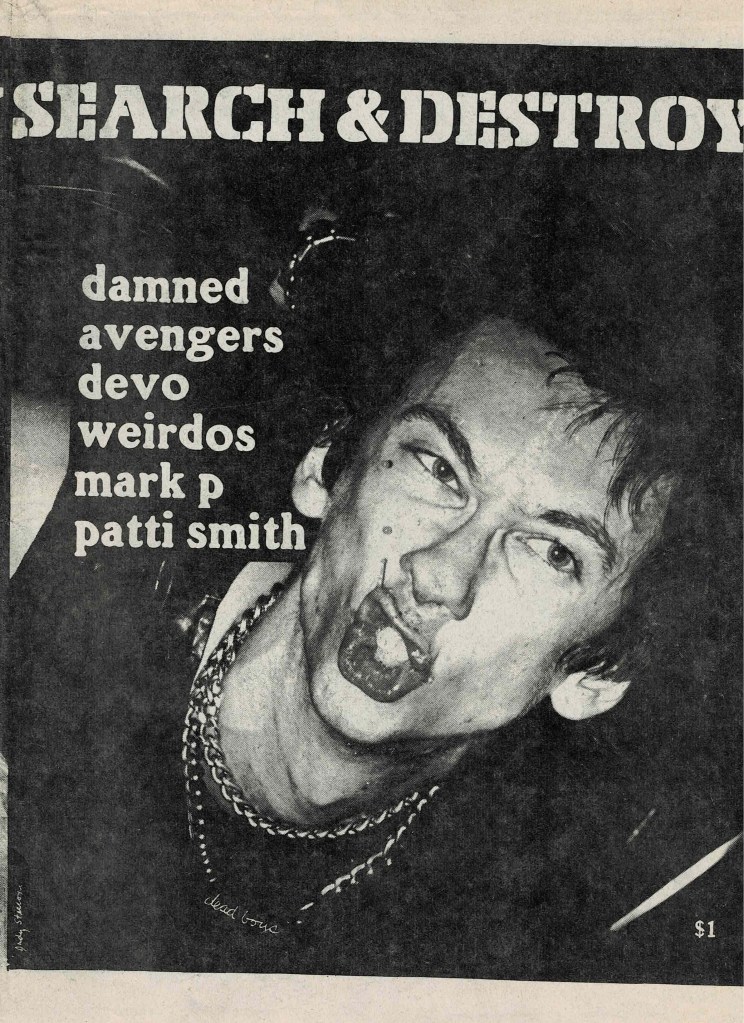
Damp #3

Part of the reason I started this endeavor up was to set a digital trail for quality, formative magazines like Damp that really possess no internet presence outside of what I myself have put up there, and especially what Tony P wrote during the years he was publishing Fuckin’ Record Reviews. Where I come from this shit matters, and besides, it gives me an opportunity to go back and re-educate myself about music I might not have been ready for when I first encountered it in the pages of, say, Kevin Kraynick’s Damp in the late 80s.

I know we’re not talking about it here, but his Beefheart issue, #5, came out when I, like so many, had heard Trout Mask Replica and said, nope, that’s definitely not for me. Maybe two years later after his mag came out, ‘92 or so, my “stance” had totally changed and I was singing the praises of the Captain wherever I could, and I got to revisit Damp #5 and really whet my palate that much more. I suppose I could do the same with this issue and The Fugs, but I already very much enjoy Tuli Kupferberg and The Fugs, perhaps more in spirit than in action. 

But what I’m getting at is that Kraynick, in 1988, was mixing his general “indie underground” (i.e. this issue’s Scrawl and Nice Strong Arm interviews) with oblique musical worlds that your average college radio 19-year-old (like me) hadn’t quite cottoned to, and placed it all on a beautiful continuum that’s rather obvious in hindsight. Kind of like Patrick Amory’s Too Fun Too Huge! that we talked about here. 
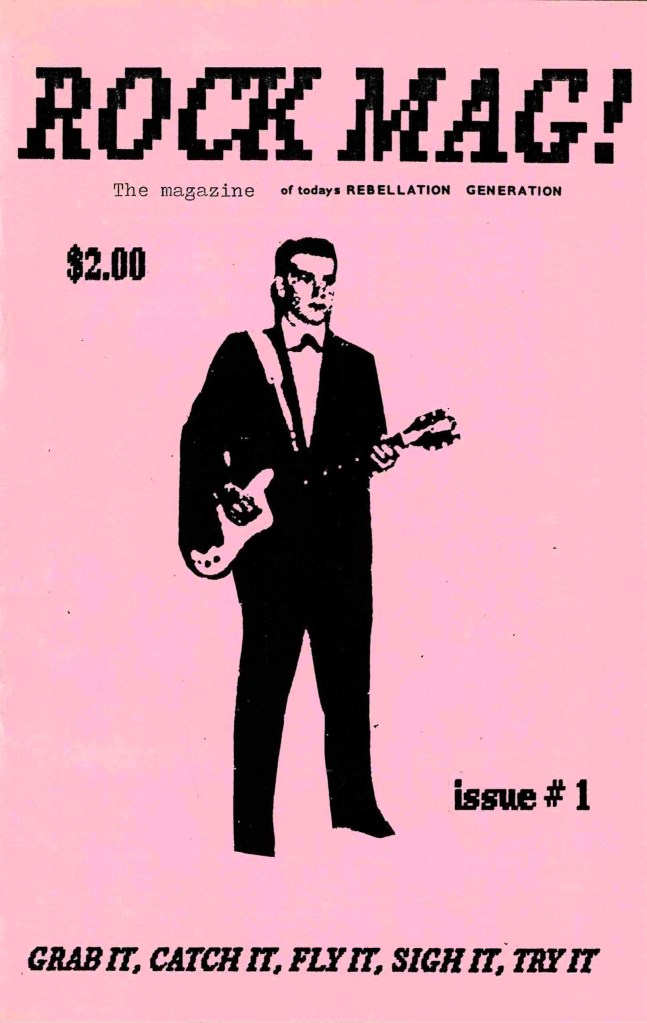
Kraynick wrote well, dug deep and used one of the worst fonts imaginable. I don’t know what you’d call it – “Dos command line”? That’s what it looked like, and it’s what word processors were built with at the time – so all is forgiven. This issue also has a great if rather sad interview with John Trubee, whom some of you may know from his album The Communists Are Coming To Kill Us!; his novelty hit “A Blind Man’s Penis”; his prank phone calls or for one of the all-time great song titles, “Satan Pukes on the High School Cheerleaders”. Trubee, in Damp #3, comes off as a misanthrope, sure, but a very self-hating misanthrope, whose bitterness and disgust at the world is only outweighed by that directed at himself. I’m glad to know, in 2023, that he’s still with us, because he’s given me a few good laffs and chortles over the years.

Meanwhile, there are a few more yuks to be had in Damp #3. Contributor Steve Erickson, whom we last discussed in our review of his Cut #11, gets his first exposure to Alex Chilton via his High Priest album and says, “I suppose someday I’ll pick up a Big Star album…why couldn’t he have covered The Fall’s “Hip Priest” or The Scientists’ “Bad Priest” instead of Carole King and “Volare”?” Oh for sure, I know how BUMMED people were around this time when they’d go see Chilton, and he’d do an earnest, not-kidding-at-all, full-blown version of “Volare”, usually with a shirt open to his navel. So good. For what it’s worth, I didn’t hear Big Star myself until 1993, and, suitably impressed, I told my friend JB about my new discovery and his riposte was, “Dude, that’s so high school”. Ouch.

Off topic again. Kraynick gets in a few zingers himself at the expense of Three Day Stubble, The Descendents, Tim Adams of The Pope fanzine (and later Ajax Mailorder) and not an insignificant amount of others. His contributors – New England/NYC fellow travelers – actually get more play than he does, especially with the features, so Damp #3 is more of a group effort than I’d remembered. The magazine would get even better from here; I have a bunch of them; and we shall be discussing them in this forum at some later date to be determined at whim.

Forced Exposure #9

(In my own fanzine Dynamite Hemorrhage #7, I did an issue-by-issue overview of Forced Exposure. Rather than write new, fresh material about this formative magazine here, this bit is taken from that. You can download a PDF of the issue where I wrote all the FE stuff here). 

The Winter 1986 issue of Forced Exposure had a sort of farewell/swan song to local Boston heroes Mission of Burma, who were retiring (we all know how that went), and it sets the tone for a mostly fantastic issue that continued to pull the magazine (and with it the entire scene) out of its hardcore roots.

What I liked best about this one besides the Burma article were the literal hundreds of reviews; every sub-underground LP and 45 coughed up around the world that quarter. These guys didn’t miss a thing, seriously. Private pressings, import 45s, EPs from deepest Buffalo and Tucson and Vancouver – they’re all in here. I also liked the fact that none of them were alphabetized and were sorted at random, and it’s almost certainly why I’ve been doing the same in the last several issues of this magazine – sort of a “you’ll just have to keep turning pages to find the one you’re looking for” attitude that fit in well with their general vibe.

Jimmy Johnson’s writing took a big leap forward in this issue, and while I always cottoned a bit more to Byron Coley’s taste, Jimmy really started to have a way with words, especially when those words were put in service of haranguing some of punk rock’s lesser lights. This was the start of the era when formerly punk and HC bands started to “tighten up”, stretch their songs out, “cross over” into metal and so forth – and Forced Exposure #9 was lying in wait for them. I loved it.

My future pal Kim Cooper – we wouldn’t actually meet for another three years – wrote in to the letters section to vent about how dopey the Lydia Lunch/Nick Cave plays in the previous issue were, and she totally nailed it:

“…It’s 1985, and any fanzine editor who chooses to publish this silly and dated material is making it quite obvious that s/he knows the history of the literary avant as poorly as the writers who are repeating the innovations of dead men. But the real crime in all this is that the young readers of the journals that feature these people are getting a skewed and sub-standard idea of what that sort of writing is capable of.” 

On the flip side, Byron Coley’s response to Dave “MDC” Dictor’s letter in the issue was one of the funniest things I’d read to that point, and was one of many recruitment tools he and the FE editors & writers used to sign me up for their righteously snotty cause.

Issue #9 featured pieces on White Boy; Couch Flambeau; Big Black; Afflicted Man; Roky Erickson and his mom interviewed by the Angry Samoans’ Gregg Turner; The Flaming Lips (a very different band in 1986 – one who were kind enough to try to sneak me and my fake ID into their Goleta, CA show as a “roadie” a year later….it didn’t work), Half Japanese tour diary, some hideous artwork by a guy I’ve never heard of since called “XNO”; Copernicus; more terrible Lunch/Cave plays; some Nick Blinko (Rudimentary Peni) artwork that only a child could love, and a combination of high art and low embarrassments. 

If Steve Albini’s horndog article about Patti Pezatti – a local fanzine editor and sister of Naked Raygun singer Jeff (ostensibly Albini’s friend?) – had been internet-available at any point in his production career, which I assume is ongoing, he’d have been blackballed and #Me-Too’ed out of a vocation entirely. It truly feels like a hundred years ago, in as many ways as one can count.

My Teeth Need Attention #1

With the exception of our peek into Silent Command #1 a couple of months ago, the Fanzine Hemorrhage story so far has been something of the proverbial “nostalgia trip”. It certainly doesn’t have to unfold that way, as long as new music ‘zines of a high caliber find their way into my hands, as happened with My Teeth Need Attention #1 just this very week. 

Actually I ordered this straight from the Carbon Records store as soon as I heard about it, as I’ve become quite acquainted in recent years with the wild world of Joe Tunis and his label and podcast. Carbon Records – which has been going since 1994, a fact that blew me away, since, given my pedestrian tastes and johnny-come-lately openness to the world of the often formless structure-shunning noise/”music” he releases, I only first heard a Carbon release in 2018, when the 2xLP guitar compilation Wound came out. Now I could be wrong about this, but I think Joe himself is in at least 20% of the bands on Carbon. From his perch in upstate New York – Rochester, the home of Kodak and Xerox! – he’s now launched a fanzine, a terrific compliment to the grounded yet outer-limits exploration of his podcast and label. 

He goes big on New Haven early, staking his reputation with interviews of two of that city’s heavyweights: Stefan Christensen and David Shapiro, the latter of whom you may know as solo guitarist Alexander. Both of them are among my very favorite musicians going right now; when they’re hitting their peaks, they respectively take “guitar playing” in some creatively bold and very exciting directions. Listen here for maybe my favorite example of Christensen’s layered, folk-rooted noise and here for a great taste of Alexander’s intricate, lo-fidelity fret-climbing. Both fellas play together in the band Headroom, another favorite here at the ‘Hemorrhage. 

So that’s the bulk of My Teeth Need Attention #1; there’s also a Tunis tour diary of a trip to Philadelphia; photos by Brian Blatt; a short piece of fiction by John Schoen and some reviews of more otherworldly psych, noise and freedom-seeking not-even-rock music. Personal, well-written and very “all in the family” – and make no mistake about it, it’s most assuredly for heads only. Hoping it becomes a thing I can count on a couple times a year.

Creep #2

Fantastic 1979 second issue from one of San Francisco’s more revered punk fanzines, Creep, which I’d long known was helmed & stewarded by one “Mickey Creep” (in actuality, Dean Sampson, sometimes known as Mickey Sampson). Sampson and his band of contributors capture the frenzied zeitgeist of 1979 punk and of San Francisco writ large better than nearly any other publication I’ve read, and unlike the jaded first-wave scenesters who were already crying punk-is-dead around this time, Creep #2 is very much about helping to document and further its vitality or rebirth, however it is you want to cut it. 

I really learned some things, too! First, all these years I thought the Maximum RocknRoll Radio show, which I used to listen to religiously on KPFA on Tuesday nights, started in 1980 or even 1981. It was started in 1977, folks – and was originally a combination of the new “punk rock sound” that was sprouting up and 50s rockabilly & oldies (!). There was even a dude named Al “Professor Pop” Ennis on the show who ran the 1950s portion; he was long gone by the time I started listening – a time of Jeff Bale, Ruth Schwartz, Tim Yohannan (of course), Ray Farrell and sometimes Jello Biafra (blah). Ennis can barely be found & connected with this show online at all, but hey, that’s why I accumulate these old fanzines, to get the real fuckin’ story.

I also learned via an advertisement about Portals to Music, a new wave record store at Stonestown Mall, now home of Target, Whole Foods and multiple Asian-themed restaurants and boba places – and a place two miles from my home that I find myself in weekly. Absolutely incongruous and baffling. Another world entirely. One final new thing I learned was that the worst bit of music writing I’d ever read had been hiding all along right here in Creep #2! One Thomas Sinclair, with his Freshman English classes surely barely in hand, writes about MX-80 Sound:

“As perchance this brisk July eve in the Bay Area, I was to experience a delightful musical and aesthetic encounter. As unpretentious and undistinguished as the visual accoutrement of the band may have been, the sound of MX-80 Sound was brilliantly polished and pulsated as rhythmically as could be expected for their indigenous brand of semi-eclecticism would allow…” – and it only gets worse from there. It’s truly mind-bending, and I’m glad to know where to find the worst piece of music writing of all time should I ever need it!

Creep #2 takes us on a tour of the state of it all, circa 1979. Jello Biafra is running for mayor. Punk violence is threatening to close down The Deaf Club, because some drunken knucklehead decided to take a chain to three parked cars outside of the club after a show. The Canadians have just come to town, and locals are hopped-up about D.O.A. and the Pointed Sticks. (D.O.A. were always hugely popular in the SF Bay Area; when I first started hearing punk for the first time, my perspective was that the biggest bands in the entire North American scene were the Dead Kennedys, Black Flag and D.O.A. pretty much in that order). And there’s a terrific interview with Craig Lee from LA’s Bags. Lee wasn’t just a shredding punk guitarist; he was always one of the good guys, and a man who shuffled off this mortal coil far too early.

I think my favorite thing in Creep #2, though, is the respectful and just-enough-noose-to-hang-himself interview with Joel Selvin, who was then, and for a long time afterward, the chief rock music writer at the San Francisco Chronicle. I grew up reading Selvin, because I read the newspaper every day, and just like the old man that I am, I still do. It was definitely de rigeur for punks to hate the mainstream rock critic; Selvin got a ton of vitriol over the years; his counterpart Robert Hilburn at the LA Times got just as much if not more. I’ll say right now that I recently read Selvin’s book about early 1960s Los Angeles pop music, Hollywood Eden, and while no masterpiece, it’s quite entertaining and very effective at calling up an ephemeral time and special place in music’s history, with his Beach Boys “Good Vibrations” chapter at the end being especially well-put-together. 

But here, in Creep #2 – wow. This photo they ran is really the epitome of the late 70s, coked-out, record-industry sleazeball; I don’t think Selvin was really that guy, but I can only imagine what the sneering punks reading Creep in ‘79, the ones who had to suffer through his weekly writings about Journey, the Doobie Brothers, Elvin Bishop and Maria Muldaur, had to say about it. Selvin himself gets off some pretty self-damaging zingers; to wit:

“Over the past few years the quality music in the local clubs has plummeted. In 1975, the Longbranch – unbelievable. It was everything a nightclub should be….I haven’t seen a show at the Mabuhay that I thought was good. I’ve checked these places out. They’re just not happening the way a club should be happening.”

“One time the Eagles were really good. It was the time that they opened for the Doobie Brothers that they were spectacular.”

“However important or significant The Clash may be, it’s “Sultans of Swing” that’s gonna be remembered from 1979….I have no doubt the American public wants the Knack and not the Clash. And certainly the sales figures reflect that.”

I guess on that last point he’s not wrong; I mean, I disliked The Clash as much as he did. And I suppose it is “Sultans of Swing” that I hear inside of Safeway or Chipolte, not “Guns on the Roof”. But oh for those days at The Longbranch, watching Sammy Hagar, Earthquake, Eddie Money and Commander Cody! 

One final note, a thing that got a lot of hearts racing here in San Francisco: Penelope Houston of The Avengers works at the San Francisco Public Library, and she helped establish a “punk rock collection” there of zines, flyers, videos and other ephemera that I’ve had the good fortune to go check out, albeit only once, and albeit only in brief because her snotty co-worker was bogarting so much of the material on a day she wasn’t working. Here’s a 90-minute panel discussion the library put on with the folks who put out Search and Destroy, Ripper and Creep – including our boy Mickey! You can learn more about the library here.

Gold Soundz #4

Not a ton I can tell you about this 1999 noise/experimental/outer-limits-of-rock fanzine, except that it hailed from Norway’s “oil city” Stavanger, was put together by one Sindre Bjerga, and was about as no-frills as they came. Zero photographs nor drawings, outside of what was in the ads themselves – just typed interviews and reviews, all clinging to a late 1990s world of micro-labels and the “popularity”, such that it was, of wrecking-ball bands like Dead C, Harry Pussy and Shadow Ring. 

I really do have to applaud whatever anti-thought went into the cover art for this one. Inside, however, Gold Soundz #4 approaches its subjects with much more care and discernment. Bjerga’s big discovery this issue is Godspeed You! Black Emperor; actually it’s not 100% clear he’s just discovered them, but after seeing them in London and hearing their album <<*#/&#>> his fandom has at the very least been cranked up to new levels. This is a band whose music I have never heard. I’m aware I could rectify that within seconds, but as my favorite line in 2014 film When We’re Young stated, in reference to instantly looking something up on the internet, “Let’s just not know”. 

The interviews are with Pan Sonic and a US label/distributor Swill Radio, run by Scott Faust who was and perhaps still is part of Idea Fire Company. These are names that mostly exist on the periphery of things I know about, so it’s cool to see it all so maximally central to another person’s worldview, a Norwegian no less. Bjerga remains an experimental musician and has, at this writing, 174 (!) releases to his name. No seriously, check out his Discogs. Even Electric Frankenstein don’t have that many.