-
Brown Paper Sack #1

Some of my favorite record-collector nutballs are the 60s punk maniacs who organically coalesced in the 1980s to fanatically scream their allegiance to unheard, raw 1965-66 American teenage garage rockers, and to orgasmically scream their disallegiance to just about everything else. Their ranks were certainly best exemplified by Tim Warren, the Crypt Records impresario who started putting out the mind-blowing Back From The Grave compilation series in 1983, and who then tacitly started releasing the Garage Punk Unknowns records two years later. For what it’s worth, I interviewed Warren about all this in issue #2 of my own magazine, which you can download a PDF of here. Yet he was in no way alone, as an avalanche of illegitimate 60s punk compilations that flowed forth in the 80s very much proved.
For a certain class of these obsessives, it’s as though 1967 came around and music completely, totally, 100% was over. That’s pretty much the tack taken by issue #1 of Brown Paper Sack. It came out in 1997 and far as I can gather was the work of Andrew Brown, a Houston, TX gentleman who wouldn’t put out a 2nd issue of this thing. While 60s punk “scholarship” had advanced quite impressively over the previous fifteen years to that point, Brown is definitely working his angle, which is most definitively Texas and Louisiana-based garage punk music of the 60s. It just so happened that Texas probably gave the world the single best per-capita ratio of screaming 60s punk bands of any of the fifty states, and therefore there’s a ton to mine in this particular angle. Around the time of Brown Paper Sack #1, a German label was putting out reissue CDs of the early 80s Flashback compilation series, now called Texas Flashbacks, and this stuff was finally beginning to be heard by folks beyond 1966 Texas teens, including by me.
I happen to have an all-time favorite 60s punk song, and that favorite is “Born Loser” by Tyler, TX’s Murphy and The Mob. Aside from the kernels of information included in the Back From The Grave Volume Three insert, the only Murphy and The Mob information I know of is Brown Paper Sack’s single-page interview with Terry Murphy, the titular head of the band. Like many of the energized and bewildered teens that made these records, they aimed to make a “British Invasion”-style A-side that might be their hit 45, a la “Psychotic Reaction” or “Dirty Water”, and often would bang out some crude B-side in an hour or two as a throwaway. Those throwaways, of course, are often the stuff of legend, a la The Twilighters’ “Nothing Can Bring Me Down” or Murphy and The Mob’s “Born Loser”, confirmed in the latter instance by this interview.
Brown either feigns or genuinely adopts a pissed, dismissive tone toward anything & everything that stood in the way of these latent garage heroes, including promoters, radio people, and every other form of music, especially pop. It’s honestly what I totally love about these guys. The one true path was defined by The Roamin’ Togas, The Gaunga Dins, The Basement Wall and so on – and fuck everyone else.
Like Ugly Things, Brown ensures that his interviews don’t simply scratch the surface but rather get down into every friggin’ detail imaginable; I mean, while most of the participants in mid-60s punk would have only been in their late forties by the time Brown caught up with them, their availability and recollections were likely deemed to have been extremely elusive, so best to catch everything now and not wait for someone else to fail to do it later. 26 years later, i.e. when I’m writing this, those still alive are now in their mid-70s – so if you ever personally wanted to grill an American 60s garage punk original mover, now would be the time. Brown Paper Sack #1 is absolutely upper-echelon 60s punk scholarship, and I’d love to know if Andrew Brown kept up his mania in print elsewhere anytime after this.

-
Drunken Fish #1

That’s Drunken Fish #1 and only, as far as I’ve ever known. It’s one of the greats, especially if you really like records….and I do. This relatively small and limited magazine included a split 45 by Splintered and The Back Off Cupids, the latter of whom I believe were affiliated with “Rocket From The Crypt”. Yet if I ever had that record, I must have sold it decades ago, and I’ve thereby been left with a fantastic collector/accumulator/navel-gazer-centric sort of fanzine that I delightedly take for a personal spin every ten years or so. Today I’d like to tell you why.
Drunken Fish was published by Darren Mock in 1992. Those of you who were sentient and rooting around the underground in the 1990s know that he quickly turned his passions into a fine label that put out records & CDs by Bardo Pond, Roy Montgomery, Truman’s Water, Doo Rag, Lee Renaldo and all manner of other heavy hitters throughout that decade. That sort of commitment to wide-ranging, off-beat underground quality shines through in his magazine as well. I’ve revisited this issue often primarily because of Dave Stimson’s “Low Tech” piece, focused on seven of the rawest & most crude of total-genius 45s from the previous fifteen years: Mike Rep & The Quotas, O Rex, Screamin’ Mee-Mees, Tav Falco & The Panther Burns, Vertical Slit, Fuckin’ Flyin’ A-Heads and Solger. Solger! Anyone who wrote anything about Solger in 1992 was an instant hero to me. That single cannot be touched. I reserve a special ‘lil piece of my heart for the genre known as “shit-fi”, so this article was and remains solid gold.
I think this is also the magazine that got me to wake up and really pay attention to Lee Hazlewood for the first time. Once I got hooked on the guy I was all-in. Man, Hazlewood records were really tough to find for a while there! The original albums were going for way more than I could afford in the mid-90s, then all of a sudden these LHI Records CDs started showing up in stores late in the decade, and I snapped every one of them up. I thought they were bootlegs at the time. Anyway, Mark Sullivan of Adelphi, MD, who wrote this excellently comprehensive Hazlewood discography piece in Drunken Fish – please stand up and take a bow, right now.
So you can likely already see the breadth & heft of this issue so far – but wait, there’s more. Mike Trouchon interviews loopy Englishman Simon Wickham-Smith, who’s living in Davis, CA while his girlfriend goes to UC-Davis (!). Johan Kugelberg covers various punk and noise rarities, and as in many of Kugelberg’s blathers, he pointlessly equates “rare” with “masterpiece”. I know that for years I’d chase down mp3s of material he’d raved about – i.e. records that he owned and that you didn’t – only to be forlorn, bereft and a little miffed that I’d spent precious time clicking & dragging when I could have been eating a hot dog or something. And Darren Mock himself pulls together a complete discography of Wales’ Fierce Recordings, who put out a Jesus & Mary Chain 45 that was just sounds from a “riot” at one of their shows (among many, many other things).
It’s a real barn-burner over the course of its 24 pages. There are Discogs listings for the aforementioned record active as of this writing that actually include the ‘zine, if you’re interested!
-
Fŏrdämning #11

Even in my ripening older age, I’ll still find myself hitting these exciting musical-discovery inflection points in which entire worlds open up, and I spend an inordinate amount of time frantically collecting, downloading, studying and of course listening to sub-genres I’d neglected.
It’s usually through the influence of one or more curators, whether that person is a friend, a writer, or a “disk jockey”. There’s the friend – several friends and correspondents, actually – who sent me deep down a dub rabbit hole when those incredible Blood & Fire CDs started popping up in the late 90s. There’s Erika Elizabeth’s Expressway to Yr Skull WMUA radio show, which I listened to religiously circa 2010-13 and discovered an appreciation for music (to quote myself) “…at the perfect intersection of deep-underground pop; 70s-80s British DIY and post-punk; 90s shoegaze and twee (stuff from lost 45s and cassettes that no one’s heard for two decades, I’m serious); garage punk; and a lot of noisy girl-helmed bands that had been lost in a patriarchal fog of several decades of disregard.” In fact I probably started the Dynamite Hemorrhage fanzine in 2013 because I’d been so re-invigorated by this particular radio show taking place across the country from me, and for the first couple issues she was the only other person I’d allow to write for it, so indebted was I & so complete was my trust.
Then there’s Matthias Andersson’s Fŏrdämning, easily one of the finest fanzines of the 21st century. He wrapped it up a few years ago, yet in 2017, when Fŏrdämning #11 came out, I could feel my own tastes and tolerances expanding simply by virtue of Andersson’s heavy influence. As I read his dissections of modern and past experimental, noise, and rock-adjacent (sometimes barely) sounds, I developed a much deeper appreciation for the weirder edges of the sub-underground, and my own podcast and fanzine evolved accordingly during the mid/late 2010’s (i.e. a few years ago). It turned out that as Matthias was moving somewhat closer to more rock-oriented sounds – i.e. he talks about his admiration for The Suburban Homes and Cheater Slicks in this very issue – he was helping me move closer to his personal original starting point in noise and formless free-form not-even-music. If it weren’t for him, I’d have known nothing about Neutral, Leda, Amateur Hour and Enhet För Fri Musik, for instance.
Fŏrdämning, you may not be surprised to find out, was a Swedish fanzine, albeit one written in perfect English. Better than perfect, even, in that there’s nothing stilted nor dumbed-down in the least, the way some English-language fanzines emanating from the European continent have often been (and listen, if I tried to attempt a fanzine or even a paragraph in Swedish or any other language, it would easily be the worst thing you’d never read).
From his perch in Gothenburg, Andersson celebrated his collector obsessions, yet in a manner not at all redolent of the stench that can often emanate from the mania of collecting. Fŏrdämning #11 opens with an essay about a beautiful year at his local record store in which a nameless collector has unloaded an insane collection of Fŏrdämning-approved gems: New Zealand 90s lathe cuts; Majora 45s; the Siltbreeze back catalog; Flying Nun rarities; Urinals and Fall singles, Twisted Village records and so much more. The essay is about how Andersson and his pals frolic in the abundance and in their amazement at their own good fortune. It’s the stuff dreams are made of – no seriously, my dreams. You can actually read the piece here.
This intro serves as a prelude to an issue that focuses on micro-labels of the past, including Bill Meyer’s Roof Bolt, Mike Trouchon’s gyttja, and two noisy tape labels I wasn’t familiar with: Thalamos and Vigilante. Roof Bolt was a terrific – and terrifically unsung – 1990s American label focused on New Zealand that put out fantastic Alastair Galbraith, Roy Montgomery and Terminals records, along with the only 45 ever from Brown Velvet Couch, a total high-water mark of the NZ underground. Andersson also carries on his back-page column about lathe-cut records “Speaker Crackle In The Garden”, which this time focuses on Sandoz Lab Technicians. In the reviews section, there are the exact reviews that turned me on to Stefan Christensen and Blue Chemise. A top-drawer issue all around.
You should also know, if you don’t already, that Andersson is the fella behind the I Dischi Del Barone, Fördämning Arkiv and Discreet Music labels. He’s been on a hell of a run the past decade.
-
Crank #2
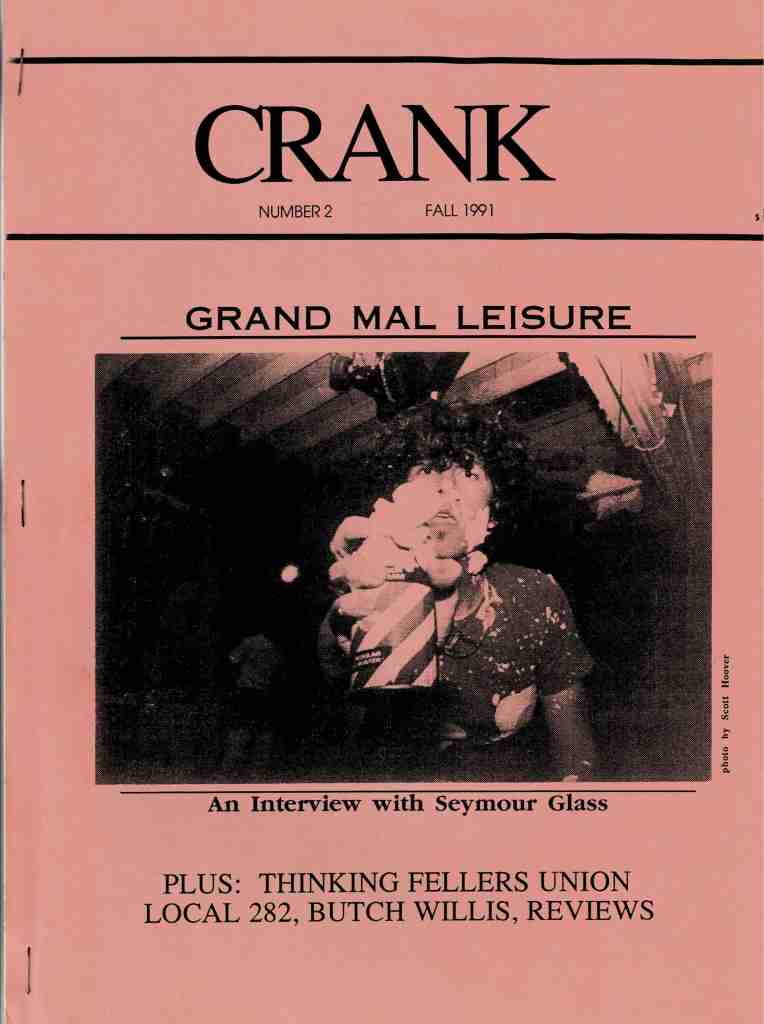
My entire collection of Marc Masters’ 1990s Crank fanzine fell victim to “the great lost fanzine box” which we tearily recounted the tale of here. I’ve been slowly righting that wrong over the past few years, and the issue I was most excited to claw back was Crank #2 from Fall 1991, the one we’ll be discussing presently. I (thought I) remembered this one the clearest and had pinned it in my mind as his “San Francisco issue”, given the Thinking Fellers Union Local 282 and Seymour Glass interviews, yet there’s a bunch I was excited & surprised to rediscover after finally holding it in my grubby paws again, thirty-plus years after the fact & nearly 25 years since my copy went astray down the I-5.
My own fuckin’ name, for one – self-centered egomaniac that I am. See, around this time I’d started my own fanzine Superdope, and as a result of our respective complementary endeavors, Marc and I became pre-internet “pen pals”, I suppose you’d call us. Isn’t that nice? Both of us were mining somewhat similar quarries at this time in our fanzines, but Marc really took his music-writing chops from this point and ran far with them. From these humble beginnings, he’s since written the definitive book on no wave; been a key writer for Pitchfork, The Wire, Bandcamp and elsewhere; and now he’s even got a few podcasts going, the most recent of which is The Music Book Podcast, which I highly recommend. Back in ‘91 he called attention in his preamble to my own minor work, and I appreciated seeing and recalling it just now.
But the dude inadvertently did me a much bigger solid in 2017 that snowballed into one of the coolest experiences of my life. Mind you, we’ve never spoken nor met in person, yet he did a piece late that year in The Wire’s Unofficial Channels column about my current fanzine Dynamite Hemorrhage. This directly led to The Wire’s editor Biba Kopf recommending me to take part in an all-expenses-paid speaking gig at The Tomorrow Festival in Shenzhen, China in 2018, where I got to ramble on about the history of music fanzines to a Chinese audience. Unlike Mark, I’ve never done anything remunerative with music writing, 100% by choice in my case, but this was as close as I’ve come and likely ever will come. An incredible stroke of fortune that I’m eternally grateful for.
Whew, so yeah, how can I be objective about Masters’ 1991 Washington DC-based fanzine, right? Well, I was a partisan for it from day one. A few things struck me on the re-read; first, I’d totally forgotten that there were two other excellent contributors, Heather Lieser and Dave Whelan, and the three of them split up the many reviews. Heather even has an entire page dedicated to her live reviews. She digs The Cannanes, and gets to opine on most of the DIY pop stuff in Crank #2. Dave seems to get about half of the noisier independent rock and some pop stuff, and Marc gets anything & everything out of the weirdo San Francisco scene, including Archipelago Brewing Company (he likes ‘em!), whom I’m proud to say I saw live once, and Caroliner, whom I’m not proud to say I saw more than once.
The Thinking Fellers Union Local 282 interview with Hugh Swarts was a really good one, as he hems and haws about how long he’s hated the name of his own band, and dishes a bit on how lame it was playing with Royal Trux at a 1991 Matador Records showcase at the 6th Street Rendezvous in San Francisco, a show I attended and which I actually thought Royal Trux never even showed up for; either that or I bailed out of the club at 1am rather than wait for them to set up (at that point I’d only heard Twin Infinitives and not the first album!). The mock Seymour Glass “interview” is a frustrating bit of self-aggrandizement disguised as self-sabotage that was both hard to read then and is even harder to comprehend now. Other than that, I like it.
Today I associate Masters with his deep appreciation for and knowledge of more experimental and difficult music, and you can certainly see the seeds of all that taking root here. Yet, as his podcasts and other fine music writing show, there’s still a rocknroller out-of-controller lurking behind that digital pen. Now if I could just find Crank #1 and #3….do you know anyone who might be able to help?
-
Alright! #2

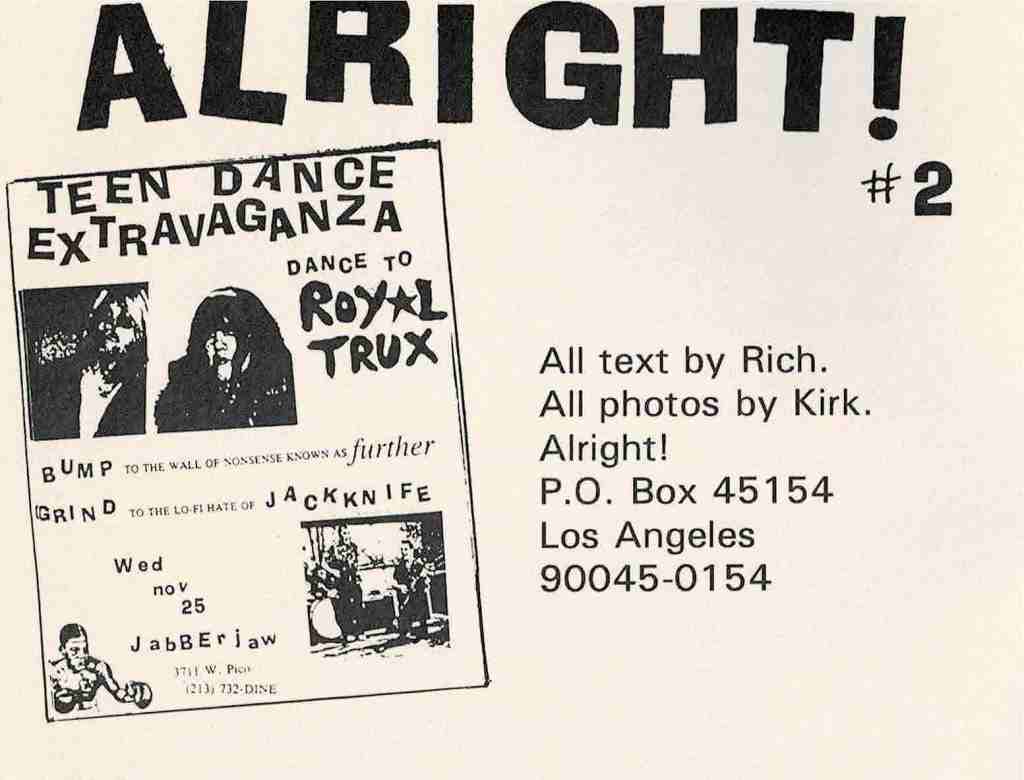
It wasn’t but two months ago when we talked about a different issue of the Alright! fanzine (#4), put out in Los Angeles by Rich, a.k.a. McKinley Richard of the band Jackknife. Rich, he was in love & lust with the garage punk of the day, both as a practitioner and as a true fan. This small missive from 1992 spans a mere twelve pages but it’s a terrific snapshot of where much of my head was at the time, mainly gawping and gaping at Royal Trux, The Bassholes, ‘68 Comeback, the Cheater Slicks, the Blues Explosion and so on – though I never saw this magazine at the time & I can’t imagine any more than 50-100 of them were ever printed. I just got this copy in the mail from JS, who gifted it to me like a true mensch. We sincerely appreciate his generosity at Fanzine Hemorrhage!
Rich makes his swelling admiration for The Trashwomen’s Danielle known right from the off, and it got me digging through my own physical archives….yeah, I know there’s a picture somewhere….yes, there it is! Before any of us knew her as a musician, she danced go-go style for The Phantom Surfers and (I thought, but I’m probably wrong) The Mummies. It was likely 1991 when she was summoned over to our clan of idiots in order for Nicole Penegor to take this photo of her and myself.

Then a year later, she turned up in a new all-female trio called The Trashwomen, at first playing instrumental surf music only, and then adding tracks with vocals as they improved – and they did improve. I recall that they let Danielle – whom I’d never met before this photo was snapped, nor after – sing one song and one song only, and it was fingernails-on-chalkboard fantastic. She was later in The Brentwoods, and therefore lives forever in our hearts.
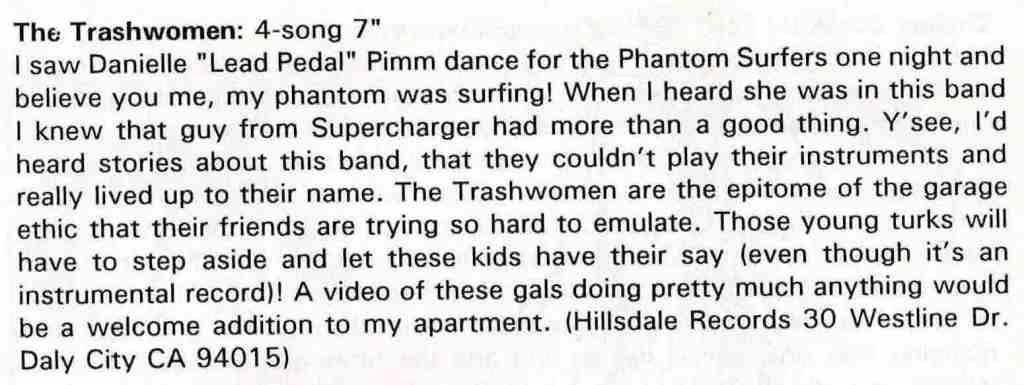
Alright #2 is like watching an unfolding snapshot of the time we all first heard The Chrome Cranks; when the final Gibson Bros album came out, and when “Larry from In The Red” had young America’s ear. Or being able to nod knowingly when Royal Trux tells Rich that Matador gave them an advance for an album, but that they “inadvertently spent all the money”. Oh, snap! Does that all sound pretty inane to you? Yeah, it does to me too from this vantage point 31 years later, but there were some good times, some mighty good times, and Rich was right there on the front lines stirring the drink.
-
Cut #11

It may not be recorded in the history books, yet no one around this house will ever forget the tragedy of “the great lost fanzine box” in 1999. We had moved from Seattle back to San Francisco that year, and used the “Starving Students” moving company, who were neither students nor starving, but were rather clear ex-cons who at least, to their credit, liked to talk baseball with me. Otherwise they were total clowns, and I realized long after the fact that one of the 3 boxes of fanzines I had been collecting over the years didn’t end up getting delivered to the new rental house in San Francisco. Several of these fanzines were most certainly copies of Steve Erickson’s Cut, along with other gems that I’ve diligently worked to replace over the years (like the entire run of Marc Masters’ Crank), along with many copies of “The Bob” and things like that which I haven’t.
This particular 11th issue of Cut came along in 1991, and it’s clear that Erickson had been pumping these out pretty aggressively, maybe about 3 per year based upon looking at his back issue contents that are listed on Page 1. He was publishing from Norwich, CT so his center of show-going gravity appeared to be Boston, and that’d make some sense given that he’s got Lou Barlow and Bob Fay along as contributors. Erickson notes in his intro that he’d just been burned to the tune of $60 by Circuit Records and distribution, which I recall being quite a fanzine cause célèbre at the time; it was a cool noise label w/ Monster Magnet and Surgery records as well as big plans for many more, and I guess the main guy there had some substance abuse problems (or something), and was ragged on pretty aggressively in things I’d read from that point onward.
But hey man, out on the west coast things were mellow and we didn’t know any of these people. Cut in May 1991 very effectively serves as an exceptionally comprehensive inventory of any & all interesting underground rock music coming out at the time, with frequent review-section swerves into hip-hop as well. I was putting out my own first issues of Superdope fanzine this particular year, and this is totally a world I was deeply marinating in: Thinking Fellers Union Local 282, Monster Magnet, Pavement, Unsane, Terminals, Thee Mighty Caesars, Gibson Bros, Skullflower and so forth. Erickson makes a point in several places of being a little frustrated with the state of it all, and he’s clearly moved on from Amphetamine Reptile and Sub Pop bands, as had I. So he and I were compatriots, and the two of us probably would have had some good times shuckin’ and jivin’ in 1991.
I did notice that in his review of Houston noise/psych/torture band The Pain Teens we get quite the proclamation: “The Pain Teens are one band who I’d unequivocally endorse as rock’n’roll’s future”. Jon Landau, call your office! I’m sorry to report here that the Pain Teens genre takeover was not to be. But how were we to know that then, am I right??
Erickson was a strong writer who granted himself and his contributors a fairly wide remit, from precious indie pop to grinding noise. He was on the Xpressway train pretty early and gets in a Plagal Grind review and deservedly flips over The Terminals’ “Do The Void” 45. That single absolutely rules, and Erickson called it. He perhaps didn’t have to review every promo he was sent in 1991, but then again neither did I, and I reviewed a whole heapin’ helpin’ of mediocrities and said nothing interesting about them, for there was little to say. I’ll admit that getting a boatload of sub-underground records in the mail every day was a fantastic treat when I was 23 and broke and perhaps increasingly narcissistic (why, you want me to endorse you? Let me see what I can do). Anyway, Cut #11 brought the misty memories flooding back, and I’m glad I at least have this one issue still around. The Starving Students criminals are all currently reading the others.
-
Slash, Vol. 2 No. 2 (November 1978)
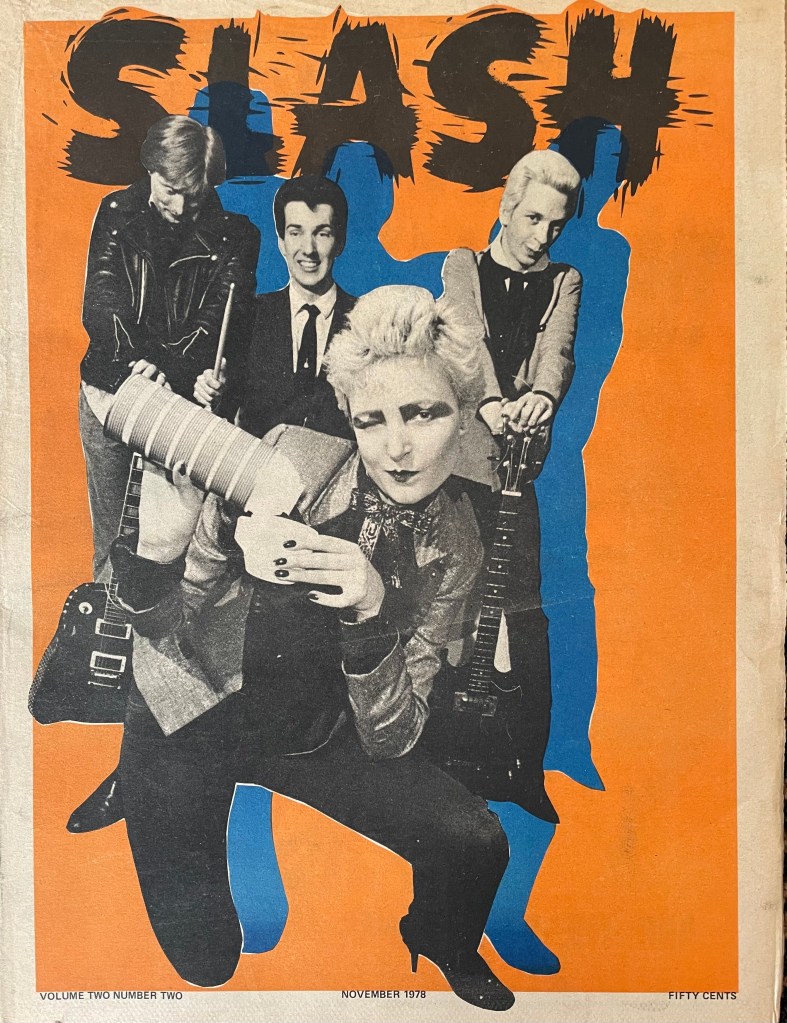
When I started this site, waaaay back in late December 2022, I promised (or threatened) that the pieces herein might not actually be about the actual fanzine issues themselves, but rather would serve as a “jumping-off point” for me to write something else entirely….maybe a watery-eyed reminiscence, perhaps a funny ‘lil tale, or maybe a rant of some sort, provided I could get myself worked up enough about a dopey music fanzine to do so. So far I’d say I’ve done almost none of that, and my posts have been more name/rank/serial number reviews of each issue in question. I hope that’s okay. This post will be a little different and more in line with what I promised/threatened, though.
Slash, a punk magazine from Los Angeles circa 1977-80, is my all-time favorite fanzine. In 2020 I published an issue of my own fanzine, Dynamite Hemorrhage, 100% devoted to talking about and celebrating Slash magazine. The magazine went out of print within a year, but you can download and read a PDF of it right here. Meanwhile, I’ve been attempting to collect the full run of Slash over the years, and I guess I’m more than halfway there now. My most recent “acquisition” is the one you see here, Volume 2 Number 2 from November 1978. It has Siouxsie and The Banshees on the cover. It’s great. We’re not going to talk about it any longer.
Instead, I’d like to publish a short and previously unpublished 2020 interview I did with Terry Graham, aka Terry “Dad” Bag of The Bags, and later of The Gun Club (and for a time, The Cramps and the Leaving Trains). We talked solely about Slash magazine.
I’d just read Graham’s book Punk Like Me, a crazed ride through his musical, relational and substance career, and I was in the midst of putting together the Slash issue of Dynamite Hemorrhage. It made sense to interview someone in one of the bands routinely featured in Slash, and I chose Mr. Graham. Alas, there was some sort of Google Docs communication snafu that was almost entirely my fault, and I went to “press” without Graham’s interview about his observations of and experiences with Slash magazine. I swore I’d publish it somewhere at some point, and here it is.
DH: What do you remember of the first time you came across an issue of Slash, and what was your reaction to it?
Terry Graham: I was very impressed. The large format and design quality gave a boost to our scene which was lacking in confidence because the punk scenes in New York and London were so well represented by numerous fanzines, magazines and national media attention.
DH: What were some of your personal interactions like with the magazine, as a member of The Bags, the Gun Club or otherwise?
Terry Graham: Slash printed an interview with the Bags with photos taken especially for the interview. That was a validating moment for the Bags. I had only been in the band for a few weeks and it gave us quite a boost.
DH: I’d love to get any anecdotes, stories, thoughts or whatever else you’ve got regarding each of the four Slash founders – one sentence, one paragraph, multiple paragraphs or nothing at all – your choice….
Claude Bessy?
Terry Graham: I didn’t know Claude too well but of course he was everywhere at once. Everyone liked him even though he could be quite irascible and cantankerous. His cynicism was always infused with a wry laugh and obvious sense of humor. His observations in Slash were spot on and added a much needed international perspective to what we were doing on the streets of L.A.
Philomena Winstanley, Steve Samiof, Melanie Nissen?
Terry Graham: I had very little interaction with Philomena, Steve and Melanie.
DH: Do you have a favorite piece or story (or even a review or graphic element) from the magazine? If so, what was it and why?
Terry Graham: I’m afraid I’ll have to default to the Bags interview because it meant a lot to us and gave us a shot of confidence that we desperately needed.
DH: What impact do you think Slash had on the music scene that it covered, i.e. how was it perceived by the bands, artists and assorted weirdos in its pages – as well as by underground LA in general?
Terry Graham: In some ways it was perceived as a moneyed attempt to crash the scene. At the same time, because it was written primarily by people involved in the scene in some way (mostly musicians) it was also thought of as a genuine attempt to legitimize our efforts to create a viable and unique rock and roll for the time. It had a lot of influence and was looked up to as the publisher of record for the scene. Some may not admit that, but it carried quite a bit of legitimacy.
DH: What impact did it have on you?
Terry Graham: I enjoyed reading it but kept an eye out for signs of the dreaded “sell out.” We were all sensitive to people who might try to capitalize on the scene and so many of us were suspicious of people like Bob Biggs, Steve Samioff, etc., but for no real reason, in fact. Not sure one can capitalize on something that makes no money and barely made a dent in record sales charts or record company decisions. Culturally, I think Slash was a very positive force. Anyone who saw it, and particularly those who weren’t part of the punk scene, would be left with an impression of authority which, in turn, added the same to our scene. All of us together – with Slash and all the other fanzines – changed the world but it took a generation or so for that to happen.
DH: Any thoughts on Jeffrey Lee Pierce’s contributions to Slash?
Terry Graham: I loved Jeff’s contributions. He was first and foremost a writer so I know he loved his work for Slash. I only wish he could have done a lot more.
DH: Did Slash suffer from myopia by ignoring certain aspects of what was going on in greater LA circa 1977-80, or did you feel it was pretty representative of what was actually happening in clubs and elsewhere around the city?
Terry Graham: Yes, it genuinely represented our scene because so many of us who were actually creating the music, wrote for Slash. The graphic design and presentation within Slash were also very creative and artistic. It was truly representative of Los Angeles during those years.
DH: Any other thoughts or stories or opinions you’d like to share?
Terry Graham: No, but I sure wish I had kept all my copies. I still have one, with Lee Ving on the cover. That’s right, the one with the Bags interview.
-
Galactic Zoo Dossier #7
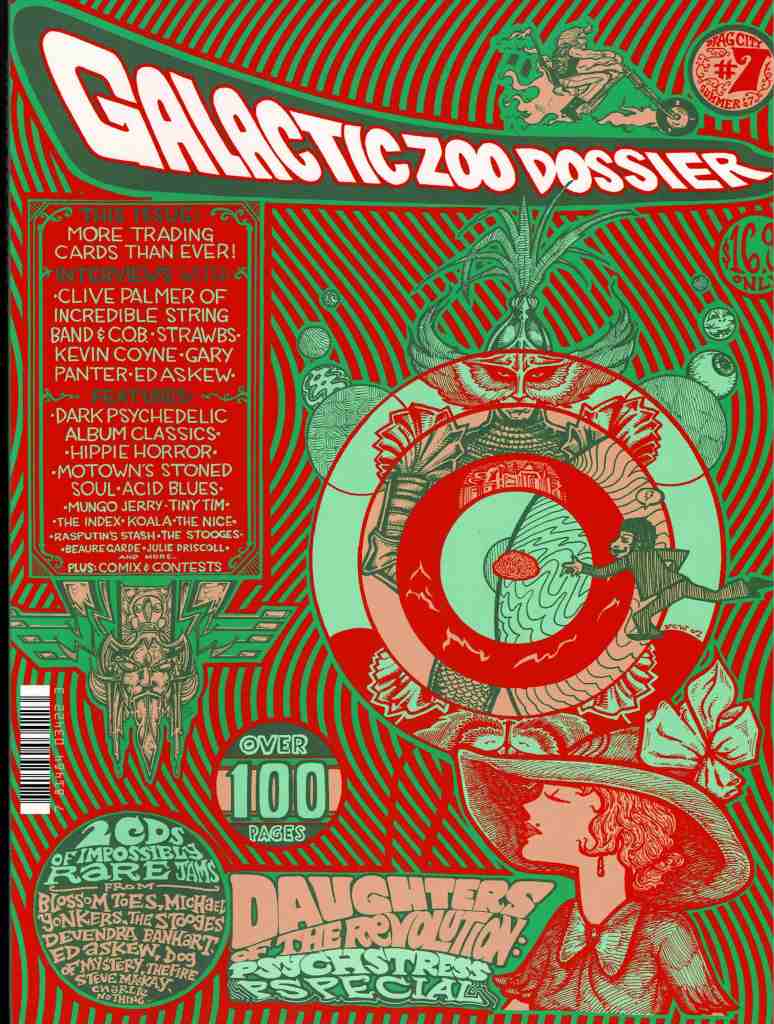
You wanna talk about a magazine that proudly stood on its own and carved its own path, it’d be this one. There’s really never been anything quite like it. Chicago’s Steve Krakow, aka Plastic Crimewave, was the guy behind this incredible compendium of obsessive, over-the-top psychedelia worship, and the man didn’t just edit and write most of the thing, he hand-scripted every article & interview with his pen (in longhand, you know what I mean?), and then hand-drew virtually every band image. Because I’m so used to reading typed text in common fonts, it actually takes some adjustment to read a full article in someone’s handwriting. Krakow even re-writes articles submitted to him in type, such as Byron Coley’s interview with Gary Panter (about lightshows!) in GZD #7. Everyone I’ve ever talked to about this magazine incredulously says the same thing: “How long do you think it took him to put this thing together?!?”.
Krakow’s drawings tend to transform nonentities like Tiny Tim or The Bee Gees or Attila into crazed psychedelic warlords; you’ll see one of these imposing renderings of, say, Mungo Jerry, and you’re like – “Wait, do I like Mungo Jerry? Should I??”. In Krakow’s world, anything at the intersection of psychedelia, garage and prog is fair game for high-energy blather – words like “freaks”, “fuzzstorms” and “free-form” come up often, and hey – it’s all to the good. We need frothing enthusiasm for lost music like this, and as long as you’re not personally dropping $250 for a copy of a Mandrake Paddle Steamer acetate on his word without taste-testing it online first, you’ll be just fine.
The crew that put this 2007 issue together with him are all totally insane music fiends, all of them. Nobody can touch Krakow, though – he even stumps his sixty- and seventy-something interviewees about their own bands, careers and B-sides. How can you not totally love this guy? He’s a do-it-all renaissance man just totally immersed and bathing in the years 1965-1974, with enthusiasm to burn and a clear passion for getting into the clubs and seeing anyone and everyone connected to his favorite genres & their post-70s exponents (for instance, Japan’s over-the-top psych bands on PSF come up pretty regularly). I actually stumbled upon his band Plastic Crimewave Sound in 2005, a couple years before this issue, and wrote a review of his show here, making sure that I praised his wild hippy pants in my recap as well.
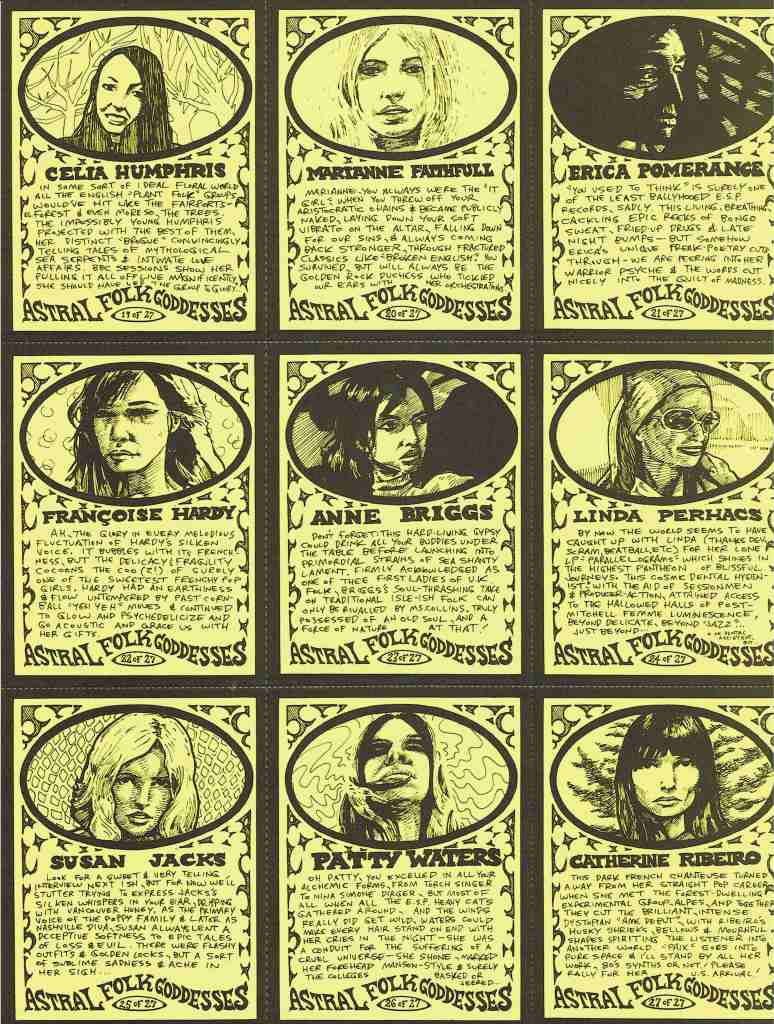
I mean, if I could travel back in time and join a nascent scene, I’d probably be at Los Angeles’ Masque on opening night in 1977, and I’d go to shows in LA six nights a week for the next 6 or 7 years. I get the sense Krakow would be on the British free festival circuit, circa 1968-72, frolicking in the mud with comely maidens, tripping his brains out to Hawkwind, the Edgar Broughton Band and Kingdom Come. I’d be remiss if I pegged the man and his world to just psych or prog, though. Free jazz is hep, and so is folk. In fact, this issue comes with two sets of hand-drawn trading cards (!), one devoted to 45 “Damaged Guitar Gods” (Daevid Allen. Skip James, Fast Eddie Clarke and so on); the other to 27 “Astral Folk Goddesses” (including many of my personal favorites like Vashti Bunyan, Anne Briggs, Linda Perhacs, Nico and Karen Dalton). Don’t separate them!!
Clearly Krakow’s got a massive 60s/70s comic collection as well, because another Galactic Zoo Dossier peccadillo is take any & all panels from comics like Archie or similar lesser lights that show hippies, burnouts, druggies, rockers, mods, psychedelic eyeballs, light shows and so on. As mentioned previously, there’s really nothing else like GZD before or since, and you’d do yourself a favor to dig into one or more, many of which are still available on the Drag City site.
-
Matter #10
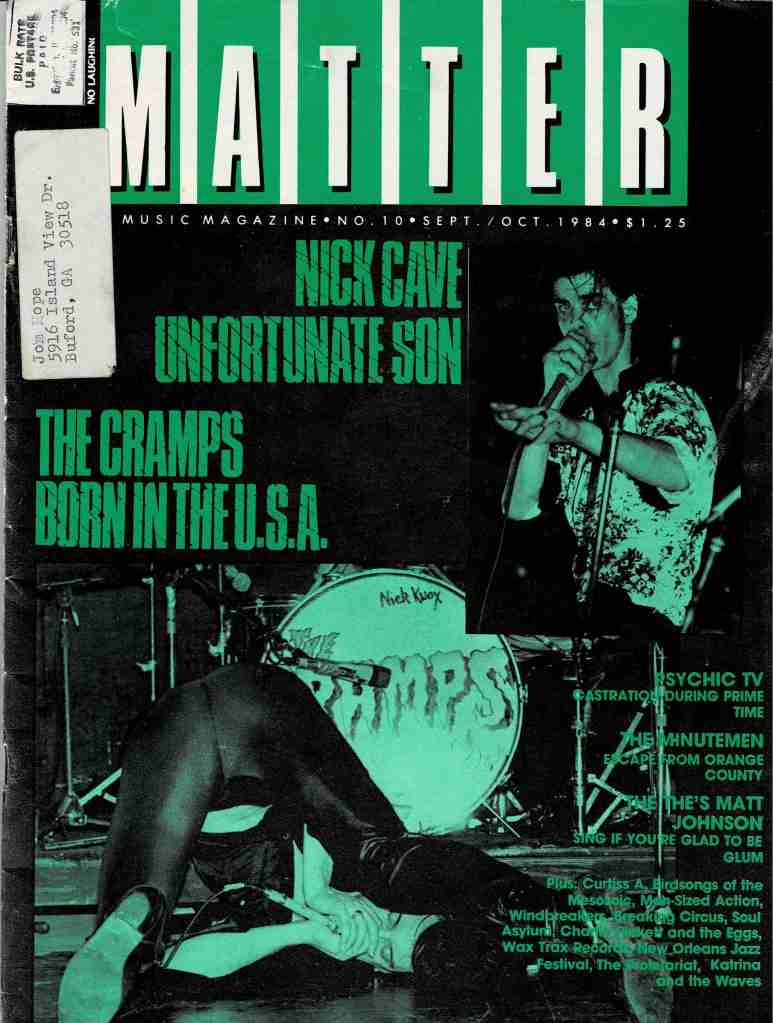
Matter, at least in its final two years of existence (1984-86), served as sort of a way station for quite a few of the best sub-underground writers of the era (Byron Coley, Gerard Cosloy, Ira Kaplan, Howard Wuelfing etc.) as well as a place to flex for newer writers (particularly Steve Albini, who has far more content in Matter #10 than any other writer). And yet there’s almost nothing to be found about Matter online, aside from this batch of cover scans. So forgive me if my stats are a little compromised here. I wasn’t buying it myself in real time, but caught up to it in a big way in early ‘86 as it was fizzling out, thanks to a pal who loaned me her stack of them.
So the first enigma wrapped in a mystery is editor Elizabeth Phillip of Weehawken NJ. In this September/October 1984 issue, virtually all of the ads are for Chicago-area local stuff; record stores and labels and recording studios and whatnot. I’ve gathered that the magazine was once published in Evanston, IL; Liz then left for college or career near NYC, yet pretty much kept the magazine humming as a Chicago-based endeavor. So how did she recruit such heavy hitters for this thing? Where did Phillip go when Matter was no longer? Would she like to do a Q&A with the navel-gazers behind Fanzine Hemorrhage blog?
Her magazine is full gloss, B&W with a color cover, and I’d have to imagine it was easily found at Tower Records and most fanzine-stocking independent record stores of the era for the big price of $1.25 per issue. Though the general lean-in is toward harder, louder, post-hardcore rocknroll music, there is a bit of mersh straddling going on, with some half-hearted nods to mainstream acts, to the British and toward what you might have called wimpy college rock. Phillip herself wrings a quality interview out of Nick Cave, after spending a period of trepidation pre-talk imagining how this feral junkie might rip her to shreds. There’s also a sloppy Cramps interview from that long, strange period in which they hadn’t released a true album in many years except the live throwaway Smell of Female.
Zen Arcade and Double Nickels on the Dime have just come out, and their titanic impact permeates this entire issue, from the letters section to reviews of bands who are neither Husker Du nor The Minutemen. I sometimes used to listen to local San Jose, CA college station KSJS around this time, when I was a senior in high school, and they were boring college rock to a T. Even they went ballistic over these two albums and The Meat Puppets’ Up On The Sun, which triggered an evolution in the station’s playlists to the point where it became a very listenable station in 1984-85. Steve Albini gets to pen full pieces on Breaking Circus and Man-Sized Action, as well as “The Moron’s Guide to Making a Record”. Albini also provides his personal phone number to any Matter readers who might have any questions (312-864-1173 if you want to give him a jingle; perhaps he’s ported this to his 2023 smartphone if you have any current questions about making a record).
Ira Kaplan, clearly a Soft Boys partisan, writes about Katrina and The Waves, who’re mere days away from their big US hit “Walking on Sunshine”, yet get hassled at Maxwell’s in Hoboken when Ira goes to see them. That song is now a Safeway and Whole Foods favorite ‘round where I live! There are other interviews with Curtiss A, Psychic TV and The The, and a round-robin reviews format in which writers like Cosloy, Phillip and Albini get to “grade” new releases from A-F just like Christgau did. Everyone loves Soul Asylum. A topic for another day on Fanzine Hemorrhage.
PS – I was able to procure this issue from a Great American named Jon Hope, as you can likely see from the label on the cover scan. Matter subscriber! ($7 for six issues – seriously). I don’t think I sent him a whole lot of value in return, so thanks, Jon. You can read his very active music blog Jonderblog here.
-
Teen Screen – February 1967
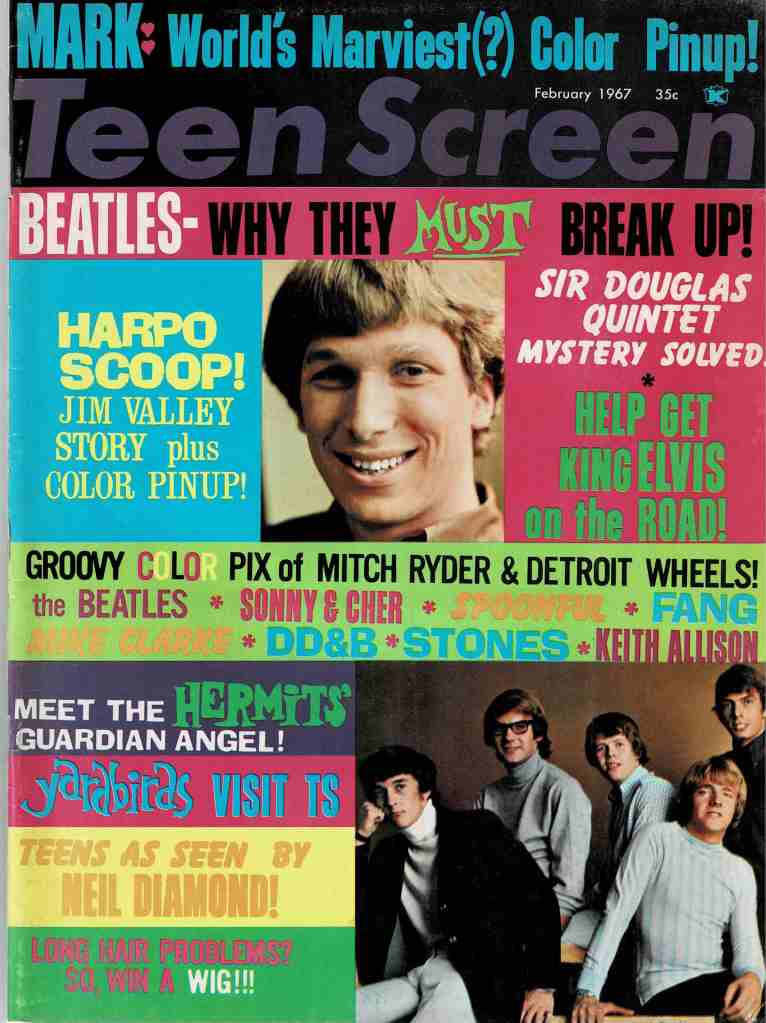
Lest we forget, the “serious” American rock fanzine underground, or serious rock magazines in general, had barely flowered by 1967. At that point in time, it was through magazines like Teen Screen, which we shall be discussing today, that young Americans were using to absorb the exploding culture of garage-infused pop music as well as pop music writ large. Crawdaddy was just a year old at this point, Cheetah was about to start up, and Rolling Stone was nearly a year away. This is a heady time in America, to be sure, and a time during which to be a teen was to have one’s world blossoming with music, film, fashion, TV and culture all very centered on your tastes and predilections. If that was your bag, I guess, right? (My own parents were barely out of their teens at this point and they couldn’t have cared less).
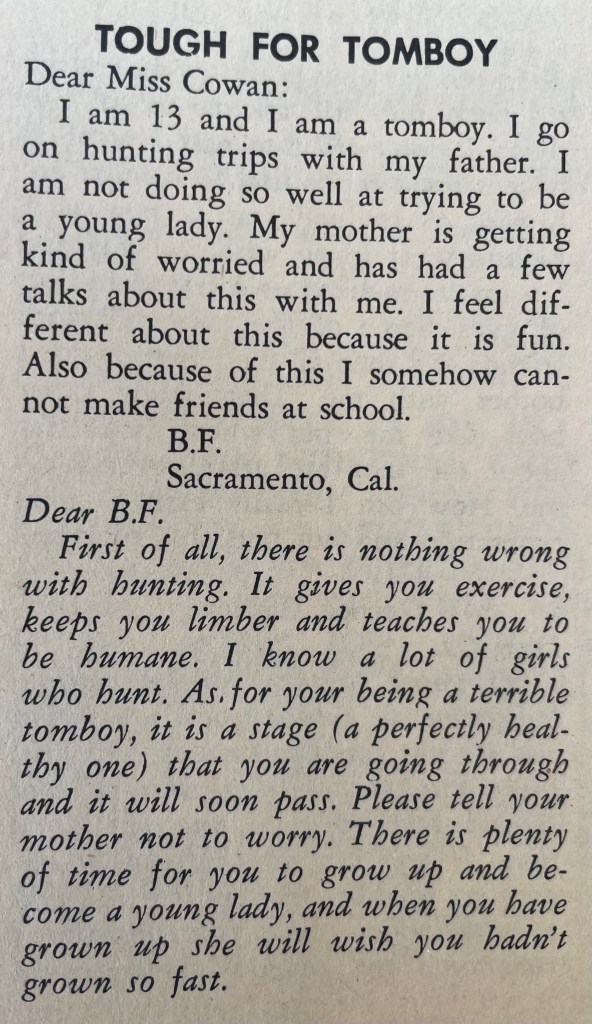
Now it’s just fun to look at a magazine like Teen Screen’s February 1967 issue and see the world through the eyes of a 15-year-old girl – or rather, through the eyes of thirty- and forty-something businesspeople aggressively marketing to that girl. It’s really something to watch the mores of a time before 1967 not quite budging to fit a young America looking to find itself, such as in Elizabeth Cowan’s “Teen Problems” column, in which she counsel a confused 13-year-old “tomboy” that her mother shouldn’t worry, because “there is plenty of time for you to grow up and become a young lady”. Any band with some young long-haired guys and a hit, or potential hit, were fodder for the dream factory. Hot hunks like the Sir Douglas Quintet and Mitch Ryder & The Detroit Wheels? Sure! San Francisco’s The Other Half and their new sound they’ve dubbed “psychotic rock”? Why not?
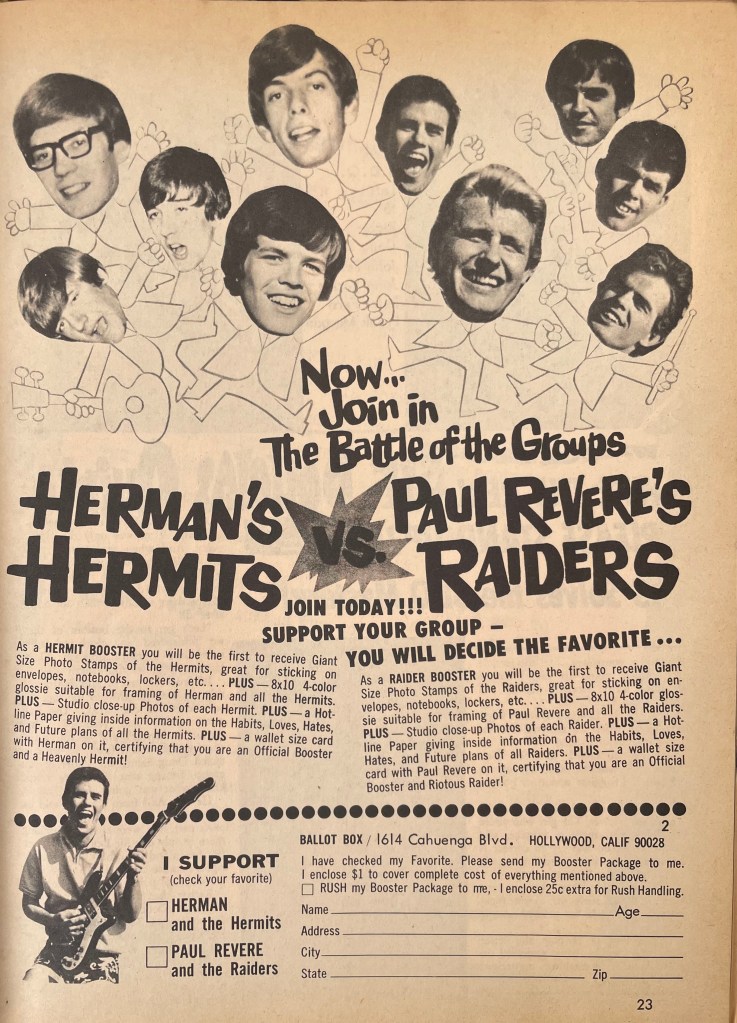
Of course, when we look back at this era it’s The Beatles, Beach Boys, Rolling Stones and a few other heavyweights whom we associate with screaming teens and general mania. Every time I come across these magazines, though, it’s Paul Revere and the Raiders – especially Mark Lindsay and Phil “Fang” Volk, whom I suppose were the handsome ones – and Herman’s Hermits who get just as much frothing attention from these fanzine precursors. And if you’re a fan of ‘66 garage rock or punk, and I know you are, you can even find some of it playing out on these pages, with a “Little Boy Blues fan club” and girls writing in about how the Syndicate of Sound are such a fab group. I was hoping for some hand-wringing about The Beach Boys’ Smile album not being out yet but mostly the staff is still celebrating what a massive chart-topper “Good Vibrations” was; despite many Beach Boys mentions throughout the mag, Brian Wilson isn’t even name-checked once. Not even a single mention in this one of The Monkees, whose show and hitmaking started in late 1966, leading me to believe that this one was being written in the Fall of ‘66 and actually on newsstands around Christmas ‘66.
For 95% of the American populace, male or female, magazines like Teen Screen, 16, Flip, Teen Life, Teen World and so on were their 1967 conduit to rock music. (It was different in the UK, with NME, Melody Maker and Record Mirror far less teen-oriented) No, the rock music of the era wasn’t especially well-served by this approach, which is why a more intellectualized approach, along with true fanzines, would start to materialize later that year. I still think they’re kind of a blast to look at so when we stumble upon copies in the low single-digits – and especially if there’s a Mark Lindsay pinup – Fanzine Hemorrhage takes the plunge.
-
Subscribe
Subscribed
Have a WordPress.com account? Log in now.

