-
Making Waves #1

I suppose it wouldn’t come as much of a surprise to most folks if one were to posit that females, i.e. women, were generally not accorded a representative amount of space nor respect in the music fanzine world as it existed up until our current century. It was a pretty dudely endeavor for too many years there, with some very visible exceptions both in the UK and North America from the punk era forward, eventually leading to an empowered flowering of women-helmed and -defined music fanzines starting in the 1990s.
Making Waves was a four-issue cross-Atlantic collaboration between two women – Camille Lan in Paris and Mary Jane Regalado in Los Angeles. Camille – who truly has outstanding taste in low-fidelity post-punk music – did the Gunilla Mixtapes mp3 mix blog. I also just unearthed this more-recent show she had a hand in. Mary Jane, who later moved to Washington DC, was in a totally loopy LA band called Neonates whom I totally dug at the time – check this digital-only album out.
Their first Making Waves came out in 2011, and it’s sort of a record-corrector and light-shiner on a plethora of women who led bands, labels and scenes in different eras, from 70s punk onward. I made it a point to buy each of ‘em (there were four in total) as they hit the digital stores, especially after this classy first one, which featured an interview with all three Kleenex/LiLiPut members whilst still alive. Better still, it was the first time I’d read an interview with Stef Petticoat (of The Petticoats!), a true UK DIY hero who was barely recognized as such in most quarters until the last ten years or so, or maybe when Times New Viking covered one of her frantic songs (“Allergy”) a few years earlier.
Alice Bag of The Bags talks about her upcoming book Violence Girl, and there’s a cool cover for it previewed in this mag that ended up not being the actual cover at all. Jeri Cain Rossi from Your Funeral gives the lowdown on the early 80s Denver scene and gets me all excited that she got to play with The Frantix and fuckin’ Bum Kon. “Debsy” from the Dolly Mixture gets a turn – and a whole lot more, not merely just 70s/80s stuff.
I also enjoy that they’re “perfect-bound”, which means that they’re like little novellas, with a spine and everything. The writers don’t fall into the keyboard warrior trap of spending an undue amount of time on jeremiads against the patriarchy – except when we deserve it, of course. The true emphasis is on quality sub-underground music and the women who made or make it. If any of this is as interesting to you as it is to me, you’ll be happy to know that three of the four issues of Making Waves can still be purchased here. Easily one of the best fanzines of the past twenty years.
(Note: I just came across this post, a week after writing this thing, that has PDFs of all four Making Waves issues).
-
Ripper #4

This is a pretty important one here at Fanzine Hemorrhage HQ: it’s the absolute very first fanzine I ever bought. Ripper was published in my then-hometown of San Jose, CA. I was just beginning the 10th grade in late 1982 and was just turning 15. Jon Grant and I would occasionally take a bus from our South San Jose neighborhood into the wilds of Campbell (where Tower Records was located) or, on this particular day, Los Gatos, to procure whatever alternative cultural totems we might be able to locate.
It was quite the slog in an auto-dependent city; the bus – “County Transit” was an afterthought for most folks and was therefore scheduled accordingly. I remember on the day that I bought my first fanzine that we had to wait a good hour or so just for our transfer bus, both getting to Los Gatos and on the way back. Once we’d arrived, though, we went to Do Re Mi Records, and this is where I procured Ripper #4, as well as an early issue of Maximum RocknRoll (#3, which you can see pictured here….I recall being a bit confused about why the guy on the cover hated sports; I loved the Giants and the Niners and wasn’t sure if I was supposed to now hate sports as well). I didn’t buy any records, but totally devoured my new magazines on the long bus slog home.
Now this particular Ripper had come out at least a year earlier, but I was just so taken with the fact that there was a local punk magazine that I had to buy it. There may have been a little “danger” involved. Both mags that I bought were immediately stashed away at the bottom of a broken drawer in my bedroom to keep them away from prying parental eyes. It wasn’t so much that I’d get in trouble or anything, I just wanted to steer clear from any uncomfortable questions about my rapidly devolving music taste, while certainly wanting to feel like I could now be somehow part of the larger punk scene that I could absolutely feel and see all around me, especially on trips to San Francisco and Berkeley.
Tim Tonooka was the editor and publisher, and by all accounts was a great American. I now have most of the other issues from his run, and it’s definitely one of the early 80s’ better punk fanzines for both breadth and especially for its original photos. He championed Black Flag quite heavily – who didn’t? – and also gave quite a boost to the San Jose and Peninsula punk bands, names you might or might not remember like Los Olividados, Social Unrest, Ribzy, The Faction, Executioner, The Drab and so on. I seem to recall that most of those bands got almost no truck with San Francisco/Berkeley punks, and that despite San Jose only being an hour’s drive from SF, it might as well have been a cowtown in the central valley for all the attention any local scene received outside of our own city limits.
Me, I was too young and mostly too chicken to go to those local shows anyway, so I missed some real corkers at VFW halls that would later be recounted in Ripper’s pages. This particular issue didn’t do a ton to turn me onto any new bands; the (California) Undead; Impatient Youth, No Alternative and the Red Rockers were all pretty weak tea, I’d come to find out, but there’s a good, brief X interview, some relaying of what sounded like a pretty tense local show by The Slits, and unfortunately quite a few pages on The Plasmatics, which even a teenage greenhorn like me could see was exceptionally lame.
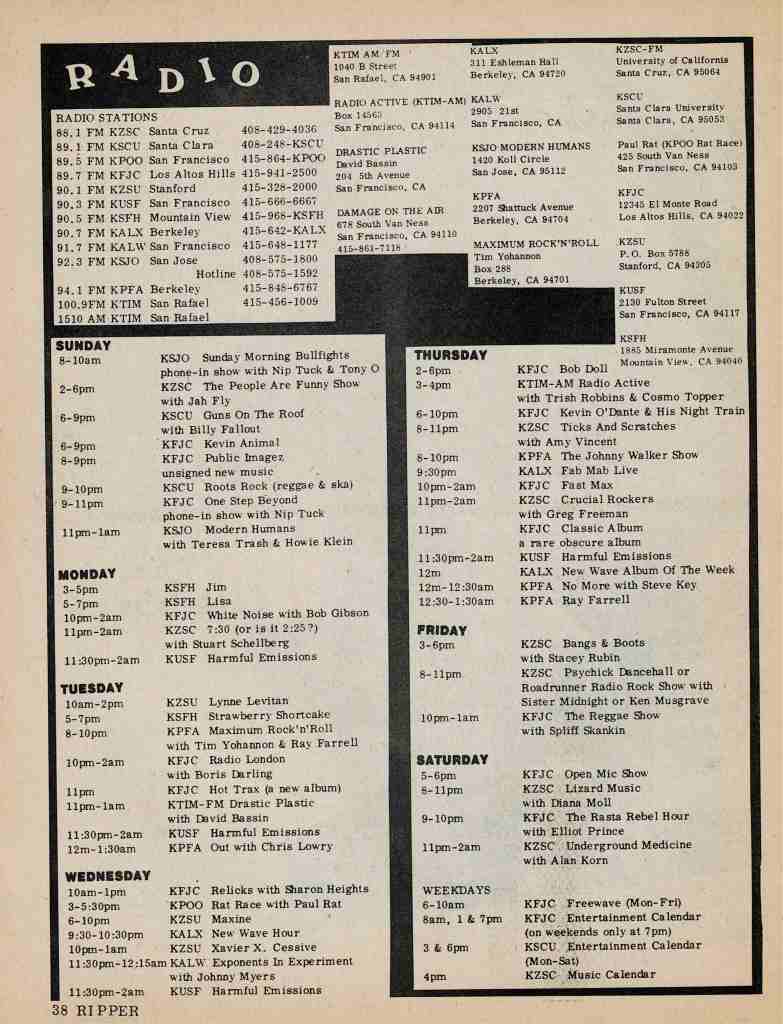
By far the most valuable service this issue provided me was this radio guide below, which I became obsessed with and thereupon used as my personal guide to the underground. The Sunday night “Guns on the Roof” show on Santa Clara’s KSCU; the Monday night “White Noise” show on KFJC and especially Tuesday nights with “Maximum Rocknroll” on the barely-received-in-San-Jose KPFA became absolute must-listens, and were hugely beneficial at expanding my world beyond the new wave & post-punk I was otherwise consuming. I never went full-bore hardcore then nor at any other time, but there was just so much incredibly wild and exciting music buzzing all around me, on the radio and in record stores and in the fanzines that I’d eventually start buying with every spare dollar. I was delirious for all of it. It could have been any mag, but this one just happens to be where the whole obsession began.
-
Grace and Dignity #1
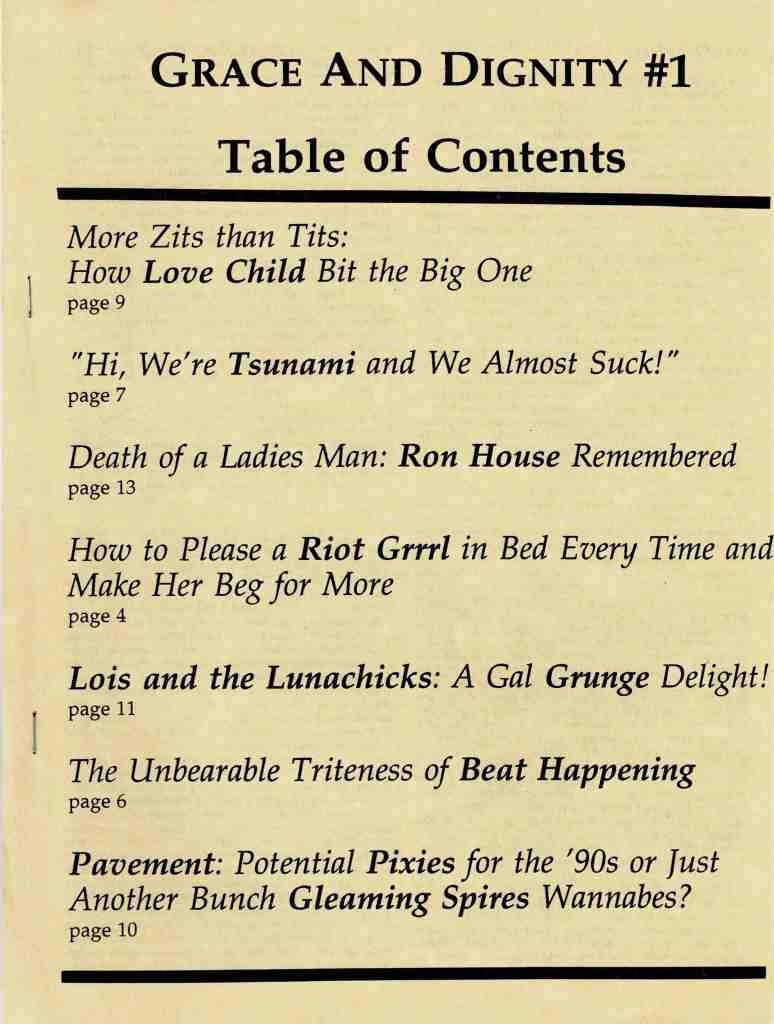
Last post we took a gander at a fanzine called Crush from a fella named Brian Berger. If you’ll recall, I had much to praise about it after lodging any reservations. After Crush ceased its 4-issue run, he published a short series of single-issue fanzines (I guess you’d call them) more or less in the vein of Crush, with names like Constant Wonder and Strange Affair and this one, late 1992’s Grace and Dignity #1.
Maybe I ought to read them all in order, since I haven’t looked at any of them in thirty years, but I can barely grasp what’s going on with this particular thing. Berger appears to be a little drunk on his own relative notoriety and looking to double down. He gets an Iowa City peer to write a paean to how good his writing is – seriously! – and then proceeds to reel off a ludicrous amount of non-sequiturs, in-jokes, literary references without context, and even a little goy-baiting just for fun. Is it a music fanzine? I suppose it is.
If I’m to understand what’s happening here, Berger is married with a child, and lives in Iowa City, IA. It’s difficult to grasp and not all that interesting to me whether that was true or not. He attended South By Southwest in Austin, and writes up a bunch of show reviews here, ranging from The Mekons to Claw Hammer to Surgery to Beat Happening. Then he writes up a bunch of record reviews, most of which have fake unfunny titles (i.e. Unrest’s Imperial f.f.f.r. becomes Imperial f.a.g.s.) and which savage the respective contents of each. Clearly this was a boy who’s mostly done with indie rock, or who was at least pretending to be. I’ll hold onto this just for completist’s sake, but this might have been the issue where enfant terrible crossed over into straight-up terrible.
-
Crush #3
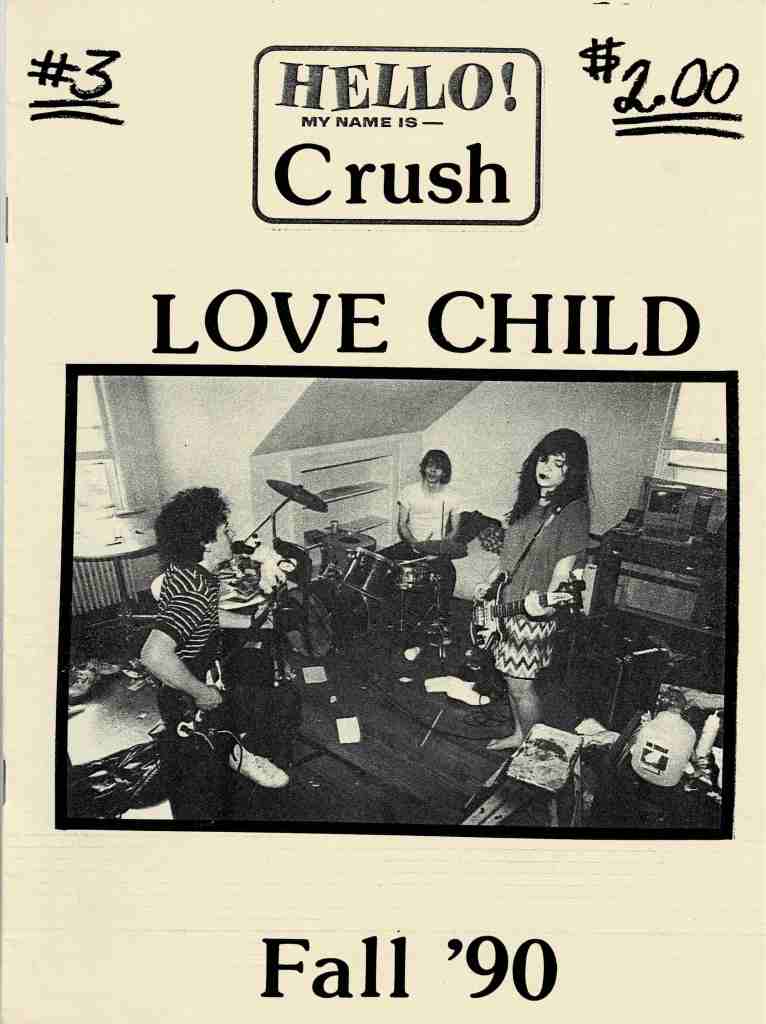
I’m certain there are some of you out there who might be able to tell us far more about this magazine’s editor Brian Berger than I can. Because of his relatively “confrontational” reviewing style and some intra-scene romantic dynamics involving him that supposedly went on in the early 1990s, I have a dim memory of Berger briefly being a person of interest among mostly East Coast fanzine-reading alterna-jerks. He published a range of single-issue zines under different names, but the one that seemed to be best-received by his undoubtedly exceptionally limited audience was Crush, the longest-lasting at three big issues, total.
I certainly can see why it was “popular”, and because I hadn’t really read this one through since I bought it in 1990, I was reminded of the Conflict fanzine imitators (Disaster, Crush) that followed in the wake of and concurrently with Gerard Cosloy’s fantastic fanzine, right down to the Courier font. Berger actually pretends to review an issue of Conflict here, saying,
“My biggest influence according to people who wish they knew what the fuck they were talking about. I’ve seen this magazine around but I don’t know what it’s about or who publishes it since I make it a rule not to read titles named after Crass-family bands.”
Even that sort of dismissive, pretend-not-to-know-what-you’re-talking-about thing was a trope straight out of Conflict itself. Well done, Brian! But wait – then he takes on Bill Callahan’s – yes, that Bill Callahan – Disaster fanzine right below that:
“Bill Callahan is one of those guys who has a “thing” for Lisa “Suckdog” Carver. In my mind that’s about as lame as being into John Wayne Gacy’s painting career, having all of last year’s Professional Bowling Association broadcasts in your video library, or wearing a Your Flesh t-shirt.”
Now that’s a bon mot I can appreciate, shoehorning both a Your Flesh and a Lisa Carver rip into a single sentence. Most of Crush #3 is record and live reviews by Berger, with an additional few of each by Alan Licht who, as it just so happens (!), also gets his band Love Child interviewed in here as well. Berger, it seems, was a Iowa college student from New Jersey back home for the summer at Mom & Dad’s while writing this thing, enmeshed in the NYC/NJ, CBGB/Maxwell’s live music social whirl. His reviews are mostly great, totally unafraid of the takedown & with pretty right-on music taste and an innate ability to separate wheat from chaff (the Big Chief reviews are especially tasty). He knows who the Hampton Grease Band are, he digs free jazz and especially loves David Allen Coe. It’s a true 1990 brain-dump from an over-the-top music obsessive who knows how to write, and write really well, at a pretty young age.
The biggest drawback is 21-year-old Brian’s wolfish and slathering questions for Rebecca Odes of Love Child, just straight-up talking about her breasts, suggesting on-stage nudity and so on right from the off. Like yeah – we get it – attractive woman in a rock band – but try a little subtlety, comrade! Hey, we’re all in our fifties now. I wonder if Berger still thinks that the “Ass Ponys” put out the single best record of 1990?
-
Zigzag #102 (June 1980)

One of the things I’ve always admired about some of the early Washington HarDCore crew was that it was The Cramps, not The Pistols nor The Stooges nor even the Velvets, whom they professed initially set them on their respective paths of mayhem & audio destruction. They were pretty much a, if not the, major touchstone band for me as well.
Even as an early-teenage new waver, hearing “Garbageman” and “Goo Goo Muck” and especially “Human Fly” on college radio directly drew me into The Cramps’ orbit, from which I’ve never looked back. I’d then see photos of them – I’m thinking especially of the particular one you can see at the bottom of this post, from a UK “1982 Rock Yearbook” that I owned back then (and picked up for nostalgia’s sake on eBay very recently) – and just salivate over how cool they must be, and how badly I needed to see them play live.
I saw Urgh! A Music War and this jaw-dropping Cramps performance right when it hit home video (or perhaps I saw it on USA Network’s Night Flight), and I practically wept with joy. Soon thereafter, my first purchased bootlegs were Cramps bootlegs, because I already had all the legit vinyl of theirs that I could afford. People would relay these incredible stories from their live shows, with anecdotes such as the one in which Lux supposedly took a gross sneaker that someone had thrown on stage, poured half his bottle of wine into it, then guzzled the wine directly from the shoe. All this tomfoolery with sexy gum-smacker Poison Ivy laying down ferocious yet simplistic fuzztone rockabilly riffs and Nick Knox beautifully taking rock drumming back to its jungle roots.
Alas, by the time I finally got to see them live, it was my freshman year of college; A Date With Elvis had just come out, and the band played the corporate “One Step Beyond” club in Santa Clara, CA. Hey, I had fun – it was The Cramps! – but it was instantly clear I’d missed the band’s high-water mark by a good five years already. Here’s a thing I wrote about The Cramps 18 years ago, still somehow online.
That brings us to that aforementioned high-water mark; the period around the 1979 Alex Chilton “Ohio Demos” (later the All Tore Up bootleg) and right afterward, when the (inferior but still great) Songs The Lord Taught Us came out. That’s approximately when the UK magazine Zigzag deigned to interview and put The Cramps on their cover, in June 1980. It even features a killer “center-spread” of Cramps photos that I’m sure I’d have ripped out and pinned to the wall if I’d owned this issue in the early 80s. The Brits loved The Cramps; I believe the entire weirdo “psychobilly” scene of the early 80s pretty much grew directly from their barnstorming across the UK.
I’m sure we’ll talk about Zigzag more next time I pull one of their issues from my collection, but suffice to say this issue (#102), all things considered, is a corker. It’s got Chris Desjardins (yeah, Chris D.!) introducing his Los Angeles compatriots X to the entire UK in a lengthy article. There’s a lucid and funny interview with The Fall, with much love and emotion for their Dragnet LP from the magazine’s staff. #102 also includes Mikey Dread, Jah Wobble and respect & raves for current dub and reggae. Somehow there’s even a straight-up sit-down interview with Pete Townsend.
One final aside: the more I immerse myself in punk fanzines of the ‘78-’80 period, the more hovering and omnipresent the ludicrous spectre of The Clash seems to be. People just loved to debate the merits and demerits of The Clash back then. In this Zigzag, the Rude Boy film has apparently just come out, and much consternation about it is made in various parts of the magazine, from the letters section to snide remarks about it being snuck into various articles and reviews. This love/hate Clash stuff crops up in US fanzines as well at the time, but it being spread all over a London-based mag such as Zigzag shows me the inner war UK critics of the time must have been at with themselves regarding a local band that promised them so much and delivered so little. They ought’ve spent all that energy & debate picking apart the glories of The Cramps instead!

-
Alright! #4
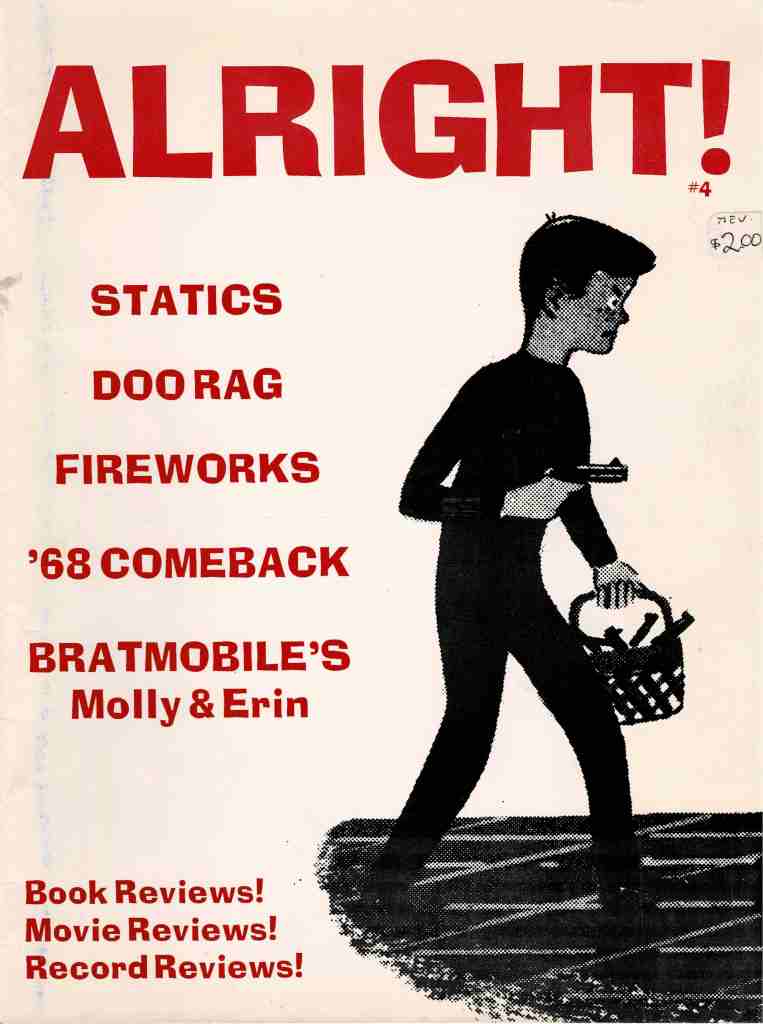
This 1994 LA-based fanzine was well-positioned at the center of beating heart of that “third great wave of punk rock” we were yammering on about in an earlier post. McKinley Richard, aka “Rich” as I somewhat knew him, and Sandra, aka “Super Sandra” for some reason, were a couple who also played together in the band Jackknife and ran the Star Fuck label, while also putting out this magazine. It’s as reverentially 1994 as it gets, complete with a rip-off of the Crypt Records font to pair with Jackknife’s bow–down-before-your-masters rip-off of much of Pussy Galore’s je nais se quoi. (And I totally dig that font, Jackknife and this magazine, so don’t let my gentle ribbin’ convince you otherwise).
‘94 was a great year to be young, drunk and going to garage punk shows, let me tell you. We had the Purple Onion here in San Francisco and a heaping helping of middling-to-great blitzoid garage punk bands in our city the previous few years, from Supercharger to Monoshock to The Brentwoods to the Dwarves to the Trashwomen to the Donnas. Rich and Sandra in LA had their own band and I reckon there was a smattering of other decent ones of their ilk in SoCal, yet the real action was spread across the USA, with the Cheater Slicks, Gories, Night Kings, Fireworks, ‘68 Comeback, Doo Rag, Bassholes and many others who were releasing top-notch 45s circa ‘91-’94, not all of it fast-n-loud but very much descended from the finest in stripped-down 50s, 60s and late 70s rocknroll. You can bathe in the scene and read about it in Eric Davidson’s excellent We Never Learn! book. And while we may sometimes pretend otherwise, everybody loved the Jon Spencer Blues Explosion, myself included. I think I’d get ear cancer if I tried to listen to them in 2023.
So Alright! #4 is living right at the nexus of all of this as it’s happening, with an onslaught of crazed records coming out plus an insane amount of live shows to wig out and lose one’s hearing at. The magazine is snotty, super-dismissive of alterna-rock (Jesus Lizard gets a nice raking over the coals, as does the city of Seattle) and is very much of its scene and of its time. I wasn’t particularly into Bratmobile while they were around (except for how incredibly magnanimous and forgiving they were when me and a few friends berated them w/ shouted Black Flag cover requests when they played SF’s Chameleon…and no, not “Slip It In”, I promise) but I’ll give Rich & Sandra credit for championing the feral rawness of some of the “riot grrrl” bands, many of whom, like Bratmobile, have aged better with time. They capture the whole sick scene quite well, and you can capture a mighty and informative whiff of 1994’s garage punk ambiance by taking a journey through this one.
-
NY Rocker, September 1982
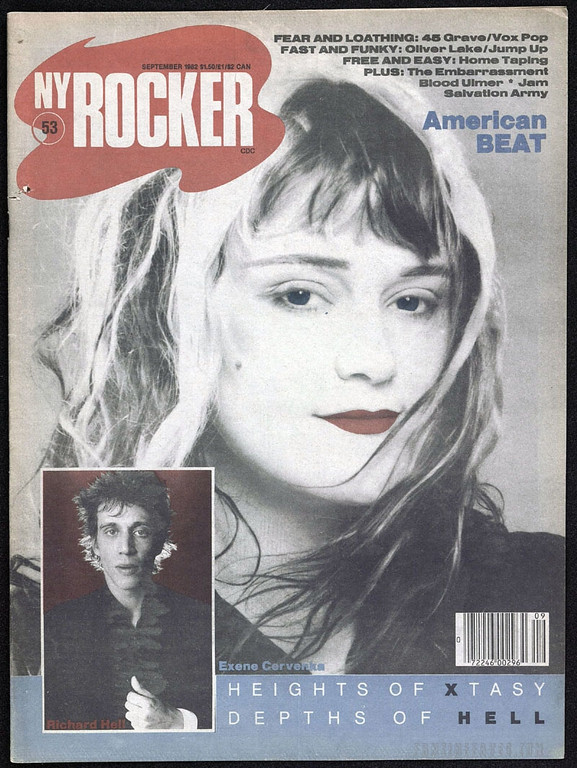
I don’t know if it’s “fair” to classify the monthly big-city punk/underground tabloids of the late 70s/early 80s – Slash, Damage, Boston Rock, Take It!, NY Rocker – as fanzines per se, but they certainly served the same purpose, often employed the same tastemakers, and were about as on-the-ground and in-the-clubs as any drooling fanzine impresario such as myself would be ten years later.
I’ve been slowly assembling a small collection of NY Rocker issues over the years. I never bought any when they were around, but I remember seeing them on sale at Rasputin’s Records in Berkeley when I was 14, probably right around the time this September 1982 issue came out. They’re more wide-ranging in both taste and remit than Slash was, and by the time the issues get to 1981 and 1982, there’s a great deal of positive coverage of “the new wave”, i.e. synthesizer-driven bands from England, coexisting quite uncomfortably right next to articles on strange American underground bands by Byron Coley and plenty of US hardcore 45 reviews. By this issue, it’s quite clear that if an act in question had “funny hair”, they were fit to be covered in the New York Rocker.
But oh, the on-the-spot treasures to be found here! There are photos of personal favorites of mine like Red Cross, Salvation Army and The Flesh Eaters that I’d never seen before. Byron Coley’s piece on Vox Pop and 45 Grave is tremendous (and hilarious) and goes a long way to explaining the mysteries of the former while helping re-illuminate the positives of the latter. Oliver Lake, who is the early 70s helped lead wild free jazz quintet The Black Artists Group, is by 1982 doing some sort of funky dance music called Jump Up, and he’s interviewed in this issue about it & his career to date. There are X and Richard Hell interviews; the former has just jumped to a major label and are touchy about it, and the latter has just released Destiny Street, and there’s much obfuscating and hemming & hawing about his drug usage and its effect on his ability to keep a band together.
I reckon my two favorite things in here are two particular live reviews. One’s a Salvation Army/The Last/Bangs review by Coley. No one’s coined the term “paisley underground” yet, thankfully, but I’m especially pleased to see Coley so incredibly smitten by The Bangs – soon to be the Bangles. I wish I’d seen them around this time; I totally love their first single and EP and their all-encompassing adoration of The Byrds, Monkees and Mamas/Papas.
The review that really takes the proverbial cake, however, is Don Howland’s relaying of the 1982 Loretta Lynn/Ernest Tubb concert at Veterans Memorial Auditorium in Columbus, OH. For those of you who know Howland from the work he’d later go on to do as a musician (Gibson Bros, Bassholes), he was also one of the finest and most subversively funny music writers ever to put pen to paper. Maybe he still is! To wit, some snippets from the show review:
“…Now Loretta attracts fans of all ages, from 3 to 103, and 10pm is bedtime for a good percentage of them, so glazed eyeballs were the order of the evening. And it looked like bedtime was a long time ago for show-opener Ernest Tubb. …He looked like a cross between a man who died a year ago and a man who died ten years ago.”
“…It was Ernest who introduced Loretta to the Opry stage a couple decades ago when she was still a timid little housewife. Woooo! ‘Little’ is still the word! What a shrimp! Those were my thoughts as the Coal Miner’s Daughter idled on stage after a brief intermission, belting out “If You’re Looking at Me, You’re Looking at Country”. I had imagined this idol of mine to stand about six-foot-six…..the whole sensation was a lot like the first time I saw Iggy up close – really.”
“…But the (song) I remember best was an homage to her Indian heritage (1/16th or 1/4th or something)” ‘Red, white and blue / Wa-oo, wa-oo, wa-oo / And proud of it too,’ set over some thumping tom riffage.”
Yeah. Get familiar with Don Howland as a writer if you’re able. I’ll take you through some other NY Rockers in this space at some point in the not-too-distant future.
-
Brain Transplant #1
It’s hard to overstate just how intense and head-spinning the “KBD era” of punk rock record collecting was. I’d date the beginning of KBD to 1989, when the first four Killed By Death LP compilations of ultra-scarce 70s/80s punk 45s hit the streets, though purists might argue it was the year before that, when Year of the Rats!! came out, or how about ‘87’s release of Where Birdmen Flew, or maybe ‘86, when Me Want Breakfast! changed lives such as mine?
I bought ‘em all, and it was beautiful. Raging, classic punk rock singles from around the world, often originally pressed in editions of 100, offered up with 15 other screamers on quasi-bootlegs, in a time in which there was no internet and – in my case – limited income with which to procure the originals, except for the rare unexpected “bin find” at record stores during a time when most store owners didn’t have a clue as to what these were worth (or would be worth), nor any idea where to buy one. Did I ever tell you about the time in 1987 I found two original Urinals 45s packed into the same poly sleeve, selling for 75 cents each?
Before long there would be a biblical flood of KBD products being unleashed by various bootleggers, sometimes under the shared “Killed By Death” moniker, but increasingly under other communally-shared labels. Most prominent was the Bloodstains series, usually easy to find in quality record stores and which took a region-by-region or country-by-country approach to punk 45s. (Fanzine Hemorrhage especially recommends the blistering Bloodstains Across California and all of the Bloodstains Across Sweden editions, in case you were wondering). There were the Back To Front compilations. The Murder Punks. Even Cumstains Over My Record Collection. Maximum Rocknroll had to put out an entire bibliographic fanzine devoted solely to these comps called CompHELLation to keep track of them all. By the mid-1990s, barrel-scraping had definitely commenced, so anything coming out after that time would usually have 1 or 2 ringers with the rest usually being dreck.
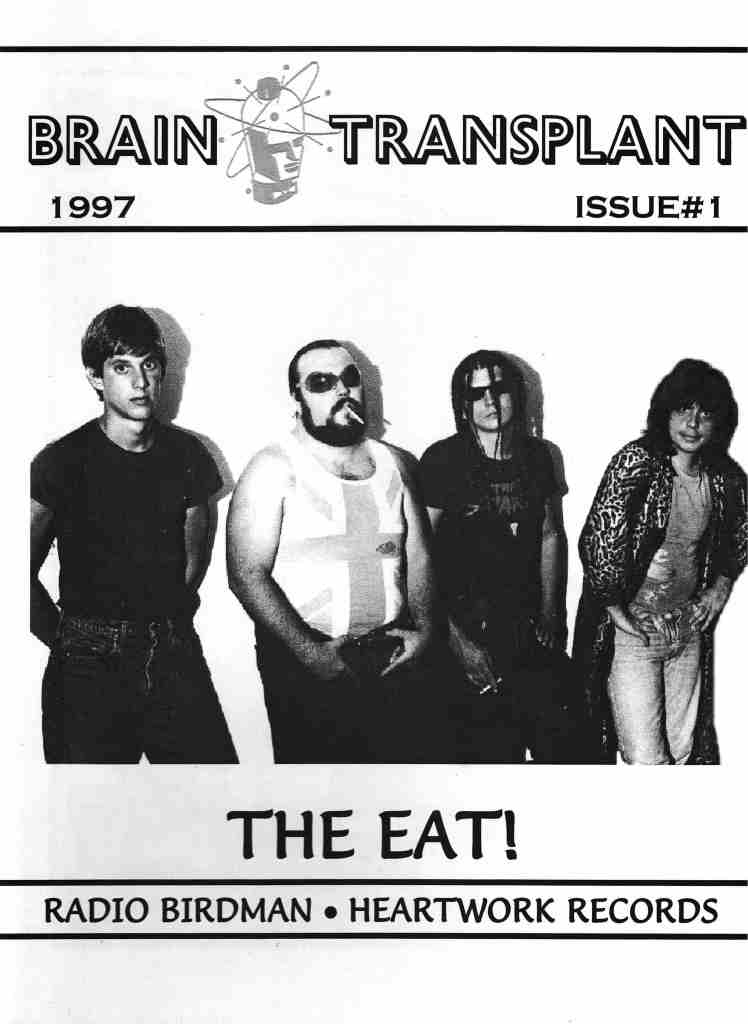
It was into this maelstrom that Roger Mah and his Brain Transplant fanzine stepped in 1997. Far as I can gather, Roger was a UCLA student at this time and was clearly a KBD disciple and expert, and he nailed the most comprehensive interview with The Eat I’ve ever seen and likely ever will see. (The Eat’s “Communist Radio” was one of the key mind-blowers on Killed By Death, Volume 1). The interview goes deep on the band’s “Giggling Hitler” record label and on the South Florida punk scene of the late 70s. Brain Transplant #1 also reprints a Johan Kugelberg piece on Sweden’s Heartwork Records that was originally in Siltbreeze fanzine, and interviews Radio Birdman’s Deniz Tek. His reviews are terrific as well, covering all of the crazed cornucopia of KBD bootleg punk comp releases, along with reviews of the final gasps what I like to call “the great third wave of punk rock”, the 1990s garage punk explosion that itself took a ton of inspiration from the KBD records.
Roger promises in the back of this one that his issue #2 will have “Unpublished Masque photos/anecdotes from Jenny Lens + more dumb punk rock records”. I know from experience that working with Ms. Lens can be taxing, if ultimately fruitful; as it turns out, Roger wouldn’t put out a second issue of the magazine until the late 2010s, and it didn’t have those Jenny Lens photos (but it was outstanding nonetheless, and I’m sure I’ll write it up here eventually). He spent the intervening years running a reissue label called, you got it, Brain Transplant.
I recently asked him if he’s going to put out another issue, and he said (and I quote): “No”.
-
Scram #5
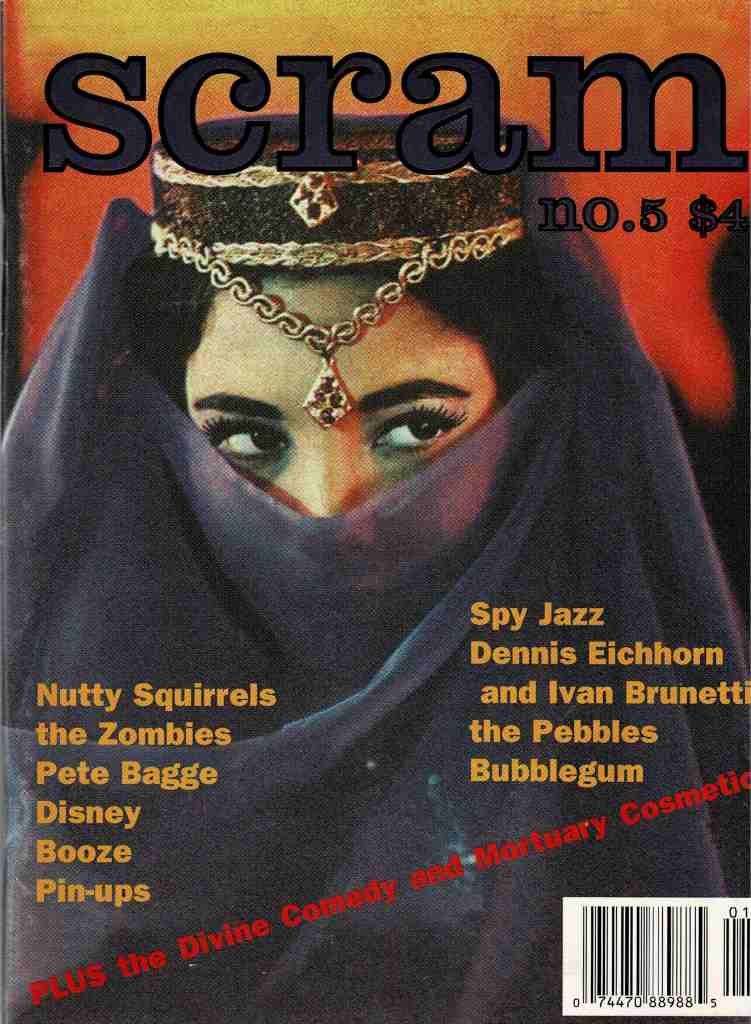
The early/mid 1990s produced such a bounty of well-crafted, self-published fanzines that were intimately devoted to self-defined subcultures that many of us didn’t fully recognize all that we had in front of us until it was totally gone. That’s sort of what happened to me with Kim Cooper’s Scram magazine. I was present at the creation of her publication in 1992, as Kim and her partner and my personal friend Steve Watson lived just down the hill from me on lower Haight Street in San Francisco, and the three of us conversed and carried on frequently. Steve and I formed a band called Helevator a couple of years before that with a great American named Chas Glynn, who’d go on to be one of Scram’s key contributors. (If you want to read the highly subjective story of “Helevator, San Francisco Rock Band”, you can do so here).
Kim proved to be quite a creative force of nature after that first, garage rock-focused issue of Scram, and she’s a truly inspirational doer to this day. I’ll get to what she’s up to later. She wrote the Deniz Tek/Radio Birdman interview piece in the second issue of my own fanzine, Superdope, while Steve did the piece on Sonic’s Rendezvous Band in the first issue. The two of them had some extremely goofy sensibilities that spanned the breadth of underground comics, pranks, 60s pop and bubblegum, beat & noir fiction and garage-influenced punk rock. I remember being super-impressed that Kim, as a teenager, had had a letter published in Forced Exposure taking them to task for their dopey and puerile Lydia Lunch/Nick Cave one-act plays. This was someone at least partially on my wavelength and who was very much marching to her own drummer.
A few issues in, she’d really nailed the aesthetic for Scram that she carried forward to its final issue in 2006. I’d define it more or less as I did above; a playful, jokey gaggle of articles and musings about oddball humans, 1960s pop music, modern garage rock, comics, writers and whatever else was driving Kim and her contributors’ fancy. It was a magazine whose patron saints appeared to be Lee Hazlewood, P.F. Sloan and Tiny Tim, among others. Like this one, #5, which has a soup-to-nuts appreciation of the late 50s/early 60s notion of “spy jazz” by David Smay, and an overview of the 60s “rodent rock” craze (think Alvin & the Chipmunks). With Scram, you’d get some really well-done dives into discographies, stories and stuff regarding music that, at the time, I wasn’t personally interested in and/or not ready for. This is why I foolishly passed on so many of Scram’s best issues once Kim had left San Francisco and moved to her hometown of Los Angeles. I had to order the ones I’d missed from her all in one big heaping batch sometime in the past decade, including this one.
Now when I read them, I’m thankful for the obsessives and freaks she assembled to tackle some of the stranger corners of the musical and musical-adjacent universes. Scram isn’t where you necessarily would go to earmark the next batch of LPs for your collection, it was a place to guffaw and chortle about some of the excesses, failures and sometimes high-water marks of middlebrow and low culture. So it’s really the articles that are worth digging into, not the reviews, nor the Bad Religion and Jawbreaker ads that paid the bills. Most of Scram’s record reviews often magnanimously took an “it’s all good” or a surface-skimming, let’s-get-this-over-with approach to the many promos they received, virtually all of which were reviewed. To this day I’m looking for a review to discerningly guide me to the next thing I ought to be listening to or to convincingly steer me away from something I ought not to, rather than a merely facile two-sentence description of its contents. In this issue, Kim herself’s reviews are actually more negative than not, yet the glut of promotional material she’s forced herself to consider is so entirely forgettable and now forgotten that little wonder, right? This “review everything we get” approach wasn’t unique to Scram at all; any back issue of Flipside or MRR will tell you as much. I’m sure it had its adherents.
Kim eventually put together the bible of bubblegum music, Bubblegum Music is the Naked Truth, the roots of which began in this very issue. In 2004 she put out Lost in the Grooves: Scram’s Capricious Guide to the Music You Missed, which she asked me to contribute to; I wrote short pieces on the Gibson Bros and the Flesh Eaters, and even got to present a pithy little thing I wrote at the book release party in Berkeley. I’ve not seen her in person since!
But man, what an amazing career she carved for herself after Scram. Not only did she write a really great piece of noir fiction called The Kept Girl, she founded Los Angeles’ Esotouric sightseeing agency with her husband Richard Schave. Esotouric, among other things, takes busloads of folks around LA on themed tours devoted to (for instance) Patty Hearst and the SLA; The Real Black Dahlia; literary LA and so on. There’s a great 11-minute documentary about what they do here, and they’ve been front and center in helping to preserve LA’s disappearing heritage of wacko signs, buildings and monuments. They do the work, in other words.
She’s my favorite example of someone who embraced her well-out-of-the-mainstream passions early in life, then built a career on top of it, rather than succumbing to the grind like the rest of us. Scram #5 is one of many fine glimpses into her developing aesthetic, and can still be ordered here.
-
What Goes On #1
Despite present appearances, the Velvet Underground weren’t always thought of as a ubiquitous progenitor and cited influence upon untold thousands of fantastic bands. The extant literature of their time supports the fact that they certainly made an impact in pushing boundaries and blowing minds, if not in selling records, yet I don’t believe it was possible to actually see their eventual and well-deserved towering stature from a lens pointed in the year 1977 toward the future.
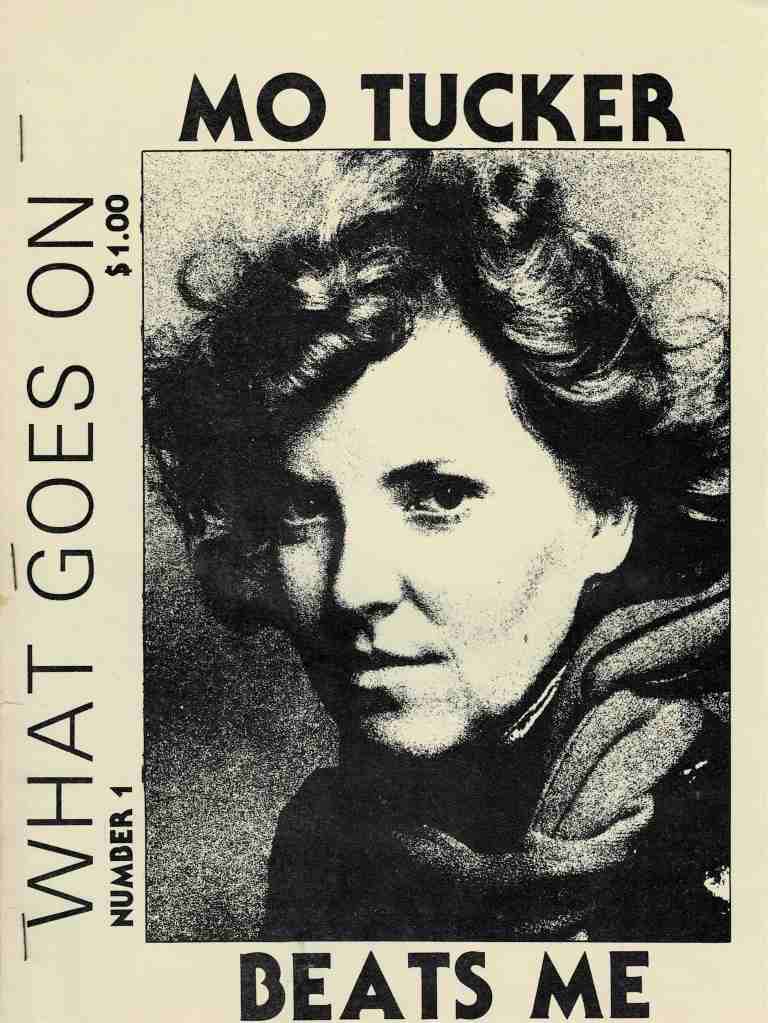
In 1977, it was a hardy, newly-converted VU fan named Phil Milstein who had the wherewithal to channel his obsessions into creating the Velvet Underground Appreciation Society, which was effectively defined by a five-issue Velvets fanzine called What Goes On that he very infrequently published with others into the 1990s. This is the very first one, a 12-page xeroxed gem from 1978.
I was fortunate to have interviewed Mr. Milstein about the Velvet Underground Appreciation Society and his magazine in my own Dynamite Hemorrhage fanzine #3, published in 2015. You can download a PDF of it here. I’ve cherry-picked our exchanges about What Goes On and am reprinting them for your reading pleasure presently:
Was there a simple “fan club” motive for the founding of the Velvet Underground Appreciation Society in 1977, or was it truly an attempt to foster a more widespread appreciation for a band that hadn’t received anything close to its proper due?
Phil Milstein: As I was absorbing the VU’s music I began hungering to learn their story, yet I could find little information on them beyond a few table scraps. At this time there was a cauldron of fan club activity heating up, with dedicated fans conducting genuine research starting to crowd out the officially-sanctioned clubs, which were little more than promo machines. I waited eagerly for someone to get something going on the VU, but, for whatever reason, nobody did. (For the record, there was indeed some nascent fan activity taking place, primarily in England, but it was very localized and I didn’t learn of it until later.) When I noticed a new zine starting for Suzi Quatro, I was appalled that a mediocrity like her would get a fanzine before a truly worthy group like the VU. With that, I was moved to act.
I was ill-equipped to publish a magazine on a group I knew so little about, but I figured that if I did a good job information would start rolling in, and that I’d learn about them concurrently with the readers. The first issue was consequently low on serious content, but the mere fact of its existence was enough to start drawing VU fans out of the woodwork. Sure enough, it wasn’t long before I began developing information — and, eventually, inside sources — just as I’d anticipated.
What was involved in the launch of the VUAS? Who were the main initial players, how did you get the word out, and were What Goes On and the Temporary Thing newsletters your primary communiques?
Phil Milstein: Recognizing that I knew so little myself about the VU, my first effort toward getting something useful going was to reach out to prominent figures in the music world who had, in some way or other, acknowledged themselves as VU fans. I recall writing, for instance, to Lester Bangs, Lenny Kaye, a musician and writer from Boston who called himself the Count, and Miriam Linna, who was then still in The Cramps. Between them they contributed articles, ideas and general support, and were instrumental in my ability to move the project forward.
The fanzine world was so active around this time that several larger publications, most notably Bomp and Goldmine, ran columns that discussed and reviewed them. Mailing addresses were invariably provided, along with the ubiquitous reminder to “include SASE”. This attention, of course, fostered further activity in its turn, and for a while it seemed that everybody and his sister had some sort of zine going. It was strong validation when Greg Shaw gave WGO an A grade in Bomp, and it led, as you’d imagine, to the arrival of a lot of SASEs.
What was the distinction between the Velvet Underground Appreciation Society and What Goes On?
Phil Milstein: What Goes On was the magazine published by the VUAS, while the VUAS was more a concept than an actual organization. There were no dues, nor even a membership list per se, and I thought of it as simply an umbrella under which I’d conduct my VU-related work. Most of its activities, in fact, were in support of projects by other people, for instance the Moe Tucker/Jonathan Richman 45 the Count put out, the And So On bootleg out of Australia,WHRB’s all-Velvets radio marathon (which provided the first-ever exposure of Robin Hough’s Boston Tea Party recordings), etc.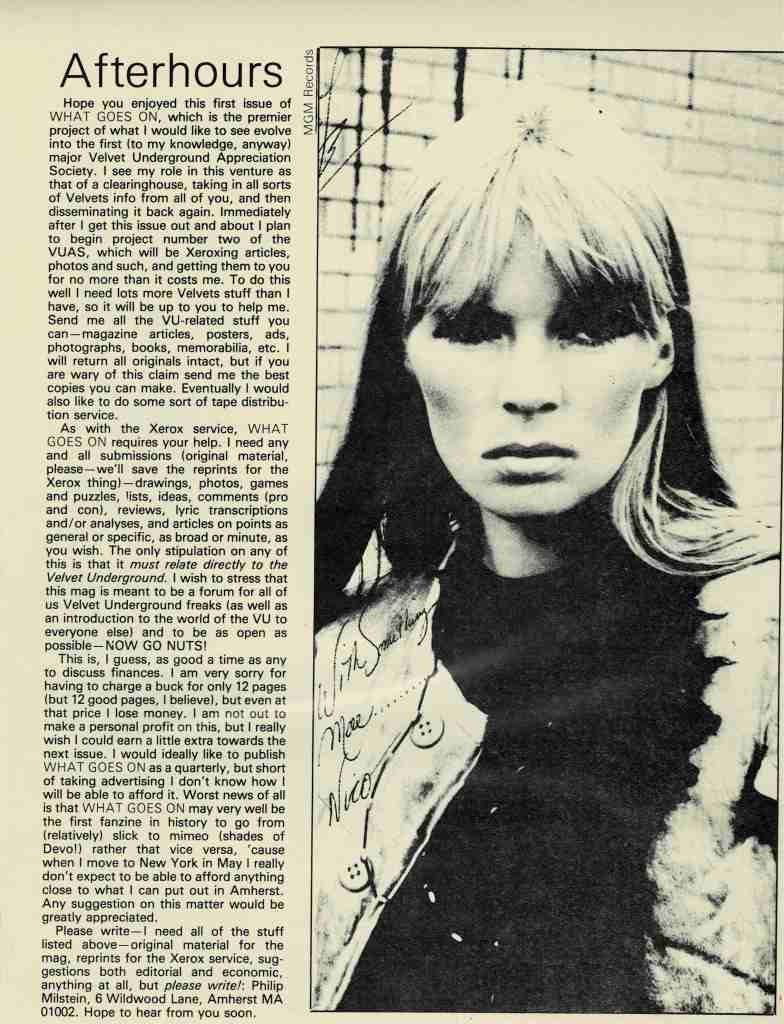
-
Subscribe
Subscribed
Have a WordPress.com account? Log in now.

