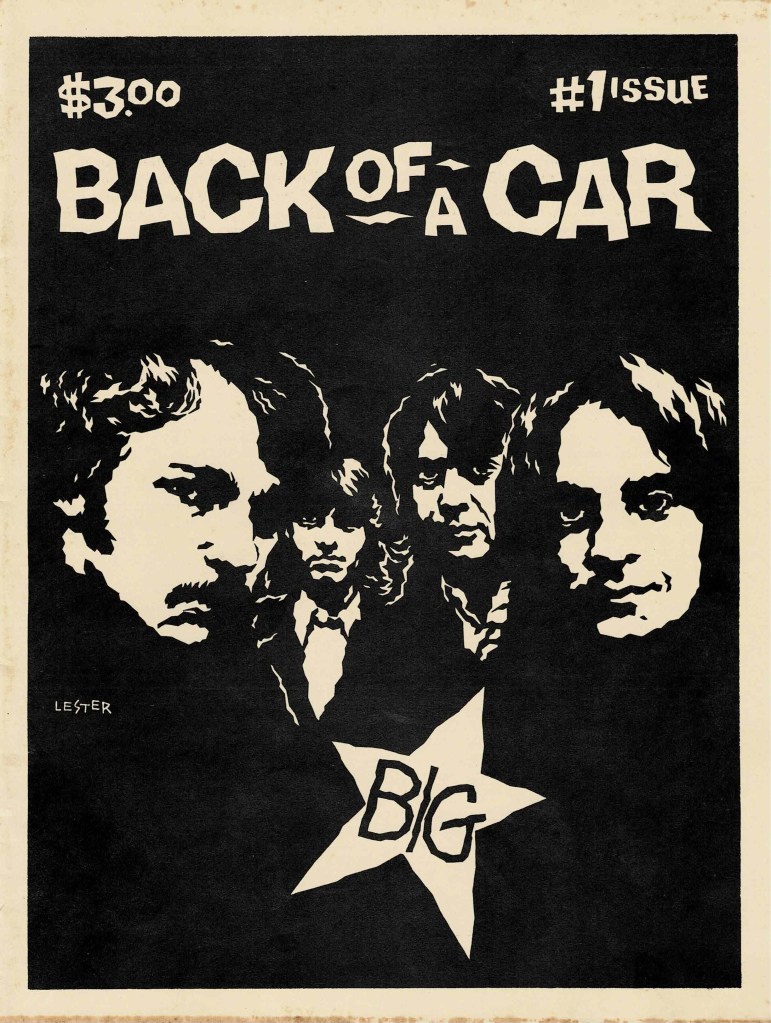
Back Of A Car #1

I came in pretty late on Big Star. Naturally I never heard them in the 1970s, but I also didn’t hear them in the 80s, either, when I would have or should have been primed to do so. My guess is, given my obsessions during my college years (Lazy Cowgirls, Pussy Galore, Scratch Acid, Laughing Hyenas and what have you), they wouldn’t have taken anyway. It wasn’t until a six-week van trip across North America in 1993 when one of my traveling companions repeatedly blasted a homemade tape of Radio City did I even hear the band, and by then I was ready. All-in. I anointed it one of the ten greatest albums of all time, which is something I’ll still stand behind without question. I’ve written about this before, but when I told a good friend about my new favorite band Big Star, he let the air out of my tires with a withering “dude, that’s so high school”. Not my fucking high school.

Anyway, I get the mythos around the band, fully. The aborted/botched/unheard third album; the record company disasters that kept the first two albums from being revered until much later; the louche Memphis party scene captured in Stranded in Canton; Alex Chilton’s difficult personality – all that. Love it. Makes a ton of sense why a fanzine like Back of Car #1 might come out in 1994, right as the band had started doing those “reunion” shows with two original members and two fellas from The Posies. The interest was there; the stories were mostly untold; and like the Velvet Underground, Big Star were a band who readily inspired something well beyond simple devotion. 

Judith Beeman of Vancouver BC was the woman behind this, and she ended up doing four of them. This is the only one I have. She talks up the nascent “internet” and electronic mail in her introduction, already finding that it has been a highly effective means of sourcing contributors and connecting with them at shows and otherwise. She provides a layperson’s intro to Big Star up front, setting the stage that this thing would be far less of a fan club type of fanzine than one merely centered around Big Star, with outflowing concentric circles into Chiltoniana, similar-sounding bands (DBs, Chris Stamey, Posies), and into Judith’s own comics obsession, which had nothing to do with Big Star in the slightest.

This is further reinforced with the very first piece in the mag, Wilson Smith’s review of the 6/5/94 Big Star quote-unquote reunion show at the Fillmore in San Francisco. I didn’t go – I had an uppity personal policy against attending any reunion shows, one that I kept in place until Mission of Burma came to the same venue eight years later. Anyway, Smith – in what I thought was a fan club magazine when I bought it – didn’t really like it all that much, and says so (!). Bravo. Apparently some secret Springsteen cover band with “Adam Durwitz” of “Counting Crows” opened, which absolutely helps to validate my decision, even though it meant I never saw Alex Chilton in the flesh while he walked amongst us. 

After that, it’s a grab bag of the aforementioned. Ken Stringfellow of The Posies and the reanimated Big Star shares his tour diary from this reunion thing. Lyrics from songs are reprinted; old reviews are dusted off and reprinted; there’s even an article on This Mortal Coil, who did “Holocaust” and “Kanga Roo” on their album that I had as a store-bought cassette in high school, It’ll End in Tears. That would have to have been the first time I ever heard any Alex Chilton compositions, just not performed by him. Judith Beeman breaks apart the Alex Chilton tribute album, which came along at a time when tribute albums were actively poisoning used bins in stores across the globe. And then, after that, it’s not really a Big Star fanzine any longer – it’s those concentric circles and a bunch of comics. 

Oh, and I learned something, too. All these years I thought “Motel Blues” was a Chilton song. Turns out it was by Loudon Wainwright III, and it took Back of a Car #1 for me to finally discover this important fact.

Good read! You can check out all four of the issues Beeman and her team of pop-loving psychotics put together right here.

What A Nice Way To Turn Seventeen #1

Something kinda funny I’ve noticed over many years of fanzine gazing is just how poorly the covers of some of the British ones have held up over the years. I’m talking only about the ink, and how badly it fades on some mags. Am I wrong, or is this a UK and European-only problem? I had and perhaps still have this theory that it had something to do with the printing presses/machines being used in the UK in the late 70s and early 80s. Was there an ink of some kind that caused covers like the one on What A Nice Way To Turn Seventeen #1 to fade as it has here? 

I asked Chris Seventeen, the gentleman responsible for this in 1983, and whose fanzine we’ve talked about here and here before. He said via email, “I must be honest and say I don’t have an answer. I’ll admit everything was done on a budget and there were printers that “specialised” in low cost printing. I certainly wasn’t considering at the time how long it might last – never thought it would be “something” 40 years from then if I’m honest. The only thought I can throw up is I did go for a coloured font – maybe black and white would have stood the test of time a little better?”

Well there goes that theory – that Thatcher-era Britain was using some obscure copier that was set to self-destruct covers of anti-establishment, underground fanzines somewhere down the road. If anyone knows what’s what, please let me know. I used modern computer technology to make this one look a little more clear than my copy actually does in real life. 

Anyway, here’s the first issue of What A Nice Way To Turn Seventeen, published in Warwickshire. Chris had previously published a fanzine called Stringent Measures, but decided that he wanted one that was a bit more “fun”, and I suppose that it is. I’m not going to make any more “scarf rock” jokes like I did last time, but let me just state for the record that scarf rocker Dave Kusworth’s band The Rag Dolls get a big write-up, as does scarf rocker supreme Johnny Thunders. Then again, so does Alex Chilton and I never saw that guy wear any sort of neckerchief. I’m always excited to read people grappling with Chilton back when there was still something of an aura of mystery around the guy, and this piece in particular picks apart Big Star’s 3rd aka Sister Lovers and tries to ensure that readers know just how special it is. Me, I certainly do like that record, but Radio City is a top ten all-timer for me, and I’d rather talk about that, if you ever wanna talk about it. Let me know.

Chris is supremely bummed that The Undertones have just broken up, ostensibly because they gave themselves a four-year-plan or something like that to have hits, and it just didn’t happen. I get it. I too enjoy the Undertones greatly, and it’s not even “Teenage Kicks” that’s my favorite. It’s “Wednesday Week”. A perfect pop song. I’ve probably listened to it 2,000 or more times in my life. I had this album with the exceptionally classy cover in high school, and it was that song that I needle-dropped over and over again. 

What A Nice Way To Turn Seventeen #1 also has features on Tempest and Nation III; big interviews with The Waterboys and The Jazz Butcher; and a short interview with a new band called The Pastels (!). For good measure, there’s a discography and a couple of pages of praise for The Ramones. I’ll often sum these things up with my own sort of lazy shorthand claiming that it’s a true fanzine, like yeah, this guy was really a true FAN and that comes out in the ZINE etc. etc. So it is. That’s what makes them so fun to read, right? It’s the homespun ones that reek of bedrooms and late nights and phonographs running in the background that I enjoy the most, all the more if the writing chops are up to snuff, as Chris’s were. After this one, he started including records along with some issues of What A Nice Way To Turn Seventeen, and that tradition carried on to the final issue. Some can even still be found here.

Creep #4

Earlier this year I bought a near-complete run of San Francisco’s top-drawer late 70s/early 80s punk fanzine Creep from the ZNZ store – who still have three of the five issues for sale as of this writing. I excitedly wrote up Creep #2 in these pages here, so I’ll spare you another introduction to the mag and let you go read that first if you’re interested, allowing us to get right to the heart of 1980 west coast punk rock USA in the here and now.

Creep #4 lives at an interesting intersection of several strands of California punk “journalism”, such as it was. There are half-hearted attempts at intellectually unpacking various scene controversies and kerfuffles of the time, such as a piece on Noh Mercy’s acerbic and still spine-rattling “Caucasian Guilt”, or a total mess of a P.I.L. show that almost didn’t happen – something akin to a piece you’d find in Damage around this time. There’s truly stupid punk-sneer writing by birdbrains such as one might find in Flipside. And given this magazine’s tenuous connection with Maximum Rocknroll, which wouldn’t publish its first issue for another two years, you can see a little bit of a political slant sashaying its way into these pages – but not too much to make Creep #4 intolerable.

I actually have to give much credit for the breadth of the interviews here. There’s one with Alex Chilton by Ray Farrell, not at all something I’d expect here – and Alex is great, totally calm and cool as Farrell takes him to task for Like Flies on Sherbert (shame on you, Ray!). There’s a brief one with Steve Tupper of Subterranean Records, which was just getting off the ground. He tells it like it is: “415 (an S.F. label) appears to be primarily interested in very commercial or very well known bands. That means exclusion of everybody else. We’re much more interested in experimental kinds of things – the kind of music being made by hordes of kids just picking up guitars and synthesizers and making music. Everything we do has this hard, grey feel to it. That’s the way the world is. Let’s face it – a lot of this stuff just isn’t hit material.”. Subterranean were the label who first released Flipper, and they were covered at length in the excellent book Who Cares Anyway? – Post-Punk San Francisco and the End of the Analog Age.

On the other hand, the interview with The Vktms doesn’t do them any favors – with all due respect to Nyna, she definitely comes across as a major league dum-dum in this interview. And I’ve done some bellyaching about Gregg Turner, Mike Saunders and the Angry Samoans before but never have I seen their misanthropy and queer-baiting at such a jacked-up level as it is in their interview here, in which they go off on all the high crimes & misdemeanors of the LA punk scene, a scene that was known to blackball the Samoans for just such behavior. I mean, these weren’t 15-year-olds from Canoga Park writing into Flipside, these were guys in their early thirties play-acting as punks and – in Saunders’ case – saying Iggy, Iggy, Iggy whenever handed the opportunity. Of course, I laughed at “Get Off The Air” and I still love large chunks of Back From Samoa and I always will, but Saunders and Turner are (or were, in 1980) detestable human beings. Watch their brief interview in this 1980 LA punk “expose” called What’s Up America and you’ll see what I mean. And Gregg Turner’s recent book was an abomination that I couldn’t get even a third of the way through. Do I make myself clear?

This was the year of collective disillusionment with The Clash, and the piece by “Austin Tatious” (great punk name I’d somehow never heard before, but still not as classy as my friend Christina’s DJ moniker Geannie Lotrimin) expresses great disappointment in their San Francisco show. The whole Lee Dorsey (“Working in a Coal Mine”) “bored cocktail lounge a la Holiday Inn backup band” opening act bit was pretty funny; I suppose this was the time that they were bringing incongruous opening acts on the road with them, which, hey, hats off for trying I guess. The Specials are also on the road in America – “Horace’s impression of U.S. AM radio: ‘Great if you like ‘Hold The Line” or ‘Life in the Fast Lane’’. He swears he heard each at least 80 times across the country with only sporadic listening.” Oh yes, 1980 commercial radio in the United States was just awful if you were there, and I was there.

Creep #4 is a content-rich goldmine for you punk historians, probably one step up from Ripper and very much in the same vein, from size to breadth to paper type to regions covered. Now let’s see a Silicon Valley Bank-like run on the few copies remaining in the ZNZ store

What A Nice Way To Turn Seventeen #6

I owe my possession of this one thanks to a pro tip from Todd Novak of Hozac Records, who reminded me that any fanzine that came with a record likely means that the record is probably for sale on Discogs…..and that some of them explicitly come bundled with the original fanzine. He explicitly called out the UK’s mid-80s What A Nice Way To Turn Seventeen fanzine as one I might want to do a little reconnaissance on. So I did, and I’m a better man for having done so.

In fact, I had to buy a full 12” compilation LP just to get the July 1986 What A Nice Way To Turn Seventeen #6; it’s got some decent stuff from The Prefects, The Doublehappys and Sneaky Feelings, among others. It’s the fanzine that’s the draw, though, with a real emphasis on old-school fanzine here. Editor Chris Seventeen and his “staff” are intensely passionate music lovers, with an aesthetic that very loosely hovers around the holy quartile of Johnny Thunders, Nikki Sudden, Marc Bolan and Keith Richards – scarf rock, if you will. There’s also a bit of mining of some of similar underground jangle covered by Bucketful of Brains at this time, along with some great 1960s worship, which, you know, had only been less than twenty years before this. Epic Soundtracks and Nikki Sudden of The Swell Maps are staffers, in fact – not merely one-off contributors, but regular members of the ‘Seventeen crew. 

So what you get is a highly welcome old-school reverence for discographies and details, the sort that mattered to collectors and accumulators of records in the era before any of this was online – before there was an online. There’s a page-long Alex Chilton discography with every record, comp track and bootleg from his Box Tops days to the present; this follows a terrific in-person Q&A with Alex that was conducted by Epic Soundtracks himself. It’s an essential interview with a guy who was often irascible and tough to reach, and he opens up in a very conversational, candid manner about what he does and doesn’t like about his career, confirming the drugged, tossed-off circumstances that led to Sister Lovers and how Jim Dickinson had a pre-assembled, unannounced band all ready to record Like Flies on Sherbert when Alex walked into the studio, and Chilton was like, “OK, let’s just go with it, then!”. 

Having recently read Matthew Goody’s Needles and Plastic as I have, I now know the tortured path by which Flying Nun Records’ music was introduced to the UK in the mid-80s – and here we have a feature on said label, with the spotlight tuned on The Chills, Flying Nun’s most popular band overseas by a mile. There’s also a reconsideration of the music of The Monkees (the editors have just seen “Head”), a piece that I feel I’ve read in a couple of different guises over the years, as those of us who grew up howling at the TV show realize that the music was actually pretty great as well. 

You want a discography of The Swell Maps? Well I suppose it helps having Epic Soundtracks and Nikki Sudden on staff, but there’s an exceptionally detailed and annotated one here, full of minutia for the true fan. At this point, 1986, we’d only seen just over half of the Swell Maps material that’d eventually see the light of day. There’s a piece on the “Louie Louie” mania that swept the world in the early 1980s, including a spotlight on the day (August 19th, 1983) that my local college radio station, KFJC, would devote the day to playing over 300 unique versions of the song. I remember it well, and turning the station on and off at various points throughout the day – yep, still playing “Louie Louie”; nope, not back to regular programming yet….

The sort of breadth and depth I’ve just tried to illuminate that permeates What A Nice Way to Turn Seventeen #6 – to say nothing of the writing and assembly, which is first-rate in a not-trying-too-hard “fanzine” sorta manner – is what now brings this issue (cue chorus of angels) into my personal fanzine pantheon. I’ll be doing my damndest to find the others in the months to come, even if it means buying some in-the-way record to have to get it.