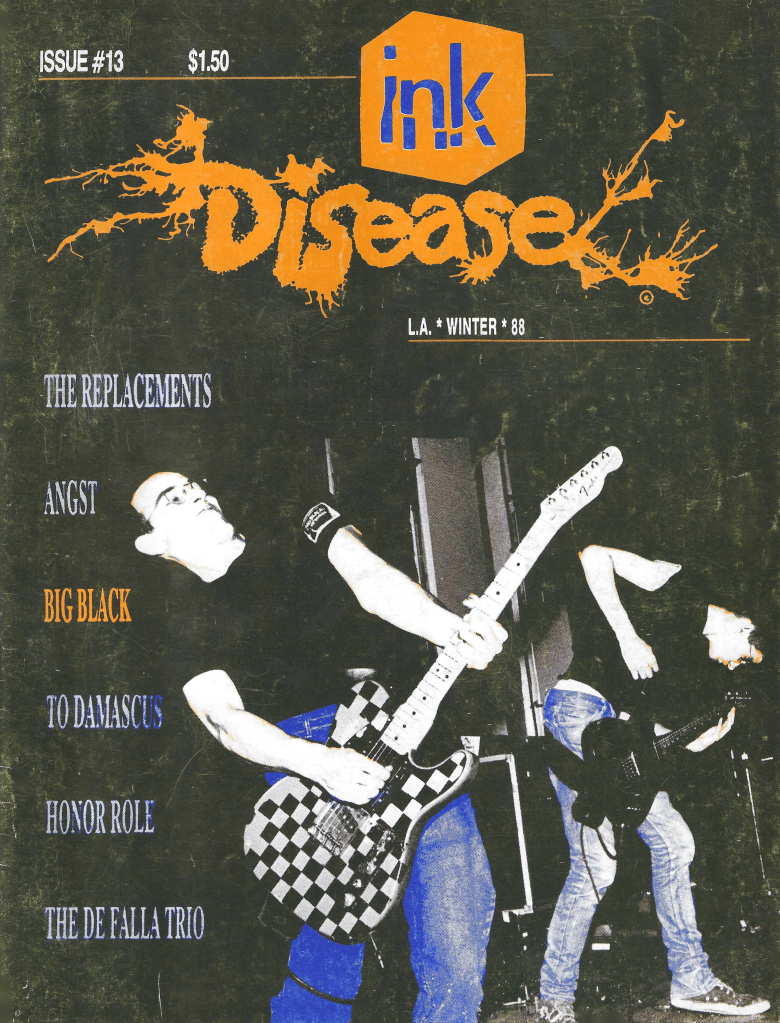
Not gonna lie, as they say, but I thought Ink Disease was pretty weak when it was around in the late 80s, and only cover stories like this one, or the one with The Weirdos, caused me to pick it up at the time. They covered the shitty stuff rather shittily, like a sub-sub-Flipside if memory serves, and yet something must have caused me to hold on to a couple of them all this time. The fanzine was well distributed, and easy to find across LA and elsewhere, and had all the usual ads from important record labels like Taang!, Boner and Fartblossom Enterprises. If you can believe it, I really haven’t looked at an issue of this since that time. Perhaps it might make sense to pry Ink Disease #13 out of cold storage, and see if it’s aged as well as that Châteauneuf-du-Pape I laid down 35 years ago?
For starters, I’m very impressed with the opening ad for Ink Disease back issues that’s a photo of each of them laid out on top of Jan Paul Beahm’s (Darby Crash’s) actual grave. Big points for concept and execution. I’m less impressed with their Ramones at Cal State Northridge review, not necessarily because I care one way or the other, but because 20-year-old me was at this one. It has a typically deep Ink Disease summary that encapsulates both the show and the mag’s writing chops: “If you have yet to see the greatest rock band of the past 10 years, then you ain’t worth the shit you have for brains”. This show will always be remembered for me and my friends driving around and around looking for a place to stay in central Los Angeles in the wee hours of that night, as we had the big free “SST Festival” in Irwindale to go to the next afternoon. We finally came upon a motel in a bad area near USC that charged $6 an hour and $30 a night, and, not knowing what the deal was with a motel that charged by the hour, I was excited to take it so we could get some sleep. We did not. Actual bedposts crashed against our walls. I tried to sleep on the floor, since there were four of us, and chicken wire poked up into my face from the carpet. And the SST festival was cancelled as well, so we didn’t get to see all the great SST bands of 1987 like Tom Troccoli’s Dog and Painted Willie.
I’ll give Ink Disease #13 credit for their willingness to let bands jabber on and on in interviews though, and then print the whole thing full-hog and without edits. I mean, your mileage may vary on this. Honor Role at least keep it succinct, but do talk about the Oxnard Skate Palace show they’d just played, another one I was honored to be in attendance for. There’s an exceptionally long interview with Angst, a funny one with a continuing theme that I’ve seen across repeated interviews with these guys (and with Slovenly) of being broke, hungry, and not having very many fans. No turning off the tape recorder here, no sir. Another interview is with Tommy Stinson of The Replacements – now, what a handsome young man! The highlight is him trying to live down a KROQ interview he and the band did in which the entire theme of the interview was “we are gay”. That must have been a riot, right? At one point, his PR flack comes in to make him wrap it up and says “Tiger Beat are in the hall”. I’m not sure whether that’s true or what, but I’m willing to believe it probably was.
The reviews are predictably inane, coming especially as they were during this dreadful era of bands like Fearless Iranians From Hell, Lemonheads, 7 Seconds, Zoogz Rift and Mighty Sphincter – whose awful record, I might add, I saw selling for $40+ in Nashville recently. No matter, it all gets discussed here, lest the promo train pull away from the station. There’s a dilly of a Divine Horsemen review: “Julie C. can lullaby to me all night long. She sounds like the sultry, white-trash, country-girl I never knew. Chris D. would do me a big favor if he kept his voice out of my earshot”. By the way, you simply must see the cover of the new Chris D. album if you haven’t yet. It is super classy and a real crowd pleaser.
Speaking of classy, there’s a jarring interview with a classical, um, “act”, called the De Falla Trio that I have to assume were somebody’s neighbors or something. It’s followed by an actually quite good interview with To Damascus; the whole band and not just Sylvia Juncosa. Sylvia goes off about why she left SWA to keep To Damascus going again. Having been around at the time, let me say that this second iteration of the band didn’t last long at all, but I did get to see them once – and lo, they were good. Tyran from the band gets in a nice story about his dad’s visit to Spahn Ranch and telling a glazed-out Charles Manson to cut his weeds. Sylvia talks about how her mom was really disappointed with the lyrics on the first Leaving Trains LP (that she was on) and gave her a talking-to about them, and about how she doesn’t want said mom coming to any of her shows “because then she’d find out I have all these tattoos”. This is helpful in case you were wondering what turned all those 80s kids into punks and freaks.
The mag closes with the reason I bought it in ‘87 in the first place, an interview with Big Black in San Francisco during their final weeks of being a band. Albini says, among other things, “You looking for a band that blows? Try The Mission”. Wow, I hadn’t read that line in nearly forty years, no kidding. I used to rattle off this exact quote to some of my death rock/smoke machine rock compadres at UC-Santa Barbara back when I first bought this issue. Oh yeah, and this part, when the band is asked about playing in San Francisco:
SANTIAGO: We never really wanted to play in California.
STEVE: Yeah, California seemed like this really strange, sick little pit of snakes that we didn’t want to get involved in. All these horrible, horrible bands….we just didn’t want to be associated with them, didn’t want to come near them.
ID: Which are the most horrible?
STEVE: I really couldn’t tell you if the Mystic bands are worse or the SST bands are worse…I couldn’t tell you.
ID: Yeah, but Sonic Youth are on SST.
STEVE: That was a big mistake on their part, I think. Them and Slovenly…BIG mistake…and Dinosaur. Big mistake. You’re traveling with some really bad company, fellows.
I recall both getting my dander up at all the hate for my home state and internalizing it to such a degree that I probably started pontificating similar words myself at the time, like a moron. I was extremely malleable and pliable at this stage in my young life, and if opinionated talking heads named Coley, Cosloy or Albini said something demonstrative, I’d often find it difficult to counter and easy to pass off as an opinion of my own. I mean, he’s making fun of Mystic Records here – that was one of my favorite pastimes even then. If you haven’t read Steve Albini’s interviews with Dan Epstein about baseball from 2017, they’re among my favorite things that I’ve read recently – Part 1 and Part 2 are here.
All told, I suppose there’s plenty of entertainment in Ink Disease #13 to potentially justify my continued clutching of it – or at least the eight paragraphs I just spent writing about it here.