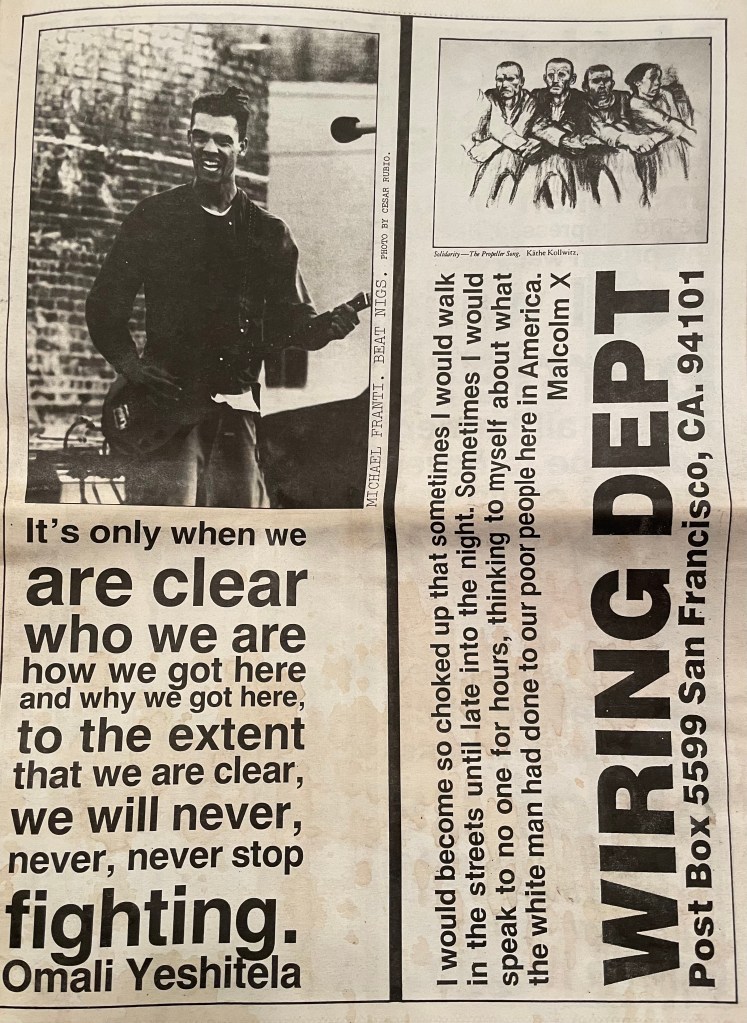
Frankly, I don’t have a ton of chronological information to go on here since the obscurant Wiring Dept didn’t provide dates nor issue numbers, but I’m pretty sure this was their sixth and final issue, and that it came out in late 1987. I’ve talked mostly positively about their 3rd and 4th issues here and here. I have another issue with Thurston Moore on the cover, and we shall discuss that in this space presently; and by “presently”, I mean it as Mark Twain used the term: “after a short time; soon”.
What kind of has this issue floundering a bit in my estimation – relative to earlier issues – is just how immersed editor Eric Cope has clearly become in radical chic and the de rigeur performative leftism that was endemic to its home base San Francisco at the time. I really think the only reason I became the bleeding heart liberal I am today later in life is due my utter contempt for the MDC/Jello Biafra/MRR force-fed feeding tube leftism of the 80s. Guatemala, El Salvador, Nicaraugua, Bobby Sands, Malcolm X, an important conference against racism, Huey Newton, Steve Biko, prison abolition poetry, Native Americans and European colonial penetration, the PLO: it’s all here, baby. It’s here and in the dorm rooms of my UC-Santa Barbara left-leaning brethren at the time, right next to the Che poster, the hacky sack, the gonorrhea antibiotics and the “One Love” and “Buffalo Soldier” records playing softly in the background.
You think I’m exaggerating? I am not. There are reverent photos of Jonathan Jackson with his guns at the Marin County Civic Center, where he died, and George Jackson, the hero, the Soledad Brother, the liberator of Angela Davis – and then a two-page spread for Huey Newton as well. I mean, yeah, I sort of dug the Black Panther mystique myself at the time (the leather, the guns, the chants, and they fed the little children of Oakland, too!), and no 4-year college journey of intellectual discovery at the time was complete without a little time spent coming to grips with Eldridge Cleaver’s Soul on Ice. Mine was completed, shall we say. But even so, I blanched when I read Wiring Dept. #6’s interview with sisters/artists Sue Coe and Mandy Coe, who have a new art book dedicated to Malcolm X and who talk incessantly about police brutality. You know, I always say it was MDC and Biafra who turned me counter-countercultural, but maybe it was this interview?
Anyway, the music content is lessened in this one as a result of having to shoehorn in all this important agitprop. But the music content is quite strong, as it was in previous music-dominant issues. Big Black are interviewed at the very end of their run in 1987. “Why is this your last tour?” “Because we’re breaking up on Sunday”. Santiago Durango was going to law school, but interviewers Humbert de Birck and Brandan Kearney seem to be trying to convince them to stay together, which we now know did not work. Steve Albini says: “When people who don’t understand what kind of music this is ask me, I ask them if they know what rock and roll is. And they usually say, yeah. And then I say, Imagine that, but with a lot of heavy machinery operating at the same time”. Also, the band expresses a deep hatred of the up-and-coming band Jane’s Addiction, who, long before they became famous, became deservingly embedded in my own personal lexicon as one of the absolute worst bands in the history of rock music. I’d say “You know, truly awful, like Jefferson Starship or Jane’s Addiction”. I stand by it!
There’s a negative review of “sellouts” Sonic Youth and their “9/28/87” show at The Fillmore on the Sister tour. This happens to be the exact same date that I saw them play one of the greatest shows I’ve ever seen, in Isla Vista, CA, also labeled as 9/28, and because two locales are a six-hour drive from each other – someone’s lying. David Katz talks to Adrian Sherwood; Sherwood describes what his music sounds like when his group plays live as “live funk dub” – then he says “Don’t use that quote. Don’t say ‘live funk dub’ – sounds horrible!”. Doesn’t he know that when you’re on the record and you say “don’t print that”, it’s absolutely gonna be printed? I’ll bet he knows that now in 2025, perhaps not so much 38 years ago.
Katz also talks to Wire in London, and it’s actually a really comprehensive overview of the band’s journey, leaning much more heavily on recent years, as the band back then were pretty reticent when confronted with their glorious past – you know, the first three albums that everyone wanted to talk about, instead of the recent stuff that they didn’t. There are also other chats with Stickdog, the Beat Nigs – a band so bad Jello Biafra loved them – Barnacle Choir, and Comic Book Opera, the latter of whom sound like something I’d go to see live for sure, if only I could teleport back to the Reagan era. There’s a review of a super-early Brandan Kearney/Barbara Manning-era World of Pooh live show at “Lipps Underground”: “singing like children who don’t want to wake their sleeping parents”. “Foot-shuffling, hunched shoulders, and staring are what pass for stage mannerisms in their rock show”. They ended said Lipps Underground show with a cover of “Gunboats” by Swell Maps. Anyone have the tape???
Most record reviews within Wiring Dept. #6 are by Kearney, in fact, and I’m pretty sure the ones that are not by him – by people like “Rosanguine”, “Curdleby”, “Stallwart Pool Trump” and “R. Pawnships” – are by him. His exceptionally positive review of Three Day Stubble’s Monster makes it pretty clear where he stands: “Remember that one person that was more pathetic than you in 7th grade? The one person you could actually look down on? Well, it’s 1987 now and it turns out that he was miles ahead of you all along.”
Bought at Rhino Records in LA for $2, sticker still on the back, and it has successfully traveled with me through the peaks and valleys of life’s rich pageant ever since.

 Fanzine Hemorrhage
