B Side #11

I started buying Sydney, Australia’s B Side around 1987, and it was an authoritative sherpa for me through the wilds & weeds of that era’s Australian underground. Independent US record stores were getting a lot of this stuff in stock at the time, so it wasn’t all that tough for me to find Scientists records, or any- & everything on the Aberrant, Citadel, Au Go Go, Waterfront, Greasy Pop, Red Eye and Black Eye labels, money permitting of course, of which I had little. Today I’m pretty ready to assert that the underground writ large, myself included, still hasn’t quite come to terms with how fertile this period was across Australia, particularly around the years 1984-86. This is where my recently-procured copy of B Side #11 lands, right in the middle of 1985. 

 For context, I just listened online to two records enthusiastically discussed here – Salamander Jim’s low-end, rumbling, psych noise-damaged “Black Star”, and The Moffs’ guitar-drenched paisley-psych 45 “Another Day in the Sun”. They’re great! It’s far more likely I just haven’t paid attention to any revivals of this stuff, since there are a ton of comps out there like this one. Anyway, Simon Lonergan and his crack team at B-Side were doing all the documentation in real time. I liken this fanzine to the UK’s Bucketful of Brains, but built instead around lowdown & dirty Australian bands with big hair and bad attitudes, as well as the more punk-oriented and as opposed to jangle-driven psych. It was the tenor of the times, as they say.

  If you’re like me, your eye was perhaps caught by B-Side #11’s promise of “Byron Coley on the State of the U.S.A.”. Coley’s “The State of American Noise Part 1” starts with an opening salvo positing that stupid Americans are ignoring the likes of the greatness he’s about to wax poetically about, which we probably were. This comes down to 4 key bands: Dredd Foole & The Din, Raunch Hands, Butthole Surfers and the Leaving Trains. The Trains’ debut LP Well Down Blue Highway “represents the culmination o’ years spent drunkenly tryin’ t’ find the Northwest Passage between The Damned and Creedence Clearwater Revival”. After describing them and the adjacent band To Damascus, he says “Now ya know more about these jerks than 99.99% of the American people. How’s it feel?”. Byron Coley sticking the landing, as usual. This is also the article in which Coley first wrote that Jello Biafra turned his nose up at the Butthole Surfers when he first saw them and said they were “too weird” – a statement that really stuck in Biafra’s craw for years afterward. Fun!

Tex Perkins (who was in Salamander Jim along with Kim Salmon) has a good interview here – he was better known as “Greg” at the time – which includes ruminations on his jealousy of the more popular Beasts of Bourbon; trouble with the cops; and the fact that he’s now about to start playing with Pat Bag and Kid Congo in Fur Bible. They haven’t even started the band yet, nor even told him what kind of music they’re going to be doing – he just wants to make sure it doesn’t sound anything like the Gun Club nor the Beasts of Bourbon. Well, maybe a little

There are also a slew of interviews with the likes of the Celibate Rifles, who just had that first LP and a 45 out at this point. A year later they’d have records that were easily procured at Aron’s and Zed in LA, and which became pretty beloved by me & my Radio Birdman-loving pals. (I don’t have them anymore and haven’t heard the band in decades). Other chats are with The Shindiggers, Decline of the Reptiles, 21 Faces, Harem Scarem, and American Eugene Chadbourne, who’s just come to town and won a handful of converts down under. 

The excitement of the age is real, and you can feel it in the big Melbourne “scene report” by David Laing and Trevor Block. They’re shooting the proverbial shit back and forth about bands like “Behind The Magnolia Curtain” and Murphy’s Hardware, who supposedly play live in matching Hawaiian shirts. Who wouldn’t be excited, am I right? And as a result of reading this blog post, you now know more about these jerks from 1985 than 99.99% of the Australian people. How’s it feel?

Truly Needy #6

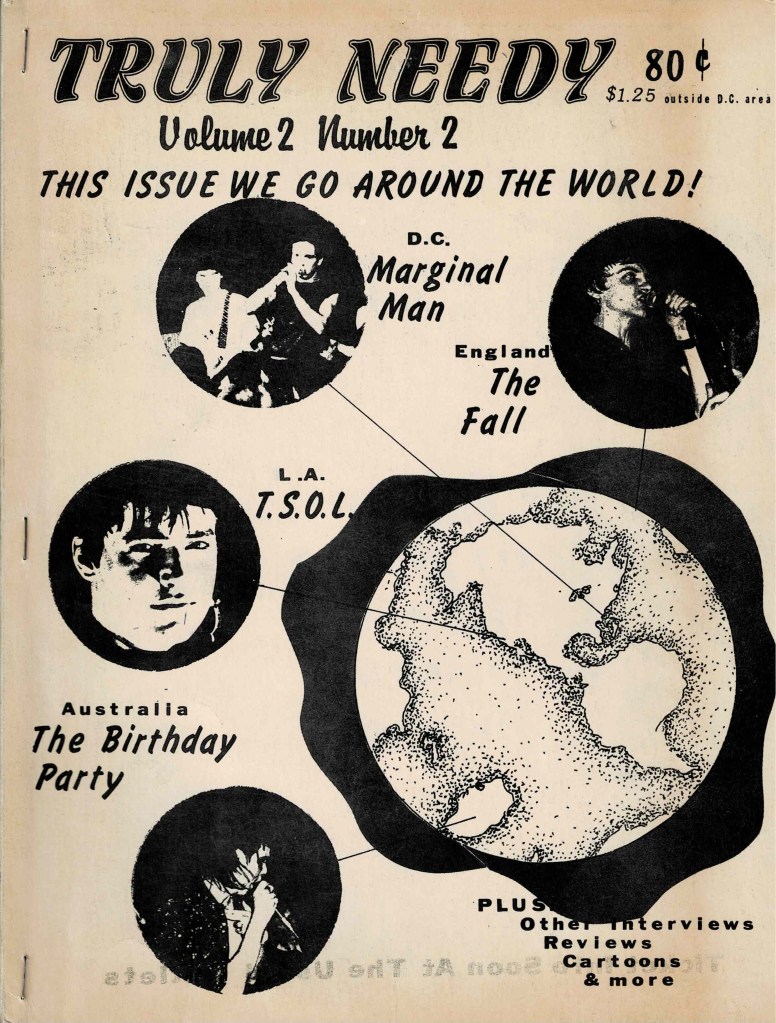
I can’t say with 100% assurance that this early 1983 issue was the actual sixth installment of DC’s mostly excellent Truly Needy fanzine, because they’d do that annoying “Volume 2 Number 2” thing that was stolen from traditional magazines at the time (Slash did it too). Yet my research seems to indicate that there was in fact a Volume 1, Number 4 issue, but not a Number 5. This would then make this one Truly Needy #6 by all rights, and by the time of the next issue, Truly Needy #7, they were finally doing their numbering the proper fanzine way. 

Truly Needy, if you’re never seen the thing, was a true heavy hitter during its time. It was totally stuffed with deep underground documentation and dribblings, all from a Washington DC base that was seeing the culmination of years of slogging scene-building – captured beautifully in the excellent Punk The Capital documentary. As when reading its peers Matter or The Offense, you could get a strange sort of jarring high from reading about the many tendrils of punk and oddball culture still exploding across the country in ‘83, and even now I’m retroactively jealous of the experiences of living through a time I myself lived through. (Which is how many folks still feel about the mid/late-1960s today). So let’s maybe take a look at what was going on then.

There’s a great early letter here from “Ayu the Braless”, talking about his visit to San Francisco: “Either SF has been sending a fake image to the East Coast or it’s become another 80’s fatality from what I saw. For 3 weeks I searched for industrial death music and only found one group, the German Shepherds, who used noise. And they were very weak and monotonous compared to earlier groups like Factrix and T.G. The performance art I saw was pure excrement….Haight-Ashbury looks like Georgetown…the punk I saw was rock & roll slow, except for the Meat Puppets, and they got pelted with bottles and drinks for having long hair”. But it’s not all bad in San Francisco for Ayu: “The gay scene is great. With the male/female ratio in the street being 9 to 1 there were lots of handsome penii walking around….the bathhouses and sex clubs (only gay ones) are numerous and filled with toys and games…if you care about your penis more than art you can have a great time”. Sure. This is actually quite sad to read considering how that entire scene was unknowingly being hollowed from within at exactly that moment.

The Fall have come to DC, and there’s an initially confrontational interview with Mark E Smith that Truly Needy editor Barbara Rice eventually wrangles under control. When asked about American bands he likes, he pops off with “Fear, Flipper and Panther Burns”, and pines for how awesome it would be if Fear could come out and play Scotland and the north of England. Then Smith says “I always thought that West Coast American punk was the best anywhere”. I mean, he’s right of course – but I didn’t expect it from Mark E Smith (!). Maybe it was this show that did it?

Truly Needy #6 carries multiple threads through its 50-some-odd pages that are both local and global in nature. For local stuff, there’s an “Ask Barney” column about scene etiquette with what appears to be fake letters, along with interviews with DC bands Marginal Man, Egoslavia and The French Are From Hell, only the former of whom I’m familiar with. For global stuff, there’s a long Crass interview that I simply can’t bring myself to read, and that stops in the middle to be “continued next issue”. The Birthday Party are now living in London again after having left Berlin, so this would be “peak heroin season” for the band if I’ve got my dates correct. There’s a quick chat with Rowland Howard and he’s affable and informative. 

Each slice of subculture has its place here – there are columns on TV, comics and a huge fanzine roundup. There’s a Tapes column featuring gems from No Trend, Your Food, Razor Penguins and The Fartz, along with everything the ROIR label had ever put out to that point. My assumption is it all arrived in a big tumbling batch, and given that the Truly Needy ethos seemed to be to review every fucking thing that hit the office, they all get a place here.

In the live reviews section, Rice reviews the 2/25/83 Minor Threat / Government Issue show at Wilson Center, and has the epiphany that the rest of the country was pretty much having about DC around that time: “Finally, this show is ample proof that we don’t need an out-of-town act headlining the bill. For once we have some of the best music in the world”. And I love the review of a 3/12/83 show of Boat Of… at DC Space; they’re a band I’ve only heard about, a Tom Smith (To Live and Shave in LA, Peach of Democracy) project. “(They’ve) been playing to confused and unhappy audiences for the past year across the state of Georgia…At the DC Space show, Boat Of… founding and central member Tom Smith handled most of the chores himself, accompanying his tapes with turntable and vocals…One fellow kept walking up to the stage and saying things like ‘This isn’t music’ and ‘You’re not doing anything’….The show ended with Tom crooning over a wonderfully mutilated version of ‘Colour My World’.”

In the huge reviews section, there’s a multitude of hardcore & goth & imports, mostly dealt with by Rice. But wait, who’s this? Why, it’s Byron Coley getting space to opine on The Chesterfield Kings, The Monkees, The Box Tops and Kansas’ The Mortal Micronotz, whom he totally loves. Great to see him adding a touch of class here. Now me, I could give a shit about the ‘Kings, but I can understand his enthusiasm for championing “six-oh” sounds in that hardcore-drenched era, which he even refers to as a stance worth taking, in the guise of both musics being tough, raw and worthy. Fair enough! Much to ponder in this one and certainly one of America’s finer fanzines during that year.

Damp #2

In 1987, Damp editor Kevin Kraynick openly worried in the pages of this issue that he’d be lumped in with fanzine editors “who are the kind of guys who always got picked last for kickball games in gym class”. I mean, sure, but if the shoe fits….right? So in meager compensation, there’s some aggro finger-pointing and posturing in places where there oughtn’t be any – “whatta dick”; “you bet your globular ass”; that sort of thing. Certainly, Damp grew up a ton in subsequent issues – including #3 that we discussed here – but was still taking some young man’s cues from Conflict without quite having the chops to approximate its humorous vitriol. 

That said, I bought Damp #2 then and I’d have happily owned it now for 37 years had it not been “disappeared” in the Great Starving Students Lost Fanzine Box. Only recently was I able to procure a copy again, perhaps even my own original for all I know. Slight concerns aside, it was an unalloyed pleasure to read cover to cover last night. There is an interview with New England locals Expando Brain, one of my very favorite super-far-underground rock bands of the mid/late 80s. Kraynick also pulls together a well-researched Snakefinger interview that’ll always be my primary source material should I ever need to do any serious Snakefinger research, such as to write a paper. There are also interviews with acts that only a young man might pretend to like – Big Dipper and Zoogz Rift –  but then there’s also the only piece I’ve ever seen on The Longshoreman, a long-running San Francisco band featuring Judy and Carol from Pink Section and the Inflatable Boy Clams. Kraynick was clearly looking a bit afield from the alterna front-runners of the day, your Soul Asylums and Big Blacks and whatnot. 

Sometimes the vituperation is pretty funny in his reviews, too, as in this fine intro to a Dash Rip Rock review: “Front cover shows the band burning guitars in the fireplace and let’s hope those are the only ones they’ve got”. As it turns out, even Kraynick knows that the miniscule 4-point font for record reviews that he’s using is utterly comic, and christens the whole section “The World’s Tiniest Record Reviews”. This was the era of Squirrel Bait, Butthole Surfers, Dinosaur and Halo of Flies worship, a consensus that emerged in the East Coast fanzines I read all the way across the country in Santa Barbara, and my taste was molded accordingly. For some reason David Ciaffardini is a great target of derision, which I kind of understand if you were comparing his Sound Choice magazine with, say, Forced Exposure, but he was an exceptionally friendly dude whom I knew personally, a true mensch from the word go, and someone whom I recently re-established contact with after 35 years. 

The snarky sub-underground fanzines all had to have their “out crowd” for sure, and there was a consensus pile-on against the same targets, the supposed “guys who always got picked last for kickball games in gym class”. Clowns like Tesco Vee and Lydia Lunch got a free pass for some reason, probably for the same reason confident extroverts always have and always do. If you can convincingly act the part, it doesn’t matter how brainless your material actually is; if you cower and show weakness in any social circle, particularly one in which young men are attempting to preen and show off for each other’s benefit, you get bullshit like over-the-top Mike McGonigal hatred and Baboon Dooley. I wasn’t totally immune myself when I started in this racket a few years later.

Then again, maybe we all just wanted to be Byron Coley. He’s interviewed here, the second part of a 2-parter, the first of which I’ve never read because I’ve never seen Damp #1. I remember reading this interview back then, and he praised the Lazy Cowgirls – who were my absolute favorite band – and it was a big, big deal to me, the voice of God anointing my own musical taste as being first-rate. And he also made fun of SWA, who were absolutely my friends’ & my favorite musical whipping post around this time. These “photos” of “Jimmy & Byron” from Forced Exposure definitely generated some chatter at the time as well, as it was hard to know what these guys looked like in an era before The Face Book and before I was able to Ask Jeeves. It took me at least a few years to realize 100% that these weren’t the guys.  

Finally, Damp #2 closes up with a guy named Wandz, who has his own page of “Hip Cat Jazz Reviews”. He even writes as if he knows what he’s talking about. A nice icing to a pretty packed fanzine.

Forced Exposure #15

(Originally written as part of a Forced Exposure fanzine overview in Dynamite Hemorrhage #7):

When Byron Coley was interviewed by Jason Gross online in 2010, he told a pretty funny story about how Diamanda Galas came to be on the cover of this Summer 1989 issue:

The (interview) we were dreading the most was the Diamanda Galas one. The problem with doing a print magazine is that sometimes, records come out and it’s like… you really don’t have enough time to deal with (them), but you want to deal with it ’cause it’s on a label like Mute. So a Diamanda Galas record came in right when the issue was due and I think Jimmie reviewed it. His whole review was something like… she was supposedly going out with Blixa (Bargeld) right then, so Jimmie wrote something like “Blixa’s dick must be as big as everybody says it is because she’s really fucking screaming on this one.” (laughs) And she kind of hit the roof because at that time, a lot of people were reading the magazine and a review like that… People would just really laugh. The label put across the word that she was furious about it. And I absolutely understand. So we said “OK, we’ll interview her. We’ll put her on the cover of the next issue.” It seemed like a good idea anyway.

But getting ready to go down for that interview… We interviewed her at a restaurant in Hell’s Kitchen. We were just like “Oh my God, she’s going to fucking castrate us.” So we went in and her rep was really vicious and we had done tons of research, so we went in prepared to be disembowel. And we apologized and explained the situation, but she was really hostile. But then as it went along and she hummed a Coltrane tune and Jimmie knew what it was (it was something theme from Meditations) and she was like “Oh!” And the questions we had were obviously well-researched – we asked her about a lot of stuff that people hadn’t really talked to her about. So it ended up being OK but that was a rough one.

She actually comes off in the interview like a pretentious, self-involved and utterly pompous ass, but whatever. I saw her finally in the mid-1990s, and it will always be one of the most memorable shows of my lifetime.

The letters section starts off with a nice bit of what we’d now recognize as “trolling” from an ex- professional baseball pitcher named Lowell Palmer, who shares the advice of “the original punk Vince Lombardi” to “do sports, not drugs”. Byron naturally takes the bait and yammers about how real adults take drugs, or, in his words, “gobble a sheet of L or bang a little smack”. Just how old were these FE guys by 1989? I’m afraid you don’t wanna know. It certainly wasn’t 19 or 20.

This issue has some fantastic material otherwise. Seymour Glass did an exceptionally comprehensive & entertaining interview with the Sun City Girls, which was followed by a single- page paean to Claw Hammer – who were fast becoming my favorite band at the time – by Eddie Flowers; “LA hasn’t been home to a ROCK combo this musically exciting and aesthetically gone since, uh, the early, Kendra-era Dream Syndicate”. Ditto that, Crawlin’ Ed.

More terrific photos of leading lights like Death of Samantha and Hanatarash and Howe Gelb litter the excellent record reviews section, and the return of the C/U Meter sees three singles get a “C/U ENTIRE PRESSING”: Vertigo’s first one (agree 100%), plus Lithium X-Mas and White Stains (both of which I’ve found online, like, just now – and both are terrific & weird psych records). Huge books section, loads of video reviews, and a new mostly noir/crime review section called “Chris D.’s Video Library” – which was a healthy step forward from the previous issue’s father/son porn reviews.

NY Rocker – September 1980

The personal, hand-assembled music fanzine’s always been the place that cultural pontificators like to point to when directing nostalgia seekers to the real pulse of an era, the sociological beat of the streets and the place where a given music’s early adopters were the ones helping to define that music’s formative boundaries and key players. I think there’s much truth to this assertion, or I otherwise wouldn’t be bleating as much as I am here. 

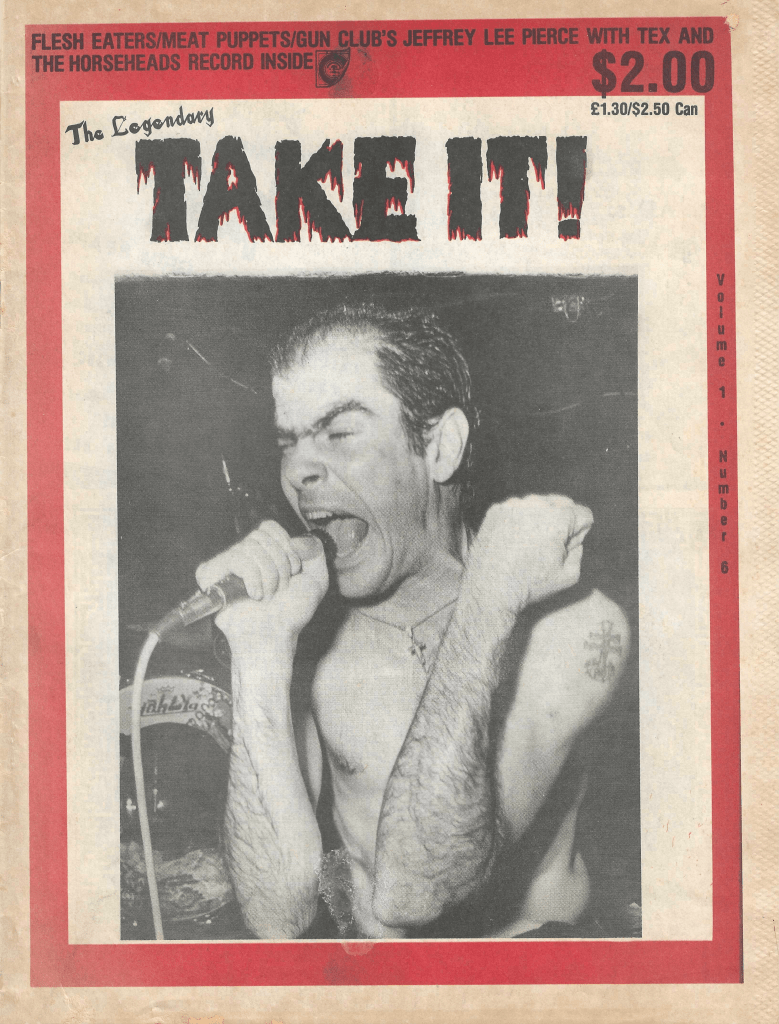
Yet I think there’s actually far more sociological and on-the-ground ore to mine from the music periodicals of particular musical eras, back when, unlike now, music periodicals were a thing. A single issue of the NY Rocker, say – or of Slash, or Damage, or Take It!, or Sounds, or Rip It Up, or Melody Maker – those newsprint periodicals, packed with columns, reviews, interviews, musings, artwork, listings, ads and photographs – each issue of these provided an incredible bounty of detail and real-time reportage and opinion that actually tops much of what irregularly-produced fanzines did. So I like to read ‘em, myself, just to put myself in the same frame of mind as any other music dork might have been in during 1980, or 1972, or 1967. In the US these local newsprint music papers pretty much died out by the mid-1980s, replaced by the local alt-weeklies that themselves have now died out.

This preamble is so we can talk about how much I loved reading NY Rocker’s September 1980 issue, OK? It’s the proverbial portal to another world, itemized and particularized extensively and exhaustively from the viewpoints of folks like Andy Schawrtz, Byron Coley, Ira Kaplan, Lisa Fancher, Jeffrey Lee Pierce, Peter Crowley and many others. Some Los Angeles names on there, right? That’s because this is a very heavy “The Best of the West” issue, with three different features on X (who’ve just released Los Angeles and played New York) and a particularly fantastic Lisa Fancher piece trying to make sense of the LA/beach hardcore scene and place it all in context. Like Kickboy Face’s similar piece in Slash around this time, she is an advocate of letting the kids be kids, hating the cops and grooving to the pure adrenaline of nascent hardcore punk. “Though it may have taken three years, these California kids have finally broken away from English apery and come up with something so crazy and incomprehensible it could only be American.”. God bless Lisa, and God bless the USA.

Oh – and she talks about a show she’s just attended in Redondo Beach at the Fleetwood with a bill of Fear / Bags / The Gears / Circle Jerks / Gun Club / The Urinals. I know, I know. She casually mentions “Slash is filming the proceedings”. Folks, this is the The Decline of Western Civilization show; “Slash” = Penelope Spheeris, the then-Ms. Bob Biggs. I know that some of The Gears footage made it to a Decline DVD; does anyone know if she actually filmed The Urinals and Gun Club as well?

Aside from the heavy LA focus in this one, there’s a “the scene is totally dead” San Francisco report from Tony Rocco, who was a staff writer for Damage and who was parroting the party line of that magazine in 1980, which we told you about in this post. There’s a (true) report about The Cramps’ Bryan Gregory quitting the band to join his girlfriend in her intense worship of Satan (!), and his new replacement, Julien H (you can see her in this clip, one of the greatest pieces of rocknroll ever committed to film). There are also great bits on The Raincoats, Gang of Four and The Selecter, all interesting, all of their time and all so exciting in the context of everything else also going on around them.

There was another reason this was such a great year – The Shaggs’ world-destroying Philosophy of the World had just been reissued, and it was blowing minds from Nashua to Great Neck and back again. Byron Coley reports on it all, in the context of a review that unsuccessfully (and tongue-in-cheek) attempts to compare it with some Slits demos that have just come out. I heard it not long after this and got quite the laff out of it, but it wasn’t until about 1983 or so that Shaggs mania would enter my home from the most unlikely of sources.

The comedian Bob (“Bobcat”) Goldthwait was a local San Francisco comic in 1983, and I was a 15-year-old who listened to the Alex Bennett Morning Show on KQAK (“The Quake”) every weekday morning before school. Every morning Bennett had someone on, a local comedian, who’d later go on to be moderately famous, like Dana Carvey, Kevin Pollak and Mark Pitta. Anyway, Goldthwait was on at least once a week, and he decided to bring The Shaggs to the west coast, both figuratively (by making Bennett play “My Pal Foot-Foot” and “Who Are Parents?” on the air all the time) and “literally”, by pretending to bankroll their big trip to San Francisco, where they’d be greeted on the ground at the airport as heroes who’d come to save rock & roll. 

Goldthwait used Bennett’s show one morning to pump up the in-studio crowd who’d come to KQAK for every show – as well as the audience listening at home – to get themselves to SFO airport immediately to cheer and hoot for The Shaggs, whose “plane was just about to land”. Goldthwait had a live mic and several dozen amped-up people around him at the airport chanting “We love The Shaggs! We love The Shaggs!” as their plane landed. I was quite entertained listening at home, let me tell ya. I don’t quite remember what happened when the Wiggin sisters didn’t actually get off the plane, but perhaps I had to get to Social Studies 1 and missed it entirely. 

Anyway, like I’ve said in previous items, I haven’t entirely lived up to my promise to write more unasked-for stream-of-consciousness diversions in these blog posts, so there you go. NY Rocker’s September 1980 issue is a real gem. I have others to review in the weeks to come. (And hey, does anyone have any info on the lone issue of NY Rocker Pix? It has on the cover one Donna Destri, the sister of Blondie’s Jimmy – I just this very week heard her name for the first time when I watched this not-especially-good documentary called Nightclubbing about Max’s Kansas City.)

Bull Tongue Review #1

After Forced Exposure wrapped it up in 1993, I had to make do with reading Byron Coley’s music writing work wherever I could track it down, even if that meant having to wade through Jay Babcock’s early 2000s Arthur periodical in order to find his & Thurston Moore’s joint “Bull Tongue” column. Man, that whole Arthur schtick really stuck in my craw at the time, and I vented my spleen here and here about it, though somewhat tongue-in-cheek in the latter instance (this was also when I was probably the most “right wing” I’ve ever been in my life, which then positioned me as a libertarian-leaning moderate Democrat).  

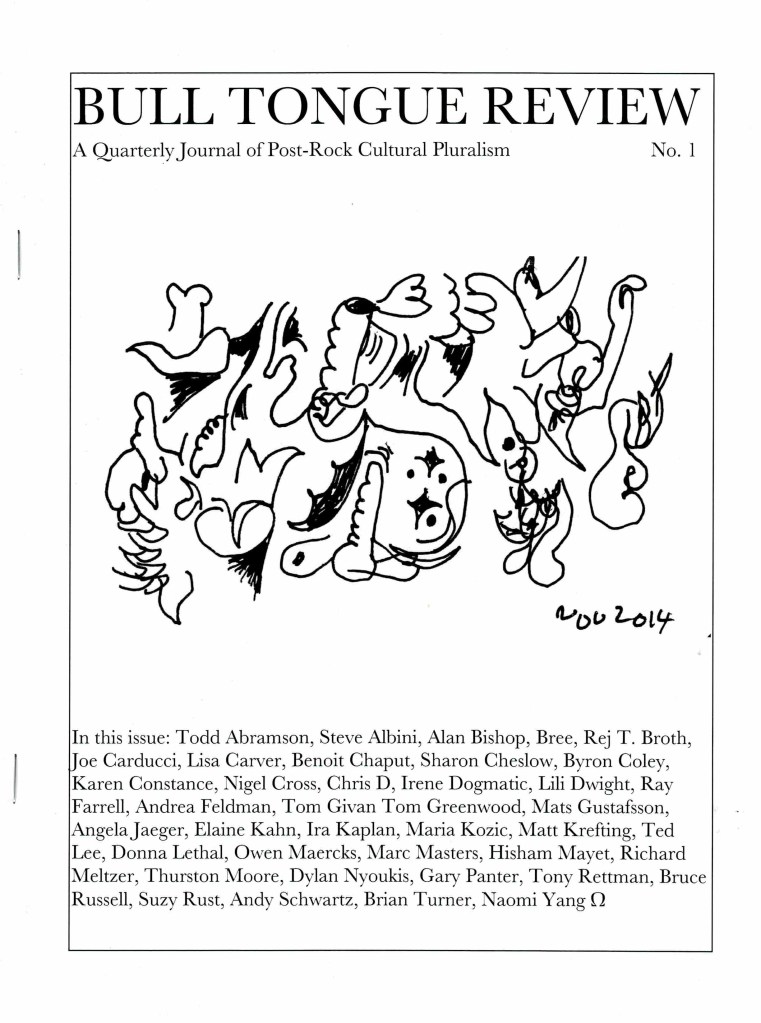
Coley’s stuff was around if you looked for it – and I certainly did, as he was foremost in helping to shape my eventual musical environment, and was often a real laff to boot. Still is. A few years back, 2014 to be exact, he finally popped up with his own publication, Bull Tongue Review, “A Quarterly Journal of Post-Rock Cultural Pluralism”. They lasted five issues in total, with the conceit being that this magazine would be a significant extension of that Arthur column, the one where he and Moore got to prattle about favorite records, books and other pieces of sub-underground cultural ephemera. Coley even says so in the intro to Bull Tongue #1, at which point the two of them get right into it, reviewing Tim Warren’s latest Back From The Grave comps, Adele Bertei’s Peter Laughner book, a bunch of S-S Records, some wild jazz, and (gasp) even my own Dynamite Hemorrhage fanzine. These guys never really took ownership of their respective parts of each long column, which was kinda fun, though I think the “When I moved to NYC in late 76 at age 18 and was later in a band called The Coachmen” section was probably written by Thurston Moore.

If their lengthy column was, in fact, the whole fanzine – hey, that’d be a really, really great fanzine! But wait, there’s more. Bull Tongue Review was an invite-only compendium of short pieces by the people from the greater Byron Coley universe: folks from the FE days like Suzy Rust, Steve Albini, Chris D and Tom Givan; and other tentacles extending outward into the underground to ensnare folks like Richard Meltzer, Joe Carducci, Lisa Carver, Gary Panter, Andrea Feldman, Brian Turner, Marc Masters, Donna Lethal and many more. (By the way – Donna Lethal is a tremendous and tremendously wacked-out writer; when I first corresponded with her she was going out with Chris D., and she told me about her indie-press memoir Milk of Amnesia, which was absolutely fantastic. I’ve lost touch with her). And even Coley’s wife Lili Dwight gets a turn, and she contributes a fine piece about those OXO Liquiseal travel mugs. 

Each contributor gets 250-500 words or so to review something, to tell a story, write a poem or, in rare cases, to contribute some artwork. Most in Bull Tongue #1 review something, usually a record (!), and that’s all to the good – yet some of the other stuff’s even better, like when Alan Bishop relays a tale told to him by Human Hands’ David Wiley about the time he got a phone call in the early 80s to rush down to a friend’s house so he could drive the Sun Ra Arkestra to a Sizzler. Or when Chris D. reviews a bunch of modern neo-noir films. Or when Owen Maercks talks about what it was really like to hear The Ramones’ first album in 1975 for the first time – what a great piece. (It may not beat Steve Albini’s writing on the matter, though – I’ll never forget his description of him and his brother playing the first LP and laughing uproariously at it, yelling “this totally sucks!” at it, calling it the worst record ever, and then…at night…thinking about it incessantly and wondering if it was time for a life change). 

Ted Lee, who still runs Feeding Tube Records with Coley, contributes the miniature artwork for each section. It’s a little jarring to have a record be reviewed, accompanied by a weird drawing rather than the album cover, but it’s their deal, not mine, and why not anyway, right? They did it this way four more times and I snapped them up as soon as I could. I keep hoping in vain that another Bull Tongue will make a surprise appearance sometime soon. It’s a terrific concept, and it’ll work well as long as some Coley-adjacent crew are the ones contributing.