The Offense #12

In 1987 and 1988 I accepted an offer from a fellow college radio DJ at KCSB-FM in Santa Barbara and “interned” at his fanzine/magazine, Sound Choice in Ojai, CA. At some point I’ll explore an issue of this, and we can talk a little more deeply about all this entailed and what came of it during my twentieth year on the planet. For now, I can state that one of my many jobs there was opening the mail, and then asking editor Dave Ciaffardini if I might take some of the hundreds of promo records and fanzines he’d receive each week home with me, which he always said yes to.

The Offense Newsletter from Columbus, OH was one that arrived in Ojai with regularity. Because this was a time of fanzine abundance, and particularly of fanzines that covered the raw punk, noise and, uh, “pigfuck” that I craved, I was flummoxed enough by The Offense Newsletter that I never took any of them home with me. Editor Tim Anstaett was really, really, really into 4AD Records and had an intense anglophilia and some tolerance for what by then I thought of as “new wave garbage” that, even though he and his contributors also deftly wrote about all the things I loved, I found too discordantly strange and therefore untrustworthy. 

Of course, now that I’m all growed up, I applaud the breadth of his tastes and passions, even if some of the chosen material in 1981’s The Offense #12 is to my ears laughably trendy or pedestrian, such as interviews with U2 or the Comsat Angels, or time spent reviewing Heaven 17 and the Human League records, right next to Cracks in the Sidewalk, Minor Threat and Dow Jones & The Industrials. (The fanzine changed from a larger fanzine to a smaller newsletter format at some point, hence the minor name change). I do like the part where the guy from the Comsat Angels says he spends most of his time listening to Pere Ubu and Chrome, and wonders why his band plays the considerably less challenging music that it does.

Want to know just how intense the 4AD worship was over here? Not only are there letters to the editor mocking Anstaett for it already in 1981, but a few years later he’d be the catalyst for the Cocteau Twins playing one of their five US tour shows in Columbus, which thankfully resulted in one of my favorite pieces of local TV news coverage ever (please watch it). Fun fact – Fanzine Hemorrhage’s editor, a San Jose, CA Gunderson High School student and part-time new waver, attended one of the other five shows in 1985, in the considerably more logical tour city of San Francisco.

The Offense #12 – actually dated as having come out precisely on November 12th, 1981 – is an even more rewarding time capsule than I’d imagined it might be. First, it’s clear that Anstaett is getting some really strong distribution on this thing, with copies all over the UK and thus loads of underground promos and letters to the editor from there and from all across the United States. He prints a ton of letters, some of which take him to task, some of which praise him to the heavens, a couple of which are flirting sexual entreaties from women that he flat-out takes the bait on. There’s a letter from a guy in Seattle named Joe Piecuch – anyone remember how ubiquitous this guy’s letters were across various publications across the 1980s? Go check your Forced Exposures. There’s also a long, snotty one from NY Rocker editor Andy Schwartz and even one from a young Randy Russell in Kent, OH, a guy whom I interviewed last year in my own Dynamite Hemorrhage #10 about his later musical endeavors in Moonlove.  

Also – remember that it’s Columbus, Ohio that we’re talking about here. Who knew that Don Howland and Ron House were big contributors to this one? Not I! Howland’s music writing is some of my favorite music writing ever, and here we’re fortunate to get his first thoughts on The Gun Club’s debut album Fire of Love, which has just come out: “‘Fire of Love’ hits turntables across America with all the impact of a severed penis hitting a crowded sidewalk after falling SOME ONE THOUSAND feet from the roof of a skyscraper. It’s that good.” Howland also praises that Scritti Politti 45 “The Sweetest Girl” (the A-side only, which he gives an A+ to the b-sides’ “F-”) – it’s a really great song, I totally agree; major KFJC college radio hit when I was a teen – while copping to a lot of the confusion and dismay on display here that so many post-punk bands are so blatantly chasing “Rock of the 80s” cash. Anstaett, too – he eviscerates records by Adam and the Ants, Human League and other UK bands that were soon to become big US alterna-radio staples.

The aforementioned Joe Piecuch isn’t merely a letter-writer, he’s also a contributor, and he’s clearly going through some major Throbbing Gristle mania in late 1981, reviewing and lauding everything and anything he can get his hands on. Anstaett reviews some recent fanzines and gets a bit frosty when Tim Tanooka at Ripper calls The Offense “80 pages of really stupid drivel published by a very pretentious Anglophile who doesn’t like hardcore punk.”. I mean it’s 42 years too late, but I’ll state for the record that this magazine neither reads as pretentious, nor does it slight nor demean hardcore punk – quite the contrary. I plowed through this issue last night and it made me think that maybe I need some other issues. Thankfully, there’s The Offense Book of Books from 2019, which compiles the first 18 issues across two mega-volumes – for real! More here, and good luck tracking this one down if you’re so inclined.

Back Door Man #4

If you’re as ludicrous a person as I am, it can be tempting to mentally place oneself in a particular year “at age” and wonder how you might have responded at the time to rocknroll’s past, present and potential future. If I put myself in 1974, I’d probably want to respond a lot like Phast Phreddie Patterson and the Back Door Man crew did at the time. I’d want to be blathering to everyone who listened about The Stooges, Velvets and Roxy Music; I’d have a reverence for rockabilly and 60s garage rock; I’d know what “punk” was three years before 1977 told me what it was; and I’d be searching, grasping for anything that hinted at the musical future I wanted to will into existence. (If I’m really stretching the imaginary point, I’d be putting out a fanzine praising Les Razilles Denudes, current krautrock, crate-digging 60s punk 45s, Simply Saucer and whatnot).

To date, every fanzine I’ve talked about here has been something that I physically own an original copy of. Not Back Door Man #4. In the early 1990s my good friend JB was spending quality time at his local San Diego Kinko’s making ersatz photocopies of his classic fanzines for certain friends, of whom I was luckily one. I got a package once with multiple Back Door Mans, a Brain Damage and a gaggle of the Patti Smith fanzine Another Dimension, all stapled and assembled beautifully. Given that they were from the mid-70s, I could almost pretend that they were the real deal, in their original form. This Back Door Man came from that batch, and yet it’s “worth” plenty to me.

I hadn’t really looked at it in a long time, this “only 40¢” fanzine from Torrance, CA. They really were a crew of “hardcore rock’n’rollers” at BDM; they included within their ranks Patterson; co-editor DD Faye (whom I confused for years with her equally lovely sister Danielle, who was in The Zippers and Venus & The Razorblades), Don Waller and Thom Gardner. At this point, 1974, considered by many far & wide to be a true low point in rock music, they are grasping at anything rebellious and wild they can get their hands on that might hint at the abandon and rawness they need. Blue Oyster Cult, Aerosmith, Ron Ashton & Dennis Thompson’s new band New Order; Mott The Hoople, Nico, Patti Smith and John Cale – even the execrable Tubes get a big write-up by Lisa Fancher, who’d later go on to run Frontier Records. It’s what you did in 1974, and it makes me think that the search for musical redemption in the bins and on the radio was actually a far more fun and ultimately rewarding environment for rocknroll fandom than, say, 2023 is. There just weren’t many clubs in which to go see local bands, nor many local bands who weren’t playing covers in fern bars.

When there were, Back Door Man #4 is all over it. Phast Phreddie does a proto-scene report called “South Bay Rock’n’Roll” talking over local live shows with the reformed Blue Cheer, along with Shatterminx, Heavy Transport, Atomic Kid and The Ratz! The Imperial Dogs, who formed that year and featured Back Door Man’s Don Waller on vocals, are also duly raved about, as well they should be. There’s also a great piece about how flummoxed they all are by Lou Reed’s new Metal Machine Music but how they appreciate its rawness and its place in th culture as a big fuck-you nonetheless. 

The staff also writes in various places about having to rely on AM radio (KHJ) to get their musical kicks, again grasping, grasping…..they’re really excited about The Sweet’s “Ballroom Blitz”, which they should be because that song rules (we also discussed it previously on this blog here). I’m assuming that FM rock Radio was already pumping that heavy-lidded dopesmoker AOR sound around that time that I remember from my precocious Sacramento childhood: Jethro Tull, Yes, Led Zeppelin and whatnot, and these guys and gals were instead looking for the proverbial teenage kicks. 

Anyway, there’s much, much more to be told in the Back Door Man saga here – but mostly elsewhere. I leave you with an interview that Scram fanzine did with Don Waller about the magazine; here’s a great RockWrit podcast interview with Phast Phreddie himself. Enjoy.

It’s So Hard To Tell Who’s Going to Love You The Best #1

Do you remember your reaction the first time you heard Karen Dalton? Honestly, now. I remember mine – it was probably in the early 2000s. I was doing the blog Agony Shorthand, and there was another music blog/site/”online magazine” called Blastitude who’d cover all sorts of strange noise and post-hardcore craziness, yet who also had an incongruous soft spot for the female singer-songwriters and girl groups of the 60s (as I very much did). I’m not sure if it was Larry Dolman or Tony Rettman, but one of those dudes was seriously championing Karen Dalton and her 60s/70s recordings, so I went and checked her out as one does on the internet, and was like – ugh. Couldn’t get past her voice, which was a strange, froggy thing that almost sounded like someone trying to emote & intonate through a cleft palate. 

But friends, this is why we show grit and persevere when we encounter barriers. It didn’t take long for me to see just how beautiful, pained and otherworldly her folk music was, and to really embrace her flawed voice – if it is even flawed – the way we embrace Neil Young and Bryan Ferry for their own vocal foibles. Then when Karen Dalton’s archival 1966 tapes came out and I heard ‘em – well wow, that really did it for me. She entered my pantheon of farsighted, tragic geniuses immediately, and I cursed myself for ever having doubted her, even if she almost totally performed songs that were not written by herself. Who cares? Karen Dalton, especially in the 60s, was phenomenal, and I’m delighted that so much of her music from that period has flowed out to the people in recent years.

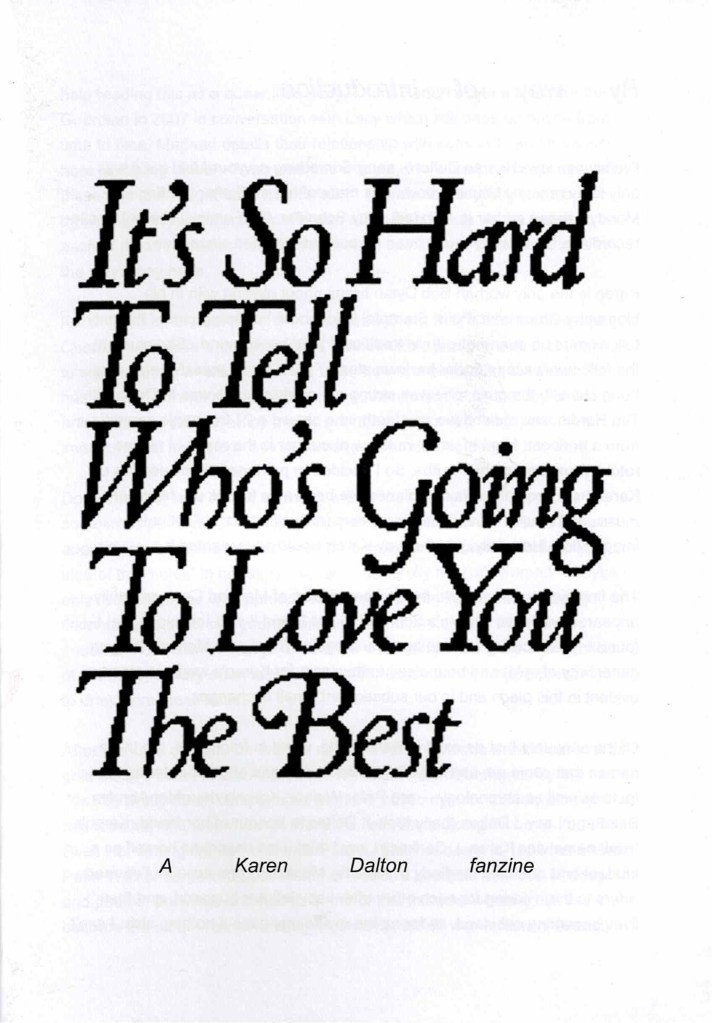
It was into this vortex of unbridled enthusiasm that a one-off, small-batch fanzine called It’s So Hard To Tell Who’s Going To Love You The Best came into my life. It was put out in the UK by an outfit (or person) called Cherry Styles, who also put out a Patti Smith fanzine and one called The Chapess, and who seem to have gone mostly dark and missing from the internet. I think it was maybe 2015 or so that this came out on Cherry’s own Synchronise Witches Press? I believe that Cherry Styles and her enthusiasms were very much borne of and furthered by the “Tumblr era”, an era which now seems to have passed. 

Anyway! It’s So Hard To Tell Who’s Going To Love You The Best is a “Karen Dalton fanzine”. It was accompanied by a cassette tape of murky, blown-out, proto-folk recordings by Bridget Hayden, one of our favorite discombobulating modern musicians here at FH HQ. That’s probably how I heard about it in the first place, though her music’s connection to Dalton’s is tenuous at best. The fanzine is a collection of tribute articles, poems, pieces of art and even a Bean Bread recipe (!), all in tribute to St. Karen. It’s a cool, personal, homespun, underground fanzine all the way. If you heart Karen Dalton, you’ll heart this fanzine.

You know what’s even better? The Karen Dalton documentary In My Own Time that was one of the very first films I saw in a theater after getting myself vaxxed & done. I’m not exaggerating when I saw that it’s one of my favorite music docs ever, right up there with The Decline of Western Civilization, Gimme Shelter, Be Here To Love Me: A Film About Townes Van Zandt and Dig!. See it! Then buy that 1966 LP, and then offer me up your No Mag collection in exchange for It’s So Hard To Tell Who’s Going To Love You The Best #1 and we’ll talk!

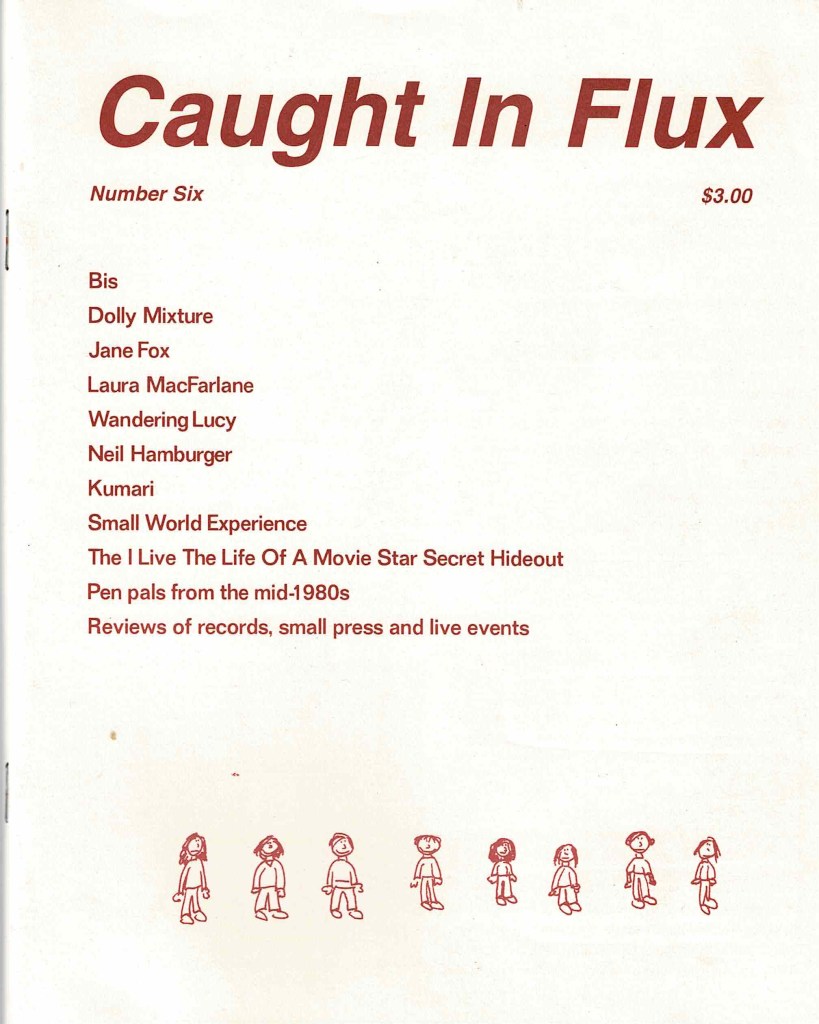
Caught In Flux #6

Mike Applestein’s a “lifer” in the wild world of music fanzines, straddling multiple decades of deep indie/insider fandom with Writer’s Block, Caught in Flux and the very recent Silent Command. (We talked about the latter here). Like a great many insular scribes, Applestein turned his attention to online writing as one century gave way to another, only returning himself to the glory of print in 2022. Because his focus was so heavily lasered-in on deeply obscure pop music and mine wasn’t, I’d really only skirted his stuff for most of the 90s, until getting to know him a little better as an “internet” writer later on.

Seasons change, people change and all that, and now, reading Caught in Flux #6 from 1997, I get the sense that Mike could make me one hell of a mixtape from all the weird nooks & crannies of the sub-underground pop world from that time, and now I’d probably like it. But so much of it is greek to me: Beanpole, The Cat’s Miaow, Honeybunch, The Softies, The Three Peeps. Singles and LPs that I rapidly flicked past because they were pink, or had cartoons, or the band were wearing dopey sweaters or whatnot. Or maybe they had names like this issue’s The I Live The Life Of A Movie Star Secret Hideout. And hey, I’m not saying I’d necessarily like any of it now. Sometimes I’ll do a deeper online dive into the indiepop world and come up with nothing but kelp and crud; and yet sometimes I’ll pull up a Jeanines or something equally wonderful.

Yet Mike and I definitely overlap on so much of the post-punk 80s stuff he’s been such a champ in championing: Young Marble Giants, which I already talked about here; but also this issue’s two jumbo Dolly Mixture interviews, which finally helped illuminate the mystery of why The Mo-dettes were consistently slagging them in their interviews, and just who the fetching Dolly Mixture track, “How Come You’re Such a Hit With The Boys, Jane?” was about. Among many other things, of course. Catching a band only 15 or so years after their time means memories are fresh enough to be recalled but also that wounds are distant enough to heal. And it’s really great to see an au courant 90s interview with mostly ignored Australians Small World Experience, whose Shelf-Life Siltbreeze reissued not that long ago.

There had been a really thriving set of fanzines tackling these worlds throughout the 1990s. I remember Maz from The Mummies had his pop magazine Four Letter Words; Tim Hinely plowed many of these fields with Dagger; there was (and still is) Chickfactor, of course, and I’m sure there were many, many, many others. All of them have much to teach us, but reading Caught In Flux #6, I think Applestein was really setting some of the terms for the scene here, and expanding it to encompass a pretty healthy variety of micro-genres. He’s still got a few available here. Guess where I got mine.