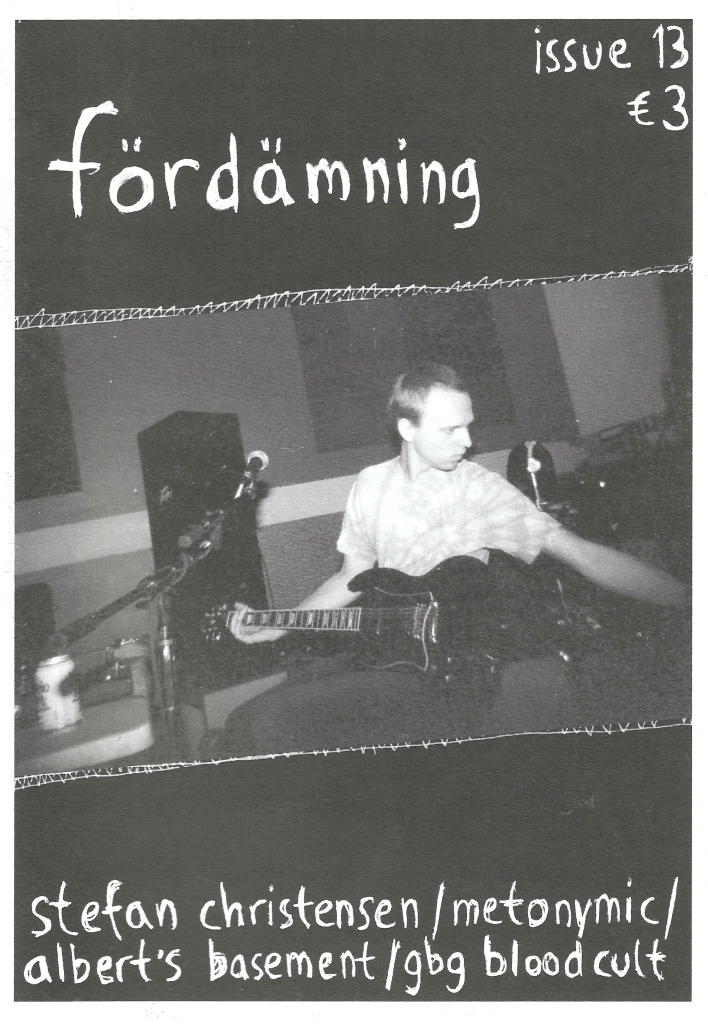
Fŏrdämning #13

It would be fair to say that I was personally quite heavily under the sway of this fanzine during the years 2015-2019 or thereabouts. While I’d been tentatively marinating in strange, low-fidelity, experimental and murky noise musics a bit for some years, I credit Matthias Andersson’s Fŏrdämning for helping give me the language with which to rank & order it, along with a host of intensely underground bands and artists to check out. My record collection and my podcast at the time absolutely were the better for it. I can’t say he’s for certain the exact person to turn me onto Stefan Christensen, Neutral, Sarah Mary Chadwick, Blue Chemise, Drunk Elk, Enhet För Fri Musik and others, but I’m pretty sure he’s the fella. 

My relationship with difficult, rock-adjacent music can sometimes be fraught, as I still set a higher bar than some of my peers might for repeat listenability, and I can get pretty easily triggered by the circle-jerking of the collector/fanzine underground over records & tapes of questionable merit. I once did all sorts of online scouring for mp3s of the New Zealand lathe-cut 45s Andersson raves about issue to issue, as well as the back catalog of the Metronymic label, written about here in Fŏrdämning #13. I found most of what I was looking for, but I also found a ton of formless, pretentiously unconstructed noodling given a smudgy, low-underground sheen through anti-production. But was it shit I’d actually listen to again? Come on. 

As I wrote about a few years ago, the Swedish Andersson was creating Fŏrdämning in his second language, English, like a goddamn native-tongue speaker, while also navigating the distribution challenges and high shipping costs that I’m sure were more acute in his Gothenburg than in my San Francisco. Yet the breadth of this small thing is pretty phenomenal, and he’s on top of every exciting micro-artist creating strange & enveloping DIY music in this year of 2017. Cover star Stefan Christensen, for instance. He’s a gifted shape-shifter who came out of conventional loud garage rock music (Estrogen Highs), discovered New Zealand’s fertile back catalog, and himself began crafting these exquisitely noisy and flummoxing records that I truly can’t get enough of. He’s a big favorite in this household, and I thank Fŏrdämning for being such an enthusiastic champion of his that I couldn’t help but getting on the bus with them. 

Fŏrdämning #13 also explores the great Australian DIY label Albert’s Basement, run by Michael Zulicki. It’s a short interview, but it cuts a little meat off the bone as to why this oddball pop label is worlds different from the rest. Andersson says in this issue’s intro that people have been “complaining” that he’s straying too far from coverage of pure, unadulterated noise, so he tosses them a bone here with Eric Nystrand’s overview of the Gothenburg Blood Cult label’s tapes. I mean, even here there are descriptions that totally propel me out of my chair toward the computer for further investigative research: the Vårtgård tape from 2007, described as “a huge heaving and patiently swelling mass of moist rot….feels like slowly being force fed dung while sewer rats flop their hungry tongues in your ears”. Do I dare?? It’s been nineteen years now; is it sometimes better to let these things stay buried?

You may or may not know that Matthias Andersson was also concurrently running the I Dischi Del Barone record label at this time, which pretty much acted as the aural representation of this fanzine: limited-run, bewildering music from some of earth’s best and most obscure artists. That morphed into Discreet Music, very active to this day. He turned these passions into a career of sorts, and you can see it all germinating in Fŏrdämning, should you be fortunate enough to stumble upon a copy or two.

Fŏrdämning #11

Even in my ripening older age, I’ll still find myself hitting these exciting musical-discovery inflection points in which entire worlds open up, and I spend an inordinate amount of time frantically collecting, downloading, studying and of course listening to sub-genres I’d neglected. 

It’s usually through the influence of one or more curators, whether that person is a friend, a writer, or a “disk jockey”. There’s the friend – several friends and correspondents, actually – who sent me deep down a dub rabbit hole when those incredible Blood & Fire CDs started popping up in the late 90s. There’s Erika Elizabeth’s Expressway to Yr Skull WMUA radio show, which I listened to religiously circa 2010-13 and discovered an appreciation for music (to quote myself) “…at the perfect intersection of deep-underground pop; 70s-80s British DIY and post-punk; 90s shoegaze and twee (stuff from lost 45s and cassettes that no one’s heard for two decades, I’m serious); garage punk; and a lot of noisy girl-helmed bands that had been lost in a patriarchal fog of several decades of disregard.” In fact I probably started the Dynamite Hemorrhage fanzine in 2013 because I’d been so re-invigorated by this particular radio show taking place across the country from me, and for the first couple issues she was the only other person I’d allow to write for it, so indebted was I & so complete was my trust.

Then there’s Matthias Andersson’s Fŏrdämning, easily one of the finest fanzines of the 21st century. He wrapped it up a few years ago, yet in 2017, when Fŏrdämning #11 came out, I could feel my own tastes and tolerances expanding simply by virtue of Andersson’s heavy influence. As I read his dissections of modern and past experimental, noise, and rock-adjacent (sometimes barely) sounds, I developed a much deeper appreciation for the weirder edges of the sub-underground, and my own podcast and fanzine evolved accordingly during the mid/late 2010’s (i.e. a few years ago). It turned out that as Matthias was moving somewhat closer to more rock-oriented sounds – i.e. he talks about his admiration for The Suburban Homes and Cheater Slicks in this very issue – he was helping me move closer to his personal original starting point in noise and formless free-form not-even-music. If it weren’t for him, I’d have known nothing about Neutral, Leda, Amateur Hour and Enhet För Fri Musik, for instance.

Fŏrdämning, you may not be surprised to find out, was a Swedish fanzine, albeit one written in perfect English. Better than perfect, even, in that there’s nothing stilted nor dumbed-down in the least, the way some English-language fanzines emanating from the European continent have often been (and listen, if I tried to attempt a fanzine or even a paragraph in Swedish or any other language, it would easily be the worst thing you’d never read). 

From his perch in Gothenburg, Andersson celebrated his collector obsessions, yet in a manner not at all redolent of the stench that can often emanate from the mania of collecting. Fŏrdämning #11 opens with an essay about a beautiful year at his local record store in which a nameless collector has unloaded an insane collection of Fŏrdämning-approved gems: New Zealand 90s lathe cuts; Majora 45s; the Siltbreeze back catalog; Flying Nun rarities; Urinals and Fall singles, Twisted Village records and so much more. The essay is about how Andersson and his pals frolic in the abundance and in their amazement at their own good fortune. It’s the stuff dreams are made of – no seriously, my dreams. You can actually read the piece here.

This intro serves as a prelude to an issue that focuses on micro-labels of the past, including Bill Meyer’s Roof Bolt, Mike Trouchon’s gyttja, and two noisy tape labels I wasn’t familiar with: Thalamos and Vigilante. Roof Bolt was a terrific – and terrifically unsung – 1990s American  label focused on New Zealand that put out fantastic Alastair Galbraith, Roy Montgomery and Terminals records, along with the only 45 ever from Brown Velvet Couch, a total high-water mark of the NZ underground. Andersson also carries on his back-page column about lathe-cut records “Speaker Crackle In The Garden”, which this time focuses on Sandoz Lab Technicians. In the reviews section, there are the exact reviews that turned me on to Stefan Christensen and Blue Chemise. A top-drawer issue all around.

You should also know, if you don’t already, that Andersson is the fella behind the I Dischi Del Barone, Fördämning Arkiv and Discreet Music labels. He’s been on a hell of a run the past decade.