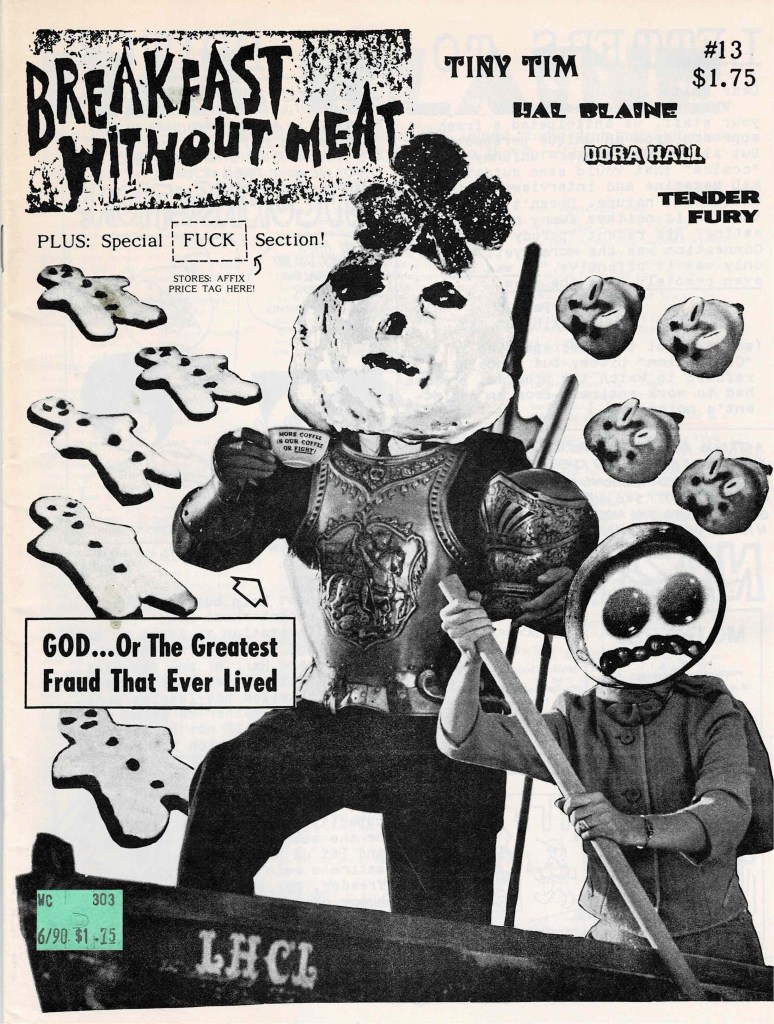
Breakfast Without Meat #13

Gregg Turkington finally got something approaching his “due” – at least as it regards his pre-Neil Hamburger career of obtuse pranks, sonic terrorism and his left-field retro-cornball aesthetic – in the new Who Cares Anyway – Post-Punk San Francisco and the End of the Analog Age book. I supplied my thoughts on the book itself here. His true introduction to the world, such as it was, came in the pages of his and Lizzy Kate Grey’s 80s/90s fanzine Breakfast Without Meat. Derek Bostrom, of the Meat Puppets, was also a frequent contributor. We’re going to talk about Breakfast Without Meat #13 from 1990 here, as it’s the only issue of the mag that I own.

I always admired those on the west coast and elsewhere whose favorite “punk” bands circa 1981-82 were Flipper and The Meat Puppets. They zeroed in on something that the rest of us didn’t about the total absurdity of hardcore. My cousin – who loved other, more true hardcore as well – was one of those, and he helped turn me on to a worldview that put these two bands at the top of some imaginary heap where comedy, nihilism, mockery and a total shitstorm of sound all work together beautifully. These were (among) Turkington’s heroes as well, and the book makes it clear that he was partially raised at Will Shatter’s knee, more or less. Shatter’s actually in this one, in a strange UFO graphic, and like I said, Bostrom has his thumbprints all over Breakfast Without Meat #13 as well, including his interviews with Hal Blaine and Tiny Tim!

The Hal Blaine interview in particular is a gas, while also being quite illuminative about the 60s, session musicians and just how omnipresent Blaine and his Wrecking Crew were on so, so many sixties records. My favorite quote is vis-a-vis Dennis Wilson of The Beach Boys and how Blaine was the studio drummer on their recordings: “A lot of people ask me, didn’t the drummers of the groups hate it? Actually they didn’t, because as I’ve said in the past, when I was making thirty-five dollars for a session with the Beach Boys, Denny would be making thirty-five thousand somewhere. And that gave him time to surf, ride his motorcycle, and play with his boats during the day.”

So that’s the relatively serious side of Breakfast Without Meat #13. Most of the remainder brings to bear the same sort of bizarro-world approach that characterized Great Phone Calls, Neil Hamburger and the Zip Code Rapists, like this “Top 20 of The Decade” – “for the decade ending Dec. 20, 1902”. Or “Gobo’s Breakfast Record Reviews”, which use a key in which you “match the codes listed after each title with its corresponding comment in the opposite column”, most of which savage the promo releases in question. 

There’s even a preposterous in-person interview held by Grey and Turkington with “Tender Fury”, a horrible post-TSOL band with Jack Grisham whom I’d 100% forgotten even existed. They are mostly flummoxed by questions like “What book would you give a newborn baby?”, “You live in LA, who really killed Marilyn Monroe?” and “If the most popular person in high school had a locker next to yours, how long would it take you to introduce yourself?”, although, to their credit, they do try to answer everything in earnest. The ensuing conversation, even from a bunch of dullards, ends up being more entertaining than most anyone I’ve ever interviewed with my boring name/rank/serial number questions about their “music” and “influences” and whatnot.

To my discredit, I passed up quite a few opportunities to buy issues of this when it was around the San Francisco Bay Area in the late 80s, and now I can’t go back to Rough Trade or Reckless or Aquarius Records to buy them. So yeah – if you’d like to make a trade or something, you’re more than welcome to check my fanzine want list, and if so, I’ll gladly share my fanzine have list with ya.

Surrender #5

For most of the 1990s and 2000s I fashioned myself as a small-l “libertarian”, politically. As such, my magazine of choice was Reason, and I read it with the zeal of the recent convert, which I was, until I wasn’t. Occasionally my punk rock & underground music world would overlap with the political libertarian world, like at the 1992 party I once attended with my “rock friends” where I somehow connected with an LA-based kook who (like me) idolized Reason editor Virginia Postrel, and whom I ended up talking “free minds and free markets” with for like two hours – then never saw the guy again.

Brian Doherty was one of the editors at Reason back then, and he still is (!). He was also the editor of a mostly-music, Los Angeles-based fanzine called Surrender (“A Journal of Ethics”). I personally exited the libertarian fold completely maybe 10-12 years ago, as I (finally) developed a much bigger appreciation for government-provided safety nets and a greater, less heartless appreciation for my fellow man and his/her basic needs that hadn’t been well-served by an approach that mostly valued capitalism over that of humanism. Doherty – well, I’m not really sure where he stands overall these days, and his take on “the issues” is fine by me regardless. He’s always been a strong thinker, writer and has long had just enough of the “whiff of the weirdo” to make him a truly interesting dude. 

Surrender #5 proves this in spades, although it’s a bit impenetrable in parts. The core of the issue is an astronomically long conversation between Doherty and Gregg Turkington, at the time the proprietor of Amarillo Records, a member of the high-concept band Faxed Head and a guy just getting his alternate-world comedy career underway as Neil Hamburger. I say “conversation”, rather than interview, because that’s exactly what it is – two guys breaking bread over a meal, discussing The Beach Boys, Richard Nixon, prank phone calls, Paul McCartney and of course Turkington’s cornucopia of surreal projects. 

“Neil Hamburger” at this point was just a character in a series of goofy fake stand-up comedy 45s. Turkington is asked if he’s ever done a live performance as Neil Hamburger, and replies “No. ‘Cause it wouldn’t be the same….if you did a show, all these people would come out who liked the records and they’re just gonna bait me, they’re gonna scream for favorite hits…it’s just gonna ruin it, ruin it completely, y’know?”. As it turned out, that’s pretty much exactly what happened when he eventually did perform the character live (and then built a career out of it in the process), before he figured out how to turn the crowd’s bleatings into an on-stage weapon. If you’ve never heard Hot February Night, I highly recommend it.

Surrender #5 also has a “Review Essay” on Turkington’s works on vinyl, along with a separate essay on Teen Beat Records. Doherty went to college in Gainesville, FL and reminisces about “the music scene” there, the same sort of watery-eyed nostalgia BS I’ve reserved for Isla Vista, CA, circa 1985-89. Best years of our lives and all that. What really sets Surrender apart from its, um, competitors of the era is Doherty’s extensive book reviews, which are erudite and strange, and that document an omnivorous appetite for the offbeat and the unorthodox. By this I don’t mean he’s reviewing stuff from “Re/Search” or whatever, thank god, but science fiction, Borges, Gore Vidal and a whole bunch of Milton Friedman books. We learn that Doherty’s currently reading all this stuff from “Uncle Miltie” – as my conservative dad calls him – because he’s writing a book, a book which eventually became Radicals For Capitalism, a book that I would myself eventually read and enjoy.

This strangely compelling read closes with an inexplicable back cover photograph of the journalist James Fallows, just because. That’s the sort of fanzine Surrender was. I’d love to find copies of his other issues.