NY Rocker #18

I’ve recently come into a gaggle of older issues of NY Rocker, and thumbing through them, I’m even happier about my minor acquisitions than I’d thought I’d be. At least on the evidence presented by NY Rocker #18 from April/May 1979, this not-really-a-fanzine tabloid newspaper was even better in its earlier years than it would be a couple years hence. I’ve talked about issues from that later era here, here, here, here and here. And I’ll talk about other ones that sprang from ‘79/’80 in the weeks to come, as I traverse them. This shall take time. For now, let’s see what was happening in the world of underground NY/LA/SF/London during the Carter years.

First, there’s Howie Klein reporting from San Francisco. Sigh. I can’t throw a stick at a fanzine from this period without encountering the guy. If you’re not a Clash fan, and I’m not, it’s hard to wrestle with hyperbole such as Klein’s blather when he sees their 2/7/79 show in San Francisco: “This was undoubtedly one of the best shows ever seen in the Bay Area…..”. If you don’t know which side of the true punk vs. corporate schmuck divide Klein stood on – or at least which side he was (rightly) perceived to be on – there are these gems from the same piece: “Rock super-promoter Bill Graham – the only major concert promoter in the U.S. to give strong and consistent support to the new wave…” (Bill fucking Graham!!) and dissing the grass-roots punk/all-ages organization called New Youth who got The Clash to play this cheap, for-the-people gig in the first place. “…the band (got) involved with New Youth, a group of mostly idealistic (like starry-eyed at best, and in some cases, simply psycho) young fans who believe in non-profit punk rock gigs. So they got The Clash to commit themselves to doing a benefit for them at a deserted Jewish synagogue between the Peoples’ Temple and the Old Fillmore in the heart of San Francisco’s black ghetto. A cheap ticket price and the opportunity to see the band in an unseated funky venue…caused a dramatic slump in ticket sales in what should have been the band’s biggest and fastest sell-out. As it turned out, The Clash came pretty near to selling out anyway….but not before a lot of rock-biz upset between the Graham Organization, Epic Records and Tapes and the William Morris booking agency”.

The horror! You can see the sort of scene mechanics that actually stressed Klein out in 1979, and why he ended up being so utterly reviled by music-focused underground aesthetes at the time, unfair as it perhaps may have been, considering one’s perspective and degree of oppositional defiance.

More irony abounds in a Sandy Pearlman interview – he produced The Clash’s Give ‘Em Enough Rope – “The Clash themselves will do virtually nothing to make it. In other words, they will not accommodate themselves to the rotten, debased, commercial system of exploitation that currently exists. The Clash do not wish to make any compromises”. Totally! On the flipside is a paean by Doug Simmons to truly underground Boston band The Neighborhoods and their singer David Minehan. I didn’t much care for the band, once I finally heard them, but my 9th grade best friend Jon Grant had just moved to San Jose from Massachusetts, and his brother had been close friends with Minehan. I’d hear all about The Neighborhoods from Jon, and seriously, I felt pretty special at age 14 knowing a guy who had a brother who was friends with a guy in an actual performing punk band that I’d never heard.

Oh, and the Beach Boys stuff in this issue is just fantastic. There’s a Greg McLean interview with Carl and Dennis Wilson of the Beach Boys, as well as a Harvey Kubernik sidebar about a recent BB book. McLean clearly isn’t a fan of Dennis Wilson: “his frequently crass and unexpected comments often cut Carl off mid-sentence, and he dropped the name of his new girlfriend, Christine McVie, whenever possible”. McLean retaliates and agitates them by only asking questions about Brian Wilson: where is he, tell me more about Brian etc. This does him no favor with the brothers. Dennis says, vis-a-vis the Dr. Eugene Landy thing, “Brian is loved dearly by all of us and us by him, and all that bullshit about him being manipulated is just….not in my experience…”. McLean then goes on to bait them further about Mike Love being an asshole (a certified fact, from what I understand), and then talks about a Beach Boys show at Radio City Music Hall in ‘79: “Between songs, Love babbled aimlessly, killing any sense of pace the show might have established. Mike Love looked old and foolish”. Everyone loves Mike Love, don’t they?

So this issue is absolutely packed, and I could write reams about each piece – but there are like, 20 pieces: The Shoes; a thing on young Boston and NY radio DJs and stations; Viv Stanshall; The Raincoats; The Only Ones; and a really early piece on The B-52s, circa their Rock Lobster 45, with great photos of a very young band and an interview by editor Andy Schwartz. Even so, NY Rocker would sometimes give space to mainstream music-lovers like Ken Barnes. He writes a thing about how much he loves disco, even in 1979 (the year of Disco Demolition Night), and says, perplexingly, “It seems to me that a lot of people are quite scared about disco, and they’re lashing back with unreasoning venom. An interesting observation by Mark Shipper pertains here – for years during the 70s rock lull, all the right fanzines clamored for the return of fast, exciting beat music kids could dance to. Now it’s here and kids dig it…but because it doesn’t follow the form the clamorers grew up with, they’ve turned on it viciously. Ironic, wouldn’t you say?”. I mean…..that’s one way to look at it?

Finally, and I feel like I’m skimming here, but there are great reviews of recent “rock concerts” by The Contortions, Nico, The Knack (who are absolutely buried by Don Waller), and The Ramones with their special opening band Lester Bangs’ Birdland. NY Rocker #18 comes to an outstanding close with Jeffery Vogel’s fake “TV Guide” listings that shit mercilessly on every upcoming show and on every NY band – especially the Dead Boys. Now that’s some vitriolic mirth-making that we at Fanzine Hemorrhage can get behind, anytime & anywhere, even from 46 years ago.
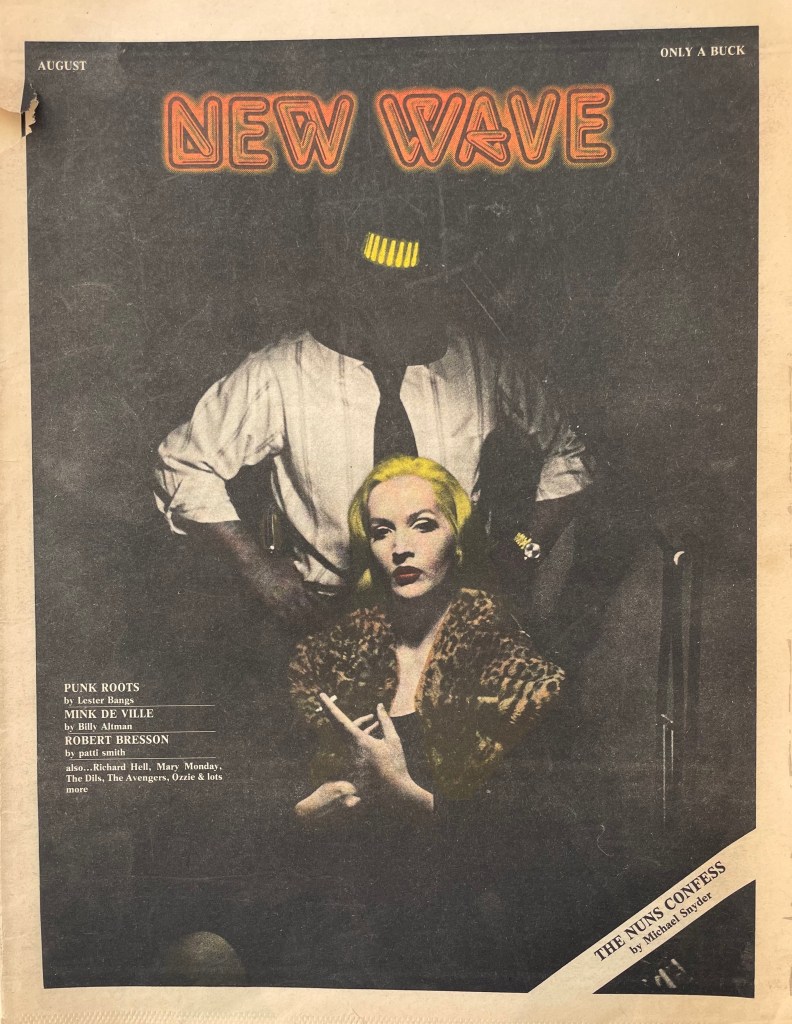
New Wave #1

This, for lack of a better term, is a “my cup runneth over” fanzine from 1977. It’s somewhat amazing to even be allowed to look at it. I was not aware of the existence of New Wave #1 until I found a way of procuring a copy on eBay – nor was I aware of the absurdly great bounty within it, save for a drunkenly-written Lester Bangs piece about punk that ended up being sadly uneventful once I actually read it. 

I’m 99% sure that this is the only issue of this San Francisco-based newspaper-style fanzine ever created, and I’m just as assured that a 1-issue run was not at all what the editors had intended when they excitedly put this together in August 1977. (For instance, in the back there’s a plea for subscribers. $9.50 for 12 issues, plus your choice of either The Ramones’ Leave Home or Tom Petty and the Heartbreakers). Who were these editors? Proving that he was in fact ultimately useful for something, the main editor was Howie Klein; the associate editor was Steve Seid, about whom more later.

Excited is definitely the word. We’re into punk pretty early here: the long-awaited and much-prophesized rocknroll revolution is finally here, which doesn’t stop many of the big-name rock writers assembled from sneering about punk anyway, Bangs included. As it should be. Where do I start? How about with some of the bigger names: Billy Altman writes about Mink Deville, and Richard Meltzer gets his own column on jazz: “Bebop on Your Mama”. It’s really funny, actually, and full of his patented discombobulated snark. He even saw Dizzy Gillespie play live that year. Patti Smith pens a mostly unreadable poetry slam-type thing on Robert Bresson that I’d probably have sent back to her for rewrite (“come on, Patti, I know you can do better”). 

Loads of excitement and hot gossip in the San Francisco, LA, NY and UK scene reports. LA’s is by Gregg Turner, he’d go on to do an almost identical column in Take It! in the 1980s. An “Amy G” is mentioned in the SF column; she’s a “former punk of the month” who has just moved to Memphis. Would this – be still my heart – be Amy Gassner, who’d join The Klitz in Memphis?? Gotta be, right? If you’ve never heard her 1979 rendition of “Brown Sugar”, which was recorded “under the influence of hog tranquilizers” and absolutely sounds like it, you’ll need to do so right now. And if you have a copy of that record and need to part with it, please get in touch.

Maybe my single favorite page in New Wave #1 is the one compiling some instant-reaction crowd interview snippets after Crime’s June 18th, 1977 show at the Mabuhay Gardens; this includes quotes from Jean Caffeine from New Dezezes, Britley Black (sic), who’d later join the band; Don Vinyl and Michael Snyder, the latter of whom was an SF rock critic I think at the Chronicle, back when daily newspapers actually had multiple in-house rock critics. Also in various spots throughout this magazine is talk about how Jennifer Moscone, the Mayor’s kid, is going to punk shows at the Mabuhay. Sheriff Michael Hennessey was into punk, too, and he used to regularly show up at the Mab. 

There are too many other features for me to go deep into: Cheap Trick, The Dils, Avengers, Nuns pieces; the only one on Ozzie from Sacramento I’ve ever seen; a Mary Monday (!) article plus a centerfold; The Negatives, a Richard Hell interview and more. There’s a country music overview by Ed Ward that tries to tie modern country outlaws like Johnny Paycheck to punk, rather unsuccessfully. And the capper, the thing that just makes this a chef’s-kiss A+ fanzine in my book, is the Steve Seid film column, “Enter The Avant Garde Surfers”. It calls out genius films like Payday and The King of Marvin Gardens and Three Women, among others, and is essentially a paean to how utterly amazing 70s American filmmaking was up to that point. Seid realizes he’s living in a golden age, and is essentially admonishing readers that they ought to realize it as well. Alas, “Star Wars”, a popular children’s film that helped to quickly bury major-studio risk-taking, was released more or less as this magazine was being written. Seid was not to know, but one of his cultural worlds was ending just as another was excitedly being born.

New Wave Rock #3

The eternal question – “is it punk or is it new wave?” – has never seemed as urgent nor as befuddling as it does on the pages of New Wave Rock #3 from February 1979. Those were different times, were they not? I’m just old enough to remember how confused mainstream journalists and record companies were in trying to get ahead of it all. The latter did everything they could for a very short time to market anything that wasn’t nailed down as “the new wave” or as “modern music”. If you didn’t “catch the new wave”, right now, you were at serious risk of becoming dangerously out of date. You probably ought to buy this AC/DC or this Rachel Sweet album just to make sure that didn’t happen.

I remember Nick Gilder’s “Hot Child in the City” was commonly thought to be new wave, at least at my elementary school – but man, Tom Petty is a real stretch. Even the guy assigned to do this piece in New Wave Rock #3, Michael P. Liben, is a bit taken aback: “When I was asked to interview Tom Petty, I had one nagging thought: Is he new wave? Granted, the press has labeled him new wave (spelled p-u-n-k), but superficially I had my doubts.”

It follows that this magazine is very hung up on such questions – punk vs. new wave, or neither at all – and I swear it comes up in every single piece in one form or another, whether it’s an interview with Mink Deville or Howie Klein’s San Francisco scene report. Such was the tenor of the times in early 1979, at least in the offices of Whizbang Productions, the outfit that put this glossy magazine out (later in the magazine there are ads for some of their other fine creations – a King Elvis giant pictorial tribute to “The King”, and a KISS Meets The Phantom: Superscoops From The 1st KISS Movie! magazine.

I believe only three of these came out in total. #1 had Kiss on the cover; #2 had Bruce Springsteen and Patti Smith. I come here not to bury but rather to praise New Wave Rock #3 – it’s a fantastic artifact, even for real-deal punkers who were reading Slash and Damage at the time. Leaving aside the “Richard Meltzer’s poetry” two-page spread, there’s also a Lester Bangs piece about when punk really started; how he was on the front lines of it all from day one with The Stooges, Velvet Underground and MC5 (fair enough); and how this vaunted second wave of punk has a big whiff of deja vu for him. Again, fair enough. The 29-year-old Bangs also rips into the “young” editors of Punk magazine, Legs McNeil and John Holmstrom and whatnot, for their ultra-orthodox stance on what he should be allowed to listen to, i.e. nothing outside of their narrowed box of 1976-78 punk. This is Lester Bangs we’re talking about, kids!

Photos in this one are amazing, and many of them I’ve never seen elsewhere. Beautiful ones of Mark Perry, Peter Laughner, Only Ones, The Screamers, The Zippers and NY Scene report “Bowery Babylon” columnist Rusty Hamilton (holy smokes!) – as well as hideous ones of The Dead Boys and The Runaways, including a soft-focus centerfold of the latter, mere moments before they were about to break up. There are four big scene reports: SF, LA, NY and London – which I reckon makes some sort of sense. Paul Grant, a guy I used to see at every Lazy Cowgirls show in Los Angeles circa 1987-89 and who’d often be the one to do a big windup & intro of the band before they started playing, wrote the LA one. 

Howie Klein’s SF one has a few choice bits of gossip, erroneous and otherwise. First, there’s the lament about rock station KSAN basically banning new wave from the airwaves. I distinctly remember the howls of anguish a year later when this once-freeform station changed formats completely to country music in 1980 to try and ride the “Urban Cowboy” phenomenon. Klein also tells us that Jefferson Starship’s Paul Kantner went to see The Avengers to see if Penelope Houston might be a good candidate to replace Grace Slick in the band (oh come on). There’s a bit about the “Nix on Six – Save The Homos” punk benefit at the Mabuhay Gardens attended by Harvey Milk a mere two months before he was killed (his November 1978 assassination clearly happened before New Wave Rock #3 went to press, as he’s referred to in the present tense).

I could absolutely go on, as I tend to do. It’s a terrific time capsule that hovers somewhere between corporate rock mag and gritty fanzine. I googled New York’s Whizbang Productions and really came up with nothing at all – perhaps a reader can tell us what their deal was, beyond what I’ve discerned myself in this post? Our comments are always open for your input.