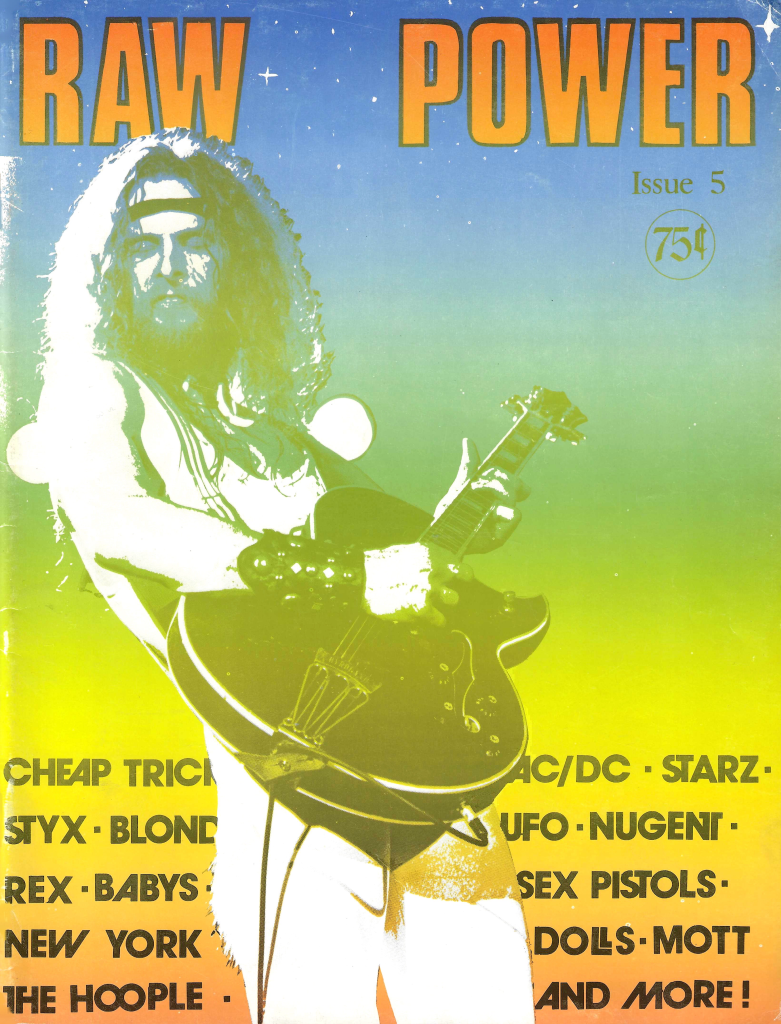
Raw Power #5

It’s been a little quiet around the Fanzine Hemorrhage blog for a few weeks, I’d reckon. This probably has something to do with me trying to modulate my reaction to just how badly I hate the internet in late 2025. I wrote a short essay about it called Opting Out Of The Rot Economy that you’re welcome to read, and perhaps take inspiration from. But there’s nothing in there that necessitates throwing the baby out with the bathwater and quit publishing entirely. This is the baby; social media is the bathwater, and that I’ve thrown out – so these posts won’t be promoted anywhere. They’ll just show up in your inbox if you’re subscribed – which you can do on the desktop version of this site rather easily if you haven’t already. If you’re not, they won’t, and someone will have to tell you about them, perhaps by calling you up on your telephone or by knocking on your door to spread the news.

The guys who put out Raw Power #5 in Spring 1978 effectively had just those means for getting the word out, aside from dropping them into LA-area stores and getting blurbs in other folks’ fanzines. These was effective methods in 1978, given the growing number of underground American fanzines taking off in the punk era and the fact that record stores were literally everywhere, and the cooler ones even carried fanzines. But if you’re putting Ted Nugent – the fucking Nuge – on your cover, you’re not really aiming to have Kickboy Face of Slash’s endorsement, or perhaps it’s even still too early to care. After all, these guys say that Raw Power is “For REAL ROCK ‘n’ ROLLERS ONLY”. If it’s loud and has guitars, it’s fair game.

The editor was a young man named “Quick Draw”. His real handle was Scott Stephens. He’s excited about “the new bands” in his opening editorial, but a little upset as well: “The only qualm I have at this time is the way the kids are branching off into little clicks. A lot of new wavers are down on bands like The Stones and The Beatles. It’s becoming very fashionable to hate the 60s”. I’ll say! “It’ll be funny to me in 10 years when I hear the new generation putting down the 70’s. And believe me, it’s gonna happen. Things that are cool now won’t be cool in 1985”. I don’t know about that. I like the use of “clicks” instead of “cliques”, which I say is forgivable, because it’s one of those words you’d hear spoken way more than you’d see written back then. But I don’t remember much ragging on punk or the new wave or power pop in 1985 – despite my belief that that was kind of a lean year for rock music, it was a year when punks were turning metal en masse, and everyone still hated the same things about the 70s that most of us hate to this day (though I’ll admit the recent reverence for prog did take me by surprise). 

Of course, I love quoting ancient editorials both here and elsewhere. There’s another by “Mike Livewire” stating “This year has certainly been one of the best for rock and roll that I can remember. Sterile FM ‘rock” and discoshit suffered some setbacks at the hands of the Rockers in 1977”. He even R.I.P.’s Peter Laughner later in the column! 

Al Flipside writes in from Whittier and has a little tete-a-tete with Quick Draw about the modern relevance of Iggy Pop. There’s a nice Mott The Hoople history, a quick interview with Debby from Blondie – whom the editor addresses as “Blondie” on the phone and asks her (of course) about being a “sex symbol”, the term we used back then for someone of well-above-average attractiveness. I’m not sure the last time I heard it used, but it’s been a while. There’s an interview with Tommy Shaw from Styxwhat? Howard Aronin has a pretty bleak comedy column reviewing phony records by real bands, through I almost cracked a faint smile at the idea of Kissongs by Kiss, a la Yessongs

I did crack a true faint smile at this rant from Kim Fowley at the start of his interview with Raw Power #5: “I am the king of punk rock. I am the Adolf Hitler of stink rock. I am the rock n’ roll dog man. I don’t care what Slash magazine, I don’t care what Greg Shaw, I don’t care what Rock Intellectuals say. Fuck you all. Why? Because I am teenage. I am cobra. I am garganchua. I am an asshole, but I can say that and you can’t. The only reason I’m in business is because of the money I make and the dirty girls I meet, and eventually the amount of power I will have”. He hates The Dils, but thinks “The Weirdos and Screamers are interesting because they want to be interesting”. Wait, all you have to do is want it? Why didn’t someone tell me all these years?

I tried to get excited about the Ted Nugent interview, in which Ted tries really hard to be an unhinged wild man, but at the end of the day, he wasn’t one-tenth as much fun of a pompous narcissistic asshole as David Lee Roth was in his interviews, and Ted’s music was far worse as well. There’s a brief feature on AC/DC (“AC/DC: Austrailia’s Amazing Punks”, spelled as I typed it) and an interview with Angus Young. The reviews section is, like I said, all about white guys who play loud guitars, no matter the genre: Rush and Sammy Hagar and The Ramones and Metallic K.O. and New York Dolls reissues and Nazareth and Ultravox and The Babys. In their Weirdos Destroy All Music review, they say “I wish the Weirdos would record some of their other songs, especially “I Dig Your Hole – I’m The Mole’”. What now? Who knows this song?? Not me. I’d like to hear your bootleg of it. 

Finally, there’s a brief column tracking the improvement of The Germs – “they’re not the world’s worst band anymore….but they still aren’t great”. And hey, here’s something I didn’t know before today: there’s an incredible archive of Raw Power issues online, as well as all sorts of information about an upcoming book project; a forthcoming seventh issue; backstories on the contributors and much much more. Go get lost in it, right now!

Who Put The Bomp! #13

Except for the couple of times I’ve written about fanzines that a friend personally xeroxed and assembled for me, my rule here at Fanzine Hemorrhage is to only blather on about zines I personally own. So, while I’m absolutely long in the proverbial tooth, that’d negate stuff like Who Put The Bomp! #13 that came out when I was seven years old; unless, of course, I went and paid some large multiple of its Spring 1975 $1 cover price in order to own it – which is exactly what I did. As discussed last time we looked at Greg Shaw’s fanzine, my goal is to try and hunt down as many of the pre-punk issues of this as I can find and/or afford. Recently, this one came into my hands, and I’d like to tell you about it.

I don’t know about you, but I have a weird fascination with what rock & roll nostalgia looked like for folks when rock music was not even two decades old. Elvis, Charlie Feathers and Carl Perkins were still alive. Even Keith Richards was still alive. So Shaw’s big thing here on the rockabilly revival is kind of a hoot; many of the late 50s/early 60s 45s are being dug up for the first time and thrown out into the world on cheap-looking compilations, and “record collecting” is really starting to become a thing as a result. Shaw talks about it in detail. You’ve seen some of these comps before; they’d look like this and used today they sell for about what they did new back then.

Of course, Happy Days was something of an instigator of all the 50s nostalgic hullabaloo, but what I’m more interested in is what record collecting looked like in 1975. Set sale lists, painstaking discographies with catalog numbers, and man oh man – the sorts of mind-melting finds in record stores that guys like me only dream about in 2024. Can you imagine having a 60s punk 45 want list and stumbling across all the original singles for a buck or less, the monsters that’d come out on the Back From The Grave comps ten years later? Anyway, if you were that guy – and you were almost certainly a guy – Who Put The Bomp’d certainly be required reading. 

Greg Shaw, an eternal optimist, surveys the world of rock music in early 1975 in an opening editorial, and sees that “70s rock is reverting to a 60s pop aesthetic”. His entire essay pushes against a narrative that 1975 is just as godawful musically as 1971 was, and hey, depending on one’s perspective, I suppose he was probably correct that “good times” were on the way. I’m just not sure it was a Beatles-esque 60s pop aesthetic that would lead the way in 1976-77. And honestly, looking at the record reviews in Who Put The Bomp! #13, it all just seems super grim to me, warmed-over glitter and boogie and pub rock. There’s a great review of the first AC/DC single, a total laff I’d never heard, and which you can watch an early video of here (do it!). He says “Their similarity to the early Easybeats is startling”. 

He also reviews the debut King Uszniewicz & His Uszniewicz-Tones 45, and of course totally gets it and loves it to death. There’s a big piece on Michigan sixties rock, including a discography of A-Square records who put out MC5 and Rationals singles, and a related bit on Bob Seger, where I learned to my surprise that he did the original of the Lazy Cowgirls“Sock it to Me Santa”, released by Shaw’s Bomp Records nine years after this fanzine. Seger’s B-side was called “Florida Time”, “the only known song to glorify Florida’s surfing scene”. You might need to listen to that too

Here’s another fun peek at the 1975 vantage point: Shaw writes that “The MC5’s best song, ‘Black to Comm’ was never recorded”. By the time I got into said band around 1985, that particular song had such the underground cache, total holy grail music that everyone wanted to hear. I’d wildly imagined this crazed, long, howling guitar blowout that’d be “Rocket Reducer” x100 and the total personification of “dope, guns and fucking in the streets”. Big disappointment when I finally did hear it, a fun rave-up but a huge sonic drop off from “Sister Ray” and “Fun House/LA Blues”. The MC5 never really had one of those, did they?

The single best thing in Who Put The Bomp! #13 is “The Rise & Fall of The Hollywood Stars”, written by Kim Fowley, and who happened to be the guy who sired them into existence and, for all I know, helped to screw them up and ensure their demise in one year. It’s really a fun read. I get this band confused with another flame-out band called The Hollywood Brats who had an entire book written about them that I see remaindered every now & again. After Fowley’s piece, a supposed 15-year-old Lisa Fancher follows up with her own piece about how special the Stars were over the course of their five gigs at The Whiskey. Here’s a good interview with her about those days. Next time I’ll try and give the 15th issue of Who Put The Bomp! a whirl, OK?

Zigzag #28

My travels into and around the “classic rock” pantheon over my life have been halted, stuttering, filled with skepticism and, ultimately, redeemed with revelation and joy. Every few years there’s a popular band that you & everyone else has loved for years that finally fully clicks in for me; in 2023, that band was The Byrds. Several years ago, it was the Pet Sounds/Smile-era Beach Boys, which I wrote extensively about in my most recent Dynamite Hemorrhage #10 fanzine. To understand why it’s taken a fifty-something man with enormous lifelong exposure to these bands so long at times to finally grasp their genius, I’ll give a sense of my starting point.

In the late 1970s and early 1980s, as my tastes were being formed in the direction of punk and “the new wave”, it was classic rock and heavy rock that I 100%, fully and totally set myself in defiant, youthful opposition to. At age 13/14/15, the bands that my doofus junior high and high school peers loved, all of whom were routinely pouring out of boomboxes on KOME and KSJO, were the full antithesis of everything I thought myself to be. If it was popular, heavy, and on the FM dial, I hated it. If heshers and especially hippies liked it, I hated it. If it was unpopular, unknown, strange, bent, angular and possibly from England, I was interested. 

So naturally this sort of stance precluded and eliminated a great deal of music in my life. The first crack in the armor for me in the late 80s was The Rolling Stones, especially once I heard Beggar’s Banquet and Exile on Main Street. Then it was a major Neil Young overdose in the early 90s, which continues to this day. The gates would continue to open, and have continued to open, for years. We let in the Beatles, AC/DC and of course The Kinks over time. Recently The Byrds, whom I’ve always sorta liked but never owned any records from, came waltzing in.

I recently got this February 1973 Zigzag #28 because I wanted to dig more into the cover feature on them. Zigzag, which I’ve written about before here and here, was edited by Pete Frame in the UK and was one of the premier fanzines of its time, even in the cold, lean years of 1972-73. “It’s produced for our friends rather than as a commercial enterprise”: this is how Frame defends to a letter-writer not wanting to “cover” Uriah Heep, Black Sabbath and Nazareth. That, and the greasy hair and foul body odor of the aforementioned. Frame’s just come back from the US where he’s hung out with a young Alan Betrock and unfortunately gone out there in the first place to see Genesis; Zig Zag in this era was quite hung up on prog, with a big Kevin Ayers interview and a killer hand-drawn “family tree” of Soft Machine, Gong and so on. I can’t predict where I’d have been in February 1973 myself at that age, and while I’d like to have said Beefheart/Stooges/Velvets were my guiding lights, I’m pretty sure Bowie would have been even more important. Which is fine.

The Byrds stuff is killer. It’s an overview of their existence from April 1965 through March 1966, including interviews with Chris Hillman and Roger McGuinn and a timeline walk through a pivotal year in the band’s life. As mentioned, for years I pretty much skimmed or ignored all the writing I’d see about this band because aside from their hits, I hadn’t heard that one song that opened the doors for me until I finally ingested “Have Your Seen Her Face”. Then Sweethearts of the Rodeo was it for me, then all the folky stuff and so on. Biggest fan etc. Zigzag #28 also has a similar retrospective piece on Love, and tells us that in 1973, “Arthur Lee is currently fronting an all-new, all-Black Love”. Click the link, it’s a good story.

In the Jimmy Page interview, at a time when Led Zeppelin were playing enormo-domes all across America and tossing TVs into swimming pools, Page talks about Takoma Records and his love for Fairport Convention and NRBQ (!). There is also an interview with Stealers Wheel ouch. Those guys are famous for the awful 70s MOR “Stuck in the Middle With You”, which was later famously used to soundtrack the slice-the-ear-off-the-cop scene in Reservoir Dogs. And sorta apropos of nothing, there’s a long interview with author J.P. Donleavy, whose book The Ginger Man my pal CM says is one of the all-time greats, and something that I must read. Should I?

There’s more in here, but some of you might especially be interested in the big Kim Fowley interview and timeline. Now me, I recently tried to reread the long-ago omnibus compendium from the early 2000s about him in Ugly Things, and I have to say I found it tough sledding. It’s not merely the beyond-credible rape accusations that have come up since that, it’s honestly that the guy was just so tedious to listen to talk about himself. His rap gets old very quickly, and Fowley’s production right-place-right-time “legend” is one of mediocrity and overhype across the board. Writer Mac Garry says “I haven’t heard the newly recorded Fowley solo album, but none of the others have ever been released here. Should you stumble across an import copy, do yourself a favour and leave it in the rack…they are all, quite frankly, abominable horsemanure”. Hey Mac, if you’re still with us 51 years later, I’d like to play you a song called “Motorboat”. Aside from that, sure. It may take yet another 51 years for me to finally come around to that particular brand of “classic rock”.