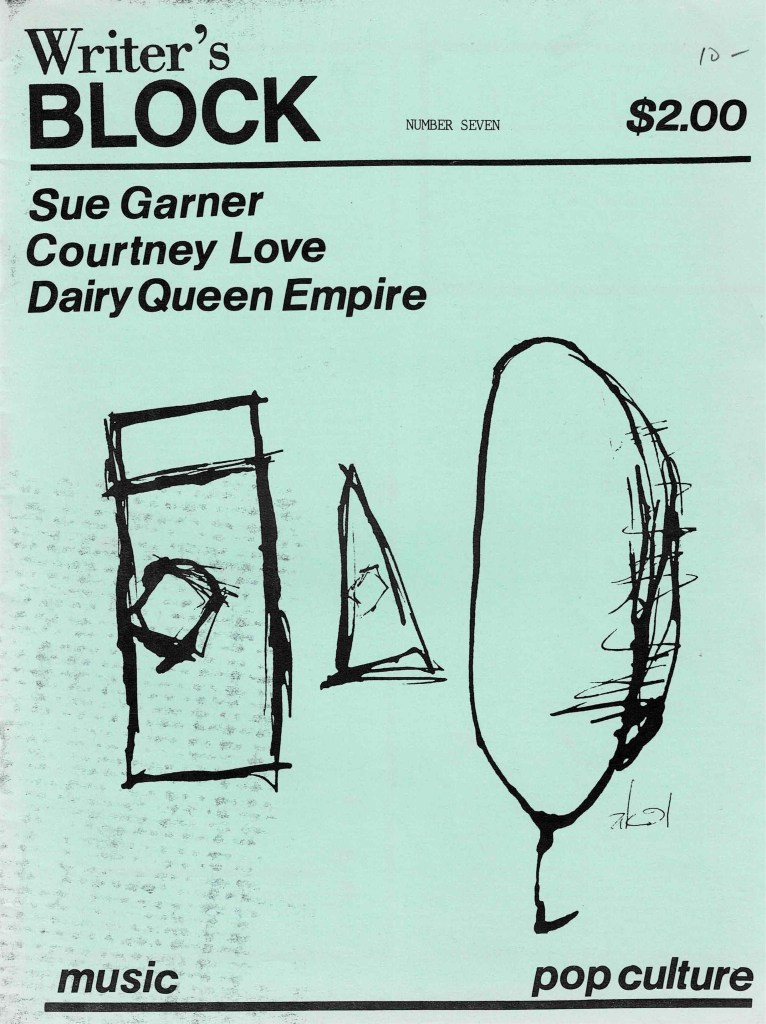
We’re now traveling backward in time through multiple fanzines that were helmed and penned by Mike Applestein. We talked about his current Silent Command fanzine here; we then conversed about his late 90s fanzine Caught In Flux here. We’re now discussing Writer’s Block #7, which came out in the Spring of 1991 and was published from Spotswood, New Jersey along with his girlfriend Alex Kogan and an all-female cast of contributing editors, including Jen Matson. You can see from the scan that my copy was marked up 5x from its original price, having recently procured it as I did from Division Leap books & ephemera.
The Writer’s Block crew are primarily rooted in underground pop music of many flavors and colors, the more lo-fi and personal the better. There’s room for the broader, noisier underground as well, and Thinking Fellers Union Local 282 and Killdozer make lauded appearances, but in general, acts like Heavenly and Unrest and The Clean rule the roost, as well as New Zealand and the Flying Nun universe. There’s an interview with the unfortunately-named Olympia, WA duo Courtney Love – I always felt sorry for them on that count – as well as with Sue Garner, who was in the Shams and Fish & Roses, and who’d later go on to be in the highly underrated (including by me, at the time) Run On. The passion and deep knowledge that went into their interview subjects and the questions asked of them is readily apparent, and no question Writer’s Block belongs in the international pop underground museum someone’ll eventually erect.
Barbara Manning writes a letter from San Francisco, and Applestein reviews her 2/23/91 show at the Knitting Factory in NYC, her first show in town since World of Pooh blew through a year previous as they were breaking up. Man, that year – 1991 – I must have seen Barbara Manning play a dozen or more shows in the San Francisco Bay Area alone. I was besotted with World of Pooh while they were around, and was bereft now that they were gone. Manning’s solo shows and early shows with “Barbara Manning and the Tablespoons” were a fantastic salve. Her work in the first half of the 90s stands up proudly vs. anyone’s. Great to see another magazine enthusiastically making said case in real time.
Pavement get one of their first local shows reviewed – the 8/12/90 show at Maxwell’s – and it’s clear from Alex Kogan’s review that they were barely more coherent then than they were the time I saw them at their big San Francisco coming-out party a few months before that. I can’t find anything online to confirm exactly when the band first played in SF, but it was a big deal for several of us based on their two 45s and the Perfect Sound Forever record, and….they were horrific! Like walk-out-long-before-the-end-of-the-set horrific. Kogan blames intoxication and a who-cares attitude. The 1990s, folks. That’s how we rolled. I never saw Pavement on a stage again.
(By the way – there is reliable evidence online that suggests that Pavement might not have actually played their first San Francisco show until 1992. This would not be the first time that my misshapen memory has arranged events to fit a narrative I’d like to convey; in this case, my attendance at a 1990 show by Pavement before anyone else saw them play. Not that I care about Pavement, you know, but I do prefer being accurate to muddled and braggy. Anyone know?)
My copy of Writer’s Block #7 has stamps and a mailing label slapped on the back, and it’s addressed to Steve Connell from Puncture fanzine. I wonder how Mike Applestein feels about Connell having turned his back like this on his 1991 sweat, toil and labor.
 Fanzine Hemorrhage