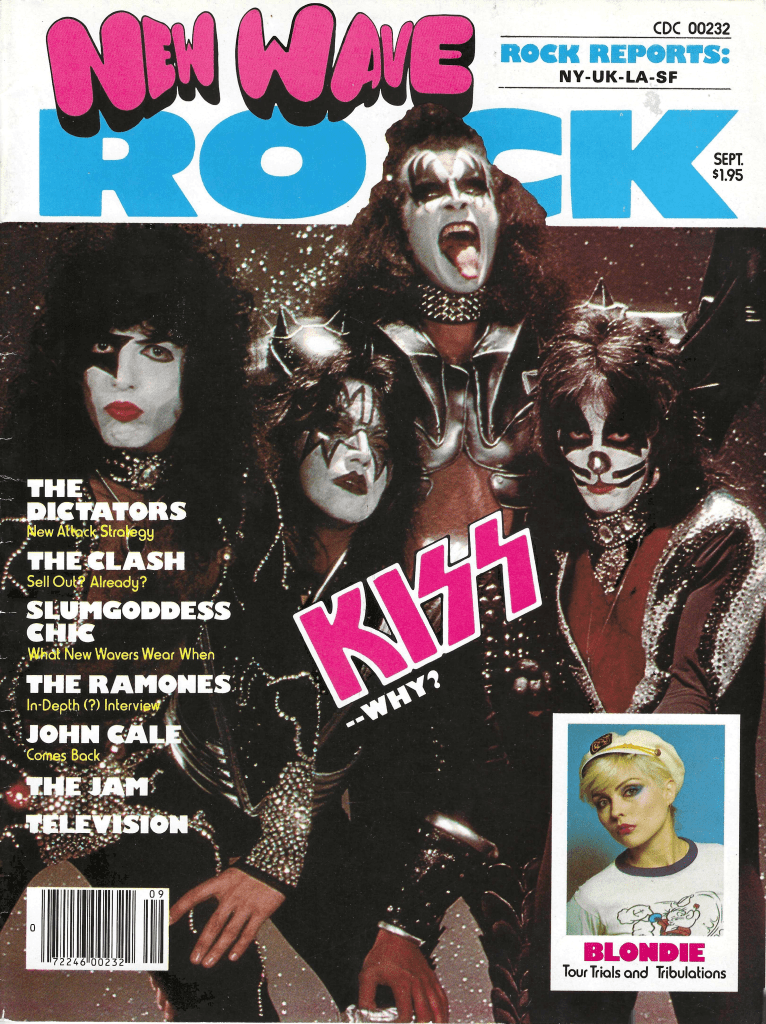
New Wave Rock #1

Well, whew, I think I’ve finally completed one of the most breathlessly exciting and highly laudable chases of my life: the quest to own all of the glossy punksploitation magazines that were put out in 1977-78 under a head-spinning spell of confusion, bafflement, excitement and money-grubbing opportunity. My late wife Rebecca would be so proud. I did it for you, honey. New Wave Rock #1 was my sacred chalice to find, and find it I did. (The others I’ve discussed are here, here, here, here, here and here). But then I had to read it, this issue with new wave rockers Kiss on the cover. But I did that too, and now I’m here to talk with you about what I uncovered. 

As it turns out, this September 1978 debut is less sploit-ta-tive than even the two issues that followed it (here and here). It’s actually quite good. Diana Clapton’s opening editorial states that she received funding and wide editorial latitude for it from publishers Harry Matetsky and Jack Borgen, but then they saw her table of proposed contents and blanched at all the no-names (Clash, The Jam, Dictators) therein. “(Harry) then asked the fourteen-year-olds in his Long Island neighborhood, which is light years away from the Bowery, who their very favorite rock group is – and that’s why we have the cover we do, friends”. She then proceeded to label Kiss’ portion in the table of contents “Kiss: what do they mean? Why are they here?”

As usual, much of the fun to be had is in the opening gossip pages, which here are broken into distinct London, New York, Los Angeles and San Francisco scene reports. There’s some loud post-Sex Pistols break-up speculation, including some that posits that Johnny Rotten and Poly Styrene are singing aging rock & roll standards together on a grand piano, and are now a “joyful couple”. There are salacious details on the Bryan Ferry/Jeri Hall split and how she’s cavorting in the clubs with Mick Jagger, leaving Ferry sad and alone in his new upper Fifth Avenue flat, which he’d moved into with Hall all the way across the Atlantic. There’s also a firsthand report on Lou Reed’s six-show, sold-out run at The Bottom Line, featuring “his transsexual lover Rachel” opening. Rachel, who “is a terrible singer”, apparently hung real tough and dealt with much audience abuse in “tight black leather, stiletto heels, a sultry smirk and a rose looped over his or her belt”. Meanwhile, Brian Eno “and the agonizingly gorgeous Julie Christie are having a fat laugh over rumors of their red-hot love affair, as they have been in each other’s company precisely twice”. 

The LA gossip column by someone purportedly named Eunice O’Reilly is even spicier. After some Germs love, there’s a list of LA’s five “bad bands”: Backstage Pass (I just finished reading Genny Schorr’s All Roads Lead To Punk like, last weekend), The Nerves, The Deadbeats, Runaways (ok, sure) and The Weirdos, “LA’s most unexciting band since Seals & Crofts….claim to not be ex-hippies in disguise, but ace Warner Brothers secretary Coral sez: ‘I went to high school with them. They had long hair and wore love beads’. Case closed”. I also enjoy “O’Reilly”’s take on power pop: “It ain’t new wave but it ain’t ‘zactly old wave either, something y’gotta just live with and LA’s got it up the gitgo”. I suspect this column was written by either Gregg Turner or Metal Mike Saunders, probably Turner, as it contains a multi-paragraph ending about “saving the best for last”, Vom. Their own band. Amazingly, there’s then a two-page spread and feature on Vom later in the mag.

Now, I’ve dissected enough pieces on Blondie, The Jam, The Ramones and the like in other Fanzine Hemorrhage write-ups to really want to spend much time with with the ones in New Wave Rock #1, but I did a double-take skimming the Blondie piece in which Clem says “…we made a movie with John Cassavetes and this guy Sam Shaw. It’s a youth-oriented movie called Blondie, and I don’t know what they’re going to do with it”. Say what now? John Cassavetes? It’s true! (More here from Waitakere Walks). I also learned about the incredibly underwhelming response The Jam received opening for, um, Blue Oyster Cult in Bridgeport, CT, and Paul Weller’s goading of the crowd with, “I know, it’s hard to understand when you’re being confronted with the future of rock and roll right in front of you”. 

One other bonus of this issue is the loads of color photographs documenting both onstage antics and candid backstage snaps, most of which I haven’t seen before. And other tidbits and anecdotes and whatnot: John Cale expounding upon punk and how much or how little was actually being learned from The Velvet Underground (he loves Sham 69, though!); The Clash claiming “people think we’re a con, but we’re not”; and a multi-page overview of Television’s year post-Marquee Moon, pre-Adventure. I’ve been listening a ton of late to the Live Portland 1978 bootleg from around exactly this time, and I think it’s quite possible it’s the single greatest documentation of Television’s majesty in any one single place.

 It’s likely that publishers Matetsky and Borgen didn’t like what they saw when they crunched the newsstand numbers for New Wave Rock #1 and asked to dial up the stupidity levers a bit for the two issues that followed – who knows. I just know that if this had been called something else, and didn’t have Kiss on the cover, it’d be as good as this, this or this from right around the same time, and perhaps remembered just as fondly and not as some joke object for dorks like me. 

New Wave Rock #2

We return again to a prime example of one of my favorite recent discoveries, which has been the mere existence of high-circulation, newsstand-friendly punksploitation mags from 1977 and 1978. Right there, right in the grocery store’s magazine aisle, next to Creem, Circus and Rock Scene. I’ve written about previous examples here, here and here. Despite whatever moderate corporate backing was propping them up, they have the same immediacy and documentative relevance of nearly any given fanzine of the era. Yeah, you’ll certainly have to excuse some of the artists featured, In this one, new waver and cover star Bruce Springsteen is said to be “Walkin’ Streets of Fire”, and is also the creator of “the most exhilarating and passionate rock ‘n’ roll you will ever hear”. Arguable. But get past that, and you’ll find some real ore to mine in November 1978’s New Wave Rock #2. 

As I talked about when we discussed New Wave Rock #3, this was produced by Whizbang Productions from their offices on East 43rd in New York City. Diana Clapton was executive editor. While I can’t find anything online about Whizbang (I’m talking nothing), Ms. Clapton wrote a Lou Reed/Velvet Underground book in 1983. She did a fine job corralling the talent. For most folks, the linchpin piece here is a continuation of a long Lester Bangs article about “The Roots of Punk” that was originally started in another publication, a 1977 fanzine from San Francisco called New Wave. The only way to read that, the editors say, is to order a copy from Aquarius Records in San Francisco. I don’t think it’s going to work anymore.

Bangs says his piece, and it’s a good piece, about The Sonics, Troggs, Count Five, Music Machine and so on, and posits that San Francisco’s dominance over rock and roll sounds in the late 60s led directly to the “punk backlash”. Speaking of the 1960s, there’s an interview with one Michael Hollingshead, who apparently turned Timothy Leary and various rock stars onto psychedelic drugs in the 60s. He believes that they “will become increasingly popular among those associated with new wave music”. I’m not sure it happened. New wavers I’ve known tended to drink, drink and drink some more. Some smoked illegal marijuana cigarettes. A couple were into “horse”. But psychedelics were for disco turds and hippie-hangover creeps.

“Scene reports” are a big deal in New Wave Rock #2 – only it appears that the only scenes worth reporting on are in NY, London, LA and SF. London’s is chock-full of color photos from a “Carnival Against The Nazis”. Paul Grant’s column about the LA scene, “Hot Stoopids on the Sunset Strip” has a bit of effortlessly casual anti-Mexican racism. He also talks about how The Cramps played “with Kim Fowley’s awful Dyan Diamond, who was pelted with ice by an unappreciative Kickboy Face (Slash’s pet frog)”. In the SF report, Howie Klein actually blames President Jimmy Carter for why The Nuns, Avengers and The Dils aren’t signed to record deals, and unfortunately it doesn’t sound like he’s joking. 

Over in New York, there’s been a big benefit for Johnny Blitz of the Dead Boys, after he was stabbed on the street and couldn’t pay his hospital bills. John Belushi is pictured sitting on drums in his place; tons of photos from this thing. This issue’s got a quartet of small, colorful features on “New York’s finest”, who happened to be the Helen Wheels Band, Nervus Rex, The Erasers and the Slander Band. I seriously don’t think I knew what Helen Wheels looked like until today. And then stepping outside of the scene reports, there’s a big thing on Generation X’s “sexy singer” Billy Idol by Pam Brown, as well as a boring piece on XTC, who are said to have “a complete dislike, bordering on contempt, for the punk movement as a whole”.

Best of all – even better than the Bangs piece – is Mary Harron’s article interviewing Nico in Paris. Yeah, it’s the very same Mary Harron that would go on to direct I Shot Andy Warhol and American Psycho. We’ll end this wrap-up of New Wave Rock #2 with two gems from her piece on Nico:

“Nico has no tact. She says whatever comes into her head, and it can be frightening. The first indication I had of this was when she was explaining why she was dropped by Island Records. ‘I made a mistake. I said in Melody Maker, to some interviewer that I didn’t like negroes. That’s all. They took it so personally. I had no idea that Island was a Jamaican company. They took it very personally, although it’s a whole different, entirely different race. I mean, Bob Marley doesn’t resemble a negro, does he?’. She then goes on to describe Idi Amin eating people and believes it’s indicative of the “entire race”.

Nico: “I think I’m a terrorist actually. Maybe I would like to spend the rest of my life in prison. Just shoot somebody and just do what Andreas Baader did. But that would be a pity because there’s no other singer like me. And if I’m in prison I can’t appear on stage, right?”

New Wave Rock #3

The eternal question – “is it punk or is it new wave?” – has never seemed as urgent nor as befuddling as it does on the pages of New Wave Rock #3 from February 1979. Those were different times, were they not? I’m just old enough to remember how confused mainstream journalists and record companies were in trying to get ahead of it all. The latter did everything they could for a very short time to market anything that wasn’t nailed down as “the new wave” or as “modern music”. If you didn’t “catch the new wave”, right now, you were at serious risk of becoming dangerously out of date. You probably ought to buy this AC/DC or this Rachel Sweet album just to make sure that didn’t happen.

I remember Nick Gilder’s “Hot Child in the City” was commonly thought to be new wave, at least at my elementary school – but man, Tom Petty is a real stretch. Even the guy assigned to do this piece in New Wave Rock #3, Michael P. Liben, is a bit taken aback: “When I was asked to interview Tom Petty, I had one nagging thought: Is he new wave? Granted, the press has labeled him new wave (spelled p-u-n-k), but superficially I had my doubts.”

It follows that this magazine is very hung up on such questions – punk vs. new wave, or neither at all – and I swear it comes up in every single piece in one form or another, whether it’s an interview with Mink Deville or Howie Klein’s San Francisco scene report. Such was the tenor of the times in early 1979, at least in the offices of Whizbang Productions, the outfit that put this glossy magazine out (later in the magazine there are ads for some of their other fine creations – a King Elvis giant pictorial tribute to “The King”, and a KISS Meets The Phantom: Superscoops From The 1st KISS Movie! magazine.

I believe only three of these came out in total. #1 had Kiss on the cover; #2 had Bruce Springsteen and Patti Smith. I come here not to bury but rather to praise New Wave Rock #3 – it’s a fantastic artifact, even for real-deal punkers who were reading Slash and Damage at the time. Leaving aside the “Richard Meltzer’s poetry” two-page spread, there’s also a Lester Bangs piece about when punk really started; how he was on the front lines of it all from day one with The Stooges, Velvet Underground and MC5 (fair enough); and how this vaunted second wave of punk has a big whiff of deja vu for him. Again, fair enough. The 29-year-old Bangs also rips into the “young” editors of Punk magazine, Legs McNeil and John Holmstrom and whatnot, for their ultra-orthodox stance on what he should be allowed to listen to, i.e. nothing outside of their narrowed box of 1976-78 punk. This is Lester Bangs we’re talking about, kids!

Photos in this one are amazing, and many of them I’ve never seen elsewhere. Beautiful ones of Mark Perry, Peter Laughner, Only Ones, The Screamers, The Zippers and NY Scene report “Bowery Babylon” columnist Rusty Hamilton (holy smokes!) – as well as hideous ones of The Dead Boys and The Runaways, including a soft-focus centerfold of the latter, mere moments before they were about to break up. There are four big scene reports: SF, LA, NY and London – which I reckon makes some sort of sense. Paul Grant, a guy I used to see at every Lazy Cowgirls show in Los Angeles circa 1987-89 and who’d often be the one to do a big windup & intro of the band before they started playing, wrote the LA one. 

Howie Klein’s SF one has a few choice bits of gossip, erroneous and otherwise. First, there’s the lament about rock station KSAN basically banning new wave from the airwaves. I distinctly remember the howls of anguish a year later when this once-freeform station changed formats completely to country music in 1980 to try and ride the “Urban Cowboy” phenomenon. Klein also tells us that Jefferson Starship’s Paul Kantner went to see The Avengers to see if Penelope Houston might be a good candidate to replace Grace Slick in the band (oh come on). There’s a bit about the “Nix on Six – Save The Homos” punk benefit at the Mabuhay Gardens attended by Harvey Milk a mere two months before he was killed (his November 1978 assassination clearly happened before New Wave Rock #3 went to press, as he’s referred to in the present tense).

I could absolutely go on, as I tend to do. It’s a terrific time capsule that hovers somewhere between corporate rock mag and gritty fanzine. I googled New York’s Whizbang Productions and really came up with nothing at all – perhaps a reader can tell us what their deal was, beyond what I’ve discerned myself in this post? Our comments are always open for your input.