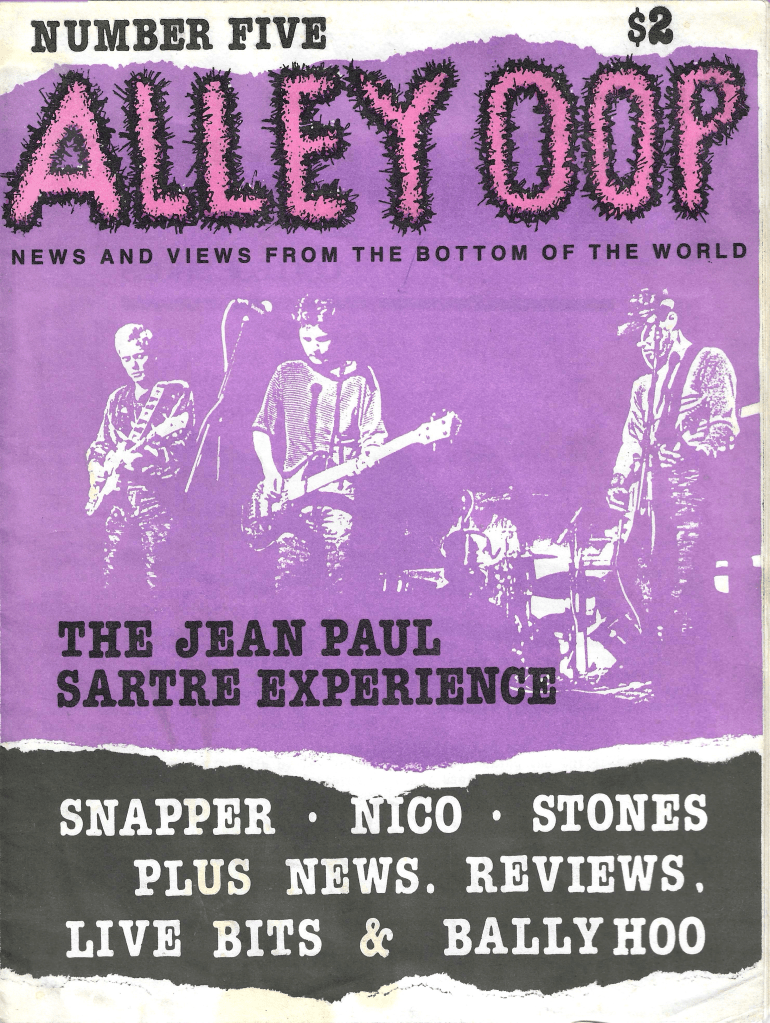
I’d wanted a copy of New Zealand’s Alley Oop for years, and so hats off and a big thank you to Brendan, who made it happen. Aside from Garage, which I’ll likely never see an original copy of, it was the NZ mag I’d most seen quotes pulled from and reviews swiped from, and upon the evidence presented here in 1988’s Alley Oop #5, there was ample reason for doing so.
While no formal editor is presented on any masthead here, at least judging by the amount of content contributed, it looks like Paul McKessar helmed the fanzine or at least was very deeply involved. He apparently got #me-too’ed a few years ago. Right away there’s a very NZ-centric gossip page, with some excited early Xpressway news. Heads-up is provided about the Dead C’s forthcoming The Sun Stabbed EP, and there’s some celebration of the fact that “sales of the Xpressway Pile=Up compilation have already exceeded some expectations”. Remember, if it sells 100 copies in New Zealand, that’s like 4 million in the United States. They also talk about an upcoming Xpressway tape of 1983 recordings by Christchurch’s The World, which didn’t actually happen until Unwucht put the stuff out in 2013.
This gossip column also hipped me to a Bill Direen & The Bilders comp from 1988 called Divina Comedia that I’m only just learning was a thing now. Then comes a trio of interviews; first up is the Jean Paul Sarte Experience. This is undertaken by Ian Henderson, brother of George, and the guy behind Fishrider Records, a terrific small label who has put out several records by Emily Fairlight, one of my favorite artists the past ten years. You’ll definitely want to check her raspy-voiced gothic Americana out, and move on to this one once you’d bought that. Snapper are talked with by McKessar, and Stones by Chris Heazlewood, an artist of deserved renown in his own right.
The reviews are fairly minimal in number, but of course the kiwis have outstanding taste. I was dazzled to see the rave for Tripod Jimmie by Bruce Russell(Xpressway/The Dead C); he loves the excellent and highly underrated A Warning To All Strangers, which he rightly says is going to be very hard to find. I barely saw it here, where I live in California, and they were from San Francisco. There’s some Pixies love from McKessar, and some slightly overwrought praise for Public Enemy too. Have I ever written about the time Public Enemy was playing UC-Santa Barbara when I was in college, around this very time, and “Flava Flav” was spotted in the middle of the afternoon, walking down Hollister Avenue in the neighboring town of Goleta wearing his big stupid clock around his neck?
McKessar talks about local live shows you’d have killed to see from Sneaky Feelings, The Puddle, Verlaines, Steven and Plagal Grind(!!). There’s a deep dive into The Clean’s Oddities 2 tape, something I actually once owned (along with an original Xpressway Pile=Up) and sold, because I totally hate cassettes. And perhaps best of all is K B Tannock’s obituary for Nico, who’d just passed away at age 49. It’s exceptionally informative, focusing mostly on her final ten years, and a little harrowing, as it contains a description of his (her?) interview with Nico in 1985. Our heroine is ravaged by heroin, as well as suffering from an inability to communicate, to hear in one ear, and to go five minutes without complaining about how badly she needed smack. We’ve written some about Nico’s interview foibles before on this site (here and here), but she really was something special and strange. (I still have yet to read this book about her, but I own it and will get to it one day).
In all, Alley Oop #5’s about as front-and-center a seat as you’d imagine getting to take at the Flying Nun & Xpressway tables as these labels were at or close to their heights. May they all eventually be lovingly collected somewhere as Garage was.
We return again to a prime example of one of my favorite recent discoveries, which has been the mere existence of high-circulation, newsstand-friendly punksploitation mags from 1977 and 1978. Right there, right in the grocery store’s magazine aisle, next to Creem, Circus and Rock Scene. I’ve written about previous examples here, here and here. Despite whatever moderate corporate backing was propping them up, they have the same immediacy and documentative relevance of nearly any given fanzine of the era. Yeah, you’ll certainly have to excuse some of the artists featured, In this one, new waver and cover star Bruce Springsteen is said to be “Walkin’ Streets of Fire”, and is also the creator of “the most exhilarating and passionate rock ‘n’ roll you will ever hear”. Arguable. But get past that, and you’ll find some real ore to mine in November 1978’s New Wave Rock #2.
As I talked about when we discussed New Wave Rock #3, this was produced by Whizbang Productions from their offices on East 43rd in New York City. Diana Clapton was executive editor. While I can’t find anything online about Whizbang (I’m talking nothing), Ms. Clapton wrote a Lou Reed/Velvet Underground book in 1983. She did a fine job corralling the talent. For most folks, the linchpin piece here is a continuation of a long Lester Bangs article about “The Roots of Punk” that was originally started in another publication, a 1977 fanzine from San Francisco called New Wave. The only way to read that, the editors say, is to order a copy from Aquarius Records in San Francisco. I don’t think it’s going to work anymore.
Bangs says his piece, and it’s a good piece, about The Sonics, Troggs, Count Five, Music Machine and so on, and posits that San Francisco’s dominance over rock and roll sounds in the late 60s led directly to the “punk backlash”. Speaking of the 1960s, there’s an interview with one Michael Hollingshead, who apparently turned Timothy Leary and various rock stars onto psychedelic drugs in the 60s. He believes that they “will become increasingly popular among those associated with new wave music”. I’m not sure it happened. New wavers I’ve known tended to drink, drink and drink some more. Some smoked illegal marijuana cigarettes. A couple were into “horse”. But psychedelics were for disco turds and hippie-hangover creeps.
“Scene reports” are a big deal in New Wave Rock #2 – only it appears that the only scenes worth reporting on are in NY, London, LA and SF. London’s is chock-full of color photos from a “Carnival Against The Nazis”. Paul Grant’s column about the LA scene, “Hot Stoopids on the Sunset Strip” has a bit of effortlessly casual anti-Mexican racism. He also talks about how The Cramps played “with Kim Fowley’s awful Dyan Diamond, who was pelted with ice by an unappreciative Kickboy Face (Slash’s pet frog)”. In the SF report, Howie Klein actually blames President Jimmy Carter for why The Nuns, Avengers and The Dils aren’t signed to record deals, and unfortunately it doesn’t sound like he’s joking.
Over in New York, there’s been a big benefit for Johnny Blitz of the Dead Boys, after he was stabbed on the street and couldn’t pay his hospital bills. John Belushi is pictured sitting on drums in his place; tons of photos from this thing. This issue’s got a quartet of small, colorful features on “New York’s finest”, who happened to be the Helen Wheels Band, Nervus Rex, The Erasers and the Slander Band. I seriously don’t think I knew what Helen Wheels looked like until today. And then stepping outside of the scene reports, there’s a big thing on Generation X’s “sexy singer” Billy Idol by Pam Brown, as well as a boring piece on XTC, who are said to have “a complete dislike, bordering on contempt, for the punk movement as a whole”.
Best of all – even better than the Bangs piece – is Mary Harron’s article interviewing Nico in Paris. Yeah, it’s the very same Mary Harron that would go on to direct I Shot Andy Warhol and American Psycho. We’ll end this wrap-up of New Wave Rock #2 with two gems from her piece on Nico:
“Nico has no tact. She says whatever comes into her head, and it can be frightening. The first indication I had of this was when she was explaining why she was dropped by Island Records. ‘I made a mistake. I said in Melody Maker, to some interviewer that I didn’t like negroes. That’s all. They took it so personally. I had no idea that Island was a Jamaican company. They took it very personally, although it’s a whole different, entirely different race. I mean, Bob Marley doesn’t resemble a negro, does he?’. She then goes on to describe Idi Amin eating people and believes it’s indicative of the “entire race”.
Nico: “I think I’m a terrorist actually. Maybe I would like to spend the rest of my life in prison. Just shoot somebody and just do what Andreas Baader did. But that would be a pity because there’s no other singer like me. And if I’m in prison I can’t appear on stage, right?”
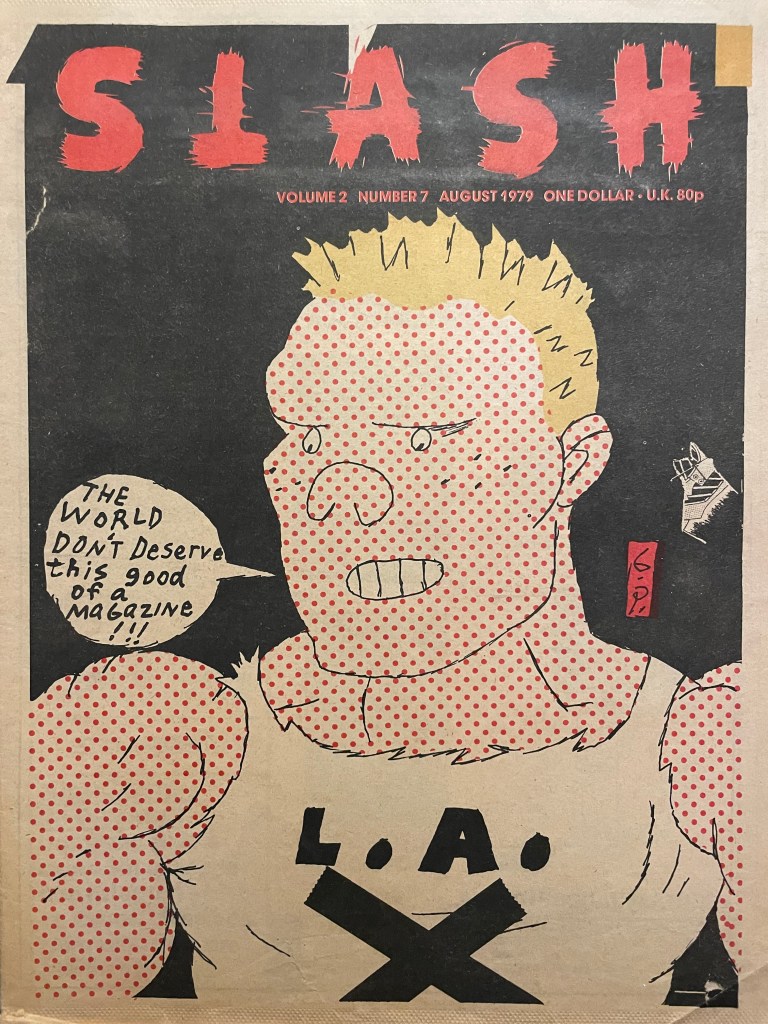
On the cover of this 40-page newsprint gem, the Slash magazine that hit the record stores of greater Los Angeles in August 1979, we have muscle-flexing LA punk “Jimbo”, setting the tone for a wave of eventual hardcore dolts like Circle One’s John Macias to follow. I’m probably a bit of a heretic here, but the nonsensical Gary Panter drawings in Slash have always gone over my head, or more likely, missed me as a member of the target psychographic profile. People seemed to love ‘em, and I suspect it was because a cartoonist/artist was actually spending time drawing punk rockers, in a punk rock magazine, and drawing them well. So bravo, Mr. Panter!
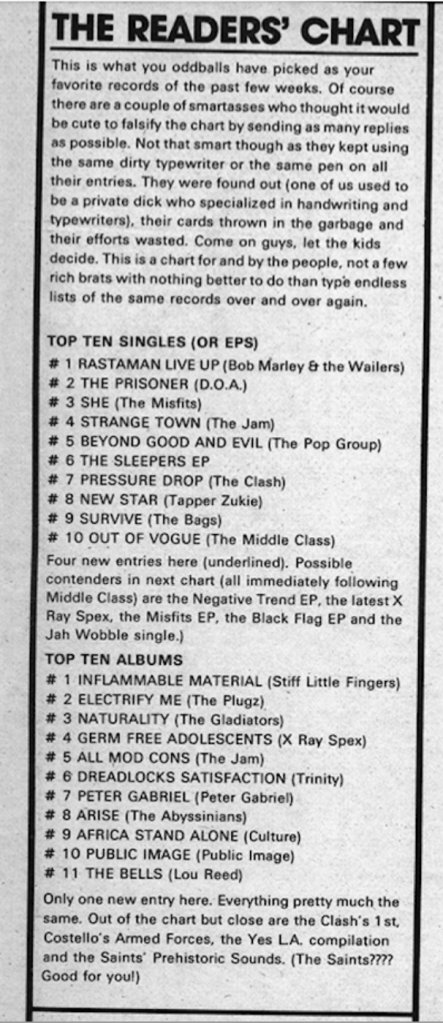
Inside we’ve got a masthead, a table of contents with photos + a “Reader’s Chart”, which looks to me to have been lightly goosed by the editors, given the presence of multiple reggae discs (Tapper Zukie?!?) and oddball critical faves like The Misfits’ Cough Cool/She 45. A year’s-long domestic subscription is hawked for $10. Different times.
The next two pages – LOCAL EXCREMENT – were standard for most of the magazine’s entire tenure, this time a nice castor-oil potty-mouth cleanup from the typical “Local Shit”. This virtiol- packed section is one that I presume was typically penned by editor Claude Bessy, given that it alternates gossipy scene reportage, unbridled enthusiasm for new bands and a heavy dose of fuck-you, aimed at targets both easy (cops) and potentially bridge-burning (club owners, certain local bands etc.). This time Kickboy quite rightly sets his sneering sights on a local free magazine called Gosh! and a recent piece called “A Conservative Looks at a Punk Rock Party”, in which the author purportedly slandered Nervous Gender’s Phranc, an out Lesbian, as well as on The Whiskey, a Sunset Blvd. club, for essentially banning punk bands “without a recording contract”, which meant most of the good ones.
Also going on in LA during the summer of 1979: Tomata du Plenty’s birthday party; the imminent release of the Germs’ as yet untitled album – you know it as (GI); the lovely Trudie Arguelles and her birthday party; a new gay club called The One Way that plays punk instead of disco; and a peaceful makeup between The Dils and Slash magazine, necessitated by some earlier poor reviews and/or snipes directed at the former by the latter.
We have an all-caps editorial – Kickboy again – that makes light of the fact that his typical editorial rant had been missing from the last few issues, and that he’d thus been hearing that Slash therefore was probably going soft, selling out etc. This August 1979 editorial eventually winds its way to the point, which is that the halcyon days of 1977 are long gone; that punk rock has evolved; and that “Punk was never more than an Attitude and a Stand. At the time, and often now, this was and is and is best expressed in the 1 2 3 4 I Hate Your Guts format. But there are other ways to get the lovely message across.”
Bessy/Kickboy enumerate a few of his favorites: The Fall. Alternative TV. The Pop Group. He’s excited and very much keeping the faith, which is one of the things I love about this guy and his writing at the time: “…it’s still all there. Growing. Spreading. Infecting.” In retrospect, it certainly was.
Next, we have the letters section. Always a hoot. The topic du jour this month relates directly to the editorial on the pages before it: Slash’s championing of slower, stranger, less raw music, much of it coming from the UK. Magazine; The Fall; Pere Ubu etc. Some of the hoi polloi are displeased. Kickboy, in his responses, keeps a hammer inside a velvet glove, nicely chirping mild and respectful dissent for some, and spewing venomous mockery at others.
On to this month’s interviews. Penetration, from England. Pauline Murray’s band. There were quite a few Slash interviews in which it was effectively impossible to discern actually who conducted it, and this was one of them. It’s just “Slash” asking the questions. I believe that probably means Bessy and Philomena Winstanley, the latter of whom took the photo of Penetration that accompanies the article. There’s also an interview with film director Paul Schrader (Blue Collar, Hardcore, American Gigolo), and this time we know who’s asking the questions: Chris D., Judith Bell and Clarissa Ainley. They’re actually pretty interested in why he’s deigning to talk to Slash, a punk magazine, and he’s clearly into punk rock in the same voyeuristic manner that his movies explore: “I like the anger, the heat…the feeling you used to have in CBGB’s that you could be stabbed and no one would know for fifteen or twenty minutes because it would so packed with people that you couldn’t fall down…”.
The other three interviews this time are with the aforementioned Nervous Gender; with X and with Nico. Nervous Gender, BPeople, Monitor and Human Hands were all arty, unusual and synth- driven bands just breaking onto the Los Angeles underground music scene that year, and often played together. Slash championed them in a major way. X, of course, were the proverbial belles of the ball in LA and with the Slash staff in general; the Slash label that grew out of the magazine would go on to release their second single and first two albums. These two interviews are conversational, respectful and interesting enough.
It’s that Nico interview that really makes this issue, though. The intro alone is phenomenal, capturing a time in her career as she was coming back & playing again in the late 70s, despite being caught in the grip of a 15-year addiction to heroin. Not precisely sure who wrote this intro which reviews her two shows at the Whiskey and sets up the visit of the interviewing crew at Tim Hardin’s house in LA, but here are some bits from it:
“Nico’ s second set was a burned-out shambles. You want your cult idol, well suffer her cult performances as she does a routine reminiscent of Judy Garland meeting Lenny Bruce in the last days….One girl shouting ‘We love you, Nico, we love you’ until Nico turns to the mike and says, ‘Do you really think that makes me feel any better?’.…when no one offers her a drink she throws a glass across the stage and says, ‘Isn’t there any dope in this damn place?’…
Next day’s interview took place at Tim Hardin’s house. Mr. Hardin, shit faced and stumbling around, hurt himself about four times while we were there. It was one of those dark sixties types hippie houses with art deco in the bathroom and a pot of beans on the stove. Nico had just been crying – former manager Paul Morrissey had taken her money so she wouldn’t spend it on foolish indulgences. She did seem too old for a babysitter, though. She is bothered by the people who have come to interview her – too many: One C. Bag, one Philomena, One Greg ‘New York Rocker’ Turner, One publicist Tim Hogan….”
To translate: that’s Craig Lee from the Bags; Slash founding editor Philomena Winstanley; Gregg Turner of Vom and the Angry Samoans; and, uh, publicist Tim Hogan. The rest of the interview proceeds as you think it might after this set-up. Nico, having delivered a strange, drugged soliloquy to Sid Vicious during her shows the night before, has this exchange with her interlocutors:
Slash: Do you like the Sex Pistols? Nico: Yes……of course. Slash: What was your favorite song? Nico: Oh – I don’t know. I couldn’t tell you. Because I don’t buy those records. I only listen to classical music.
There’s a three-page “Los Angeles Band Update” spread that seeks to update the reader about the prime movers on the local scene, circa summer ‘79. It’s a gas, because so many of these bands are being documented in single-paragraph form during either their early nascence or when they’ve already evolved into the legendary acts they’d eventually gain their due for. I’m reprinting the Germs piece here. This is whom Slash saw fit to document that summer:
The Alleycats / Arthur J and the Goldcups / The Bags / The B People / Black Randy and the Metrosquad / Backstage Pass / Black Flag / The Brainiacs / The Controllers / The Deadbeats / The Dickies / The Dils / The Eyes / The Extremes / Eddie and the Subtitles / Fear / The Flesheaters / The Flyboys / F-Word / The Germs / The Go-Gos / The Gears / Holly and the Italians / Human Hands / The Mau Mau’s / Middle Class / Nervous Gender / The Plugz / Rhino 39 / The Rotters / The Skulls / The Satintones / The Screamers / The Simpletones / U.X.A. / Wall of Voodoo / The Weirdos / X / The Zeros
That was what a week out in the clubs of underground Los Angeles would bring to you on any given day of the week that summer. Unreal. The blurbs are accompanied by fantastic Melanie Nissen photos of many of the bands, most of them never seen since except in these pages, this month. Oh, and there’s a two-full-pages center spread “family tree” with numerous drawings called “2 Years of Punk in LA” that does one of those hand-drawn family tree lineage things that Trouser Press was popularizing around the same time, but instead of being about Humble Pie or Traffic or whatever, it’s about virtually every punk band from LA the past two years, including many new-to-me combos like The Strict IDs, The Brothelcreepers, LA Shakers and The Whores – in addition to the Germs / Bags / Black Randy and the Metrosquad and all our other faves. I’d love to reprint it here, but you wouldn’t be able to read it.
After the interviews and features, Slash would most often feature live reviews from the previous months, and they do the same here. They’re often lengthy, packed with detail, and never withholding of opinion. As per the previous section – whoa. What a month! Chris D., writing as V/D, reviews early Black Flag (Keith Morris version) at the Bla Bla Cafe on 6/11/79: “They rival only the Germs in their potential for snowballing a room full of sedate people into a mangled tumult of chaos”. There are two reviews of a Screamers six-night stand at The Whiskey that make it sounds like the absolute death knell of the band, a Weimar cabaret-style performance with a female backing vocalist and violins. One unnamed reviewer wants to vomit; Kickboy says not so fast. The Screamers would be broken up within six months. The other reviewed shows range from X to Nervous Gender to the Plugz to Ray Campi and His Rockabilly Rebels. Teleport me back and I’ll go to every last one of ‘em.
Record reviews always came next, first a section of 45s, then one for albums. What was new in August of 1979? Everything from Augustus Pablo’s East of the River Nile to Devo’s Duty Now For The Future to Kleenex’s You/U 45 to The Jam’s Strange Town single (about which Kickboy writes, “This should have been reviewed ages ago. Nobody came forth with their little paragraph. What could be the reason behind such indifference. I wonder.”) The breadth of the reviews was wide enough to accommodate the aforementioned; a bunch of reggae singles; some new wave or power pop items from all over the country (most of which are dumped upon); and a ritual deboning of The Clash, a fairly standard and often wide target for Slash during their time publishing.
Finally, there’s a full page travelogue devoted to a worshipful trip to Jamaica taken by one Ranking Jeffrey Lea, otherwise known as Jeffery Lee Pierce, who would form the band that would eventually morph into the Gun Club mere months after this was written. Pierce, Bessy and Chris D. were huge reggae fiends and integrated their passion into the pages of Slash as effortlessly as they did other underground musics, recognizing in real time that this time – 1977-79 – was an exceptionally fertile period for reggae, dub and roots music, as the passage of time would soon prove.
Then a Jimbo cartoon, and that was Slash Vol. 2 No. 7, over and out. It’s certainly not enough for me to merely tell you about how interesting or well laid-out or of-the-moment it all is, yet I know of no other publication that captured the zeitgeist of a given month, any month, in musical history better than this one. Slash had the intimacy of a fanzine – written in the first person with the intention to cajole, harangue, celebrate and champion – combined with the ritual deadline-date urgency of a much more streamlined and professional operation. It arrived each month as promised, with a chronicling of the month just passed, a handful of new enemies made and heroes to pedestalize, and a wide-eyed, optimistic look at sub-underground musical horizons – and a possible revolution in musical tastes that might lay just ahead.
This March 1978 issue of Seattle’s Twisted is almost certainly one of the twenty titles I’d bravely save from a fire, were I to only save twenty. The three issues of Twisted ran from June 1977 until this one, and someday, inshallah, I’ll find a way to procure the other two. While it has neither the writing chops of Slash nor the NY Rocker at this time, Twisted #3 is omnivorously devoted to uncovering the excitement of global punk wherever it leads them, no matter how far underground it takes them, and no matter how many miles they need to drive to, say, San Francisco for the Sex Pistols/Avengers/Nuns show to get the story.
There are over a dozen contributors, both writers and photographers. It starts off with a revelatory bang by a writer taken by friends while in NY to an early Cramps show at CBGB – mind totally blown. This is followed by a little local coverage of The Mentors, I’m afraid to say, who are called “the disembowelment of rock ‘n roll”. Early songs like “Secretary Hump” were already nice and worked out even here in early ‘78, and we’re blessed with lyrics for this and other fine songs like “Macho Package” and “Can’t Get It Up”. The disgusting picture of El Duce is thankfully followed up with one of lovely Jennifer from The Nuns, along with an interview w/ Richie Dietrick from her band, a total NYC born-and-bred, attitude-drenched goombah who was already an out gay man by this time. Pretty bold move in ‘78, and I’ve gone my whole punk-lovin’ life not knowing that.
As the eyes of the world zeroed in on punk rock, Twisted #3 was getting nervous. There’s a punk vs. “New Wave” semantics essay, and in the mag’s gossip column it is reported that “MISCARRIAGE in Boston reports that the city is being inflicted with a strange illness, ‘new wave virus’, which all the punks have….”. Meanwhile, there’s much love for The Avengers and Penelope, who’d recently moved from Seattle to SF to go to art school and then formed her band there. “Record contract rumors are flying like crazy – Sire being the head of the list”. Is this sorta like when Penelope was scouted to replace Grace Slick in Jefferson Starship?
I wasn’t particularly into the mean article about Nico and her show at the Mabuhay Gardens in San Francisco. The photograph you see here was from that December 8th, 1977 performance, and it’s one of my all-time favorite rock photos. And jeez, the ads in this thing. There are ads for Screamers and Dils tours which will bring them to the Northwest, and there’s a great one for Slash magazine itself. Twisted #3 are very excited about the debut Black Randy and the Metrosquad 45 “Trouble at the Cup”, and give the man a two-page celebratory spread just to rejoice about it.
As we discussed a bit when I reviewed Chatterbox #4, the local Seattle punk scene really got roaring quite a bit earlier than I’d previously comprehended. I mean this was Seattle – now a metropolis, but then with less than 500,000 people (and post-Boeing, falling) and in the corner of nowhere. Or so I thought. There’s a centerfold-esque photo of the early Lewd; an interview with The Snots and some Midwest transplants called The Invaders whom I’ve never heard of. In addition to a Portland scene report (with three other bands I’ve never heard of). Lydia Lunch of Teenage Jesus and the Jerks gets to be nihilistic; there some blather about The Clash; and a Generation X interview, a band that for me proved the maxim that any punk residing in the upper 20% of physical good looks will always gain disproportionate attention irrespective of talent. Until they don’t.



 Fanzine Hemorrhage