New York Rocker #4 (September 1976)

I’d recently vowed in these pages to cobble together a ‘lil NY Rocker collection, and I’ve been making good on this important promise (to myself). Yet I’d never, ever seen any ones with this typeface, one of the first four mythical issues, in the wild – that is, until I came upon New York Rocker #4 and struck up a bargain with its seller at the 2025 San Francisco Art Book Fair. This 1975-76 era is one of my favorites for rock music writing due to its anticipatory excitement, with much undefined underground exploration in the air and on the fuckin’ streets, with absurd decadence and drug bottoming-out the norm. Nowhere was this more the case, of course, than in New York City. 

I don’t really know a whole lot about cover star Cherry Vanilla, except that she was central to the first moment I ever become acquainted with “punk rock”, her famous “Lick Me” photo having been part of Time magazine’s July 11th, 1977 punk rock article that absolutely blew my mind and maybe scared me a little bit at the age of 9. Her interview here is sober, reflective and humble, and it’s a far cry from the she-devil harlot I’m sure imagined her to be when I saw that photo. Still not quite sure what she did in the grand social whirl of the time, though this bio is a start. This is followed by a Duncan Hannah photo sesh with Andy Warhol and Talking Heads at The Factory on May 26th, 1976, and then a terrific article & photos of John Cale at the Ocean Club in July ‘76, with one Lou Reed backing him up, and a hopped-up Patti Smith jumping on stage, unasked, multiple times to get involved.

Hilly Kristal, CBGB proprietor, pens an article about his own Live at CBGB Vol.1 comp, with special praise for The Shirts, Tuff Darts and Mink De Ville. Me, I’m just glad that there was a band called The Shirts at one point in history. They look like total street rockers with matching white jumpsuit/pant combos – outstanding. There’s an exceptionally catty gossip column called “Pressed Lips” by Janis Cafasso, whom I understand may have been Johnny Thunders’ girlfriend at one point in time and features in various Dolls lore I found online. I wonder if she ever did illegal drugs? Her column is a gem – honestly, this sort of real-time lens into at-the-moment scene machinations is a far better history lesson than anyone’s dimly-remembered memoir. Here are a few of her insights from the Bicentennial summer:

  • “Where have all the groupies gone? Not much time from shaking go-go these days I guess. Money first, sex second. Tsk-tsk, calling Sable…”
  • “By the way, Richard Hell, the king of crinkle (somebody please find him an iron) has gotten a new group and now for some serious attempts at sound??? God loves all the bewildered beatniks!”
  • “Two nights in a row the Mael brothers, as in Ron and Russell, could be seen ogling little Tina of Talking Heads…”
  • “Can we please put Bobby Blane, the new Dolls organist in a straightjacket and nail his shoes to the stage so he doesn’t have to offend the audience with his mincing and peacock strutting. Best quote of the evening in reference to Bobby Blane was from Wayne County who said ‘I just loooove the Dolls new lead singer’. And that about sizes it up. Two Mick Jaggers in the same group is a bit much!!”. 

Great stuff, am I right? Just for some context, the David Johansson-led final-wave of the NY Dolls were running on fumes at this point; Johnny Thunders’ Heartbreakers were reemerging in a big way; and Richard Hell’s “new band” talked about here, post-Television, would of course be Richard Hell & The Voidoids

But wait, there’s more. Victor Bokris has a short story called Coffee Shop; he’d go on to write biographies of several of the folks we’ve already mentioned here. Milk & Cookies get very defensive: “We just don’t want to be known as a wimpy, trite pop band”; “We’re not the Bay City Rollers”; “There’s some meat to our songs”. You be the judge! By far the most interesting piece to me, after the gossip column, naturally, is the deep dive by Craig Gholson with Richard Lloyd of Television. He talks about some early Television songs he sang, like “What I Heard” (great!!!) and an “X-rated” one called “Hot Dog”. He talks about the break he took from the band “to straighten out some personal problems” (i.e. drug addiction). He speculates what might be on their upcoming debut album; “Kingdom Come” is discarded for being too long and “Double Exposure” for being too old. Titles, too, have been rejected: See No Evil and Repeatinginging (whew on that last one). 

And more! Sneakers from North Carolina (Chris Stamey, Mitch Easter etc) get what I imagine was probably their first interview; The Runaways get a dopey one as well; there’s a great posed photo of The Heartbreakers, we get a wacky check-in with The Ramones, already olde-timers by this point but still with only that first LP out; and New York Rocker #4 closes up incongruously with Lance Loud’s paean to Robin Williamson of The Incredible String Band, mounting a comeback or whatever you’d want to call it with his “Merry Band” in New York City that month. What a time to be alive, the quote-unquote old struggling to stay relevant and the new struggling to be born, and everyone still under 35 years of age.

NY Rocker #18

I’ve recently come into a gaggle of older issues of NY Rocker, and thumbing through them, I’m even happier about my minor acquisitions than I’d thought I’d be. At least on the evidence presented by NY Rocker #18 from April/May 1979, this not-really-a-fanzine tabloid newspaper was even better in its earlier years than it would be a couple years hence. I’ve talked about issues from that later era here, here, here, here and here. And I’ll talk about other ones that sprang from ‘79/’80 in the weeks to come, as I traverse them. This shall take time. For now, let’s see what was happening in the world of underground NY/LA/SF/London during the Carter years.

First, there’s Howie Klein reporting from San Francisco. Sigh. I can’t throw a stick at a fanzine from this period without encountering the guy. If you’re not a Clash fan, and I’m not, it’s hard to wrestle with hyperbole such as Klein’s blather when he sees their 2/7/79 show in San Francisco: “This was undoubtedly one of the best shows ever seen in the Bay Area…..”. If you don’t know which side of the true punk vs. corporate schmuck divide Klein stood on – or at least which side he was (rightly) perceived to be on – there are these gems from the same piece: “Rock super-promoter Bill Graham – the only major concert promoter in the U.S. to give strong and consistent support to the new wave…” (Bill fucking Graham!!) and dissing the grass-roots punk/all-ages organization called New Youth who got The Clash to play this cheap, for-the-people gig in the first place. “…the band (got) involved with New Youth, a group of mostly idealistic (like starry-eyed at best, and in some cases, simply psycho) young fans who believe in non-profit punk rock gigs. So they got The Clash to commit themselves to doing a benefit for them at a deserted Jewish synagogue between the Peoples’ Temple and the Old Fillmore in the heart of San Francisco’s black ghetto. A cheap ticket price and the opportunity to see the band in an unseated funky venue…caused a dramatic slump in ticket sales in what should have been the band’s biggest and fastest sell-out. As it turned out, The Clash came pretty near to selling out anyway….but not before a lot of rock-biz upset between the Graham Organization, Epic Records and Tapes and the William Morris booking agency”.

The horror! You can see the sort of scene mechanics that actually stressed Klein out in 1979, and why he ended up being so utterly reviled by music-focused underground aesthetes at the time, unfair as it perhaps may have been, considering one’s perspective and degree of oppositional defiance.

More irony abounds in a Sandy Pearlman interview – he produced The Clash’s Give ‘Em Enough Rope – “The Clash themselves will do virtually nothing to make it. In other words, they will not accommodate themselves to the rotten, debased, commercial system of exploitation that currently exists. The Clash do not wish to make any compromises”. Totally! On the flipside is a paean by Doug Simmons to truly underground Boston band The Neighborhoods and their singer David Minehan. I didn’t much care for the band, once I finally heard them, but my 9th grade best friend Jon Grant had just moved to San Jose from Massachusetts, and his brother had been close friends with Minehan. I’d hear all about The Neighborhoods from Jon, and seriously, I felt pretty special at age 14 knowing a guy who had a brother who was friends with a guy in an actual performing punk band that I’d never heard.

Oh, and the Beach Boys stuff in this issue is just fantastic. There’s a Greg McLean interview with Carl and Dennis Wilson of the Beach Boys, as well as a Harvey Kubernik sidebar about a recent BB book. McLean clearly isn’t a fan of Dennis Wilson: “his frequently crass and unexpected comments often cut Carl off mid-sentence, and he dropped the name of his new girlfriend, Christine McVie, whenever possible”. McLean retaliates and agitates them by only asking questions about Brian Wilson: where is he, tell me more about Brian etc. This does him no favor with the brothers. Dennis says, vis-a-vis the Dr. Eugene Landy thing, “Brian is loved dearly by all of us and us by him, and all that bullshit about him being manipulated is just….not in my experience…”. McLean then goes on to bait them further about Mike Love being an asshole (a certified fact, from what I understand), and then talks about a Beach Boys show at Radio City Music Hall in ‘79: “Between songs, Love babbled aimlessly, killing any sense of pace the show might have established. Mike Love looked old and foolish”. Everyone loves Mike Love, don’t they?

So this issue is absolutely packed, and I could write reams about each piece – but there are like, 20 pieces: The Shoes; a thing on young Boston and NY radio DJs and stations; Viv Stanshall; The Raincoats; The Only Ones; and a really early piece on The B-52s, circa their Rock Lobster 45, with great photos of a very young band and an interview by editor Andy Schwartz. Even so, NY Rocker would sometimes give space to mainstream music-lovers like Ken Barnes. He writes a thing about how much he loves disco, even in 1979 (the year of Disco Demolition Night), and says, perplexingly, “It seems to me that a lot of people are quite scared about disco, and they’re lashing back with unreasoning venom. An interesting observation by Mark Shipper pertains here – for years during the 70s rock lull, all the right fanzines clamored for the return of fast, exciting beat music kids could dance to. Now it’s here and kids dig it…but because it doesn’t follow the form the clamorers grew up with, they’ve turned on it viciously. Ironic, wouldn’t you say?”. I mean…..that’s one way to look at it?

Finally, and I feel like I’m skimming here, but there are great reviews of recent “rock concerts” by The Contortions, Nico, The Knack (who are absolutely buried by Don Waller), and The Ramones with their special opening band Lester Bangs’ Birdland. NY Rocker #18 comes to an outstanding close with Jeffery Vogel’s fake “TV Guide” listings that shit mercilessly on every upcoming show and on every NY band – especially the Dead Boys. Now that’s some vitriolic mirth-making that we at Fanzine Hemorrhage can get behind, anytime & anywhere, even from 46 years ago.

NY Rocker #33

A couple of years ago I realized I probably needed to procure as many NY Rocker issues as I might be able to afford, before they started being priced like Slash currently is. Even now there are pathways to getting these for $15-$25 a pop, so that’s what I did a few years back – and then I wrote reviews of them here, here, here and here. Even now, I’m just catching up to the half-dozen or so I bought. I actually remember first seeing this while it was actively being published at Rasputin’s in Berkeley, CA, probably in 1981, but I was too broke and too much of a teenage dumb-dumb to be able to buy it.

NY Rocker, including in this December 1980 issue, brought together heroes like Don Snowdon, Byron Coley, Ira Kaplan, Don Waller and later Don Howlanda lot of Dons – along with guys who loved Chic and disco-dancing or whatever, and weren’t afraid to tell you. It never really reads to me as quite hitting the quality level of Slash or even Damage most of the time, but that’s irrelevant. It’s still absolutely stacked with the maniacal explosion of underground music that defined the times, both across the USA and in the UK, much of which NY Rocker pays close attention to, as well as anything else interesting beyond Manhattan’s borders.

First up after the table of contents, Ira Kaplan talks about how Robert Frank’s Cocksucker Blues finally screened in New York after years of legal purgatory, and how tough it was to get into one of the screenings. “Ironically, it’s possible that the only people more disappointed than those who didn’t get in were those who did….Cocksucker Blues’ strength is that it makes the fabled lore of the road – the drugs, the sex, the destruction of hotel rooms – look not merely ugly, but as we’ve been assured touring is, boring – a combination I’ve never seen pulled off before”. Bingo. My thoughts precisely on this film, which is a “watch once, discuss, then forget” sort of viewing. 

Cover star Captain Beefheart is interviewed with Doc at The Radar Station having just come out. If you’ve read Van Vliet interviews before, his style was give a millimeter, take an inch – so it’s difficult to get a bead on him aside from his eccentricity, which frankly, is enough for me. You just need to know what to expect going in. I suspect a collection of all his late 70s/early 80s interviews wouldn’t add up to much in terms of new revelations on, say, the creative process – but he’s just daffy enough and moderately confrontational that it’s still a fun read.

Jeff Hayes has a piece on a bunch of heavy metal teens going to a Molly Hatchet show, and about their subculture of booze, partyin’ and metal. The obvious comparison, of course, would be Heavy Metal Parking Lot from six years later. There’s an embarrassing Delta 5 interview by Jim Anderson where he wants to commit the 3 women in the 5-person band to a sort of “women in rock” solidarity with The Raincoats and the Slits and they’re having none of it. In 1981, when I was really diving into college radio for the first time, my initial favorites were the funk/bass-heavy, female-sung, post-punk rhythms of the Delta 5, Au Pairs and Bush Tetras, all sitting at ground zero in this December 1980 issue. It’s amazingly still a sound that hasn’t gotten old for me, likely because it was as formative as it comes (even though I rarely listen to anything else like it).

So much else going on! Jah Wobble is now driving a cab in London and figuring out his next move – which merits an entire short piece on him. “Lightnin’ Jeffrey” Lee Pierce has his own section on reggae records; the cream of the crop has already risen, and he knows it. He was doing these sorts of reviews and roundups for Slash too. There’s a takedown of the Times Square film, which I’ve never seen because I’ve never wanted to. And there’s a great interview with the band Information, plus later, an ad for their Tape #1 with Mofungo and Blinding Headache, a tape recently unearthed again here. Rick Brown from this band is still killing it with 75 Dollar Bill, 44 years later.

Byron Coley and Greg McLean do a passel of 45 reviews – Mission of Burma, Dead Kennedys, Jad Fair, Snakefinger and many, many lesser lights. There’s a “30 NY bands of the moment” centerspread – Bush Tetras, Zantees, Mofungo, Ut, Von Lmo, DNA, Lounge Lizards and Klaus Nomi (!), among others. And what a surprise – there’s a short piece on the mysterious Chain Gang with a great photo; it’s about how no one knows who they are, and how they’ll just pop up for a gig somewhere in NYC, maybe on a fishing pier, about once a year.

Finally, there’s a cornball Richard Meltzer piece to close out the issue. Meltzer’s inscrutability seems to have been one of his greatest calling cards for his small legion of fans, but I’ve always found that to be such a strange sort of put-on. I mean, Ulysses and Pynchon and countless others can reward one’s deep reading, but Meltzer at his abstraction-vomiting worst? The best I can say for him in pieces like this is that I know he was a canny jokester who loved making the scene uncomfortable, and certainly never took himself or much music seriously. But I’d hate to have to try to parse a blatantly uninteresting piece like “Borneo Jimmy’s Lost and Found” again. I mean what did Richard Meltzer ever do compared with Molly Hatchet anyway?

NY Rocker #38 (April 1981)

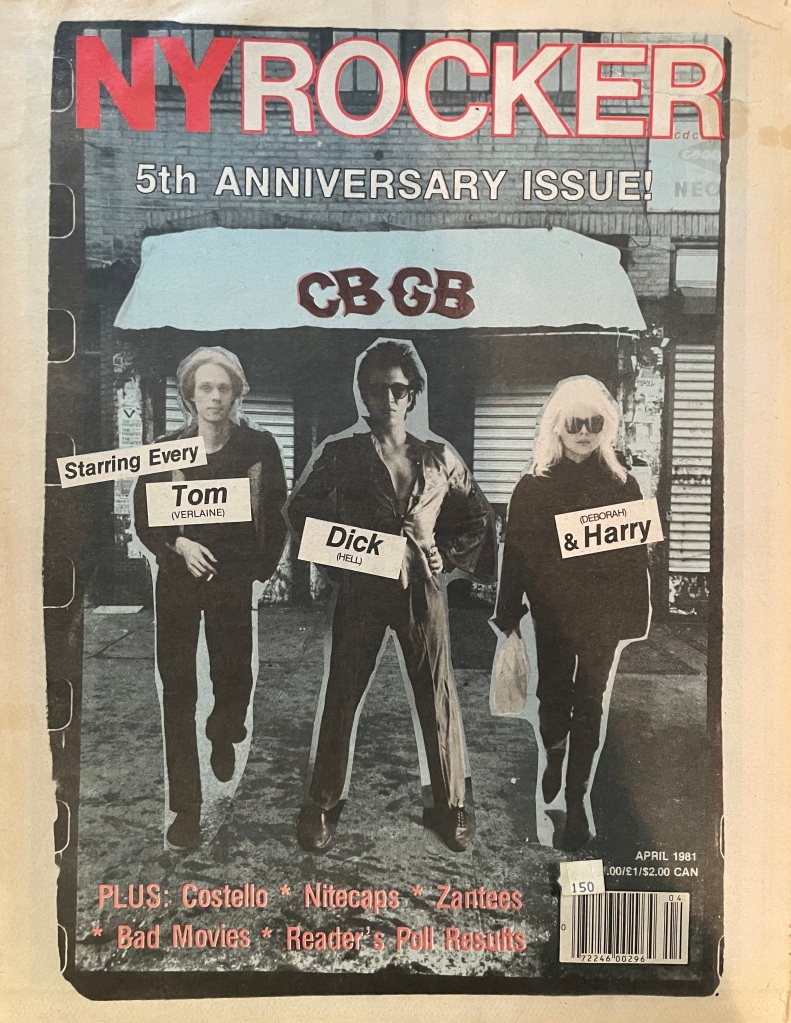
In April 1981 I’m sure it felt like a pretty big deal that NY Rocker had weathered the storms of punk and post-punk and come out on the other side of five years of publishing. They’d have a few more to go, though the end was quite a bit more ignominious than anything happening there from 1976 through 1982. So this issue, celebrating said 5-year anniversary, is a pretty nice one to have around, particularly because it’s not all onanistic back-patting but rather a normal monthly NY Rocker issue, tarted up with a little deserved looking back. 

On that front, there’s a cool piece called “Whatever Happened to the Class of ‘76?”, focused on the Manhattan/CBGB/Max’s whoosh that gave the mag and underground music much of its initial jolt. Tom Verlaine, in 1981, is said to be “a study in career suicide”. The Ramones’ lack of commercial breakthrough is thoroughly bemoaned, though some hope is held out for their new 45 “She’s a Sensation” (it didn’t chart, not even close). Suicide are “finally on the verge of the commercial success they so richly deserve” (I don’t remember said success). There’s definitely some bellyaching that Patti Smith is now in Detroit being a mom and raising a family, likely written by “a young person” who perhaps hadn’t yet considered having children now or ever.

They also track down “The De-Classe of ‘76” as well: those who disappeared. This includes acting editor for NY Rocker issues #2, 3 and 4 Craig Gholson, who says he got out early in the game because he “became disinterested in the music. I wanted to write about Television. I didn’t want to have to write about the Dead Boys”. Amen and godspeed, Craig. The “early days” reminiscing continues with a piece of Kristian Hoffman memories, a great Roberta Bayley photo spread of all the key ‘76-’77 NYC players and best of all, a reprint of Lester Bangs’ Peter Laughner obit from the September 1977 issue. It’s a phenomenal piece, readable here and also in one of the Bangs books, and it’s highly ironic for its depictions of Bangs trying to reason with Laughner to not drink and drug himself to death. and not letting him up into his apartment because Laughner was becoming “bad news”. I say highly ironic because I read the Bangs bio and, well, black kettle/black pot and all that. 

As far as the 1981 stuff in here, well, there’s news of a Plasmatics indecency arrest in Milwaukee, and The Specials being fined in London for “encouraging fighting” at their gigs, which was highly preposterous. The Plasmatics were indecent, though, on every level. I remember both of these incidents, but man, growing up in the suburbs as I did among the rubes, any time my musically unsophisticated peers wanted to reference whatever was happening in punk and “the new wave”, it was often The Plasmatics that they reached for. The 6 o’clock news had probably done something on them blowing up a school bus, or Wendy’s nipple tape, or this arrest. The hoi polloi, the great unwashed – they usually knew about Devo (total fags), the Plasmatics (that chick’s a dyke) and the Dead Kennedys (probably gay).

Now – on the proverbial flipside, NY Rocker #38 features a cool visit to the Brooklyn abode of Miriam Linna and Billy Miller of The Zantees to admire their record collection, jukebox and retro dishware. Bill Landis of Sleazoid Express weighs in with a fantastic primer essay, “From Tack to Gore: The Exploitation Film in America”, so good it makes me want to order that book I just hyperlinked to. In the reviews section, reviewer David Blither tries to grapple with the landmark ½ Japanese½ Gentlemen/Not Beasts triple LP box set, and far from finding it wanting, walks away from the experience with the zeal of the convert. Love that thing. And Howard Wuelfling gets a ton of great shit to review: a pile of Cleveland 45s like Pressler-Morgan, X_X, The Styrenes and Cleveland Confidential, plus the debut Bad Brains, a Wipers single and even the Lesa (Aldridge) 45. What would you say if I told you 1981 was one of the top three years in rock music history? NY Rocker #38 is another in a long line & litany of verifiable and documented proof points, so I shall provide no quarter on my stance.

NY Rocker #57

The 1984 Conflict fanzine we talked about last time makes explicit reference within its pages at just how bad NY Rocker was by that year, and folks, it’s that exact era that this particular issue – NY Rocker #57 from May 1984 – resides in. And whew, it is indeed pretty bad. It’s not the voice of the NYC underground any longer, but rather an Anglophilic pseudo-music industry paper, reminding me just how rotten things were just north of the deep underground that year.  

What they’re covering is mostly garbage. The execrable Girlschool, The Smiths, Eddy Grant, another feature on X (the previous two issues I wrote about had X on the cover both times, just not their sell-out “year of change” X of 1984-85); Chrissie Hynde and all manner of commercial mediocrities across the board (Robert Cray??!), in every corner of the magazine. 

Patrick Albino writes in to vent about British provocateur and known Stalinist Julie Burchill having recently made her way to NY Rocker’s pages. Burchill was a bit more complex than that, politically, and eventually traveled from one pole halfway to the next, growing up enough to write this piece a couple of years ago. Editor Iman Lababedi takes the bait full-on and sounds about as much of a peace creep doofus as any Ruth Schwartz or Tim Yohannan response in that era’s MRR: “During an age that finds America’s right-wing lunacy reaching new dimensions of danger, you’re complaining about our printing a brilliant communist columnist. I know what side you’re on and it isn’t mine”.

Burchill’s column here is fantastic, actually, a wild review of various drugs and the current state of UK drug-taking. She’s said elsewhere that she had “put enough toot up my admittedly sizeable snout to stun the entire Colombian armed forces”. There’s a ton of UK/US cross-pollination going on in this issue, very reflective of the “Rock of the 80s” times when synth-pop and MTV were the centerpiece of mainstream rock writers attempting to shy away from Madonna, Springsteen, Prince, Michael Jackson etc. So it makes NY Rocker #57 feel far less of a fanzine than the previous issues I’ve discussed (here and here), and more like the new wave dreck Trouser Press was dishing out at this time, usually with worse writing. It reads at times like a non-benevolent corporate parent has taken over, yet that doesn’t appear to be the case, which is a bummer because it might explain why they took such a dive down the dumper.

Still, like Trouser Press in this era, there are moments. There’s a NY Underbelly column by Tim Sommer – he was in Even Worse! – featuring one of those rare Sonic Youth shots with Kim Gordon in glasses, along with small features on Swans, Ut and Sonic Youth. While the reviews are mostly of commercial records, the review section ends on a high note with a highly positive review of New Orleans’ Shitdogs (!). Three years later I’d see the Lazy Cowgirls play that band’s “Reborn” every single show, and have the singer of the Cowgirls relay to me personally the theretofore-unknown glory of The Shitdogs. 

Thing is, for $1.95 I’d have bought this every month had it been made available to me, reservations aside. I was a junior in high school at this point – and a Smiths fan – and I would have welcomed it into my home, while recognizing even then that it was fairly weak across the board. It’s a very different music publication than the one that had Byron Coley and Don Howland writing for it a couple of years earlier. What I learned is that the magazine had “folded” in 1982, and that this and only one other issue had been part of a brief – and totally unsuccessful – revival of NY Rocker. It ended up being the final issue, and I think that was most certainly for the best. 

NY Rocker – September 1980

The personal, hand-assembled music fanzine’s always been the place that cultural pontificators like to point to when directing nostalgia seekers to the real pulse of an era, the sociological beat of the streets and the place where a given music’s early adopters were the ones helping to define that music’s formative boundaries and key players. I think there’s much truth to this assertion, or I otherwise wouldn’t be bleating as much as I am here. 

Yet I think there’s actually far more sociological and on-the-ground ore to mine from the music periodicals of particular musical eras, back when, unlike now, music periodicals were a thing. A single issue of the NY Rocker, say – or of Slash, or Damage, or Take It!, or Sounds, or Rip It Up, or Melody Maker – those newsprint periodicals, packed with columns, reviews, interviews, musings, artwork, listings, ads and photographs – each issue of these provided an incredible bounty of detail and real-time reportage and opinion that actually tops much of what irregularly-produced fanzines did. So I like to read ‘em, myself, just to put myself in the same frame of mind as any other music dork might have been in during 1980, or 1972, or 1967. In the US these local newsprint music papers pretty much died out by the mid-1980s, replaced by the local alt-weeklies that themselves have now died out.

This preamble is so we can talk about how much I loved reading NY Rocker’s September 1980 issue, OK? It’s the proverbial portal to another world, itemized and particularized extensively and exhaustively from the viewpoints of folks like Andy Schawrtz, Byron Coley, Ira Kaplan, Lisa Fancher, Jeffrey Lee Pierce, Peter Crowley and many others. Some Los Angeles names on there, right? That’s because this is a very heavy “The Best of the West” issue, with three different features on X (who’ve just released Los Angeles and played New York) and a particularly fantastic Lisa Fancher piece trying to make sense of the LA/beach hardcore scene and place it all in context. Like Kickboy Face’s similar piece in Slash around this time, she is an advocate of letting the kids be kids, hating the cops and grooving to the pure adrenaline of nascent hardcore punk. “Though it may have taken three years, these California kids have finally broken away from English apery and come up with something so crazy and incomprehensible it could only be American.”. God bless Lisa, and God bless the USA.

Oh – and she talks about a show she’s just attended in Redondo Beach at the Fleetwood with a bill of Fear / Bags / The Gears / Circle Jerks / Gun Club / The Urinals. I know, I know. She casually mentions “Slash is filming the proceedings”. Folks, this is the The Decline of Western Civilization show; “Slash” = Penelope Spheeris, the then-Ms. Bob Biggs. I know that some of The Gears footage made it to a Decline DVD; does anyone know if she actually filmed The Urinals and Gun Club as well?

Aside from the heavy LA focus in this one, there’s a “the scene is totally dead” San Francisco report from Tony Rocco, who was a staff writer for Damage and who was parroting the party line of that magazine in 1980, which we told you about in this post. There’s a (true) report about The Cramps’ Bryan Gregory quitting the band to join his girlfriend in her intense worship of Satan (!), and his new replacement, Julien H (you can see her in this clip, one of the greatest pieces of rocknroll ever committed to film). There are also great bits on The Raincoats, Gang of Four and The Selecter, all interesting, all of their time and all so exciting in the context of everything else also going on around them.

There was another reason this was such a great year – The Shaggs’ world-destroying Philosophy of the World had just been reissued, and it was blowing minds from Nashua to Great Neck and back again. Byron Coley reports on it all, in the context of a review that unsuccessfully (and tongue-in-cheek) attempts to compare it with some Slits demos that have just come out. I heard it not long after this and got quite the laff out of it, but it wasn’t until about 1983 or so that Shaggs mania would enter my home from the most unlikely of sources.

The comedian Bob (“Bobcat”) Goldthwait was a local San Francisco comic in 1983, and I was a 15-year-old who listened to the Alex Bennett Morning Show on KQAK (“The Quake”) every weekday morning before school. Every morning Bennett had someone on, a local comedian, who’d later go on to be moderately famous, like Dana Carvey, Kevin Pollak and Mark Pitta. Anyway, Goldthwait was on at least once a week, and he decided to bring The Shaggs to the west coast, both figuratively (by making Bennett play “My Pal Foot-Foot” and “Who Are Parents?” on the air all the time) and “literally”, by pretending to bankroll their big trip to San Francisco, where they’d be greeted on the ground at the airport as heroes who’d come to save rock & roll. 

Goldthwait used Bennett’s show one morning to pump up the in-studio crowd who’d come to KQAK for every show – as well as the audience listening at home – to get themselves to SFO airport immediately to cheer and hoot for The Shaggs, whose “plane was just about to land”. Goldthwait had a live mic and several dozen amped-up people around him at the airport chanting “We love The Shaggs! We love The Shaggs!” as their plane landed. I was quite entertained listening at home, let me tell ya. I don’t quite remember what happened when the Wiggin sisters didn’t actually get off the plane, but perhaps I had to get to Social Studies 1 and missed it entirely. 

Anyway, like I’ve said in previous items, I haven’t entirely lived up to my promise to write more unasked-for stream-of-consciousness diversions in these blog posts, so there you go. NY Rocker’s September 1980 issue is a real gem. I have others to review in the weeks to come. (And hey, does anyone have any info on the lone issue of NY Rocker Pix? It has on the cover one Donna Destri, the sister of Blondie’s Jimmy – I just this very week heard her name for the first time when I watched this not-especially-good documentary called Nightclubbing about Max’s Kansas City.)