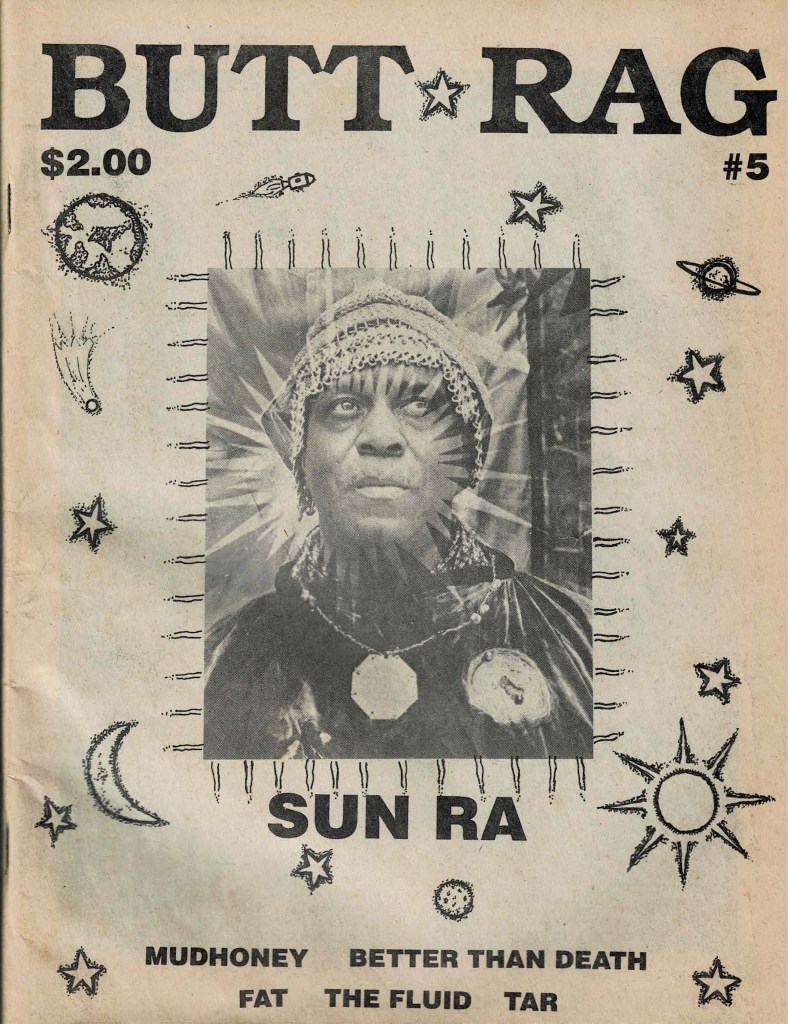
Peter Margasak has, over several decades, come to represent for me what one might hope a snot-nosed 80s fanzine writer would ultimately blossom into with practice, open-mindedness and intense on-the-ground, in-the-clubs lived experience. I suppose one gets out of it they bring into it, and jeez, even in 1989 and in Butt Rag #5, Margasak’s taste was incredibly expansive and pushing ever outward, even as he gossip-mongered about Amphetamine Reptile records, Mudhoney and Sonic Youth. Even more so than in the previous issue of Butt Rag I wrote about, Margasak is caught suspended in amber here – for both better and worse – between the often mean-spirited tenor of US rock/underground fanzine-speak and a guy who’s leaving it all behind for intelligent forays into boundary-pushing music of many types.
To wit: talking about Steve Albini’s passing in his post just yesterday on his Nowhere Street site, Margasak says, regarding Albini and himself, “His lacerating wit and scrupulous code of conduct arrived like a worthy ideal. I tried to ape the way he and peers like Byron Coley and Gerard Cosloy wrote about music; being harsh seemed cool. Of course, it was stupid, misguided, and often cruel”. Alas, that’s something I do take away a bit from Butt Rag #5. In the intro essay, it’s relayed that David Thomas of Pere Ubu has just passed on an interview with the fanzine, “due to the obscene nature of the name of this publication”. Then Margasak fat-shames the hell out of him.
Yet his tastes were generally more open than those of his peers and certainly more than mine were in 1989. He’s into the deeper layers of indie/underground rock; noisy stuff, and especially avant-music trending toward free, far-out jazz and whatever honking and squirting is going on in the late eighties – very much including reissues and new discoveries from actual jazz legends and long-tail heroes. Margasak and I would have found common cause over a beer in Mudhoney and The Fluid that year (!), though, like many of his fanzine peers, he thought that the Thrown-Ups were fantastic (“three brilliant singles on Amphetamine Reptile”). You be the judge. Tar, whom he also talks to here, never did anything for me, but they made several dozen people happy and that’s just great. Not to speak ill of the dead, but Tar say in this mag that they were not happy recording with Steve Albini and found him, contrary to later reputation, to be far too heavy-handed and opinionated with them. (and if you’d told me in 1989 that the NY Times and The Atlantic would publish well-crafted Steve Albini obituaries on the eventual day of his death, I’d have seen it as some sort of unanticipatable upside-down world).
Then we get into the stuff that excites me now. A band called Chewing The Fat are interviewed by John Corbett. They are compared with Massacre, whom I’d shamefully never heard until this year, and who are one of my favorite recent “discoveries”. I can’t find anything online about Chewing The Fat, and I reckon that might mean that they never recorded. (Update: I’ve subsequently been informed by Peter Margasak himself that the band were just called FAT – just like it says on the cover – and their music can be found here).
There’s another piece on an improv-leaning band called Better Than Death, and then, of course, a John Corbett Sun Ra interview from 1985, which made it only 4 years old. Ra talks about his trips to Jupiter, that what he’s doing is “the first time this has ever happened on this planet”, and a lot of his usual patter – “the ‘avant-garde’ refers to, I suppose, advanced earth music, but this is not earth music….I have to play things that are impossible. I have to get a piano and hit some notes on there that aren’t on there”. You can see why we love the guy – I did long before I’d even heard his actual music. It’s still discordant for me to imagine Margasak having John Corbett writing for his fanzine, but that’s because I came to Corbett not when he was a 26-year-old writing for fanzines, but when he was the polished and highly experienced writer of jazz/improv books from the past decade like A Listener’s Guide to Free Improvisation and Vinyl Freak.
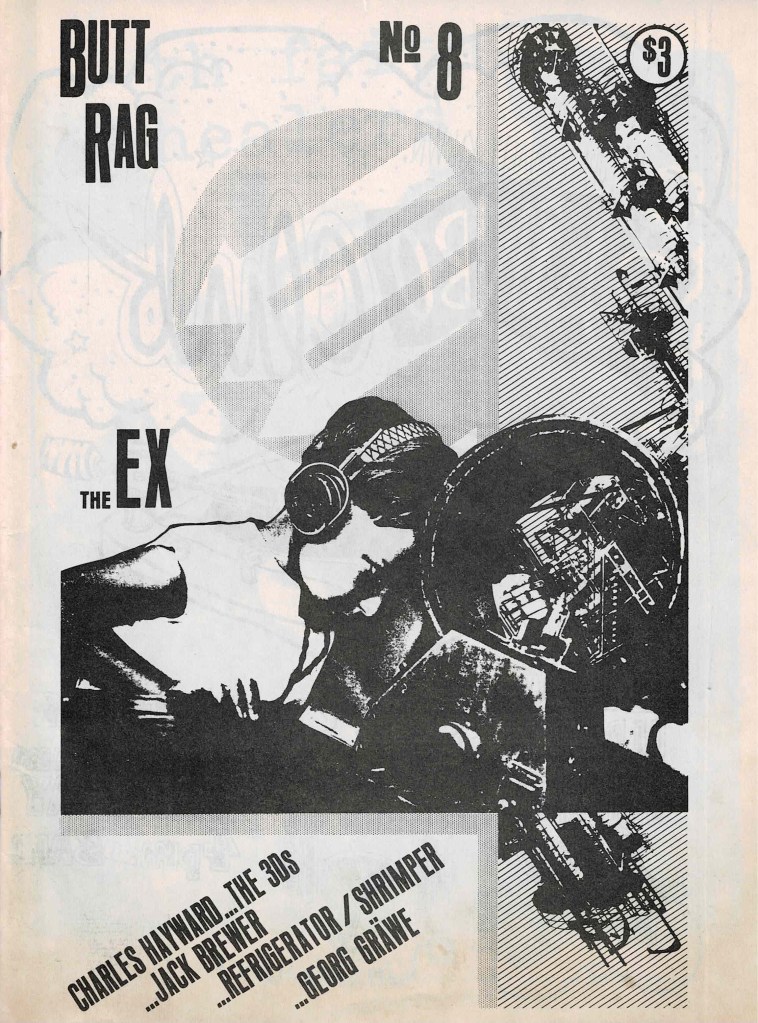
Then follows, as in Butt Rag #8, an absolutely massive section of reviews. These straddle both sides of that young man trapped in amber. Reviews range from High Sheriff Ricky Barnes & The Hoot Owls to Sub Pop neanderthals Blood Circus; Anthony Braxton; the Cowboy Junkies, whom he loves (nothing wrong with that); Galaxie 500; Machine Gun reviewed by Corbett, David Murray Trio, that Nirvana debut 45 i sold for $80 that’s now worth $10,000; Reverb Motherfuckers (he’s decidedly not a fan); the first Royal Trux; Talulah Gosh and the phenomenal Venom P Stinger 45.
Sometimes it’s clever, sometimes it’s not. He reminded me that people used to call Dinosaur Jr.’s Bug LP You’re Living All Over Me All Over Again – or maybe it was Margasak himself that started that “meme”, in this very issue. Regarding a Philly band called More Fiends: “Turning in an above-average effort in Philadelphia is generally several notches below what the same quality would rate nationally”. Well said. (This ratio would change for the better in the 1990s). By the same token, he’s really on board with the simpleton consensus on Halo of Flies; their new single “rips your head apart”. Fuck yeah! L7, the awful LA mostly-female band, well – “apparently the guitarist in the Laughing Hyenas got her start in this ancient band”. Alas, that was this L7, seven years earlier.
A review of a Chemical People album on Cruz Records: “I sure hope Greg Ginn gets his shit together, ‘cause I can’t take any more of this crap.” It may not have seemed so running a music fanzine at the time, but I’ll posit there was actually zero reason to take said crap in the first place. My life was bountifully enriched, and my lifespan possibly extended, by not listening to anything on Cruz Records, ever. I’d get records like that in the mail, and they’d go straight onto the Amoeba Music “to-sell” pile, unlistened to and most certainly unreviewed. As it should have been, for the betterment of the scene! And then in Butt Rag #5, there’s another giant section of short reviews after all of the longer reviews. It’s a lot to take in, but it’s fantastic to have it around when needed, and another reminder of this absurdly record-drenched era and its more general mania for over-the-top music documentation in print.
 Fanzine Hemorrhage