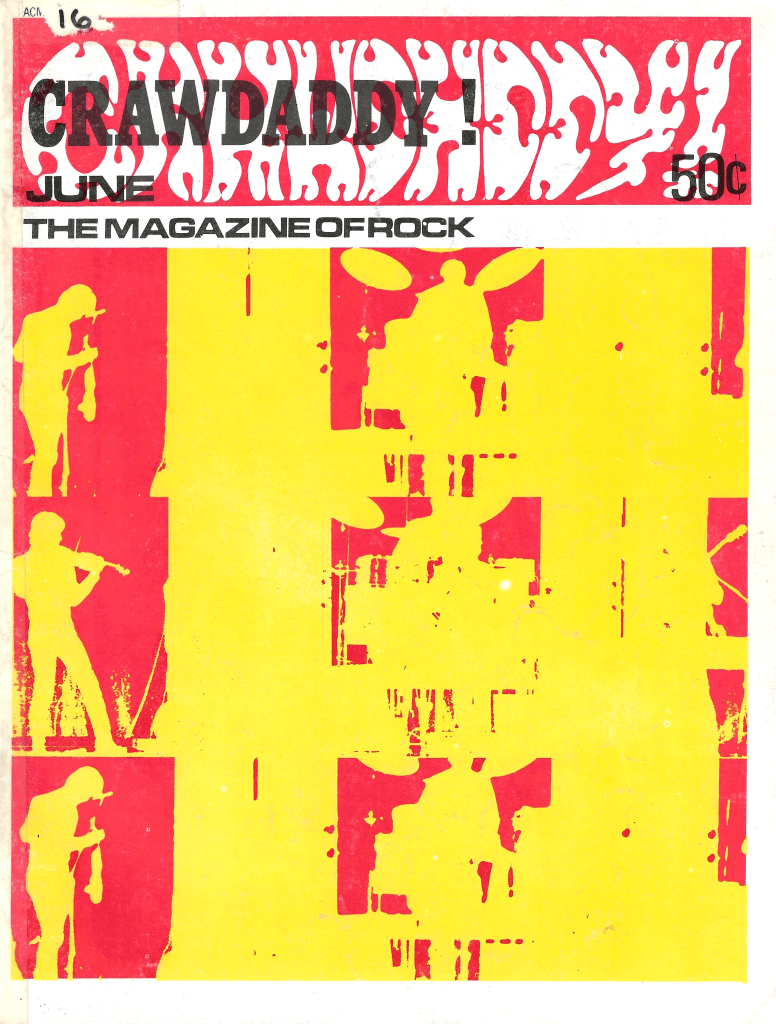
Crawdaddy! #16

I’ve only got a couple 60s issues of the original Crawdaddy! – “The Magazine of Rock” – and I’m quite aware that it wasn’t a true self-published fanzine, as weren’t the magazines Rock Scene, Teen Screen, Trouser Press, Cheetah, Beetle, Sounds and a few others I’ve bantered about here. It’s a great window into the “rock as culture” movement of the late 60s, in which rock music was dissected as intellectual fodder, the whole “but-what-does-it-all-mean” ethos that was part & parcel of the era’s zeitgeist. It’s still a point of chagrin in my house just how picked-over Bob Dylan’s lyrics were at the time, but I know Bobby Z has his fans, and who am I to say they were wrong to do so.

Paul Williams was the editor of the original version of the magazine, which started up in 1966. His run at the helm ended in late 1968, not long after this issue, Crawdaddy! #16 from June 1968, but the thing continued throughout the 70s, albeit without much cultural cache that I can discern. Williams would later re-launch the magazine in the early 1990s as almost a fanzine again from his then-San Diego home. He provided a writing hub to so many folks who’d go on to be fairly well-known, such as Richard Meltzer and this issue’s Sandy Pearlman and Peter Guralnick. (Wikipedia says that Gilda Radner and Dan Aykroyd wrote for it in the 70s!). 

Crawdaddy! #16 finds itself parked pretty well in front of a lot of what I’d like to think I’d be excited about during the hot hot summer of 1968. The United States of America get the cover and an excellent write-up by David Flooke, focused quite a bit on how they might use their synthesizers to build on “the second coming of the new music era, which was heralded by Sergeant Pepper along with Pet Sounds”. People actually liked Sergeant Pepper back then, folks – no, I’m serious! But I love this piece because it’s so excited about “this group that is shaping art into rock”, and also mainly because I really, really dig the LP that Flooke is so excited about, so I’m excited to feel his real-time excitement. 

There’s much excitement as well about a Doors live show by Kris Weintraub, who is already rhapsodizing about the godlike power of “Jim”, on a first-name basis. Williams writes about Smokey Robinson & The Miracles and The Beau Brummels, the latter being one of San Francisco’s finest and a big favorite of Mimi Hinman (my mother), though I did not know they were still hoofing it in 1968. David Anderle and Williams then get into a long recorded discussion about Brian Wilson. The article is simply called “Brian”, and it’s part three of their deep exploration into every conceivable aspect of Wilsoniana. Williams sees 1967’s Wild Honey as “some sort of breakthrough”, and they go way into it, with diversions into Dylan, the Doors, Elvis and even Rembrandt and Modigliani. Your patience may vary. 

Another piece contrasts The KinksSomething Else with The Who’s The Who Sell Out and yes, I’ll say my patience for over-explanation does waver a bit on this one. Tim Ellison – whom I know at least somewhat revered Crawdaddy! – brought back this style of labored writing in the 1990s in his excellent fanzine Rock Mag!, but I also felt Tim, educated as well as he was by comparatively lowbrow punk fanzines, leavened his prose with some real tongue-in-cheek weirdness that might have gotten his submissions summarily rejected by Williams in the 60s, who knows.

But look, the real gem here is a real-time inspection by Pearlman of White Light/White Heat by, that’s right, the Velvet Underground. He zeroes in on many things, only some of which I can really understand, but his biggest excitement is reserved for Maureen Tucker’s Bo Diddley-groove, and the band’s unswerving dedication to repetition. He loves “Sister Ray”. And in 1968, to love “Sister Ray” was to be ahead of the curve, shall we say. White Light/White Heat peaked at 199 on Billboard’s album chart, which only went to 200. He can’t really tell if their repetition means “they’re playing badly or not”, but doesn’t care. I don’t either. It’s probably my favorite album of all time.

 Marc Silber ends Crawdaddy! #16 with a piece on Autosalvage’s debut album, which would ultimately be their only. I’d never heard of them, but I like what I’m hearing right now. Of course, I also happen to be on a Moby Grape/Love/Kinks sort of bender right now, so all of this is in my proverbial wheelhouse at the present moment. I’m sure I’ll go back to disparaging the hippies any day now.

NY Rocker #18

I’ve recently come into a gaggle of older issues of NY Rocker, and thumbing through them, I’m even happier about my minor acquisitions than I’d thought I’d be. At least on the evidence presented by NY Rocker #18 from April/May 1979, this not-really-a-fanzine tabloid newspaper was even better in its earlier years than it would be a couple years hence. I’ve talked about issues from that later era here, here, here, here and here. And I’ll talk about other ones that sprang from ‘79/’80 in the weeks to come, as I traverse them. This shall take time. For now, let’s see what was happening in the world of underground NY/LA/SF/London during the Carter years.

First, there’s Howie Klein reporting from San Francisco. Sigh. I can’t throw a stick at a fanzine from this period without encountering the guy. If you’re not a Clash fan, and I’m not, it’s hard to wrestle with hyperbole such as Klein’s blather when he sees their 2/7/79 show in San Francisco: “This was undoubtedly one of the best shows ever seen in the Bay Area…..”. If you don’t know which side of the true punk vs. corporate schmuck divide Klein stood on – or at least which side he was (rightly) perceived to be on – there are these gems from the same piece: “Rock super-promoter Bill Graham – the only major concert promoter in the U.S. to give strong and consistent support to the new wave…” (Bill fucking Graham!!) and dissing the grass-roots punk/all-ages organization called New Youth who got The Clash to play this cheap, for-the-people gig in the first place. “…the band (got) involved with New Youth, a group of mostly idealistic (like starry-eyed at best, and in some cases, simply psycho) young fans who believe in non-profit punk rock gigs. So they got The Clash to commit themselves to doing a benefit for them at a deserted Jewish synagogue between the Peoples’ Temple and the Old Fillmore in the heart of San Francisco’s black ghetto. A cheap ticket price and the opportunity to see the band in an unseated funky venue…caused a dramatic slump in ticket sales in what should have been the band’s biggest and fastest sell-out. As it turned out, The Clash came pretty near to selling out anyway….but not before a lot of rock-biz upset between the Graham Organization, Epic Records and Tapes and the William Morris booking agency”.

The horror! You can see the sort of scene mechanics that actually stressed Klein out in 1979, and why he ended up being so utterly reviled by music-focused underground aesthetes at the time, unfair as it perhaps may have been, considering one’s perspective and degree of oppositional defiance.

More irony abounds in a Sandy Pearlman interview – he produced The Clash’s Give ‘Em Enough Rope – “The Clash themselves will do virtually nothing to make it. In other words, they will not accommodate themselves to the rotten, debased, commercial system of exploitation that currently exists. The Clash do not wish to make any compromises”. Totally! On the flipside is a paean by Doug Simmons to truly underground Boston band The Neighborhoods and their singer David Minehan. I didn’t much care for the band, once I finally heard them, but my 9th grade best friend Jon Grant had just moved to San Jose from Massachusetts, and his brother had been close friends with Minehan. I’d hear all about The Neighborhoods from Jon, and seriously, I felt pretty special at age 14 knowing a guy who had a brother who was friends with a guy in an actual performing punk band that I’d never heard.

Oh, and the Beach Boys stuff in this issue is just fantastic. There’s a Greg McLean interview with Carl and Dennis Wilson of the Beach Boys, as well as a Harvey Kubernik sidebar about a recent BB book. McLean clearly isn’t a fan of Dennis Wilson: “his frequently crass and unexpected comments often cut Carl off mid-sentence, and he dropped the name of his new girlfriend, Christine McVie, whenever possible”. McLean retaliates and agitates them by only asking questions about Brian Wilson: where is he, tell me more about Brian etc. This does him no favor with the brothers. Dennis says, vis-a-vis the Dr. Eugene Landy thing, “Brian is loved dearly by all of us and us by him, and all that bullshit about him being manipulated is just….not in my experience…”. McLean then goes on to bait them further about Mike Love being an asshole (a certified fact, from what I understand), and then talks about a Beach Boys show at Radio City Music Hall in ‘79: “Between songs, Love babbled aimlessly, killing any sense of pace the show might have established. Mike Love looked old and foolish”. Everyone loves Mike Love, don’t they?

So this issue is absolutely packed, and I could write reams about each piece – but there are like, 20 pieces: The Shoes; a thing on young Boston and NY radio DJs and stations; Viv Stanshall; The Raincoats; The Only Ones; and a really early piece on The B-52s, circa their Rock Lobster 45, with great photos of a very young band and an interview by editor Andy Schwartz. Even so, NY Rocker would sometimes give space to mainstream music-lovers like Ken Barnes. He writes a thing about how much he loves disco, even in 1979 (the year of Disco Demolition Night), and says, perplexingly, “It seems to me that a lot of people are quite scared about disco, and they’re lashing back with unreasoning venom. An interesting observation by Mark Shipper pertains here – for years during the 70s rock lull, all the right fanzines clamored for the return of fast, exciting beat music kids could dance to. Now it’s here and kids dig it…but because it doesn’t follow the form the clamorers grew up with, they’ve turned on it viciously. Ironic, wouldn’t you say?”. I mean…..that’s one way to look at it?

Finally, and I feel like I’m skimming here, but there are great reviews of recent “rock concerts” by The Contortions, Nico, The Knack (who are absolutely buried by Don Waller), and The Ramones with their special opening band Lester Bangs’ Birdland. NY Rocker #18 comes to an outstanding close with Jeffery Vogel’s fake “TV Guide” listings that shit mercilessly on every upcoming show and on every NY band – especially the Dead Boys. Now that’s some vitriolic mirth-making that we at Fanzine Hemorrhage can get behind, anytime & anywhere, even from 46 years ago.