Sense of Purpose #1

Dave Sprague was the editor, publisher and for the most part, lone writer for Sense of Purpose #1. He published it from his apartment in New York City in December 1983, and I admire how dogmatically locked-in he was on only the defined contours of the rock music underground he cared about, rather than taking the larger view. I’m reasonably certain that Sprague may have been unaware of and/or unable to access much of it – you have to remember, a lot of fanzine folk got themselves deeply clued-in about far-flung independent music in one of two ways: by being involved in college radio, where new records were everywhere, or by receiving loads of free promos from all corners of the globe after publishing a first issue. This being the first issue of Sense of Purpose and therefore not yet reliant on a promo gravy train, I see Sprague trending a bit toward what was on alternative radio and in middlebrow-ish publications like Trouser Press at the time. 

This includes a bunch of what we then called “imports” from the UK, records available almost completely in sections labeled as such at record stores – Alien Sex Fiend, The Cure, The Smiths and whatnot. He’s also big into LA’s Americana and quote-unquote paisley underground bands, as we shall discuss, and as relayed when we talked about his second issue of Sense of Purpose here. Sprague’s pedantic opening editorial bemoans the synth-pop, dress-up “Rock of the 80s”, finding too-easy targets in the Stray Cats and Billy Idol and positioning his fanzine as standing “against” them. I might have written something similar in 1983, so all is well. I do like and puzzle a bit how this is immediately juxtaposed with a paean to the Sisters of Mercy, whom I also kind of enjoyed myself during the days I rabidly trolled the imports section; I was also really big on Red Lorry Yellow Lorry and Xmal Deutschland my senior year of high school. 

He gets a big talk in with the Dream Syndicate, who’ve recently lost Kendra Smith on bass but still retain Karl Precoda on guitar. The Medicine Show wasn’t out yet, but Steve Wynn is already warning people about how desperately he wants to be popular. He says the band’s way more influenced by Bryan Adams than by Lou Reed at this point, and claims “one band we all think is inspirational/amazing/great on every level is Steely Dan”. Regarding Kendra’s departure earlier that year, Wynn says “When Kendra left, it changed the band a lot – essentially we broke up and reformed, and now a lot of the old stuff sounds dated to me”. Fair enough, I suppose. I wouldn’t see Dream Syndicate live until 1986, with Paul Cutler on guitar, but they played the Days of Wine and Roses material beautifully. I just couldn’t stand Wynn, and everything he said on the mic was pompous, annoying and self-mythologizing. I can see in this interview that this is just where he was at for a few years; he thankfully mellowed with age, as one does.

The talk with Green on Red is good as well, albeit with much ado made about Dan Stuart’s legendary alcohol intake. There’s a Cleveland fixation in this issue and in its follow-up that makes me wonder if that’s maybe where Sprague was from originally. He touts a Cle band called The Wombats, and a fellow writer named Larry Smiley delves deeply into Brian Sands. Why not Evie Sands? Bobby Sands? Cleveland, that’s why. And speaking of Cleveland, Sprague drags up something I feel like I once knew, but then completely forgot – that post-Kid Congo Cramps guitarist “Ike Knox” was actually Mike Metoff from The Pagans! Sprague also goes unnecessarily overboard on The Cramps’ new Smell of Female EP, as many of us did at the time, because it was the first new Cramps vinyl in a long while, and despite it being live and mediocre, was felt to be much-needed. I’m sure I haven’t listened to it in over thirty years.
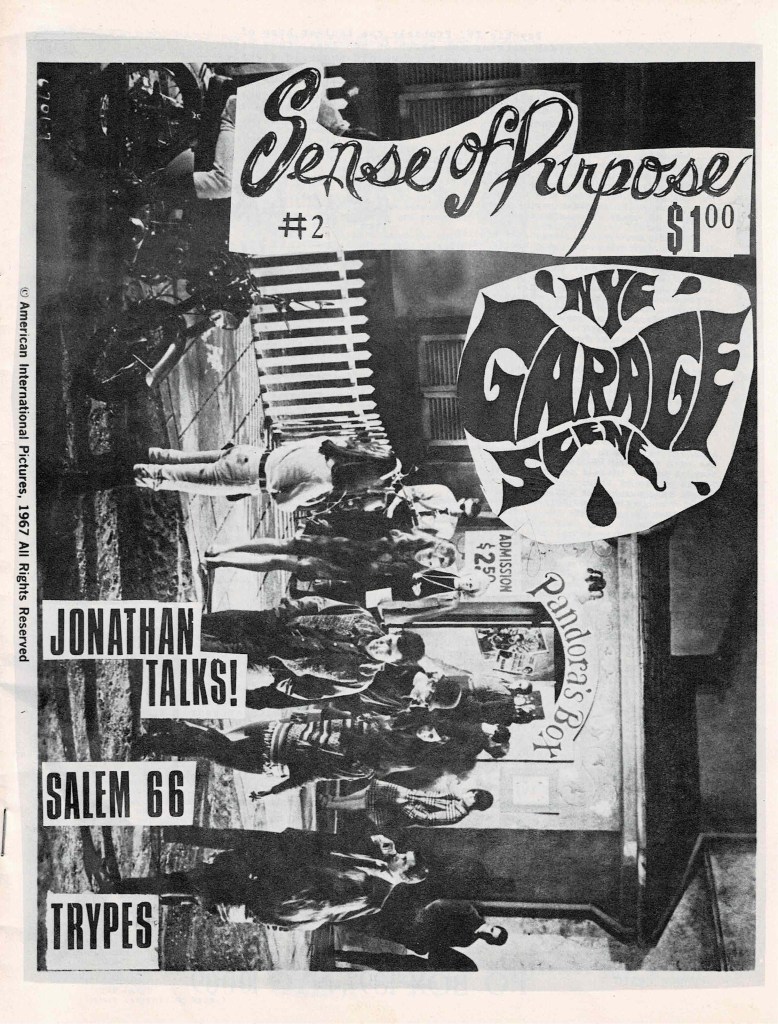
Sense of Purpose #2

Sense of Purpose #2 came out in 1984 and was pulled together by a guy named Dave Sprague in New York City. I was just trying to figure out how I knew the name Dave Sprague from the 90s. Perhaps we were correspondents? We might’ve been. I didn’t save all my scented letters in a shoebox. I then remembered that he used to write for Your Flesh, and moreover, that I even used to read Your Flesh. But this fella honed his chops in his own self-defined corner of the underground music universe, with Sense of Purpose truly ignoring huge portions of what music fanzines were going on about at the time in favor of a curated garage, psych and rooted Americana angle, minus the jangle and the college rock endemic to fanzines like The Bob or Jet Lag

In fact Sprague puts his critical ducks in a row right off the bat, with an opening editorial about how awful Psychic TV were live. Leaving aside the question of why he was in attendance, this essay expands into a treatise against the sort of then-fashionable juvenilia that tried to make hay out of surgical training films; that turned anything sexual into something potentially violent and ugly; that made fun of crippled children and so forth. The Meatmen, for instance, or some of the grade-z material that Forced Exposure somehow thought worthy of publication.  

There’s a section of letters to the editor (including one from Mr. Ott from White Boy!) that has one correspondent taking him to severe task for liking the Green on Red LP on Slash in his first issue. Gravity Talks? Decent record! Clearly the LA so-called paisley underground was big in Sprague’s mind at the time; he’s got a tape of the Dream Syndicate’s forthcoming second album The Medicine Show and he’s truly flipping out over it. I share – and shared at the time – many folks’ reservations with the thing, but nearly forty years of perspective still have me pretty bullish on the record, despite the enveloping spectre of major-label, let’s-get-big-on-alterna-radio gloss on that and so many other second albums from 1984-1985.

We talked about Living Eye fanzine just a few days ago; Sprague is also keeping tabs on the NYC 60s scene and a bunch of bands I really just couldn’t cotton to: The Fuzztones, The Cheepskates, Mod Fun, The Vipers, Outta Place etc. Then, after listing and dissecting these heavyweights, there’s another short column on brand-new garage bands: Alter Boys, Raunch Hands, Tryfles, Swampgoblins, and House Pets. There is some bountiful and deserved enthusiasm in the reviews section for the new Australian sixties feedback/sleaze heroes the Lime Spiders, whom I discovered on San Jose’s KSJS radio that same year. When I hauled my nervous 17-year-old self to college in Santa Barbara the following year, and wanted to impress my older cousin who was DJ-ing a Cramps/fuzz/punk-laden show on KCSB, I called in to request that band’s “Slave Girl”, which he hadn’t yet heard. It was a 1985 “life highlight” when he breathlessly came on the air right after the song and said, “Jay you are HOT!”. I desperately wanted and needed that sort of cred in my life at the time, and music obsession would be my path forward. 

Another thing I really enjoy about Sense of Purpose #2 is its intense focus on the Cleveland underground of the present and recent past. There’s big love for Cleveland’s Easter Monkeys from Christopher Stigliano, and he also provides the full Andrew Klimek story (X__X and others). His Cleveland enthusiasms duly infected Sprague, who then contributed a piece on Red Dark Sweet, probably the only one I’ve ever seen anywhere….? This was a NY-by-way-of-Cleveland duo of Charlotte Pressler and Andrew Klimek; they call themselves “free rock”, and you absolutely need to listen to their “Oh! Carol” here if you haven’t heard it.  

There are interviews with Salem 66 and the Trypes as well, the latter of which includes a history lesson on The Feelies and common member Glenn Mercer. Finally, in what is always an entertaining and confounding chat with Jonathan Richman, we find in 1984 that Jonathan is clearly going through an intense environmentalist phase. “Farming is important, especially on a small scale like the gardens in the East Village. I also don’t like flush toilets. I avoid them whenever I can”. Definitely this was a fanzine a cut well above the median read at the time, as well as a fascinating look at how good music taste can concentrate into some really interesting Venn diagrams at different points in history.