Bite Down #1

Over the course of Fanzine Hemorrhage’s reign of error, I’ve had the distinct pleasure of dissecting several 80s and 90s fanzines by one Brian Berger: Crush #3, Grace and Dignity #1 and Constant Wonder #1. Last time I even sirened a call that I sent across the internet for Berger to get in touch for a real old-school “Fanzine Hemorrhage grilling”, but our bait was left bobbing on the water. The common themes of any given Berger fanzine were a very learned abrasiveness; a high intellectual quotient that didn’t show itself off too much; complete & total independent music immersion; and a bit of horndoggery that did little to advance the seriousness of his cause. Thanks to one BH, I now have Fall 1988’s Bite Down #1, which I believe may be the very first of all the Brian Berger fanzines.

At this point, he’s a student at the University of Michigan, and therefore publishing Bite Down from Ann Arbor. Of course, Ann Arbor, especially its clubs, TOTALLY SUCKS. I love how college students from big cities, such as my own beloved progeny vis-a-vis Tucson, Arizona, often have the perspective of living and cavorting in exactly two places in their lives, and therefore if the second falls short of the first for, say, nightlife, the whole place just SUCKS. Berger places his zine’s opening editorial and statement of purpose on the inside back cover, the last place you’d think to look, and professes his love for rock and roll while also sheepishly admitting he’s a mere 19 years old. Well jeez, I was 20 myself at this exact time, and his obsessive interests very much mirrored mine: what various mythic fanzine types were up to (especially Forced Exposure and Conflict); Sonic Youth; the Gibson Bros; and the releases that were pouring out monthly by the dozens on Touch & Go, Homestead and SST. 

Most/all of the reviews I wrote for Sound Choice at the same age are just as guileless and uninformed as Berger’s, so any mirth-making here is refractory and probably aimed at myself, okay? But it’s funny! The Mekons’ 7-7-88 show at Maxwell’s was “the best show I’ve ever seen”. It may well have been! I say the same thing about the 9-28-87 Sonic Youth show at Borsodi’s Coffeehouse in Isla Vista, CA, which took place when I myself was 19.  “While a goodly amount of praise has been heaped upon the combo known as B.A.L.L., IT AIN’T BEEN ENOUGH!”. Really? B.A.L.L.? Richard Meltzer’s L.A. is the Capital of Kansas: an all-caps “MASTERPIECE”. (Maybe I should read that one). 

He cares even more about Shimmy-Disc records, a label whose program I struggled to get with at the time, but Berger is full-bore. B.A.L.L.’s new one is their “second straight masterpiece”; King Missile are “hilarious”; and even that Carney Hild Kramer record is a “masterwork” (there are nineteen copies of this LP currently selling at $3.48 on Discogs, not to conjoin art and capitalism, nor try to make any statements about price as a cue for quality). He also swipes the Forced Exposure “C/U meter” for his own 45 reviews, which was shorthand for “Could/Use x amount of copies”. So with a C/U of 1, you’d keep your lone copy; C/U of 500 meant, in theory, you needed to go find 500 copies. Tad, who is called “the friggin’ messiah” for his Daisy/Ritual Device single, gets a “C/U Entire Pressing”. Fuck, so that’s why I can’t find the goddamn Tad single – Berger got them all.

Only one more bit of funnin’, and then I’m done. (For the record, I enjoyed reading Bite Down #1 cover to cover today). His interview with Thurston Moore of, yes, Sonic Youth, is really good, mostly because Moore was and is always game to talk shop with a fellow record/music obsessive. It makes me laugh because the questions are so the sorts of questions I would ask bands not just in the 80s, when I’d meet them in person, but even through the 90s, as if they didn’t have anything else to talk about. “How’s the tour?”. “So you guys are playing with Laughing Hyenas”. “What’s the deal with this one record I collected from you” etc. Questions that were just as one-dimensional as I was at that age. I also learned that Thurston Moore’s tour diary in Forced Exposure was enlivened by some somewhat mean-spirited edits by Jimmy Johnson, which, I guess if it happened to me, I’d never submit anything to anyone ever again.

I do think Berger made a quantum-sized developmental leap from Bite Down #1 to Constant Wonder #1 in four years, and some of those rougher edges were never sanded down – mostly to the good in his case. They certainly made for more readable and more memorable fanzines, and I reckon the guy’s still a person of interest from this era, even if I’m the only one still interested.

Unsound #4

What a strange, creative and insularly self-driven fanzine Unsound was. We talked about issue #1 of this one here earlier in the year; I’m now going to attempt to render several paragraphs about Unsound #4, published in San Francisco during the first half of 1984. Little thought was given to economizing the page count in this issue, so you get a really crazed (but readable) mess of font types and sizes, short pieces about nothing whatsoever, longer pieces about not much in particular; and then more-or-less standard record reviews and interviews, mostly centering around a nexus of industrial, experimental, avant-garde and just generally oppositional musicians, musical offshoots, writers and artists.

This is how Zoogz Rift and his “Amazing Shitheads” come to bring his “odd, abrasive” free-form dada music to the Unsound party, just by being as oppositional as the First Amendment and the outer limits of taste might allow, all the while complaining (tongue planted firmly in cheek, I’d imagine) that he’s “being boycotted by the music industry”. Sonic Youth, fresh off their first visit to Europe and the release of Confusion Is Sex also have an interview here, 100% Thurston Moore representing, and right in that window where those of us hearing the band for the first time thought of them as something vaguely (if mildly) dangerous and transgressive. Remember, this is a time where “this music” wasn’t really even on college radio and the records themselves were often poorly distributed. All details were transmitted via fanzines.

I’d see blurry B&W photos of wild people like Michael Gira, Sonic Youth with guitars locked and hair long, even the relatively more popular Einstürzende Neubauten etc. and it was all pretty nuts and a little too much for a suburban high schooler. However, much more daring high schoolers like Jo Smitty and Mark Arm were living it in their suburban Seattle band Mr. Epp, referred to here in a bizarre post-mortem piece (“A self explanation”) entirely written by the band themselves. Four years later I’d see boogie-rockers Sonic Youth and Arm’s Mudhoney sharing a stage at San Francisco’s Fillmore. I’m going to bet Unsound editor William Davenport stayed home.

Then again, who really knows? It’s sort of funny combing through the record reviews of this one, which mixes up stuff like The Haters and deep-underground, edition-of-5 noise tapes with whatever records awful hardcore labels like Mystic Records were sending Unsound. Davenport, Brad Laner and other writers treat it all quite magnanimously, to my surprise – even the Gay Cowboys in Bondage tape! 

I’ve also just come off reading Marc Masters’ outstanding overview of cassette tape history and lore, High Bias: The Distorted History of the Cassette Tape (get it!). My favorite chapter is on the 80s tape underground that was helped to flourish – all things being relative, of course – by fanzines like Op and by college radio programs helmed by freaks who’d play whatever tapes showed up at the station, no matter how homespun. This is a world that Unsound also helped to steward and cultivate, and there’s also a great piece about “Art Radio” in which people call up particular shows on the left of the dial in order to share their “audio art” with the limited audience brave enough to tune in. I barely recorded my own doofus 1980s college radio shows, and it kills me that so much amazing and daring cultural weirdness on the airwaves was barely heard once, and will unquestionably never be heard again.

 Finally, there’s what looks to be a mail interview with a 26-year-old Adrian Sherwood of On-U Sound, and he’s hilariously defensive and dismissive of many things surrounding “reggae” and the mainstream. It’s a hoot. Unsound #4 itself is too, mostly for all the right reasons.

Chemical Imbalance #4

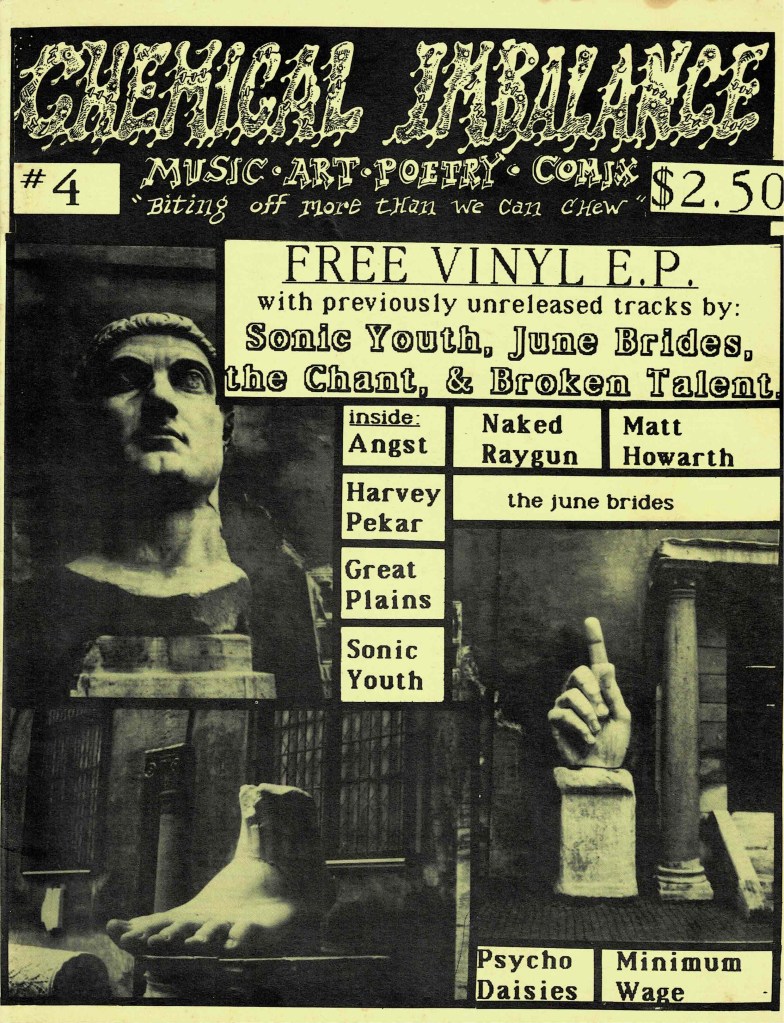
I’ve owned this issue of Mike McGonigal’s Chemical Imbalance since the day I bought it in 1986 in an LA record store because it had an included 4-song EP with Sonic Youth on it. It was clear to me in reading through it just now that I really hadn’t flipped its pages since, so honestly, it was a pleasant surprise to see a wonderfully sophomoric yet still well-informed and -intentioned dose of independent, far-left-of-center Americana. If you remember McGonigal as a guy pilloried for my-unremembered and what I’m sure were nonsense “scene crimes” by the likes of Byron Coley and Steve Albini, you’d be forgiven for thinking – as I did – that maybe his early college-era fanzine would have aged none too well. It’s aged just fine.

I mean, I have several of the issues that came after Chemical Imbalance #4 as well, I’m pretty sure. It was never one of my favorites, and I’d be hard-pressed to name a band, musical genre or artist of any sort that this fanzine turned me onto – but it was always easy to find, packed with deep-underground ephemera and tuned to whatever alt-wavelength I found myself frequenting in the late 80s. McGonigal went on to run Yeti and Maggot Brain magazines, both of which suffer(ed) from a seemingly forced, mile-wide/inch-deep eclecticism that render any tastemaking therein to be highly suspect. I suppose that was true of Chemical Imbalance as well – a sort of “look at me, I don’t only like punk rock” narcissism that probably kept me from ever coming back to his mag after my first reading, yet didn’t prevent me from buying at least three more issues. Like I said, maybe time and age has melted my resistance, because I kinda like nearly everything about this one save for the poetry and most of the comics. I always wonder if “fanzine poetry” is meant to be an ironic joke when I come across it anyway.

Seymour Glass, whom we learned recently to our great surprise was a key cog at San Francisco’s BravEar around this time, does a fine interview with that city’s so-deeply-unsung-that-nobody-liked-them Angst. As it turns out, I liked Angst; saw them live; and was a major proponent of their first Happy Squid EP, which you gotta hear if you haven’t. So this interview too was a nice surprise, a great retelling of awful tour stories and corrupt bookers and strange bills put together by SST with Angst and Saint Vitus. There’s a mail interview with Great Plains, another band on a bigger indie label who were probably better than the sub-minus attention they received indicated, and one with Kim Gordon of Sonic Youth, “because everyone else interviews Thurston”. Sonic Youth mania was only just barely wheels-up at that point, with Evol having recently come out, and it shows from interviews with other bands here, like when Jeff Pezzati from Naked Raygun interrupts himself to blurt out, “I just saw Sonic Youth, they were amazing!!”. 

And with regard to all the comics in Chemical Imbalance #4, well, I’ll tell you about my reverse-evolution with comics. In 1986, when a music fanzine would print comics, I’d get all huffy and uptight about it. Comics were for children, and were uniformly unfunny to boot. I thought “Baboon Dooley” was totally inane (still do). When grown men later started busting a nut over goofus music-adjacent comic artists like Peter Bagge, I stuck my head in the sand and said I. Hate. Comics. I only started thawing with regard to comics, or comix if you will, around the age of 40, and you know, that wasn’t all that long ago. I went back to re-read a bunch of Dan Clowes stuff and fell down that rabbit hole and it introduced me to the whole world of Fantagraphics and Kitchen Sink and bizarre art-dada stuff like Doug Allen’s Steven. I’m totally down with comix now, kids!

I still think the ones in this magazine are mostly imbecilic, but hey, I now thoroughly respect the gumption shown in pulling them together and stand proudly behind their Constitutional right to print ‘em.

Sonic Death #5

I’ve long had a hankering to own a copy of Thurston Moore’s multi-issue 80s fanzine Killer, but I’ve never seen the thing and don’t know anyone who has one (do you?). Sometimes I’ve gotten it confused with a 90s fanzine called Sonic Death, which is maybe a little more easy to come by but still often quite “dear” if you’re looking to trade money for one. I did it anyway. It’s a publication of the Sonic Youth Fan Club – there was, in fact, such a thing (!). And it’s 100% written by Thurston, Lee, Kim and Steve. How about that?

Sonic Death #5 finds us in 1994. I was sort of following Sonic Youth at that point but I’d mostly tuned out; suffice to say I was not in the fan club. This was not due to any anti-SY stance on my part; I still maintain the September 28th, 1987 show of theirs at Borsodi’s Coffee House in Isla Vista, CA was one of the capital-G Great Nights of My Life. And maybe my second-favorite time I saw them of the 7-8 times I did was a year after this fanzine, a blowout performance on the Washing Machine tour in San Francisco, with The Amps and Bikini Kill opening. Tremendous band, but I was spoiled for choice in those years and when it came down to, say, High Rise, Dadamah and the Cheater Slicks vs. “Kool Thing”, I had my lines drawn when it came to my record-buying dollar, and was highly resistant to just about anything on a major label, including my previous independent favorites who’d grabbed at the brass ring. 

This issue totally sucked me in with one of my favorite photos ever of the eternally perplexing Royal Trux from 1987; you can see Jennifer’s eyes, for one. There’s another one here. No other Royal Trux content graces Sonic Death #5 – a great fanzine move! Lee Renaldo writes a chatty and excited introduction and catches up the club w/ recent doings on the last day of 1993, talking about recent shows playing with Neil Young, Metallica, The Black Crowes and Faith No More, among many others. “I had to wonder at one point how we’d managed to get our foot in this door!”. Indeed. 

Here’s what I love about these folks; this dumbfounded wide-eyed marveling gives immediate way to an interview with The Ex, followed by Thurston Moore going bananas with a few dozen reviews of far-underground 45s and LPs spanning from Keiji Haino to The Frumpies to Skinned Teen to The Shadow Ring to Merzbow to the Screamin’ Mee-Mees. The distance from MTV to PSF was really bridged by this band, and this band only. There’s a bunch of banter about the next album, xeroxed fan letters (including those screaming “sell out!”), and something pretty cool – “print-outs” of missives from the online Sonic Life mailing list, all from 1993. I don’t believe I really understood that there was something called an internet and that I could be on it until at least a year later, despite being 25 years old at that point; it was my late-fortysomething Mom who gave me the lowdown on chat rooms and America Online and all that, if you can believe it. I’ve written here about just how amazing it was to get “email” at work, which I and my favorite co-workers immediately used for pranks only. There was a Sonic Life listserv, and I didn’t even know about it.

Sonic Death #5 is a sloppy and chaotic fanzine through and through, in the very best sense of both words. I’d have to think it introduced quite a few Fan Club members to an aesthetic and a revelatory “mode of seeing” that they’d never cottoned to before. Lucky for all of us, each issue of this fanzine is available to read right here and right now as a PDF, thanks to Sonic Youth themselves. Download them before they go away like that amazing Contextual Dissemination site did!