Matter #12

For those of us who were living there, maybe we didn’t know it at the time, but the year 1985 would eventually prove to be one of the leanest annums in underground music history. “Americana/new sincerity” garbage was ascendent. Post-punk had splintered into dozens of mostly boring strands. Hardcore was an absolute joke of pseudo-metal postering, brain-dead funnypunk and political nincompoopery. It’s arguable that 1984 or 1986 was worse, but I don’t think so. This 1985 zeitgeist is where Matter #12 has landed. (despite what the cover misprint says, this was their twelfth issue; I’ll talk about the real Matter #11 another day).

You’ve got a fella from The DBs on the cover. Do any of you have revered bands that you’ve read about and have known about for 40+ years, but who, to the best of your knowledge, you’ve never actually heard? The DBs are this band for me. Why would I start now, right? For years I was rather smugly proud that The Feelies were this band for me, but then I went and heard them around 2010 or so, and totally ruined everything. 

Matter #12 had a grade-A letters page, and invariably, as we’ve written about when discussing other issues of the magazine here and here, there’s always someone complaining about staff writer Steve Albini. Nick Mink of Lawrence, KS writes that Albini is “a pompous, ignorant, pretend-intellectual, contemptible pile of stinking horseshit”. Hard to believe today, but people actually took their dopey indie rock pretty seriously, and it was considered very au courant to pick sides and head into pitched battle against those whose musical taste didn’t flatter yours. This issue also has a wordy complaint from Derek Bostrom of The Meat Puppets about a letter penned against them in a previous issue, ending with “people who don’t like the Meat Puppets can fuck off as far as we’re concerned”. See, even smart people like Bostrom were young and dumb once, so don’t feel too embarrassed about what you said in your twenties. 

Matter also did the three-dot gossip column thing so popular in the punk fanzines before it; the best piece of blather in this one concerns Billy Bragg playing a tape of Albini’s Big Black for his tour-mates Echo and the Bunnymen, “who were very impressed. When told he’d won the Bunnyfolk’s favor, however, Black’s Steve Albini was not”. There are three new up-n-comers profiled on the following pages: Dumptruck, Live Skull and White Animals, the latter of whom (a college-bar cover band that apparently did reggae versions of pop songs) sound like the worst thing about the 80s/90s not called The Freaky Executives or Skankin’ Pickle

The magazine, previously a Chicago fanzine, is now based in Hoboken, NJ and as such has pieces from locals like Jim DeRogatis and Jim Testa, the latter of whom does a (relatively) early piece on the Butthole Surfers. So far so good after a Minimal Man interview, but then a terrible Rolling Stone-level puff piece on “General Public”? And then two pieces about the awful Del Fuegos and how they can’t wait to sell out and make money? And then one about the other terrible band I used to always confuse them with, the Del-Lords? 1985, folks.

If I was a Robyn Hitchcock fan I’m sure his interview here (I assume with editor Liz Phillip) would have excited me somewhat, as it’s really well-done and wide-ranging, but it’s hard to muster even a modicum of excitement for the tepidly limp “garage” bands waxed about after this: The Fuzztones, The Prime Movers and The Mad Violets. I first heard “sixties-inspired punk” that year vis-a-vis these bands and their peers The Vipers,the Lyres, the Chesterfield Kings and so forth, and it’s little wonder it took me another couple of years to care about anything 60s-ish at all, I was so turned off. After the usual “group reviews” thing the mag did where each writer gets a few sentences and assigns a letter grade, Steve Albini’s “Tired of Ugly Fat?” column closes up with the postulation that “we are plum ready for some new blood and some new noise….in gross terms there is still strong music being made, but by fewer and fewer bands and in ever-more-limited contexts”. That is 1985 to me, distilled to its essence. Like other fanzines I’ve written about here, Matter #12’s is great source material if you want to get an excellent sense of what this semi-barren ‘84-’86 interregnum was like.

Matter #8

Matter was positioned right at the nerve center of underground and slightly just-above-underground America during its mid-1980s run. It was a fanzine that was well-designed enough to be a “magazine” and with enough cachet to land bigger interviews w/ the likes of The Smiths, while positioning them next to what they likely really wanted to cover, which was true favorites like The Go-Betweens and Chicago locals such as End Result and Sports of Kings. And let it be said that this wasn’t some mouth-breathing boy’s club. The masthead touts Editor Elizabeth Phillip, managing editor Irene Innes and business manager Irene Igawa – a female trifecta that, let me assure you, was tokenistically uncommon in this realm in 1984. This is the world of Our Band Could Be Your Life, except directed and guided by women, and with Steve Albini taking a starring role. 

Matter #8 is the first issue with a new cover design – you can see all the covers here – and it came out in April/May 1984. Right there on the first page, BAM, first letter, there’s some correspondence from Steve Lafrenier with some concerns about one of the mag’s chief writers, one Steve Albini. Complaints of this sort came to color a great many of the letters-to-the-editors in Matter over the years. Lafranier says: “What is Steve Albini talking about? After reading two issues of Matter’s gleeful publication of this guy’s opinions, it gets pretty obvious that he doesn’t really have any. Exactly like the atrophied, tail-end of a dead ‘scene’ he unceasingly promotes, his writing exemplifies the kind of hypocrisy he claims to be in the business of subverting. Gad, what reactionary duck shit”, before then going and calling Albini and the editors on the carpet with some examples. 

Albini responds not with a sneering load of snark, but with “You miss most of the points I’ve ever made, but you hit paydirt on one issue. Several people have brought to my attention how much overt fag baiting I’ve been doing. Having re-read much of what I’ve written, I have to agree. That’s not why I do this, and I don’t want it to appear that way. It takes letters like yours to make people like me rethink old habits”. Progress! The scene policed itself when it had to. Andy Schwartz of NY Rocker also writes in to complain about the 4-issue subscription price (for $6!) while praising Steve Albini’s “black and white” thinking to the hilt. And Dave Sprague of Sense of Purpose writes with his own boatload of praise for Matter, then asks if he can write for the mag.

As mentioned, coverage and interviews were straddling varying shades of musical taste and genres that were often not entirely complementary, and that’s why this is a fanzine that likely had a pretty wide appeal to those in Chicago and elsewhere who found it. For local stuff, there’s news of a demo from a new band called Urge Overkill; Naked Raygun’s Flammable Solid and Big Black’s Bulldozer are discussed as well, along with lesser lights like the Bonemen of Barumba. Beyond Chicago, there are interviews with Otto’s Chemical Lounge, The Bluebells, Slickee Boys, and The Specimen. The latter get stuck talking about how one writer dubbed their syntho-goth fishnet & lace posing as “positive punk”, somehow, and how they’re now having to live it down in every interview. 

Blake Gumprecht doesn’t exactly paint The Go-Betweens as wild rocknroll outlaws, saying rather that “They’re not a cult band, nor have they ever had that hit single, and I’m not sure they ever will. They don’t dress remarkably, act funny or weird, or even talk a heckuva lot. Nice. Normal. Unassuming. Simple. Modest. Quiet. Those are the words people use to describe The Go-Betweens.” They’ve just been dropped from Rough Trade, and are at something of a crossroads, trying to figure out if they should move permanently to New York or not. Matter are so into the band – as I know many of you are/were and I sometimes am – that Michael Lev gets to write a second article/interview with the band in this same issue.

There’s breaking news on Kendra Smith’s new band Clay Allison – to be known as Opal a year or two later. They say, “Smith writes that the band is getting increasingly cool: ‘Led Zeppelin meets Love meets Syd Barrett’. Her partner David Roback, formerly with Rain Parade, says that Clay Allison is to Rain Parade what Big Star is to the Box Tops. An album is forthcoming on the band’s own Serpent label”. Neither the Led Zeppelin nor that forthcoming album were true – here’s what the (fantastic) 45 actually sounded like

Furthermore! There’s a piece on the burgeoning Athens GA scene – OhOK, Love Tractor, Buzz of Delight et al. This world was a big deal and ever-present on many hipsters’ lips at the time. There’s a Trouble Funk complete discography along with a big multi-paragraph pile of praise, probably the single best and certainly the most completist thing written about them I’ve seen. Anyone out there go to this show? And Albini writes up “The Moron’s Guide to Making a Record”, which is funny because he did something similar and/or identical in Matter #10, which I wrote about here. I’m too lazy to go grab that one out of the boxes; I wonder if it was a reprint to help further the cause? Like I said, the scene looked after itself. 

Finally, Matter would do this thing in their record reviews where 3-5 reviewers would get a short paragraph or two, and everyone would assign a letter grade. It was always good fun to see just how much of an outlier Albini might be. Black Flag’s My War gets a C from Albini – “This is it? We had to wait over two years for this? I don’t know what’s running through Greg Ginn’s head, but if he thinks noodling around in King Crimson territory while Henry grunts and huffs is some bold new direction, we’d be better off if Black Flag had another few years of court-imposed silence”. I couldn’t have said it better myself. He gives it a C. Glen Sarvady says “Side two is possibly the worst thing I’ve ever heard, and that includes groups I expect to be awful”. He also gives it a C. For these comments alone, I give Matter #8 an A, but I would even without ‘em.

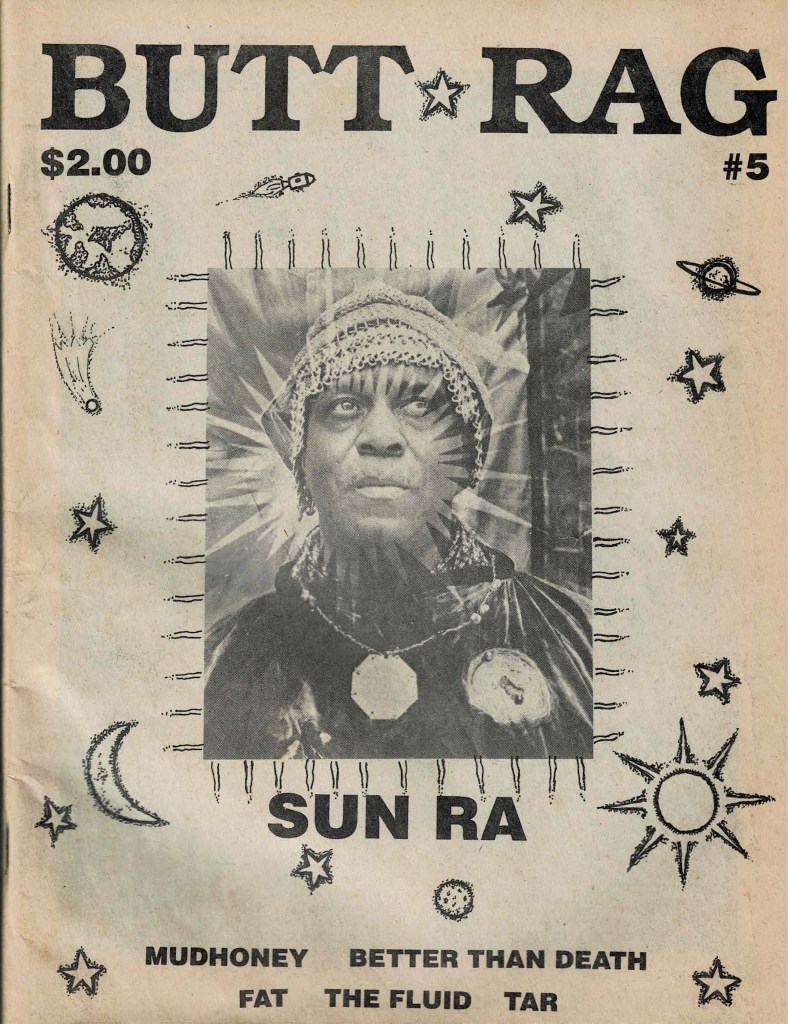
Butt Rag #5

Peter Margasak has, over several decades, come to represent for me what one might hope a snot-nosed 80s fanzine writer would ultimately blossom into with practice, open-mindedness and intense on-the-ground, in-the-clubs lived experience. I suppose one gets out of it they bring into it, and jeez, even in 1989 and in Butt Rag #5, Margasak’s taste was incredibly expansive and pushing ever outward, even as he gossip-mongered about Amphetamine Reptile records, Mudhoney and Sonic Youth. Even more so than in the previous issue of Butt Rag I wrote about, Margasak is caught suspended in amber here – for both better and worse – between the often mean-spirited tenor of US rock/underground fanzine-speak and a guy who’s leaving it all behind for intelligent forays into boundary-pushing music of many types. 

To wit: talking about Steve Albini’s passing in his post just yesterday on his Nowhere Street site, Margasak says, regarding Albini and himself, “His lacerating wit and scrupulous code of conduct arrived like a worthy ideal. I tried to ape the way he and peers like Byron Coley and Gerard Cosloy wrote about music; being harsh seemed cool. Of course, it was stupid, misguided, and often cruel”. Alas, that’s something I do take away a bit from Butt Rag #5. In the intro essay, it’s relayed that David Thomas of Pere Ubu has just passed on an interview with the fanzine, “due to the obscene nature of the name of this publication”. Then Margasak fat-shames the hell out of him. 

Yet his tastes were generally more open than those of his peers and certainly more than mine were in 1989. He’s into the deeper layers of indie/underground rock; noisy stuff, and especially avant-music trending toward free, far-out jazz and whatever honking and squirting is going on in the late eighties – very much including reissues and new discoveries from actual jazz legends and long-tail heroes. Margasak and I would have found common cause over a beer in Mudhoney and The Fluid that year (!), though, like many of his fanzine peers, he thought that the Thrown-Ups were fantastic (“three brilliant singles on Amphetamine Reptile”). You be the judge. Tar, whom he also talks to here, never did anything for me, but they made several dozen people happy and that’s just great. Not to speak ill of the dead, but Tar say in this mag that they were not happy recording with Steve Albini and found him, contrary to later reputation, to be far too heavy-handed and opinionated with them. (and if you’d told me in 1989 that the NY Times and The Atlantic would publish well-crafted Steve Albini obituaries on the eventual day of his death, I’d have seen it as some sort of unanticipatable upside-down world).

Then we get into the stuff that excites me now. A band called Chewing The Fat are interviewed by John Corbett. They are compared with Massacre, whom I’d shamefully never heard until this year, and who are one of my favorite recent “discoveries”. I can’t find anything online about Chewing The Fat, and I reckon that might mean that they never recorded. (Update: I’ve subsequently been informed by Peter Margasak himself that the band were just called FAT – just like it says on the cover – and their music can be found here).

There’s another piece on an improv-leaning band called Better Than Death, and then, of course, a John Corbett Sun Ra interview from 1985, which made it only 4 years old. Ra talks about his trips to Jupiter, that what he’s doing is “the first time this has ever happened on this planet”, and a lot of his usual patter – “the ‘avant-garde’ refers to, I suppose, advanced earth music, but this is not earth music….I have to play things that are impossible. I have to get a piano and hit some notes on there that aren’t on there”. You can see why we love the guy – I did long before I’d even heard his actual music. It’s still discordant for me to imagine Margasak having John Corbett writing for his fanzine, but that’s because I came to Corbett not when he was a 26-year-old writing for fanzines, but when he was the polished and highly experienced writer of jazz/improv books from the past decade like A Listener’s Guide to Free Improvisation and Vinyl Freak

Then follows, as in Butt Rag #8, an absolutely massive section of reviews. These straddle both sides of that young man trapped in amber. Reviews range from High Sheriff Ricky Barnes & The Hoot Owls to Sub Pop neanderthals Blood Circus; Anthony Braxton; the Cowboy Junkies, whom he loves (nothing wrong with that); Galaxie 500; Machine Gun reviewed by Corbett, David Murray Trio, that Nirvana debut 45 i sold for $80 that’s now worth $10,000; Reverb Motherfuckers (he’s decidedly not a fan); the first Royal Trux; Talulah Gosh and the phenomenal Venom P Stinger 45. 

Sometimes it’s clever, sometimes it’s not. He reminded me that people used to call Dinosaur Jr.’s Bug LP You’re Living All Over Me All Over Again – or maybe it was Margasak himself that started that “meme”, in this very issue. Regarding a Philly band called More Fiends: “Turning in an above-average effort in Philadelphia is generally several notches below what the same quality would rate nationally”. Well said. (This ratio would change for the better in the 1990s). By the same token, he’s really on board with the simpleton consensus on Halo of Flies; their new single “rips your head apart”. Fuck yeah! L7, the awful LA mostly-female band, well – “apparently the guitarist in the Laughing Hyenas got her start in this ancient band”. Alas, that was this L7, seven years earlier. 

A review of a Chemical People album on Cruz Records: “I sure hope Greg Ginn gets his shit together, ‘cause I can’t take any more of this crap.” It may not have seemed so running a music fanzine at the time, but I’ll posit there was actually zero reason to take said crap in the first place. My life was bountifully enriched, and my lifespan possibly extended, by not listening to anything on Cruz Records, ever. I’d get records like that in the mail, and they’d go straight onto the Amoeba Music “to-sell” pile, unlistened to and most certainly unreviewed. As it should have been, for the betterment of the scene! And then in Butt Rag #5, there’s another giant section of short reviews after all of the longer reviews. It’s a lot to take in, but it’s fantastic to have it around when needed, and another reminder of this absurdly record-drenched era and its more general mania for over-the-top music documentation in print.

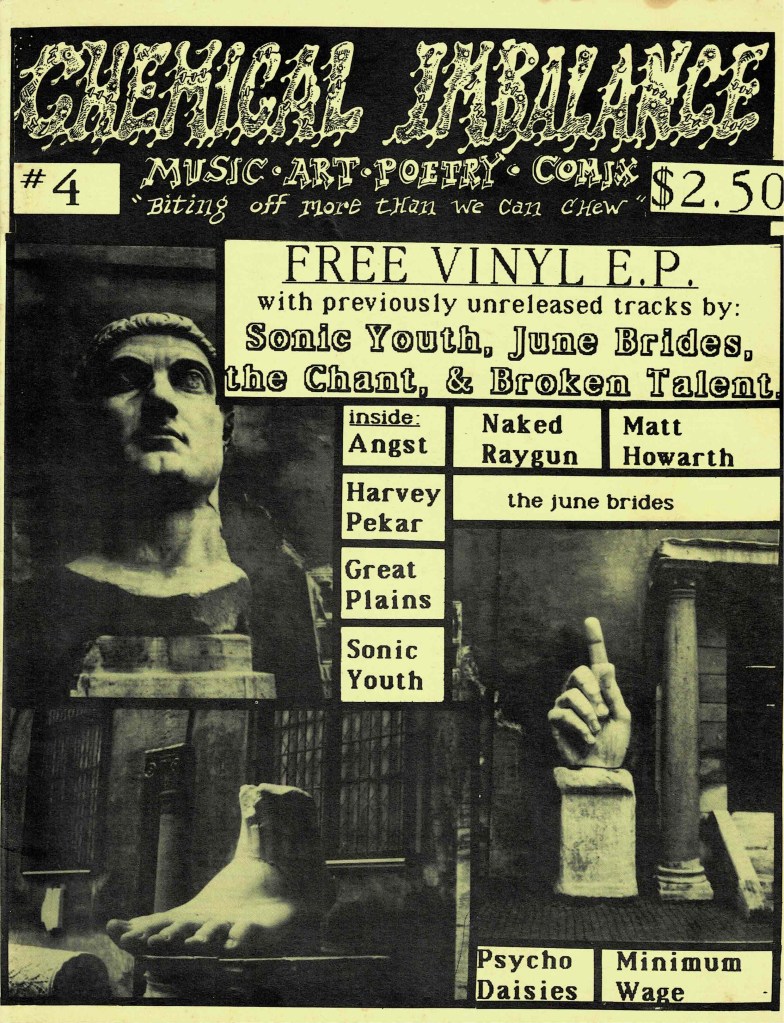
Chemical Imbalance #4

I’ve owned this issue of Mike McGonigal’s Chemical Imbalance since the day I bought it in 1986 in an LA record store because it had an included 4-song EP with Sonic Youth on it. It was clear to me in reading through it just now that I really hadn’t flipped its pages since, so honestly, it was a pleasant surprise to see a wonderfully sophomoric yet still well-informed and -intentioned dose of independent, far-left-of-center Americana. If you remember McGonigal as a guy pilloried for my-unremembered and what I’m sure were nonsense “scene crimes” by the likes of Byron Coley and Steve Albini, you’d be forgiven for thinking – as I did – that maybe his early college-era fanzine would have aged none too well. It’s aged just fine.

I mean, I have several of the issues that came after Chemical Imbalance #4 as well, I’m pretty sure. It was never one of my favorites, and I’d be hard-pressed to name a band, musical genre or artist of any sort that this fanzine turned me onto – but it was always easy to find, packed with deep-underground ephemera and tuned to whatever alt-wavelength I found myself frequenting in the late 80s. McGonigal went on to run Yeti and Maggot Brain magazines, both of which suffer(ed) from a seemingly forced, mile-wide/inch-deep eclecticism that render any tastemaking therein to be highly suspect. I suppose that was true of Chemical Imbalance as well – a sort of “look at me, I don’t only like punk rock” narcissism that probably kept me from ever coming back to his mag after my first reading, yet didn’t prevent me from buying at least three more issues. Like I said, maybe time and age has melted my resistance, because I kinda like nearly everything about this one save for the poetry and most of the comics. I always wonder if “fanzine poetry” is meant to be an ironic joke when I come across it anyway.

Seymour Glass, whom we learned recently to our great surprise was a key cog at San Francisco’s BravEar around this time, does a fine interview with that city’s so-deeply-unsung-that-nobody-liked-them Angst. As it turns out, I liked Angst; saw them live; and was a major proponent of their first Happy Squid EP, which you gotta hear if you haven’t. So this interview too was a nice surprise, a great retelling of awful tour stories and corrupt bookers and strange bills put together by SST with Angst and Saint Vitus. There’s a mail interview with Great Plains, another band on a bigger indie label who were probably better than the sub-minus attention they received indicated, and one with Kim Gordon of Sonic Youth, “because everyone else interviews Thurston”. Sonic Youth mania was only just barely wheels-up at that point, with Evol having recently come out, and it shows from interviews with other bands here, like when Jeff Pezzati from Naked Raygun interrupts himself to blurt out, “I just saw Sonic Youth, they were amazing!!”. 

And with regard to all the comics in Chemical Imbalance #4, well, I’ll tell you about my reverse-evolution with comics. In 1986, when a music fanzine would print comics, I’d get all huffy and uptight about it. Comics were for children, and were uniformly unfunny to boot. I thought “Baboon Dooley” was totally inane (still do). When grown men later started busting a nut over goofus music-adjacent comic artists like Peter Bagge, I stuck my head in the sand and said I. Hate. Comics. I only started thawing with regard to comics, or comix if you will, around the age of 40, and you know, that wasn’t all that long ago. I went back to re-read a bunch of Dan Clowes stuff and fell down that rabbit hole and it introduced me to the whole world of Fantagraphics and Kitchen Sink and bizarre art-dada stuff like Doug Allen’s Steven. I’m totally down with comix now, kids!

I still think the ones in this magazine are mostly imbecilic, but hey, I now thoroughly respect the gumption shown in pulling them together and stand proudly behind their Constitutional right to print ‘em.