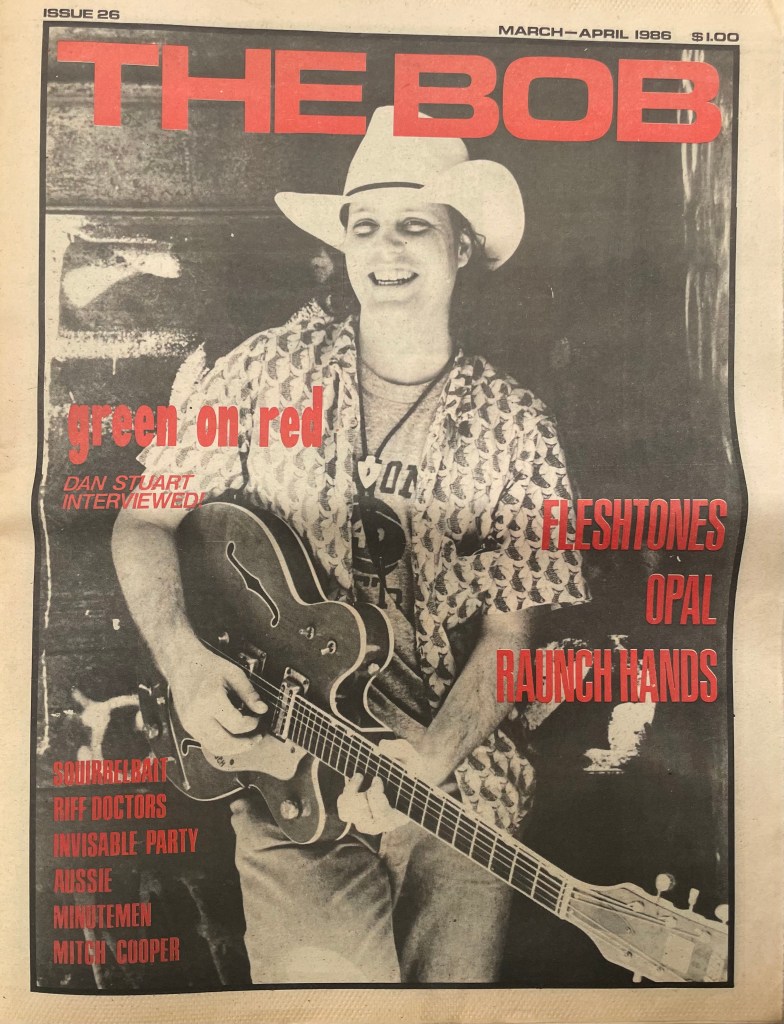
Around 1985-87, the tabloid fanzine The Bob was pretty ubiquitous on the Tower Records magazine racks and at the indie record stores I used to frequent in California. While their all-encompassing approach to “college rock” certainly covered bands I cared about – i.e. The Bob #26’s bits on The Minutemen and D. Boon’s passing and Pat Thomas’ short overview of Opal – I only bought it every now and again, given the lack of any real cultivated, inspirational, BS-detecting “taste” that I might glom onto. The temperament appeared to have been: indie music is great, listen to all of it, but maybe not if it’s too aggressive or too challenging. Fair enough?
That’s at least what I’ve gathered again in 2025 revisiting this March-April 1986 issue. The Fleshtones, Scruffy The Cat and even The Bangles’ Different Light are taken seriously, as are the longest and most obscure stretches of the jangly American underground tail. As long as someone sent in some vinyl to be reviewed – especially if it’s Engima Records or in any way R.E.M.– or paisley underground-affiliated – it’s gonna get in here. Most of the time it’s going to have one of those reviews that hems & haws and picks at it a bit, then weirdly concludes, “you need to hear this” or “you need to buy this”. As someone who emphatically relied upon fanzines to tell me what was truly worth buying at the time, this was not an approach that built credibility, nor gave me any level of confidence in The Bob’s discernment.
I always associated The Bob with Fred Mills. His byline was everywhere in virtually every issue, doing many of the interviews and writing a huge chunk of the reviews. Fred was sort of the saving grace, in my opinion. While he was (at times) the foremost purveyor of the review style I’ve just decried, he also was an inveterate music fiend who clearly “collected records” (as did I at this time, age 18), and was absurdly, slavishly devoted to bands, live gigs and uncovering undiscovered gems. In 1993 when I was the “roadie” for the band Claw Hammer, Fred somehow proactively found me on the show floor at Hotel Congress in Tucson, AZ (we’d never met nor corresponded), and we proceeded to banter about all manner of musical ephemera, helping to solidify the positive-leaning sentiments I’d accumulated to date. We’ve not communicated since.
It’s really Mills, Pat Thomas and a parade of lesser lights in The Bob #26. Mills gets the Green on Red deep dive, and upon re-reading it now, I reckon I learned a bit more about where this band’s head was at during that first wave of indie/Americana bands jumping unsuccessfully to major labels. (The best writing about that disappointing blip in time, I think, is in the second of the two John Doe/Tom DeSavia LA punk books). Thomas rightly praises the 28th Day record and seems to imply they were from Los Angeles – they were not. Mills has an entire column on Australian bands; there was a ton of curiosity around this time about The Scientists, Triffids, Decline of the Reptiles and others, whose records were just barely making it to the USA. I’m pretty sure my own Aussie mania of the time was at least piqued by Mills’ columns – so perhaps there was some residual tastemaking going on despite me saying in self-aggrandizing hindsight that there wasn’t.
There are various write-ups of similar 60s psych/garage revival groups like The Mod Fun, Chesterfield Kings, Plan 9, Plasticland et al. I was just at Amoeba Music in San Francisco on Friday; some dude had sold crateloads of this stuff on vinyl – your Miracle Workers, Yard Traumas and what have you, including the aforementioned Aussie stuff – to the store a few months back. While it was fun to look at when it came in, I noticed this week that most of it was now “priced to move” in the reduced/clearance portion of the used LPs. Even at $5.99 a pop, I couldn’t find anything worth slotting into the collection. Not even the Psychotic Turnbuckles, but I at least held that in my hands for five minutes.
1984-1986 remains a puzzling time for me in the broader tale of what underground rock music was during the decade, but a fanzine like The Bob, for better or for worse, goes a long way toward illuminating the quote-unquote lived experience among certain sectors at the time. A glut of vinyl, an aesthetic distaste for punk and what it wrought, a surging “psych” and lite-garage sensibility, and an attempt to guiltlessly straddle the underground and overground. That’s what I remember from The Bob and similar publications like Jet Lag, which is probably why I ultimately found my late-teenage salvation in Forced Exposure, Conflict and Flesh and Bones instead.
 Fanzine Hemorrhage