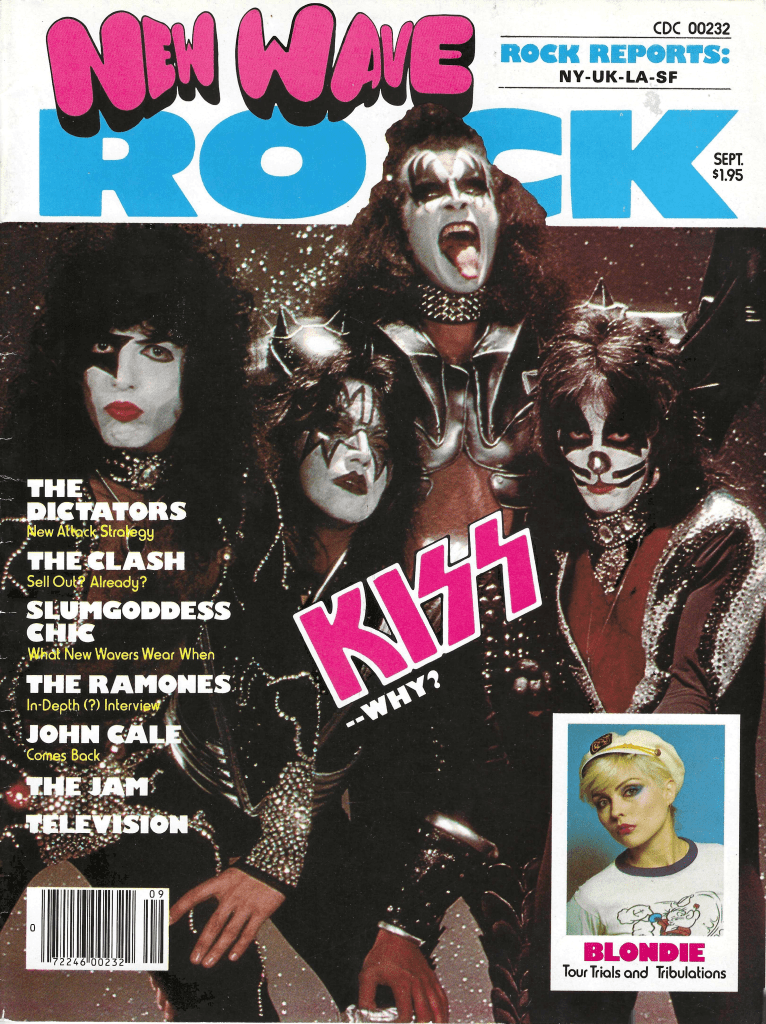
Well, whew, I think I’ve finally completed one of the most breathlessly exciting and highly laudable chases of my life: the quest to own all of the glossy punksploitation magazines that were put out in 1977-78 under a head-spinning spell of confusion, bafflement, excitement and money-grubbing opportunity. My late wife Rebecca would be so proud. I did it for you, honey. New Wave Rock #1 was my sacred chalice to find, and find it I did. (The others I’ve discussed are here, here, here, here, here and here). But then I had to read it, this issue with new wave rockers Kiss on the cover. But I did that too, and now I’m here to talk with you about what I uncovered.
As it turns out, this September 1978 debut is less sploit-ta-tive than even the two issues that followed it (here and here). It’s actually quite good. Diana Clapton’s opening editorial states that she received funding and wide editorial latitude for it from publishers Harry Matetsky and Jack Borgen, but then they saw her table of proposed contents and blanched at all the no-names (Clash, The Jam, Dictators) therein. “(Harry) then asked the fourteen-year-olds in his Long Island neighborhood, which is light years away from the Bowery, who their very favorite rock group is – and that’s why we have the cover we do, friends”. She then proceeded to label Kiss’ portion in the table of contents “Kiss: what do they mean? Why are they here?”.
As usual, much of the fun to be had is in the opening gossip pages, which here are broken into distinct London, New York, Los Angeles and San Francisco scene reports. There’s some loud post-Sex Pistols break-up speculation, including some that posits that Johnny Rotten and Poly Styrene are singing aging rock & roll standards together on a grand piano, and are now a “joyful couple”. There are salacious details on the Bryan Ferry/Jeri Hall split and how she’s cavorting in the clubs with Mick Jagger, leaving Ferry sad and alone in his new upper Fifth Avenue flat, which he’d moved into with Hall all the way across the Atlantic. There’s also a firsthand report on Lou Reed’s six-show, sold-out run at The Bottom Line, featuring “his transsexual lover Rachel” opening. Rachel, who “is a terrible singer”, apparently hung real tough and dealt with much audience abuse in “tight black leather, stiletto heels, a sultry smirk and a rose looped over his or her belt”. Meanwhile, Brian Eno “and the agonizingly gorgeous Julie Christie are having a fat laugh over rumors of their red-hot love affair, as they have been in each other’s company precisely twice”.
The LA gossip column by someone purportedly named Eunice O’Reilly is even spicier. After some Germs love, there’s a list of LA’s five “bad bands”: Backstage Pass (I just finished reading Genny Schorr’s All Roads Lead To Punk like, last weekend), The Nerves, The Deadbeats, Runaways (ok, sure) and The Weirdos, “LA’s most unexciting band since Seals & Crofts….claim to not be ex-hippies in disguise, but ace Warner Brothers secretary Coral sez: ‘I went to high school with them. They had long hair and wore love beads’. Case closed”. I also enjoy “O’Reilly”’s take on power pop: “It ain’t new wave but it ain’t ‘zactly old wave either, something y’gotta just live with and LA’s got it up the gitgo”. I suspect this column was written by either Gregg Turner or Metal Mike Saunders, probably Turner, as it contains a multi-paragraph ending about “saving the best for last”, Vom. Their own band. Amazingly, there’s then a two-page spread and feature on Vom later in the mag.
Now, I’ve dissected enough pieces on Blondie, The Jam, The Ramones and the like in other Fanzine Hemorrhage write-ups to really want to spend much time with with the ones in New Wave Rock #1, but I did a double-take skimming the Blondie piece in which Clem says “…we made a movie with John Cassavetes and this guy Sam Shaw. It’s a youth-oriented movie called Blondie, and I don’t know what they’re going to do with it”. Say what now? John Cassavetes? It’s true! (More here from Waitakere Walks). I also learned about the incredibly underwhelming response The Jam received opening for, um, Blue Oyster Cult in Bridgeport, CT, and Paul Weller’s goading of the crowd with, “I know, it’s hard to understand when you’re being confronted with the future of rock and roll right in front of you”.
One other bonus of this issue is the loads of color photographs documenting both onstage antics and candid backstage snaps, most of which I haven’t seen before. And other tidbits and anecdotes and whatnot: John Cale expounding upon punk and how much or how little was actually being learned from The Velvet Underground (he loves Sham 69, though!); The Clash claiming “people think we’re a con, but we’re not”; and a multi-page overview of Television’s year post-Marquee Moon, pre-Adventure. I’ve been listening a ton of late to the Live Portland 1978 bootleg from around exactly this time, and I think it’s quite possible it’s the single greatest documentation of Television’s majesty in any one single place.
It’s likely that publishers Matetsky and Borgen didn’t like what they saw when they crunched the newsstand numbers for New Wave Rock #1 and asked to dial up the stupidity levers a bit for the two issues that followed – who knows. I just know that if this had been called something else, and didn’t have Kiss on the cover, it’d be as good as this, this or this from right around the same time, and perhaps remembered just as fondly and not as some joke object for dorks like me.
 Fanzine Hemorrhage