Wiring Dept. #4

Maybe it didn’t really feel like it at the time to me, but Wiring Dept. has reputationally come into its own, nearly forty years after the fact, as an important sub-underground music publication that found joy, innovation and immense left-of-center creativity in post-hardcore San Francisco circa 1984-86. These were supposed to be “the lean years”, but I’ve got a whole Wiring Dept. #4 here that says they weren’t. (I talked about Wiring Dept. #3 here as well). 

I know where I was when I bought this in 1985 or early 1986 – it was at Rough Trade Records on 6th Street in San Francisco, and I was up visiting from college on one of my many record-buying excursions to the city while staying with my parents in San Jose. It was likely rung up at the counter by KFJC’s Spliff Skankin (Dennis Bishop), who worked there, and whom I listened to incessantly in high school (and who therefore likely intimidated me at the age of 18 when I bought this – these DJs were absolute gods to me). Given my youth and general punk rock orientation at the time, I probably blanched a little at the pretentious poetry and song lyrics – many by Dylan – in the margins of many pages, and at the inwards circularity of the fanzine, in which much of it seemed primed to elevate its creators and their own endeavors. I’m over it now.

But as examples of what I’m talking about, let’s dissect Wiring Dept. #4 a little. There’s an interview with SF band Trial by Grux of Caroliner and by editor Eric Cope. Then Cope writes about Caroliner. Then William Davenport of Unsound fanzine does an interview with The Flaming Lips after their first LP. Then Cope interviews Davenport. Cope’s own band, Glorious Din, gets a reprint of their interview on KALX radio, and then their album gets a rave review in Cope’s own magazine as well. Who’d have thunk it?

Brandan Kearney of World of Pooh was part of this loose collective as well. He writes a bunch of the record reviews; his band, then a duo, gets raved about; there’s a long review of their tape Dust. and also a review of Brandan Kearney’s magazine Nuf Sed Digest, which I’d never even known about until re-reading this just now. Who’s got a spare copy to trade me for one of my extra CMJ New Music Monthlies? There’s also a review of a World of Pooh tape called Pigmies in a Rose Petal that I’m not 100% sure actually ever existed, and another of a comp tape called UGLY SF III: Bellair McKuen Natures the Preying ANXthouse, supposedly with Lennonburger, Church Police and Caroliner. Google turns up nothing. I need to hear this and I need your help.

There are loads of short interviews, including with four small-ish bands who became much larger in years to come: the aforementioned Flaming Lips; 10,000 Maniacs; Faith. No More and Peter Buck of R.E.M., who were already kind of a big deal on the indie/Americana circuit but nothing like they’d be two/three years later. Yet there are also chats with Controlled Bleeding, Love Tractor, Flat Duo Jets and Stiff Legged Sheep – who were awesome, by the way. Listen here. Corrosion of Conformity, too. Fuckin’ C.O.C., man. I saw them play at the Oxnard Skate Palace, no lie.

Frightwig talk about their upcoming record: “Have you ever seen Russ Meyer, early Russ Meyer films? He did Debbie Does Dallas (sic). He had this film about three go-go dancers who travel around in these sports cars. It’s called Faster Pussycat, Kill, Kill. And we’re the three dancers in our sports cars. Faster Frightwig, Kill Kill. It has nothing to do with the music. We just like Russ. We identify with him. We all have big tits. We’re all foxy. I wear hip huggers and dance and we race around in our sports cars and kill men with our bare hands.”

Dave Katz – who for some totally weirdo reason got really mad at me for this 2005 review I wrote of his book! – writes about The Fall’s new 45 Cruiser’s Creek, saying that, “In a way, they sound almost like an 80’s Creedence Clearwater….the main problem with this song about a back woods party is its annoying backing vocals”. Poor Brix, just couldn’t catch a break from the men both lusting after her and wishing she’d go away, sort of a sub-underground version of modern MAGA Alexandria Ocasio-Cortez/Taylor Swift syndrome. And really, maybe the reviews in Wiring Dept. #4 aren’t to be trusted as a matter of course. There’s an uncredited review of the Dead KennedysFrankenchrist, easily one of the worst records I’ve ever heard. This album with “Jock-O-Rama (Invasion Of The Beef Patrol)” and “MTV Get Off The Air”  is compared to Iggy Pop and Joy Division, and about which it is said, “Frankenchrist is worth about a million dollars just for the lyrics. What Jello Biafra sings is not mere words put to music, these words come from deep within his heart. He feels with a tortured soul….a record that opens your eyes to injustice and human suffering….do not miss this record”. Hey, I’d leave that review uncredited, too. 

All this and a picture of Bob Noxious from The Fuck Ups. It’s therefore little wonder that Wiring Dept. copies are p-r-i-c-e-y when encountered on eBay these days. It’s outstanding source material for documenting whatever it is that was going on musically in 1985, a tale that very much varies with the teller.

Unsound #4

What a strange, creative and insularly self-driven fanzine Unsound was. We talked about issue #1 of this one here earlier in the year; I’m now going to attempt to render several paragraphs about Unsound #4, published in San Francisco during the first half of 1984. Little thought was given to economizing the page count in this issue, so you get a really crazed (but readable) mess of font types and sizes, short pieces about nothing whatsoever, longer pieces about not much in particular; and then more-or-less standard record reviews and interviews, mostly centering around a nexus of industrial, experimental, avant-garde and just generally oppositional musicians, musical offshoots, writers and artists.

This is how Zoogz Rift and his “Amazing Shitheads” come to bring his “odd, abrasive” free-form dada music to the Unsound party, just by being as oppositional as the First Amendment and the outer limits of taste might allow, all the while complaining (tongue planted firmly in cheek, I’d imagine) that he’s “being boycotted by the music industry”. Sonic Youth, fresh off their first visit to Europe and the release of Confusion Is Sex also have an interview here, 100% Thurston Moore representing, and right in that window where those of us hearing the band for the first time thought of them as something vaguely (if mildly) dangerous and transgressive. Remember, this is a time where “this music” wasn’t really even on college radio and the records themselves were often poorly distributed. All details were transmitted via fanzines.

I’d see blurry B&W photos of wild people like Michael Gira, Sonic Youth with guitars locked and hair long, even the relatively more popular Einstürzende Neubauten etc. and it was all pretty nuts and a little too much for a suburban high schooler. However, much more daring high schoolers like Jo Smitty and Mark Arm were living it in their suburban Seattle band Mr. Epp, referred to here in a bizarre post-mortem piece (“A self explanation”) entirely written by the band themselves. Four years later I’d see boogie-rockers Sonic Youth and Arm’s Mudhoney sharing a stage at San Francisco’s Fillmore. I’m going to bet Unsound editor William Davenport stayed home.

Then again, who really knows? It’s sort of funny combing through the record reviews of this one, which mixes up stuff like The Haters and deep-underground, edition-of-5 noise tapes with whatever records awful hardcore labels like Mystic Records were sending Unsound. Davenport, Brad Laner and other writers treat it all quite magnanimously, to my surprise – even the Gay Cowboys in Bondage tape! 

I’ve also just come off reading Marc Masters’ outstanding overview of cassette tape history and lore, High Bias: The Distorted History of the Cassette Tape (get it!). My favorite chapter is on the 80s tape underground that was helped to flourish – all things being relative, of course – by fanzines like Op and by college radio programs helmed by freaks who’d play whatever tapes showed up at the station, no matter how homespun. This is a world that Unsound also helped to steward and cultivate, and there’s also a great piece about “Art Radio” in which people call up particular shows on the left of the dial in order to share their “audio art” with the limited audience brave enough to tune in. I barely recorded my own doofus 1980s college radio shows, and it kills me that so much amazing and daring cultural weirdness on the airwaves was barely heard once, and will unquestionably never be heard again.

 Finally, there’s what looks to be a mail interview with a 26-year-old Adrian Sherwood of On-U Sound, and he’s hilariously defensive and dismissive of many things surrounding “reggae” and the mainstream. It’s a hoot. Unsound #4 itself is too, mostly for all the right reasons.

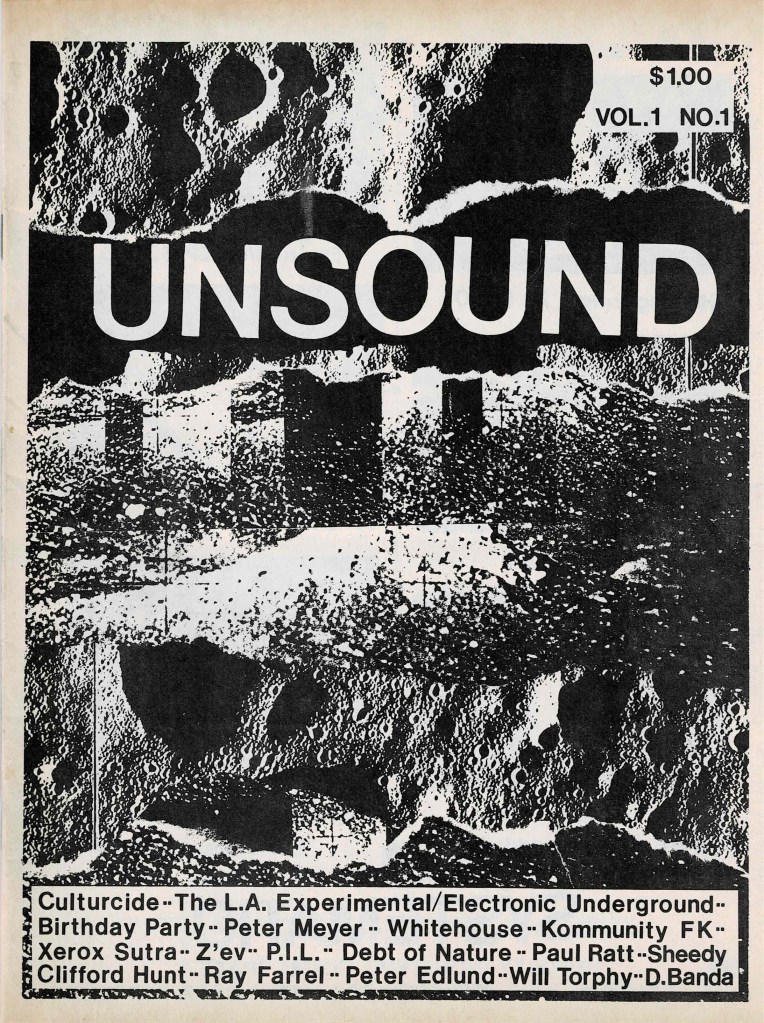
Unsound #1

There now exists an online store built to slake the vintage music fanzine accumulation cravings of any & all freaks who might be reading this – ZNZ. I stumbled upon their inventory just over a month ago and struck up a correspondence with the good folks over there, and as it happened, “they’ve” (actually “he’s”) been kind enough to execute a trade of sorts with me, which netted me today’s topic, Unsound #1 from 1983. I’ve already become a repeat paid customer at ZNZ and recommend that you start getting involved if you’re so inclined. 

I’ve never owned a copy of Unsound before, despite its San Francisco roots (where I’m from) and the fact that it’s mentioned in the sort of whispered tones and reverent language reserved for the quote-unquote greats. Maybe it’s because Unsound very pointedly turned its back on punk as it was morphing into hardcore, and started documenting the proto-industrial, noise and experimental west Coast sub-underground pretty much before most anyone else did. 

The fanzine was put out by William Davenport, who’s got an exceptionally informative Wikipedia entry if you wanna check it out. He gladly takes ads from punk and hardcore bands – it was 1983! – but he covers acts like Culturcide, Kommunity FK and minimalist radio weirdo Peter Meyer and his Night Exercise program. Davenport interviews Nick Cave of the Birthday Party and asks him if he listens to “radical” bands like P.I.L., which Cave kind of scoffs at and throws back in his face (!). There’s also a terrific overview of the 1983 Los Angeles Experimental/Electronic underground by Brad Laner, starting with the L.A.F.M.S. and a post-Nervous Gender band called Gobscheit. He concludes a deep list of interesting experimenters with, “Well, that’s about it for now. It’s a short list because there just plain isn’t that many people here that are interested in experimenting when they could be making money producing boring rehashes of the Velvet Underground.”. Touché, Brad Laner. The Dream Syndicate will be giving you a rotary-dial phone call shortly.  

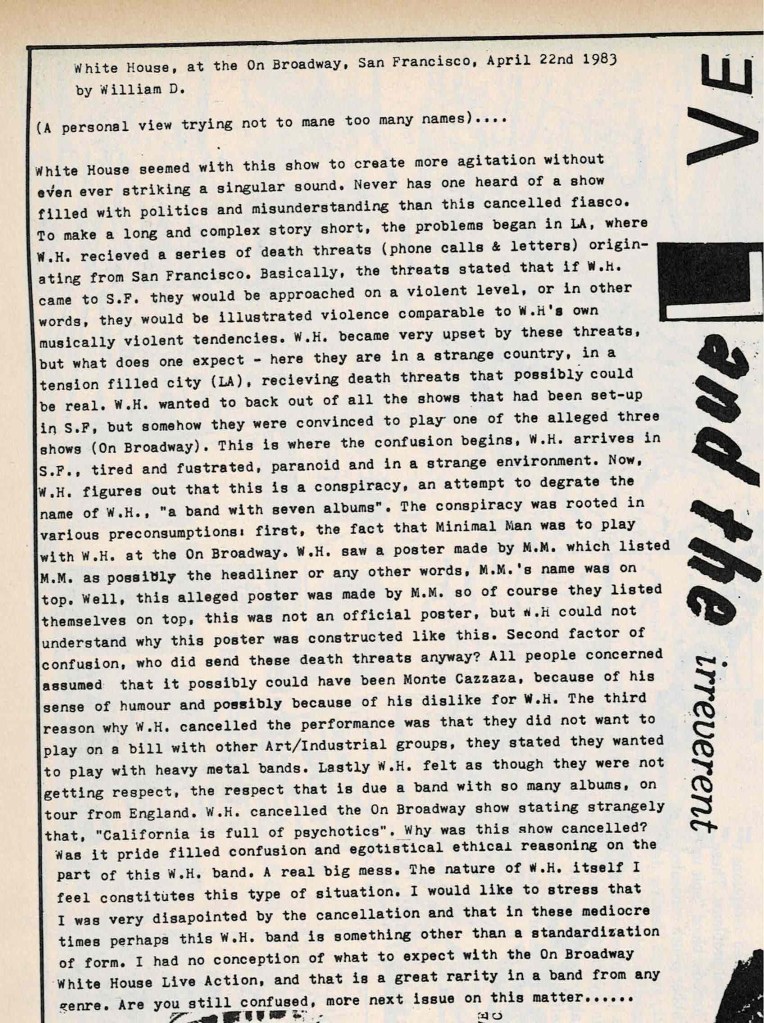
I also learned about Brad Laner’s Los Angeles band Debt of Nature – via an article written by one Brad Laner! – and that their bass player was none other than John Trubee, whom we were last discussing here. Maybe the pick of the issue, though, was this story about Whitehouse and their aborted San Francisco show at the On Broadway, which is so good I’ve scanned it for you here.

Looks like Davenport reprinted a bunch of Unsounds and is now selling them on behemoth corporate deathkulture website Amazon.com!