-
We might not actually be done with this thing yet
Hey folks, if you’re still out there, I’m looking to rev up Fanzine Hemorrhage again so hope you’ll stick around. Turns out I’ve still got plenty to talk about. In no way did my mania for older music fanzines cease since I last posted; more have come in the door that I feel probably deserve a proper reckoning-with on this site.
I felt that I’d been getting a little redundant earlier this year, and took it as a sign that maybe I’d said all there was to say about these zines. So now the challenge is to perhaps not be so redundant. Easier said than done, but here’s hoping.
I will attempt the resurrection next week, so please stay subscribed if you are, and tell a friend if any of this is their thing. I’m not moving it to Substack or anything, so there’s no profit motive whatsoever, just the great vibes I get when I see that soul-sucking AI tools from Google are hoovering up everything I’ve written here and turning it into the authoritative source for any & all questions about music fanzines from the 60s through the 00s. Who wouldn’t feel good about that?
See you next week.
-
Take It! #6
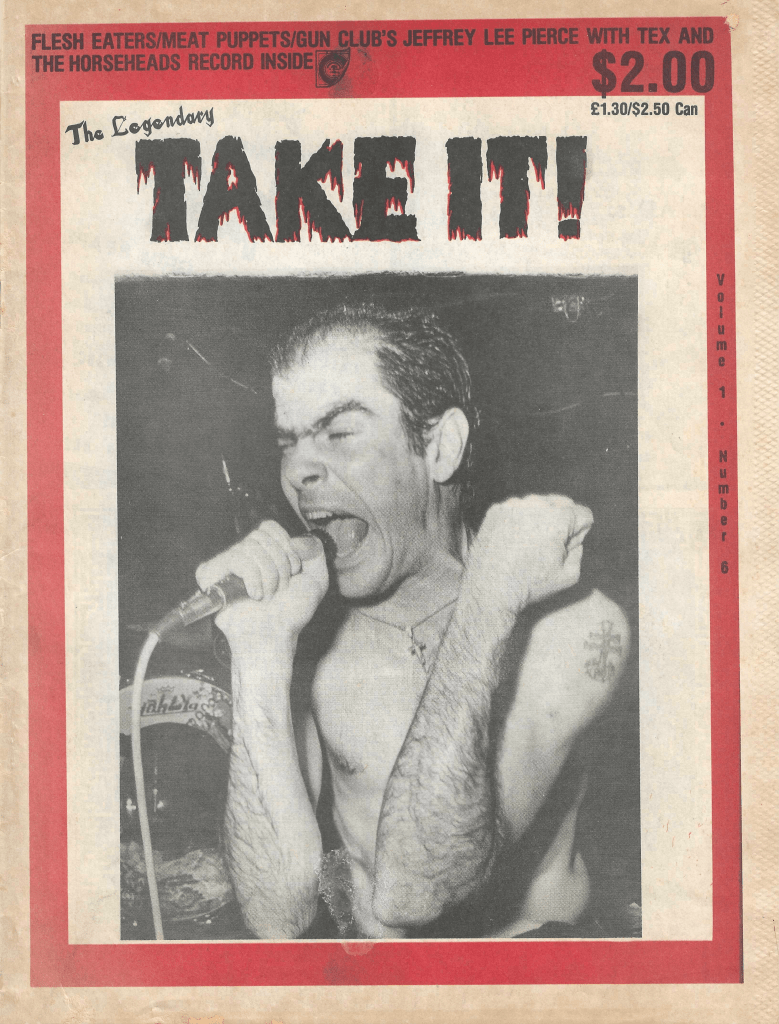
Finally, we wrap up the Fanzine Hemorrhage project, which has been running constantly & with a couple hundred reviews written since 2022, with what’s likely my favorite issue of any fanzine, ever. It’s Take It #6 from 1982. But first, a couple of things:
- I put out my own fanzines in the 2010s and 2020s under the names Dynamite Hemorrhage and Radio Dies Screaming. The ten issues of the former are now sold out, but I have plenty of issue #1 of the latter, from late 2024. Take a look, and feel free to order Radio Dies Screaming #1 here.
- For years, I’ve taken photos of old American signs – mostly motels and faded glories of the 1950s and 1960s. I mean, it’s not at all professional or anything – they’re phone photos – but I’ve got an, um, ongoing “portfolio” here if you’re interested. I’m not on social media, so this is kind of the only way I’ll likely get anyone to ever take a peek.
- I’ve got an eBay page set up to unload some extraneous fanzines, and other printed matter that I’m now done with. I’d love for you to take a look and bookmark the site if you ever like to buy old music fanzines and/or collected ephemera from the past. It will be updated frequently. Check it out.
Now, let’s talk about Take It #6.
This is the lone issue of Take It! that I can say I was “contemporaneous” with; I distinctly remember it being available for purchase at the Record Factory on Blossom Hill Road in San Jose, CA, but I also remember not buying it, given my non-familiarity with the bands on the flexidisc – oh, just The Flesheaters, Meat Puppets and Tex and the Horseheads, each at the height of their respective powers. “The greatest flexidisc of all time”, some have called it (actually that was me that called it that). Anyway, I’d get my copy a few years later while I was in college, and I’ve savored it like a fine chianti with fava beans for years. As long as we’re making lists, it’s one of the single best issues of a fanzine that I’ve ever encountered as well.
I’ve probably read it more times than anything save my Forced Exposures, but until today it had been a while. Opening it now to tell you about it, I’ve found that Michael Koenig writes in the intro that he patterned the cover of this magazine to be much like that of Slash, given that Chris D. of the Flesh Eaters (who wrote for Slash) is the cover star. Ironically, this issue of Take It! has shrunk to a normal 8.5”x11” size after having been the jumbo tabloid size of Slash for every issue before this final one.
But wait – let’s talk about that flexidisc first. Tex and The Horseheads with Jeffrey Lee Piece do a blitzkrieg version of “Got Love If You Want It”. While this is not the first band I might go to for the full “roots/punk” experience, I kinda think they’re a bit underrated, and they capture a side of LA that I got to see myself in late bloom five years later: the jean-jacketed, longhaired, alcoholic, wasted sleazoid faux cowboy punk that haunted Hollywood Blvd. and clubs like Raji’s. The Meat Puppets, at the height of their powers, contribute “Teenager(s)”, which I’ve written about elsewhere as having the best opening two seconds of perhaps any song, ever, before turning into a shitstorm of nonsense, and then into a laid-back hippie/doper desert mind-expander. (Check Dynamite Hemorrhage #5 if you want to read more about it). And a live Flesh Eaters track (!), “River of Fever”, was recorded on the 1982 tour that Byron Coley writes about in this issue, about which more later.
The mag starts off with a great “three dot” gossipy column by one Julie Farman – who’d go on much later to detail a sexual harassment incident with the Red Hot Chili Peppers she was the victim of – called “Blabbermouth Lockjaw”. She gives some great copy about T.S.O.L. trying to beat up Minor Threat’s Brian Baker in a bathroom; a near-death accident in Boston when Snakefinger’s “Snakemobile” flipped over; a never-was 80-page Byron Coley fanzine called Flunk that’s “about to come out”; and – ooh, ouch, “Fear replaces Derf Scratch with something/one called THE FLEA”.
Michael Koenig gives his own Boston live action scene report and makes me wish I’d seen Talia Zedek in Dangerous Birds; David & Jad Fair in Sit: Boy Girl, Boy Girl, and Chris D. in the Flesh Eaters (well, I did see that, but not until 1990). Chris D., in fact, gets his own column in here – was this his first published writing since Slash went under? Someone’ll have to tell me. One of the true standout columns this time is a new one from Don Howland, whom you perhaps know from his later work with the Gibson Bros and the Bassholes. Here he dissects the musical sins of Australia, and counts down a “Low 11” of insipid pop acts that I still quote from to this day.
The piece that always really did it for me in this one is Byron Coley’s tour diary of his time roadie-ing for The Flesh Eaters on their first national tour – “Flesh Eaters ‘82: Masterpieces Hexed from the Dunes of Jive Broken Roads” (sounds like Chris D. might have titled that one). For years, and perhaps even now, I’ve claimed the 1978-83 Flesh Eaters as “my favorite band” – and also for years, this was the most up-close-and-personal I’d ever gotten with them, all filtered through Coley’s mania for the American underground and his warped sense of humor. The part about them playing live in Madison with Die Kreuzen always made me pretty jealous; in fact this whole tour they’re mostly playing with hardcore bands, forcing the band to play faster just to keep the pits flying. You can actually hear it on “River of Fever” on the flexi, which turns into a breakneck pace midway through, quite unlike the version on A Minute to Pray, A Second to Die.
Other highlights – Gregg Turner turns in an excellent LA scene report, complete with absurd reprinted lyrics from a local metal band called Slave-State whom I’m very sad to report did not appear to ever get any vinyl released. Eric Lindgren writes a piece about “The 10 Most Twisted Tracks From The Sixties”, including The Lollipop Shoppe, Legendary Stardust Cowboy, MC5 and Swamp Rats. Byron Coley writes an insane amount of record reviews, plus a column on beatniks. Richard Meltzer and Mick Farren have their turns as well. And….that’s it. That was the end of Take It!. No pleas for financial help, no indication that another issue wasn’t around the corner, nothing. The magazine gathered steam and rapidly got stronger and when it died with the publication of this issue, it was easily the best fanzine in the USA.
Even today – in 2026 – every single issue is available directly from Michael Koenig himself right here. Fair warning: it’ll cost you, especially #6, which, at $250, is 10x the price of each of the others. I’d wait for your Hanukkah or Christmas money to accumulate, and maybe write Koenig a nice email and see if he’ll sell them all to you for <$300. Tell him Jay at Fanzine Hemorrhage sent you. And thanks for reading!
-
Pussyfoot #1
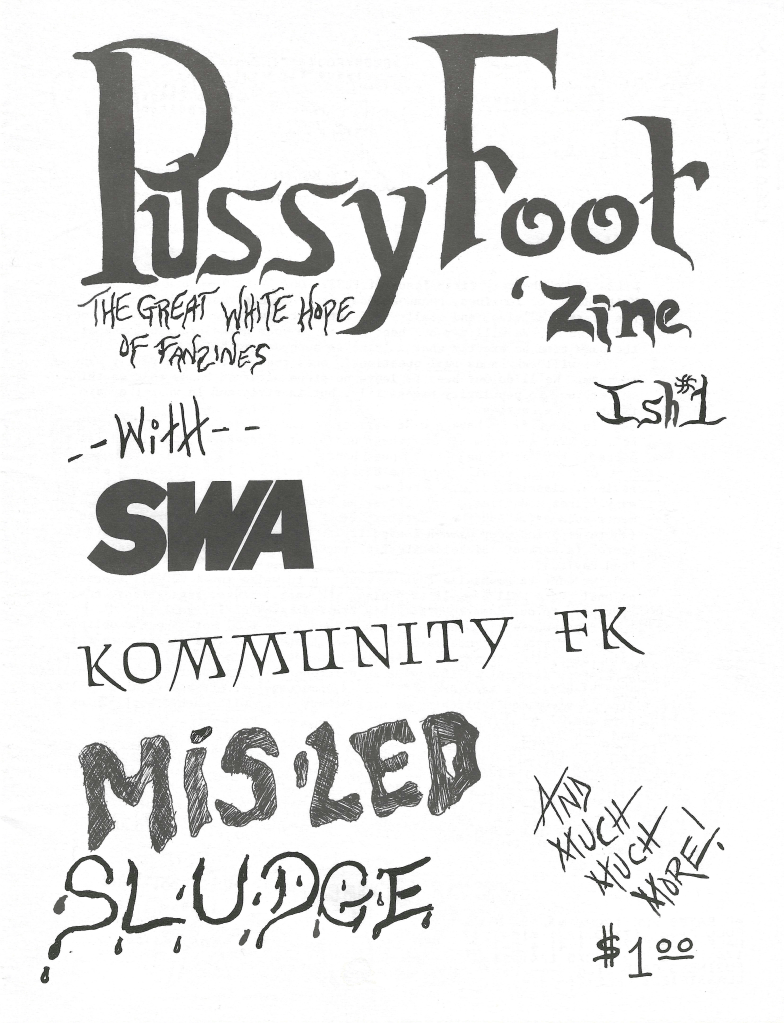
There was this period in 1987 or so that you’d probably call “peak SST”, when said label was pumping out multiple records each month by a host of mediocrities – from Lawndale to B’last to Swa to Zoogz Rift and so on. This is when I first started seeing shows at the Anti-Club in Los Angeles, and if an out-of-town or bigger local SST band was headlining, there’d be a whole host of these lesser lights on the bill as well. It’s how I got to see Swa. And B’last! And later, Always August, Sylvia Juncosa, DC3 and Painted Willie.
Record Time recently did a huge feature on this era and on the garbage clogging the label at the time, a “say something nice about one of these records” feature that I got to put in one review for (Das Damen). But Pussyfoot #1 from ‘87 is right in the heart of it, spending much quality time at these Anti-Club four-band SST specials, and they very unironically chose (of all bands from which to choose) to interview Swa themselves. The interview – with Chuck Dukowski, Merrill Ward and Sylvia Juncosa – is as utterly lamebrained and cringe-inducing as the band themselves were. Merrill Ward: “SWA is the revelation, it’s revealing, it’s the opening. SWARA is the revealment and the actual face of the god in heavens….the Sex Doctor is the healer, the wounded healer & through his pain he’s able to heal & liberate the true spirits of sensuality that exists from the body & souls of man”.
Listen folks, you haven’t lived until you’ve been forced to suffer through Swa in 1988 at the Anti-Club, only to find that there’s a tiny blessed patio outside that you can escape to, only to then have Merrill Ward come outside with his long mic cord to tunelessly moan in your face while his band plays bombastic thud-core back inside. Only being on the receiving end of a stoned Greg Ginn hippie hair-shake in my face while fruitlessly trying to ignore his band Gone rivaled it at the time.
Pussyfoot #1 from La Habra, though, is fully on board in this “ish”. They also bring us a chat with a La Mirada punk band called The Misled, featuring this gem:
PF: What do you think of punk bands changing styles to Heavy metal-glam rock (i.e. Channel 3, Overkill, etc.)?
Chris from The Misled: They turn into fags while they do it.Much of the fanzine is taken up with placeholders for next issue’s classified ads, next issue’s letters to the editor, subscriptions, ad rates and lots of big planning. There were others, however! The editor was a guy named Blaze James. Blaze James, Blaze James….I know this name. Oh, he was later in the band TVTV$ in the 90s, right. All I remember from the one time I saw them live was that a guy in the band had these awesome Coca-Cola branded pants, and that I was totally hammered and heckling them, which is something I’d only do if I was hammered.
Speaking of hammered, the last interview we’ll jest & jape about here is with a 1987 NY Dolls-esque band from the LA area called Sludge, whom I never heard of nor from at the time. And man, are they right in step with their era – long hair, a guy flipping off the camera, lots of talk about Budweiser and weed, jokes about eventual cirrhosis of the liver. Verbal Abuse, anyone? At least Flesh & Bones interviewed, you know, the good bands from this scene and epoch.
-
It’s (Your Name) Magazine #1
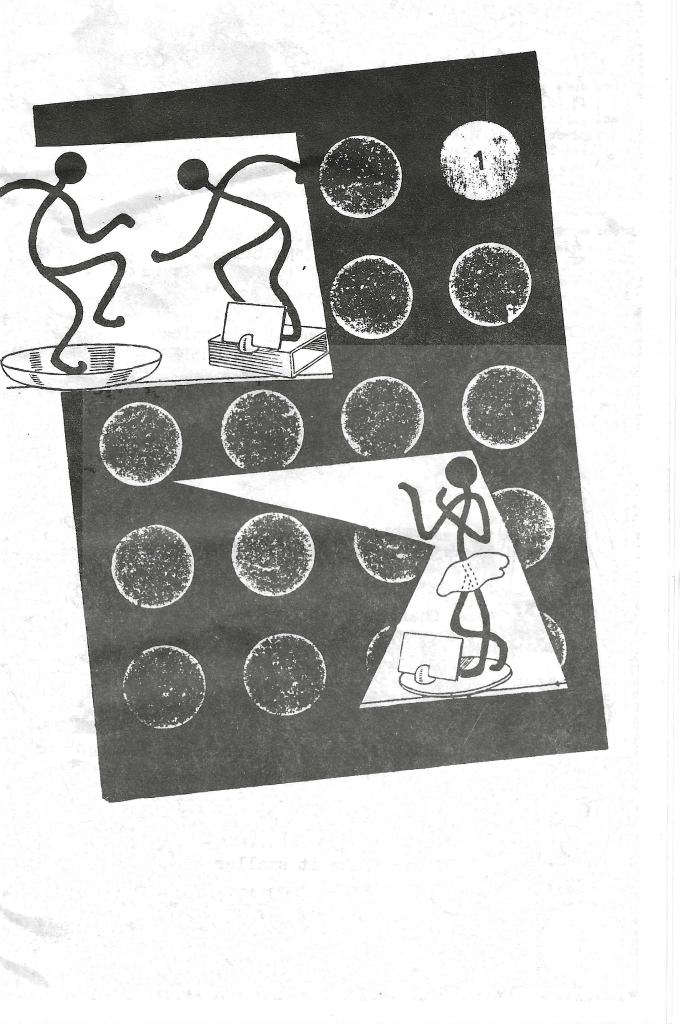
It may be something of a trifle, but the debut issue of Seattle’s It’s (Your Name) Magazine from ‘round about 1980 is a brief counterpoint to the popular conception of pre-grunge Seattle being solely slathered in speed metal and hardcore punk. You’d probably have to call this a no wave fanzine, if you’d call it anything at all – certainly its elliptical, cut-and-paste weirdness echoes both no wave-era NYC fanzines and some of the post-punk zines coming out of the UK at the time. Neither hardcore nor metal exists or rates in this world; its heroes are DNA, the Bush Tetras, Pink Section, Young Marble Giants, Joy Division and similar subjects.
A small co-ed team of editors and colleagues are behind this first and likely only issue, and supply the drawings, the word collages, and the strange pasted type that allows for words to hyphenate and fall off the page in all the wrong places. Kind of no wave, am I right? The DNA piece, “DNA stayed at my home”, is exactly that: a droll recounting of what they all talked about, who slept in which room, where they collectively went out to eat, and exciting information about Ikue Mori doing her laundry. DNA in Seattle in 1980 – it doesn’t really calculate for me, and yet the included loose-leaf entertainment guide promises upcoming shows in town by the Mo-Dettes, Delta 5, Cabaret Voltaire and Ultravox. You’d think we were in bleedin’ Sheffield.
The sole interview is with New York’ s Bush Tetras, who, along with the Au Pairs and Delta 5 were among my earliest favorite bands, once I discovered the left of the dial and college radio vis-a-vis KFJC. Clearly the bass-heavy, female-fronted post-punk sound scratched some primordial teenage itch I didn’t know I had, and I love all three bands to this day. The band are delighted to answer out-of-the-norm questions such as “What are the most irritating things people do?”, “Life without electricity?” and “Why don’t you live in Seattle?”. It turns out that one of the most irritating things that people do to Pat Place, Cynthia Sley and Laura Kennedy is confront them in the streets for being weirdos, calling them “Adams Family” or “Munsters” and asking them confused questions about their hair and clothes. It’s just like all of their fans who most likely were being called “Devo” around this time – hell, evenI got called Devo in junior high and high school for my tastes or lack thereof, and I looked and dressed like a Young Republican.
And really, besides some tongue-in-cheek quizzes, a blank page, and a plea for advertisers, that’s about it for It’s (Your Name) Magazine #1. Of course it whets my appetite & piques my interest to want to know more about the editorial team here – Ray, Bev, Ken, Lembi, Charles, Janet and Thom – so if any Seattlites or those of you who might be deeply knowledgeable about the Seattle post-punk scene of 46 goddamn years ago have any skinny about it all, can you please just let Fanzine Hemorrhage’s dozen-plus readers know in the comments?
-
Super Rock (June 1978)
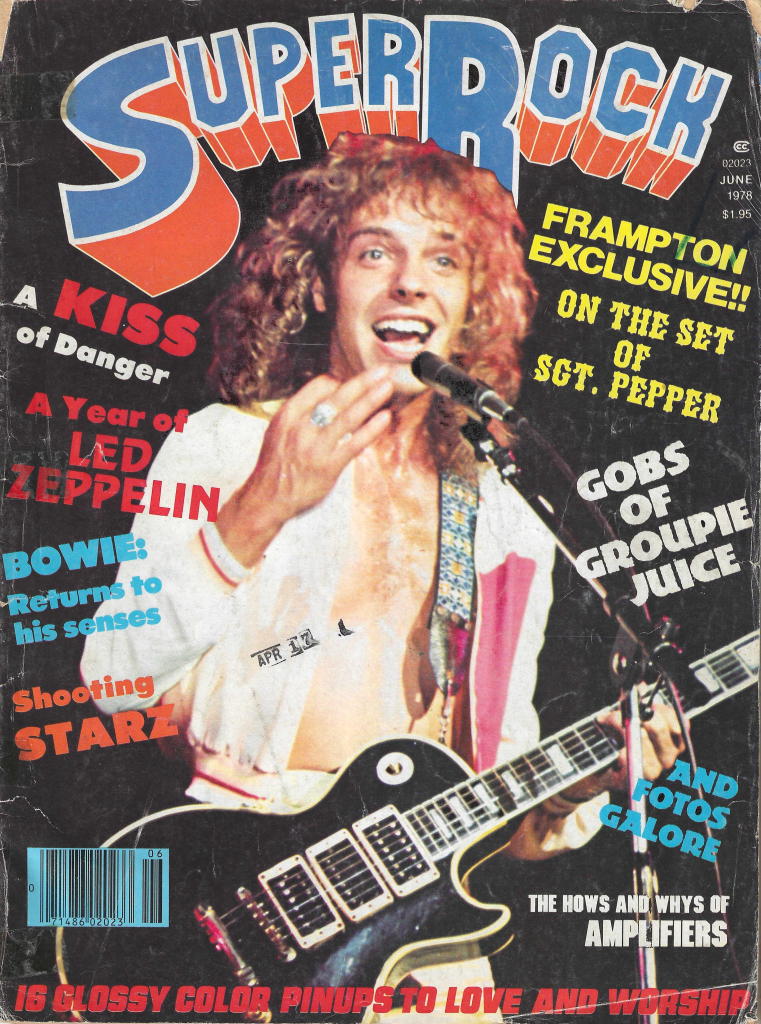
Let’s end our 2025 postings with something that’s not even a fanzine and didn’t come from the underground, just to bum you out. I bought Super Rock’s June 1978 issue online this year for a couple of reasons: first, because of my immense enjoyment of their second issue, the punksploitation one, which I wrote about here – and secondly, because the editor was one Myron Fass. Fass was a serial churner of exploitation magazines and comics of all types, a total “schlockmeister” who could really turn a buck on newsstand magazines on UFOs, monsters, mobsters, JFK, Elvis, and, apparently, 1970s rock-n-rollers. He was written about lovingly in one of the Bad Mags books, which I also got turned onto this year.
Whatever punk they’d been writing about a few months before this was almost completely shitcanned by June ‘78, even with the continued presence of Hannah Spitzer on the masthead, seen inside sporting an awesome sneer and a Sex Pistols shirt. Hannah, please write to the ‘Hemorrhage. Let’s converse! Spitzer actually gets the opening gossip column, but was likely forced at gunpoint to write about Meatloaf, ELO, Ted Nugent and Rod Stewart. She looks much more like someone in the crowd at a Teenage Jesus & The Jerks show, and writes accordingly with much vim and vigor.
As with Rock Scene – one of the all-time greats – Super Rock is just overloaded with original, mostly non-publicity photos, a result of its staffers being out and about in New York City and elsewhere. It also has – ugh – color centerfold photos of Stewart, Andy Gibb, the Bee Gees & Peter Frampton, and David Bowie, who’s praised in an article for returning to his senses after Young Americans with his latest records Low and Heroes. “David has dropped the dressup, cut the shit and emerged almost naked with honest and individual energy”. That’s one way to put it.
I don’t think I’ve ever seen a true “groupie” column before, but the one from “Dirty Darla” called “Ball Me Out” is quite a treat. She’s upset that the Pistols have just played in Atlanta “…without giving Darla a call. I was counting on a cream/dream date with them – that’s right, all of them….except Steve Jones, maybe – who one of my bisexual male friends who prefers men thinks is a real humpy macho stud punk – whew! Anyhow, I just saw ‘em on the network news!! Hot flashes!”. Poor Darla. I’m sure she did better with some of the more hairy cro-magnons that are interviewed and raved about across the pages of this thing: Starz, J. Geils Band, Billy Squire, Edgar Winter, Player and Tom Petty.
There are cool photos of the Patti Smith Group in the studio recording Easter, with a special drop-in from an extremely young-looking Bruce Springsteen. This is followed up with an interview, with, um, Olivia Newton-John. Wait a minute – here’s some “punk”! There’s a piece on Iggy Pop, marveling that he’s still alive in 1978. There’s a puff piece on a group called Flame with a female singer who are said to be “Red-hot and Ready To Rock!!”. Now that this has forced me to listen to them online, they may quite literally be one of the worst things I’ve ever heard. Give me Rapid Fire any day.
You want excruciating – have you ever tried to watch that Sgt. Pepper film remake starring the Bee Gees and Frampton? I was 10 when that came out to much hype, and it was just absolutely panned. My sister and I tried to watch it on TV the next year, but I don’t think we made it all the way through – and she was in love with Robin Gibb. Apparently it recouped its costs, though. The promotional budget must have been through the roof, as even here in Super Rock it’s the subject of several articles and photo spreads. Myron Fass was no dummy.
It all makes for some fun reading, I suppose, and it’s why I’ll likely keep buying cheapo copies of Super Rock and Rock Scene should I come across them – maybe even the one with Supertramp on the cover. You’ll just have to let me know if it’s still okay to write about them here. See you in 2026!
-
Making Waves #4
A few words before we start: I’ve got a revived music podcast you might potentially be interested in called Agony Shorthand, with all episodes captured here. I also did “the done thing” and made a list of my favorite books I read in 2025, with lots of extraneous commentary, which you can take a look at here. On with today’s program!
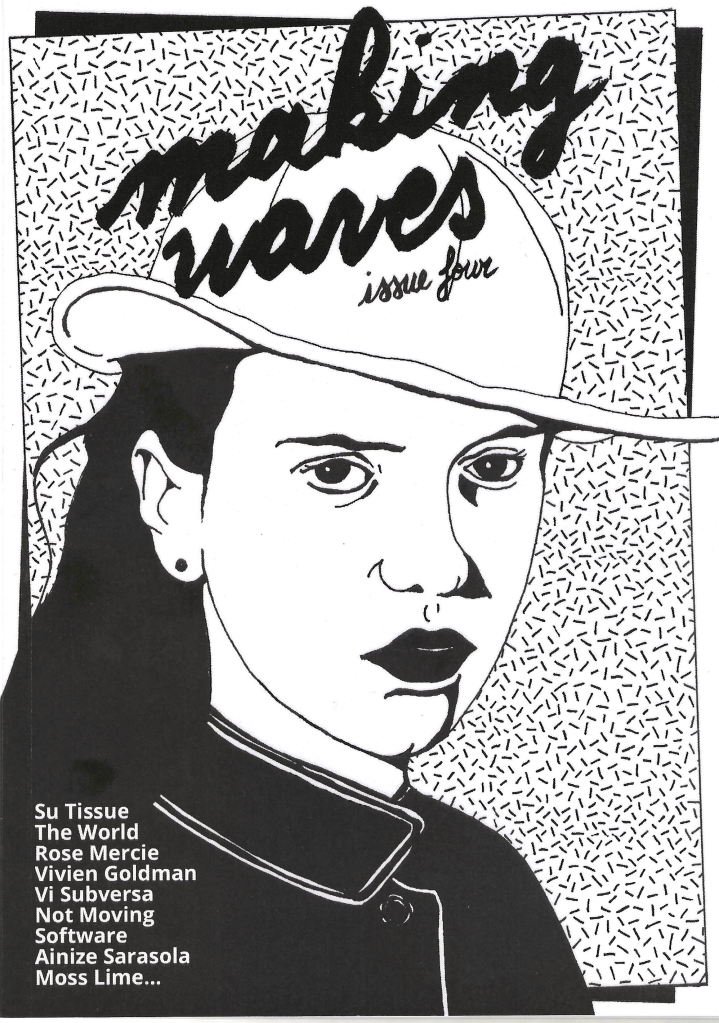
Haven’t given Making Waves #4 the once-over since blazing through it when it came out in 2016, but I did write a bit about their 2011 debut issue nearly three years ago, perhaps providing something of an introduction to the cut of their femme-slanted jib here. This one, #4, ended up being their final issue, and the point is made is the intro that they’d prefer to focus this one a bit more on current bands as opposed to the mostly-archival stance of the previous three. So that’s what they did!
The World, Rose Mercie and Moss Lime – all bands I liked, all with different features here: an interview, a tour diary and a playlist, respectively. Moss Lime, Freelove Fenner and Brave Radar were fantastic female-fronted abstract pop groups from Montreal last decade, and all deserve to not be forgotten; in fact, they deserve far better than that, and I kinda wish I’d pumped them up a little more when they were still around.
Cover star Su Tissue falls into the “attention comes so much easier when you’re exceptionally attractive” slot that Billy Idol and other beautiful mediocrities did, though I happen to totally love Su’s completely absurd “Manson girl meets Little House on the Prairie” persona, and the fact that she ditched it all at exactly the point when she was ready to be done with it. Also, watch this 90-second video of her Suburban Lawns playing “Unable” in 1979 – wow. Apparently there are middle-aged men who’ve spent way too much time on the internet fruitlessly attempting to track her down, her mystery and magnetism being catnip. For what it’s worth, I am not one of those middle-aged men. Katie Alice Greer wasn’t either, but she chips in here anyway with “The Eternal Mystery of Su Tissue”, and despite using the words “cultural pedagogy” in the piece, pulls off a nice tribute to the Garbo-like woman who even today just wants to be left alone.
Making Waves #4 doesn’t shrink from the post-punk women they’d sorta hung their chapeaus upon in previous issues. Vivian Goldman, for one, gets a MW interview grilling, and we’re all the better for it. Vi Subversa, the woman who fronted Poison Girls and who garnered much attention for being a fortysomething mom whilst doing so, also gets a tribute piece. There are other things on creative women from multiple disciplines whom I don’t know anything about, and, incongruously, a playlist of 70s power pop by dudes to check out.
I know I told you three years ago that 3 of the 4 issues of Making Waves were still available to purchase here, and somehow, for reasons beyond the grasp of sanity and explanation, they still are.
-
Creep #5

Creep #5 from Fall 1980 would come to be the final issue of this now-venerated San Francisco punk fanzine, a publication we’ve previously explored here and here. It doesn’t appear they knew that at the time, but I do sense a bit of “drift” in this one, as it’s a smorgasbord of opinion, rants, “just asking questions” essays, interviews and scene reports. Of course this might describe any punk fanzine of the era, but the only real unifier here in the previously cohesive Creep is the highly unifying presence of Flipper, a band whose self-destructiveness and contempt for the rudiments of “show business” was legendary, and is recognized as such in real time in this issue.
What I sense here is editors Mickey Creep and Mark Creep effectively letting anyone write about and/or contribute just about anything, which, in its totality, helps provide me with what I’d imagine to be the state of the San Francisco underground at the time. There’s a lot of scene navel-gazing here, and I love it. “Western Fraud” is about the corporatization of the Western Front festival and the fact that the 1980s edition allowed in some new wave bands and some venues with legendarily moronic bouncers. Here’s a flyer for the 1979 version, and a tough-to-read 1980 version, featuring shows by “Bill Graham Presents”. Creep, not an overtly or at least over-the-top political ‘zine, except when Jello Biafra is writing for them, seems to be mostly concerned with keeping punks from selling out as well as from eating each other alive.
The editorial magnanimity in allowing one writer to praise Brian Ferry at length and another to do a free-form piece extolling Roky Erickson is a nice surprise. James Koetting in his Ferry piece at least has the good sense to recognize that the jig was up when Flesh and Blood came out. The New Youth collective, which I was just talking about the other day, get a post-mortem that features Caitlin Hines prominently, and is probably the best overview you’ll find on the intra-scene dynamics and backbiting that came from putting on punk shows outside of the established clubs at this time. There’s a long interview with Paul Rat as well that adds yet another layer to the same. (for fun, here’s a 1979 phone call between Rat and Black Randy you might want to spend 9 minutes with).
The Flipper interview is, by turns, hilarious and even a little shocking. The amount of drugs and alcohol these boys put away at the time – well, now that I’m a fifty-something dad, I want to stage an intervention to at least to keep Will Shatter alive a little longer. (“Beautiful Boy”). Shatter has some collage art in here that’s excellent as well. Some deep intelligence, casual racism, complex theory and general chaos comes to the fore in this interview, and clearly there’s a small chunk of San Francisco that’s become totally enraptured with the band during the previous year. And hey, we lost Bruce Loose this year, but Ted Falconi is still with us, folks!
The Dead Kennedys have just come back from their first tour of England, and there’s a great piece about how incredibly bleak things are over there, both in the punk scene – then morphing into oi – and otherwise. Jello is startled by the fact that in the UK, so many of the kids coming to see them want him to sign something, and how even performers like him are treated like untouchable gods – except to spit on during the show, of course. A Crass piece makes similar points about England and of course extols all the ways they’ll likely be making it better. Olga deVolga from Vs. gets to rant about the scene and show off her general anger, and breaks the news that Vs. will be “merging” with Seattle’s The Lewd to form a new band called – The Lewd. There’s a long conceptual piece about Bill Griffith and his Zippy the Pinhead comic, which was quite popular with local weirdos well into the 1990s and still endures to this day. Careful connoisseurs of all the garbage I’ve written might recall the Kurt Cobain/Zippy connection I wrote about here.
There’s even a crossword puzzle with questions like, “Who taught the Cramps their songs?”, “Anarchy in the __”, and “Ted, Will, Bruce and Steve are ____”. (I told you everything comes back to Flipper in this one). We could go on and on picking this one apart, and I’d like to, but let me conclude by giving a huge kudo and shout-out to Creep #5 for being the only contemporaneous fanzine I’ve ever seen that wrote about the Fuckin’ Flyin’ A-Heads while they were still around (though it appears Touch and Go may have as well!). If you know, you know. Not merely a review of the 45, but a brief chat, which talks about their move to San Francisco from Honolulu. This might be why I found my cheap copy of “Swiss Cheese Back” at Record Vault in SF in the late 1980s, a glorious banner day that was subsequently undercut by my poor decision to sell the same single on eBay ten years later.
-
Scram #19
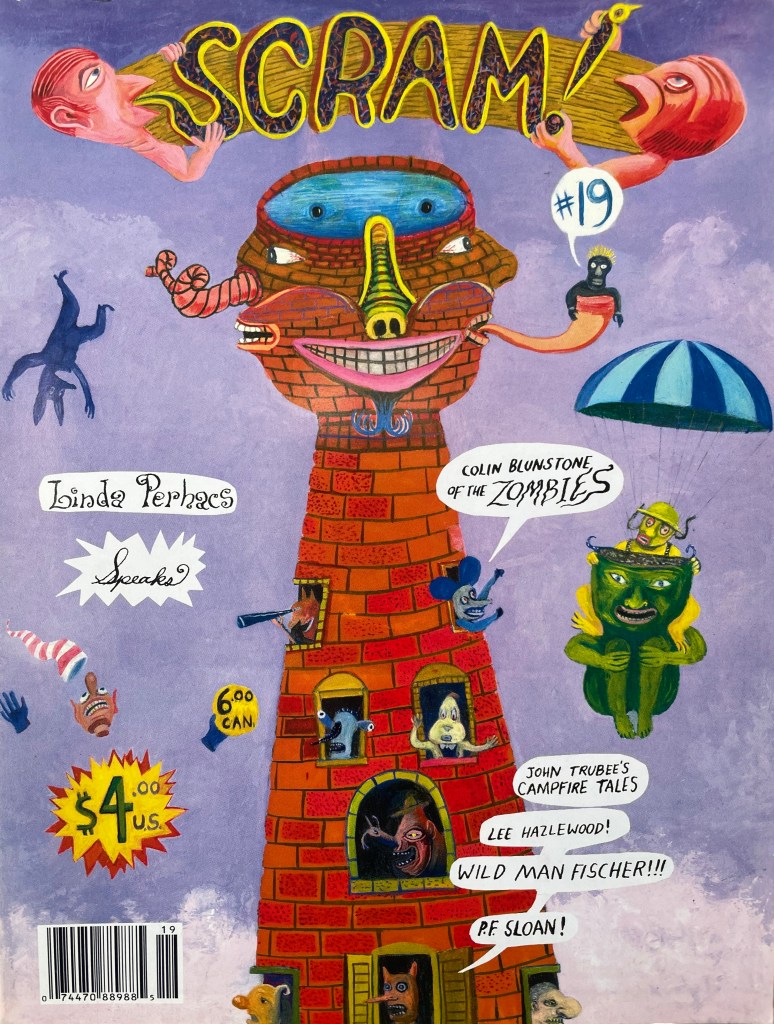
It’s been some time since we’ve taken a look at Kim Cooper’s 1990s-00s Scram; I think it was one of the very first fanzines I wrote about on this site, here and here. I’ve got this trove of them, a near-complete run, and every now and again it seems like a good idea to break one out, and I’m always glad I did – particularly the later issues, as this thing just continued to gather steam until its final transmission, issue #22.
Scram #19 – “Hollywood’s Premiere Journal of Unpopular Culture” – is the Spring 2004 issue, and features a few of the same unearthings I was myself pretty excited about at the time. To wit: Linda Perhacs. Not long after the time I’d discovered how much I loved Vashti Bunyan’s music, I went looking for other lost 60s/70s female folk oddities, and came across Perhacs’ dreamy and strange 1970 Parallelograms. It resonated pretty strongly, and not only with me. It had just been reissued on CD a few years before this issue, and as Cooper notes in the intro, “The reviews were odd. Without any evidence beyond the text itself, the critics made assumptions about Linda, painting her as a dippy hippie sprite who somehow channeled these vast ideas unknowingly”. So Cooper and Ron Garmon had the first sit-down interview ever granted by Perhacs for this issue to fill in the gaps.
I mean, the best revelation by far is that Perhacs is a name we now know only because she, as a post-college dental hygienist, haltingly passed on some of her home recordings to one of her rich patients in Beverly Hills, Leonard Rosenman. Dazzled, he then did everything possible to hustle her into a studio. She just thought of them as “campfire songs”, something she did for fun. Also, her “Hey, Who Really Cares?” ended up being the theme song for the TV cop show Matt Lincoln, because the producers wanted a “delicate song on top of this hard action”, inspired as they were by Robert Altman’s M.A.S.H. theme “Suicide is Painless”. How about that? I’ll let you find the other revelations in your own copy of Scram #19.
I am also thankful for all the younger zine editors who, unlike me, thought to interview the immortal Lee Hazlewood while he still communed with us on this mortal coil. Dan Kapelovitz gets the honor here – a piece he originally wrote for Hustler (!) and which was rejected by the editors. I wish I’d talked to this guy (Hazlewood, not Kapelovitz) when he was around, seriously. What a storyteller – about his run-ins with Frank Sinatra; about sexual attitudes in Europe; about young fans in Sweden who scream so loud they scare his band, and who only want to hear his obscurities, not his hits.
About a month ago I saw the Zombies’ documentary Hung Up On a Dream and I now have a new appreciation for Colin Blunstone and co. that I only slightly had before (I even bought Odessey and Oracle, a record I’d never owned). But yeah, an interview with Blunstone was right in Kim Cooper’s wheelhouse – The Zombies being exactly the sort of band I associate with Scram: a little forgotten; a little underrated; a little fey or twee or different or goofy or strange or orchestral. His chat here is engaging and wide-ranging for sure; he talks more about the “tour” of the Philippines that the Zombies undertook which is perhaps the highlight of the documentary.
The John Trubee interview by one of his childhood summer camp pals is priceless as well. As mentioned before, it’s the interviews, features and weird bits of humor papered throughout Scram that made it stand out, not the record reviews of contemporary crap from labels whose ads helped pay for the print runs (although, frankly, Scram was relatively ad-free, and well over 90% of this issue’s pages don’t have one). The fanzine was its own little insular world of obsessions and excitements, and typifies just how interesting and enduring a well-executed ‘zine can be when one person’s weirdo vision is carefully unfurled and then shoddily typeset.
-
No Mag #5
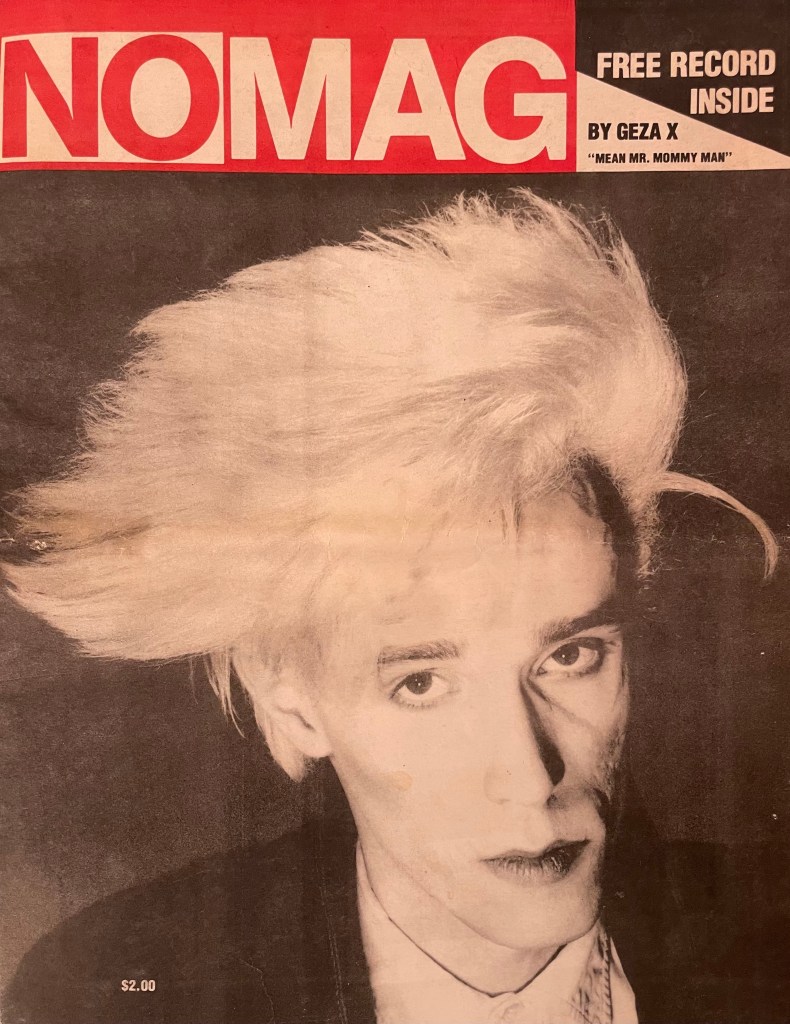
Hard to say for certain exactly when No Mag #5 hit the streets, but given the ad for the Circle Jerks’ brand-new Group Sex and a Vinyl Fetish ad touting “the last Slash”, I’m going with late 1980. Much like a never-satisfied, highly creative novelist, No Mag truly jumbled its format from issue to issue, in search of some higher, elusive truth. Always arty, fashion-forward, transgressive and exceptionally strange, my various copies are at times extremely music-interview and scene-gossip heavy, yet other times they’ll overwhelmingly default to collage art, sexual photography and disorientation. This is (mostly) one of the latter. We talked about different issues here and here.
You know the jarring, conceptualist, highly nonsensical Los Angeles late-night TV programme New Wave Theater from exactly this time? No Mag was its spiritual brethren, and though I lack proof, I’ve gotta think editor Bruce Kalberg and New Wave Theater’s Peter Ivers spent some quality methamphetamine time together. And this issue, No Mag #5 – it’s the first issue of this I ever saw, some years after it came out, probably in 1987 or so at my cousin’s Isla Vista, CA apartment. I’ve certainly never been able to forget the opening fake “interviews” with No Mag readers, all of whom are represented by pictures of the hideously deformed, or of people with various facial skin lesions and tongue abnormalities.
No Mag #5 does have a Bryan Gregory interview; he’s moved to LA after quitting or being kicked out of The Cramps, and hey, he likes it here. He hasn’t seen a band in a year; soon he’d go on to start the very forgettable and very forgotten Beast. There’s also a long bit of puffery and myth-making about Geza X, none of which is true. Apparently this issue came with a flexi of his, but my copy doesn’t have it and, as Elliot Gould’s Philip Marlowe might say, “it’s okay with me”.
As mentioned, this issue in particular jumbles together sleek ads of new wave fashion plates; strange collage-art mash-ups; poetry (of a sort), a thing about war and survivalism from Search and Destroy’s Vale and Andrea; comics; more freakish faces; and a ton of Frank Gargani photographs. Some of these are absolute gems: 11-year-old Stevie Metz of Mad Society; lovely Shannon from Castration Squad; this one of Crystal from the Speed Queens; Belinda Carlisle of the Go-Go’s, pre-fame; and a cool-looking group of dudes called The Adaptors, about whom I know nothing and who may have been from San Francisco.
Of course, you really don’t need me to tell you about it, since you can download every issue of No Mag right here, thanks to the legendary benevolence of Ryan Richardson.
-
B Side #11

I started buying Sydney, Australia’s B Side around 1987, and it was an authoritative sherpa for me through the wilds & weeds of that era’s Australian underground. Independent US record stores were getting a lot of this stuff in stock at the time, so it wasn’t all that tough for me to find Scientists records, or any- & everything on the Aberrant, Citadel, Au Go Go, Waterfront, Greasy Pop, Red Eye and Black Eye labels, money permitting of course, of which I had little. Today I’m pretty ready to assert that the underground writ large, myself included, still hasn’t quite come to terms with how fertile this period was across Australia, particularly around the years 1984-86. This is where my recently-procured copy of B Side #11 lands, right in the middle of 1985.
For context, I just listened online to two records enthusiastically discussed here – Salamander Jim’s low-end, rumbling, psych noise-damaged “Black Star”, and The Moffs’ guitar-drenched paisley-psych 45 “Another Day in the Sun”. They’re great! It’s far more likely I just haven’t paid attention to any revivals of this stuff, since there are a ton of comps out there like this one. Anyway, Simon Lonergan and his crack team at B-Side were doing all the documentation in real time. I liken this fanzine to the UK’s Bucketful of Brains, but built instead around lowdown & dirty Australian bands with big hair and bad attitudes, as well as the more punk-oriented and as opposed to jangle-driven psych. It was the tenor of the times, as they say.
If you’re like me, your eye was perhaps caught by B-Side #11’s promise of “Byron Coley on the State of the U.S.A.”. Coley’s “The State of American Noise Part 1” starts with an opening salvo positing that stupid Americans are ignoring the likes of the greatness he’s about to wax poetically about, which we probably were. This comes down to 4 key bands: Dredd Foole & The Din, Raunch Hands, Butthole Surfers and the Leaving Trains. The Trains’ debut LP Well Down Blue Highway “represents the culmination o’ years spent drunkenly tryin’ t’ find the Northwest Passage between The Damned and Creedence Clearwater Revival”. After describing them and the adjacent band To Damascus, he says “Now ya know more about these jerks than 99.99% of the American people. How’s it feel?”. Byron Coley sticking the landing, as usual. This is also the article in which Coley first wrote that Jello Biafra turned his nose up at the Butthole Surfers when he first saw them and said they were “too weird” – a statement that really stuck in Biafra’s craw for years afterward. Fun!
Tex Perkins (who was in Salamander Jim along with Kim Salmon) has a good interview here – he was better known as “Greg” at the time – which includes ruminations on his jealousy of the more popular Beasts of Bourbon; trouble with the cops; and the fact that he’s now about to start playing with Pat Bag and Kid Congo in Fur Bible. They haven’t even started the band yet, nor even told him what kind of music they’re going to be doing – he just wants to make sure it doesn’t sound anything like the Gun Club nor the Beasts of Bourbon. Well, maybe a little.
There are also a slew of interviews with the likes of the Celibate Rifles, who just had that first LP and a 45 out at this point. A year later they’d have records that were easily procured at Aron’s and Zed in LA, and which became pretty beloved by me & my Radio Birdman-loving pals. (I don’t have them anymore and haven’t heard the band in decades). Other chats are with The Shindiggers, Decline of the Reptiles, 21 Faces, Harem Scarem, and American Eugene Chadbourne, who’s just come to town and won a handful of converts down under.
The excitement of the age is real, and you can feel it in the big Melbourne “scene report” by David Laing and Trevor Block. They’re shooting the proverbial shit back and forth about bands like “Behind The Magnolia Curtain” and Murphy’s Hardware, who supposedly play live in matching Hawaiian shirts. Who wouldn’t be excited, am I right? And as a result of reading this blog post, you now know more about these jerks from 1985 than 99.99% of the Australian people. How’s it feel?
-
Subscribe
Subscribed
Already have a WordPress.com account? Log in now.
 Fanzine Hemorrhage