-
Wind-Up Industrial Burnoff #4
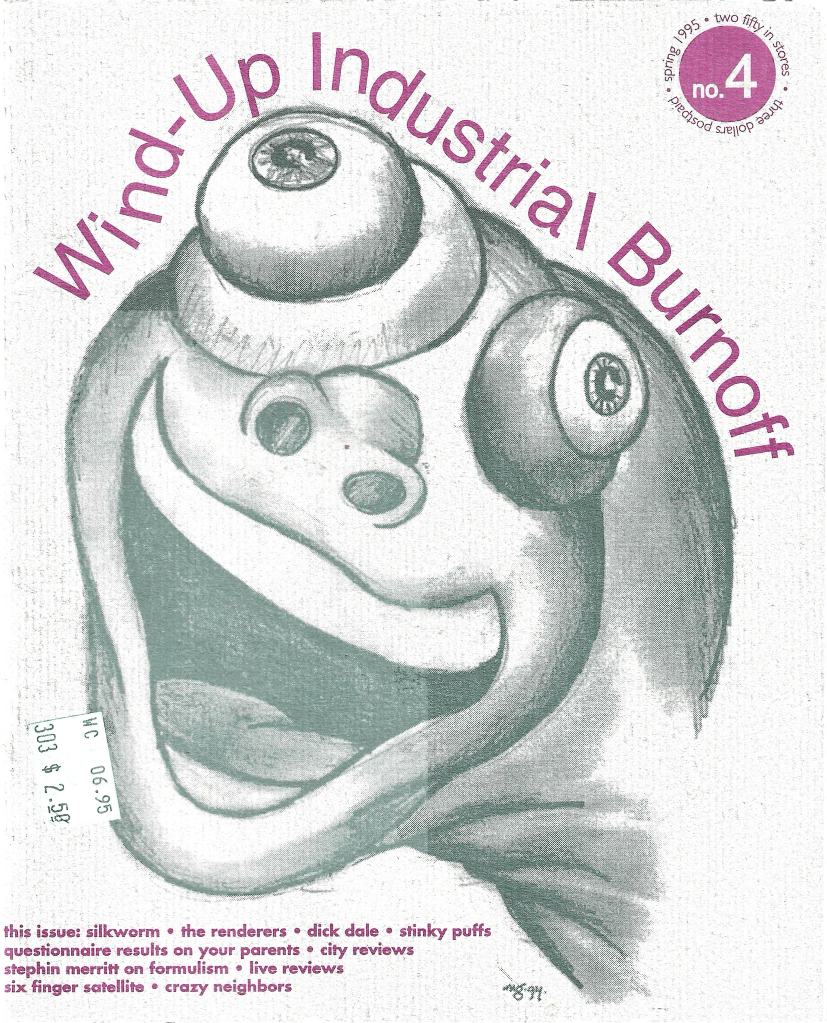
First, a big thanks to Tim G, who is the patriotic American who sent me Wind-Up Industrial Burnoff #4. To be more precise, this is Wind-Up #4 – the longer tag-on title was sort of their thing, as with the other one in this series I wrote about two years ago, Wind-Up Butter Cow (which was #5, and the final issue in this series). And “their” = “her”, as in Liz Clayton, the fanzine’s editor and omnipresent interviewer, live show reviewer, city reviewer, editorial writer and so forth. No, this one’s definitely not a “perzine” as I sort of hinted at with #5 – this is a 1995 music fanzine that leans 90s indie underground and then kind of spins off from there.
First, let’s just say it: so, so many ads. This is not all bad. Despite ads taking up 40-50% of the real estate here, Clayton clearly had the micro-indie “loss leader” labor-of-love record label in mind, and I was marginally happy to be reacquainted with New World of Sound, Walt, Brinkman, Roof Bolt, IMD, Anyway, Union Pole, Tube Alloy, Dark Beloved Cloud, Cher Doll and Car in Car Disco Product. I bought or was mailed nearly every 45 under the sun during those years, and so many of the ones from New Zealand artists in particular are the big fish that got away when I decided around 1999 that vinyl was dead and I’d better clear it all out, right now. Many are advertised here. And funding a fanzine doesn’t come cheap, I get it. I did the same thing, until I crapped out and decided to go low-tech and ad-free.
I’ve also got this perverse pride, which I’ve written about before, on never having heard certain bands or musicians, despite them being important to people I might be adjacent to. Sometimes I just don’t want to, you know? Ignorance being bliss and so forth. Silkworm are one of those bands. I don’t know ‘em. They’re interviewed here, and it’d probably be interesting if you knew ‘em! Six Finger Satellite and The Renderers I know, same with Dick Dale – him, that guy, he’s one I totally know. He comes off as a great, cranky S.O.B. in his chat with Rob Warmowski. Warmowski tries and fails to bait him several times into acknowledging the existence of punk rock, with questions about Agent Orange and JFA. How awesome would it have been to get Dick Dale sharing his take on the Blatant Localism 45 and “Beach Blanket Bong-Out”?
There’s a somewhat striking set of short Q&As with various scene denizens about their parents: what they inherited from them, what they find maddening about them and the like. The supposition might have been that we’re punks, and we got to this point probably through something our parents did or didn’t do for or to us. Happily, like me, most folks like their parents just fine, and see their strengths and foibles as clearly as anyone else does. My dad was just telling me two days ago about how much he enjoyed going to see Claw Hammer live in 1993 with me – a show at which he was quietly called an “old man” by a friend of mine who didn’t know it was my father, and despite his then being nine years younger than I am right now.
Better still – and better than the music stuff – are Liz Clayton’s “City Reviews” from various road trips that year. Clayton strikes me as someone I’d have enjoyed breaking bread with in 1995; this was around the time that I was also pretty fascinated with the US of A, which I’d only just started seeing, and especially with “local scenes”, music and otherwise. While we absolutely decried the “homogenization of America” at the time, the Wal-Martization of the country and all that, it now seems like she was traveling a set of quaint isolated villages with names like “Memphis” and “Albuquerque” with their own quirky local customs, compared with the true monoculture of 2026. She also wins my admiration with her simple yet pointed review of Phoenix, Arizona: “Phoenix sucks!”. Aside from Stinkweeds, it still does.
All the Wind-Ups are in that RILM Archive of Popular Music Magazines, which I guess you need to register for and maybe pay a little, I suppose, and you can then read a whole mess of fanzines on your computing device, including some of my misbegotten 1990s fumbles. Liz Clayton’s contributions to the cause are all right here.
-
Fŏrdämning #13
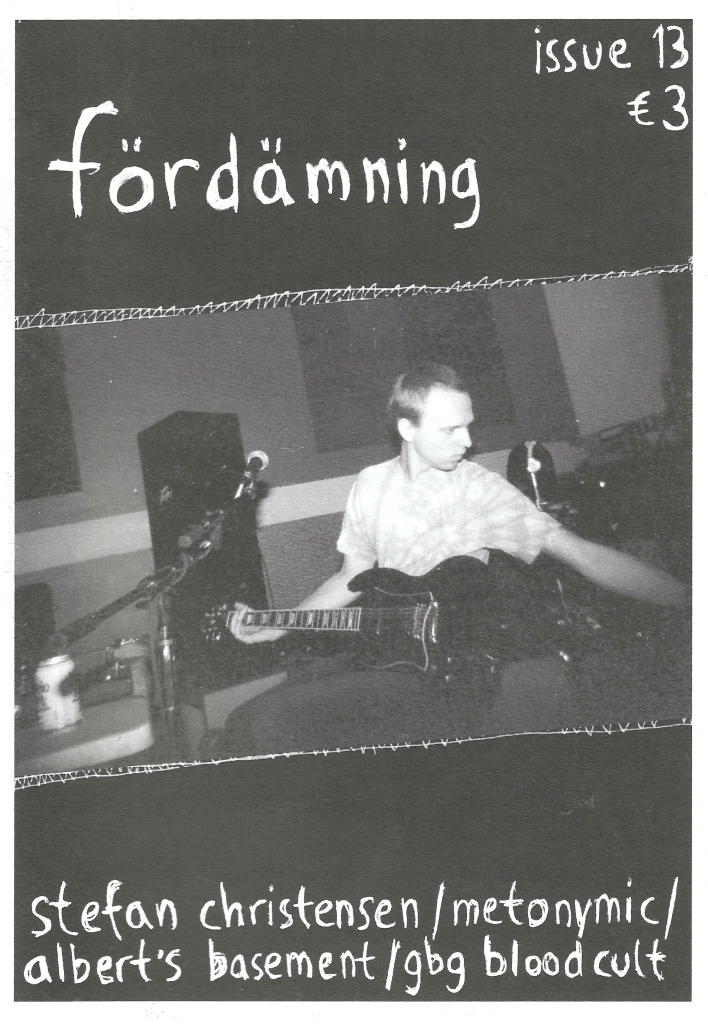
It would be fair to say that I was personally quite heavily under the sway of this fanzine during the years 2015-2019 or thereabouts. While I’d been tentatively marinating in strange, low-fidelity, experimental and murky noise musics a bit for some years, I credit Matthias Andersson’s Fŏrdämning for helping give me the language with which to rank & order it, along with a host of intensely underground bands and artists to check out. My record collection and my podcast at the time absolutely were the better for it. I can’t say he’s for certain the exact person to turn me onto Stefan Christensen, Neutral, Sarah Mary Chadwick, Blue Chemise, Drunk Elk, Enhet För Fri Musik and others, but I’m pretty sure he’s the fella.
My relationship with difficult, rock-adjacent music can sometimes be fraught, as I still set a higher bar than some of my peers might for repeat listenability, and I can get pretty easily triggered by the circle-jerking of the collector/fanzine underground over records & tapes of questionable merit. I once did all sorts of online scouring for mp3s of the New Zealand lathe-cut 45s Andersson raves about issue to issue, as well as the back catalog of the Metronymic label, written about here in Fŏrdämning #13. I found most of what I was looking for, but I also found a ton of formless, pretentiously unconstructed noodling given a smudgy, low-underground sheen through anti-production. But was it shit I’d actually listen to again? Come on.
As I wrote about a few years ago, the Swedish Andersson was creating Fŏrdämning in his second language, English, like a goddamn native-tongue speaker, while also navigating the distribution challenges and high shipping costs that I’m sure were more acute in his Gothenburg than in my San Francisco. Yet the breadth of this small thing is pretty phenomenal, and he’s on top of every exciting micro-artist creating strange & enveloping DIY music in this year of 2017. Cover star Stefan Christensen, for instance. He’s a gifted shape-shifter who came out of conventional loud garage rock music (Estrogen Highs), discovered New Zealand’s fertile back catalog, and himself began crafting these exquisitely noisy and flummoxing records that I truly can’t get enough of. He’s a big favorite in this household, and I thank Fŏrdämning for being such an enthusiastic champion of his that I couldn’t help but getting on the bus with them.
Fŏrdämning #13 also explores the great Australian DIY label Albert’s Basement, run by Michael Zulicki. It’s a short interview, but it cuts a little meat off the bone as to why this oddball pop label is worlds different from the rest. Andersson says in this issue’s intro that people have been “complaining” that he’s straying too far from coverage of pure, unadulterated noise, so he tosses them a bone here with Eric Nystrand’s overview of the Gothenburg Blood Cult label’s tapes. I mean, even here there are descriptions that totally propel me out of my chair toward the computer for further investigative research: the Vårtgård tape from 2007, described as “a huge heaving and patiently swelling mass of moist rot….feels like slowly being force fed dung while sewer rats flop their hungry tongues in your ears”. Do I dare?? It’s been nineteen years now; is it sometimes better to let these things stay buried?
You may or may not know that Matthias Andersson was also concurrently running the I Dischi Del Barone record label at this time, which pretty much acted as the aural representation of this fanzine: limited-run, bewildering music from some of earth’s best and most obscure artists. That morphed into Discreet Music, very active to this day. He turned these passions into a career of sorts, and you can see it all germinating in Fŏrdämning, should you be fortunate enough to stumble upon a copy or two.
-
Terminal! #19
Hey, a couple of things before we get started this time:
— I have a Fanzine Hemorrhage column in the new Record Time #4 fanzine. It looks like this’ll be a regular thing in one of the best print things on the planet right now, so I’m delighted to be a part of it. Order yours here. I was asked to review a couple of “power pop” fanzines. Hilarity ensues!
— I’ve also got a couple of pieces in the nearly-out Where The Wild Gigs Were, Volume 2 book put together by Tim Hinely and Eric Eggleston. Their first book was a real joy to read, and it sold out very quickly, so if this is interesting to you I’d recommend making the buy sooner rather than later. I talk about two long-gone clubs: Los Angeles’ Raji’s, and San Francisco’s 6th Street Rendezvous. Other, better writers talk about other clubs as well!
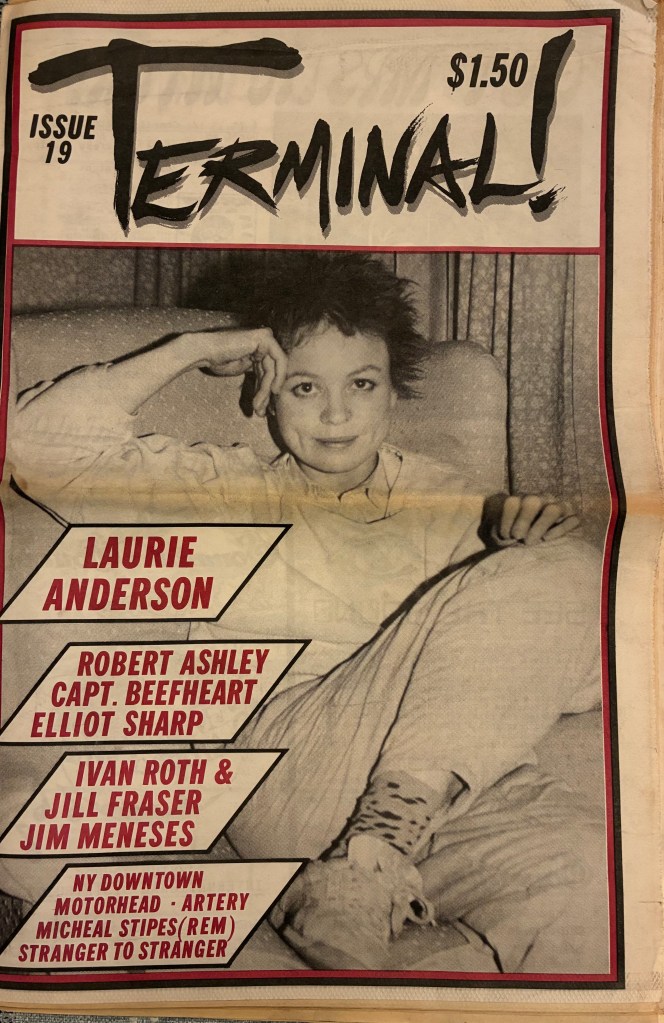
I got June 1985’s Terminal! #19, my first and only issue of this Philadelphia tabloid, as part of a batch of fanzines proffered to me for the price of “please take these off my hands”. Now I know that, like New York, Los Angeles, San Francisco, Boston, Seattle, Portland and South Florida, Philly had its own large-format underground thing as well. Maybe I’d barely heard of it because, um, ….it’s not that good…..but at any rate, I think there are a few things to discuss here about it anyway.
Terminal! #19 is an “all things to all people” sort of paper with equal access to all points in the underground and lower-tier mainstream. You can be a good band, and you can also very much be a bad band, and you’ll get relatively uncritical coverage here. You can be a 1972 radio interview with Captain Beefheart transcribed for the first time, or you can be a “street rock” band called The Limits, who’ve ascended the scale of Philadelphia rock royalty to the point where they’re now opening for The Hooters. You can be Lemmy from Motorhead, shooting the shit about the band he just fired, or you can be American composer Robert Ashley, complaining about San Francisco’s provincial music scene. You can be Mykel Board or you can be “Shredder”, and still be allowed to write for this paper.
You can be other things, too. My introduction to cover star Laurie Anderson came from an issue of Sounds I read back in 1982, in which UK readers had just voted her “O Superman” the worst song of 1981. Say what you will about that song, but this woman ended up marrying and then staying with Lou Reed, so clearly had the patience, fortitude and self-negation of Mother Teresa and then some. She gets the centerspread in Terminal #19, and honestly I tried to pay attention while I was reading it, and yet next thing I knew it was 6am and my alarm was going off for work.
Because this is 1985, and Philadelphia’s an hour-ish from New York City, there’s a “New York Downtown” report that hits nicely. It reports on Mofungo, Rhys Chatham, Arto Lindsay, John Zorn and others; elsewhere in the mag Rat At Rat R are namedropped more than once. I loved those guys. See, hindsight shows us that there’s always a good time to be alive and listening to music, even 1985. You just need to be in New York is all.
Back when I was a college radio DJ in the late 80s, the Philadelphia “horror punk” band The Serial Killers were placed on my show to do a live set. I’d never heard the band before. I got to yakking with singer and prime mover “Paul Bearer” and we got along pretty well; he liked alcoholic beverages, and as a matter of fact, so did I. I was really impressed with his deep, deep Philly accent – so deep in fact, that I often couldn’t understand what he was saying. We traded some live tapes after that, and even talked on the phone a time or two. He once told me “We got a new drama”. I was like, “A new drama? Come again now?”. “A new DRAMA”. “Um – okay. What’s that mean?”. “A DRAMA – someone who plays DRAMS!”. At KCSB he also stepped out to the drinking fountain to get some “wooder”. Fantastic. Far more fascinating than Terminal #19 for sure!
-
New York Rocker #2
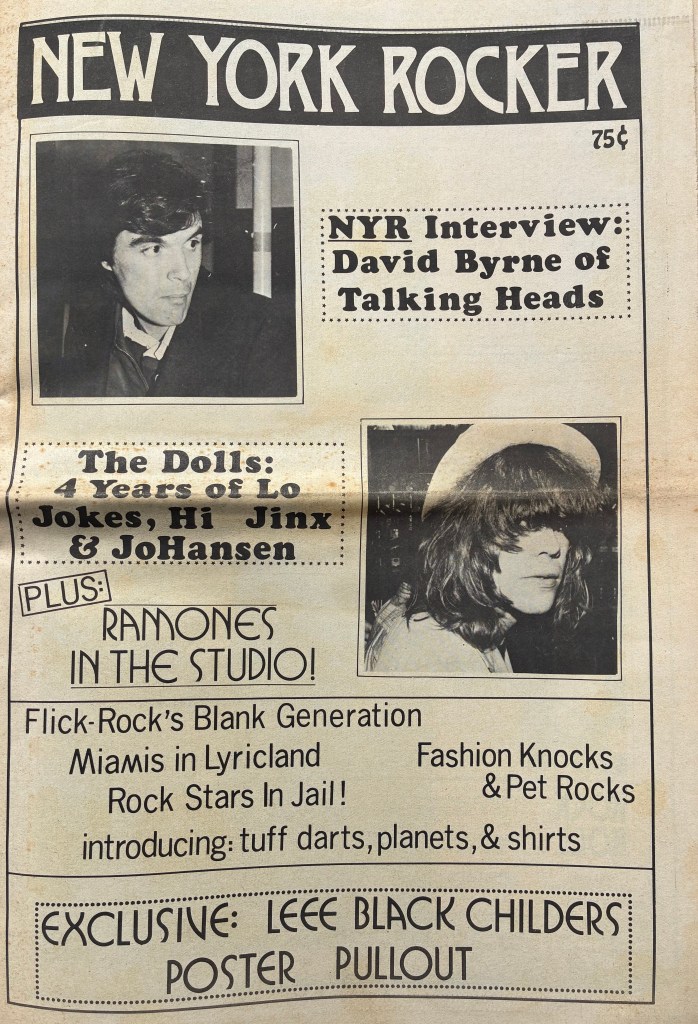
Over many years of being an idiot fanzine collector, I’ve thankfully amassed a fairly substantial stash of New York Rockers, so many now that I’d have to really cut out some life management time (exercising, eating, bathing etc) in order to find the hours to write about each one here. But I totally want to – they’re really fun to dissect and write about. I’ve been able to do so here, here, here, here, here, here and here so far. This particular one is one of the earliest issues I’ve procured, because March 1976’s New York Rocker #2 is, in fact, one of the very earliest issues.
If a more note-perfect representation of the New York rock underground at its absolute most exciting stage exists, I certainly have never seen it. Everything was coalescing at this time: Amos Poe’s Blank Generation film; Talking Heads, Television, Blondie, Ramones, Heartbreakers, Richard Hell & The Voidoids and every known CBGB band of that very early era. They’re all recording demos, partying with each other, gathering at Max’s and CBGB, and basically laying the groundwork for it all. The photographers – Leee Black Childers, Roberta Bayley, Guillemette Barbet – are assembling and documenting. The writers of this fanzine are getting their very first bylines.
Speaking of Amos Poe, at this point in history the now-seminal Black Generation doc capturing all of this on film that he did with Ivan Kral is still coming together – but hey, did you guys know about a 1974-75 film those two did together called Night Lunch?? With Television, Roxy Music, NY Dolls, Ramones, Patti Smith etc? Dude, neither did I. It’s all a nice reminder of the scene segue happening at this moment, March ‘76, where glam is definitely passé and the Dolls themselves come in for a little bit of ridicule for still sort of being a “thing”. There’s a great piece in here about the three phases of the NY Dolls, celebrating the first two and then pooping on this current, post-red leather phase, where it’s only David Johansen and Sylvain Sylvain play-acting as the Dolls, and are mostly playing in Japan.
The action, of course, is at CBGB and with unsigned bands, and that’s all New York Rocker #2 wants to talk about. This is a 100% “local scene” magazine at this point; there’s not even any Bowie or Roxy Music or Stones gossip. No one has a record out save for the Patti Smith Group – even the Ramones’ debut was still a month away, but there are cool photos of them in the studio recording it. Things seem to be so closely knit that the Blondie and Talking Heads articles are actually first-person pieces by Gary Valentine and David Byrne, respectively. The Byrne piece is a pretty funny one by an idealistic but still less-than-formed young man, musing about his place in culture; whether he’ll be able to make a career of this; his lack of dance moves, and how he really digs “Love To Love You Baby” “except for the groans”. Weren’t the groans kind of the whole point?
Max’s – whose physical location I went to and worshipped at in person just this past January – is having an “Easter Rock Festival” over a long weekend in April with Heartbreakers, Wayne County, Ramones, Talking Heads, Blondie, Mink DeVille, Marbles and…..Pere Ubu! (among many others). Artwork for the full-page ad is by Duncan Hannah, whose autobiography I just purchased but haven’t read yet. There’s a piece called “Clothes Nose: Sniffing Out NY Rock Dress Sense” that rates every band in the scene on their clothing game on a 1-10 scale, with explanations. Television score a 7, but only for “Tom Verlaine’s cheekbones” and “Tom Verlaine’s eyes”. The Fast get a low 3/10 and a rejoinder “What Sparks wore in 1974, Fast wear in 1976”. Mink DeVille ekes out a 5/10 but then gets hammered with “Name does not fit appearance. Mink is sort of a convict Springsteen/Presley/Lofgren, and looks okay if you can’t see Springsteen/Presley/Lofgren”. Presley would die on the toilet less than eighteen months later. Admittedly, Nils Lofgren looked pretty cool in 1975, though I’d probably huck apples at him if he was tooling around town in those clothes and holding his glass like that today.
And Fredda Lynn’s column “Excuse Me, Are You In It For The $$$?” might be the best thing in here. She’s at CBGB on a Thursday night, and proceeds to ask every attendee in a band or who has published photographs the titular question. Chris Frantz of Talking Heads and later Tom Tom Club is in it to win it, as they say: “I’ve always wanted to accumulate some money…it would be nice to have a big bundle”. Jerry Nolan, true New Yorker, says (and you have to imagine the accent and the attitude here), “Let’s put it like this – I’ve been in this business for seventeen years, and I haven’t made a dime yet. That should answer your question”. Ian Hunter (Mott The Hoople) is a big “NO. All I can say is no”. Whom to believe?
It’s all stellar source material for an inflection point that even the folks putting together New York Rocker #2 seem to recognize as such, and are furiously documenting it all with the necessary excitement and droll coolness required.
-
Sunbeam Tiger #1
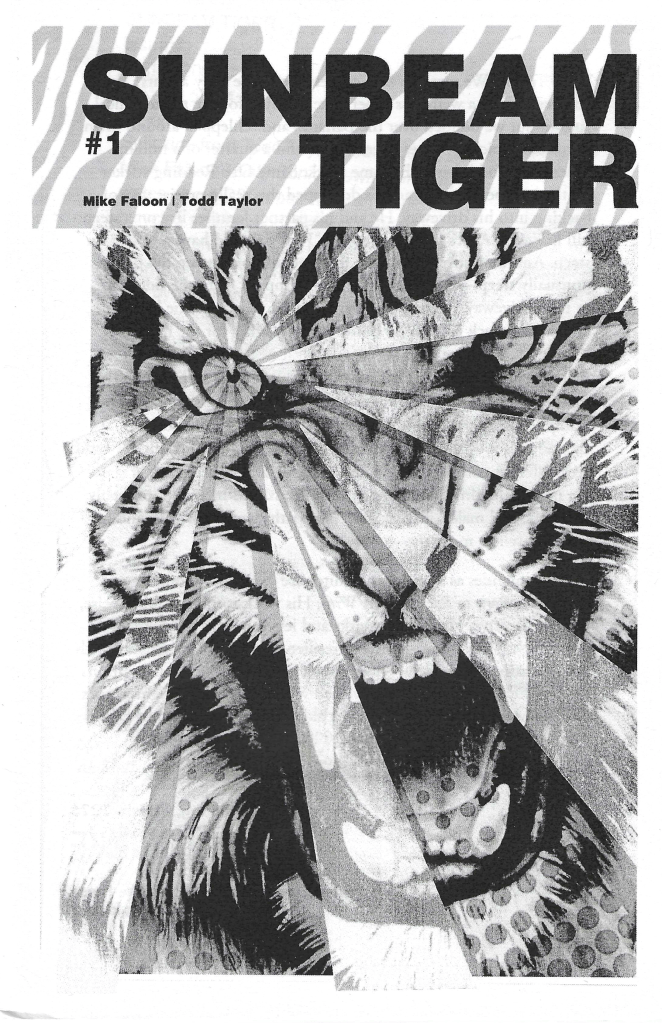
You folks remember Mike Faloon, right? We fluffed the hell out of that guy when we reviewed his Sonic Viewfinder #1 fanzine last year, and here he is in 2026 with another fine team-up zine called Sunbeam Tiger #1. The “team-up” is with Todd Taylor, a fella from Razorcake, and each gentleman gets two at-bats to see if they can move the runners. I think they move them really well, two big bags at least.
Faloon gets the music coverage, with “coverage” being the operative word. As with Sonic Viewfinder, he takes a literary fiction approach to his subjects, blending multiple tangentially related stories and musings together into a greater whole. It’s an approach I actually like a lot if (and only if) the person behind it’s got the chops to do so. I certainly don’t. Faloon does. His piece on a heretofore unknown-to-me modern act called Black Ends weaves in and out of bits about the band; about his daughter forgetting the keys to her college storage unit; and about the career arc of The Moody Blues. It all works, and one comes to think that maybe said band’s Psychotic Spew is something one maybe ought to take a peep at.
Taylor – also an excellent writer with his own somewhat unorthodox in-and-out style – puts weak pampered elitist pricks like me to shame with his paean to “Repair” – i.e. fixing broken things yourself. For this guy, it’s not a lifestyle, it’s a life – so much so that he spends large parts of his week at a DIY bike repair collective in Los Angeles, helping to get angelenos off & riding in what might be the most bike-unfriendly city in America. I remember when we bought our home many years ago, my boss told me “You’re either going to get really good at fixing things, or really good at writing checks”. I got really good at writing checks. All Taylor’s article does – besides thoroughly entertain me – is send a big crashing guilt wave across my bow. I mean I’ve fixed the toilet a few times and I’m surprisingly good at gardening my tiny plot(s), but Taylor’s on another competence planet entirely. His closing short piece on the Sunbeam Tiger automobile is connected to the larger one, and provides this fanzine with its name.
Faloon’s other piece is on Patrick Shiroishi, who’s created some pretty crazed exploratory musics with a variety of collaborators over the past x number of years. I’m particularly fond of this one. Again, Faloon weaves in some baseball, Japanese WWII internment, and a fanzine-making project he does with the elementary school kids he teaches – which resulted in the kids actually making The Patrick Shiroishi Zine. Two thought occur naturally: one, why wasn’t Mike Faloon my elementary school teacher instead of Mrs. Sullivan, and two, can we get a copy of the Shiorishi fanzine for discussion here at Fanzine Hemorrhage?
Get your own copy of Sunbeam Tiger #1 for a hefty $2 here.
-
Bedloe’s Island #2
In the midst of some of my past yammerings on this site, I’d mentioned my regrettable unfamiliarity with many of the rock fanzines of the pre-punk 1970s, aside from Who Put The Bomp and a small sampling of others. This really has to do with their scarcity and their unaffordability – I mean, yes, I’d love to have ‘em – but also with how I grew up and learned about rocknroll in the late 70s and 1980s. It was an article of faith during my “learning era” that 1970-76 were nearly worthless years, a complete wasteland of bloat and stupidity, with oceans of prog, teenybop bands, hard-rock excess and CSN&Y eventually driving kids to invent punk rock at the mid-point of the decade. It wasn’t true, but it served to cement my nearly lifelong disinterest in whatever fanzines might have been active during those years – because, after all, what would they cover?
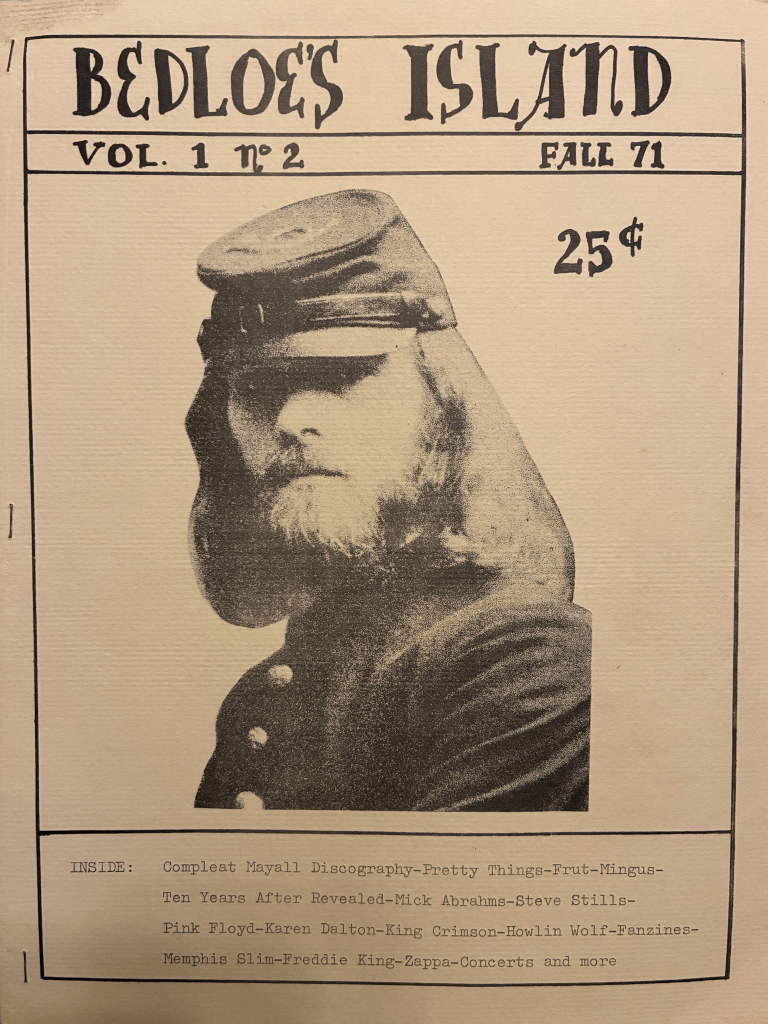
A kind American recently stepped in and provided me with some source texts from this period to help guide me toward the light. One of these was Bedloe’s Island #2 from Fall 1971, edited by New Jersey’s own Jesse Farlowe, who also contributes the majority of the text. Due to an upcoming address change to Goddard College in Plainfield, VT, I’m left to assume that Farlowe was a young man, a late-term high schooler even. If it indeed shows in some of the writing, I say who the fuck cares. His mania for digging as deep as he was physically and aurally able to do in 1971 is highly admirable, and his breadth of enthusiasms run wide, from The Mothers of Invention to Pink Floyd to both the white- & black-skinned purveyors of blues.
And in the great fanzine tradition, it’s not like he and his contributors aren’t above calling a spade a spade. Farlowe’s not a fan of Hawkwind’s debut (“long boring instrumentals with electronic noises attempting to fill the holes in the music which only succeed in making it worse”), nor of Karen Dalton’s In My Own Time (“True, her voice is original – sorta like Melanie trying to sound like Janis Joplin – but it is also one of the most irritating sounds I’ve ever heard. Each time she begins to sing I get a shiver down my spine”). It goes the other way, too. Contributor Tom Ayers completely busts two nuts over – wait for it…… – Poco, live in concert (“their shitkickin’ country brand of rock makes ya smile no matter how down things may be getting for you…This is just about the most infectious music I’ve ever heard – and they’re good musicians, too. Poco is perhaps the most dynamic band around today”). I was going to chime in and say “and they hadn’t even released “Amie” yet!”, but that was Pure Prairie League, another godhead proto-punk monster band.
Bedloe’s Island #2 is a hoot to dig through because it’s (obviously) written on a manual typewriter and there’s a bit of a coded apology at the start for the price having to be raised to 25 cents from whatever comparably affordable price it was before. The era when information was scarce and painstakingly manual cobbling had to be done is all too apparent in Farlowe’s John Mayall discography, which attempts to list every record by not just Mayall, but those who played with him, such as Eric Clapton and Peter Green. So you therefore get a Fleetwood Mac discography up to 1971. I remember being a kid when Rumors was the biggest record on the planet, and seeing all these other strange-looking Fleetwood Mac records in the bins and wondering why no one ever talked about those. Farlowe did!
Still, he’s feeling the winds of change and the cold, end-of-an-era current that started at Altamont is now starting to bum his trip a little, too. He’s got an editorial about some monkey business going on with the crowd at an Emerson, Lake and Palmer show (!) and connects it to a recent stabbing at a Who concert in Forest Hills (!!). “Rowdiness is quite prevalent at concerts….once an avid concert goer I can no longer take ‘the scene’ and limit my concerts to a select few….hopefully it will all blow over…”). Whew, I am glad that Farlowe did not get to experience Long Beach’s Fender’s Ballroom in the 1980s. It did not blow over. The first time I went there in 1985 I was told that the previous week’s show had been a “bloodbath”, which effectively had me standing at the back near an exit for most of the evening, as skins, punx and miscreants of all stripes slammed their asses off, fists first. Good times. Give me ELP’s rowdy-ass crowd any day.
-
Poison Penn’s #2
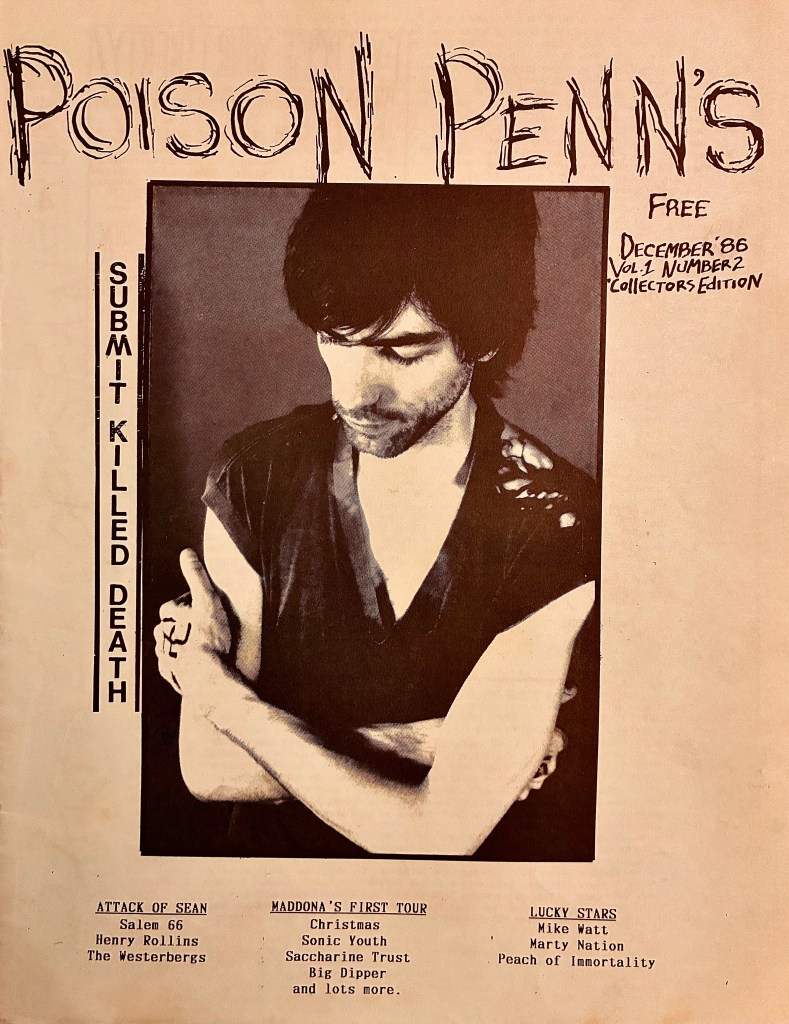
It’s just now dawning on me that the Boston-based Debbi Shane who put out this “collector’s edition” fanzine in 1986 has got to be the Debbie Shane who moved to San Francisco and was in the band Dumbhead a few years later….right? She wouldn’t remember me from the proverbial Adam, but I saw her band a time or two, and one time in the early 90s she and I worked cheek by jowl at “Rough Trade Records inventory day”, for which I was remunerated with free records that they were distributing. I sold these some years later, including original Flying Nun records by The Clean. I wonder if those are worth anything?
Poison Penn’s #2 apparently takes its name from the recently betrothed Madonna and Sean Penn, who, stoked by Sonic Youth, somehow became a cause celebre in the deep underground that year. It was this sort of in-joke that seemed to teeter between irony and sheep-like conformity, and something I did everything I possibly could to ignore at the time. Having not seen the first issue of this fanzine, it seems from letters to the editor to have overdone the Madonna angle even more than this one, and I’d likely find that a little hard to bear. This one keeps it in check, aside from ladling on too many questions about her/him to interview subjects like Peach of Immortality and Mike Watt, who try their best to wriggle away.
There’s much to recommend here, however! Shane, who admits to not even having hit drinking age yet as of this date, is an attack-you-with-a-tape-recorder-after-the-gig type of interviewer, and I like that approach. She’s also, this year, very fond of “the cinema of transgression”, as evidenced by R. Kern on the cover; a printed manifesto from Nick Zedd about all the people who’ve fucked him over; and an interview with Marty Nation, who famously dangled his participle in the film Fingered and did some unthinkable things to Lydia Lunch with a gun. At the same time, she’s also enamored with Big Dipper, an indie-rock quartet of dorks who had a few albums on Homestead and whom she’s moony over in multiple reviews and asides.
The mail interview with Tom Smith of Peach of Immortality is in that same highly unreadable fractured-punctuation style that he’d recently done in some Forced Exposure thing. He talks about his label’s upcoming Laughing Hyenas and Drunks With Guns records, which did not, in fact, actually happen. Shane then disses the band in her live review, happy that they’re from DC and therefore “will be leaving in the morning”. Then there’s a club-bomb interview with Bob Forrest of LA’s Thelonious Monster (!?!), who were just awful, in which Forrest – whom people said was a real fun guy! – admits to having just done a bunch of coke in the bathroom. The things an intrepid, spontaneous reporter with a tape recorder can obtain can be pretty magical.
Mike Watt claims that the aforementioned Madonna wrote “La Isla Bonita” about his hometown, San Pedro, CA – which, if you’ve experienced the sheer natural beauty of that town, you’d understand is 100% true immediately. Shane goes to see Saccharine Trust at TT’s in Boston on 10/30/86; at said show, “Jack Brewer pulled his arm outta his socket mid-set. He ran back stage, dove chest first onto a table, and dangled his arm back into place”. That had to be absolutely awesome to see, right up there with Jeff Connolly of The Lyres beating up a bandmate mid-song, or the guy from Lubricated Goat having a narcolepsy attack on stage.
She ends with a live review containing a fanciful tale very much in the spirit of phony live reviews that fanzines like Conflict and Flesh and Bones were writing at the time. In this one, the members of Sonic Youth, at the 11/22/86 Irving Plaza NYC show, see Shane taping said show; drop their instruments, and dive off the stage to pummel her, after which she’s hospitalized, where she’s now suffering from amnesia and attempting to write these words. Heeey, now that I think about it, maybe that Jack Brewer story was bogus too. Damn. Great fanzine! Does anyone have any other issues?
-
BravEar #3
After the seminal purchase of my first two punk fanzines in 1982, recounted here, the purchase of any and all underground music-related fanzines became a habit, shall we say. The tack-on of one or more fanzines to my Tower Records or Universal Records or Streetlight Records bag for another buck or two, if I had it, became something of a everyday move. It’s why I’m still blabbering about those exact physical copies here. I also was working the counter and/or the drink machine at San Jose’s Wienerschnitzel twenty hours a week at $3.35 an hour, so I absolutely had the extra cash for whatever the fuck I wanted.
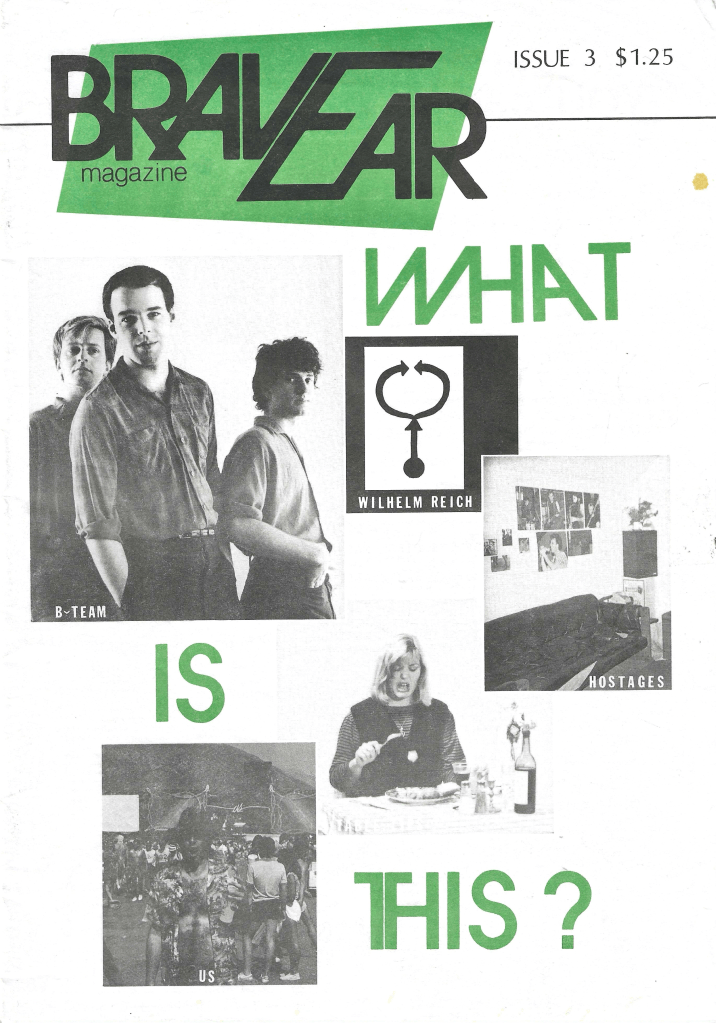
BravEar became a regular early buy. It wasn’t really because I loved this particular fanzine all that much, but because it was a visceral connection to San Francisco, a near-mythical, club-packed, punker-filled city located one long hour to my north. I wanted to be there so goddamn much. I’d read about shows at the Sound of Music, the I-Beam, the Mabuhay and elsewhere and curse my birth year and inability to drive. So I’d buy BravEar and Puncture and live it all vicariously instead.
However, and I’m just going to say it – when BravEar sucked, it really sucked, and in 1982, issue #3, it really sucked. I got this issue after the fact – just this year, as it happens. I’d never even cradled it in my hands. These are actual adults reviewing records and live shows from ABC, the Stray Cats, Bananarama and Oingo Boingo as though they’re worth dissecting, people who’ve got a foot in the true underground but instead have already bought into the corporate story of funny-haircutted dandies playing disco being the next link in the new wave. They’re also doing a lot of half-baked shitting on 1982 bands like first-EP Dream Syndicate. I mean, 1982 was an absolutely fantastic year for underground music, maybe the last truly great one in a six-year run, and you’re writing about the majesty of Thomas Dolby? (“I enjoin you to have a listen, preferably while reading the words”).
No wonder nearly everyone’s hiding behind some godawful pseudonym here (“Ohr Well”, “Dogtowne”, “Velvet Thistle”). BravEar did get a lot better in later years, despite some remonstrance here and here from me on issues #10 and #12 respectively. And hey, they give some space to Bill Christman to write about, yes, San Jose’s own hardcore punks Los Olividados! SJ pride all the way. Now I get confused sometimes about the fellas who did the hardcore punk rock shows on KFJC back then, but the one that blew my mind every Monday night was Bob Gibson’s “White Noise”. I listened every week, despite being a little intimidated by ‘81-’82 hardcore. He played Los Olividados for sure. I think he’s a distinct person who’s neither Alex Morgan (“Vinyl Rites”) nor Bill Christman, but maybe Morgan and Christman were the same person? Does anyone know what I’m even talking about? No?? OK. let’s move on.
I’m bummed this issue was so flaccid more out of the sense of them missing an opportunity and blowing it. It’s just music of course, and a fanzine, and both are kinda dumb – but you people don’t pay me for milquetoast takes, right? Lorry Fleming, who was managing editor for this issue, would later go on to write a great fanzine column in the otherwise avoidable BAM. Perhaps she was, like, 18 years old here? And that’s why she greenlit the poetry, the politics and the Wilhelm Reich piece? I mean, you should see the crap that I personally allowed in the KCSB Livewire in 1988, and I was editing at age twenty. So I’m going to stop dumping on BravEar #3 out of immense respect for the process, if not the results.
-
Freakout, USA #1
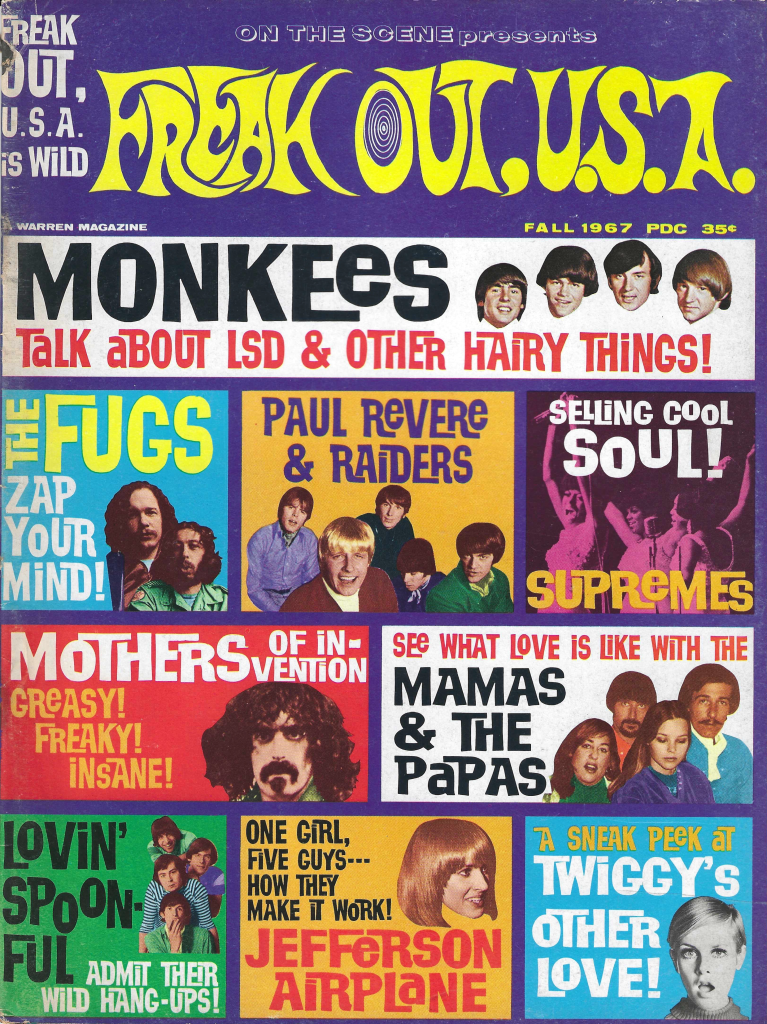
They say if you can remember the 1960s you were never really there, but in my case the point is moot – I was never really there. Yet I’ve cottoned onto the absolute mania of the time, this strange period in which supposed “humor” was wrung from jabbering a mile a minute, from non-sequiter jokes and asides, and from this very 1960s sort of wacky patter I associate with TV shows like Laugh-In and The Monkees and with magazines like the short-lived Freakout, USA. I’m not sure it has dated all that well, but then again, it’s getting close to sixty years now. I’d imagine the humor of the 1900s felt a little dated when this thing was being published as well.
Readers may recall that I reviewed the second and final Freakout, USA #2 here. I also made you a promise that I’d find you (and me, of course) a physical copy of Freakout, USA #1, and here we are. That second issue was probably more bloated with “psychedelia” and over-the-top far-outisms than this one, but even here it’s clear from the cover that it’s not 1966 any longer, and the female target audience likes it freaky, wild and kooky. (For the record, it’s Fall 1967).
This time period coincides with absolute USA Monkee-mania. Accordingly, there are Monkees-only stand-alone pieces from Page 8 to 23 here, with loads of Davey-thinks-this, Peter-likes-this-kind-of-girl, Mickey-wants-that and so on. 15 straining pages of The Monkees, and loads of hot pix. Again, it’s not just who’s cutest, though – there’s talk of LSD, politics and other weighty topics for the times for clued-in teenage women and men. This is followed by three articles on whom I believe were considered the second cutest band of that year, Paul Revere and The Raiders. The girls loved “Fang”, the bass player. Fang!!
I really can’t think of The Mamas and The Papas any longer without immediately calling up the lyric, “And no one’s getting fat except Mama Cass”. Poor Ellen Naomi Cohen. What a raw deal this young woman got, all her earnings notwithstanding. The piece in Freakout, USA #1 is ostensibly about how rich the M’s & P’s are now, and what they’re doing with their “California Dreamin’” money. “They have called Cass the Fat Angel, which she doesn’t seem to mind, for she weighs over 200 pounds and pulls no punches about it”. You think maybe that’s because it’s all anyone could talk about with her? Jesus Christ, I know I wasn’t there, but someone else must have been overweight in the 1960s, right? If you were there, please let me know if it was just “Mama” Cass and no one else.
But really, and I hinted about this before when I yammered about Freakout, USA #2, this issue juxtaposes all the pretty boys and angel-throated girls with two other hot & hairy up comers – The Fugs and The Mothers of Invention! What do you think of these spicy hunks, young ladies? “The Fugs are not everyone’s cup of tea. They leave some folks cold. They are loud, vulgar, and dirty-looking….And they’ve become enormously popular”. Well, I’m not so sure about that last part. What’s great is that Freakout, USA #2 is so committed to the bit that they even are helping to flog Fugs sweatshirts and Fugs buttons. Ed Sanders even looks kinda handsome in his! Different times.
This issue is rounded out with some peppery prattle about Twiggy and an abysmally unreadable article about the Jefferson Airplane, which bums me out because besides The Fugs, they’re my favorite band here. Was no one writing about The Left Banke around this time??? I can’t say for sure if I’d been a 14-year-old American girl in 1967 that I’d have been completely immune to the charms of The Monkees, but I’d like to think my favorite band would have actually been the Left Banke instead. Or The Magic Band.
-
Reasons For Living #1
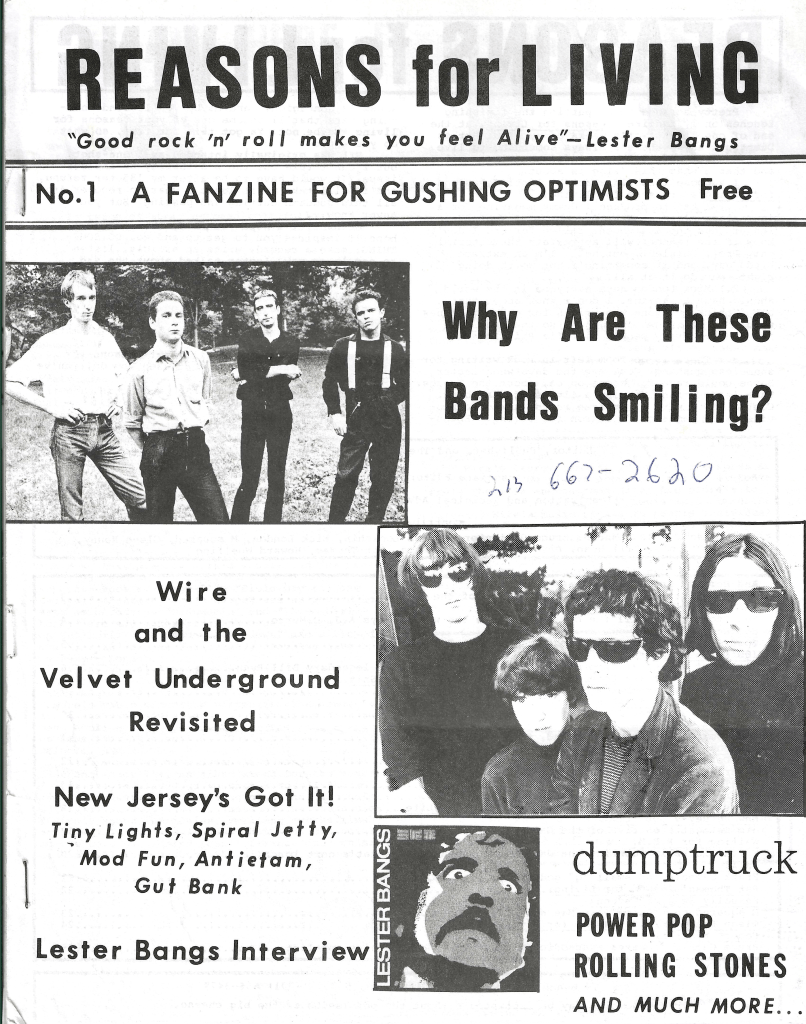
This is a 1985 fanzine that presages some obsessions that college-aged editor Jim DeRogatis would later be somewhat known for; namely, his Lester Bangs fixation – which would result in him ultimately writing the Bangs biography, Let It Blurt – and his Wire fandom, which would somewhat ridiculously garner him & his friends a slot opening for the band on Wire’s entire 1987 US tour, doing Pink Flag from start to finish as “The Ex-Lion Tamers” so that Wire wouldn’t have to play any of it. I still think that’s preposterously awesome, and I wrote about it in one of my own fanzines.
Reasons For Living #1 was something of a “dummy magazine” and final project that had its roots in an NYU journalism class DeRogatis was taking that year. He’s got a stated goal of bringing back shameless gushing and enthusiasm, as opposed to deep snark and hatred of mediocrity. Well, which would you rather read? Yeah, me too, but this one’s got plenty of “spunk” and “vim” to go around, and a little “vigor” to boot. He wrote it from home in Jersey City, and called upon contributors to give some of their quote-unquote reasons for living. This results in stand-alone pieces on the Rolling Stones, Tom Petty, The Creation, R.E.M., XTC, power pop and Robert Wyatt. Naturally, your tolerance and enthusiasm will vary depending on your patience with said acts or musical movements. But of deep snark and hatred of mediocrity, there is not a whit.
Wire receive the full DeRogatis treatment, pre-comeback. A couple of years later, there’d be some deep snark and hatred of mediocrity pointed their way for sure, but at this point, with the 3 golden records being the sum total of their true discography, the track record was exceptionally solid. The editor also gets in his licks with coverage of The Velvet Underground during that hallowed VU-has-just-come-out period. I remember it well, as it was my introduction to the band, “Foggy Notion” and “Temptation Inside Your Heart” in particular – the latter of which bugged the shit out of me. He also spends a little time on Dumptruck and a New Jersey underground band round-up, including mid-80s east coast fanzine punching bag “Gut Bank”.
The star diamond in this one is Lester Bangs interview excerpts from a talk teenage DeRogatis had with him just over 2 weeks before his death in 1982. Excellent stuff. Take a look at this particular bit of Lester-on-Lester; it is kind of a drag and highly ironic, given that he’d be dead sixteen days later:
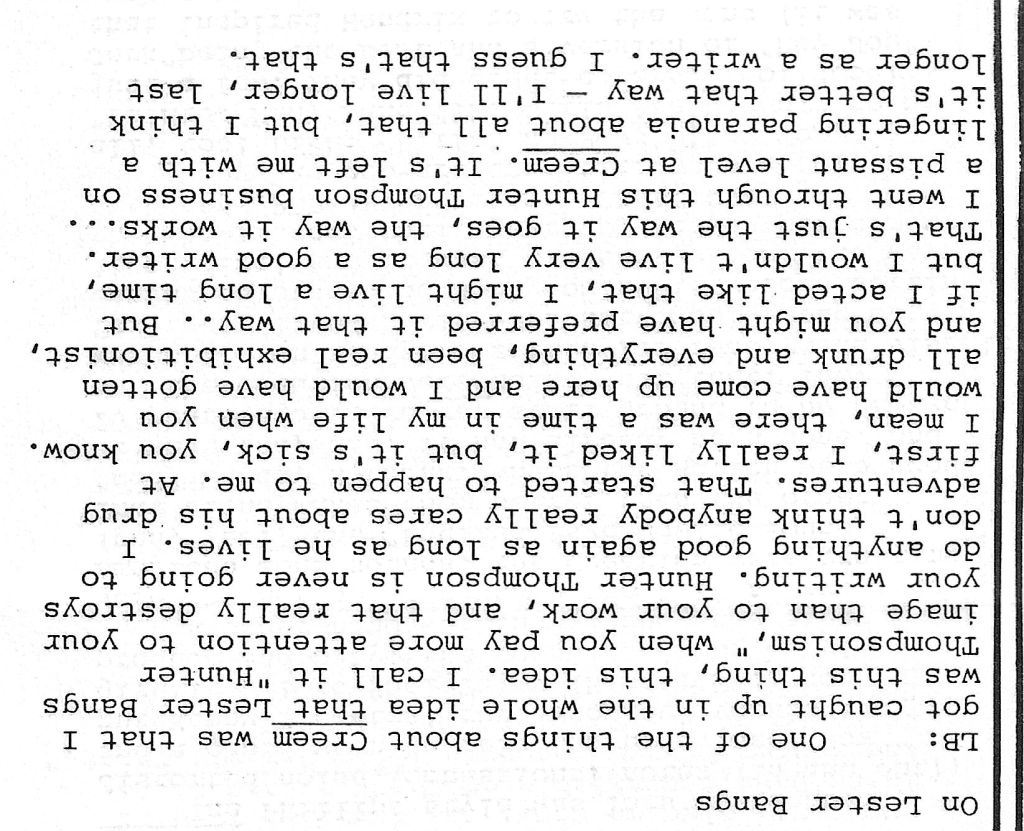
The back-half contributors get a little more free reign than the front-half gushers. Art Black, later or perhaps concurrently the editor of Away From The Pulsebeat, writes about his girl getting knocked unconscious at a show and about how that means punk is probably dying. Laff all you want, folks: Art Black was a fucking nostradamus on this one. Howard Wuelfing is given space to opine on ten things he enjoys, from sex to beer to Big Star. I love the 1985 “good beer” list he provides: “Stegmaiers, Straub’s, Ballantine Ale, Rheingold, John Courage (draught), McSorley’s Ale (draught) and Tuborg Gold (draught only!)”. Dude, I know things were grim in 1985 for beer – I was still a full four years away from my first “Sierra Nevada Pale Ale” – but right there in DC you had the Brickskeller, “the first restaurant of its kind to offer customers a beer list with thousands of beers from around the world.” I went to the Brickskeller not long after I’d hit legal drinking age, and my jaw nearly cracked the wooden floor. Let’s just say that Tuborg Gold “on draught” was far less than second best on that night.
-
Subscribe
Subscribed
Already have a WordPress.com account? Log in now.
 Fanzine Hemorrhage