-
Wrapping Up
The lack of activity here has been telling, so let’s put a fork in it and call it done! Happy to converse at any time at thejayhinman@gmail.com, and thanks to anyone who’s been reading this one over the last four years.
-
Knock knock knock, Housekeeping

As I gather my wits for my next flurry of Fanzine Hemorrhage posts, I wanted to throw out some links to a few other things I’m working on, or happen to be a part of:
— The new Where The Wild Gigs Were, Volume Two book, edited by Tim Hinely and Eric Eggleson, is out, and it’s a beaut. It “feels good in the hands”, and, germane to today’s post, I wrote two pieces for it. One’s on the dimly remembered and rarely celebrated 6th Street Rendezvous Club in San Francisco (1989-91), and the other’s on Los Angeles’ Hollywood Blvd den of iniquity Raji’s, 1985-94. More importantly, there are dozens of other venue-related prattlings like mine on clubs all over North America, authored by many fine writers. The first edition sold out fast (there’s a limited new edition now), so you might want to grab a copy sooner rather than later here.
— I’ve made a few editions of the Agony Shorthand music podcast of late, which you can stream or download here.
— A few months ago I shared a link to my photographs of the great North American old signs that I like to stalk and capture. I didn’t like that site – 500px – very much, so I got a Flickr account and uploaded my entire “portfolio” here. It is actively being updated as I spot any new ringers in the wild.
— And finally, since you’re here for music fanzines, I still have a small box of Radio Dies Screaming #1 left to share with the world. I put this fanzine out at the end of 2024. They’re $6 + shipping anywhere in the world. Order here.
-
Zigzag #85
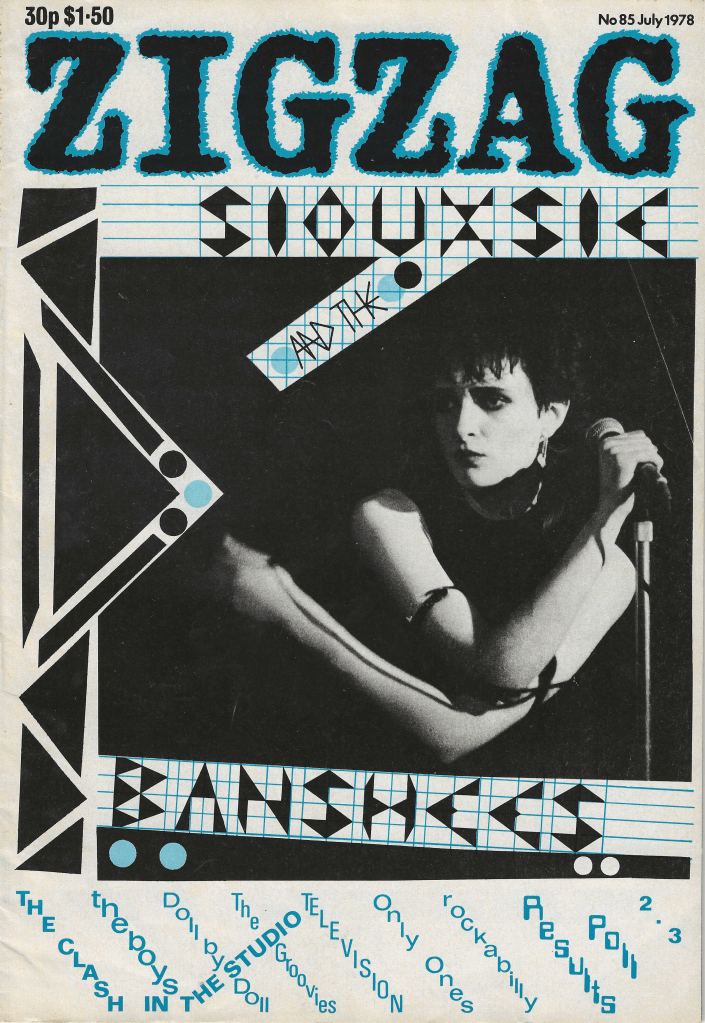
I believe we’ve established previously in these pages that Zigzag fanzine, published continuously in the UK throughout the 70s and into the 80s, was a first-rate repository for the musical attitudes, obsessions and posturing of its times. This is particularly true if you were a record collector or fanatical show-goer in the United Kingdom during these years. It’s one of my favorites, and you can check out previous issues I’ve talked about here, here and here.
Zigzag #85 is from July 1978, and the big-deal band of the moment – a band editor Kris Needs & his crew are especially excited about because they’re “unsigned!!” – is Siouxsie and the Banshees. Careful readers of this blog may know, while others may be surprised to learn, that Siouxsie and the Banshees happen to be one of my all-time favorite bands. I’m talking The Scream up through Juju, and all the singles therein, though if you made a case for their run ending at A Kiss In The Dreamhouse, I could get on board with that. I certainly own the record! My friend Brian and I were Banshees and Cramps obsessives in high school, and when I got too cool for them in the late 80s, I sold all the records, then later proceeded to buy them all back when being cool became as foreign to me as being foreign.
Of course, reading opinionated chatterbox “Siouxsie Sioux” prattle on in this well-done interview with the full band isn’t always illuminating, but she was certainly no dum-dum and it’s great that Zigzag #86 catches them as a time before their first 45 is out, when the band’s already getting voted in as “the best” in several categories in Zigzag’s reader’s poll. When they tour the country outside of their native London, Siouxsie says, they get a bunch of territorial crap: “…in Durham, ‘round Newcastle and that, I just despise it so much when up north – and even in London – there’s a sort of patriotism with a plot of land. It’s like a lot of people went there just to say ‘Piss off you old slag, Newcastle punk rules!’”. There are also spot-on comparisons with how they’re being perceived:
Kenny Morris (drummer): Some people have often said things like “How come you’ve had all this trouble and a band like Devo hasn’t?”. The fact is Devo are such a comfortable package. It’s all there, all there strangeness…it’s all dead comfortable.
Zigzag: Sounds put you in their “New Music Supplement” with Devo and all them…
Siouxsie: Oh, it’s always with Wire and XTC. XTC are a joke band. They’re comedians, and I don’t like comedians.This is followed by a Clash report – clearly an important band to both the staff and their readers. We learn that the band are gearing up to record a second album, and we get a sneak peak of the new song titles like “Guns on the Roof” and “Operation Julie”. In the excellent Television interview, Tom Verlaine just does not want to play the game, and spends most of his time politely denying rumors and assertions from writer John Tobler, as well as any sort of affinity to any scene or other band, except for a brief moment when he cops to loving The Doors and Love. Tobler backhandedly tries to diss the pre-release copy of Adventure he’s heard, and Verlaine, to his credit, takes him both literally and seriously. He does a fine job of explaining himself and his vision for the band, while certainly brooking no dissent with being called “the band leader” by Tobler.
We then travel to America to talk about and with The Quick, a piece unfortunately written and readied for publication before writer Teri Morris finds out that, whoops, they’ve just broken up. Zigzag publishes it anyway. “The Quick watched LA go punk crazy without ever taking a step in that direction”. Morris talks to guitarist and songwriter Steven Hufsteter, who tells her “We could have easily punked out, it wouldn’t have presented any problem. We probably could have gotten a record contract, a lousy one…..We want to be a packaged item. We want to be a product on the market. It’s not what we want to be so much as what we have to be”. Again, note the emphasis on being “signed” vs. “unsigned”. Also, note your confusion when you consider the record contracts that The Bags, Weirdos, Screamers, Germs and X did not have at this point, and in some cases, never received at all. (The Dickies did – they easily punked out).
There’s an Only Ones interview (they’ve signed to CBS!!), and a bunch of Flamin’ Groovies overhype, talking about some of the same English touring dates and the “real rock and roll revival” they spurred in the UK that a recent Ugly Things piece picked apart. Kris Needs talks about their “frantic, no-holds-barred, euphoric energy” and their absolutely MONSTROUS version of “Paint It Black”. I’ve never really understood it, but that’s me.
I do like “An Expensive Beginner’s Guide to Rockabilly”, which is a very Who Put The Bomp-like overview of the genre, mostly of the Sun guys and many of the reissues that were starting to come out on Charly Records in the mid/late 70s. And in the reviews you get two great put-down slaggings of both Bruce Springsteen’s Darkness on the Edge of Town and Alternative TV’s The Image Has Cracked. These reviews, regardless of their enthusiasm or lack thereof, are a nice proxy for where the heads of Zigzag’s staff were at the time: raised and succored on what we later called mainstream AOR, or album-oriented rock, then spun sideways by punk rock and its assault on the senses. They wrote intelligently and curiously about both, and I’m happy to pull in as many copies of the 70s version of this fanzine as I can still afford.
-
Hypertension #7
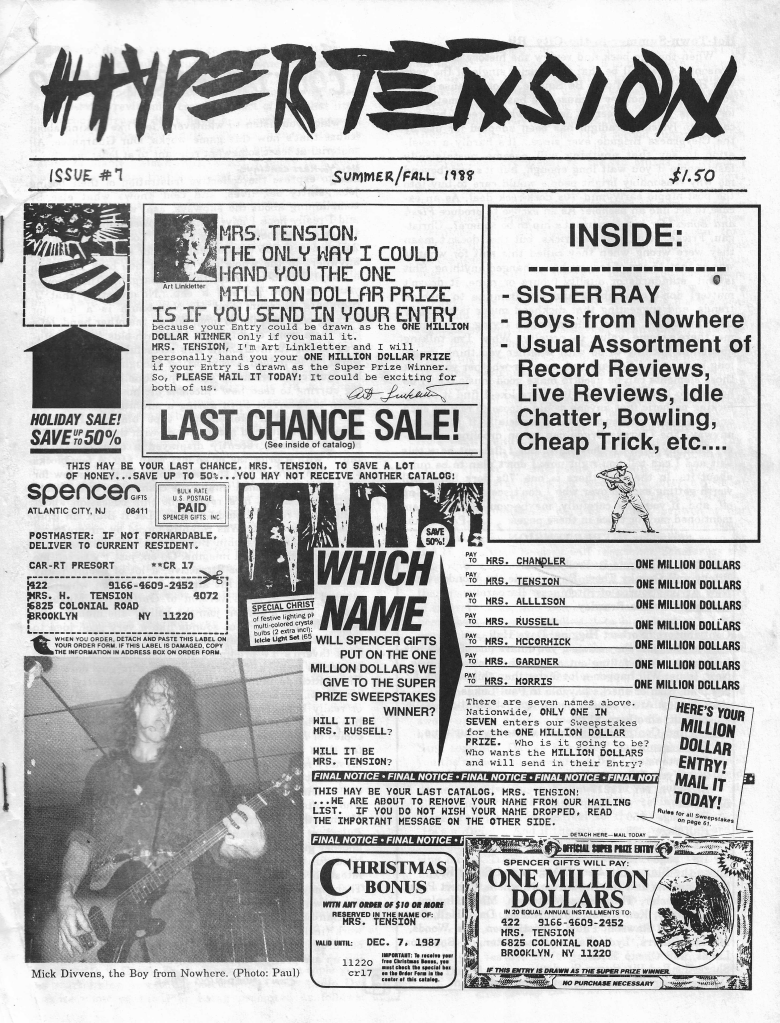
Hard one to stomach, this Hypertension #7, but that’s probably not being altogether fair, and we believe in fairness and accuracy in reporting here at FH. Editor Paul Lukas, is, like me, now an “old guy”, but at one point in his journey he was not – he was a young twentysomething marinating in whatever “biting”/”cutting” fanzine template it was that Gerard Cosloy had laid down with Conflict, but he was, alas, not doing it particularly well – yet doing it with an unearned bravado that, who knows, I might have really enjoyed at the time. That said, I was a total ding-dong dumbbell in 1988.
Now, if you know the name Paul Lukas, it’s because he took his underground publishing fetish and love for the offbeat and kind of turned it into a vocation of sorts. I mean, he’s minor-league famous for a column called Uni Watch, for sports uniform obsessives, that I’d never heard about until about ten minutes ago. I remember his Beer Frame, and I remember Inconspicuous Consumption. These were non-music fanzines – or “zines”, as some call them. You know, the sort of people who create “zines” and sell them at tables at “‘zinefests” and so on. I remember seeing John Marr from Murder Can be Fun at one of those things and he looked so abject and miserable, I think it might be why he stopped publishing completely (incidentally, this was the only “zinefest” I’ve ever walked into and then out of).
And look, there’s nothing wrong with any of that. If I met Paul Lukas, lord knows he and I would probably have much to talk about beyond sciatica and the AARP newsletter: a fella who likes beer, music, baseball and a good laff is probably a great fucking American. So let’s just judge Hypertension #7 by itself, then, seen through an all-consuming lens of hindsight, regret and modern snark. Lukas was publishing this in Brooklyn in 1988. Let’s start by saying I’m really hoping he’s Jewish, because his ability to thread in too-many jokes about the Jews in this thing could, and should, only be pulled off by a Member of the Tribe.
He opens with an editorial about the “cleverness brigade” and how he stands righteously opposed to them, without fully saying whom they are, except for they like Shimmy-Disc Records, Half Japanese and they might publish Flesh & Bones fanzine. As I said, the whole tone of this is exceptionally Cosloy-esque, especially the opening 3-dot gossip and opinion thing. I saw this style parroted/ripped off in Bill Callahan’s Disaster too, but this one is far more annoying in its jovial dissing by virtue of not being very funny, i.e. “the Nu Muzak Semen-ar”; “I saw Boys From Nowhere and you didn’t” and the slagging of various bands. This is done without the sort of established tastemaking that might have had me buying, selling & attending/not attending based on his flippant reviews. Perhaps if I’d read Hypertension #1-6 I might appreciate the full cut of his jib, and feel otherwise.
There’s lots of “cringe” insider shorthand, too – the Celibate Rifles are “the Rifles”, the Band of Susans are the “Band of Susie-Q’s”, Sonic Youth is for some reason “Chronic Youth” or “Scenic Youth”, and Buster Poindexter is “B. Poindexter”. I don’t know who first started writing like this but it thankfully was a short-lived trend that seems to have been left to die in the 1980s. There are ongoing Cheap Trick jokes; lots of complaining about lyrics and people who don’t dissect lyrics the way he does; and some praise for Patti Smith on the basis of, OMG I can’t even type this: “Patti Smith always understood that rock & roll is sex”. There, whew, I did it. How you guys doing out there?
Now, once we’ve gotten through all of that, well, there are two halfway decent interviews with Ohio rocknrollers the Boys From Nowhere and Sister Ray, both of whom who featured prominently in my record collection at the time. There are well-written and positive reviews of Drunks With Guns and Nice Strong Arm – ditto. And then leading into “the man he would soon become”, there are many ironic product reviews and baseball references, the former of which are uninteresting to me and the latter of which feel totally Cosloy, but I also grant that many of us roundly enjoy America’s pastime. Some even successfully melded the sport with underground punk rock music in a manner that didn’t annoy me.
But I can’t say, now that I’ve read so many of their fanzines, that I actually miss the days when every late 80s NY/Boston/Jersey smart kid who loved Dinosaur and Big Dipper published a fanzine, and brutally aped his idols in the course of doing so. If I’d been doing the same during those years, I know my product would have been absolutely insufferable. What I came out with 4-5 years later was bad enough. I’m glad the dude found his calling down the line, and in so many ways, Hypertension #7 is quite rewarding as a repository for the tenor of its times, much like Teen Screen or Cheetah were for theirs.
-
Punk Magazine #2
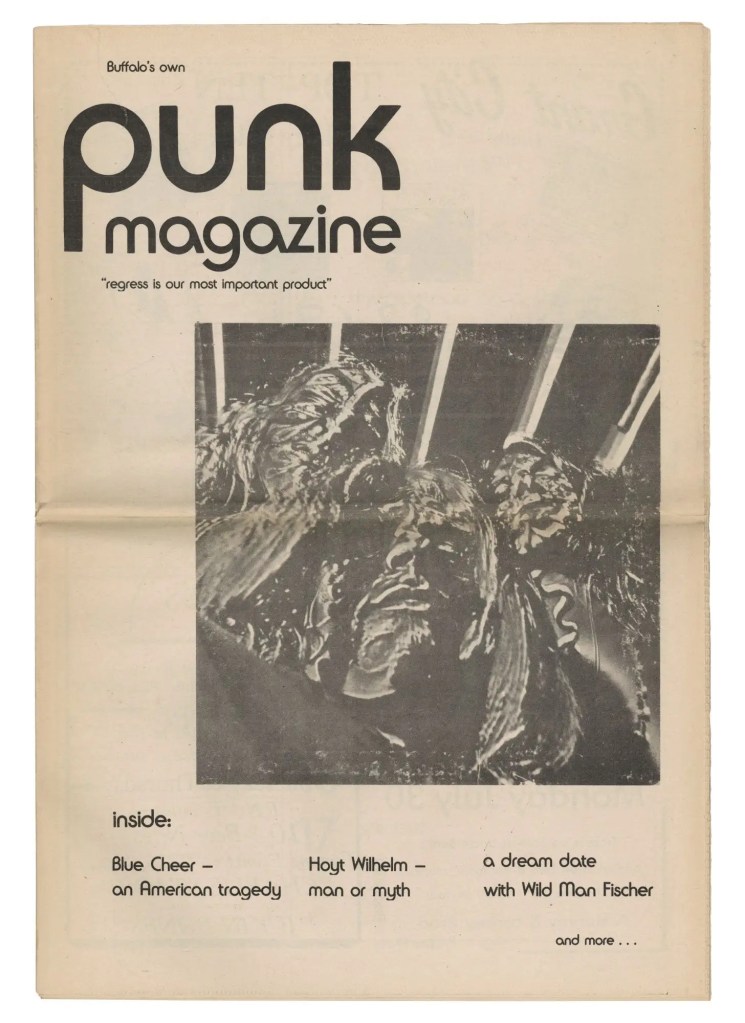
I did not buy Punk Magazine #2 in 1973 because I was, as it turns out, five years old. Rather, I came to it as an idiot “fanzine collector” quite recently. So recent in fact that it first crossed the threshold of my house in 2026. First, let’s establish that this had nothing to do with the Legs McNeil/John Holmstrom Punk magazine of a few years later, which I’d call among the most overrated fanzines of all time if I’d thought it was much “rated” in the first place. Easily. Nearly unreadable. No, this Punk was sired and stewarded by Billy Altman out of Buffalo, NY during the “rock desert” year of ‘73, which probably wasn’t all as bad a year as folks once made it out to be.
Anyway, it’s kind of a treat and a real collection of early rock-write all-stars, from Lester Bangs to Richard Meltzer to Mike Saunders to Scott Fischer to Joe Fernbacher to Altman himself. They’ve all just recently come back from the debauched “National Rock Writers Convention” in Memphis, and its existence is tossed around occasionally here without many details shared. On one hand, these fellas seem to be writing solely for each other to garner laffs, and are having a hell of a fun time doing so. This makes it quite fun to read. I’d have absolutely loved most of this in my twenties, which is when I first read Meltzer, Nick Tosches and Lester Bangs and thought their rock-adjacent fuck-you writing was just the coolest.
Thirty years on and much of it has the distinct whiff of its times – which in so many ways are far superior to our times, sure, but again, it’s also a bit of a “revenge of the dorks” circle jerk that maybe you need to be 22-25 years of age and just figuring it all out to be truly blown away by. And it’s a good thing Congress didn’t get a hold of this one at the time, as it’s a little obscene, perhaps. But quite funny, if you’re willing to be entertained!
Punk Magazine #2 is a rock broadsheet, more or less, but most of the writers prefer to wander off the reservation, and are rarely “telling the truth” in their actual rock writing, either, which is few and far between in any case. For instance, there are 3 pieces about baseball, just as many as there are about music – including one by Terry Bromberg about my San Francisco Giants. These baseball pieces all seem written by the same person, even though they’re not. These guys each have an erudite, nyuk-nyuk sensibility that’s about wringing as much hilarity as possible out of a sport that’s ostensibly not all that funny. Wilber Wood is a fatty, Tito Fuentes dresses like a pimp and the ladies love him. Smokey Burgess is so unhealthy he can only pinch-hit, and so on.
This was the state of one strain of humor in 1973 – a little gonzo, a little offensive, and very over the top. Philip Roth, bless him, wrote my two least favorite of his 31 books in this style and during this general timeframe – The Great American Novel (about baseball!) and Our Gang (about Nixon). Smart wiseasses were ascendant in part of the culture for a very, very short interregnum.
As for fabrication in the rock writing portions, Altman’s Vanilla Fudge piece purports to be a love letter to the band and is anything but. Mike Saunders lies his way through a piece on Blue Cheer, the outlines of which are still true, and there’s also a true (I think) discography at the end. Nice “Gump Worsley” reference in the piece, too – hockey fans thank you. Fernbacher’s thing on Wild Man Fischer is probably the best of this trio of “rock” articles, and, given the subject matter, doesn’t need to resort to prevarication in order to entertain.
Lester Bangs’ piece about why “alcohol is just the best” is among his weakest things of his I’ve ever read, despite how hard he seems to be trying to be an outta control wildman on the typewriter. And – it’s almost gauche to say this – it was probably written whilst under the influence of his selfsame topic! There’s also a whole piece by Meltzer on the many times he traveled across the USA to get laid in 1972, with each session rendered graphically and in detail. It certainly brings to mind a piece by him I once loved and have not forgotten entitled “I Never Ate Rebecca Rosen”.
The zine is riddled with typos, and it’s probably all part of the Punk ethos that those are not corrected nor whited out, even when they were noticed. I’m good with that. It bums me out a bit that this feels both like such a time capsule and a lost era, and that I’m not frothing about it the way I would have had I read it first in, say, 1991. And jeez, the two copies of this online are selling for $1,200 and $1,500 respectively, so how did I come to get mine on eBay for less than 1/20th of that? (Was that the most inane collector douchebag humblebrag you’ve ever read? You’re welcome!)
-
The Offense Newsletter #44
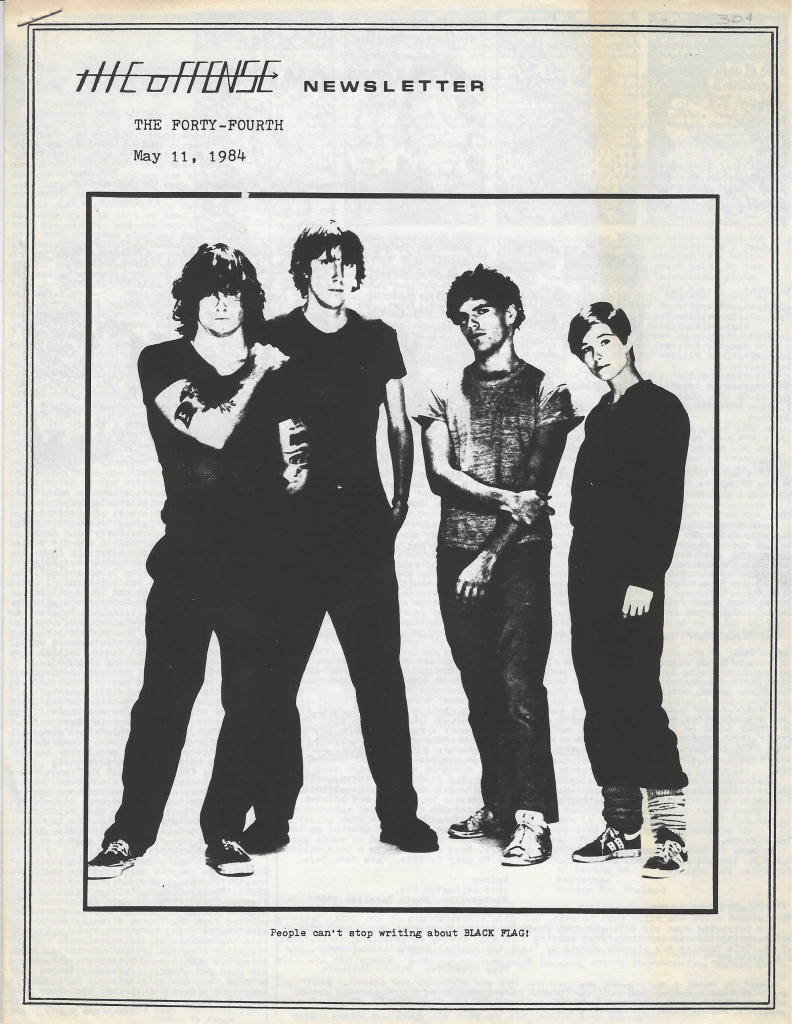
I have discussed this Columbus, OH fanzine and its previous iteration The Offense on several different occasions, and it may behoove you to peruse those discussions, presently: they are to be found here, here, here and here. The rule of thumb in this house is that it’s important to get & gather every and all issues of The Offense and its Newsletter, as it has proven itself to me to be one of the greats – entertaining as hell, and completely tapped into the many currents and scene wars of the first-half 1980s American underground. It’s passionate, loose, and yet highly articulate about everything from those 4AD records shimmering in the import bin to the many post-punk forks & branches needling their way through the USA, including hardcore, paisley psych and goth/doom/deathrock/what-have-you.
The May 11th, 1984 cover’s got Black Flag on it and a small caption, “People can’t stop writing about BLACK FLAG!”. They really couldn’t, could they? In hindsight, I have many thoughts about post-Damaged Black Flag: the plodding, angry, unfunny, metal-tinged, Rollins-era band that extensively toured the world & elsewhere from 1984 to 1986. First – because I remember it well – so much attention was paid to them in 1984 because we are all waiting for them to be great again. Because “the first four years” and Damaged are absolutely monumental, right? But every time some garbage dirge like Loose Nut or The Process of Weeding Out would hit the stacks, everyone would listen to it, forget it quickly, and give them the old “well, there’s always next year” false hope. Meanwhile, the band would scowl and mug on stage and throw fans a few silly punk bones during a gig – a “Six Pack” or a “Nervous Breakdown”, maybe, before proceeding with the plod.
Secondly, let’s admit their reputation was wholly made during 1979-81. I’ve met maybe 2-3 people in my lifetime who, when they talk about Black Flag, want to first talk about 1984-86. Maybe some heshers or speed metal guys. But not music fans. So no wonder poor music fan Don Howland – yes! Don Howland! – is so conflicted here in his lengthy review of a 4/14/84 Black Flag / Meat Puppets / Nig-Heist show at the Reggae Lounge in NYC. (The “Reggae Lounge”??). Don pretends to really like My War, as many pretended to at the time, but he’s not really sure what to make a show in which he’s “pretty disappointed by 90% of the new stuff”. He misses Chuck Dukowski’s onstage bloviating and general mania, but admits that new bassist Kira Roessler is, in fact, “prettier”.
But it’s a great marker of the times, this review, and I feel like it proves my point number one above – that when you’ve made a legend for yourself on the basis of some of the most powerful music of all time, anything else you do – even stoned, angry dirges performed in black dolphin shorts – is going to pale by comparison, and totally confuse the fans. Not that there’s anything wrong with confusing the fans, of course – there’s a reason that we all love Flipper so much. Or even this gig’s Meat Puppets, who are, shall we say, not welcomed to the Big Apple whilst playing the country-fried songs from Meat Puppets II. They say it was the Brits who spit at the bands. Not if you believe Howland’s piece here – us Americans were just as adept at the ‘ol “hawk tuah” as any punk from the mother country.
Joe Piecuch also writes about the 4/27/84 bill with the same lineup; he’s less conflicted about Black Flag and sees them as standing proudly apart from the scene, “as unwilling to lead as they are to be led”. That’s one way of putting it, and probably the only feather in Black Flag’s cap during this era: they couldn’t care less what you thought of them. But is that anything to really hang your hat on, when the records are so incredibly lame?
As discussed in previous reviews here of The Offense Newsletter, the letters page served as the bulletin board for the underground scene, or at least some portion of it. Often they were barbs directed at editor Tim Anstaett, who gave as good as he got. There’s lots of discussion about the best of 1983 reader’s poll results, which The Birthday Party apparently walked away with. Now there was a band, ladies and gentlemen! Steve Hesske gets a page of record reviews – they’re pretty funny – and Rob Wylie interviews a band called NonFiction, with whom I am unfamiliar. Bands such as the Icicle Works and of course the Cocteau Twins are bantered about in the letters. Those, as they say, were the days.
-
Check The Record #3
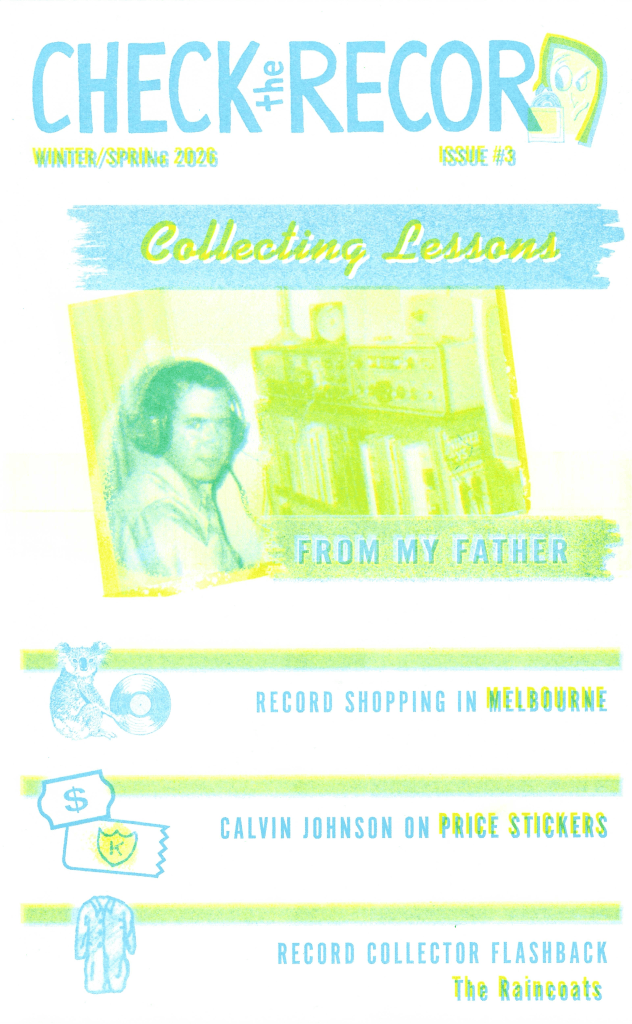
The daily thoughts, dreams and the peculiarities of the record collector can be all-enveloping. You find yourself too frequently contemplating your next big score, perhaps only minutes after completing your last one. Pressing quandaries such as record storage, what to do about price stickers, and whether or not to buy a different country’s pressing of a record you already own are thoughts that easily crowd out those more healthily devoted to family, friends and personal health & hygiene. It’s far too tempting to fall into it, and I’ve done so many times over my extended life; I may perhaps even be in a cycle of this sort right now. Even when I’m not in a collecting cycle, I still have these fantastic dopamine-drenched recurring dreams that involve flipping through vinyl, the sorts of trips to Berkeley and Los Angeles that made me the man I am today.
Sometimes the only means of extracting oneself from it all is to aggressively start the selling process – firing up the eBay account and ordering big packs of mailing boxes from Bags Unlimited. This too I have frequently done, with much current regret, over the years.
Perhaps there’s a better way, one that allows you to keep all the records and do so guilt-free. Jen Matson, the publisher of Check The Record #3, is one who leans in – way in – into the mania. When I read her impenitent fanzines about record collecting (I talked about the other two here and here), I take them as apologia for my own off-and-on obsessions. Her approach to her own methods & madness in, say, accumulating every single overseas Go-Betweens pressing is straightforward, workmanlike and totally no-nonsense. She writes with a sense of fun & whimsy about it all, totally one-upping my own combination of guilt, shame and financial worry. I think I was perhaps too scarred by this documentary about lonely and near-suicidal record collectors, afraid of hitting my sixties in a similar state of mind.
Matson charts a different path, one in which you can – and DO – fly to Melbourne, Australia, ostensibly for a minor music festival, but really to visit every single record store in the metropolitan region. This is a standout piece in Check The Record #3, marked on multiple occasions by the pain of going out of your way to a store only to find that it’s a lame alterna-jerk shop with no used records and overflowing with awful overpriced “Record Store Day” backstock. You can feel her sense of trepidation and triumph when she spots a copy of the Go-Betweens’ Send Me a Lullabye on the wall at Round and Round Records (a store formerly owned by friend of the blog Dave Lang):
“Did I already own a copy of this vinyl? Did I already own copies of all of the Go-Betweens’ albums on vinyl? Yes and yes. But since I am a wee bit of a completist when it comes to this band, I was always a bit sad that my copy was the UK reissue on Rough Trade, not the original Australian pressing on Missing Link Records, with a gatefold sleeve and a different, truncated track listing. In my 35+ years of record shopping, I’d never spotted it in the wild”.
I don’t think you’ll be at all surprised to learn that she bought it, and “left the store in grand spirits”. I get it, and I forgive this behavior: a different track listing and a gatefold sleeve? Forget gassing up the car next week, we can walk instead. Later, she buys a “condition upgrade” copy of a record she already has, and cries about seeing The Gordons’ Flying Nun debut – a phenomenal record that I once owned – for $172, despite it having a stained and scribbled-upon cover. This she does not purchase.
The other two main pieces in Check The Record #3 explore the roots of her collecting predilections, unsurprisingly passed on from her dad, who himself amassed a great and totally unnecessary collection of operation & maintenance manuals for World Word II-era airplanes – and a funny, somewhat droll exploration by Calvin Johnson on how to deal with price stickers on records. Me, I’m so goddamn impatient that I go straight to tearing them off, and therefore have multiple pockmarked LP covers as a result. There are better ways, as you’ll learn should you choose to get your own copy of this thing right here.
-
Some of the lesser-seen posts
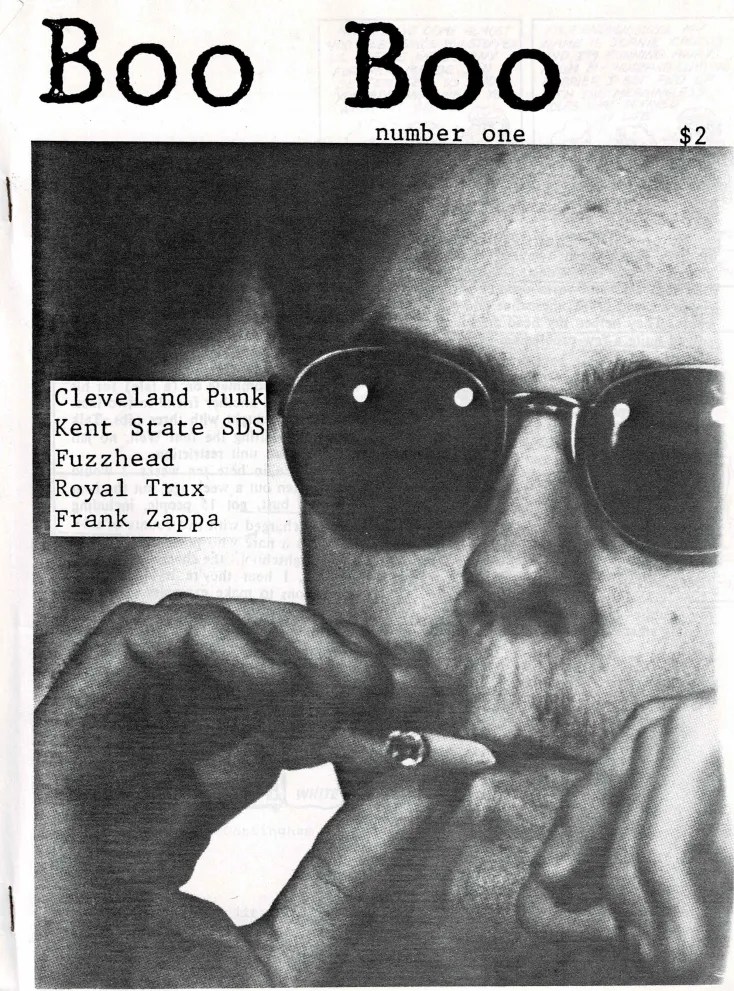
As a man’s thoughts turn to summer – to baseball, to barbeque and to baseness of all kinds – it becomes clear that writing about music fanzines of recent decades has become, shall we say, a lesser priority. But fear not – this doesn’t mean we’re throwing in the towel (again). It simply means it’s a good time to re-up a bunch of older posts from the days when we were actually doing this 3 times a week, for some reason. Here they are.
Boo Boo #1
What a Nice Way To Turn Seventeen #6
The Offense #12
Sooprize Package #2
Back Door Man #4
Take It! #2
Conflict #42
It’s So Hard To Tell Who’s Going To Love You The Best #1
New Dezezes #2
New Dezezes #1
Zigzag #95
Talk Talk (Vol. 3 No. 2 – 1981)
Wipeout! #7
Breakfast Without Meat #13
Away From The Pulsebeat (Winter 1987)
Bull Tongue Review #1
Sonic Death #5
Hexarc #1
Throat Culture #2
Teen Looch #8
We Jazz #6
Slush #2
Slash Vol. 3 No. 1 (January/February 1980)
Caught In Flux #6
Chatterbox #4
Flipside #32
Bucketfull of Brains #13
Paranoia #4
Surrender #5
Popwatch #6
Unsound #1
New Wave Rock #3
Forget It! #4
Damp #3
Forced Exposure #9
My Teeth Need Attention #1
Creep #2
Gold Soundz #4
Butt Rag #8
Great God Pan #12
Human Garbage Disposal #4
No Mag #10
BravEar #12
Sounds (November 7th, 1981)
Z Gun #1
Wiring Dept. #3
Flesh and Bones #6
Trouser Press #36
Damage #7
Take It! #5
Bazooka! #3
We Got Power #4
Brown Paper Sack #1
Drunken Fish #1
Fŏrdämning #11
Crank #2
Alright! #2
Cut #11
Slash Vol. 2 No. 2 (November 1978)
Galactic Zoo Dossier #7
Matter #10
Teen Screen – February 1967
Vintage Violence #6
Curiosity in Stout Shoes #1
Tuba Frenzy #4
What Goes On #1
Scram #5
Brain Transplant #1
NY Rocker, September 1982
Alright! #4
Zigzag #102
Crush #3
Grace and Dignity #1
Too Fun Too Huge! #2
Astronauts #4
Mental Children #2
Truly Needy #10
Silent Command #1
Sounds (November 8th, 1980)
Conflict #37
Cimarron Weekend #6.04…
Search & Destroy #6
Making Waves #1
Ripper #4 -
Drink & Drive #2
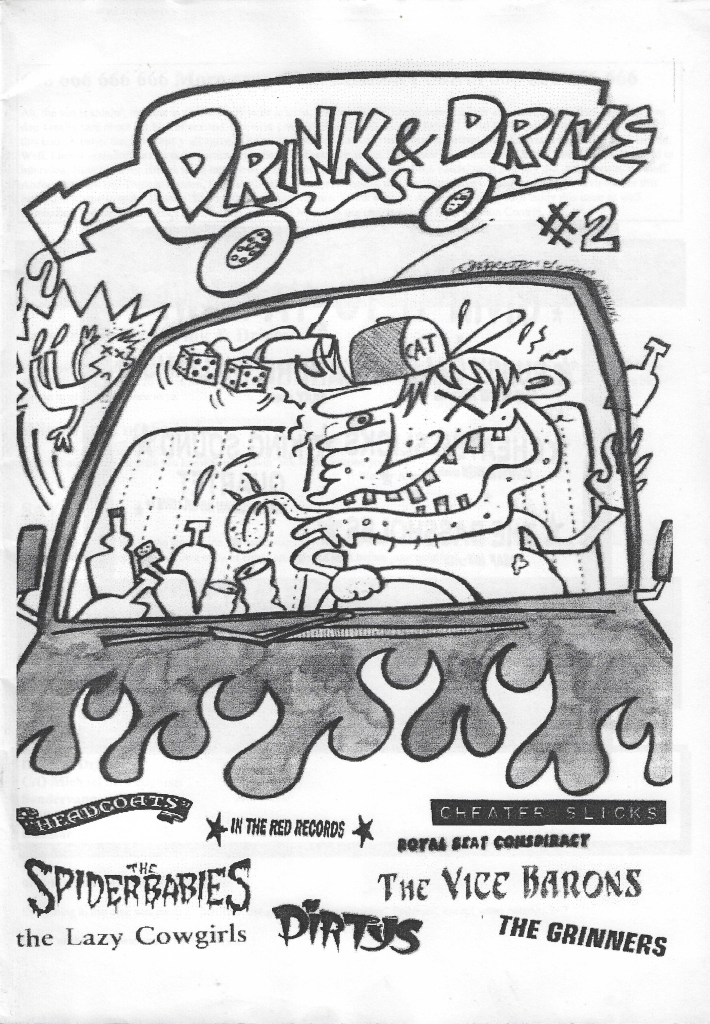
It never escaped me during my many years spent rubbing elbows in the “garage punk scene” that said scene is often overpopulated with what you might call – for lack of a better word – “dum-dums”. The wallet-on-a-chain dimwits, the rockabilly girls, the cro-magnon alcoholics: they were all in the family at any given 1990s garage punk show for sure. And hey, three cheers for our dum-dums! They’re not torturing themselves like I am with scene contextualization, record collecting and five-dollar adjectives. They’re here to fucking rock, to drink beer, hoot at the bands and yell at poseurs. I spent much time in the trenches with them, and their extroverted enthusiasms helped propel many a 90s show forward from good time to great time. Sometimes these dum-dums even created fanzines back in 1998, such as Drink & Drive #2.
However, late in the 90s I had started backing away a bit. New bands with names like “The Hookers” and the “River City Rapists” were being celebrated, and the general IQ level of my compadres seemed to be rapidly trending downward rather than up. I remember when the fanzine Hit List started coming out. I’d rifle through it on the newsstands, and I really thought it couldn’t get any stupider. (And don’t worry, I’ve got an issue that I’ll be covering in this space in the near future). Jeff Bale from Maximum RocknRoll was deeply involved, which was a real “it figures” moment for me, though that wasn’t exactly the turn I expected him to take once he was done being a left-wing peace creep.
It is into this dum-dum environment that Drink and Drive #2 proudly steps forth and perhaps even outdoes Hit List. Editor Michael Pedersen has his priorities straight and his controversial opinions eagerly given: “Ah, the sun is shinin’, my zine is almost ready to be printed, life is good. All I need now is a beer and some pussy. Remember, soft rock = soft cock, fuck techno and kill a hippie”. Of course I could cut Pedersen some slack and say well you know, he was from Denmark, English isn’t his first language etc. But that didn’t stop European garage punk fiends Tom Arnaert and Henrik Olausson from putting out high-quality, literate and hilarious garage punk fanzines at the same time – Bazooka and Human Garbage Disposal, respectively, which were better than virtually all American zines of similar ilk. No, Pedersen unfortunately just fell for the Tim Warren/Crypt Records “razzle-dazzle” hook, line and sinker, and simply doesn’t have the mental chops to carve his own path through the idiocy of the current scene.
Grant him this, though: he was a hustler. He nails mail interviews with Larry Hardy of In The Red Records; Pat Todd of the Lazy Cowgirls; and Dana Hatch of the Cheater Slicks. Great, great Americans all, and three of the people most responsible for my 80s-90s garage punk obsessions. He also interviews the Spider Babies from Portland, who, when I saw them at San Francisco’s Purple Onion in the early 90s, were outstanding, with a pissed-off female keyboardist and an absolutely brutal 60s punk vibe. Here, they’ve huffed the doofus vapor that was heavily circulating in 1998, and, when asked to describe their current sound, come up with “It’s like Billy Childish gettin’ raped by The Dwarves while listening to the Mentors, while fantasizing about fuckin’ the guys in Screwdriver”.
Likewise with The Dirtys – one of the Crypt Records bands of the time that finally pulled me away from the label after its decade and a half of stellar work. The Dirtys don’t like gays, they love porn and beer, they joke incessantly about fisting, lesbians and so forth. They’re exceptionally sensible and cognizant of the changin’ times, these dum-dums, and this forum was purpose-built for them. And somehow Pedersen gets Billy Childish and Thee Headcoats to talk to him, a real “get” in our business. This goes a bit better, and I didn’t leave feeling utterly embarrassed for the participants – but do you perhaps feel as I do now that we might have “oversold” Childish and his bands a bit in the 80s and 90s? It kind of feels like kid music to me now, but that’s probably because I’m not exactly a kid any longer.
I mean, that’s likely why I’m struggling with Drink & Drive #2 in the first place, right? Get a clue, grandpa! Yet it is sort of telling that the whole “I’m-a-rapist”/anti-homosexual/goin’ after pussy thing sort of stumbled hard a year or two later, and very few were doing that dum-dum dance in the 21st century (yes, I know that there are exceptions; I saw the Richmond Sluts, and attended a 2016 Humpers reunion in Long Beach with some of the absolute dumbest people on the planet). This is selling for $2 right now. A Dirtys CD currently only sets you back $4. Maybe we take this issue for the period piece that it is, and interrogate ourselves for how we let ourselves move from the Gories, Supercharger and Cheater Slicks to whatever this all was, seven years later. Can we somehow blame Jon Spencer?
-
Travellin’ Fist #1
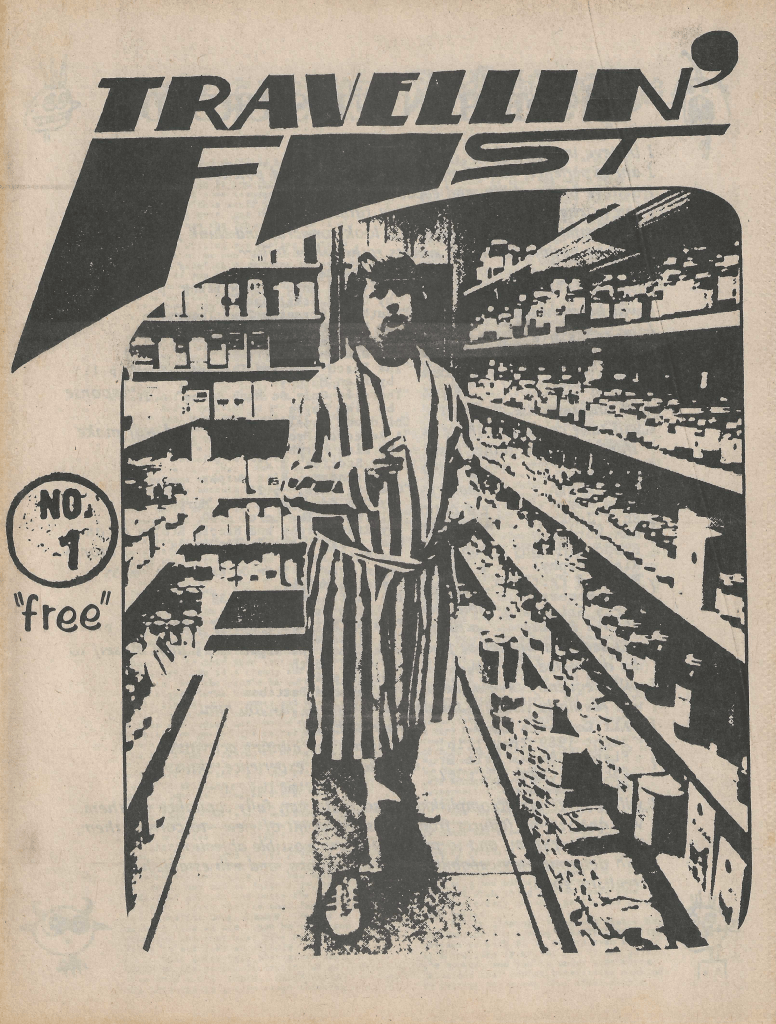
I’ve never come to know how the dense 1988 Chicago one-and-done fanzine Travellin’ Fist came to be free upon its publication. My working theory is that, given its lack of advertisements and its esoteric, wordy and (at the time) somewhat outré content, charging for it might have been a tough proposition to begin with, so it became a “let’s give it to friends” proposition. Lord knows I had to search hell’s half acre to get my own copy thirty-eight years later, after seeing references to it over the years.
Travellin’ Fist #1 was birthed and sired by both Dan Koretzky, who’d very soon come to found Drag City Records with Dan Osborne, and Rian Murphy, who’d himself also come to be highly involved in the label. I knew that there would be some “Beach Boys content” in this one, and indeed, there is. That would not have been much of a draw for me in 1988, lemme tell ya, but as I wrote about in my own fanzine and have also published here, that changed in a big way later – and not all that long ago, either. But I didn’t know precisely where it’d take me until I spent some quality time with it this week, and now I think I have a much better idea about it all.
It starts with Chris Stigliano producing one of his patented and rather self-referential rants about his inability to be published in publications with statures bigger than, say, Travellin’ Fist, as well as his struggles getting his fanzine Phfudd! effectively distributed. At the same time, “Don’t Get Into Rock Writing!” hits out – in a highly flailing but satisfyingly rabid manner – at many highly worthy late 80s targets that range from Chuck Eddy to BravEar to Creem to Ben Fong-Torres to the folks running the Village Voice music section at the time. No question that becoming a “rock writer” was always both a poor career and life choice. I never for even a moment considered it, despite once making a fat $60 for three record reviews at the San Francisco Bay Guardian in 1993. I therefore second and third Stig’s celebration of publishing a money-losing and yet life-affirming fanzine in its stead.
This is followed by a long piece by Rian Murphy about Game Theory, postulating on why they’re not more revered. I mean, among a certain set of folks, some of whom I knew well, they certainly were, but I do take the point. The author says “Maybe it has to do with the soft aura of light ringed around the early 70s, which is often where Scott Miller, the brain child behind the name, is coming from”. Yes, I am sure that’s true. To me, Game Theory were Big Star minus the great songwriting, + the addition of some strange, abstract chord & tonal changes. Big Star sold terribly enough without strange, abstract chord & tonal changes. Also, in 1988 the quasi-effeminate vocals were not in keeping with the pigfuck times, or at least with what au courant fanzines of the era were frothing on and on about.
This same piece then morphs into an excellent dissection of Grace Slick and the Jefferson Airplane, and it’s none too complementary, choosing to elevate the few things that were great about said band, and calling onto the carpet the many things that weren’t (“Marty Balin squealing like a pig – anything but soothing”). This is a band about whom I’d actually welcome a locked room debate over, and/or a nude fistfight over hot coals. I’m not totally sure which side I’d be taking.
The first Beach Boys piece is also by Rian Murphy, the one person who probably gets about 75% of the page count in Travellin’ Fist #1. Why not? This piece has a bit of why use one word for something when you can use two?, stoned sort of Beat generation patter going, but it’s a warts-and-all exegesis about all & sundry aspects of the band, by way of discussing recent books about them. This is followed by a second piece by Murphy about the band’s Sunflower, which is interesting enough that I think maybe it’s time for me to listen to the record for the first time.
But what else is in here, you ask? Lots. An incongruous God Bullies interview, a personal diary masquerading as a Chicago scene report, a John Hughes movie overview, a sex/drugs/poor writing-filled “West Coast Scene Report” by Phil Jenks that’s such an awful Forced Exposure parody that I’m thinking it probably was a parody; an Astral Weeks article; and even some Raymond Pettibon cartoons. There’s a defence of Chemical Imbalance fanzine, albeit with a rewritten Camper Van Beethoven review from said fanzine, now done “better and more accurately” by Murphy.
Murphy again pops off on California bands in another piece, and how they’re so awful and yet how so many of them are so great (??). Again, it’s a complete stream of consciousness thing almost certainly written with a big bag of weed by his side. I don’t fully condone then-illegal marijuana cigarettes, but given the guy’s extreme music knowledge and mania, him letting his freak flag fly in order to “paint pictures with words” is quite entertaining when held against the usual low fanzine standard, and he held my attention in ways that I’m not used to it being held when skimming & scanning a fanzine. This California love/hate session eventually and predictably becomes a long discussion of, that’s right…..The Beach Boys.
The closest music fanzines I’ve ever seen to Travellin’ Fist #1 – literate, exploratory, musically omnivorous, a little tough to follow at times – were Brian Doherty’s Surrender, which I talked about here, and Tim Ellison’s Rock Mag, discussed here. Perhaps the Brian Berger fanzines. You can even perhaps intuit, in hindsight, the direct line from this fuzzy, different-plane way of thinking and writing to the musical output of the Drag City label, which continues to this day.
-
Subscribe
Subscribed
Have a WordPress.com account? Log in now.

