-
Reasons For Living #1
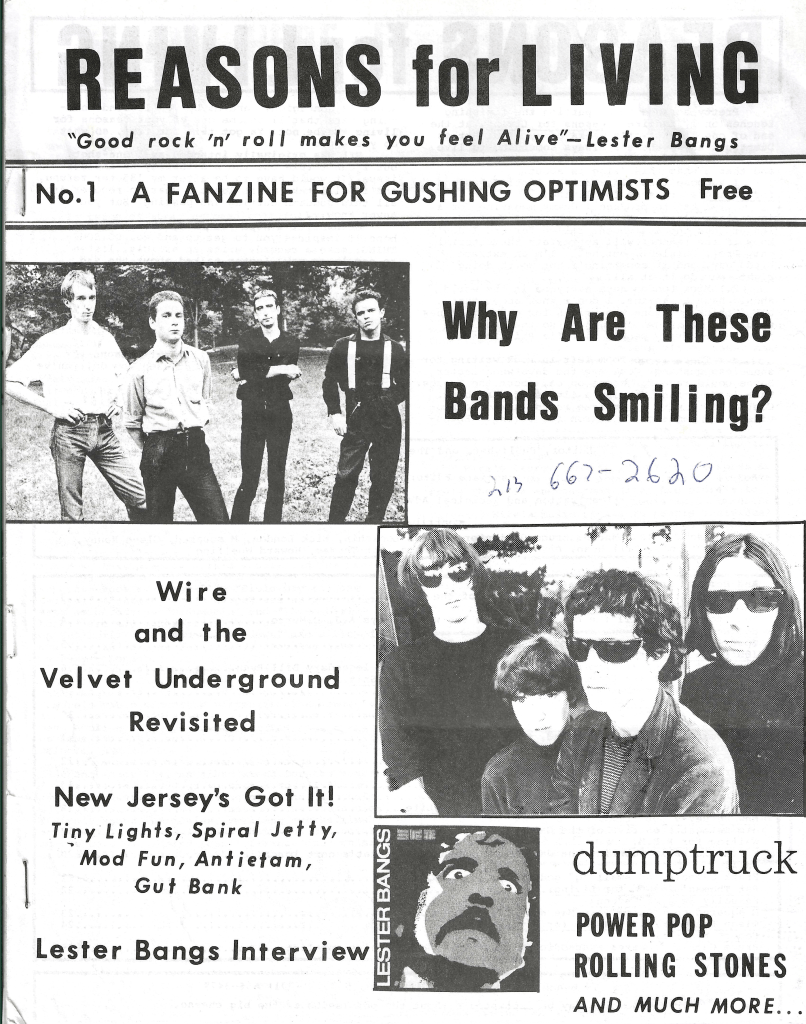
This is a 1985 fanzine that presages some obsessions that college-aged editor Jim DeRogatis would later be somewhat known for; namely, his Lester Bangs fixation – which would result in him ultimately writing the Bangs biography, Let It Blurt – and his Wire fandom, which would somewhat ridiculously garner him & his friends a slot opening for the band on Wire’s entire 1987 US tour, doing Pink Flag from start to finish as “The Ex-Lion Tamers” so that Wire wouldn’t have to play any of it. I still think that’s preposterously awesome, and I wrote about it in one of my own fanzines.
Reasons For Living #1 was something of a “dummy magazine” and final project that had its roots in an NYU journalism class DeRogatis was taking that year. He’s got a stated goal of bringing back shameless gushing and enthusiasm, as opposed to deep snark and hatred of mediocrity. Well, which would you rather read? Yeah, me too, but this one’s got plenty of “spunk” and “vim” to go around, and a little “vigor” to boot. He wrote it from home in Jersey City, and called upon contributors to give some of their quote-unquote reasons for living. This results in stand-alone pieces on the Rolling Stones, Tom Petty, The Creation, R.E.M., XTC, power pop and Robert Wyatt. Naturally, your tolerance and enthusiasm will vary depending on your patience with said acts or musical movements. But of deep snark and hatred of mediocrity, there is not a whit.
Wire receive the full DeRogatis treatment, pre-comeback. A couple of years later, there’d be some deep snark and hatred of mediocrity pointed their way for sure, but at this point, with the 3 golden records being the sum total of their true discography, the track record was exceptionally solid. The editor also gets in his licks with coverage of The Velvet Underground during that hallowed VU-has-just-come-out period. I remember it well, as it was my introduction to the band, “Foggy Notion” and “Temptation Inside Your Heart” in particular – the latter of which bugged the shit out of me. He also spends a little time on Dumptruck and a New Jersey underground band round-up, including mid-80s east coast fanzine punching bag “Gut Bank”.
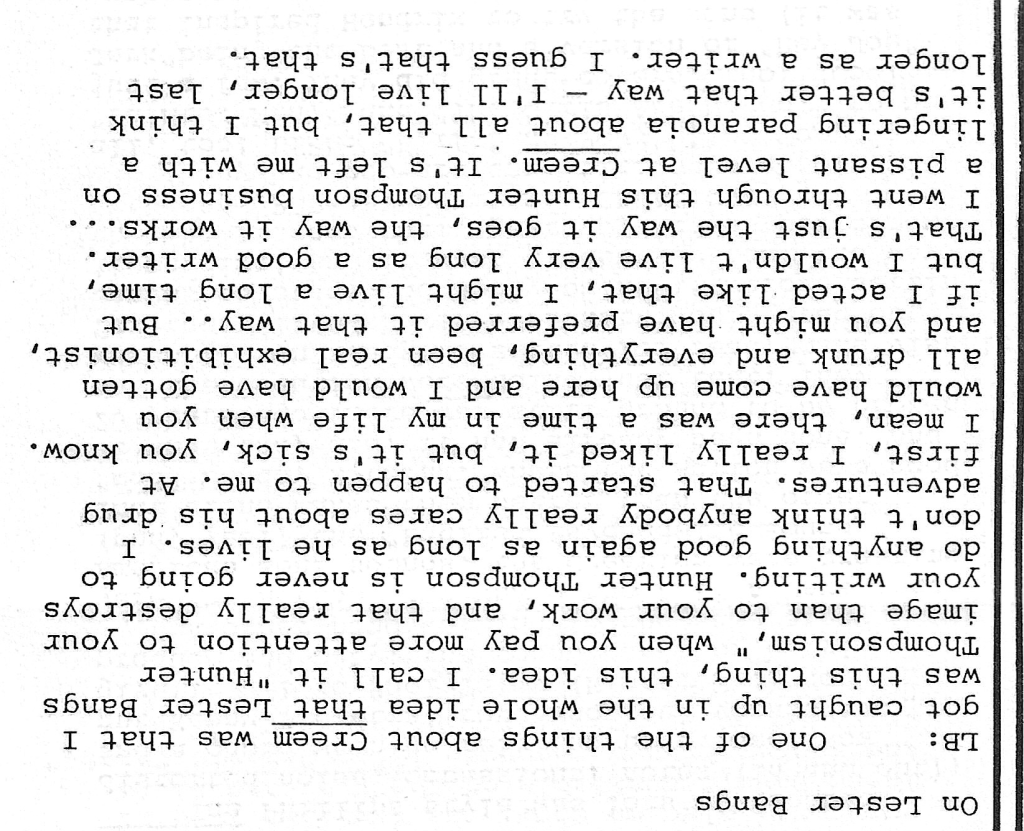
The star diamond in this one is Lester Bangs interview excerpts from a talk teenage DeRogatis had with him just over 2 weeks before his death in 1982. Excellent stuff. Take a look at this particular bit of Lester-on-Lester; it is kind of a drag and highly ironic, given that he’d be dead sixteen days later:
The back-half contributors get a little more free reign than the front-half gushers. Art Black, later or perhaps concurrently the editor of Away From The Pulsebeat, writes about his girl getting knocked unconscious at a show and about how that means punk is probably dying. Laff all you want, folks: Art Black was a fucking nostradamus on this one. Howard Wuelfing is given space to opine on ten things he enjoys, from sex to beer to Big Star. I love the 1985 “good beer” list he provides: “Stegmaiers, Straub’s, Ballantine Ale, Rheingold, John Courage (draught), McSorley’s Ale (draught) and Tuborg Gold (draught only!)”. Dude, I know things were grim in 1985 for beer – I was still a full four years away from my first “Sierra Nevada Pale Ale” – but right there in DC you had the Brickskeller, “the first restaurant of its kind to offer customers a beer list with thousands of beers from around the world.” I went to the Brickskeller not long after I’d hit legal drinking age, and my jaw nearly cracked the wooden floor. Let’s just say that Tuborg Gold “on draught” was far less than second best on that night.
-
CompHELLation #1

Starting with my acquisition of the bootleg Dangerhouse 45s collection Me Want Breakfast! in 1986, my musical life was totally upended by the serial unearthing of ear-shredding punk rock singles from 1977-84. Suffice to say that in 1986 and 1987, very little was being written about the ultra long-tail of American punk singles from less than a decade earlier, so it was hard to know about it all unless you were there and actively buying 45s at the time, and I mostly hadn’t been. (Though, when 1980’s “Job” by The Nubs finally got comped, I finally got to play a godhead song for folks that I’d only been able to fumblingly describe using the highly limiting oral tradition).
The comps started coming in dribs and drabs at first. I bought Where Birdmen Flew and Year of the Rats, and they were absolute staples of my then-radio show, my social relationships with other punk fiends and collectors, and my life in general. Sort of hard to transmit now, when everything’s available at any time to anyone, but these two comps are where I first heard Crime, The Urinals, the Psycho Surgeons, the Australian X and so many more. I mean many “older” Americans who were now in their late 20s had heard Crime and the Urinals by this time, of course, but those records were going for, like, $15! Who had that kind of money? Then it was the first four Killed By Death comps in 1988 and 1989 – holy shit. Chain Gang, The Eat, The Mad, The Queers. Mindblowing. The gates came off after that, and bootleg punk compilations flew out from all corners of the globe, documenting every jot and titter from Belgrade to Bergen.
(As an aside, when I stopped writing Fanzine Hemorrhage for a short while earlier this year, it was because I’d felt that I’d been getting far too redundant. I’ve realized that the two paragraphs I just wrote basically tell the same story I’ve already relayed in my review of Brain Transplant #1 fanzine. Just to keep things honest and on the level).
By the late 90s, it was tough to keep up, and really – in my case, anyway – no need to, because most of the Killed By Deaths and Bloodstains comps at that point showed increasing diminishing returns, to the point where many of them had absolutely no good songs at all. But how would one know or not know if they were missing something? Into this breach stepped Mark Murmann, known to many as “Icki”, and Maximum RocknRoll presents CompHELLation, put out toward the end of 1998. He’s a real renaissance man, Murmann – outstanding photographer, Mother Jones photo editor and even the frontman of a cool punk band I saw over a decade ago. He also collected punk rock compilation records, religiously, and created the then-best record of all that had come out at the time, indexed first by title, and then by every individual band. If you’d ever wondered which comps the Meaty Buys turned up on, well, before Discogs, this was definitely where you’d get your answer. While MaximumRocknRoll clearly funded and distributed the mag, if you wanted to order a copy, it says inside to get it from “Icki”, not from MRR. So they clearly allowed him the space for this excellent vanity project.
Leafing through it now, I’m remembering vague scene mutterings about the people who put these out. I mean, virtually everyone knows that Johan Kugelberg was wholly or partly responsible for the first four KBDs. Did he fund them? I don’t know. Probably. Byron Coley had at least something to do with Bloodstains Across California if not other early gems in that series. Tom Lax did the Killed By Death #1 DIY thing that turned me onto some UK stuff I’d absolutely never heard before.
I was never especially deep in with the real collectors at the time, as I never had the cash to buy the originals once KBD mania took hold, yet I was at least somewhat adjacent to them, merely by flogging their illicit product in my own Superdope fanzine in the 90s. I bought an Electric Eels Cyclotron/Agitated 45 at a record show in the late 80s for $12 and felt like a pretty big-time record turd there for a couple months. And for those that still know, even now, some of the best stuff still can be bought for not too much money. My pal Jon just bought a Rude Kids “Raggare is a Bunch of Motherfuckers” 45 this year, and he’s a schoolteacher. Priorities!
My copy of this, as you can see from the scan, has coffee stains (or something) all over the front and back. I thought maybe I was the butterfingers who ruined this zine three decades ago, but now, seeing Murmann’s own listing for it on his page with similar coffee stains, I know it was all part of the plan, at least for some of the issues. If only my copy was part of some limited numbered series for dipshits, I could crow about it here!
-
Ink Disease #13
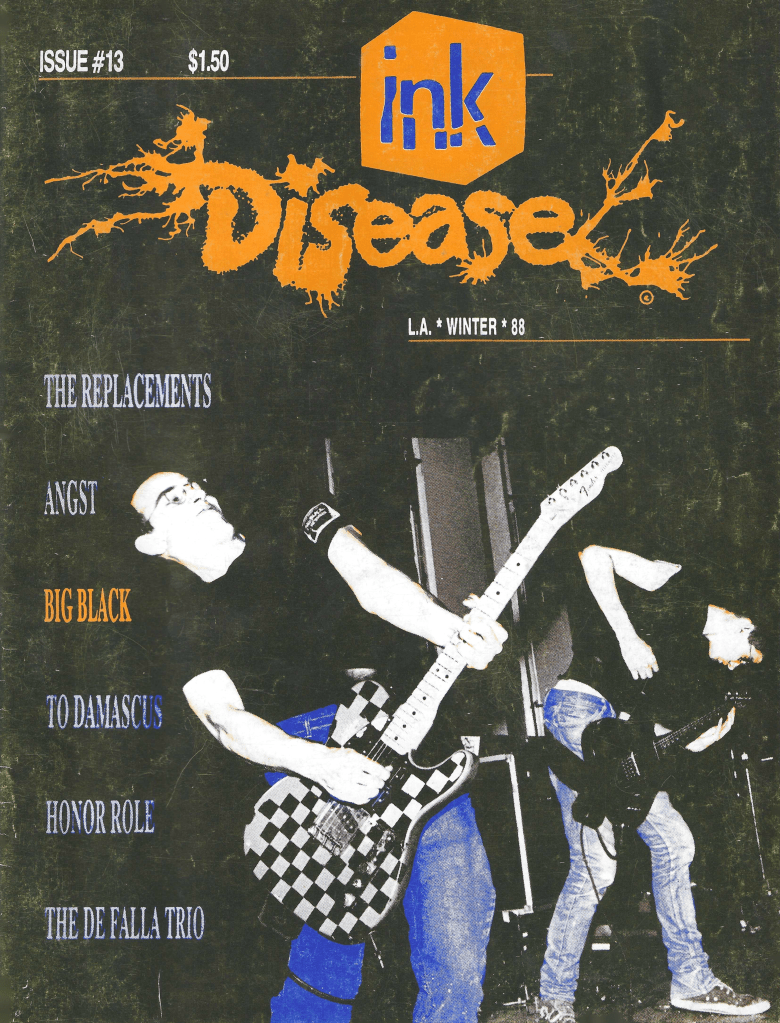
Not gonna lie, as they say, but I thought Ink Disease was pretty weak when it was around in the late 80s, and only cover stories like this one, or the one with The Weirdos, caused me to pick it up at the time. They covered the shitty stuff rather shittily, like a sub-sub-Flipside if memory serves, and yet something must have caused me to hold on to a couple of them all this time. The fanzine was well distributed, and easy to find across LA and elsewhere, and had all the usual ads from important record labels like Taang!, Boner and Fartblossom Enterprises. If you can believe it, I really haven’t looked at an issue of this since that time. Perhaps it might make sense to pry Ink Disease #13 out of cold storage, and see if it’s aged as well as that Châteauneuf-du-Pape I laid down 35 years ago?
For starters, I’m very impressed with the opening ad for Ink Disease back issues that’s a photo of each of them laid out on top of Jan Paul Beahm’s (Darby Crash’s) actual grave. Big points for concept and execution. I’m less impressed with their Ramones at Cal State Northridge review, not necessarily because I care one way or the other, but because 20-year-old me was at this one. It has a typically deep Ink Disease summary that encapsulates both the show and the mag’s writing chops: “If you have yet to see the greatest rock band of the past 10 years, then you ain’t worth the shit you have for brains”. This show will always be remembered for me and my friends driving around and around looking for a place to stay in central Los Angeles in the wee hours of that night, as we had the big free “SST Festival” in Irwindale to go to the next afternoon. We finally came upon a motel in a bad area near USC that charged $6 an hour and $30 a night, and, not knowing what the deal was with a motel that charged by the hour, I was excited to take it so we could get some sleep. We did not. Actual bedposts crashed against our walls. I tried to sleep on the floor, since there were four of us, and chicken wire poked up into my face from the carpet. And the SST festival was cancelled as well, so we didn’t get to see all the great SST bands of 1987 like Tom Troccoli’s Dog and Painted Willie.
I’ll give Ink Disease #13 credit for their willingness to let bands jabber on and on in interviews though, and then print the whole thing full-hog and without edits. I mean, your mileage may vary on this. Honor Role at least keep it succinct, but do talk about the Oxnard Skate Palace show they’d just played, another one I was honored to be in attendance for. There’s an exceptionally long interview with Angst, a funny one with a continuing theme that I’ve seen across repeated interviews with these guys (and with Slovenly) of being broke, hungry, and not having very many fans. No turning off the tape recorder here, no sir. Another interview is with Tommy Stinson of The Replacements – now, what a handsome young man! The highlight is him trying to live down a KROQ interview he and the band did in which the entire theme of the interview was “we are gay”. That must have been a riot, right? At one point, his PR flack comes in to make him wrap it up and says “Tiger Beat are in the hall”. I’m not sure whether that’s true or what, but I’m willing to believe it probably was.
The reviews are predictably inane, coming especially as they were during this dreadful era of bands like Fearless Iranians From Hell, Lemonheads, 7 Seconds, Zoogz Rift and Mighty Sphincter – whose awful record, I might add, I saw selling for $40+ in Nashville recently. No matter, it all gets discussed here, lest the promo train pull away from the station. There’s a dilly of a Divine Horsemen review: “Julie C. can lullaby to me all night long. She sounds like the sultry, white-trash, country-girl I never knew. Chris D. would do me a big favor if he kept his voice out of my earshot”. By the way, you simply must see the cover of the new Chris D. album if you haven’t yet. It is super classy and a real crowd pleaser.
Speaking of classy, there’s a jarring interview with a classical, um, “act”, called the De Falla Trio that I have to assume were somebody’s neighbors or something. It’s followed by an actually quite good interview with To Damascus; the whole band and not just Sylvia Juncosa. Sylvia goes off about why she left SWA to keep To Damascus going again. Having been around at the time, let me say that this second iteration of the band didn’t last long at all, but I did get to see them once – and lo, they were good. Tyran from the band gets in a nice story about his dad’s visit to Spahn Ranch and telling a glazed-out Charles Manson to cut his weeds. Sylvia talks about how her mom was really disappointed with the lyrics on the first Leaving Trains LP (that she was on) and gave her a talking-to about them, and about how she doesn’t want said mom coming to any of her shows “because then she’d find out I have all these tattoos”. This is helpful in case you were wondering what turned all those 80s kids into punks and freaks.
The mag closes with the reason I bought it in ‘87 in the first place, an interview with Big Black in San Francisco during their final weeks of being a band. Albini says, among other things, “You looking for a band that blows? Try The Mission”. Wow, I hadn’t read that line in nearly forty years, no kidding. I used to rattle off this exact quote to some of my death rock/smoke machine rock compadres at UC-Santa Barbara back when I first bought this issue. Oh yeah, and this part, when the band is asked about playing in San Francisco:
SANTIAGO: We never really wanted to play in California.
STEVE: Yeah, California seemed like this really strange, sick little pit of snakes that we didn’t want to get involved in. All these horrible, horrible bands….we just didn’t want to be associated with them, didn’t want to come near them.
ID: Which are the most horrible?
STEVE: I really couldn’t tell you if the Mystic bands are worse or the SST bands are worse…I couldn’t tell you.
ID: Yeah, but Sonic Youth are on SST.
STEVE: That was a big mistake on their part, I think. Them and Slovenly…BIG mistake…and Dinosaur. Big mistake. You’re traveling with some really bad company, fellows.I recall both getting my dander up at all the hate for my home state and internalizing it to such a degree that I probably started pontificating similar words myself at the time, like a moron. I was extremely malleable and pliable at this stage in my young life, and if opinionated talking heads named Coley, Cosloy or Albini said something demonstrative, I’d often find it difficult to counter and easy to pass off as an opinion of my own. I mean, he’s making fun of Mystic Records here – that was one of my favorite pastimes even then. If you haven’t read Steve Albini’s interviews with Dan Epstein about baseball from 2017, they’re among my favorite things that I’ve read recently – Part 1 and Part 2 are here.
All told, I suppose there’s plenty of entertainment in Ink Disease #13 to potentially justify my continued clutching of it – or at least the eight paragraphs I just spent writing about it here.
-
No Exit #1

I guess it’s likely more than clear that I’ve got a small handful of fanzine “micro-genres” that I collect, and therefore that I disproportionately write about here. Anything marginally well-done from San Francisco circa 1977-87 will usually make the grade, for instance. Case in point would be New Dezezes, Damage, Creep, Search & Destroy, Wiring Dept, Unsound, Bravear, New Wave, Revolutionary Wanker, Puncture, Breakfast Without Meat and others besides that I’ve prattled on about, surely. There are even some I’d yet to cover, like No Exit #1, edited by a 1977 SF scenester named Tony Steel, a man whose name had yet to pass my eardrums nor penetrate my eyes in any other form. And I’ve been studying up for a while, let me tell you. So here it is!
The ‘77 excitement here is real. I’m talking ALL-CAPS real, as a single lowercase letter is nowhere to be found within No Exit #1. James Stark – one of the punk photography all-timers – handles the visuals, and fashion is helmed by a woman going by the outstanding blank generation moniker of Jane Who (Jane’s big fashion contribution is a single page of photo booth shots of pretty people preening in sunglasses – the page is called appropriately called “Fashion”). And right out of the gate, we’ve got some attitude being thrown. “Thanks to the only bands in SF, all four and no one else”. Having lived in San Francisco myself for 37 years now, I can appreciate the sentiment. During some of our leaner years, four might even be a bit too optimistic. Luckily for the No Exit triad, Crime and The Nuns and whomever the other two were would be joined by at least another half-dozen true ringers within months.
And also: “No Exit is a publication dealing with exclusively new wave music, people and fashion. There are a lot of fanzines but only a few deal just in new wave items, so get it while you can”. (Note the beautiful lack of the lame “oxford comma” in that one – back from when even new wave ding-dongs knew how to write and punctuate correctly). The opening gossip is all pretty standard fare, but I like the bit about “Bill Graham of Fillmore West fame has finally given in! No it’s not Kiss and The Runaways but a semi-normal show July 30th, The Ramones, the Dictators (blagh!) & The Nuns (local kids make good) – well I give it an 8 out of 10”. And there is some real honest excitement over NBC’s coverage of “Punk Rock in Britain” on the 11:30pm Weekend Show – something that, if you were so inclined, you absolutely would have stayed up for & gathered all your n’er-do-well punk friends around the tube for. Such was the nearly unquenchable thirst for punk in its earliest days.
Their interviews are as brief as brief gets. A guy from this period named Novak – he produced the second Crime 45 – gets a page. Each member of Crime themselves, in fact, receives a page. Johnny Strike disavows any connections whatsoever with punk or new wave; he’s in a rocknroll band, end of story. Frankie Fix talks about the very first song he ever wrote, in 1976 – the year before – called “Razors”. Anyone out there have the demo to send me? Perhaps he was still going by Marc D’Agostino at that point. There is also a picture of him signing autographs, as well. Crime fucking mania in mid-’77! Neither Ron The Ripper nor Brittley Black say anything particularly distinguishing, but I guess overall I’m mostly bummed that Ricky Tractor wasn’t called back for a Q&A here.
There are reviews – love for the excellent Users 45 and new Step Forward singles from Chelsea and The Cortinas – and then that’s it: No Exit #1 over and out, an ephemeral one-and-done fanzine from the frenzied mess of mid-1977. They were publishing from 49 Germania Street, a lovely little one-block street in the lower Haight. At the time the area wouldn’t have been so lovely; nearby housing projects were get-yourself-robbed zones and the blocks surrounding Germania didn’t quite manifest the gentrified charm you’ll now see fifty (what??) years later, to say the least. Such was life as a shoestring punk in ‘77. Tony Steel, if you’re out there, please get in touch with the ‘Hemorrhage!
-
Take It! #6
Finally, we wrap up the Fanzine Hemorrhage project, which has been running constantly & with a couple hundred reviews written since 2022, with what’s likely my favorite issue of any fanzine, ever. It’s Take It #6 from 1982. But first, a couple of things:- I put out my own fanzines in the 2010s and 2020s under the names Dynamite Hemorrhage and Radio Dies Screaming. The ten issues of the former are now sold out, but I have plenty of issue #1 of the latter, from late 2024. Take a look, and feel free to order Radio Dies Screaming #1 here.
- For years, I’ve taken photos of old American signs – mostly motels and faded glories of the 1950s and 1960s. I mean, it’s not at all professional or anything – they’re phone photos – but I’ve got an, um, ongoing “portfolio” here if you’re interested. I’m not on social media, so this is kind of the only way I’ll likely get anyone to ever take a peek.
- I’ve got an eBay page set up to unload some extraneous fanzines, and other printed matter that I’m now done with. I’d love for you to take a look and bookmark the site if you ever like to buy old music fanzines and/or collected ephemera from the past. It will be updated frequently. Check it out.
Now, let’s talk about Take It #6.
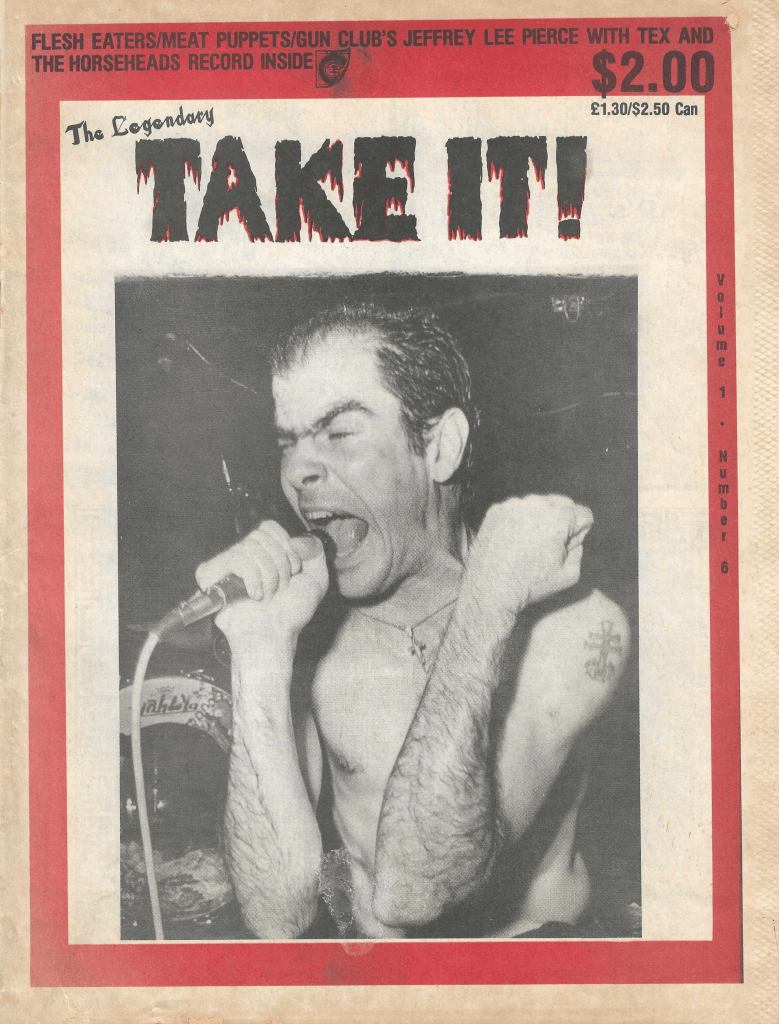
This is the lone issue of Take It! that I can say I was “contemporaneous” with; I distinctly remember it being available for purchase at the Record Factory on Blossom Hill Road in San Jose, CA, but I also remember not buying it, given my non-familiarity with the bands on the flexidisc – oh, just The Flesheaters, Meat Puppets and Tex and the Horseheads, each at the height of their respective powers. “The greatest flexidisc of all time”, some have called it (actually that was me that called it that). Anyway, I’d get my copy a few years later while I was in college, and I’ve savored it like a fine chianti with fava beans for years. As long as we’re making lists, it’s one of the single best issues of a fanzine that I’ve ever encountered as well.
I’ve probably read it more times than anything save my Forced Exposures, but until today it had been a while. Opening it now to tell you about it, I’ve found that Michael Koenig writes in the intro that he patterned the cover of this magazine to be much like that of Slash, given that Chris D. of the Flesh Eaters (who wrote for Slash) is the cover star. Ironically, this issue of Take It! has shrunk to a normal 8.5”x11” size after having been the jumbo tabloid size of Slash for every issue before this final one.
But wait – let’s talk about that flexidisc first. Tex and The Horseheads with Jeffrey Lee Piece do a blitzkrieg version of “Got Love If You Want It”. While this is not the first band I might go to for the full “roots/punk” experience, I kinda think they’re a bit underrated, and they capture a side of LA that I got to see myself in late bloom five years later: the jean-jacketed, longhaired, alcoholic, wasted sleazoid faux cowboy punk that haunted Hollywood Blvd. and clubs like Raji’s. The Meat Puppets, at the height of their powers, contribute “Teenager(s)”, which I’ve written about elsewhere as having the best opening two seconds of perhaps any song, ever, before turning into a shitstorm of nonsense, and then into a laid-back hippie/doper desert mind-expander. (Check Dynamite Hemorrhage #5 if you want to read more about it). And a live Flesh Eaters track (!), “River of Fever”, was recorded on the 1982 tour that Byron Coley writes about in this issue, about which more later.
The mag starts off with a great “three dot” gossipy column by one Julie Farman – who’d go on much later to detail a sexual harassment incident with the Red Hot Chili Peppers she was the victim of – called “Blabbermouth Lockjaw”. She gives some great copy about T.S.O.L. trying to beat up Minor Threat’s Brian Baker in a bathroom; a near-death accident in Boston when Snakefinger’s “Snakemobile” flipped over; a never-was 80-page Byron Coley fanzine called Flunk that’s “about to come out”; and – ooh, ouch, “Fear replaces Derf Scratch with something/one called THE FLEA”.
Michael Koenig gives his own Boston live action scene report and makes me wish I’d seen Talia Zedek in Dangerous Birds; David & Jad Fair in Sit: Boy Girl, Boy Girl, and Chris D. in the Flesh Eaters (well, I did see that, but not until 1990). Chris D., in fact, gets his own column in here – was this his first published writing since Slash went under? Someone’ll have to tell me. One of the true standout columns this time is a new one from Don Howland, whom you perhaps know from his later work with the Gibson Bros and the Bassholes. Here he dissects the musical sins of Australia, and counts down a “Low 11” of insipid pop acts that I still quote from to this day.
The piece that always really did it for me in this one is Byron Coley’s tour diary of his time roadie-ing for The Flesh Eaters on their first national tour – “Flesh Eaters ‘82: Masterpieces Hexed from the Dunes of Jive Broken Roads” (sounds like Chris D. might have titled that one). For years, and perhaps even now, I’ve claimed the 1978-83 Flesh Eaters as “my favorite band” – and also for years, this was the most up-close-and-personal I’d ever gotten with them, all filtered through Coley’s mania for the American underground and his warped sense of humor. The part about them playing live in Madison with Die Kreuzen always made me pretty jealous; in fact this whole tour they’re mostly playing with hardcore bands, forcing the band to play faster just to keep the pits flying. You can actually hear it on “River of Fever” on the flexi, which turns into a breakneck pace midway through, quite unlike the version on A Minute to Pray, A Second to Die.
Other highlights – Gregg Turner turns in an excellent LA scene report, complete with absurd reprinted lyrics from a local metal band called Slave-State whom I’m very sad to report did not appear to ever get any vinyl released. Eric Lindgren writes a piece about “The 10 Most Twisted Tracks From The Sixties”, including The Lollipop Shoppe, Legendary Stardust Cowboy, MC5 and Swamp Rats. Byron Coley writes an insane amount of record reviews, plus a column on beatniks. Richard Meltzer and Mick Farren have their turns as well. And….that’s it. That was the end of Take It!. No pleas for financial help, no indication that another issue wasn’t around the corner, nothing. The magazine gathered steam and rapidly got stronger and when it died with the publication of this issue, it was easily the best fanzine in the USA.
Even today – in 2026 – every single issue is available directly from Michael Koenig himself right here. Fair warning: it’ll cost you, especially #6, which, at $250, is 10x the price of each of the others. I’d wait for your Hanukkah or Christmas money to accumulate, and maybe write Koenig a nice email and see if he’ll sell them all to you for <$300. Tell him Jay at Fanzine Hemorrhage sent you.
And thanks for reading! -
Pussyfoot #1
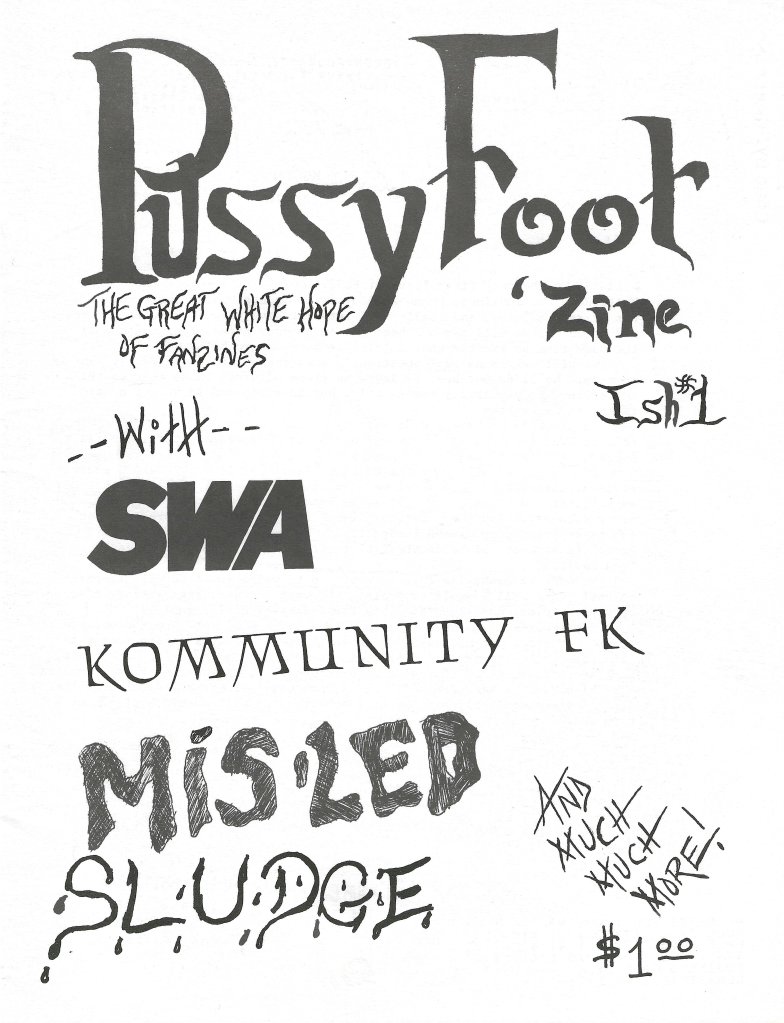
There was this period in 1987 or so that you’d probably call “peak SST”, when said label was pumping out multiple records each month by a host of mediocrities – from Lawndale to B’last to Swa to Zoogz Rift and so on. This is when I first started seeing shows at the Anti-Club in Los Angeles, and if an out-of-town or bigger local SST band was headlining, there’d be a whole host of these lesser lights on the bill as well. It’s how I got to see Swa. And B’last! And later, Always August, Sylvia Juncosa, DC3 and Painted Willie.
Record Time recently did a huge feature on this era and on the garbage clogging the label at the time, a “say something nice about one of these records” feature that I got to put in one review for (Das Damen). But Pussyfoot #1 from ‘87 is right in the heart of it, spending much quality time at these Anti-Club four-band SST specials, and they very unironically chose (of all bands from which to choose) to interview Swa themselves. The interview – with Chuck Dukowski, Merrill Ward and Sylvia Juncosa – is as utterly lamebrained and cringe-inducing as the band themselves were. Merrill Ward: “SWA is the revelation, it’s revealing, it’s the opening. SWARA is the revealment and the actual face of the god in heavens….the Sex Doctor is the healer, the wounded healer & through his pain he’s able to heal & liberate the true spirits of sensuality that exists from the body & souls of man”.
Listen folks, you haven’t lived until you’ve been forced to suffer through Swa in 1988 at the Anti-Club, only to find that there’s a tiny blessed patio outside that you can escape to, only to then have Merrill Ward come outside with his long mic cord to tunelessly moan in your face while his band plays bombastic thud-core back inside. Only being on the receiving end of a stoned Greg Ginn hippie hair-shake in my face while fruitlessly trying to ignore his band Gone rivaled it at the time.
Pussyfoot #1 from La Habra, though, is fully on board in this “ish”. They also bring us a chat with a La Mirada punk band called The Misled, featuring this gem:
PF: What do you think of punk bands changing styles to Heavy metal-glam rock (i.e. Channel 3, Overkill, etc.)?
Chris from The Misled: They turn into fags while they do it.Much of the fanzine is taken up with placeholders for next issue’s classified ads, next issue’s letters to the editor, subscriptions, ad rates and lots of big planning. There were others, however! The editor was a guy named Blaze James. Blaze James, Blaze James….I know this name. Oh, he was later in the band TVTV$ in the 90s, right. All I remember from the one time I saw them live was that a guy in the band had these awesome Coca-Cola branded pants, and that I was totally hammered and heckling them, which is something I’d only do if I was hammered.
Speaking of hammered, the last interview we’ll jest & jape about here is with a 1987 NY Dolls-esque band from the LA area called Sludge, whom I never heard of nor from at the time. And man, are they right in step with their era – long hair, a guy flipping off the camera, lots of talk about Budweiser and weed, jokes about eventual cirrhosis of the liver. Verbal Abuse, anyone? At least Flesh & Bones interviewed, you know, the good bands from this scene and epoch.
-
It’s (Your Name) Magazine #1
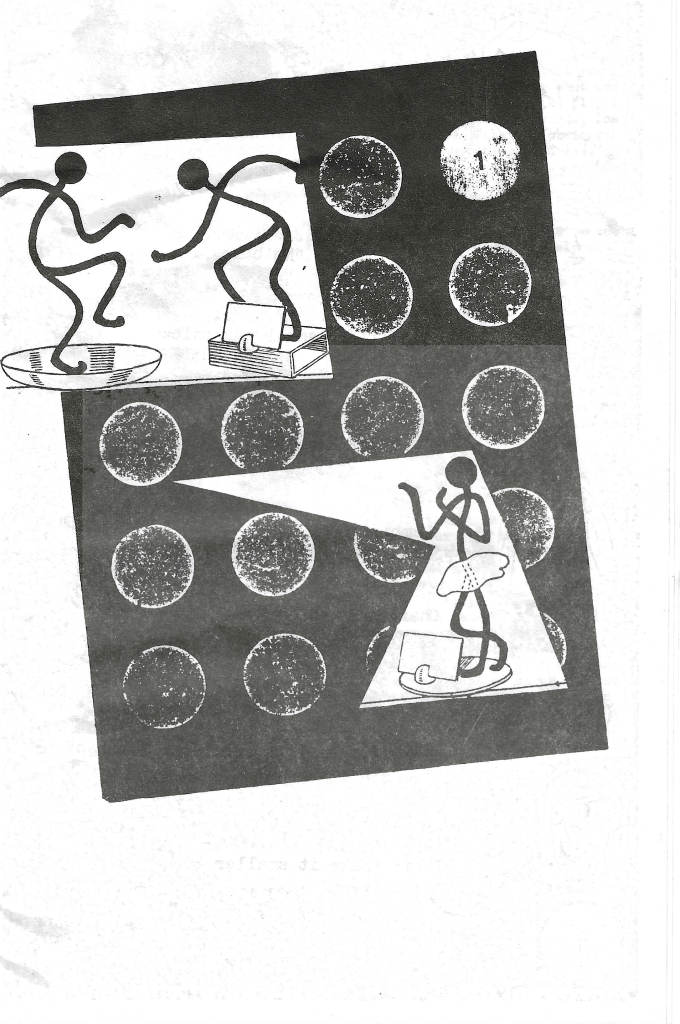
It may be something of a trifle, but the debut issue of Seattle’s It’s (Your Name) Magazine from ‘round about 1980 is a brief counterpoint to the popular conception of pre-grunge Seattle being solely slathered in speed metal and hardcore punk. You’d probably have to call this a no wave fanzine, if you’d call it anything at all – certainly its elliptical, cut-and-paste weirdness echoes both no wave-era NYC fanzines and some of the post-punk zines coming out of the UK at the time. Neither hardcore nor metal exists or rates in this world; its heroes are DNA, the Bush Tetras, Pink Section, Young Marble Giants, Joy Division and similar subjects.
A small co-ed team of editors and colleagues are behind this first and likely only issue, and supply the drawings, the word collages, and the strange pasted type that allows for words to hyphenate and fall off the page in all the wrong places. Kind of no wave, am I right? The DNA piece, “DNA stayed at my home”, is exactly that: a droll recounting of what they all talked about, who slept in which room, where they collectively went out to eat, and exciting information about Ikue Mori doing her laundry. DNA in Seattle in 1980 – it doesn’t really calculate for me, and yet the included loose-leaf entertainment guide promises upcoming shows in town by the Mo-Dettes, Delta 5, Cabaret Voltaire and Ultravox. You’d think we were in bleedin’ Sheffield.
The sole interview is with New York’ s Bush Tetras, who, along with the Au Pairs and Delta 5 were among my earliest favorite bands, once I discovered the left of the dial and college radio vis-a-vis KFJC. Clearly the bass-heavy, female-fronted post-punk sound scratched some primordial teenage itch I didn’t know I had, and I love all three bands to this day. The band are delighted to answer out-of-the-norm questions such as “What are the most irritating things people do?”, “Life without electricity?” and “Why don’t you live in Seattle?”. It turns out that one of the most irritating things that people do to Pat Place, Cynthia Sley and Laura Kennedy is confront them in the streets for being weirdos, calling them “Adams Family” or “Munsters” and asking them confused questions about their hair and clothes. It’s just like all of their fans who most likely were being called “Devo” around this time – hell, evenI got called Devo in junior high and high school for my tastes or lack thereof, and I looked and dressed like a Young Republican.
And really, besides some tongue-in-cheek quizzes, a blank page, and a plea for advertisers, that’s about it for It’s (Your Name) Magazine #1. Of course it whets my appetite & piques my interest to want to know more about the editorial team here – Ray, Bev, Ken, Lembi, Charles, Janet and Thom – so if any Seattlites or those of you who might be deeply knowledgeable about the Seattle post-punk scene of 46 goddamn years ago have any skinny about it all, can you please just let Fanzine Hemorrhage’s dozen-plus readers know in the comments?
-
Super Rock (June 1978)
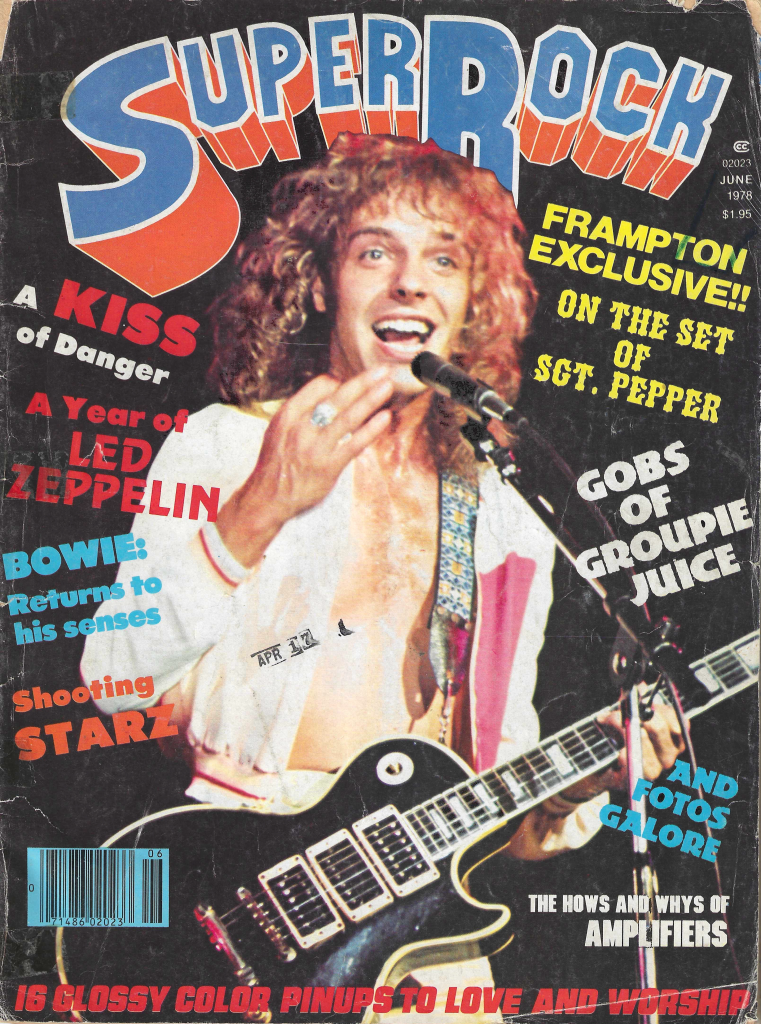
Let’s end our 2025 postings with something that’s not even a fanzine and didn’t come from the underground, just to bum you out. I bought Super Rock’s June 1978 issue online this year for a couple of reasons: first, because of my immense enjoyment of their second issue, the punksploitation one, which I wrote about here – and secondly, because the editor was one Myron Fass. Fass was a serial churner of exploitation magazines and comics of all types, a total “schlockmeister” who could really turn a buck on newsstand magazines on UFOs, monsters, mobsters, JFK, Elvis, and, apparently, 1970s rock-n-rollers. He was written about lovingly in one of the Bad Mags books, which I also got turned onto this year.
Whatever punk they’d been writing about a few months before this was almost completely shitcanned by June ‘78, even with the continued presence of Hannah Spitzer on the masthead, seen inside sporting an awesome sneer and a Sex Pistols shirt. Hannah, please write to the ‘Hemorrhage. Let’s converse! Spitzer actually gets the opening gossip column, but was likely forced at gunpoint to write about Meatloaf, ELO, Ted Nugent and Rod Stewart. She looks much more like someone in the crowd at a Teenage Jesus & The Jerks show, and writes accordingly with much vim and vigor.
As with Rock Scene – one of the all-time greats – Super Rock is just overloaded with original, mostly non-publicity photos, a result of its staffers being out and about in New York City and elsewhere. It also has – ugh – color centerfold photos of Stewart, Andy Gibb, the Bee Gees & Peter Frampton, and David Bowie, who’s praised in an article for returning to his senses after Young Americans with his latest records Low and Heroes. “David has dropped the dressup, cut the shit and emerged almost naked with honest and individual energy”. That’s one way to put it.
I don’t think I’ve ever seen a true “groupie” column before, but the one from “Dirty Darla” called “Ball Me Out” is quite a treat. She’s upset that the Pistols have just played in Atlanta “…without giving Darla a call. I was counting on a cream/dream date with them – that’s right, all of them….except Steve Jones, maybe – who one of my bisexual male friends who prefers men thinks is a real humpy macho stud punk – whew! Anyhow, I just saw ‘em on the network news!! Hot flashes!”. Poor Darla. I’m sure she did better with some of the more hairy cro-magnons that are interviewed and raved about across the pages of this thing: Starz, J. Geils Band, Billy Squire, Edgar Winter, Player and Tom Petty.
There are cool photos of the Patti Smith Group in the studio recording Easter, with a special drop-in from an extremely young-looking Bruce Springsteen. This is followed up with an interview, with, um, Olivia Newton-John. Wait a minute – here’s some “punk”! There’s a piece on Iggy Pop, marveling that he’s still alive in 1978. There’s a puff piece on a group called Flame with a female singer who are said to be “Red-hot and Ready To Rock!!”. Now that this has forced me to listen to them online, they may quite literally be one of the worst things I’ve ever heard. Give me Rapid Fire any day.
You want excruciating – have you ever tried to watch that Sgt. Pepper film remake starring the Bee Gees and Frampton? I was 10 when that came out to much hype, and it was just absolutely panned. My sister and I tried to watch it on TV the next year, but I don’t think we made it all the way through – and she was in love with Robin Gibb. Apparently it recouped its costs, though. The promotional budget must have been through the roof, as even here in Super Rock it’s the subject of several articles and photo spreads. Myron Fass was no dummy.
It all makes for some fun reading, I suppose, and it’s why I’ll likely keep buying cheapo copies of Super Rock and Rock Scene should I come across them – maybe even the one with Supertramp on the cover. You’ll just have to let me know if it’s still okay to write about them here. See you in 2026!
-
Making Waves #4
A few words before we start: I’ve got a revived music podcast you might potentially be interested in called Agony Shorthand, with all episodes captured here. I also did “the done thing” and made a list of my favorite books I read in 2025, with lots of extraneous commentary, which you can take a look at here. On with today’s program!
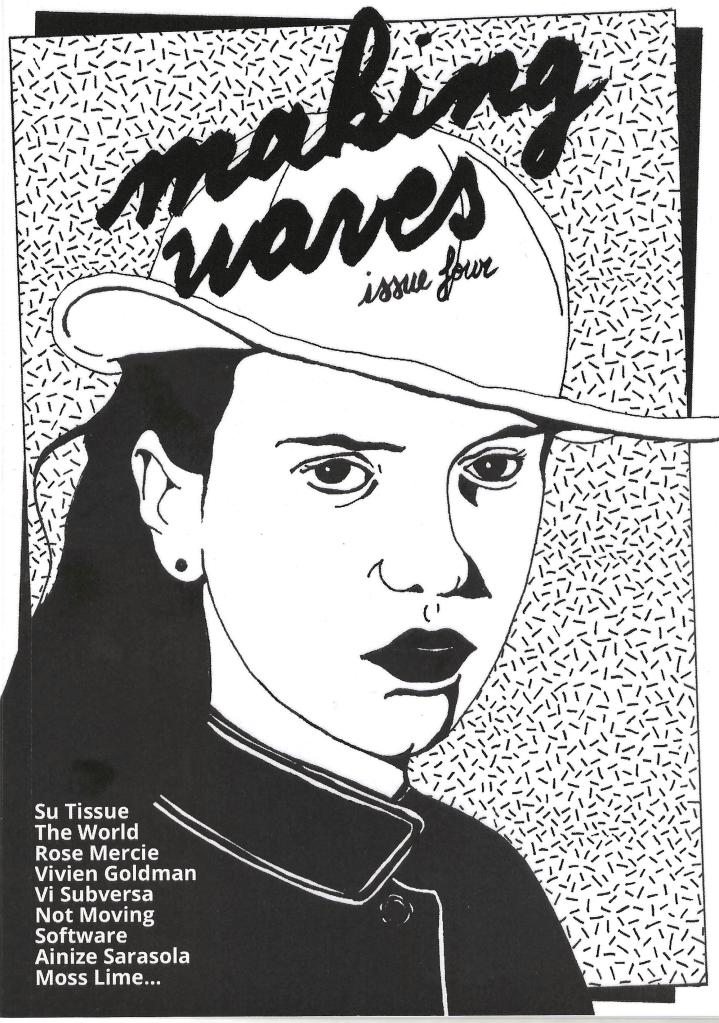
Haven’t given Making Waves #4 the once-over since blazing through it when it came out in 2016, but I did write a bit about their 2011 debut issue nearly three years ago, perhaps providing something of an introduction to the cut of their femme-slanted jib here. This one, #4, ended up being their final issue, and the point is made is the intro that they’d prefer to focus this one a bit more on current bands as opposed to the mostly-archival stance of the previous three. So that’s what they did!
The World, Rose Mercie and Moss Lime – all bands I liked, all with different features here: an interview, a tour diary and a playlist, respectively. Moss Lime, Freelove Fenner and Brave Radar were fantastic female-fronted abstract pop groups from Montreal last decade, and all deserve to not be forgotten; in fact, they deserve far better than that, and I kinda wish I’d pumped them up a little more when they were still around.
Cover star Su Tissue falls into the “attention comes so much easier when you’re exceptionally attractive” slot that Billy Idol and other beautiful mediocrities did, though I happen to totally love Su’s completely absurd “Manson girl meets Little House on the Prairie” persona, and the fact that she ditched it all at exactly the point when she was ready to be done with it. Also, watch this 90-second video of her Suburban Lawns playing “Unable” in 1979 – wow. Apparently there are middle-aged men who’ve spent way too much time on the internet fruitlessly attempting to track her down, her mystery and magnetism being catnip. For what it’s worth, I am not one of those middle-aged men. Katie Alice Greer wasn’t either, but she chips in here anyway with “The Eternal Mystery of Su Tissue”, and despite using the words “cultural pedagogy” in the piece, pulls off a nice tribute to the Garbo-like woman who even today just wants to be left alone.
Making Waves #4 doesn’t shrink from the post-punk women they’d sorta hung their chapeaus upon in previous issues. Vivian Goldman, for one, gets a MW interview grilling, and we’re all the better for it. Vi Subversa, the woman who fronted Poison Girls and who garnered much attention for being a fortysomething mom whilst doing so, also gets a tribute piece. There are other things on creative women from multiple disciplines whom I don’t know anything about, and, incongruously, a playlist of 70s power pop by dudes to check out.
I know I told you three years ago that 3 of the 4 issues of Making Waves were still available to purchase here, and somehow, for reasons beyond the grasp of sanity and explanation, they still are.
-
Creep #5

Creep #5 from Fall 1980 would come to be the final issue of this now-venerated San Francisco punk fanzine, a publication we’ve previously explored here and here. It doesn’t appear they knew that at the time, but I do sense a bit of “drift” in this one, as it’s a smorgasbord of opinion, rants, “just asking questions” essays, interviews and scene reports. Of course this might describe any punk fanzine of the era, but the only real unifier here in the previously cohesive Creep is the highly unifying presence of Flipper, a band whose self-destructiveness and contempt for the rudiments of “show business” was legendary, and is recognized as such in real time in this issue.
What I sense here is editors Mickey Creep and Mark Creep effectively letting anyone write about and/or contribute just about anything, which, in its totality, helps provide me with what I’d imagine to be the state of the San Francisco underground at the time. There’s a lot of scene navel-gazing here, and I love it. “Western Fraud” is about the corporatization of the Western Front festival and the fact that the 1980s edition allowed in some new wave bands and some venues with legendarily moronic bouncers. Here’s a flyer for the 1979 version, and a tough-to-read 1980 version, featuring shows by “Bill Graham Presents”. Creep, not an overtly or at least over-the-top political ‘zine, except when Jello Biafra is writing for them, seems to be mostly concerned with keeping punks from selling out as well as from eating each other alive.
The editorial magnanimity in allowing one writer to praise Brian Ferry at length and another to do a free-form piece extolling Roky Erickson is a nice surprise. James Koetting in his Ferry piece at least has the good sense to recognize that the jig was up when Flesh and Blood came out. The New Youth collective, which I was just talking about the other day, get a post-mortem that features Caitlin Hines prominently, and is probably the best overview you’ll find on the intra-scene dynamics and backbiting that came from putting on punk shows outside of the established clubs at this time. There’s a long interview with Paul Rat as well that adds yet another layer to the same. (for fun, here’s a 1979 phone call between Rat and Black Randy you might want to spend 9 minutes with).
The Flipper interview is, by turns, hilarious and even a little shocking. The amount of drugs and alcohol these boys put away at the time – well, now that I’m a fifty-something dad, I want to stage an intervention to at least to keep Will Shatter alive a little longer. (“Beautiful Boy”). Shatter has some collage art in here that’s excellent as well. Some deep intelligence, casual racism, complex theory and general chaos comes to the fore in this interview, and clearly there’s a small chunk of San Francisco that’s become totally enraptured with the band during the previous year. And hey, we lost Bruce Loose this year, but Ted Falconi is still with us, folks!
The Dead Kennedys have just come back from their first tour of England, and there’s a great piece about how incredibly bleak things are over there, both in the punk scene – then morphing into oi – and otherwise. Jello is startled by the fact that in the UK, so many of the kids coming to see them want him to sign something, and how even performers like him are treated like untouchable gods – except to spit on during the show, of course. A Crass piece makes similar points about England and of course extols all the ways they’ll likely be making it better. Olga deVolga from Vs. gets to rant about the scene and show off her general anger, and breaks the news that Vs. will be “merging” with Seattle’s The Lewd to form a new band called – The Lewd. There’s a long conceptual piece about Bill Griffith and his Zippy the Pinhead comic, which was quite popular with local weirdos well into the 1990s and still endures to this day. Careful connoisseurs of all the garbage I’ve written might recall the Kurt Cobain/Zippy connection I wrote about here.
There’s even a crossword puzzle with questions like, “Who taught the Cramps their songs?”, “Anarchy in the __”, and “Ted, Will, Bruce and Steve are ____”. (I told you everything comes back to Flipper in this one). We could go on and on picking this one apart, and I’d like to, but let me conclude by giving a huge kudo and shout-out to Creep #5 for being the only contemporaneous fanzine I’ve ever seen that wrote about the Fuckin’ Flyin’ A-Heads while they were still around (though it appears Touch and Go may have as well!). If you know, you know. Not merely a review of the 45, but a brief chat, which talks about their move to San Francisco from Honolulu. This might be why I found my cheap copy of “Swiss Cheese Back” at Record Vault in SF in the late 1980s, a glorious banner day that was subsequently undercut by my poor decision to sell the same single on eBay ten years later.
-
Subscribe
Subscribed
Have a WordPress.com account? Log in now.

