-
Scram #19
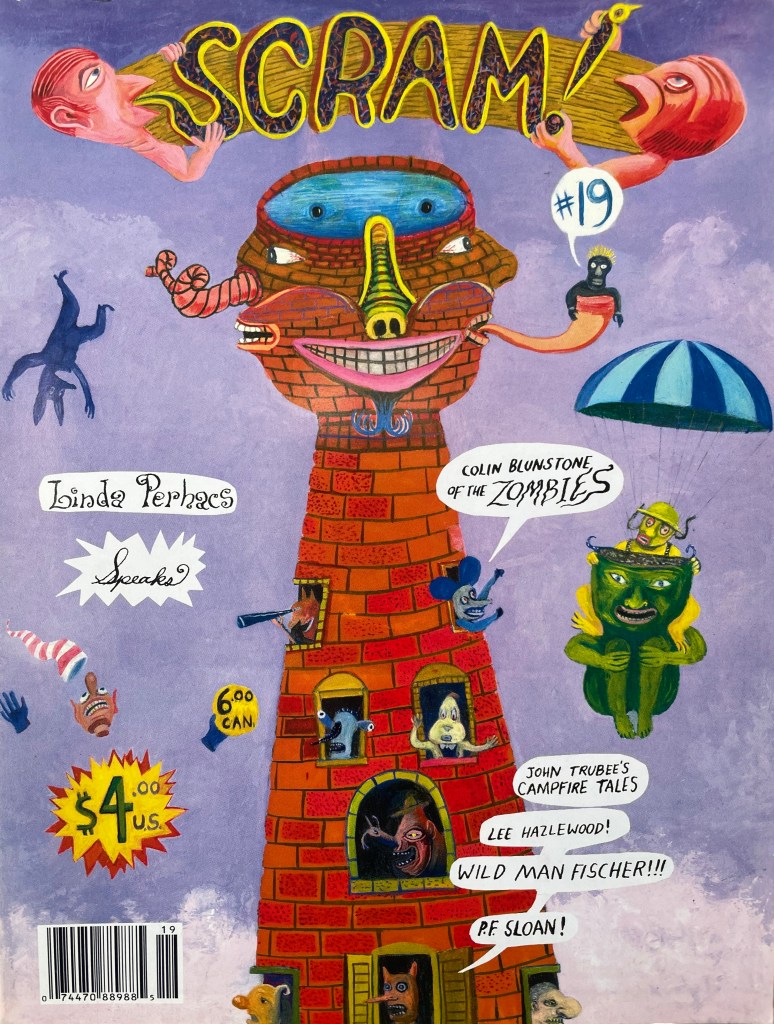
It’s been some time since we’ve taken a look at Kim Cooper’s 1990s-00s Scram; I think it was one of the very first fanzines I wrote about on this site, here and here. I’ve got this trove of them, a near-complete run, and every now and again it seems like a good idea to break one out, and I’m always glad I did – particularly the later issues, as this thing just continued to gather steam until its final transmission, issue #22.
Scram #19 – “Hollywood’s Premiere Journal of Unpopular Culture” – is the Spring 2004 issue, and features a few of the same unearthings I was myself pretty excited about at the time. To wit: Linda Perhacs. Not long after the time I’d discovered how much I loved Vashti Bunyan’s music, I went looking for other lost 60s/70s female folk oddities, and came across Perhacs’ dreamy and strange 1970 Parallelograms. It resonated pretty strongly, and not only with me. It had just been reissued on CD a few years before this issue, and as Cooper notes in the intro, “The reviews were odd. Without any evidence beyond the text itself, the critics made assumptions about Linda, painting her as a dippy hippie sprite who somehow channeled these vast ideas unknowingly”. So Cooper and Ron Garmon had the first sit-down interview ever granted by Perhacs for this issue to fill in the gaps.
I mean, the best revelation by far is that Perhacs is a name we now know only because she, as a post-college dental hygienist, haltingly passed on some of her home recordings to one of her rich patients in Beverly Hills, Leonard Rosenman. Dazzled, he then did everything possible to hustle her into a studio. She just thought of them as “campfire songs”, something she did for fun. Also, her “Hey, Who Really Cares?” ended up being the theme song for the TV cop show Matt Lincoln, because the producers wanted a “delicate song on top of this hard action”, inspired as they were by Robert Altman’s M.A.S.H. theme “Suicide is Painless”. How about that? I’ll let you find the other revelations in your own copy of Scram #19.
I am also thankful for all the younger zine editors who, unlike me, thought to interview the immortal Lee Hazlewood while he still communed with us on this mortal coil. Dan Kapelovitz gets the honor here – a piece he originally wrote for Hustler (!) and which was rejected by the editors. I wish I’d talked to this guy (Hazlewood, not Kapelovitz) when he was around, seriously. What a storyteller – about his run-ins with Frank Sinatra; about sexual attitudes in Europe; about young fans in Sweden who scream so loud they scare his band, and who only want to hear his obscurities, not his hits.
About a month ago I saw the Zombies’ documentary Hung Up On a Dream and I now have a new appreciation for Colin Blunstone and co. that I only slightly had before (I even bought Odessey and Oracle, a record I’d never owned). But yeah, an interview with Blunstone was right in Kim Cooper’s wheelhouse – The Zombies being exactly the sort of band I associate with Scram: a little forgotten; a little underrated; a little fey or twee or different or goofy or strange or orchestral. His chat here is engaging and wide-ranging for sure; he talks more about the “tour” of the Philippines that the Zombies undertook which is perhaps the highlight of the documentary.
The John Trubee interview by one of his childhood summer camp pals is priceless as well. As mentioned before, it’s the interviews, features and weird bits of humor papered throughout Scram that made it stand out, not the record reviews of contemporary crap from labels whose ads helped pay for the print runs (although, frankly, Scram was relatively ad-free, and well over 90% of this issue’s pages don’t have one). The fanzine was its own little insular world of obsessions and excitements, and typifies just how interesting and enduring a well-executed ‘zine can be when one person’s weirdo vision is carefully unfurled and then shoddily typeset.
-
No Mag #5
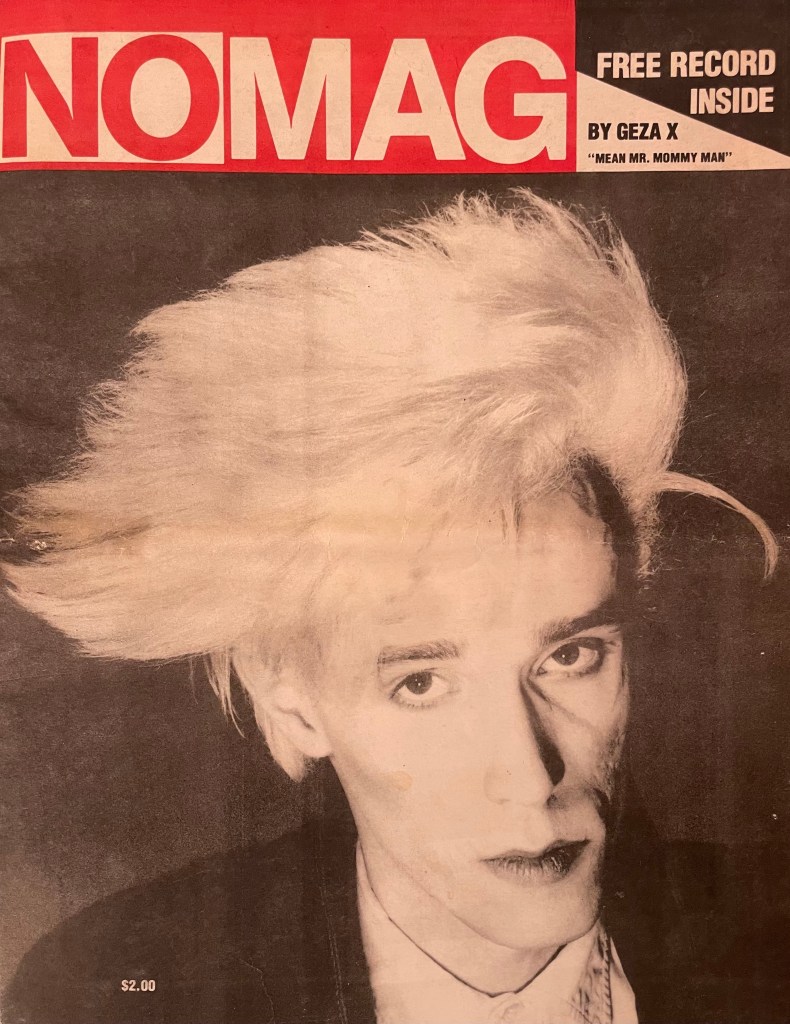
Hard to say for certain exactly when No Mag #5 hit the streets, but given the ad for the Circle Jerks’ brand-new Group Sex and a Vinyl Fetish ad touting “the last Slash”, I’m going with late 1980. Much like a never-satisfied, highly creative novelist, No Mag truly jumbled its format from issue to issue, in search of some higher, elusive truth. Always arty, fashion-forward, transgressive and exceptionally strange, my various copies are at times extremely music-interview and scene-gossip heavy, yet other times they’ll overwhelmingly default to collage art, sexual photography and disorientation. This is (mostly) one of the latter. We talked about different issues here and here.
You know the jarring, conceptualist, highly nonsensical Los Angeles late-night TV programme New Wave Theater from exactly this time? No Mag was its spiritual brethren, and though I lack proof, I’ve gotta think editor Bruce Kalberg and New Wave Theater’s Peter Ivers spent some quality methamphetamine time together. And this issue, No Mag #5 – it’s the first issue of this I ever saw, some years after it came out, probably in 1987 or so at my cousin’s Isla Vista, CA apartment. I’ve certainly never been able to forget the opening fake “interviews” with No Mag readers, all of whom are represented by pictures of the hideously deformed, or of people with various facial skin lesions and tongue abnormalities.
No Mag #5 does have a Bryan Gregory interview; he’s moved to LA after quitting or being kicked out of The Cramps, and hey, he likes it here. He hasn’t seen a band in a year; soon he’d go on to start the very forgettable and very forgotten Beast. There’s also a long bit of puffery and myth-making about Geza X, none of which is true. Apparently this issue came with a flexi of his, but my copy doesn’t have it and, as Elliot Gould’s Philip Marlowe might say, “it’s okay with me”.
As mentioned, this issue in particular jumbles together sleek ads of new wave fashion plates; strange collage-art mash-ups; poetry (of a sort), a thing about war and survivalism from Search and Destroy’s Vale and Andrea; comics; more freakish faces; and a ton of Frank Gargani photographs. Some of these are absolute gems: 11-year-old Stevie Metz of Mad Society; lovely Shannon from Castration Squad; this one of Crystal from the Speed Queens; Belinda Carlisle of the Go-Go’s, pre-fame; and a cool-looking group of dudes called The Adaptors, about whom I know nothing and who may have been from San Francisco.
Of course, you really don’t need me to tell you about it, since you can download every issue of No Mag right here, thanks to the legendary benevolence of Ryan Richardson.
-
B Side #11

I started buying Sydney, Australia’s B Side around 1987, and it was an authoritative sherpa for me through the wilds & weeds of that era’s Australian underground. Independent US record stores were getting a lot of this stuff in stock at the time, so it wasn’t all that tough for me to find Scientists records, or any- & everything on the Aberrant, Citadel, Au Go Go, Waterfront, Greasy Pop, Red Eye and Black Eye labels, money permitting of course, of which I had little. Today I’m pretty ready to assert that the underground writ large, myself included, still hasn’t quite come to terms with how fertile this period was across Australia, particularly around the years 1984-86. This is where my recently-procured copy of B Side #11 lands, right in the middle of 1985.
For context, I just listened online to two records enthusiastically discussed here – Salamander Jim’s low-end, rumbling, psych noise-damaged “Black Star”, and The Moffs’ guitar-drenched paisley-psych 45 “Another Day in the Sun”. They’re great! It’s far more likely I just haven’t paid attention to any revivals of this stuff, since there are a ton of comps out there like this one. Anyway, Simon Lonergan and his crack team at B-Side were doing all the documentation in real time. I liken this fanzine to the UK’s Bucketful of Brains, but built instead around lowdown & dirty Australian bands with big hair and bad attitudes, as well as the more punk-oriented and as opposed to jangle-driven psych. It was the tenor of the times, as they say.
If you’re like me, your eye was perhaps caught by B-Side #11’s promise of “Byron Coley on the State of the U.S.A.”. Coley’s “The State of American Noise Part 1” starts with an opening salvo positing that stupid Americans are ignoring the likes of the greatness he’s about to wax poetically about, which we probably were. This comes down to 4 key bands: Dredd Foole & The Din, Raunch Hands, Butthole Surfers and the Leaving Trains. The Trains’ debut LP Well Down Blue Highway “represents the culmination o’ years spent drunkenly tryin’ t’ find the Northwest Passage between The Damned and Creedence Clearwater Revival”. After describing them and the adjacent band To Damascus, he says “Now ya know more about these jerks than 99.99% of the American people. How’s it feel?”. Byron Coley sticking the landing, as usual. This is also the article in which Coley first wrote that Jello Biafra turned his nose up at the Butthole Surfers when he first saw them and said they were “too weird” – a statement that really stuck in Biafra’s craw for years afterward. Fun!
Tex Perkins (who was in Salamander Jim along with Kim Salmon) has a good interview here – he was better known as “Greg” at the time – which includes ruminations on his jealousy of the more popular Beasts of Bourbon; trouble with the cops; and the fact that he’s now about to start playing with Pat Bag and Kid Congo in Fur Bible. They haven’t even started the band yet, nor even told him what kind of music they’re going to be doing – he just wants to make sure it doesn’t sound anything like the Gun Club nor the Beasts of Bourbon. Well, maybe a little.
There are also a slew of interviews with the likes of the Celibate Rifles, who just had that first LP and a 45 out at this point. A year later they’d have records that were easily procured at Aron’s and Zed in LA, and which became pretty beloved by me & my Radio Birdman-loving pals. (I don’t have them anymore and haven’t heard the band in decades). Other chats are with The Shindiggers, Decline of the Reptiles, 21 Faces, Harem Scarem, and American Eugene Chadbourne, who’s just come to town and won a handful of converts down under.
The excitement of the age is real, and you can feel it in the big Melbourne “scene report” by David Laing and Trevor Block. They’re shooting the proverbial shit back and forth about bands like “Behind The Magnolia Curtain” and Murphy’s Hardware, who supposedly play live in matching Hawaiian shirts. Who wouldn’t be excited, am I right? And as a result of reading this blog post, you now know more about these jerks from 1985 than 99.99% of the Australian people. How’s it feel?
-
Revolutionary Wanker #2

Typically I keep to a couple of core rules here at Fanzine Hemorrhage, the primary one being that every zine discussed here is one that I myself presently own. That means “no PDFs”, though I admit that we’d be able to have some excellent (one-way) fanzine conversations if I bent my rules for access into my “PDF collection”. It also usually means no copies or xeroxes of fanzines. I have bent this rule twice already, however, for Brain Damage #1 and Back Door Man #4. So let’s bend it again for October 1981’s Revolutionary Wanker #2 from San Francisco, a crisp xerox sent directly to me by editor Naomi Batya, who was a hell of a “good sport” after all my shucking and jiving on this site when I discussed my original copy of her Revolutionary Wanker #1.
There’s an opening triumphant disclaimer that the zine is now publishing independently of Creep, and that this is likely for the better. Joan Moan contrasts the negativity of punk with the positive vibrations emanating from the Rastafari world, informed by her trip to Jamaica. She certainly wasn’t the only one disillusioned with mean-spirited punk rockers who go on to big-up on Jah. Alter “Ego” Cronkite – these names, jesus – seems to have taken his own trip around the country to see what various punk scenes are like in LA, DC, NY and even Rochester, and they each came up severely lacking compared with Shangri-La San Francisco. “If you still want to be a punk, stay in San Francisco”. Anyone else think LA and DC were starving for good punk bands in late 1981?
Tony Kinman from Rank & File is interviewed and naturally gives voice to what it’s like being in a country band, vs. being in The Dils as he’d been two years agone. The band’s approach in 1981 is to play country music within the punk club circuit, and rightly see themselves as the only ones doing as such. Good interview. I’d always assumed those guys were really prickly, but not with the kind young women at Revolutionary Wanker they weren’t. And his favorite SF band is Flipper, as I’d hope mine would have been at the time.
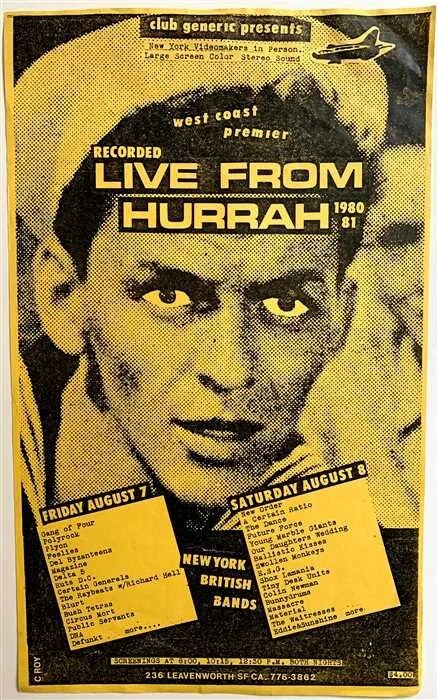
Z’ev does come off initially as exceptionally prickly in his chat with “Will Ling” and “Tobe Lead”, but settles down a bit and eventually takes some major swipes at his electronic & proto-industrial music brethren. You kinda learn to love the guy by the end – isn’t that nice? Each time there’s an interview, it’s then followed by adornments of many stripes – song lyrics, clip art, short musings and the occasional advertisement. In fact there’s an ad I’d never seen for the Market Street Cinema, which I only know as a legendary porn palace, showing off a killer Au Pairs / ESG / B-Team show that’s coming to town on October 2nd. There’s also a praise-drenched review of a new club called Club Generic in the Tenderloin at 236 Leavenworth that sounds like a truly wild space during an exceptionally creative time. These are the sort of events they’d have: here, here and here.
There’s also an intro to filmmaker Marc Huestis, who was then just getting rolling. So yeah – not exactly a generic table of contents, and already a big leap from the issue that had come out just a few months before this one. I’ve got xeroxes of the others, and you can mark your calendars as I’ll be diving into those sometime within the next several years, count on it!
-
New Wave Rock #1
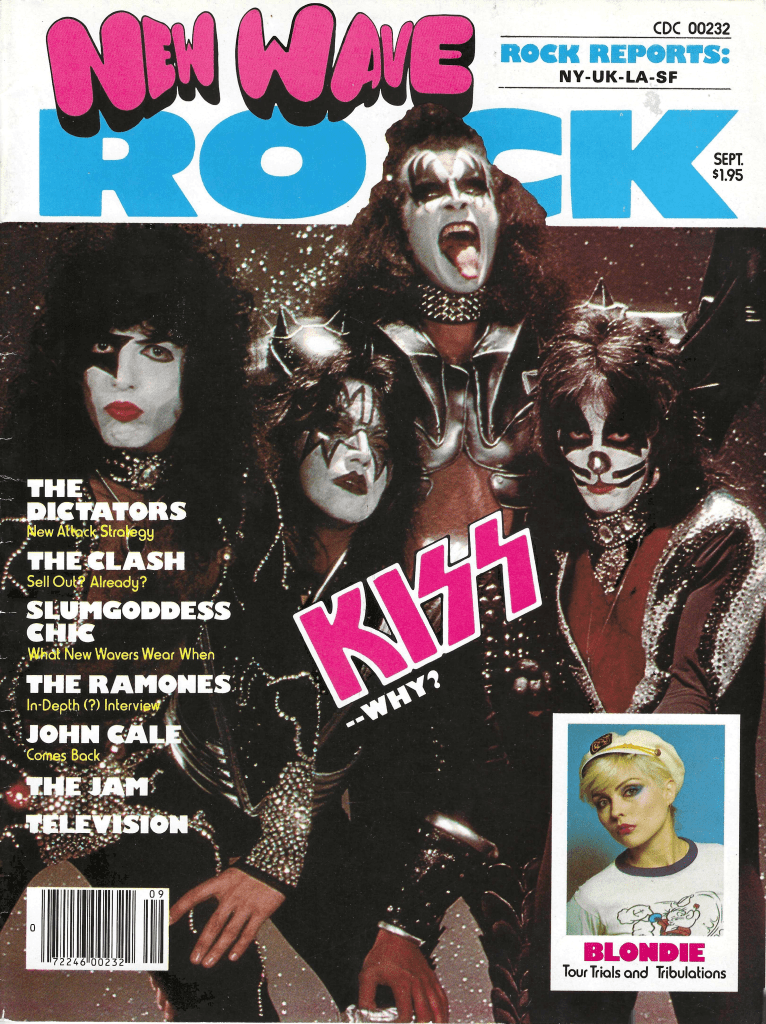
Well, whew, I think I’ve finally completed one of the most breathlessly exciting and highly laudable chases of my life: the quest to own all of the glossy punksploitation magazines that were put out in 1977-78 under a head-spinning spell of confusion, bafflement, excitement and money-grubbing opportunity. My late wife Rebecca would be so proud. I did it for you, honey. New Wave Rock #1 was my sacred chalice to find, and find it I did. (The others I’ve discussed are here, here, here, here, here and here). But then I had to read it, this issue with new wave rockers Kiss on the cover. But I did that too, and now I’m here to talk with you about what I uncovered.
As it turns out, this September 1978 debut is less sploit-ta-tive than even the two issues that followed it (here and here). It’s actually quite good. Diana Clapton’s opening editorial states that she received funding and wide editorial latitude for it from publishers Harry Matetsky and Jack Borgen, but then they saw her table of proposed contents and blanched at all the no-names (Clash, The Jam, Dictators) therein. “(Harry) then asked the fourteen-year-olds in his Long Island neighborhood, which is light years away from the Bowery, who their very favorite rock group is – and that’s why we have the cover we do, friends”. She then proceeded to label Kiss’ portion in the table of contents “Kiss: what do they mean? Why are they here?”.
As usual, much of the fun to be had is in the opening gossip pages, which here are broken into distinct London, New York, Los Angeles and San Francisco scene reports. There’s some loud post-Sex Pistols break-up speculation, including some that posits that Johnny Rotten and Poly Styrene are singing aging rock & roll standards together on a grand piano, and are now a “joyful couple”. There are salacious details on the Bryan Ferry/Jeri Hall split and how she’s cavorting in the clubs with Mick Jagger, leaving Ferry sad and alone in his new upper Fifth Avenue flat, which he’d moved into with Hall all the way across the Atlantic. There’s also a firsthand report on Lou Reed’s six-show, sold-out run at The Bottom Line, featuring “his transsexual lover Rachel” opening. Rachel, who “is a terrible singer”, apparently hung real tough and dealt with much audience abuse in “tight black leather, stiletto heels, a sultry smirk and a rose looped over his or her belt”. Meanwhile, Brian Eno “and the agonizingly gorgeous Julie Christie are having a fat laugh over rumors of their red-hot love affair, as they have been in each other’s company precisely twice”.
The LA gossip column by someone purportedly named Eunice O’Reilly is even spicier. After some Germs love, there’s a list of LA’s five “bad bands”: Backstage Pass (I just finished reading Genny Schorr’s All Roads Lead To Punk like, last weekend), The Nerves, The Deadbeats, Runaways (ok, sure) and The Weirdos, “LA’s most unexciting band since Seals & Crofts….claim to not be ex-hippies in disguise, but ace Warner Brothers secretary Coral sez: ‘I went to high school with them. They had long hair and wore love beads’. Case closed”. I also enjoy “O’Reilly”’s take on power pop: “It ain’t new wave but it ain’t ‘zactly old wave either, something y’gotta just live with and LA’s got it up the gitgo”. I suspect this column was written by either Gregg Turner or Metal Mike Saunders, probably Turner, as it contains a multi-paragraph ending about “saving the best for last”, Vom. Their own band. Amazingly, there’s then a two-page spread and feature on Vom later in the mag.
Now, I’ve dissected enough pieces on Blondie, The Jam, The Ramones and the like in other Fanzine Hemorrhage write-ups to really want to spend much time with with the ones in New Wave Rock #1, but I did a double-take skimming the Blondie piece in which Clem says “…we made a movie with John Cassavetes and this guy Sam Shaw. It’s a youth-oriented movie called Blondie, and I don’t know what they’re going to do with it”. Say what now? John Cassavetes? It’s true! (More here from Waitakere Walks). I also learned about the incredibly underwhelming response The Jam received opening for, um, Blue Oyster Cult in Bridgeport, CT, and Paul Weller’s goading of the crowd with, “I know, it’s hard to understand when you’re being confronted with the future of rock and roll right in front of you”.
One other bonus of this issue is the loads of color photographs documenting both onstage antics and candid backstage snaps, most of which I haven’t seen before. And other tidbits and anecdotes and whatnot: John Cale expounding upon punk and how much or how little was actually being learned from The Velvet Underground (he loves Sham 69, though!); The Clash claiming “people think we’re a con, but we’re not”; and a multi-page overview of Television’s year post-Marquee Moon, pre-Adventure. I’ve been listening a ton of late to the Live Portland 1978 bootleg from around exactly this time, and I think it’s quite possible it’s the single greatest documentation of Television’s majesty in any one single place.
It’s likely that publishers Matetsky and Borgen didn’t like what they saw when they crunched the newsstand numbers for New Wave Rock #1 and asked to dial up the stupidity levers a bit for the two issues that followed – who knows. I just know that if this had been called something else, and didn’t have Kiss on the cover, it’d be as good as this, this or this from right around the same time, and perhaps remembered just as fondly and not as some joke object for dorks like me.
-
The Bob #26
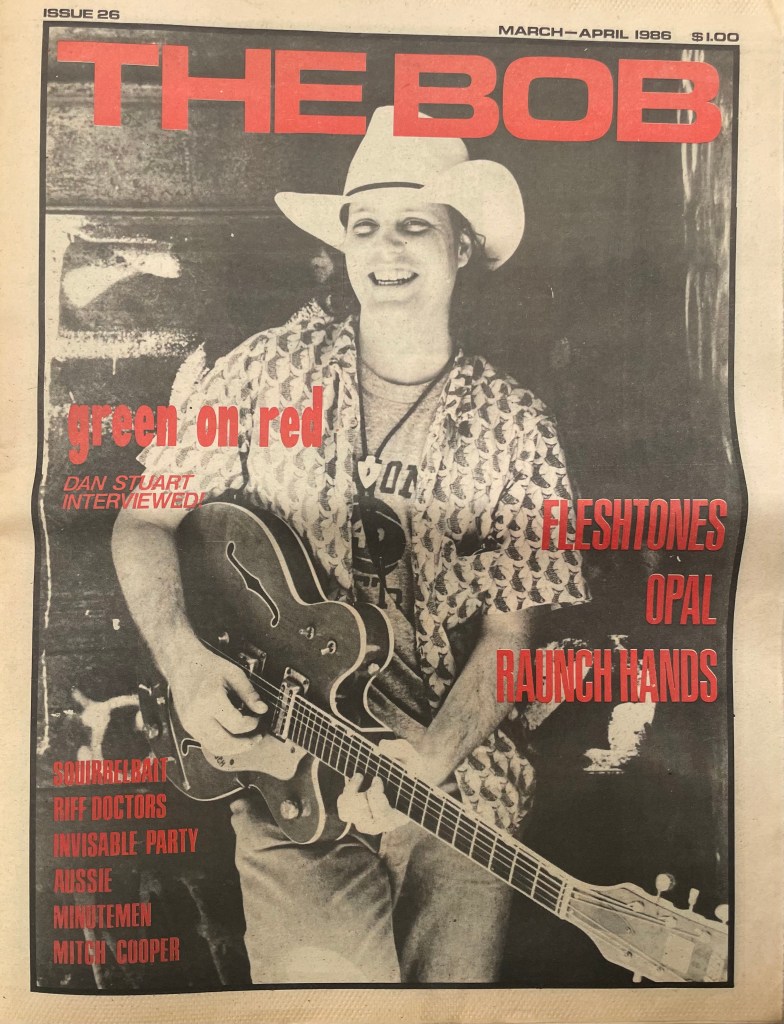
Around 1985-87, the tabloid fanzine The Bob was pretty ubiquitous on the Tower Records magazine racks and at the indie record stores I used to frequent in California. While their all-encompassing approach to “college rock” certainly covered bands I cared about – i.e. The Bob #26’s bits on The Minutemen and D. Boon’s passing and Pat Thomas’ short overview of Opal – I only bought it every now and again, given the lack of any real cultivated, inspirational, BS-detecting “taste” that I might glom onto. The temperament appeared to have been: indie music is great, listen to all of it, but maybe not if it’s too aggressive or too challenging. Fair enough?
That’s at least what I’ve gathered again in 2025 revisiting this March-April 1986 issue. The Fleshtones, Scruffy The Cat and even The Bangles’ Different Light are taken seriously, as are the longest and most obscure stretches of the jangly American underground tail. As long as someone sent in some vinyl to be reviewed – especially if it’s Engima Records or in any way R.E.M.– or paisley underground-affiliated – it’s gonna get in here. Most of the time it’s going to have one of those reviews that hems & haws and picks at it a bit, then weirdly concludes, “you need to hear this” or “you need to buy this”. As someone who emphatically relied upon fanzines to tell me what was truly worth buying at the time, this was not an approach that built credibility, nor gave me any level of confidence in The Bob’s discernment.
I always associated The Bob with Fred Mills. His byline was everywhere in virtually every issue, doing many of the interviews and writing a huge chunk of the reviews. Fred was sort of the saving grace, in my opinion. While he was (at times) the foremost purveyor of the review style I’ve just decried, he also was an inveterate music fiend who clearly “collected records” (as did I at this time, age 18), and was absurdly, slavishly devoted to bands, live gigs and uncovering undiscovered gems. In 1993 when I was the “roadie” for the band Claw Hammer, Fred somehow proactively found me on the show floor at Hotel Congress in Tucson, AZ (we’d never met nor corresponded), and we proceeded to banter about all manner of musical ephemera, helping to solidify the positive-leaning sentiments I’d accumulated to date. We’ve not communicated since.
It’s really Mills, Pat Thomas and a parade of lesser lights in The Bob #26. Mills gets the Green on Red deep dive, and upon re-reading it now, I reckon I learned a bit more about where this band’s head was at during that first wave of indie/Americana bands jumping unsuccessfully to major labels. (The best writing about that disappointing blip in time, I think, is in the second of the two John Doe/Tom DeSavia LA punk books). Thomas rightly praises the 28th Day record and seems to imply they were from Los Angeles – they were not. Mills has an entire column on Australian bands; there was a ton of curiosity around this time about The Scientists, Triffids, Decline of the Reptiles and others, whose records were just barely making it to the USA. I’m pretty sure my own Aussie mania of the time was at least piqued by Mills’ columns – so perhaps there was some residual tastemaking going on despite me saying in self-aggrandizing hindsight that there wasn’t.
There are various write-ups of similar 60s psych/garage revival groups like The Mod Fun, Chesterfield Kings, Plan 9, Plasticland et al. I was just at Amoeba Music in San Francisco on Friday; some dude had sold crateloads of this stuff on vinyl – your Miracle Workers, Yard Traumas and what have you, including the aforementioned Aussie stuff – to the store a few months back. While it was fun to look at when it came in, I noticed this week that most of it was now “priced to move” in the reduced/clearance portion of the used LPs. Even at $5.99 a pop, I couldn’t find anything worth slotting into the collection. Not even the Psychotic Turnbuckles, but I at least held that in my hands for five minutes.
1984-1986 remains a puzzling time for me in the broader tale of what underground rock music was during the decade, but a fanzine like The Bob, for better or for worse, goes a long way toward illuminating the quote-unquote lived experience among certain sectors at the time. A glut of vinyl, an aesthetic distaste for punk and what it wrought, a surging “psych” and lite-garage sensibility, and an attempt to guiltlessly straddle the underground and overground. That’s what I remember from The Bob and similar publications like Jet Lag, which is probably why I ultimately found my late-teenage salvation in Forced Exposure, Conflict and Flesh and Bones instead.
-
Damage #1

One of the great tabloid fanzines of all time, Damage published thirteen issues in San Francisco from 1979 to 1981. I’ve had the pleasure of talking with you in this forum about it before: Damage #6 and Damage #7. Now let’s take a peek at the very first issue, Damage #1 from June 1979, even if it does have Jello Biafra on the cover. Trust me, my copy wasn’t “complimentary”, as you can see stamped along the top here, but it leads me to believe that my copy belonging to a previous owner once was.
There seems to be a real coalescence of smart and driven people around the San Francisco underground music scene in 1979, not merely a bunch of dimwit punks. They’ve all been given a place to congregate in the pages of Damage #1. There’s billboard artist “DA”, provided with this sobriquet as a cover for his real name, due to his public vandalism of billboards and corporate buildings. This includes putting up a series of large posters that say, “Rich..? Boring…? Then you soon may be dead unless you contribute to the new wave revolution. Send money today = be spared tomorrow”. An address at 626 Post Street is helpfully provided. He also created confrontational machine-based visual art and displayed it in public spaces, like a gas station, making me think he might very well be Mark Pauline, or someone within his orbit. Though I doubt Mark Pauline would have given much thought to fomenting a “new wave revolution”.
Another great interview is with Robert Hanrahan, manager of The Offs and Dead Kennedys, and a guy who put on shows at San Francisco’s legendary Deaf Club. (Robert is now Daphne Hanrahan). The club is struggling with fire regulations, police presence, and with quality-of-life cleanup issues on Valencia Street. Mayor Dianne Feinstein is referred to as “the Queen of Hearts”, in reference to a legendary mocking magazine cover that I unfortunately can’t find reference to on the internet. She was reviled by the punks. Hanrahan complains about people trying to piggyback on the club’s notoriety and/or get in for free: “We’ve had people come to the club and flash New West press passes, and we say, okay that’ll be three dollars. And they’re shocked – ‘but we can write about you, we can give you all kinds of publicity’….one night Black Randy came to the door and announced, ‘Black Randy, party of twelve’. I said ‘Black Randy, party of none, it’s three bucks apiece’. He was flipped. We let him in, and a half hour later two guys were carrying him out because he had passed out in the bathroom”.
Now if you’ve done even the tiniest bit of cursory reading about the late 70s San Francisco punk scene, you surely know who Dirk Dirksen is. The interview with him here is fantastic. The interviewer comes at him repeatedly and rather lamely with every Mabuhay Gardens controversy du jour – ticket prices ($4.50 on weekends instead of $3!); whether he’s enriching himself from the Mabuhay (he is not); “a lot of people resent the way you act on stage”, and so on. The final question is “Someone asked me to ask you if it’s true you hate punks”. Dirkson replies, “I only love myself. I don’t know any punks, but those pseudo-punks that come to the Mabuhay, I certainly like them”. Read an entire book about him here.
Damage #1 also talks to bands, I assure you. There’s a rare one with The Urge, an all-female band that included Jean Caffeine, who did New Dezezes fanzine (which I wrote about here and here) a year or two before this band, and who, along with her bandmates, went to Washington High in the Richmond (two members are still there at the time of this interview). There’s a talk with No Sisters, a band of brothers, all of whom wear nerd glasses. There are strange utterings from Coum Transmissions, i.e. the Throbbing Gristle folks, a collective very popular with a certain San Francisco archetype of the era, as you may well know. Craig and Alice from The Bags do a perfunctory Q&A, and MX-80 Sound, who’ve just moved to SF from Bloomington, IN, get their own small grilling here.
Just to give the proper context, may I please continue? There’s an interview with Nervous Gender, a photo essay of “A Day at Home with Sally Mutant”, and a piece on filmmaker George Kuchar. Jello Biafra gets a column to spout his nonsense; John and Exene from X give a short interview, decorated with some phenomenal band action shots. The women from Noh Mercy talk about the blowback to “Caucasian Guilt”, and about some of their difficult live shows, such as the one in LA at Madame Wong’s where the highly touchy madame took exception to them wearing kimonos on stage, and for being women in the first place, then banned them from ever playing there again. There’s an LA gossip column from someone named “Jane’s Plane” and an SF gossip column by Ginger Coyote, who put out the fairly weak fanzine Punk Globe and was later in the execrable White Trash Debutantes.
Yeah, all of that….and even more. I really dug the interview with the folks behind New Youth Productions, who put on a legendary grassroots Clash/Zeros/Negative Trend show on 2/8/79 and ruffled a ton of industry feathers in the process. There’s much more about Caitlin Hines from New Youth in my own Dynamite Hemorrhage #8, which you can read here. So as I said at the outset here, tons of energy, spit and vinegar in San Francisco at the time, and you really couldn’t capture it a whole lot better than Damage #1 did.
-
Crawdaddy! #16
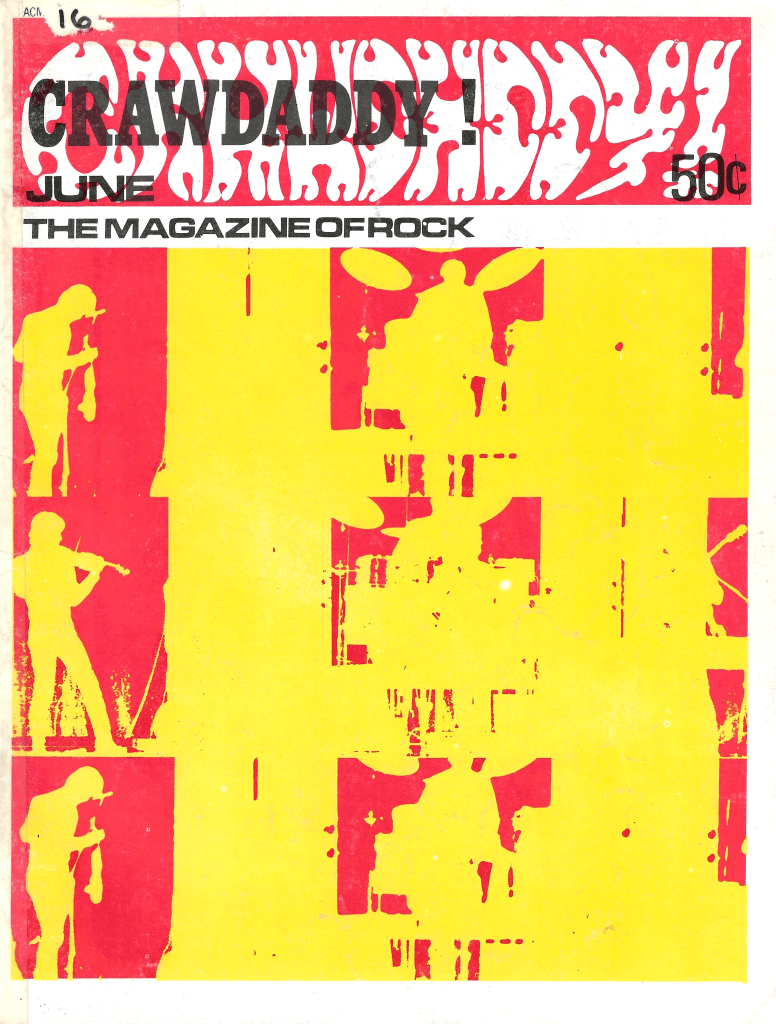
I’ve only got a couple 60s issues of the original Crawdaddy! – “The Magazine of Rock” – and I’m quite aware that it wasn’t a true self-published fanzine, as weren’t the magazines Rock Scene, Teen Screen, Trouser Press, Cheetah, Beetle, Sounds and a few others I’ve bantered about here. It’s a great window into the “rock as culture” movement of the late 60s, in which rock music was dissected as intellectual fodder, the whole “but-what-does-it-all-mean” ethos that was part & parcel of the era’s zeitgeist. It’s still a point of chagrin in my house just how picked-over Bob Dylan’s lyrics were at the time, but I know Bobby Z has his fans, and who am I to say they were wrong to do so.
Paul Williams was the editor of the original version of the magazine, which started up in 1966. His run at the helm ended in late 1968, not long after this issue, Crawdaddy! #16 from June 1968, but the thing continued throughout the 70s, albeit without much cultural cache that I can discern. Williams would later re-launch the magazine in the early 1990s as almost a fanzine again from his then-San Diego home. He provided a writing hub to so many folks who’d go on to be fairly well-known, such as Richard Meltzer and this issue’s Sandy Pearlman and Peter Guralnick. (Wikipedia says that Gilda Radner and Dan Aykroyd wrote for it in the 70s!).
Crawdaddy! #16 finds itself parked pretty well in front of a lot of what I’d like to think I’d be excited about during the hot hot summer of 1968. The United States of America get the cover and an excellent write-up by David Flooke, focused quite a bit on how they might use their synthesizers to build on “the second coming of the new music era, which was heralded by Sergeant Pepper along with Pet Sounds”. People actually liked Sergeant Pepper back then, folks – no, I’m serious! But I love this piece because it’s so excited about “this group that is shaping art into rock”, and also mainly because I really, really dig the LP that Flooke is so excited about, so I’m excited to feel his real-time excitement.
There’s much excitement as well about a Doors live show by Kris Weintraub, who is already rhapsodizing about the godlike power of “Jim”, on a first-name basis. Williams writes about Smokey Robinson & The Miracles and The Beau Brummels, the latter being one of San Francisco’s finest and a big favorite of Mimi Hinman (my mother), though I did not know they were still hoofing it in 1968. David Anderle and Williams then get into a long recorded discussion about Brian Wilson. The article is simply called “Brian”, and it’s part three of their deep exploration into every conceivable aspect of Wilsoniana. Williams sees 1967’s Wild Honey as “some sort of breakthrough”, and they go way into it, with diversions into Dylan, the Doors, Elvis and even Rembrandt and Modigliani. Your patience may vary.
Another piece contrasts The Kinks’ Something Else with The Who’s The Who Sell Out and yes, I’ll say my patience for over-explanation does waver a bit on this one. Tim Ellison – whom I know at least somewhat revered Crawdaddy! – brought back this style of labored writing in the 1990s in his excellent fanzine Rock Mag!, but I also felt Tim, educated as well as he was by comparatively lowbrow punk fanzines, leavened his prose with some real tongue-in-cheek weirdness that might have gotten his submissions summarily rejected by Williams in the 60s, who knows.
But look, the real gem here is a real-time inspection by Pearlman of White Light/White Heat by, that’s right, the Velvet Underground. He zeroes in on many things, only some of which I can really understand, but his biggest excitement is reserved for Maureen Tucker’s Bo Diddley-groove, and the band’s unswerving dedication to repetition. He loves “Sister Ray”. And in 1968, to love “Sister Ray” was to be ahead of the curve, shall we say. White Light/White Heat peaked at 199 on Billboard’s album chart, which only went to 200. He can’t really tell if their repetition means “they’re playing badly or not”, but doesn’t care. I don’t either. It’s probably my favorite album of all time.
Marc Silber ends Crawdaddy! #16 with a piece on Autosalvage’s debut album, which would ultimately be their only. I’d never heard of them, but I like what I’m hearing right now. Of course, I also happen to be on a Moby Grape/Love/Kinks sort of bender right now, so all of this is in my proverbial wheelhouse at the present moment. I’m sure I’ll go back to disparaging the hippies any day now.
-
Bite Down #1

Over the course of Fanzine Hemorrhage’s reign of error, I’ve had the distinct pleasure of dissecting several 80s and 90s fanzines by one Brian Berger: Crush #3, Grace and Dignity #1 and Constant Wonder #1. Last time I even sirened a call that I sent across the internet for Berger to get in touch for a real old-school “Fanzine Hemorrhage grilling”, but our bait was left bobbing on the water. The common themes of any given Berger fanzine were a very learned abrasiveness; a high intellectual quotient that didn’t show itself off too much; complete & total independent music immersion; and a bit of horndoggery that did little to advance the seriousness of his cause. Thanks to one BH, I now have Fall 1988’s Bite Down #1, which I believe may be the very first of all the Brian Berger fanzines.
At this point, he’s a student at the University of Michigan, and therefore publishing Bite Down from Ann Arbor. Of course, Ann Arbor, especially its clubs, TOTALLY SUCKS. I love how college students from big cities, such as my own beloved progeny vis-a-vis Tucson, Arizona, often have the perspective of living and cavorting in exactly two places in their lives, and therefore if the second falls short of the first for, say, nightlife, the whole place just SUCKS. Berger places his zine’s opening editorial and statement of purpose on the inside back cover, the last place you’d think to look, and professes his love for rock and roll while also sheepishly admitting he’s a mere 19 years old. Well jeez, I was 20 myself at this exact time, and his obsessive interests very much mirrored mine: what various mythic fanzine types were up to (especially Forced Exposure and Conflict); Sonic Youth; the Gibson Bros; and the releases that were pouring out monthly by the dozens on Touch & Go, Homestead and SST.
Most/all of the reviews I wrote for Sound Choice at the same age are just as guileless and uninformed as Berger’s, so any mirth-making here is refractory and probably aimed at myself, okay? But it’s funny! The Mekons’ 7-7-88 show at Maxwell’s was “the best show I’ve ever seen”. It may well have been! I say the same thing about the 9-28-87 Sonic Youth show at Borsodi’s Coffeehouse in Isla Vista, CA, which took place when I myself was 19. “While a goodly amount of praise has been heaped upon the combo known as B.A.L.L., IT AIN’T BEEN ENOUGH!”. Really? B.A.L.L.? Richard Meltzer’s L.A. is the Capital of Kansas: an all-caps “MASTERPIECE”. (Maybe I should read that one).
He cares even more about Shimmy-Disc records, a label whose program I struggled to get with at the time, but Berger is full-bore. B.A.L.L.’s new one is their “second straight masterpiece”; King Missile are “hilarious”; and even that Carney Hild Kramer record is a “masterwork” (there are nineteen copies of this LP currently selling at $3.48 on Discogs, not to conjoin art and capitalism, nor try to make any statements about price as a cue for quality). He also swipes the Forced Exposure “C/U meter” for his own 45 reviews, which was shorthand for “Could/Use x amount of copies”. So with a C/U of 1, you’d keep your lone copy; C/U of 500 meant, in theory, you needed to go find 500 copies. Tad, who is called “the friggin’ messiah” for his Daisy/Ritual Device single, gets a “C/U Entire Pressing”. Fuck, so that’s why I can’t find the goddamn Tad single – Berger got them all.
Only one more bit of funnin’, and then I’m done. (For the record, I enjoyed reading Bite Down #1 cover to cover today). His interview with Thurston Moore of, yes, Sonic Youth, is really good, mostly because Moore was and is always game to talk shop with a fellow record/music obsessive. It makes me laugh because the questions are so the sorts of questions I would ask bands not just in the 80s, when I’d meet them in person, but even through the 90s, as if they didn’t have anything else to talk about. “How’s the tour?”. “So you guys are playing with Laughing Hyenas”. “What’s the deal with this one record I collected from you” etc. Questions that were just as one-dimensional as I was at that age. I also learned that Thurston Moore’s tour diary in Forced Exposure was enlivened by some somewhat mean-spirited edits by Jimmy Johnson, which, I guess if it happened to me, I’d never submit anything to anyone ever again.
I do think Berger made a quantum-sized developmental leap from Bite Down #1 to Constant Wonder #1 in four years, and some of those rougher edges were never sanded down – mostly to the good in his case. They certainly made for more readable and more memorable fanzines, and I reckon the guy’s still a person of interest from this era, even if I’m the only one still interested.
-
Alley Oop #5
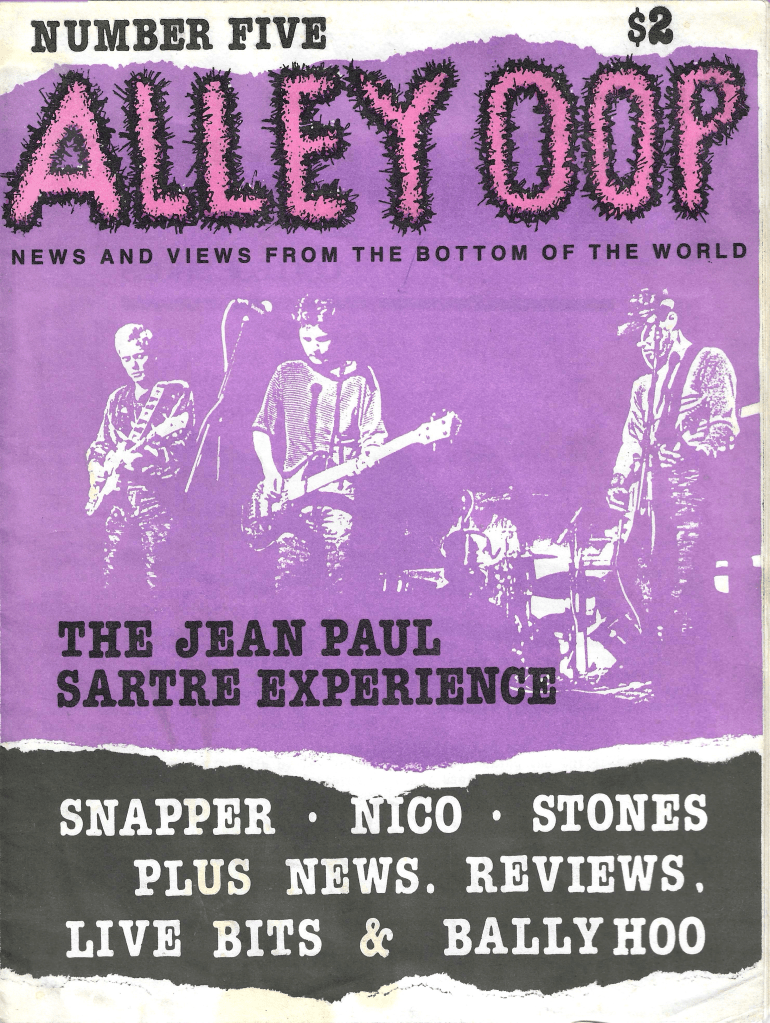
I’d wanted a copy of New Zealand’s Alley Oop for years, and so hats off and a big thank you to Brendan, who made it happen. Aside from Garage, which I’ll likely never see an original copy of, it was the NZ mag I’d most seen quotes pulled from and reviews swiped from, and upon the evidence presented here in 1988’s Alley Oop #5, there was ample reason for doing so.
While no formal editor is presented on any masthead here, at least judging by the amount of content contributed, it looks like Paul McKessar helmed the fanzine or at least was very deeply involved. He apparently got #me-too’ed a few years ago. Right away there’s a very NZ-centric gossip page, with some excited early Xpressway news. Heads-up is provided about the Dead C’s forthcoming The Sun Stabbed EP, and there’s some celebration of the fact that “sales of the Xpressway Pile=Up compilation have already exceeded some expectations”. Remember, if it sells 100 copies in New Zealand, that’s like 4 million in the United States. They also talk about an upcoming Xpressway tape of 1983 recordings by Christchurch’s The World, which didn’t actually happen until Unwucht put the stuff out in 2013.
This gossip column also hipped me to a Bill Direen & The Bilders comp from 1988 called Divina Comedia that I’m only just learning was a thing now. Then comes a trio of interviews; first up is the Jean Paul Sarte Experience. This is undertaken by Ian Henderson, brother of George, and the guy behind Fishrider Records, a terrific small label who has put out several records by Emily Fairlight, one of my favorite artists the past ten years. You’ll definitely want to check her raspy-voiced gothic Americana out, and move on to this one once you’d bought that. Snapper are talked with by McKessar, and Stones by Chris Heazlewood, an artist of deserved renown in his own right.
The reviews are fairly minimal in number, but of course the kiwis have outstanding taste. I was dazzled to see the rave for Tripod Jimmie by Bruce Russell (Xpressway/The Dead C); he loves the excellent and highly underrated A Warning To All Strangers, which he rightly says is going to be very hard to find. I barely saw it here, where I live in California, and they were from San Francisco. There’s some Pixies love from McKessar, and some slightly overwrought praise for Public Enemy too. Have I ever written about the time Public Enemy was playing UC-Santa Barbara when I was in college, around this very time, and “Flava Flav” was spotted in the middle of the afternoon, walking down Hollister Avenue in the neighboring town of Goleta wearing his big stupid clock around his neck?
McKessar talks about local live shows you’d have killed to see from Sneaky Feelings, The Puddle, Verlaines, Steven and Plagal Grind (!!). There’s a deep dive into The Clean’s Oddities 2 tape, something I actually once owned (along with an original Xpressway Pile=Up) and sold, because I totally hate cassettes. And perhaps best of all is K B Tannock’s obituary for Nico, who’d just passed away at age 49. It’s exceptionally informative, focusing mostly on her final ten years, and a little harrowing, as it contains a description of his (her?) interview with Nico in 1985. Our heroine is ravaged by heroin, as well as suffering from an inability to communicate, to hear in one ear, and to go five minutes without complaining about how badly she needed smack. We’ve written some about Nico’s interview foibles before on this site (here and here), but she really was something special and strange. (I still have yet to read this book about her, but I own it and will get to it one day).
In all, Alley Oop #5’s about as front-and-center a seat as you’d imagine getting to take at the Flying Nun & Xpressway tables as these labels were at or close to their heights. May they all eventually be lovingly collected somewhere as Garage was.
-
Subscribe
Subscribed
Have a WordPress.com account? Log in now.