-
Anorexic Teenage Sex Gods #7
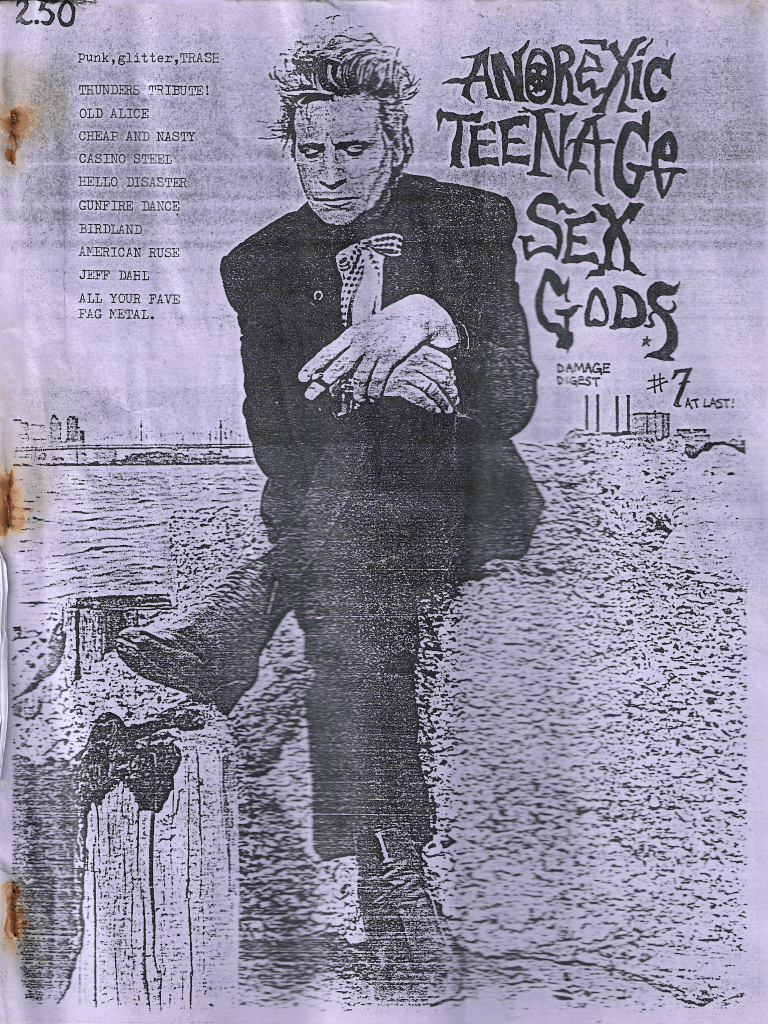
A real nice fella named Brian wrote to us here at Fanzine Hemorrhage not long ago and said he was doing some summer cleaning, and would we like a copy of Damage fanzine that he had laying around. We sure would! Lo and behold in the mail, Brian’s kindly-proffered package included no Damage, but rather a gratis copy of Anorexic Teenage Sex Gods #7 from 1991. I hadn’t been familiar with this Cambridge, MA fanzine, but it turns out that on their editorial masthead, they stated that they were, in fact, “The Last Rock N Roll Zine”. How about that?
Editor Gag Warlock and his co-editor “Frank” were very much of the drunk-n-loose glam/slam/rocknroll persuasion, the sorts of folks who worship Johnny Thunders and like it LOUD, sloppy and stupid. I knew these people well – I mean, not Gag and Frank, but this alcoholic jean-jacket & bandanas trash-glam-punk crew. I wrote a thing in the Where The Wild Gigs Were book some years back all about The Chatterbox, a San Francisco club for whom this lifestyle was their entire brand. And I supported it! I had so much fun with my fake ID at The Chatterbox, a melting pot of speed metal heshers, gender norm-challenging NY Dolls freaks, and loads of drunk women who yelled too much.
What do you know, Johnny Thunders has just passed away as issue #7 is getting pulled together, so there’s lots to talk about. The first piece is coverage of a Memorial/Benefit show on June 19th, 1991 just two months after his death. Then a an actual memorial/tribute from one of the Anorexic Teenage Sex Gods writers to St. Johnny, with a dissected top ten of the man’s greatest moments. Some deep cuts, too – “Short Lives” is #1 – I guess it’s a song that took the lead on this 45. You and I might have picked something else, I suppose, but let’s remember that it wasn’t our fanzine.
This is followed by two more Thunders tributes, one by “DJ Philly Phil” and the other by Kris Guidio. And then all this sadness makes way for some anger. Gag Warlock is pissed about “ultra-glam-fag-metal” types here in 1991 who are dressing up in leggings and who have followed in the wake of the success of Guns & Roses. Wait, were we still complaining about this in 1991? Come on. To me, that world was so Los Angeles 1987, yet for Gag, he’s upset how after G&R, “every doctor’s kid in the country became a street glam cowboy with a bottle of bleach and a rose tattoo, fade-to-bottle of JD and a full sleeve-job (a la Nikki Sixx). Leopard skin pillbox hats, cowboy ballads a la Roy Rogers or Bon Jovi or something; tight plastic Lip Service trousers and a totally whole lot of hairspray”. You know, I only follow about half of what he’s saying there, but I kinda feel like that Sunset Blvd ‘87-’88 look was mostly buried by then. But things can really, really stick in your craw sometimes, can’t they?
When they move on to reviews, they’re very much of a piece with each other: Jeff Dahl Group (lots of Dahl in this thing), Celebrity Skin (some excellent Don Bolles dirt about what an ass he was when he stayed at the writer’s house), Cadillac Tramps, and even some early 3-song EP by Pearl Jam that the writer not unsurprisingly sees as a Green River outgrowth, rather than the Monsters of Rock they’d become later that year (“Album will be out when you read this so buy it”). They also love The Gargoyles, who were unquestionably one of the Bottom Five worst bands I ever saw in my life. I said so in an early issue of my Superdope fanzine around this same time and lemme tell ya, the band didn’t like it!
Really, if you have the look, these guys at Anorexic Teenage Sex Gods are more than forgiving. There is, to wit, love for scarfcore from Nikki Sudden as well as for leather, cigarette and fog machine rock from Sisters of Mercy. But there’s a line that just can’t be crossed, perhaps that same line that got Gag Warlock so worked up about all the Guns & Roses follow-ons, so this issue has a couple of nice vitriolic takedowns of bands I’ve never heard of called The Glamour Punks and the Stars From Mars. Have to admit those are great band names, considering. Yet for all this discernment, our editors are not above calling someone a “Jewboy”. Even in 1991 we didn’t say that, folks. Toward the end there’s a Touch Me Hooker interview and some Alice Cooper hype, but at that point I decided to pull out my Torah scrolls and put on a Marissa Nadler record to quietly recover from all the glam/slam/trash-rocknroll-in-your-fuckin-face action going down here.
-
Raw Power #5
It’s been a little quiet around the Fanzine Hemorrhage blog for a few weeks, I’d reckon. This probably has something to do with me trying to modulate my reaction to just how badly I hate the internet in late 2025. I wrote a short essay about it called Opting Out Of The Rot Economy that you’re welcome to read, and perhaps take inspiration from. But there’s nothing in there that necessitates throwing the baby out with the bathwater and quit publishing entirely. This is the baby; social media is the bathwater, and that I’ve thrown out – so these posts won’t be promoted anywhere. They’ll just show up in your inbox if you’re subscribed – which you can do on the desktop version of this site rather easily if you haven’t already. If you’re not, they won’t, and someone will have to tell you about them, perhaps by calling you up on your telephone or by knocking on your door to spread the news.
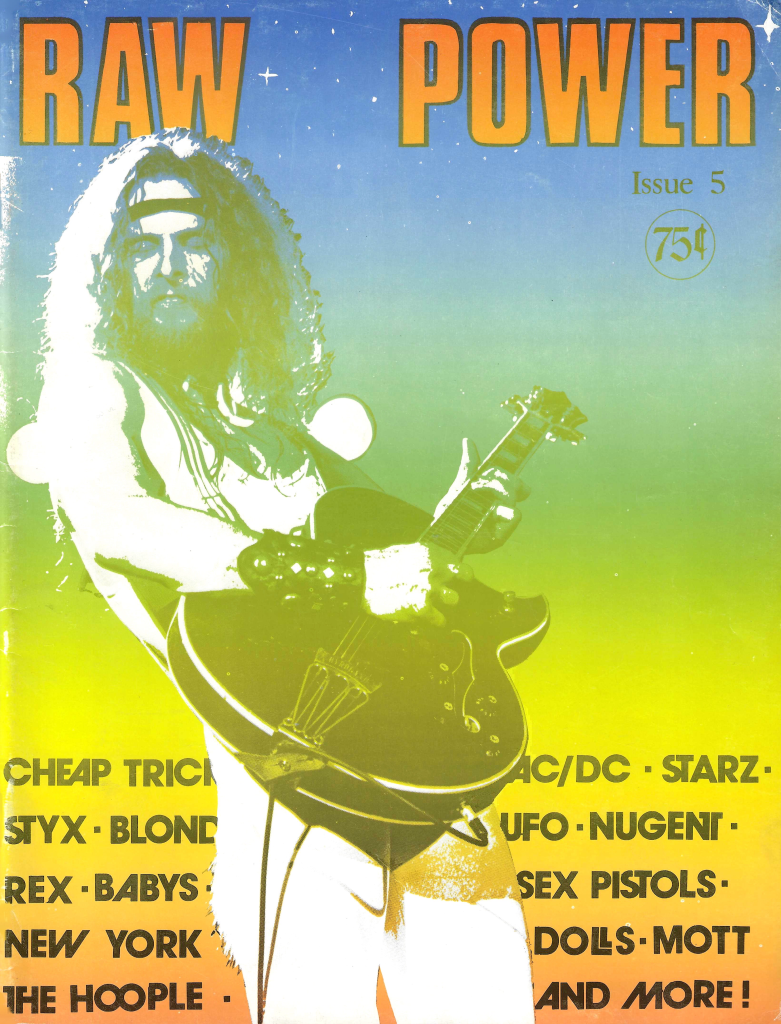
The guys who put out Raw Power #5 in Spring 1978 effectively had just those means for getting the word out, aside from dropping them into LA-area stores and getting blurbs in other folks’ fanzines. These was effective methods in 1978, given the growing number of underground American fanzines taking off in the punk era and the fact that record stores were literally everywhere, and the cooler ones even carried fanzines. But if you’re putting Ted Nugent – the fucking Nuge – on your cover, you’re not really aiming to have Kickboy Face of Slash’s endorsement, or perhaps it’s even still too early to care. After all, these guys say that Raw Power is “For REAL ROCK ‘n’ ROLLERS ONLY”. If it’s loud and has guitars, it’s fair game.
The editor was a young man named “Quick Draw”. His real handle was Scott Stephens. He’s excited about “the new bands” in his opening editorial, but a little upset as well: “The only qualm I have at this time is the way the kids are branching off into little clicks. A lot of new wavers are down on bands like The Stones and The Beatles. It’s becoming very fashionable to hate the 60s”. I’ll say! “It’ll be funny to me in 10 years when I hear the new generation putting down the 70’s. And believe me, it’s gonna happen. Things that are cool now won’t be cool in 1985”. I don’t know about that. I like the use of “clicks” instead of “cliques”, which I say is forgivable, because it’s one of those words you’d hear spoken way more than you’d see written back then. But I don’t remember much ragging on punk or the new wave or power pop in 1985 – despite my belief that that was kind of a lean year for rock music, it was a year when punks were turning metal en masse, and everyone still hated the same things about the 70s that most of us hate to this day (though I’ll admit the recent reverence for prog did take me by surprise).
Of course, I love quoting ancient editorials both here and elsewhere. There’s another by “Mike Livewire” stating “This year has certainly been one of the best for rock and roll that I can remember. Sterile FM ‘rock” and discoshit suffered some setbacks at the hands of the Rockers in 1977”. He even R.I.P.’s Peter Laughner later in the column!
Al Flipside writes in from Whittier and has a little tete-a-tete with Quick Draw about the modern relevance of Iggy Pop. There’s a nice Mott The Hoople history, a quick interview with Debby from Blondie – whom the editor addresses as “Blondie” on the phone and asks her (of course) about being a “sex symbol”, the term we used back then for someone of well-above-average attractiveness. I’m not sure the last time I heard it used, but it’s been a while. There’s an interview with Tommy Shaw from Styx – what? Howard Aronin has a pretty bleak comedy column reviewing phony records by real bands, through I almost cracked a faint smile at the idea of Kissongs by Kiss, a la Yessongs.
I did crack a true faint smile at this rant from Kim Fowley at the start of his interview with Raw Power #5: “I am the king of punk rock. I am the Adolf Hitler of stink rock. I am the rock n’ roll dog man. I don’t care what Slash magazine, I don’t care what Greg Shaw, I don’t care what Rock Intellectuals say. Fuck you all. Why? Because I am teenage. I am cobra. I am garganchua. I am an asshole, but I can say that and you can’t. The only reason I’m in business is because of the money I make and the dirty girls I meet, and eventually the amount of power I will have”. He hates The Dils, but thinks “The Weirdos and Screamers are interesting because they want to be interesting”. Wait, all you have to do is want it? Why didn’t someone tell me all these years?
I tried to get excited about the Ted Nugent interview, in which Ted tries really hard to be an unhinged wild man, but at the end of the day, he wasn’t one-tenth as much fun of a pompous narcissistic asshole as David Lee Roth was in his interviews, and Ted’s music was far worse as well. There’s a brief feature on AC/DC (“AC/DC: Austrailia’s Amazing Punks”, spelled as I typed it) and an interview with Angus Young. The reviews section is, like I said, all about white guys who play loud guitars, no matter the genre: Rush and Sammy Hagar and The Ramones and Metallic K.O. and New York Dolls reissues and Nazareth and Ultravox and The Babys. In their Weirdos Destroy All Music review, they say “I wish the Weirdos would record some of their other songs, especially “I Dig Your Hole – I’m The Mole’”. What now? Who knows this song?? Not me. I’d like to hear your bootleg of it.
Finally, there’s a brief column tracking the improvement of The Germs – “they’re not the world’s worst band anymore….but they still aren’t great”. And hey, here’s something I didn’t know before today: there’s an incredible archive of Raw Power issues online, as well as all sorts of information about an upcoming book project; a forthcoming seventh issue; backstories on the contributors and much much more. Go get lost in it, right now!
-
Sonic Viewfinder #1

Mike Faloon’s been orbiting my subcultural radar for a couple dozen years now; first, it was for the outstanding baseball fanzine Zisk, which he’s co-edited with Mike Fournier since the Miguel Tejada era. That still thankfully comes out with some regularity, and there’s a summer 2025 issue out now. They put out a book with some of their best material called Fan Interference some time ago, and if you’re a baseball dork like me, you’re probably going to want to read it.
Over the years I’d read between the lines and had gathered in various parts of their zine that both Faloon and Fournier were also very much “music guys”, but Faloon threw me with a great left-turn of a book in 2018 called The Other Night at Quinn’s: New Adventures in The Sonic Underground. It’s about moving during that time to a new small-ish town in New York’s Hudson River Valley with his family and discovering a local club in Beacon, NY called Quinn’s, home to improv and free jazz and regulars like Joe McPhee – whom Faloon has also recently co-written an oral history memoir for/with.
The Other Night at Quinn’s was sort of revelatory for me, as it came at a time when I was trying (and succeeding) to go three or four steps deeper into free jazz than I’d gone before. Faloon’s real-time reporting of his many nights at the club, picking apart his own discovery process, and musings about what he’s hearing all matched much of my own way of hearing this stuff. Plus, it gave me a laundry list of players to check out, which I did.
He takes that same careful, probing, asking-questions approach for this just-out first issue of a new underground rock fanzine called Sonic Viewfinder #1. For instance, he goes to see the double-bill of Famous Mammals and The Spatulas at Tubby’s near his home, only knowing anything of either band from fanzines he’s read. Whereas my approach to writing about such a show would be to pack 12-15 pithy sentences into two paragraphs, larded with praise and maybe a laugh line or two, Faloon instead stretches out his impressions, interspersing them with wandering-mind tangents, such as callbacks to other records or books or barely-related topics, before oh-yeah-right returning to the bands in a “review”. (For the record, he loves both, as do I – I saw the former play live myself just two weeks ago).
That’s pretty much what you can expect in the digest-sized, 28-page Sonic Viewfinder #1. The other two explorations are of musicians Damon Locks and Wendy Eisenberg, both more in keeping with the sorts of intrepid adventurers he wrote about with gusto in that Quinn’s book. The Eisenberg piece has me wondering why I’ve never gotten the Lasik surgery she did; perhaps I too could turn the experience of having done so into a double album. Faloon’s technique is a rare one in our content-addled, attention span-wrecking age. It’s one of consideration, questioning and humility – all worthy approaches, particularly when applied with care to hard-to-find music that deserves patience, reckoning and deep listening. Get a copy here for $3 if you want to see it for yourself.
-
Collected Ephemera – A New Thing To Look At
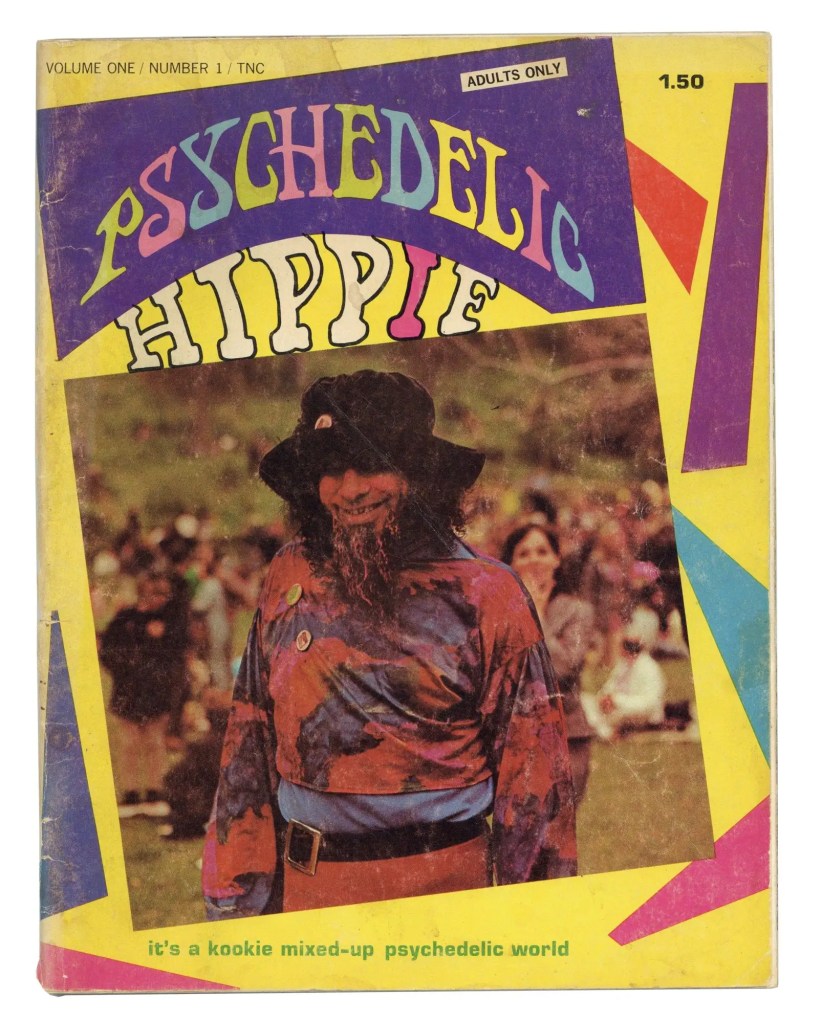
Hey, I wanted to let Fanzine Hemorrhage readers know that I’m by no means stopping what I’m doing here, but I also have a Substack that I recently created called Collected Ephemera. These work best by subscription, and you’ll get an email of each new post in your inbox as soon as I hit submit.
Collected Ephemera follows the same pathways this site does. It’s a deep dive into the paper, magazines and marginal collectables I’ve accumulated over the years, especially 60s & 70s political rabble-rousing, underground music, smut, hippy/biker stuff, postcards and much else. They are all sitting in plastic storage containers and, well, each of them has a story. I’m aiming to be one of the people who might tell that story.
Meanwhile, I’ve got a stack of interesting fanzines to write about on this site, but if you’re potentially interested in this other thing, you can subscribe to it right here.
-
Destroy LA #5

I’ve always wanted to own a different issue of this thing that has Circle One’s John Macias on the cover, because that guy was my hero. “Let’s Get Rid of Society”: an all-timer, am I right? “Destroy Exxon” is even better. Alas, I’ve only been able to procure this issue of Destroy LA #5, published in 1983 in Van Nuys, CA.
It’s a wild hardcore punk fanzine that is somewhat undercut by a cover tagline that you see here of “Alternative Beat”. This is explained. Apparently the FBI was after them for their Destroy LA name (say what? Fuckin’ Reagan!) and so they’ll be changing it. But thankfully “…Alternative Beat seems to represent us better”. This dichotomy plays out throughout this issue, as we shall discover. However, I have found no instances of any subsequent fanzine that existed under that name. Perhaps this is for the best?
Alan Brown, Lyn Carvelli and Dan Mazewski were both the editors and entire staff for this one. Not only did they crank it out with a press run of 10,000, they put out an LP compilation of many of the bands featured herein called The Sound of Hollywood. I remember this one, one of the many utterly terrible hardcore comps that came out on Mystic, but man what a cover! It’s selling for $58 and up on Discogs now, likely because of two acoustic Bad Religion tracks.
Yes, about that. This issue catches Bad Religion right as they’re gearing up for the release of their prog rock album with the outer space cover, Into The Unknown, an absolutely legendary record that was so poorly-received the band immediately stuck their tails between their legs, veered right back into punk, and called its follow up Back To The Known. In this interview, they are clearly already prepared for how hated they’ll be when Into The Unknown comes out.
Brett Gurewitz: “L.A. is gonna disown us….even if one person buys it we will still have our life together….all I know is if no one does like it and if it bombs we’re still not gonna be dead…”. Greg Graffin: “If we continue playing ‘punk’ because we’re guaranteed to sell 20,000 records, we’d be selling out”. (unneeded note: Bad Religion subsequently released several albums that have sold over 500,000 copies; earned multiple Gold and Platinum album awards, and won a Grammy). Graffin also uses an expression I really haven’t heard since I was in high school in the early 80s when he says “Our first record sold up the butt”. This is a phrase which inexplicably means “a lot”. We should bring that expression back, I’m thinking.
Much of Destroy LA #5 has ultra-tiny type and some sloppy printing that makes it a tough read at times, but I was able to make it through the opening interview with Red Scare and found that this goth punk band had a female singer, which I didn’t know. Bobbi Brat unfortunately died of cancer a mere five years after this interview. There are also interviews with Shattered Faith; F-Beat, some rockabilly thing; and what’s billed as a “newer music” band, Still Life. This band features a guy, Paul Lesperance, who was the blonde singer fella with the bangs in ‘77-’78 Masque punks Shock – yeah – “This Generation’s on Vacation”, baby! His new band really, really wants a record company behind them, to “get a deal”. Alas, it seems that their only appearance on any sort of record at all was, um, Destroy LA/Mystic Records’ aforementioned The Sound of Hollywood compilation.
Destroy LA #5‘s record reviews are brief, to the point, and I’m afraid are none too helpful. Regarding The Dream Syndicate’s The Days of Wine and Roses, the entire review is “A real promising band with a real good and fun stage show also”. This is followed by a page of MTV video reviews, including much of the new wave/synth pop stuff that I assume would likely have made up the bulk of any future Alternative Beat fanzine.
Finally, I’ll let you go with some tidbits from the interview with Watty of The Exploited. He has several important opinions worth noting: “Philadelphia was shit, it’s all Crass fans or wankers”; “Black Flag played with us in Britain, they were pure wankers”; “I hate (Jello) Biafra, he is a wanker”; “Chron Gen are wankers, they’re shit”; “Chelsea? Gene October is a faggot, a wanker, a poof”. He also won’t even let the interviewer start asking questions until he takes off his Crass buttons. Worth finding this one for this single page alone.
-
Street Life #2

You can see that my 48-year-old copy of this one has what we in the business call a bit of “toning”. Nothing to fret about.
Street Life #2 is another early punk/”street rock” Lisa Fancher fanzine, much like this one, but quite a bit earlier, maybe even a full year earlier. Punk rock’s evolution tracked like dog years at this point, where 1 month was equal to 7 months of new releases, groundbreaking shows, instant haircuts, musical osmosis and general scene chicanery. 1977’s Street Life #2 weighs in with a pretty impressive lineup of contributors, with Bob Morris as the actual editor; Fancher as the assistant editor and chief writer; and Jenny Stern aka the soon-to-be-known-as Jenny Lens as staff photographer. And even a letter to the editor from our hero Eddie Flowers in Alabama right off the bat, too.
You know, they’re actually calling that new sound of 1976-77 Street Rock in some places, which is marginally better than City Rock, I suppose. Seems to me the key band making waves in Street Life #2, aside from The Ramones, of course, are The Quick. The Quick! Like in the Screamers interview by Fancher with photos by Stern: “They came to LA hoping to make a splash when the entire scene consists of the Quick and….umm….the Quick”. Yet what I most enjoy about this early chat with Tomata and Tommy Gear is how it ends with “Be watching for a Screamers EP coming out on Street Life Records!”. We all know how well that went – about as well as Black Flag’s debut LP on Upsetter. (For the back story on the latter, I’ll just drop an amazing advertisement from No Mag at the bottom of this post; and The Screamers infamously never released a shred of music in their lifetime, always holding out for the better deal that never came).
For more inexplicable things that actually did happen, Bob’s “Beat of The Street” column talks about Kim Fowley producing a Helen Reddy record. Sally Dricks does a long hero-worshippy review of Bowie’s Low, and teenager Fancher, who also did layout for Street Life #2, throws in a large-font “best yet – LF” just to ensure her voice is also heard on the matter. There’s an entire column talking about the debauchery at a Ramones after-party at the “Screamers house” in Hollywood, and then another column flipping out over The Saints’ I’m Stranded. This is accompanied by a phenomenal Stern photo of The Ramones from that 1977 gig with Blondie at the Whiskey – this one. Someone make me a poster of that thing!
Sex Pistols land on the cover because the talk of the nascent punk world was revolving around the “bad words” they said on England’s Bill Grundy TV show in 1976. Given that these are fanzine people, there’s also a long Greg Shaw interview that allows him to expound upon his theories of musical evolution, the winds of change heralded by punk, the importance of fanzines, Peter Frampton and more. And then the big surprise as I’m going through it is how it all comes to a jarring halt with about 8 pages left to go, and morphs into record collector set sales and auction listings. This is something I might have expected from Goldmine, but not from an urgent fanzine from the streets.

-
Record Time #3

Record Time tracks, measures and elucidates upon the long tail of analog musical history in a manner unlike no fanzine before it. It’s not here to champion the “winners”, although some of what it champions are indeed winners. It exists to cover anything that you’d likely find in a thrift store, a shitty record store or at a garage sale, and that you’d likely be able to buy for the price of 1 or 2 Venti no-whip lattes. I gave a bit of detail on its modus operandi in a bit I wrote on Record Time #1, and now we shall briefly explore the latest issue, Record Time #3, because it could very well be the best of a fantastic trio.
Editor Scott Soriano has an omnivorous and over-active brain, clearly, and this has powered a record fetish that knows few bounds. He’s turned me onto so much treasure and trash over the years. His Crud Crud blog in the 2000s was the digital embodiment of what Record Time is attempting to accomplish, and I loved that thing so much that I made myself four outstanding mix CD-Rs from the mp3s I’d hoovered up from him back then. When he wants to go deep, he absolutely goes deep, as in the Plastic Bertrand-inspired records piece in #1, the Sex Pistols novelty & backlash records thing in #2, and this issue’s absolutely absurd and breathtakingly complete overview on mainstream artists who decided to dip a toe into “punk” in the late 70s/early 80s.
Like how could I forget Alice Cooper’s Flush The Fashion LP from 1980, produced by Roy Thomas Baker (!) and with a “punk party platter” of song titles like “Clones”, “Model Citizen”, “Nuclear Infected” and “Pain” (no, sorry, not this Pain). Or that The Tubes had a whiny song called “I Was a Punk Before You Were a Punk” that insecurely recites all the ways in which their mid-70s zany costumes and trash debauchery schtick helped bring San Francisco punk rock to life in 1976-77? And Soriano briefly relays the tale of Van Halen turning into Scottish punk band “The Enemas” for one night in 1977, a story you can read more about here. This is why we spend $15 on the mostly ad-free Record Time magazine, folks.
There are well over a dozen deeply-researched and well-written pieces in here by a plethora of contributors, so I’ll restrain myself to conveying a couple big highlights. “…The worst thing that happened in 1973 was a TV special and accompanying album which only those outside of a handful of die-hard diva fans and enthusiasts of shitty records know about: Barbra Streisand…and Other Musical Instruments”. Soriano then proceeds to describe this atrocity in painstaking detail, a record and TV special that seems to have almost totally disappeared from the Streisand legend. You must read it, and then you must watch as much of the special as you can handle. Those were different times.
Chris Selvig’s piece on and record-by-record dissection of Colorado 80s-90s improv-skronk destroyers Blowhole was quite welcome, and he even brings the band back together to rehash the good times over a microphone. Somehow I’d never known the story of boyfriend-murderer and 60s easy listening fox Claudine Longet, but “Johnny Sunshine” relays it all here, and in true Record Time fashion, also feels the need to assiduously evaluate the relative merits and demerits of each of her 99-cent LPs, currently sitting in bulk at a Community Thrift near you.
And look, I’m even in this one, briefly. Soriano sent out an entreaty last year to a few folks he knew, asking them to pick one 80s SST record from the 1986-88 glut that they like, but not the popular ones, so no one was permitted to slop out another paean to Sonic Youth, Dinosaur Jr or Bad Brains. I picked Das Damen’s Jupiter Eye, and I stand by it. $4.71 on Discogs. There’s a real cast of heavy hitters picking theirs here as well, including Gerard Cosloy, Tom Carter, Brian Faulkner, Bill Chen, Mike Trouchon, Ryan Wells, Karl Ikola, Chris Selvig and other top-drawer stars of the scene. Some picked the album I should have picked, but naturally no one picked Swa. Of course not.
“They” tell me that Record Time #3 is finding its audience more limited than it should be, which would be a goddamn crime. There’s really nothing else like it on the planet. Jarvis Cocker even writes for it. I don’t really know who that is, mind you, but he writes for it, and perhaps that’s all the inspiration you’ll need after my yammering to go seek this one out.
-
ChinMusic! #1
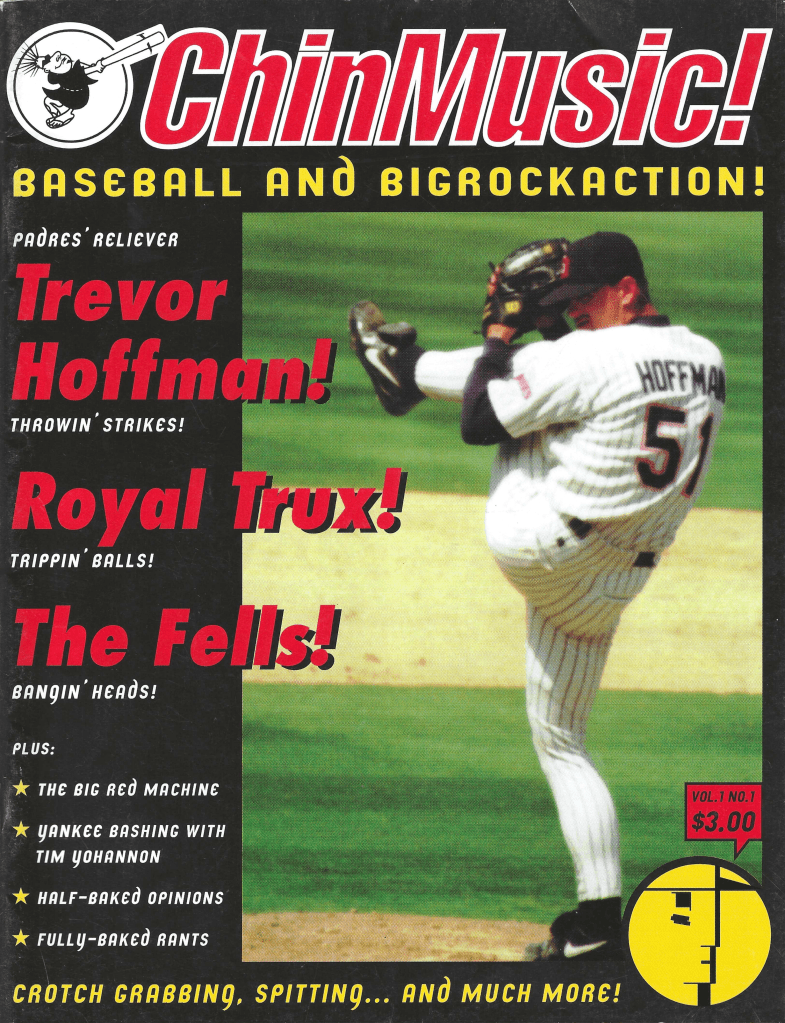
I remember my actual glee when I discovered this issue at Cody’s Books in Berkeley, CA in 1997. Baseball and punk rock, two of my lifetime passions, together in one fanzine. This was in the glory days of “the magazine”, no doubt about it. Cody’s had a magazine section that went on forever; just the underground music stuff alone was packed with your ChinMusic!s and your Pure Filths and your Superdopes. Man, when I was in grad school in Seattle during 1997-99, there was an even better magazine emporium on University Avenue that I’d while my time away in between classes. The place was unreal; every possible publication angle about every sub-genre was covered and available for purchase. My favorite was a golfing magazine targeted at hipsters/dorks, attempting to make golf attractive to the same sort of folks who enjoyed tiki bars and vintage 50s fashion. (No matter how hard I search Google for variations of “90s golf magazine for hipster doofus morons”, I can’t find this title). Or the computing magazine that put pornstar Christy Canyon and her internet-worker sister on the cover.
So why not a ChinMusic!, right? The Venn diagram of rocknrollers and baseball fiends overlaps far more than one might have thought – in fact, that’s the magazine’s entire stated reason for being, as explained in ChinMusic! #1’s opening editorial. It’s funny how often in this magazine – I also have other issues – that I’d come across one of their interviews with a big-league ballplayer and get totally excited that he was a punker, only to find that, like the great Trevor Hoffman in this issue, they’re really just music guys. In the way that we are “all” music guys and gals. “I got a little Van Halen, I got a little Alanis Morisette, Metallica’s in my glove compartment, I got a little Country music, I think you’ve got to be able to listen to everything”, says Hoffman. Everything, Trevor? So where are your Siltbreeze CDs and It’s War Boys mixtapes, then?
I know I was initially pretty excited, when I spied this mag, at the notion that Tim Yohannan, my bête noire, would be talking baseball inside. Humorless, pedantic Tim Yo talking about hating the Yankees and how to break in a new glove? Sign me up. And for what it’s worth, I personally interacted with Yohannan several times before his untimely death in 1998, and he was neither pedantic nor humorless at all; kind of a fun dude, to be honest! I was just scarred from all the teenage hours spent listening to his between-music struggle sessions on MRR Radio in the 80s, and feeling like he and Jeff Bale, Jello Biafra, Ruth Schwartz and “the gang” would have been the most insufferable people imaginable to spend five minutes with. But Tim Yo loathed the Yankees and he loved the NY/SF Giants – just like me. Does it bum you out like it does me that he passed away from cancer at the unripened age of 52, younger than I am now? If you’re my age, didn’t you see him as an “old guy” when he was around? It’s just a cosmic joke, isn’t it. All of it.
Kevin Chanel was the editor and prime idea man here, and he’d recently arrived in San Francisco from San Diego, hence some of the Padres-centricity here. There are two pieces in ChinMusic! #1 that really stand out for me: first, Chanel’s baseball water cooler blather session with none other than Royal Trux’s Neil Hagerty. No music, just ball. It’s outstanding. It reminds me of the sorts of multi-beer baseball nerdouts I’ve absolutely loved to engage in over the years with co-workers, family members and really anyone at all, blue collar to white, with sports being the great leveler and all that. Hagerty really knows his stuff, and it’s just a gas to read him talking about his beloved Orioles and whether Keith Hernandez will get into the Hall of Fame, rather than astral nonsense, drugs, and Brownsville Station.
Pete Simonelli contributes a piece about the mid-1970s Cincinnati Reds, specifically those 1975-76 “Big Red Machine” teams that were incredibly formative for me, Simonelli, Tim Hinely, the Zisk guys, Gerard Cosloy and probably several million others who were deservedly awed by them. Any chance I get to read about Cesar Geronimo, I’m going to take it. Darby Romeo interviews her dad about baseball; he probably wasn’t 52 yet either – and there’s a variety of music coverage that, like that of Great God Pan, is to my eyes very much secondary to the main event, which is baseball and its intersection with punk rock, even when it’s tenuous, tangential and maybe not even there, but we’re pretending that it is. Hey, the dude from Scared Straight, one of Mystic Records’ lesser lights, played in the pros – that really happened.
Funny enough, Chanel, whom I’ve never met, ended up marrying and procreating with Sunny Anderson (Girlyhead publisher, a delightful woman whom I have met many times, yet not for over thirty years). The two of them literally live down the street from me. It has been reported to me over the course of the past ten years that they have seen me running and/or walking the dog, and that their daughter knows who my son is (I mean of course she does, he’s Jay Hinman’s kid). And yet we’ve never once talked about Randy Jones or Broderick Perkins or Juan Eichelberger. When the time comes, well-armed with 50+ years of baseball ephemera and deep study through excellent secondary sources such as ChinMusic! #1, I will be ready.
-
New York Rocker #4 (September 1976)

I’d recently vowed in these pages to cobble together a ‘lil NY Rocker collection, and I’ve been making good on this important promise (to myself). Yet I’d never, ever seen any ones with this typeface, one of the first four mythical issues, in the wild – that is, until I came upon New York Rocker #4 and struck up a bargain with its seller at the 2025 San Francisco Art Book Fair. This 1975-76 era is one of my favorites for rock music writing due to its anticipatory excitement, with much undefined underground exploration in the air and on the fuckin’ streets, with absurd decadence and drug bottoming-out the norm. Nowhere was this more the case, of course, than in New York City.
I don’t really know a whole lot about cover star Cherry Vanilla, except that she was central to the first moment I ever become acquainted with “punk rock”, her famous “Lick Me” photo having been part of Time magazine’s July 11th, 1977 punk rock article that absolutely blew my mind and maybe scared me a little bit at the age of 9. Her interview here is sober, reflective and humble, and it’s a far cry from the she-devil harlot I’m sure imagined her to be when I saw that photo. Still not quite sure what she did in the grand social whirl of the time, though this bio is a start. This is followed by a Duncan Hannah photo sesh with Andy Warhol and Talking Heads at The Factory on May 26th, 1976, and then a terrific article & photos of John Cale at the Ocean Club in July ‘76, with one Lou Reed backing him up, and a hopped-up Patti Smith jumping on stage, unasked, multiple times to get involved.
Hilly Kristal, CBGB proprietor, pens an article about his own Live at CBGB Vol.1 comp, with special praise for The Shirts, Tuff Darts and Mink De Ville. Me, I’m just glad that there was a band called The Shirts at one point in history. They look like total street rockers with matching white jumpsuit/pant combos – outstanding. There’s an exceptionally catty gossip column called “Pressed Lips” by Janis Cafasso, whom I understand may have been Johnny Thunders’ girlfriend at one point in time and features in various Dolls lore I found online. I wonder if she ever did illegal drugs? Her column is a gem – honestly, this sort of real-time lens into at-the-moment scene machinations is a far better history lesson than anyone’s dimly-remembered memoir. Here are a few of her insights from the Bicentennial summer:
- “Where have all the groupies gone? Not much time from shaking go-go these days I guess. Money first, sex second. Tsk-tsk, calling Sable…”
- “By the way, Richard Hell, the king of crinkle (somebody please find him an iron) has gotten a new group and now for some serious attempts at sound??? God loves all the bewildered beatniks!”
- “Two nights in a row the Mael brothers, as in Ron and Russell, could be seen ogling little Tina of Talking Heads…”
- “Can we please put Bobby Blane, the new Dolls organist in a straightjacket and nail his shoes to the stage so he doesn’t have to offend the audience with his mincing and peacock strutting. Best quote of the evening in reference to Bobby Blane was from Wayne County who said ‘I just loooove the Dolls new lead singer’. And that about sizes it up. Two Mick Jaggers in the same group is a bit much!!”.
Great stuff, am I right? Just for some context, the David Johansson-led final-wave of the NY Dolls were running on fumes at this point; Johnny Thunders’ Heartbreakers were reemerging in a big way; and Richard Hell’s “new band” talked about here, post-Television, would of course be Richard Hell & The Voidoids.
But wait, there’s more. Victor Bokris has a short story called Coffee Shop; he’d go on to write biographies of several of the folks we’ve already mentioned here. Milk & Cookies get very defensive: “We just don’t want to be known as a wimpy, trite pop band”; “We’re not the Bay City Rollers”; “There’s some meat to our songs”. You be the judge! By far the most interesting piece to me, after the gossip column, naturally, is the deep dive by Craig Gholson with Richard Lloyd of Television. He talks about some early Television songs he sang, like “What I Heard” (great!!!) and an “X-rated” one called “Hot Dog”. He talks about the break he took from the band “to straighten out some personal problems” (i.e. drug addiction). He speculates what might be on their upcoming debut album; “Kingdom Come” is discarded for being too long and “Double Exposure” for being too old. Titles, too, have been rejected: See No Evil and Repeatinginging (whew on that last one).
And more! Sneakers from North Carolina (Chris Stamey, Mitch Easter etc) get what I imagine was probably their first interview; The Runaways get a dopey one as well; there’s a great posed photo of The Heartbreakers, we get a wacky check-in with The Ramones, already olde-timers by this point but still with only that first LP out; and New York Rocker #4 closes up incongruously with Lance Loud’s paean to Robin Williamson of The Incredible String Band, mounting a comeback or whatever you’d want to call it with his “Merry Band” in New York City that month. What a time to be alive, the quote-unquote old struggling to stay relevant and the new struggling to be born, and everyone still under 35 years of age.
-
Revolutionary Wanker #1

I hadn’t known this free 1981 San Francisco xerox zine existed until alerted to it by the good folk at San Francisco’s Groove Merchant, who seems to get his hands on just about anything and everything interesting these days. What’s more, now that I’ve procured my own copy of Revolutionary Wanker #1, I come to find that it’s a “Creep Production”, backed by the one and only “Mickey Creep” of Creep. How about that?? The editors listed on the so-called masthead are Naomi Batya and Robin Lande, about whom I can turn up very little on the internet, unless this is the same Naomi Batya who wrote a Hebrew folk tune at age 14 and grew up in Mendocino County, just north of SF? The dates for a San Francisco punk rock rebellion line up well!
This arrives at just the right epoch to document the uncomfortable gelling of hardcore punk and SF’s strange post-punk underground, the latter epitomized by Toiling Midgets and Flipper, and celebrated with relish in the Who Cares Anyway book. The Wounds, who played the 1981 Eastern Front fest in Berkeley’s Aquatic Park – the place that became my daily skip-work-early running route during the five years I worked in nearby Emeryville – with the aforementioned, are interviewed here. So are 7 Seconds. They were from Reno, and were basically children at this point, with no vinyl out yet and more shows in SF than in their hometown. They’d soon put out the Skins, Brains & Guts EP, with all-timers like “Racism Sucks” and “I Hate Sports”. Neither interview is particularly illuminating, and it stands to reason that the amount of intellectual effort expended toward Revolutionary Wanker #1 was measured by the monetary reward expected from it, which was quite little, given its price of $0.00.
To wit, “Joan Moan” writes a piece about poseurs, and how they’re “destroying the ‘scene’ from inside-out”. This essay is thankfully leavened by a nice unexplained “Flipper Rules Fools” piece of graffiti next to it. Naomi Batya – who, given this evidence, couldn’t have been the one to write that Hebrew folk tune, provides a poem called “Most People”, that ends with this stanza:
Most people I meet have fucking no brain
No wonder they consider me fucking insane
Believing what they’re taught that it’s wrong to use their head
Most people I meet they might as well be dead.Holy shit! Drop the fucking mic, Naomi. The address listed for this one, presumably where Naomi wrote these words, is 41 29th Street in the Mission District, about two miles from where I’m sitting right now. I know this house. Here’s what it looks like today. This debut issue ends with an interview with “two anarchists in the Haight”, who’ve asked to remain anonymous. I guess there was a group at one point who called themselves Mindless Thugs who embarked upon a terror campaign against Haight Street merchants, in response to being called “mindless thugs” in the first place by local media. Or something like that. I really can’t understand the coded insider language of 1981 anarchists, to be fair. And I really don’t get the connection to Creep magazine at all for this thing.
So, do I now need to own the other three issues of Revolutionary Wanker that came out after this? Is Ronald Reagan going to start World War III??? Of course I do. This is subcultural gold.
(BREAKING: multiple sets of all four issues of Revolutionary Wanker are for sale right here, directly from the source)
-
Subscribe
Subscribed
Have a WordPress.com account? Log in now.

