-
Bored Out #2

Ryan Leach is a gentleman whom you may be familiar with from his excellent label Spacecase Records; from the many interviews he’s published online with people whom I actually want to read about; and for being a super plugged-in guy with particular interests in 70s Memphis, 70s-80s Los Angeles and the current contours of the sub-underground. Our kind of fella, in other words. His recent interview with Eric Friedl on the Goner podcast might have been a bit of a downer, shall we say, regarding the fragile state of independent record production and distribution, but it was highly engaging nonetheless, and I came away even more impressed with Leach and his tenacity in the face of disinterest from the great unwashed hordes.
So I suppose that this second issue of his Bored Out fanzine from right now in 2025 is meant to be the sequel to his book of interviews, which presumably is now meant to be thought of as Bored Out #1 (right?). And like that one, most if not all of the material here started out online, where publishing is free, and is now available in print in a numbered edition of 100 (mine’s 22/100), which obviously has a sunk cost to be recouped. I’m here to tell you that you’ll be glad to have helped in these efforts.
The real standouts, comprising well over half of the issue, are the interviews with In The Red Records’ Larry Hardy and with Corporate Rock Sucks: The Rise and Fall of SST Records author Jim Ruland. Leach is an excellent asker of questions and knows his shit. He’ll insert his thoughts & views into the narrative when it makes sense, and god love him for his willingness to transcribe a two-hour interview. One reason I probably default to email interviews for my own fanzine is a regrettable lack of internal fortitude for the long, slow pain of transcription. Looking at his banter with Larry and Jim, it reminds me how much better a live chat is and why those interviews I’ve done in this manner are so, so much more interesting & readable than taking the lazy man’s pathetic path.
Larry Hardy, whom I’ve known personally for years, has a fantastic history of run-ins, releases and stories from all manner of interesting musicians, from Tav Falco to The Gories to the Cheater Slicks and beyond. Leach gets the most out of him, even given Hardy’s admirable lack of ego. Same with Ruland – man, I was a little suspicious of his SST book given that it was by “the guy who wrote the Bad Religion bio”, but I loved it; absolutely told the story as it needed to be told, with the best part being “the fall” of SST in the 90s/00s by far (Jambang, anyone?). Again, Leach, who knows a ton about SST and the world surrounding it, asks excellent questions, just shooting the shit with a fellow music freak. I have made a note to learn from his methods.
The remainder of Bored Out #2 is reviews of films and records, some of which you might have already seen on the man’s Tumblr – I know you’re all still on Tumblr, of course. East German films; Hardware; The Axemen; Robert Rental – you know. Power hitters. Get your copy here, and ignore the incorrect copy below the image; that’s Bored Out #1 that’s being deservedly touted.
-
Super Rock #2

Well, we had to get to Super Rock #2 at some point, right? Once I discovered the small plethora of punksploitation mags that came out in ‘77’-78, I made it a life goal to make sure I owned every one of them. Even Super Rock #2. (the others I’ve discussed are here, here, here, here and here). I will also have a New Wave Rock #1 report coming soon – I think those had been the final two punksploitation items I’d been lacking, a situation which has recently been successfully addressed.
To call the cover of Super Rock #2 “problematic” is severely understating the case, given that it’s a preview of a (pretend) gang-rape pictorial in which the Dead Boys are the perpetrators. The editors, Jeff Goodman and Christine Chestis, are falling all over themselves in the opening editorials congratulating photographer Glenn Brown on his fine work here documenting the depravity. Sure, his photos of the Dead Boys playing live are pretty outstanding, but that band was about nothing but the posing and the mastering of the “look”. “Modern Day Periodicals” of New York, NY (a name reminiscent of a mafia money laundering holding company) have a bit to answer for here, but….I suppose it was different times folks, different times. Just keep telling yourself that.
Right up front we’ve got two different gossip columns mixing up punks, rockers and Blondie (Deborah Harry, apparently, refuses to party and likes to sleep instead). They’re trying so hard for breadth that they overlap in their highly uninteresting stories about Iggy & Bowie, the Stones, the Ramones and Linda Ronstadt. But here I am thinking on my first read of Super Rock #2 that this is still mostly going to be a punk rock magazine, only to immediately stumble upon a Q&A with Natalie Cole, Nat King’s daughter, followed by a piece on Abba and then one on Fleetwood Mac. The incongruity between the cover and its contents is highly jarring.
So on that note, maybe my favorite piece here regards Lynyrd Skynyrd: all the fights they get into, their glutton-for-punishment groupies, and their generally high levels of pure stupidity. Some real crackers, these boys, and I mean that in the nicest way. I recently heard “What’s Your Name” playing somewhere and totally loved it, after loathing it as a child when it’d come onto my AM dial. The article talks about their newest upcoming song, “That Smell”. Whew, it sure does. Alas, this piece was published mere months before the band’s dissolution in the face of some pretty unspeakable tragedy.
The Ramones interview conclusively proves Dee Dee was no, um, rocket scientist either, but you didn’t need me to tell you that. Hannah Spitzer, who does the Ramones piece and whom we’ve highlighted previously, gets all the true punk-ish stuff in this issue: Iggy, Ramones, Dead Boys and the Television pieces (she loves Marquee Moon and calls it “real rock…with bone-tingling tightness” – I agree!). Bit of a reach here, but does anyone know anything about Ms. Spitzer beyond her fine work in the punksploitation mags? Maybe she’s still with us? Hannah, get in touch with the ‘Hemorrhage, we need to talk…..!
Love the full-color poster stuff in the middle of the magazine, starting with one of Keith Moon – also soon to taste tragedy – and Joe Cocker together, wearing goofy hats. Guaranteed to be left in the magazine intact! There’s also a hideous Grace Slick poster as well, same story. These went on no one’s walls, ever. Can’t say the same for the Bay City Rollers piece & photos, but you look at them now and hey, they were really funny-looking fellas, weren’t they? I’m just old enough to remember Roller-mania, epitomized by the repeat on-the-hour play of “Saturday Night” on KROY Sacramento when I was a child, and their ubiquity in every female-targeted pre-teen mag. Sha Na Na are here too, pimping for their soon-to-launch TV show, which I also watched at age 10. Look folks, we only had six channels in the 1970s. You’ll perhaps want to watch an episode yourself, right now.
So no, it’s not really a punk issue except when Hannah Spitzer’s around, for the most part. There are other things here on Willy and Toots DeVille; Talking Heads, in which the bass player is referred to as “Martina Weymouth”, the first time I’ve ever heard that anywhere; John Cale, Foreigner, Flame, Split Enz (who sport some exceptionally ridiculous haircuts), Derringer, Starz, Piper (helmed by Billy Squire); Harry Chapin, Kraftwerk, and Nite City, a Ray Manzarak outfit whom I’m utterly delighted to have never heard. Topping it off are some great Ebet Roberts photos of NY underground nightlife denizens. As with Rock Scene, there’s way more to an issue of “Super Rock” than you might have bargained for, and as with Rock Scene, after a flirtation with punk, they mercilessly tossed it fully and totally aside.
-
Damp #4
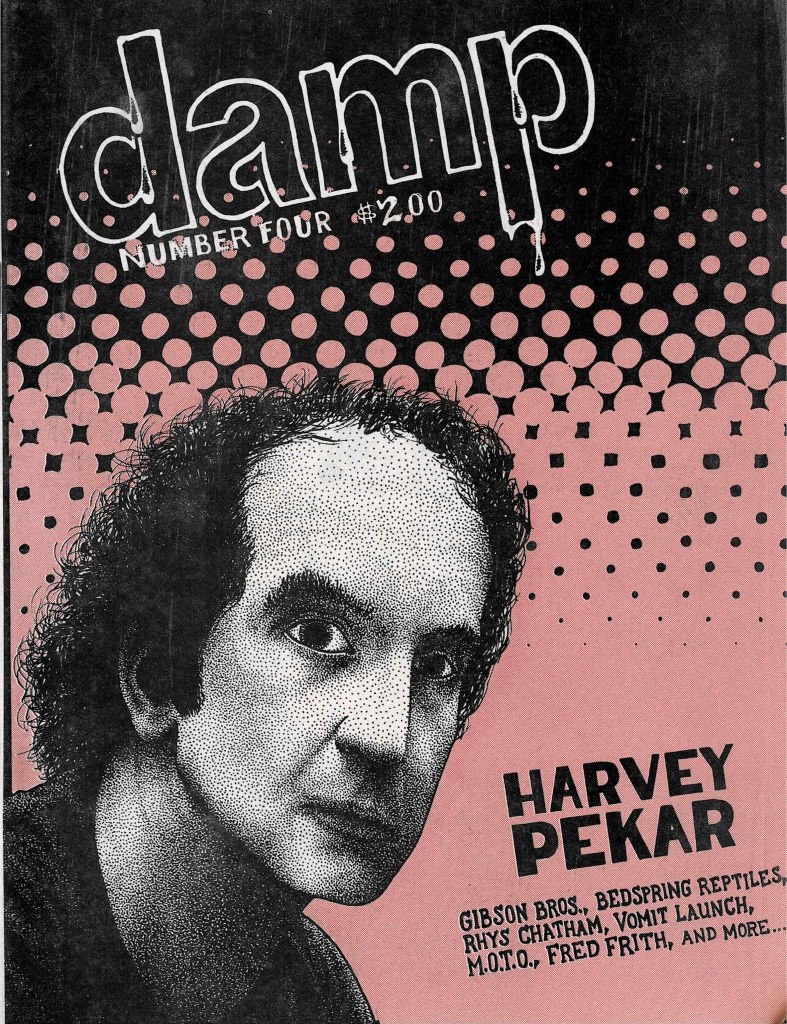
In my previous write-ups of Kevin Kraynick’s Damp #2 and Damp #3, and even though I talked about them in reverse order, I still noted the growth, wisdom and “maturity” from one issue to the next. I mean, maturity in a sense, right? We are talking about early twentysomethings publishing indie rock fanzines from their apartments. Yet by Winter 1989, when Damp #4 came out, Kraynick was a wizened professional. He’s still using that “dos command line” font every now & again, but now it’s being varied with a ‘lil Helvetica and some sort of proto-Arial font that I can’t place. Like I said, totally pro.
This was being assembled and composed from somewhere called So. Willington, CT, and surprisingly gets right to the meat of the matter with an early anti-George Bush essay by Michael “Spike” Anton. The back cover even has a Bush drawing in which one of his eyes has a holy cross in it and the other has a swastika. Brutal, brutal burn. Remember when Bush and, I don’t know, Dan Quayle – were the most evil Republicans you could think of? Wouldn’t you like to have those days back again in 2025? Politics does pop up from time to time in Damp #4, but really more as a hobby than as MRR-style rants, and actually, so does the National Football League (we call it the NFL). I thought fanzine dorks only admitted to liking baseball??
There’s a lot to unwind here, but my re-read of this one for the first time since maybe the early 2000s had me immediately heading straight to the Gibson Bros interview, which took place in 1988, just after the Homestead reissue of their Jay’s-top-50-records-of-all-time debut Big Pine Boogie. I like how guitarist/hero Don Howland tries to downplay that he was ever in Great Plains; Cut editor Steve Erickson’s name is repeatedly taken in vain, and a pledge is made by the band to never, ever play Boston again. Kraynick rather sweetly butters up his Columbus, OH-residing subjects with “Columbus seems like it would be a great town to live in. The bands are certainly top notch coming out of there.” (Much chuckling from DON and JEFF). Don: “On what would you base that kind of an assumption on, Kevin?”. Later Howland says “There’s probably forty people who do cool stuff here and they’re all sick of each other”.
Another interview is with the rock group “M.O.T.O.“. I’m not sure how it happened, but I went 35+ years without ever once hearing this band – perhaps willfully, based on descriptions I’d read – until I saw them at Gonerfest 2024 in Memphis last year. Well, I saw four or five songs anyway, and then it was time to go find some water or something. Mission accomplished. Mark Lo both gets his own column on cassettes and gets to do the Rhys Chatham interview. I like how it’s not the standard “fanzine Q&A”, like the pedestrian way I’ve always done them, but an actual article by Lo, with quotes and answers from Chatham interspersed as & when they are needed and/or required – the way a journalist does it.
There was a band in here I’d never heard of – the Bedspring Reptiles – and then I come to find they’re actually the Minneapolis band the Baby Astronauts, whom I was really into in the late 80s. They’ve just changed their name. Kevin drops a Department Store Santas reference (!) within his intro. A debut Bedspring Reptiles LP has been recorded and is being readied for release (note: it wasn’t). Obviously, you can tell from the cover that Harvey Pekar, Fred Frith and Vomit Launch are interviewed as well. Only one of these artists mentions and praises The Whitefronts.
I guess I can take or leave the mocking porno reviews, which are something Forced Exposure was already doing, but this is nicely offset by a much-needed glossary of Funkadelic slang and its translation (Thumpasaurus People = “foot-stomping hand clap Funkateers”), which I’ve now pinned to the microwave in case the Mothership disgorges the Brides of Funkenstein at my door. The review section, called “Big Ass Rock on Turd Mountain”, is full of ‘88/’89s brightest and its lesser lights. Kraynick provides his biggest props (and a nice little preemptive “scolding” to indie rock fans) for Last Exit. Unfortunately his next-biggest are for Prince, who is perhaps my least favorite mainstream recording artist of all time. And some of this is so dumb it’s great: for Pussy Galore’s Sugarshit Sharp, he says “Well, big fat boogies, if it ain’t another clatter clatter ding dong from the Boopsie Boys”. I suppose that’s one way to put it, isn’t it?
My copy even has a stuffed insert with 20 handwritten, one-sentence, mostly dismissive “late-arriving” record reviews, including the Nirvana and Mudhoney debuts. Damp #5 and #6 are even better than all of this nonsense, and we haven’t even covered those yet. Can you hang with me another two years, folks?
-
Flipside #30

I’ve discussed it before in this forum (here, here and here), but I’ll repeat: I believe my memory to be correct in that no one looked to Flipside while it was around as a place for “rock criticism”, nor as a place to have one’s mind blown and taste defined by the immortal power of its prose. Nay, Flipside in the 1980s was more a clubhouse, bulletin board, connection point and gathering place for teenagers, night owls and newly-minted punk obsessives – a place to get the Southern California-centric ground-level view of it all, straight from Los Angeles & Orange Counties, where everyone’s favorite bands (Black Flag, Circle Jerks, Adolescents, Fear et al) were from. Consequently, it’s those early 80s issues that I still have and cherish, and/or have acquired after the fact.
In the 90s Flipside served a similar function, even once the bloom had almost completely worn off the SoCal musical rose. Today, as I’ve tried to make clear in previous Flipside unpackings, their issues remain one of the single best collections of archival material we have to make sense of it all, and I enjoy the fanzine far more now than I did then. Because I love LA punk rock of this era more than I do my family, my country and life itself, I still find myself quite enraptured with the slamtastic goings-on in this Flipside #30 from early 1982.
This magnanimity even extends to an early photo of Rodney Bigenheimer with Unit 3 and Venus and a Shane Williams with letter from prison. But I’m more entertained by this era’s letters from punks complaining about scene violence, poseurs, Serena Dank and “Parents of Punkers” and of course about the outstanding Phil Donahue episode with “mothers of punks”. A guy from Jodie Foster’s Army (from Phoenix) writes in complaining about how messed-up & angry the LA scene has become, and about a fight he nearly got into with some lunkhead when his band played the Cuckoo’s Nest. Editor Al Flipside responds, “We know things are a mess, our scene has been invaded by lots of assholes, most of them big”. Someone named “Kansas City” writes in complaining about San Francisco’s punks, but then blurts out this curveball kicker: “I liked the Sex Pistols and all that other shit too, but that was more than three years ago, anyway, what are the Sex Pistols compared to The Minutemen and The Meat Puppets? Or Tav Falco?”. Kansas City, contact Fanzine Hemorrhage with your real name and coordinates, please!
There are a ton of random-passing interviews; because Flipside staffers were at all the shows; they’d just corner a band before or afterward and let the tape roll. Sometimes it yielded some quotables; often it did not. The Adolescents are back after a short stint with Pat Smear on guitar (!); an item a page later says Smear is going to tour with Paul Roessler to back up Nina Hagen on a world tour (!!). Can confirm! There’s an interview with local band Godhead, who had a 45 on the Bemisbrain label (who gave us Hell Comes To Your House) that I thought I’d never heard, then I just listened to it here and yeah, I totally know this one – and without a doubt, I have not heard this song since the 1980s.
Other early ‘82 groups interviewed included Fear; The Effigies from Chicago, RF7, Anti-Pasti and a brief Greg Hetson/Circle Jerks chat. New Order – yes, the very same – are being extremely difficult; Flipside #30’s interview with them is an interview of them saying they don’t want to be interviewed. They still snapped two smiling band member photos nonetheless (incidentally, I think New Order were fantastic around this era – listen). There’s also Modern Warfare, who get compared to The Germs and don’t mind in the least, and unfortunately TSOL and Crucifix interviews as well, both of which still remain unread 43 years later so that I can eventually apply those five minutes to charity work instead.
And look who’s on the cover. Salvation Army, who would change their name next year to The Three O’Clock, talk about an upcoming New Alliance 45 called “Blow Your Mind” that never actually happened, as well as a full-length album that will be called Looking Through The Walking Four O’Clock. This also never happened. On one of my podcasts I back-announced some early Salvation Army material and authoritatively remarked they’d never put out an album, and that this material only ever came out later as Befour Three O’Clock – you know, the one with “She Turns To Flowers”. My pal Nick corrected my dumbassery – there was a Salvation Army album, and the two records were one and the same. Singer Michael Quercio was known as “Rickey Start” at this time, and in this interview. Some real mythmaking going on in early ‘82.
What else? Scene reports! From Seattle’s” “The group I like and think has a lot of talent is Solger” – oh hell yeah. The Phoenix report talks about how Madison Square Gardens is likely to close because of (imported?) punk violence. The scene reporter – Michael Cornelius – is crossing his fingers it won’t be more of the same at the upcoming Black Flag/Saccharine Trust/Minutemen/Plebs show. Plebs fans were totally nuts! There’s a photo of The Flesh Eaters’ Chris D. standing with two fellas from Social Distortion. There’s just been a Masque Revival Night in February 1982 at the Cathay de Grande with Controllers/Skulls/Bags/Plugz/Arthur J & The Goldcups, put together by Craig Lee, at which attendees were instructed to dress like it was 1977, a mere 5 years earlier. What would you dress like if instructed to dress like 2020? I shudder to think. At said event, The Bags only played “fast stuff” and were purportedly amazing. I would have gone if you’d have told me about it.
Well, I just spent a ton of time flipping through my own copy of Flipside #30 taking notes in order to painstakingly capture the mood and the magic for you, only to just now find that you can experience it all yourself thanks to the Internet Archive. Enjoy!
-
Wiring Dept. #6
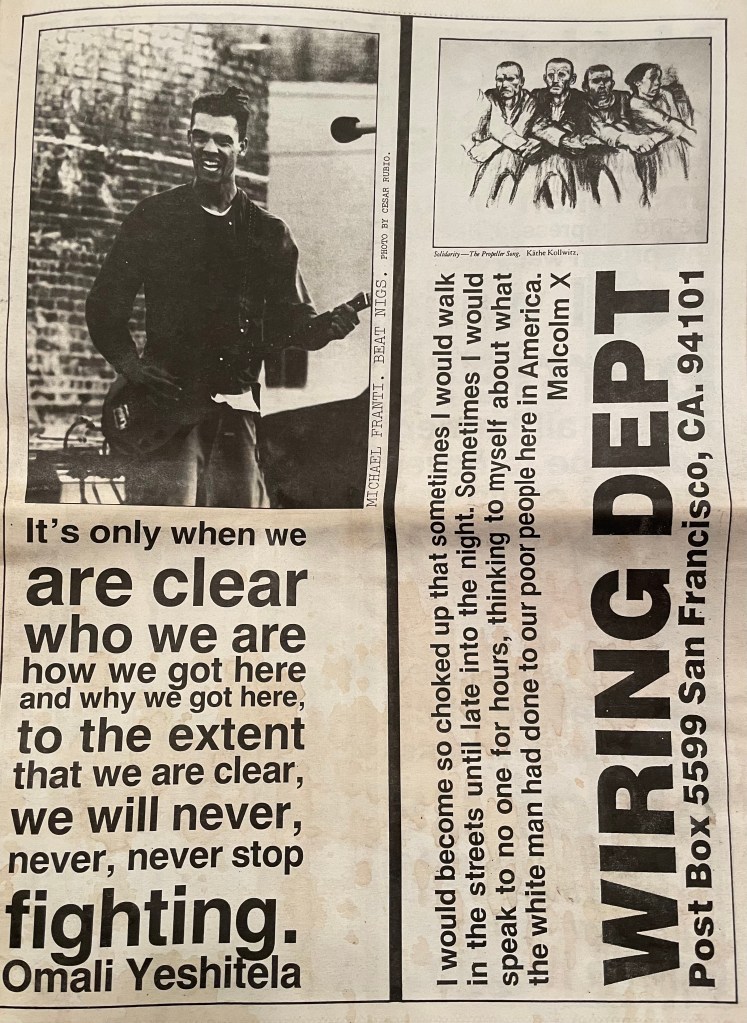
Frankly, I don’t have a ton of chronological information to go on here since the obscurant Wiring Dept didn’t provide dates nor issue numbers, but I’m pretty sure this was their sixth and final issue, and that it came out in late 1987. I’ve talked mostly positively about their 3rd and 4th issues here and here. I have another issue with Thurston Moore on the cover, and we shall discuss that in this space presently; and by “presently”, I mean it as Mark Twain used the term: “after a short time; soon”.
What kind of has this issue floundering a bit in my estimation – relative to earlier issues – is just how immersed editor Eric Cope has clearly become in radical chic and the de rigeur performative leftism that was endemic to its home base San Francisco at the time. I really think the only reason I became the bleeding heart liberal I am today later in life is due my utter contempt for the MDC/Jello Biafra/MRR force-fed feeding tube leftism of the 80s. Guatemala, El Salvador, Nicaraugua, Bobby Sands, Malcolm X, an important conference against racism, Huey Newton, Steve Biko, prison abolition poetry, Native Americans and European colonial penetration, the PLO: it’s all here, baby. It’s here and in the dorm rooms of my UC-Santa Barbara left-leaning brethren at the time, right next to the Che poster, the hacky sack, the gonorrhea antibiotics and the “One Love” and “Buffalo Soldier” records playing softly in the background.
You think I’m exaggerating? I am not. There are reverent photos of Jonathan Jackson with his guns at the Marin County Civic Center, where he died, and George Jackson, the hero, the Soledad Brother, the liberator of Angela Davis – and then a two-page spread for Huey Newton as well. I mean, yeah, I sort of dug the Black Panther mystique myself at the time (the leather, the guns, the chants, and they fed the little children of Oakland, too!), and no 4-year college journey of intellectual discovery at the time was complete without a little time spent coming to grips with Eldridge Cleaver’s Soul on Ice. Mine was completed, shall we say. But even so, I blanched when I read Wiring Dept. #6’s interview with sisters/artists Sue Coe and Mandy Coe, who have a new art book dedicated to Malcolm X and who talk incessantly about police brutality. You know, I always say it was MDC and Biafra who turned me counter-countercultural, but maybe it was this interview?
Anyway, the music content is lessened in this one as a result of having to shoehorn in all this important agitprop. But the music content is quite strong, as it was in previous music-dominant issues. Big Black are interviewed at the very end of their run in 1987. “Why is this your last tour?” “Because we’re breaking up on Sunday”. Santiago Durango was going to law school, but interviewers Humbert de Birck and Brandan Kearney seem to be trying to convince them to stay together, which we now know did not work. Steve Albini says: “When people who don’t understand what kind of music this is ask me, I ask them if they know what rock and roll is. And they usually say, yeah. And then I say, Imagine that, but with a lot of heavy machinery operating at the same time”. Also, the band expresses a deep hatred of the up-and-coming band Jane’s Addiction, who, long before they became famous, became deservingly embedded in my own personal lexicon as one of the absolute worst bands in the history of rock music. I’d say “You know, truly awful, like Jefferson Starship or Jane’s Addiction”. I stand by it!
There’s a negative review of “sellouts” Sonic Youth and their “9/28/87” show at The Fillmore on the Sister tour. This happens to be the exact same date that I saw them play one of the greatest shows I’ve ever seen, in Isla Vista, CA, also labeled as 9/28, and because two locales are a six-hour drive from each other – someone’s lying. David Katz talks to Adrian Sherwood; Sherwood describes what his music sounds like when his group plays live as “live funk dub” – then he says “Don’t use that quote. Don’t say ‘live funk dub’ – sounds horrible!”. Doesn’t he know that when you’re on the record and you say “don’t print that”, it’s absolutely gonna be printed? I’ll bet he knows that now in 2025, perhaps not so much 38 years ago.
Katz also talks to Wire in London, and it’s actually a really comprehensive overview of the band’s journey, leaning much more heavily on recent years, as the band back then were pretty reticent when confronted with their glorious past – you know, the first three albums that everyone wanted to talk about, instead of the recent stuff that they didn’t. There are also other chats with Stickdog, the Beat Nigs – a band so bad Jello Biafra loved them – Barnacle Choir, and Comic Book Opera, the latter of whom sound like something I’d go to see live for sure, if only I could teleport back to the Reagan era. There’s a review of a super-early Brandan Kearney/Barbara Manning-era World of Pooh live show at “Lipps Underground”: “singing like children who don’t want to wake their sleeping parents”. “Foot-shuffling, hunched shoulders, and staring are what pass for stage mannerisms in their rock show”. They ended said Lipps Underground show with a cover of “Gunboats” by Swell Maps. Anyone have the tape???
Most record reviews within Wiring Dept. #6 are by Kearney, in fact, and I’m pretty sure the ones that are not by him – by people like “Rosanguine”, “Curdleby”, “Stallwart Pool Trump” and “R. Pawnships” – are by him. His exceptionally positive review of Three Day Stubble’s Monster makes it pretty clear where he stands: “Remember that one person that was more pathetic than you in 7th grade? The one person you could actually look down on? Well, it’s 1987 now and it turns out that he was miles ahead of you all along.”
Bought at Rhino Records in LA for $2, sticker still on the back, and it has successfully traveled with me through the peaks and valleys of life’s rich pageant ever since.
-
Defiant Pose #8
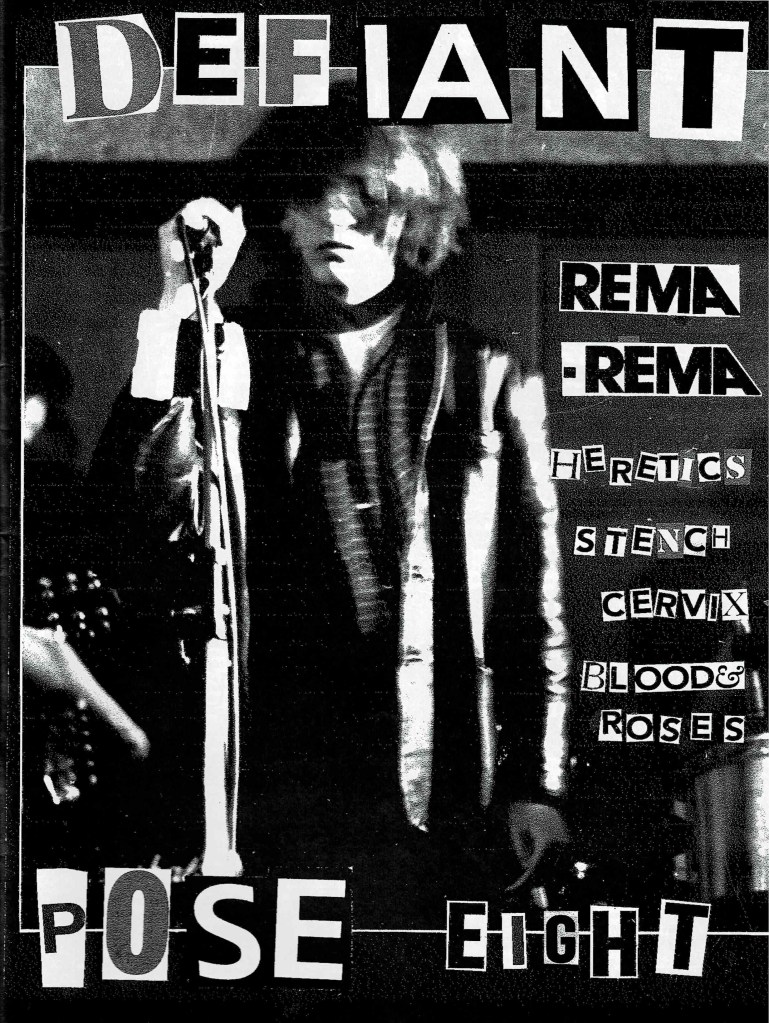
Defiant Pose #8 from 2014 was a punk fanzine, and it went to great pains to make sure you couldn’t forget it. Each page looks like something out of Sniffin’ Glue or innumerable other 1977-78 punk clarion calls: 100% cut-and-paste, cheap xeroxing and varied fonts. Like the “MacIntosh” had never been invented. Not that there’s anything wrong with that, right? Now me, I’ll tend to steer well clear of fanzines with interviews w/ bands like “Stench” and “Cervix”, neither of whom I’ve ever heard – because, of course, you can in fact judge a book by its cover – but Defiant Pose #8 transcended these transgressions quite impressively due to its core subject matter this time.
Yes, I bought this UK fanzine in 2014 because it came with a Rema-Rema 45. This was a late 70s UK band who’d only had that Wheel in the Roses EP to their name (the first record on 4AD!), a record that (to my ears) only had one notable track: the outstanding, eponymous, clanging post-punk juggernaut “Rema-Rema”. That track is so, SO special that I took a flyer on this mag + 45, and w–o-w. The included single International Scale/Short Stories was the best thing this band ever did, including all the stuff that came out after this, and you do need to hear it. That said, what I linked there is not quite the version on the 45.
Better still, Defiant Pose #8 gets some of the Rema-Rema gang back together for multiple interviews and fond reminiscing about the salad days of yore. Turns out, to no one’s surprise, they struggled to find their place in the proverbial scene, despite having Marco Pirroni from Siouxsie & The Banshees on guitar. Pirroni would shortly thereafter achieve world stardom playing “antmusic” with Adam and the Ants. It’s very possible that this collection of interviews helped to kick-start Rema-Rema fandom into gear again, as it wasn’t too long afterward that a full documentary was made about the band that I haven’t yet seen.
Michael, the guy that put this one out, is a true punk rock archivist/lifer and it shows in the absurd amount of flyer reprints in this one and in another issue I have (#6) that focused on LA punk. He runs a record label called Inflammable Material that is fuckin’ punk to the core. There are still other issues of Defiant Pose available (here, too) if your interest is piqued.
-
Hot Spit #1
When I was involved in Southern CA college radio in the late 80s, we at KCSB always kept a watchful eye on any other California stations that might be as cool as ours. KXLU in LA – no way. KALX in Berkeley – perhaps. KFJC in Los Altos Hills – absolutely. The one I was especially curious about was KDVS in Davis, just outside of Sacramento. You’d think maybe not with that one, given its location, and yet every time I’d meet a DJ from that station at a show or elsewhere, that person would know far more about underground music than I did. I’m thinking both Sharon McKenzie and Karl Ikola in particular; the former ran Hecuba Records and turned me onto Bill Direen & The Bilders; the latter would go on to run Anopheles Records, and was & is a guy who knew just about everything about everything psychedelic, raw and strange.
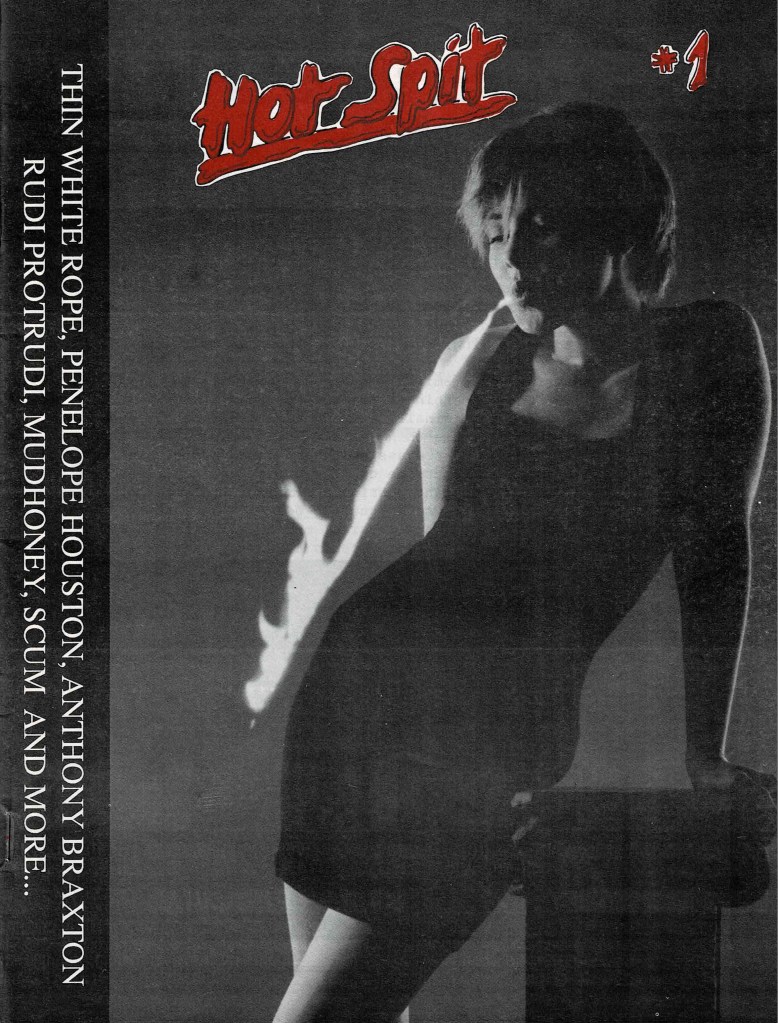
Ikola didn’t write for Hot Spit #1 in 1989, but Sharon McKenzie did, and so did some other heavyweight names from greater Sacramento that I’m very familiar with: Brian Faulkner (still does a fantastic show on KDVS to this day, and whom I interviewed in my own Radio Dies Screaming #1 last year); Jed Brewer (he’s in mesmerizing psych shamans San Kazakgascar); and wow, Ted Verani, whom I used to work with at two different corporate jobs over 20 years ago. The zine was edited by Bill Smith, and while his opening editorial lacks a fair bit of depth (“That’s kind of the way it is with alternative music. It has always been a little different. Hot Spit brings you that something different”), the overall package is just fine – even with the subtitle for the fanzine being “The sizzle of alternative sounds”, and the cover looking like what might result if you handed off art direction for your fanzine to the one college art major sophomore you happened to know. Alas, Smith died quite young, as I’ve just discovered.
There’s an Anthony Braxton interview by Damon Cleckler, which takes place in Braxton’s office at Mills College moments after he’s just finished teaching a class there. He really gets him talking! They cover AACM, Stockhausen, Braxton’s writings and, most importantly, whether or not he’ll be getting tenure at Mills and be able to stay on in Oakland. I checked Wikipedia and it’s looking like he didn’t, which is probably why Braxton and I never went out for beers during those years or saw a Thinking Fellers show together.
Also a good Penelope Houston interview; she’s actually a bit bemused that there’s still a cult of The Avengers out there; she also does a nice call out for Mary O’Neil of the Wannabe Texans, a pal and hero of ours here at FH and a woman who’d later go on to form Virginia Dare. Our man Verani interviews Rudi Protrudi of The Fuzztones. Verani says “A lot of the bands that were playing with you – The Morlocks, Telltale Hearts, the Chesterfield Kings – have all disappeared, and Protrudi humbly responds “They’re all dead and gone. We buried them”. Gross! And it wouldn’t be a good Davis-area mag without a Thin White Rope piece; along with True West and Game Theory, they were the patron saints of greater Sacramento’s alterna-whatever throughout the 80s and into the 90s. McKenzie writes a puff piece on Mudhoney, Brewer tries to wave a flag for Voivod, and many marginal independent releases of ‘89–’90 are given the once-over. Hot Spit #1, folks!
-
NY Rocker #18

I’ve recently come into a gaggle of older issues of NY Rocker, and thumbing through them, I’m even happier about my minor acquisitions than I’d thought I’d be. At least on the evidence presented by NY Rocker #18 from April/May 1979, this not-really-a-fanzine tabloid newspaper was even better in its earlier years than it would be a couple years hence. I’ve talked about issues from that later era here, here, here, here and here. And I’ll talk about other ones that sprang from ‘79/’80 in the weeks to come, as I traverse them. This shall take time. For now, let’s see what was happening in the world of underground NY/LA/SF/London during the Carter years.
First, there’s Howie Klein reporting from San Francisco. Sigh. I can’t throw a stick at a fanzine from this period without encountering the guy. If you’re not a Clash fan, and I’m not, it’s hard to wrestle with hyperbole such as Klein’s blather when he sees their 2/7/79 show in San Francisco: “This was undoubtedly one of the best shows ever seen in the Bay Area…..”. If you don’t know which side of the true punk vs. corporate schmuck divide Klein stood on – or at least which side he was (rightly) perceived to be on – there are these gems from the same piece: “Rock super-promoter Bill Graham – the only major concert promoter in the U.S. to give strong and consistent support to the new wave…” (Bill fucking Graham!!) and dissing the grass-roots punk/all-ages organization called New Youth who got The Clash to play this cheap, for-the-people gig in the first place. “…the band (got) involved with New Youth, a group of mostly idealistic (like starry-eyed at best, and in some cases, simply psycho) young fans who believe in non-profit punk rock gigs. So they got The Clash to commit themselves to doing a benefit for them at a deserted Jewish synagogue between the Peoples’ Temple and the Old Fillmore in the heart of San Francisco’s black ghetto. A cheap ticket price and the opportunity to see the band in an unseated funky venue…caused a dramatic slump in ticket sales in what should have been the band’s biggest and fastest sell-out. As it turned out, The Clash came pretty near to selling out anyway….but not before a lot of rock-biz upset between the Graham Organization, Epic Records and Tapes and the William Morris booking agency”.
The horror! You can see the sort of scene mechanics that actually stressed Klein out in 1979, and why he ended up being so utterly reviled by music-focused underground aesthetes at the time, unfair as it perhaps may have been, considering one’s perspective and degree of oppositional defiance.
More irony abounds in a Sandy Pearlman interview – he produced The Clash’s Give ‘Em Enough Rope – “The Clash themselves will do virtually nothing to make it. In other words, they will not accommodate themselves to the rotten, debased, commercial system of exploitation that currently exists. The Clash do not wish to make any compromises”. Totally! On the flipside is a paean by Doug Simmons to truly underground Boston band The Neighborhoods and their singer David Minehan. I didn’t much care for the band, once I finally heard them, but my 9th grade best friend Jon Grant had just moved to San Jose from Massachusetts, and his brother had been close friends with Minehan. I’d hear all about The Neighborhoods from Jon, and seriously, I felt pretty special at age 14 knowing a guy who had a brother who was friends with a guy in an actual performing punk band that I’d never heard.
Oh, and the Beach Boys stuff in this issue is just fantastic. There’s a Greg McLean interview with Carl and Dennis Wilson of the Beach Boys, as well as a Harvey Kubernik sidebar about a recent BB book. McLean clearly isn’t a fan of Dennis Wilson: “his frequently crass and unexpected comments often cut Carl off mid-sentence, and he dropped the name of his new girlfriend, Christine McVie, whenever possible”. McLean retaliates and agitates them by only asking questions about Brian Wilson: where is he, tell me more about Brian etc. This does him no favor with the brothers. Dennis says, vis-a-vis the Dr. Eugene Landy thing, “Brian is loved dearly by all of us and us by him, and all that bullshit about him being manipulated is just….not in my experience…”. McLean then goes on to bait them further about Mike Love being an asshole (a certified fact, from what I understand), and then talks about a Beach Boys show at Radio City Music Hall in ‘79: “Between songs, Love babbled aimlessly, killing any sense of pace the show might have established. Mike Love looked old and foolish”. Everyone loves Mike Love, don’t they?
So this issue is absolutely packed, and I could write reams about each piece – but there are like, 20 pieces: The Shoes; a thing on young Boston and NY radio DJs and stations; Viv Stanshall; The Raincoats; The Only Ones; and a really early piece on The B-52s, circa their Rock Lobster 45, with great photos of a very young band and an interview by editor Andy Schwartz. Even so, NY Rocker would sometimes give space to mainstream music-lovers like Ken Barnes. He writes a thing about how much he loves disco, even in 1979 (the year of Disco Demolition Night), and says, perplexingly, “It seems to me that a lot of people are quite scared about disco, and they’re lashing back with unreasoning venom. An interesting observation by Mark Shipper pertains here – for years during the 70s rock lull, all the right fanzines clamored for the return of fast, exciting beat music kids could dance to. Now it’s here and kids dig it…but because it doesn’t follow the form the clamorers grew up with, they’ve turned on it viciously. Ironic, wouldn’t you say?”. I mean…..that’s one way to look at it?
Finally, and I feel like I’m skimming here, but there are great reviews of recent “rock concerts” by The Contortions, Nico, The Knack (who are absolutely buried by Don Waller), and The Ramones with their special opening band Lester Bangs’ Birdland. NY Rocker #18 comes to an outstanding close with Jeffery Vogel’s fake “TV Guide” listings that shit mercilessly on every upcoming show and on every NY band – especially the Dead Boys. Now that’s some vitriolic mirth-making that we at Fanzine Hemorrhage can get behind, anytime & anywhere, even from 46 years ago.
-
Not Fade Away #4

Not Fade Away #4 showed its face in 1985, only a mere five years after the previous issue, the Not Fade Away #3 that I talked about here. It’s a pure and heartfelt celebration of raw Texas rock & roll sound, with nothing past 1970 talked about; it’s focused squarely on the sixties punk and blasted-out psychedelia that had the Lone Star State marking itself as the pinnacle location for both forms. Doug Hanners was the guy who made the fanzine happen, and he was a first-rate devotee of garage rock, yet was also clearly into documenting Texas’ hillbilly and rockabilly musics this time around as well.
Right off the bat there’s a Texas Archive Records ad on the inside front cover, promising that a new “Flashback series” is coming – I thought that would have to be the amazing Texas Flashbacks comps, but no, it’s a different set of records entirely. Hanners was involved. There’s a great early discussion about the band The Blue Things, and the feature talks at length about a 60s radio station with immense wattage called KOMA out of Oklahoma City. Its signal was so strong they’d announce live shows each night that were happening from Bismarck, ND to Plainview, TX – in case listeners in those areas needed something to do. I love that stuff. When I was growing up in San Jose, CA, I was able to pick up a Tijuana, Mexico AM station called “The Mighty 690”, with the 60s DJ “The Real Don Steele” still holding down the fort at night. That’s a long way from San Jose, folks, and was totally fascinated with these transmissions from another world. I was also able to pick up KFI from Los Angeles, and I can still sing their jingles, teasers and stingers to this day.
Not Fade Away #4 took a similar approach to that of Ugly Things in putting forth every known detail about a given short-lived 60s band, and interviewed any living members willing to talk. Rather unlike Ugly Things, however, Hanners and his crew opted for relative descriptive and discussion brevity in most cases. They have a couple of killer ones here for sure – The Sparkles, whom you may know for “No Friend of Mine” and “Hipsville 29 B.C.”, and The Stoics, who did the awesome “Hate”. The latter band also had bodyguards pulled from the Capinch motorcycle gang, and I learned that they ultimately had a falling out because “half the band wanted to go in a Kinks direction, and the other half in a Stones direction”. Let’s call the whole thing off!
Other interviews are with The Golden Dawn, who bond with Hanners during their interview over their mutual distaste for the first Red Krayola record. There are short pieces on The Remaining Few, The Sherwoods, The Lavender Hour, Sea-Ell Records, and a great longer piece with Weldon Rogers bantering with Hanners about West Texas music in the 1950s: radio stations, record labels, regional music, country, hillbillies, Ernest Tubb and more. After the three pages of reviews of Texas 45s and reissues – again, nothing post-sixties allowed, please! – I gazed upon a cool ad for Austin’s Mediaphile Performing Arts Books & Magazines, a store that could (probably) not exist now. They’re advertising “The Roky Erickson Story – over 200 xeroxed pages of newspaper articles, record reviews, interviews, posters etc. With discography”. Here’s what little I could dig up online about it. I’d buy that for a dollar! Even in 1985, they’re wanting $25 for it.
This issue concluded the run for Not Fade Away – four outstanding missives in ten years. Truly essential 60s punk scholarship here, and probably the germ that helped so many of us realize Texas’ unsung but outsized contributions to the greater culture during that decade.
-
Fuz #1

I first became aware of fuzz-drenched “biker rock”, 60s biker films, and the music of Davie Allan and the Arrows when that Angel Dust comp came out way back in 1988. Pretty goddamn revelatory! The Arrows very quickly became a touchstone band for me, and over the course of the intervening 37 years I tried to pick up any reissues or unearthings of their instrumental madness that I could. I’ve mightily enjoyed much of the crazed post-60s stuff Allan’s done as well, particularly his 1990s resurgence with blistering 45s like Chopper/Open Throttle. Always got a good laff out of his poses in his latter-day photos – tough, mean, unsmiling and still pissed off about the way Mike Curb treated him in the 60s.
Fuz #1 sort of functions as the best Davie Allan & The Arrows “book” and discography we may ever get, despite coming out back in 1997, even before the Devil’s Rumble 2x compilation finally writed many wrongs and got Allan’s music to the people. Though the Arrows stuff in here is not even novella-length, it’s at least a strong retelling of how Allan and his group became the in-play session men for teen exploitation films from American International Pictures and how they were shepherded through a variety of projects by young Hollywood mogul Mike Curb, later a California lieutenant governor. I’ll never forget when CA governor Jerry Brown was out of the county once, Curb, his elected-but-not-appointed lieutenant, pulled an Alexander Haig “I’m in charge here now” move, and started vetoing bills and making appointments himself, thoroughly pissing off the Democrat establishment and prompting immediate rule changes.
Anyway, Fuz #1 was the brainchild of one Seth Wimpfheimer, and Seth’s the guy who takes on assembling the Allan piece, which is 2/3rds of the mag. Packed with storytelling, photos, movie posters, asides and old radio station charts – “Blues Theme” was #1 across many west coast stations in late 1967! – his Allan piece only really lacks an interview with the man himself. I will assume it was not for a lack of trying. There’s a great late 60s group shot of Allan, Curb and a gaggle of young-&-beautiful Hollywood singers, actors, musicians and actresses. The dude on the far left is Doug Moody, identified here as an A&R man (which he was). You may know him better as the proprietor of Mystic Records, generally thought by many to be the worst hardcore punk label of all time.
Gudrun Müller contributes the other piece to this fanzine, and it’s a celebration of 60s exploitation actress Mimsy Farmer. Müller can’t really “keep it in his pants”, shall we say, yet he puts together an excellent overview of her filmography and the usual sordid Hollywood BS that kept her both working and not working. I know I’ve seen Riot on the Sunset Strip and Devil’s Angels – both of which she was in – but if I’m being honest, it’ll be tough for me to complete her filmography as I really can’t find the brain capacity to devote to exploitation cinema in 2025. There was once a time, but that time is no longer.
All of Fuz #1 is on thick, glossy pages and it’s a real treat to hold and caress. As one does. My understanding is that Wimpfheimer never made a Fuz #2, but if you know differently, please let us know in the comments.
-
Subscribe
Subscribed
Already have a WordPress.com account? Log in now.
 Fanzine Hemorrhage
