-
We Jazz #6

Just a couple of years ago, a Finnish jazz label called We Jazz ambitiously decided to start a journal-sized quarterly publication about – you guessed it – jazz. They packed it from day one with a breadth, depth and visual style unseen before in a jazz publication, to my knowledge, very much non-fusty, of our times and “jazz in the 21st century”, while absolutely trussed to jazz history, especially 60s avant-jazz and beyond.
I ordered the second one, which they called Pursuance, a year or two back, and instantly knew this was going to have to be a regular – albeit an expensive – purchase. I’m still something of a neophyte jazz listener; I certainly know what I like, and I even do an irregular jazz podcast called Jazz Libertines – but there are loads of missing gaps in my knowledge that this publication is helping to fill, including what’s happening currently. I really have only regularly followed the Clean Feed, Astral Spirits and Rune Grammofon labels, and any jazz Soul Jazz puts out, and even those I can’t keep up with at all. Too many hobbies, always my cross to bear.
So I’m looking for guidance and shepherding and right now the We Jazz journals are just that. They’re up to 8 editions of this as of this writing, and it’s enough of a professional concern that the label is now offering subscriptions. This issue I just finished reading last night is the 6th, and it came out in Winter 2022 and has the title Revelation.
So you indie rockers and fanzine heads will know the names Peter Margasak and Bill Meyer, both last talked about in our pages here and here, respectively. They’re heavy contributors of both features and reviews; Daniel Spicer, who writes for The Wire and many other places, is as well. Mostly it’s Scandinavians, so there’s a strong Scandinavian slant to the jazz that’s covered – which is great, because my exceptionally uninformed opinion says that most of the wildest and most interesting stuff happening in jazz the last 10/15 years has been happening there. While there are exceptions, the jazz that’s covered generally starts with stuff that’s a little “out” or moderately experimental, and carries on to music that’s 100% free and improvisational. Nothing smooth or fushiony here, far as I can tell, although no question I’ve followed some of the trails they’ve painted for me on Bandcamp or Spotify or whatever and found them lacking – but as we say in the business – that’s jazz, baby.
We Jazz is a beautiful and tactile magazine: thick paper, color photographs and artwork, professional photographers and an overall sense of care & feeding, while still capturing enough of the fanzine ethos by being written by true jazz heads, casually and almost entirely free of dictat and dogma. #6 has terrific pieces on Pharoah Sanders, 60s/70s label Black Jazz Records and this amazing Sun Ra: Art on Saturn book that I just reserved at my local library. That’s the stuff I personally knew a little bit about; Francis Gooding also writes one of my absolute favorite record reviews in ages about the Horace Tapscott The Quintet release, very much questioning its provenance and motives for multiple paragraphs, while boiling down whether it’s any good or not to the final sentences (note: it is).
Then there’s a plethora of deeper dives both visual and journalistic into other realms – and it’s important to note, it’s not always jazz they cover here; for instance, the Nyege Nyege Festival in Uganda, put together by these guys. It’s otherworldly, raw electronica for the most part. And this issue continues the photographic exploration of “Tokyo jazz joints” and record collector haunts across the city, though I think they’re running out of material here – the first one was amazing and had me Googling flights, but now, four installations in, I reckon it’s run its course.
Listen, I’m leaving out way more than I’m telling you about We Jazz magazine. As long as you’re willing and able to “pay the freight” for these, as it were, I think they’re pretty fantastic and likely exceptionally collectable in their own right. Not that we’d ever buy something like this for that reason, though, right?
-
Slush #2
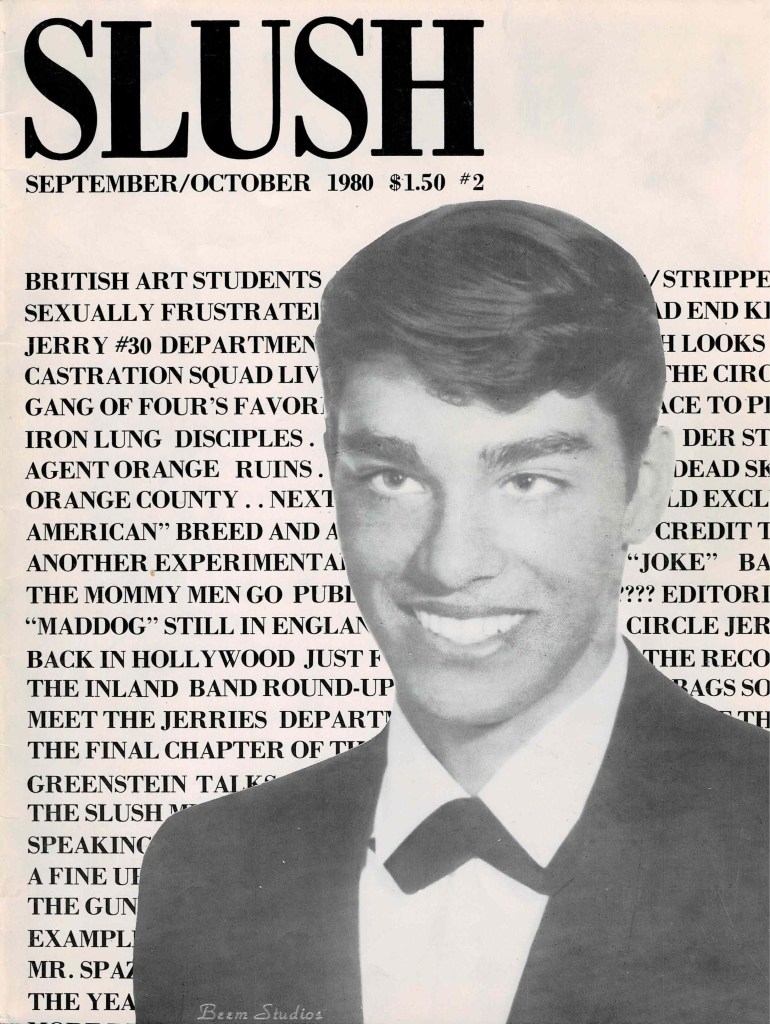
I’d truly fashioned myself as about as much of a ‘77-’83 Los Angeles punk/underground collector, snob and scholar as one who wasn’t there might possibly be, but somehow I’d not been told the news that Masque founder & proprietor and Scottish punk gadfly Brendan Mullen had his own outstanding early 80s fanzine, Slush (!). If it weren’t for the online fanzine store ZNZ I still wouldn’t know about it, yet when I spied Slush #2 sitting on their digital racks and got a gander at what it was all about – Mullen’s semi-ridiculous Slash magazine “parody”-cum-scandal sheet-cum-straight-up, punk-reverent fanzine, well, I did what anyone as weirdly obsessed as I am about this era might do. I pounced.
And it’s even better than I expected, this Slush #2. I thought it might be short on content and long on snark, but it’s actually long on both. Better still, it’s good enough to be respectively deemed a worthy LA extension of the godlike Slash, and nearly as informative, opinionated and certainly as on-the-ground and in the center of the maelstrom as Slash was. I mean, Mullen’s the guy that gave the first-wave LA punks their playhouse. He didn’t slink away after it was shut down; in fact, he was a drummer in multiple bands himself: Geza X and The Mommymen; Arthur J and The Gold Cups and Hal Negro and the Satin Tones. He even famously – and it’s referenced here – served as Black Flag’s singer for a gig or two between Ron Reyes and Dez Cadena, though I’d have to check the record on that again to confirm that it was more of an in-joke than a tryout.
On the cover is a high school photo of Eddie Joseph, later of Eddie & The Subtitles and someone lionized here as an all-around great guy. Inside we have a promise that the magazine “can only come out every two months (realistically) instead of monthly as had originally been hoped”. The magazine, I’m afraid to say, never came out again, but not before promising a third issue that would feature The Urinals, Vox Pop, East LA “punk in the barrio”, “The Screamers movie”, Russel Mael, Don Bolles and much more. If I’m wrong, like I was ignorant of this fanzine’s entire existence, and this did come out, can someone please let me know?

There’s a big essay up front called “Is There, Isn’t There Punk Rock Violence?????”. I was absolutely prepared for an anti-LA Times piece (it is that) and lots of “I swear, I hate cops, to the max” equivocating, but no – Mullen pulls a surprise rabbit out of his punk rock hat and basically says, yeah, it’s pretty out of control right now, and he sets his target straight at Huntington Beach, or the “Aitch Bees” as he calls them. It’s actually a fairly responsible essay, written by an adult, a man who’s very much excited for punk’s continued evolution but who sees the seeds of its eventual destruction already germinating.
But Mullen celebrates Orange County two pages later with a very excited piece called “Orange County….California Screamin’…The Fourth Wave”; Mike Patton, truly of the OC (and also of The Middle Class), gets in his long own Fullerton/Anaheim scene report, with mini-features on pretty much every band that calls themselves a punk band and who maybe played a gig in a garage.
The Bags have broken up. There’s another nail in the first wave, and Mullen provides the obituary. Craig Lee of said band – weren’t we just talking about him? – provides the world’s first look at brand-new band Castration Squad with his ex-bandmate Alice, and (sigh) Tracy Lea, referred to here as “Little Tracy”. Lee also provides another intro to The Gun Club, “a brand new band who’ve maybe played only six or seven gigs and as yet have not established any audience”. Germs have broken up, too – Darby’s working on establishing The Darby Crash Band, and would, alas, be dead within 3 months. AND we get to see who that new Black Flag singer is who’s not Mullen!
So yeah, it’s all very exciting and another glimpse into something I’d have given my proverbial eye teeth to have taken part in. Maybe I could’ve saved Slush when Mullen put out that call for contributors….maybe I could’ve saved Brendan….maybe I could’ve saved the scene itself….

-
Slash, Vol. 3 No. 1 (January/February 1980)
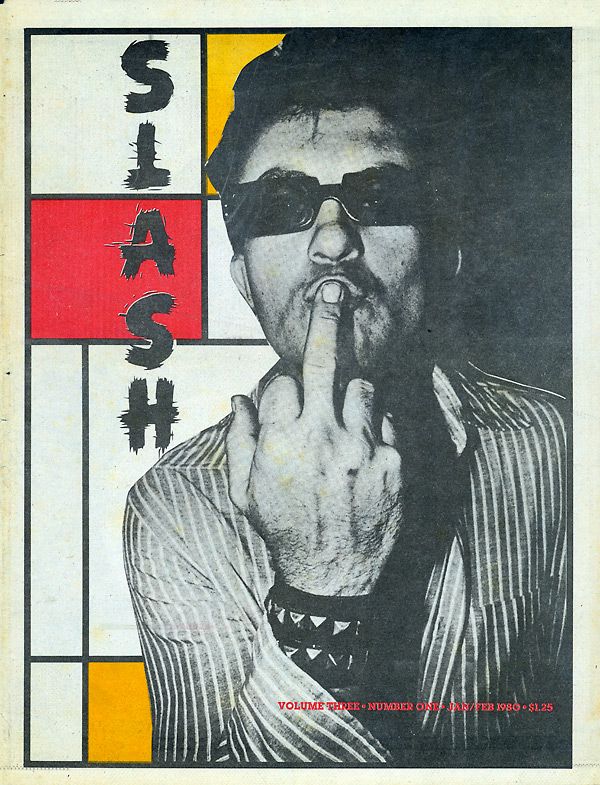
Ringing in a new decade with Lee Ving’s “salute to the 80s” on the cover, the first issue of a new year of Slash is absolutely phenomenal. It would, alas, be Slash magazine’s final year. Now I’ve said this before, and said before that I’ve said it before, but this is my all-time favorite fanzine. I put together an entire tribute issue of my own fanzine dedicated to Slash, which you can download here – just so you know where I stand and all. At some point we might talk about each issue in these digital pages.
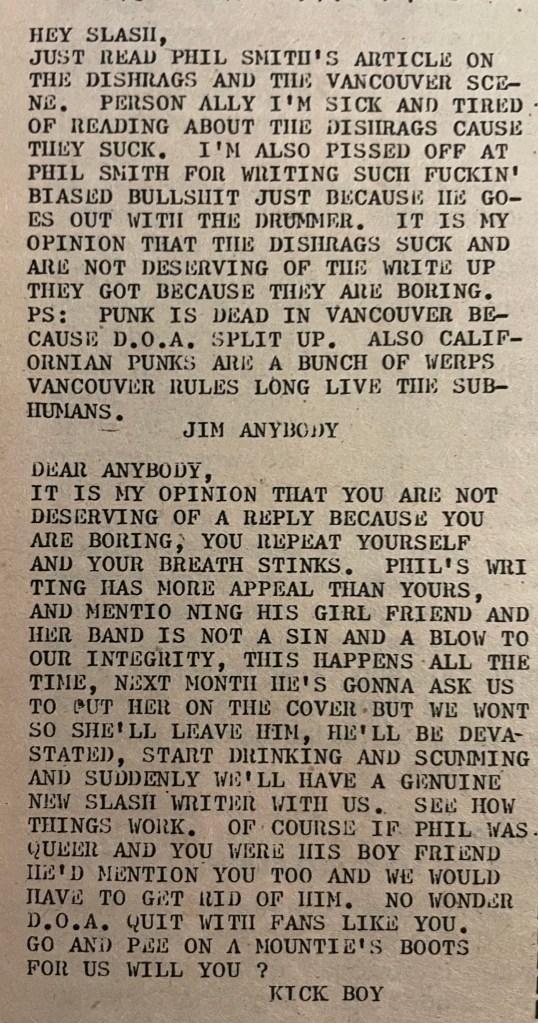
Let’s start with editor Claude Bessy, aka Kickboy Face. Kickboy was so artful in his bon mots in response to letters to the editor, and often even humble and friendly to Slash’s analog correspondents if he felt they’d made a particularly insightful point about the magazine, the punk scene or a particular band or club. However, sometimes he was less than charitable, and those were the best. See the scan at the bottom of this post.
By this time, Slash was not as solely focused on Los Angeles as it was punk and underground rock writ large – what we now call “post-punk”, you might say. They were not calling it that then, if you can imagine. If someone interesting came to town, they were getting interviewed. This issue brings Joy Division and Psychedelic Furs interviews; I think we can all agree that the latter, on their first album, were quite alright! Slash says “Their music sounds like a fight between The Velvet Underground and The Stooges against Roxy Music and X-Ray Spex”, which may be a bit of hyperbole, I’m afraid, but try listening to “Dumb Waiters” and tell me you don’t dig this era of the band. Slash were also really into the Two-Tone UK ska bands at the time – there’s an interview with Madness here – and I have no beef with that either, not in the least. I nearly sobbed with joy when I saw The Specials do this in 1980 on Saturday Night Live on a rare night my parents let me stay up, so don’t let me hear you talking down to the rude boys and girls.
For a moderately underground publication, the roll call of acts interviewed in this issue alone who are now on t-shirts worn by millions is pretty stupendous. Bob Marley talks with Kickboy. I told you about Madness, Psychedelic Furs and Joy Division already. The Buzzcocks. The Fall. And thankfully, LA stuff too – “Catching up with The Bags”, a band who’d been around for over two big years by that point. There’s an interview with beach punks The Crowd, as “beach punk” was becoming quite the thing.
And oh my, were there some crazy bills the previous month in LA: The Fall / X / The Germs / Suburban Lawns one night; Black Flag / Fear / The Urinals / The Last the next. This issue also includes long reviews of brand-new records out that month: London Calling. Metal Box. 20 Jazz Funk Greats. New Picnic Time. Kickboy does a very admirable job with The Clash record in particular, neither knocking them down too far nor buying into what they were trying to sell by that point – mostly he makes fun of the praise that he knew would be heaped on this 2xLP by folks who couldn’t even whisper the word “punk” eighteen months earlier. He was spot-on. And loads of these fine reviews were by Craig Lee of The Bags, whose stint as a lead writer at Slash didn’t really last all that long, but he did go on to write about music for the LA Times before leaving us too early in 1991.
I mean, every issue of Slash is this good, not merely for the immense envy it provokes in me for those of you who were going to these gigs and buying these records in the immediate moment, but for it being what someone called “a towering giant of literate, eye-popping, on-the-ground Los Angeles punk rock reportage and graphic design.”
This same scribe says,
“These weren’t merely Hollywood party people who were getting drunk and puking on the cops – though they were that! – this was a loosely-assembled collection of exceptionally talented writers, photographers and graphic designers who saw the opportunities this subculture provided them to cleave off entirely from the dominant Los Angeles narratives of the day (sun, cocaine, easy vibes, The Eagles, Fleetwood Mac, Steve Garvey, tennis, Hollywood filmmaking) and create something dark & exciting, something that truly subverted the proverbial “dominant paradigm”.
So we’ll go with that as a summation for this one, and see what we can come up with next time we bring one of these around the ‘Hemorrhage.
-
Caught In Flux #6
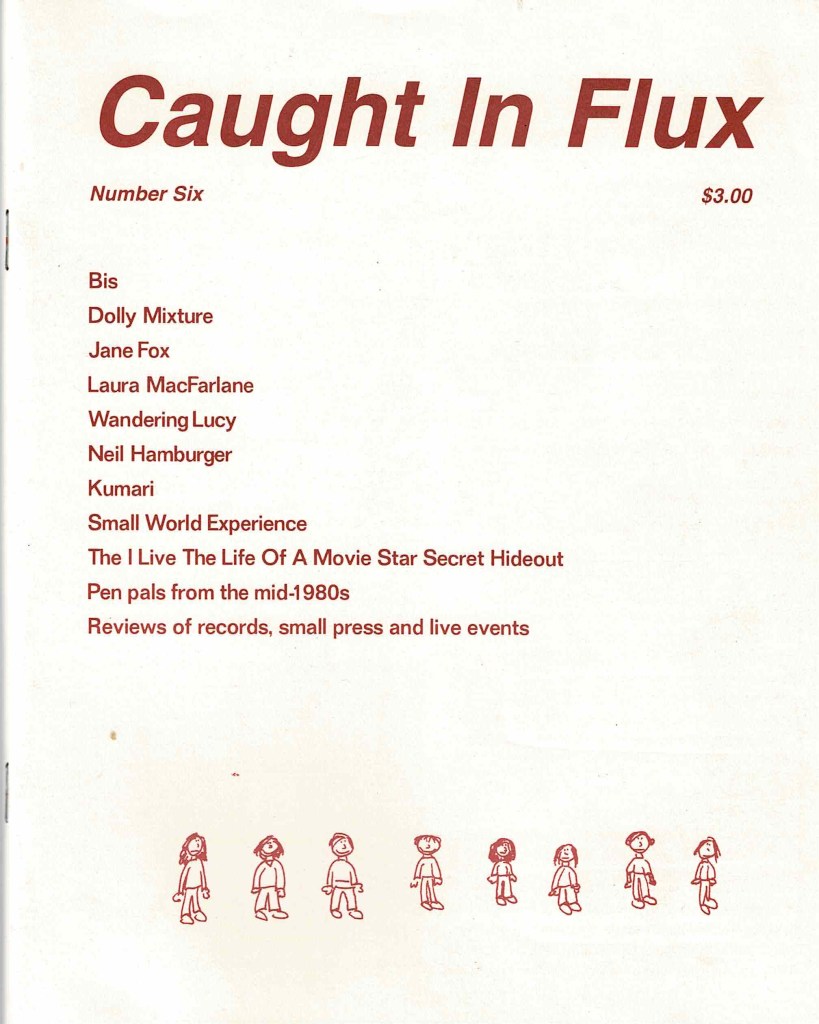
Mike Applestein’s a “lifer” in the wild world of music fanzines, straddling multiple decades of deep indie/insider fandom with Writer’s Block, Caught in Flux and the very recent Silent Command. (We talked about the latter here). Like a great many insular scribes, Applestein turned his attention to online writing as one century gave way to another, only returning himself to the glory of print in 2022. Because his focus was so heavily lasered-in on deeply obscure pop music and mine wasn’t, I’d really only skirted his stuff for most of the 90s, until getting to know him a little better as an “internet” writer later on.
Seasons change, people change and all that, and now, reading Caught in Flux #6 from 1997, I get the sense that Mike could make me one hell of a mixtape from all the weird nooks & crannies of the sub-underground pop world from that time, and now I’d probably like it. But so much of it is greek to me: Beanpole, The Cat’s Miaow, Honeybunch, The Softies, The Three Peeps. Singles and LPs that I rapidly flicked past because they were pink, or had cartoons, or the band were wearing dopey sweaters or whatnot. Or maybe they had names like this issue’s The I Live The Life Of A Movie Star Secret Hideout. And hey, I’m not saying I’d necessarily like any of it now. Sometimes I’ll do a deeper online dive into the indiepop world and come up with nothing but kelp and crud; and yet sometimes I’ll pull up a Jeanines or something equally wonderful.
Yet Mike and I definitely overlap on so much of the post-punk 80s stuff he’s been such a champ in championing: Young Marble Giants, which I already talked about here; but also this issue’s two jumbo Dolly Mixture interviews, which finally helped illuminate the mystery of why The Mo-dettes were consistently slagging them in their interviews, and just who the fetching Dolly Mixture track, “How Come You’re Such a Hit With The Boys, Jane?” was about. Among many other things, of course. Catching a band only 15 or so years after their time means memories are fresh enough to be recalled but also that wounds are distant enough to heal. And it’s really great to see an au courant 90s interview with mostly ignored Australians Small World Experience, whose Shelf-Life Siltbreeze reissued not that long ago.
There had been a really thriving set of fanzines tackling these worlds throughout the 1990s. I remember Maz from The Mummies had his pop magazine Four Letter Words; Tim Hinely plowed many of these fields with Dagger; there was (and still is) Chickfactor, of course, and I’m sure there were many, many, many others. All of them have much to teach us, but reading Caught In Flux #6, I think Applestein was really setting some of the terms for the scene here, and expanding it to encompass a pretty healthy variety of micro-genres. He’s still got a few available here. Guess where I got mine.
-
Chatterbox #4
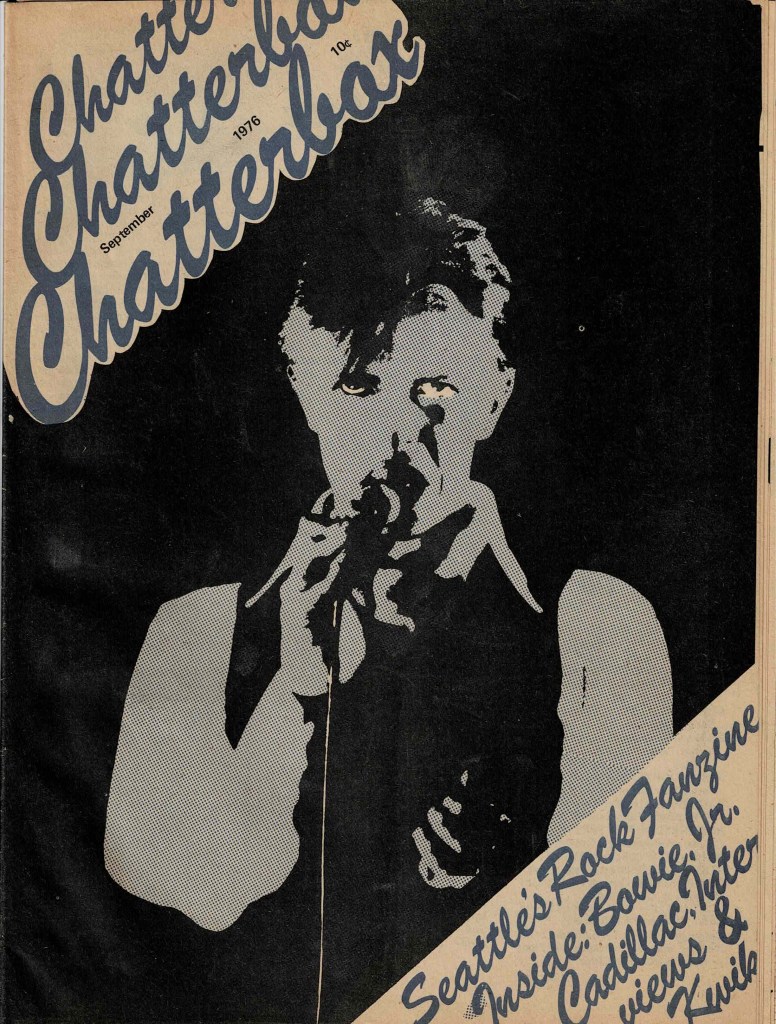
September 1976. 10 cents. The word “punk” is already being used in earnest and we’re not in NY or LA, we’re in Seattle. Chatterbox #4 is truly an educational glimpse into a world in which educated rocknroll fans are yearning for something better, and very much realize that they’re on the cusp of it. Hence this newsprint mag’s balancing an “out with the old” approach (Neil Hubbard’s anti-stadium concert editorial, trashing the “animals” at recent Wings and Led Zeppelin shows) with a celebration of the typical crumbs offered up around this time – Patti Smith Group, Ramones, Roxy Music, Bowie and the like – even Television get a positive mention.
An unnamed writer relays that, “The other night on KZOK’s listener-programmed “Your Mother Won’t Like It” show, some little tart named Mary really did a show ‘mothers wouldn’t like:” Dictators, Stooges, Ramones, Eno, New York Dolls….wall to wall bizarropunk.” That must have been a mindblower for certain Northwesterners. FM Radio still did that sort of thing in 1976; that’s right around the time I started flipping my radio over from the AM dial, and where I lived, in Sacramento, we had two stations that still had some of this freeform feel: KZAP and KNDE. They called it “album rock”, meaning not singles, but I wasn’t quite ready for some of these heavy sounds at age 8, let alone wall to wall bizarropunk. (In fact, when I first heard The Runaways’ “Cherry Bomb” on the radio not long after this, it kinda scared me a little).
There’s a gossip column (“Chatterbox Chitchat”, written by “Melba Toast”) in which Tomata Du Plenty of The Tupperwares details his trip to Los Angeles, which I’m certain was a warm-up that led him to leave Seattle mere months later to start up The Screamers in LA. There’s also talk about The Beatles getting back together in 1976 – I believe this was really a thing at the time – and much dropping of names about local Seattle acts and scenesters. What I’m pleased to learn here is that there was a robust original music scene in town at this point; it wasn’t just fern bar bands playing covers, and writers pissing and moaning about it.
The best thing in here is a rollicking, long interview with Dave Hill of Slade, who’s a self-admitted total “yob” and a great sport, just totally open to gabbing with the fanzine writer about anything and everything. These guys were megawatt rock stars in the UK at the time, not in the US, which he acknowledges and seems pretty chagrined about. This part wasn’t too convincing on Dave’s part, though:
CB: HAVE YOU EVER HEARD OF A GROUP CALLED THE STOOGES?
DH: Yeah.
CB: GREAT HUH?
DH: Yeah, the name I like.
The interviewer then tries to bait him into badmouthing fellow UK travelers The Sweet, who were breaking in the US in a major way with “Fox on The Run” and “Ballroom Blitz”. The latter song was a very early Jay Hinman favorite; my mom once walked in on me in our Sacramento garage, dancing and shouting the lyrics at top volume to it as it played on my transistor. Dave Hill won’t take the bait about The Sweet! A true gentleman; now I’m sorry we Americans totally ignored Slade.
I love everything about Chatterbox #4 and its writers’ enthusiasms and passions. It’s a relatively professional if homespun publication and I’m definitely going to see if any other copies might find their way into my hands in the near future.
-
Flipside #32

It’s possible that overly judgmental folks like me have given Flipside the proverbial “short shrift” over the years. I didn’t even buy a copy until well into college, 1986 or so, mostly because they gave such energetic and frothing coverage to any & every punk rock lame-o band, differentiating not in the least and really just there to innocuously champion all of it. No one cared much about their prose, because (as I saw it) no one there could effectively convince you with any sort of engendered credibility to buy a record or see a particular band anyway.
Yet when I read an issue like Flipside #32 from 1982 cover to cover, all it makes me do is wish I was there side-by-side with Al & Hud and the whole Flipside gang at every single show from South Orange County to the North San Fernando Valley, watching hardcore punk explode and share stages with creeping death rock bands (45 Grave, Christian Death), that next LA wave of over the-top art/performance acts (Johanna Went, Vox Pop) and those few rarified bands that were just miles ahead of everyone else (Minutemen, Dream Syndicate, 100 Flowers, Flesh Eaters).
This was the thrill of reading a Flipside, well into the 1990s. These people really lived it. I’d always marvel at their live reviews. A typical Friday night would have Flipside correspondents jumping from show to show all over the greater LA area, trying to document every last jot & titter coming from the clubs. I got to sort of brush shoulders a few times with editor Al Flipside and a guy named Bob Cantu in the early 90s, and it was all very real: they would start the evening seeing a band in Hollywood, say, then hustle down to Long Beach for another show and then make their way to a 2am wind-down party afterward, drinking and reveling all the way, then file their broken and disjointed dispatches in the next Flipside (“we missed so-and-so but I heard they were good; then the cops came”). I thought I was personally going pretty hard in my 20s, but these folks had me licked – and Al was in his thirties, having started Flipside in 1977. (To say nothing of scene correspondent and “rock and roll bank robber” Shane Williams – I’ve documented my direct encounters with him here).
It was the same in 1982. You read this thing and you still can’t believe LA had so many amazing shows you’d have gone to yourself in June ‘82 alone. You too would be humping it to Canoga Park and Hollywood and Costa Mesa and San Pedro all month long. It’s quite the time capsule, this one. There is such a buzz of punk rock activity that there are “Southern California H.C.” scene reports from Northwest O.C., Palos Verdes, Riverside and “More O.C.” respectively, while the rest of the magazine reports many wild shows that took place in Los Angeles proper.
There’s a priceless letter to the editor from teenager Mark Arm from Seattle, WA, exhorting punks to “think for themselves”; decrying the use of drugs in the scene, and relaying the fact that he had to talk his mom out of joining “Parents of Punkers” after punk rock music and fashions were featured on the Phil Donahue show. “She sees a counselor instead.”
Name an active LA-area punk-adjacent band in 1982 and they’re in here somewhere, as you can see from the cover, but there’s also a Flesh Eaters interview; a Twisted Roots family tree; an interview with the hideous Jeff Dahl about his awful new band Powertrip (“Fuck it all. The only thing I’m into is speed, beer, rock & roll and young girls.”); Eddie and the Subtitles; The Big Boys; and lots of love in the live reviews for the totally-zonkers Meat Puppets (they played with The Cramps in San Pedro this summer; where were you?) and brand-new band the Dream Syndicate, who are said to “sound blatantly like the Velvet Underground, yet are so unselfconscious about it that their plagiarism can’t be held against them.”
About 18 months later, in my estimation, it all started to go sideways in LA, music-wise. By 1984 the city and its nether regions still held more good bands per capita then most anywhere else, but it was a fast fade through the rest of the 80s. Of course my years of living in Southern California happened to be 1985-1989, and so I’d look at Flipside at record stores, then compare it to the vitality, breadth and craft of a Forced Exposure or Conflict and find it all quite “lacking”. Thus my attitude about it over the years, save for my awe and immense admiration for the crazed show-going of their staffers. This issue’s making me a little more generous in my retroactive estimation for the thing.
-
Bucketfull of Brains #13

With R.E.M. as its most famous global export, the rootsy American “college rock” of the mid-80s, alternately derided or celebrated in stateside fanzines as “jangle” – but most commonly as college rock – was applauded and lauded very enthusiastically across the pond. I used to buy those Sounds, NMEs and Melody Makers almost weekly when they’d turn up in SF Bay Area record stores around 1983-85, and sometimes it was the only place to actually learn and get more than a cursory paragraph about bands like True West, Green on Red, Thin White Rope, Naked Prey and so forth.
I’ll admit I wasn’t a big fan, except for what I’d hear from the “paisley underground” bands from LA: Dream Syndicate, Green on Red (especially this EP) the Three O’Clock (I wouldn’t hear their earlier Salvation Army stuff for a few more years) and the Bangs/Bangles. I did not, and still do not, care much for the Rain Parade – but wow, the UK press talked about them like they were the second coming. Just after high school I saw a show in Santa Cruz with R.E.M. headlining, and True West and the Three O’Clock opening. This would have been absolute “peak UK mania” for Americana rock.
Unfortunately so much of that stuff got snapped up and corporatized by major labels pretty quickly, and I couldn’t really see that the UK press – and by that time, Spin and Rolling Stone – were making fine distinctions about what was truly interesting and mind-expanding, and what was just some lame rootsy retread. I’m thinking about bands like “Jason and The Scorchers” and The Del-Fuegos. No thanks. Bucketfull of Brains was a UK fanzine that did a little better, I guess, at pulling wheat from chaff, yet they were clearly all-in on anything with chiming guitars and a mythos, real or imagined, that circled around the desert, the west, California and so forth. Bands that wore cowboy boots on stage and played loud-ish guitars were right in the wheelhouse.
There’s a sense in reading Bucketfull of Brains, at least this particular issue, #13, that maybe punk never actually happened. Rocknroll progressed from The Byrds, Beatles and psychedelia to late 70s power pop and early 80s jangle, and there might have been this in-between period that’s perhaps better not spoken of. Certainly it’s an approach that few others were taking at the time, and it reads like a true fanzine, with somewhat primitive typesetting and clear, unadorned fandom taking the reins, as opposed to, say, an assignment from an editor.
So in this world, which would have been written right around the time I was gawking at that show in Santa Cruz, and which came out in October 1985, a record like the Hoodoo Gurus’ Mars Needs Guitars is a masterpiece. Thin White Rope are genius desert mystics (despite being from the college town of Davis, CA). And the aforementioned Del Fuegos “are probably the connecting link between garage rock and American ‘roots’ rock and roll”. Well, probably, right?
Nigel Cross was no longer the editor (his last at the helm was BoB #10), but he relates a tale of visiting Los Angeles and being driven (poorly) by Falling James Moreland, with Kendra Smith in the car to see the Dan Stuart (Green on Red) and Steve Wynn (Dream Syndicate) side project Danny & Dusty play a rare live gig. He’s magnanimous for the most part in describing his evening until summarizing, in the sweet English manner, “I’d somehow expected more than was delivered tonight”. I like that. I’d have liked to have seen Danny & Dusty too, as I very much enjoy that album of theirs, which was overpressed on a major label to the point where at this writing there are 79 copies for sale on Discogs, starting at $3.79.
Jon Storey was the editor at this time, and I’ll say with honesty that his version of the magazine got better in the years to come. I have a few of them, and frankly this one doesn’t quite capture a breadth of taste and enthusiasm across the spectrum of white rocknroll the way later issues do. There’s a piece on LA’s Wednesday Week and an interview with Husker Du, who’ve just jumped about to a major label and are very much happy to leave SST behind.
But the best is an overview of New Zealand’s underground by one Richard Langston, at the time the editor of Dunedin’s Garage fanzine, the issues of which just got a deluxe release in book form (!). It’s called “Legends of the Kiwi Beat”, and it introduces England to The Clean, The Chills, Sneaky Feelings, The Verlaines, Doublehappys, The Rip and Look Blue Go Purple, written in a “you won’t believe what’s going on down here since you can’t find these records, so let me tell you” style. Was this actually the first time this music was introduced to the UK? I can’t tell you – I was an American teenager.
But the piece is worth the price of admission for this issue and then some, and thankfully, Bucketfull of Brains mags are fairly easy to come by on eBay for not too much money if you’re so inclined. It was quite well-distributed; we even got them at Morninglory Music in my college town of Isla Vista, CA, where I’d turn my nose up at it with all the musical confidence and knowledge I’d thus far accumulated at age 18.
-
Paranoia #4
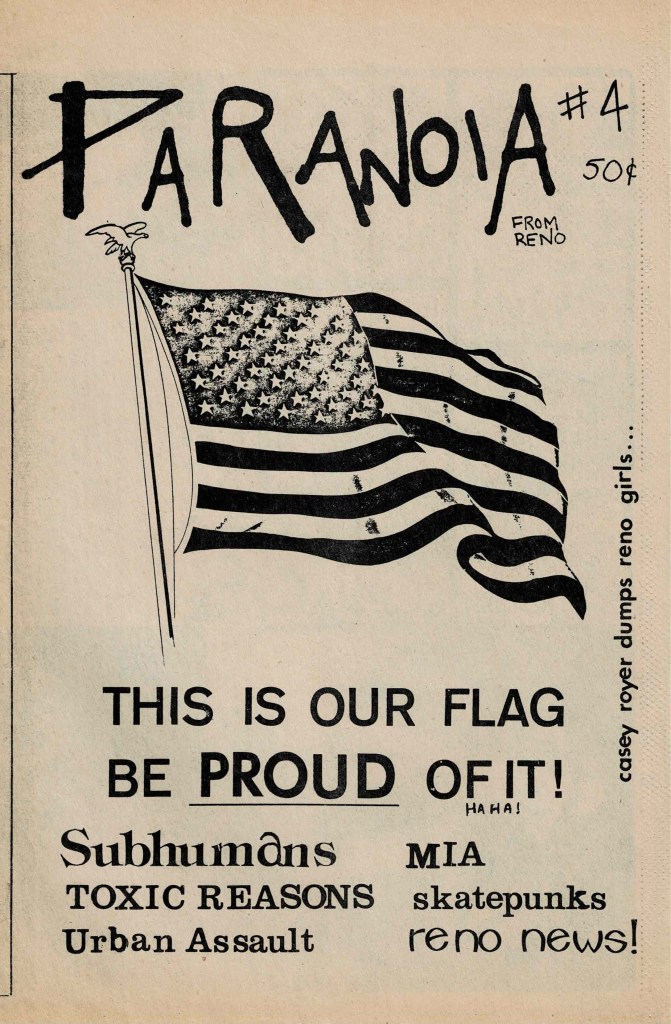
I don’t collect or gather too many hardcore punk fanzines, just the ones I bought “back then” like Ripper and/or stuff too ridiculously fun to ignore, like the We Got Power #4 we talked about here. Often these 1982-83 mags were written by teens, for teens, with all the mangled syntax, bungled graphics and party-or-go-home enthusiasms you’d expect of such efforts. This is most certainly the case with 1982’s Paranoia #4, from one of the USA’s exploding hardcore punk small-cities at the time, Reno NV! That’s right, the Skeeno HC scene totally lives and breathes right here.
Paranoia – you can read other issues here – appears to have been put out by Bessie Oakley and Jone Stebbins from the all-female band The Wrecks. Stebbins later went on to be in the band Imperial Teen and seems to be running a series of hair salons now. The Wrecks – well, you may know and love them from “Punk Is An Attitude” from Not So Quiet on the Western Front.
Their magazine is a hoot, kind of like We Got Power was, full of party photos, inside jokes, show reviews, gossip, skateboarding action shots and some serious consternation about the state of the scene. This issue’s cover, I’d imagine, is quite tongue in cheek, but in case you were confused, please note that Bessie or Jone has scrawled “Ha Ha!” underneath the headline. Whew! What’s great is that while I was recently calling San Jose something of a cowtown back at this time, Reno truly was, and so the fact that a whole cadre of breakneck slammin’ bands came up out of this place at the same time was somewhat remarkable. I mean Urban Assault were from South Lake Tahoe, as unlikely a place as anywhere to have anything like a HC scene, and Paranoia really pulls off the all-for-one, one-for-all ethos by spotlighting every single hardcore band from Nevada and even Rebel Truth from nearby Sacramento, CA. This issue’s also got a strong Canadian tinge, with a Subhumans interview and lots of D.O.A. chatter.
San Francisco was and remains the nearest truly big city, and certainly the only one at the time with a network of clubs to play in, Alas, according to Paranoia #4, “The Mabuhay Gardens of San Francisco is no longer booking hardcore bands, just gay new wave ones”. Well, darn it all to hell! Paranoia was, I’d imagine, the house organ of the Skeeno scene, and no, I don’t know why they called it Skeeno and maybe they didn’t either. A goofy time capsule for sure.
-
Surrender #5

For most of the 1990s and 2000s I fashioned myself as a small-l “libertarian”, politically. As such, my magazine of choice was Reason, and I read it with the zeal of the recent convert, which I was, until I wasn’t. Occasionally my punk rock & underground music world would overlap with the political libertarian world, like at the 1992 party I once attended with my “rock friends” where I somehow connected with an LA-based kook who (like me) idolized Reason editor Virginia Postrel, and whom I ended up talking “free minds and free markets” with for like two hours – then never saw the guy again.
Brian Doherty was one of the editors at Reason back then, and he still is (!). He was also the editor of a mostly-music, Los Angeles-based fanzine called Surrender (“A Journal of Ethics”). I personally exited the libertarian fold completely maybe 10-12 years ago, as I (finally) developed a much bigger appreciation for government-provided safety nets and a greater, less heartless appreciation for my fellow man and his/her basic needs that hadn’t been well-served by an approach that mostly valued capitalism over that of humanism. Doherty – well, I’m not really sure where he stands overall these days, and his take on “the issues” is fine by me regardless. He’s always been a strong thinker, writer and has long had just enough of the “whiff of the weirdo” to make him a truly interesting dude.
Surrender #5 proves this in spades, although it’s a bit impenetrable in parts. The core of the issue is an astronomically long conversation between Doherty and Gregg Turkington, at the time the proprietor of Amarillo Records, a member of the high-concept band Faxed Head and a guy just getting his alternate-world comedy career underway as Neil Hamburger. I say “conversation”, rather than interview, because that’s exactly what it is – two guys breaking bread over a meal, discussing The Beach Boys, Richard Nixon, prank phone calls, Paul McCartney and of course Turkington’s cornucopia of surreal projects.
“Neil Hamburger” at this point was just a character in a series of goofy fake stand-up comedy 45s. Turkington is asked if he’s ever done a live performance as Neil Hamburger, and replies “No. ‘Cause it wouldn’t be the same….if you did a show, all these people would come out who liked the records and they’re just gonna bait me, they’re gonna scream for favorite hits…it’s just gonna ruin it, ruin it completely, y’know?”. As it turned out, that’s pretty much exactly what happened when he eventually did perform the character live (and then built a career out of it in the process), before he figured out how to turn the crowd’s bleatings into an on-stage weapon. If you’ve never heard Hot February Night, I highly recommend it.
Surrender #5 also has a “Review Essay” on Turkington’s works on vinyl, along with a separate essay on Teen Beat Records. Doherty went to college in Gainesville, FL and reminisces about “the music scene” there, the same sort of watery-eyed nostalgia BS I’ve reserved for Isla Vista, CA, circa 1985-89. Best years of our lives and all that. What really sets Surrender apart from its, um, competitors of the era is Doherty’s extensive book reviews, which are erudite and strange, and that document an omnivorous appetite for the offbeat and the unorthodox. By this I don’t mean he’s reviewing stuff from “Re/Search” or whatever, thank god, but science fiction, Borges, Gore Vidal and a whole bunch of Milton Friedman books. We learn that Doherty’s currently reading all this stuff from “Uncle Miltie” – as my conservative dad calls him – because he’s writing a book, a book which eventually became Radicals For Capitalism, a book that I would myself eventually read and enjoy.
This strangely compelling read closes with an inexplicable back cover photograph of the journalist James Fallows, just because. That’s the sort of fanzine Surrender was. I’d love to find copies of his other issues.
-
Popwatch #6

We were all seriously spoiled for choice when it came to underground fanzines in the early/mid 1990s, and didn’t even know it. Some, like Popwatch and even my own Superdope, weren’t even all that underground, and could be easily found in nationwide Tower Records stores and had print runs in the thousands (mine only actually hit those numbers once). Yet there was only so much that I could or would read back then, to say nothing of my limited-means income that only allowed just so much superfluous fanzine spending.
I actually passed on all of the Popwatch mags I saw then, with merely one exception – then only later wondered why I hadn’t accumulated them in the 90s. It may be that I incorrectly saw it more as a corporate-leaning magazine rather than as a fanzine per se; such were the very important distinctions that dictated the terms of my pocketbook.
What became retrospectively clear was just how strong a line Leslie Gaffney’s Popwatch had built to the incredibly fruitful New Zealand music scene of the time. Popwatch #6 arrived in 1994 when there was just one amazing NZ 45 after another coming out on US labels like Majora, Siltbreeze, New World of Sound, Ajax and Roof Bolt. Alastair Galbraith and Bill Direen each came and played shows in the US – I saw ‘em! – and this issue interviews both gentlemen. Galbraith actually contributed the glossy cover collage art you see here. I particularly like Bill Meyer’s “Who Is Bill Direen?” piece – honestly didn’t read this until after I’d interviewed Direen myself for Dynamite Hemorrhage #2, twenty years later, thinking that I’d finally cornered the US market.
There’s a whole passel of top-tier contributors to Popwatch #6, including our old pal Brian Turner, then the publisher of Teen Looch fanzine (and don’t worry, Brian, if you’re reading this – we’ll be getting to the ‘Looch one of these days). Turner contributes a piece on Japanese noise; Tim Bugbee interviews Jim Shepard; Gaffney herself interviews Crawling With Tarts. Corporate magazine my ass.
It was a laff to see reviews by Les Scurry, a guy I used to DJ with on KFJC circa 1989-90 when he was the music director over there. The dude was a serious curmudgeon and seen-it-all nihilist before his time, and it comes out in his many dismissive reviews in this issue. He did the same thing when he’d stand in front of the entire KFJC stuff at our mandatory weekly meeting on Wednesdays and go through that week’s new releases that’d been mailed to the station – “this is garbage”, “this one’s a big pile of dumper”, “you can forget playing this on the air” and so on.
The reviews section is really the only blot on the Popwatch record, as aside from Scurry, it’s relentlessly positive to a fault, and it attempts to review absolutely everything, as was the wont of many fanzines that styled themselves as comprehensive guides did at the time. I’ve written about these tendencies before; there were and remain irreconcilable pet peeves.
I also magnanimously recognize that not everyone reads these things the same way that I do; I’m always looking for guidance as to what’s the next set of records to buy, while others might be looking for some larger context on the state of underground music in 1994, be it San Diego pop-punk, twee midwestern jangle or UK industrial noise. But it’s tough for me to really contextualize anything when reading a review of some indie-pop doofus that concludes, “This is what music should be”. Oh yeah?
Or these choice sentences: from an Alastair Galbraith review: “Dedicated to Pip Proud, an English singer that no one’s ever heard of…” (three issues later this Australian singer would be featured in Popwatch); and from a Sleater-Kinney review: “Three hardcore girls from NYC”. Anyway, there’s stuff reviewed in here that is obviously pre-internet, and that has stayed that way for nearly 30 years, completely stuck in the analog world forever. I still want to hear that Spuyten Duyvil single Scurry praises in a very rare moment of favorableness.
The great thing about Popwatch is they were all pretty much like this: packed to the gills, full of New Zealand worship (they also documented Barbara Manning extensively, another huge favorite of mine during this era) and were bursting with highly educated, navel-gazing, record-collecting contributors. I’m stunned as to how nearly impossible it is to find anything about it online; it has stayed just as remotely analog as many of the long-tail bands it covered.
-
Subscribe
Subscribed
Already have a WordPress.com account? Log in now.
 Fanzine Hemorrhage