-
Sooprize Package #2
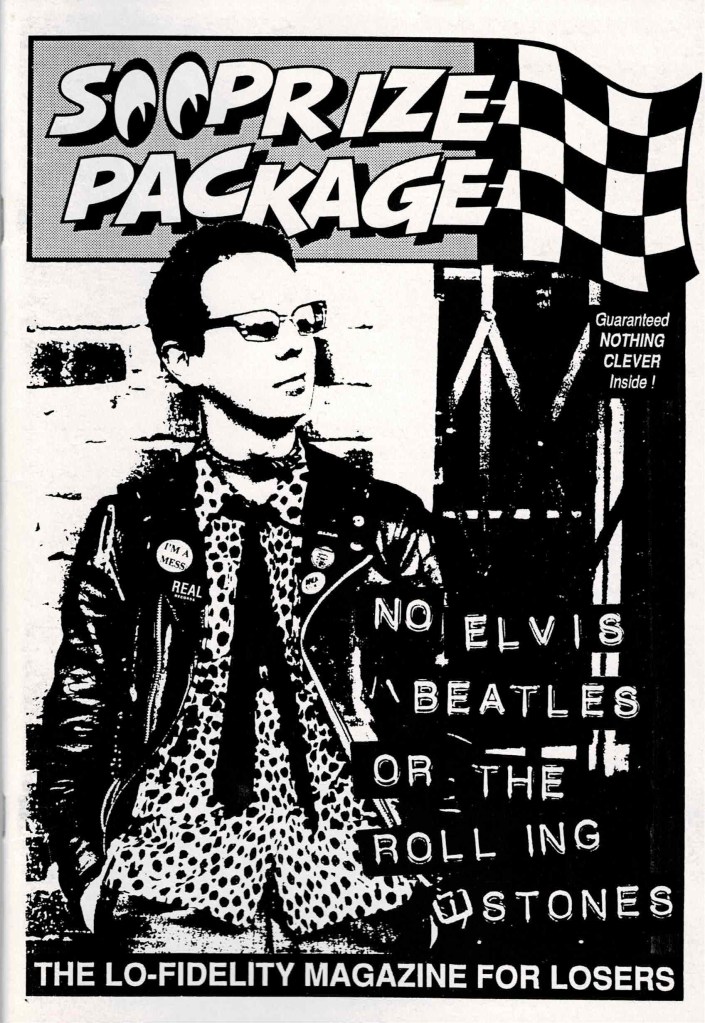
To date I’ve tried to share a bit of the tenor and tone of the 1990s garage punk fanzines I collected at the time, and have written several dispositive entries here about Wipe Out!, Alright!, Human Garbage Disposal and Bazooka, respectively. Today we’re going to talk about one I hadn’t been aware of at the time but found a copy of to procure online, Sooprize Package #2 from the UK, a fanzine I was hipped to by someone who rightly thought I might enjoy it. Oh dear, it’s “The Lo-Fidelity Magazine for Losers” – already signaling a deep need to “fit in” with the faux-aggressive, fuck-it-all punk presentation of the time (1994).
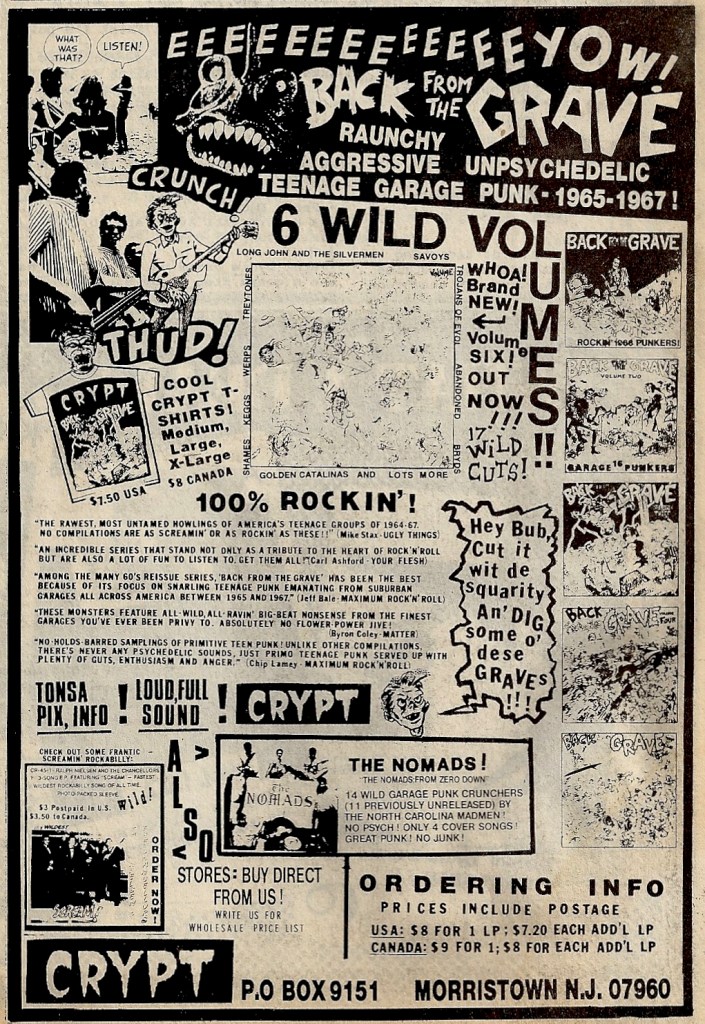
You see, there was this whole class of garage-rooted bands and fanzines who basically took their cues directly from Tim Warren’s over-the-top Crypt Records advertisements of the 80s and 90s. Those ads were absolute masterworks of confrontational art and low class, with a presentation and an ethos that truly couldn’t be beat. Everyone laughed their asses off about that at the time. I’ve done you the favor of printing an example here so you can see the germ from which fanzines like Sooprize Package took (virtually all of) their inspiration from.
While I totally loved Crypt, of course, they helped to enable a bit of a dividing line between discerning music-first lovers of the raw, loud & snotty, and the many dullards who got off on exclamation points, “losers”, “rekkids”, “you suck” etc. – and in dressing oneself in sartorial splendor like the man on the cover of this one, Shane White of The Spoiled Brats (a local from my area, San Francisco, who did his own fanzine Pure Filth that probably sat on what I’d personally call the wrong side of the line).
If you’re a believer in the 80/20 rule, well, so am I. 20% of this shtick, both musically and in the scene infrastructure that surrounded it, was a blast and had a winking “intelligence”, for lack of a better term, that understood that the riffs, energy and the mayhem of 60s- and ‘77-inspired rocknroll could be effectively harnessed and even improved upon, mixing in feedback, brute-force noise and dirty blues (Cheater Slicks, Oblivians) or inventing a goofus teen dance party “language” that played upon sitcom tropes and borrowed from the best no-fi bands of the 60s and 70s (Supercharger, Brentwoods). There were plenty of other ways to successfully cut it within that hallowed 20%, and bands like The Night Kings, Gories, Fireworks and others did just that. I even liked a lot of the instrumental surf revival action at the time, and no, I didn’t mind at all that some of the bands dressed funny and synchronized their moves on stage. What’s better than getting three sheets to the wind and self-lobotomizing at a live rock show, am I right?
80% of it was total garbage. It’s where you found the hot rod creeps, the wallet-on-a-chain goofballs, Gearhead, all-white bands with “Los” in their names, grown men wearing monkey masks, “Man or Astroman” and so on. Sooprize Package #2 straddled this line rather deftly, to be honest. Clearly editor James Petter got off on anything “raw ‘n wild” and he did his best to stoke the fires of this whole scene in a very well-put-together digest-sized fanzine that celebrated it all in xeroxed, cut-n-paste glory. It’s also a trans-continental celebration, bringing in English and European bands that I’ve never heard with bands that routinely performed within three miles of my home. The San Francisco tentacles of this scene stretched even further than I knew of at the time, and this 1994 issue is going bananas over the Trashwomen, Spoiled Brats, Phantom Surfers and Rip Offs, and these bands are playing all across Europe and Japan, with their exploits documented herein.
Petter, like I said, is a highly excitable guy, and he basically plasters the Crypt advertisement ethos across the entire issue. His best piece in here by far is a restrained and actually quite illuminative interview with Lux & Ivy from The Cramps at the Regent Hotel in posh Marylebone, London. The band have just released what I’m sure was a totally forgettable record called Flamejob (I’ve never heard it, to be fair, so it may be a psychobilly masterpiece), but listen – they’re Lux & Ivy. They were always a fantastic interview, and they’re even better here. They’ve just signed to Creation Records, because they’re The Cramps and of course they did. Petter does a great job getting them to open up about their passions, their discography and even their thoughts on some of the current bands in the lowbrow garage punk scene who are routinely opening shows for them at this point. Gotta love Erick and Kristy.
So I suppose the whole thing’s a bit of the proverbial mixed bag, but I’d prefer to be magnanimous and acknowledge that it’s impossible to not greatly admire the effort, craft and enthusiasm that went into assembling Sooprize Package #2. I was doing my own fanzines at the time and I certainly could have used a bit more of the lightheartedness and sloppy fun present here. Sure, I vastly prefer the way that Eric at Wipe Out! did it, but mostly because his tastes were more aligned with mine, and he rarely suffered the knuckle-draggers and humored them the way Sooprize Package does. All of this really feels like 100 years ago by now, doesn’t it?
-
Back Door Man #4

If you’re as ludicrous a person as I am, it can be tempting to mentally place oneself in a particular year “at age” and wonder how you might have responded at the time to rocknroll’s past, present and potential future. If I put myself in 1974, I’d probably want to respond a lot like Phast Phreddie Patterson and the Back Door Man crew did at the time. I’d want to be blathering to everyone who listened about The Stooges, Velvets and Roxy Music; I’d have a reverence for rockabilly and 60s garage rock; I’d know what “punk” was three years before 1977 told me what it was; and I’d be searching, grasping for anything that hinted at the musical future I wanted to will into existence. (If I’m really stretching the imaginary point, I’d be putting out a fanzine praising Les Razilles Denudes, current krautrock, crate-digging 60s punk 45s, Simply Saucer and whatnot).
To date, every fanzine I’ve talked about here has been something that I physically own an original copy of. Not Back Door Man #4. In the early 1990s my good friend JB was spending quality time at his local San Diego Kinko’s making ersatz photocopies of his classic fanzines for certain friends, of whom I was luckily one. I got a package once with multiple Back Door Mans, a Brain Damage and a gaggle of the Patti Smith fanzine Another Dimension, all stapled and assembled beautifully. Given that they were from the mid-70s, I could almost pretend that they were the real deal, in their original form. This Back Door Man came from that batch, and yet it’s “worth” plenty to me.
I hadn’t really looked at it in a long time, this “only 40¢” fanzine from Torrance, CA. They really were a crew of “hardcore rock’n’rollers” at BDM; they included within their ranks Patterson; co-editor DD Faye (whom I confused for years with her equally lovely sister Danielle, who was in The Zippers and Venus & The Razorblades), Don Waller and Thom Gardner. At this point, 1974, considered by many far & wide to be a true low point in rock music, they are grasping at anything rebellious and wild they can get their hands on that might hint at the abandon and rawness they need. Blue Oyster Cult, Aerosmith, Ron Ashton & Dennis Thompson’s new band New Order; Mott The Hoople, Nico, Patti Smith and John Cale – even the execrable Tubes get a big write-up by Lisa Fancher, who’d later go on to run Frontier Records. It’s what you did in 1974, and it makes me think that the search for musical redemption in the bins and on the radio was actually a far more fun and ultimately rewarding environment for rocknroll fandom than, say, 2023 is. There just weren’t many clubs in which to go see local bands, nor many local bands who weren’t playing covers in fern bars.
When there were, Back Door Man #4 is all over it. Phast Phreddie does a proto-scene report called “South Bay Rock’n’Roll” talking over local live shows with the reformed Blue Cheer, along with Shatterminx, Heavy Transport, Atomic Kid and The Ratz! The Imperial Dogs, who formed that year and featured Back Door Man’s Don Waller on vocals, are also duly raved about, as well they should be. There’s also a great piece about how flummoxed they all are by Lou Reed’s new Metal Machine Music but how they appreciate its rawness and its place in th culture as a big fuck-you nonetheless.
The staff also writes in various places about having to rely on AM radio (KHJ) to get their musical kicks, again grasping, grasping…..they’re really excited about The Sweet’s “Ballroom Blitz”, which they should be because that song rules (we also discussed it previously on this blog here). I’m assuming that FM rock Radio was already pumping that heavy-lidded dopesmoker AOR sound around that time that I remember from my precocious Sacramento childhood: Jethro Tull, Yes, Led Zeppelin and whatnot, and these guys and gals were instead looking for the proverbial teenage kicks.
Anyway, there’s much, much more to be told in the Back Door Man saga here – but mostly elsewhere. I leave you with an interview that Scram fanzine did with Don Waller about the magazine; here’s a great RockWrit podcast interview with Phast Phreddie himself. Enjoy.
-
Take It! #2

(This piece is taken from a written overview I did on Take It! fanzine (1981-82) in the most recent Dynamite Hemorrhage fanzine #10. You’re more than welcome to check out the full piece in the magazine if you’re so inclined).
This one doesn’t helpfully provide a date of publishing, yet judging from the extensive talk of the late 1980 deaths of both John Lennon and Darby Crash, I’d attempt to date this one around Spring ‘81. Therefore it follows on the heels of its predecessor quite faithfully. Aside from the US/UK music split, there is some film talk; a piece on a pornographic cake company and another on an artist named Jonathan Borofsky – he’d later go on to make the “Hammering Man” sculpture you now see in front of the Seattle Art Museum. There’s a non-rock photo section curated by Phil-n-Phlash, whom I know far better for his photos of Boston hardcore a year or two later, including the Boston Not LA cover, and whose photos continue in future issues. And there’s a Boston punk rock fashion show review.
But since you’re here for the music, let me tell you a bit about what Take It! was on about in early 1981. Well, there’s some gratuitous Fleshtones bashing, something that was de rigueur in fanzines at the time, but better still, the Byron Coley column and record reviews are among the best things I’ve read by the guy – the sort of johnny-on-the-spot reportage that I want to see collected in that Byron Coley compendium that no one’s put up the cash to assemble (yet).
Now at this time he did somehow believe that the debut Angry Samoans 12” EP was better than either of Black Flag’s Nervous Breakdown or Jealous Again. OK then! I’ve been wrong before myself. He also investigates and then champions the Pebbles compilations that were just then starting to trickle out (guy was an early-and-often champion of 60s punk for sure). He says that Suburban Lawns’ “Janitor”…”has many lapses in generally acceptable diction and that’s okay too”. His column ends up comparing songs between Michael Hurley – whom I truly believe no one was talking about in 1981 – and Bound & Gagged.
Phil Milstein does a terrific piece on NRBQ; he was just as engaging a writer then as he is now. There’s an on-the-nose semi-takedown of Jim Carroll and his “Jim Carroll Band”. We also get a Buzzcocks interview and an unreadable piece of slash fiction about Bob Dylan, John Lydon and God. Finally, in Gregg Turner’s LA column, he scathingly pontificates about the recent death of Darby Crash, something he seems pretty happy about – proving himself to be the petty, self-involved creep I’ve long taken him to be. This jousting is then coupled with some praise for The Mentors, of all things, whilst simultaneously casting aspersions on the physical appearance of Mentors band members such as guitarist Sickie Wifebeater (“amazing gtrst tho”). Ah, to be young and exceptionally good-looking in Hollywood like Gregg Turner from the Angry Samoans!
-
Conflict #42
In recent weeks I’ve, uh, “opened up” about just what my precise musical obsessions were during the years 1986-89, and unsurprisingly – and I’m not ashamed of most of ‘em – they were a lot like those of many others. If it was on Touch & Go, Homestead, Amphetamine Reptile or SST, it got my attention. If it was abrasive, rocking and loud, it got my attention. My “favorite contempo band” during this era ranged from the Lazy Cowgirls to Mudhoney, I think, with pit stops for Big Black, Naked Raygun, Scratch Acid, Soul Asylum, Urge Overkill and the Laughing Hyenas along the way. There was some deeper digging going on for sure, and I spent far more time with music from the first half of the 80s than the second half I was living in. Yet as we came out of the 1980s, I think my very “favorite current band” on 1/1/90 was Death of Samantha. My “all-time favorite bands” were The Flesh Eaters, The Velvet Underground and The Fall. I still had much to discover, and aside from the Gibson Bros, The Clean, World of Pooh & a few pop bands, I was very decidedly a hard/loud/noise-centered impressionable young twentysomething as the decade closed.
After all that, and with 33+ years of hindsight, the band I listen to the most now from those days is – that’s right, you totally nailed it: Pussy Galore. I was into them from the very first time I spied Laurel Waco’s Groovy Hate Fuck EP and convinced her to let me borrow it, strategically hiding the back cover with its large-lettered PUSSY-JEW-CUNT-DIE-MEAT-KILL-ASSHOLE with my arm as I shepherded it back to my Isla Vista, CA dorm room. I soon found the Feel Good About Your Body 7”EP at Zed Records in Long Beach, and then the real topper was that 1986 Pussy Gold 5000 EP, where they instantly became one of the tip-top bands of the era, and the one I revere the most now.
I saw them on 10/27/88 at Raji’s in Los Angeles, a show so ear-splittingly loud that I scooted to the very back of the room, where Eugene, the then-cook at Raji’s and the bald hero who kicks off The Decline of Western Civilization (“That’s stupid, punk rock, I don’t know, I just think of it as rocknroll”), was peeking out of his kitchen cubbyhole at the chaos up on stage. I drove home to Isla Vista fearing permanent ear damage, and could barely hear my friends talking in the car. Those were, as they say, “good times”.
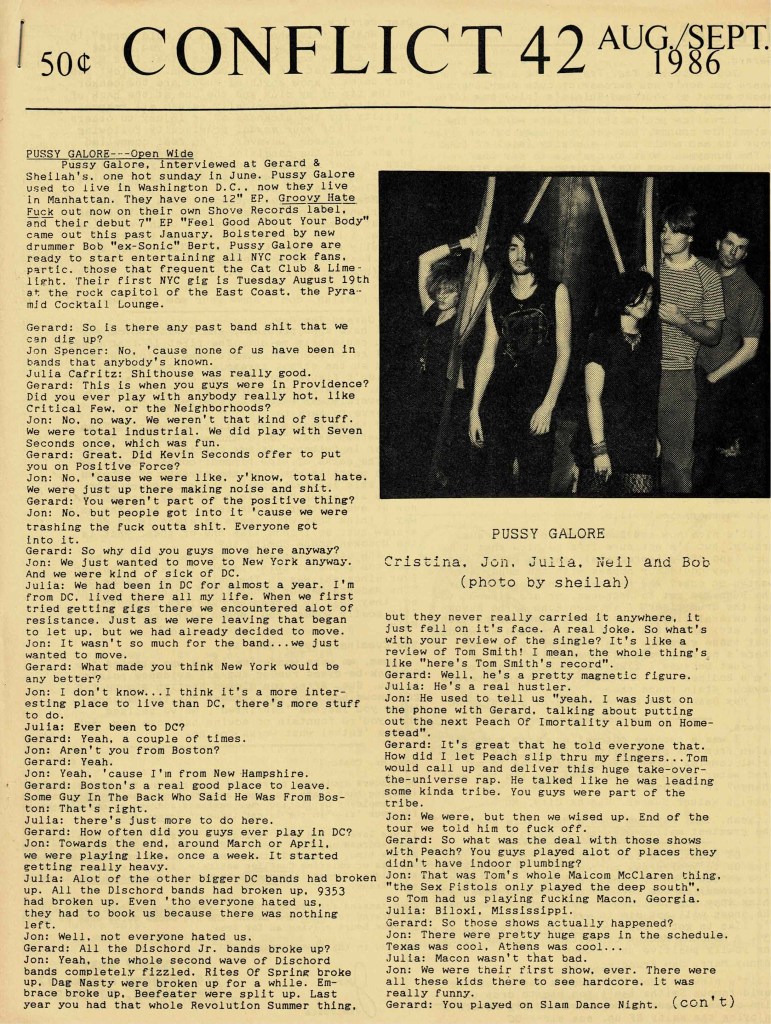
This issue of Gerard Cosloy’s Conflict, #42, was probably where I first heard the members of Pussy Galore “speak”. It took me probably until this interview to understand that it was their underlying snotty 60s garage punk riffs & attitude, caked in a total wall of noise, that was what endeared me to them the most. When I found out down the road that folks like Tim Warren and Larry Hardy were just as smitten as I was with the band, well, it all made sense. And look, I’ve taken this long to even really get to talking about this issue of the fanzine – I told you when I started this that Fanzine Hemorrhage would be a stream-of-consciousness, mostly unedited voyage into the unknown, and this time I’m keeping my promise.
So let’s talk about Conflict #42. This is about as seminally representative of Cosloy’s mid/late-80s stance and vibe as any of his issues were. Around this time, names like “Jim Testa”, “Mike Gitter”, “Donny the Punk” and “Jack Rabid” were only known to me as mocked men in the pages of Conflict, and though my knowledge of their crimes was therefore heavily one-sided, I ate it all up nonetheless and got a ton of laffs out of Cosloy’s sarcastic eviscerations. (We’d later get copies of Gitter’s XXX fanzine on the west coast and that certainly helped to reinforce things). It didn’t hurt that Cosloy’s sense of humor fell in many of the same bizarro places mine did at the time. This issue has much talk about an “oi revival”, so much so that it is broached to a bewildered Pussy Galore and comes up in at least ten different reviews. He asks the band, “If both The Exploited and The Partisans were drowning and you could only save one of them, which would you save?”, which is followed by “(dead silence)”. (I will state for the record, however, that The Exploited’s “Dead Cities” and The Partisans’ “Police Story” are the two finest songs of the oi/UK82 era).
Cosloy was running Homestead Records at this point, or at least selecting which bands to sign, and 1985/86 saw his releases of leading scene indicators from Sonic Youth, Dinosaur, Big Black, Volcano Suns, Death of Samantha, Green River and many others. So the guy came with some cred, shall we say, all the more enhanced by an ability to pick gems from the underground to spotlight in Conflict that I’d then go out and buy, or at least play on my college radio show. My re-read of Conflict #42 surprised me as to just how many English (non-oi) bands he was digging into, from Eyeless in Gaza to The Wedding Present to The Weather Prophets to The Mighty Lemon Drops, about the latter of whom he says, “If this band ever comes to NYC, they will surely feel the wrath of skin violence, razors in the night, et al.”
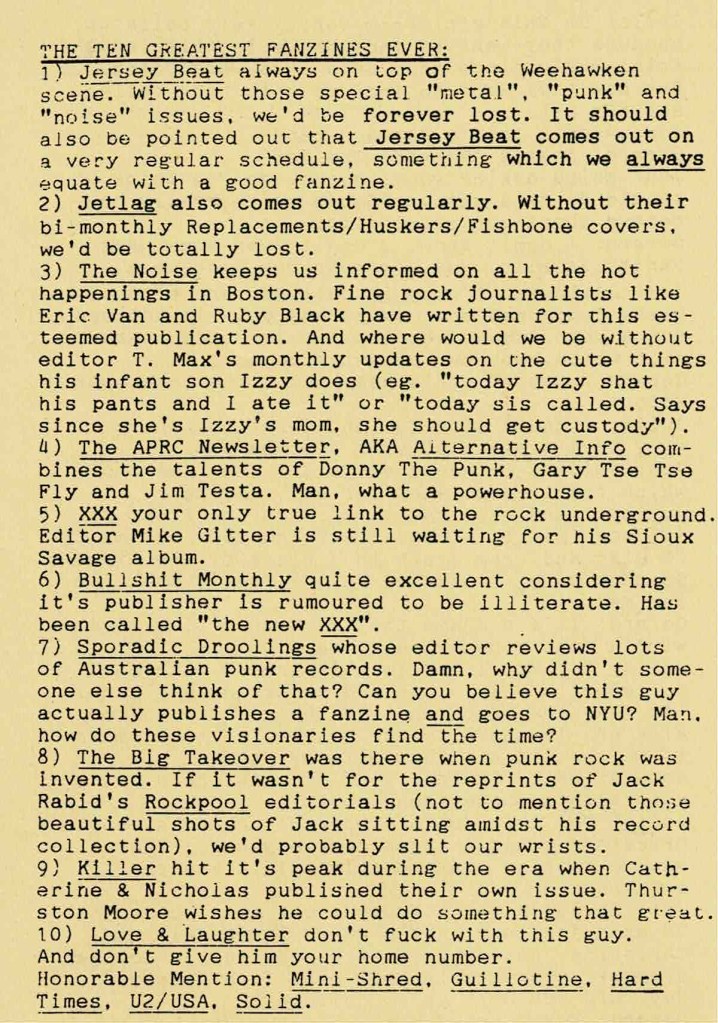
I’ll also give the man some props for where he lived and published in 1986: 62 Avenue C #3 in Manhattan. I visited New York in 1991 during the crack epidemic and, as a soft San Franciscan, felt a little tense walking anywhere east of Avenue A – so kudos for some real urban living. I’ll leave you with Cosloy’s round-up of current top fanzines of the day to help you parse out the then-cut of his jib.
-
It’s So Hard To Tell Who’s Going to Love You The Best #1
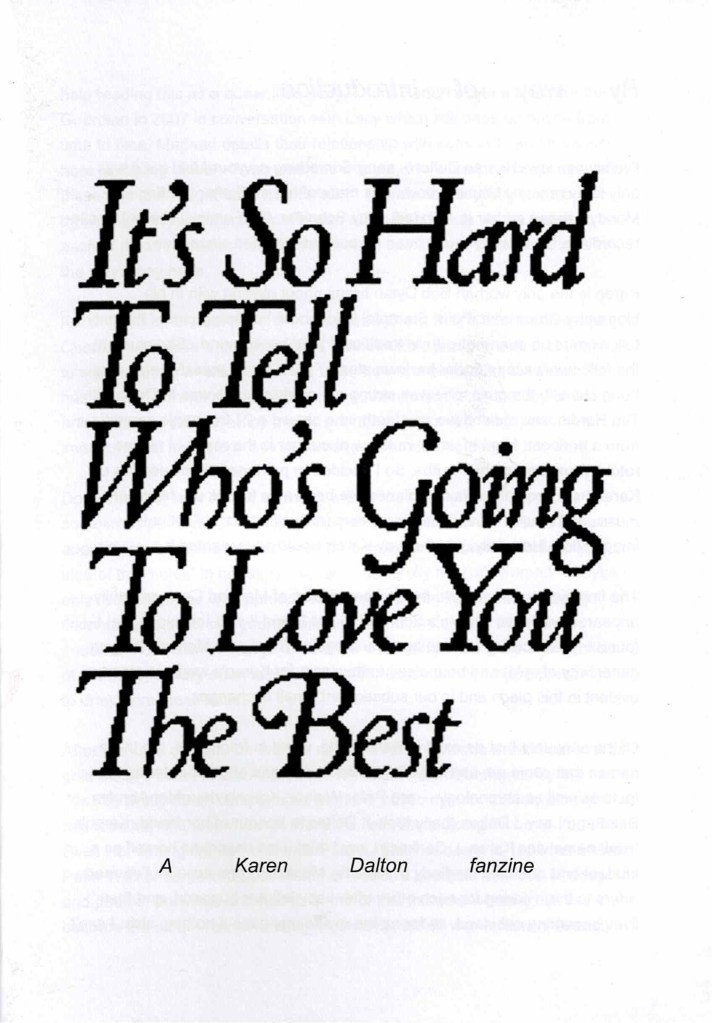
Do you remember your reaction the first time you heard Karen Dalton? Honestly, now. I remember mine – it was probably in the early 2000s. I was doing the blog Agony Shorthand, and there was another music blog/site/”online magazine” called Blastitude who’d cover all sorts of strange noise and post-hardcore craziness, yet who also had an incongruous soft spot for the female singer-songwriters and girl groups of the 60s (as I very much did). I’m not sure if it was Larry Dolman or Tony Rettman, but one of those dudes was seriously championing Karen Dalton and her 60s/70s recordings, so I went and checked her out as one does on the internet, and was like – ugh. Couldn’t get past her voice, which was a strange, froggy thing that almost sounded like someone trying to emote & intonate through a cleft palate.
But friends, this is why we show grit and persevere when we encounter barriers. It didn’t take long for me to see just how beautiful, pained and otherworldly her folk music was, and to really embrace her flawed voice – if it is even flawed – the way we embrace Neil Young and Bryan Ferry for their own vocal foibles. Then when Karen Dalton’s archival 1966 tapes came out and I heard ‘em – well wow, that really did it for me. She entered my pantheon of farsighted, tragic geniuses immediately, and I cursed myself for ever having doubted her, even if she almost totally performed songs that were not written by herself. Who cares? Karen Dalton, especially in the 60s, was phenomenal, and I’m delighted that so much of her music from that period has flowed out to the people in recent years.
It was into this vortex of unbridled enthusiasm that a one-off, small-batch fanzine called It’s So Hard To Tell Who’s Going To Love You The Best came into my life. It was put out in the UK by an outfit (or person) called Cherry Styles, who also put out a Patti Smith fanzine and one called The Chapess, and who seem to have gone mostly dark and missing from the internet. I think it was maybe 2015 or so that this came out on Cherry’s own Synchronise Witches Press? I believe that Cherry Styles and her enthusiasms were very much borne of and furthered by the “Tumblr era”, an era which now seems to have passed.

Anyway! It’s So Hard To Tell Who’s Going To Love You The Best is a “Karen Dalton fanzine”. It was accompanied by a cassette tape of murky, blown-out, proto-folk recordings by Bridget Hayden, one of our favorite discombobulating modern musicians here at FH HQ. That’s probably how I heard about it in the first place, though her music’s connection to Dalton’s is tenuous at best. The fanzine is a collection of tribute articles, poems, pieces of art and even a Bean Bread recipe (!), all in tribute to St. Karen. It’s a cool, personal, homespun, underground fanzine all the way. If you heart Karen Dalton, you’ll heart this fanzine.
You know what’s even better? The Karen Dalton documentary In My Own Time that was one of the very first films I saw in a theater after getting myself vaxxed & done. I’m not exaggerating when I saw that it’s one of my favorite music docs ever, right up there with The Decline of Western Civilization, Gimme Shelter, Be Here To Love Me: A Film About Townes Van Zandt and Dig!. See it! Then buy that 1966 LP, and then offer me up your No Mag collection in exchange for It’s So Hard To Tell Who’s Going To Love You The Best #1 and we’ll talk!
-
New Dezezes #2

I’ve noticed in looking back at early punk fanzines that many of the youngsters writing for them had clearly been weaned on their daily paper’s gossip column, and therefore took this time-honored scandal-sheet form into their first writings. Quite a few fanzines loved to go with these “items” about who was dating whom; who was breaking up; who got drunk at a party; who got burned by a label and so on. Even the “scene reports” that clogged up MaximumRocknRoll eventually took some of this form.It’s even more fun, in 1977’s New Dezezes #2 (we talked about #1 here two days ago), to see just how either off-base and wrong, or prescient and predictive, so many of these “items” actually were. To wit:
“Rat Scabies left THE DAMNED because of a rumoured suicide attempt and the band has decided to break up!”
“The new CRIME drummer is McDonald’s employee HANK RANK – who has never played drums before”
“David Braun, keyboard player for The Screamers, has been sacked and is now starting his on (sic) record label – DANGER HOUSE (sic)”
“The Cramps drummer Miriam left & the band has since disbanded”
“Penelope Houston got a chunk of her arm bitten off at a trendy DEVO party”
“A new punk club called THE MASQUE has opened up in L.A.”
Great stuff in ‘77! Jean Caffeine’s New Dezezes #2 has a color cover this time around as well as double the amount of staples (top left and top right!), but still insisted on printing on one side of paper only for about two-thirds of the pages, somehow switching gears every now & again and going big on “both sides”. Sometimes the pages are in landscape mode, others in portrait, and often hand-written or banged out on a clunky typewriter, as one did in those days.
Given that Peter Urban was one of the prime movers on this magazine, and that he managed The Dils, it’s only right and natural that The Dils get a big feature in this one. The Dils were also a fantastic all-timer of a punk band, and their new 45 I Hate The Rich has just hit the stores. Yet the Paul Weller (The Jam) interview seems to take the tone & tenor of this thing down a bit. The Jam clearly toured the US earlier than I’d thought, and listen, The Jam were also one of my favorite bands in high school – more the “Going Underground” and “Down in the Tube Station at Midnight” Jam, not the snotty, punk-ish sounding 1977 Jam. I still like that stuff, but I always thought Weller was a boob and a terrible interview, just a huge chip on his shoulder at all times and someone who was really, really bad at being the “common man” he so very much wanted to be. Springsteen is better at that act for sure!
Greg and Jimmy from The Avengers each get their own interviews in this one, and there are some cool photos of a new band called The Liars, who never recorded, but how about this – there’s terrific footage of them from 1978 right here on YouTube! (And while you’re at it, how about CRIME sounding like the Velvet Underground playing “Sweet Sister Ray”?). You know, the crowd from these days loved to whistle on about “the spirit of ‘77” long after those days were over, but all you need to do is watch those videos and the sheer joy of the crowds having a total ball – and then read a mag like New Dezezes #2 documenting it all in real time – and you’ll cut them some slack, when you’re not whining in your own head about missing it all because you were nine years old, like I always tend to do.
-
New Dezezes #1

This is a now-legendary early San Francisco punk fanzine from 1977 (!) that I found somewhere about fifteen years ago, maybe at a record store or a yard sale or a church jumble, I honestly can’t remember. I’m delighted to have it, as it’s early, man – very, very early. The editor was Jean Caffeine, with heavy contributions from Peter Urban. Urban managed The Dils at this time, and is someone I connected with relatively recently when I did Dynamite Hemorrhage #8 and interviewed him about his ex-partner Caitlin Hines. Very magnanimous and helpful, and I appreciated his perspective greatly. The guy’s still very willing to talk about the scene, the old days and whatnot, as evidenced by this very recent clip.
New Dezezes #1 is stapled in the upper left corner and only printed on one side, like a pack of flyers assembled, collated and hurriedly stapled together. As DIY as it comes, as rushed as the torrent of music that was washing over these impressionable and young SF rebels. There’s loads of excitement over the fact that on commercial TV – the only kind we got back then, actually – “…the NBC Weekend show had a segment on punk rock and it was great. It showed the Sex Pistols live and in the studio….the punk club audiences were shown trashing the clubs and each other. (Lots of SF people must have been watching because the Mabuhay has suddenly gotten a lot more frantic)…..Unfortunately, actually seeing a glimpse of the English scene only whetted my appetite for more. FUCK the U.S.A.! I WANNA GO TO ENGLAND”.
My understanding is that Caffeine stuck around San Francisco a bit longer and then moved to New York and became a member of Pulsallama, and then to Texas and became a “cow-punk”. Urban was around far longer and may actually still be in SF; he certainly gets back here (which is the city in which I live) often enough to participate in various punk rock anniversary hoo-hahs/nostalgia trips (all of which I love, of course). This is their earliest work, and it chooses its targets to celebrate wisely. There’s a form-fill interview with two members of Crime; a big rave-up by Peter Urban on The Screamers; and a good interview with a rambunctious Richie Detrick of The Nuns, where I learned that he was “Crazy Richie”, an early member of The Ramones, kicked out because he had a nervous breakdown (!). He also answers a very important question, “Do you think there are any new wave bands here?” (meaning San Francisco). His retort: “There are only 3. 1) NUNS 2) CRIME 3) AVENGERS. I don’t consider Mary Monday new wave. I don’t consider her nothin’. All these bands just hopped on a band wagon. You go to Mabuhay and there’s all these shit bands.”.
This is also likely the earliest venue for the punk photos of James Stark, who’s now celebrated widely and wisely for same. (You can get his book here). And there’s a piece on Bobby Death of the band Skidmarx; Mr. Death never recorded with either this band nor his own Bobby Death Band, so this is kind of a rare treat of a guy who turns up sometimes in photos and old fanzines but who’s sort of a missing link between all the bands like Crime and The Nuns who did record.
Hey, one thing I’d recommend if you’re interested in the 1977+ San Francisco scene is this book about Mabuhay Gardens booker and fabled MC Dirk Dirkson called Shut Up You Animals!!! The Pope is Dead. A Remembrance of Dirk Dirksen: A History of the Mabuhay Gardens. The book itself is super sloppy and a bit half-baked (I think the copy editor may have been Will Shatter on a five-day heroin bender), but there’s a show-by-show overview of every show at the Mab from the first day they started booking punk to the very last day they had bands in the late 80s. It’s great! You can sit there and pick out a month, I don’t know, let’s say August 1978, and fantasize how just that month you could’ve seen Crime, The Bags, The Dils, The Flesh Eaters, The Weirdos, Negative Trend, Avengers, The Germs and so on. I mean, that’s the sort of thing I like to do, anyway. I guess if you’re Jean Caffeine and Peter Urban, you use it as a tally of where you likely were on any given night that month. We’ll talk about Issue #2 of this fanzine next time.
-
Zigzag #95

These Zigzags from late 70s UK can be pretty illuminating on the 1979 state of the underground rock fandom and just how fast and furious and sideways new, exciting bands were hitting editor Kris Needs and the team. These folks had completely modified their approach to music once punk hit. It started as a straight rock magazine in 1969 – check out this 1976 Jefferson Starship cover, ugh! – and one year later, just about all of that was whooshed aside in favor of punk, pre-punk like The Stooges, any/all punk offshoots and – being that this was England and the punks loved reggae – some reggae as well.
By July 1979, when this issue hit the local newsagent, it was clear that the magazine and its readers had started to codify their representative favorites. Zigzag #95 is totally packed with Siouxsie and the Banshees mania. Their reader’s poll has Siouxsie winning “Sexiest person”, “Best Dressed” and “Female Singer”, and the band taking #1 for “Best Single” (“Staircase”, easily one of their worst 45s) and the #2 slot for album (The Scream, their first), best group and best live group – all second to The Clash, I might add. It’s a recurring theme in 1979 fanzines in both the UK and the US, I have found – The Clash lord over all, even though it seems to me as though no one actually really loved Give ‘Em Enough Rope at the time.
Zigzag’s just had their tenth anniversary party, actually, and there’s a multi-page spread talking about how great it was. No, they didn’t invite Steve Hillage nor Be-Bop Deluxe nor Dr. Feelgood nor Marc Bolan, though the latter couldn’t make it anyway since he’d died two years earlier. But Siouxsie was there. Wayne County was totally there. The Clash and PiL were there. Were you there? Drop us a line if you were.
Kris Needs does a “stop the press” review about how blown away he is by Public Image Ltd.’s “Death Disco” single (“frightening, monstrous dancing musik”), in fact. And I can say with a high degree of subjectivity and assurance 44 years later that it was the best thing PiL did and would ever do. The other new UK item the team at Zigzag are totally hopped up about are the Psychedelic Furs. Just as Kickboy Face in the United States and Slash would soon be calling the earliest incarnation of the band a “Velvet Underground / Roxy Music hybrid”, so too are those same influences thrown around by this magazine, along with Syd Barrett and Bolan himself. Well, now who wouldn’t be excited about that in 1979?
The thing is, I’ve always kinda liked the early Psychedelic Furs myself. They were a staple of KFJC, my college radio learning module, when I was coming of age in my San Jose, CA bedroom. The big hits on KFJC were “Sister Europe”, “Dumb Waiters” and “Pretty in Pink”, if I recall. This was at least two years before the latter song became the theme to a very popular teen movie, and catapulted the band to minor stardom. So reading these early Slash and Zigzag real-time appraisals of the band made me go back and listen to those first two albums, the self-titled one and Talk Talk Talk, and you know what? I get it. I completely get the excitement, and it sort of rekindled a respect for the band that I’d partially lost, so much so that my most recent Dynamite Hemorrhage Radio podcast plays a trio of songs to try to convince others that the FURS are h-o-t-t stuff.
Zigzag #95 shows further good taste and refinement by interviewing The Cramps, and furthering their desire to not be a cult band (Lux: “I consider us a totally commercial band. It’s just a matter of bending people our way.”), along with Switzerland’s Kleenex. Singer Regula Sing has just left the band, and the band are pissed about it. I think this was the catalyst for them turning into LiLiPut, right? Oh, and I think I may have been someone who once furthered something I don’t think is true any longer; Regula Sing did not go on to form The Mo-Dettes under the name Ramona Carlier, even though there are plenty of websites that say she did. I don’t believe the two of them look enough nor sound enough alike, and I’m gonna call bullshit on the whole thing right now, OK?
Destroy All Monsters and The Prats interviews, too! Good magazine, real good one, and I’m going to try and keep scooping more of them up where I can.
-
Talk Talk (Vol. 3 No. 2 – 1981)
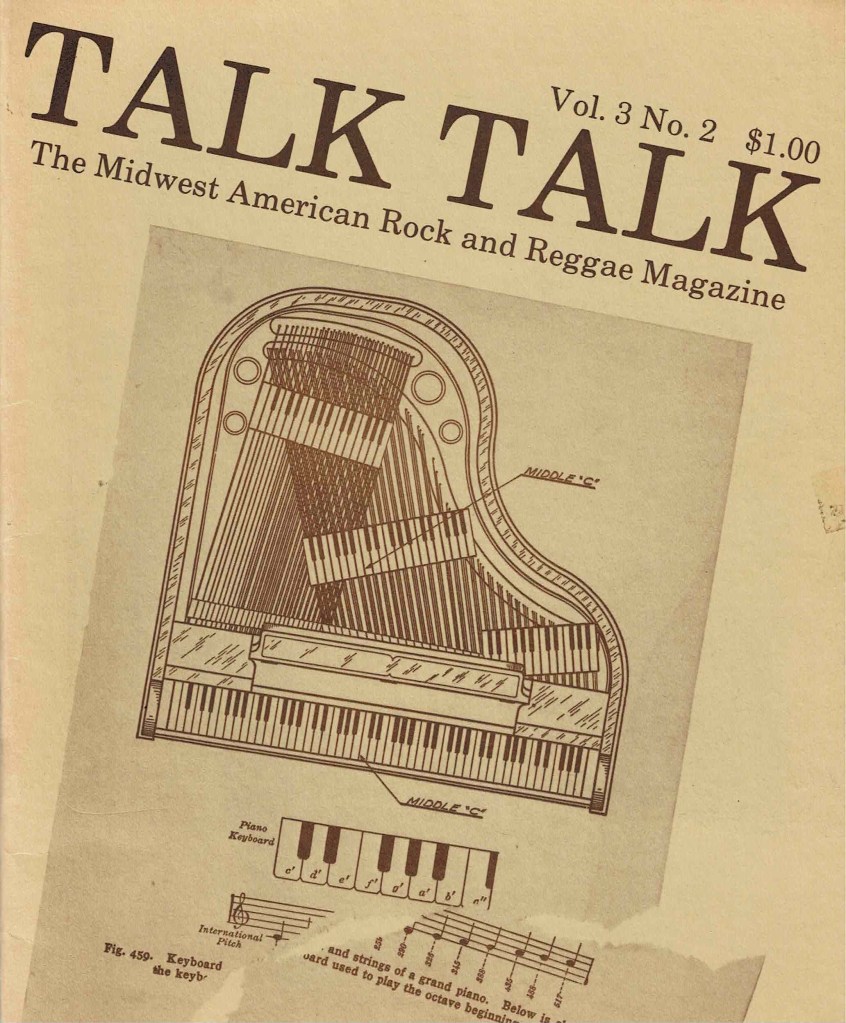
Well this cover really makes you wanna kick out the fuckin’ jamz, doesn’t it? Talk Talk was a frequently-published, late 70s/early 80s “Midwest American Rock and Reggae Magazine” from Lawrence, KS. Lawrence gathered a bit of a counterculture halo effect over the years by being a cool college town plopped in the middle of Kansas, and particularly because William S Burroughs spent some quality time there. I’ve been to Lawrence a couple of times, and frankly, I loved the place. Easily one of the most liveable places in this country, vibrant & safe and with mostly decent weather, as long as you’re cool with being surrounded by college kids and cornfields and with having Kansas City as your nearest metropolis.
That’s maybe easier to say now than it was in 1981, a time in which records, news and trends moved much more slowly, particularly from the coasts to the dead-center of Midwest USA. Talk Talk Vol. 3 No. 2 has the feel of a place partially locked out of the cutting edge, such as it was, while being one still dying to take part regardless. You get this vibe sometimes in fanzines outside of NY, LA, SF and Chicago. They know that something’s happening, just that it’s somewhere else, and their ability to successfully separate wheat from chaff is often therefore a bit limited.
Like the record reviews in this one: Adam and The Ants and Black Flag are given roughly equivalent milquetoast reviews; in Black Flag’s case, for Damaged, “…Once you listen to their latest release, you might not really want to see them. Granted, this type of music is not for everyone.” That’s typical of the journalistic standards of most of the writing, but I definitely got a laugh out of the fact that the editor, Bill Rich, clearly laid down the law of the use of contractions. There’s nary a “don’t” nor a “can’t” nor a “let’s” anywhere in Talk Talk, but rather, “Let us”, “cannot” and so on. Strunk and White, call your office!
Yet there’s still a real “college try” going on here to build a scene, and that’s worth admiring. Plenty of local bands are covered, including one I know and like: Get Smart!. I also dig the equivalent coverage given to reggae, even dub, such as Augustus Pablo’s Rockers Meet King Tubbys in a Firehouse, about which Hill says, “These people seem to meet everywhere”. I guess flexis were included with later issues; flexidiscs were huge in 1981, but the one from Abuse here seems to have gone missing in my copy. Thanks to ZNZ for including this as a special bonus in a shipment to me; he has a way of doing that, I’ve noticed, so you might wanna insist on some left-field or middle-of-America bonus next time you place an order there.
-
Wipeout! #7
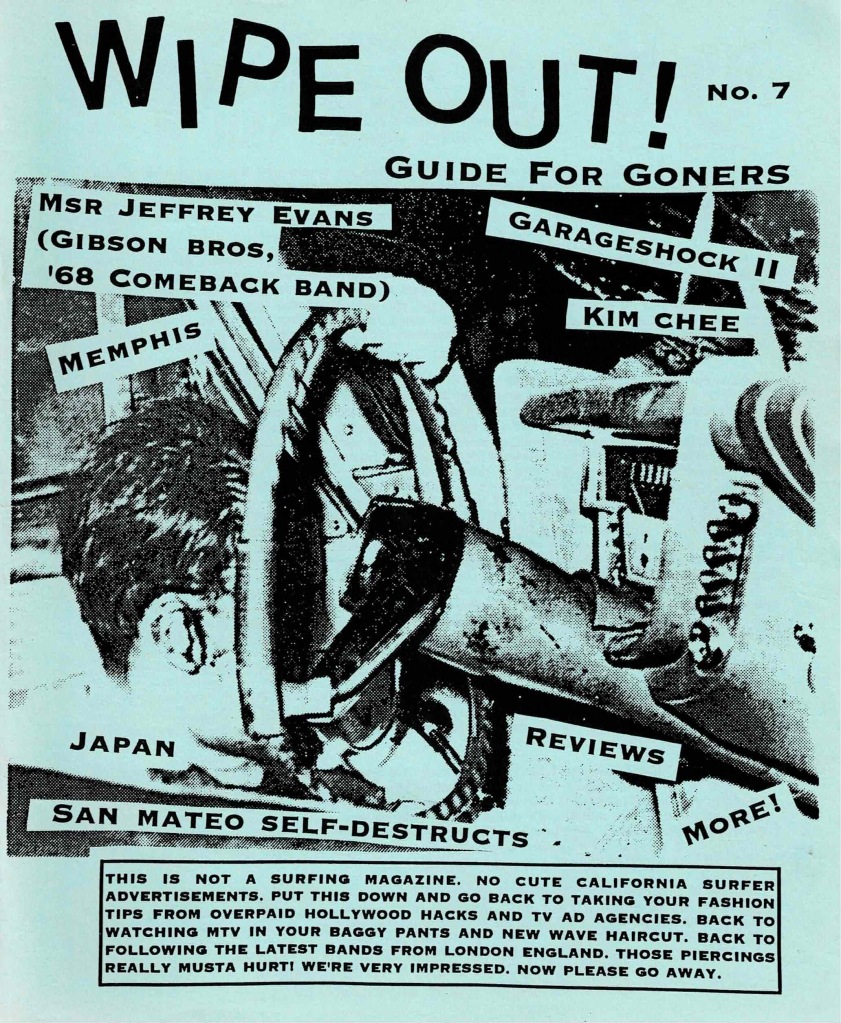
Always knew that Eric Friedl’s Wipeout! was one of my hands-down favorite reads of the 90s, yet cracking it again this week only reinforced what a total blast his fanzine was. I know that given Friedl’s subsequent stature as a member of The Oblivians and as the creator and proprietor of Goner Records, these early garage punk & noise-adjacent fanzines from him are quite “in demand”. I had to regrettably trade one away to a European just to get something I really needed from a guy, and now I feel like I’m the one who got totally rooked.
I certainly remembered the sheer amount of wild and tip-top underground music content the guy shoved into each particular issue, but reading Wipeout! #7 from 1993, I’d also forgotten how absurdly chaotic an issue could be. Like Friedl says at several points in this mag: he’s really just into the music, he loves the music, and he doesn’t really care that much about what he’s writing nor what you think about it. So check out this Truman’s Water 45 review for a sense of how it all went down with this as his ethos:
Though we don’t knead no stinking badges Truman’s Water frustrate the 7” fan by making their albums essential to understanding the short 7”ers, giving keys and subject headers to look up in individual research. So these spastics don’t obey, and throw “Sad Sailor Song” into epic areas and pretty without sentimentality or icky Ricardo beat (cha cha), wires are wiry and I hear the phone ring during the whole thing (a good sign!).
I get the first sentence; the second is about as wacked-out as the Truman’s Water singles themselves, and fairly representative of any given Friedl review, in this issue at least. One of Eric’s recurring loves in these magazines is what was going on in my part of the world in ‘93, San Francisco, which he mistakenly calls “The San Mateo Scene”: Mummies, Supercharger, Spoiled Brats, Phantom Surfers, Trashwomen and so on. He was even more up on it all than I was from his perch in Memphis, and I was seeing one or another of those bands literally every other weekend around that time. Here’s a letter to the editor in this issue, referencing some of Friedl’s mania from Wipeout #6:
Eric,
Mummies mummies mummies mummies mummies mummies, you’ll be swallowing shitrock hard when you realize it’s gonna sound as shitty in one year as 77 punk does now. I can’t wait.
Cal
Vanishing Rock, CO
Took me another five/ten years to get there with The Mummies, but Supercharger still can’t be touched.
Another big love is Japan – garage punk from Japan; noise; The Boredoms; surf, you name it. If it was raw and Japanese, Friedl was on it. And this one’s got an interview with Jeff Evans from ‘68 Comeback and The Gibson Bros, quite a bit better and more incisive than the one I did in Superdope #6 that same year. Friedl also documents a roadtrip to “Garageshock II” in Bellingham, WA, which you’d probably call a proto-Gonerfest from the early 90s that was pulled together by Dave Crider from Estrus Records. Many of this issue’s heroes performed at that Summer 1993 thing, and it sounds like something maybe I should have traveled up to see myself. I don’t know, I had my garage punk favorites at the time, but anything that strayed into “hot rod” or “monster rock” or novelty shit, I really had trouble with – so yeah, while I’d see The Cheater Slicks or Supercharger or Teengenerate or anything related to Don Howland, Jeff Evans or even Jon Spencer in a hot minute that year, I probably would’ve been moping into my Red Hook and doing my best to avoid the bowlcuts and the romulans and the drunken go-go bar girls at “Garageshock II”.
Finally, this one came out when Eric’s own band The Oblivians were starting to move it into gear, putting out their killer debut 45 Call The Shots that same summer. Man, we were so overflowing with exceptional garage trash that year, weren’t we? I think that was THE year. Within a year or two The Oblivians would be touring in Europe, and Friedl only had two more Wipeout!s to give us before really devoting himself to Goner Records and his band. I’ve hung on to a few of ‘em, and I shall be dissecting them in time as this Fanzine Hemorrhage project proceeds accordingly.
-
Subscribe
Subscribed
Have a WordPress.com account? Log in now.

