-
No Mag #13

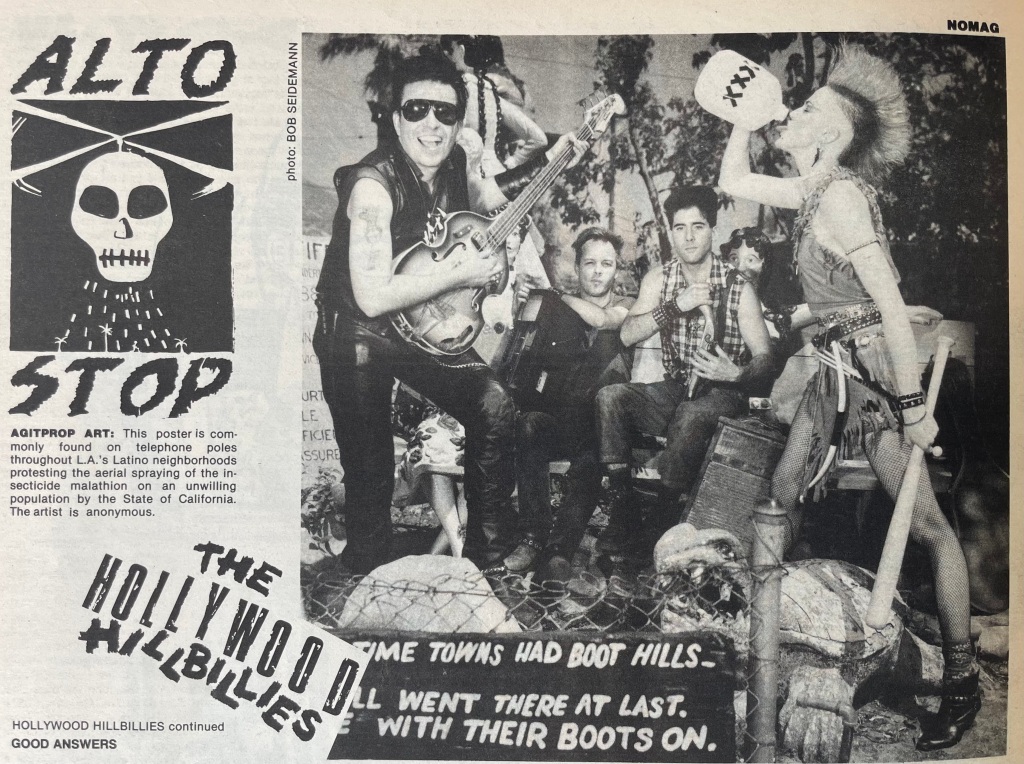
It wasn’t quite the case across the entire breadth of independent music, yet all told 1984 was a pretty rotten year for sub-underground rocknroll music in Los Angeles, California – that is, if you’re reading the thirteenth issue of NoMag, the one with Nancy from “Animal Dance” on the cover. Unless you were laser-focused on the SST bands in a way that NoMag decidedly wasn’t – Double Nickels on The Dime, Meat Puppets II and Zen Arcade all came out this year – you’d be forgiven for thinking that the previous world-beating LA music scene had completely and rapidly devolved to godawful cowpunk, retread goth or sell-out pseudo-roots music.
It’s kind of a bummer to have to see it, but as went the overt trends in LA, so went NoMag – underlining that not all NoMags were created equal. What a letdown. Thumbing through it, it’s clear that editor Bruce Kalberg has become more attracted to the trappings and fringes of alternative culture than to the music that defined it. Everyone is either a goofball cow punk, has a hideous angular new wave haircut or is dressed in highly choreographed “LA sleaze” wear. There’s a group called the Hollywood Hillbillies celebrated here who I am absolutely delighted to have never made the acquaintance of.
When I arrived at KCSB in 1985 as a college radio DJ it was these records – the bands interviewed in this issue – that were clogging our library: The D.I.’s; the “no original members” TSOL; Tupelo Chain Sex, The Fiends, Kommunity FK, Detox and so forth. They were usually on labels like Enigma and Restless, quasi-major labels that rose out of hardcore to pump up this sort of clotheshorse rock, or speed metal, or novelty punk. I do somewhat enjoy Tex & The Horseheads – they define the spirit of ‘84 LA for me for better or worse than pretty much anyone else – but SST barely exists here outside of a paid inside front cover ad; no one’s fashionable enough.
There’s an interview with the Cambridge Apostles with Alice Bag and two of the Atta brothers from The Middle Class. They sound from their own description of themselves like a dance band, and Alice spends most of the interview herself dancing away from questions about The Bags. A great deal of the activity documented in NoMag #13 feels to me like some real goings through of the motions, the washed-up flotsam of a recently capsized music scene and a lot of musicians desperately searching for the road to cash in. John Doe is interviewed about X and his relationship with his record company, Elektra, and he’s all smiles. You’ll have to read his More Fun In The New World anthology book to see what thirty years of hindsight brought to him – but let’s just say it doesn’t quite jibe with the sunny disposition presented here.
That was my favorite of the two Doe books because – well, it’s right there in the sub-heading of the book, “The Unmaking and Legacy of LA Punk”. Everything I’ve just spend three paragraphs moaning about it is confirmed by the folks who participated in it, and the unmaking is happening right here in real time within the pages of NoMag #13.
-
Dagger #8
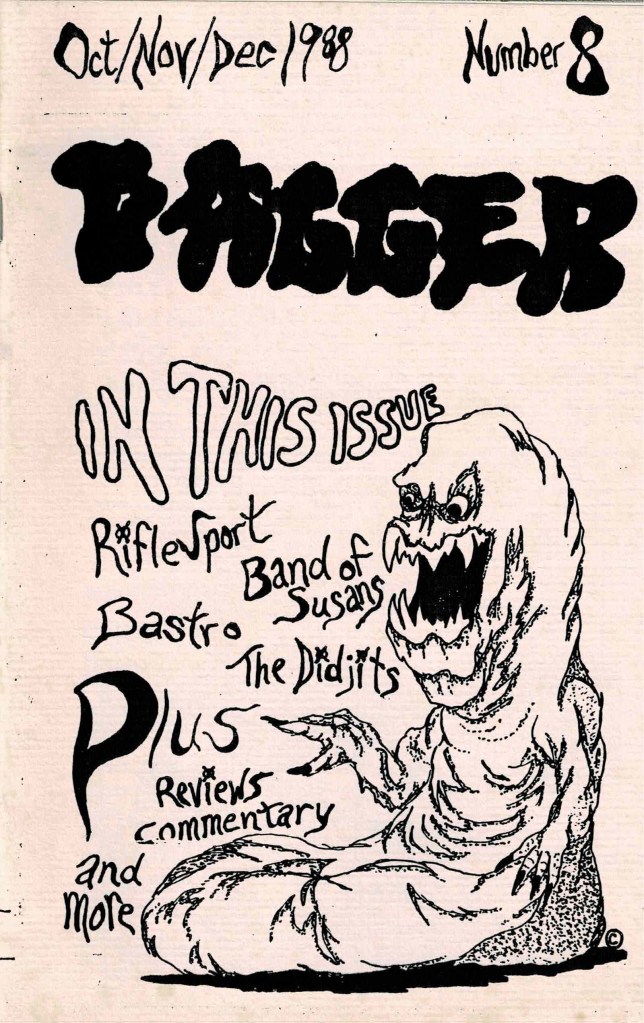
Tim Hinely’s been doing Dagger fanzine in various forms, sizes and guises since the 80s, and I suppose this would have to be the first one of his I ever picked up, back in 1988. The guy has given much back to the music that nursed and nourished him, not just in the form of his longstanding fanzine, but also the anthology book about music clubs Where The Wild Gigs Were, which he edited (an entirely brand-new second volume of which is forthcoming, maybe next year). He also helms a Facebook group devoted to fanzines called Zine Chatter that you can look at if you’re willing to log in to Facebook and surrender yourself to the algorithmic maw.
Now back in 1988, Tim was a young stallion going to loads of live shows, as active in the scene from his New Jersey locale as I was from my own California locale. More, even. He finds himself trapped at funnypunk shows, seeing Murphy’s Law and loads of other flotsam. Because I read his mag a lot of the 90s and 00s and associate him with that persona, this 1988 version of Hinely shows a little bit more ‘tude than he’d show later, as he later morphed into more of a pure underground pop guy from these HC beginnings. One of the shows he reviews here is that famous Fugazi one where the singer hung himself upside down through a basketball hoop. Another is the Gibson Bros – yes! – during which Tim falls in love with drummer Ellen Hoover and relays that their set was abandoned because Don Howland was too hammered to finish the show. Sounds like the Gibson Bros on their east coast tours for sure – a real alcoholiday by all accounts.
All of this action is taking place across New Jersey and greater Philadelphia. Hinely also talks with, as you can see in the cover, The Didjits, Rifle Sport, Bastro and Band of Susans, none of whom I’ve listened to in thirty years – but the interviews are very much fan’s-eye-view, alley-behind-the-club sorts of chats, and therefore quite entertaining. There are an incredible amount of fanzines briefly reviewed as well, showing just what an abundance of ‘em were being published at the time. This was definitely an era where, if Maximum Rocknroll or Flipside reviewed your fanzine, you were certain to receive a plethora of unasked-for xeroxed punk mags from the deepest recesses of the United States; sometimes from prisoners, sometimes from teenagers; always with a “Wanna trade?” note. When I was publishing, yes, sometimes I did wanna trade, but mostly I emphatically did not. I wonder what Tim did.
Dagger #8 is itself a pretty cheapo xerox, which renders it all pretty quaint and of the times. Some reviews just don’t quite come off the “printing press” and are just faint letters, and a couple others take a comic run right off the side of the page. I do hope the advertisers in the back weren’t charged a fortune. I’m guessing that Jersey Beat and a speed metal band called Methadrine probably weren’t.
-
Cheetah #5

Not really a full-on music magazine, and absolutely not a fanzine, but we’re definitely going to write about it anyway. I first heard about quintessentially quasi-intellectual 60s counterculture magazine Cheetah all of two years ago, when I was deep in the enveloping throes of my late-bloomer Brian Wilson obsession, the one that I wrote about in Dynamite Hemorrhage #10. This fantastic Jules Siegel essay about the runaway train wreck that was the Smile sessions ran in this publication in 1967, and I henceforth learned that it was Ellen Willis who founded and edited Cheetah. I ordered my own copy – and it is the one we shall be discussing presently.
My research tells me that eight issues in total were published, with the final being the May ‘68 issue, right between the assassinations of MLK and RFK. These cataclysms haven’t even happened yet, yet the back of this February 1968 issue previews next month’s by saying “In the most dire winter of our discontent, the social fabric of America is pulling apart. With maps and diagrams, we’re going to show you just how bad it all is.” I’ll say for the record that I believe that 2020-21 in the United States was even worse, and only by virtue of electoral sanity have we restored the possibility of moving past it.
But anyway, continuing with the Brian Wilson theme, actually, the February 1968 issue is like one big tribute to Mr. Van Dyke Parks. There’s a full piece on him by Tom Nolan, and an intro essay at the start of the magazine for this young wonderkind, full of worship but preemptively apologetic about the potential pretentiousness of his lyrics. “Columnated ruins domino”! In general, Cheetah #5 is packed with writing that’s very much trying to be the new thing, the new journalism, and some parts of the charade wear better than others. The narcissism of the counterculture is on full display, for good and for ill.
There is, for instance, an amazing ad for a different magazine called Avant-Garde right out of hip 60s intellectual central casting, along with other various terrifically dated ads devoted to sexual liberation totems and “smoke grass” buttons and T-shirts. There’s a whole piece about a groovy trip to the San Diego zoo, and another about the killer LA experimental psych band The United States of America. Robert Christgau contributes a piece about hitchhiking. People did that in the 60s, you know.
Nearly every main article has the exceptionally annoying habit of beginning, going a page or two at most, and then requiring the reader to pick it up again toward the back end of the magazine. Sure, magazines (to the extent they exist) still do that to this day, but not on the momentum-stopping level of Cheetah in 1968. Ellen Willis contributes the best piece in here about Communist rabble-rouser Bettina Aptheker, a woman often held up as a true Hero of The Struggle by the pamphleteering Left when I was attempting to get my political bearings in the 1980s. There’s also something about the “I Ching” which I think may have something to do with tarot cards, and something else about “concrete poetry” which is akin to what we might later have called graphic design. Oh, and a bunch of awful and unfunny New Yorker-like single panel cartoons.
Do I like Cheetah #5, though? I do! Had I been age 20-whatever in 1968, I’d have fit squarely in their demographic and psychographic profile, and while it’s always great to make fun of hippies, I’ve no doubt that this magazine would’ve probably fit me well had I too grown up in stultifying 50s USA, without college radio, fanzine and punk rock to guide me where it eventually did. Even the brief musical nuggets of Van Dyke Parks and Dorothy Moskowitz and Cheetah’s passel of record reviews would have been enough for me to take out that one-year subscription for $5 – even though said subscription would have unfortunately run aground a mere three issues later.
-
Rock Mag! #1
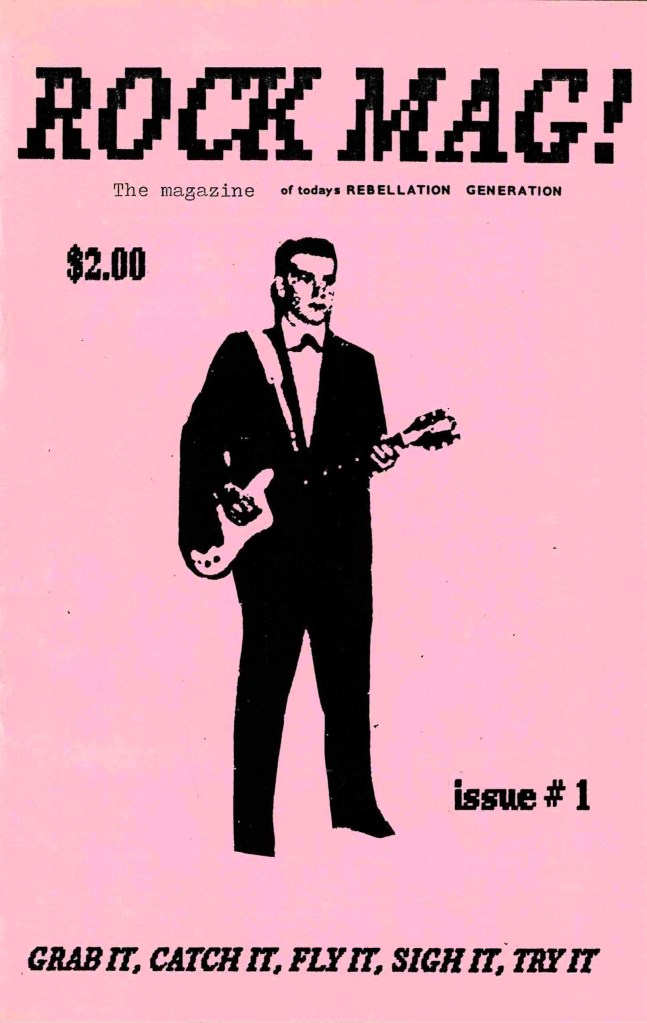
In the early 90s when I was publishing my first fanzine Superdope, there were a few other fellas in my age bracket with concomitant music tastes who were also publishing their homespun fanzines, and with whom I’d regularly communicate. Among them were Marc Masters of Crank, Glen Galloway of Zero Gravity, Eric Friedl of Wipeout! and Tim Ellison of Rock Mag! Tim headed up – and still heads up a revised version of – the San Diego band The Nephews, a band I got to see just once at a tiny club down there called The Neptune, which I later learned was the original Casbah club (SD’s long-running best underground club from the 80s onward). I found their records to be a little uneven at times but they were terrific live, and I particularly remember how great this track was.
More importantly, I really liked Tim. Contrarian, obtuse, wryly funny, highly educated (music and otherwise) and willing to go waaay out on a limb for the music he liked. Rock Mag! wasn’t for everyone. I remember sending an extra issue of it that Tim let me write a few reviews in to my pal Scott “Deluxe” Drake of The Humpers, thinking he’d love the weird piece Tim wrote on links between The Fall and certain animal noises. He sent me a letter back saying he was totally baffled and frustrated by the whole thing and that he’d never read another fanzine like it. Exactly!
The first issue of Rock Mag! arrived in 1992, and two-thirds of it is given to theorizing on the nature of rock, how we listen to rock, how we contextualize rock and ultimately defending rock after lambasting it. So sure, it’s an acquired taste I suppose; this issue arrived not long after Rock and The Pop Narcotic by Joe Carducci, a tome that set many typewriters and tongues a-waggin’. It is certainly referenced here, as is Richard Meltzer’s Aesthetics of Rock; neither in flattering terms for the most part. I never really deconstructed the meanings behind the music in this manner and probably never will, as my own brain really doesn’t work that way, but I totally got a gas out of how Tim did it, in his truly passionate, devil-may-care manner.
He then gives in to writing a big batch of record reviews, because, as he says here, “Rock Mag! (the non-rhetorical magazine of the ‘Rebellation Generation’) is called Rock Mag! because it is a rock mag and rock mags have record reviews in the back of the mag.” Among these record reviews lies praise for The Gories, Hanatarash, Electric Eels, Cheater Slicks, Ruins, The Dwarves (Tim loved the Dwarves, as did I for a time), Dead C, Pavement, Shonen Knife and one of Tim’s other non-R.E.M. favorites, The Fall. On the back cover is a nice big salute to “Paul Fucking McCartney”, and that was Rock Mag! #1. The second issue had what I believe was one of only a couple interviews he ever did, but we’ll get to talking about that one in due time and shall wait, as all good things must.

-
NY Rocker – September 1980

The personal, hand-assembled music fanzine’s always been the place that cultural pontificators like to point to when directing nostalgia seekers to the real pulse of an era, the sociological beat of the streets and the place where a given music’s early adopters were the ones helping to define that music’s formative boundaries and key players. I think there’s much truth to this assertion, or I otherwise wouldn’t be bleating as much as I am here.
Yet I think there’s actually far more sociological and on-the-ground ore to mine from the music periodicals of particular musical eras, back when, unlike now, music periodicals were a thing. A single issue of the NY Rocker, say – or of Slash, or Damage, or Take It!, or Sounds, or Rip It Up, or Melody Maker – those newsprint periodicals, packed with columns, reviews, interviews, musings, artwork, listings, ads and photographs – each issue of these provided an incredible bounty of detail and real-time reportage and opinion that actually tops much of what irregularly-produced fanzines did. So I like to read ‘em, myself, just to put myself in the same frame of mind as any other music dork might have been in during 1980, or 1972, or 1967. In the US these local newsprint music papers pretty much died out by the mid-1980s, replaced by the local alt-weeklies that themselves have now died out.
This preamble is so we can talk about how much I loved reading NY Rocker’s September 1980 issue, OK? It’s the proverbial portal to another world, itemized and particularized extensively and exhaustively from the viewpoints of folks like Andy Schawrtz, Byron Coley, Ira Kaplan, Lisa Fancher, Jeffrey Lee Pierce, Peter Crowley and many others. Some Los Angeles names on there, right? That’s because this is a very heavy “The Best of the West” issue, with three different features on X (who’ve just released Los Angeles and played New York) and a particularly fantastic Lisa Fancher piece trying to make sense of the LA/beach hardcore scene and place it all in context. Like Kickboy Face’s similar piece in Slash around this time, she is an advocate of letting the kids be kids, hating the cops and grooving to the pure adrenaline of nascent hardcore punk. “Though it may have taken three years, these California kids have finally broken away from English apery and come up with something so crazy and incomprehensible it could only be American.”. God bless Lisa, and God bless the USA.
Oh – and she talks about a show she’s just attended in Redondo Beach at the Fleetwood with a bill of Fear / Bags / The Gears / Circle Jerks / Gun Club / The Urinals. I know, I know. She casually mentions “Slash is filming the proceedings”. Folks, this is the The Decline of Western Civilization show; “Slash” = Penelope Spheeris, the then-Ms. Bob Biggs. I know that some of The Gears footage made it to a Decline DVD; does anyone know if she actually filmed The Urinals and Gun Club as well?
Aside from the heavy LA focus in this one, there’s a “the scene is totally dead” San Francisco report from Tony Rocco, who was a staff writer for Damage and who was parroting the party line of that magazine in 1980, which we told you about in this post. There’s a (true) report about The Cramps’ Bryan Gregory quitting the band to join his girlfriend in her intense worship of Satan (!), and his new replacement, Julien H (you can see her in this clip, one of the greatest pieces of rocknroll ever committed to film). There are also great bits on The Raincoats, Gang of Four and The Selecter, all interesting, all of their time and all so exciting in the context of everything else also going on around them.
There was another reason this was such a great year – The Shaggs’ world-destroying Philosophy of the World had just been reissued, and it was blowing minds from Nashua to Great Neck and back again. Byron Coley reports on it all, in the context of a review that unsuccessfully (and tongue-in-cheek) attempts to compare it with some Slits demos that have just come out. I heard it not long after this and got quite the laff out of it, but it wasn’t until about 1983 or so that Shaggs mania would enter my home from the most unlikely of sources.
The comedian Bob (“Bobcat”) Goldthwait was a local San Francisco comic in 1983, and I was a 15-year-old who listened to the Alex Bennett Morning Show on KQAK (“The Quake”) every weekday morning before school. Every morning Bennett had someone on, a local comedian, who’d later go on to be moderately famous, like Dana Carvey, Kevin Pollak and Mark Pitta. Anyway, Goldthwait was on at least once a week, and he decided to bring The Shaggs to the west coast, both figuratively (by making Bennett play “My Pal Foot-Foot” and “Who Are Parents?” on the air all the time) and “literally”, by pretending to bankroll their big trip to San Francisco, where they’d be greeted on the ground at the airport as heroes who’d come to save rock & roll.
Goldthwait used Bennett’s show one morning to pump up the in-studio crowd who’d come to KQAK for every show – as well as the audience listening at home – to get themselves to SFO airport immediately to cheer and hoot for The Shaggs, whose “plane was just about to land”. Goldthwait had a live mic and several dozen amped-up people around him at the airport chanting “We love The Shaggs! We love The Shaggs!” as their plane landed. I was quite entertained listening at home, let me tell ya. I don’t quite remember what happened when the Wiggin sisters didn’t actually get off the plane, but perhaps I had to get to Social Studies 1 and missed it entirely.
Anyway, like I’ve said in previous items, I haven’t entirely lived up to my promise to write more unasked-for stream-of-consciousness diversions in these blog posts, so there you go. NY Rocker’s September 1980 issue is a real gem. I have others to review in the weeks to come. (And hey, does anyone have any info on the lone issue of NY Rocker Pix? It has on the cover one Donna Destri, the sister of Blondie’s Jimmy – I just this very week heard her name for the first time when I watched this not-especially-good documentary called Nightclubbing about Max’s Kansas City.)
-
Luggage #1

I believe Luggage #1 was the first and only in its run – a Boston-based digest fanzine from the haphazardly-xeroxed school of design, focused on music skirting the boundaries of rock. The editors were Jason Castolene and Mike Zimbouski, and there’s an excited sense of newfound discovery in the fanzine, that they’ve very recently unlocked a hidden portal to the deep underground and are newly bathing within a deep well of improvisational noise, jazz, not-quite-rock and related experimentation. It all comes off as wide-eyed and prone to the disproportionate obsession and over-analysis that can make life in one’s twenties so fun and so frivolous.
Trans Am, purportedly a krautrock-inspired band who are interviewed here, put that myth to rest by telling Luggage that they’ve just heard most of it for the first time, with one guy piping up to say he’d just heard Faust today. There’s an interview with clarinetist Don Byron, whom the editors are chastising me for not knowing in 1997; alas, I’ve only heard of him now, 26 years later, reading this old fanzine I’ve recently found. Good, prepared questions from the Luggage team and it gave me a great sense of that late 90s NY/Knitting Factory downtown era that I wish I’d have been able to experience a bit of firsthand.
The final of their trio of interviews is with Thurston Moore, and I’m always game to read his explorations of record collecting, navigation of the obscure, and straddling of the major label and micro-indie worlds. The editors flummox him a bit with the sort of rookie questions I unfortunately still ask my subjects in the interviews I do: “What are you listening to these days?” “What books are you reading?” “What’s Sonic Youth doing next?”. Byron Coley is referred to here and in another part of the magazine as “Byron Cohen”.
Moore makes a particularly relevant point in the interview about what’s driving such a strong interest in improvisational and far-underground, out-there music in 1997 – and while he doesn’t quite say it with these words, it’s effectively the turned backs of underground music freaks who once revered major label bands like his own Sonic Youth. The underground, having seen their bands so thoroughly co-opted, are digging deeper into formless tuneage, distant krautrock, harsh noise and even the strange, loose psychedelic folk music starting to coalesce around this time, just to see what might turn up and excite them the way bands did in the 1980s. Here I was in 1997 thinking it was just a buncha scene credential hogs pretending to enjoy Keiji Haino and The Tower Recordings, and it was Moore’s evenhanded take that probably explains it all better. As I’ve mentioned before, it took me quite a few years before I’d personally come back to the late 90s to really dig into all I missed by turning my own back on the sub-sub-underground.
Therefore, I still don’t know what’s what with some of Luggage #1’s favorites: Analogue, Five Starcle Men, Oval etc. The fanzine closes out with an incongruous show review of Polvo playing in Boston in 1996, “an epiphanic experience” for the unnamed writer. “Polvo” is one of those you-had-to-be-there-I-guess 90s fanzine-rave bands, much like “The Grifters”, from whom I’m still waiting for a first decent song to penetrate my consciousness. Anyone know if Castolene and Zimbouski went on to write elsewhere? (Yes! Just found out that Zimbouski published this collection of short stories…).
-
Ugly Things #62
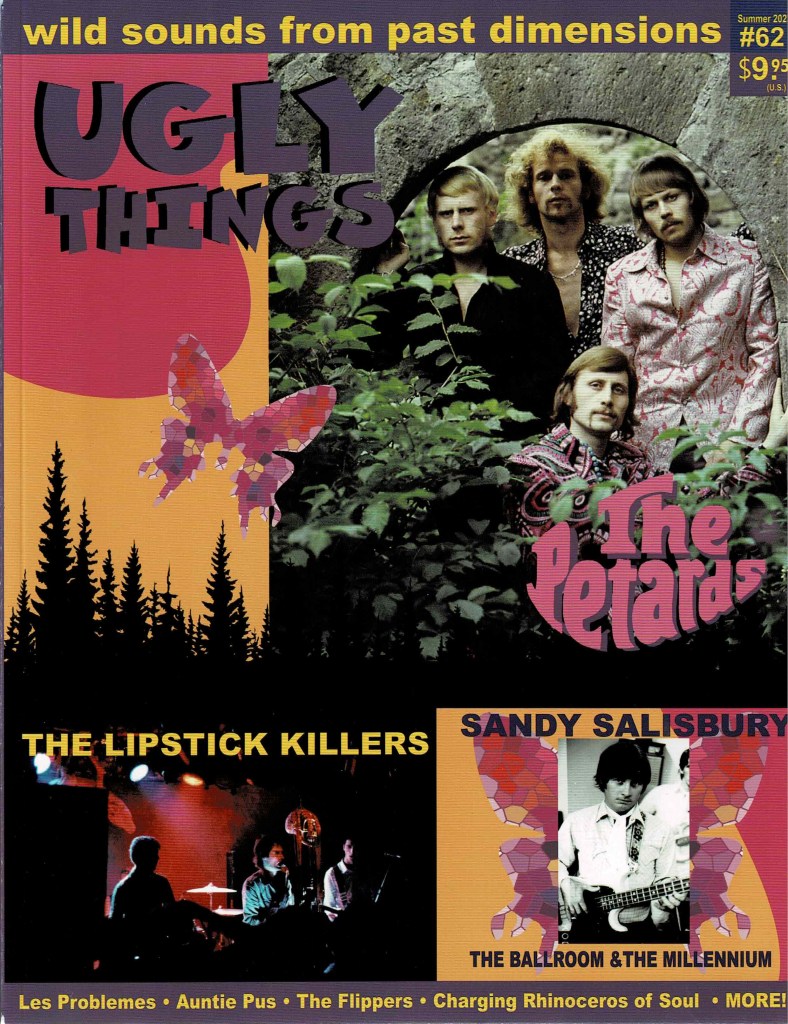
Ugly Things has been around for forty years now. Amazing. How about that? Twenty years ago I got it in my pudding head to write partially-mocking “reviews” on my blog of what were then issues #21 and #23, only a mere third of the way into the magazine’s lifecycle, and I’ve pretty much regretted it ever since, despite more or less “agreeing with myself” on what I had to say about it. The thing is, there’s no world in which it’s a good idea to belittle what Mike Stax and his longtime cast of contributors have achieved with this gargantuan thing: the careers they’ve resurrected, the historical records they’ve either set straight or thoroughly defined in the first place, and the sheer mania and volume of fandom and documentation, which truly has known no bounds.
Stax magnanimously dropped a comment on my old blog not long after this, sort of reminding me of something unnecessarily snarky and lame I’d said, and my face fell to the floor. Of all the people to mock, why Ugly Things?? I probably own half their issues, and I’m a happy current paying subscriber. I discover new 60s and 70s sounds every time I get one. So here’s what I had to say back then, in 2003 and 2005, across two different posts:
Ugly Things #21: November 17th, 2003
NOW A FEW WORDS ON “UGLY THINGS”….Last week I finished this year’s edition of Ugly Things magazine (#21) after spending a couple of weeks with it – well, “finished” is perhaps a bit of an exaggeration. How does one actually finish a massive tome like this, packed with absolutely insane amounts of 60s rock arcana and incidental, meaningless flotsam? I mean, the cover feature on mediocre London-via-Riverside psych band THE MISUNDERSTOOD is 45 pages of tiny type, in which the band’s marginally interesting back story and sub-stories are flogged into painful submission – and it’s only the second of three jumbo cover stories planned on the group.
I’d accuse Mike Stax of trying to grab a Pulitzer if that was even plausible. Likewise, the massive reviews section in the back would garner a lot more credibility if it weren’t for the utter lack of subjectively (yes! more subjectivity please!) and unabashed cheerleading for every tinpot reissue of flowery psych/pop turd, Danish beat combo and marginal 60s garage rock outfit. Isn’t at least some of this stuff just absolute shit? – and doesn’t some of it merit, say, a 1-paragraph review as opposed to 7-8 paragraphs of down-to-the-liner-notes scientific dissection? I think Stax does get it at some level – one reviewer makes reference to a dictat from headquarters asking for “less words” in the reviews. I’d say that judging from the boatload of bloated reviews this issue, the memo hit the circular file the second it arrived.
Hey, don’t get me wrong – I eagerly buy Ugly Things every time a new issue hits the stands, and strongly encourage you to do the same. No magazine covers its scene this deeply – and in recent years that scene has expanded to raw music from the 70s and 80s (witness the “controversial” Crime, Union Carbide Productions and Misfits cover features). There’s always some features that serve the public interest exceptionally well – witness #21’s piece that sorts through the recent mass of ABKCO Rolling Stones reissues.
They’ve even stooped to allow famous record collector Johan (“I owe you one”) Kugelberg on the masthead, and at least he does keep things verbally moving along – and covers micro-scenes that no one else does. Why, this issue JK even tackles Danny & The Dressmakers and the legend of Fuck Off Records. And he even prints up a list that he just happened to find in a scrapbook – hey, now where’d that come from??!? – of his favorite records in September 1983 – when he was just a mere teen! Not surprisingly, because he’s always been such a groover, he was way into SPK, Pere Ubu, Television and The Popes – just like all the other kids! I mean, come on. I lay even odds that this list of “favorite 1983 records” was written in, oh, how about 2003?
Anyway, the new Ugly Things is out! Go forth and prosper.
Ugly Things #23 – September 27th, 2005
Someone once said on this site that it was obvious that I didn’t “like” Ugly Things magazine, yet nothing could be further from the truth. I happen to have a strong appreciation for the way the love of music can make intelligent folks go utterly bonkers, and therefore spend precious waking minutes obsessively cataloging and testifying to their faves in the hopes that someone else might catch on. It’s why, despite my better judgment, I still post entries to Agony Shorthand at least 3-5 times per week. I’m right with you, Stax & co. I’ll buy your magazine every time.
Where I part company with the Ugly Things crew is in attempting to see the forest for the trees. For every genre of music, including 60s garage and beat, there is a cut-off line, below which the music is so unremarkable or throwaway that it merits not a second’s worth of debate. For Ugly Things, that line is waaaay down there. Not only does Ugly Things refuse to really “debate” anything (bad reviews are barely allowed — you can actually watch reviewers like Mike Fornatale squirm as they attempt to be magnanimous), but they joyfully celebrate every unfilled pothole from the 1960s — like, in this issue, “The Checkmates”, “Charlie Crane”, “The Belfast Gypsies” and “Las Mosquitas”. Those might be some fucking out of control rock monsters, but I highly doubt it, and the approach to their music is strictly biographical name/rank/serial number scribing. Aggressive skimming is unavoidable.
Still, the sheer repetition of underwhelming 60s rock music paints a picture of a sort, and the Ugly Things team are so incredibly clued-in to their world that you end up getting jazzed about some of it in any case. Not like I need another 60s punk comp, but they’ve got me excited to buy “The Ikon Records Story” 2xCD (Sacramento!!). They also view just about every cool music DVD that hits the shelves and read every single rock book as well, and if that’s your bag, these guys have it nailed better than anyone. This particular Ugly Things issue seems to be lacking a little something, like they’re just waiting to get this Misunderstood saga out of the way before relatively firing on all cylinders again. And I never thought I’d say this, but I actually miss Johan Kugelberg this issue (I guess he was making his electroclash album with Moby). Still, for 9 Paypaled bucks, you’ve got a quality read that’ll last you all Autumn. The worst Ugly Things is better than, say, the best “Maxim Blender”.
OK, so here we are back in 2023 again. I just finished the Summer 2023 issue, Ugly Things #62, last night. I left more on the table than I was able to cognitively take away from it, which is normal, because if I spent time actually reading the word-for-word entirety of, say, The Petards cover story and every story like it, I’d never again read books, watch films, have friends, etc. Yet that Petards cover story will always be there when I need it, like if I hear one of their songs at a fab hullabaloo or a far-out shindig and I’m like, “Let’s Shazam this fucker – oh, it’s The Petards??!! I gotta go back to Ugly Things #62 and find out what those young Germans were really on about in 1968!”.
Another thing Ugly Things does really, really well: you’ll be reading along with a record review, and all of a sudden it’ll be accompanied by an impromptu interview, like this issue’s MX-80 Sound chat. In other words, the cover doesn’t encompass the totality of the contents therein, and that makes for some really great surprises. And Phil Milstein writes for it. God bless Ugly Things and I’m sorry again for my snarky blather of the early aughts.
-
Boo Boo #1
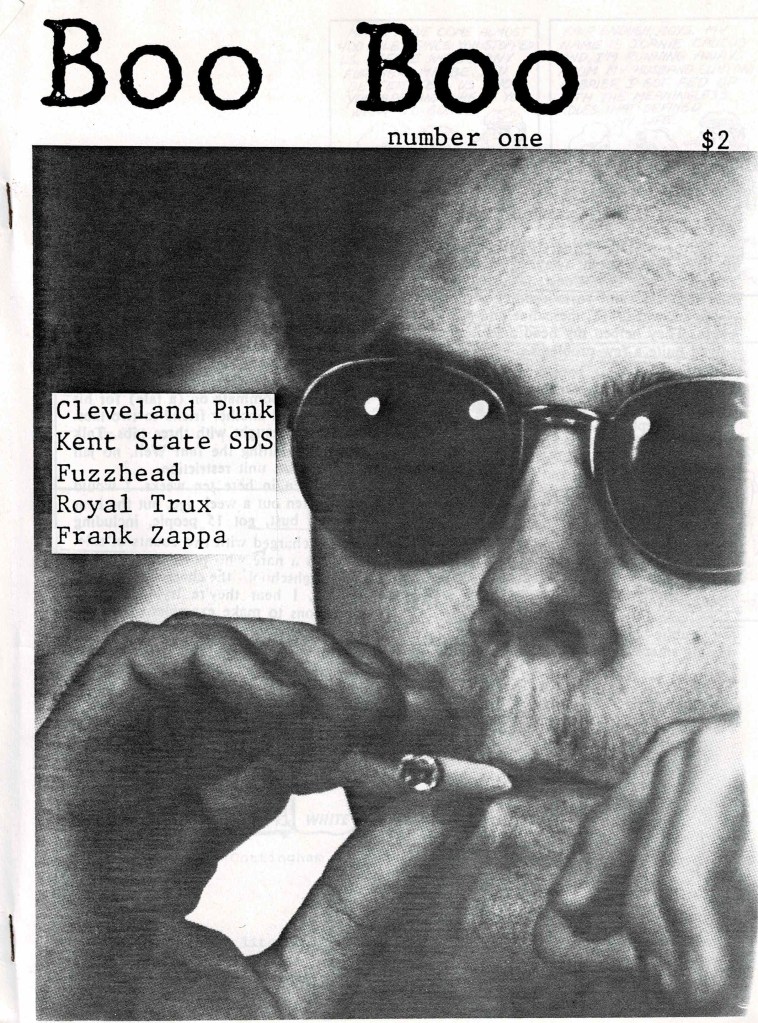
Terrific 1994 glorification of various countercultures here by Brett Sokol in Boo Boo #1, complete with a weed-smokin’ radical on the cover and a glorious pastiche of 60s-90s anti-mainstream vibes. Royal Trux were perhaps the perfect “bridge” band of this ilk from one generation to the next, and I loved Sokol’s opening disclaimer before his interview with them: “Royal Trux take the attitude toward interviewers that most people have towards their landlord: why would you want to give them more than you had to?”. Turns out that they’re actually quite game to answer his questions; I’ve noticed through the years that if you really wanted to get Neil Hagerty talking, start asking him about Zappa, or Jefferson Airplane, or Creedence. Sokol figures this out pretty early on in the interview and it just flows from there.
Boo Boo #1 is exceptionally Cleveland-heavy, which is where the fanzine emanated from. So there’s a cool interview with Scott Pickering, talking about Ragged Bags, Spike in Vain and more, along with tangential scans and reprints, such as a recent Anastasia Pantsios review of the Cleveland portions of Clinton Heylin’s From The Velvets to the Voidoids book (oh man was I excited when that book hit the shelves in 1993). Also a deep dive into the discography and aesthetic of Fuzzhead, a project/band I’ve only really recently connected with, thirty years later, and am still trying to figure out. Then there’s just out-of-context advertisements for stuff like Terminal Records, clipped from another fanzine fourteen years earlier – although I know when I first saw this in 1994 I was ready to spring for that Cleveland Confidential 45 at $3 before realizing what Sokol was up to.
About 50% of the way in, it’s almost like Sokol ran out of steam, or perhaps he did what he really wanted to do anyway, which is to bask in the glories of the freak underground of 15-25 years prior. The mag re-xeroxes hippie-fied excerpts from the “Bring The War Home” early late 60s/70s would-be revolution, with reprints of pieces from Ramparts; Fugs ads; a ton of Zappa ads and reviews; Weather Underground articles; CLE magazine scene reports and more. You just need to roll with it, and once you do it’s actually pretty great to see the “big picture” as it existed in Sokol’s brain at the time. It’s a winning concept and it’s kept my Boo Boo #1 tucked safely in a poly sleeve and in a sealed box for safekeeping for nearly the last thirty years.
Sokol later went on to write for the NY Times and elsewhere, and now runs a Miami publishing house called Letter16 Press primarily focused on photography; I gladly bought their Charles Hashim book a year or two ago, and it’s really something. If I’m not mistaken, he was also behind White Heap Records, who put out a Vile Cherubs CD and then called it a day, just as this fanzine did after this single issue.
-
What A Nice Way To Turn Seventeen #6

I owe my possession of this one thanks to a pro tip from Todd Novak of Hozac Records, who reminded me that any fanzine that came with a record likely means that the record is probably for sale on Discogs…..and that some of them explicitly come bundled with the original fanzine. He explicitly called out the UK’s mid-80s What A Nice Way To Turn Seventeen fanzine as one I might want to do a little reconnaissance on. So I did, and I’m a better man for having done so.
In fact, I had to buy a full 12” compilation LP just to get the July 1986 What A Nice Way To Turn Seventeen #6; it’s got some decent stuff from The Prefects, The Doublehappys and Sneaky Feelings, among others. It’s the fanzine that’s the draw, though, with a real emphasis on old-school fanzine here. Editor Chris Seventeen and his “staff” are intensely passionate music lovers, with an aesthetic that very loosely hovers around the holy quartile of Johnny Thunders, Nikki Sudden, Marc Bolan and Keith Richards – scarf rock, if you will. There’s also a bit of mining of some of similar underground jangle covered by Bucketful of Brains at this time, along with some great 1960s worship, which, you know, had only been less than twenty years before this. Epic Soundtracks and Nikki Sudden of The Swell Maps are staffers, in fact – not merely one-off contributors, but regular members of the ‘Seventeen crew.
So what you get is a highly welcome old-school reverence for discographies and details, the sort that mattered to collectors and accumulators of records in the era before any of this was online – before there was an online. There’s a page-long Alex Chilton discography with every record, comp track and bootleg from his Box Tops days to the present; this follows a terrific in-person Q&A with Alex that was conducted by Epic Soundtracks himself. It’s an essential interview with a guy who was often irascible and tough to reach, and he opens up in a very conversational, candid manner about what he does and doesn’t like about his career, confirming the drugged, tossed-off circumstances that led to Sister Lovers and how Jim Dickinson had a pre-assembled, unannounced band all ready to record Like Flies on Sherbert when Alex walked into the studio, and Chilton was like, “OK, let’s just go with it, then!”.
Having recently read Matthew Goody’s Needles and Plastic as I have, I now know the tortured path by which Flying Nun Records’ music was introduced to the UK in the mid-80s – and here we have a feature on said label, with the spotlight tuned on The Chills, Flying Nun’s most popular band overseas by a mile. There’s also a reconsideration of the music of The Monkees (the editors have just seen “Head”), a piece that I feel I’ve read in a couple of different guises over the years, as those of us who grew up howling at the TV show realize that the music was actually pretty great as well.
You want a discography of The Swell Maps? Well I suppose it helps having Epic Soundtracks and Nikki Sudden on staff, but there’s an exceptionally detailed and annotated one here, full of minutia for the true fan. At this point, 1986, we’d only seen just over half of the Swell Maps material that’d eventually see the light of day. There’s a piece on the “Louie Louie” mania that swept the world in the early 1980s, including a spotlight on the day (August 19th, 1983) that my local college radio station, KFJC, would devote the day to playing over 300 unique versions of the song. I remember it well, and turning the station on and off at various points throughout the day – yep, still playing “Louie Louie”; nope, not back to regular programming yet….
The sort of breadth and depth I’ve just tried to illuminate that permeates What A Nice Way to Turn Seventeen #6 – to say nothing of the writing and assembly, which is first-rate in a not-trying-too-hard “fanzine” sorta manner – is what now brings this issue (cue chorus of angels) into my personal fanzine pantheon. I’ll be doing my damndest to find the others in the months to come, even if it means buying some in-the-way record to have to get it.
-
The Offense #12

In 1987 and 1988 I accepted an offer from a fellow college radio DJ at KCSB-FM in Santa Barbara and “interned” at his fanzine/magazine, Sound Choice in Ojai, CA. At some point I’ll explore an issue of this, and we can talk a little more deeply about all this entailed and what came of it during my twentieth year on the planet. For now, I can state that one of my many jobs there was opening the mail, and then asking editor Dave Ciaffardini if I might take some of the hundreds of promo records and fanzines he’d receive each week home with me, which he always said yes to.
The Offense Newsletter from Columbus, OH was one that arrived in Ojai with regularity. Because this was a time of fanzine abundance, and particularly of fanzines that covered the raw punk, noise and, uh, “pigfuck” that I craved, I was flummoxed enough by The Offense Newsletter that I never took any of them home with me. Editor Tim Anstaett was really, really, really into 4AD Records and had an intense anglophilia and some tolerance for what by then I thought of as “new wave garbage” that, even though he and his contributors also deftly wrote about all the things I loved, I found too discordantly strange and therefore untrustworthy.
Of course, now that I’m all growed up, I applaud the breadth of his tastes and passions, even if some of the chosen material in 1981’s The Offense #12 is to my ears laughably trendy or pedestrian, such as interviews with U2 or the Comsat Angels, or time spent reviewing Heaven 17 and the Human League records, right next to Cracks in the Sidewalk, Minor Threat and Dow Jones & The Industrials. (The fanzine changed from a larger fanzine to a smaller newsletter format at some point, hence the minor name change). I do like the part where the guy from the Comsat Angels says he spends most of his time listening to Pere Ubu and Chrome, and wonders why his band plays the considerably less challenging music that it does.
Want to know just how intense the 4AD worship was over here? Not only are there letters to the editor mocking Anstaett for it already in 1981, but a few years later he’d be the catalyst for the Cocteau Twins playing one of their five US tour shows in Columbus, which thankfully resulted in one of my favorite pieces of local TV news coverage ever (please watch it). Fun fact – Fanzine Hemorrhage’s editor, a San Jose, CA Gunderson High School student and part-time new waver, attended one of the other five shows in 1985, in the considerably more logical tour city of San Francisco.
The Offense #12 – actually dated as having come out precisely on November 12th, 1981 – is an even more rewarding time capsule than I’d imagined it might be. First, it’s clear that Anstaett is getting some really strong distribution on this thing, with copies all over the UK and thus loads of underground promos and letters to the editor from there and from all across the United States. He prints a ton of letters, some of which take him to task, some of which praise him to the heavens, a couple of which are flirting sexual entreaties from women that he flat-out takes the bait on. There’s a letter from a guy in Seattle named Joe Piecuch – anyone remember how ubiquitous this guy’s letters were across various publications across the 1980s? Go check your Forced Exposures. There’s also a long, snotty one from NY Rocker editor Andy Schwartz and even one from a young Randy Russell in Kent, OH, a guy whom I interviewed last year in my own Dynamite Hemorrhage #10 about his later musical endeavors in Moonlove.
Also – remember that it’s Columbus, Ohio that we’re talking about here. Who knew that Don Howland and Ron House were big contributors to this one? Not I! Howland’s music writing is some of my favorite music writing ever, and here we’re fortunate to get his first thoughts on The Gun Club’s debut album Fire of Love, which has just come out: “‘Fire of Love’ hits turntables across America with all the impact of a severed penis hitting a crowded sidewalk after falling SOME ONE THOUSAND feet from the roof of a skyscraper. It’s that good.” Howland also praises that Scritti Politti 45 “The Sweetest Girl” (the A-side only, which he gives an A+ to the b-sides’ “F-”) – it’s a really great song, I totally agree; major KFJC college radio hit when I was a teen – while copping to a lot of the confusion and dismay on display here that so many post-punk bands are so blatantly chasing “Rock of the 80s” cash. Anstaett, too – he eviscerates records by Adam and the Ants, Human League and other UK bands that were soon to become big US alterna-radio staples.
The aforementioned Joe Piecuch isn’t merely a letter-writer, he’s also a contributor, and he’s clearly going through some major Throbbing Gristle mania in late 1981, reviewing and lauding everything and anything he can get his hands on. Anstaett reviews some recent fanzines and gets a bit frosty when Tim Tanooka at Ripper calls The Offense “80 pages of really stupid drivel published by a very pretentious Anglophile who doesn’t like hardcore punk.”. I mean it’s 42 years too late, but I’ll state for the record that this magazine neither reads as pretentious, nor does it slight nor demean hardcore punk – quite the contrary. I plowed through this issue last night and it made me think that maybe I need some other issues. Thankfully, there’s The Offense Book of Books from 2019, which compiles the first 18 issues across two mega-volumes – for real! More here, and good luck tracking this one down if you’re so inclined.
-
Subscribe
Subscribed
Have a WordPress.com account? Log in now.

