-
Beetle (October 1974)

I get it – we’re really stretching the concept of “fanzine” here, as this is a full-fledged rock magazine from 1974, something found on what we once called the newsstand. Perhaps at the grocery store magazine rack. If it’s any consolation, I won’t be tackling any Creem, Circus or Hit Parader here – but the Canadian publication Beetle gives me an excuse to talk about Roxy Music, and I’m always happy to converse about Roxy Music.
Maybe we ought to get a handle on Beetle first, though. While you can find plenty of back issues for sale on eBay, I’m not really coming up with much about it on the broader world wide web, so we’ll have to go with what we have here, the only issue owned by Fanzine Hemorrhage. It’s October 1974 – widely and quite rightly considered one of the proverbial low points in rock n roll history. There are features on Chuck Mangione, a young and not-yet-famous Billy Joel and Brownsville Station (“Smokin’ in the Boy’s Room” – one of the first rock songs I ever heard). There are excited reviews of The Bee Gees, Earth Wind & Fire and Chicago, whose singer is pictured wearing a Black Hawks jersey. Original six, baby!
Yet there is quality music worth paying attention to, and at least someone at Beetle knows about it. Apparently the New York Dolls took a beating in the most recent issue, and the letters section roundly takes them to task for it. They review Too Much Too Soon and call it “truly fine raunch”, which I guess in hindsight seems a little off, because that record was some serious “sophomore slump” if there ever was such a thing, right? While the staff at Beetle gripe in several places about the Canadian content laws that mean that their radio stations are clogged with Canadian rock garbage, they are homers to some extent: “Mahogany Rush, a heavy Hendrixian trio from Montreal, are soon to be one of the better known Canadian bands in the U.S. So how come they’re unheard of in Canada?”
This reminds me of the time I was reading the morning newspaper when I was on a work trip in Toronto, the day after the academy awards. There were two screaming headlines on the front page – one about the winner of that year’s Best Picture, and an even larger one in which there was a big story about Canadian Sarah Polley not winning “Best Adapted Screenplay”. I can understand it, though. I’ve always been part of the all-encompassing American monoculture that swallows everything, and it was nice to maybe see things from the perspective of someone from Flin Flon or Moose Jaw.
Speaking of film, there’s a laudatory long review of Peter Bogdonovich’s Daisy Miller, which is something that was “quite rare” in those days. But what excites me the most here is the big piece on Roxy Music, including a strange interview with Bryan Ferry that’s threaded in. When I was still obsessively listening to Casey Kasem’s American Top 40 in the mid/late 1970s, I heard a show he did, more like a half-day special, in which he played a ton of the previous hits of the 1970s. I had just become acquainted with “Love is the Drug” around that time, and loved it, but had never heard anything else from Roxy – and Casey Kasem, of all people, busted out “The Thrill of It All” on this program. Life changer.

I immediately bought Roxy Music’s Greatest Hits, this 1977 American album you see here that never really got repressed in the US or UK afterward – this was probably 1980. I played that thing to death, and honestly even now I think it’s a perfect record. Culling the best of Roxy Music into one LP, and actually choosing the best is no easy feat, even if it doesn’t contain “Remake/Remodel” or “In Every Dream Home a Heartache”. But it also doesn’t have any of that Flesh and Blood or Avalon crap, and I was really glad when I heard that stuff that I’d started here.
I was also kind of blown away when Casey played “The Thrill of It All” on an American Top 40 special. My impression at the time was that no one cared about Roxy Music in the USA at all, and that they had been more or less an underground band (granted, I was 12 years old at the time so I didn’t know anything about anything). Beetle, and obviously plenty of other extant rock music writing I’ve subsequently seen, showed that this was not really the case; there was a strong contingent of Roxy fans in the US; they were played on both AM hit radio and FM rock radio; and people did go to their shows here (and in Canada). They were just more beloved in their native England, unlike Mahogany Rush in their native Canada, I guess.
-
Forced Exposure #15

(Originally written as part of a Forced Exposure fanzine overview in Dynamite Hemorrhage #7):
When Byron Coley was interviewed by Jason Gross online in 2010, he told a pretty funny story about how Diamanda Galas came to be on the cover of this Summer 1989 issue:
The (interview) we were dreading the most was the Diamanda Galas one. The problem with doing a print magazine is that sometimes, records come out and it’s like… you really don’t have enough time to deal with (them), but you want to deal with it ’cause it’s on a label like Mute. So a Diamanda Galas record came in right when the issue was due and I think Jimmie reviewed it. His whole review was something like… she was supposedly going out with Blixa (Bargeld) right then, so Jimmie wrote something like “Blixa’s dick must be as big as everybody says it is because she’s really fucking screaming on this one.” (laughs) And she kind of hit the roof because at that time, a lot of people were reading the magazine and a review like that… People would just really laugh. The label put across the word that she was furious about it. And I absolutely understand. So we said “OK, we’ll interview her. We’ll put her on the cover of the next issue.” It seemed like a good idea anyway.
But getting ready to go down for that interview… We interviewed her at a restaurant in Hell’s Kitchen. We were just like “Oh my God, she’s going to fucking castrate us.” So we went in and her rep was really vicious and we had done tons of research, so we went in prepared to be disembowel. And we apologized and explained the situation, but she was really hostile. But then as it went along and she hummed a Coltrane tune and Jimmie knew what it was (it was something theme from Meditations) and she was like “Oh!” And the questions we had were obviously well-researched – we asked her about a lot of stuff that people hadn’t really talked to her about. So it ended up being OK but that was a rough one.
She actually comes off in the interview like a pretentious, self-involved and utterly pompous ass, but whatever. I saw her finally in the mid-1990s, and it will always be one of the most memorable shows of my lifetime.
The letters section starts off with a nice bit of what we’d now recognize as “trolling” from an ex- professional baseball pitcher named Lowell Palmer, who shares the advice of “the original punk Vince Lombardi” to “do sports, not drugs”. Byron naturally takes the bait and yammers about how real adults take drugs, or, in his words, “gobble a sheet of L or bang a little smack”. Just how old were these FE guys by 1989? I’m afraid you don’t wanna know. It certainly wasn’t 19 or 20.
This issue has some fantastic material otherwise. Seymour Glass did an exceptionally comprehensive & entertaining interview with the Sun City Girls, which was followed by a single- page paean to Claw Hammer – who were fast becoming my favorite band at the time – by Eddie Flowers; “LA hasn’t been home to a ROCK combo this musically exciting and aesthetically gone since, uh, the early, Kendra-era Dream Syndicate”. Ditto that, Crawlin’ Ed.
More terrific photos of leading lights like Death of Samantha and Hanatarash and Howe Gelb litter the excellent record reviews section, and the return of the C/U Meter sees three singles get a “C/U ENTIRE PRESSING”: Vertigo’s first one (agree 100%), plus Lithium X-Mas and White Stains (both of which I’ve found online, like, just now – and both are terrific & weird psych records). Huge books section, loads of video reviews, and a new mostly noir/crime review section called “Chris D.’s Video Library” – which was a healthy step forward from the previous issue’s father/son porn reviews.
-
Flipside #31

History was made with this April 1982 issue of Flipside, at least in my world. My older, clued-in cousin had it and let me peruse it frequently, mostly to laugh at The Misfits interview and to ogle Tracy Lea from Red Cross, my ultimate punk rock girl crush for many years. It struck a major chord for me because this one came out right at the tip-top of “peak LA hardcore” – peak US hardcore, pretty much – and it reads accordingly, in all of its stupidity, squalor, excitement and chaotic splendor. In fact, its tiny type truly packs in an entire universe of slam-your-ass-off punk rock mania, written for teens by people who weren’t teens, yet who wrote as intelligently as any dim-bulb high school simpleton from Canoga Park or Hawthorne or La Mirada might.
Lest you think I come here to bury Flipside #31, let it be said that I do not! I tried to capture my general feeling about the fanzine when I wrote about the issue that’d come out right after this one here. This one’s even better, for many reasons, mostly for how on-the-ground it all is, documenting the scene at eye level and in the words of its jackbooted and bandanna’ed participants. A nicely representative letter from Mark Evans gets us started:
Hey Flipside: I’m from the SF area and I’m 14 years old and I go to all the shows I can in S.F. We have some good shows up here like just a while ago Fear played with Circle One and some other bands from around here like Fuck Up’s, Lewd Crucifix and Domino Theory. Up here our Vex is the Elite Club, we have shows about every two weeks it’s totally cool. I want to say another thing: you probably have heard about the Mabuhay Gardens where they have shows every night, it sucks all they have is new wave shows, it sucks total big dick!!! — Mark Evans PS: Print this so I can show my mommy
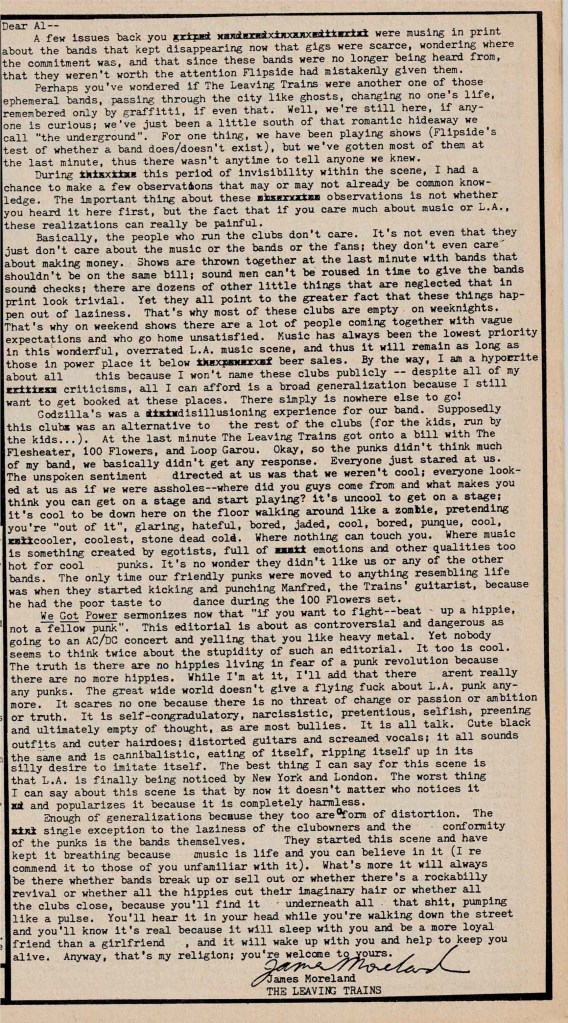
On the opposite page is another fine missive about the scene from one “Falling” James Moreland of the Leaving Trains; I’ve done you the favor of scanning it in its entirety at the end of this post. Boy did I have some interesting run-ins with that guy over the years. There was the time in the late 80s when I tried bantering with him at a show at the Coconut Teazer (!) in LA, and he was aggressively licking his lips and jittering. I was like, oh, so that’s what speed does to you. A few years later I watched him get kicked out of Al’s Bar in LA at his own show, then later eavesdropped on him having an intense argument with Taquila Mockingbird in the parking lot. Soon enough he’d show up all around LA in dresses, yammering incessantly, and my understanding is gender fluidity has been a part of who he is ever since. There’s a “Dead or Alive?” page up for him here. I’m very glad he’s still with us: an American original.
So – the Misfits article. Now I do enjoy The Misfits myself, at least the pre-Walk Among Us 45s. But I don’t need to tell you what a horrible human being Glenn Danzig was. I don’t know about now. My cousin and I – who were huge Flesh Eaters fans – used to get a real kick out of this part of the interview:
Flipside: And you and Chris D. mixed the album. Weren’t you supposed to play with Chris D.’s band the Flesheaters?
Glenn: Yeah, but they’re scared of us.
Flipside: Why’s that?
Glenn: I don’t know…maybe because we’re all (make a mean scary face gesture) and they’re all homos, ya know?!! I don’t care what they like, I hate them. God this is homo city around here!!
Jerry: We try to avoid going down that street (Santa Monica Blvd. near Starwood).
Glenn: You go to the supermarket or to use the phone and it’s so yeecch (makes kissing sound), “Fuck you, leave me alone for 5 seconds!!” In N.Y. it’s not like that. Everybody is into their own trip. No one bugs you, if you’re a homo, fine, you are a homo and go where homo’s go. But here it’s so fucked up, everybody’s pushing on you. You have a lot more homos here than in New York!!
Flipside: Well, right here is where they all concentrate…
Glenn: And Frisco is fucking homo land!! Yeah we wanted to eat at McDonald’s and the Flesheaters wanted to go into homo-ville, we just said, “fuck you, you give us the money, we’re getting out of here!!”.
You sometimes forget from the vantage point of 2023 just how rabidly anti-gay the youth of America were forty years ago. I was in high school then, and I remember. The letters section of Flipside #31 is just “fag”, “homo”, “that’s gay”, “I hate that queer”, etc., ad nauseam. HR, in the interview with the Bad Brains, responds to the question “How’d it go in SF?” with, “Well, it’s ok, but too many faggots.” Back to The Misfits – their interview here took place after their infamous San Francisco show at the Elite Club, during which “Doyle” totally brained some kid in the crowd with his guitar. (The incident is very well-described here). That show is reviewed in this issue, and ends a little shakily, “We figured someone might have been murdered but I haven’t read anything about it in the paper.”
So aside from all that, there’s a nice interview with Pagan Icons-era Saccharine Trust, who are already tiring of punk and moving on to what they’d become one album later; Tracy Lea and the always reliably hilarious Red Cross; Jodie Foster’s Army reveal the origins of the song title “Beach Blanket Bongout”, quite seriously among the top five song titles of all time as voted by Fanzine Hemorrhage; and a plethora of tiny-type scene reports mostly written by morons, which are yet Illuminative of a pretty special and unique time in the American underground. It’s an insanely-packed issue that all criticisms aside was highly worth the dollar my cousin spent on it in the HC Spring of 1982.
-
Writer’s Block #7
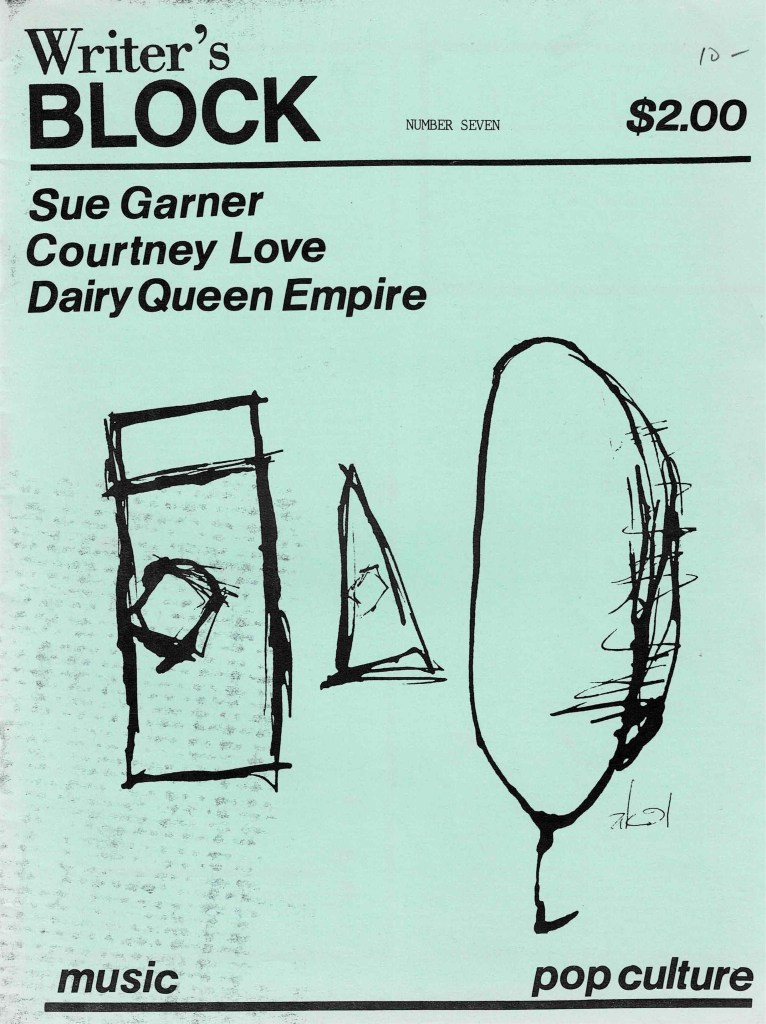
We’re now traveling backward in time through multiple fanzines that were helmed and penned by Mike Applestein. We talked about his current Silent Command fanzine here; we then conversed about his late 90s fanzine Caught In Flux here. We’re now discussing Writer’s Block #7, which came out in the Spring of 1991 and was published from Spotswood, New Jersey along with his girlfriend Alex Kogan and an all-female cast of contributing editors, including Jen Matson. You can see from the scan that my copy was marked up 5x from its original price, having recently procured it as I did from Division Leap books & ephemera.
The Writer’s Block crew are primarily rooted in underground pop music of many flavors and colors, the more lo-fi and personal the better. There’s room for the broader, noisier underground as well, and Thinking Fellers Union Local 282 and Killdozer make lauded appearances, but in general, acts like Heavenly and Unrest and The Clean rule the roost, as well as New Zealand and the Flying Nun universe. There’s an interview with the unfortunately-named Olympia, WA duo Courtney Love – I always felt sorry for them on that count – as well as with Sue Garner, who was in the Shams and Fish & Roses, and who’d later go on to be in the highly underrated (including by me, at the time) Run On. The passion and deep knowledge that went into their interview subjects and the questions asked of them is readily apparent, and no question Writer’s Block belongs in the international pop underground museum someone’ll eventually erect.
Barbara Manning writes a letter from San Francisco, and Applestein reviews her 2/23/91 show at the Knitting Factory in NYC, her first show in town since World of Pooh blew through a year previous as they were breaking up. Man, that year – 1991 – I must have seen Barbara Manning play a dozen or more shows in the San Francisco Bay Area alone. I was besotted with World of Pooh while they were around, and was bereft now that they were gone. Manning’s solo shows and early shows with “Barbara Manning and the Tablespoons” were a fantastic salve. Her work in the first half of the 90s stands up proudly vs. anyone’s. Great to see another magazine enthusiastically making said case in real time.
Pavement get one of their first local shows reviewed – the 8/12/90 show at Maxwell’s – and it’s clear from Alex Kogan’s review that they were barely more coherent then than they were the time I saw them at their big San Francisco coming-out party a few months before that. I can’t find anything online to confirm exactly when the band first played in SF, but it was a big deal for several of us based on their two 45s and the Perfect Sound Forever record, and….they were horrific! Like walk-out-long-before-the-end-of-the-set horrific. Kogan blames intoxication and a who-cares attitude. The 1990s, folks. That’s how we rolled. I never saw Pavement on a stage again.
(By the way – there is reliable evidence online that suggests that Pavement might not have actually played their first San Francisco show until 1992. This would not be the first time that my misshapen memory has arranged events to fit a narrative I’d like to convey; in this case, my attendance at a 1990 show by Pavement before anyone else saw them play. Not that I care about Pavement, you know, but I do prefer being accurate to muddled and braggy. Anyone know?)
My copy of Writer’s Block #7 has stamps and a mailing label slapped on the back, and it’s addressed to Steve Connell from Puncture fanzine. I wonder how Mike Applestein feels about Connell having turned his back like this on his 1991 sweat, toil and labor.
-
Termbo #1
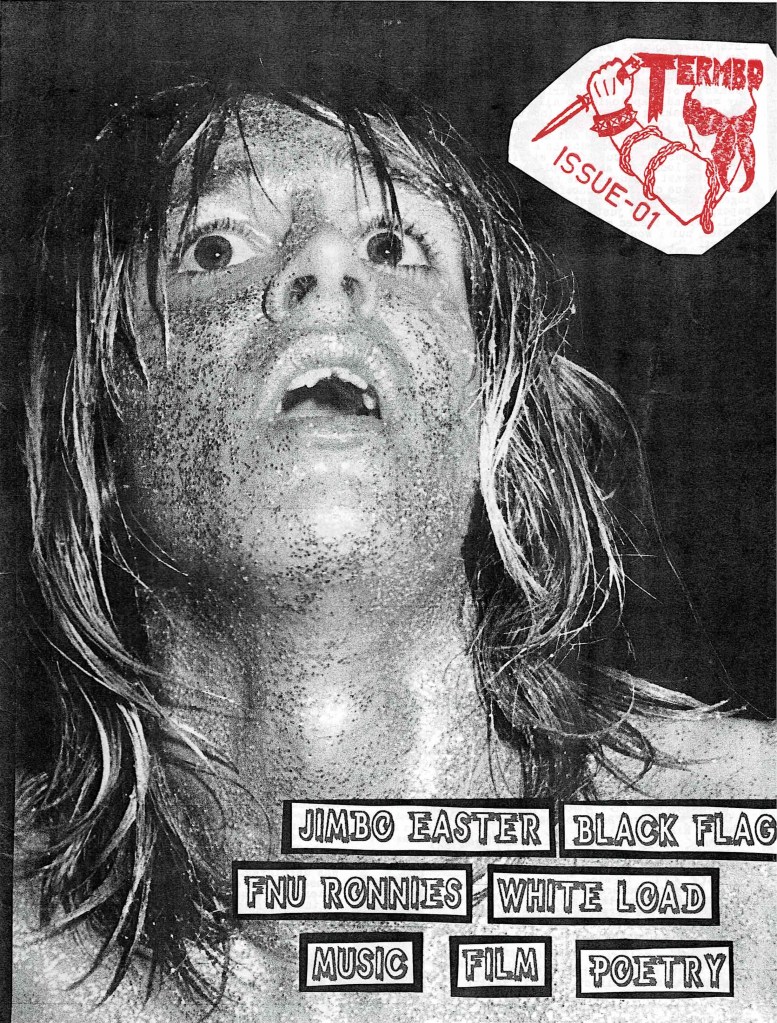
Remember when the Terminal Boredom guys did a print zine? Aside from three collections of internet reprints, I had thought that Termbo #1 in 2013 was the only one they did, but even as I’m writing this, I just found out that there was another three years later that I never saw. Then they were done. Now their message board’s totally kaput as well. I can’t say I really did anything over there, maybe a post or two, but a lot of their online action was concurrent with a lot of my online action, and I had much respect for the community of frothing, opinionated-as-hell garage punk misanthropes they built, as well as for the gentlemen who built it, primarily Rich Kroneiss and a few other hearty, regular contributors.
If you had to try and pinpoint their aesthetic, this fanzine’s cover provides many clues. A messed-up looking “beach wrestler”; a muscular heavy metal arm with a knife; and a band called “White Load”. (Forget the “poetry”; you certainly will once you read it). Today’s Total Punk record label is an almost perfect manifestation of the world that Terminal Boredom helped to incubate and further along. Termbo #1 states its mission pretty clearly from the off: “…a collection of articles and interviews, most of which were written for this print edition in particular and some older material that never made it to the Termbo site for whatever reason.”
Of those articles, there is one that stands out very clearly for me. Russ Murphy digs deep into the Black Flag debacle that had gone on that year, the one where Greg Ginn brought Ron Reyes back into the fold for a “Black Flag” record and tour, pretty much just to spite the shenanigans Keith Morris was pulling with his own bands Off! and Flag. I’m not totally sure of the chronology of all this stuff, because I really tried my hardest to not pay attention to any of it, but when this record cover came out it was truly a “drop everything” moment. Murphy illuminates the contours of the controversy and attempts a journey into Ginn’s head to understand what possessed him to do any of this, and as a card-carrying Black Flag freak, tries really hard to enjoy the record (“Careful listening shows that there is more going on here than a casual listen will reveal”). He comes to the conclusion that in order to actually listen to and get something out of this record, the listener will really have to “put some effort” into it. I can imagine – but no thanks! Great piece.
Also enjoyed the film reviews by Jordy Shearer, which range from “Cabin Boy” to “Frances Ha” to Antonioni’s “The Passenger” and back again to “Phantasm”. There’s also a long piece about exploitation films – I think it’s by Kroneiss, but it’s uncredited – and the hallowed video stores and VHS tapes of his misspent youth. There’s an interview with the aforementioned White Load and a photo in which one of the guys has a fuckin’ sword. Totally killer. And another with the FNU Ronnies, who were a pretty wild experimental punk band I think I may need to listen to again.
If you want to know where all the “message board punks” went after the death of Terminal Boredom – or if you do know – this thread’s where you need to head next after subscribing to future Fanzine Hemorrhage posts in the upper right-hand corner of our desktop site.
-
Deep Water #5

The late 1990s were the heyday of “brothers going their own way” when it came to underground, rock-adjacent music – as least as it was covered by fanzines at the time. I’ve already yammered about how averse to free jazz, abstract folk and experimental noise I was at the time in my previous discussions of Tuba Frenzy #4, Astronauts #4 and Gold Soundz #4, so I won’t belabor the unimportant point here, nor the unimportant point that I’ve come whimpering back to it all in the subsequent decades. Just be glad I don’t have any issues of De/Create or Opprobrium. Those were the ones that really pissed me off back then.
This brings us to Deep Water #5 from Winter 1998, which emanates from the same genus as those others. You see a fanzine published from Iowa City, Iowa and there’s a pretty good chance that someone’s going to college. In fact the mailing address is on “College Street”. There are three editors, and I’m a bit suspicious of their listed names: “Kevin Moist”, “Bill Reader” and “Chris Curley” – though I suppose if Reader and Curley were going for something wacky they’d have done a little better than that.
The fanzine begins inauspiciously. There’s a long article from a pal of theirs, an American in Poland, haranguing the music fanzine reader (who after all, just wants to ROCK) about Poland’s inelegant post-Communist transition to democracy and hyper-capitalism in the 1990s. It smells like a ploy by the writer to get published in the only place he might be able to – his friends’ budget music fanzine. He probably bugged the crap out of them to shoehorn this dreary drone in there. That said, there are recipes in the magazine – like recipes you cook, for food – so maybe Deep Water was attempting an omnivorous approach to culture as they themselves defined it.
There’s nowhere to go but up from there – and thankfully they go way up! Kevin Moist’s intro to his Brother J.T. interview is exceptionally well-written. Now I know he was a college boy. Just a well-done interview through and through – like one of the better wide-ranging fanzine discussions with a smart person you’ll ever read; if you’ve ever read a good Dan Melchior interview, it’s the same vibe – and now I’m feeling like I need to go back and listen to more Brother J.T. records. I mostly started and ended in the 80s with “she’s just fourteen and I don’t care!”. The same thing happened to me when I read the long piece on Cordelia’s Dad – another erudite exploration that makes me wonder how I missed this band. Good music writing’ll do that, and is all too rare. And how did I forgot all about Grimble Grumble until today??
Honestly, maybe I’m most taken with the Times New Roman font, always the font of choice for my own mags. I know I ask for details sometimes on these obscure mags and it’s been very rare that anyone’s been willing and able to provide it, but: does anyone know anything more about Deep Water and the fellas that put it out? (I found this, so that’s a good start). You leave a comment about it if you do, and fifty years from now some middle-aged dude that hasn’t been born yet will totally thank you.
-
Who Put The Bomp! #14

Who Put The Bomp was an ur-fanzine, one of the earlier and absolute best examples of a rocknroll fanatic following his obsessions and documenting every jot and titter from his heroes. Greg Shaw is deservedly lauded for parting from the mainstream in his writing when it was warranted; for going deep into topics that no one else would touch (like this issue’s instrumental surf records coverage) and for bringing on a king’s table of rock writers over the years to write for the mag – including Lester Bangs, Richard Meltzer, Dave Marsh, Greil Marcus and “Metal” Mike Saunders.
I’ve had all six of the late 70s punk-infused issues, from when it was just called Bomp! magazine, for quite some time. I’m only now coming around to trying to cobble together issues of the pre-1976 Who Put The Bomp! fanzine, of which there are 15 issues. The first one of those I got was the “British Invasion Issue”, #10-11, and it’s so massive and meaty and full of tiny type that I’ve barely cracked the code on the thing. All-in, it’s longer than most books about music you’re likely to read. All the issues before that one are too scarce and expensive for Fanzine Hemorrhage’s pocketbook, but if there’s a will there’s a way, and there’s totally a will.
So I’m concentrating on those issues between that British Invasion one and and the punk-era stuff, and recently found a lovely copy of Who Put The Bomp! #14 from Fall 1975, the one with these hodads on the cover. Like I said, the key to the issue is the instrumental surf music discography and backstory. It’s an incredible resource even now, 48 years later. I’m sure there’s probably some small-press record collector book that’d tell me a bunch of the same info I can get here, but there might not be. I happen to love this stuff and it grows on me even more as I age into the typical age bracket of the “1961 surf instrumental 45 record collector”. After glomming onto this thing I’ve been spending a bunch of time with the Surf-Age Nuggets: Trash & Twang Instrumentals box set, as well as with my Lost Legends of Surf Guitar comps. OK, grandpa!
I learned all about Tony Hilder, who produced Fresno’s Revels (who did “Church Key”) and was a prime mover in the early 60s California Central Valley instrumental surf scene, which I was surprised as you were to find out was a thing. Hilder then put out a series of “right-wing records” about the John Birch society and Barry Goldwater, which I’m sure are total fucking godhead. Alas, the piece says “The defeat of Barry Goldwater and the demise of surf music marked the end of Tony Hilder’s active involvement in the music industry. He is now employed as a salesman of freeze-dried food products in Southern California, writing reactionary declarations in his spare time”.
Other highlights: a complete discography and story about Dutch rock (The Outsiders, Q65, Shocking Blue etc.) and another oddly compelling discography of Beatles novelties and parodies – none of it by the Beatles, but stuff like The Twiliters’ “My Beatle Haircut”. I mean, the folks that put this stuff together, need I say, did not have the internet, or Goldmine, or anything similar. Just their own crate-digging and obsessive compiling, at a time when a used, non-picture sleeve 45 in a record store could be picked up for a nickel, dime or quarter.
And Roky Erickson is back! He’s just been released from a Texas state psychiatric hospital after being inside for five years – and he’s got a new band, Roky Erickson & Bleib Alien. He’s come to Los Angeles to play his brand-new songs, “Two-Headed Dog”, “Starry Eyes”, “Don’t Slander Me” and “Don’t Shake Me Lucifer”. Can you believe it? Greg Turner is on the scene, and gets Erickson to do a fairly coherent interview. This is then followed up with a full International Artists discography, because of course it is.
The new wave is almost here. Shaw notes in his end-of-issue column that “Big news around Hollywood is The Runaways, a group of 3 high school girls (14, 16, 18) who play like The Sweet and sing great teenage anthems, most of them written by Kerry Krome, a 13-year-old girl prodigy. They also do The Troggs’ classic “Come Now”. Remember, you read it here first.” In 1975, that was probably the case. She was actually Kari Krome, real name Carrie Mitchell, and boy does she now have a sordid and likely indisputable story to tell.
Who Put The Bomp #14 is one of those fanzines you wanna hold onto for dear life, not merely because of its centrality to a certain all-encompassing rock & roll mindset in ‘75, but as a resource to be frequently mined. I probably gave Shaw short shrift in my twenties for being what his contributors Greg Turner and Mike Saunders would call “a power pop turd”, but hey, I’ve even come around a little on some 70s power pop. Let me see if I can find a few of those other issues and I promise to meet ya here to talk about them.
-
OP #19 (The “S” issue)

OP was the offspring of Olympia, WA’s John Foster in 1979, who envisioned documenting an ephemeral organization called “The Lost Music Network” in which record labels, cassette artists, radio stations, fanzines and small clubs might coalesce into a like-minded fraternity of deeply-underground comrades. Over 26 issues, he did much to further the concept, and the glossy-cover Op received some pretty strong nationwide distribution, particularly in its later years, as it traipsed through the alphabet with showcase issues for each letter. It was something I then saw as pretty gimmicky and limiting, but which absolutely aged better with time and an actual look at how they pulled it off.
Issues of Op are generally able to be found. I never owned any at the time, most likely because their musical remit went well beyond my ability to ingest it as a teenager. I sauntered down to the San Francisco Art Book Fair a few weeks ago and, to my surprise, there were paper ephemera merchants with all sorts of vintage fanzines for sale, including Oregon’s Division Leap. I procured a handful of Op issues from them at a fair price, include Op #19, the “S” issue from 1983.
Foster and his loose, extensive network of relied-upon contributors were single-minded in their dedicated focus to micro-indie iconoclasts of any genre, from hardcore to 20th century classical to experimental home tapers. It’s an intense collection of information in small-point type, and while I read the issue in detail earlier in the week, it would be wrong to say I was hanging on every word, since there’s not really a defined joint opinion or tastemaking approach outside of “celebrating the unknown” and the misunderstood – regardless, at times, of its ultimate quality. John Foster’s record reviews in particular attempt to be magnanimous to a fault. I had forgotten 100% about SF Bay Area heshers Eddie and The Tide, the great white local hope of burnouts and stoners at my high school, but even they clearly sent their indie record to Op in hopes of not getting a beating – which they didn’t.
That said, Jamie Rake in his Sin 34 review says “Julie must be the worst female vocalist since Debbie of The Flying Lizards”. I don’t really know who that is, but don’t you come at Julie. He also talks about a Wisconsin HC band called The Shemps and asks “when was the last time you heard a pro-sports punk tune? Check out ‘The Pack Will Be Back’”. I definitely need to hear this song. There’s a really great section of fanzine reviews from Foster and Chris Stigliano, the latter of whom also highlights and marvels at a new onslaught of Velvet Underground bootlegs. As far as the interviews go – again, only with artists whose names start with “S”, there’s a perplexingly perfunctory one with Sun Ra, in which he answers multiple questions with variations on “Well I don’t know about that, because I am not human”.
There’s also a long letters section so different from the ones we see in publications today, with “letters” pulled from emails and Twitter comments. These were letters that then had to be re-typed and transcribed. Shane Williams writes from prison. I had forgotten that one of his longtime tropes had been “You’d be a little bit racist too, if you’d seen what I’ve seen in the joint”. The more late 70s/early 80s fanzines I immerse myself in, the more the letters section often feels like the star of the show. I’m even warming to the Flipside letters section, especially when I can find some teen’s name in there complaining about their scene or their mom or the cops, with the hindsight to know that said teen later went on to be well-known in a band, or put out their own fanzine, or wrote fiction etc. – or was just a letter-writin’ gadfly like Shane Williams or Joe Piecuch.
So you may know that Op, once Foster finished up with the letter “Z” issue, had its lofty networking mission carried on afterward by two more fanzines, Sound Choice and Option. The former even invented its own extension of the Lost Music Network: “The Audio Evolution Network”. Both suffered from some of the same shortcomings as their predecessor while each having some winning aspects of their own. We’ll talk about them some other day here on the ‘Hemorrhage.
-
Bad Vibe #2

In the spring of 1993 I spent two months traveling North America as the road manager, driver & merch seller for the band Claw Hammer, who were friends of mine from Los Angeles. As someone with zero musical talent – and lord knows I tried to pretend otherwise – I was utterly beside myself that I’d actually be able to go on tour, traveling from city to city, haulin’ in and haulin’ out, just like the underground musicians whose lives I was appropriating by having thrown in my cultural lot with them as a college radio DJ, record buying-obsessive and fanzine publisher.
I was so excited by 60 days spent crammed in an Econoline touring the US of A and a little bit of Canada that I quit my job as a customer service rep at Monster Cable, though my sabbatical ended up being short enough that I was able to reclaim my place on the corporate ladder upon returning. The band themselves were on something of an upswing, having recently come off a supporting tour with Mudhoney and with a new record out on the lucre-loaded Epitaph Records, run by Brett from Bad Religion. So I was decidedly a fifth wheel to the 4 band members – the guy who settled up at the end of the night with the club booker; the guy who pulled the van into Des Moines; the guy who taped the t-shirts and CDs to the wall behind the merch table; the guy who had to call Peter Davis at Creature Booking to make sure the show in Baton Rouge or Wichita or Montreal was still on.
It was all about the Claw Hammer guys and who came to see them – I remember in particular a show in Tulsa with six paying customers, three of whom were members of the Flaming Lips. Occasionally and very rarely, however, there were people I’d meet on the road who actually came to the club with the intention of seeing me. Yeah, some were friends from college, but sometimes (like once or twice) there was actually someone who knew about my music fanzine Superdope and wanted to talk sub-underground musical baseball with me. That’s how I met the Bad Vibe guys.
It was at the Cabaret Metro in Chicago in May 1993. If I’m not mistaken, “Ween” were the headliner, and a Canadian pop band called Sloan, who had a massive tour bus parked outside, played as well. David Salvia and Jim Sonnenberg from mid-state Illinois had recently put out a garage punk fanzine called Bad Vibe #1, and I had a copy & it’s very likely we’d exchanged “letters” about it – in fact it’s almost certainly how they knew I’d be at this show in their state.
Well these two wide-eyed, cornfed Midwesterners saddled up to the merch table and introduced themselves, and we had a fine time talking about the ins & outs of the scene, about the rigors of publishing and distribution and whatnot. Claw Hammer? Pffffft. When they started playing, these guys couldn’t care less and anchored themselves to the table, in the club’s now-empty lobby. I felt so important! It was me – I was the one who was on tour, and these were my two fans! I tried to play all the hits for them: the times I saw Pussy Galore; the time I hung out with Rob Vasquez; that one time the Cheater Slicks stayed at my house, and everything else I could muster. By the end of the night, like Springsteen, Little Steven and “The Big Man”, I’d truly sweated it out and left it all on stage….I mean on the merch table. We then said our goodbyes and never spoke again.
A few months later Bad Vibe #2 came out, the issue we’re talking about today. Salvia and Sonnenberg one-upped my awful interview (Superdope #5) with Rob Vasquez and The Night Kings with an even worse interview with Vasquez, who cops to being baked 24/7 and really can’t seem to muster enthusiasm for much of anything, including the phone conversation he’s taking part in. They also included a great record with the mag – the Night Kings’ Brainwashed EP. Then they even went and put in posters of the Blues Explosion and Royal Trux. I could never afford color anything, nor could I include a record (not even a flexi) – so I said then to myself and I say now: well done, lads.
It strikes me re-reading Bad Vibe #2 thirty years later that there were young men who really, really had a thing for The Muffs’ Kim Shattuck; I believe the Bad Vibe team may have counted themselves among them. (Alas, she unfortunately passed away just this past year). Their magazine strikes me now as youthfully dumb, as mine was, while also having a strong handle of the slightly more “popular” side of garage punk – Vasquez very much not included there – and digging into some of the deeper wells at the same time. It’s a fun read, and you can actually still buy a fresh copy here, thirty years on.
-
Attack #8
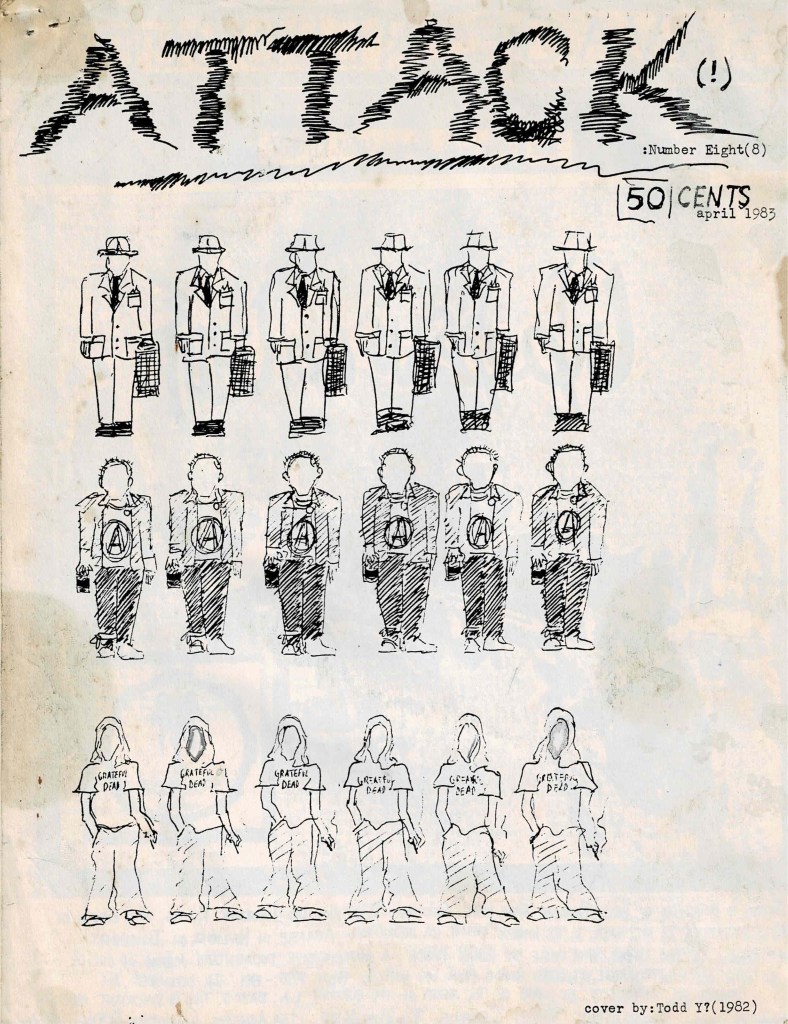
Whenever it was that I found my used, stained issue of Attack #8 in a record store, I know I dragged it to the counter mostly assuming it was a relatively generic, slapdash cut-n-paste April ‘83 hardcore punk fanzine that had caught my fleeting attention for some reason or another. Seattle, maybe. I do dig Seattle. It was only upon bringing it home did I realize I had something pretty fantastic here – a young Jo Smitty was the editor and guy behind it (!). You may know him as a member of Mr. Epp and The Calculations (vocalist on most tracks), or as Jeff Smith, the guy behind Feminist Baseball fanzine in the 90s. And it features multiple contributions from Mark Arm, whom you may know from…..you know who Mark Arm is.
It was a true treat to get duly reacquainted with this one after so many years away from it while it was sequestered securely away in a garage box. Attack #8 really hammers home what an open-minded fella teenage Jo Smitty was. He’ll talk your ear off about Whitehouse, The Fall, Grandmaster Flash, dozens of hardcore slammeisters and even English punk. ‘83 Smitty loves The Poison Girls and Crass. He and his contributors make the Seattle music scene sound way more exciting and cohesive than popular histories of the pre-grunge era have led me to believe. Wasn’t this supposed to be the city that time forgot, the place few touring bands set foot in because it was “too far” from California or whatever? Not at all the impression given here – these boys are slamming their asses off to Black Flag, DOA, Dead Kennedys and all the Northwest heroes, from Poison Idea to The Fartz – and P.I.L.. Iggy Pop. Savage Republic, TSOL and The Ramones as well.
Smitty also reviews a bunch of films; his contributor Talya Christian hates Urgh: A Music War, and singles out The Cramps as being particularly lame, putting them in her “boring to sickening” list (??). This was a particularly fertile moment in American punk rock history – the amazing “Quincy punk” episode had just aired, and it was a whopper. Much-discussed in high school alterna-circles at the time. Smitty understands the stakes here and devotes an entire article to it. Me, I did not see this one in real time when it aired, but I was delighted to have caught the slightly less-heralded CHiPs punk episode on its debut! I’d be willing to fund a Blu-Ray with these two on it, along with some Wally George episodes, maybe.
Now, Mark Arm, he loves himself some hardcore – totally blown away by Minor Threat, maybe not too impressed with Negative Approach, and he probably loves Flipper most of all. He contributes an excellent savaging of TSOL’s Beneath The Shadows album. In case it hasn’t been clear on this blog to date, I thought, and have always thought, that TSOL were utterly atrocious from day one. I’ll try not to mention them again, but when we talk about early 80s fanzines they always seem to have been around. Rebel Truth from Sacramento are interviewed, and so is Whitehouse!
Just a gem of a bedroom fanzine from top to bottom. You can ogle all of the covers of Attack fanzine here if you’d like.
-
Subscribe
Subscribed
Have a WordPress.com account? Log in now.

