-
Ptolemaic Terrascope #24

I’ve sort of dipped in and out of Phil McMullen and Nick Saloman’s Ptolemaic Terrascope world over many years, but I’ve come to see their efforts at creating a psychedelic music oracle and broadsheet as a highly successful one, no more so than this mid-career effort from November 1997, Ptolemaic Terrascope #24. I guess the way I sorta contextualize the magazine is as an underground but widely-distributed fanzine treading somewhere at a midpoint between Bucketfull of Brains and the later Galactic Zoo Dossier; more intelligent than either and slightly more geared toward a collector mentality.
Ptolemaic Terrascope often included vinyl and CDs, and this one, which has a 4-song vinyl comp EP, excitedly announces that future issues will include compact discs. Fuck yeah! It also announces the 1998 Terrastock 2 festival taking place in San Francisco, the city which has been my hometown for 34 years except for the mere two years I was away in grad school in Seattle, which, alas, coincided with this festival. I came home to SF for spring break and this has just happened and all the cool heads were abuzz about it; you are welcome to gaze at the lineup I’d just missed by a day or two.
The biggest draw in this issue is a Karl Precoda interview, a rarity if there ever was one. He won’t talk about The Dream Syndicate, but this discussion was held right as that excellent first Last Days of May CD was coming out, and I really love that thing and its follow-up and don’t get why they still seem to be almost completely unheard. It’s terrific to see a reluctant Precoda eventually settle graciously into his interview and talk technique, dub music, his guitars and more. There’s also a Guided By Voices interview. Robert Pollard has just turned 40 and defensively expounds a bit on his advancing age, saying “I still think I’ve got a few years left”. I’ll say he did.
Other features are on The Electric Prunes; The Misunderstood, later subjects of an exhaustive Ugly Things exhumation; a Ghost side project called Cosmic Invention; and a cool piece on Pelt (Mike Gangloff, Jack Rose and Patrick Best) – an excellent overview of a band I missed at the time, confusing them with the UK’s Felt whom I didn’t like. In the reviews section, we’ve got some absurdly tiny type that even twentysomethings might complain about – not that any of those were reading Ptolemaic Terrascope #24, right? – and it meshes reviews of stuff like Santana – Live at the Fillmore with a passel of freak-rock albums on the New World of Sound label such as Plague Lounge, a teenage pre-Comets on Fire band whom I once saw open for Monoshock.
That reviews section is a good encapsulation of the sort of musical melange this ostensible psych fanzine was trying to pull together: heavy rock, freakbeat, far-out pop, strange noise, garage rock, and anything with even a twinge of drug use, real or imagined. Advertisers are all over the map, from the most minimalist of noise labels to the most maximalist (if super-underground) of loud rocknroll/punk labels. Seems that issues of this magazine aren’t too tough to procure online if one is so inclined, but me, I’ve just got this and one other and could probably find room somewhere for another few.
-
Punk Rock #2 (February 1978)

Incredible: a true, no-doubt-about-it, cash-in-on-the-trend punk rock exploitation magazine. I was intrigued enough by the looks of this one to order it from Ryan Richardson’s Ryebread Rodeo fanzine emporium, and despite the falling-apart cover and the general contents therein, I’m glad I did. To the best of my knowledge, only three issues of this made it out there; this is the first one and this is the third and final. (Just poking around the internet I also came up with this 1978 issue of another punksploitation mag, Punk Rock Stars. “Kiss: Did They Start It All?” I’ve often wondered!).
I really can’t be certain how serious the birdbrain writers at Punk Rock #2 were taking themselves or their punk magazine assignment from corporate parent Stories, Layouts & Press Inc. Most of the writing affects a silly, “dangerous” sort of phony aura that sounds like broke, young bespeckled journalists who’ve just come off of covering The Allman Brothers and Kansas for other mags, and who’ve maybe just been forced to read the 1977 Time magazine article on punk and taken their cues accordingly. Or they’re sort of hanging on to their former, more comfortable rocknroll worlds, as in Gloria Robinson’s opening gossip column, which starts off with items on Blondie, the Sex Pistols, The Runaways and Lou Reed before drifting wistfully to unironically talk instead about The Beach Boys, Elton John, Greg & Cher Allman and the Grateful Dead.
Photos of The Dead Boys permeate this thing. If there was one group who went all-in on throwing themselves in front of cameras and beclowning themselves as wild “punks”, it was them. It’s fun to see some of the features trying to decide what’s punk and what isn’t. This was the era, if you’ll recall, that Mink DeVille routinely showed up in punk features (including here), mostly because the band played often at CBGBs and Willy DeVille had an angular haircut and punkish mien. Punk Rock #2 has features on The Dictators (one of the few well-written pieces, this one by Michael P. Liben) and a wild-looking group of Detroit hair farmers with the MC5’s Dennis Thompson in the band called Sirius Trixon and the Motor City Bad Boys.
Darcy Diamond travels to Los Angeles to go The Jam’s press conference, and to briefly write about and misspell the name of The Weirdos (here called “The Wierdos”; you’ll also see a great deal of confusion within Punk Rock #2 about there vs. their vs. they’re). “My punk friends in The Germs and The Bags implored me to catch The Weirdos set.”. And really, the less said about the “How to be a Punk” guide in the middle of this thing, the better. I get the sense from a doofus editorial up front that Punk Rock magazine was ginning itself up for an on-the-ground media war with John Holmstrom’s equally awful Punk magazine, which clearly never took place once the former checked out in April 1978.
-
Seven – Scat Records Quarterly #2
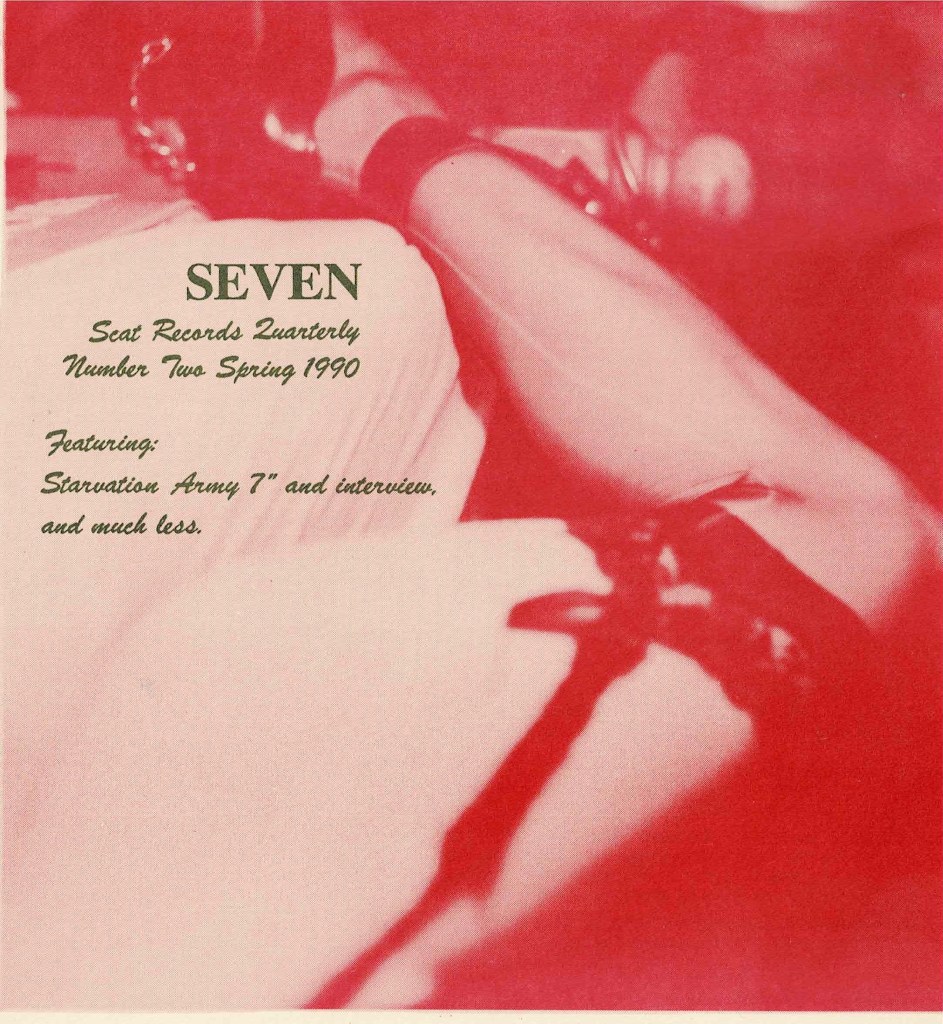
Robert Griffin was the fella behind the early 90s fanzine-with-a-record-from-a-band-from-Cleveland Seven. He also ran and still runs Scat Records, who, among their many other accomplishments, were the label who basically hipped the world at large to Guided By Voices, a band that only folks like Tom Lax knew about before the 1993 Propeller/Vampire on Titus CD hit the street, courtesy of Scat. And then the world fell in love, as you’ll remember.
Griffin also put out the phenomenal 3×10” release Those Were Different Times in 1997, which gave the world some incredible til-then-unreleased 1970s Electric Eels and Mirrors gems. He was in the band Prisonshake, and when I started communicating with him around the time Seven – Scat Records Quarterly #2 came out in 1990, I was blown away that I was actually in analog communication with a guy from the aggro mid-80s post-punk band Spike In Vain, whom I vainly held to my bosom as one of the secret treasures that only I knew about. I wrote about them in Superdope #2 the next year thanks to some info that he – and only he – was capable of providing me.
And funny enough, Griffin plays something of a role in one of own my major life events. I took my now-wife of 25 years, Rebecca, on our first-ever date to see Guided By Voices at the I-Beam in San Francisco on July 2nd, 1994. I was a big fancy man, “on the list” with a “plus one”, thanks to Griffin, and of course that helped cement the date with this target of my affection. Who wouldn’t be totally impressed with a “potential boyfriend who gets on lists with a plus one”? – only to find at the door that “Nope, there’s no Jay Hinman on the list, sorry, nope, go away freeloader”. Thankfully I was able to rustle up $16 for a couple of ducats and she somehow stayed with me regardless. She’s upstairs right now. Griffin didn’t know what happened, and hey – it’s all cool in 2023.
Seven #2 from 1990 was about 7” singles only, as were the other issues. I applauded and still applaud the concept. I’ve had my own deep forays into singles-only collecting, and even in recent years I’ve bought a bunch of 45s on Discogs and in stores to build back all the great records in my favorite format that I’d sold over the years, then thought better of it and promptly sold those records yet again. #2 comes with a Starvation Army single I’ve never listened to, as well as other wacky inserts like photographs, cheapo toys (a plastic snake, a skeleton hand and a black balloon), and other assorted real inserts, including a Scat Records catalog.
The idea to do a different sort of fanzine with packaging as the linchpin was another strong marketing play from a guy who was and probably still is interested in doing things differently from the indie herd, even if it meant spending more. The thing is even numbered, and mine is #343/1000. Serious record dork alert. The fanzine itself is OK. There are many reviews of small indie pop records, loads of Cleveland things and a focus on the Sub Pop and Amphetamine Reptile records that were pouring forth like Old Faithful around that time. 1990 – a weird year for the underground. I see it as a transitional year from the shitty late 80s into a much more fruitful underground (New Zealand, garage punk, Siltbreeze etc.) from 1991-94.
I remember being moderately frustrated by the Cleveland-centricity of this fanzine at the time, primarily because I didn’t really like the bands. Griffin’s own band Prisonshake were good but so much of the local stuff that Seven flogged just didn’t have any real heft once I’d get down to buying it at Epicenter or Aquarius or wherever. Fair enough, though – I’d write disproportionately about my San Francisco Bay Area favorites in my own fanzine, and many of those bands proved to be utterly baffling outside of the 415 area code. I hadn’t looked at my copies of Seven in many years and now I’ve got two others in front of me, so I reckon we’ll take a look at those in these pages when the time is right.
-
Some Links and Some Tips to Enhance the Fanzine Hemorrhage Experience
I started this site at the end of 2022 and have kept it exceptionally prolific over the subsequent 9 months. A pal told me he thought I’d totally lose stream after 10-15 posts, but I guess the evidence points to 3 pithy and prosaic posts a week having been the norm almost ever since it started. Given the amount of printed music fanzines I’ve built up over the years and the very, very important things I need to say about them in this forum, I’ve found it quite cathartic to just post whatever the hell hits my fingertips as I’m typing after a run-through of these fanzines, many of which I’ve stored in boxes and not looked at for up to 35 years.
Anyway, I’m going to take a short break this week and come roaring back shortly. In the meantime, I wanted to provide a few tips that might make reading the “blog” – and it’s most certainly a 2005-era blog – more enjoyable.
- Subscribe to this thing and get an email every time I post. Since so many of you kids spend all your time on your cellular telephones, you may not know that there’s a desktop version of Fanzine Hemorrhage that’s way better than the telephone version. If you come to the site on a computer, you’ll see right there in the upper right-hand corner that you can drop your email address in and subscribe – then you’ll get every post emailed to you the moment it’s out there. Wouldn’t that be amazing??!?
- There are tons of links to other posts on the sidebar. There’s a veritable cornucopia of fanzine blatherings on the right-hand sidebar; again, it’s not something you can see on your smartphone browser. Nearly every post is there, although now there are so many that I’ll post hyperlinks at the bottom of this post to some of the older ones that aren’t there any longer.
- Read Fanzine Hemorrhage in landscape view on your phone, not portrait. Hey, I didn’t make the rules for how it all looks on the internet, but I noticed that the cover scans looks all goofy and compressed when your read the mobile version length-wise (portrait view), and look great when you hold your phone width-wise (landscape view). And since this site is so incredibly forward-looking and graphics-rich, you’re going to want that full sensory experience for sure.
Meanwhile, my “trademark of quality” is that I will only yak about fanzines I personally own in physical form, which certainly precludes me from talking about the ones I don’t own, but I’ve also drawn the line at PDFs of incredible music fanzines that I’ve downloaded over the years (for now). Speaking of – if you downloaded a bunch of the punk fanzines that the Contextual Dissemination site had up before that site vanished, please let me know. I was an imbecile and somehow assumed they’d be there forever, just like everything on the internet. We can trade PDFs or something!
Finally, here are some of the earliest posts on Fanzine Hemorrhage from “the early days”, meaning December 2022 and January 2023:
-
Damage #6

Coming only mere months in May 1980 before the desultory Damage #7 issue that we discussed here, the bloom is most certainly not yet off of the punk rock rose in Damage #6. In fact, this issue’s one of this San Francisco tabloid’s very finest, easily in league with Slash and NY Rocker issues that were being published concurrently. Sure, it’s all filtered through a San Francisco sensibility, and despite being a proud taxpaying, child-rearing resident of said city for 34 years now, I still gag on so much of the “punk politics” and arty pretensions of SF during the 70s and especially the 80s – hell, even now – which are often just a real hectoring bummer in the midst of such a plethora of so much countercultural flowering.
But not in Damage #6, really! I mean, there was a police bust at Target Video downstairs from Damage HQ during a party for Japanese group The Plastics, and editor Brad Lapin is none too pleased in his editorial. Damage then gives it full coverage in a big article and even a comic. I swear man, I hate cops to the max. There’s also a brief supplement for NART magazine, all political art and very San Francisco. Caitlin Hines, who wrote better at age 19 or 20 than I ever have at any age, savages promoter and record label impresario Howie Klein for something he said about her in issue #5. I have this issue, but am too lazy to go read it now. Hines says, “I have always been most fair in my dealings with him, never once alluding to his age, girth, infamous past exploits in Nepal, balding dome or rather unsightly general appearance”. She was fantastic. I interviewed her ex-partner Peter Urban about her in Dynamite Hemorrhage #8 if you wanna read it.
Jane Cantillon interviews and writes about John Cale (I think it’s actually Jane Hamsher, who was a contributing editor at Damage). “When I told Cale I was writing this for Damage, he said defensively, ‘I’m not new wave!’”. There’s also a tongue-in-cheek short interview with the “pretty” and “pert and perky pop fave” Lydia Lunch, who’s just released Queen of Siam. Even then people were making deliberate fun of her horribly over-the-top persona! Speaking of similar circles, there’s an overview of performance art in San Francisco. I guess Karen Finley plied her trade for a while in SF? I did not know that. And we also have an introduction to “local electronic music”: Non, Factrix, Minimal Man and The Scientists. This was the wild sound of young San Francisco in 1980, along with Flipper, who get a rave review for their contribution to the SF Underground comp.
I was also pretty impressed with the San Francisco scene report. It talks about artpunk quartet The Bob, whom they call “…the best thing out of Oakland since ‘You are now leaving Oakland’ signs”. The LA scene report right next to that says that Patricia Morrison has left The Bags (true) and that the band has renamed themselves Plan 9 (wow, if true!). And then a chunk of reviews, most of which are by rockin’ Jeff Bale, very soon to be a star player in the Maximum RocknRoll world.
I’d be remiss if I didn’t mention the interview with The Mutants, whose Sue Mutant, one of their three singers, graces the cover. They’re not a band I’ve ever really cottoned to much, and most folks who were there will tell ya to steer clear of the records – live is where they were at. A couple of months ago The Roxie Theater here in San Francisco had a night of Napa State Mental Hospital rock & roll, by which I mean they played the entire June 1978 performance of The Cramps there; along with The Mutants’ entire heretofore-unseen performance, and then Jason Willis’ and Mike Plante’s excellent short documentary on the day. I swear the audience felt like it was comprised of San Francisco’s first 200 punks, all the Mab and Deaf Club denizens of the day, and they dutifully hooted and hollered whenever their friends turned up on camera. Then a couple of Mutants came out and did a little Q&A before V. Vale came up on stage and hijacked the proceedings and we left to go get a beer. Good times.
-
What a Nice Way To Turn Seventeen #2

Due to the beneficence of Chris Seventeen, the 1980s editor and publisher of the UK’s What a Nice Way To Turn Seventeen fanzine, I’m now in the possession of several additional copies that span beyond my original issue #6 that I talked about here. Many of these came with records included, including 1984’s What a Nice Way To Turn Seventeen #2, which has a 4-track EP that included musicians with whom I’m familiar, like Nikki Sudden and The Jazz Butcher, as well as those with whom I am not, like The Rag Dolls and The Sad-Go-Round. In any case my copy doesn’t have a record, and I’m going to be okay with that.
Now let’s get the big concern out of the way first. People, usually people even older than myself as if that’s possible, have at times expressed their concern about the font size of my own Dynamite Hemorrhage fanzine, yet my 9-point font is practically the top row of the eye chart when compared with this one. Epic Soundtracks – yes, that Epic Soundtracks, not the other one you went to high school with – writes a piece about discovering Brian Wilson that I’m dying to read, but it’s literally written in one or two point font, so small that it blurs on the page and is nearly an undifferentiated series of dots and inkblots. In the light on a nice day, it’s possible to find some coherence to it, but in evening light you can totally forget about it.
Andrew Bean contributes a piece on Captain Beefheart that I can somewhat read, though a magnifying glass helps – one of those plastic ones with a flat bottom that you can glide across a page that grandpas like me who complain about fanzine font sizes like to use. It posits that “When Trout Mask Replica appeared, cloaked in a sleeve which depicted a guy in a silly hat and a fish mask waving from the front, and on the back, a bunch of weird-looking guys who looked like refugees from the Alpha Centauri Home For The Criminally Insane creeping around in bushes, wearing dresses and waving table lamps around, the record-buying public were not impressed.” Why the hell not??
You want to know about the other things that make the 16-page What a Nice Way to Turn Seventeen #2 fanzine such a gem? I’ll tell you. There’s a record-fiends-only guide to collecting the Texas 60s punk label Eva Records by Chris Seventeen, as well as a celebration of Creation Records, a brand new label at this point (!). David J from Bauhaus rants with extreme passion about the John Cale show he saw in London in January 1983. And there’s an annotated Johnny Thunders discography. I certainly missed many of the greats, but I did see this fanzine’s cover star Thunders play live on January 7th, 1987 at a pool hall called The Golden Eagle in Santa Barbara, CA – the aural evidence of said performance is right here. I know I was mostly there because The Lazy Cowgirls opened, but still. Johnny Thunders, right?
What a Nice Way to Turn Seventeen #2 actually reminds me of another fantastic fanzine that came out with a 7” single as part of the package – Drunken Fish #1. Both were “wrap-arounds” with the record inside and both take an omnivorous collector freak’s eye toward their scenes of choice. In this case, it’s the current UK underground, American offbeat rock geniuses and scarf rock through the ages. I’d love to see a book of this stuff someday if they’d agree to pump up the font size 5x at a minimum.
-
Check The Record #1

Last time we talked about Jen Matson over here it was to call attention to some early 90s writing she did in Writer’s Block #7. She also helmed her own indiepop fanzine in the 90s called Nonstop Diatribe, and through it all to the present day doing a radio show/podcast, she’s quite clearly someone with the record collecting disease. Check The Record #1 is an analog celebration of the analog sickness, done up in such a bright, breezy manner that you’d be forgiven for thinking that collecting records had somehow been very healthy and to be encouraged all along.
I actually suspected this whole thing was going to be Scottish records only, an ode to “Edwyn” and “The Shoppies” and whatnot, but it’s a more generalist whirl around her collection and how it came to be. Like the price stickers piece is totally great: photographic evidence of non-removable price stickers on various records she’s bought, along with the story of acquiring that record and the trade-off involved when she came to realize that peeling the thing would cause more damage than it was worth. Let me say it right now, for all of us: I’ve been there.
The Scottish piece is great too, total thrill-of-the-hunt stuff, maybe not as mind-boggling as that Fŏrdämning piece “The Dirty Year”, but I was right there with Matson as she relays being taken to the “special basement” at Edinburgh’s Avalanche Records to have her pick of whatever treasures she wanted. I still have dreams like that, and I don’t even collect records anymore. There’s also a humility-first advice column about putting information into the crowdsourced Discogs, and about the creeps who sometimes populate the site and try to one-up these free laborers.
Her partially facetious (I think) ode to the CD long box is really the ultimate glass-half-full paean to something that I remember being hated from the first day they appeared. In the late 80s I asked my parents for Coltrane’s A Love Supreme LP for Christmas, and I got it, except that my father somehow thought that the CD long box version of it was a 12” record. Dad…!!! I recently spent an hour at his house helping him set up his “cellular phone” (totally baffled), his laptop (he couldn’t get past the login screen) and even showing him how to find the Xfinity On-Demand channel so he could pick movies to watch. He’d told me and my sister that “Comcast changed the channel on me” and we totally shared a good laugh, thinking he’d sat on the remote or something and knocked his cable service offline. Turned out Comcast actually had changed the channel, and after showing Dad how to use the buttons on the remote to browse the guide, he was fully back in the business of entertaining himself.
Anyway, after my Coltrane long box fiasco – I brought it back to Rainbow Records in San Jose to exchange it for the LP, and they didn’t have the LP – I wouldn’t actually buy my first CD for another three years, until 1992. And I’m soooo proud of what it was: Monster Magnet’s abysmal Spine of God, sold back to a used store before the week was up. I’d forgotten all about long boxes until Matson’s piece, so there you go – she just spurred me to tell a couple of uninteresting stories in the service of talking about her new fanzine. See what yarns you can spin about your own record experiences by grabbing Check The Record #1 here.
-
Muckraker #9
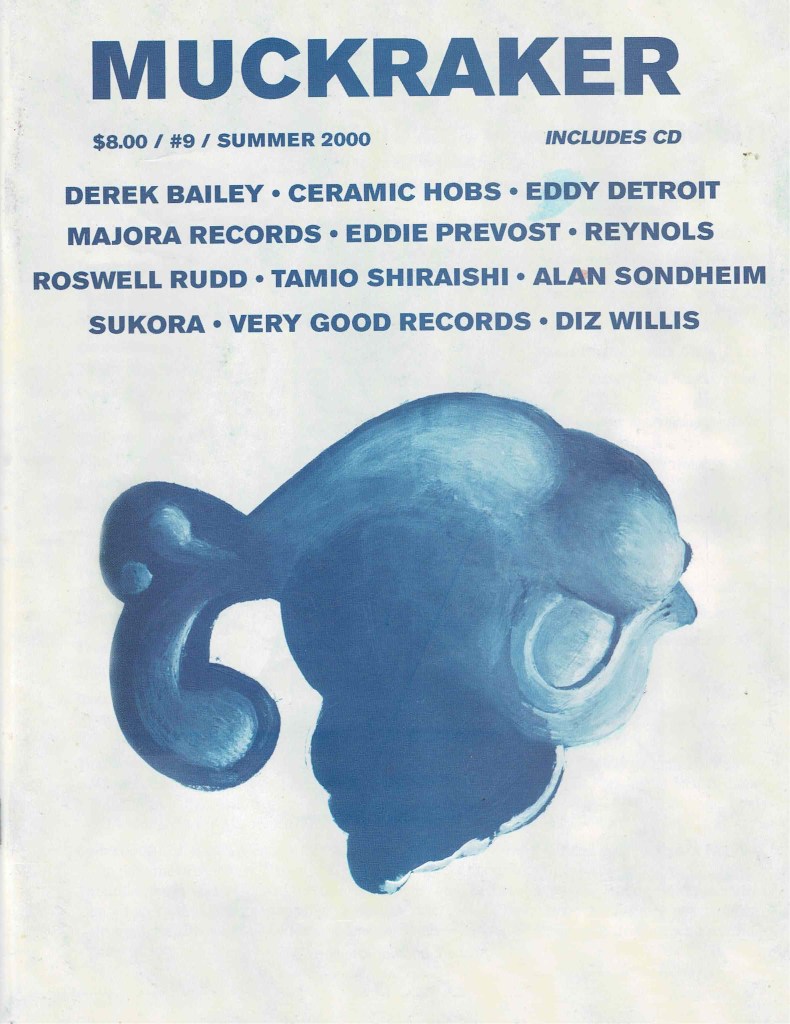
I guess 23 years on, we’re probably well past the point where we might routinely encounter a thick, glossy-cover, free improvisation / experimental / noise mag with a CD inside of it at Tower Records, aren’t we? Muckraker #9 came out in Summer 2000 and was a pretty fetching and decently-distributed publication pulled together with some regularity throughout the 90s by Patrick Marley – always on the deep edge of obscurity, while always approachable enough to bring in purportedly open-minded experimental skeptics such as myself.
I mean, Muckraker #9 is literally packed with so many deep and likely semi-listenable obscurities I really can’t grasp a ton of it; it’s music I haven’t heard and perhaps never will hear, and that’s probably okay. Much of the reviewed tapes and CD-Rs and lathe-cut singles are not findable even today, though you never know what’ll turn up at Fusetron that might have been sitting there for 23 years. Muckraker often skirts the boundaries of what TQ fanzine once called “the no fans underground” – music so formless and vague that it’s often comfortable assuming that it’s being directed toward a listening audience of zero. Still, I’m excited to see so many great, fanzine-funding ads for labels with deep weirdo catalogs that I missed or barely comprehended at the time – labels like Squealer, Little Army, High Knee, Chocolate Monk, Freedom From, Polyamory, Menlo Park, Povertech Industries and many, many more.
The biggest draw for me here has always been the interview with Nick Schultz of Majora Records by Gretchen Gonzales. It was such a phenomenal and wide-ranging talk with one of our nation’s leading and most cantankerous lights that I reprinted it in Dynamite Hemorrhage #5, then interviewed Nick myself as an addendum to it. Majora was an exceptionally special 1990s label, and one that we risk forgetting to our undying shame. This is followed by a piece with Nick and Alan Bishop of the Sun City Girls bantering about Eddy Detroit, telling stories about this longtime Phoenix-area musical enigma, mostly because Marley and the Muckraker team couldn’t actually pin down Eddy Detroit himself for a talk.
Some hallowed forerunners of the no-fans underground are interviewed as well, both Derek Bailey and then Eddie Prevost of AMM. Prevost is the exact opposite of pompous and obtuse; he tells stories of early AMM shows in 1966 where promoters wouldn’t pay them for their completed sets because they were “only tuning up”. There’s another interview with Ceramic Hobs, a group I’m most familiar with due to the forthrightness of the principles about their mental illness, institutionalizations and so forth. Simon Morris of the band calls the music he makes about his psychosis “the last frontier”. It might be, but does it burn down the house? Does it totally kick out the fucking jams? You’ll have to tell us.
I always liked that Patrick Marley went on to thrive in a true journalism career – like, he’s a major stringer for The Washington Post these days. He and the Muckraker team proved to me back then both here and in previous issues that you can make anything musical (or non-musical) interesting enough if you ask the right questions, write intelligently, respect your audience and do the hard work of explaining the validity and context of the music you’re talking about.
-
Brain Damage #1
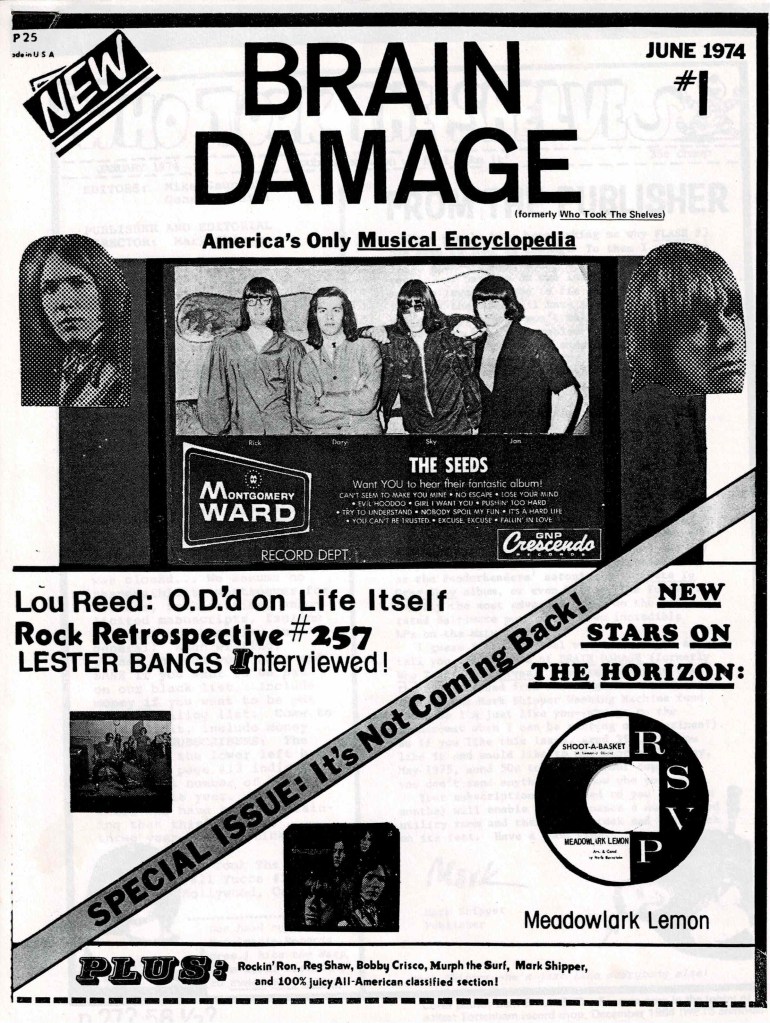
We had a post a couple of days ago about the annus horribilis of 1974, so let’s return there again today and talk about a “real” early-years music fanzine, Brain Damage #1, and a great, albeit insular, one at that. This comes courtesy of a xerox my friend JB made for me of it in the early 1990s, as he magnanimously did with the Back Door Man issue we once discussed here. Talk about heavy hitters: the editors are Metal Mike Saunders (much later of Vom and the Angry Samoans) and Gene Sculatti, and the publisher is Mark Shipper (Chris Stigliano went deep on his 1972 fanzine Flash, which put forth multiple issues, here).
Brain Damage #1 was a one-and-done parody fanzine, “formerly called Who Took The Shelves”. I’m sure it was all quite uproarious for the creators, and if you’ve got something of a historical sense of fanzines like Who Put The Bomp, magazines like Creem, and the general rock critic milieu of the early 1970s, much of the mirth-making taking place here might even make some sense to a contemporary audience. They say “Subscriptions are $56 for 240 issues in the United States and Canada. Overseas rates do not exist and we reserve the right to refuse all requests from Limeys, Polacks, and New Yorkers.” They start with fake letters from Lester Bangs, Robot Hull, John Fogerty and Jon Landau, all very funny to the editors I’m sure, and continue on with a phony Lester Bangs interview and a heavy metal records consumer guide from “Bobby Crisco” aka Robert Christgau. There are some chortles and guffaws to be had, yet no splitting of sides.
Then there’s a first-rate, over-the-top piece about basketball hero Meadowlark Lemon of the Harlem Globetrotters and his (very real) “Shoot-a-Basket” 45, compared extremely favorably with the Stooges, the Shadows of Knight, Love and early Pink Floyd. James Williamson is rumored to be the guitarist on it. I think I’d better check that one out. There’s an extensive “Juke Box Jury” by Reg Shaw, aka Greg Shaw, complete with the same font and layout he was using in his own fanzine. And then, quite unexpectedly, there’s a real guide to Lou Reed’s early pre-Velvets Pickwick 45s by Wayne Davis, not really played for laughs but more some gentle mocking of his work with The Beachnuts and so forth.
Now even in the course of all this tomfoolery there are many uses of the term “punk rock”, once again resting the case that the term was something very much in circulation well before 1976 – at least in rarefied rock-crit circles – and that it was used to describe exactly what you think it was. As of this writing, there’s a copy of Brain Damage #1 for sale on eBay for the low low price of $199.99, but it does contain some photos of the pages if you’d like to take a peek.
-
My Teeth Need Attention #2

Joe Tunis, a.k.a. “CarbonJoe”, is already back in action with a second digest-sized issue of My Teeth Need Attention as we hoped and prayed for back when we reviewed his first one earlier this year. Not only has his game been upped this time around with an absolutely lovely hue of orange/red for the cover – I believe this may have been the same shade as the “Fire Engine Red” crayon in my 64-color childhood Crayola box – but he’s got a terrific interview with another one of the 21st century’s best music fanzine creators, Matthias Andersson of Fŏrdämning.
Because Fŏrdämning wasn’t exactly easy to come by when it was around in the United States of America, or outside of Sweden at all, you may better know Andersson for his i Dischi Del Barone, Discreet Music, Fŏrdämning Archiv and Förlag För Fri Musik labels, all of which are still active. He’s also a member of numerous experimental musical acts on said labels, the most “famous” of whom are Enhet För Fri Musik, who are very, very famous and who routinely sell out hockey rinks in their native Sweden. This interview conducted by Tunis is the most complete overview I’ve seen of how this incessant curator and furtherer of the underground came to be the man he is today. If I can be said to have modern heroes, Andersson is probably one of mine and it’s always great to hear from someone who got into rad punk and underground sounds from Bones Brigade skate videos, especially when they lived in a 400-person village in Southern Sweden.
My Teeth Need Attention #2 has a similarly deep philosophical investigation with New Zealand musician and label owner Anthony Milton, who relates that he nearly recently died from a brain hemorrhage, wracking me with guilt over the callousness of this blog’s name. Liam Grant, one of the finest solo guitarists on the planet right now and who has a new LP on Carbon Records as it turns out, contributes a few pages of tour photos. Then there’s a record-collector-adjacent piece of fiction and another about a bewildering encounter with a male prostitute; another tour diary from Joe just like last issue; and it closes off with a gaggle of reviews, a few of which have led me by the hand into “exciting new dimensions in music” like this wild 1970s Pygmy Unit private-press jazz thing.
An excellent 2023 fanzine made on real paper! You can grab a copy here.
-
Subscribe
Subscribed
Have a WordPress.com account? Log in now.

