-
Charming #2

I was decidedly not an indiepop kid in the late 1980s, so I’ve come to my only issue of the Charming fanzine well after its publication date. But I do know that fanzines were an essential part of the UK pop underground and that within them many a battle was fought, many a crush was nursed and many an obsessed vinyl collector was born. Years later – and I mean years later – I finally caught up to 80s English and Scottish acts like Tallulah Gosh, Fat Tulips, Pooh Sticks and so on, but I didn’t give that stuff much of a sniff back in my knuckle-dragging youth.
Charming #2 from 1988’s pretty much everything you’d want it to be, though, if that is or was a world that mattered to you. Fully cut-and-paste, with loads of wacky photos, double entendres, scene gossip, drawings and excitedly hurried reviews of bands both new and old. The editor was “Stephen Charming” (he also refers to himself as “Stephen Sexbomb Charming”, as one does), and he published out of a really small coastal town in the east of England called Dovercourt. Wikipedia says “Dovercourt is a seaside town and former civil parish, now in the parish of Harwich, in the Tendring district, in the county of Essex, England.” So now you know.
The enthusiasm and vulgarity of The Pooh Sticks is on full display here in their interview, as the (male) members of the group discuss what they’d like to do to and with Clare Grogan. My Bloody Valentine are a new band, one already gathering a major reputation for “driving audience members out of the emergency exits” for their ear-bleeding set closer “You Made Me Realise” (spelling, MBV!!). I first heard them on Loveless and still enjoy that one in fits and starts, but they’d already started to become a touchstone band for many in the late 80s. Charming #2 has definitely lost whatever goodwill and admiration they had for The Smiths by this point – I can’t believe we’re talking about The Smiths for the second post in a row, or in any posts at all – and there’s a to-do made in multiple places about them selling out, cleaning up, whatever. All very nasty, too – Stephen Charming wasn’t a guy who suffered his fools gladly and while he may have enjoyed twee sounds he’s far from a shrinking violet in print, which makes for a fun read.
That’s when you can actually read the thing – jeez, am I starting to sound my age or what? 4- to 6-point fonts, man – I want to enjoy them, but I do really struggle with some of the fanzines of yesteryear, such as this one, made for US fighter pilots with 20/20 vision holding a magnifying glass. Oh, there’s a few other things, though – remember when we talked about Drunken Fish #1 fanzine and their big run-through of the Fierce Recordings label? Charming #2 does this too, in less discographical form. And the big overview in here of UK band The Primitives – I wouldn’t hear them until the 2010s, having closed my ears off nearly entirely to such music, but if you’ve ever heard a better feedback-drenched indiepop song than “Really Stupid” – listen to it right here – well, I want you to tell me about it and we’ll do a nude fistfight on hot coals over which one’s really better.
-
NY Rocker #57

The 1984 Conflict fanzine we talked about last time makes explicit reference within its pages at just how bad NY Rocker was by that year, and folks, it’s that exact era that this particular issue – NY Rocker #57 from May 1984 – resides in. And whew, it is indeed pretty bad. It’s not the voice of the NYC underground any longer, but rather an Anglophilic pseudo-music industry paper, reminding me just how rotten things were just north of the deep underground that year.
What they’re covering is mostly garbage. The execrable Girlschool, The Smiths, Eddy Grant, another feature on X (the previous two issues I wrote about had X on the cover both times, just not their sell-out “year of change” X of 1984-85); Chrissie Hynde and all manner of commercial mediocrities across the board (Robert Cray??!), in every corner of the magazine.
Patrick Albino writes in to vent about British provocateur and known Stalinist Julie Burchill having recently made her way to NY Rocker’s pages. Burchill was a bit more complex than that, politically, and eventually traveled from one pole halfway to the next, growing up enough to write this piece a couple of years ago. Editor Iman Lababedi takes the bait full-on and sounds about as much of a peace creep doofus as any Ruth Schwartz or Tim Yohannan response in that era’s MRR: “During an age that finds America’s right-wing lunacy reaching new dimensions of danger, you’re complaining about our printing a brilliant communist columnist. I know what side you’re on and it isn’t mine”.
Burchill’s column here is fantastic, actually, a wild review of various drugs and the current state of UK drug-taking. She’s said elsewhere that she had “put enough toot up my admittedly sizeable snout to stun the entire Colombian armed forces”. There’s a ton of UK/US cross-pollination going on in this issue, very reflective of the “Rock of the 80s” times when synth-pop and MTV were the centerpiece of mainstream rock writers attempting to shy away from Madonna, Springsteen, Prince, Michael Jackson etc. So it makes NY Rocker #57 feel far less of a fanzine than the previous issues I’ve discussed (here and here), and more like the new wave dreck Trouser Press was dishing out at this time, usually with worse writing. It reads at times like a non-benevolent corporate parent has taken over, yet that doesn’t appear to be the case, which is a bummer because it might explain why they took such a dive down the dumper.
Still, like Trouser Press in this era, there are moments. There’s a NY Underbelly column by Tim Sommer – he was in Even Worse! – featuring one of those rare Sonic Youth shots with Kim Gordon in glasses, along with small features on Swans, Ut and Sonic Youth. While the reviews are mostly of commercial records, the review section ends on a high note with a highly positive review of New Orleans’ Shitdogs (!). Three years later I’d see the Lazy Cowgirls play that band’s “Reborn” every single show, and have the singer of the Cowgirls relay to me personally the theretofore-unknown glory of The Shitdogs.
Thing is, for $1.95 I’d have bought this every month had it been made available to me, reservations aside. I was a junior in high school at this point – and a Smiths fan – and I would have welcomed it into my home, while recognizing even then that it was fairly weak across the board. It’s a very different music publication than the one that had Byron Coley and Don Howland writing for it a couple of years earlier. What I learned is that the magazine had “folded” in 1982, and that this and only one other issue had been part of a brief – and totally unsuccessful – revival of NY Rocker. It ended up being the final issue, and I think that was most certainly for the best.
-
Conflict #36

I’ve discussed Conflict #37 and Conflict #42 on this site previously; the former was (obviously) the issue of Gerard Cosloy’s fanzine that followed the one we’re discussing today, yet it took 18 months after Conflict #36 to actually see publication, by which point Cosloy had taken the entire year of 1985 off from publishing a fanzine, and had moved from Boston to New York City. So this one, Conflict #36 from August/September 1984 was the last of the Boston issues, and was definitely included in that whopping batch of Conflicts and Matters that Jackie Ockene let me borrow over spring break 1986, and which I count as a “germinal” event in my overall musical appreciation development, such that it was.
Conflict #36 begins with something truly incongruous and unusual: what appears to be a heartfelt apology to folks like Mike Gitter and Billy Ruane and Al Quint whom he’d spent much mirth and merrimaking mocking in previous issues, the ones Jackie let me borrow. Mostly these folks were Boston-area publishers who wrote about punk & hardcore, and wrote about it poorly, as I gathered. Whatever happened in issue #35, I don’t know, but there are multiple letters printed in this one calling Cosloy out for being an asshole/jerk/too critical etc. It either had finally hit home, or this young man was being incredibly facetious in his apology; in any case, I have most issues of Conflict after this one, and sensitive and magnanimous they are most certainly not. So it didn’t hold for long – not even past page one in this one, to be honest.
What’s different about this issue from the ones that followed, aside from centering on Boston scene jibber-jabber and mock controversies rather than NYC, is its general girth. There are an obscene amount of reviews in here, everything under the 1984 sun that lived at the underground crossroads of hardcore, goth, college rock and nascent pigfuck. That could be X or R.E.M, Siouxsie and the Banshees or New Order, or Fang and the Sluglords and Flipper and Gang Green. Or Circle X or Sonic Youth or Live Skull. Interesting times, my friends.
Patrick Amory, whom we last visited in these pages when we talked about his Too Fun Too Huge #2 fanzine, gets his own jumbo section to wax about records and live shows he’s seen around Boston. He puts out a contrasting (to Gerard’s) view of live 1984 Meat Puppets, calling them “heavy metal” and not worthy of the insane underground hype then-circulating around the Meat Puppets II record (one of my all-timers, for what it’s worth). Frankly, once I’d see them live for the first time two years later, that’s what they were – a shitty 70s rock band. Since I missed their berzerk, blitzoid hardcore days, I kinda feel like I missed their live genius entirely, because after I saw them in 1986, they were even worse!
Now Amory also reviews SSD’s How We Rock, which he rightly calls the worst album title of all time, yet he still thinks the whole thing is “powerful”, “supertight” and “awesome”. I wonder if he still listens to it. (Cosloy also reviews it, also digs it). I would have loved to see SS Decontrol live in 1981-82, but I personally believe “Springa” was hands-down one of the five worst vocalists in hardcore punk history. I really, really hope Al Barile, Choke and the Boston Crew don’t read this. Speaking of Boston ‘core, Forced Exposure’s Jimmy Johnson is a kid that has his say in Conflict #36, and gets a big section of reviews that mirror the interests of his own mag at the time – also HC, but also bizarro UK goth and noise. Cosloy’s excited about a ton of stuff in this one, with special lionizations of the latest records from Saccharine Trust and Big Black.
That’s it – no interviews, just dozens upon dozens of short reviews, laced liberally with scene reports, gossip and invective. That’s precisely what I needed when I read this in 1986, and Conflict from that point forward became one of the only two 100% totally essential fanzines for me in the late 80s, right alongside Forced Exposure.
-
The Two Hundred Pound Underground #1

First time I ever came across the name “Tony Rettman” was through a relatively strange pathway, back when I was doing my Agony Shorthand blog around 2004. Before there was really any social media of note, if you wanted to “troll” someone, you did so in the comments of someone’s blog. My blog was usually exempt, but at one point it got continually and habitually trolled by someone named Don Rettman – nothing too over-the-top, just some nastiness about whatever music I was writing about, mixed with some light-touch character assassination. All in good fun. In seeking to figure out who this guy was, I was told by a few east coasters in the know that Don Rettman was a longtime & well-known underground record collector, and a guy who had a younger brother named Tony, whom I came to find out actually looked at my blog on occasion and who I got in touch with via electronic mail.
Tony Rettman eventually cleared up the smoke somewhat; his brother wasn’t the rogue commenter, nor was it he, and it was someone anonymous out to besmirch us all in one way or another. All of those comments vanished when the comment-hosting provider I was using went belly-up. I then came to find that Tony Rettman was a main player on the Blastitude website, a really great digital fanzine of the era – not really a blog – which I eventually came to read daily. I soon found that Rettman was not only exceptionally versed in the minutiae of hardcore punk, he’d very much “lived through it”, and his subsequent books like this one and this one and this one have since crowned him as perhaps the preeminent historian of the genre. I remember one bit of correspondence between us back then in which he was jealous that I’d seen the band “Doggy Style” live. Now that is some truly omnivorous and forgiving ‘core commitment.
I came to track down some issues of his five-issue fanzine, The Two Hundred Pound Underground, which was later shortened to 200lbu. We’ll be talking about #1 today. It came out in 1996, and was co-edited by Nick Forte in New Brunswick NJ. The true pièce de résistance in this one is the extensive interview with Brian McMahon of the Electric Eels, going deep and going long on Cleveland in the 1970s at a time when many folks were waking up to just how incredible the sub-underground music scene had been there twenty years previous. McMahon is asked about Charlotte Pressler saying in From The Velvets To The Voidoids that he’d lived something of a double life, split between his Catholic upbringing and his involvement with the Eels, to which McMahon responds, “Charlotte is misguided…sounds like creative writing….Charlotte was insane at that time. She was abusing drugs too much. She was probably right in the middle of a nervous breakdown at the time. I mean look what Peter (Laughner) did to get away from her!”
There’s also a full page about something called the “God Says Fuck The Reunion” tour, in which bands in every town get to pretend to be The Electric Eels, in support of whatever bands the ex-Eels members are playing in at the time. I’ve never heard if this fiasco actually happened in 1996-97. Did it? Beyond that, there are a couple of pieces of fiction by V-3’s Jim Shepard, and a tiny, effectively unreadable print piece by Dwayne Zarakov about a tour by New Zealand’s Space Dust in the US. Can’t even read it to tell you much about what it says, but apparently my old pal Doug Pearson of Oakland, California is featured in it.
I’m always up for reading anything and everything by and about Eddie Flowers, whose Vulcher and Slippy Town Times fanzines I’ll eventually get to writing about sometime here. He talks a great deal about how his band Crawlspace came to be in Los Angeles, and how and why they morphed rather suddenly from the ramalama MC5-ish rock band I saw live in the late 80s to the sprawling, druggy, improvisation freak-noise act they’d become in the 90s. Todd Homer of Mooseheart Faith also gives a nice spin through how and why he broke from his bandmates in the Angry Samoans to do something similar, and just how uncaring and unkind the vacuous masses LA could be to bands like his and Flowers’ around this time (not that I liked them any more than said masses did!).
Rettman and the 200lbu crew at this point are really setting out to explore the outer limits, and do so in a large set of record reviews that, again, due to tiny blurred type are effectively impossible to read: Kevin Ayers, Brother JT, Climax Golden Twins, the Hampton Grease Band reissue, the LAFMS box set and so forth. As befitting The Two Hundred Pound Underground #1’s tenor and tone, it closes with a rapturous endorsement of the Siltbreeze 1996 live extravaganza with The Shadow Ring, Charalambides and Harry Pussy. Kids were going bananas for that stuff in ‘96. Aside from the readability concerns, it’s a highly effective and well-crafted snapshot of refined and expansive music taste, with the chops to communicate about it deftly and effectively. And zero Santana live record reviews to speak of.
-
Punk Doesn’t Need a Fanzine Called 20aMPC #1
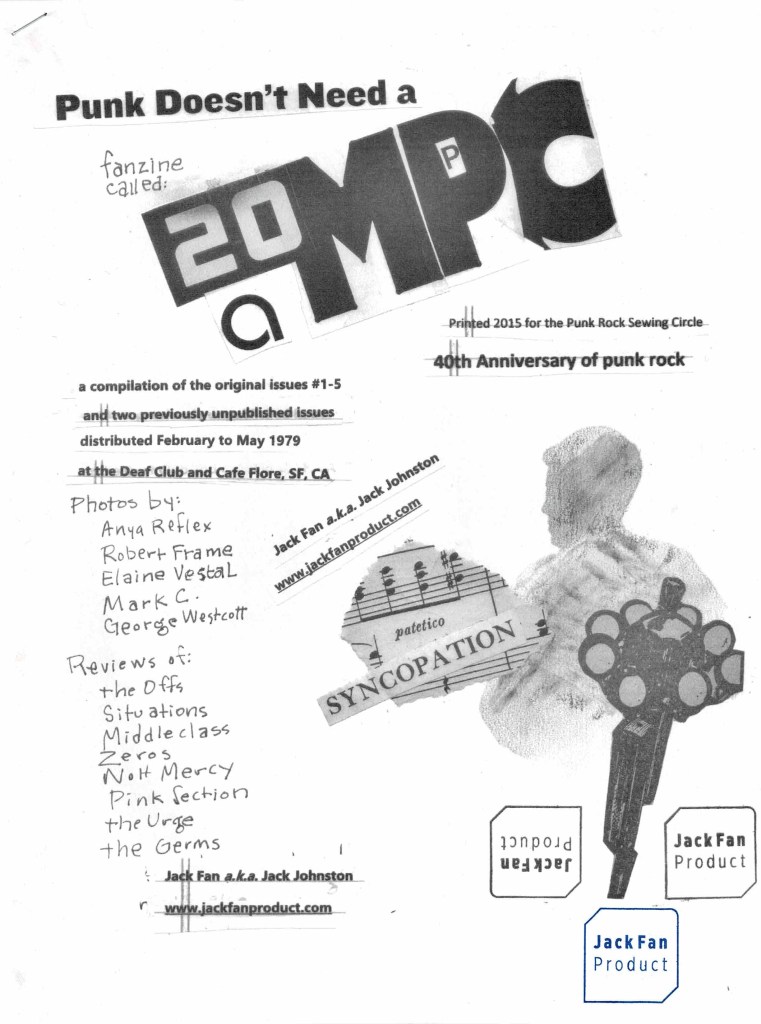
If this collection of blink-and-miss giveaway issues of a small free fanzine from 1979 called 20aMPC didn’t exist, I’d probably never have known of the thing’s original existence in the first place. I love it when folks collect stuff like this for those of us who weren’t there. My understanding from this podcast is that Pleasant Gehman is going to be reprinting her late 70s LA punk fanzine Lobotomy this year, and I’m all over that when it happens – but hey, just in case you find out about it first, can you let me know?
So 20aMPC was a xeroxed/stapled fanzine given away or sold for 5 cents (!) at The Deaf Club in San Francisco between February and May 1979. This collection takes the original five issues, and adds two brief “previously unpublished issues”. It was put together in 2015 by San Francisco’s Punk Rock Sewing Circle, a collection of quote-unquote original punks who were holding quite a few punk anniversary events around that time, some of which I attended. The writer and editor was Jack Fan, a.k.a. Jack Johnson, and he appeared to be a young man swept up into the scene and living large 24/7, pogoing from shows at The Deaf Club to DJing and working at Cafe Flore to touring with The Offs – clearly his close friends – and attending shows across SF, five nights a week at least.
This was his micro-fanzine, and you gotta marvel how tightly he packed these issues with a mere four months of personal punk history, while also illuminating the evolution of punk on the ground, as it was happening. Key players in these issues include the aforementioned Offs; Pink Section; The Situations (I don’t know this band); The Cramps, and a posse of LA bands coming up the coast, like The Bags, The Germs, Middle Class, Zeros and more. Be still my friggin’ heart.
One key takeaway is Fan’s massive disdain for the Mabuhay Gardens club and for Dirk Dirkson. He almost positions the Mab as the “corporate” club, the one that only tourists and the bridge & tunnel crowd go to. Such were the razor-fine lines of punk rock 1979! But jeez, there was such a cornucopia of shows to choose from in San Francisco every weekend, maybe you’d want to draw these lines once a cool clubhouse-type hangout like The Deaf Club opened up. 20aMPC came out so frequently that Fan is able to give schedules of upcoming shows each weekend, and the lineups just make one’s eyes water: X/Bags/Units/Suburbs; Offs/Bags/Alleycats, and Mutants/Avengers/Pink Section just over a 30-hour period alone, Friday and Saturday nights February 23rd-24th, 1979.
Crime are called “notorious capitalists” because they charged $4.50 for a show. The other person to really take it on the chin here is Howie Klein, which absolutely seems to be a recurring theme in these SF punk fanzines. I mean, from the time I started hearing about the guy I was highly suspicious; while it’s hard for me to see Dirk Dirkson as anything but the real deal, Klein struck me as a musical opportunist with questionable taste in music, a junior-level Bill Graham safe enough for the suits but able to dabble in punk-ish power pop and with bands searching for career opportunities, the ones that never knock. Jack Fan sure thought so!
This Punk Doesn’t Need a Fanzine Called 20aMPC collection is still very much available for interested parties right here.
-
Bixobal #3
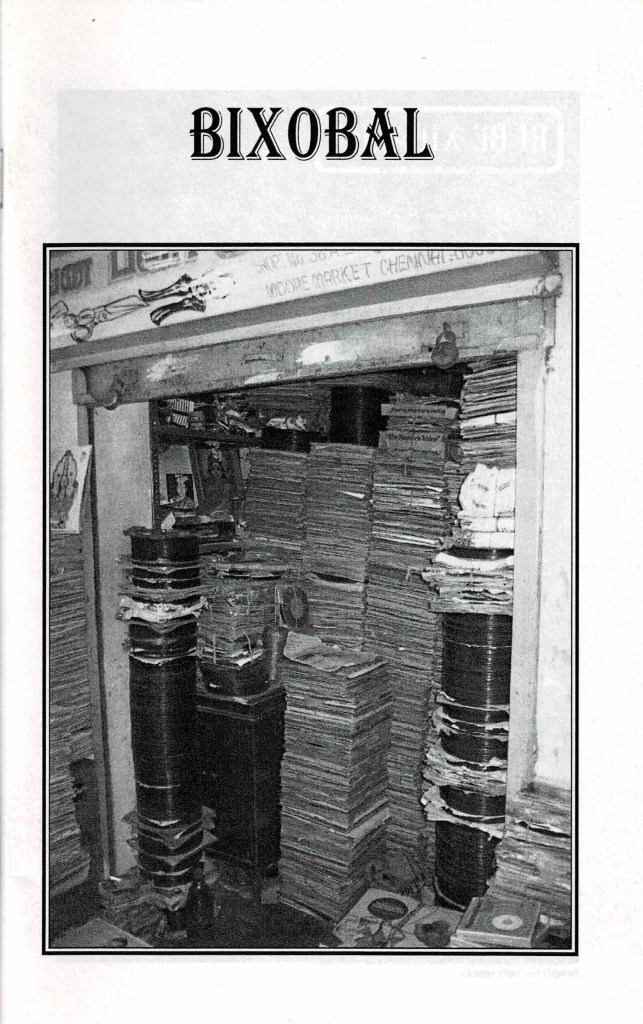
When the next great compendium of “cult bands” is written, please save a giant section of the book for the Sun City Girls if you’re the one who’s writing it. The sub-underground impact of this Seattle-via-Phoenix-via-the globe trio from about the mid-1990s onward was immense, and they did much to sully the loins of fans of improvisational ragas, world esoterica, barely-structured chaos, absurdist comedy and generalized audience baiting. They were a world unto themselves, and fanzines like 2008’s Bixobal #3 and quite a few others like it took no small amount of their cues from the expansive world they defined, and from rejecting the rest of the world said band were so clearly defined against.
That’s a hyper-simplification of this fanzine, no question – yet the first thing I see on its inside front cover is an ad for Bixobal’s in-house record label Ri Be Xibalba’s Charlie Gocher tribute album, and on the back, tour dates for Alan and Rick Bishop’s “The Brothers Unconnected” tour. Incidentally, I’m told that I accompanied some friends to the 5/21/2008 show from this tour at Slim’s in San Francisco. It’s one of the very few nights I spent absolutely hammered over the past two decades; in fact, it’s probably the last time that’s happened. Suffice to say I don’t really remember the show but I’m sure it was an outtacontroller.
Bixobal #3, edited by Eric Lanzilotta in Seattle, I believe, is a point-perfect representation of the insular world defined and wrought by the Sun City Girls, taken into a written direction and done quite well. Rob Millis writes about 78rpm records; he’d soon put out the terrific Victrola Favorites package of some of his favorites. Allan MacInnis nails an extensive interview with Peter Stampfel of the Holy Modal Rounders, definitely a gem worth reading. There’s an interview with German 70s something-or-other Gerd Kraus, and then a mess of reviews, including a few at the end by Patrick Marley of Muckraker.
If I’m being honest, so much of this No Neck Blues Band, formless drone, anti-music music drives me totally bonkers, and it becomes difficult for me at times to understand the line in between “I like this because it’s digging deeper and taking me someplace new” and “I like this because you won’t, and it’s obscure and insular.” I know that’s not an especially notable nor new criticism, now nor ever. I have no such problem with most free jazz and with challenging world musics I’m encountering for the first time, yet I’ve always shuddered a bit when formerly indie rock white guys disappear up their collective anus into music played by others like them that’s premised on & defined by its difficulty and obscurity. Then I wonder if the problem’s me. It probably is me.
Bixobal #3 reviews a few of the newer Sublime Frequencies releases and guess what – they love ‘em. I love that if this world I’m describing is one you cotton to, then you’re in luck – you can still buy this thing for a big $2.50 at the Fusetron music emporium. Load up your cart and tell them Fanzine Hemorrhage sent ya!
-
Scram #15

We return now to Kim Cooper’s Scram, a low-culturally omnivorous magazine whose fifth issue I dissected a bit earlier in the year here. The Los Angeles-based mag had gathered a great deal of steam by this point, 2002, to the point where they’d recently held their own showcase weekend “Scramarama” at the Palace Theater in LA, which I learned in this issue my cousin Doug Miller was the bartender and alcohol-procurer for. Of course he was!
As mentioned last time, Scram had a sensibility that didn’t quite dovetail with my unrelentingly pure underground-music-that-must-be-beyond-reproach stance at the time, so while I always liked it, I really have come to enjoy it now, after the fact, now that I’m not such a pigheaded contrarian. The borders of their schtick were quite loose, but encompassed elements of goofy 60s pop, novelty records, garage punk, pranks, toys, oddballs, analog-era artifacts and underground comix. The writing was fun, upbeat, winking and satiric. Contributors – in this issue alone – ranged from Gene Sculatti to Mike Applestein to Andrew Earles to Brian Doherty, with Kim Cooper lording over the proceedings and setting the tone as “editrix”.
Right out of the gate Scram #15 hits it out of the park with a funny & revealing Dan Clowes interview that’s contemporaneous with the release of the Ghost World film, one of the 2000’s best, discussing everything it took to get it made and released. I was so taken with reading this last night that I’m going to watch the Criterion edition of the film tonight w/ all the extras. There’s a panel review of rock-themed board games, such as a Monkees, a K-Tel and even a Partridge Family game that I actually remember from my youth. And then Sculatti’s piece is actually a 1971 interview he did with songwriter and producer Gary Usher, talking extensively about his interactions with the Byrds, Beach Boys and the early 60s instrumental surf scene.
Remember how excited everyone got about that Langley Schools Music Project release, a mid-70s recording of some Canadian schoolkids arranged through their music program into doing tracks like “Space Oddity” and “In My Room”? Applestein interviews Hans Fenger, the maestro behind it, as well as one of the now-grown-up kids, who gives a fairly reluctant interview about something she’s clearly still a little baffled about. Mike Applestein also milks a piece out of “Five Concerts I Missed”, a terrific concept I wish I’d thought of first: shows you could have gone to, but didn’t, and then regretted. I’d start with SST’s “The Tour” on February 28th, 1985 at the Keystone Palo Alto with The Minutemen, Husker Du, Meat Puppets and Saccharine Trust, which I couldn’t get any of my high school friends to attend with me so I bailed.
I’ve got nearly a complete run of Scram except for issues #8, #9 and #10, which I’m missing and can’t find. Anyone able to help a brother out?
-
Creep #4

Earlier this year I bought a near-complete run of San Francisco’s top-drawer late 70s/early 80s punk fanzine Creep from the ZNZ store – who still have three of the five issues for sale as of this writing. I excitedly wrote up Creep #2 in these pages here, so I’ll spare you another introduction to the mag and let you go read that first if you’re interested, allowing us to get right to the heart of 1980 west coast punk rock USA in the here and now.
Creep #4 lives at an interesting intersection of several strands of California punk “journalism”, such as it was. There are half-hearted attempts at intellectually unpacking various scene controversies and kerfuffles of the time, such as a piece on Noh Mercy’s acerbic and still spine-rattling “Caucasian Guilt”, or a total mess of a P.I.L. show that almost didn’t happen – something akin to a piece you’d find in Damage around this time. There’s truly stupid punk-sneer writing by birdbrains such as one might find in Flipside. And given this magazine’s tenuous connection with Maximum Rocknroll, which wouldn’t publish its first issue for another two years, you can see a little bit of a political slant sashaying its way into these pages – but not too much to make Creep #4 intolerable.
I actually have to give much credit for the breadth of the interviews here. There’s one with Alex Chilton by Ray Farrell, not at all something I’d expect here – and Alex is great, totally calm and cool as Farrell takes him to task for Like Flies on Sherbert (shame on you, Ray!). There’s a brief one with Steve Tupper of Subterranean Records, which was just getting off the ground. He tells it like it is: “415 (an S.F. label) appears to be primarily interested in very commercial or very well known bands. That means exclusion of everybody else. We’re much more interested in experimental kinds of things – the kind of music being made by hordes of kids just picking up guitars and synthesizers and making music. Everything we do has this hard, grey feel to it. That’s the way the world is. Let’s face it – a lot of this stuff just isn’t hit material.”. Subterranean were the label who first released Flipper, and they were covered at length in the excellent book Who Cares Anyway? – Post-Punk San Francisco and the End of the Analog Age.
On the other hand, the interview with The Vktms doesn’t do them any favors – with all due respect to Nyna, she definitely comes across as a major league dum-dum in this interview. And I’ve done some bellyaching about Gregg Turner, Mike Saunders and the Angry Samoans before but never have I seen their misanthropy and queer-baiting at such a jacked-up level as it is in their interview here, in which they go off on all the high crimes & misdemeanors of the LA punk scene, a scene that was known to blackball the Samoans for just such behavior. I mean, these weren’t 15-year-olds from Canoga Park writing into Flipside, these were guys in their early thirties play-acting as punks and – in Saunders’ case – saying Iggy, Iggy, Iggy whenever handed the opportunity. Of course, I laughed at “Get Off The Air” and I still love large chunks of Back From Samoa and I always will, but Saunders and Turner are (or were, in 1980) detestable human beings. Watch their brief interview in this 1980 LA punk “expose” called What’s Up America and you’ll see what I mean. And Gregg Turner’s recent book was an abomination that I couldn’t get even a third of the way through. Do I make myself clear?
This was the year of collective disillusionment with The Clash, and the piece by “Austin Tatious” (great punk name I’d somehow never heard before, but still not as classy as my friend Christina’s DJ moniker Geannie Lotrimin) expresses great disappointment in their San Francisco show. The whole Lee Dorsey (“Working in a Coal Mine”) “bored cocktail lounge a la Holiday Inn backup band” opening act bit was pretty funny; I suppose this was the time that they were bringing incongruous opening acts on the road with them, which, hey, hats off for trying I guess. The Specials are also on the road in America – “Horace’s impression of U.S. AM radio: ‘Great if you like ‘Hold The Line” or ‘Life in the Fast Lane’’. He swears he heard each at least 80 times across the country with only sporadic listening.” Oh yes, 1980 commercial radio in the United States was just awful if you were there, and I was there.
Creep #4 is a content-rich goldmine for you punk historians, probably one step up from Ripper and very much in the same vein, from size to breadth to paper type to regions covered. Now let’s see a Silicon Valley Bank-like run on the few copies remaining in the ZNZ store.
-
Not Fade Away #3
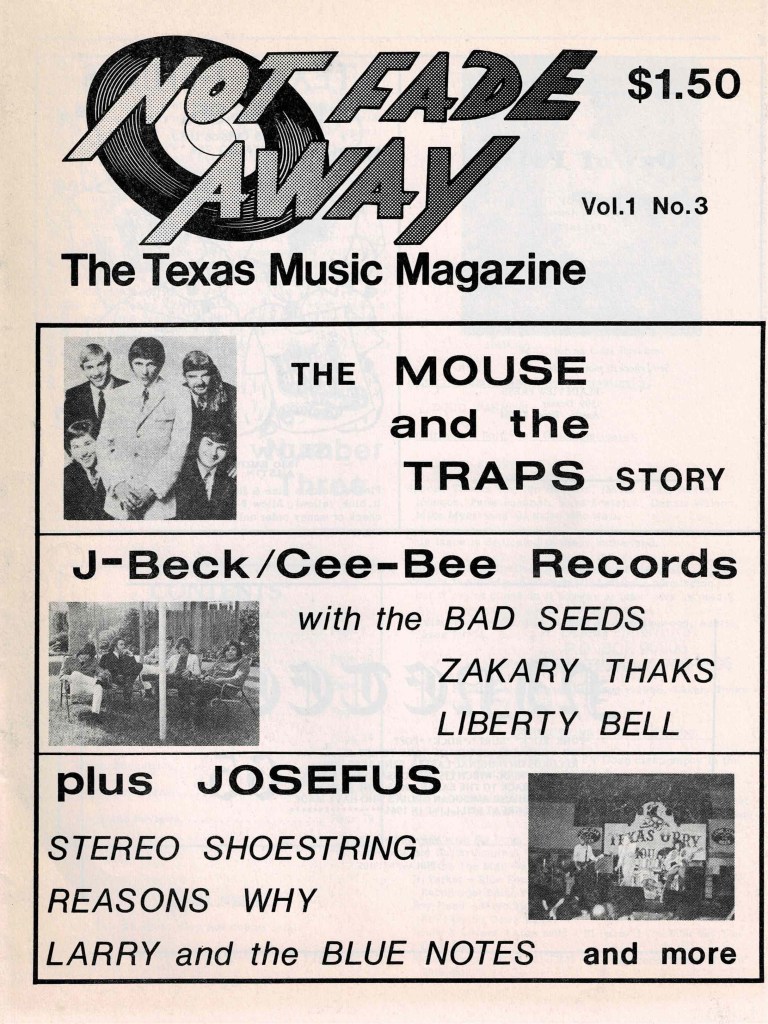
Despite never having truly been a true record collector – much more of a record accumulator – I hold obsessed, deeply committed collectors in high regard, and rarely tire of their stories of the hunt & the big score. Aside from the guys who almost single-handedly resurrected pre-WWII blues by going door-to-door in the deep South to look for 78s in the late 50s/early 60s, my favorite collectors are the 60s punk fiends, the guys who cobbled together a cohesive and distinctly American narrative for what was clearly going on in thousands of garages and basements across the USA in 1965-1967. That’s the world that 1980’s Not Fade Away #3 traffics in, and their scope is further refined to the great state of Texas, almost certainly the American locus of the most insanely wild and highest-quality 60s garage punk during those years.
Now think back, if you’re old enough to do so, to what 60s punk scholarship was like in 1980. Sure, Nuggets had long been out, the first few Pebbles comps were around and Greg Shaw’s Who Put The Bomp! was writing about this stuff at times. Most of what we’d come to know about the great underground 60s punk 45s would come later, though, first through a series of 60s punk bootlegs like What A Way To Die, Garage Punk Unknowns and Scum of the Earth, and then of course via Back From The Grave, the greatest compilation series of all time. I’d have to imagine that editor Doug Hanners was doing his own original research, digging up telephone numbers from white pages & writing letters to studios listed on 45s released fourteen years previous – and he actually started the mag in 1975.
The biggest features are all listed on the cover here – Mouse and The Traps get the top billing and the longest piece. I was most smitten with the side-by-side photos of these Texas rogues from 1966 (basic cool roughneck hippie kids) and 1967 (far-out psychedelic shaman with love beads and paisley shirts). There’s a great short piece on The Reasons Why, who’d cut this absolute screamer called “Don’t Be That Way” in 1966. They dispel any myths one might have had about well-behaved teenagers at dance clubs and fraternal lodges, in particular the Beyersville SPJST: “All these kids from the little towns would pack the place. Being out in the country we’d get a lot of cowboy redneck types and sometimes things would get pretty wild. We’d be up on stage playin’ and the dance floor would be packed, then all of a sudden this whirlpool would start in the middle of the floor. It wouldn’t be just a few guys from Taylor fightin’ a few guys from Rockdale, it’d be everybody from Taylor fightin’ everybody from Rockdale….one time this cowboy picked up this hippy and threw him through the plate glass window in front.” Texas punk!
Was also psyched, if you will, to see the small piece on The Stereo Shoestring. Have you ever heard their psychedelic face-melter “On The Road South”?? Please do so, right here! Maybe ten years ago I re-read this particular issue and started cataloging the things in the review section I’d never heard, particularly in the short “Tex-Mex” section of 45s. I then went onto the illicit file-sharing site Soulseek and found said Tex-Mex 45s, and they were a true blast. Texas is a big state and all, but I think per-capita it really musically punched well above its weight for many, many years. Not Fade Away #3 is a superb fan’s-eye furthering of what made this particular state’s iconoclasts and cultural rebels stand out, and documents everything I love about the crazed collector mentality.
-
Chemical Imbalance #4
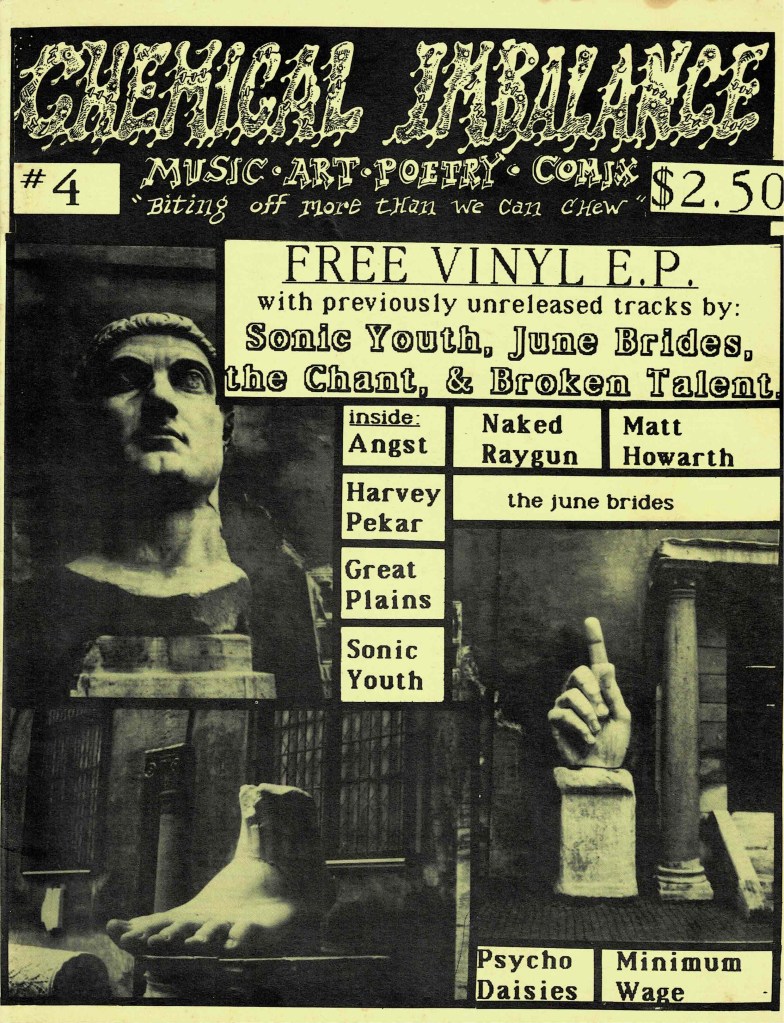
I’ve owned this issue of Mike McGonigal’s Chemical Imbalance since the day I bought it in 1986 in an LA record store because it had an included 4-song EP with Sonic Youth on it. It was clear to me in reading through it just now that I really hadn’t flipped its pages since, so honestly, it was a pleasant surprise to see a wonderfully sophomoric yet still well-informed and -intentioned dose of independent, far-left-of-center Americana. If you remember McGonigal as a guy pilloried for my-unremembered and what I’m sure were nonsense “scene crimes” by the likes of Byron Coley and Steve Albini, you’d be forgiven for thinking – as I did – that maybe his early college-era fanzine would have aged none too well. It’s aged just fine.
I mean, I have several of the issues that came after Chemical Imbalance #4 as well, I’m pretty sure. It was never one of my favorites, and I’d be hard-pressed to name a band, musical genre or artist of any sort that this fanzine turned me onto – but it was always easy to find, packed with deep-underground ephemera and tuned to whatever alt-wavelength I found myself frequenting in the late 80s. McGonigal went on to run Yeti and Maggot Brain magazines, both of which suffer(ed) from a seemingly forced, mile-wide/inch-deep eclecticism that render any tastemaking therein to be highly suspect. I suppose that was true of Chemical Imbalance as well – a sort of “look at me, I don’t only like punk rock” narcissism that probably kept me from ever coming back to his mag after my first reading, yet didn’t prevent me from buying at least three more issues. Like I said, maybe time and age has melted my resistance, because I kinda like nearly everything about this one save for the poetry and most of the comics. I always wonder if “fanzine poetry” is meant to be an ironic joke when I come across it anyway.
Seymour Glass, whom we learned recently to our great surprise was a key cog at San Francisco’s BravEar around this time, does a fine interview with that city’s so-deeply-unsung-that-nobody-liked-them Angst. As it turns out, I liked Angst; saw them live; and was a major proponent of their first Happy Squid EP, which you gotta hear if you haven’t. So this interview too was a nice surprise, a great retelling of awful tour stories and corrupt bookers and strange bills put together by SST with Angst and Saint Vitus. There’s a mail interview with Great Plains, another band on a bigger indie label who were probably better than the sub-minus attention they received indicated, and one with Kim Gordon of Sonic Youth, “because everyone else interviews Thurston”. Sonic Youth mania was only just barely wheels-up at that point, with Evol having recently come out, and it shows from interviews with other bands here, like when Jeff Pezzati from Naked Raygun interrupts himself to blurt out, “I just saw Sonic Youth, they were amazing!!”.
And with regard to all the comics in Chemical Imbalance #4, well, I’ll tell you about my reverse-evolution with comics. In 1986, when a music fanzine would print comics, I’d get all huffy and uptight about it. Comics were for children, and were uniformly unfunny to boot. I thought “Baboon Dooley” was totally inane (still do). When grown men later started busting a nut over goofus music-adjacent comic artists like Peter Bagge, I stuck my head in the sand and said I. Hate. Comics. I only started thawing with regard to comics, or comix if you will, around the age of 40, and you know, that wasn’t all that long ago. I went back to re-read a bunch of Dan Clowes stuff and fell down that rabbit hole and it introduced me to the whole world of Fantagraphics and Kitchen Sink and bizarre art-dada stuff like Doug Allen’s Steven. I’m totally down with comix now, kids!
I still think the ones in this magazine are mostly imbecilic, but hey, I now thoroughly respect the gumption shown in pulling them together and stand proudly behind their Constitutional right to print ‘em.
-
Subscribe
Subscribed
Have a WordPress.com account? Log in now.

