-
Away From The Numbers #1

I always felt kinda sorry for the city of San Diego during the 1980s. Despite the fact that over 1.7 million people resided in the San Diego metro area in 1980, and despite the area itself being an earthly paradise, the city’s underground music scene was duller than dishwater. Not even 90 minutes north lay Orange County and just over two hours away was Hollywood, and yet with LA and OC concurrently thriving with one of the greatest underground rock scenes of all time, the best San Diego could come up with was, what – Battalion of Saints? And in the-mid 80s, The Morlocks and Crawdaddys?
When I’d talk to music-obsessed folks from SD at the time, they’d tell me about their shitty music clubs and how biker gangs would regularly fight at X shows, as well as how their weekends were usually spent in cars driving to LA for shows by necessity. It was gratifying when the 90s rolled around and the city truly got “a scene of one’s own” and dozens of strange and oddly complementary local underground bands. Those who participated in it – such as my now-wife – say that it was truly a blast. But before that, to me it was the land of shitty hardcore and the embarrassingly juvenile (if highly complex and time-consuming) “macabre” art of “Mad Marc Rude”. So I concentrated my San Diego vibes on the fish tacos and the sunshine instead.
Mad Marc was otherwise known as Mark Hoffman, and his bizarre, nonsensical editorial in May 1980’s Away From The Numbers #1 illustrates the vapidity of adolescence and the scene he and his peers were trying to will into life. To their credit, while what’s going on in LA colors so much of what’s covered here, they’re trying very hard to make a figuratively clean cut at the border of Orange and San Diego counties, and editor Pete Verbrugge comes off admirably for trying. “The object of Away From The Numbers is to shed light on San Diego’s new wave scene by bringing to attention events, people and places that we feel haven’t received adequate coverage.” Like The Jam playing in LA? Sure! “There are obstacles, of course, like the SDPD”. Fuckin’ cops. They hate us, we hate them, right?
I do like the coverage of local thrift shops by “Jolie” – man, one thing I do remember about early 90s visits to San Diego was stuff like that: stopped-in-time thrift stores and old movie theaters and bookstores that looked like no one had walked in since 1974. Verbrugge’s “show of the month” took place on March 29th, 1980 and was a bill of The Alleycats, the Go-Gos and a local group called Mature Adults. Mature was perhaps the antithesis of our editor’s physical reaction to the Go-Gos: “It took the Gogos all of three minutes to win the crowd over, about the same time it took me to come all down my pants”. Whew; I know I’ve seen some really outtasite shows in my life but thankfully that hasn’t happened yet.
The Cramps are due to come play the North Park LIons Club in May, and I do hope that they made it, because Away From The Numbers #1, specifically reviewer Russ Toppman, is buzzing about the band, as well as should have been. Songs The Lord Taught Us has just come out and he’s floored, as I would eventually be when I’d hear it a couple of years later. I also like the back-page advertisement for a two-location local record store called Arcade Music Company, where all records and tapes are $2.49 (can you imagine?) and that there’s a “New Wave section coming in May”. A new wave section! Man, I used to love the new wave sections at my local mainstream chain record stores. At Record Factory in San Jose it was called “Modern Music”, and I’d go in there and ogle the same 17 or so unsold records every time, until I finally discovered Tower Records in Campbell, which had everything, and even domestic underground records were filed away as “Imports”. Away From The Numbers #1 is a strong time capsule of that era, and it’s a fanzine that’s highly fetching in a historical and sociological sense, while perhaps not quite as an informed curation of sub-underground SoCal circa 1980.
-
Living Eye #4

As much as I’ve been a fan of 60s punk and archival garage raunch for so long, I’d have to admit that my “fanzine game” in these areas has been pretty weak overall over the years. Sure, we’ve talked about Brown Paper Sack, Not Fade Away, Ugly Things and Who Put The Bomp! in these pages before, but I kinda feel like this whole group of obsessive/compulsive 60s garage punk maniacs emerged at once in the early 1980s, and I have to feel like they left some other good small-batch fanzines behind them. Right? Well Ken Aronds from New Jersey did, and the lone copy I’ve ever seen of his is the sole one that own, Living Eye #4 from 1982.
And look, I’m not talking about NY goofballs who ogled the Fuzztones or the Fleshtones or whomever. I mean those rubbing elbows with Tim Warren or Mike Mariconda, and who were sincerely crate-digging for 40-cent gems at Venus Records and Midnight Records, not dressing up like dipshits. Aronds and his pals seem to have been the former type. Doing this in 1982 is pretty ahead of the curve for sure, but Aronds casts a jealous set of loins toward Los Angeles, who “have the best neo-60s scene”, which was almost certainly true. “The scene here in the big city is followed almost entirely by guys, which is kind of depressing”. Amen, brother. If I could have been rubbing shoulders with Susanna Hoffs around this time, I’d have been all-in myself. “How come there aren’t any girls on hand trying to look like Marianne Faithfull or Edie Segewick or Raquel Welch or Nancy Sinatra???”. How come indeed, New York???
Living Eye #4 takes the various micro-genres that make up what I guess we’ll call “underground oldies” and provide them with their own review columns. For instance, there’s a surf 45s review column and a rockabilly reviews column by one Tina Valentine, then a girl groups column – all 60s stuff. Aronds has his own column of 60s punk and psych records, then there’s another by Dave Baldwin with more of them, mostly total obscurities. Again, I’m not getting the sense that these were high-spending collectors in the Tim Warren sense, but rather accumulators of anything raw, high-energy and fun that they could afford. The column authors stitch together whatever information’s on a no-PS record’s label with whatever arcana they already know about that scene (“Is this from San Jose? I think this is from San Jose. Did they go to school with the Count Five?” etc).
Aronds lands what I’m sure for him was quite a coup, an essay by Greg Shaw, “Why Collect Old Records?”. It’s a paean to the 1960s and a justification for burying oneself into spending money on records from it. There’s a rockabilly revival underway again (this every-three-years cycle seems to have completely died in the 21st century), so Wanda Jackson gets a reverent feature. Aronds also provides a feature on Ann-Margret, yet with a mere single photo of Ann tucked in the back. Clearly the man wasn’t yet able to shamelessly pilfer from the internet the way I do.
Right there in New York City keeping the flag flying in 1982 were cover stars The Zantees, with Miriam Linna and Billy Miller. Kicks, their fanzine which I’ll cover in these parts shortly, is talked about in the past tense. Maybe my favorite underground-fanzine thing about Living Eye #4 is how loads of pieces will start on one page and continue on another, including my favorite no-count fanzine move, in which a piece starts on Page 26 and is then “continued on pg. 23”, earlier in the magazine a few pages back. It’s a truly fumble-fingered, backed-into-a-corner layout choice that even I haven’t erred into yet, and I’m terrible at this stuff. I’d love to see the other Living Eyes, if anyone out there perhaps knows where I might see them…?
-
Nothing Doing #1
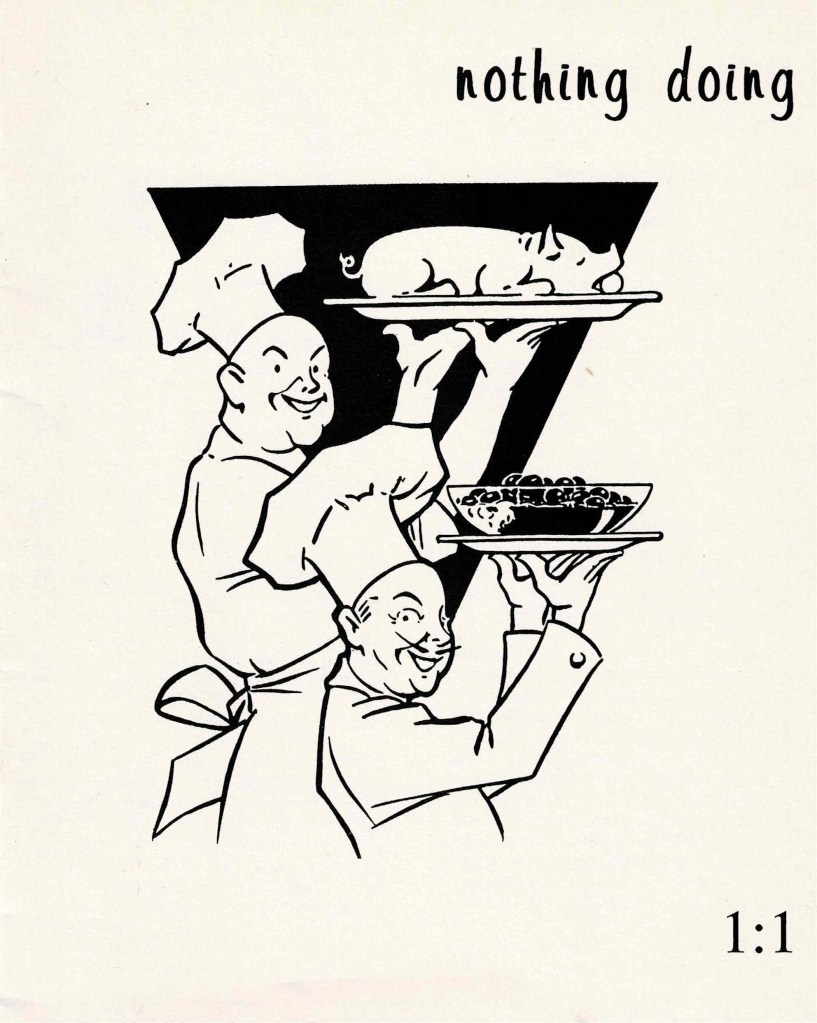
In my 20s I was very magnetically drawn to those who were undeniably smarter, funnier and more interesting than I was. Through the use of common bonding agents such as alcohol and underground music talk (areas in which I could hold my own, if nowhere else), on occasion I found myself holding court with one of these bon vivants, a guy named Brandan Kearney. I’d initially come to admire this gentleman through his band World of Pooh during the years 1989-90; he would come to do time in Caroliner, The Steeple Snakes, Faxed Head, the Heavenly Ten Stems, The Three Doctors Band and the Totem Pole of Losers in the 80s and early 90s, and then others besides. He ran a San Francisco label called Nuf Sed that put much of this out.
A couple methods to get a better handle on this world would be to read Will York’s Who Cares Anyway – Post-Punk San Francisco and the End of the Analog Age book, and/or to read the oral history of World of Pooh that I assembled in Dynamite Hemorrhage #3 fanzine, which you can download a PDF of right here. Aside from the boner where I bumbled and called Kearney WoP’s bassist, I’m proud of how it turned out. As Kearney was immersed in and helping to drive San Francisco’s absurdist early 90s parallel world sub-underground culture, he furthered his contribution with a two-issue run of a small fanzine called Nothing Doing. Nothing Doing #1 came out in Spring 1994, and it wasn’t really a music fanzine at all, because any and all music discussed within it did not exist except in Kearney’s unique and wacked vision, informed as it was by weird religious tracts, thrift store records, conspiracy theories, the Chinese Communist Party and an extreme and ahead-of-its-time notion of anti-comedy.
Its purpose was clearly to subvert, for lack of a better term, the notion of the fanzine. Since music fanzines were ubiquitous and often uniform in 1994, Nothing Doing #1 stood out, shall we say, to the extent that it was seen by anyone. There’s a table of contents with zero connection to the contents herein. The demo tape review section features music by acts like no (fucking) name and Whirling Petals, the latter of whom’s tape Embroidery and Crucifixion is reviewed thusly: “Within two minutes of pressing ‘play’ I felt like I was dying of encephalitis. I mean that in the best possible sense, and with all due credit to Oliver Eustace, the Petals’ morbidly obese lead singer – an utterly deluded fop whose muse seems to be having a little joke at his expense….Certainly no one else is washing hogs like this, at least not while accompanied by a chorus-drenched mandolin, a piccolo and a triangle”.
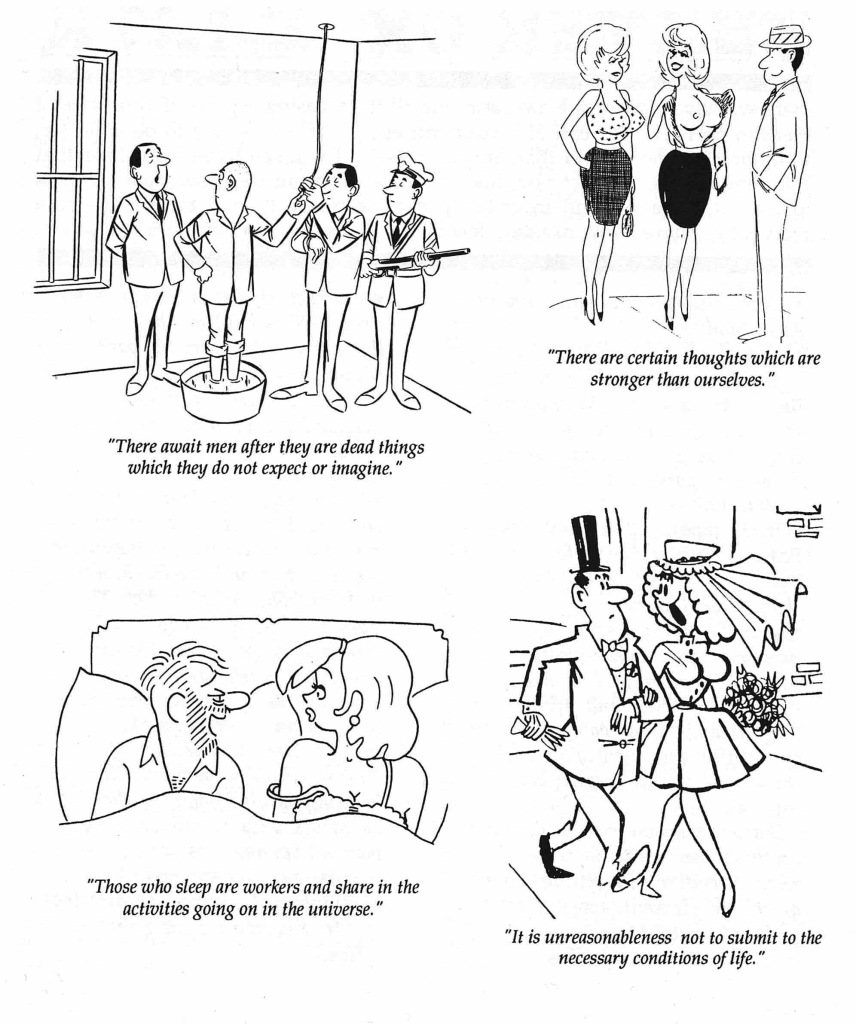
There’s a further section of reviews of recordings from “The China Record Company”, whose albums include We Steel Workers Have an Iron Will and Poor and Lower-Middle Class Peasants Love Chairman Mao Most. If I ever looked for these in thrift stores, I never found them. A representative proxy for the remainder of Nothing Doing #1 might be the “cartoons” section, which I’ve helpfully scanned for you here. Laugh it up, and I’ll get down to tackling this mag’s second issue here within the next 365 days.
-
Twisted #3

This March 1978 issue of Seattle’s Twisted is almost certainly one of the twenty titles I’d bravely save from a fire, were I to only save twenty. The three issues of Twisted ran from June 1977 until this one, and someday, inshallah, I’ll find a way to procure the other two. While it has neither the writing chops of Slash nor the NY Rocker at this time, Twisted #3 is omnivorously devoted to uncovering the excitement of global punk wherever it leads them, no matter how far underground it takes them, and no matter how many miles they need to drive to, say, San Francisco for the Sex Pistols/Avengers/Nuns show to get the story.
There are over a dozen contributors, both writers and photographers. It starts off with a revelatory bang by a writer taken by friends while in NY to an early Cramps show at CBGB – mind totally blown. This is followed by a little local coverage of The Mentors, I’m afraid to say, who are called “the disembowelment of rock ‘n roll”. Early songs like “Secretary Hump” were already nice and worked out even here in early ‘78, and we’re blessed with lyrics for this and other fine songs like “Macho Package” and “Can’t Get It Up”. The disgusting picture of El Duce is thankfully followed up with one of lovely Jennifer from The Nuns, along with an interview w/ Richie Dietrick from her band, a total NYC born-and-bred, attitude-drenched goombah who was already an out gay man by this time. Pretty bold move in ‘78, and I’ve gone my whole punk-lovin’ life not knowing that.
As the eyes of the world zeroed in on punk rock, Twisted #3 was getting nervous. There’s a punk vs. “New Wave” semantics essay, and in the mag’s gossip column it is reported that “MISCARRIAGE in Boston reports that the city is being inflicted with a strange illness, ‘new wave virus’, which all the punks have….”. Meanwhile, there’s much love for The Avengers and Penelope, who’d recently moved from Seattle to SF to go to art school and then formed her band there. “Record contract rumors are flying like crazy – Sire being the head of the list”. Is this sorta like when Penelope was scouted to replace Grace Slick in Jefferson Starship?

I wasn’t particularly into the mean article about Nico and her show at the Mabuhay Gardens in San Francisco. The photograph you see here was from that December 8th, 1977 performance, and it’s one of my all-time favorite rock photos. And jeez, the ads in this thing. There are ads for Screamers and Dils tours which will bring them to the Northwest, and there’s a great one for Slash magazine itself. Twisted #3 are very excited about the debut Black Randy and the Metrosquad 45 “Trouble at the Cup”, and give the man a two-page celebratory spread just to rejoice about it.
As we discussed a bit when I reviewed Chatterbox #4, the local Seattle punk scene really got roaring quite a bit earlier than I’d previously comprehended. I mean this was Seattle – now a metropolis, but then with less than 500,000 people (and post-Boeing, falling) and in the corner of nowhere. Or so I thought. There’s a centerfold-esque photo of the early Lewd; an interview with The Snots and some Midwest transplants called The Invaders whom I’ve never heard of. In addition to a Portland scene report (with three other bands I’ve never heard of). Lydia Lunch of Teenage Jesus and the Jerks gets to be nihilistic; there some blather about The Clash; and a Generation X interview, a band that for me proved the maxim that any punk residing in the upper 20% of physical good looks will always gain disproportionate attention irrespective of talent. Until they don’t.
-
Unsound #4

What a strange, creative and insularly self-driven fanzine Unsound was. We talked about issue #1 of this one here earlier in the year; I’m now going to attempt to render several paragraphs about Unsound #4, published in San Francisco during the first half of 1984. Little thought was given to economizing the page count in this issue, so you get a really crazed (but readable) mess of font types and sizes, short pieces about nothing whatsoever, longer pieces about not much in particular; and then more-or-less standard record reviews and interviews, mostly centering around a nexus of industrial, experimental, avant-garde and just generally oppositional musicians, musical offshoots, writers and artists.
This is how Zoogz Rift and his “Amazing Shitheads” come to bring his “odd, abrasive” free-form dada music to the Unsound party, just by being as oppositional as the First Amendment and the outer limits of taste might allow, all the while complaining (tongue planted firmly in cheek, I’d imagine) that he’s “being boycotted by the music industry”. Sonic Youth, fresh off their first visit to Europe and the release of Confusion Is Sex also have an interview here, 100% Thurston Moore representing, and right in that window where those of us hearing the band for the first time thought of them as something vaguely (if mildly) dangerous and transgressive. Remember, this is a time where “this music” wasn’t really even on college radio and the records themselves were often poorly distributed. All details were transmitted via fanzines.
I’d see blurry B&W photos of wild people like Michael Gira, Sonic Youth with guitars locked and hair long, even the relatively more popular Einstürzende Neubauten etc. and it was all pretty nuts and a little too much for a suburban high schooler. However, much more daring high schoolers like Jo Smitty and Mark Arm were living it in their suburban Seattle band Mr. Epp, referred to here in a bizarre post-mortem piece (“A self explanation”) entirely written by the band themselves. Four years later I’d see boogie-rockers Sonic Youth and Arm’s Mudhoney sharing a stage at San Francisco’s Fillmore. I’m going to bet Unsound editor William Davenport stayed home.
Then again, who really knows? It’s sort of funny combing through the record reviews of this one, which mixes up stuff like The Haters and deep-underground, edition-of-5 noise tapes with whatever records awful hardcore labels like Mystic Records were sending Unsound. Davenport, Brad Laner and other writers treat it all quite magnanimously, to my surprise – even the Gay Cowboys in Bondage tape!
I’ve also just come off reading Marc Masters’ outstanding overview of cassette tape history and lore, High Bias: The Distorted History of the Cassette Tape (get it!). My favorite chapter is on the 80s tape underground that was helped to flourish – all things being relative, of course – by fanzines like Op and by college radio programs helmed by freaks who’d play whatever tapes showed up at the station, no matter how homespun. This is a world that Unsound also helped to steward and cultivate, and there’s also a great piece about “Art Radio” in which people call up particular shows on the left of the dial in order to share their “audio art” with the limited audience brave enough to tune in. I barely recorded my own doofus 1980s college radio shows, and it kills me that so much amazing and daring cultural weirdness on the airwaves was barely heard once, and will unquestionably never be heard again.
Finally, there’s what looks to be a mail interview with a 26-year-old Adrian Sherwood of On-U Sound, and he’s hilariously defensive and dismissive of many things surrounding “reggae” and the mainstream. It’s a hoot. Unsound #4 itself is too, mostly for all the right reasons.
-
Show-Kai #1

Part of what I remember the best about doing a fanzine in the early 1990s was how rapidly it put me in contact with all sorts of weirdos running labels, in bands and doing their own fanzines. It was a bit of a whirlwind for an introvert. I took advertisements in Superdope, the mag I was doing from 1991-98, in order to help fund the thing. That helped me “meet” folks like David Hopkins from Public Bath Records, a Madison, WI-based label that was carving out a totally niche play as a US-based imprint that only put out deeply underground music from Japan, and from nowhere else. The Japan Bashing series of comp 45s in particular was quite enjoyable, though that whole Japanese underground, though ubiquitous in the sorts of fanzines I was inhaling in 1990-92, ended up being quite ephemeral in the broader sense of having staying power in hearts and minds lasting beyond that brief era.
Show-Kai #1 from 1991 was Hopkins’ solo, one-and-done fanzine, with a Public Bath stamp on the cover and a written approach wholly dedicated to exposing the deepest crevices of Japanese outsider noise, no wave, punk and psychedelic rock. Clearly, Hopkins was a guy who had just come off living in Japan and who’d drunk deeply from underground well whilst there, making friends with Eye Yamatsuka and many other musical misfits along the way. As celebrated as these Japanese freaks were around this time, I personally found it hard to get truly excited about many of them, including The Boredoms. It was only when I heard the first Tokyo Flashback, reviewed here, and especially when Larry Hardy told me about and then played me High Rise II a year later, that I latched on to any of it, and even then just the PSF stuff and maybe Ruins a little bit, whom I once saw in San Francisco at a club called “Morty’s”.
In fact, until reading this I’d forgotten I’d seen the all-female Sekiri (“Dysentery”) in SF around this time, and I couldn’t have cared less about Shonen Knife, the 5-6-7-8s and what have you. But lord, this fanzine brings back to memory so, so many bands from the late 80s and early 90s, from KK Null to UFO or Die to Omoide Hatoba to Masonna to the legendary Hanatarashi, featuring the aforementioned Eye Yamatsuka. Eye was in a great many bands around this time. The Japanese underground was truly a microculture with some absolutely rabid adherents around the world, and reading Show-Kai #1 you get the sense that we barely scratched the surface getting this music to the people then, and that it has nearly vanished from the historical record now – at least in Western media.
Hopkins reviews a new Boredoms tape called Boretronix 3 that’s just come out: “I guess your chances of ever hearing this are pretty slim, and that’s really too bad. This is one of those cassette things that Eye releases whenever they need a little pocket money. He makes a hundred, walks around to about five record stores and goes home with the cash. Side one is clearly not The Boredoms. It sounds like Eye screwing around with Boredoms tapes and other found/sampled stuff”. Hopkins clearly didn’t anticipate the internet, and the fact that you can now listen to this on your cellular telephone right here.
Show-Kai #1 has a highly admirable who-gives-a-fuck layout style, decorated as it is in the margins with xeroxed Japanese baseball cards, kanji script and photos of toys. Like the Damp #3 fanzine from roughly the same era, the primitive font used here is the one I like to generously call “DOS command line”. Eye Yamatsuka contributes a bonkers nonsense comic where you’re supposed to arrange the panels to make sense to you. Yet you’d never accuse Show-Kai #1 of being bereft of content, no sir – there’s a History of no wave in the Kansai region of Japan, where Osaka is located, from 1984-89. Aunt Sally and Ultrabide are the names I know from this time; you may be more familiar with the many other players mentioned. There are also interviews with modern acts: Chu from Dub Squad, Omiya Ichi from Daihakase, Yamamoto Seiichi from UFO or Die, and with the bands Goonzees, The Folk Tales, and Soap-jo Henshi. All your favorites!
This is rounded out nicely with a July 1990 Boredoms interview, in which they insult each other, talk about their legendary show opening for Pussy Galore in Osaka (which I’ve seen referenced elsewhere, maybe in the new Thurston Moore book?), and in which there are multiple pictures of them all bowling together.
And, as I just found out, you can secure a digital download of Show-Kai #1 here, as long as you have¥100 in your Paypal account. That’s somewhere between fifty cents and $273 in real ‘Merican money, I’m not entirely sure.
-
Frequency #1

I’ve griped before – and have seen others griping – about how the back half of the 1990s (specifically 1996-99) was a musical low period marked by a dearth of exciting, ground-breaking new music, rocknroll or otherwise. Low periods are nothing uncommon, obviously; there would be no high periods without them. It’s certainly all in the eye of the beholder, naturally. I was in grad school during these times, and my record collecting necessarily fell off a cliff due to lack of funds and time. I got married; I moved to Seattle and back; and yeah, I was still listening to music like a fiend, but found myself shuffling into a comfortable if limiting corner of my own making: either garage punk, solo guitar (my John Fahey discovery & appreciation totally soared during this time) or old pre-WWII blues and country, of which there was much to discover. This corner was almost entirely analog in nature.
So just as Jeremy Rotsztain was publishing Frequency #1 in Summer 1997 and having the time of his life with new electronics-driven space rock and the whole Kranky/Drag City Chicago funhouse that was surging during these years, I was busy ignoring most of it. He might tell you the late 90s were the glory years. Honestly, I really only overlapped with Rotsztain and the Ontario-based Frequency crew at the time on Stereolab and Roy Montgomery, two acts I hold close to my bosom to this day. But Jessamine, Trans Am, Rachel’s, Silver Jews? Barely knew ‘em; and when easy streaming later allowed me to plumb their catalogs, I found this world wasn’t particularly to my liking in any case. Such are the vagaries of taste.
Picked up a used copy of Frequency #1 at a local record store recently and used it to try and sway me into their Moog-centric world. Best piece in here is an interview with Simeon from Silver Apples. I’d forgotten about how they’d “reformed” during this time; the Silver Apples Discogs shows many releases during these years. It’s all coming back to me; the kids were going nuts about their crazy 1960s oscillator sounds right as the internet and message boards were getting started, yet I’d only heard that 60s stuff (Silver Apples and Contact) and was still a few years away from appreciating even that. Can anyone give an honest endorsement of any of that 90s stuff? If so, which one(s)? I’ll investigate accordingly.
Rotsztain was a fanzine editor who’d meticulously done his homework before each interview and came in pre-loaded with discographical and tour questions that he may or may not have already known the answers to. His talk with Jim O’Rourke is a good one as well, and O’Rourke previews a new album he’s working on – Bad Timing – a fantastic record. So it’s not all bleeps and blurbs over at Frequency! Rotsztain became an artist of some renown; you can see his work on his own website here. Meanwhile, I can’t get a read on whether his Frequency fanzine ever published again but this one here is a nice capsule to pull out when I’m ready to try and reevaluate the late 90s yet again.
-
Search and Destroy #3
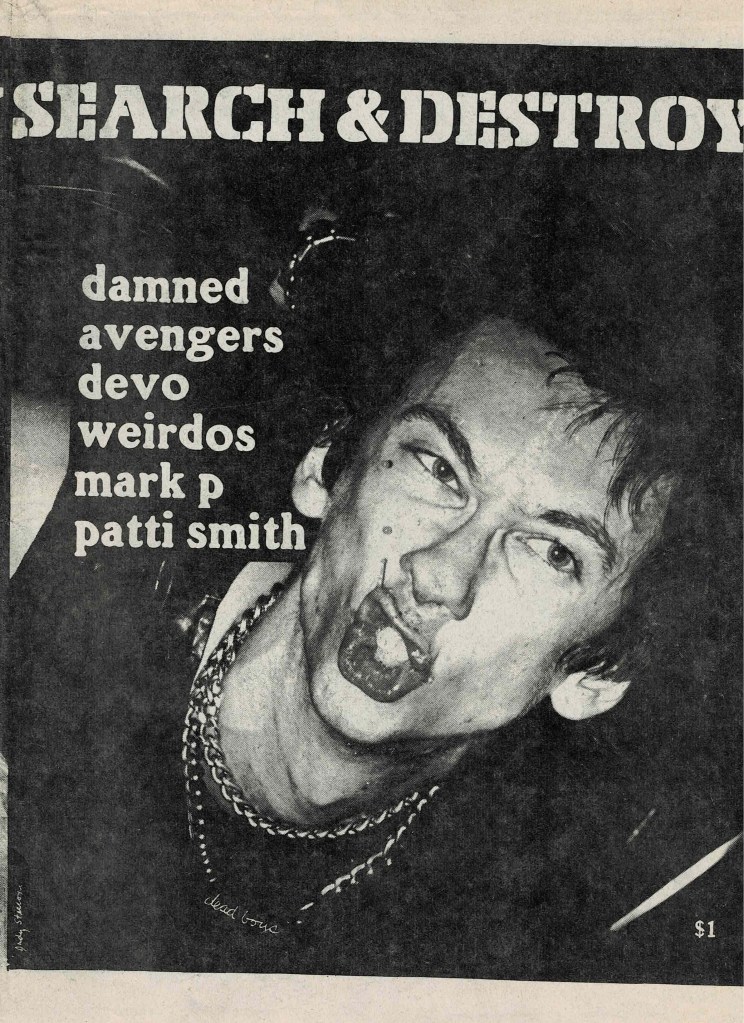
It is not difficult in our current times for a San Franciscan to happen upon V. Vale, late 1970s editor of Search and Destroy fanzine, sitting in front of City Lights bookstore or at an art event of some kind, selling intact and original back issues of Search and Destroy at around $25-$30 a pop. I was fortunate to come by my copies in a different manner, and certainly not by being one of the original 100 Bay Area punks in 1977. This is when Search and Destroy #3 was published, presumably in the back half of the year, given the killer New Year’s Eve Crime/Weirdos show advertised herein.
Let’s start with the mystery of the cover of this one. I’m still not sure who this is! For years I reckoned it was someone from The Damned, but nah, none of those guys looked like this. Who is this dude? What a photo. Wait, is it Stiv Bators? Someone tell us. Search and Destroy #3 is as up-to-the-minute on the whys and wherefores of punk rock music as anything contemporaneous you’ll read anywhere; you’d think from the tone taken that it had been around and thriving for several years by this point. No one’s jaded, but neither is anyone blithering around like a weeks-old convert, pie-eyed about the Sex Pistols or what have you. The scene is raw, hot and exploding, and the coverage reflects it. Search and Destroy always defined “punk” with a pretty wide remit, so even in ‘77 The Residents are included. There’s even a super-brief Don Van Vliet interview.
The first piece is an interview with Black Randy, who does everything in his power to ensure that he’ll alienate everyone around him, telling many matter-of-fact stories from his times in jail and as a male hustler. The real deal, this guy was. Debbie Harry, long before Blondie has come near anything approaching popularity, is asked if she’s had any offers to be in movies and says, “No, only Amos Poe”. Sorry, Amos. Cliff Roman from The Weirdos attempts to turn Northern California on to In-N-Out Burger – we didn’t have them back then up here; in fact, when I went to college in Southern California eight years after this, I couldn’t get SoCal folks to keep their yaps shut about In-N-Out and Tommy’s. Perhaps the best of the interviews is with Mark Perry of Alternative TV and Sniffin Glue fanzine, already years-old before his time and with a perspective so far ahead of his gobbing, safety-pin bedecked contemporaries.
Oh, there’s a Devo interview as well. I just saw Devo’s 50-year anniversary show in San Francisco a couple weeks ago. They’re in their seventies now, and they were great. Devo in 1977 loves Germany, the country, because “they avoided the hippie 60s” and because “German cinema is the only thing happening in film, practically” – hyperbole in 1977, coming off an absolutely incredible 8-year run for American film. You often can’t see it when it’s happening right in front of you, can you? Search and Destroy #3 has a Crime centerfold (!) and reprints a bunch of lyrics by brand-new bands like X, as well as The Germs’ “Forming”. These feel like space-fillers, but I’m also wondering how anyone was able to interpret and transcribe anything Darby was muttering.
Finally, I’ll leave you with some snippets from The Dils, who got to collectively author the Los Angeles “Street Report”. They’d moved down there from San Francisco as a band at one point; I’m not positive on the timeline but I’m guessing their stay down south wasn’t taking so well:
“A big thing in LA is people telling each other to FUCK OFF, & getting involved in little, petty street skirmishes – imitating English punks they’ve seen on TV. Like the strangle-dance – it’s stupid!”
“LA likes bands gaudy and silly on the surface – we get slagged off because we have a political outlook, for being Too Serious. We get shit like “Communist Chairman Mao” and “Dils Suck” written on our cars.”
“Audiences here are totally infatuated with the Johnny Rotten star trip. They don’t realize that when he first took a suit and ripped it apart, then fastened it together with safety pins, he was SAYING SOMETHING – not that “safety pins are cute” – the clothes like the music are supposed to be a threat.”
“The BAGS are a joke band – they wear bags over their heads, nipples and kotexes all over their bodies. VENUS & THE RAZORBLADES are garbage – Kim Fowley puppetoons.”
“The DILS don’t hate the poor.”
-
Galactic Zoo Dossier #5

As I said last time in my typically hackneyed and cliched manner, there’s really never been a fanzine quite like Galactic Zoo Dossier before or since. First, editor Steve Krakow has put forth his own singular, personal vision for what defines true rocknroll. That’s not unique to Krakow, of course, but for him It’s “psychedelic” in every guise and form, overlapping with all things trippy and raw. This can be psych-pop, folk, or hippie rock, or it can be grunting, Stoogely groin emanations. It’s that he illustrates and hand-draws his entire mag that just boggles the mind, and I’m using present tense here as I write about Winter 2001’s Galactic Zoo Dossier #5, because my understanding is that a new issue is currently in the works after a long layoff.
This issue is dedicated to Skip Spence, and why not? There’s not really a Spence thread running through it, except for a very agreeable piece (as in, I agree with it) by Scott Wilkinson called “The Myth of the San Francisco Sound”. He convincingly posits that there was very little continuity between the many celebrated and underground late 60s bands in my hometown, and therefore trying to make a big hullabaloo connecting the Dead, Fifty Foot Hose, Moby Grape, It’s a Beautiful Day and what have you is just silly. It was just a happening music scene with loads of tripped-out kids; otherwise just as absurd as talking about the “Los Angeles Sound” of the late 70s.
Plenty of things to really love in this one. Dieter Moebius and Michael Rother give the story on Harmonia, a record I now love but didn’t hear until a year or two ago (!), as well as other krauty things. There’s also a nice bit about horrific rock stars like Kenny Loggins or Rick Springfield that had their own “psychedelic” periods, which I take to mean a song or two that were vaguely hippie-ish (Galactic Zoo Dossier is unfortunately quite liberal with terms like “kickass” to the point of straining credulity). And staying on the kraut theme, there’s a jukebox jury where Krakow plays records for Michael Karoli and Damo Suzuki from Can. Karoli claims to have never heard Syd Barrett “knowingly” until that day. Come again now??
While Galactic Zoo Dossier #5 came out in 2001, it clearly was in the works for some time, as you might expect given its craft. There’s a scene report from the April 1998 Terrastock II in San Francisco that I missed by a few days, Kendra Smith, Alastair Galbraith, Mudhoney and even Major Stars’ most recent show in SF before the one I saw in 2019, which I’m currently claiming to have been one of the twenty greatest live shows I’ve ever seen. Krakow also writes about some Incredible Chicago shows he’s witnessed with Major Stars themselves, as well as Japan’s High Rise and Mainliner on the same night (yeah, I know they shared members). There are also small pieces on Chants R&B, Idle Race and Kaleidoscope, who are said to have been every bit as great as The Beatles, and I say that’s totally okay if someone wants to think that.
So much more, too. “German heavy rock” by Kit Moore; a surface-scraping interview with Dick Taylor of Pretty Things; a talk with dumb-dumb dopesmokers Electric Wizard, and a set of removable “Damaged Guitar Gods” trading cards. These encompass a wide range of freaks and string-benders, from Jandek to Davie Allan to Eddie Hazel to James Williamson to Pip Proud. Krakow seemingly knows everything and everybody, and now he’s 22 years older and wiser than that. Totally gearing up for that next issue if and when it arrives.
-
The Story So Far #4
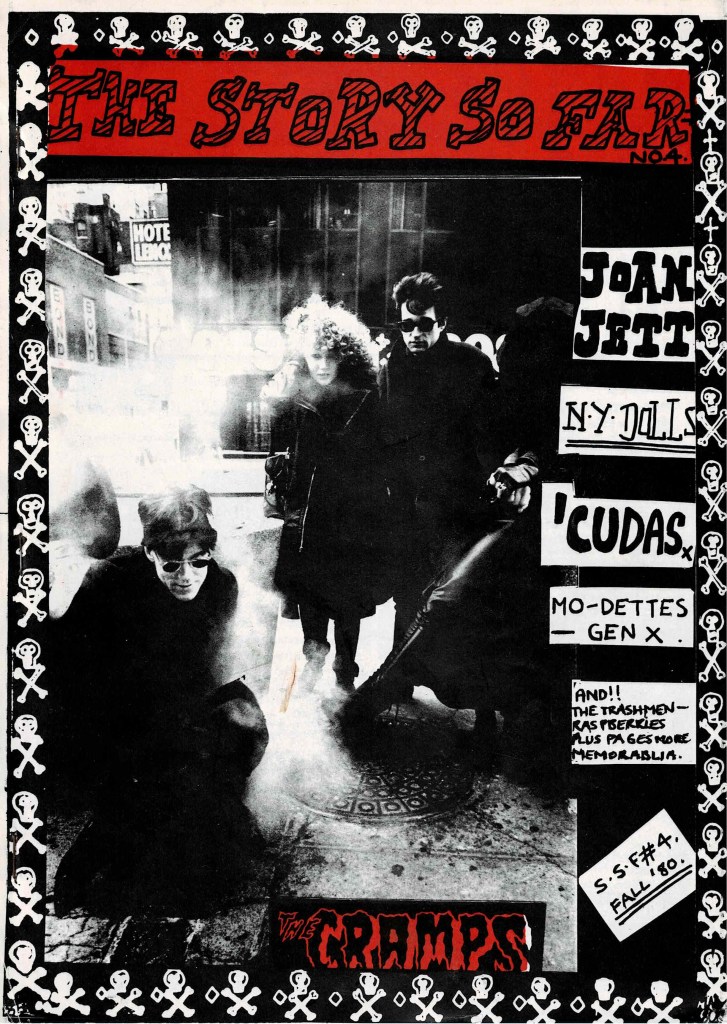
We’re back here at Fanzine Hemorrhage after a several-month break. That break was what enabled us to complete a film-focused fanzine called Film Hemorrhage #1, which has just come out and is available here. Now on with the program.
Music fanzine culture in the early 80s UK was more robust and fertile than anywhere else on the planet, I think it’s fair to say. The Story So Far #4 is highly representative of an excitable and ear-to-the-ground subculture of music freaks there, just allowing an onslaught of underground music to wash over them in 1980 and trying to document as much as possible before it drifts away. This in turn engenders new brain-jolting discoveries from the 1960s and 1970s, a particular new obsession of this fanzine, which has tribute pieces on The Raspberries and The Trashmen.
The editors were “Tim” and “Marts”, and according to the masthead, Nikki Sudden is a contributor in here somewhere. “This issue is full of yanks, which is unintentional but just turned out that way”, says one of them. If only they knew just how problematic that would sometimes feel for certain anglophilic American publications who went the other way. Key among the yanks in The Story So Far #4 are cover stars The Cramps, who really took hold of England during the early 80s and who were actually introduced to me back by English publications that I was buying in the USA (as well as by college radio). Even in 1980 we’ve got an ad in here for Lindsay Hutton’s Cramps fan club, as well as a Cramps interview and original photos from recent gigs. Lux is highly complementary of The Barracudas, a band highly visible in UK fanzines at the time but who don’t seem to me to be particularly well-remembered now.
I’m a little baffled by the letter to the editor from Vermilion Sands, a woman who became one of my retroactive 70s punk rock crushes once I saw her photo in Hardcore California a couple years after this. She’s at this point a former San Francisco punk and Search and Destroy contributor now based in England, making what sounds like some abysmal biker rock. It sounds as though she’s encouraging bands to sell out and join a major label, but she could just as well be arguing the exact opposite in her clipped, elliptical, punk rock-inspired typing. I’m really unsure, but it merited a full page in The Story So Far #4. In other news, Joan Jett has just released her first solo record and talks a bunch about the LA glitter and Rodney’s English Disco scene; Tim gives a full-page rave to the new Mo-Dettes album, and Marts tries to do the same for some new Generation X piece of vinyl, clearly his favorite bands two years ago but you can just tell the guy’s heart isn’t in it any longer.
I wonder what became of Tim and Marts seven years later. Were they nodding off at Spacemen 3 gigs? Were they pigfuckers deeply into Big Black, Killdozer and the Butthole Surfers? Did they go through an intense “jangle” interlude? Fellas, write us here at Fanzine Hemorrhage as we’d love to get to understand the cut of your 1980s jib!
-
Subscribe
Subscribed
Have a WordPress.com account? Log in now.

