-
Halana #4

I’d have to say that even if the late 1990s ended up being one of my least-favorite eras for music, I’m still rather struck by just how many well-designed, high-circulation fanzines were being made available at the time that covered the most absolute out music on the planet. People bought ‘em! I’m still not sure if the rock-adjacent improv & experimental underground was actually and truly peaking around this time, or if there were just more folks paying attention to it as a defiant reaction against the mainstream co-optation of the independent rock underground – you know, the whole “Royal Trux and V3 and Thomas Jefferson Slave Apartments on major labels” thing. I had the opposite reaction and mostly ran for the hills, both from the mainstream and from the deep-deep underground for a few years. But I still bought their fanzines.
From Muckraker to Bananafish to Opprobrium to Deep Water to this one, Halana #4 – and obviously there were others – there was an entire circuit of editors and an audience who revolved around craft micro-labels like Betley Welcomes Careful Drivers, Swill Radio, Sedimental, Oblique and dozens of others, many of whom released not-even-music music. Halana #4 came out in 1999 and was edited by Chris Rice in Ardmore, PA. His magazine focused primarily on what is somewhat euphemistically called “new music”, which means avant-grade and certainly non-linear music not at all informed by the 4/4 beat, nor from, say, your traditional “rocknroll boogiewoogie”.
The contributing editor was Ian Nagoski, who’d later become a hero of mine with his Canary Records and incredible unearthings of 78rpm records by American immigrants, which he then turned into an expansive series of analog and digital-only releases with all that and more. In a similar, fellow traveler sort of vein, the touchstone piece in Halana #4 is a long travelog by Richard Bishop (Sun City Girls), packed with advice and stories and an enumeration of his approach to jaunting across India, Indonesia, Malaysia etc. Ian Nagoski himself writes about saxophonist Joe Maneri and his son Mat, and like any good curator, he got me to check them out 25 years later, something I didn’t do in 1999 when I very first saw this piece and was sort of openly rejecting the world that Halana was marinating in. Check out Maneri’s Paniots Nine from 1998, totally beautiful klezmer/gypsy Greek jazz from another realm. It’s a long piece, but you come out really wanting to HEAR these guys. I sure did, and have more to learn.
There’s a long section of reviews by Chris Rice that takes up the rear of the fanzine. Nothing “rocks” in the least except Mainliner and Major Stars toward the end, and that’s fine as far as it goes. But there is a big heaping helping of praise for Revenant Records, which also just happened to be MY favorite record label in 1999. The rest of the section is lasered-focused on improvisational abstractions, with even most free jazz being too “straight” for Halana. There is a compilation CD in my copy that’s been there since I bought it. I just know I’m gonna hate it and I really like the mag, so why ruin it, right?
-
Lost Mynds #1

The first time I ever heard “sixties garage punk” was while in high school in the early 80s via the reissued Nuggets compilations. Not knowing anything about any of it, my standard was quickly set by The Count Five’s “Psychotic Reaction” and the Standells’ “Dirty Water”. I liked it, but was altogether indifferent to the larger picture. Once I arrived in college in 1985, I’d hear raw snatches of sixties garage punk on the radio that I really found appealing, but it wasn’t until I heard the Back From The Grave comps that year that I went totally apeshit for the form.
At that point, anyone modern with a bowl haircut and 60s psychedelic lettering on their records was fair game for me to (try and) get super excited about, and we had records from all of ‘em at KCSB, the college radio station I fell in with. I had plenty to sample from. Yard Trauma, The Raunch Hands, Pushtwangers, Vipers, Gruesomes, Deja Voodoo, Stomachmouths, Plasticland, The Brood, Chesterfield Kings, Cynics – it was all stuff I tried and failed to like. It really took The Morlocks, the Boys From Nowhere and then The Gories to get me fired up about any modern 80s band attempting to look and sound the part. Everything else sounded tinny and too reverentially retro, especially the stuff on Voxx Records, which suffered from both poor recording quality and mediocre A&R to boot.
This is all a long way of introducing a Montreal fanzine I have from 1986 called Lost Mynds #1 which is fully steeped and marinated in a world I was trying to steep and marinate myself in that year. You can see that the cover is beautiful, and the fanzine itself looks terrific, totally home-assembled and with a great visual, cut-and-paste aesthetic. However, it was really trite and untrustworthy in the main, especially re-reading it now. They’re trying to approximate some absurd version of hipster-speak across all of their articles: “daddy-o”, “cats and kiddies”, “way out”, “fab”, “squaresville” etc. Dear Christ is that shit annoying.
That said, their remit is wide and there’s no question the folks behind this were living and breathing all the nooks & crannies of 60s-inspired punk and psych that were blossoming across the 1980s. Nearly all of the bands I mentioned in my roll call above of the eighties/sixties bands are featured or are interviewed here, with an interview with The Lyres/DMZ’s Jeff Connolly as well. There include scans from other magazines, sixties stuff, and then a few tribute pieces to actual sixties bands like The Yardbirds, Stones, Pretty Things etc. – and, and good on ‘em for this, the Ugly Ducklings – maybe Canada’s finest sixties punk band? You tell me.
When they get to seeing The Cramps live for the first time, on the A Date With Elvis tour, they’re just as sour about it being their Cramps intro as I was when I saw them for the first (and only) time in 1986, having been a fanatic for the band for the previous four years. So I can commiserate there for sure, but all that forced teenybopper talk otherwise leaves me a little cold when considering the totality of the Lost Mynds #1 fanzine.
-
I Wanna Be Your Dog #7
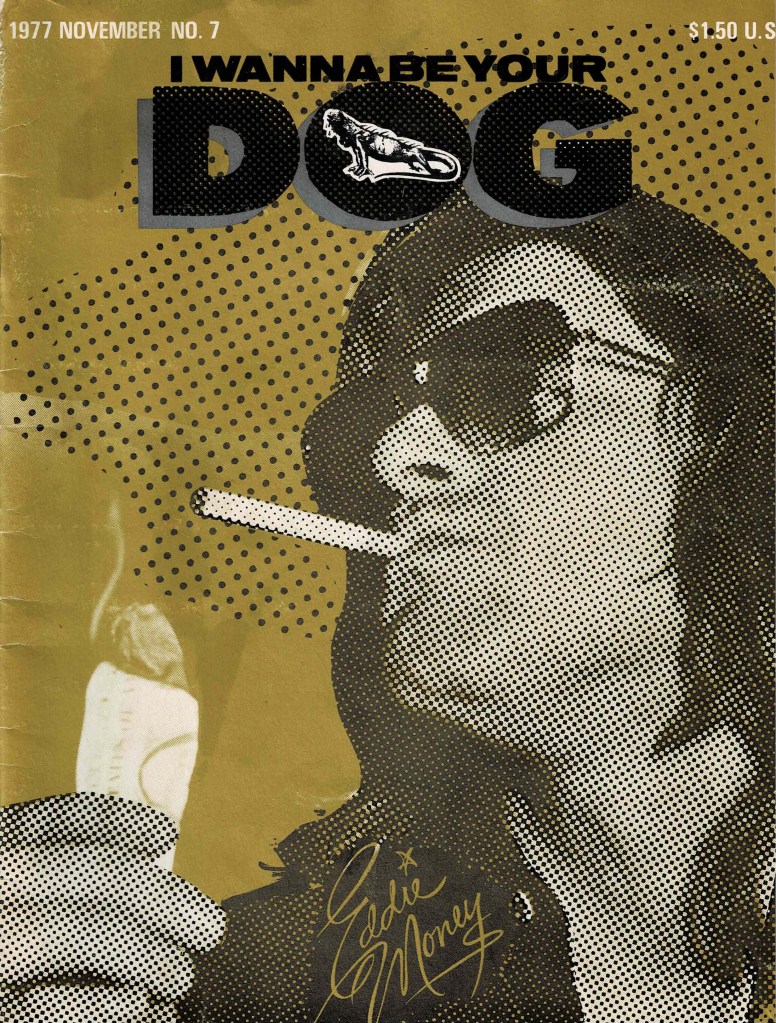
My understanding of the 1970s fanzine I Wanna Be Your Dog doesn’t travel particularly far, but here’s where it goes: I believe it started as an Iggy-obsessed French proto-punk fanzine, which then lasted into the punk era, with November 1977’s I Wanna Be Your Dog #7 being the final issue. It was actually an offshoot of the Iggy Pop fan club, no less. This final issue is in English, and they’ve opened a US “office” in Hollywood, ensuring that most of the content here is focused around US-based bands (which, frankly, it was previously, even whilst written in French).
Big-time punk rocker Eddie Money is on the cover. He’s interviewed and sounds absolutely coked to the gills. He keeps talking about Blondie, saying “she’s very beautiful”, and even when corrected by the interviewer, keeps referring to Blondie and “her band”, and rambles on about how bad they are for a backing band. It’s a pretty typical interview of rocker guys getting their first taste of Top 40 fame during the early punk era; they’re wanting to praise it all for being “from the streets”, but they’re also working to backhandedly distance themselves from it at the same time. I’ve seen a half-dozen similar interviews; at this time, ‘77/’78, one of the opening questions of virtually any interviewer in a punk mag was “What do you think about punk?” and/or “Do you see yourself as part of the punk movement??”.
There’s an interview with and some lavish praise thrown at Devo, as well as features on Mink Deville, Deaf School and Cheap Trick, the latter of whom come off as exceptionally affable goofballs. Of course, I’m most excited about I Wanna Be Your Dog #7’s early forays into the Los Angeles punk underground, and there’s a big LA scene spread near the back. It’s said that “the scene revolves around the bands and their performances. Three bands stand out: The Weirdos, Backstage Pass and The Screamers”. Two out of three ain’t bad! About Backstage Pass, they say, “They’re not ‘punks’ but they’re definitely part of the new wave”. Genny Schorr from that band is still active and she put quite a rock career behind her – all documented here.
There’s also a short piece on The Weasels, creators of “Beat Her With a Rake and Make Her Pay For Her Mistake” fame, along with a photo of creepy Kim Fowley with his arm around one of The Runaways. The Dogs from Detroit, now in LA, are interviewed, and they really were just about the perfect band for this fanzine’s Iggy-fied aesthetic. Crime from San Francisco are interviewed by Vale, and they come off as being kind of “silly”, which I like! They left all bogus attitudes at home that day. Phast Phreddie reviews the excellent first Human Switchboard 45 and says “If this kinda record sounds interesting to you, please, keep far away from me”. Finally, The Germs’ first 45 is reviewed by “Al and Pooch” (Flipside!) and they review it as if “Sex Boy”, and not “Forming”, had been the A-side. Strong move!
There appears to be a book about and possibly even collecting the I Wanna Be Your Dog fanzine, written completely in French, available here.
-
Escargot #1

I’ve got a friend in the fanzine obsession game who occasionally will magnanimously take care of me by sending along small packages of stuff he’s accumulated that he thinks I might like, and he’s usually spot-on. I recently received an unasked-for copy of San Francisco’s Escargot #1 from Autumn 1995, published by three women, one of whom I personally know quite well: Windy Chien. She used to run Aquarius Records, and she’s since gone on to some very deserved recognition for her fine art knotwork, something that really has to be seen to be believed how cool it all is.
This mag came along at a time and in a year when I very much should’ve appreciated it and known what it was, and yet I’ve never heard of the thing. Devoted to “Music and the Internet” – mostly the then-new information superhighway – it seems to have been put out by something called “Sick & Tired”, which I vaguely recall being another fanzine or a record label or something. I believe the name is meant to be a witty counterpoint to “snail mail”, which is what folks started calling “hand-written mail with a stamp on it” at this point.
You know, I wasn’t really an early Internet guy. We got “e-mail” in at my job at Monster Cable in 1994, and as I’ve written about here, it was a revelation for those of us who sometimes made more time at work for pranking each other than we did, you know, actual work. My mom, of all people, was cavorting on the Internet a good 18 months before I was, farting around in AOL chat rooms and telling me all about it. She once asked me if I knew who someone named “Costes” was, as he was a strange Frenchman she was being weirded-out by online, and whom she deduced was probably running in similar underground circles as I was. I did know – he was a Lisa Suckdog compatriot. I don’t think I got my own e-mail address until late 1996, on “The Microsoft Network” – jhinman@msn.com. I never participated in chat rooms, the “Chug list”, on listservs or anything like that. I think my early web activity was restricted to reading Suck, Salon and Feed every single day, but honestly, until streamable and/or downloadable music became a thing, I mostly refrained from connecting with my fellow music freaks outside of e-mail correspondence until the late 1990s.
Given the current enshitification of the Internet in 2024, the boundless enthusiasm in Escargot #1 for its potential to liberate us all from Kathleen, Jeanne and Windy in 1995 all seems very quaint, and a little sad, I suppose. We humans really fucked it all up, didn’t we? The whole idea here is to help shepherd readers, most of whom were new to online life, into the underground music crevices and ratholes that Kathleen, Jeanne and Windy were so excited about. There are lessons in “netiquette”, “modem musts”; a jargon dictionary; and helpful instructions for how to get going on e-mail, mailing lists and “the newest and most glitzy aspect of the Internet”: the World Wide Web. Then, at the end, they list who’s online that you ought to check out, like a Kiwimusic page, KZSU radio, Sebadoh’s and Stereolab’s respective web pages, and many lists to subscribe to.
When they interview someone, like Pussy Galore/Free Kitten’s Julia Cafritz or Franklin Bruno, the talk is fun and gossipy, primarily revolving around Internet stuff. These early adopters, Cafritz in particular, are already getting a little over it. I wonder how they feel now, after the birth, heyday and slow death of social media? Midway in, there’s a stream of live reviews with zero Internet content (I’m capitalizing that word and hyphenating “e-mail” because that is what we did in the 1990s), including shows I was personally in attendance at, such as the Dirty Three opening for the Thinking Fellers Union Local 282 during “Dirty Three Weekend” in San Francisco, which Windy Chien rightly reports as a long weekend in which everyone in town’s mind was suitably blown by that trio’s live performances. Mine certainly was – knew I’d like it because I’d been such a big Venom P. Stinger fan, but that first trip through from Dirty Three was even better.
I also liked Jeanne McKinney’s description of “the lovely Miss Cindy Dall” during her time playing live with Smog. I certainly was smitten with her from the word go when I saw her play. “If you’ve seen them on either tour you’ll know what I mean by ‘the lovely Miss’…it’s what my friends call a ‘high-maintenance look’. Much of the time not only is Miss Dall tastefully made-up, with tastefully coiffed hair, but also with a theatrical gown. And while her guitar playing seems error-free, it’s pretty simple stuff…and even after the many shows she’s played with Smog, she still seems nervous but self-confident, on the one hand hiding behind her stage persona, on the other not quite sure where the persona ends…This is fascinating stuff for me.” Dall, sadly, died way too young. I really enjoyed her in Bill Callahan’s band, and there’s a great 1995 show available to watch right here if you’re interested.
All fanzines are time capsules in their way, of course, yet Escargot #1 especially marks a moment in time that was unique, refreshing and exciting for those caught up in it all. You can feel the promise of the Internet as a place where oddballs and obsessives are already starting to find each other, an algorithm-free, advertising-free, VC-money-free, bottoms-up collective of misfits who are straddling the world of print fanzines on one hand and an undefined, exploding digital realm on the other. It’s one of the more interesting fanzines I’ve ever come across.
-
Vulcher #4

Though we’ve barely met, I’ve been somewhat connected with Eddie Flowers, the founder and editor of Vulcher fanzine, for going on 35 years now. I spent huge portions of the years 1985-89 routinely driving two hours from Santa Barbara to see live shows in Los Angeles, during that grim era when LA music was still mostly ruled by jean jacket cowboys and bullet belt bullshit. My patron saints in those years were the Lazy Cowgirls, and I loved everything and anything in their orbit. That very much included Eddie Flowers’ band Crawlspace, who started life as a high-energy, MC5-adjacent compliment to the Cowgirls – as you can hear on the 1988 Gimme The Keys!! Trigon Records comp that featured Crawlspace, Claw Hammer and many of the other bands I/we then considered part & parcel of the Cowgirls’ hallowed, hard-driving cadre.
I remember “chatting” with Ed and the Lazy Cowgirls’ Keith Telligman in Isla Vista, CA – the student ghetto adjacent to UC-Santa Barbara – during an all-day Trigon Records fest at AnisQ’oyo’ Park while the two of the them were totally tripping their brains out on LSD. A short conversation! Later, Flowers would self-publish a tiny ‘zine in the late 1990s called Slippy Town Times, and he’d routinely send them all my way, and sadly, I lost every one of them in the great fanzine disaster of 1999. The previous year, I’d published the eighth and final issue of my own 90s fanzine called Superdope, and I’ll never forget how Flowers responded to my “Forty-Five 45s That Moved Heaven and Earth” piece with an absolutely frothing electronic mail pointing out ALL the amazing 45s I’d missed in my personal list of the greatest 45s of all time.
Frankly, if I’d never met the guy, I’d still know he was one of the good guys by his general tone, tenor and track record. Now you also might know him as the fella from all-timer 1970s Indiana punk band The Gizmos, and you’d be right about that. But we’re here today to talk about his Vulcher fanzine, and specifically Vulcher #4 from Summer 2018, which I chose randomly from the five issues that were published during the back half of the last decade, up through 2019. It boasts an incredible roll call of contributors and friends, including Byron Coley, Todd Novak, Alexa Pantalone, Eric Friedl, Bruce Cole, Tim Hinely and a couple dozen others. Vulcher was akin during its brief run to a free-form Ugly Things mixed with the haphazard contributions in Bull Tongue Review, with no real concern for whether music covered therein is from the 50s, 60s, 70s or 2018.
Flowers and his crew are excellent at staying current with the spaced-out, free youth making music around the planet. He’s super supportive of young bands he meets along with way such as Rays, who were probably my favorite band around this time. I also like that he does the thing that I tried to always do in my mags, which is throw a random record review into any available spare space, rather than actually try to adjust layout and photos to make it all look professional. Too hard. I truly know the feeling.
Vulture #4 includes some real ringers. There’s a great Richard Lloyd (Television) interview by Kelsey Simpson, a woman who is a major contributor here and in other issues, probably because she’s actually Vulcher’s co-editor. Rich Coffee – once himself a Gizmo with Flowers – interviews Michael Rummens of The Sloths, and later The Hollywood Stars. You know “Makin’ Love” by The Sloths, right? Right?? Jay Dobis writes an open letter to Sean L. Maloney, who wrote the 33⅓ edition on The Modern Lovers (a top ten gem for me). It’s chock full of “wrong!!!” corrections, the sort of totally obsessed navel-gazing esoterica that I live for.
I really dig the Screamin’ Mee-Mees photos and essay by Flowers. Eddie understands their genius as too few others did. There’s also a Flowers thing on strange CD label Eastern Prawn, one of whose bands were Celebrity Handshake, a band who at their best are absolutely fucked rocknroll of the highest caliber, and who fit neatly into the man’s improvisational, ultra-raw, drug-friendly worldview quite well. Finally, and perhaps a little strangely, Chris Sienko contributes a long history of Crawlspace circa 1985-97, including a picture taken from LA’s Anti-Club where I saw them play in their early days. Hey, who cropped me out of the photo?
I can’t find any issues of Vulcher for sale online at the current moment, which is a true shame because, I mean, these just came out five minutes ago in the relative timeline that this website covers. Flowers is still just in his late sixties, so if he’s got the gumption to get another printed endeavor off the ground, there’s still time and I’d be all over it.
-
Pissed + Broke #4
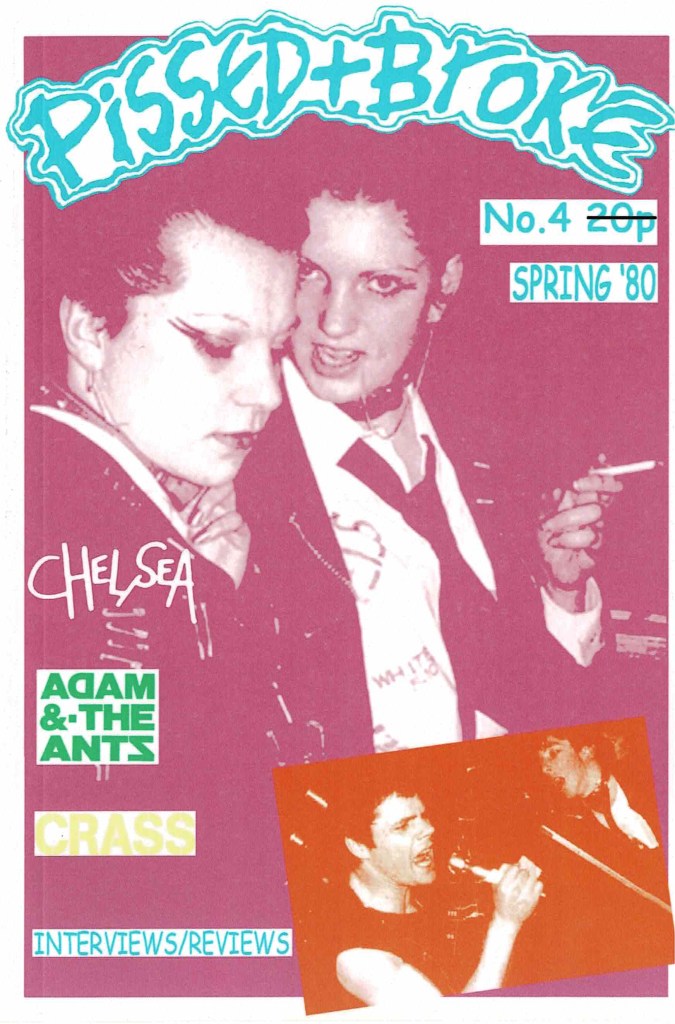
I’ve noticed a trend over the course of the past few months with small-press books or collections I’ve purchased on Amazon. The final page will say “Made in the USA, Las Vegas NV” and then provide the date it was printed. In every case, this is the date I ordered it. It happened with a paperback of Charles Willeford’s Pick-Up, which was riddled with spelling errors. It happened with a book by Patrick Cooper about Elaine May’s 1976 film Mikey and Nicky, which I have yet to read. And it happened with this fanzine reprint of Pissed + Broke #4, put out in Bournemouth, England by Jon Lange in Spring 1980.
I get what’s going on here now. This must be Amazon’s print-on-demand offering “Kindle Direct Publishing”, and there’s a lot to recommend it. This could be how the Fanzine Hemorrhage book or my novel I haven’t written eventually sees the light of day, you know what I mean? And at least there’s no spelling errors in Pissed + Broke #4 beyond what young Lange bobbled himself in the original edition. There’s a sort of a modern “wrapper” around this one in which Lange explains his thinking and offers apologies for same, both in an introduction and in an appendix with endnotes. Chris D. did this in his Writing For Slash book as well. There’s not much reason for apologies; much of the endnotes is devoted to dissecting his interview with Adam Ant of the Dirk Wears White Sox-era Adam and the Ants, mostly to pile on Adam, who’d become one of the biggest stars in the UK about a year after this.
He talks to Gene October of Chelsea, another guy I’ve always reckoned to be a blithering idiot and a quote-unquote “bad person” after reading about his behavior toward the Black Flag guys on their UK tour in this Rollins essay. (I’m not sure if this Rollins follow-up tale is actually true, but I hope it is). Lange was also a massive Crass fan, and goes deep on Stations of the Crass. It was just after this time that I started buying my first issues of the UK music papers and Crass were a major topic of conversation, particularly in Sounds. Their confrontational political stance and extreme DIY ethos was highly perplexing and/or fascinating to the powers that be, both institutionally and journalistically. I’d say shame about their music, but I’ll listen to a little Crass every now and again.
Anyway, I’m all for unearthing old fanzines and republishing them via Kindle Direct Publishing or whatever it takes to bring them to the people. Lange has got another issue of his 80s fanzine up there as well if you’re interested.
-
Mouth of the Rat #14
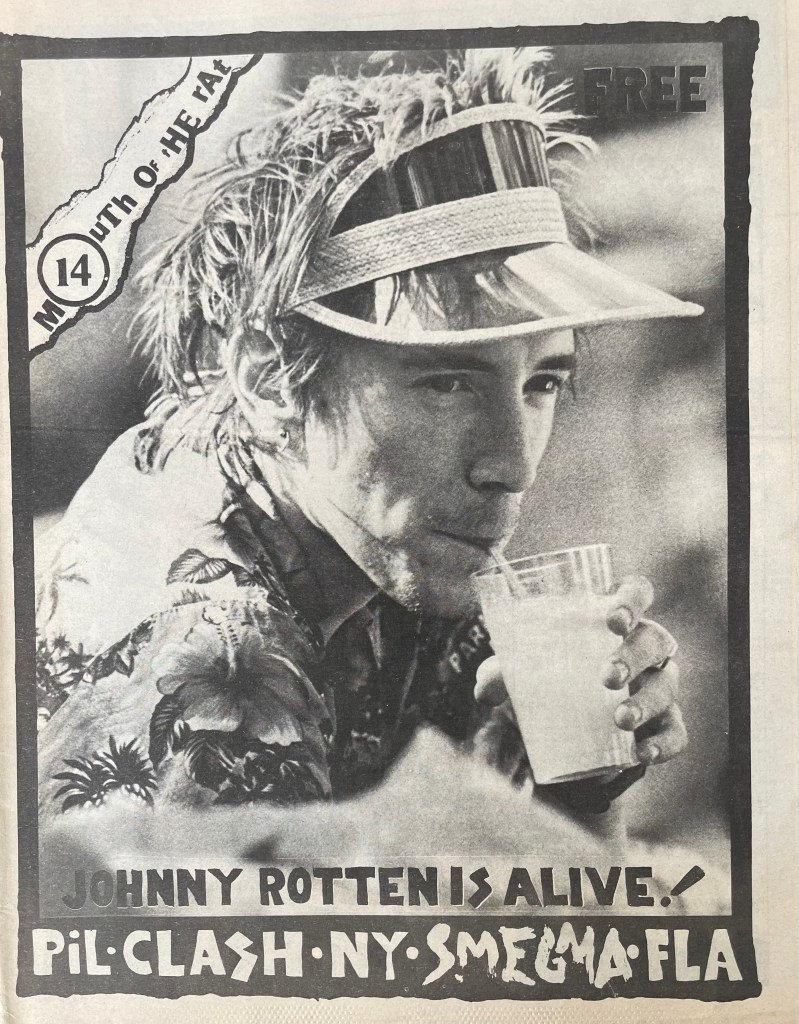
Mouth of the Rat was a free South Florida music newspaper, similar in concept at least to the far inferior free BAM or even The Rocket papers of my youth and twenties, except entirely punk-centric, unbeholden to major labels, and far more in line with Slash or NY Rocker. Dave Parsons not only edited and wrote most of the paper, he hand-lettered it, which yeah, it’s been done in a few places, but I’d never seen it as extensively and hand-crampingly executed as it is here until Galactic Zoo Dossier came along. (Lindsay Hutton did do it pretty well himself in Next Big Thing over many years).
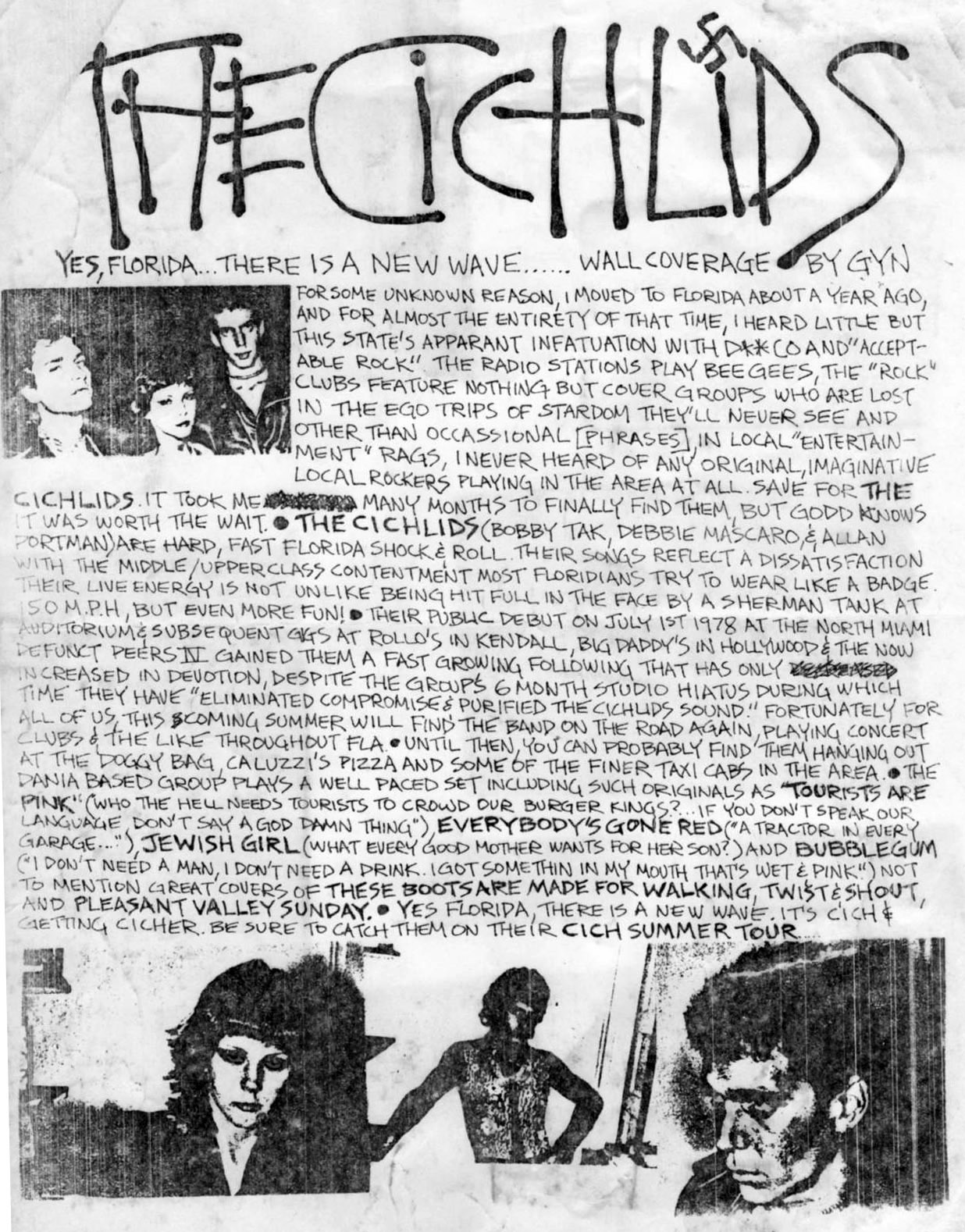
I’m especially excited about the May 1980 issue, Mouth of the Rat #14, for one very, very important reason. There’s actual, in-the-moment documentation of Smegma – soon to be Sheer Smegma and then Teddy and The Frat Girls! This all-female group might be the greatest thing to have ever emerged from South Florida, and I’m definitely including navel oranges, Gloria Estefan, the Challenger space shuttle and Kreamy ‘Lectric Santa. Atonal, decadent, primitive, godlike art/punk howl from women who were clearly making it up as they want along, but who, in two brilliant songs, “I Owe It To The Girls” and “Clubnight” – created two of the all-time high-water marks of American – nay, global – culture. Because they’re so ridiculously undocumented anywhere, I’ve snapped photos (below) from Mouth of the Rat #14 so you see how Parsons was perceiving them after their very first show.
That’s really enough, but there’s more. I gathered from reading this issue that The Cichlids meant as much to Floridians at the time as, say, the Ramones did to NY several years earlier. Here’s a scan I found from an earlier Mouth of the Rat. Such was the localization of scenes at the time, where your bands were barely known by anyone outside your city, even when they’d put out 45s, but were influential and life-changing heroes within your own city limits. It was a couple of years later, but we’d talk about hardcore band The Faction the same way in San Jose, CA, and it felt like maybe no one an hour north of us in San Francisco knew who they were.
Being 1980, The Clash and Public Image Ltd. are very much on young Parsons’ mind. Aside from reports of touring around and seeing them live across the eastern US – something you had to do growing up in the southeast corner of the USA – he’s writing about every new record he’s finding or getting sent, which includes all the Posh Boy stuff coming out of LA; The Mo-Dettes; the Pop Group and Young Marble Giants, the latter of which he loves, but he knows that you won’t, punker. Eventually Parsons would move to New York City and start Ratcage records and put out the first couple of Beastie Boys releases. I had this version of their Cooky Puss 12” in high school and am glad to see it’s only selling for triple what I paid for it at the time, as opposed to the 100x I’d expected.
Anyway, Smegma! :


-
BB Gun #5
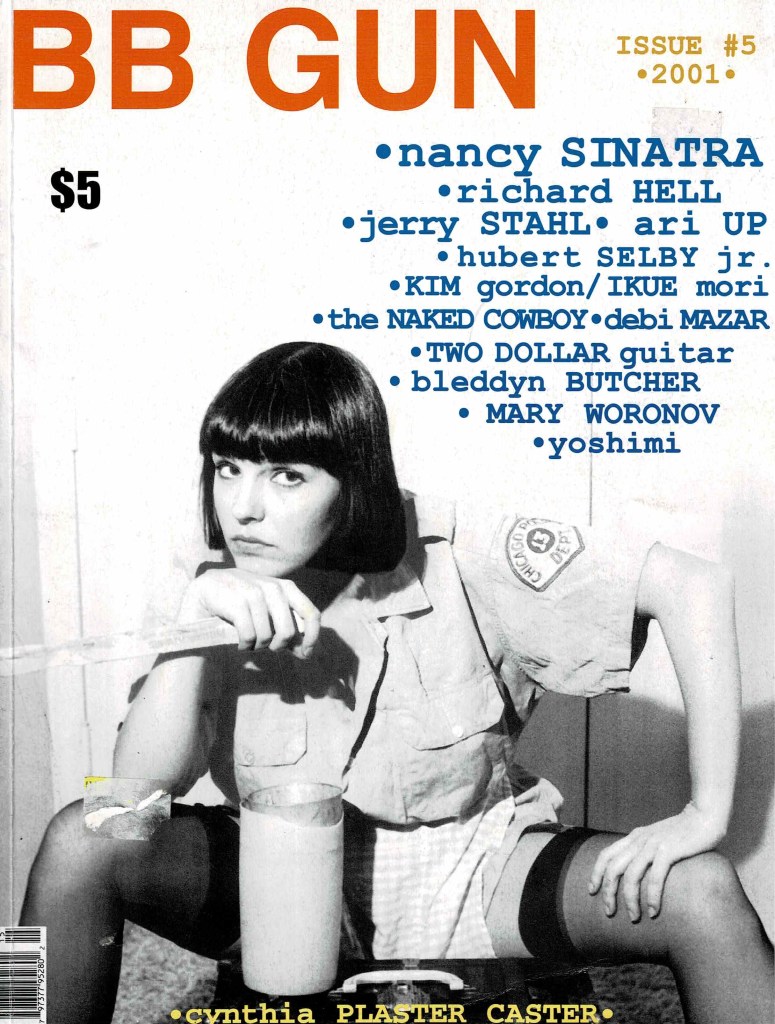
I have a couple issues of Bob Bert’s late 90s/early 2000s BB Gun in the files and on balance I’m glad to have them around, though its “underground sleaze” horndog aesthetic was pretty off-putting even in its day. At its worst, it was sort of a lower east-side NYC parallel to the “lad’s mags” of the era, what with its lascivious droolings over various alterna-females and the constant written bloviations of Lydia Lunch. Thankfully, BB Gun #5 from 2001 is rarely at its worst, and can be much more generously read as a “glossy entertainment yearly”, albeit one drawn from fringe sub-scenes across music, film and literature, with many if not most participants plucked from Bob Bert’s most obvious orbits (i.e. Sonic Youth, Pussy Galore and Lydia Lunch, all of whom he drummed for).
BB Gun #5’s really one of those “all in the family” affairs. Bert interviews Kim Gordon and Ikue Mori; there are Richard Kern photos and many references to the man; Nick Zedd gets to say his piece (which is unreadable); Thurston Moore helps out with a Yoshimi interview. That sort of family. Actually, and this harkens back to the Sho-Kai #1 fanzine I wrote about here, here’s Bert’s description of encountering Yoshimi’s band for the first time:
“When Pussy Galore played in Osaka, Japan in 1988, the opening act was the Boredoms. In all my years of witnessing every kind of rock-noise attacks, I was never so blown away, as I watched this raucous, barrage of kamikaze sounds snap the air in two. There were two drummers, one who (at least three times per number) would stand up on his stool and fall face first into the set and continue playing, wildly and ferociously; thunder-driven. Behind the other kit was one of the most remarkable drummers I ever heard. I had a translator-friend next to me, who taught me how to say, ‘Yoshimi, will you marry me?’. I yelled it after every song!”
Cute!! I wish The Boredoms had performed that falling-into-the-drums trick when I saw them. Richard Hell is interviewed by Bert, and Hell is already defensive at the fannish questions being asked at the start of the interview: “So how exhaustive is this gonna be?”. Well, it ends up being really exhaustive and extremely interesting, so journalistically I’m glad Bert stuck to his guns. Bert also gets a big piece in on Nancy Sinatra, who was in a sort of comeback phase around that time, if you’ll recall, as well as an interview with cover star Cynthia Plaster Caster, who’s just come off of casting the engorged member of longtime Fanzine Hemorrhage hero “Danny Doll Rod”.
Evelyn McDonnell, who used to be the lead rock writer at my local free alt-paper SF Weekly during the years when I read those things cover-to-cover, has a good interview with Ari Up of The Slits in BB Gun #5. Ms. Up has lived a life, shall we say. Lunch is awarded with the literature beat, and she interviews Jerry Stahl, the sort of barely-readable “transgressive” writer you’d expect her to admire. She also talks to Hubert Selby Jr., who apparently “stomped a new asshole in the face of literature”. One of the other main editors here is Jack Sargeant, and he talks to both Mary Woronov (!) and to Bleddyn Butcher, a photographer whom I always get mixed up with the woman in My Bloody Valentine.
There’s plenty of other things to mention in what’s nearly a 100-page tome. There’s an utterly insufferable “Beatles/Stones Dialectic in Music” by Ian Svenonius, a piece that makes Nick Zedd’s look like Percy Blythe Shelley. Bert’s really into a fetching underground actress named Misty Mundae, who acts in some guy named William Hellfire’s low budget exploitation films, and it all reminds me of the Film Threat era which has passed us by. And while I can’t fault Bert for falling for the JT LeRoy swindle, it’s still pretty funny to read “if he keeps it up into his twenties he could be the next Burroughs or Shelby Jr.”. We could’ve only hoped!
-
Punk Rock #1

I was so charmed by my purchase of punksploitation mag Punk Rock #2 earlier in the year (wrote about it here) that I found it highly important to track down the first issue from December 1977 as well. And you know what? This one surprisingly doesn’t have quite the over-the-top “-sploitation” quotient of its descendant, reading instead like a frothy, punk-centric issue of Rock Scene from around the same time.
There are loads of photos and 66 pages of features, mostly centered on NY but really with a transatlantic ear to the ground. Sex Pistols, Blondie, Stranglers, Devo, Dead Boys, Iggy Pop, Deaf School (“a pick to click”) and Television interviews, photo spreads, treatises or all three. But where the rubber meets the proverbial road for me in this one is in the really well-done piece on DMZ, whom you kinda forget sometimes were blowing minds across Boston starting in 1976. What a fantastic band those first two years. Marie Cosentino’s feature is an interview with JJ Rassler of the band, and Robert Post’s photos show what a wild, unhinged powerhouse they must have been on a Friday night at The Rat. There’s also a “Hot Pix from The Rat” section, as it turns out, with crazed Post-taken pictures of new wavers The Cars, Nervous Eaters, Third Rail, Willie “Loco” Alexander and total heshers Thundertrain!
Rassler, in the DMZ interview, wants to dodge virtually all of the questions about punk and whether they’re a part of it, a stance that’s almost uniform across the interviews with Tom Verlaine, Patti Smith and others. Everyone’s excited that something new is happening, and everyone insists that they alone stand somewhat removed from it all. We’re so early in the game at this point that punk rock vs. new wave questions haven’t cropped up yet. Iggy Pop so successfully dodges these sorts of questions that his interview is almost like a piece of dada, a weird back-and-forth with interviewer Hannah G. Spitzer, who’s clearly making her questions up on the spot and is having loads of fun trying to bait Iggy to say something controversial.
Donna Santisi gets a full “punk rock from L.A.” photo spread in the back, and she was a hell of a photographer. Terrific snap of Chip Kinman wearing a hammer & sickle shirt that’s captioned “This is the lead guitarist from Dil”. There are Screamers, Shock, Weirdos, The Pop and Backstage Pass pics as well. Inject it in my veins.
I’m all-in on the punksploitation mags like this and New Wave Rock. Stay with us as I attempt to find the final Punk Rock #3 at a price I can afford, when we shall thenceforth discuss it in these quarters.
-
Sense of Purpose #2
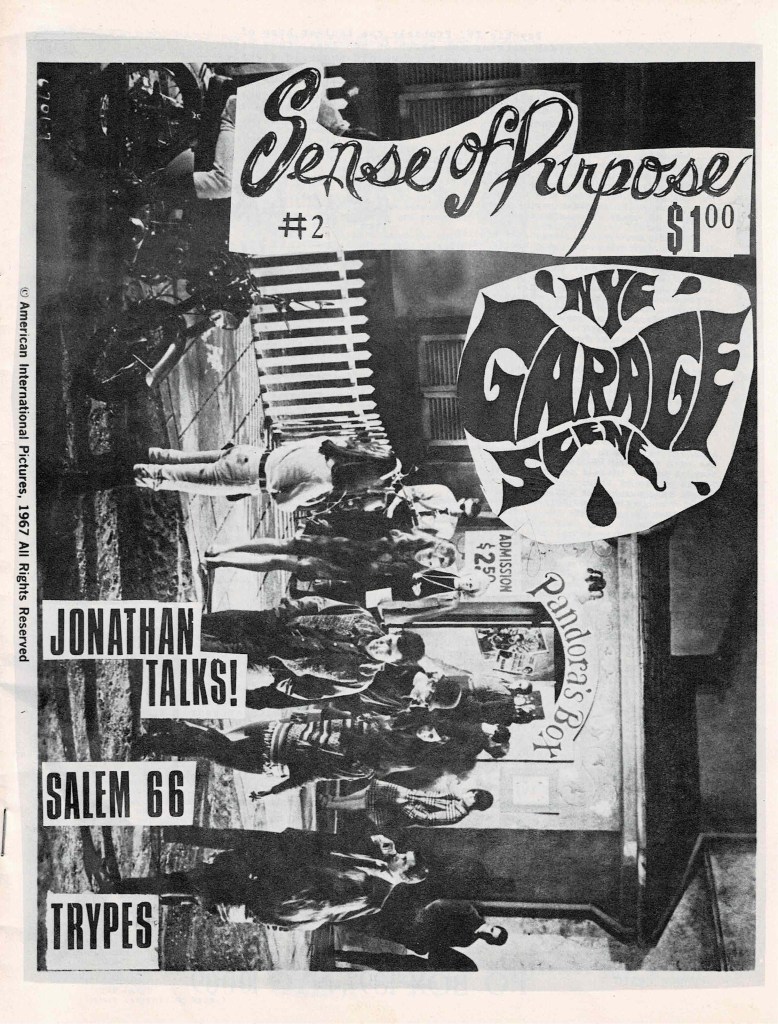
Sense of Purpose #2 came out in 1984 and was pulled together by a guy named Dave Sprague in New York City. I was just trying to figure out how I knew the name Dave Sprague from the 90s. Perhaps we were correspondents? We might’ve been. I didn’t save all my scented letters in a shoebox. I then remembered that he used to write for Your Flesh, and moreover, that I even used to read Your Flesh. But this fella honed his chops in his own self-defined corner of the underground music universe, with Sense of Purpose truly ignoring huge portions of what music fanzines were going on about at the time in favor of a curated garage, psych and rooted Americana angle, minus the jangle and the college rock endemic to fanzines like The Bob or Jet Lag.
In fact Sprague puts his critical ducks in a row right off the bat, with an opening editorial about how awful Psychic TV were live. Leaving aside the question of why he was in attendance, this essay expands into a treatise against the sort of then-fashionable juvenilia that tried to make hay out of surgical training films; that turned anything sexual into something potentially violent and ugly; that made fun of crippled children and so forth. The Meatmen, for instance, or some of the grade-z material that Forced Exposure somehow thought worthy of publication.
There’s a section of letters to the editor (including one from Mr. Ott from White Boy!) that has one correspondent taking him to severe task for liking the Green on Red LP on Slash in his first issue. Gravity Talks? Decent record! Clearly the LA so-called paisley underground was big in Sprague’s mind at the time; he’s got a tape of the Dream Syndicate’s forthcoming second album The Medicine Show and he’s truly flipping out over it. I share – and shared at the time – many folks’ reservations with the thing, but nearly forty years of perspective still have me pretty bullish on the record, despite the enveloping spectre of major-label, let’s-get-big-on-alterna-radio gloss on that and so many other second albums from 1984-1985.
We talked about Living Eye fanzine just a few days ago; Sprague is also keeping tabs on the NYC 60s scene and a bunch of bands I really just couldn’t cotton to: The Fuzztones, The Cheepskates, Mod Fun, The Vipers, Outta Place etc. Then, after listing and dissecting these heavyweights, there’s another short column on brand-new garage bands: Alter Boys, Raunch Hands, Tryfles, Swampgoblins, and House Pets. There is some bountiful and deserved enthusiasm in the reviews section for the new Australian sixties feedback/sleaze heroes the Lime Spiders, whom I discovered on San Jose’s KSJS radio that same year. When I hauled my nervous 17-year-old self to college in Santa Barbara the following year, and wanted to impress my older cousin who was DJ-ing a Cramps/fuzz/punk-laden show on KCSB, I called in to request that band’s “Slave Girl”, which he hadn’t yet heard. It was a 1985 “life highlight” when he breathlessly came on the air right after the song and said, “Jay you are HOT!”. I desperately wanted and needed that sort of cred in my life at the time, and music obsession would be my path forward.
Another thing I really enjoy about Sense of Purpose #2 is its intense focus on the Cleveland underground of the present and recent past. There’s big love for Cleveland’s Easter Monkeys from Christopher Stigliano, and he also provides the full Andrew Klimek story (X__X and others). His Cleveland enthusiasms duly infected Sprague, who then contributed a piece on Red Dark Sweet, probably the only one I’ve ever seen anywhere….? This was a NY-by-way-of-Cleveland duo of Charlotte Pressler and Andrew Klimek; they call themselves “free rock”, and you absolutely need to listen to their “Oh! Carol” here if you haven’t heard it.
There are interviews with Salem 66 and the Trypes as well, the latter of which includes a history lesson on The Feelies and common member Glenn Mercer. Finally, in what is always an entertaining and confounding chat with Jonathan Richman, we find in 1984 that Jonathan is clearly going through an intense environmentalist phase. “Farming is important, especially on a small scale like the gardens in the East Village. I also don’t like flush toilets. I avoid them whenever I can”. Definitely this was a fanzine a cut well above the median read at the time, as well as a fascinating look at how good music taste can concentrate into some really interesting Venn diagrams at different points in history.
-
Subscribe
Subscribed
Have a WordPress.com account? Log in now.