-
Ripper #6

Last year I shared the formative and highly boring tale and of the very first fanzine I ever purchased, Ripper #4, procured in late 1982 from Do-Re-Mi records in Los Gatos, CA (though it had come out more than a year earlier). In the nearly forty-two years since, I’ve found my way to a few other issues of San Jose’s Ripper, including Ripper #6, which editor Tim Tonooka has scrawled in the margin that he “took to printer, 12/29/81”. Big year for the scene, and a big year to come.
As I wrote in that earlier piece, San Jose struggled with its relative cultural stature as compared with the cosmopolitan savoir faire of San Francisco, felt acutely by local punks and by high school dorks like myself at the time. Ripper #6 kicks off with a nice talk with local punks Ribsy, – two women, two guys, and a big point of local pride among the tiny handful of punks at my school. They’re quite adept of extracting lemonade from the lemons they’d been handed:
Ripper: What do you like about living in San Jose?
Kat: The fact that you can make a dent.
Sharon: Mostly the fact that there’s very few punks here at all. When people see us it’s really a shock to them, more so than if we’re in San Francisco. There nobody says anything. But in San Jose they say “Oh my god! What is wrong with you?”. People in San Jose don’t even know what punks are. Somebody asked me if I was a nun once because my hair was so short and I was dressed in black. People in San Jose are really uninformed, and that’s what I like, is being able to talk to people and inform them about it.
Matt: The only reason I hang out in San Jose is the band, otherwise I would just as well be hangin’ out in San Francisco.
Sharon: I like San Jose because I feel like a square peg in a round hole, and I always like that feeling. Because everybody in San Jose dresses the same, in clothes from two years ago.I’ll bet Sharon Nicol from Ribsy grew up to be a very well-adjusted woman with an highly developed sense of self. If you want to get a sense of San Jose culture from around this era and the world I grew up in, here’s the inside front cover of my Gunderson High School yearbook from 1982-83:

A group called N.W.S. (New Wave Sluts) is trying to book shows in San Jose and are having some trouble. The 10/29/81 show at Campbell’s Briner Hall with Black Flag was “shut down by local police”. Fighting a war we can’t win! Ribsy made it onto the bill of every one of the 5 shows they were able to have there. There’s some complaining about local shows in San Francisco as well, with The Sound of Music – great article about it here – getting rep’ed as the place for discerning punks to make their presence known in late ‘81.
I like how Ripper provides the ages of the people whom they talk with, so we get to learn from Wasted Youth (later LA’s Wasted Youth) that everyone in the band is 17 or 18, which happens to be 2-3 years younger than my own son is today. When they talk with T.S.O.L. there’s some discussion about how moronic singer Jack wears horror/goth makeup on stage now. He says, “The only thing that makes me mad is that a lot of times people say I’m like an Ant or something, They go, ‘Oh yeah, you love Adam Ant.” But I was wearing makeup when I was a skinhead three years ago, just to bum people out”. Was there a worse California punk band than T.S.O.L. around this time? China White, maybe?
Cover band The Lewd are also interviewed; they were at their peak here, this year if you ask me. The Seattle-era Lewd were great but the American Wino-era Lewd totally ruled. Fantastic photos of the band, too, like 20 of them! In the Black Flag interview, there’s a reference to a 5/17/81 show they played with The Ghouls, Deanna from Frightwig’s early band. I’ve played them on Dynamite Hemorrhage Radio from a song (“Cheap Hotel”) that Brandan Kearney taped off the radio in 1981 (!) and was kind enough to digitize and send to me. I messaged Deanna about The Ghouls and this demo a couple years ago, and she effectively told me “I don’t have any recordings and barely know anything about it, godspeed to you”. Perhaps someone out there knows where these recordings are buried? The internet turns up exceptionally little.
Ripper #6 also contains a piece heaping well-earned praise upon England’s Au Pairs, who were one of my favorite bands at this time thanks to incessant play on KFJC of their debut Playing with a Different Sex. The huge review section includes a piece looking at six different Girlschool records, about which Tonooka says “Their records are proof that there actually is such a thing as good heavy metal”. Arguable on many fronts. The first Meat Puppets 45, one of my top 20 singles of all time, is delightfully called “one of those terminally great records like the Urinals single” and a “rubber room riot”. Finally, in the reader’s poll results, we find that “46% of the people who answered live in Northern California. Their average age is 19 years old. Our readers’ two most favorite bands are Black Flag and the Circle Jerks”. These pit demons, stage divers and Moral Majority enemies are now averaging out at 61 years of age today. Don’t you love it?
-
Siltbreeze #8
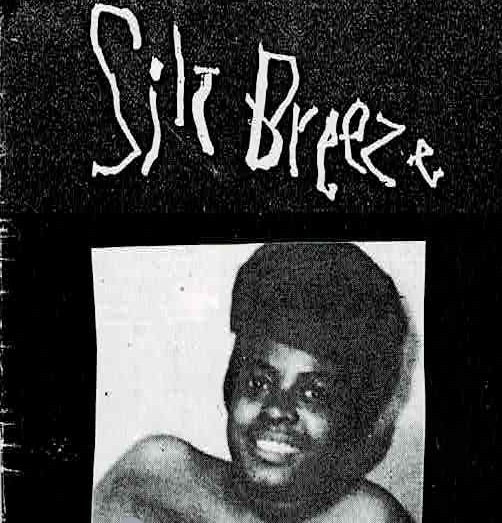
In 1989 my pal Bob, whom I was visiting and staying with in Seattle, took me for the first time to the house of his friend “Jimmy The Bud Man” across the water in West Seattle, so that we might drink some adult beverages and partake communally in what is often euphemistically called “the good times”. This was before I’d come to know Jimmy The Bud Man as Jimmy Stapleton, and before the world would come to know him as the proprietor of Bag of Hammers records, a label that put out some pretty exceptional garage punk 45s across the breadth of the 1990s.
Jimmy was a pin-on-the-chest, wave-the-flag, head-held-high record collector. I even saw him, later, introduce himself to someone at a party as, “Hi, my name’s Jimmy, and I collect records”. To that end, partying at his house was, for me, also a great night of plowing through his vinyl and through his stacks of fanzines. He was one of those guys who’d rip the needle off a record thirty seconds in to immediately play you something else, or jog to the back of the house to pull out some weird print gem from his fanzine collection. One he really wanted me to check out was Siltbreeze, a small digest-sized mag from Philadelphia festooned with an array of absurd 1970s pornographic pictures. I was first intrigued just by the sheer ridiculousness of the thing – super-dumb and ultra-cheap xeroxed porn photos bracketing various record reviews and short features – but then, as I started reading it, I got the sense that the folks behind it knew a ton about the deep crevices of the underground, self-created, pressing-of-200 rock music world that I was personally fascinated with then, as now.
Within a year I’d come to understand that Siltbreeze was primarily driven by Tom Lax out of Philadelphia, and he and I would become correspondents or telephone pals or whatever it was we did before electronic mail. This fanzine would quickly turn into a world-champion record label, about which I will assume you know a bit about – and if not, here’s a great primer. Let it be established: fantastic record label, one of the golden greats etc. etc. Yet Siltbreeze was a fanzine first, and I’m going to assume its outré design choices and decidedly politically incorrect general orientation is why more folks don’t know about it…..and yeah, its exceptionally limited print run is likely another reason.
The final issue was Siltbreeze #8, the one we’re looking at today. At this point, which I believe was early 1991, Lax & co. were off and running putting out Dead C, Gibson Bros and Monkey 101 records, among others. But even if he’d never done that, his fanzine’d still be one of the best I’ve ever come across. Once I got my hands on a bushel of his back issues, I came to realize that not only did this fella know about every wacko sub-underground record coming out on every continent, he wrote about them with panache and style, in truly comedic and reference-packed paragraphs that made you want to drop four dollars and an SASE in the mail for whatever 45 he happened to be hyping.
I mean, the guy’s brain makes connections that others don’t, can’t or won’t. I remember when I sent him the Monoshock 45 I put out back in 1994, and he told me, “they sound like the bastard sons of Kriminella Gittarer”. Told the guys in the band that, and they were like, “Ha ha, sure, OK. Kriminella Gittarer. We totally love them”. But they fucking did sound like that. In Siltbreeze #8, Lax – if it is Lax writing here (everything’s uncredited) – he’s fired up about Liimanarina (who were great!), Chris Heazlewood, Dustdevils, Vermonster, Terminals, Rancid Vat, Cheater Slicks and much more besides. There’s a “Silt Picks” top records list near the back that lists a few current favorites; when he listed “Television – Live Portland ‘78 LP” among them, I just knew, given the credibility the man had already built in previous pages, that was a bootleg I’d have to go out and find, and eventually I did. And lo, it was excellent.
Siltbreeze #8 rounds out the reviews and the general transgression with an Alcoholics Unanimous tour diary. Wow, anyone else remember Brilliancy Prize Records, Thee Whiskey Rebel, the Drinking is Great 45…? That’s a whole Portland, OR sub-subculture someone oughta do a feature film on. Right after they make the Jimmy The Bud Man movie and after Feral House compiles all the Siltbreeze mags into book form.
-
Slash, Vol. 2, No. 7 (August 1979)
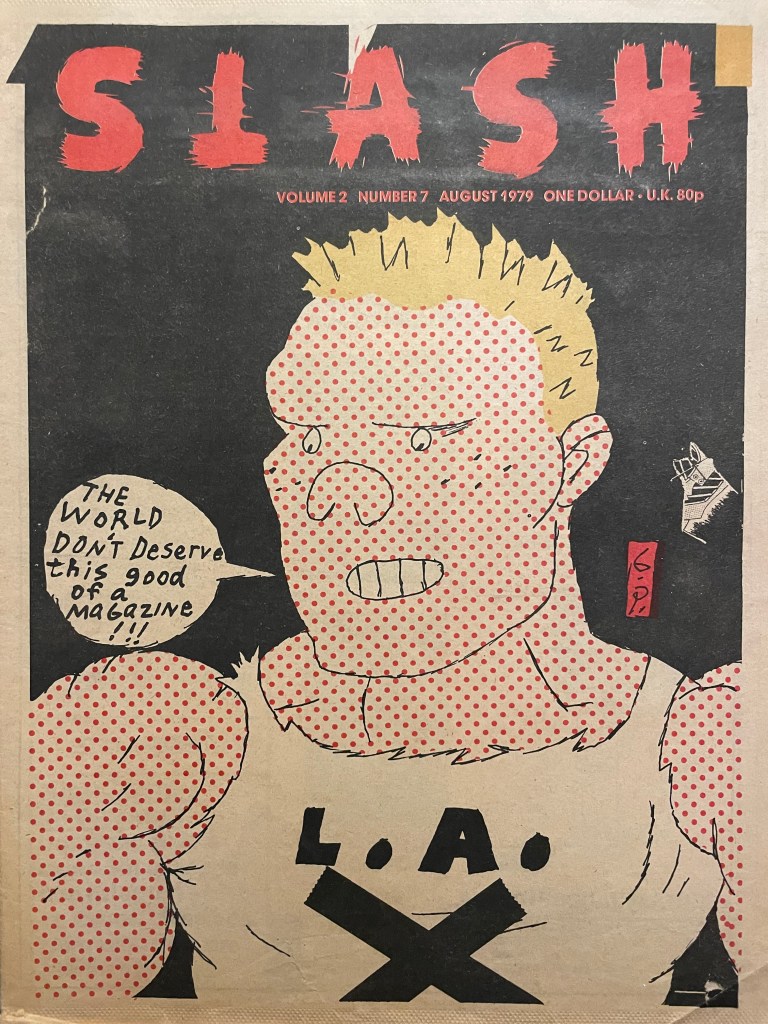
On the cover of this 40-page newsprint gem, the Slash magazine that hit the record stores of greater Los Angeles in August 1979, we have muscle-flexing LA punk “Jimbo”, setting the tone for a wave of eventual hardcore dolts like Circle One’s John Macias to follow. I’m probably a bit of a heretic here, but the nonsensical Gary Panter drawings in Slash have always gone over my head, or more likely, missed me as a member of the target psychographic profile. People seemed to love ‘em, and I suspect it was because a cartoonist/artist was actually spending time drawing punk rockers, in a punk rock magazine, and drawing them well. So bravo, Mr. Panter!
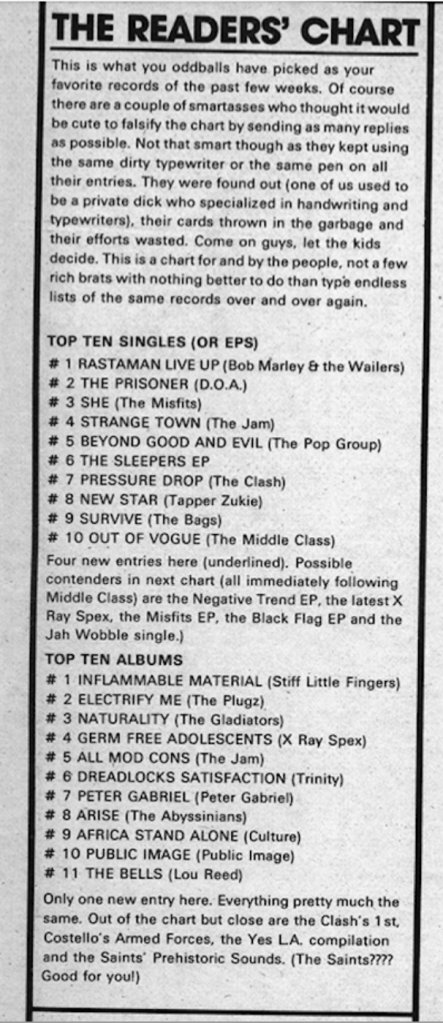
Inside we’ve got a masthead, a table of contents with photos + a “Reader’s Chart”, which looks to me to have been lightly goosed by the editors, given the presence of multiple reggae discs (Tapper Zukie?!?) and oddball critical faves like The Misfits’ Cough Cool/She 45. A year’s-long domestic subscription is hawked for $10. Different times.
The next two pages – LOCAL EXCREMENT – were standard for most of the magazine’s entire tenure, this time a nice castor-oil potty-mouth cleanup from the typical “Local Shit”. This virtiol- packed section is one that I presume was typically penned by editor Claude Bessy, given that it alternates gossipy scene reportage, unbridled enthusiasm for new bands and a heavy dose of fuck-you, aimed at targets both easy (cops) and potentially bridge-burning (club owners, certain local bands etc.). This time Kickboy quite rightly sets his sneering sights on a local free magazine called Gosh! and a recent piece called “A Conservative Looks at a Punk Rock Party”, in which the author purportedly slandered Nervous Gender’s Phranc, an out Lesbian, as well as on The Whiskey, a Sunset Blvd. club, for essentially banning punk bands “without a recording contract”, which meant most of the good ones.
Also going on in LA during the summer of 1979: Tomata du Plenty’s birthday party; the imminent release of the Germs’ as yet untitled album – you know it as (GI); the lovely Trudie Arguelles and her birthday party; a new gay club called The One Way that plays punk instead of disco; and a peaceful makeup between The Dils and Slash magazine, necessitated by some earlier poor reviews and/or snipes directed at the former by the latter.
We have an all-caps editorial – Kickboy again – that makes light of the fact that his typical editorial rant had been missing from the last few issues, and that he’d thus been hearing that Slash therefore was probably going soft, selling out etc. This August 1979 editorial eventually winds its way to the point, which is that the halcyon days of 1977 are long gone; that punk rock has evolved; and that “Punk was never more than an Attitude and a Stand. At the time, and often now, this was and is and is best expressed in the 1 2 3 4 I Hate Your Guts format. But there are other ways to get the lovely message across.”
Bessy/Kickboy enumerate a few of his favorites: The Fall. Alternative TV. The Pop Group. He’s excited and very much keeping the faith, which is one of the things I love about this guy and his writing at the time: “…it’s still all there. Growing. Spreading. Infecting.” In retrospect, it certainly was.
Next, we have the letters section. Always a hoot. The topic du jour this month relates directly to the editorial on the pages before it: Slash’s championing of slower, stranger, less raw music, much of it coming from the UK. Magazine; The Fall; Pere Ubu etc. Some of the hoi polloi are displeased. Kickboy, in his responses, keeps a hammer inside a velvet glove, nicely chirping mild and respectful dissent for some, and spewing venomous mockery at others.
On to this month’s interviews. Penetration, from England. Pauline Murray’s band. There were quite a few Slash interviews in which it was effectively impossible to discern actually who conducted it, and this was one of them. It’s just “Slash” asking the questions. I believe that probably means Bessy and Philomena Winstanley, the latter of whom took the photo of Penetration that accompanies the article. There’s also an interview with film director Paul Schrader (Blue Collar, Hardcore, American Gigolo), and this time we know who’s asking the questions: Chris D., Judith Bell and Clarissa Ainley. They’re actually pretty interested in why he’s deigning to talk to Slash, a punk magazine, and he’s clearly into punk rock in the same voyeuristic manner that his movies explore: “I like the anger, the heat…the feeling you used to have in CBGB’s that you could be stabbed and no one would know for fifteen or twenty minutes because it would so packed with people that you couldn’t fall down…”.
The other three interviews this time are with the aforementioned Nervous Gender; with X and with Nico. Nervous Gender, BPeople, Monitor and Human Hands were all arty, unusual and synth- driven bands just breaking onto the Los Angeles underground music scene that year, and often played together. Slash championed them in a major way. X, of course, were the proverbial belles of the ball in LA and with the Slash staff in general; the Slash label that grew out of the magazine would go on to release their second single and first two albums. These two interviews are conversational, respectful and interesting enough.
It’s that Nico interview that really makes this issue, though. The intro alone is phenomenal, capturing a time in her career as she was coming back & playing again in the late 70s, despite being caught in the grip of a 15-year addiction to heroin. Not precisely sure who wrote this intro which reviews her two shows at the Whiskey and sets up the visit of the interviewing crew at Tim Hardin’s house in LA, but here are some bits from it:
“Nico’ s second set was a burned-out shambles. You want your cult idol, well suffer her cult performances as she does a routine reminiscent of Judy Garland meeting Lenny Bruce in the last days….One girl shouting ‘We love you, Nico, we love you’ until Nico turns to the mike and says, ‘Do you really think that makes me feel any better?’.…when no one offers her a drink she throws a glass across the stage and says, ‘Isn’t there any dope in this damn place?’…
Next day’s interview took place at Tim Hardin’s house. Mr. Hardin, shit faced and stumbling around, hurt himself about four times while we were there. It was one of those dark sixties types hippie houses with art deco in the bathroom and a pot of beans on the stove. Nico had just been crying – former manager Paul Morrissey had taken her money so she wouldn’t spend it on foolish indulgences. She did seem too old for a babysitter, though. She is bothered by the people who have come to interview her – too many: One C. Bag, one Philomena, One Greg ‘New York Rocker’ Turner, One publicist Tim Hogan….”
To translate: that’s Craig Lee from the Bags; Slash founding editor Philomena Winstanley; Gregg Turner of Vom and the Angry Samoans; and, uh, publicist Tim Hogan. The rest of the interview proceeds as you think it might after this set-up. Nico, having delivered a strange, drugged soliloquy to Sid Vicious during her shows the night before, has this exchange with her interlocutors:
Slash: Do you like the Sex Pistols?
Nico: Yes……of course.
Slash: What was your favorite song?
Nico: Oh – I don’t know. I couldn’t tell you. Because I don’t buy those records. I only listen to classical music.There’s a three-page “Los Angeles Band Update” spread that seeks to update the reader about the prime movers on the local scene, circa summer ‘79. It’s a gas, because so many of these bands are being documented in single-paragraph form during either their early nascence or when they’ve already evolved into the legendary acts they’d eventually gain their due for. I’m reprinting the Germs piece here. This is whom Slash saw fit to document that summer:
The Alleycats / Arthur J and the Goldcups / The Bags / The B People / Black Randy and the Metrosquad / Backstage Pass / Black Flag / The Brainiacs / The Controllers / The Deadbeats / The Dickies / The Dils / The Eyes / The Extremes / Eddie and the Subtitles / Fear / The Flesheaters / The Flyboys / F-Word / The Germs / The Go-Gos / The Gears / Holly and the Italians / Human Hands / The Mau Mau’s / Middle Class / Nervous Gender / The Plugz / Rhino 39 / The Rotters / The Skulls / The Satintones / The Screamers / The Simpletones / U.X.A. / Wall of Voodoo / The Weirdos / X / The Zeros

That was what a week out in the clubs of underground Los Angeles would bring to you on any given day of the week that summer. Unreal. The blurbs are accompanied by fantastic Melanie Nissen photos of many of the bands, most of them never seen since except in these pages, this month. Oh, and there’s a two-full-pages center spread “family tree” with numerous drawings called “2 Years of Punk in LA” that does one of those hand-drawn family tree lineage things that Trouser Press was popularizing around the same time, but instead of being about Humble Pie or Traffic or whatever, it’s about virtually every punk band from LA the past two years, including many new-to-me combos like The Strict IDs, The Brothelcreepers, LA Shakers and The Whores – in addition to the Germs / Bags / Black Randy and the Metrosquad and all our other faves. I’d love to reprint it here, but you wouldn’t be able to read it.
After the interviews and features, Slash would most often feature live reviews from the previous months, and they do the same here. They’re often lengthy, packed with detail, and never withholding of opinion. As per the previous section – whoa. What a month! Chris D., writing as V/D, reviews early Black Flag (Keith Morris version) at the Bla Bla Cafe on 6/11/79: “They rival only the Germs in their potential for snowballing a room full of sedate people into a mangled tumult of chaos”. There are two reviews of a Screamers six-night stand at The Whiskey that make it sounds like the absolute death knell of the band, a Weimar cabaret-style performance with a female backing vocalist and violins. One unnamed reviewer wants to vomit; Kickboy says not so fast. The Screamers would be broken up within six months. The other reviewed shows range from X to Nervous Gender to the Plugz to Ray Campi and His Rockabilly Rebels. Teleport me back and I’ll go to every last one of ‘em.
Record reviews always came next, first a section of 45s, then one for albums. What was new in August of 1979? Everything from Augustus Pablo’s East of the River Nile to Devo’s Duty Now For The Future to Kleenex’s You/U 45 to The Jam’s Strange Town single (about which Kickboy writes, “This should have been reviewed ages ago. Nobody came forth with their little paragraph. What could be the reason behind such indifference. I wonder.”) The breadth of the reviews was wide enough to accommodate the aforementioned; a bunch of reggae singles; some new wave or power pop items from all over the country (most of which are dumped upon); and a ritual deboning of The Clash, a fairly standard and often wide target for Slash during their time publishing.
Finally, there’s a full page travelogue devoted to a worshipful trip to Jamaica taken by one Ranking Jeffrey Lea, otherwise known as Jeffery Lee Pierce, who would form the band that would eventually morph into the Gun Club mere months after this was written. Pierce, Bessy and Chris D. were huge reggae fiends and integrated their passion into the pages of Slash as effortlessly as they did other underground musics, recognizing in real time that this time – 1977-79 – was an exceptionally fertile period for reggae, dub and roots music, as the passage of time would soon prove.
Then a Jimbo cartoon, and that was Slash Vol. 2 No. 7, over and out. It’s certainly not enough for me to merely tell you about how interesting or well laid-out or of-the-moment it all is, yet I know of no other publication that captured the zeitgeist of a given month, any month, in musical history better than this one. Slash had the intimacy of a fanzine – written in the first person with the intention to cajole, harangue, celebrate and champion – combined with the ritual deadline-date urgency of a much more streamlined and professional operation. It arrived each month as promised, with a chronicling of the month just passed, a handful of new enemies made and heroes to pedestalize, and a wide-eyed, optimistic look at sub-underground musical horizons – and a possible revolution in musical tastes that might lay just ahead.
-
Forced Exposure #6

Finding a copy of Forced Exposure #10 in 1986 at Rockpile Records in Goleta, CA was one of those proverbial “trigger events” that dramatically sped my progress down a path of sub- underground music obsession. It would not be hyperbole to note that this particular fanzine was where I truly learned just how extensive, inventive and widespread the American & global independent music scene(s) were, while also getting some of my first critical filtering techniques that helped me better separate the truly excellent from the merely good-enough.
During the 1980s, I read every Forced Exposure magazine that came out with such a slavish devotion that it practically helped build the record collection that I have to this day. What I loved, and even today still love about it, was that it was the most accurate “consumer’s guide” I’d ever read, in the sense that if Jimmy Johnson and especially if Byron Coley said it was good, it almost always was. That to me has always subsequently been the litmus test for a good fanzine. “Can I trust your taste?” (please, let’s leave my own questionable taste out of this).
I’ve always admired those who might be trustworthy gatekeepers, and there’s no doubt this magazine helped me want to attempt to pretend to be one myself. I also thought, at age 18, the way Jimmy & Byron snottily but cleverly dismissed annoying halfwits like Jello Biafra was unlike anything I’d ever seen from the underground press to that time, and those guys helped at the time to provide me with a far more wizened (and newly subjective) perspective about music than anyone else, ever. In a nutshell, if you “came of age” in the 1980s and have the sort of general music taste that might lead you to peruse, say, my own Dynamite Hemorrhage, calling Forced Exposure your “favorite” magazine of that era is nearly self-evident. It was virtually everybody’s favorite at the time.
Forced Exposure #6 is where the levee broke for this magazine. For the first time, bands not on the breakneck hardcore touring circuit nor even remotely connected to hardcore were being spotlighted, praised, and interviewed in a somewhat juvenile (understandably so, given editor Jimmy Johnson’s age) yet incredibly informed way. Bands such as the Dream Syndicate, the Birthday Party and even Venom (!). I may be 100% wrong on this, so correct me if so, but I’m pretty sure this is the first time Byron Coley bared his pen in Forced Exposure‘s pages, after being a resident scribe at the New York Rocker and the excellent Take It! fanzine. He interviews Los Angeles’ weird fake-Christian punk band RF7 and scribes a few reviews, in the apostrophe-laden and made-up word style (spuzz, spoo, zug) that was hilarious, exciting & yes, a bit annoying at times.
Most of Johnson’s stuff sticks to the ‘core or the nearly-‘core, but he also dips a toe into some raving reviews of goth heavyweights of the time like the March Violets and Southern Death Cult (much like Touch & Go used to go ape over the Virgin Prunes). Another Boston teen, Gerard Cosloy, was a fanzine up-n-comer himself at the time, and he submits the Dream Syndicate interview, and it’s a good one, very “in the moment” when that moment was just after their incredible debut LP The Days of Wine and Roses.
Like any fanzine from this time, it’s a blast to look back & see the brand-new punk & post-punk records that people would gladly trade a kidney for in 2024 going for $3-$6 in advertisements. An additional treat is how out-of-step Forced Exposure was with the Maximum RocknRoll hardcore punk orthodoxy of the time, which was over-the- top “politically correct” before any of us had ever heard the term. Exhibit A is an interview in #6 with the Nig Heist, easily the most un-PC band of the day (GG Allin and the F.U.’s notwithstanding), and Exhibit B is a screed against the “Rock Against Reagan” collective, something championed by lefty punk bands MDC and the Dead Kennedys, making the case that the whole thing was a charade designed to buy a particular hippie named Dana Beale some more dope. Coming from the west coast, the first time I saw a punk rag that dared to question the Orwellian judgment of MRR was phenomenally refreshing (Flipside, the other popular west coast punk mag, was almost completely and totally apolitical).
The Forced Exposure of 1983, which is when #6 came out, would prove to be worlds apart from the musical universe of Forced Exposure #18 ten years after. But we’ll get there. I wrote about FE #9 and FE #15 as well, if you want to hit those links.
-
Mysterex #2
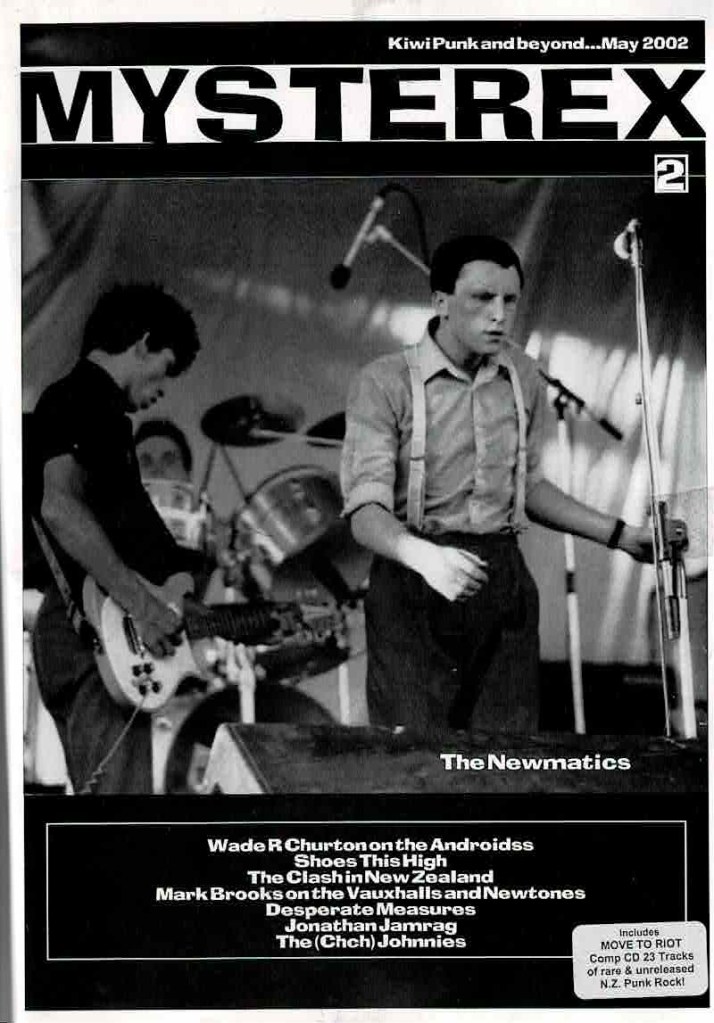
I think when I was introduced to the notion of “New Zealand’s punk rock history” not long before this – probably when I first heard AK-79 in 1993, when it was reissued on CD – I was like, “Wait, New Zealand had a punk rock history?”. Well indeed it did; I should have known better; and in the early 2000s, a fanzine called Mysterex sprung up to document it all. See, I’ve always been chagrined by the Flying Nun-centric notion that the bands The Enemy and then Toy Love “started punk in New Zealand”, something that you’ll read from time to time, and which is lustily contradicted here and here. Mysterex #2 from 2002, the only issue I have, was devoted to not only setting the record straight, but setting the record, period, for a scene completely eclipsed by the country’s even greater musical heights reached in the post-punk era.
Andrew Schmidt was the editor, and he’s explained the whole tale behind why he started the mag and its timeline here. Not surprisingly, this one surely moved the most units of any of his issues, coming as it did with a 23-track CD compilation of NZ punk called Move To Riot which I don’t seem to have around any longer. I remember reading Mysterex #2 on a beach on Cape Cod when we were visiting my brother in law that year, so if any of my P-Town or Sandwich crew found this CD 22 years ago, you know where to find me.
For me the big draw was and remains the feature on Shoes This High, helmed by Brent Heyward and creators of one of the great global post-punk 45s of all time. The long piece is full of Heyward reminiscences on the Wellington scene, and as accompanied by a timeline that explains the epochal events in said city, like David Bowie playing there in December 1978, and even “overseas records” by Pere Ubu, Captain Beefheart, Lou Reed and The Clash showing up in Wellington shops the same month. The article has got to be the pièce de résistance of Shoes This High scholarship, and I hope it finds its way to digital at some point, for the kids.
Speaking of The Clash, there’s an oral history of their visit to New Zealand in 1982, including quotes from members of The Clash taken from elsewhere. Much of the rest of the magazine is spent delving deep into bands that Schmidt and his contributors saw as missing links and important bands in the development of the two island’s punk scenes: The Androidss; The Newmatics, and a little bit of the Suburban Reptiles. Them I know! Mark Brooks is interviewed extensively about the Christchurch scene, and that’s followed by an interview with an early group, Desperate Measures. Mysterex fanzine has got a yen for the forgotten and the misplaced, and that’s right in my proverbial wheelhouse when I’m, you know, reading a fanzine on a beach somewhere.
Oh, and then there’s a list at the end that goes right for my obsessive/cataloging/list-making jugular: “Thirteen Great Uncomped Kiwi Post-Punk Classics, 1980-83”, which for some reason includes a track from the amazing **** (Four Stars) compilation. Would you say that was “uncomped”? I’d say that’s really stretching the definition. Really well-put together fanzine with a righteous mission and execution.
-
Radio Free Hollywood #1

The pre-punk era of LA captured by Back Door Man and here in Radio Free Hollywood #1 is endlessly fascinating for those of us who love to marinate in the whos, whys and wherefores of the sparks that had to ignite to make that particular music scene as combustible as it became starting in 1977. But the argument here, in early 1977, is that the sparks have already ignited. There had recently been a “ground zero” event on August 24th, 1976 with The Pop!, The Dogs and The Motels playing a show in Hollywood, billed as an antidote to the fern bars, disco and cover bands plaguing greater Los Angeles.
While it’s hard for me to imagine that these particular bands could be a catalyst of any kind, you take what you can get sometimes, don’t you? The opening editorial sets its mission as wanting to capitalize on what’s been growing out of that one live show. You’ve got people who write for Back Door Man taking part in this as well, including Phast Phreddie Patterson and Gregg Turner. To them, what’s happening is something they’re calling “street rock”, so accordingly there’s a big column looking at what’s going on called “Out in the Streets”.
“At present, there are over a dozen good bands playing steadily on the Hollywood circuit, among them Quiet Riot, The Pop!, The Berlin Brats, The Dogs, The Motels, The Quick, The Boyz, Shock, Van Halen, Sway, Wolfgang and Zolar-X”. There’s even a letter to the editor talking about what a shredder of a guitarist Eddie Van Halen is. Street rock!! But as punk encroaches, Phast Phreddie, at least, is ready. He talks about some exciting new 45s and loves “(I’m Stranded)” by The Saints and the third Pere Ubu single. And I guess The Motels had a song at this point called “Whatever Happened to the Modern Lovers?”. This gives credence to just how barren and bereft rocknroll must have felt to so many who’d lived through the Sunset Strip-60s, and/or who marinated in The Stooges, MC5, Velvet Underground and even Can and Hawkwind. I’d certainly list 1976 as one of my bottom-five years to have been young and searching for hot raw sounds in the United States of America.
But you can always pretend, right? That’s how you get a piece like “The Pop – Rock n Roll Monsters” by Gregg Turner. I guess I can sort of see if you’re into this sorta street rock/headbanger/AOR/vest-rock bullshit, a la Van Halen and Quiet Riot and The Pop!, you might see the arrival of bands like The Germs and The Weirdos and The Screamers in a few months as something of a threat – which could be why Turner and Vom were sending it up somewhat, only to reverse course and in a can’t-beat-’em-join-’em move, start the Angry Samoans in 1978.
Radio Free Hollywood #1 is basically one large sheet of newsprint folded up. I find it quite entertaining in its way, and I’m glad to have it around.
-
Osmotic Tongue Pressure #3
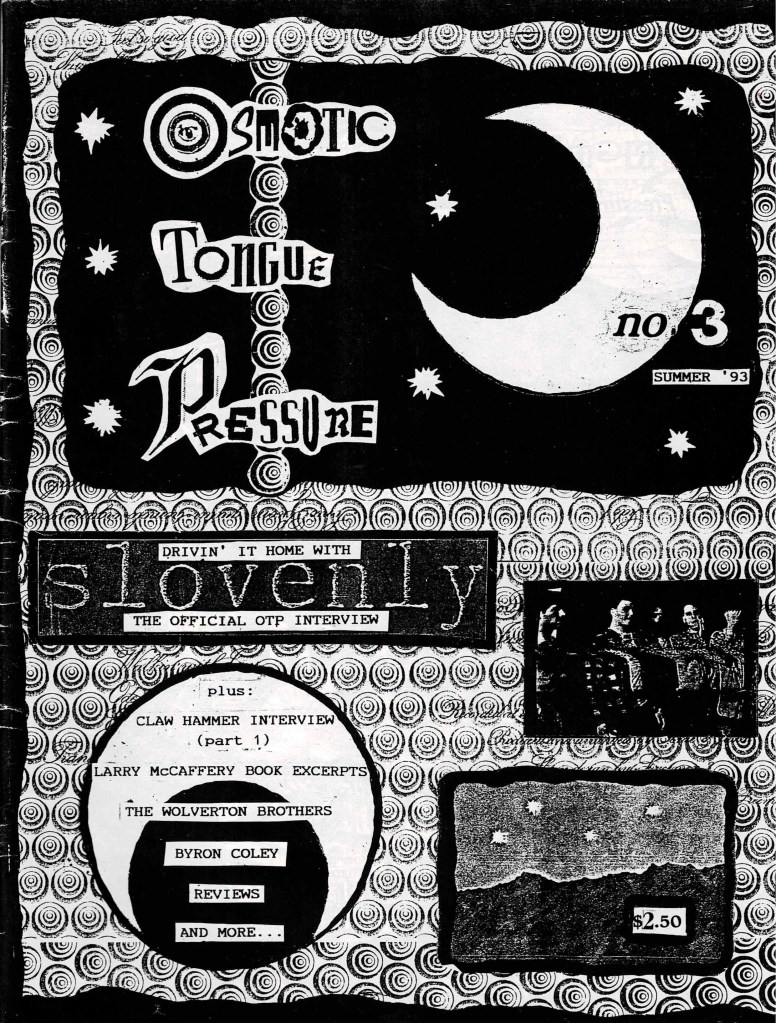
I haven’t really sat down and given Summer 1993’s Osmotic Tongue Pressure #3 any sort of true once-over in the thirty-plus years since I enthusiastically bought it, devoured it and then mostly forgot it. I’d really only remembered & marked it as a real good one, one named after some Richard Meltzer-ism of unknown provenance. Gave it the full re-read last night in order to properly consider it for a true Fanzine Hemorrhage exhumation, and I’ll come out and say that it was a really great one, now ranking in whatever imaginary ledger I’ve got going internally as “one of the top music fanzines of the 1990s”. Allow me to explain why and how!
I once scanned the cover of this for another blog and said it was an early 1990s fanzine from San Diego put out by a guy named Mike Kinney, whom I also knew had shuffled off this mortal coil far too young – only eight or so years after this issue was created. I was half right. There were two editors, with Kinney holding down Southern California and Kevin Cascell as the other half, living and creating this from San Francisco, my hometown then as now. In fact, it’s almost eerie reading all these show reviews how often he and I were rubbing proverbial shoulders without actually knowing each other. It’s not like this is a really big city, just one with a subcultural footprint larger than its actual population.
Anyway, Cascell went to the May 1992 Pavement show and disliked it as vehemently as I did; he and I overlapped at shows ridiculously in this opening section. Sebadoh/Some Velvet Sidewalk at Morty’s (unlike him, I thought Some Velvet Sidewalk were fantastic, yet have barely thought of them since, let alone listened to them); Claw Hammer at the Nightbreak; Antiseen at Brave New World; I think I was even at the MX-80/Slovenly show in Oakland, although I missed Slovenly. I also saw the Helter Skelter: LA Art in the 90s thing w/ Raymond Pettibon, Robert Williams, Mike Kelley and many others at Temporary Contemporary/LACMA that Mike Kinney went to. Life is a drink and you get drunk when you’re young. In fact, when Kinney sees The Cows at the alcohol-free, all-ages Jabberjaw club in LA and, while he’d had a decent time and likes the band, concludes rightly that “it’d have been nice to throw some beer on ‘em”.
Cascell, by the way, would join the band Truman’s Water within a year of the release Osmotic Tongue Pressure #3, and he’d also put together stuff as the No Friends Band, whose unearthed stuff has received a ‘lil deserved airplay on my podcast. He’s also a phenomenal collage artist, one of my favorite offbeat forms of creativity, one I keep saying I’ll explore more of and never do.
I suppose I’m not really explaining yet just why this mag was so fantastic. To start with, these were young men of taste and class. I’ll enumerate further in a bit, but both wrote exceptionally well, each with a healthy combination of highly literate snark and excitable fanzine jive talk, and who just come off as the sort of lads you’d simply want to be talking music with. I’ve no doubt they’d have turned me onto some of the free jazz they were ably comprehending years before I was. For instance, a representative sampling from the reviews section finds the Gibson Bros, Pharoah Sanders, Rudolph Grey, William Hooker Sextet, Royal Trux, The Humpers, Eugene Charbourne and the Dead C – and a consistent bashing of a coterie of Merge Records / power-pop-turd / indie-lite bands. As well they should, my friends, as well they should.
These guys are also both clued-in enough to totally love the feral energy of rock beasts Claw Hammer, and accordingly have an interview with them here. Reviewer Cary Holleran observes their dip in form on Pablum in the reviews section, even though he knows & concedes they rule live and hadn’t lost a step there in the least. This happened to be right at the time I was along on a tour w/ those fellas as their road manager, somewhat discussed here. Kinney really digs Tim Ellison’s Rock Mag, to his immense credit. The interview with Slovenly is also really insightful and wide-ranging, and came at the absolute end of their run, as they wouldn’t be a band for even a few more months after the execution of this discussion.
Finally, showing off the style and taste of these erudite young scholars, there’s a guide to “cyberpunk” books and a set of reminiscences by Byron Coley, some of which are in such miniscule type that I can’t even read them with my reading glasses on. Now there’s a sentence I hadn’t conceived of myself typing in 1993. It kinda kills me that I wasn’t clinking glasses and slapping backs with these two guys when I was in my quote-unquote prime. We’d have had many a fine bro-down together. They made it to an issue #5 in 1996, but I’ve seen neither hide nor hair of the other three in my lifetime thus far. Have you?
-
Wiring Dept. #4

Maybe it didn’t really feel like it at the time to me, but Wiring Dept. has reputationally come into its own, nearly forty years after the fact, as an important sub-underground music publication that found joy, innovation and immense left-of-center creativity in post-hardcore San Francisco circa 1984-86. These were supposed to be “the lean years”, but I’ve got a whole Wiring Dept. #4 here that says they weren’t. (I talked about Wiring Dept. #3 here as well).
I know where I was when I bought this in 1985 or early 1986 – it was at Rough Trade Records on 6th Street in San Francisco, and I was up visiting from college on one of my many record-buying excursions to the city while staying with my parents in San Jose. It was likely rung up at the counter by KFJC’s Spliff Skankin (Dennis Bishop), who worked there, and whom I listened to incessantly in high school (and who therefore likely intimidated me at the age of 18 when I bought this – these DJs were absolute gods to me). Given my youth and general punk rock orientation at the time, I probably blanched a little at the pretentious poetry and song lyrics – many by Dylan – in the margins of many pages, and at the inwards circularity of the fanzine, in which much of it seemed primed to elevate its creators and their own endeavors. I’m over it now.
But as examples of what I’m talking about, let’s dissect Wiring Dept. #4 a little. There’s an interview with SF band Trial by Grux of Caroliner and by editor Eric Cope. Then Cope writes about Caroliner. Then William Davenport of Unsound fanzine does an interview with The Flaming Lips after their first LP. Then Cope interviews Davenport. Cope’s own band, Glorious Din, gets a reprint of their interview on KALX radio, and then their album gets a rave review in Cope’s own magazine as well. Who’d have thunk it?
Brandan Kearney of World of Pooh was part of this loose collective as well. He writes a bunch of the record reviews; his band, then a duo, gets raved about; there’s a long review of their tape Dust. and also a review of Brandan Kearney’s magazine Nuf Sed Digest, which I’d never even known about until re-reading this just now. Who’s got a spare copy to trade me for one of my extra CMJ New Music Monthlies? There’s also a review of a World of Pooh tape called Pigmies in a Rose Petal that I’m not 100% sure actually ever existed, and another of a comp tape called UGLY SF III: Bellair McKuen Natures the Preying ANXthouse, supposedly with Lennonburger, Church Police and Caroliner. Google turns up nothing. I need to hear this and I need your help.
There are loads of short interviews, including with four small-ish bands who became much larger in years to come: the aforementioned Flaming Lips; 10,000 Maniacs; Faith. No More and Peter Buck of R.E.M., who were already kind of a big deal on the indie/Americana circuit but nothing like they’d be two/three years later. Yet there are also chats with Controlled Bleeding, Love Tractor, Flat Duo Jets and Stiff Legged Sheep – who were awesome, by the way. Listen here. Corrosion of Conformity, too. Fuckin’ C.O.C., man. I saw them play at the Oxnard Skate Palace, no lie.
Frightwig talk about their upcoming record: “Have you ever seen Russ Meyer, early Russ Meyer films? He did Debbie Does Dallas (sic). He had this film about three go-go dancers who travel around in these sports cars. It’s called Faster Pussycat, Kill, Kill. And we’re the three dancers in our sports cars. Faster Frightwig, Kill Kill. It has nothing to do with the music. We just like Russ. We identify with him. We all have big tits. We’re all foxy. I wear hip huggers and dance and we race around in our sports cars and kill men with our bare hands.”
Dave Katz – who for some totally weirdo reason got really mad at me for this 2005 review I wrote of his book! – writes about The Fall’s new 45 Cruiser’s Creek, saying that, “In a way, they sound almost like an 80’s Creedence Clearwater….the main problem with this song about a back woods party is its annoying backing vocals”. Poor Brix, just couldn’t catch a break from the men both lusting after her and wishing she’d go away, sort of a sub-underground version of modern MAGA Alexandria Ocasio-Cortez/Taylor Swift syndrome. And really, maybe the reviews in Wiring Dept. #4 aren’t to be trusted as a matter of course. There’s an uncredited review of the Dead Kennedys’ Frankenchrist, easily one of the worst records I’ve ever heard. This album with “Jock-O-Rama (Invasion Of The Beef Patrol)” and “MTV Get Off The Air” is compared to Iggy Pop and Joy Division, and about which it is said, “Frankenchrist is worth about a million dollars just for the lyrics. What Jello Biafra sings is not mere words put to music, these words come from deep within his heart. He feels with a tortured soul….a record that opens your eyes to injustice and human suffering….do not miss this record”. Hey, I’d leave that review uncredited, too.
All this and a picture of Bob Noxious from The Fuck Ups. It’s therefore little wonder that Wiring Dept. copies are p-r-i-c-e-y when encountered on eBay these days. It’s outstanding source material for documenting whatever it is that was going on musically in 1985, a tale that very much varies with the teller.
-
Bazooka! #1

Earlier on Fanzine Hemorrhage we discussed Belgian Tom Arnaert’s late 90s Bazooka! fanzine and specifically, issue #3. Even thinking of Tom and his fanzine has me pining a bit for the late 90s/early 00s glory days of “CD-R trading”, in which I’d roast up six CDs for you and send ‘em through the mail, and you’d roast up six for me from your collection and fling them my way. I built a hell of a CD “burn collection” in that manner, not just with Arnaert but with several clued-in correspondents all over the world.
I was especially happy to do this with Arnaert and a guy named Luc Onderdonck, both of whom would check stuff out from libraries in Belgium, collections of 78s or punk or world music that never made their way to the USA, then make copies for us both. There was another fella up in Seattle that was a fellow online DJ at Antenna Radio – here’s a Wayback Machine capture of a 2001 show of mine, No Count Dance Party – and I’ve totally blanked on the guy’s name (I think it was “Irv Hunter”?), but he and I, we had ourselves a time with our frantic CD-R trading. To this day, I still make myself CD-Rs of digital files all the time, rather than store everything on a hard drive. I don’t like looking at digital files – I’d still rather cobble together the original artwork, print it out, stuff it into a poly sleeve with the disc and have a fake-but-real CD of my own making,
Anyhow, I recently was able to come into a copy of Arnaert’s very first issue from early ‘96, Bazooka! #1. We see this young man finding his musical and publishing sea legs at this point, and he is indeed a young man; based on some mathematical deducing done from an offhand comment in his interview with The Tinklers that he made about being four years old when they started up in 1978, that would put young Tom at 21 or 22 at this point. In many ways – much like the atrocities I myself was publishing at that age (but far better than mine) – it feels like it, and it even seems that Arnaert didn’t quite have the all-consuming command of the English language that he’d even have just a couple years later, when I first came across Bazooka! #3 and found this guy writing circles around his fanzine contemporaries.
1994-1996 was peak garage punk mania for many garage-crazed individuals around the world, as we’ve documented here, here and here. Accordingly, Arnaert is big on The Oblivians, and gets in a good mail interview w/ Eric Friedl, who magnanimously answers everything like a mensch. He also gets in good with Dennis Callaci of Shrimper Records and the band Refrigerator, a gentleman & a label that were true fanzine/underground “objects of attention” at the time, something I found it hard to latch onto myself. Then there’s an interview with Kevin Munro of the band Mule, a guy who’d been in the Laughing Hyenas for a time. He comes across as a bit of an antagonist and perhaps something of a “dum-dum”.
Oh, and I love Arnaert calling out some doofus from “The Swingin’ Neckbreakers” when they played in Gent, Belgium: “Highly praised by the people from Norton Records and despised by other garage freaks for copying the 60s r&r sound without adding anything substantial to it (or something like that). I could see from the singer’s face that he was some arrogant piece of shit and that they were going to suck real hard. And I was right cuz a bit later, after a series of sneers addressed to the soundman, the singer threw down his bass, jumped off stage and got in a fight with the soundman. Really weak….”. Who needs Pitchfork when you have reviewers who’ll lay it on the line and leave it all on the field like that? Tom Arnaert, it’s time to bring back Bazooka! for a new generation. Get in touch and I’ll hook you up with a printer.
-
Big Star #3
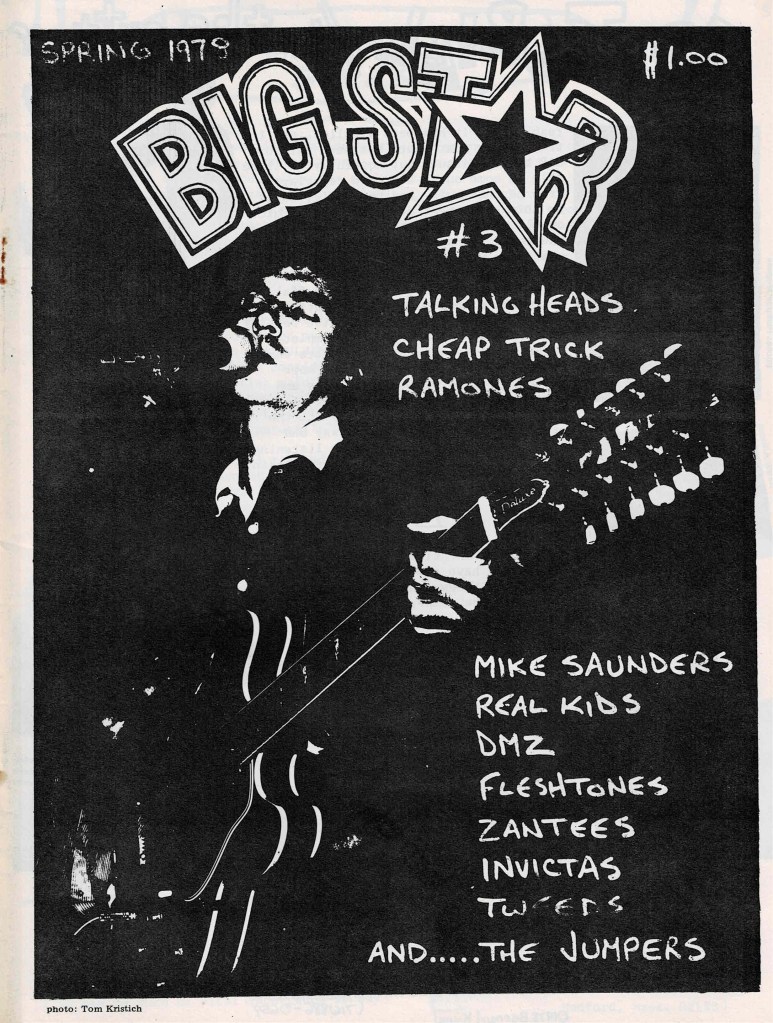
Terrific third and final issue in Big Star’s run. You certainly can’t complain about the use of the name in Spring 1978, particularly when I was raised to understand that no one had cared about Big Star, the band, several years earlier, and that their fans at the time could be counted on the fingers of several hands. It wasn’t quite true, yet the fact that punk fanzine empresario Bernard Kugel (Bernie to his friends!) found a way to easily merge them into his mag along with The Ramones and so forth spoke volumes about how they were perceived by at least a subset of the underground.
Now Bernie, he was doing this in Buffalo, NY, and he’s been subsequently called the “godfather of the Buffalo punk scene”. I’ve never seen the other two issues of Big Star, but Big Star #3 is an excellent early ‘78 rocknroll fanzine right out of fanzine central casting. Like, I mean, I’m not really into Talking Heads but I like how Kugel does three seperate interviews with 3 different band members, right after their album’s come out, then loops back around to interview Tina Weymouth again. In some cases, each interview’s no more than a half-dozen questions. Jerry Harrison gets asked about his previous band, the godlike Modern Lovers:
Big Star: Why did the original Lovers break up?
JH: Just personalities.
Big Star: What do you think of Jonathan’s current stuff?
JH: I’m not wild about it. I mean I think it’s sort of interesting but it’s not exciting to me. That’s why I really didn’t want to continue because it was all his personality. If you really like his personality, then that’s great. I don’t think his personality is that great.
Miriam Linna – whom I believe was out of The Cramps at this point but in Nervus Rex – does a column called “The New Sounds of the U.S.A”. She goes wild for The Real Kids, DMZ, The Fleshtones and The Zantees, the latter of whom she praises for “their impeccable taste and truly inspired treatment of rock n roll”. As it turned out, she was weeks away from joining the band herself as their new drummer, if she hadn’t already.
Kugel does a puff piece on local band The Jumpers, whose 45 Kugel’s label Radio City has just so happened to have just released. There are brief fanzine-y chats with Cheap Trick and The Ramones, two bands who’d, unlike The Jumpers, go on to immortal and everlasting glory by being inducted into the Rock and Roll Hall of Fame. And there’s a good freewheeler of an interview w/ Metal Mike Saunders. He talks about becoming an accountant; how “Kiss is the best American rock group, hands down”; how “The Ramones’ albums literally make me ill”; his band Vom, which was still coming together with Richard Meltzer and Gregg Turner when this interview takes place in October 1977, after getting launched with the creation of their first song, “Getting High With Steven Stills”. All this and a full-page Twinkeys ad, with one band member holding a “Sacramento” baseball pennant right at the time that said city was my hometown!
-
Subscribe
Subscribed
Have a WordPress.com account? Log in now.

