-
Flesh and Bones #7

A year ago I wrote up a thing about a very important fanzine to me, Middlesex, New Jersey’s Flesh and Bones #6. When Spring 1988 rolled around and Flesh & Bones #7 rolled around with it, I made zero haste and bought this one immediately upon sight, almost certainly at Rhino or Aron’s in Los Angeles. I was, at this point, a junior in college and very much immersed in record collecting and ultra-loud “longhaired punk” bands from both Seattle and the east coast, very much including this issue’s Green River, White Zombie and Das Damen. But honestly, the music coverage in Flesh and Bones, such as it was, was absolutely secondary to the mag’s presentation ethos, which revolved around comedically cutting, pasting and manipulating 50s, 60s and 70s advertisements and comics; loads of drug and hippie humor; eye-popping modern comix art; wild, hair-swinging photos of modern abrasive heshers, and a super goofy, it’s-fun-but-who-gives-a-shit approach to rock & roll in general.
I believe I enjoyed this particular issue even more than I did #6, though it wasn’t quite as revelatory. Even now I get a big laff out of it. Published by Jeff/“Jeffo”, a gentleman whom I’ve tried to digitally engage with in our current era to no avail, Flesh & Bones #7 has even more erstwhile hair farmers than its predecessor, including truly awful shirtless photos of Saint Vitus, who were unfortunately interviewed as well. The mag starts with a phony underground rock gossip column with blatantly untrue “items” about the likes of Ed Gein’s Car, Sloth, Phantom Tollbooth, Redd Kross and Live Skull – so not only those captivated by that strange 1986-89 interregnum when male hair went totally bananas and a handful of bands half-pretended that Jim Dandy and Black Oak Arkansas were something to aspire to.
Along those lines, there is a fantastic “guide to being a real man” photo essay called “Manly Phrases and Gestures” by a greasy rocker named Davoid, from a (apparently real) band called Wassermann Love Puddle. He shows off his scar, his cop belt, his boots, how to answer the door with a baseball bat, and best of all, his melancholy down times, sitting at the bar alone, “Thinking about ‘Nam”. Oh yeah – ‘Nam. Charlie. Don’t get me started, comrade. There’s also a “Wild Women of Rock” article with loads of photos in which we get to meet and celebrate, among others, Elyse from Raging Slab, Jennifer from Royal Trux, Sean from White Zombie and yes, Yanna from Big Stick!
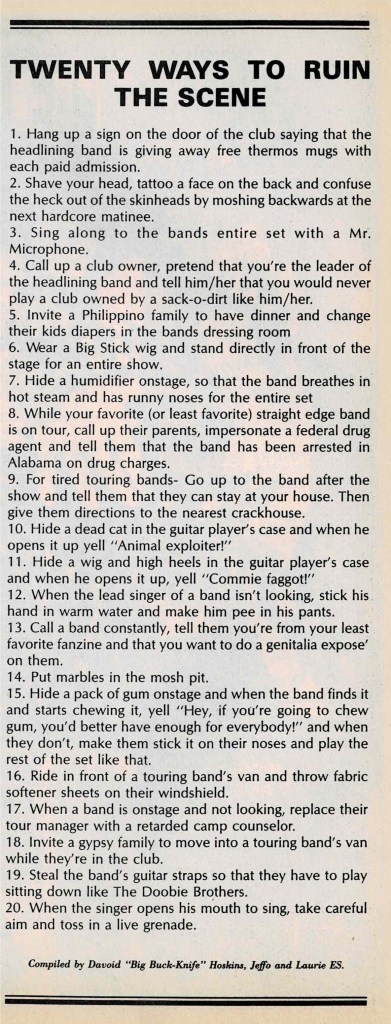
Das Damen are allowed to say their piece in an abbreviated 1986-87 tour diary that’s well worth paying attention to. Bob Bert tells his life story, taking us up to the present days in Pussy Galore, who were one of my 2-3 favorite bands on the planet at this time and who, in my eyes, aged the best of just about anyone from the so-called pigfuck years. Typical of Flesh & Bones #7 is in-jokey pieces that fill spaces in between features like “Twenty Ways To Ruin The Scene”. Those of you as old as i am will remember when “the scene” was sacrosanct, and any efforts to disunite or trample upon it were highly frowned upon. Is it funny? I don’t know, is it? When you’re 20 years old it sure is.
Peppered around all of this stuff are strange comics, tongue-firmly-in-cheek record reviews and so, so many great band photos – in the back section of live reviews alone are some of the best shots I’ve ever seen of The Flaming Lips, BALL, Divine Horseman, No Trend and Death of Samantha – with every photo uncredited! It’s as good as Monica Dee’s stuff but I have no idea who took these gems. And in 1988, you could buy this meaty, 80-page Flesh & Bones #7 for a cover price of $2. Today it goes for a little more than that.
-
NY Rocker #38 (April 1981)
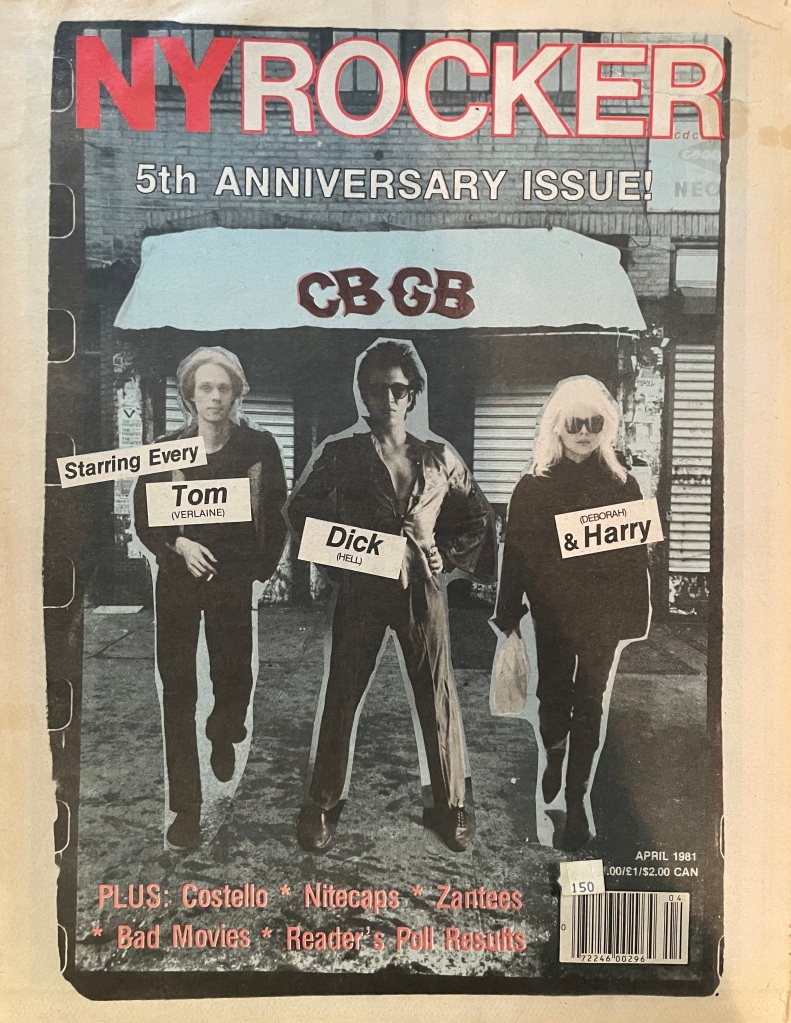
In April 1981 I’m sure it felt like a pretty big deal that NY Rocker had weathered the storms of punk and post-punk and come out on the other side of five years of publishing. They’d have a few more to go, though the end was quite a bit more ignominious than anything happening there from 1976 through 1982. So this issue, celebrating said 5-year anniversary, is a pretty nice one to have around, particularly because it’s not all onanistic back-patting but rather a normal monthly NY Rocker issue, tarted up with a little deserved looking back.
On that front, there’s a cool piece called “Whatever Happened to the Class of ‘76?”, focused on the Manhattan/CBGB/Max’s whoosh that gave the mag and underground music much of its initial jolt. Tom Verlaine, in 1981, is said to be “a study in career suicide”. The Ramones’ lack of commercial breakthrough is thoroughly bemoaned, though some hope is held out for their new 45 “She’s a Sensation” (it didn’t chart, not even close). Suicide are “finally on the verge of the commercial success they so richly deserve” (I don’t remember said success). There’s definitely some bellyaching that Patti Smith is now in Detroit being a mom and raising a family, likely written by “a young person” who perhaps hadn’t yet considered having children now or ever.
They also track down “The De-Classe of ‘76” as well: those who disappeared. This includes acting editor for NY Rocker issues #2, 3 and 4 Craig Gholson, who says he got out early in the game because he “became disinterested in the music. I wanted to write about Television. I didn’t want to have to write about the Dead Boys”. Amen and godspeed, Craig. The “early days” reminiscing continues with a piece of Kristian Hoffman memories, a great Roberta Bayley photo spread of all the key ‘76-’77 NYC players and best of all, a reprint of Lester Bangs’ Peter Laughner obit from the September 1977 issue. It’s a phenomenal piece, readable here and also in one of the Bangs books, and it’s highly ironic for its depictions of Bangs trying to reason with Laughner to not drink and drug himself to death. and not letting him up into his apartment because Laughner was becoming “bad news”. I say highly ironic because I read the Bangs bio and, well, black kettle/black pot and all that.
As far as the 1981 stuff in here, well, there’s news of a Plasmatics indecency arrest in Milwaukee, and The Specials being fined in London for “encouraging fighting” at their gigs, which was highly preposterous. The Plasmatics were indecent, though, on every level. I remember both of these incidents, but man, growing up in the suburbs as I did among the rubes, any time my musically unsophisticated peers wanted to reference whatever was happening in punk and “the new wave”, it was often The Plasmatics that they reached for. The 6 o’clock news had probably done something on them blowing up a school bus, or Wendy’s nipple tape, or this arrest. The hoi polloi, the great unwashed – they usually knew about Devo (total fags), the Plasmatics (that chick’s a dyke) and the Dead Kennedys (probably gay).
Now – on the proverbial flipside, NY Rocker #38 features a cool visit to the Brooklyn abode of Miriam Linna and Billy Miller of The Zantees to admire their record collection, jukebox and retro dishware. Bill Landis of Sleazoid Express weighs in with a fantastic primer essay, “From Tack to Gore: The Exploitation Film in America”, so good it makes me want to order that book I just hyperlinked to. In the reviews section, reviewer David Blither tries to grapple with the landmark ½ Japanese½ Gentlemen/Not Beasts triple LP box set, and far from finding it wanting, walks away from the experience with the zeal of the convert. Love that thing. And Howard Wuelfling gets a ton of great shit to review: a pile of Cleveland 45s like Pressler-Morgan, X_X, The Styrenes and Cleveland Confidential, plus the debut Bad Brains, a Wipers single and even the Lesa (Aldridge) 45. What would you say if I told you 1981 was one of the top three years in rock music history? NY Rocker #38 is another in a long line & litany of verifiable and documented proof points, so I shall provide no quarter on my stance.
-
Savage Damage Digest #3

Part of the reason I hold onto so many of these goddamn fanzines is because I just know I’m gonna need ‘em someday. Case in point is this Larry Wallis piece in 2013’s Savage Damage Digest #3. I recently embarked upon a UK late 60s/early 70s hippie/hard rock scuzz mini-bender – Deviants, Pink Fairies, Groundhogs, all that – and man, was I glad to be able to dimly remember the Wallis piece in this one that I’d mostly skimmed over 11 years ago. You see, despite my longtime Talmudic “study” of the rocknroll form, I’m still constantly attending a school of my own making, expanding my horizons and whatnot, and/or revisiting stuff I’d passed on the first time because I wasn’t quite ready. Like The Byrds we talked about last time.
What am I gonna do for succor and encouragement, buy the nonexistent Pink Fairies book on Amazon? No, I’m going to head to the stacks and read editor Corey Linstrum’s long, ultra-nitpicking (in the best possible sense) overview of Pink Fairies guitarist Wallis’ entire musical career. Now I know. At least for the 45 minutes in which I retain the information I’ve just read, I can have a fuckin’ blowout conversation about Wallis with you or anybody. That’s why I “invest” in fanzines as I do, because it’s that important.
When I got this issue of Savage Damage Digest #3 in 2013, I was just grateful that a real print fanzine was still publishing. Seemed to be a grim period, besides my own, stalwarts like Ugly Things and a few others. I was drawn in my Linstrum’s massive Avengers/Greg Ingraham interview, which is bedecked with many well–placed photos and flyers, including many I’ve never seen before. Did I ever tell you guys that the first punk song I ever loved was the “The American In Me”? I was barely out of elementary school, heard it on the left of the dial, and it was world-changing. Today I sort of see them as a decidedly second-tier early-wave US punk band so my interest in their 70s shenanigans is perhaps lower than my interest in, say, first-hand recollections of The Electric Eels, which thankfully Linstrum has in a later issue. But yeah, the Ingraham interview is the sort of deep-dig dork-out that I very much admire, and should I ever need to gather source material for a big Avengers listening sesh and eventual discussion with you over a beer, I’ll absolutely know where to go.
One final thing I admire about Linstrum is that he clearly just heads where the spirit moves him. Like he’s got an entire fanzine out about the history of underground music in San Francisco’s East Bay, which I bought when it came out and’ll get to on this site at some point. He fills a page with a rocknroll crossword puzzle, with print so small I abandoned it both now and in 2013 when I first came across it – back when I could see everything just fine. Only moderate bum note is a perfunctory and sort of unprepared interview with Jeff McDonald of Redd Kross; time was an interview with the wacky McDonald brothers was a key reason to buy a fanzine, yet at this point Redd Kross were just awful and there was little use pretending otherwise. But there’s no accounting for taste, as they say!
-
Zigzag #28

My travels into and around the “classic rock” pantheon over my life have been halted, stuttering, filled with skepticism and, ultimately, redeemed with revelation and joy. Every few years there’s a popular band that you & everyone else has loved for years that finally fully clicks in for me; in 2023, that band was The Byrds. Several years ago, it was the Pet Sounds/Smile-era Beach Boys, which I wrote extensively about in my most recent Dynamite Hemorrhage #10 fanzine. To understand why it’s taken a fifty-something man with enormous lifelong exposure to these bands so long at times to finally grasp their genius, I’ll give a sense of my starting point.
In the late 1970s and early 1980s, as my tastes were being formed in the direction of punk and “the new wave”, it was classic rock and heavy rock that I 100%, fully and totally set myself in defiant, youthful opposition to. At age 13/14/15, the bands that my doofus junior high and high school peers loved, all of whom were routinely pouring out of boomboxes on KOME and KSJO, were the full antithesis of everything I thought myself to be. If it was popular, heavy, and on the FM dial, I hated it. If heshers and especially hippies liked it, I hated it. If it was unpopular, unknown, strange, bent, angular and possibly from England, I was interested.
So naturally this sort of stance precluded and eliminated a great deal of music in my life. The first crack in the armor for me in the late 80s was The Rolling Stones, especially once I heard Beggar’s Banquet and Exile on Main Street. Then it was a major Neil Young overdose in the early 90s, which continues to this day. The gates would continue to open, and have continued to open, for years. We let in the Beatles, AC/DC and of course The Kinks over time. Recently The Byrds, whom I’ve always sorta liked but never owned any records from, came waltzing in.
I recently got this February 1973 Zigzag #28 because I wanted to dig more into the cover feature on them. Zigzag, which I’ve written about before here and here, was edited by Pete Frame in the UK and was one of the premier fanzines of its time, even in the cold, lean years of 1972-73. “It’s produced for our friends rather than as a commercial enterprise”: this is how Frame defends to a letter-writer not wanting to “cover” Uriah Heep, Black Sabbath and Nazareth. That, and the greasy hair and foul body odor of the aforementioned. Frame’s just come back from the US where he’s hung out with a young Alan Betrock and unfortunately gone out there in the first place to see Genesis; Zig Zag in this era was quite hung up on prog, with a big Kevin Ayers interview and a killer hand-drawn “family tree” of Soft Machine, Gong and so on. I can’t predict where I’d have been in February 1973 myself at that age, and while I’d like to have said Beefheart/Stooges/Velvets were my guiding lights, I’m pretty sure Bowie would have been even more important. Which is fine.
The Byrds stuff is killer. It’s an overview of their existence from April 1965 through March 1966, including interviews with Chris Hillman and Roger McGuinn and a timeline walk through a pivotal year in the band’s life. As mentioned, for years I pretty much skimmed or ignored all the writing I’d see about this band because aside from their hits, I hadn’t heard that one song that opened the doors for me until I finally ingested “Have Your Seen Her Face”. Then Sweethearts of the Rodeo was it for me, then all the folky stuff and so on. Biggest fan etc. Zigzag #28 also has a similar retrospective piece on Love, and tells us that in 1973, “Arthur Lee is currently fronting an all-new, all-Black Love”. Click the link, it’s a good story.
In the Jimmy Page interview, at a time when Led Zeppelin were playing enormo-domes all across America and tossing TVs into swimming pools, Page talks about Takoma Records and his love for Fairport Convention and NRBQ (!). There is also an interview with Stealers Wheel – ouch. Those guys are famous for the awful 70s MOR “Stuck in the Middle With You”, which was later famously used to soundtrack the slice-the-ear-off-the-cop scene in Reservoir Dogs. And sorta apropos of nothing, there’s a long interview with author J.P. Donleavy, whose book The Ginger Man my pal CM says is one of the all-time greats, and something that I must read. Should I?
There’s more in here, but some of you might especially be interested in the big Kim Fowley interview and timeline. Now me, I recently tried to reread the long-ago omnibus compendium from the early 2000s about him in Ugly Things, and I have to say I found it tough sledding. It’s not merely the beyond-credible rape accusations that have come up since that, it’s honestly that the guy was just so tedious to listen to talk about himself. His rap gets old very quickly, and Fowley’s production right-place-right-time “legend” is one of mediocrity and overhype across the board. Writer Mac Garry says “I haven’t heard the newly recorded Fowley solo album, but none of the others have ever been released here. Should you stumble across an import copy, do yourself a favour and leave it in the rack…they are all, quite frankly, abominable horsemanure”. Hey Mac, if you’re still with us 51 years later, I’d like to play you a song called “Motorboat”. Aside from that, sure. It may take yet another 51 years for me to finally come around to that particular brand of “classic rock”.
-
Only Death is Fatal #1
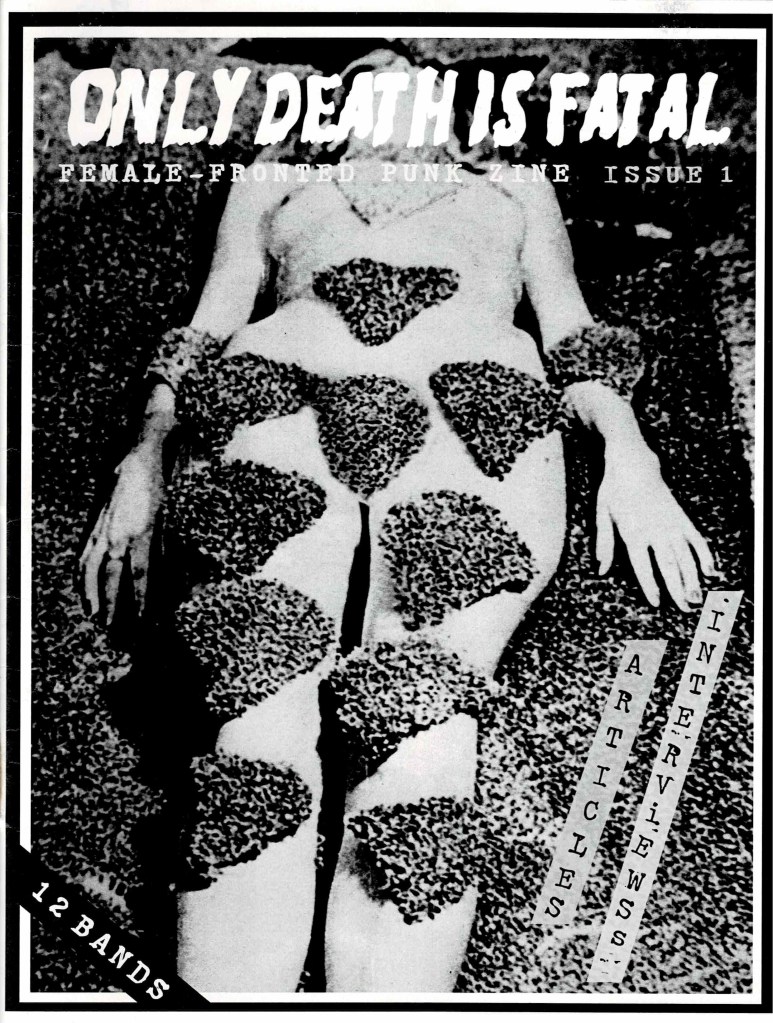
After years of being something of an afterthought and/or the provenance of “girls just sing better” dorks like me for a couple patriarchal decades, the exhumation of “female-fronted punk” truly took a quantum leap in the 2010s. I became acquainted with Erin Eyesore, née Erin Fleming, who lived in San Francisco as I did and hosted the great Ribbon Around a Bomb show that was only classically rad 70s/80s femme-punk. She had me onto the program at the Radio Valencia studios once and let me “spin” some of my best mp3s. It was fun to email her links to the Reference of Female-Fronted Punk Rock bootlegs every now and again with a quick “Hey u ever hear this?” and get an eye-roll emoji back. She was still doing the show recently at her and my joint alma mater KCSB-FM Santa Barbara, too – shows linked here.
Erika Elizabeth, too – superstar DJ, musician, risograph designer and writer – she did a killer piece in 2014’s Dynamite Hemorrhage #2 fanzine on female-fronted punk obscurities that helped further the disentombment of so much of this music. Right before that, I happily picked up a copy of 2013’s Only Death is Fatal #1, published out of Montreal by a woman known to me only as Megon, and it’s this deep dive into ultra-obscurity we’ll be talking about today. Unless I’ve got it wrong, Megon only published this one print fanzine before going the full digital on her “blogspot” blog, which ran out of steam in 2017 yet not before making a full accounting of hundreds of female-fronted punk and post-punk corners.
She was the type of editor to hear a weird UK DIY song on a comp track by a band with a ridiculous name like Cool To Snog and say, “Hey! I need to interview the folks from Cool To Snog!”. Someone needed to, and we’re all the better for it. That’s really the unstated mission statement of Only Death is Fatal #1 – to turn over the previously unturned rocks. She tracks down the two sisters from the only band in here besides Bona Dish whom I’d heard of – the Anemic Boyfriends, from Alaska (!) – and gives what I’m sure is the most full airing of their history to them they’d ever been proffered. Turns out the ‘Boyfriends moved to San Francisco, and then away from it, not once but twice!
Because these bands were barely talked to by fanzines in their day and almost all moved on (as people do) to raise families, work jobs and so forth, you get a sense that even the band members struggle to remember what actually happened in 1980 and why. Megon will ask the sort of naval-gazer of a question I’d ask, something learned through deep online & offline scouring and tape insert reading, only to get an answer like, “Ah, you’ve really got me there. I don’t know how that came about”. But she did a phenomenal job sourcing original photographs & flyers, and going deep on the questions – she actually knocked it out of the park with Bona Dish, who I myself interviewed in 2013 as well, and got a cool photo that the band didn’t send to me (sorry, Megon gets it mate).
And then, after all of this flurry of female-fronted punk documentation from Erin, Erika and Megon, Jen B. Larson put out the book Hit Girls: Women of Punk in the USA, 1975-1983 just over a year ago. I suggest you give it a gander if you’re so inclined. Sin 34 and the Inflatable Boy Clams get their own chapters, so you’re likely to want to get involved.
-
Twisted #1

Seattle, Washington ended up being pretty well-represented at the mid/late 70s dawn of punk rock by not one but two stellar publications, both of which I’ve written about before – Chatterbox and Twisted. I vowed when I typed up some words about the latter that I’d do what it takes to procure the two copies I didn’t have of the latter, and somehow I was able to do just that. All it takes is a willing and friendly seller and a highly obsessive buyer willing to forgo some of life’s pleasures in order to buy some dopey fanzine from 1977.
Except Twisted #1’s not dopey – I mean, not really. Hitting the hot, hot streets of the jet city in July 1977, there’s excitement in the air and Seattle is all of a sudden on the fucking punk rock/alterna-music circuit, with Iggy Pop and Blondie not merely having just come to town to play together, but to party it up with our editors and with all sorts of new, nascent, barely formed punk bands as well. Their whole 4-day Northwest visit is documented blow-by-blow here, like the big deal that it most assuredly was for the participants. This was when Iggy had Bowie playing keyboards for him (!), and there’s a photo of him just sitting off to the side of the stage, nonchalantly doing his thing and trying not to be noticed. “With Iggy on stage it would be hard for anyone, even him, to be noticed.”
Each day, Iggy goes off to parties and jam sessions with the editors – he does not bring Bowie with him, though there’s a message left at the hotel for editor “Robert Roberts”: “David Bowie called – looking for Iggy”. Turned out Bowie was looking for the party but couldn’t find it. I think he got lost at the shpritzer honker splasher. He missed Iggy jamming with “Blondie’s band”; he missed Iggy hanging out with Seattle band The Feelings and commandeering their instruments; and he missed a trip to Herfy’s, the beloved Sacramento hamburger chain of my youth.
Somehow there’s a party as well in Ballard, and I’m going to guess new Seattle punk band The Knobs had something to do with it, as they are profiled in Twisted #1. This is the band that The Lewd grew out of, with lead singer J. “Satz” Beret. Hell yes. Weren’t we just talking about The Lewd? It says here that “…The Knobs never played an official show, because as SATZ says…”We had no songs.” However, The Knobs did play one intimate “performance” at a Fremont rehearsal space called The Funhole. This A-list evening was written up in a Seattle punk fanzine Twisted.” I know from having lived there that Ballard and Fremont are almost the same neighborhood, lightly separated as they are by “Phinney Ridge”. Going to guess this was the show. Anyone in the Fanzine Hemorrhage reading audience get loaded that night at The Funhole?
Other things are happening too, folks. Tomata and The Screamers have recently moved to LA but have kept their ties with the Twisted editors, which means there are a ton of a photos and a wild-eyed write-up of the band’s otherworldly synth-blast, including a snap from the legendary Slash magazine party where both entities became known to the LA underground. Tomata himself writes up a frothingly happy piece about The Damned’s visit to LA and all the partying they did together. I mean, this is all formative stuff. Any & all documents about 1977 punk in Los Angeles contains these events, and here we are on the ground with the people who either made it happen or were witnessing it.
In the record reviews, some nameless reviewer thinks The Saints’ I’m Stranded album is pretty awful, yet digs the new ones from The Tubes and U.F.O. Cool. And there’s a Danny Fields interview. Did you know that Fields was the editor of teenybopper mag 16 back then? Somehow this fact had eluded me. Twisted #1’s a short one, 25 pages, but for 60 cents and a chance to have your mind blown & musical taste rearranged, there’s some truly excellent value for money going on.
-
What Goes On #3
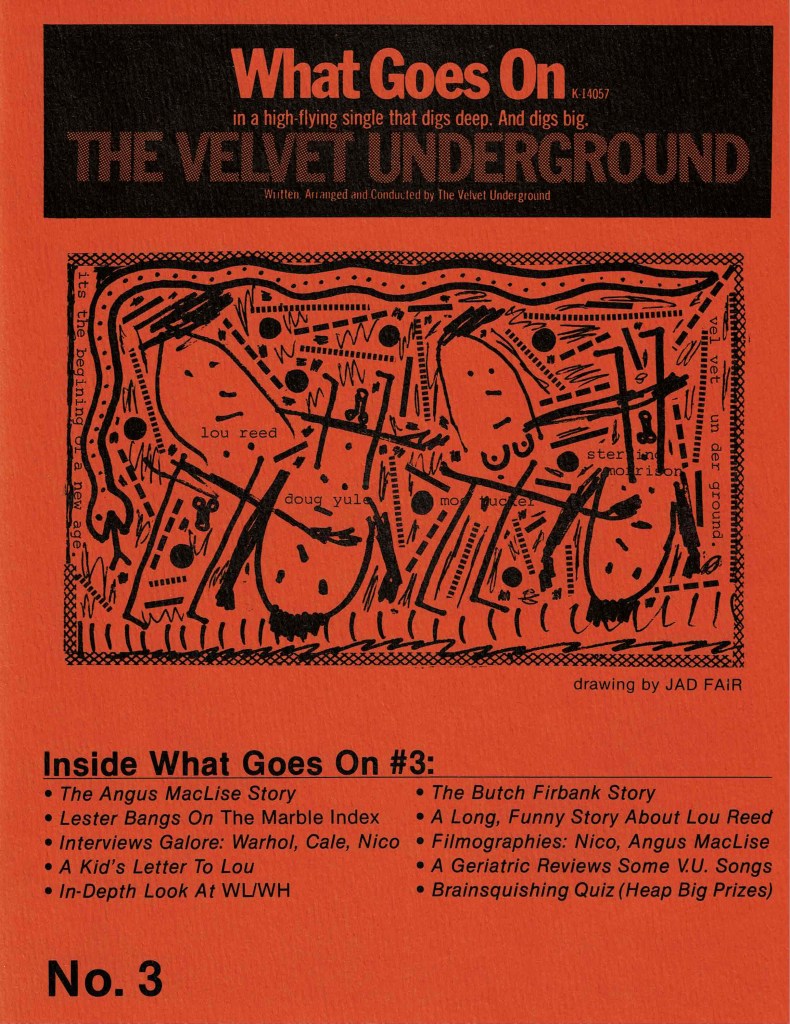
As I’m sure you’re aware, there’s been a rich history of single-artist music fanzines catering to “the obsessives” for many decades now. Backbreaking work has been done by certified Dylanologists, for instance, then deployed with extreme prejudice in numerous Dylan fanzines over the years – and whenever I get the gumption to search for music fanzines on eBay, I’ll get dozens upon dozens of listings for fanzines about Kiss, Tori Amos, Kate Bush, David Bowie, Pink Floyd, Stone Roses, Bruce Springsteen, The Smiths and obviously many more. Never the Velvet Underground, unfortunately; that is, unless a copy of What Goes On turns up online, which isn’t particularly often.
I scanned What Goes On #1’s cover and printed a bit of my interview with Velvet Underground Appreciation Society founder & What Goes On editor Phil Milstein here. Those first two late 70s issues are fantastic, but this fanzine really started to flower in 1982 with the publication of What Goes On #3, which, well – on one hand it’s a straight-up, obsessive fan magazine devoted to what might be the greatest rock band of all time, yet on the other, it’s a supreme piss-take on the idea of fan magazines. Milstein, as I’d later come to understand, encompasses multitudes – a wiseacre archivist of the obscure and the outsider; a serio-comic writer whom it’s sometimes impossible to know when he’s being honest or inscrutable; and, at times, a musician in his own right. That’s in addition to his lifelong servitude to and furthering of the cult of the Velvet Underground, a passion which I have nothing but the highest admiration for.
That admiration was extended once I dug into What Goes On #3. While fully devoted to explaining & expanding the genius of the Velvet Underground, It absolutely doesn’t take itself very seriously, and it’s all the better for it. Milstein, 25 years old at the time, prefigures one of my favorite SNL sketches of all time – the one at the Star Trek convention – with a moderately ridiculous Velvets quiz, with questions like “When Nico first met Andy Warhol, she was carrying a demo acetate in her purse. What was the song on the demo, and who wrote it?”. Funny enough, I can answer a big chunk of these questions, but that’s with the benefit of 42 additional years of Velvets scholarship having been brought to life since 1982.
This isn’t a navel-gazer of a fanzine, though. There are interviews in this issue alone with Andy Warhol, Tony Conrad, Henry Flynt, Terry Riley and Byron Coley’s outtakes of his NY Rocker John Cale interview from 1980. Dana Hatch – who’d later go on to glory as the drummer and throat-scraping vocalist in the Cheater Slicks – and who was really just a ‘lil nipper at this point – does a detailed overview of VU live records and gets his letter to & drawings for Lou Reed published as well. A big unpublished Lester Bangs piece on Nico is published here (!), and Tim Yohannan – yes! Tim Y! – has a piece about his own homemade, DIY Velvet Underground album covers.
What Goes On #3 treats solo recordings from Nico, Cale, Reed etc with the same sort of reverence and respect as it does VU stuff, but is certainly willing to carve it up as necessary, as it somewhat does for Reed’s newest LP The Blue Mask. A writer named Richard Mortifolglio contributes an excellent piece on White Light/White Heat – no jokin’ here, just a dissection of the record I’ve sometimes called my absolute favorite piece of vinyl. Perhaps the most entertaining section is “Ken’s Corner”, featuring a nursing home resident out of the pages of David Greenberger’s Duplex Planet magazine:
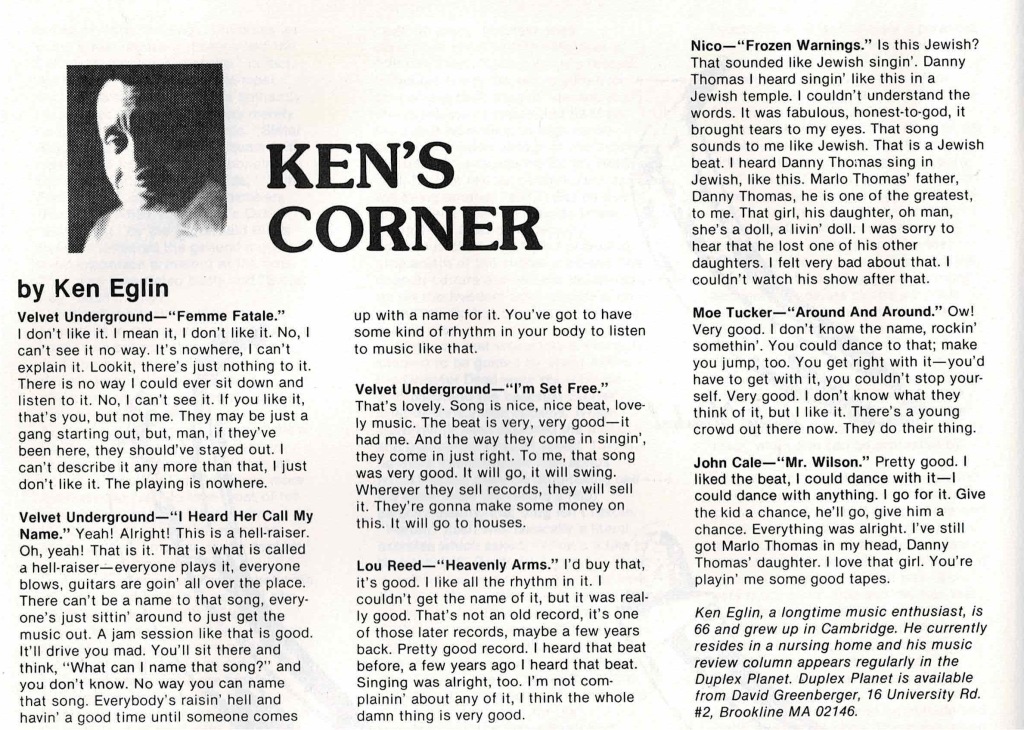
The mag’s nooks & crevices are filled in with bootleg reviews and every jot and titter from Velvets world, including mentions of the band in other mags, such as Lou Reed himself mentioning the VUAS and What Goes On in some Dutch mag, and how he likes to read it on the toilet. That’s actually pretty charitable from Reed, all things considered. I’ll be more charitable than that and state that this is an absolute treasure, and something well worth reprinting in book form along with the other issues. I do hope that someone takes up the call.
-
Z Gun #2

I believe it’ll serve the world and the ultimate digital historical record in some meager way if I take a crack on this site at each of the three Z Gun fanzines that came out toward the end of the 2000s. I talked about Z Gun #1 a year ago here. In Spring 2008, Scott Soriano and Ryan Wells sprung a second issue upon us, one they manifested as Z Gun #2. Like its predecessor, it was probably the best print fanzine that came out in its year, and I suspect I’d be hard-pressed to find examples to the contrary.
For instance, it contains one of my favorite interviews in any fanzine, ever – one with Australian duo Fabulous Diamonds. Not only was their dubbed-out experimental delay some of the absolute finest music of the day, the band were a male/female non-couple who seemed to cultivate this bizarre, right-out-in-the-open sexual tension that made them hate each other. In this too-brief interview by contributor DX, they talk about how they love to yank people’s chains about the sex they’re having with each other; how Jarrod wanted their record cover to be them actually 69’ing, and Nisa giving him tons of crap about how “if it came to the crunch I think he wouldn’t do it”, and Jarrod riposting that he wouldn’t be able to perform if it was with Nisa. Just a total gem of a chat, almost entirely about how much they loathe or fake-loathe each other, with nothing at all about their music.
There are Sightings and Ceramic Hobs interviews as well, with none of the interviews here having any photos of the bands whatsoever, a clearly deliberate anti-fanzine choice that I’ll have to ask one of these San Franciscans about one of these days if we ever find ourselves on the same cable car. Monty Buckles interviews Mike Doscocil of Drunks With Guns, and quite memorably says their band’s guitar “sounds the way burning plastic smells”. Bravo! This was never more apparent than on “Wonderful Subdivision”, one of the late 20th century’s most towering and majestic works of art. Doskocil admits that seeing Flipper in Kansas City at the local VFW in ‘83 or ‘84 had a major impact on his band, as you’d have expected it might have.
Rich Kroneiss, bless him, does an overview and survey of Amphetamine Reptile Records, which honestly, in 2008 was probably a label we were all a little too long in the tooth to pretend had any lasting power beyond its ability to fry the severely underdeveloped synapses of 19-year-old male faux misanthropes and colored-vinyl fiends. Hard for me to even get excited about Halo of Flies any more, much as I’d like to. Cosmic Psychos, sure. I’d have to really think beyond that, but nothing’s coming to me, and I saw just about all of them live at one point or another (King Snake Roost were a total blast).
2008, wow. A ton of underground records were still coming out on 45 and LP. In Z Gun #2, was the era of Eat Skull, Billy Bao, Black Lips, Eddy Current Suppression Ring, Hospitals, Mayyors, Pissed Jeans, Sic Alps and Slicing Grandpa. As I rather belatedly came to sort of realize putting out my own fanzines, reviewing everything that comes into the office helps no one – not the readers that have to wade through a plethora “it’s alright, I guess” reviews; not the bands whose work is given the cursory once-over and the tepid, “highly qualified” endorsement; and neither does it serve the writers, who spend some of life’s finite time padding the fanzine with mediocrity when it could have been perhaps better spent giving another 5 pages each to the Fabulous Diamonds to fight with each other, or to more stories from Mike Doscocil. This was the Art for Spastics era for me, a radio program I used to listen to religiously online made by DJ Rick of KDVS. His aesthetic fit neatly in line with that of the Z Gun editors, and even with my griping about too many reviews, when you get to the end of them you come to realize/remember that 2008 was actually a pretty healthy time for the scene.
We could use more Soriano and Wells in print right about now, couldn’t we? But hark! Scott Soriano has a new fanzine, Record Time, about to drop any day now. Pre-orders here!
-
Flipside #36

I’ve come to terms with Flipside in its early 80s guise not as a taste-building nerve center, nor as a place where one might gather intelligent discourse on the state of the scene, yet rather as a sociological excavation of punk rock as it was actually lived. Every time I saw/see something like The Vandals or Suicidal Tendencies on a Flipside cover I mentally classified/classify it as a taste-optional children’s magazine, but that’s not totally fair. You can get more on-the-ground sociological punk research in any given Flipside letters section alone than anywhere else of its time, and if that’s your thing, then issues like late 1982’s Flipside #36 are worth their weight in gold.
In this one, Susanna Hoffs writes on a postcard with the breaking news of how The Bangs were forced to change their name. Someone else writes to defend the honor of Al from SS Decontrol, who’d apparently come under some scene criticism of late; Sothira from Crucifix writes to complain about a racist cartoon of him in a previous issue; and all manner of punk cretins write in from godforsaken Southern California towns like Norco, Glendora and El Toro, the latter of which is now called Lake Forest. We’re in the peak hardcore era, but Flipside was relatively magnanimous in their coverage breadth, extending it even to an Allen Ginsberg mail interview by “roving reporter Helen”.
There’s a whole page interviewing The Misfits about the fallout from Doyle recently clocking a kid on the head with his guitar in San Francisco. Needless to say they’re both defensive and dismissive. The editors talk to Rebel Truth from Sacramento; to 100 Flowers; to Bill Bartell from White Flag (who has a Dave Markey movie coming out about him); and to MDC from San Francisco, who for once don’t strike me as complete nincompoops. I will grant that band the quote-unquote power of some of their blitzoid hardcore on their first album, but they really turned me off at age 15 when I’d hear them on MRR radio, trying to out-Left Wing their hosts to the point of absurdity. There’s also a big interview with The Necros, with lots of discussion about English spike-haired punk; anarchy and its deeper meaning; bands that sing about Reagan etc. All the teenage punk hits of ‘82, brought to you by the deep thinkers at Flipside.
Want to know what else was going on with folks trying to “catch a wave” on the sub-underground in 1982? There’s an ad for Chris Ashford’s What? Records for a new Davie Allen and the Arrows 45, “Stoked on Surf”. “You may remember David’s 1967 twangy fuzz-tone hit ‘Blues Theme’ from that outrageous biker movie ‘The Wild Angels’. Now he’s off bikes and onto boards!”. Well that didn’t last long. I actually read an entire interview last night with a band that was unknown to me, The Romans, who had ex-Monitor, Human Hands and Deadbeats folks, and who loved the Symbionese Liberation Army and the paisley underground. My kind of people. Had to go listen to some online. I’ve heard worse! In fact, I totally dug it and ordered a cheapo used copy of their You Only Live Once off of Discogs. Who was it that said Flipside weren’t tastemakers? Me?!?
It’s apparent that if you’re looking to truly piece together the rough corners of Los Angeles music history during the glory years of 1977-83 that Flipside, given its breadth and dogged documentation, would have to be a primary resource. The amount of content in any given issue is staggering, honestly, and as I talked about before, one thing I actually admired and even sort of envied about Al, Hud, Gerber and the crew was how they really were out there and in clubs, veteran’s halls and parties – every night of the week, anywhere there was a show.
For better or worse, they set the historical record in ways that others never could or did. For that alone, I’ll keep reading and unpacking these with pleasure, because 15-year-old “Slammy” from Buena Park in the letters section gets to capture the essence of being young and dumbstruck by the power of the ‘core for eternity, in a way that some nostalgia-ridden 50-something meathead like myself simply can’t. Copy of this on the Internet Archive here!
-
Sporadic Droolings #5

I remember Sporadic Droolings fanzine mostly because it served as a repository for much of Shane Williams’ writing before he wrote for Flipside. When I came to “know” Williams – a story which I wrote about in detail here – he reminded me frequently about his time served at this fanzine. The man was, indeed, “a talker”. I almost didn’t write about Sporadic Droolings #5 because, in flipping through it, I came to editor Dave Burokas’ intro to an article of his that starts out, “If there is a person who is extremely dedicated to punk rock, it is certainly Donny the Punk”. Yet for better or worse, we plow onward.
Sporadic Droolings #5 came out in 1986. Burokas was based in Kearney, NJ, and was a devotee of tiny type and of cramming a ton of information into small spaces. He apologizes for not answering all his letters because “he’s going to college full-time”, and good for him. I was doing the same in the year of our lord 1986. You have to wade through some mire to find the good stuff here, such as a “save the punk scene” editorial written at a sub-kindergarten level by one Bill McLaughlin, but in general, there’s good materials to be found.
Shane Williams, in prison at this time, interviews shitty punk band 76% Uncertain and then redeems himself by interviewing Laura and Stacey from Austin’s Rabid Cat Records, who helped bring the world Scratch Acid, a band who that year were in the process of becoming one of my favorite things on the planet. He then writes a ham-handed but not altogether wrong editorial inveighing against political correctness of the MRR variety. I get the sense that Shane, having let’s say some time on his hands, was allowed by Burokas to just do his thing and send letters full of questions to various bands; they’d then take the answers back, type up an interview, and shove it into Sporadic Droolings. Shane also does this for Philadelphia’s Ruin and for Orange County, CA’s Pontiac Brothers.
Regarding the latter, it’s unfortunately a lot more Shane than actual answers from the band. Guitarist Ward Dotson is asked about his time in the Gun Club, and says, ‘I have been out of the band for over three years, and I’m doing my best to try and forget about the whole mess”. I have a real soft spot for these guys, the Pontiac Brothers, not just because my pal Jon W was in the band for a bit, but for their devotion to tiny clubs and bars in Orange County and for actually being the rare sort of bar rock band that I can envision seeing three sheets to the wind in a cramped bar and totally loving it. Here, here’s why. Alas, I missed them and never was allowed the experience.
Burokas catches Gerard Cosloy as Homestead Records has really hit its stride, with Sonic Youth having just announced they’re leaving for SST but with the label otherwise hitting big with Big Black, Squirrel Bait, Nick Cave & The Bad Seeds and so forth. Apparently, as was his wont, Cosloy had “tangled” with Sporadic Droolings and/or Burokas in the pages of his Conflict fanzine recently, and this interview was meant to be an amends-maker. In the intro, Burokas says, “He started out with two strikes, Gerard did. First, he was late for the interview. Second and worst of all, he had a Mets duffle bag with him. But he managed to escape the strikeout”. The interview actually fills in quite a few gaps in my personal understanding of Cosloy’s rise through, and eventual all-seeing lordship over, the US rock music underground.
Kudos as well to Burokas for his Honeymoon Killers interview – no one was writing about this NYC band at the time, and they sound like inspired & deranged people you’d want to hang out with. There’s a piece on the Celibate Rifles and much excitement about Birdman-inspired Aussie garage punk that was well-distributed at the time, and that was about to start clogging up my personal record collection with Psychotic Turnbuckles, Seminal Rats, Eastern Dark and Hard-Ons vinyl. In the live reviews section, I had to laugh at the entry on Dinosaur and Squirrel Bait at Maxwell’s in Hoboken NY on 1/9/86. Squirrel Bait were TOO LOUD for Dave, and I’m thinking, oh man if that was hurting his eardwums, what’s he going to think about….and then he predictably complains that Dinosaur were “even louder!!”. I heard all this stuff about how punishingly loud Dinosaur were for a good 18 months before I finally saw them, and when they finally came to the west coast, not only did my ears survive but they were perhaps the biggest live-music disappointment in my young life up to that point. Pussy Galore, on the other hand – oh dear. I’m still saying “whaaaat?” to my wife on their account.
I just couldn’t read the Donny the Punk interview, I just couldn’t. But there’s a nice full-page ad for the Ed Gein’s Car LP on the back cover. I’ll keep Sporadic Droolings #5 around for sure.
-
Subscribe
Subscribed
Have a WordPress.com account? Log in now.

