-
Surfin’ Bird #3

I possess more than a few fanzines, some even from countries besides my own, but I’m pretty sure Surfin’ Bird #3 from late 1979 is my only punk-era Canadian fanzine. Aside from Denim Delinquent and The Pig Paper, I personally don’t know of any others (?) from the pre-punk and punk interregnums. Well, I’m delighted to have this one from Verdun, Quebec in any case; it reinforces strongly what I felt when I was the merch guy for the band Claw Hammer in 1993 during their gig in Montreal: “Whoa, this is like being in a foreign country” – something I really don’t feel in Toronto or Vancouver at all.
Case in point, their local scene(s), aside from punk bands like Teenage Head (who give the best interview by far in this one) and new wave acts like Toronto’s Martha and The Muffins, are wholly unknown to me. You might have known about the Canadian band Heaven 17 – not to be confused with the English synth-pop duo – but I sure didn’t. Maybe you’ve been a lifelong fan of Segarini and the 222’s and Lorne Ranger and know all about a Jam knock-off band called The Mod, but Surfin’ Bird #3 has provided me with my virgin voyage with all of them. In Verdun and in Montreal, it appears, the battle lines between punk and new wave are not finely drawn; rather it’s disco that is drawn & quartered as the enemy, even as bands that we’d know later as danceable disco-esque hitmakers like Men Without Hats (!) are written up here.
It’s funny, when I was really young, maybe a year or so after this magazine appeared, I’d buy copies of Billboard Magazine in suburban San Jose, CA and ogle the charts they’d have in the centerspread called “Hits of the World”. It would list the Top 25 in places like New Zealand, or Australia, or England, or Canada. Because the US charts were just so godawful in 1979/1980 – Toto and Donna Summer and Rod Stewart and “Escape (The Pina Colada Song) etc. – I’d look at what was going on in the other English-speaking countries and wonder deeply what Split Enz or The Flying Lizards or Martha and The Muffins sounded like. This was the era when my new wave and punk curiosity was so incredibly high that I’d sit by the radio, scanning the FM dial for stations from San Francisco, and I’d write down the titles of anything that sounded like it might be part of “the new wave”. The very first song I wrote down was Lou Reed’s “Vicious”, so I was spot-on. Not long after, it was Martha and The Muffins’ “Echo Beach”, which most certainly was.
Anyway, here at Surfin’ Bird there’s a sense of a gaggle of big-city individuals (Verdun is a Montreal suburb) taking an us-against-the-world approach to defending and furthering the merits of their scene and worldview, and even if it means driving to Toronto for shows, that’s what needs to be done. Thankfully The Ramones show they’ve gone to is in Montreal, and they score a quickie interview with Dee Dee after the show. He doesn’t say anything outrageous or drugged and they’re left with a “wow, what a great guy, and his wife was so nice too” afterglow. And underscoring the vast metaphorical distance between the US and Canadian borders at this time, they’ve excitedly gotten their hands on the Rock and Roll High School soundtrack, but the film isn’t playing anywhere yet. I did get to see that pretty early and thought it was one of the funniest things I’d ever seen – my mom even loved it, and we’d watch it on cable repeatedly.
The Surfin’ Bird crew receive a supportive letter to the editor from Al Flipside as well, and this pleases said editors greatly, as they’re already avid Flipside readers. They had every reason to be proud without it, as their newsprint mag and this 3rd and final issue is well laid-out and tightly edited (as these things go), packed with photos and certainly not lacking in unjaded enthusiasm. The very first issue of Surfin’ Bird from 1978 is available here for you to peruse and download should you wish to do so.
-
Sense of Purpose #1

Dave Sprague was the editor, publisher and for the most part, lone writer for Sense of Purpose #1. He published it from his apartment in New York City in December 1983, and I admire how dogmatically locked-in he was on only the defined contours of the rock music underground he cared about, rather than taking the larger view. I’m reasonably certain that Sprague may have been unaware of and/or unable to access much of it – you have to remember, a lot of fanzine folk got themselves deeply clued-in about far-flung independent music in one of two ways: by being involved in college radio, where new records were everywhere, or by receiving loads of free promos from all corners of the globe after publishing a first issue. This being the first issue of Sense of Purpose and therefore not yet reliant on a promo gravy train, I see Sprague trending a bit toward what was on alternative radio and in middlebrow-ish publications like Trouser Press at the time.
This includes a bunch of what we then called “imports” from the UK, records available almost completely in sections labeled as such at record stores – Alien Sex Fiend, The Cure, The Smiths and whatnot. He’s also big into LA’s Americana and quote-unquote paisley underground bands, as we shall discuss, and as relayed when we talked about his second issue of Sense of Purpose here. Sprague’s pedantic opening editorial bemoans the synth-pop, dress-up “Rock of the 80s”, finding too-easy targets in the Stray Cats and Billy Idol and positioning his fanzine as standing “against” them. I might have written something similar in 1983, so all is well. I do like and puzzle a bit how this is immediately juxtaposed with a paean to the Sisters of Mercy, whom I also kind of enjoyed myself during the days I rabidly trolled the imports section; I was also really big on Red Lorry Yellow Lorry and Xmal Deutschland my senior year of high school.
He gets a big talk in with the Dream Syndicate, who’ve recently lost Kendra Smith on bass but still retain Karl Precoda on guitar. The Medicine Show wasn’t out yet, but Steve Wynn is already warning people about how desperately he wants to be popular. He says the band’s way more influenced by Bryan Adams than by Lou Reed at this point, and claims “one band we all think is inspirational/amazing/great on every level is Steely Dan”. Regarding Kendra’s departure earlier that year, Wynn says “When Kendra left, it changed the band a lot – essentially we broke up and reformed, and now a lot of the old stuff sounds dated to me”. Fair enough, I suppose. I wouldn’t see Dream Syndicate live until 1986, with Paul Cutler on guitar, but they played the Days of Wine and Roses material beautifully. I just couldn’t stand Wynn, and everything he said on the mic was pompous, annoying and self-mythologizing. I can see in this interview that this is just where he was at for a few years; he thankfully mellowed with age, as one does.
The talk with Green on Red is good as well, albeit with much ado made about Dan Stuart’s legendary alcohol intake. There’s a Cleveland fixation in this issue and in its follow-up that makes me wonder if that’s maybe where Sprague was from originally. He touts a Cle band called The Wombats, and a fellow writer named Larry Smiley delves deeply into Brian Sands. Why not Evie Sands? Bobby Sands? Cleveland, that’s why. And speaking of Cleveland, Sprague drags up something I feel like I once knew, but then completely forgot – that post-Kid Congo Cramps guitarist “Ike Knox” was actually Mike Metoff from The Pagans! Sprague also goes unnecessarily overboard on The Cramps’ new Smell of Female EP, as many of us did at the time, because it was the first new Cramps vinyl in a long while, and despite it being live and mediocre, was felt to be much-needed. I’m sure I haven’t listened to it in over thirty years.
-
Op #5 (The “E” issue)

We last checked in with John Foster’s Op magazine a couple of years after this one, 14 issues down the line, when they’d found their feet a bit more. Here, back in early 1981, Op #5 is fully newsprint, folded up into a couple of messy sections like a free alt-weekly. I’d be lying if I said it didn’t make the reading experience moderately frustrating, and I’d be lying further if I said some of the layout choices weren’t totally, totally eighties, with acres of white space and new wavy doodles running across them.
At this junction, Op #5 had both breadth and depth but maybe not as much heft as it’d come to feature. It hewed to its vision as a central connecting point for the North American sub-underground, which crossed paths mostly through the mail and via the airwaves at this point in 1981: fanzines, cassettes, records and local radio shows, all of which Op is there to document with addresses and call numbers and perfunctory reviews. You’ll see something like Yazoo Records’ Heroes of the Blues trading cards reviews next to some avant-noise tapes next to new punk records like the Flesh Eaters’ No Questions Asked (Foster doesn’t like it). A young Calvin Johnson, who’d soon go on to start K Records and Beat Happening, doesn’t like the Circle Jerks’ Group Sex, either.
It’s not the place I’d have gone to build my record collection based on the sterling taste and deep knowledge of its writers. Their zeal to link freaks with freaks is messianic and all-encompassing, and in many ways a nice backward look at the hippie papers of the 60s and 70s that attempted to do the same thing. The shortcoming, at least at this stage of the fanzine, is that while I walk away impressed with all the buzzing and DIY activity across the US and Canada – and elsewhere – in 1981, it’s tough to get a read on what’s actually exciting out there. The excitement, it would seem, is that there’s a world beyond major labels, and that that’s enough.
Op published 26 issues, each focused on a letter of the alphabet. This one is “E”, so there are somewhat half-assed features on Bill Evans, Gil Evans and Roky Erickson, among others. Interspersed in the “E” section are a bunch more record reviews that have nothing to do with that letter. One gets the sense that for many of the labels who sent Op their releases, these might be the only reviews those records and cassettes ever got. I know this was a seminal mag for many folks, but I surmise based on the evidence presented that it really kicked in around the back half of the alphabet and not quite yet in Spring 1981.
Incidentally, my copy was sent to Creep magazine, based on the mailing label on the back, so I’m holding the very copy once caressed and fondled by “Mickey Creep”.
-
Paranoia #5
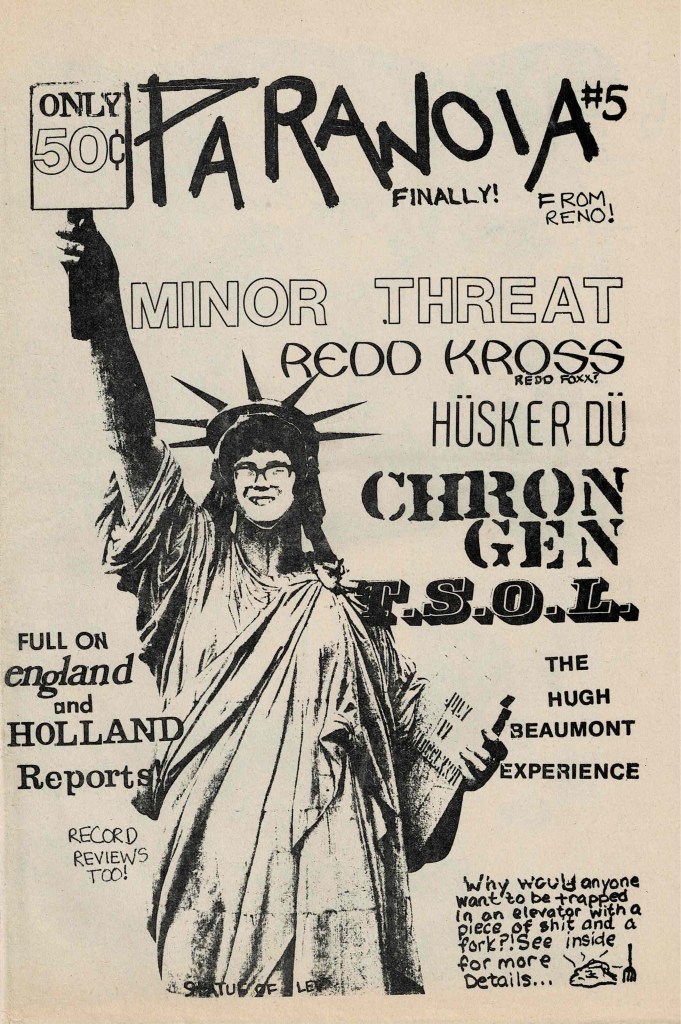
The wizened elders amongst us may remember when Reno, Nevada was a primo hardcore punk rock hot spot that gave birth to slammers like 7 Seconds, Urban Assault and The Wrecks. In the 1981-83 hardcore heyday, tiny Reno was a stop on the touring grind for Black Flag, Husker Du, DOA, The Fix, Minor Threat and countless others. The scene’s “house organ”, if you will, was Paranoia, put out by Bess and Jone from The Wrecks. We celebrated their 4th issue from earlier in 1982 here; we shall be discussing their lively fifth issue, also from 1982, presently.
It starts off with a bang in the letters section, where one GG Allin writes in frothing mad (and cursing!) about a record review. Bessie & Jone try to one-up him with a delightfully snarky response. Grace Ann Sawyer writes in as a new resident in the Reno/Sparks area and says “I am starving for New Wave action of any type”. I certainly know the feeling, Grace Ann! Then it’s on to the news, where we learn that “Bryan Jones, the 15-year-old lead singer of Jerry’s Kids from Boston, Mass was forced to quit the band by his father”. There’s other news about Robo joining The Misfits, Void breaking up, and “Henry from Black Flag and Ian MacKaye from Minor Threat have thoughts of putting out a comedy record”. Had said thoughts been acted upon, this might have been the worst thing I’ve ever heard, save for Jello Biafra’s stand-up comedy records that unfortunately did come out.
Next we’re on to the interviews and detailed scene reports from Holland and the UK. There are talks with Chron-Gen, Husker Du, the Hugh Beaumont Experience and TSOL, who are vapid and dull-witted as always. Of course, I had to adjust my seating and get a glass of water to settle in with the Minor Threat interview. At this point, they’re all under 20, don’t like San Francisco punks and think Reno compares quite favorably. To each his or her own. Naturally, there are some detailed explanations about what “straight edge” both is and isn’t. Ian’s not against sex; “I think it’s a great great thing”. I also learned for the first time that Ian MacKaye once did codeine, and “it was boring”. This is what precisely what teen punks – and I – have come to Paranoia #5 for.
Born Innocent-era Red Kross have just changed their name, and are interviewed by Bess. She starts asking some gross-out questions (nose-picking, butts, and all manner of what have you), sadly causing my all-time punk rock heartthrob Tracy Lea to wander away from the interview that she’d previously been an active participant in. While they’re being interviewed here in Reno, the McDonald brothers ask Bess if she’s ever seen The Wrecks. She informs them that she’d recently been in The Wrecks, but that they’d just broken up. It’s as dumb of an interview as I’ve ever read, right up there with some of the We Got Power chats for pure intellectual firepower.
Minor Threat and Husker Du have just played Reno, separately; otherwise Bessie and Jone are driving to San Francisco and sometimes Sacramento for their gigs. Man, one time I drove to Reno and back from San Francisco in one day trying to elect Democrats in Nevada in 2016 (you may remember one of them, Hillary Rodham Clinton), and let me tell you, that is a hoof. Anything for the blessed ‘core. These women and all of their friends are just having a blast; as in the other issue I reviewed, there are multiple party pictures, cut-outs of people smiling, at gigs, making out etc. The reviews, such as they are, are also pretty fun. The Fartz’ World Full of Hate is summarized with the very helpful “If you like The Fartz, get this.” Who didn’t like The Fartz??
Finally I learned a bit about The Sluts from New Orleans. Barry Goubler, did you see this band? They love The Stooges, Bad Brains, Black Flag and Saccharine Trust, so I say what’s not to love about them. I guess Dee Slut from the band had a little notoriety himself, unbeknownst to me – read all about that here.
-
Who Put The Bomp! #13

Except for the couple of times I’ve written about fanzines that a friend personally xeroxed and assembled for me, my rule here at Fanzine Hemorrhage is to only blather on about zines I personally own. So, while I’m absolutely long in the proverbial tooth, that’d negate stuff like Who Put The Bomp! #13 that came out when I was seven years old; unless, of course, I went and paid some large multiple of its Spring 1975 $1 cover price in order to own it – which is exactly what I did. As discussed last time we looked at Greg Shaw’s fanzine, my goal is to try and hunt down as many of the pre-punk issues of this as I can find and/or afford. Recently, this one came into my hands, and I’d like to tell you about it.
I don’t know about you, but I have a weird fascination with what rock & roll nostalgia looked like for folks when rock music was not even two decades old. Elvis, Charlie Feathers and Carl Perkins were still alive. Even Keith Richards was still alive. So Shaw’s big thing here on the rockabilly revival is kind of a hoot; many of the late 50s/early 60s 45s are being dug up for the first time and thrown out into the world on cheap-looking compilations, and “record collecting” is really starting to become a thing as a result. Shaw talks about it in detail. You’ve seen some of these comps before; they’d look like this and used today they sell for about what they did new back then.
Of course, Happy Days was something of an instigator of all the 50s nostalgic hullabaloo, but what I’m more interested in is what record collecting looked like in 1975. Set sale lists, painstaking discographies with catalog numbers, and man oh man – the sorts of mind-melting finds in record stores that guys like me only dream about in 2024. Can you imagine having a 60s punk 45 want list and stumbling across all the original singles for a buck or less, the monsters that’d come out on the Back From The Grave comps ten years later? Anyway, if you were that guy – and you were almost certainly a guy – Who Put The Bomp’d certainly be required reading.
Greg Shaw, an eternal optimist, surveys the world of rock music in early 1975 in an opening editorial, and sees that “70s rock is reverting to a 60s pop aesthetic”. His entire essay pushes against a narrative that 1975 is just as godawful musically as 1971 was, and hey, depending on one’s perspective, I suppose he was probably correct that “good times” were on the way. I’m just not sure it was a Beatles-esque 60s pop aesthetic that would lead the way in 1976-77. And honestly, looking at the record reviews in Who Put The Bomp! #13, it all just seems super grim to me, warmed-over glitter and boogie and pub rock. There’s a great review of the first AC/DC single, a total laff I’d never heard, and which you can watch an early video of here (do it!). He says “Their similarity to the early Easybeats is startling”.
He also reviews the debut King Uszniewicz & His Uszniewicz-Tones 45, and of course totally gets it and loves it to death. There’s a big piece on Michigan sixties rock, including a discography of A-Square records who put out MC5 and Rationals singles, and a related bit on Bob Seger, where I learned to my surprise that he did the original of the Lazy Cowgirls’ “Sock it to Me Santa”, released by Shaw’s Bomp Records nine years after this fanzine. Seger’s B-side was called “Florida Time”, “the only known song to glorify Florida’s surfing scene”. You might need to listen to that too.
Here’s another fun peek at the 1975 vantage point: Shaw writes that “The MC5’s best song, ‘Black to Comm’ was never recorded”. By the time I got into said band around 1985, that particular song had such the underground cache, total holy grail music that everyone wanted to hear. I’d wildly imagined this crazed, long, howling guitar blowout that’d be “Rocket Reducer” x100 and the total personification of “dope, guns and fucking in the streets”. Big disappointment when I finally did hear it, a fun rave-up but a huge sonic drop off from “Sister Ray” and “Fun House/LA Blues”. The MC5 never really had one of those, did they?
The single best thing in Who Put The Bomp! #13 is “The Rise & Fall of The Hollywood Stars”, written by Kim Fowley, and who happened to be the guy who sired them into existence and, for all I know, helped to screw them up and ensure their demise in one year. It’s really a fun read. I get this band confused with another flame-out band called The Hollywood Brats who had an entire book written about them that I see remaindered every now & again. After Fowley’s piece, a supposed 15-year-old Lisa Fancher follows up with her own piece about how special the Stars were over the course of their five gigs at The Whiskey. Here’s a good interview with her about those days. Next time I’ll try and give the 15th issue of Who Put The Bomp! a whirl, OK?
-
Ragnarok #6

In my lifetime there have been no hometowners like Cleveland hometowners – which is to say that underground fanzine guys from Cleveland have traditionally covered their oft-maligned city and its punching-way-above-their-weight bands with the fervor and boosterism of highly-compensated Chamber of Commerce execs. “That’s okay with me”. Cleveland was a rock town for decades with a per-capita scene batting average high above the norm, I’m talking from ‘75 onward into the 1990s, even into June 1991 perhaps, which is when the digest-sized Ragnarok #6 came out.
Make that “Steve Wainstead’s Ragnarok”, as it says on the cover, in a feat of awesome doofus branding that just makes me laugh. Wainstead is indeed a hometowner, and outside of some visiting touring bands, Ragnorok #6 is C-Town all the way. If I didn’t know a little bit about Puff Tube and the Soul Vandals and whatnot – probably from Seven – Scat Records Quarterly and the 1990s version of CLE – I’d have no idea what he’s talking about. And again, that’s fine. His aesthetic is type, cut, paste, repeat – with vintage illustrations and graphics helping to tart up the overall environment. Any punk- or noise-adjacent show in Cleveland from the preceding month that he and his crew attended gets reviewed, with one megawatt event in particular (Puff Tube/Soul Vandals on 5/9/91, where were you??) getting six different reviews, including one from Cleveland royalty, Charlotte Pressler!
Steel Pole Bath Tub are the out-of-towners treated with respect. They were from my town, San Francisco, and around this time I was pretty well fed up with them, as they seemed to be the opening band for every other mid-sized show I went to that year. If it wasn’t them, it was The Melvins. At least one larger show I attended it was Steel Pole Bath Tub and The Melvins opening. I cared for neither, and I was always the guy who believes it when they’d say “Doors 7 / Show 8”, and then I’d show up at 9pm and walk in as Steel Pole Bath Tub were starting their first song. However, in their Ragnarok #6 interview, all three gentlemen are intelligent, funny and quite road-weary, with a good sense of their place in the whole cosmic joke. Now I feel just awful having tried to dodge them all those years. Boner Records 4-ever.
There’s another interview, this time with locals The Vivians, whom I’d never heard. Check out the entire campus at Case Western having a motherfucking rocknroll riot during one of their sets here. The Pressler stuff near the end is cool to read, though it spins out into the pointy-headed academic meandering that I’m sure made some sense to her at the time. In all, good local fanzine and you’d have bought one for three quarters yourself after a big night of excess at Peabody’s Down Under.
-
Rock Scene (March 1976)
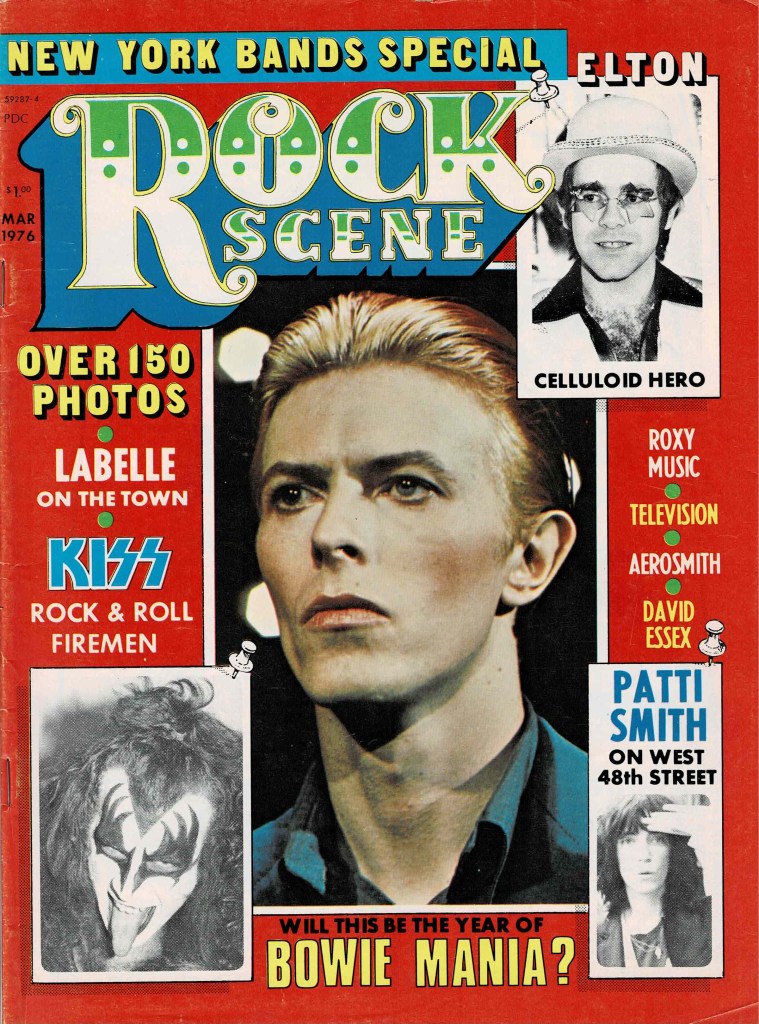
You know and I know that Rock Scene wasn’t a fanzine, and that it probably has no place on this blog. Yet they were so well-situated at the nexus of the pre-punk void, before 1976 and all it represented, that it’s one of the absolute best places to get a handle on how tastes, fashions, criticism and fandom itself were evolving in the mid-1970s. I mean here we are in March 1976. There’s no mention of the Sex Pistols, who’d played 13 gigs to that point, but everyone here will hear them in about in a few weeks and go bananas – the shot in the arm editors Richard and Lisa Robinson were looking for in their post-Dolls landscape, despite all that’s already going on right in their hometown of New York City. Rock Scene would embrace punk in a big way, without leaving the remnants of glitter, glam and hard rock behind, at least in what I think was their 1976-78 heyday.
Rock Scene was very much a NYC mag. They called themselves “The alternative to the alternatives!”. While that may be going a bit far in the era of Back Door Man, Who Put The Bomp, Chatterbox and countless others that I don’t own and wish I did, I actually enjoy it even more than Creem and certainly more than Circus. This is despite not having a ton of written content and much “criticism”, as it were. This March 1976 issue is a big drunken party on the streets and in the clubs, full of photos and photo essays with only a modicum of commentary to support it all. I figure as long as they were paying photographers like Bob Gruen, Leee Childers and Raymond le Fourchette well for their snaps – because they’re fantastic – it’s actually pretty fun to read an inversion of the text-over-visuals form that’s pretty standard in any fanzine or magazine dabbling in underground rock.
Besides, it is a fanzine when the editors are given so much leeway to cover whatever the hell they want, and then insert themselves into the visual narrative as often as possible. Richard and LIsa Robinson take an exceptionally onanistic approach to their duties by printing as many photos of themselves with rock stars, record execs and scenesters as they can fit. There are 5 with Lenny Kaye and either one or both of them in this issue alone. Because it’s early 1976, there is a bunch on the CBGB scene, with Heartbreakers and Television pics I’ve absolutely never seen. Cyrinda Foxe gets herself into many a photo, as well she should, and Lance Loud is out and about as well.
There are other photo spreads on Cherry Vanilla, Roxy Music, The Marbles, Patti Smith Group (with Ivan Kral giving Shaun Cassidy and Leif Garrett a run for their money in the set-teenage-girls’-hearts-aflame dept.), Elton John, David Bowie and Jim Dandy (!). There’s an early photo spread of Blondie’s Debbie Harry with a totally different, almost Midwest Christian wife look that I kinda like. (She doesn’t have a real name in this magazine – she’s “Blondie”). There’s also a “new bands” section trying to drum up excitement for Killer Kane, a Raspberries spinoff called Windfall and a bunch of hairy New Jersey bands. There’s even a Sable Starr (LA groupie) action shot to give the west coast a little love.
There is some actual writing, though! I appreciated an entire column about comics – Marvel, DC and comix – treating it all very seriously and simpatico with rock and roll. There’s some BS about Kiss at a high school – I can’t read anything about Kiss – but there’s also a great letter to the editor from one “Peggy O’Neil” about how great Kiss are. Could it really be this Peggy O’Neil?? Donald Lyons writes about the film scene in 1976 and finds it “lousy”, this the year of Taxi Driver, The Killing of a Chinese Bookie, Mikey and Nicky, Network and Marathon Man, which was hot on the heels of an even better 1975. Don’t get me started.
-
Damp #2

In 1987, Damp editor Kevin Kraynick openly worried in the pages of this issue that he’d be lumped in with fanzine editors “who are the kind of guys who always got picked last for kickball games in gym class”. I mean, sure, but if the shoe fits….right? So in meager compensation, there’s some aggro finger-pointing and posturing in places where there oughtn’t be any – “whatta dick”; “you bet your globular ass”; that sort of thing. Certainly, Damp grew up a ton in subsequent issues – including #3 that we discussed here – but was still taking some young man’s cues from Conflict without quite having the chops to approximate its humorous vitriol.
That said, I bought Damp #2 then and I’d have happily owned it now for 37 years had it not been “disappeared” in the Great Starving Students Lost Fanzine Box. Only recently was I able to procure a copy again, perhaps even my own original for all I know. Slight concerns aside, it was an unalloyed pleasure to read cover to cover last night. There is an interview with New England locals Expando Brain, one of my very favorite super-far-underground rock bands of the mid/late 80s. Kraynick also pulls together a well-researched Snakefinger interview that’ll always be my primary source material should I ever need to do any serious Snakefinger research, such as to write a paper. There are also interviews with acts that only a young man might pretend to like – Big Dipper and Zoogz Rift – but then there’s also the only piece I’ve ever seen on The Longshoreman, a long-running San Francisco band featuring Judy and Carol from Pink Section and the Inflatable Boy Clams. Kraynick was clearly looking a bit afield from the alterna front-runners of the day, your Soul Asylums and Big Blacks and whatnot.
Sometimes the vituperation is pretty funny in his reviews, too, as in this fine intro to a Dash Rip Rock review: “Front cover shows the band burning guitars in the fireplace and let’s hope those are the only ones they’ve got”. As it turns out, even Kraynick knows that the miniscule 4-point font for record reviews that he’s using is utterly comic, and christens the whole section “The World’s Tiniest Record Reviews”. This was the era of Squirrel Bait, Butthole Surfers, Dinosaur and Halo of Flies worship, a consensus that emerged in the East Coast fanzines I read all the way across the country in Santa Barbara, and my taste was molded accordingly. For some reason David Ciaffardini is a great target of derision, which I kind of understand if you were comparing his Sound Choice magazine with, say, Forced Exposure, but he was an exceptionally friendly dude whom I knew personally, a true mensch from the word go, and someone whom I recently re-established contact with after 35 years.
The snarky sub-underground fanzines all had to have their “out crowd” for sure, and there was a consensus pile-on against the same targets, the supposed “guys who always got picked last for kickball games in gym class”. Clowns like Tesco Vee and Lydia Lunch got a free pass for some reason, probably for the same reason confident extroverts always have and always do. If you can convincingly act the part, it doesn’t matter how brainless your material actually is; if you cower and show weakness in any social circle, particularly one in which young men are attempting to preen and show off for each other’s benefit, you get bullshit like over-the-top Mike McGonigal hatred and Baboon Dooley. I wasn’t totally immune myself when I started in this racket a few years later.

Then again, maybe we all just wanted to be Byron Coley. He’s interviewed here, the second part of a 2-parter, the first of which I’ve never read because I’ve never seen Damp #1. I remember reading this interview back then, and he praised the Lazy Cowgirls – who were my absolute favorite band – and it was a big, big deal to me, the voice of God anointing my own musical taste as being first-rate. And he also made fun of SWA, who were absolutely my friends’ & my favorite musical whipping post around this time. These “photos” of “Jimmy & Byron” from Forced Exposure definitely generated some chatter at the time as well, as it was hard to know what these guys looked like in an era before The Face Book and before I was able to Ask Jeeves. It took me at least a few years to realize 100% that these weren’t the guys.
Finally, Damp #2 closes up with a guy named Wandz, who has his own page of “Hip Cat Jazz Reviews”. He even writes as if he knows what he’s talking about. A nice icing to a pretty packed fanzine.
-
The Offense #15
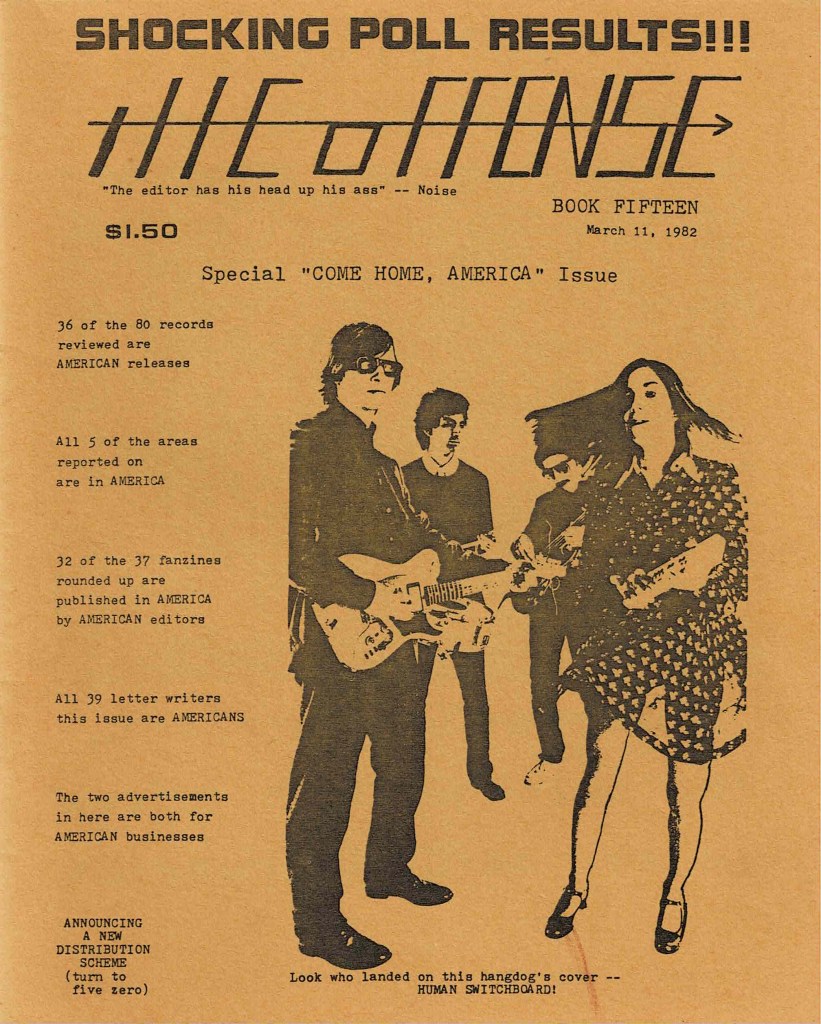
Last summer I worked myself into a small lather attempting to pick apart 1981’s The Offense #12, which you can peruse right here. I’ve got a few other issues of this thing in my stacks that we ought to talk about, such as March 1982’s The Offense #15. Not only must I beg and struggle for good lighting and total concentration in order to actually read its microscopic print, my head aches all the more for just how ridiculously stacked it is. Really, it’s 51 pages of content that could have easily been 102 pages with different layout decisions, and its breadth is just mind-boggling.
Hailing from Columbus, Ohio – no one’s real idea of any sort of musical hotbed at the time, yet it was just about to be rightly perceived as such over the following 15-20 years – The Offense was helmed by Tim Anstaett, who staffed it with a group of dispersed individuals, each intensely devoted to underground music and the life surrounding it, as well as to extending their tentacles to contact and convert every like-minded soul. I mean, it’s almost a crusade with these folks, and I remember very well this devout intensity of feeling of both being an outsider and worshiping other outsiders, and to gobbling up every bit of underground music, film, writing and gossip as I could.
Honestly, The Offense would have been my favorite mag in 1982 had I’d known it existed, because it was over-the-top anglophilic (as I was), while deeply interested in the American underground and what was happening in individual cities, or, as we once called them, “scenes” (as I was). UK chart-toppers live uncomfortably here side by side with the fastest and meanest American hardcore bands, and letter writers range from nascent goth girls to new wave goobers to Barry Henssler of The Necros, raving about his visits to the DC scene. You can see on the cover here that much mirth & merrymaking is being had at combatting the mag’s reputation as “anglophilic”, right up the dawn of the USA-love-it-or-leave-it Reagan era.
The 1981 readers poll results lean way more post-punk and English, which likely reflects that, at this point, there were no American publications covering that music with any sort of knowledge nor intelligence save for perhaps Trouser Press – and they were really just trying to stay alive at that point by putting Adam Ant or whomever on the cover. I’d buy two-months-old Sounds, NME and Melody Makers if I wanted to read about my faves Bauhaus or the Au Pairs or Simple Minds. At The Offense #15, the big winners are The Psychedelic Furs, Joy Division and Siouxsie and the Banshees – but also, there’s some serious coverage of underground Ohio as well. Human Switchboard are on the cover, and there’s lots of love for Naked Skinnies (who I only know as Mark Eitzel’s first band) and something called Razor Penguins.
The writing staff is populated by heavy hitters such as Ron House, Don Howland, Steve Hesske and the “controversial” Seattlite Joe Piecuch. I think it’s House who writes all his reviews like they’re song lyrics, like this for the Process of Elimination comp (currently selling for $271 on Discogs – I had this record!!): “Necros alternately try to be the scariest and fastest of all and succeed / Violent Apathy win shit production recognition, with most the others close runners-up / what’s wrong with saving your gig money for time in a decent studio with someone behind the board who halfway knows what he’s doing? / guess then it wouldn’t be a team effort /” – and so on. It takes some getting used to, but hey, “why be normal”, right?
There’s really no sense of what someone’ll think about something; records now part of the canon get slammed; commercial mediocrities like U2 and the “Fun Boy Three” are canonized; tiny underground bands can go either way. Hesske loves The Bongos’ “The Bulrushes” – so did/do I. Again, if I’d come across this at John Muir Junior High toward the end of 9th grade I’d have absolutely taken out a subscription and likely been king shit of turd mountain at my school (nah, I’d have absolutely gotten my ass kicked if I brought it to class).
Anstaett bemoans that only 1000 copies were able to be printed of his mag each issue due to various distribution snafus the past year. I’m just glad one of them landed in my paws eventually, and as it turned out, this was the final issue of The Offense before it relaunched as the smaller The Offense Newsletter later that year.
-
Outasite #1

For me, the name “Greg Prevost” had mostly meant one, or rather two, things of consequence: the amazing, blown-out 1978 Distorted Levels single, and its belated and even more over-the-top Mean Red Spiders follow-up, which wouldn’t come out until 1990. Truly one of the all-timers for catastrophically ridiculous gargle-mouth vocals, unnecessary male screaming, violent lyrics, and blitzoid, sped-up Stoogified guitar worship. That’s my Greg Prevost. Turns out he was in some other bands as well and did a ‘lil fanzine called Outasite, an early 80s issue of which just crossed my transom.
Now I know this is from the early 1980s because Greg mentions his favorite band are The Zantees, but his opening editorial and highly-believable copyright symbol tries to mark Outasite #1 as being a fanzine from “1966”. The advertisements and clip-art from various teen mags are lined up accordingly, but his heart’s not really into the joke. A thing pops up about The Nazz; records are reviewed that came out in 1967; The Byrds and Chocolate Watchband (who he really interviewed!) talk about post-’66 stuff and so forth. I didn’t intend to hold him to the conceit as I read it.
I will hold him accountable for entertainment and educational value, however, and on that front Outasite #1 is a bit mixed. It might be that his taste in “outasite 60s psychedelic” stuff runs a bit more pedestrian than I’d have hoped. I mean, even in 1981 or whenever this was truly out there, page-filling photo features on The Rolling Stones, Yardbirds and Paul Revere & The Raiders really didn’t add much to any conversation that was happening or to any furthering of wild, underground 60s garage punk. It’s only those interviews, especially the one with Groop Ltd. – that really have any heft, and even those are little more than name/rank/serial number Q&As. There’s too much teeny bopper diddling, and not enough of the raw meat I so desperately crave.
Some of the reviews near the back get at the true fanzine qualities that might take this one into a higher strata. Prevost is a record collector, see, and his passion for 45s he’s found on record excursions is immense, clear and fetching. Love the devotion to uncovering every 60s jot & titter by any band connected with Rochester NY, his hometown, but he’s also a huge fan of the mind-melters from 1965-68 Texas, including Knights Bridge’s “Make Me Some Love” – a major favorite here at the ‘Hemorrhage. Somehow in the course of clicking around the internet I learned that this is the same Outasite mag that eventually put out this and this, too. Those definitely might be worth a flip-through some sweet day.
-
Subscribe
Subscribed
Have a WordPress.com account? Log in now.

