-
BravEar #10
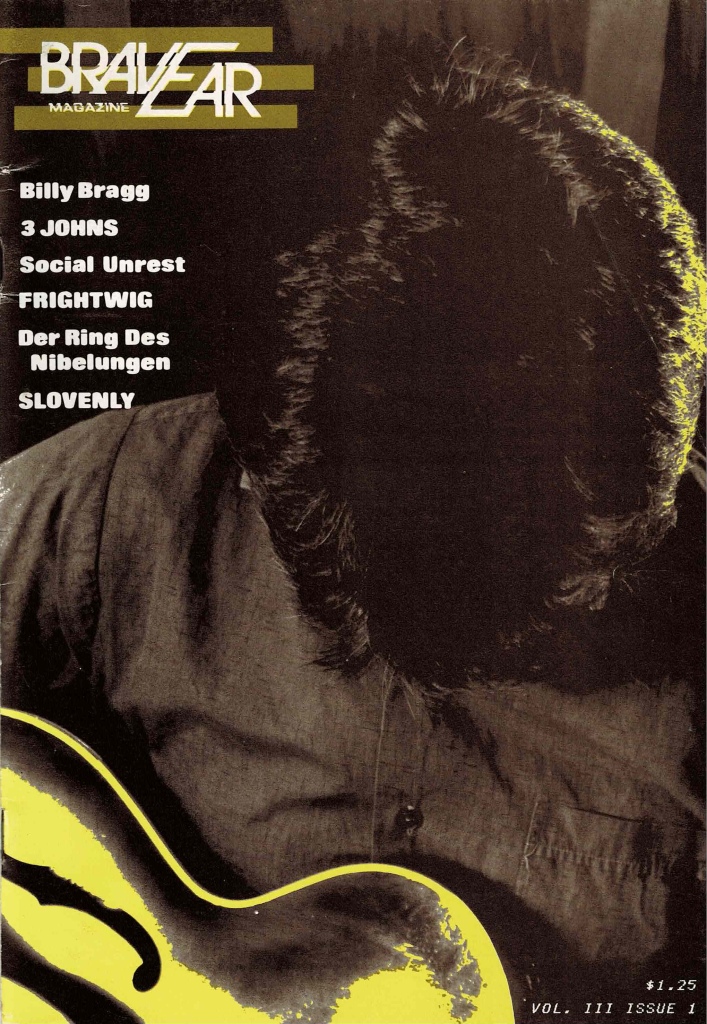
I didn’t exactly provide the most ringing endorsement of BravEar #12 when I talked about it here, and I’m not going to pretend that BravEar #10 from 1985’s a whole lot better, though remember I’m nitpicky and regrettably still fighting some of my teenage/early twentysomething “scene battles” in my head even now. What’s unique about this nearly forty year-old fanzine is that it’s one of the few that I have that old that I bought when it came out, and that I didn’t lose or damage somehow. You can see from the cover – which is actually a very well-done minimalist cover – that this San Francisco fanzine mixed it up stylistically without fear or favor, and good on ‘em for it.
Rory Lyons was the editor, Michael Miro the publisher and Seymour Glass – yeah, that guy – the star/ace reporter. There’s an opening faux gossip column that I know they carried over multiple issues called “Viv N’ Sandie”. They provide news you can use, such as the hot item that MDC’s rad-anarcho-veggie singer Dave Dictor “has opened a groovy veg-a-mighty snack bar in the midst of SF’s Mission District. Dave whips up millions of dead alfalfa sprouts as well as fro-yo and other delicacies”. Why is this culinary landmark not still around??? Who killed it? Reagan, that’s fucking who. They’re also giving unfortunate ink to the birth of one of San Francisco’s absolute worst trends of the late 80s, the “punk-funk” bands, by talking up “SF’s answer to the Red Hot Chili Peppers, the Three Mouse Guitars”. Thank christ I never saw that band, but I’ll admit that somehow I once caught a set by “The Freaky Executives”.
Frightwig get a post-first LP interview by Terri Sutton. I greatly enjoyed Frightwig interviews through the years, such as the one we discussed here. Here they say “We’re the female equivalent of macho men” and talk about reactions to them when they play live: “From Kansas City to Denver to back here, the consistent reaction I’ve heard – same words too – was these guys goin’, ‘Man, I’ve got a HARD-ON’”. Billy Bragg comes off as a pedantically boring lefty, total P.E.A.C.E. creep all the way. The Three Johns – yeah, Jon Langford from The Mekons was in this band as a part-timer; these Brits also talk about The Tories and the Miners’ Strike for their American underground music audience, raptly paying close attention I’m sure. And Social Unrest are called onto the carpet to defend why they’re still playing hardcore punk in 1985. Why indeed.
For whatever reason – and hey, I’m good with it, it’s definitely breaking the mold, there’s “part one” of a big piece about Richard Wagner’s Ring Cycle. “Der Ring Des Nibelungen”, baby. If you’re like me, you first heard “The Ride of the Valkyries” from this in that badass helicopter gunship scene in Apocalypse Now, and thought that this was some classical music you could get into. Then you learned a bit more about Wagner and his anti-semitism and how Hitler loved the guy and then you maybe thought you weren’t that into him. Then you remembered not to mistakenly conflate art with the artist, and recalled that this is always the best rule to follow, and were cool with Wagner again.
Seymour Glass gets to say his piece and interviews Slovenly. My takeback from this interview and others I saw with the band around this time was that they were ridiculously (and undeservedly, in my eyes) unpopular, and they knew it. Glass asks them, “Do you consider the album successful on any level whatsoever?”. Guitarist/bassist Tom Watson responds “At least we got it out”. Aim high, Slovenly! And in the reviews section, I had to laugh when I read Lyle S.’s review of Alex Chilton’s show at the I-Beam on 6/24/85: “Granted, when a singer/guitarist is 34 years old the voice and fingers don’t do what they used to at age 21 and 22, and it was evident this night, especially when Chilton performed those ‘72-’73 Big Star classics”. Ouch, 34 years old and too old to rock effectively. Keep that in mind if you’re in a band right now and creeping up on 30, okay?
-
Coolest Retard #15

So let’s be clear – I wasn’t shuckin’ and jivin’ in the Chicago clubs in July/August 1981, and I only became aware of Chicago’s Coolest Retard fanzine from that era this year, 2024. Thank you Todd N. Once I got the lowdown on it and was allowed to see – and touch! – a couple of copies of the thing, I resolved to track down a copy somehow, and Coolest Retard #15 is the one I chose as “the one to grab”. I mean, that cover, right?
Somehow the tribute piece to Mark E. Smith as “Retard of the Year” is even better than expected. Grotesque is the newest Fall record at this point, and like Kickboy Face, editor Craig Schmidt totally gets it. (At least I think it’s Schmidt – the piece is uncredited, but it’s the best writing in here, and who else but the fanzine’s editor gets to bestow the honor of coolest retard?). Who knows Craig Schmidt’s story out there? Schmidt, you there? Drop us a note in the comments, anyone, or contact me via electronic mail so as to further my societally valuable and highly desirable fanzine scholarship.
“Quite frankly The Fall are the only group I listen to at times. Not because they are so smoothing and soothing, but because there are so many loose ends to tie up…..They throw together their album sleeves, and chock them full of stories and myths about R. Totale and his son Joe. Mark indulges in hit and miss vocals (I dare you to try and replicate his vocal on New Face in Hell), kazoos pop up in songs, not as clever additions but as prominent keynotes in the song. Production aspects travel the gamut of the control board, definitely pass the level of ‘good’ taste”. Yep. How great was it to hear and enjoy The Fall for the first time, folks? I heard This Nation’s Saving Grace first in ‘85, and it’s fantastic – but I had the pleasure after that of diligently working my way backwards, and right or wrong – and there are many opinions here – had the liberty to not care much of what came out after 1985.
Coolest Retard #15’s most distinguishing characteristics beyond this, and I say this with zero malice, are its Anglophilia and the sheer number of ads from local clubs and businesses they were able to hustle into the thing. Profit margin on this cut/paste/staple job must have been immense! Schmidt, you out there? Anyway, touchstone bands beyond The Fall in this one are Gang of Four, Stranglers, Echo and The Bunnymen and the Au Pairs, among others. Even some early synth-poop like Heaven 17 – not the Canadian one – sneaks in. There’s some talk of punk and nascent hardcore, with news shared that The Fix are about to play the west coast with the Dead Kennedys. I just blasted a bunch of Fix in my car the other day – just an absolute onslaught and easily one of the ten great true HC bands of all time. At least that’s what I say. There’s some early coverage of Chicago locals Naked Raygun and Strike Under and the Busted at Oz bands.
Another interesting piece and very of its era is “That African Sound” by Johnny Von Damen, which looks at how African polyrhythms are sneaking into all sorts of rock and rock-adjacent music right about now, from Public Image Ltd. to Bow Wow Wow to Brian Eno. “Von Damen” welcomes the trend, and recommends, and I quote, that you “give it a spin!”. Whoever reviews The Cramps’Goo Goo Muck/She Said 45 believes that new guitarist “Kid (Congo) is no Bryan Gregory but a hell of a lot better than Julian”. Julian! Julien Hechtlinger, aka Julien Grindsnatch, was in The Cramps for about five minutes in 1980, famously playing second guitar on stage in the song captured for Urgh: A Music War, one of the greatest moments of historical culture ever recorded. No shade thrown to Julien, please. Finally, we learn in Coolest Retard #15 that Black Flag will be playing at local club Tuts on Wednesday, July 15th – and the next night at the same club, The Fall with locals Da. If you’re up for the threepeat, the next night you can go see The Psychedelic Furs. “Knowing what I know now”, I’d have been at all three for a back-to-back-to-backer the Summer of ‘81; hangovers, school and the fact that I was 13 and living in California and not reading the ‘Retard be damned.
-
Butt Rag #5
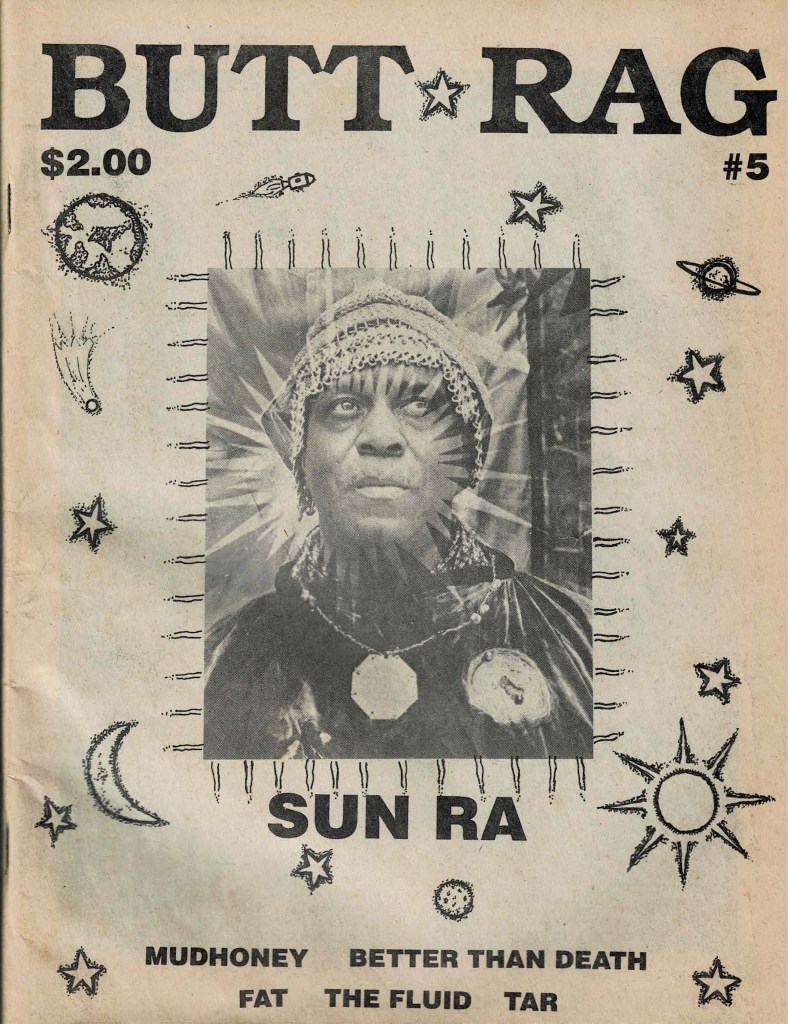
Peter Margasak has, over several decades, come to represent for me what one might hope a snot-nosed 80s fanzine writer would ultimately blossom into with practice, open-mindedness and intense on-the-ground, in-the-clubs lived experience. I suppose one gets out of it they bring into it, and jeez, even in 1989 and in Butt Rag #5, Margasak’s taste was incredibly expansive and pushing ever outward, even as he gossip-mongered about Amphetamine Reptile records, Mudhoney and Sonic Youth. Even more so than in the previous issue of Butt Rag I wrote about, Margasak is caught suspended in amber here – for both better and worse – between the often mean-spirited tenor of US rock/underground fanzine-speak and a guy who’s leaving it all behind for intelligent forays into boundary-pushing music of many types.
To wit: talking about Steve Albini’s passing in his post just yesterday on his Nowhere Street site, Margasak says, regarding Albini and himself, “His lacerating wit and scrupulous code of conduct arrived like a worthy ideal. I tried to ape the way he and peers like Byron Coley and Gerard Cosloy wrote about music; being harsh seemed cool. Of course, it was stupid, misguided, and often cruel”. Alas, that’s something I do take away a bit from Butt Rag #5. In the intro essay, it’s relayed that David Thomas of Pere Ubu has just passed on an interview with the fanzine, “due to the obscene nature of the name of this publication”. Then Margasak fat-shames the hell out of him.
Yet his tastes were generally more open than those of his peers and certainly more than mine were in 1989. He’s into the deeper layers of indie/underground rock; noisy stuff, and especially avant-music trending toward free, far-out jazz and whatever honking and squirting is going on in the late eighties – very much including reissues and new discoveries from actual jazz legends and long-tail heroes. Margasak and I would have found common cause over a beer in Mudhoney and The Fluid that year (!), though, like many of his fanzine peers, he thought that the Thrown-Ups were fantastic (“three brilliant singles on Amphetamine Reptile”). You be the judge. Tar, whom he also talks to here, never did anything for me, but they made several dozen people happy and that’s just great. Not to speak ill of the dead, but Tar say in this mag that they were not happy recording with Steve Albini and found him, contrary to later reputation, to be far too heavy-handed and opinionated with them. (and if you’d told me in 1989 that the NY Times and The Atlantic would publish well-crafted Steve Albini obituaries on the eventual day of his death, I’d have seen it as some sort of unanticipatable upside-down world).
Then we get into the stuff that excites me now. A band called Chewing The Fat are interviewed by John Corbett. They are compared with Massacre, whom I’d shamefully never heard until this year, and who are one of my favorite recent “discoveries”. I can’t find anything online about Chewing The Fat, and I reckon that might mean that they never recorded. (Update: I’ve subsequently been informed by Peter Margasak himself that the band were just called FAT – just like it says on the cover – and their music can be found here).
There’s another piece on an improv-leaning band called Better Than Death, and then, of course, a John Corbett Sun Ra interview from 1985, which made it only 4 years old. Ra talks about his trips to Jupiter, that what he’s doing is “the first time this has ever happened on this planet”, and a lot of his usual patter – “the ‘avant-garde’ refers to, I suppose, advanced earth music, but this is not earth music….I have to play things that are impossible. I have to get a piano and hit some notes on there that aren’t on there”. You can see why we love the guy – I did long before I’d even heard his actual music. It’s still discordant for me to imagine Margasak having John Corbett writing for his fanzine, but that’s because I came to Corbett not when he was a 26-year-old writing for fanzines, but when he was the polished and highly experienced writer of jazz/improv books from the past decade like A Listener’s Guide to Free Improvisation and Vinyl Freak.
Then follows, as in Butt Rag #8, an absolutely massive section of reviews. These straddle both sides of that young man trapped in amber. Reviews range from High Sheriff Ricky Barnes & The Hoot Owls to Sub Pop neanderthals Blood Circus; Anthony Braxton; the Cowboy Junkies, whom he loves (nothing wrong with that); Galaxie 500; Machine Gun reviewed by Corbett, David Murray Trio, that Nirvana debut 45 i sold for $80 that’s now worth $10,000; Reverb Motherfuckers (he’s decidedly not a fan); the first Royal Trux; Talulah Gosh and the phenomenal Venom P Stinger 45.
Sometimes it’s clever, sometimes it’s not. He reminded me that people used to call Dinosaur Jr.’s Bug LP You’re Living All Over Me All Over Again – or maybe it was Margasak himself that started that “meme”, in this very issue. Regarding a Philly band called More Fiends: “Turning in an above-average effort in Philadelphia is generally several notches below what the same quality would rate nationally”. Well said. (This ratio would change for the better in the 1990s). By the same token, he’s really on board with the simpleton consensus on Halo of Flies; their new single “rips your head apart”. Fuck yeah! L7, the awful LA mostly-female band, well – “apparently the guitarist in the Laughing Hyenas got her start in this ancient band”. Alas, that was this L7, seven years earlier.
A review of a Chemical People album on Cruz Records: “I sure hope Greg Ginn gets his shit together, ‘cause I can’t take any more of this crap.” It may not have seemed so running a music fanzine at the time, but I’ll posit there was actually zero reason to take said crap in the first place. My life was bountifully enriched, and my lifespan possibly extended, by not listening to anything on Cruz Records, ever. I’d get records like that in the mail, and they’d go straight onto the Amoeba Music “to-sell” pile, unlistened to and most certainly unreviewed. As it should have been, for the betterment of the scene! And then in Butt Rag #5, there’s another giant section of short reviews after all of the longer reviews. It’s a lot to take in, but it’s fantastic to have it around when needed, and another reminder of this absurdly record-drenched era and its more general mania for over-the-top music documentation in print.
-
Surfin’ Bird #3

I possess more than a few fanzines, some even from countries besides my own, but I’m pretty sure Surfin’ Bird #3 from late 1979 is my only punk-era Canadian fanzine. Aside from Denim Delinquent and The Pig Paper, I personally don’t know of any others (?) from the pre-punk and punk interregnums. Well, I’m delighted to have this one from Verdun, Quebec in any case; it reinforces strongly what I felt when I was the merch guy for the band Claw Hammer in 1993 during their gig in Montreal: “Whoa, this is like being in a foreign country” – something I really don’t feel in Toronto or Vancouver at all.
Case in point, their local scene(s), aside from punk bands like Teenage Head (who give the best interview by far in this one) and new wave acts like Toronto’s Martha and The Muffins, are wholly unknown to me. You might have known about the Canadian band Heaven 17 – not to be confused with the English synth-pop duo – but I sure didn’t. Maybe you’ve been a lifelong fan of Segarini and the 222’s and Lorne Ranger and know all about a Jam knock-off band called The Mod, but Surfin’ Bird #3 has provided me with my virgin voyage with all of them. In Verdun and in Montreal, it appears, the battle lines between punk and new wave are not finely drawn; rather it’s disco that is drawn & quartered as the enemy, even as bands that we’d know later as danceable disco-esque hitmakers like Men Without Hats (!) are written up here.
It’s funny, when I was really young, maybe a year or so after this magazine appeared, I’d buy copies of Billboard Magazine in suburban San Jose, CA and ogle the charts they’d have in the centerspread called “Hits of the World”. It would list the Top 25 in places like New Zealand, or Australia, or England, or Canada. Because the US charts were just so godawful in 1979/1980 – Toto and Donna Summer and Rod Stewart and “Escape (The Pina Colada Song) etc. – I’d look at what was going on in the other English-speaking countries and wonder deeply what Split Enz or The Flying Lizards or Martha and The Muffins sounded like. This was the era when my new wave and punk curiosity was so incredibly high that I’d sit by the radio, scanning the FM dial for stations from San Francisco, and I’d write down the titles of anything that sounded like it might be part of “the new wave”. The very first song I wrote down was Lou Reed’s “Vicious”, so I was spot-on. Not long after, it was Martha and The Muffins’ “Echo Beach”, which most certainly was.
Anyway, here at Surfin’ Bird there’s a sense of a gaggle of big-city individuals (Verdun is a Montreal suburb) taking an us-against-the-world approach to defending and furthering the merits of their scene and worldview, and even if it means driving to Toronto for shows, that’s what needs to be done. Thankfully The Ramones show they’ve gone to is in Montreal, and they score a quickie interview with Dee Dee after the show. He doesn’t say anything outrageous or drugged and they’re left with a “wow, what a great guy, and his wife was so nice too” afterglow. And underscoring the vast metaphorical distance between the US and Canadian borders at this time, they’ve excitedly gotten their hands on the Rock and Roll High School soundtrack, but the film isn’t playing anywhere yet. I did get to see that pretty early and thought it was one of the funniest things I’d ever seen – my mom even loved it, and we’d watch it on cable repeatedly.
The Surfin’ Bird crew receive a supportive letter to the editor from Al Flipside as well, and this pleases said editors greatly, as they’re already avid Flipside readers. They had every reason to be proud without it, as their newsprint mag and this 3rd and final issue is well laid-out and tightly edited (as these things go), packed with photos and certainly not lacking in unjaded enthusiasm. The very first issue of Surfin’ Bird from 1978 is available here for you to peruse and download should you wish to do so.
-
Sense of Purpose #1

Dave Sprague was the editor, publisher and for the most part, lone writer for Sense of Purpose #1. He published it from his apartment in New York City in December 1983, and I admire how dogmatically locked-in he was on only the defined contours of the rock music underground he cared about, rather than taking the larger view. I’m reasonably certain that Sprague may have been unaware of and/or unable to access much of it – you have to remember, a lot of fanzine folk got themselves deeply clued-in about far-flung independent music in one of two ways: by being involved in college radio, where new records were everywhere, or by receiving loads of free promos from all corners of the globe after publishing a first issue. This being the first issue of Sense of Purpose and therefore not yet reliant on a promo gravy train, I see Sprague trending a bit toward what was on alternative radio and in middlebrow-ish publications like Trouser Press at the time.
This includes a bunch of what we then called “imports” from the UK, records available almost completely in sections labeled as such at record stores – Alien Sex Fiend, The Cure, The Smiths and whatnot. He’s also big into LA’s Americana and quote-unquote paisley underground bands, as we shall discuss, and as relayed when we talked about his second issue of Sense of Purpose here. Sprague’s pedantic opening editorial bemoans the synth-pop, dress-up “Rock of the 80s”, finding too-easy targets in the Stray Cats and Billy Idol and positioning his fanzine as standing “against” them. I might have written something similar in 1983, so all is well. I do like and puzzle a bit how this is immediately juxtaposed with a paean to the Sisters of Mercy, whom I also kind of enjoyed myself during the days I rabidly trolled the imports section; I was also really big on Red Lorry Yellow Lorry and Xmal Deutschland my senior year of high school.
He gets a big talk in with the Dream Syndicate, who’ve recently lost Kendra Smith on bass but still retain Karl Precoda on guitar. The Medicine Show wasn’t out yet, but Steve Wynn is already warning people about how desperately he wants to be popular. He says the band’s way more influenced by Bryan Adams than by Lou Reed at this point, and claims “one band we all think is inspirational/amazing/great on every level is Steely Dan”. Regarding Kendra’s departure earlier that year, Wynn says “When Kendra left, it changed the band a lot – essentially we broke up and reformed, and now a lot of the old stuff sounds dated to me”. Fair enough, I suppose. I wouldn’t see Dream Syndicate live until 1986, with Paul Cutler on guitar, but they played the Days of Wine and Roses material beautifully. I just couldn’t stand Wynn, and everything he said on the mic was pompous, annoying and self-mythologizing. I can see in this interview that this is just where he was at for a few years; he thankfully mellowed with age, as one does.
The talk with Green on Red is good as well, albeit with much ado made about Dan Stuart’s legendary alcohol intake. There’s a Cleveland fixation in this issue and in its follow-up that makes me wonder if that’s maybe where Sprague was from originally. He touts a Cle band called The Wombats, and a fellow writer named Larry Smiley delves deeply into Brian Sands. Why not Evie Sands? Bobby Sands? Cleveland, that’s why. And speaking of Cleveland, Sprague drags up something I feel like I once knew, but then completely forgot – that post-Kid Congo Cramps guitarist “Ike Knox” was actually Mike Metoff from The Pagans! Sprague also goes unnecessarily overboard on The Cramps’ new Smell of Female EP, as many of us did at the time, because it was the first new Cramps vinyl in a long while, and despite it being live and mediocre, was felt to be much-needed. I’m sure I haven’t listened to it in over thirty years.
-
Op #5 (The “E” issue)

We last checked in with John Foster’s Op magazine a couple of years after this one, 14 issues down the line, when they’d found their feet a bit more. Here, back in early 1981, Op #5 is fully newsprint, folded up into a couple of messy sections like a free alt-weekly. I’d be lying if I said it didn’t make the reading experience moderately frustrating, and I’d be lying further if I said some of the layout choices weren’t totally, totally eighties, with acres of white space and new wavy doodles running across them.
At this junction, Op #5 had both breadth and depth but maybe not as much heft as it’d come to feature. It hewed to its vision as a central connecting point for the North American sub-underground, which crossed paths mostly through the mail and via the airwaves at this point in 1981: fanzines, cassettes, records and local radio shows, all of which Op is there to document with addresses and call numbers and perfunctory reviews. You’ll see something like Yazoo Records’ Heroes of the Blues trading cards reviews next to some avant-noise tapes next to new punk records like the Flesh Eaters’ No Questions Asked (Foster doesn’t like it). A young Calvin Johnson, who’d soon go on to start K Records and Beat Happening, doesn’t like the Circle Jerks’ Group Sex, either.
It’s not the place I’d have gone to build my record collection based on the sterling taste and deep knowledge of its writers. Their zeal to link freaks with freaks is messianic and all-encompassing, and in many ways a nice backward look at the hippie papers of the 60s and 70s that attempted to do the same thing. The shortcoming, at least at this stage of the fanzine, is that while I walk away impressed with all the buzzing and DIY activity across the US and Canada – and elsewhere – in 1981, it’s tough to get a read on what’s actually exciting out there. The excitement, it would seem, is that there’s a world beyond major labels, and that that’s enough.
Op published 26 issues, each focused on a letter of the alphabet. This one is “E”, so there are somewhat half-assed features on Bill Evans, Gil Evans and Roky Erickson, among others. Interspersed in the “E” section are a bunch more record reviews that have nothing to do with that letter. One gets the sense that for many of the labels who sent Op their releases, these might be the only reviews those records and cassettes ever got. I know this was a seminal mag for many folks, but I surmise based on the evidence presented that it really kicked in around the back half of the alphabet and not quite yet in Spring 1981.
Incidentally, my copy was sent to Creep magazine, based on the mailing label on the back, so I’m holding the very copy once caressed and fondled by “Mickey Creep”.
-
Paranoia #5
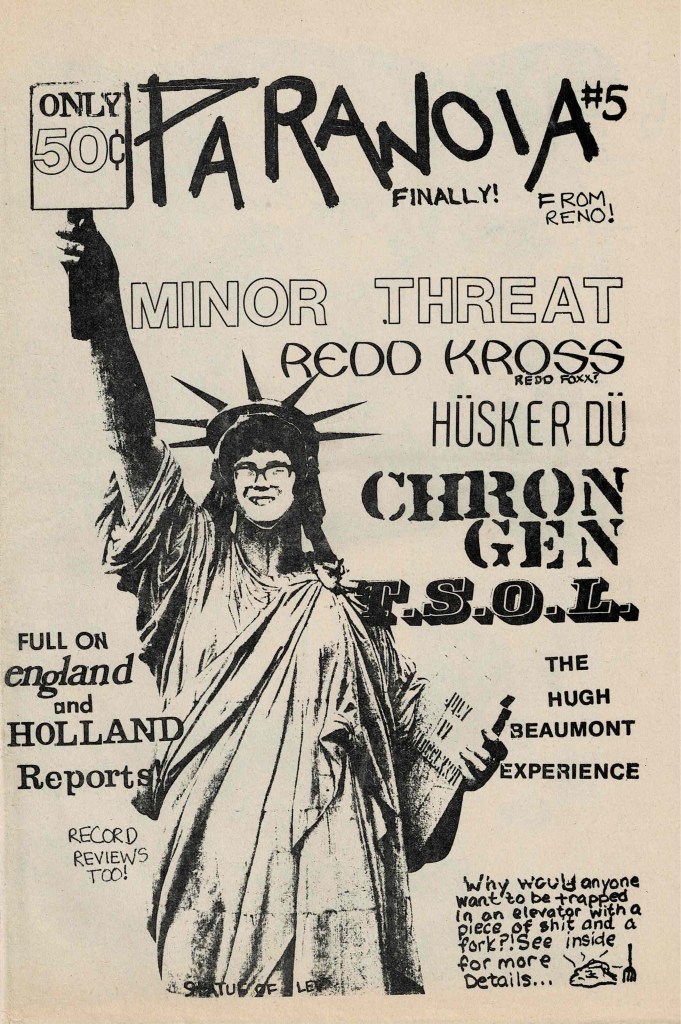
The wizened elders amongst us may remember when Reno, Nevada was a primo hardcore punk rock hot spot that gave birth to slammers like 7 Seconds, Urban Assault and The Wrecks. In the 1981-83 hardcore heyday, tiny Reno was a stop on the touring grind for Black Flag, Husker Du, DOA, The Fix, Minor Threat and countless others. The scene’s “house organ”, if you will, was Paranoia, put out by Bess and Jone from The Wrecks. We celebrated their 4th issue from earlier in 1982 here; we shall be discussing their lively fifth issue, also from 1982, presently.
It starts off with a bang in the letters section, where one GG Allin writes in frothing mad (and cursing!) about a record review. Bessie & Jone try to one-up him with a delightfully snarky response. Grace Ann Sawyer writes in as a new resident in the Reno/Sparks area and says “I am starving for New Wave action of any type”. I certainly know the feeling, Grace Ann! Then it’s on to the news, where we learn that “Bryan Jones, the 15-year-old lead singer of Jerry’s Kids from Boston, Mass was forced to quit the band by his father”. There’s other news about Robo joining The Misfits, Void breaking up, and “Henry from Black Flag and Ian MacKaye from Minor Threat have thoughts of putting out a comedy record”. Had said thoughts been acted upon, this might have been the worst thing I’ve ever heard, save for Jello Biafra’s stand-up comedy records that unfortunately did come out.
Next we’re on to the interviews and detailed scene reports from Holland and the UK. There are talks with Chron-Gen, Husker Du, the Hugh Beaumont Experience and TSOL, who are vapid and dull-witted as always. Of course, I had to adjust my seating and get a glass of water to settle in with the Minor Threat interview. At this point, they’re all under 20, don’t like San Francisco punks and think Reno compares quite favorably. To each his or her own. Naturally, there are some detailed explanations about what “straight edge” both is and isn’t. Ian’s not against sex; “I think it’s a great great thing”. I also learned for the first time that Ian MacKaye once did codeine, and “it was boring”. This is what precisely what teen punks – and I – have come to Paranoia #5 for.
Born Innocent-era Red Kross have just changed their name, and are interviewed by Bess. She starts asking some gross-out questions (nose-picking, butts, and all manner of what have you), sadly causing my all-time punk rock heartthrob Tracy Lea to wander away from the interview that she’d previously been an active participant in. While they’re being interviewed here in Reno, the McDonald brothers ask Bess if she’s ever seen The Wrecks. She informs them that she’d recently been in The Wrecks, but that they’d just broken up. It’s as dumb of an interview as I’ve ever read, right up there with some of the We Got Power chats for pure intellectual firepower.
Minor Threat and Husker Du have just played Reno, separately; otherwise Bessie and Jone are driving to San Francisco and sometimes Sacramento for their gigs. Man, one time I drove to Reno and back from San Francisco in one day trying to elect Democrats in Nevada in 2016 (you may remember one of them, Hillary Rodham Clinton), and let me tell you, that is a hoof. Anything for the blessed ‘core. These women and all of their friends are just having a blast; as in the other issue I reviewed, there are multiple party pictures, cut-outs of people smiling, at gigs, making out etc. The reviews, such as they are, are also pretty fun. The Fartz’ World Full of Hate is summarized with the very helpful “If you like The Fartz, get this.” Who didn’t like The Fartz??
Finally I learned a bit about The Sluts from New Orleans. Barry Goubler, did you see this band? They love The Stooges, Bad Brains, Black Flag and Saccharine Trust, so I say what’s not to love about them. I guess Dee Slut from the band had a little notoriety himself, unbeknownst to me – read all about that here.
-
Who Put The Bomp! #13

Except for the couple of times I’ve written about fanzines that a friend personally xeroxed and assembled for me, my rule here at Fanzine Hemorrhage is to only blather on about zines I personally own. So, while I’m absolutely long in the proverbial tooth, that’d negate stuff like Who Put The Bomp! #13 that came out when I was seven years old; unless, of course, I went and paid some large multiple of its Spring 1975 $1 cover price in order to own it – which is exactly what I did. As discussed last time we looked at Greg Shaw’s fanzine, my goal is to try and hunt down as many of the pre-punk issues of this as I can find and/or afford. Recently, this one came into my hands, and I’d like to tell you about it.
I don’t know about you, but I have a weird fascination with what rock & roll nostalgia looked like for folks when rock music was not even two decades old. Elvis, Charlie Feathers and Carl Perkins were still alive. Even Keith Richards was still alive. So Shaw’s big thing here on the rockabilly revival is kind of a hoot; many of the late 50s/early 60s 45s are being dug up for the first time and thrown out into the world on cheap-looking compilations, and “record collecting” is really starting to become a thing as a result. Shaw talks about it in detail. You’ve seen some of these comps before; they’d look like this and used today they sell for about what they did new back then.
Of course, Happy Days was something of an instigator of all the 50s nostalgic hullabaloo, but what I’m more interested in is what record collecting looked like in 1975. Set sale lists, painstaking discographies with catalog numbers, and man oh man – the sorts of mind-melting finds in record stores that guys like me only dream about in 2024. Can you imagine having a 60s punk 45 want list and stumbling across all the original singles for a buck or less, the monsters that’d come out on the Back From The Grave comps ten years later? Anyway, if you were that guy – and you were almost certainly a guy – Who Put The Bomp’d certainly be required reading.
Greg Shaw, an eternal optimist, surveys the world of rock music in early 1975 in an opening editorial, and sees that “70s rock is reverting to a 60s pop aesthetic”. His entire essay pushes against a narrative that 1975 is just as godawful musically as 1971 was, and hey, depending on one’s perspective, I suppose he was probably correct that “good times” were on the way. I’m just not sure it was a Beatles-esque 60s pop aesthetic that would lead the way in 1976-77. And honestly, looking at the record reviews in Who Put The Bomp! #13, it all just seems super grim to me, warmed-over glitter and boogie and pub rock. There’s a great review of the first AC/DC single, a total laff I’d never heard, and which you can watch an early video of here (do it!). He says “Their similarity to the early Easybeats is startling”.
He also reviews the debut King Uszniewicz & His Uszniewicz-Tones 45, and of course totally gets it and loves it to death. There’s a big piece on Michigan sixties rock, including a discography of A-Square records who put out MC5 and Rationals singles, and a related bit on Bob Seger, where I learned to my surprise that he did the original of the Lazy Cowgirls’ “Sock it to Me Santa”, released by Shaw’s Bomp Records nine years after this fanzine. Seger’s B-side was called “Florida Time”, “the only known song to glorify Florida’s surfing scene”. You might need to listen to that too.
Here’s another fun peek at the 1975 vantage point: Shaw writes that “The MC5’s best song, ‘Black to Comm’ was never recorded”. By the time I got into said band around 1985, that particular song had such the underground cache, total holy grail music that everyone wanted to hear. I’d wildly imagined this crazed, long, howling guitar blowout that’d be “Rocket Reducer” x100 and the total personification of “dope, guns and fucking in the streets”. Big disappointment when I finally did hear it, a fun rave-up but a huge sonic drop off from “Sister Ray” and “Fun House/LA Blues”. The MC5 never really had one of those, did they?
The single best thing in Who Put The Bomp! #13 is “The Rise & Fall of The Hollywood Stars”, written by Kim Fowley, and who happened to be the guy who sired them into existence and, for all I know, helped to screw them up and ensure their demise in one year. It’s really a fun read. I get this band confused with another flame-out band called The Hollywood Brats who had an entire book written about them that I see remaindered every now & again. After Fowley’s piece, a supposed 15-year-old Lisa Fancher follows up with her own piece about how special the Stars were over the course of their five gigs at The Whiskey. Here’s a good interview with her about those days. Next time I’ll try and give the 15th issue of Who Put The Bomp! a whirl, OK?
-
Ragnarok #6

In my lifetime there have been no hometowners like Cleveland hometowners – which is to say that underground fanzine guys from Cleveland have traditionally covered their oft-maligned city and its punching-way-above-their-weight bands with the fervor and boosterism of highly-compensated Chamber of Commerce execs. “That’s okay with me”. Cleveland was a rock town for decades with a per-capita scene batting average high above the norm, I’m talking from ‘75 onward into the 1990s, even into June 1991 perhaps, which is when the digest-sized Ragnarok #6 came out.
Make that “Steve Wainstead’s Ragnarok”, as it says on the cover, in a feat of awesome doofus branding that just makes me laugh. Wainstead is indeed a hometowner, and outside of some visiting touring bands, Ragnorok #6 is C-Town all the way. If I didn’t know a little bit about Puff Tube and the Soul Vandals and whatnot – probably from Seven – Scat Records Quarterly and the 1990s version of CLE – I’d have no idea what he’s talking about. And again, that’s fine. His aesthetic is type, cut, paste, repeat – with vintage illustrations and graphics helping to tart up the overall environment. Any punk- or noise-adjacent show in Cleveland from the preceding month that he and his crew attended gets reviewed, with one megawatt event in particular (Puff Tube/Soul Vandals on 5/9/91, where were you??) getting six different reviews, including one from Cleveland royalty, Charlotte Pressler!
Steel Pole Bath Tub are the out-of-towners treated with respect. They were from my town, San Francisco, and around this time I was pretty well fed up with them, as they seemed to be the opening band for every other mid-sized show I went to that year. If it wasn’t them, it was The Melvins. At least one larger show I attended it was Steel Pole Bath Tub and The Melvins opening. I cared for neither, and I was always the guy who believes it when they’d say “Doors 7 / Show 8”, and then I’d show up at 9pm and walk in as Steel Pole Bath Tub were starting their first song. However, in their Ragnarok #6 interview, all three gentlemen are intelligent, funny and quite road-weary, with a good sense of their place in the whole cosmic joke. Now I feel just awful having tried to dodge them all those years. Boner Records 4-ever.
There’s another interview, this time with locals The Vivians, whom I’d never heard. Check out the entire campus at Case Western having a motherfucking rocknroll riot during one of their sets here. The Pressler stuff near the end is cool to read, though it spins out into the pointy-headed academic meandering that I’m sure made some sense to her at the time. In all, good local fanzine and you’d have bought one for three quarters yourself after a big night of excess at Peabody’s Down Under.
-
Rock Scene (March 1976)
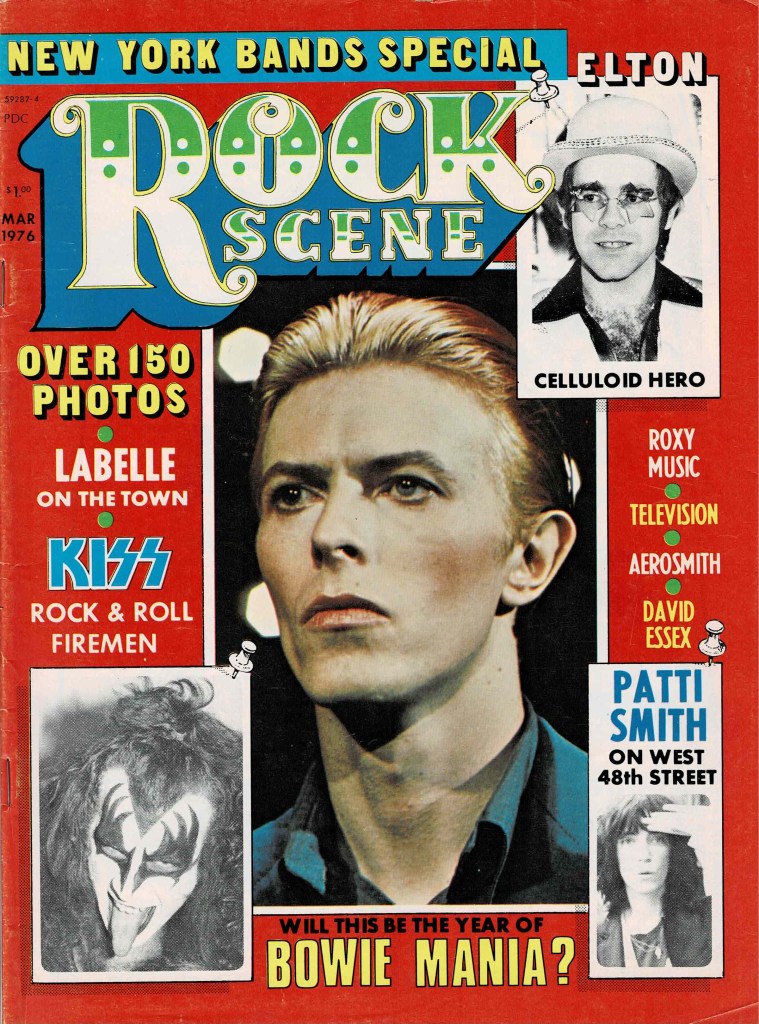
You know and I know that Rock Scene wasn’t a fanzine, and that it probably has no place on this blog. Yet they were so well-situated at the nexus of the pre-punk void, before 1976 and all it represented, that it’s one of the absolute best places to get a handle on how tastes, fashions, criticism and fandom itself were evolving in the mid-1970s. I mean here we are in March 1976. There’s no mention of the Sex Pistols, who’d played 13 gigs to that point, but everyone here will hear them in about in a few weeks and go bananas – the shot in the arm editors Richard and Lisa Robinson were looking for in their post-Dolls landscape, despite all that’s already going on right in their hometown of New York City. Rock Scene would embrace punk in a big way, without leaving the remnants of glitter, glam and hard rock behind, at least in what I think was their 1976-78 heyday.
Rock Scene was very much a NYC mag. They called themselves “The alternative to the alternatives!”. While that may be going a bit far in the era of Back Door Man, Who Put The Bomp, Chatterbox and countless others that I don’t own and wish I did, I actually enjoy it even more than Creem and certainly more than Circus. This is despite not having a ton of written content and much “criticism”, as it were. This March 1976 issue is a big drunken party on the streets and in the clubs, full of photos and photo essays with only a modicum of commentary to support it all. I figure as long as they were paying photographers like Bob Gruen, Leee Childers and Raymond le Fourchette well for their snaps – because they’re fantastic – it’s actually pretty fun to read an inversion of the text-over-visuals form that’s pretty standard in any fanzine or magazine dabbling in underground rock.
Besides, it is a fanzine when the editors are given so much leeway to cover whatever the hell they want, and then insert themselves into the visual narrative as often as possible. Richard and LIsa Robinson take an exceptionally onanistic approach to their duties by printing as many photos of themselves with rock stars, record execs and scenesters as they can fit. There are 5 with Lenny Kaye and either one or both of them in this issue alone. Because it’s early 1976, there is a bunch on the CBGB scene, with Heartbreakers and Television pics I’ve absolutely never seen. Cyrinda Foxe gets herself into many a photo, as well she should, and Lance Loud is out and about as well.
There are other photo spreads on Cherry Vanilla, Roxy Music, The Marbles, Patti Smith Group (with Ivan Kral giving Shaun Cassidy and Leif Garrett a run for their money in the set-teenage-girls’-hearts-aflame dept.), Elton John, David Bowie and Jim Dandy (!). There’s an early photo spread of Blondie’s Debbie Harry with a totally different, almost Midwest Christian wife look that I kinda like. (She doesn’t have a real name in this magazine – she’s “Blondie”). There’s also a “new bands” section trying to drum up excitement for Killer Kane, a Raspberries spinoff called Windfall and a bunch of hairy New Jersey bands. There’s even a Sable Starr (LA groupie) action shot to give the west coast a little love.
There is some actual writing, though! I appreciated an entire column about comics – Marvel, DC and comix – treating it all very seriously and simpatico with rock and roll. There’s some BS about Kiss at a high school – I can’t read anything about Kiss – but there’s also a great letter to the editor from one “Peggy O’Neil” about how great Kiss are. Could it really be this Peggy O’Neil?? Donald Lyons writes about the film scene in 1976 and finds it “lousy”, this the year of Taxi Driver, The Killing of a Chinese Bookie, Mikey and Nicky, Network and Marathon Man, which was hot on the heels of an even better 1975. Don’t get me started.
-
Subscribe
Subscribed
Already have a WordPress.com account? Log in now.
 Fanzine Hemorrhage