-
The Bible #1

I’ll never lose sight of the magnanimity shown by Miranda Fisher to yours truly in 2013 when I was working to get Dynamite Hemorrhage #1 fanzine off the ground, when she and photo editor Jon Chamberlin gave me heeded advice on ad rates, the proper weight of paper and what to look for in a printer. She was publishing Rubberneck fanzine from Texas at that point, at a time when underground music fanzines were kinda scarce. She’d later go on to do one called Casting Couch – color covers and everything for both mags – and played in a number of wild garage punk bands, the most well-known of whom – relatively speaking, folks! – was probably The Zoltars.
So I see a thing about this new music fanzine The Bible #1 online; Dave Brushback was waxing enthusiastically about it most certainly, and hey, being a fan of the fanzine genre, my interest was piqued and an order was placed. Moreover, I’m looking at the cover and wondering if there was maybe a Grady Runyan interview in there somewhere. Yet little did I know it was a Miranda Fisher ‘zine until it arrived in the post, and moreover yet again, that she published it right here in my hometown of San Francisco, California, where she too now lives. Welcome, Miranda. I do hope the Golden Gate has opened its arms to you.
The two best pieces in here do in fact happen to be Miranda’s, and they’re ruminative explorations – one on the nature of music taste and how one comes by it, and another about her obsession with “TikTok” videos in which average doofuses make short videos in order to rate and review everything on Rolling Stone’s top 500 albums list. I’m glad she described these excruciating exercises in dumbassery for me, because not only do I not have access to “TikTok”, there’s just certain stuff I can’t watch any longer, even ironically – like, say, a Presidential debate, or an 80s boobie comedy, or any sort of video by a would-be influencer or talking head on social media.
The Bible #1 is also enriched by Miranda’s reviews of records more or less in the garage/psych/spazz realm, with exceptions like Rosali and Winged Wheel and other things of that ill-defined ilk. Mitch Cardwell – a great American whom I did know lived around these parts, as he always has – writes about David Nance and Mowed Sound in Oakland, a show that literally took place only two months ago. So yes, this is a new fanzine. And among other things, there’s a long talk with Donna Allen from Chronophage, and it’s clear that Miranda and Donna know each other from ‘ol Texas times and have the sort of comfort and familiarity to put forth a pretty “intimate” talk, in the figurative sense. There’s some joshin’ and free-associatin’ and perhaps some secrets spilling out. Maybe partying had helped!
Anyway, I think it’s one of those things where you get in contact with Miranda directly to be allowed to order one, sort of like “ask a punk” shows at someone’s house. The Bible #1 can be obtained by asking nicely at thebiblezine@gmail.com.
-
Slash, Vol. 1 No. 8 (February 1978)

At some point I’m going to have achieved the unthinkable, and will have amassed a complete run of Slash magazine, all 29 issues plus the NY Rocker “supplement” from 1981. I don’t have that many goals in life – I mean, I wanna see all the National Parks, and I’d like to see the SF Giants win another World Series with me in the crowd, and maybe my kid’ll have his own kids – so this is by far my dumbest bucket list goal. I’m three away. Bracing myself for the anticlimax.
Slash, Vol. 1, No. 8 is a very recent acquisition – thank you JJ from Germany. It is, of course, phenomenal – a stellar early example of what was almost certainly the best punk fanzine of all time. Central to many folks’ conception of and love for Slash was the ritualistic opening editorial from Claude Bessy, aka Kickboy Face. This one from February 1978 is called “Warning: Crazed Punks Ahead”. It’s dripping with sarcasm and some level of vitriol, but also with love and warmth for the pure, the true, and the open-minded. Even in early 1978, Kickboy was warning the hordes and asking them to please allow punk to evolve and breathe and not reach a dead end – this request coming right with the Pistols just having broken up and The Masque having just closed. About the former, he says: “It does not matter”. Regarding the latter: “It does matter. As soon as we know what has to be done, we will do it”.
There are many interesting, unconfirmed threads in the “Local Shit” column. There’s a warning of a Dils and Avengers combination band getting together to play a gig in San Francisco as Police and Thieves. Did this actually happen? “X’s single is still awaited on Dangerhouse. Main track will probably be “Blue Spark”. (It wasn’t). “Speaking of Dangerhouse…they are already negotiating with Arizona band The Consumers”. (They didn’t).
Of-their-time gems crop up on virtually every page in any given Slash. A key theme in this issue is the encroachment of “power pop”, and a little thrashing of Greg Shaw (Bomp!)’s character for already wishing to sand down the rough edges of punk with lightweight, skinny-tie melodic pop music – though Kickboy nicely defends Shaw’s honor as well. There is a terrific letter to the editors about this power pop threat from “El-Tot Sira”, hopefully someone who went on to paid writing elsewhere. This person could even have been a Slash staffer for all I know. It sounds a little like Falling James. Too early, probably.
I suppose the centerpiece of this thing are the two long bits on the Sex Pistols’ southern US shows in Dallas and Tulsa; Kickboy then gets in a long piece about their San Francisco farewell show, which just about every LA punk you can name traveled up north for. There is some excellent bagging on The Nuns and on The Dictators: “How many times do the creeps have to be told that The Dictators are about as relevant as Blue Oyster Cult? When will they stop reading those press releases and listen to the fucking music?? I’m not even a hardcore punk but I can tell the pseudo leftovers from the desperate kids, and the Dictators…”. Dot dot dot.
One cool curio here is a big full-page ad for the benefit shows being held for the recently-closed Masque at the Elks Lodge on February 24th and 25th. I know what you’re thinking – the shows that ended in a riot, with punks getting clubbed left & right by the pigs! No!! These were successful benefit shows. In 1979, at the same venue, it didn’t go quite as well.
Finally, a few other interesting tidbits – an interview with an LA punk band called The Wildcats, whom I’d never heard of. The Xray Spex interview catches Poly Styrene when she’s young and nervous, a mere 19 years old in December 1977 and sounding every bit of it. There’s a rave review for Skrewdriver’s All Skrewed Up. Kickboy does an entire reggae column called “Dread Greats!” under the nom de plume of Chatty Chatty Mouth, and gets into Tapper Zukie, The Upsetters’ Super Ape, Yabby U and the Prophets and more. Don’t forget, his original foray into publishing was with a reggae fanzine called Angeleno Dread, and what I wouldn’t kill to see a copy of one of those, even a PDF. And he gets in a nice rave for The Avengers and a little LA/SF dig: “Next time The Avengers drop by, let’s kidnap them until they agree to live down here. All this commuting back and forth is a waste of energy. Or maybe we should trade them for something San Francisco might want”. I know – we’ll take the Masque and all the bands that play there – how about that?
-
Zip It Up!: The Best of Trouser Press Magazine 1974 – 1984 (book)

(I wrote this for a print magazine that’s not coming out, and borrowed a few sentences from an issue of Trouser Press I talked about here).
I happened to have been a teenaged Trouser Press subscriber in the early 1980s, but given my youth, had never purchased an issue during their 70s heyday as an Anglophilic rock magazine whose subhead was “America’s Only British Rock Magazine”, and who were actually originally known as the Trans-Oceanic Trouser Press. Theirs was a good niche to mine in the 1970s going head-to-head on the stands with Creem, Circus and Rock Scene, yet starting in 1978 with a Todd Rundgren cover, the magazine started backing away from the UK in favor of the domestic. By the time I was subscribing, their forte was whatever crapola English or American “rock of the 80s” band was burning up MTV, with cover features on Duran Duran, the Stray Cats and Adam Ant egregiously pulling them away from whatever earned credit they’d accumulated.
That said it’s hard to be too overly critical of Trouser Press, as this curated collection makes clear. Editor Ira Robbins emerges through the looking glass of 40 years and peppers his article introductions with the same criticisms you and I might level at his magazine. I’ve heard the man give an articulate account of himself in several quarters, and he’s a mensch and a fan above all else. The magazine was still far too indulgent of whatever was “above board” and on the charts, with a particular focus on power pop, pub rock (they loved them some Ducks Deluxe and Brinsley Schwarz), Elvis Costello, The Ramones and The Who. Granted, the “American Underground” column was a longtime staple and highlight; it’s where I learned about LA’s paisley underground in 1982 – and they even wrote about Flipper, GG Allin and all manner of small-press 45s in the same space. The Kate Bush, P.I.L. and Peter Tosh pieces in particular that are fully reprinted here are excellent reads, as is a 1979 Lou Reed interview that helped cement and lock in place his reputation as the biggest asshole on the planet.
It’s maybe a little difficult to get the full sway of the magazine and the tenor of their times, even when contracted and excerpted in this heavy 447-page tome. I’d recommend picking up individual pre-1982 back issues of Trouser Press instead to get a far better sense of how each contextualized any given month of rock music in real time.
-
The Story So Far #3

Here’s another issue of this 1980 English fanzine – I talked about Issue #4 here. “Marts” and “Tim” are the editors, and it looks like this is a Summer 1980 thing, which means the short interview with Joy Division and Ian Curtis was done mere weeks before he killed himself in May 1980, and this was printed before they had a chance to acknowledge it. Ironically, Curtis asks here, rhetorically, “Why does everyone say our music is gloomy and doomy?”. Poor fella.
You have to imagine that Tim and Marts were excellent at slapping backs and greasing palms, given the access they were provided to “bigger names” for their small regional fanzine The Story So Far #3. For instance, The Clash have just come back from the US, and London Calling has just come out. I certainly appreciate the band providing this much attention to a small fanzine; however, what came out of their mouths was often just narcissistic BS and it totally soured me on the band from an early age. This happened to be late, late in their run, but man – I remember listening to San Francisco’s commercial “rock of the 80s” new wave station The Quake around 1984 or so, and a drunken Joe Strummer either called in or stumbled into the studio, I can’t remember which. He proceeded to give an over-the-top master class in unbridled self-admiration, conceit and ego, ranting about how he was takin’ The Clash back to their roots, how his music was incredibly important for the kids, and how the new album he was working on – it would be Cut The Crap – was going to be a major, major work. It was highly entertaining, to be fair.
So are these Mick Jones quotes from the Clash interview in The Story So Far #3:
“America is dying for the sort of music we play. Dying for it. Going berserk, right…We’re probably one of the last hopes you’ve got, really”.
Better still: “I personally asked Gary Numan, who must be a quite a simple chap really, to explain what the fuck he’s on about. Because we can stick two roadies in fuckin silly pyramids and make them dance around the stage, and we can get a load of fuckin big lights at the back to make us look better….explain what you’re on about, my man. It’s your time to do it…be plain, the kids can’t understand you. They only buy your records because ours ain’t out, but when they are out, you can go to fuckin hell”.
Mick Jones, ladies and gentlemen. The guy who’d be in Big Audio Dynamite a few years later.
Gary Numan kinda takes it on the chin across the entire issue. There’s an interview with Daniel Miller from Mute Records, who’s just come off being “The Normal” but hasn’t quite hit paydirt by signing Depeche Mode yet. In it. one of the editors hand-scrawls something about how Gary Numan’s Tubeway Army has “ripped off Daniel Miller”. Perhaps. Now these guys love The Cramps; it appears to have been total mania at their recent shows in the UK, and the editors see them as the personification of everything great about America, as do I. As should we all.
Finally, there’s an “unedited” interview with The Mo-Dettes. I’ve read interviews with them before and they were pretty loopy, “taking the piss” sorts of talks. They adored going after other bands in a way that no one does any longer. Here’s a feisty quote from Jane in the band: “Rough Trade’s a bunch of hippies. They’re a load of stupid intellectuals with too many ‘isms’. It’s all these feminists. I’d include The Raincoats in the feminist bag…I think their music stinks”. Apparently there’s a Mo-Dettes flexidisc included in this issue, but mine’s just two blank pieces of orange tape on the inside front cover, sort of like what a gallery wall looks like after an art heist. Not that I’m comparing the two, mind ya.
-
Punk Rock Special: Johnny Rotten and the Sex Pistols (Spring 1978)

Punksploitation gets pretty meta here, for what could be more exploitative than a single-issue magazine about the most exploitative and supposedly shocking band around, right? I’ve said it before, and I’ll say it again: I sometimes find it difficult to read about the Sex Pistols at all. So much of my so-called musical education was formed with them as the dominant example of “punk”, the band that had changed the world and so on. It’s hard to even contextualize those guys now due to over-familiarity. I’m also not all that hopped-up on their music, and never really have been.
However, in the spirit of late 1977 newness, especially in the US, it’s easy to recognize why the Stories, Layouts & Press publishing enterprise would have found it a strong business move to put this out. They even call it a “cash-in special” with no irony. The purpose is to introduce the band to the US public, and they absolutely revel in the salacious and the vile. The band is “besmeared with vomit, dripping with obscenity”, and right from the off there are several tales of how each of the Sex Pistols has gotten his ass royally kicked back in England multiple times.
There are mini-features on each band member. “The most horrible, the most ugly-looking, the one that leads the group is a 20-year-old deviant named Johnny Rotten”. “The Sex Pistols needed a guitar player, see, so they found one, a jerky lookin’ nerd with an asshole of a smile. The kid’s name was Steve Jones”. After that, it’s every page loaded with sneering photos of the band, sometimes with those same photos repeated on subsequent pages. Punksploitation any way you cut it, baby.Inexplicably, there’s also a small scene report from London with live show pictures of Poly Styrene and….Angus Young of AC/DC (hunh?). Hannah Spitzer weighs in with a preposterously dumb “How To Be a Punk” piece to close it all off, which appears to borrow almost completely from the same piece she wrote in Punk Rock #2 I’ve reviewed previously, and which came out right around the time this one did. Page count, Hannah! We have a page count to fill!
This whole magazine’s wonderfully crude and flaunts its capitalistic approach in multiple ways, even comparing England’s no-future problems with America’s so-called robust economy (this in 1978, the high-interest rate doldrum Carter years). If I’d somehow owned this at the time, I’d have hidden it so, so deep into the crevices of my bedroom that even I wouldn’t have been able to find it. I lived in fear of encounters such as the one where my aunt found my cousin’s hidden Hell Comes To Your House comp LP, and told him, “I found your punk rock record, and I literally threw up”. No wonder misbegotten youth totally gobbled up the entire print run of this top-tier punksploitation special.
-
A Bunch of Links to The Old Stuff
Here are a ton of otherwise hard-to-uncover links to posts written here in this site’s earliest days waaaay back in 2023. All the other posts are located on the sidebar of the desktop site (but can’t be seen on mobile).
Boo Boo #1
What a Nice Way To Turn Seventeen #6
The Offense #12
Sooprize Package #2
Back Door Man #4
Take It! #2
Conflict #42
It’s So Hard To Tell Who’s Going To Love You The Best #1
New Dezezes #2
New Dezezes #1
Zigzag #95
Talk Talk (Vol. 3 No. 2 – 1981)
Wipeout! #7
Breakfast Without Meat #13
Away From The Pulsebeat (Winter 1987)
Bull Tongue Review #1
Sonic Death #5
Hexarc #1
Throat Culture #2
Teen Looch #8
We Jazz #6
Slush #2
Slash Vol. 3 No. 1 (January/February 1980)
Caught In Flux #6
Chatterbox #4
Flipside #32
Bucketfull of Brains #13
Paranoia #4
Surrender #5
Popwatch #6
Unsound #1
New Wave Rock #3
Forget It! #4
Damp #3
Forced Exposure #9
My Teeth Need Attention #1
Creep #2
Gold Soundz #4
Butt Rag #8
Great God Pan #12
Human Garbage Disposal #4
No Mag #10
BravEar #12
Sounds (November 7th, 1981)
Z Gun #1
Wiring Dept. #3
Flesh and Bones #6
Trouser Press #36
Damage #7
Take It! #5
Bazooka! #3
We Got Power #4
Brown Paper Sack #1
Drunken Fish #1
Fŏrdämning #11
Crank #2
Alright! #2
Cut #11
Slash Vol. 2 No. 2 (November 1978)
Galactic Zoo Dossier #7
Matter #10
Teen Screen – February 1967
Vintage Violence #6
Curiosity in Stout Shoes #1
Tuba Frenzy #4
What Goes On #1
Scram #5
Brain Transplant #1
NY Rocker, September 1982
Alright! #4
Zigzag #102
Crush #3
Grace and Dignity #1
Too Fun Too Huge! #2
Astronauts #4
Mental Children #2
Truly Needy #10
Silent Command #1
Sounds (November 8th, 1980)
Conflict #37
Cimarron Weekend #6.04…
Search & Destroy #6
Making Waves #1
Ripper #4 -
Wipeout! #6
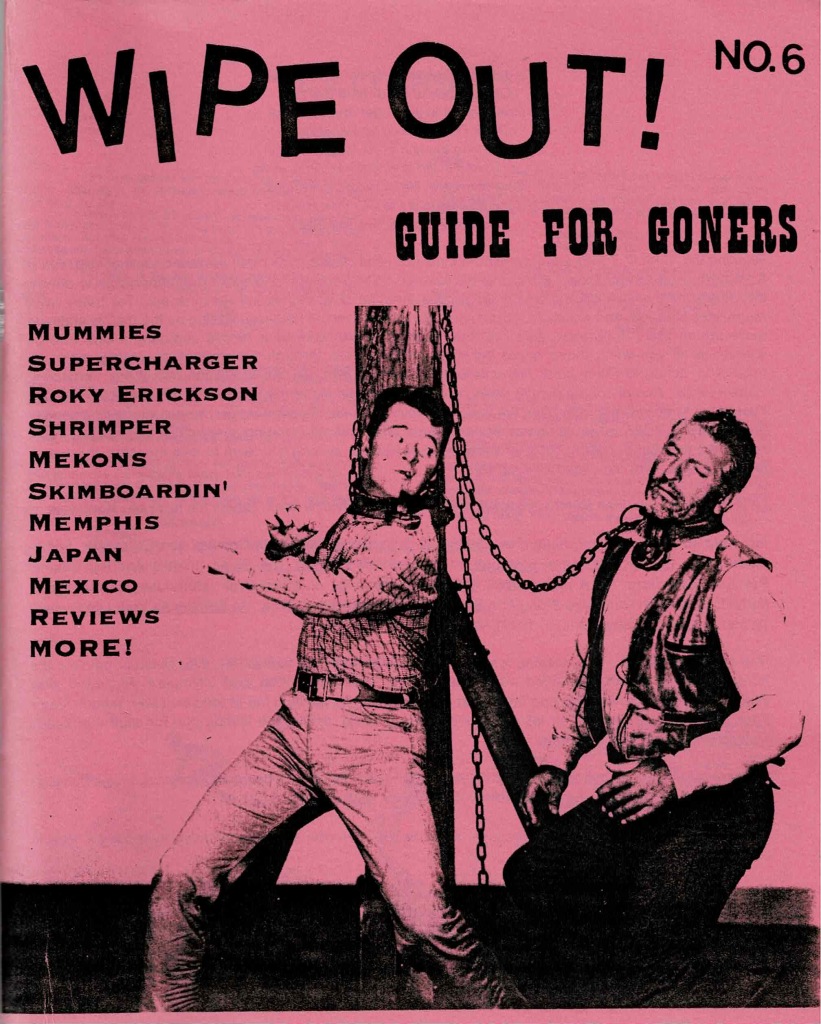
I was a major Wipeout! partisan when this thing was around, and even still, I’m not sure many fanzines have aged as gracefully thirty-plus years on as this one has. Even when Eric Friedl was finding pedantic fault in some 45 or live show, it was the man’s overall and all-encompassing joie de vivre vis-a-vis wild, sub-underground rock n roll music – and Friedl’s ability to transmit it and get you REALLY excited to come aboard – that stands out. This was a guy deeply into culturally mining multiple corners of the musical underground. You can just feel the endorphins rushing as he turns over another rock and immediately pounds his impressions into his TRS-80 or whatever. It’s hard even now to not want to make his 1992 bag your bag today, even if it’s harsh and unlistenable Japanese noise. I’m reading through his reviews just today, and genuinely wondering if I totally missed the boat on Zeni Geva and The Gerogerigegege.
Not that everyone agreed with this assessment at the time! In 1992’s Wipeout #6, Friedl reprints a review from the Denver Independent Observer’s 6/18/92 issue and an article called “New Alternative Music Magazines”: “…and of all the Bangs/Meltzer/Coley-inspired zines, WIPEOUT is by far the worst…Friedl reviews in (an) ‘irreverent’ borrowed style that merely succeed at being irrelevant, insulting and inane…has nothing to say to true followers of British and American alternative music…”. Let me state for the record that for true followers of alternative music, depending upon how defined, this may be true. There’s another letter from a guy in a Columbus, OH band called Shitfits, complaining about not being reviewed in Wipeout: “Skaters are into ska and hardcore too”. Also not untrue. But Friedl wasn’t. Glen Galloway also has a partial letter printed in which he writes about my fanzine: “Superdope reigns and I didn’t mean to imply otherwise”. Wait, what did he imply??
The linchpin piece in this one, I suppose, is the giant overview and complete discography to date of The Mummies, a band that for better or for worse helped define the “budget rock” template and aesthetic for so many bands that followed. It talks about their “final gig” on New Year’s Eve 1991 – this is a band that’s still playing multiple shows per year to this day. I like that Friedl looks askance at the band’s involvement with local San Mateo hair farmers/stoners Three Stoned Men and Wig Torture: “What is it with these ‘just say fuck hippiedom’ kinda guys’ involvement with stoner rock? Could they be closet long-hairs? Or is the San Mateo scene so small that these are the only other bands worth their time?”. I think I’m pretty sure I know the answer.
As sort of a tag-along, there’s a Supercharger overview and interview (best SF Bay Area garage band of the era by a mile, though they were thought of in some quarters as a Mummies “little brother band” at first). Clearly it’s a mail interview, as every time guitarist Darin Rafaelli makes a smart-ass remark, he’s immediately corrected by bassist Greg Lowry, who clearly filled out his portion next. Friedl gives a bunch of ink to an act called the Country Rockers, a Memphis band whose entire trajectory and decline I completely missed. Other sections include a mighty Roky Erickson overview and discography; a thing on Mexican rock and roll, a little bit of a non-judgmental tiptoe into “techno”, and loads of zine reviews.
As I’ve discussed before, Wipeout! was one of a tiny handful of fanzines that gave tons of slavish attention to obscure Japanese weirdness, along with Bananafish and Show-Kai. Wipeout! treats many things from the land of the rising sun as worthy of attention, from blistering and atonal noise to garage rock to pop. He even reviews Pink Lady. I still remember the brief 1980 TV show Pink Lady and Jeff, which you can watch here. My mom was an ESL teacher to Japanese exchange students, who’d come to San Jose and stay in our home. We went through a major “Japan” phase ourselves at 1085 Normington Way, and this unfortunately even included watching each episode of Pink Lady and Jeff when it came on.
And like any fanzine worth its salt, Wipeout! #6 is just larded up with a ton of reviews, except it’s not lard at all, and maybe unlike the following issue, most of them are totally coherent and well-reasoned, if in a “first-draft, fuck it” style. This is where you really feel the full weight of Friedl’s fetching, wide-ranging and entirely self-curated music mania. He loves The Brainbombs’ first two 45s: “these singles completely busted my wig wide open”. He gives critical and deserved hosannas to the Feel Lucky, Punk?!! compilation. He loves the Jesus Lizard; well, we were all young once…! There’s a big Sun City Girls section. You could curate a tremendous 1992 record collection from these picks, and I’m certain that this fanzine helped my own collection along a bit.
Not long after I wrote about Wipeout! #7 here, a terrific podcast interview with Friedl came out on Armen Svadjian’s RockWrit and it’s a great place to understand where the man’s head was at at the time. You’ll learn that Wipeout! actually “started with Issue #4, because I thought no one actually cared about a first issue. If anyone has copies of the extremely rare #1-#3 issues, let me know, because I didn’t write ‘em”.
-
Smallflowers Press #1

One-and-done New England fanzine put out by a guy who chose near-anonymity by merely calling himself “Kris”. I’m sure there’s no question that if you were at all part of the Brattleboro/Amherst early 2000s freak scene that funneled its way into wider consciousness via Byron Coley & Thurston Moore’s Arthur column, you surely knew who Kris was. He seems to have been exceptionally well-acquainted with the whats and wherefores of just about everyone and everything surrounding the players in that professed New Weird Underground, a movement that had something of a moment around the time of Smallflowers Press #1’s publication in 2004. I found this hippie encroachment to be a little threatening at the time and I kept a wary and highly suspicious eye upon it, yet it fizzled and fragmented as these things tend to do.
Kris and his small team did something I’ve never seen in a fanzine before: Smallflowers Press #1 consists of three long interviews, period, each supplemented by a ton of photos. Here’s what Coley/Moore had to say about it in one of their columns:
“If you ever wondered about the minutiae of the New England Underground, you could do much worse than to get the debut issue of SMALLFLOWERS PRESS. This is a solo newsprint mag that contains incredibly detailed interviews with Dredd Foole, Chris Corsano, and all the countless members of Sunburned Hand of the Man. It’s a massive 76-page read, and probably a tough slog if you’re not somewhat besotted by this stuff, but if you are, well, sheesh, this one’s for you.”
I suppose it could be a tough slog, yet the interviews have such obvious camaraderie and are so stepped in music arcana that I find them fairly easy sledding in most parts. The massive Dredd Foole (Dan Ireton) interview in particular hones in for a big chunk on the late 70s/early 80s Boston underground, and the man’s deep involvement with Mission of Burma and its players. The comparatively small-ish Chris Corsano interview is cool because Corsano – one of the all-time most ferocious drummers I’ve ever seen – was really just a young pup at this point, already quite accomplished and playing with numerous free jazz and freeform giants.
The true whopper here is the enormous Sunburned Hand of the Man interview, which takes up nearly 50 pages in total. You want the early story on this magickal, mystical free rock collective, you’ll find it here. The band talks about their June 10th, 2003 show in San Francisco with Comets on Fire that I captured my magnanimous impressions of here the following day. I guess I kinda liked ‘em! I was trying so hard back then to incorporate the hippie and free-folk interlopers into my hidebound worldview and taste parameters. Every so often, it’d work – like I became a huge Josephine Foster fan around this time. You read the interview with “Sunburned” here, and it’s not hard to admire their rural, back-to-the-land, communal approach to living and making music.
I don’t know, something about the post-9/11 cultural landscape and the void left in underground music after the massive wave of the 1990s left a lot of interesting, obscure musical tentacles, micro-labels and homespun fanzines like Smallflowers Press floating about, each doing their thing in as radically independent a manner as could be imagined. When I search for ways to make fun of it, as is my wont, I don’t get as far as I’d like, leading me to believe that given the right set of circumstances and chemical fortification, I too might have been one of the barefoot dancing heshers on stage with them at any given show. I also think that someone could pull together from tapes a compilation documenting the best of the New England “free music” scene documented here that’d probably knock our socks off. Kris, you still out there?
-
Back From The Grave #1

What do you call those low-run, xerox-y looking, print publications that Boo-Hooray puts out, often about obscure and collectible underground music? Fanzines? No? Well then will you at least humor me this time? I only have a couple of Boo-Hooray items, the few that correspond precisely with my interests, of which one of them is something I’d have opened a vein for if I hadn’t otherwise been able to procure it. It’s a one-off, 66-copies-printed (allegedly) fanzine all about the Back From The Grave 60s garage punk compilation series. This Tim Warren-curated album collection, as I’m sure I don’t need to tell you, is an all-time peak cultural totem that makes Americans like me just a little more patriotic every time we listen, and it’s a series that did more for the cause of “garage punk” writ large than anything save for Lenny Kaye’s Nuggets and those mid-60s teenage punkers themselves. And each volume was 100x better than the best volume of Nuggets, great as those are.
This Back From The Grave “fanzine” – well, I only latched onto a copy because Boo-Hooray proprietor Johan Kugelberg traded me one, mostly because I’d just published my own interview with Tim Warren about the then recently-resurrected Back From The Grave series in my Dynamite Hemorrhage #2 fanzine. Read it here if you’d like. The reason I did so wasn’t merely because I wanted to pay tribute to the most raw, savage and deeply underground 60s punk 45s – though of course there was that – but because Warren himself was, and I’m sure still is, a wildly enigmatic, funny and highly opinionated and obsessive vinyl hound. He’s a guy whom I’d somehow built up enough personal goodwill with over the years that he said he’d talk to me, and he doesn’t seem to talk to that many folks. I’ll never forget while I was waiting to call him at the anointed hour we were supposed to speak, he was already frantically typing unedited answers to my questions in the Google Doc I’d sent him. I’m sitting there watching the document explode in real time, so I had to call him in Germany 15 minutes early just to get him to stop. The interview is transcribed just as it happened – some written, most spoken.
Also met the dude once in San Francisco in the mid-1990s when he was nice & hammered, sunglasses on in a club at 11pm, trucker hat pulled low over his forehead. We had a real nice chat. Everything about this LP series and how it came to be – and of course the music it documents – is immensely fascinating to me. I’m also writing right now with the fatal elitist prick assumption that you reading this right now “get” everything I’m saying, and totally already know all about Back From The Grave and the music on it. Odds are you actually might not, and that’s completely understandable. Check out this, this, this and this for some of my all-time favorites.
This Back From The Grave mag has an unnecessary but very cool “glow in the dark” substance slathered on the lettering for “Back” and “Grave” that you see here. Tested it last night (for the first time, after owning this for ten years) and it worked! Its contents are even better. Effectively, it’s a well-curated collection of every bit of BFTG ephemera that Kugelberg could find: interviews, advertisements, alternate album covers that weren’t released, even the hand-written interview that Tim Warren did with members of The Keggs as he was putting Back From The Grave Volume One out.

The main entry, I guess, is Sylvain Collette’s illustrated discography of the different BFTG volumes and editions. You get a teaser about a wildly rare bootleg double LP called Garage Kings that came out with the first two BFTG editions, something I certainly never knew about. There’s a fantastic interview with Mort Todd, the guy who created the covers for the first seven editions of the series, all of which are worth staring at and parsing for twenty minutes at a time. They offer much to learn about Warren’s worldview. There are several Tim Warren interviews, a Mike Stax essay, a Johan Kugelberg essay, and quite a bit more. Johan says, and I believe him, that Warren is the one who told him “Oh, you should do a 70s punk Back From The Grave”. Kugelberg took the advice, and those ended up being the first 4 volumes of the Killed By Death compilations. Life-changers.
So I know it’s a drag reading about something that only 66 copies were made of. Bums me out with collectable records all the time. I have good news for you, though, something that I didn’t know until I started Googlin’ while writing this post. As of this writing someone’s selling one on eBay for $300; better still, someone scanned the whole thing and it’s available for free on the Internet Archive to look at right now, if that’s something you’d be interested in doing. Then you can see what all this malarkey and balderdash is all about.
-
Skid #5

I only came to possess a copy of 1982’s Skid #5 because its editor, one Jon Hope, kindly sent me one over ten years ago. We’d been conversing about this & that & what have you, fanzines and rock and roll music and all of that jazz, and in the course of him sending me some of his old copies of Matter – which I’m still totally psyched beyond belief he did – I also got Skid #5, published out of his hometown of Oconomowoc, WI. I kid you not. It’s a real place. Over 18,000 people happily live there to this day.
It’s funny, the deeper I head into fanzines from 1981-1982 the more I realize that not everyone was balkanizing themselves into hardcore vs. not hardcore. Out in California, where I’m from, I really can’t remember a reputable fanzine that successfully straddled blazing ‘core, English post-punk and mainstreamish FM alterna-rock, treating it all as part of the great cosmic whirl and with equal levels of respect. It was, like, Ripper and Maximum Rocknroll and Flipside and Paranoia – among many, many others – on the pure HC side, and then a few gothy, mod or nu-wave fanzines on the other side, never the twain shall meet. Out there in the “real America”, there was The Offense and Op and Skid making sure they did, in fact, meet. Hope’s favorite songs, listed in his intro, proclaim his current favorite songs to be from acts such as Felt, The Replacements, Die Kreuzen, Gang of Four, Flipper, The Embarrassment and Secret Hate (!).
And something I’ve never seen before: Skid #5 includes a post-it note to hold its contents in place, I thought it was just mine, but there are instructions right there in the intro. Deliberate – and very bold – D.I.Y. move. Being from Wisconsin, Hope and his crew cover some of the time period’s serious Wisconsin heavyweights – Ama-Dots, Oil Tasters and No, “a Green Bay hardcore band”. Kansas’ The Embarrassment have just come to Milwaukee after opening for P.I.L. in Chicago, and got 8 people in the crowd as their audience as their reward. “They report they haven’t given up on Milwaukee”. They appear here to be Hope’s favorite band, as he claims to be all out of superlatives to describe them.
Then you get into the astoundingly innumerable reviews – was he getting promos or was he just an incredible record collector? – and it’s really just the crème de la crème of modern hardcore punk. He flips for Flipper and the This is Boston Not L.A. comp (“except for the noticeable lack of SS Decontrol, this is really impressive”). Hell, I’ll say! I still think the blitzoid Gang Green stuff on that record is jaw-droppingly, eye-wateringly great, up there with Void, Negative Approach and The Fix in my personal hardcore pantheon, and just one notch below the first Die Kreuzen LP (speaking of Wisconsin, as we were). Hope is a little tepid on the Flesheaters’ Forever Came Today, before moving on to review the plethora of material that’s just come out that quarter, with Punk and Disorderly and Bullshit Detector II right in there with Joe Jackson, SPK and Y Pants. Raise your hand if you were 14 years old around this time and Punk and Disorderly was among your first five punk album purchases.
Then, in the area that’s not well-held by the post-it note, there’s an English Beat interview, and it all wraps up with a “Church of the Subgenius” pamphlet for reasons unknown. If you have to ask, you’ll never know. It’s probably better that way.
-
Subscribe
Subscribed
Have a WordPress.com account? Log in now.

