-
“Who Cares Anyway – Post-Punk San Francisco and the End of the Analog Age” – by Will York
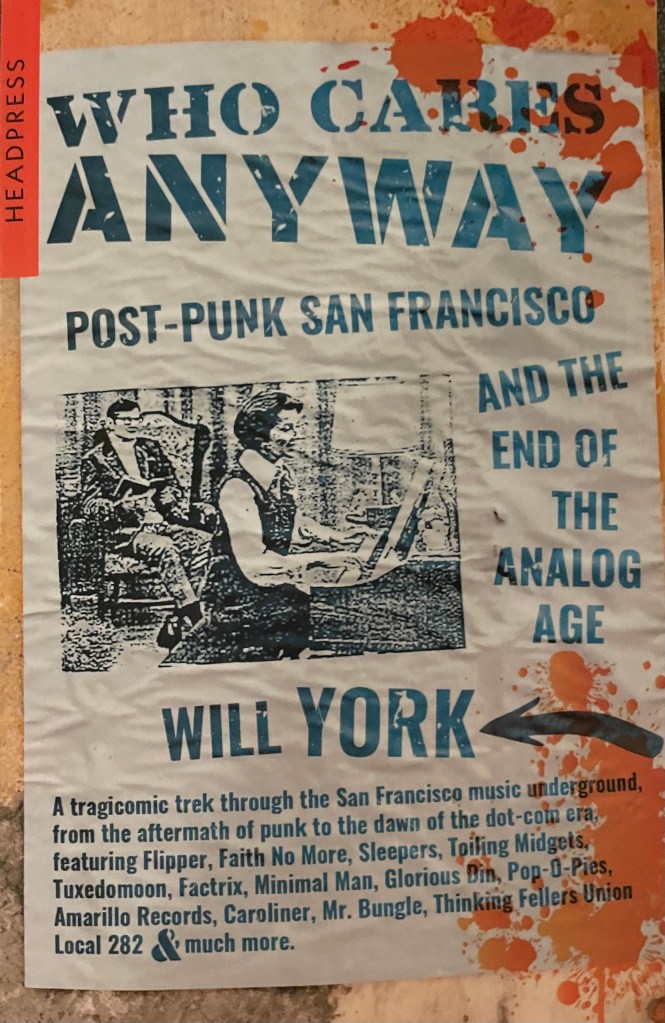
I recognize that writing about Will York’s engrossing new book on San Francisco’s 1977-94 “post-punk” sub-underground takes us off our chosen journalistic beat a bit. Clearly, this is a book, and my site focuses on fanzines, and yet I just devoured this 560-page tome in what was effectively three glued sittings, and I’d very much like to tell you about it. It’s one of the best rock books I’ve read in years, and I’ve read a few. And to wit: what is a book about music, if not a very large fanzine? I rest my case.
Let’s set the stage a bit for what Who Cares Anyway is and isn’t. It is decidedly not a book about post-punk writ large, i.e. music with watery basslines, angular rhythms and whatnot. In fact several of its core bands in the early chapters, such as Negative Trend and The Sleepers, were very much concurrent with first-wave punk. It’s also not a place where you’re going to learn a whole lot about Chrome or The Residents, nor even really that much about Tuxedomoon, despite their the latter’s named presence on the cover.
Rather, the book takes a throughline through important and forgotten bands and quasi-”movements” that really haven’t received much play as of yet, with the biggest chunks of the book reserved for the stories of Flipper (the undisputed arrow leading out of first-wave, punk-adjacent tomfoolery and negation, who then greatly influenced the trajectories of so many of the oddballs who made up the late 80s/early 90s San Francisco underground); Ricky Willams and all he wrought upon The Sleepers and Toiling Midgets; the ramshackle DIY roots and eventual worldwide stardom of Faith No More (about which more later); the Caroliner saga; and everything & anything related to Gregg Turkington, who was clearly author Will York’s entree into the weird San Francisco alternative universe of bands that either didn’t care about their audiences and/or that sought to provoke them in the most oblique manner possible.
There are so, so many places the book could have gone wrong and didn’t. It resisted every temptation to bemoan the post-whatever-this-scene-was dot-com era, and push a de rigeur whiny “it was so much better then” narrative. It strayed far away from the political groupthink that strangled so much of the SF/Berkeley underground for decades, and indeed, it wasted no opportunities that arose to find ways to gently mock Tim Yohannan and/or Jello Biafra. It did not place an undue emphasis on the supposed “bleakness” of 1980s San Francisco (except for the all-too-real hardcore drug scene), and in fact solicited commentary from musicians who made downer or bleak music about how they’d moved to San Francisco because it’s such a beautiful city. Nor did York ignore the post-Flipper, pre-1990s music scene there, a time generally thought to be a creative low point, a point which I myself have argued and which I lived through, and which I’m now not 100% convinced was actually the case.
Oh, and Who Cares Anyway is an oral history, for the most part – which, to me, is the absolute best way to capture a scene or an era that one was not a part of, or really even one you were immersed in. York is a journalist whose SF heyday was spent writing for The Bay Guardian in the early 2000s; I remember his writing well from those days, as well as that of Mike McGuirk and Kimberly Chun.
Lots to talk about here! Let me first get my own biases and connections out of the way; as I’ve blathered on about here and elsewhere, I have lived in San Francisco since 1989, and was going to club shows here starting in 1984 – so yes, I suppose I’m an interested party, and I was reveling in many of these local bands on the radio before that (l can absolutely remember my utter delight and amusement the first time I heard both “Ha Ha Ha” and “Brainwash” from Flipper on KFJC, but I wouldn’t see them live until 1990). Unbeknownst to me until I read the book, York quoted from my 1990s fanzine Superdope twice; from my Dynamite Hemorrhage fanzine once and even once from my long-dormant Detailed Twang blog. I’m happy that I had something to indirectly contribute to this thing in some way, as, truth be told, it’s a book I’d love to have written but would never have had the chops nor the patience to pull off.
York, like a handful of prominent rock writers, spends a lot of time on Ricky Williams, the erstwhile drug addict, drummer on Crime’s first 45, Sleepers singer and later Toiling Midgets singer (he even spent a very brief period fronting Flipper, and is the one who named the band). For years I’ve tried to understand the appeal of The Sleepers to so many whose taste I trust: I also find the Toiling Midgets’ 1982 Sea of Unrest mostly unlistenable, and it really all boils down to Williams. I can’t stand his vocals, and that’s that. While reading this book, I was so taken with these stories and the scene-setting that I did something I’ve probably done a dozen times already over the years; I listened to the complete Sleepers discography online to see if something would finally click, and it sort of did, just not when he was singing. Michael Belfer’s “raw prog” guitar playing is fantastic, however.
Taking this one step further, I learned a ton about the Toiling Midgets that I didn’t know from this book – most importantly, that their second album from 1985, Dead Beats, is phenomenal. I’d ignored it completely the past near-forty years, and checked it out last week, inspired by reading this book. It’s almost entirely instrumental, which is how the band started their life before Williams entered the picture – a dense, hard, totally enveloping wash of sound, only sullied by his vocals on two tracks. I saw them live, playing a short instrumental set in 1991, right when they first came back and just before their Matador Records album Son. All I really knew about them at the time was that they’d been “serious drug people”, and that I didn’t like Sea of Unrest, but even that short set let me know that there was something special there. I honestly just didn’t follow up on it until now.
Who Cares Anyway covers a ton of ground, deeply and authoritatively without overstaying on any one band or moment: Flipper, of course; but also Noh Mercy, Glorious Din, the Pop-O-Pies, Club Foot, Arkansas Man, Inflatable Boy Clams, Subterranean Records, Minimal Man, Factrix, Wiring Dept. magazine and much more. I would have wished for more stories of the Sound of Music club, but at least there’s this article here; I was too young for that place but I used to hear bands announced as playing there during KFJC’s nightly music listings. I’d also think that Frightwig would’ve been a good fit for this book, and am not entirely sure how they missed the cut.
Of course, my initial reaction to seeing Faith No More as part of this project was to blanch at the thought, but I also knew about their early sub-underground roots as a stranger sort of rock band (when they were Faith No Man and then Faith. No More). When York sort of puts their whole story in context, their ultimate global success offers a nice juxtaposition with the rest of the scene that barely left town. I recall Brandan Kearney (World of Pooh, Caroliner, Nuf Sed Records) telling me that those guys were longtime friends of his; clearly members of the band collaborated with Gregg Turkington in projects like Faxed Head; and even though I’ve deliberately never heard music by the related band “Mr. Bungle”, York makes the case for their self-sabotaging uniqueness, at any rate. If I’d been writing this book I think I can now see why Faith No More might merit inclusion as an anchor and/or a foil.
As for all the bands I did get to see and experience in real time, well, I can’t believe someone wrote a book that actually calls out Beetleleg, Junglee, Archipelago Brewing Co, the Easy Goings, Job’s Daughters and even has multiple chapters on the Zip Code Rapists. There’s a picture from a World of Pooh show I attended and a description of the “Brandan bashes Barbara over the head with a fake beer bottle” show that I also attended. The Thinking Fellers Union Local 282 get much deserved play, and little did I know: they mostly got their start playing at the Maximum RocknRoll-affiliated Gilman Street Project in Berkeley. I’d completely forgotten that that club, in perhaps the lamest and most Soviet move ever, initially tried to prevent bands from flyering for their gigs there, in favor of a “We’re a community, just show up and pay to get in every night, and who knows what bands you might see?” approach. It didn’t last long.
When it comes to the Amarillo Records bands and Turkington- and Kearney-related projects of the 1990s: I enjoy reading about them, I enjoy thinking about them, I truly enjoy reading others’ reactions to them, and mostly don’t enjoy listening to them all that much. Caroliner were a perfect case in point, though my antipathy to them runs deeper. “Grux”, the prime mover in this longtime conceptual project, was once introduced to a friend of mine, a “normie” and one of the nicest people I know. My friend proceeded to stick out his hand for a handshake, which was rejected with a sneer by “Grux”. Instant hate from me when I heard that story a day later. This book reveals that he was just as much of an asshole with everyone, even berating Turkington for being such a sell-out that he owned a car, while still asking Turkington to drive him places. I did not know the story of why Brandan Kearney ditched Caroliner and Grux, but good for him, and you’ll have to read Who Cares Anyway to find out.
So excited to also read about the Zip Code Rapists’ phony “breakup” and the follow-up bands the Zip Code Revue and the Three Doctors Band. What an incredible piece of dada artistry that all was, and a terrific piece of minutia to cover in a book. York makes mention of a legendary piece in Portland’s Snipe Hunt newspaper in which the two members of the ‘Rapists are each allowed space to vent about their “acrimonious breakup”, a total knee-slapper (for real, I’m certain I slapped my knee while reading it) that I wished I’d saved. Apparently it was included in the Three Doctors Band’s Back To Basics – “Live” LP, a record that I’d heard was so godawful I never even thought to own one.
I’ve certainly boared like an eabla enough over this book for you turkreys. Get your copy here if any of this sounds worth pursuing!
-
Damp #3

Part of the reason I started this endeavor up was to set a digital trail for quality, formative magazines like Damp that really possess no internet presence outside of what I myself have put up there, and especially what Tony P wrote during the years he was publishing Fuckin’ Record Reviews. Where I come from this shit matters, and besides, it gives me an opportunity to go back and re-educate myself about music I might not have been ready for when I first encountered it in the pages of, say, Kevin Kraynick’s Damp in the late 80s.
I know we’re not talking about it here, but his Beefheart issue, #5, came out when I, like so many, had heard Trout Mask Replica and said, nope, that’s definitely not for me. Maybe two years later after his mag came out, ‘92 or so, my “stance” had totally changed and I was singing the praises of the Captain wherever I could, and I got to revisit Damp #5 and really whet my palate that much more. I suppose I could do the same with this issue and The Fugs, but I already very much enjoy Tuli Kupferberg and The Fugs, perhaps more in spirit than in action.
But what I’m getting at is that Kraynick, in 1988, was mixing his general “indie underground” (i.e. this issue’s Scrawl and Nice Strong Arm interviews) with oblique musical worlds that your average college radio 19-year-old (like me) hadn’t quite cottoned to, and placed it all on a beautiful continuum that’s rather obvious in hindsight. Kind of like Patrick Amory’s Too Fun Too Huge! that we talked about here.
Kraynick wrote well, dug deep and used one of the worst fonts imaginable. I don’t know what you’d call it – “Dos command line”? That’s what it looked like, and it’s what word processors were built with at the time – so all is forgiven. This issue also has a great if rather sad interview with John Trubee, whom some of you may know from his album The Communists Are Coming To Kill Us!; his novelty hit “A Blind Man’s Penis”; his prank phone calls or for one of the all-time great song titles, “Satan Pukes on the High School Cheerleaders”. Trubee, in Damp #3, comes off as a misanthrope, sure, but a very self-hating misanthrope, whose bitterness and disgust at the world is only outweighed by that directed at himself. I’m glad to know, in 2023, that he’s still with us, because he’s given me a few good laffs and chortles over the years.
Meanwhile, there are a few more yuks to be had in Damp #3. Contributor Steve Erickson, whom we last discussed in our review of his Cut #11, gets his first exposure to Alex Chilton via his High Priest album and says, “I suppose someday I’ll pick up a Big Star album…why couldn’t he have covered The Fall’s “Hip Priest” or The Scientists’ “Bad Priest” instead of Carole King and “Volare”?” Oh for sure, I know how BUMMED people were around this time when they’d go see Chilton, and he’d do an earnest, not-kidding-at-all, full-blown version of “Volare”, usually with a shirt open to his navel. So good. For what it’s worth, I didn’t hear Big Star myself until 1993, and, suitably impressed, I told my friend JB about my new discovery and his riposte was, “Dude, that’s so high school”. Ouch.
Off topic again. Kraynick gets in a few zingers himself at the expense of Three Day Stubble, The Descendents, Tim Adams of The Pope fanzine (and later Ajax Mailorder) and not an insignificant amount of others. His contributors – New England/NYC fellow travelers – actually get more play than he does, especially with the features, so Damp #3 is more of a group effort than I’d remembered. The magazine would get even better from here; I have a bunch of them; and we shall be discussing them in this forum at some later date to be determined at whim.
-
Forced Exposure #9

(In my own fanzine Dynamite Hemorrhage #7, I did an issue-by-issue overview of Forced Exposure. Rather than write new, fresh material about this formative magazine here, this bit is taken from that. You can download a PDF of the issue where I wrote all the FE stuff here).
The Winter 1986 issue of Forced Exposure had a sort of farewell/swan song to local Boston heroes Mission of Burma, who were retiring (we all know how that went), and it sets the tone for a mostly fantastic issue that continued to pull the magazine (and with it the entire scene) out of its hardcore roots.
What I liked best about this one besides the Burma article were the literal hundreds of reviews; every sub-underground LP and 45 coughed up around the world that quarter. These guys didn’t miss a thing, seriously. Private pressings, import 45s, EPs from deepest Buffalo and Tucson and Vancouver – they’re all in here. I also liked the fact that none of them were alphabetized and were sorted at random, and it’s almost certainly why I’ve been doing the same in the last several issues of this magazine – sort of a “you’ll just have to keep turning pages to find the one you’re looking for” attitude that fit in well with their general vibe.
Jimmy Johnson’s writing took a big leap forward in this issue, and while I always cottoned a bit more to Byron Coley’s taste, Jimmy really started to have a way with words, especially when those words were put in service of haranguing some of punk rock’s lesser lights. This was the start of the era when formerly punk and HC bands started to “tighten up”, stretch their songs out, “cross over” into metal and so forth – and Forced Exposure #9 was lying in wait for them. I loved it.
My future pal Kim Cooper – we wouldn’t actually meet for another three years – wrote in to the letters section to vent about how dopey the Lydia Lunch/Nick Cave plays in the previous issue were, and she totally nailed it:
“…It’s 1985, and any fanzine editor who chooses to publish this silly and dated material is making it quite obvious that s/he knows the history of the literary avant as poorly as the writers who are repeating the innovations of dead men. But the real crime in all this is that the young readers of the journals that feature these people are getting a skewed and sub-standard idea of what that sort of writing is capable of.”
On the flip side, Byron Coley’s response to Dave “MDC” Dictor’s letter in the issue was one of the funniest things I’d read to that point, and was one of many recruitment tools he and the FE editors & writers used to sign me up for their righteously snotty cause.

Issue #9 featured pieces on White Boy; Couch Flambeau; Big Black; Afflicted Man; Roky Erickson and his mom interviewed by the Angry Samoans’ Gregg Turner; The Flaming Lips (a very different band in 1986 – one who were kind enough to try to sneak me and my fake ID into their Goleta, CA show as a “roadie” a year later….it didn’t work), Half Japanese tour diary, some hideous artwork by a guy I’ve never heard of since called “XNO”; Copernicus; more terrible Lunch/Cave plays; some Nick Blinko (Rudimentary Peni) artwork that only a child could love, and a combination of high art and low embarrassments.
If Steve Albini’s horndog article about Patti Pezatti – a local fanzine editor and sister of Naked Raygun singer Jeff (ostensibly Albini’s friend?) – had been internet-available at any point in his production career, which I assume is ongoing, he’d have been blackballed and #Me-Too’ed out of a vocation entirely. It truly feels like a hundred years ago, in as many ways as one can count.
-
My Teeth Need Attention #1

With the exception of our peek into Silent Command #1 a couple of months ago, the Fanzine Hemorrhage story so far has been something of the proverbial “nostalgia trip”. It certainly doesn’t have to unfold that way, as long as new music ‘zines of a high caliber find their way into my hands, as happened with My Teeth Need Attention #1 just this very week.
Actually I ordered this straight from the Carbon Records store as soon as I heard about it, as I’ve become quite acquainted in recent years with the wild world of Joe Tunis and his label and podcast. Carbon Records – which has been going since 1994, a fact that blew me away, since, given my pedestrian tastes and johnny-come-lately openness to the world of the often formless structure-shunning noise/”music” he releases, I only first heard a Carbon release in 2018, when the 2xLP guitar compilation Wound came out. Now I could be wrong about this, but I think Joe himself is in at least 20% of the bands on Carbon. From his perch in upstate New York – Rochester, the home of Kodak and Xerox! – he’s now launched a fanzine, a terrific compliment to the grounded yet outer-limits exploration of his podcast and label.
He goes big on New Haven early, staking his reputation with interviews of two of that city’s heavyweights: Stefan Christensen and David Shapiro, the latter of whom you may know as solo guitarist Alexander. Both of them are among my very favorite musicians going right now; when they’re hitting their peaks, they respectively take “guitar playing” in some creatively bold and very exciting directions. Listen here for maybe my favorite example of Christensen’s layered, folk-rooted noise and here for a great taste of Alexander’s intricate, lo-fidelity fret-climbing. Both fellas play together in the band Headroom, another favorite here at the ‘Hemorrhage.
So that’s the bulk of My Teeth Need Attention #1; there’s also a Tunis tour diary of a trip to Philadelphia; photos by Brian Blatt; a short piece of fiction by John Schoen and some reviews of more otherworldly psych, noise and freedom-seeking not-even-rock music. Personal, well-written and very “all in the family” – and make no mistake about it, it’s most assuredly for heads only. Hoping it becomes a thing I can count on a couple times a year.
-
Creep #2

Fantastic 1979 second issue from one of San Francisco’s more revered punk fanzines, Creep, which I’d long known was helmed & stewarded by one “Mickey Creep” (in actuality, Dean Sampson, sometimes known as Mickey Sampson). Sampson and his band of contributors capture the frenzied zeitgeist of 1979 punk and of San Francisco writ large better than nearly any other publication I’ve read, and unlike the jaded first-wave scenesters who were already crying punk-is-dead around this time, Creep #2 is very much about helping to document and further its vitality or rebirth, however it is you want to cut it.
I really learned some things, too! First, all these years I thought the Maximum RocknRoll Radio show, which I used to listen to religiously on KPFA on Tuesday nights, started in 1980 or even 1981. It was started in 1977, folks – and was originally a combination of the new “punk rock sound” that was sprouting up and 50s rockabilly & oldies (!). There was even a dude named Al “Professor Pop” Ennis on the show who ran the 1950s portion; he was long gone by the time I started listening – a time of Jeff Bale, Ruth Schwartz, Tim Yohannan (of course), Ray Farrell and sometimes Jello Biafra (blah). Ennis can barely be found & connected with this show online at all, but hey, that’s why I accumulate these old fanzines, to get the real fuckin’ story.
I also learned via an advertisement about Portals to Music, a new wave record store at Stonestown Mall, now home of Target, Whole Foods and multiple Asian-themed restaurants and boba places – and a place two miles from my home that I find myself in weekly. Absolutely incongruous and baffling. Another world entirely. One final new thing I learned was that the worst bit of music writing I’d ever read had been hiding all along right here in Creep #2! One Thomas Sinclair, with his Freshman English classes surely barely in hand, writes about MX-80 Sound:
“As perchance this brisk July eve in the Bay Area, I was to experience a delightful musical and aesthetic encounter. As unpretentious and undistinguished as the visual accoutrement of the band may have been, the sound of MX-80 Sound was brilliantly polished and pulsated as rhythmically as could be expected for their indigenous brand of semi-eclecticism would allow…” – and it only gets worse from there. It’s truly mind-bending, and I’m glad to know where to find the worst piece of music writing of all time should I ever need it!
Creep #2 takes us on a tour of the state of it all, circa 1979. Jello Biafra is running for mayor. Punk violence is threatening to close down The Deaf Club, because some drunken knucklehead decided to take a chain to three parked cars outside of the club after a show. The Canadians have just come to town, and locals are hopped-up about D.O.A. and the Pointed Sticks. (D.O.A. were always hugely popular in the SF Bay Area; when I first started hearing punk for the first time, my perspective was that the biggest bands in the entire North American scene were the Dead Kennedys, Black Flag and D.O.A. pretty much in that order). And there’s a terrific interview with Craig Lee from LA’s Bags. Lee wasn’t just a shredding punk guitarist; he was always one of the good guys, and a man who shuffled off this mortal coil far too early.
I think my favorite thing in Creep #2, though, is the respectful and just-enough-noose-to-hang-himself interview with Joel Selvin, who was then, and for a long time afterward, the chief rock music writer at the San Francisco Chronicle. I grew up reading Selvin, because I read the newspaper every day, and just like the old man that I am, I still do. It was definitely de rigeur for punks to hate the mainstream rock critic; Selvin got a ton of vitriol over the years; his counterpart Robert Hilburn at the LA Times got just as much if not more. I’ll say right now that I recently read Selvin’s book about early 1960s Los Angeles pop music, Hollywood Eden, and while no masterpiece, it’s quite entertaining and very effective at calling up an ephemeral time and special place in music’s history, with his Beach Boys “Good Vibrations” chapter at the end being especially well-put-together.

But here, in Creep #2 – wow. This photo they ran is really the epitome of the late 70s, coked-out, record-industry sleazeball; I don’t think Selvin was really that guy, but I can only imagine what the sneering punks reading Creep in ‘79, the ones who had to suffer through his weekly writings about Journey, the Doobie Brothers, Elvin Bishop and Maria Muldaur, had to say about it. Selvin himself gets off some pretty self-damaging zingers; to wit:
“Over the past few years the quality music in the local clubs has plummeted. In 1975, the Longbranch – unbelievable. It was everything a nightclub should be….I haven’t seen a show at the Mabuhay that I thought was good. I’ve checked these places out. They’re just not happening the way a club should be happening.”
“One time the Eagles were really good. It was the time that they opened for the Doobie Brothers that they were spectacular.”
“However important or significant The Clash may be, it’s “Sultans of Swing” that’s gonna be remembered from 1979….I have no doubt the American public wants the Knack and not the Clash. And certainly the sales figures reflect that.”
I guess on that last point he’s not wrong; I mean, I disliked The Clash as much as he did. And I suppose it is “Sultans of Swing” that I hear inside of Safeway or Chipolte, not “Guns on the Roof”. But oh for those days at The Longbranch, watching Sammy Hagar, Earthquake, Eddie Money and Commander Cody!
One final note, a thing that got a lot of hearts racing here in San Francisco: Penelope Houston of The Avengers works at the San Francisco Public Library, and she helped establish a “punk rock collection” there of zines, flyers, videos and other ephemera that I’ve had the good fortune to go check out, albeit only once, and albeit only in brief because her snotty co-worker was bogarting so much of the material on a day she wasn’t working. Here’s a 90-minute panel discussion the library put on with the folks who put out Search and Destroy, Ripper and Creep – including our boy Mickey! You can learn more about the library here.
-
Gold Soundz #4
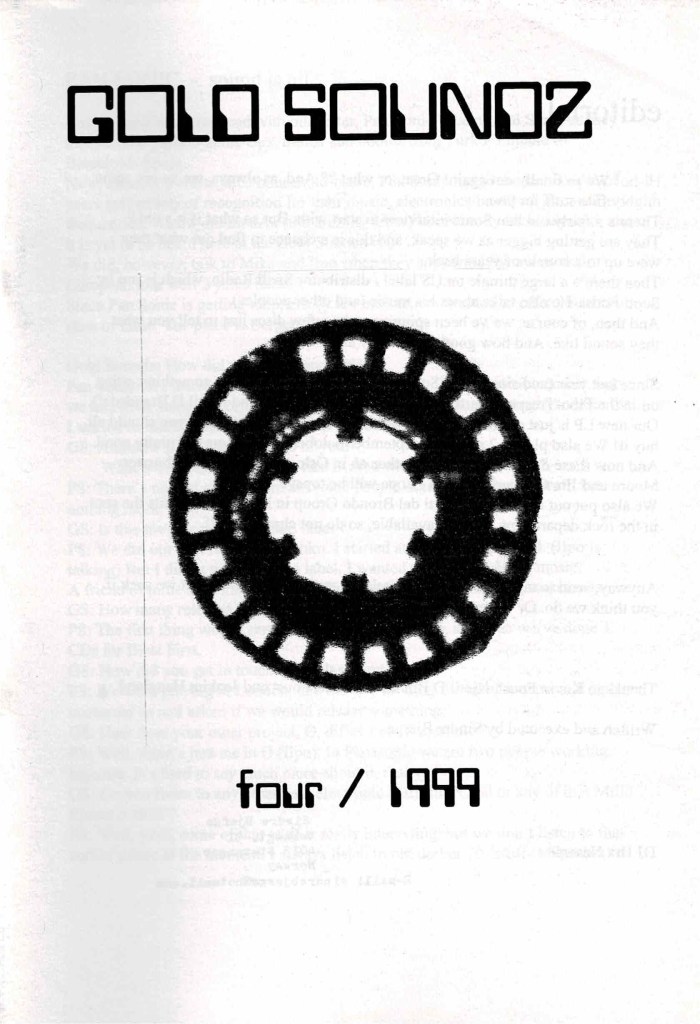
Not a ton I can tell you about this 1999 noise/experimental/outer-limits-of-rock fanzine, except that it hailed from Norway’s “oil city” Stavanger, was put together by one Sindre Bjerga, and was about as no-frills as they came. Zero photographs nor drawings, outside of what was in the ads themselves – just typed interviews and reviews, all clinging to a late 1990s world of micro-labels and the “popularity”, such that it was, of wrecking-ball bands like Dead C, Harry Pussy and Shadow Ring.
I really do have to applaud whatever anti-thought went into the cover art for this one. Inside, however, Gold Soundz #4 approaches its subjects with much more care and discernment. Bjerga’s big discovery this issue is Godspeed You! Black Emperor; actually it’s not 100% clear he’s just discovered them, but after seeing them in London and hearing their album <<*#/&#>> his fandom has at the very least been cranked up to new levels. This is a band whose music I have never heard. I’m aware I could rectify that within seconds, but as my favorite line in 2014 film When We’re Young stated, in reference to instantly looking something up on the internet, “Let’s just not know”.
The interviews are with Pan Sonic and a US label/distributor Swill Radio, run by Scott Faust who was and perhaps still is part of Idea Fire Company. These are names that mostly exist on the periphery of things I know about, so it’s cool to see it all so maximally central to another person’s worldview, a Norwegian no less. Bjerga remains an experimental musician and has, at this writing, 174 (!) releases to his name. No seriously, check out his Discogs. Even Electric Frankenstein don’t have that many.
-
Butt Rag #8
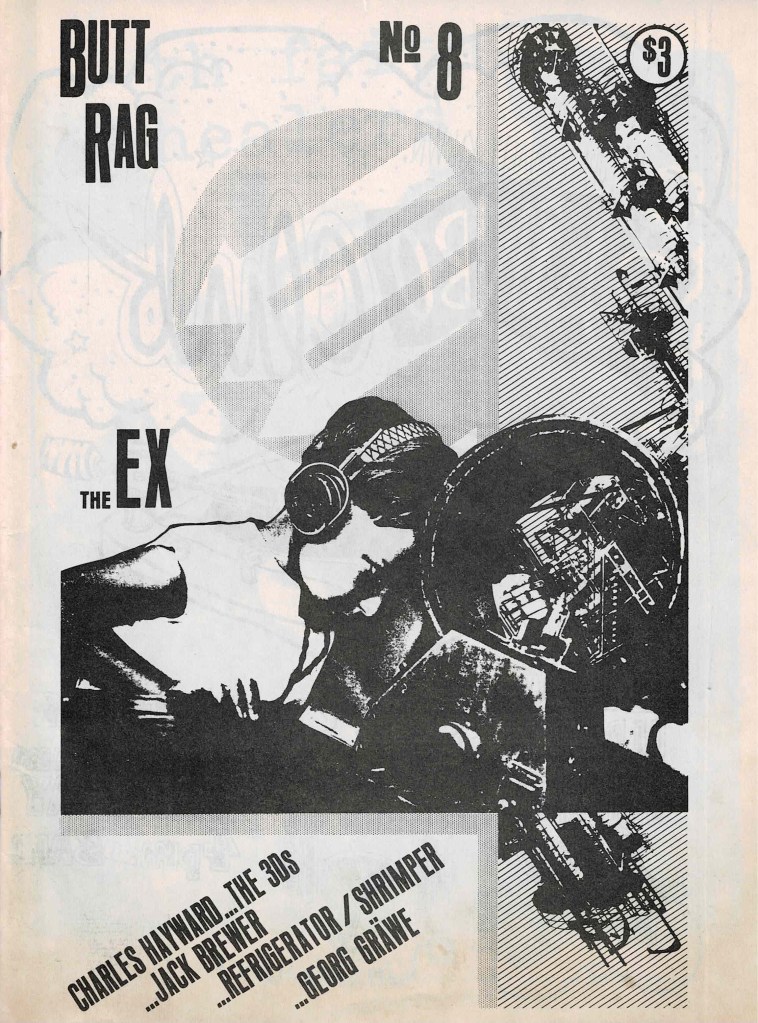
There was almost always some dude associated with the fanzines I regularly read in the early 1990s, and now it’s somewhat gratifying to see some of those dudes, like Crank’s Marc Masters and Butt Rag’s Peter Margasak, now serving as institutionalized, expert music writers across a variety of forward-looking publications. I continue to see Margasak covering jazz, classical, outré rock and other such topics in places like We Jazz, Bandcamp and elsewhere, and I even subscribe to the man’s Substack. And to think we were all merely record-obsessed, fanzine-producing young idiots at one point (caveat: I still am, just not young).
Unfortunate name aside, Butt Rag was one of the early 90s’ omnivorous musical gourmand’s bibles. You just needed to be on Margasak’s expansive wavelength, because he was certainly pretty forthright in telling you what was & wasn’t worth paying attention to. By the time I caught up to this Chicago fanzine on issue #6, it had been coming out for a few years, and I only have just that one, as well as the one from 1993 we’re talking about today, Butt Rag #8.
First off, it’s absolutely enormous: 100% newsprint, 144 pages, and – get this – it has a couple hundred (long and detailed) record reviews, all written by Margasak. It’s a staggering amount of opining; I know what this particular individual probably spent the bulk of his 1992 and early 1993 evenings doing, when not going to shows. Everything from mediocre Homestead releases (I forgot all about “Bodeco” until re-reading this) to wild NYC and Chicago free jazz to experimental/20th century classical and then, every single independent release on virtually every US, UK, NZ and international label that had come out the previous six months – as well as a couple dozen reissues. It’s incredible. And naturally, Margasak’s enthusiasm for it all ranges greatly from “godhead” to “derivative twaddle”. I was paying pretty robotic attention to things of this ilk around this time, and I truly haven’t heard half of what he reviewed here.
There’s also a sort of strangely forced familiarity with various underground scene denizens, in which jokes are made about them and their first or last names are tossed off as asides within a review. I personally tried as best I could to stay the course within my own 80s-90s blatherings and remember that, when discussing a Thurston Moore, Gerard Cosloy, Byron Coley or Steve Albini: We don’t actually know these people, and they are not our friends (unless of course you did know them; then you were running the additional risk of overt name-dropping/piggybacking). But that’s young people for ya. When your world, social life, inner life, outer life etc. revolves around underground rock music, sometimes it’s hard to gather the sort of perspective that might even out the humanity and general worth of its primary players with that of the next-door neighbor, the girl at the cafe and one’s brother-in-law. I’ve been there.
Butt Rag #8 spends a good amount of time grilling Jack Brewer, ex-Saccharine Trust, in a manner that very few in the 1990s did, so I really like that piece. Brewer was definitely a trip, and I don’t feel like people talked to him about his own inner world enough. The guys from Claw Hammer told me a great story once about the “Jack Brewer Band” touring the US, and accidentally ditching a band member at a rest stop in Texas somewhere, then driving all the way to their ultimate destination six hours away (New Orleans, Albuquerque, something like that) before realizing the guy wasn’t in the van, then having to cancel their show to go back to pick him up. A time before cellular telephony, and a nice testimonial to the power of not paying attention.
There are also big features on David Mitchell from the 3Ds (saw them around this time, they were great!); Charles Hayward from This Heat; John Corbett on The Ex; and – a fanzine obsession I never quite understood at the time nor now – the “Shrimper” label from California’s Inland Empire. You can absolutely see the seeds of where Margasak’s tastes and writing would eventually take him; it wasn’t long after this that he was regularly writing for the Chicago Reader, and then on from there. I daresay you ought to check out back issues of the ‘Rag should you ever stumble upon the chance.
-
Great God Pan #12
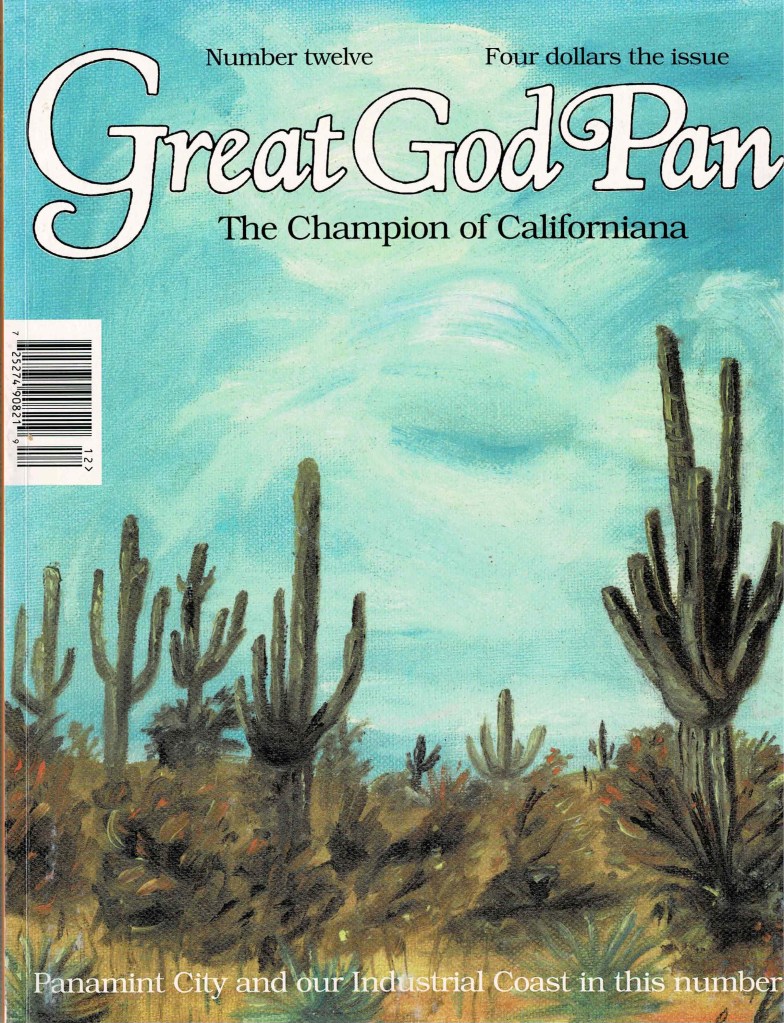
(Originally written for Dynamite Hemorrhage fanzine #9).
In the 1990s a California-based music fanzine called Great God Pan started an issue-by-issue transition from being ostensibly about independent rock music to being entirely “The Journal of Californiana”. It was a fanzine that looked like and was put together like a fanzine – and which took advertisements from the indie labels of the day – and yet was pretty much wholly about California and Pacific West lore, tall tales, explorations, and California- themed artwork by the time they wrapped it up in 2000. Editors Mark Sundeen and Eric Bluhm were car campers, western history nerds and lovers of the offbeat, deranged and strange. It occurred to me often while reading it that music was truly becoming a bill-paying afterthought for them with each passing issue, and I was very much okay with that at the time.
I caught the magazine about halfway through their transition, in the mid-1990s, and likely bought and devoured them all because I was both a Californian just starting to take edifying personal road trips across every freeway in the state, and because I was an underground rocknroll fiend who’d scarf up every decent fanzine on the rack. Yet it was only in 2020 that I decided to again crack open my stack of Great God Pans to see how they held up a couple of decades later. You may recall that you yourself had many evenings spent at home during the year of our lord 2020.
Many wonders revealed themselves again, and some for the very first time. In two issues of the magazine, Great God Pan #12 and #13, there lived three pieces each by a writer named Michael Fessier Jr. These pieces had originally been published in the Los Angeles Times’ Sunday magazine, West, during 1970 and 1971, as part of a 10-part exploration of the soul of an exceptionally impenetrable city called “L.A.: In Search of the City”. I got busy reading them, somewhat chagrined that unless my memory had totally failed me, I was doing so for the first time. I couldn’t believe how outstanding this guy’s prose was, nor how in-depth his travels to the far corners of this big, wide, unending city had taken him.
As he explained in the introduction to the as-then only partially underway series on February 22nd, 1970, “The author was not too sure of what he would do or who he would talk to, except that he would try very hard to avoid actors, hippies, noisy advocates of the Silent Majority and Timothy Leary. Certainly somebody else was out there.” He then explained to Great God Pan 28 years later that his actual target in doing the series was the Times itself: “the Times and my accumulated sense that outside movies, the Times, novels, and all the rest of it – there was this other L.A., totally unnoticed.”
This has also struck me about Los Angeles time and again. One turn off of a freeway, and you’re drifting through Pico Rivera, or Sylmar, or Altadena, or Montebello, or Lawndale. All of it Los Angeles, just as much as Wilshire Blvd. or Hollywood & Vine or Fairfax & Melrose. I’ve found myself in places like this for one reason or another, their own self- contained worlds off the 710 or 405 or 110, and just been like, “Wow….people live here.”. My pal Jerry used to take me around Los Angeles and Orange counties in the 1990s, and I was the gawking tourist who wanted to know about any & all regional differences between Buena Park and Santa Ana, between El Segundo and Hawthorne, between Orange and Anaheim.
Fessier’s writing about pockets of the city were absolutely revelatory to me, and I read and then re-read all six of the ten pieces that Great God Pan had been able to reprint. He doggedly interviewed hyper-local “characters” in each region he visited like a gumshoe detective, not to unravel a case but instead to make one: that this place, this Cudahy or Rustic Canyon or a skid row downtown street, this place is a place that matters to the people who live and work there.
The San Dimas piece in particular should have won a Pulitzer, such is the pathos and humor of the story. It’s the story of a 28-year-old man named Fred Blitstein who’s carpetbagged into the Inland Empire town to make a name for himself in civic improvement, with an eye toward transforming the decaying Bonita Avenue into an open- air “Early California” living museum. No one can quite figure out what “Early California” actually means, and can only point to older pictures of Bonita Avenue looking just as it does today by way of example. This disappoints Blitstein greatly, who desperately wants to do something exciting and memorable for San Dimas:
Blitstein was out showing me around in his trim, tangerine-colored Opel GT. “Southern California,” he was explaining, “is the land of the two-time loser. A pretty plastic facade. You push through it and there is nothing there.”
He had come to study in Southern California thinking it would be the nearest thing to his beloved Florida. The place of his imagination was the movie-poster one, all beach and sun and pretty girls. He was badly disappointed, and now believes that Southern California out-tinsels Florida five to one. He went to a conference of urban affairs people at the Hilton where the question of “What is Southern California?” was asked. Nobody had any answers. “Southern California is an abstraction,” said Blitstein. “You can’t tell what it is, even where it is.”
“Southern California is God’s test of man,” he said, whipping his car around corners so quickly I was feeling a little carsick.
Depending on how you look upon this time in Southern California, it’s either a far more innocent era than our own, or a part of post-Manson reckoning that was already ripping the city apart. The Manhattan Beach piece, about swingin’ mustachioed bachelors trying to party and get down with stewardesses, seems to split the difference. To me, 1970 seems, you know, like a long time ago, half a century even – and yet elements of Fessier Jr.’s Los Angeles are still instantly recognizable to this day.
The ten pieces in West were – by title and titular region:
● “Growing Up in Cudahy” (Cudahy)
● “In With The In Crowd” (Manhattan Beach)
● “Coming To The Canyon” (Rustic Canyon)
● “The Pied Piper of San Dimas” (San Dimas)
● “Portraits and People” (The Huntington Library in Pasadena)
● “The Living End” (Downtown LA)
● “The Gates of Rolling Hills” (Rolling Hills)
● Title unknown – San Fernando Valley 1
● Title unknown – San Fernando Valley 2
● Title unknown – San Fernando Valley 3
“Title unknown” because I haven’t read them, nor found even references to them online, and not for lack of trying. Suitably impressed by what I did read (to say the least), I tracked down Great God Pan co- editor Mark Sundeen, whom I also learned subsequently went on to quite a writing and book-publishing career of his own. I let him know that my research uncovered that Fessier had passed away in Santa Barbara in 2014, at the age of 75, and I even had floated the idea of actually publishing these pieces in a book of my own, money permitting. Here’s what he told me:
Yeah, Fessier, wow. What a guy. I don’t think I knew he died. He was such a great writer, one of those Californians like John Fante or Leonard Gardner who had so much talent, such a unique West Coast way of seeing the world, but just didn’t figure out how to break through to a wide audience. I blame the fact that the publishing world sits on the East Coast but there were surely other factors. The way I remember meeting him is that he wrote a glowing review of Great God Pan in the LA Weekly, and we got in touch with him and he mentioned this piece he’d written decades earlier about Manhattan Beach, where we lived, and so of course we wanted to read it, and were blown away by it, and asked it we could reprint the series. I think we meant to keep publishing more, but we soon “retired.”I personally would pitch in a few bucks to publish a book of his essays about LA from the early 70s. I think he really captured it better than say, Didion, because he really dove into the uncool places far from Hollywood. When I met him I was in grad school at USC and just discovering the New Journalists of the 70s like Gay Talese and Tom Wolfe and Didion and I thought/think he was as good as them.
I think he sent us old xeroxes of either his typed drafts or the West pages, and I typed them into the computer manually!
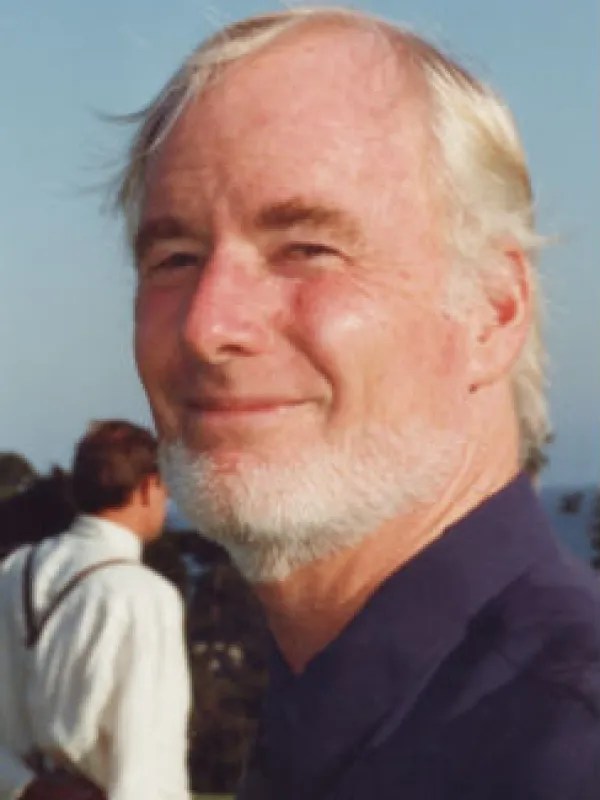
Michael Fessier, Jr. What’s exceptionally frustrating in this always-connected, everything documented era we live in is just how tough it can be to dig up printed materials from the past – and even to find people, say, Fessier Jr.’s two sons – who haven’t really left much of an internet presence, except for the fact that they appear to be alive and about my age. I didn’t know what I was going to ask them when I did find them, to be fair, but it was probably permission to compile all ten of these pieces into a book on my not-quite- launched vanity private press. Maybe I’d call it “L.A.: In Search of the City”! I suppose that costs money, and anyway, I can’t track these guys down, and that’s probably just as well. It’s the Los Angeles Times that likely owns the rights to the ten pieces, and I’m not ready to slug it out with Otis Chandler just yet.
Until that time comes, I merely wanted to illuminate the fact that this amazing trove of urban spelunking and writing exists, as Great God Pan also did, even if I’m not actually reprinting it so you can compare notes with me and all your Dynamite Hemorrhage– reading chums. I’d do what I can to grab copies of Great God Pan #12 and #13 if you’re at all interested in checking this stuff out, and hey, if you figure out how to work the microfiche machine, maybe we can take this Fessier Jr. project a step further together.
(Postscript: not only did I make contact in 2022 with one of Fessier Jr.’s sons, who basically told me godspeed and thank you, more or less, I was bestowed with a treasure trove of Fessier Jr. scans from SL, who did know how to work the machines at his local library. I got to read the three San Fernando Valley pieces, but also a ton more of Fessier Jr.’s work in New West, the LA Weekly and other journalistic venues. Fantastic stuff, and makes me even hungrier to finance and publish that book.)
-
Human Garbage Disposal #4
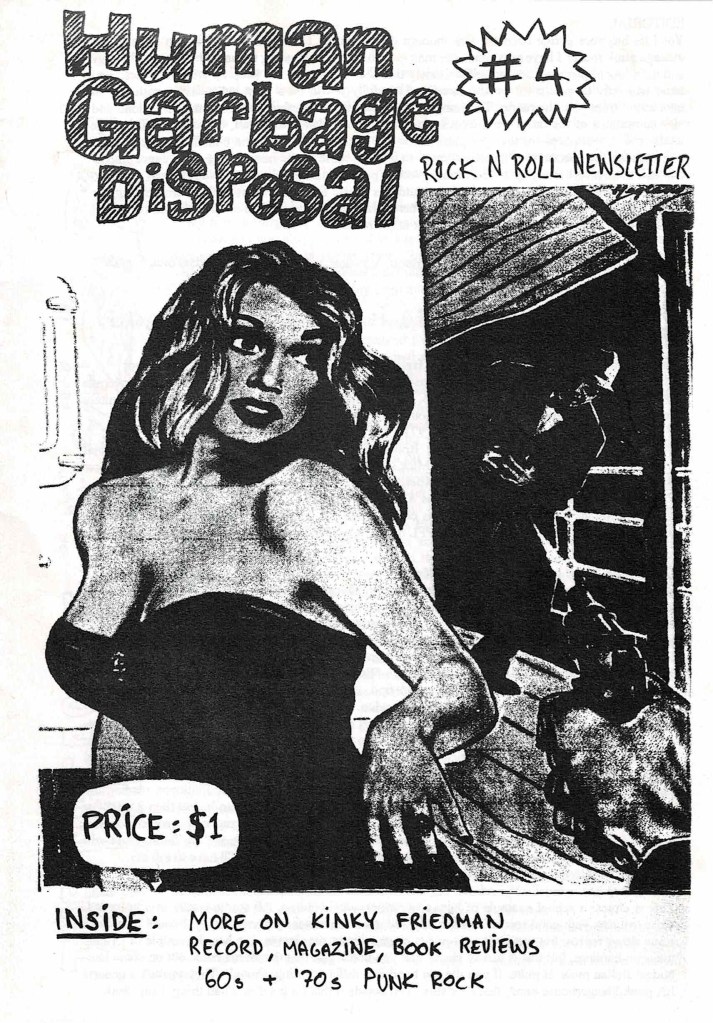
A terrifically robust fanzine subculture sprouted up around the great third wave of garage punk wave in the 1990s; you know, the one defined by bands like the Cheater Slicks, Supercharger and The Gories and by labels like In The Red, Crypt and Goner. Or, perhaps I should qualify and say that crew helped defined the first half of the nineties; there was also this additional berzerk blitzkrieg of loud-fast-raw garage punk in the decade’s second half that one might instead associate with an avalanche of Japanese bands; Rip Off Records, and some of the better material on labels like Estrus and Sympathy.
The Europeans – they got in good during this latter stage, and were regularly importing American and Japanese bands over to tour, and were cranking out some of their own fine imitations & even a few moderately original variations. Everyone knows that if you’re a podunk North American band drawing 15 people a night in your own backyard, but you have Euro distribution and a small set of fans across the pond, you’ll be treated like pampered dukes & duchesses in places like Utrecht, Ghent, Madrid and Munich.
It was also the Europeans who were producing the best garage punk fanzines of this era (aside from Eric Friedl’s Wipeout!, which we’ll come onto one of these days soon; Todd Killings’ Horizontal Action also made the grade) – well, at least I think so. Two Europeans, anyway. We already discussed Tom Arnaert’s Bazooka on this site. The other total ringer was Swede Henrik Olausson’s Human Garbage Disposal. I only have two issues, #4 and #5, and they’re small-batch, small-page-count, small-print expositions on the crude, feral and exciting world of garage-based punk sounds, 1960s-present. Not small-brained!
Olausson, like Arnaert, had a command of the English language that far outweighed that of most of my own countrymen, and unlike Arnaert, he was pretty fucking snotty and dismissive. Red lines were set and not crossed; the whole “turbo-charged” big rock sound of slobs like The Hellacopters and Turbonegro was verboten in this mag, except to mock mercilessly. No, Olausson had phenomenal taste, and even re-reading 1997’s Human Garbage Disposal #4 again last night, I was discovering stuff I missed back then, like a Spanish band with the dumb name Pretty Fuck Luck whom I then “googled” and found some ripping, underwater lo-fi garbage clang from. See, in ‘97 or ‘98 when I first had this magazine, you couldn’t just leap from print to digital to hear what you were reading about; even Napster and all that started later, and it took me a good four years to even try those services because I was petrified that I’d be served with a $20,000 cease-and-desist for downloading a Wire bootleg or something.
Human Garbage Disposal #4 is 12 pages of record, live and fanzine reviews, divided into “modern music” (with a great 1979 new wave font), 60s punk reissues and 70s punk/KBD stuff. There’s an explainer on Kinky Friedman (of Kinky Friedman and his Texas Jewboys), following up on something from the previous issue that I don’t own. So no – Olausson wasn’t necessarily bound by a commitment to rock at all costs. He praises the debut Demolition Doll Rods LP after saying “Their previous singles left a little more to desire”, one of which I actually helped put out (!). He and I actually part company there; I couldn’t find much to like about that band after their first single, and it all seems pretty stupid now, wouldn’t you agree? He does a great job eviscerating aspects of the Amphetamine Reptile label while laying it on thick for killer records by The Bassholes, Supercharger, the Murder Punk comps, the Urinals and then some.
I don’t suppose that any of you out there know how I might get in touch with Henrik Olausson of Landskrona, Sweden, would you?
-
No Mag #10
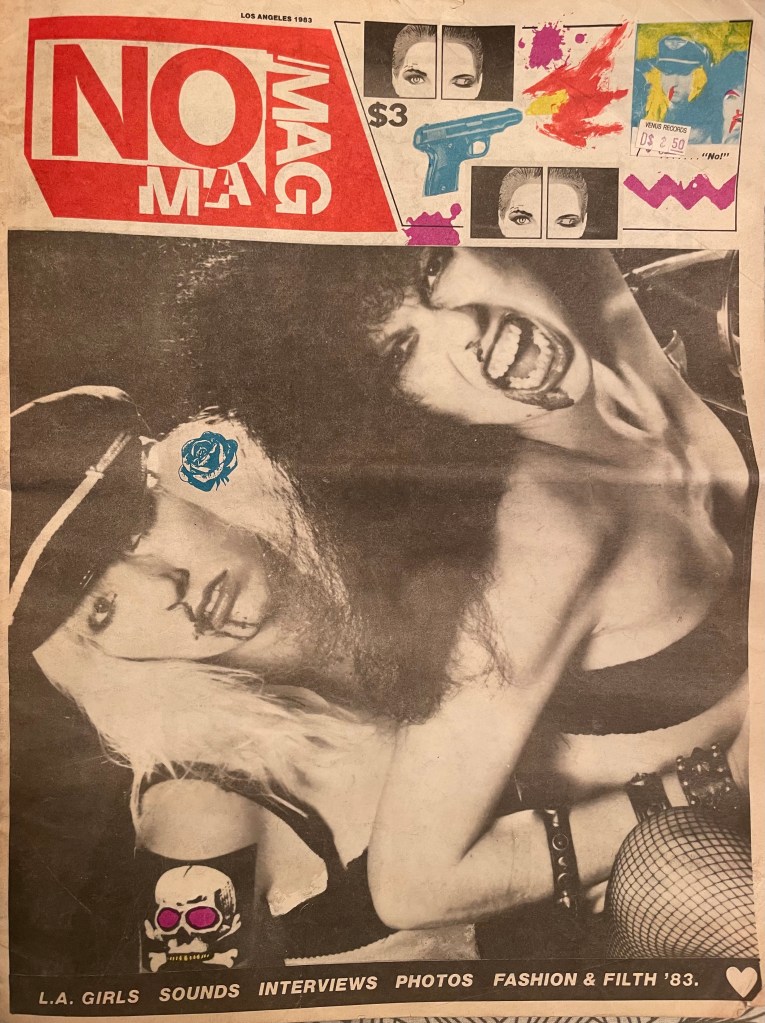
There’s really nothing that’s ever been like Los Angeles’ illustrious No Mag, before or since. Sired into this world by Bruce Kalberg, the magazine lived in defiant, outright violation of whatever common standards of “decency” were during its 1978-85 run, a run which happened to overlap beautifully with the flowering of the great Los Angeles punk rock underground. Some issues of No Magazine or No Mag may index heavier on music than this one – the local scene, if you will – but #10 is a great entrée into Kalberg’s crazed world of art, sex, blood, photography, violence, excretory functions, glamor and punk rock. I’d buy every single copy of this fantastic magazine’s fourteen-issue run if I could afford to – they’re quite “dear” and hard to find! – but thankfully they’re easily read online, thanks to the titanic efforts of Ryan Richardson and his Circulation Zero site. I’ve got three of them, and No Mag #10 is the one we’ll take a peek at.
You may have seen an episode or two of Peter Ivers’ early 80s late-night LA TV show New Wave Theater, right? No Mag was of that absurd, demented world, just with crisper execution and far better taste in music. This issue really does lean heavy on juxtaposing modern out-there art and photography with hammering home just how open-mindedly “free” Kalberg and his pals are about all things sexual, even going so far as to aggressively and obnoxiously try and get Kat Arthur of Legal Weapon to admit she’s gay. The cover you see here previews a couple of vixens whose “sex poetry”, I suppose you’d call it, is inside – one of the two women is a 22-year-old Suzanne Gardner, who’d later go to play guitar and sing for L7. I’m going to assume on the evidence presented herein she’d had a bit of a rough life up to that point.
Musically, we get interviews with Savage Republic; Michelle from Twisted Roots; Saccharine Trust; Voodoo Church; 3 of the 4 guys from Social Distortion (total boneheads) and Kat from Legal Weapon. There are no “serious” record reviews nor hot band alerts – but other issues do have these; this one has some long extrapolations on photographers and artists who are unknown to me, all told in Kalberg’s surreal style and paranoid prose. At times I get the sense that he is really tempting the censors as much as possible; this was the Reagan era and the backlash was fierce. Kalberg, like any grown adult who waddled & wallowed in excrement and filth and sexuality, comes off less as a truth-telling rebel forty years down the road, and more of a provocateur whose antics reflected a nihilism that seems pretty stunted & juvenile, rather than bold and powerful. I wonder if that’s how he felt about it all when he hit his fifties.
That said, the best piece in here is The Mentors reviewing and grading all of the 1982-83’s newest, hottest punk rock and local new wave records from the likes of X, Black Flag, Circle Jerks, the Go-Gos, TSOL and so on. Everything gets either an “F” or an “F-Minus-Minus”, except for Fear, who get a D. The photo shoot accompanying their reviews shows the members of the Mentors either setting fire to, taking a dump on, knifing or otherwise defiling every one of the records in question. A real class act from a classy magazine!
If you’d like to get a sense of how Bruce Kalberg’s life ultimately turned out, you could do worse than to take a gander at this 2009 piece from the LA Weekly; slightly more forgiving is this obituary from 2011. Me, I’ll be happily wallowing in the No Mag mire as long as I live, especially if I can ever find those 11 issues of it I don’t own.
-
Subscribe
Subscribed
Have a WordPress.com account? Log in now.

