-
The Offense Newsletter #59

We’re getting to the point in this Fanzine Hemorrhage endeavor where certain publications are coming around two, three, sometimes four times now. Which makes it easy for me to spare you the backstories of some of them, like The Offense / The Offense Newsletter – you can just check out previous explanatory posts on that one in particular here, here and here, if that’s something you’d be interested in doing. This allows me to skip the set-up for The Offense Newsletter #59, which wasn’t just from 1985, and wasn’t just from July 1985, but was from July 19th, 1985.
Cocteau Fever is almost here! In only two months the Cocteau Twins will play one of five dates they’d play on their first-ever US tour in Columbus, OH – totally shafting Chicago – and it was all thanks to Tim Anstaett and his 4AD-besotted, typewriter-cranked Offense Newsletter. Your Fanzine Hemorrhage editor saw one of those five shows, which took place the week before I left home and moved to Santa Barbara for college. There’s not really a ton about it in here – just some acknowledgement that it’s for real and it’s happening. There are also some ‘85 Columbus show listings for the weeks ahead that are super 1985: Black Flag, The Chameleons, Sonic Youth/Die Kreuzen, New Order/A Certain Ratio, Gang Green, Meat Puppets, 7 Seconds.
As with other issues I’ve read, the letters section sorta rules the roost and in fact takes up six of the twelve overall pages in this one. To read The Offense Newsletter, it seems, was to enter into conversant dialog with The Offense Newsletter. It offered a chance for readers around the country and indeed the world to pop off with scene reports (Gerard Cosloy does so from Boston); to slag and/or praise Tim for his tastes; to broker offense with others who’d written previous letters for their tastes; to complain about Husker Du; to clarify whether or not Tim hates your fanzine (Barbara Rice of Truly Needy); and even, in the case of Great Plains’ Mark Wyatt, to pen an unsolicited, show-by-show mini-tour diary. You’ll get more true pulse on the actual contours of Underground America here than you probably will anywhere else.
Of course I’m probably most drawn in by what comprises another 1/3rd of the pages here – an interview with Craig Scanlon and Simon Rogers from The Fall, accompanied by some spectacular live photographs of the band (and I’ve fallen in love with 1985 Brix Smith all over again, just like I did that year). They’d been touring on The Wonderful and Frightening World of The Fall, and were just gearing up to release their last truly fantastic record, This Nation’s Saving Grace. Scalon tells Tim aka TKA that Room To Live was “the worst LP we’ve ever released”, and I suppose a case can be made – but can you imagine being super-ashamed of a record that contains “Solicitor in Studio”, “Marquis Cha Cha” and the title track? Not me. Embarrassment of riches up until 1985.
Finally, there’s a small live review section at the end. Don Howland at that point was sometimes writing as “Chet Howland”, and he took on the 6/4/85 Black Flag / DC3 / Twisted Roots show in Lafayette, Louisiana. It’s another gem from Howland, one of my all-timers for music writing. He takes ‘Flag bassist Kira Roessler to task for morphing her look to fit in with the skeezy horndogs she’s playing with, and bemoans the fact that he’s really there to hear them play the ‘79-’81 stuff: “…But when they did an oldie like ‘Gimmie Gimmie Gimmie’ I was just reminded how much this band used to matter to me. But that’s just ole Chet…poor ole Chet. Poor poor poor Chet”. It wasn’t just ole Chet – it was almost every punker who showed up at a Black Flag show from 1983-86 and got a shirtless man in dolphin shorts grinding & sweating all over them to turgid, plodding dirge-metal, and a band totally stoned out of their gourds. Then they’d do “Six Pack” or something, and the crowd would go apeshit. Run the tapes!
-
Year Zero #1

Tom Lax from Siltbreeze Records has been selling off a bunch of fanzines and records online, and I figured I ought to get in on some of the action. I’d never heard of nor seen the Australian Year Zero #1 from 1993, but the Tom of Finland cover caught my eye. When “Tom’s” art wasn’t being used in the explicitly gay/leather/roughneck context it was intended for, it was at times being appropriated by straight fellas in the underground rock environment. I’m not the sort of guy who wantonly ascribes homoeroticism to straight men, such as football players or fanzine editors, so I won’t try to unpack it except for to say that these muscled, at times violent drawings were likely the only homoerotic images subconsciously deemed allowable in the snarky, ironic early 90s fanzine world – precisely because they push so brutally against a fairied, sissified gay male stereotype, and because they totally knock the non-gay viewer off balance for a second or two. Call your semiotics and gender studies professors for a deeper read.
The editors of this Melbourne-based journal of class and taste (“Buy me, butt stain!” on the cover) are named “Dave Boofhead”, “The Wiz” and “Jan the Man”, which makes it a little tough to get a read on ‘em as people. Could one of these folks have been Melbourne’s Dave Lang, who’d later put together a record label and a blog called Lexicon Devil? There was evidence that pointed both for and against it, so I decided to do some digging into his blog to see if I could come up with evidence for the affirmative, and sure enough! “….Early that year, I dropped off copies of the first issue of Year Zero to ML. To be honest, I wrote a lot of it when I was drunk and I didn’t expect anyone to buy it, let alone read it, but was surprised when I went back a week later to see that the half-a-dozen copies I’d left the previous week had apparently all sold….”.
This makes sense. The editors’ collective understanding of underground rock music appears to all-consuming and obsessive, if somewhat nascent and overly informed by Maximum RocknRoll and Flipside, two (of course) well-distributed fanzines that I know were highly formative for Dave. When I later started reading Dave’s excellent online writings, maybe ten years after this, he’d totally ditched the buy-me-butt-stain and GG Allin-celebrating shtick you sometimes see here for a more sober consideration of decades’ worth of jazzy skronk, psych, offbeat punk and so forth. Here, he and his team are still a little more impressed by Peter Bagge comics and scene gossip than I’m sure they’d care to remember, but as I always say with regard to these things, given my own early-20s missteps – never apologize for having been young and dumb.
The marquee item here is a great talk with Ron House of the Thomas Jefferson Slave Apartments, who brings Mike Rep along for the ride. “Dave Boofhead” is able to draw them out quite a bit & get both to explore Columbus and Ohio writ large as places to make music; drinking; the current scene & market for their strange musics, and more. Two eminently interesting and opinionated gentlemen for sure, and they still have much to teach us to this day. An Australian group called Peril are interviewed, along with a GG Allin prison chat. It’s all coming back to me now: GG was supposed to get out of prison and immediately go on tour and kill himself on stage, perhaps taking some of the audience with him. It didn’t quite go to plan.
Dave and Jan and The Wiz each get the own “scene report” columns, sort of, a very MRR-like move where they get to piss & moan about various scene indignities. There are also many record reviews and they’re all fun, tossed-off sort of blatherings, clearly written at a time when these guys were just intensely & totally devoted to rooting out the wildest, weirdest music they could find (Skullflower, Styrenes, Brainbombs, Merzbow, Zeni Geva, Dead C, Electric Eels) – then sometimes making mirth with it and shredding it to pieces, as Dave does with Boyd Rice and Non.
Oh, and while I hadn’t been aware of Year Zero in 1993, they were aware of me and my own early-20s then-fanzine Superdope. They even swipe an image directly from it! I did get orders from Australia every now & again, and I got a kick out of hearing how my fanzine was received by these gentlemen 32 years ago: “An excellent Northern Californian zine that is both totally analy-retentive and cliqueish, but yet also a damn good read….I swear, all this bunch seem to do all day is piddle around all day worshipping the goddamn hell out of the Thinking Fellers Union, Dead C, The Ex, Sun City Girls and just about any New Zealand, Finnish or Japanese band you care to mention….they don’t get too smart-arsey about the whole thing (unlike ourselves here at YZ)…My only complaints concern the slightly ‘garage’ bias of the zine (that genre, with a few exceptions, bores the shit out of me) and the totally over-the-top Thinking Fellers Union worshipping sessions that seem to accompany just about every issue…They also say that the last issue was ‘the last issue’, but they seem to say that every issue”. Wow. 100% guilty as charged.
-
Flesh and Bones #8

Since I only possess three issues of late 80s Flesh and Bones, and because I already covered Flesh and Bones #6 here and Flesh and Bones #7 here, I don’t reckon it’ll be worth me going into too many background details in order to tackle their ultimate issue, Flesh and Bones #8, the classy cover from which you see here. Instead, perhaps we should ask: how was it that so many hardcore punk fiends from 1982-84 became longhaired, heavy metal-adjacent grunge & hesh rock fiends just a couple years later? This very much includes myself, minus the long hair and the taste for metal.
At the end of the day, it’s because it’s the place where dumb, primal, post-teenage testosterone was finding the most logical home to roost circa 1987-89. If not Green River and Mudhoney, then certainly the more abrasive Touch & Go stable that for me was best defined by the Laughing Hyenas, Killdozer and Big Black. All of the aforementioned were total godz to me then, and thus, Flesh and Bones was one of the music fanzines I was most excited to buy when I’d see it at Rhino or Aron’s in Los Angeles. The touring/booking networks and the nationwide club circuit plowed up by hardcore was still very much in existence, and labels like Touch & Go, Homestead, SST and Sub Pop had more money in their pockets than ever before (Sub Pop, of course, was really just getting off the ground at this time).
Flesh and Bones #8 editor Jeffo, as I’ve discussed, had an innate knack for grafting together his main obsessions into a unified universe of his own making. These would be idiotic 1970s hard rock, comics/comix, 60s hippie/freak/teen stuff and the 1980s hardcore punk he was weaned on – and then spit it out into a wild, page-count-heavy fanzine packed with any modern bands traveling on this same wavelength. Redd Kross around this era would be a great “comp”. White Zombie when they were starting up. And of course Raging Slab.
This one from January 1989 was his final issue. There’s a lot of tomfoolery afoot. The first interview is with Sloth, a longhaired glammy/riff-heavy punk band whom I liked and whom I saw live at The Chatterbox in San Francisco not long after this. Going with the “if it has long hair, looks like it might smell bad, and plays loud rock music – it’s in!” vibe, there’s next a thing about a group of festival hippies called Magic Mushroom, and pictures of them at the Glastonbury Festival (Summer Solstice 1971), really for no reason at all.
In the extensive “Nothing But 8-Tracks” record review section, it’s most of the current typical current noise/grunge/punk, but then Jeffo will sneak in a review of some food or beverage, such as his one on Mickey’s Malt Liquor, otherwise known far and wide as “Mickey’s Big Mouth” due to the wide opening of each jug-sized bottle. Apparently it was pretty rare on the East Coast. “The more vulgar of brew-consumers will tell you that the main draw behind Mickey’s is that after you drain its contents you can use the bottle to hold your own golden ale”. Well, that may be true, but honestly, in the late 80s, when craft beer and microbreweries were barely in existence, Mickey’s was also just “upscale” enough for those of us not wanting to plod through yet another Stroh’s or Meister Brau. The beer still exists!
As a non-tangential aside, I had a bit of a Southern California “police story” around this time, a couple years before. My friends and I took my 1980 Ford Mustang to the Oxnard Skate Palace in beautiful Oxnard, California to see The Butthole Surfers, Dag Nasty, Aggression and Uniform Choice. We packed my car with Mickey’s Big Mouth, and upon arrival, thereby commenced to drink (and drink heavily) in the parking lot of the Skate Palace, like morons. Since I’ve learned that this show was on April 4th, 1987, this meant that I was 19 years old. It wasn’t three minutes before cop flashlights were shining into the car, and we were all made to sheepishly get out and show our IDs. “How’d you all like to go to JAIL tonight?”, we were asked. Upon studying my ID – I was probably the youngest – I was told “You – you shouldn’t be drinking at all”. Absolutely not sir, a big mistake on my part. I think I was most worried about missing the show, to be honest, but all we really got for our idiocy was that we had to slowly pour out about 12 Mickey’s in front of the cops before we’d even gotten a buzz on. We understood we were fighting a war that we couldn’t win, you might say. And we still had a lot to learn about State Violence/State Control.
But back to Flesh and Bones #8, right? While it wasn’t really a magazine I looked at to figure out which new bands to listen to, the whole was far greater than the sum of its parts. There’s are interviews with and/or things on Gwar, The Lunachicks, Dave Brock from Hawkwind, the Tater Totz, Reverb Motherfuckers, Soundgarden, The Hickoids (with jokes about Molly Hatchet), Gary Panter and a film column by Howie Pyro, reviewing “mondo” films like Shanty Tramp and Mantis in Lace. Laurie Es is a big contributor. There’s a piece of fiction called “Hurricane” by “Chris T”, which I believe was meant to be a Forced Exposure parody.
Those are all just seat-fillers for the three best parts. First, the interview with JD King, comix artist and once-bandmate of Thurston Moore’s in The Coachmen. King reads from Thurston’s letters that he’d written to him from around that time – 1977-78 – show reviews in which Moore says things like “Talking Heads are my main influence in life”, or, regarding The Cramps, “Everybody hates this band. They’ll never record. The worst band ever to be on stage. I dig them. I know they can’t play”. Second, the outstanding piece by Dr. Buzz called “Snarfin’ at the End of Aisle Eight – A Guide to Household Inhalants”, which talks about the relative merits of inhaling Lemon Pledge vs. Aqua Net vs. Easy-Off Oven Cleaner. Who knew so much joy was to be had just below our kitchen sink in the 1980s.
Finally, the live reviews in Flesh and Bones were always the best, almost completely made up as they were with totally imaginary hijinks and shenanigans. I’ve particularly been enamored with this one from a 1988 Firehose, Volcano Suns, Screaming Trees and Dos show at Irving Plaza in NYC for years: “By now, Irving Plaza is supposed to be leveled to make way for a parking deck, so who knows how many straight-edge ghosts are wandering the ruins, ready to spook any vino-breathing bum that happens to wander into their concrete haunt, Back in the old days, this place was host to many a cola fest featuring real fighting bands like Minor Threat and SS Decontrol. Far cry from the fistless poop making the round today….So anyway, I walked up the stairs to the main room not expecting trouble (I’m not the kind of guy that looks for fights) when suddenly, this skinhead wearing a ‘Doc Marten’ sweatshirt stepped out of the shadows and growled ‘You the dude who does Flesh+Bones?’ ‘Ye-eah’, I managed to stammer. ‘Well this is for Springa!’, he replied, and smacked me in the face with a magic-marker x-ed fist. The force of the punch sent me tumbling down the stairs again. Luckily, I was wearing my shlep-rock parka with the big furry hood, so it helped cushion my fall. By the time I made it up the stairs again, the guy was gone (sissy!) and DOS were playing their last song. This tall guy in a Big Stick wig kept heckling Kira, shouting ‘Show us your underwear!’ and ‘Kira’s got the 10½!’”….and it goes on from there with multiple lies that I’m sure turned an entirely mediocre show into one much more exciting.
Flesh and Bones was one of the greats, and I strongly encourage you to grab any you find on eBay that might lie within your self-appointed price range. Do it for Springa.
-
Back Of A Car #1
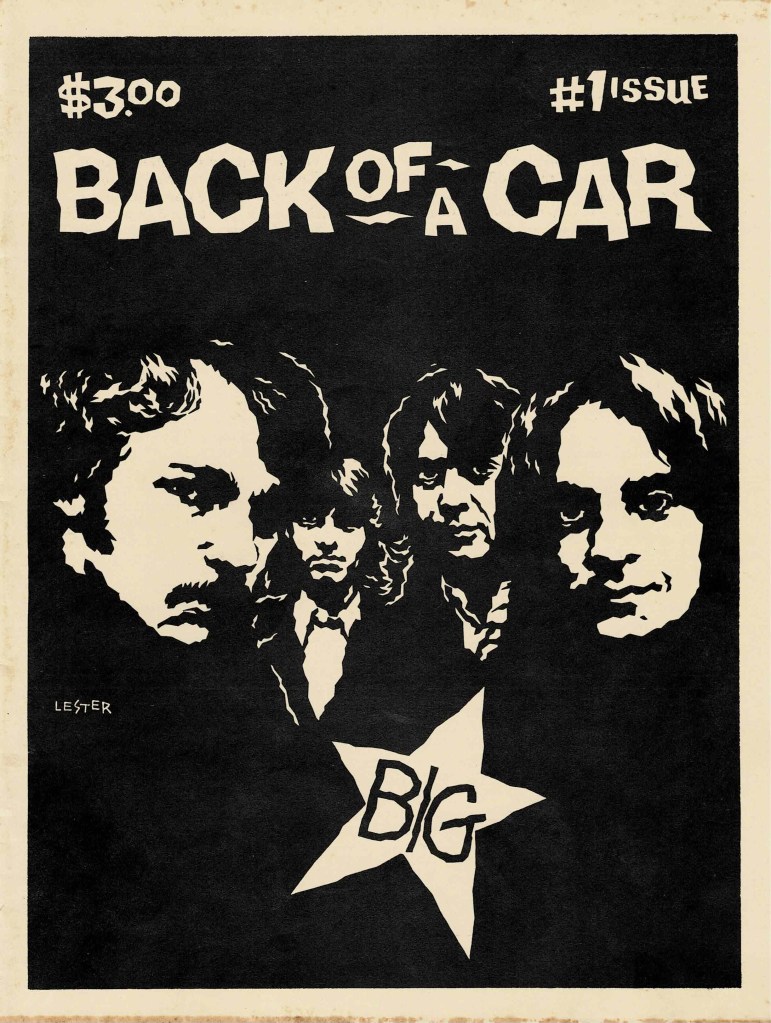
I came in pretty late on Big Star. Naturally I never heard them in the 1970s, but I also didn’t hear them in the 80s, either, when I would have or should have been primed to do so. My guess is, given my obsessions during my college years (Lazy Cowgirls, Pussy Galore, Scratch Acid, Laughing Hyenas and what have you), they wouldn’t have taken anyway. It wasn’t until a six-week van trip across North America in 1993 when one of my traveling companions repeatedly blasted a homemade tape of Radio City did I even hear the band, and by then I was ready. All-in. I anointed it one of the ten greatest albums of all time, which is something I’ll still stand behind without question. I’ve written about this before, but when I told a good friend about my new favorite band Big Star, he let the air out of my tires with a withering “dude, that’s so high school”. Not my fucking high school.
Anyway, I get the mythos around the band, fully. The aborted/botched/unheard third album; the record company disasters that kept the first two albums from being revered until much later; the louche Memphis party scene captured in Stranded in Canton; Alex Chilton’s difficult personality – all that. Love it. Makes a ton of sense why a fanzine like Back of Car #1 might come out in 1994, right as the band had started doing those “reunion” shows with two original members and two fellas from The Posies. The interest was there; the stories were mostly untold; and like the Velvet Underground, Big Star were a band who readily inspired something well beyond simple devotion.
Judith Beeman of Vancouver BC was the woman behind this, and she ended up doing four of them. This is the only one I have. She talks up the nascent “internet” and electronic mail in her introduction, already finding that it has been a highly effective means of sourcing contributors and connecting with them at shows and otherwise. She provides a layperson’s intro to Big Star up front, setting the stage that this thing would be far less of a fan club type of fanzine than one merely centered around Big Star, with outflowing concentric circles into Chiltoniana, similar-sounding bands (DBs, Chris Stamey, Posies), and into Judith’s own comics obsession, which had nothing to do with Big Star in the slightest.
This is further reinforced with the very first piece in the mag, Wilson Smith’s review of the 6/5/94 Big Star quote-unquote reunion show at the Fillmore in San Francisco. I didn’t go – I had an uppity personal policy against attending any reunion shows, one that I kept in place until Mission of Burma came to the same venue eight years later. Anyway, Smith – in what I thought was a fan club magazine when I bought it – didn’t really like it all that much, and says so (!). Bravo. Apparently some secret Springsteen cover band with “Adam Durwitz” of “Counting Crows” opened, which absolutely helps to validate my decision, even though it meant I never saw Alex Chilton in the flesh while he walked amongst us.
After that, it’s a grab bag of the aforementioned. Ken Stringfellow of The Posies and the reanimated Big Star shares his tour diary from this reunion thing. Lyrics from songs are reprinted; old reviews are dusted off and reprinted; there’s even an article on This Mortal Coil, who did “Holocaust” and “Kanga Roo” on their album that I had as a store-bought cassette in high school, It’ll End in Tears. That would have to have been the first time I ever heard any Alex Chilton compositions, just not performed by him. Judith Beeman breaks apart the Alex Chilton tribute album, which came along at a time when tribute albums were actively poisoning used bins in stores across the globe. And then, after that, it’s not really a Big Star fanzine any longer – it’s those concentric circles and a bunch of comics.
Oh, and I learned something, too. All these years I thought “Motel Blues” was a Chilton song. Turns out it was by Loudon Wainwright III, and it took Back of a Car #1 for me to finally discover this important fact.
Good read! You can check out all four of the issues Beeman and her team of pop-loving psychotics put together right here.
-
South Bay Ripper #2
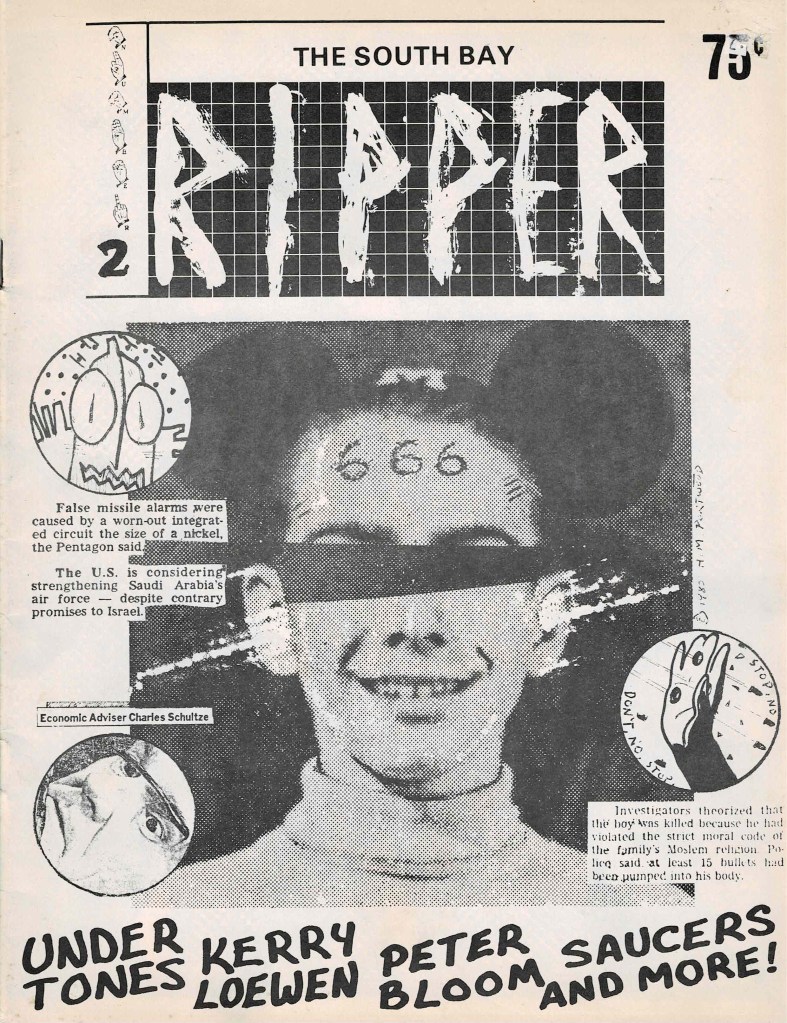
If there’s a better illustration of the metaphorical distance between the major, “in-touch” US underground music power centers (NY, LA, SF) and the proverbial cowtowns that surrounded them in 1980 than South Bay Ripper #2, I’m not sure where I’d find it. This San Jose fanzine – later to evolve into a true giant in its field, Ripper – really hits a nerve for me. I was in 7th grade in San Jose in 1980, and the sort of grasping, desperate drive to hear anything that was different, weird or challenging was all-consuming for me that year, but I barely knew where to find it.
These kids were older than I was for sure – 19-20 as opposed to, um, 12 – so they had IDs and freedom and perhaps the ability & wherewithal to get rides up to San Francisco for shows. But what South Bay Ripper #2 underscores here is both how utterly out of touch my then-city of 500,000 people was with the attitudes and tastes of San Francisco, a mere hour to the north, and how even a local AOR radio station playing The Pretenders or “Train in Vain” by The Clash was a big deal. I mean, in 7th grade I was personally obsessed with both The Pretenders and B-52s, both of whom penetrated my consciousness before college radio had, and I’d scour free papers like BAM for any glimpses of “the new wave”. There would be advertisements for strange-looking local bands like No Sisters, The Spies and The Jars – none of whom I’d ever heard – and I remember telling a kid at school, when he asked me what my favorite bands were, “Oh, No Sisters, The Spies, The Jars – you know”.
Tim Tonooka, Violent Vamp and the rest of the South Bay Ripper crew weren’t all that far ahead of me in 1980, save for the fact that they’d actually seen all the limp power-pop and “energy rock” bands like SVT and Mr. Clean and the Nu-Models that fell under the all-encompassing moniker of “new wave” that year. (Let’s again note for the record that this fanzine changed radically and for the better in 1981). They too are grasping at whatever shreds of underground culture they can find – and it’s really, really hard to find in San Jose! One of the few blessings of our current era is that a kid in Hattiesburg, Mississippi or McGillicuddy, Iowa can tell you as much about the Electric Eels and Can and Teenage Jesus & The Jerks – and their modern equivalents – just as readily as a kid in Manhattan or LA can. In San Jose in 1980, it seems that word of The Clash, The Pretenders and Rockpile might have penetrated the city limits, but what was being written about in Slash, Damage, NY Rocker and so forth had barely made a dent.
Maybe a few reasons for that, which this fanzine helps to shed light on. KFJC, which would soon go on to be one of the finest underground college radio stations of all time (and which would change my life a year or so after this), had only recently had control wrested from a mainstream-focused programming manager in 1979, and they had been dipping their toes into “the new wave” pretty gingerly. Two of the writers for this one, Kevin Animal and Diana Campa, were DJs I used to listen to regularly on that station. I’ll never forget my jaw hitting the floor when Diana played “Sex Beat” by the Gun Club, the first time I ever heard the band. South Bay Ripper #2 bemoans the lack of venues to play at – even some dopey “local wavoids” called Two Words aren’t allowed to play the annual “Tapestry in Talent” festival, a thing my mom used to go to every year to buy ceramic owls and potholders.
Local commercial rock radio, like hard-rock KSJO, was trying out programs like Kerry Loewen’s “Modern Humans” on Sunday nights from 11pm-1am. Loewen is interviewed here, and he sounds like a proto-industry shill, the sort of person Howie Klein was always rightly or wrongly accused of being. Loewen says he’s not allowed to say the words “punk” or “new wave” on the air. “I like to call the music on the show Modern Music. That’s the term I coined and people may like or hate it”…..”I played 5 songs in an hour that were New Wave and they included like Madness, Iggy Pop, the Romantics and Bram Tchaikovsky; obviously semi-punk”.
Yet Kerry Loewen was a guru to the South Bay Ripper staff. And why not? I remember how in San Jose everything cool felt just out of reach for us. I’d see the badass skull logo for San Francisco’s KUSF and I wanted desperately to listen to the station. I’d read about bands from England playing on Berkeley’s KALX, and try and tune every radio in the house in an almost entirely futile attempt to try and pick it up. This fanzine doesn’t just tout Loewen; there’s also an interview with Peter Bloom, a young man who’d recently booked a 13-gig string of new wave shows at San Jose State’s Spartan Pub. They reminisce about bands like The Instamoids, Jo Allen & The Shapes and The Kingbees from LA who played during the legendary run. Jo Allen does a brief interview, and he is asked to describe his music. “It’s basic 80’s rock. I wouldn’t call it New Wave cuz that doesn’t mean anything anymore. I wish people would stop the confusion with New Wave so it would get another image other than spitting and safety pins”. 1980 is 1977 in San Jose, California, but thankfully hardcore will totally wipe the slate clean a year later.
-
Rock Scene (January 1975)

We’ve already established in a previous post here that Rock Scene was by no means a fanzine of the sort we’re typically going on about here. A more rigid editor might require us to strike any discussion of it from the site. But since I’m the editor, here we are: Rock Scene Volume 3, Number 1 from January 1975, with Roxy Music on the cover, no less. Big in Cleveland.
The magazine’s editor Richard Robinson – who looks a tad like Gary Numan in his photo – says in his intro thing that, vis-a-vis rock and roll at the dawn of 1975, “There’s a lot happening, but it’s just repeats, no matter how good it is. You’ll find hints of what’s new in Rock Scene; unfortunately it’s just hints. The truth is that it’s up to you to get these new rock scenes underway”. How frustrating, right? I can totally feel the malaise in the three-dot gossip column about Yes, Focus, Burton Cummings and Chicago – although “Our spies report that they’ve seen Lou Reed sporting white hair” and that “overseas fans will soon have a chance to hear the King Biscuit Flower Hour as overseas syndication is in the works”. I totally remember this show, and hadn’t thought of it in a great while. It was a late-night FM rock staple with live concerts from American AOR/FM staples. The people took what they could get in the late 70s.
And yet – I don’t think they actually had it all that bad, really. I have gathered a few issues of Rock Scene in my time – which was decidedly not its time – and have found it to be both information- and visual-packed. Candid photos, usually from parties, were among its specialties. Some of these are quite baffling: there’s a picture of Sha-Na-Na’s Bowzer with Keith Moon; a photo of a roller derby competition with the caption “Roller Derby: something new on the rock scene”; and a photograph of a sculpture of Black Oak Arkansas’ Jim Dandy riding a horse naked whilst holding a tambourine. Apparently the band tried to get the British Museum to take the sculpture, and were rejected. Weird.
After a Suzi Quatro interview, there’s a goofy photo spread called “Suzi Q. Judges a Dance Contest”, with this nauseating accompanying text: “The big day finally came when Suzi Quatro and Co. arrived in Hollywood! Waiting breathlessly for her at the airport with his lookalike hairdo, Suzi Q. t-shirt and posters for her to autograph was none other than Rodney Bingenheimer! (sic). After many welcoming kisses, roses, and more than a few tears of joy – Rodney whisked Miss Teenage Daydream off to his disco on the Sunset Strip – to judge a dance contest (cute?) and meet some Hollywood, er, scenemakers”. Get off the air, Rodney!!
The “Ask Doc Rock” column has a question about 8-track bootleg tapes (wow), and another question about how to see the skull on the cover of the Velvet Underground’s White Light White Heat. This is followed by a “Roxy Run-Down” with a piece on each band member, and Lance Loud’s column “Tid Bits from the Diamond Doggiebag”, about Bowie, Bryan Ferry and David Johanson and Jimmy Page all partying at Club 82 – but not together – along with various gossip on Van Dyke Parks, Jobriath and Sparks.
Other photo spreads are of David Johanson and Cyrinda Foxe at home, in a typical ultra-tiny NYC apartment for two; and some great snaps of McKenzie Phillips partying her ass off with Mick Jagger. There’s lots of Bowie; rock stars’ cars; “Eno Cruises the Big Apple”; and photos from the nascent stirrings of the New York rock underground. I love the really early photo of Patti Smith playing live (her debut 45 Hey Joe/Piss Factory has just dropped), along with photos of the Harlots of 42nd Street and Teenage Lust. I mean, I can go on and on here to continue painting the picture: there’s a “Dear Wayne (County)” advice column; an insufferable Kim Fowley column in which he pretends to interview himself; a piece on Brownsville Station by Lenny Kaye; and Rock Scene’s London report from Linda Merinoff, with some super syrupy gossip about Nico being exceptionally difficult and surly and badmouthing everyone she plays with except Brian Eno.
These mags are usually no more than $15 a pop online if you’re discriminating in who you buy from, and worth every cent for the innumerable reasons mentioned herewith.
-
New Wave #1
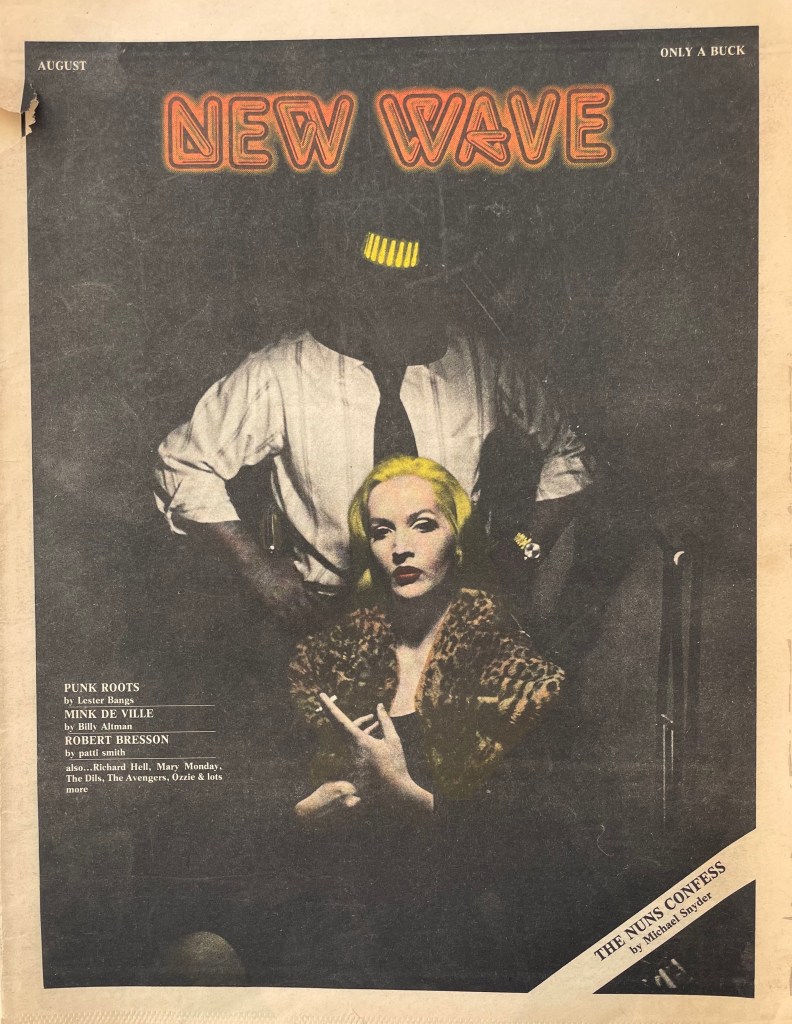
This, for lack of a better term, is a “my cup runneth over” fanzine from 1977. It’s somewhat amazing to even be allowed to look at it. I was not aware of the existence of New Wave #1 until I found a way of procuring a copy on eBay – nor was I aware of the absurdly great bounty within it, save for a drunkenly-written Lester Bangs piece about punk that ended up being sadly uneventful once I actually read it.
I’m 99% sure that this is the only issue of this San Francisco-based newspaper-style fanzine ever created, and I’m just as assured that a 1-issue run was not at all what the editors had intended when they excitedly put this together in August 1977. (For instance, in the back there’s a plea for subscribers. $9.50 for 12 issues, plus your choice of either The Ramones’ Leave Home or Tom Petty and the Heartbreakers). Who were these editors? Proving that he was in fact ultimately useful for something, the main editor was Howie Klein; the associate editor was Steve Seid, about whom more later.
Excited is definitely the word. We’re into punk pretty early here: the long-awaited and much-prophesized rocknroll revolution is finally here, which doesn’t stop many of the big-name rock writers assembled from sneering about punk anyway, Bangs included. As it should be. Where do I start? How about with some of the bigger names: Billy Altman writes about Mink Deville, and Richard Meltzer gets his own column on jazz: “Bebop on Your Mama”. It’s really funny, actually, and full of his patented discombobulated snark. He even saw Dizzy Gillespie play live that year. Patti Smith pens a mostly unreadable poetry slam-type thing on Robert Bresson that I’d probably have sent back to her for rewrite (“come on, Patti, I know you can do better”).
Loads of excitement and hot gossip in the San Francisco, LA, NY and UK scene reports. LA’s is by Gregg Turner, he’d go on to do an almost identical column in Take It! in the 1980s. An “Amy G” is mentioned in the SF column; she’s a “former punk of the month” who has just moved to Memphis. Would this – be still my heart – be Amy Gassner, who’d join The Klitz in Memphis?? Gotta be, right? If you’ve never heard her 1979 rendition of “Brown Sugar”, which was recorded “under the influence of hog tranquilizers” and absolutely sounds like it, you’ll need to do so right now. And if you have a copy of that record and need to part with it, please get in touch.
Maybe my single favorite page in New Wave #1 is the one compiling some instant-reaction crowd interview snippets after Crime’s June 18th, 1977 show at the Mabuhay Gardens; this includes quotes from Jean Caffeine from New Dezezes, Britley Black (sic), who’d later join the band; Don Vinyl and Michael Snyder, the latter of whom was an SF rock critic I think at the Chronicle, back when daily newspapers actually had multiple in-house rock critics. Also in various spots throughout this magazine is talk about how Jennifer Moscone, the Mayor’s kid, is going to punk shows at the Mabuhay. Sheriff Michael Hennessey was into punk, too, and he used to regularly show up at the Mab.
There are too many other features for me to go deep into: Cheap Trick, The Dils, Avengers, Nuns pieces; the only one on Ozzie from Sacramento I’ve ever seen; a Mary Monday (!) article plus a centerfold; The Negatives, a Richard Hell interview and more. There’s a country music overview by Ed Ward that tries to tie modern country outlaws like Johnny Paycheck to punk, rather unsuccessfully. And the capper, the thing that just makes this a chef’s-kiss A+ fanzine in my book, is the Steve Seid film column, “Enter The Avant Garde Surfers”. It calls out genius films like Payday and The King of Marvin Gardens and Three Women, among others, and is essentially a paean to how utterly amazing 70s American filmmaking was up to that point. Seid realizes he’s living in a golden age, and is essentially admonishing readers that they ought to realize it as well. Alas, “Star Wars”, a popular children’s film that helped to quickly bury major-studio risk-taking, was released more or less as this magazine was being written. Seid was not to know, but one of his cultural worlds was ending just as another was excitedly being born.
-
Trendy Rag #9
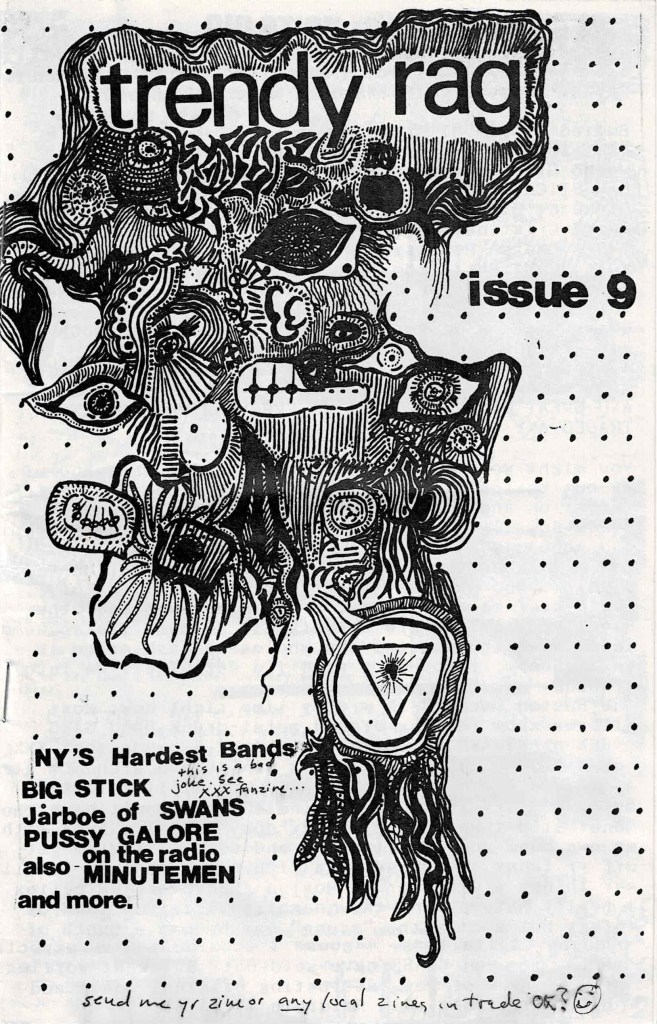
This 1986 cut/paste/copy mini-zine is my sole issue of Trendy Rag, published just outside of Boston by a fella named Jim Hildreth. Jim appears caught between a love of hardcore and a need to make fun of it; between a love of nascent guitar noise/pigfuck and a need to sneer at the fanzines helping to shepherd it (Forced Exposure, Conflict, Chemical Imbalance); and between a desire to put out an opinionated fanzine and to shut the hell up – as alluded to in his intro.
I’m not sure how much further Hildreth went with this fanzine – are you? Nothing online – well, nothing except for this and this I guess – which I suppose is why I do this site in the first place. He kinda kicks the thing off with a recognition of the “limp” Boston scene of the late 1986 moment – “most all-ages shows revolve around metal-drunk band GANG GREEN or STRAWDOGS that XXX keeps presenting”. Ah ha, the all-ages modifier is our clue that Hildreth is a young man – well, that and the fact he’s still listening to 7 Seconds in 1986, or ever listened to them at all. There’s a mail interview with Big Stick that’s pretty much a both-ways goof, in which the duo each claim to be in their 70s and profess their love for many of the same metalcore bands Hildreth was bemoaning one page earlier.
Jarboe of The Swans also more or less dodges many of her interview questions, but I think it’s the first time I’ve read an interview with her (never a fan of her solo music nor of The Swans, there are only so many years in a life) and I like that she’s in keeping with whatever obtuse and abstracted persona I’d imagined for her. Steve Epstein and Jeremy Spencer guest-reprint their December 1985 radio interview with The Minutemen, conducted two weeks before D. Boon’s death. Hildreth mentions in his intro how much he hated Project: Mersh when it came out and therefore skipped the band when they came through town; this unfortunately mistaken opinion was one held by many at the time, and I’ve never understood it. Excellent record!
I was most excited to see a super-early Pussy Galore interview – maybe my favorite band of the late 80s. And it’s not with Spencer, it’s with Cristina (Martinez), and she’s not even in the band any longer: “I’ve been kicked out of the band and they’re trying to get a new guitar player this girl Rebecca Corbett who used to be in Missing Foundation”. She talks about how she’s about to start playing with the Honeymoon Killers; about how the phenomenal Pussy Gold 5000 record ended up on Buy Our Records (“they offered us money”); about her work as a phone sex operator (she encourages the interviewers to get out their Visas and Master Cards), and about how a super-secret surprise tape’s about to come out, and how we’re all going to love it but she can’t tell us what it is (it was Exile on Main Street). Mostly she’s just brash, young and annoying, which is entirely keeping with her 80s persona as well.
Most of Trendy Rag #9 is handwritten, including the entire “Recordings” review section. This is where I can see Hildreth bouncing around from late-hardcore mediocrities to stuff like Rat At Rat R and Ciccone Youth and a Slits live bootleg he’s just picked up. Best quote: “The Slits were an amazingly beautiful band and The Cocteau Twins just totally ripped them and many other Rough Trade bands like The Raincoats off”. Oh yeah??
-
Rock Mag #6
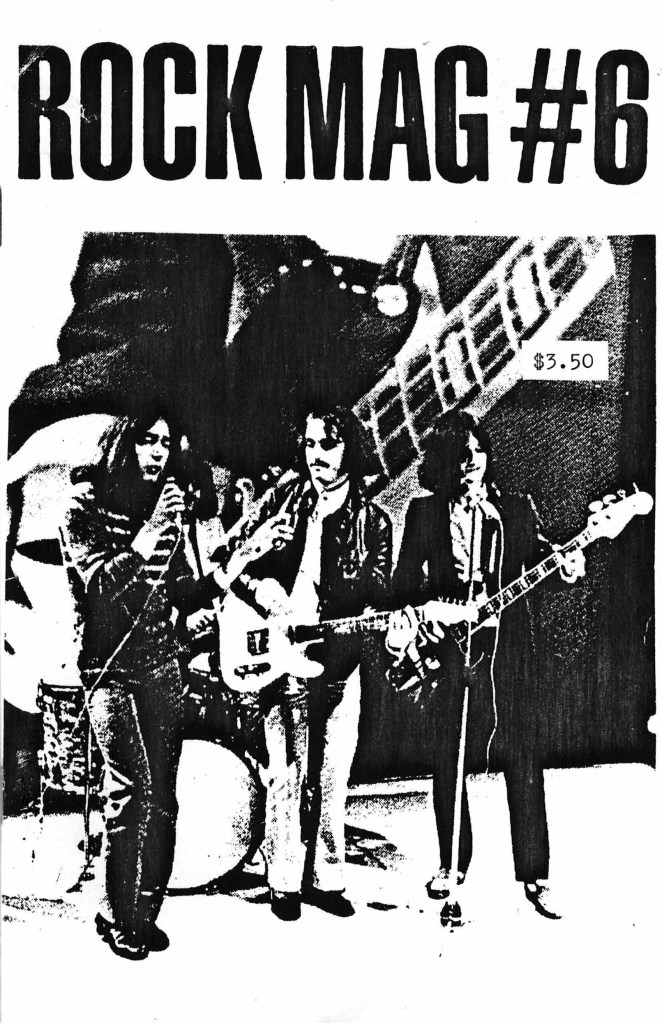
As I relayed last time we discussed Tim Ellison’s Rock Mag, there really wasn’t a music fanzine quite like it before, and there definitely hasn’t been since. I mean, I’ve subsequently come to have read much of the strange, erudite and serious rock writing of the 60s and 70s, but even that stuff in Crawdaddy or Beetle or Cheetah doesn’t really have the potent mix of over-the-top earnestness and below-the-surface humor of Rock Mag, and of course, none of those mags were tied so utterly to the outlook and informed worldview of one single rock-obsessed man.
Rock Mag #6 doesn’t call out its time of publication, but I believe just by the records covered that it’s probably late 1996 or early 1997. It starts off with a bang: “Having gotten so far away from what Rock originally (and for the better) meant, this is probably the worst ever period for Rock”. “If I were running a major label I could enquire about signing many artists: VON LMO, maybe Silver Apples and The Godz if they were up for it, The Fall, The Red Krayola, The Dead C, Ghost, Ruins, High Rise, Fushitsusha, Cheater Slicks, The Dirt Bombs and The Inhalants, Run On, Satisfact, Los Cincos, maybe old-timers like Blue Oyster Cult and Voivod….That’d be a good start for a Rock label”. Oh, and Ellison has a section called CDs vs. Records: The Final Word: “Records are better!”.
A highlight in this issue, as in other issues of Rock Mag, is a letter from Alan Licht. His mind clearly works a lot like Tim Ellison’s does, and carves all sorts of grooves into every manner of musical minutia. Ellison, of course, has a long response to Licht’s long letter, with digressions into Can, Stevie Nicks lyrics, The Seeds, The White Album and so on. I’d listen to a box set of these guys’ phone calls from around this time period, but that’s me. There are also other letters from two great Americans, Scott Derr and Doug Pearson.
Unlike the typical interview/essay/record review fanzines, my own included, it was always something of a crap-shoot what you’d get in any given issue of this one. Rock Mag #6 has an unexplained reprint of some out-of-context Richard Meltzer paragraphs; a berzerk hand-written word explosion on George Harrison, and – get this – a page-by-page annotated takedown on Simon Reynolds’ The Sex Revolts. I never read that, but it’s fun to see what was totally discombobulating Tim at the time. This is the sort of piece I alluded to above; on one level, it reads as much ado about nothing at all, and you’re like, what the hell is this guy so worked-up about. On another level, it’s a sort of anti-comedy and quite entertaining in its fake-but-not-really outrage. On a third level, it is valid and exceptionally pointed criticism – old-school criticism, the kind they used to write, when there were true critics employed at newspapers and national magazines.
And look, I know just over a week ago I discussed another fanzine that had a small section of my own “record reviews” – let me assure you, that one and this one were the only times that ever happened. Rock Mag #6 has a “Superdope supplement” with eleven reviews that I wrote and only published here. Reading back on them now, there are some good ones on Alex Chilton and The Dwarves and The Urinals, and some incredibly stupid ones on the Blues Explosion and the Ear Piercing Punk comp reissue. Tim, of course, gets the real review page count. He reviews the Un 45 on Siltbreeze – a great mind-boggler – and everything else from Masonna to The Fall to the Shadow Ring to Nautical Almanac to the newest R.E.M. major label CD; then a few backwards looks, including to The Three O’Clock’s Arrive Without Traveling (“one of the great Rock albums of the 80s”). Footnotes galore.
After the main section of reviews, there’s another long column with a ton more records that were sent to Tim. Anyone who did a music fanzine then remembers just how many independent labels were in existence back then, in an era when physical media actually sold copies. Downloadable files barely existed. So greenhorns like me & Tim, we’d have glorious mail days nearly every day, even if the majority of stuff we received was going to end up at a used record store by the end of the week. I remember the two months I was away on the Claw Hammer tour in 1993, coming home to three overflowing buckets full of packages that I got to tear open like the happiest overindulged rich kid on Christmas morning. I wish I were joking, but I can remember my endorphins basically exploding out of my head that afternoon.
On the inside back cover, he’s still picking apart that Sex Revolts book. Jeez, maybe now I wanna read this thing, just to zoom to the pages Tim hated and compare the contents with the affront Tim’s taking. It can’t be that bad, can it? A poindexterish rock book about the centrality of gender that one might likely read in a cultural studies course at an elite American university? Sign me the fuck up.
-
Twisted #2

Twisted was Seattle’s finest and foremost contribution to on-the-ground ‘77-’78 punk rock documentation, and it’d probably be one of the fanzine high-water marks for any musical era, really. Their full arc was a short three-issue run, and I’ve already aired my views about Twisted #1 and Twisted #3 at the respective links. Here we are in late 1977 completing the run with the middle-issue Twisted #2.
This issue reads not so much as a Seattle mag, but as a Northwest regional fanzine, with road trips to Vancouver, Portland record store ads etc. The Pacific Northwest, then as now, really has just those three large metro areas, and forty years ago they felt – I’m sure quite rightly – that they totally were off the map for the rest of North America in terms of touring bands and coverage. Make your own scene! The ad sales department at Twisted has clearly been taking some three-hour trips in both directions from Seattle, as we’ve got Vancouver and Portland record stores and newsmagazines well-represented, along with a few major label ads for hot new bands The Tubes and The Boomtown Rats.
A nice surprise in the early pages is “A Punk’s Guide to Stereo”, an audiophile approach to playing punk records at the requisite level of fidelity. Do true audiophile maniacs still exist now? I used to converse with some of these lunatics daily in my first job out of college at Monster Cable, which you can read about here (seriously, I think it’s my favorite piece of writing I’ve ever been involved with). I suspect they’re mostly a dying breed, with an average age of 75+ now, but whoa, what a fanatically insular subculture when it was around. Brian Tristan, Lobotomy contributor and a man who’d eventually become Kid Congo Powers, contributes a bird’s eye view of what it has been like to be the president of the Ramones LA fan club for the past year now; this is accompanied by a fantastic photo of Joey Ramone record shopping with Tomata du Plenty. And then this is followed by a stuttering and strange first-person 4-day diary of the Ramones’ visit to Vancouver.
Still keeping it north of the border, we then get a 3-band Vancouver overview, with things on The Skulls (featuring singer Joey Shithead – “undoubtedly the focal point of the band”), Dee Dee and The Dishrags (they’d come to be known as just The Dishrags) and The Furies. There’s a piece on The Mumps and a thing on The Jam in LA at The Whiskey, with loads of photos. The Lewd get their first photo shoot – they look super, super, super punk – and this is followed by what I am certain was their first feature, as they seem to have been in existence as a band for mere weeks. Clearly they were Seattle’s great white hope of ‘77. And this Screamers fan club ad, reprinted below – wow.
I’m maybe getting a little tired of saying it, but it wouldn’t be an early punk fanzine without a dumb three-dot or multi-dot gossip column. Of course Twisted #2 has one. “Screamers have ousted their keyboardist David (Brown). He is now a residing partner in the newly formed Dangerhouse Records”. The Knobs have broken up, and turned into The Lewd and The Snots. “The Damned have lost their drummer. Early reports said that Rat Scabies had been fired for ripping up a hotel lobby in Paris. Fired for being a punk?”. “Iggy has a new hair cut. It’s very short on top and looks almost ROTTEN-like. Don’t call him a punk though, the press agent at RCA says he’ll hit ya”. “In San Francisco there’s a new fanzine out – “NEW DESEASES” (sic). It’s as close to an English fanzine as your gonna find in this country”. Gorilla Rose, a semi-legendary name from around this time for his antics adjacent to The Screamers and his huge influence on the aforementioned Brian Tristan, gets his own gossip column that follows this, “The Rose Report”, mostly focused on LA happenings.
Layout’s great, brain-rattled enthusiasm is great, writing is good enough, and suffice to say that Twisted’s one of the all-time keepers, and only 60 cents an issue back in the proverbial day.

-
Subscribe
Subscribed
Have a WordPress.com account? Log in now.

