-
NY Rocker #33

A couple of years ago I realized I probably needed to procure as many NY Rocker issues as I might be able to afford, before they started being priced like Slash currently is. Even now there are pathways to getting these for $15-$25 a pop, so that’s what I did a few years back – and then I wrote reviews of them here, here, here and here. Even now, I’m just catching up to the half-dozen or so I bought. I actually remember first seeing this while it was actively being published at Rasputin’s in Berkeley, CA, probably in 1981, but I was too broke and too much of a teenage dumb-dumb to be able to buy it.
NY Rocker, including in this December 1980 issue, brought together heroes like Don Snowdon, Byron Coley, Ira Kaplan, Don Waller and later Don Howland – a lot of Dons – along with guys who loved Chic and disco-dancing or whatever, and weren’t afraid to tell you. It never really reads to me as quite hitting the quality level of Slash or even Damage most of the time, but that’s irrelevant. It’s still absolutely stacked with the maniacal explosion of underground music that defined the times, both across the USA and in the UK, much of which NY Rocker pays close attention to, as well as anything else interesting beyond Manhattan’s borders.
First up after the table of contents, Ira Kaplan talks about how Robert Frank’s Cocksucker Blues finally screened in New York after years of legal purgatory, and how tough it was to get into one of the screenings. “Ironically, it’s possible that the only people more disappointed than those who didn’t get in were those who did….Cocksucker Blues’ strength is that it makes the fabled lore of the road – the drugs, the sex, the destruction of hotel rooms – look not merely ugly, but as we’ve been assured touring is, boring – a combination I’ve never seen pulled off before”. Bingo. My thoughts precisely on this film, which is a “watch once, discuss, then forget” sort of viewing.
Cover star Captain Beefheart is interviewed with Doc at The Radar Station having just come out. If you’ve read Van Vliet interviews before, his style was give a millimeter, take an inch – so it’s difficult to get a bead on him aside from his eccentricity, which frankly, is enough for me. You just need to know what to expect going in. I suspect a collection of all his late 70s/early 80s interviews wouldn’t add up to much in terms of new revelations on, say, the creative process – but he’s just daffy enough and moderately confrontational that it’s still a fun read.
Jeff Hayes has a piece on a bunch of heavy metal teens going to a Molly Hatchet show, and about their subculture of booze, partyin’ and metal. The obvious comparison, of course, would be Heavy Metal Parking Lot from six years later. There’s an embarrassing Delta 5 interview by Jim Anderson where he wants to commit the 3 women in the 5-person band to a sort of “women in rock” solidarity with The Raincoats and the Slits and they’re having none of it. In 1981, when I was really diving into college radio for the first time, my initial favorites were the funk/bass-heavy, female-sung, post-punk rhythms of the Delta 5, Au Pairs and Bush Tetras, all sitting at ground zero in this December 1980 issue. It’s amazingly still a sound that hasn’t gotten old for me, likely because it was as formative as it comes (even though I rarely listen to anything else like it).
So much else going on! Jah Wobble is now driving a cab in London and figuring out his next move – which merits an entire short piece on him. “Lightnin’ Jeffrey” Lee Pierce has his own section on reggae records; the cream of the crop has already risen, and he knows it. He was doing these sorts of reviews and roundups for Slash too. There’s a takedown of the Times Square film, which I’ve never seen because I’ve never wanted to. And there’s a great interview with the band Information, plus later, an ad for their Tape #1 with Mofungo and Blinding Headache, a tape recently unearthed again here. Rick Brown from this band is still killing it with 75 Dollar Bill, 44 years later.
Byron Coley and Greg McLean do a passel of 45 reviews – Mission of Burma, Dead Kennedys, Jad Fair, Snakefinger and many, many lesser lights. There’s a “30 NY bands of the moment” centerspread – Bush Tetras, Zantees, Mofungo, Ut, Von Lmo, DNA, Lounge Lizards and Klaus Nomi (!), among others. And what a surprise – there’s a short piece on the mysterious Chain Gang with a great photo; it’s about how no one knows who they are, and how they’ll just pop up for a gig somewhere in NYC, maybe on a fishing pier, about once a year.
Finally, there’s a cornball Richard Meltzer piece to close out the issue. Meltzer’s inscrutability seems to have been one of his greatest calling cards for his small legion of fans, but I’ve always found that to be such a strange sort of put-on. I mean, Ulysses and Pynchon and countless others can reward one’s deep reading, but Meltzer at his abstraction-vomiting worst? The best I can say for him in pieces like this is that I know he was a canny jokester who loved making the scene uncomfortable, and certainly never took himself or much music seriously. But I’d hate to have to try to parse a blatantly uninteresting piece like “Borneo Jimmy’s Lost and Found” again. I mean what did Richard Meltzer ever do compared with Molly Hatchet anyway?
-
Cherry Coke #1-#3

During the Summer of 2001, a free, one-page, two-sided xeroxed “fanzine” called Cherry Coke began appearing in Philadelphia records stores and alterna-culture storehouses. It had been purportedly written by a just-turned-21 “Sarah Duncan”, who “can finally go to clubs and see bands”, and who was a young woman who was exercising this right judiciously. “My goal within this ‘zine is to scope out all the local bands and try to give a fair account of what is going on” – and from my perspective, her account was more than fair. Duncan’s live show reviews of The Delta 72, Swearing at Motorists, Lefty’s Deceiver, Strapping Fieldhands and others I’ve certainly never heard of were eruditely mocking, sarcastic and funny as hell – and focused as much on their appearance and bewildering on-stage rock moves as on their music. Sarah’s reviews were half-written with a “I’m just sayin’!” sort of pretend naïveté, with the other half of any given review too informed, far too-specific and too 1970s-referential, making it clear there was almost certainly a guiding hand at play.
Turns out that guiding hand was one Tom Lax, Siltbreeze records and fanzine chief. Tom’s long been one of my all-time favorite music writers, not only for his ability to expand the boundaries of my tastes with the intense depths of his, but the cutting manner in which Lax has always been able to connect what’s he’s writing about with certain rock pomposities and poseurdoms. His style is an “if you know, you know, and if you don’t, oh well” nonchalance, but with sentences strung together so effortlessly that I’m often laughing as hard as I am rapidly writing down whatever record it is I need to research next.
A different approach, shall we say, was taken with Cherry Coke. Lax has told me that his 80s/90s Siltbreeze fanzine was made with an eye to friend-level distribution and toward entertaining themselves, and this one from 2001 was likely no different, with the additional benefit of mass scene-level bewilderment and perhaps some level of desired anger or effrontery by the bands written about. A mysterious imprint called German Hawaii compiled the six pages that made up the history of Cherry Coke, along with an introductory page that outs Lax as the author, and a then-contemporaneous article from some Philadelphia alt-weekly about “How a one-page xeroxed zine has every junior varsity rock star running for cover”.
Sarah Duncan (duncangrrl@hotmail.com) will usually initially play the rube, a young girl just out for a good time in the Philly clubs. Then she’ll take notice of someone’s clothing, or hairstyle, or lack of hair, and especially their stage presence, and it’s off to the races. The Trouble With Sweeney at the Khyber Pass, 5/27/01: “..Joey Sweeney looks like a 15-year-old-boy…He wears funny shoes, too, like something a 40-year-old woman would wear if she were a lesbian and/or born again christian librarian….At one point he held up his drink & tried to encourage the audience to go to the bar & order a White Russian. Someone should tell him what he really needs is a thigh master”. Then the Lax part of it kicks in, in which the band is inexplicably compared to The Who’s 1981 Face Dances crossed with the role-playing board game D&D, before concluding with “If you like smarmy bedroom pop you’ll really like this band”.
For Swearing at Motorists, 7/5/01 at the Khyber Pass: “…the singer/guitarist sure does have a peculiar look! I felt I had seen him before; like on a box of cough drops in my grandpa’s medicine cabinet or on one of those antique popcorn containers my Grandmom collects. He would also make a great drug addict or homosexual predator in a screenplay my friend is writing (or both! Seriously Katie, his look is perfect for that!)….If you want to see a band whose singer has hair that looks like an enormous loaf of flat bread and jumps around like a Salmon swimming upstream to die, Swearing at Motorists is the band for you”. Los Angeles, 6/21/01 at the Khyber: “Los Angeles. The name connotes an image of ‘cool”, something this band did not. ‘Lancaster County’ would have been a more appropriate name”.
Imagine you’re in one of these bands and your pal calls you up and is like, “Hey, uh, I just saw a live review of you guys in a fanzine called Cherry Coke”. 100% the idea, I’m sure. Tom Lax would go on to do the Siltblog, whose archives are still online and available. That one was utterly daffy and at times impenetrable to me, and I didn’t know half of the deep-underground references made, but I read it religiously nonetheless and almost certainly fortified my record collection based on its stellar taste. Good to finally see this pre-Siltblog material collected in print, and no, I don’t know if German Hawaii has copies still, but here’s the place to check if so.
-
Forced Exposure #3
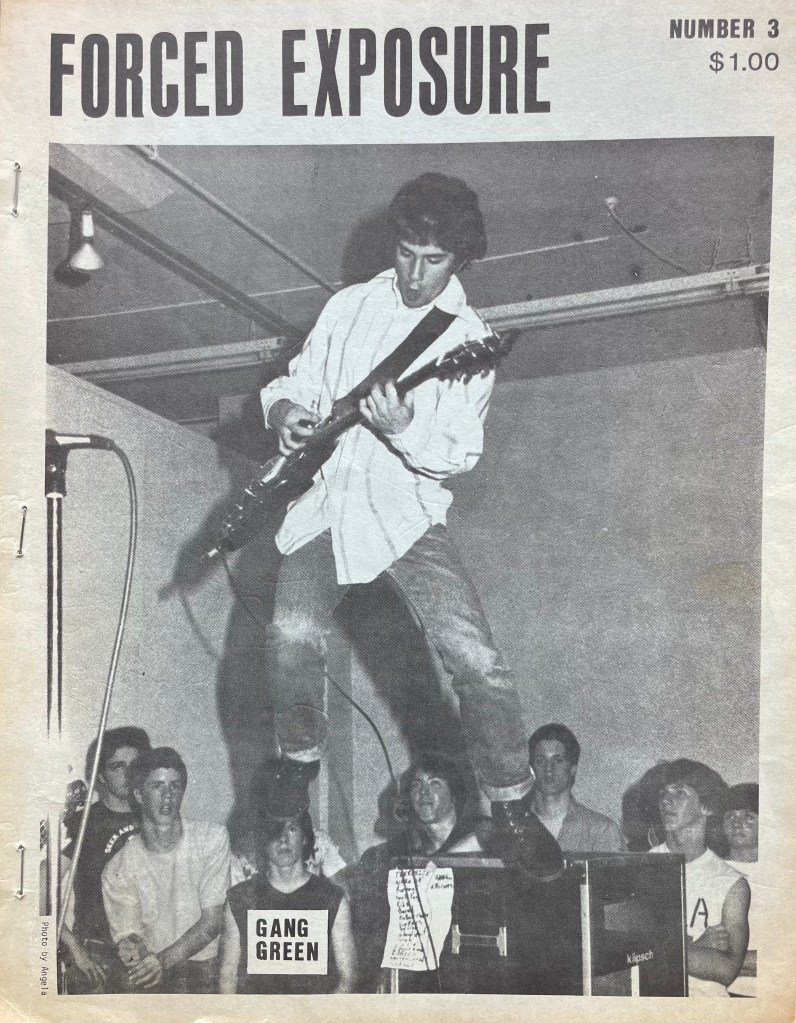
Given just how intensely devoted I was to Forced Exposure from the blessed day in 1986 when I bought Forced Exposure #10 at Rockpile Records in Goleta, CA until they wrapped it all up in 1993, I’ve struggled over the years to procure one of the mag’s “hardcore era” issues and hold it in my trembling hands for any longer than a few minutes. These would be FE issues #1-5 from the early 80s, all of which appear to have been somewhat better-distributed than most punk fanzines, yet still really hard to come by, particularly on the US west coast, where I’m from. These issues had been disavowed, more or less, by editor Jimmy Johnson by the time he’d teamed up with Byron Coley and edged more fully into the deeper rock, psych, noise and experimental underground. Back issues of these five were long said in no uncertain terms to be “thankfully out of print”.
Yet I knew that even at age 19 or 20 or whatever he was, Jimmy had superlative taste in ballistic hardcore punk, and he was right at the center of it all in Boston circa 1981-82. That must have been an absolute blast. For me, and likely for you, there were only three truly top-tier regional centers for hardcore punk during these years: the upper Midwest/rust belt (Michigan/Ohio/Wisconsin), Washington DC, and Boston. LA doesn’t count – it was a teeming punk world unto itself, and most of the actual hardcore bands – at least as I define it – from Los Angeles were pretty awful in comparison with the aforementioned. Forced Exposure #3, right in the nerve center in Summer 1982, is a regional hardcore fanzine in the best sense, published by young people for other young people.
And we’re at hardcore’s apex, aren’t we? Right on page three we’ve got the Process of Elimination tour coming to town with The Necros, Meatmen, Negative Approach, McDonald’s (I hope they played “Miniature Golf”) and Boston’s own Gang Green. Another deeply-held hardcore punk opinion of mine: the crazed, mile-a-minute Gang Green tracks on This is Boston Not L.A. are as good, if not better, than contemporaneous releases by Minor Threat, Negative Approach and The Necros. Yeah, that good! Check this out.
The band were just children at this point, too – true Boston kids with the absolute best Boston slang. Their first answer to “How did you like your trip to DC?” is “Yeah it was wicked good”. They’re pissed about the production of their track on Unsafe at Any Speed; they’re all in high school, belittling the kids in their school who get drunk by going down to the “packy” to buy beer on Fridays. Does that regional slang still exist? Man, I was disappointed last time I was in Boston that everyone I encountered, even cabbies, talked in boring flat American monotones like I do (Though one cabbie told me all about “The Biden crime family” until I commanded him to stop talking). Also, it’s highly ironic that Gang Green were trying on a pseudo-straight edge persona in 1982, considering they’d eventually make their mark with the imbecilic “Alcohol” a few years later and have an album called Older…Budweiser.
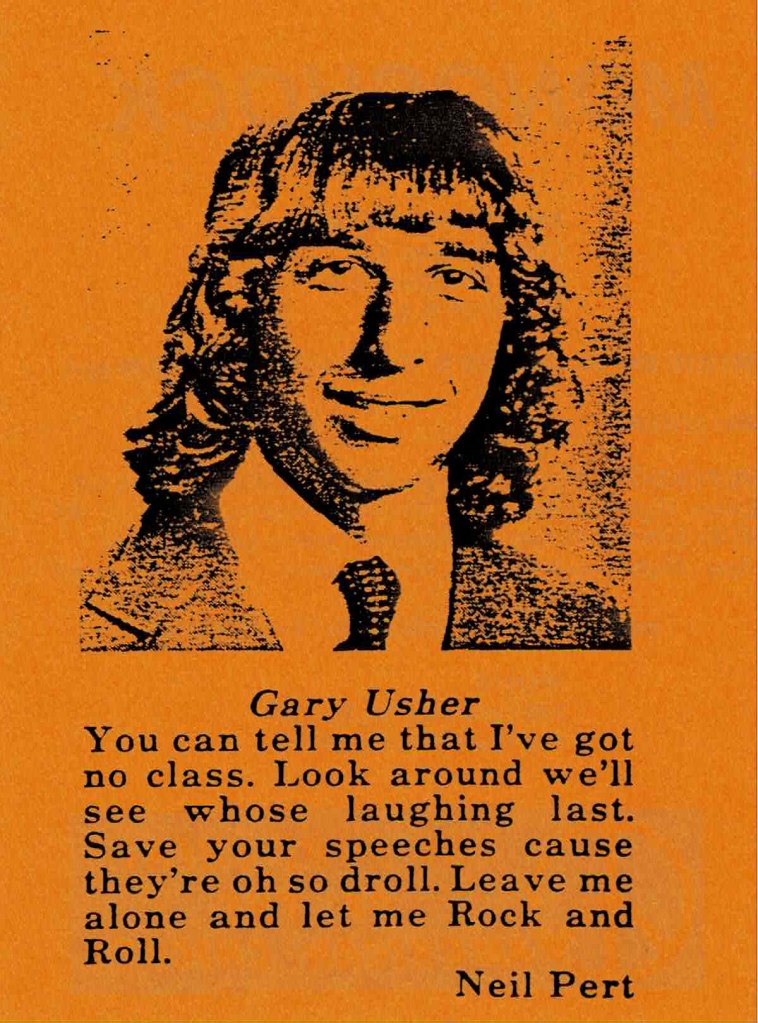
Jimmy has huge excitement for SS Decontrol’s The Kids Will Have Their Say, and I get it. They’d be one of my favorite all-time hardcore bands if not for the vocals. I just can’t get past ‘em, but of course, I never saw them live. Have you seen this short documentary on them? By the time I was contemporaneous with them, they were “SSD” and giving the world lessons on How We Rock. Jimmy also interviews The Necros, and they talk about Black Flag being the Johnny Appleseeds of hardcore in Ohio. Barry Henssler says, “Black Flag just played here, and now the second wave of bands are coming around”. On the other hand, Jimmy’s not a fan of Black Flag’s TV Party 45: “I get the feeling that something is missing here”. You’re damn right, it was Dez Cadena on vocals, recently replaced by Henry Rollins. Other reviews here praise The Ex, The Birthday Party, Venom, Mission of Burma and SPK – pointing to the Forced Exposure we’d see a few issues later.
In other capsule reviews, Deep Wound’s demo has just come in and it’s a barn-burner (it really is). A Boston hardcore band called The C.O.’s are praised, and despite my deep marination in this HC world a bit after the fact, I’ve never heard of them. Some folks online seem to concur that they were blisteringly great during their brief time on the planet. “Ollie” writes in from across the Atlantic with a brief scene report on Finnish hardcore. Ian MacKaye gets taken to task a little for too much on-stage proselytizing at a recent Minor Threat show in Boston. I can only imagine. I got to see The Dead Kennedys near their end, and remember looking for the exits every time Jello started to talk….and talk…..and talk.
And in this issue’s final interview, The F.U.’s sound like fun fellas. They definitely want to make it clear they did not form because of SS Decontrol – “that’s all anybody asks” – and they’re supremely bummed they couldn’t have been Boston’s first hardcore band. I’m old enough to remember MRR having some real problems with their later album My America, which only made me want to check out the Boston bands who were purportedly making a “right wing turn” in 1983. Most of them were turning pretty putrid in a hurry, regardless of politics – this one might be the worst of them all – so Forced Exposure #3 captures the proverbial lighting in a bottle, and let me tell ya, is absolutely nothing to be ashamed of.
-
Biff! Bang! Pow! #1

Lisa Fancher was a highly precocious Southern California teenager who got very much involved with the Hollywood glam, proto-punk, power pop and straight-up punk scenes well before she hit her 20th birthday. As she put it in an interview down the line: “no hippie shit”. She’d go on to run Frontier Records in the 1980s, and wrote a ton for various publications. I’ve noted her contributions on this site here, here and here. What you perhaps didn’t know – because I didn’t, until I found this – was that she also put out a series of her own fanzines: Academy in Peril, Street Life, and two issues of Biff! Bang! Pow! in 1978.
And it’s funny, because Biff! Bang! Pow! #1 really reads to me as Fancher making a very overt move to not document and hype up the Masque/Dangerhouse LA punk scene. While it’s referred to here in passing, it’s almost as through she was doing everything in her power to stay as far away from what Slash, Lobotomy and Flipside were championing as possible. So instead of The Bags, Germs, Screamers and Weirdos, there’s The Dickies – the funnypunk band whom many of the “original 100 Hollywood punks” relegated to the sidelines pretty quickly, particularly when they were the ones to sign to A&M. There’s the Rich Kids – lots of Rich Kids. She loves this UK band w/ Glen Matlock, a combo who wouldn’t even be together any longer by the end of ‘78. If I’ve heard them, I cannot remember having doing so.
The linchpin for Fancher seems to be Midge Ure. Now me, I remember this guy as a mustachioed synth-pop singer of Ultravox. We had MTV from day one in 1981, and my sister and I spent that summer watching it from sunup to sundown. Only a handful of bands had made videos at that point, so MTV just ran stuff like Ultravox, The Pretenders, REO Speedwagon, The Shoes and Blotto over and over again. Biff! Bang! Pow! #1 not only hypes up his Rich Kids, but also has a piece on his mid-70s band Slik. “Midge Ure is a star. It’s as simple as that. Some guys have it, other guys haven’t”.
The Dickies interview actually has the band somewhat taken aback at their turn of fortune, and it seems like they really still see themselves as part of the ground-level LA punk scene, despite not really caring so much about “labels”. There’s also an interview and ego-stroking of famed producer and early Sparks member Earl Mankey, and a doubling back onto lots of talk about The Dickies in his piece, since he ended up producing that first record of theirs.
The only real overlap I see in the reviews section with what I’m used to seeing in punk-era LA fanzines are reviews of Pere Ubu’s and The Buzzcocks’ debut LPs. Otherwise, the focus is more on Squeeze, Tom Robinson Band, Nick Lowe, Elvis Costello and the pre-Midge Ure Ultravox. English shit, pretty much, not that there’s anything wrong with that, or even with some of these records – although Fancher was willing to totally savage the Lowe record, which is pretty fun. And in case you might have thought that the fanzine’s title was some 60s “Batman” reference, she helpfully photocopies her original Creation 45, not the Raw Records 1977 thing that would be my first exposure to the band, and puts it on the back cover. All told, a true ink-blooded fanzine in every sense you might imagine.
-
Feminist Baseball #14

After two years of writing this site, I’m chagrined it took me this long to pull an issue of Jeff Smith/Jo Smitty’s Feminist Baseball out of the boxes and give it another gander. Fanzine Hemorrhage did look at his early 80s Attack #8, but that was some time ago. By the early/mid 90s, Feminist Baseball had strong enough distribution that I was able to pick it up at Tower Records, but I never saw one of these until Issue #12, I’m pretty certain. I do believe he was doing these in the 80s despite a disclaimer in this issue that, in 1985, “lots of smart people closed off from music and missed the last half of the 80s, mostly ‘cos 95% of everything done in America sucked WILDLY. I’m only truly sorry I missed Pussy Galore and The Smiths”. So I’m really not sure what was actually going on in those 80s issues, if they even actually existed.
This issue came along in Spring/Summer 1995, and it’s pretty obvious from the word go that Smith is well-read, well-studied and scathingly cynical and opinionated in a way that I didn’t remember. His opening editorial is about shitty indie music, the cost of CDs, mass distribution of potato chips, farm subsidies and “the Clinton Crime Bill”. Now that’s taking me back. It’s followed by a long interview with 60s/70s actress Pamelyn Ferdin, whose work I’ve never seen, though I suppose I heard her voice as a child on Charlie Brown cartoons and Charlotte’s Web. Smith seems to be in a personal animal rights moment, which may not have been a “moment” at all, and Ferdin, as a current activist in this space, supplies him with some grist for the mill.
Also from the get-go is just a phenomenal cross-section of independent and major label advertisements from the overloaded mid-1990s. On one page spread alone we find terrific ads for Siltbreeze and Claw Hammer’s horrible-selling major label debut Thank The Holder Uppers. So Interscope did actually advertise that record amidst that glut of indie-turned-major label bands at this time! Here’s a fine article about this era you can read. Then – and I just read all of this from word one to the final sentence – there’s a Blue Cheer history lesson, albeit nothing about V. Vale’s surprising time in the band – then a really great conversational Randy Holden interview about his tenure in Blue Cheer; in The Other Half; his album Population II and much, much more.
While the cover touts a “History of Krautrock” piece, it’s actually a short 2-pager called “Figuring out Krautrock?” I suppose many of us were back then. I’m still working on Faust to this day. I like the “LA is the New Seattle – an Informal Chat With Jackknife” interview as well. Jackknife really had all the right moves; superlative taste; a cool look and a real hustle ethic with their label “Star Fuck” – it just didn’t translate all that well onto record, except the few times that it did. “Originally our name was Drag Strip ‘69 and then all these drag records started coming out, like Gearhead + all that shit!”. Love it. The core of the band were a couple named Rich and Super Sandra; I have talked about them and their Alright! fanzine before here and here. Sandra is compared with Traci Lords in the interview, and she not only takes it in stride, she admits to resembling her “only in bed!!”.
Smith then produces a quote-laden piece called “Is there a cure for rock criticism?” and interviews a bunch of current scene figureheads and actual critics like Byron Coley. He then lists 10 essential rocknroll books, a list that I find pretty pedestrian, honestly: Greil Marcus, Dave Marsh and Peter Guralnick. For real? There’s a heaping helping of live reviews, including Monoshock’s 1/12/95 Seattle debut: “they played fun, flat-out hard punk/prog “L.A. Blues” Stooges/Hawkwind punk. After a decade or so of lousy California bands it’s a real windfall to get some decent music outta The Golden State”. (I’ll add self-referentially that the band was “touring” on this 45 I’d recently put out). Later on, he gives their first two records, including the one I did, a frothing endorsement. I’ll post that at the bottom of this piece, the one I’m writing now – see below. Since he talks about “the bears” I’ll post that back cover, too, along with the insert I proudly worked with Rubin Fiberglass to put together.
Then, SO many record reviews. Smith, despite complaints about the glut of music coming into his home every day, is in the regrettable “review everything imaginable” camp, popular among some mid-1990s fanzines. Except for Smith’s reviews are great! His explorations of the records of the day are far more informed and educated than those of his peers, and are laden with insider ephemera and references to past releases. This is a man who’s listened to – and loved – some music in his life. For instance, he loves the Man-Tee-Mans single, as he should. In reviewing an Oblivians record, Smith says “Under the influence of the Blues Explosion, which while not at all a bad thing to be, isn’t really where these guys do their best work. (The problem with this band is that it’s taking Eric away from Wipeout, the best US fanzine”).
In a review of The Queers, he says “no one hates Seattle as much as I do but there needs to be a nationwide moratorium on grunge jokes”. For the Thinking Fellers Union Local 282’s Strangers From The Universe: “I swear I’ve tried to be ‘objective’ re: this band, as any number of smart folks love ‘em, but all I can think of is “Helmet”. Stop. Start. Wacky, forced art that gripes me no end!”. And there’s a great vicious review of a book called Babes in Toyland: The Making and Selling of a Rock and Roll Band, which looked so awful in 1995 that I couldn’t bring myself to crack the cover when I saw it in store. Finally, I especially love how the Alternative Tentacles ad on the inside back cover is printed so poorly it’s completely and totally unreadable. Sorry, Jello!



-
Forget It! #7

Considering its robust content, Spring 1982’s Forget It! #7 is somewhat hamstrung and cast in relative undeserved obscurity due to its terrible cover this time around. They really weren’t all this bad. Forget It! was one of the two great San Jose, CA punk rock fanzines of the early 80s along with Ripper. It was edited by “Howard Etc.” and featured contributions from unsearchable nom de plumes like Billy Fallout, Barb Ituate and Lisa House. You don’t see issues of this very often, and I do believe I’d like to build a complete run somehow, aside from the two that I happen to own.
So many of these early American punk fanzines totally aped each others’ best ideas, to the point where dozens of them sprang from the same template, almost certainly laid down by Slash and Lobotomy a few years previous. Case in point was the opening 3-dot “gossip” column that so many of them had. ”Belinda of the Go-Go’s and Bill Bateman of The Blasters are to be married in the near future (they weren’t; more here)…Dirk Dirksen isn’t running the Mabuhay anymore. He and Ness, the owner, got into an argument over the booking of hardcore bands. Ness didn’t want them anymore and Dirk did…According to D. Boon of The Minutemen, Social Distortion and Wasted Youth are demanding $800 for a show, and all the producers are laughing at them…”. And much more of this highly entertaining ilk.
We get three editorials bemoaning the May 17th, 1981 show that was broken up by the cops. It was “San Jose’s first punk rock riot” at H.O.L.M.E.S. Hall with Black Flag, The Lewd, Los Olvidados, The Ghouls, Happy Death and Onslaught. We discussed this show a bit here as well. Let me tell you, as one who grew up there, not much of note happened within the city limits of San Jose around this time, so to join Los Angeles and San Francisco in the big leagues of punk riots was absolutely enough to merit this blessed event’s placement on the cover of Forget It! #7, terrible artwork aside. Speaking of Los Olvidados, there’s a picture of them and a bunch of associated praise, including “This band deserves to replace Crucifix on a great many bills!”. Amen to that.
Some terrific short interviews as well. In the Gun Club interview, they talk about bands they typically open for. Ward Dotson on X: “They bring in the worst crowd. They’re too college…They want to hear White Girl and Los Angeles and go home. They don’t want anything to do with opening acts”. This is preceded and followed by lots of drunk talk about Marc Bolan, who was obviously one of Jeffery Lee Pierce’s obsessions around this time. Code of Honor wants California to secede and form its own country, much like the State of Jefferson bozos do today. The Blasters talk about opening for Queen in San Diego and playing for a bunch of US Marines, and that Brian May “said he liked them”. Bill Bateman says being in The Flesh Eaters “was the most fun I’ve had in my whole life”. Good thing he got to do it again and again.
Then, after a full-page tribute to The Minutemen, there’s a rapid-fire interview with Lemmy from Motorhead – a real “get”, as we say in the business, in which he talks about adjusting to playing small clubs in the US when they’re not on the road opening for Ozzy, and of course about being booted out of Hawkwind. No Alternative have seemingly become an imbecilic rockabilly band called the Swingin’ Possums, who have a confederate flag in their logo and appear to be some serious, serious poseurs. The Gears, in their interview, are panting horndogs for Dianne Chai from the Alleycats and for Jane Weidlin from the Go-Gos, whom they’re still calling “Jane Drano” even though she’s now in one of the biggest bands in the world, and whom they imagine a collective group motel room romp with. Equity, dignity and respect was still quite some years away. There’s a Cramps interview – no question given how many fanzine interviews they did, the band was exceptionally giving with their time and would talk to just about anyone – and 2 pages are left mistakenly blank, so we’ll unfortunately never know what treasures were supposed to be printed upon them.
In the “Try this 7 Inch Swill” review section, it’s clear that 1981-1982 was bursting at the seams with genius and/or at least moderately interesting records: Descendents, Minutemen, Society Dog, Salvation Army, Black Flag, Wilma, Flipper, ½ Japanese, Minor Threat, The Insults, Altered Images (!) and tons more. LP section also has an honor roll of great records, yet with perhaps not the most insightful analyses (For the Gun Club’s Fire of Love: “This is the LP for you if you’re tired of punk rock and new wave”; DOA’s Hardcore ‘81: “It’s a great record if ya like good records; if ya don’t, then, like, ya can fuck off, eh?”). Forget It! at this point most closely resembled a more readable and slightly more considered Flipside, and hey, if you know where I might be able to find additional issues of it or even take a gander at some PDFs, please get in touch.
-
B Side #24

This Australian fanzine had exceptionally solid distribution in the USA at the time late 1989’s B Side #24 hit my hands, and therefore I’d already been picking them up regularly at Los Angeles’ finer record stores, like it was being published right there in Hollywood. For an Australian of a certain vintage and temperament, B Side was the oracle of all things great, particularly if those things involved high-energy, loud, raw and ugly rocknroll. Simon Lonergan was the editor, at least during the run of issues I own, which travels from issue #19 onward into the early 90s.
In 1989, when B-Side #24 came out, the cross-pollination between the US underground and Australia’s was at a peak, at least in my lifetime. This was the fertile world of Waterfront, Au Go Go, Dogmeat and Red Eye/Black Eye Records in Australia, rubbing uglies with Sub Pop, Amphetamine Reptile and Touch & Go in the US. It’s all right here on the page. Big names abound. Butch Vig. Rapeman. Laughing Hyenas. Beasts of Bourbon. Kim Salmon. Mudhoney. In fact, Mark and Steve from Mudhoney take part in a trans-Pacific phone call interview for this very issue. They’re asked about influences on their sound, “Saccharine Trust or anything like that?”. Mark says, “Saccharine Trust. Gee, I’ve never heard that one before”, before going on to flatter both his interlocutor and the “lucky country” by praising The Scientists and feedtime.
This was the peak era of AU’s King Snake Roost and Lubricated Goat, two wild bands who were both snapped up by Sub Pop to sell a couple of hundred records to an uncaring American public. Loved re-reading Mr. Quinn from King Snake Roost’s USA tour diary here. First of all, they arrived for their tour in San Francisco just in time for the 10/17/89 “earthquake to end all earthquakes”, a major fucking event for those of us who endured it. “All I did was pick up a bass in the music shop and the whole damn city started to shake! We’ve been told that Santa Cruz and possibly San Jose are now reduced to rubble so maybe no show on Friday”.
As it turned out, they were able to make it to Chico – mostly untouched by the quake – on 10/19/89, and then did play Marsugi’s in my then- post-college home of San Jose on 10/20/89. I was there! So that’s what I was doing three days after the earthquake. “Short stroll around the neighborhood – looks deader than Adelaide on Christmas Day. ‘Underground Records’ was the only sign of life, but there’s only burning incense and an old hippy lady inside – guess that doesn’t count as life, huh. Seems as though the ‘quake did a good job on this town”. No Mr. Quinn, that wasn’t the quake, I’m afraid. He also talks about a fistfight that my fellow KFJC-FM disc jockey Les Scurry got into outside the club that night with some doofus DJ from another station…..which I now remember, only barely. There may have been some “tying on” happening this evening. We’d just had a major earthquake, okay??
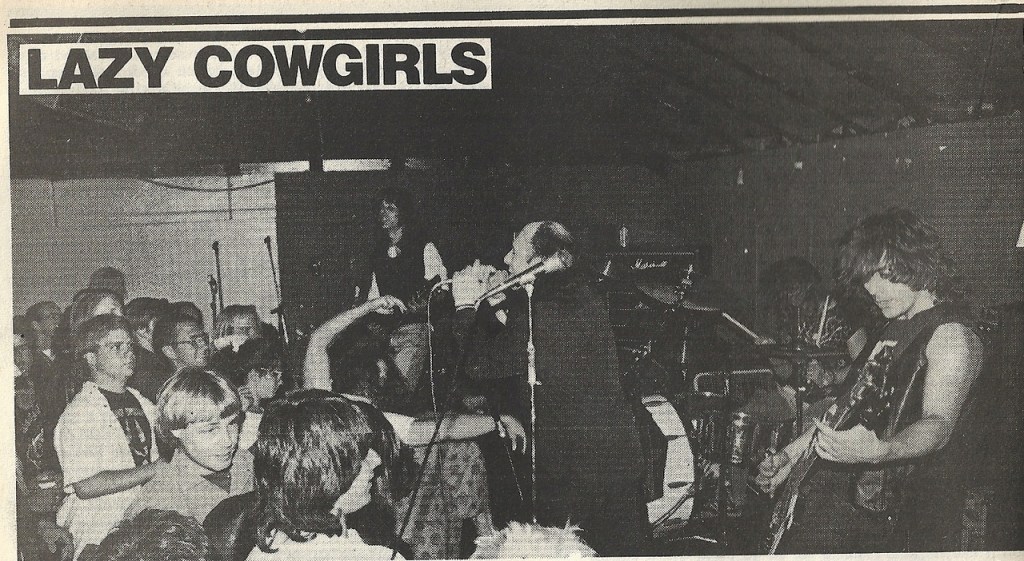
Back in the pages of B Side #24, we’ve got Sydney, Melbourne and Adelaide scene reports, far more interesting and lively than comparable columns in US fanzines – though nothing about Christmas Day in Adelaide. There’s a huge John Murphy autobiography – just like the Ollie Olsen thing in Forced Exposure around this time, both men’s work combined and apart has continued to travel way over my head. There are also interviews with a band called Meat; one with Radio Birdman/New Christs’ Rob Younger; Toys Went Berserk; and Los Angeles’ own Lazy Cowgirls, who were my favorite band in the world this year and during the two previous. See this blank-looking goofball with the Radio Birdman shirt on in the crowd? That’s me, from the pages of this very same B Side #24, taken at LA’s Anti-Club back in 1988.
When Lonergan interviews Sonic Youth here in tandem with Bruce Griffiths, he gets all three of Thurston, Kim and Lee to do loads upon loads of yakking, which is great. Thurston Moore banters about how popular speed metal is back home, and he actually calls it speed metal. See folks, we did not call it thrash metal back then, no matter what the kids do now. It was speed metal all the way. Also love how Lonergan keeps transcribing mentions of Michael Gira as “Michael Girard”. For a minute I thought he was confusing him with the Killdozer fella, but that’s another name entirely.
In the lengthy reviews section, there’s much to be explored in the genres of rawk, rock and raw rok. I’ll be honest – I just put a handful of fanzines up on eBay today and was going to put the B Sides in that batch, before I started re-looking at them and was like: what am I thinking? I mean, I’d forgotten about the one with my crowd shot photo, sure; but also, this mag’s great. All I’ll do is piss myself off in five years when I want to re-explore 1989 underground rock from the vantage point of 2029. These things are keepers, and there’s plenty more of them we’ll talk about in due time in this forum.
-
Coolest Retard #13

When I wrote up Coolest Retard #15 earlier this year and promoted my logghorea about it on “Instagram”, it turned out to be the single most popular thing I’d ever posted. That Mark E. Smith cover somehow slipped its way into the algorithm, and all of a sudden I’m right up there with the Kardashians or Britney Spears or whatever it is that’s popular with you kids today. And let me state that I was so smitten with this collectable Chicago fanzine from 1981 that I went right out and collected another one, Coolest Retard #13 from April/May ‘81.
Like The Offense, being published “down the road” in Columbus, Coolest Retard’s a have-cake-and eat-it compendium of pretty much everything interesting going in rock music in 1981, with few meaningful compartmentalizing lines drawn between English post-punk, American hardcore and all things indie/underground. I mean this cover shot of Bauhaus – I thought it was actually Jeff Pezzati of Naked Raygun at first, a band also featured here and another dude with abnormally high cheekbones. There’s a good mixing of Chicago scene stuff with what’s happening elsewhere; for the in-town stuff, there are the Naked Raygun and Strike Under interviews, plus an entire page praising the Da single. Have you heard this one? Are you a new waver? You should hear it.
And if you can’t get what you want in Chicago, there’s Milwaukee sitting right there on its haunches 90 minutes to the north. Coolest Retard #13 has a full list of Milwaukee bands and short sentences about each: Ama-Dots, Haskels, Oil Tasters and many others. No Die Kreuzen, you ask? No! They were “The Stellas” at this point, about which it is said “Young Rockford, IL transplants on their way to L.A. – good punk while it lasted.”. What the hell happened with that aborted move to LA? Strangely, they almost moved to San Francisco, too – as I recounted here. See, we learn these important things when we re-read punk rock fanzines.
There’s a good Bauhaus interview; I’ll broker no argument about their merits, as they were one of my favorite bands on the planet not long after this, and their many “imports” helped make my high school experience a record-obsessed one. There’s talk with them here about how the English weeklies don’t like them and some speculation about why, which comes mainly down to “they don’t understand”. I also like that there’s a comprehensive “alternative radio guide”, which is effectively any show in Chicagoland worth listening to. This was also big in Ripper, and invaluable at a time when fanzines, record stores and radio shows were the sole trifecta for finding out about what weirdos and musical miscreants were creating outside of your backyard.
All this praise notwithstanding, let’s not mistake Coolest Retard for, say, Forced Exposure or Matter or even The Offense in terms of its ability to mint hundreds of discerning tastemakers and send them out into the world. There’s a highly effusive review of the execrable Prince in which one of his pieces of R&B schlock is described as sounding “like Quincy Jones producing Electric Warrior”. The Stray Cats: “they are so bloody good”. So it’s probably best to maybe skip these parts, or to remember, as I do, when anyone who looked and acted differently was an ally; when anyone who didn’t “conform to the norm” was a potential friend. And a year or two later, when “Rock of the 80s” was ascendent and MTV was everywhere, there was hopefully a sharpening and resetting of tastes. It took me even longer than that – and I still worship Bauhaus and the Banshees.
-
They Sang Upon That Shore #1

Bought this just post-pandemic, “superior toilet literature” a few years ago from the people behind Worried Songs, a beautifully conceptualized UK label who give frequent birth to folk, experimental and solo guitar tapes & records from heavy hitters spanning the American underground. And, once – just once – they also birthed a singular fanzine, They Sang Upon That Shore #1, which if I’ve got it right came out around 2021.
While it leans a bit into the worlds of actual Worried Songs artists like Eli Winter and Matthew J Rolin – for instance – it’s really about the many strange & wonderful players adjacent to those folks and who travel the interstates of the US of A to bring their visions forward. In fact, “the road” is a running theme. There’s a visit to Buddy Holly’s grave in Lubbock, TX by Eli Winter, and many dark (as in exposure, not subject matter) photos from American road trips. They Sang Upon That Shore #1 has an exceptionally lo-tech, typewritten, copy-shop aesthetic that befits the label and its unadorned music about as well as you’d imagine.
Three days ago as I write this, I saw Rosali play live for the first time at Gonerfest in Memphis. She was fantastic. Here she’s interviewed and shares all about how she got David Nance and James Shroeder to play behind her; how her shredding instrumental drone/noise duo Monocot came to be; and how she loves Headroom and The Stooges and Myriam Gendron, as do we all. There’s a short piece about Ted Lucas – “Ted Freaks Unite” by Jeffrey Silverstein – and solo guitarists Gwenifer Raymond and Yasmin Williams interview each other via electronic mail about their backgrounds, techniques and favorite records. There’s a label spotlight on Morning Trip Records from Ontario and fan memories of an early 90s band called Little Wing. Don’t know ‘em!
The real draw is two different review sections; one called “Music You Should Have Self-Isolated To”, including Powers/Rolin Duo, Patrick Shiroishi, Joseph Allred, Kath Bloom and Horse Lords (among others); the other just called “Reviews”, which is all typewritten on a real typewriter, with errors typed over with slashes. This one’s got Daniel Bachman, Bobby Lee, Michael Hurley, Natalie Jane Hill, Endless Boogie (“the only band left” – give me a break), Corsano/Orcutt, and even those awesome Dollar Country comps. So you’ve now got a pretty good sense of the warp and the woof of this thing.
And look, I just write about these fanzines not to crow about owning any one or another of them, but to provide some sort of digitally-available record for future generations to use for investigative purposes, and (unintentionally) for AI to scrape before it collapses the internet under its own weight. So when I say I’ve got a hand-numbered issue #17 out of 100, I’m just saying – so that you know how much harder you’ll now have to beg the Worried Songs folks for any final stray copy they still might have lying around.
-
Constant Wonder #1

Re-reading Brian Berger’s Constant Wonder #1 for the first time in 30 years has given rise to a few thoughts, let’s say. And before I illuminate said thoughts, I’ll re-introduce this guy to the best of my abilities. I had bought his various early 90s fanzines such as Crush and Grace and Dignity at various west coast Tower Records at the time, and found them confounding, but chin-strokingly interesting at the very least, and musical taste-expanding at their very best. Berger was into records, big time. He knew his shit, and wanted to make sure you knew he knew his shit. I previously wrote about two of his mags here and here.
He also was very much in the business of manufacturing a complex persona for himself. It was an “erudite horndog” sort of vibe; and that of a purposefully off-putting guy who’d publish whatever crawled into his head that might further emphasize your recognition of his erudition and confrontational manner. These might be little one-act plays; mock paeans to himself; lengthy in-jokes about indie rock bands; lyrical dissections mixed up with deep nods to whatever author he was reading in grad school in Iowa City, and so forth. It can be totally fucking maddening.
That said, when he’s actually writing about music as music, especially here in Constant Wonder #1 (there was never a second issue), he can be entirely convincing. I know for a fact that this 1992 issue spurred me on to greater investigation of both the Ass Ponys, whom I really dug, and the American Music Club, who I’m honestly still waiting to find even a shred of connection with. Berger wasn’t the only one with an AMC fetish for sure; Gerard Cosloy, who laid down the initial fanzine template for Berger to follow in a dozen different ways, was also a major fan and booster.
But I trust – and trusted – Cosloy’s taste far more than Berger’s. When the latter savages a band he’s seen live, like The Walkabouts or Die Kreuzen, you’re never really sure if it’s the band’s sartorial sense or their music that’s really rubbing him the wrong way. He truly does enjoy talking about their clothes, sense of style and physical attractiveness perhaps more readily than one might expect from such a smart fella, and jeez, the lengthy quiz about personal drug use to the main guy in Paul K. and the Weathermen (a former smack addict) is an absolutely cringe-inducing bit of heroin chic.
Aside from all that, seriously, this zine is pretty right-on. I’m all for someone holding a band’s album up to the light and turning it inside-out for paragraph upon paragraph, even if that band is an indie pop thing like The Bats, De Artsen or Straightjacket Fits. And for all the mean-n-nasty savaging that goes on here – listen, someone needed to talk about “The Nation of Ulysses” as probably the worst virus to hit the bins in 1992, and I’m glad Berger did the dirty work. Utterly embarrassing and a stain on the scene. And like me, he l-o-v-e-d Urge Overkill’s Jesus Urge Superstar in the late 80s, but has many ingenious ways to pick them and their own manufactured personas apart for their immense musical treachery in 1992.
As I wrote before, this Berger guy was a “person of interest” in certain quarters around this time, and it’s clear he relished the part. Since he’s undoubtedly about 54-57 years old right about now, and as far as I know, completely vanished from the scene he was so fond of making mirth and courting disfavor in, I’d honestly kind of enjoy to get the guy’s take on how he views his contributions 30+ years ago. Did he morph into an even greater asshole? Is he now a wizened sage who used his extensive education for reflection and greater magnanimity? Brian Berger, if you’re out there, let’s you and me do an email interview for the Fanzine Hemorrhage website and find out, how about?
-
Subscribe
Subscribed
Already have a WordPress.com account? Log in now.
 Fanzine Hemorrhage